One of my most unpleasant memories of film-school was in a Film Theory course in which we learned about Auteur Theory by watching Francois Truffaut’s French New Wave classic The 400 Blows.
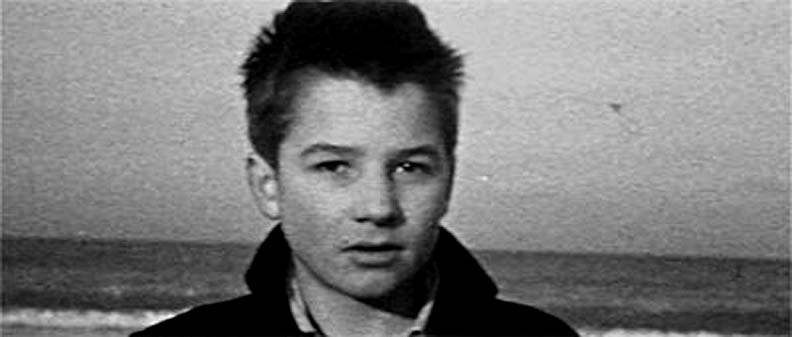
I had already seen “The 400 Blows” about a year before watching it in class. I knew it was a great film and something special, and watching it in this class and learning about Auteur Theory made it all the more intriguing to me…when it ended with that iconic image of Antoine Doinel (Jean-Pierre Leaud) looking to the camera with a look of question (like, where does he go from here?), I was getting ready to applaud but nearly everyone else in the class was laughing. One student in the front row even said, “Why would you want to show us that? That was one of the worst movies EVER!”
I felt so bad for the professor that at one point, as I ran into him in the hall, I told him, “For what it’s worth, ‘The 400 Blows’ is one of my favorite movies.”
And it is, too. It’s also one of the biggest influencers for my favorite subgenre of film: the coming-of-age story.
It’s also one of the tougher ones: no melodrama or sentimentality–it’s just showing this troubled kid who always gets in trouble with school and with his parents, puts himself in a bad position many times, and everyone sees him in the worst possible light. Even when he changes his mind to return something he had stolen, everyone wants to label him as a bad egg. In one of the most heartbreaking scenes in the film, done in one shot (which was actually the young actor’s audition footage–Truffaut liked it so much he included it in the film), we get numerous reasons for his unhappiness.
My favorite scene: the psychologist interview I already mentioned is a highlight, but my favorite scene is still the ending that my peers/classmates laughed at. Yeah, that awkward optical camera zoom-in is dated, but what it means, I will never forget. Antoine has just done yet another thing that will get him in even more trouble, he has no idea where to go from there, and neither he nor we have any idea what is going to happen to him. The push-in on his face says it all: an uncertain young man faces an uncertain future.
Truffaut has made four other films featuring this character of Antoine Doinel–I’ve only seen the immediate follow-up (“Antoine and Colette”) but not the others. Not yet, anyway…
A few months into 2021, there’s a few 2020 films I consider “favorites.” For instance, I’ve already seen I Used to Go Here, The Rental, Bad Education, and The Invisible Man countless times. But there’s one particular film from this past year that I think I’m going to treasure…
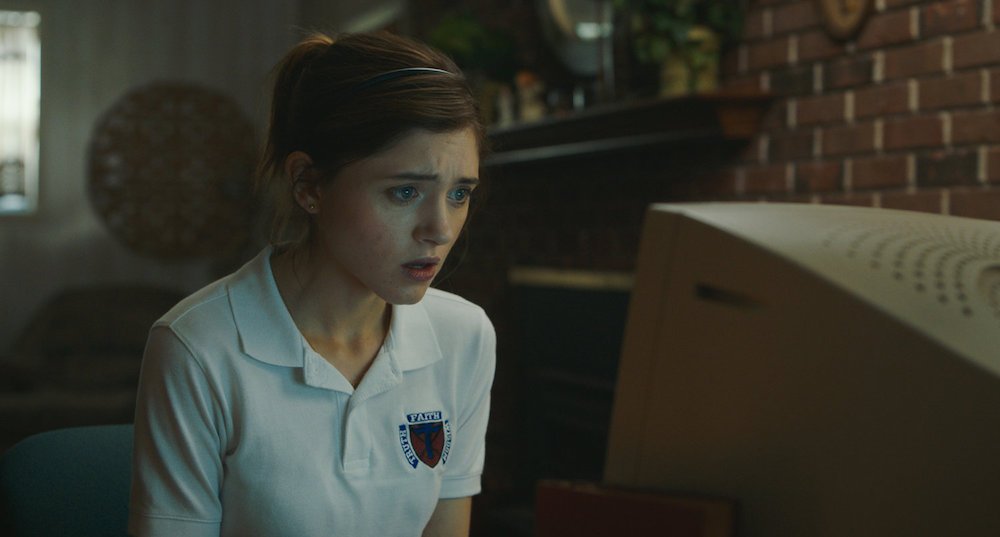
Based on the short film of the same name, “Yes, God, Yes” is about a devout Catholic teenage girl, named Alice, whose world is changed when she discovers pornography and…self-pleasure, I’ll call it for my most sensitive FB friends.
Natalia Dyer of “Stranger Things” fame plays Alice–Dyer is 25 years old and could probably still play these naive-teenage-girl roles when she’s 45!! She absolutely shines in “Yes, God, Yes” as her character goes through a coming-of-age personal journey that never strikes a false note. (I’m surprised that this film didn’t garner any Indie Spirit Award nominations, especially for Dyer’s great performance.)
Alice is curious about sex but totally inexperienced in the subject. She’s also afraid to try experiencing it because her Catholic school teaches that it’s a sin to engage in premarital sex–and even after marriage, sex is strictly for procreation. That’s why when a rumor starts in the halls about her having been intimate with a male classmate, she has no idea what anyone is talking about. (I’d say what sexual act is being questioned in this rumor, but it’s funnier when you hear it yourself.) She didn’t do it, but now she’s being slut-shamed due to the rumor. She also has growing feelings of sexual desire (not helped by a cybersex encounter in a chat room), for which her friend Laura (Francesca Reale) and Father Murphy (Timothy Simons) cause her to feel shame.
Alice thinks if she goes on a school-funded retreat, she’ll get back to the path of righteousness. But there’s a lot on her mind that leaves her more curious to explore her sexuality…including a hunky senior, Chris (Wolfgang Novogratz), from whom she craves attention.
One of the things I admire most about “Yes, God, Yes,” written and directed by Karen Maine (who was a co-writer for “Obvious Child,” another challenging film on taboo subjects), is how frank and honest it is about this girl’s story, and it’s never mean-spirited. It’s handled in a sweet, sincere manner. It can even be very funny but never because of cheap, exploitative jokes. We laugh at these moments for the same reasons we feel for Alice throughout the film: because the film feels real.
It’s also a film with a message: how we need to be more open about ourselves and trust each other with honesty and respect, because that’s what Jesus would want us to do. (You could also go to an extent and argue that the message is about how we need to understand our own sins so that we can deal with them better.) Alice learns that just about everyone, including Father Murphy, is hiding something, which confuses her even more. That leads her to a calm discussion with a kindly bar owner (played wonderfully by Susan Blackwell) who assures her that it’s only human to discover where certain developments may lead personally.
In this scene, she basically taught poor Alice in just a few minutes a lesson that no one in that school could in years.
“Yes, God, Yes” ends ambiguously, with no easy answers (at least, that’s how I see it). Where Alice goes from here is anyone’s guess. But I wish her the best. She’s bright and sweet and lovely–she deserves to be happy.
I couldn’t tell you how many times I’ve streamed this wonderfully acted, subtle, gentle comedy-drama on Netflix in the past few months. And the greatest part about it? It’s short–about 77 minutes, including credits! That’s another thing I admire about “Yes, God, Yes”–it’s only as long as it needs to be.
You know, maybe that’s the reason I love it so. It’s a wonderfully-crafted, beautifully-detailed “compact film” (if you will) that wastes no time establishing characters or motivations and yet gives us just enough material to make us understand it all, without ever once wearing out its welcome.
“Yes, God, Yes” is currently streaming on Netflix and available elsewhere on-demand–I can’t recommend it enough. It’s honestly the kind of wonderful, charming little indie comedy that I’d like to see more of.
You know, I sometimes don’t know right away whether or not a movie I see will become a “favorite.” Sometimes, I’ll see it and give it a positive review and want to see it again. And after a good amount of time, I’ll have seen it enough times so that when I’m reorganizing my DVD/Blu-Ray collection, I pick up that particular one and think to myself, “Yeah…I think this IS one of my favorite movies! Maybe not in the top 100 but top 200 maybe?”
Believe it or not, David F. Sandberg’s 2016 supernatural horror film “Lights Out” is one of those movies. Why? I’ll try to explain.
Based on Sandberg’s truly scary short film of the same name, “Lights Out” tells the story of a broken family trying to survive as a supernatural demonic entity haunts them–and the monster can only overpower you in the dark. In the light, you’re safe. In the dark, you’re doomed!
“The Babadook,” this is not. In fact, it’s a much simpler film than the complex “The Babadook”–but that’s part of what I like about it. “Lights Out” has the attitude of a mainstream horror film but a serious message about fighting depression underneath the surface.
The characters are all well-developed and interesting. Maria Bello delivers great work as Sophie, the mother of an adult daughter named Rebecca (Teresa Palmer) and a pre-teen son named Martin (Gabriel Bateman)–she has mental health issues that seem to be worsening and it worries little Martin as she seems to be talking to herself…or is she? Things get creepier when it becomes clearer to Martin that there is someone else with his mother–someone who told her to stop taking her medications because “she” can make everything better for Sophie. Martin can’t sleep at night because of what’s happening, so Rebecca, who has been estranged from Martin and Sophie for a while especially after her father mysteriously died (we see in a very creepy prologue, featuring Billy Burke as the father, how he died), now has to play a parental role to protect him as it seems things aren’t safe with Sophie as long as this thing is with her. When Rebecca learns of who/what this thing is, she and Martin learn they have to protect Sophie from it as well.
They feel like real people I can identify with. There’s another character worth mentioning because he’s my favorite in the whole film: Bret (Alexander DiPersia), Rebecca’s boyfriend. Any other horror film would have written this guy as your one-dimensional idiotic jerk who would be the first to die. But not only is Bret supportive, loyal, and resourceful–he lives!
“Lights Out” was made by someone who clearly loves horror movies enough to know when to break the rules and when to follow them, and like Mike Flanagan (the king of modern American horror these days), he puts atmosphere and character ahead of scares so that we care about who the scares are happening to.
Now, as for the ending…I was a little unsure about the ending because you could look at it many different ways. One way is that there’s a sacrifice from one character that had to be made to protect the others. Another way is to look at it as tragic that it had to happen. Another way is to think there were many other alternatives to this. Another way, the sickest way, is to say this ending promotes suicide, which I definitely don’t think is the case. There is an extended ending (seen on the film’s Blu-Ray) that doesn’t really work because it makes it seem pointless overall. Without giving it away, I think the ending works as a way of combining tragedy and the will to keep fighting because things are always going to be tough. Plus, it’s amazing I’m even thinking so hard about this for a horror film in which it’s destined that people die.
Whatever the case, I know David F. Sandberg worked really hard in making this more than just another mainstream supernatural horror film. He made a mainstream supernatural horror film that is truly about something. And it’s also given me inspiration in writing my own horror films these past couple years, so I know the film has had that effect on me.
My favorite scene: would it surprise anyone if I said it was the “cellphone scene?” Those who know the film know what I’m talking about.
Many different times on this blog, I’ve tried ranking my favorite movies. Well, now I’m going to do something different–I’m going to create individual posts for some of my top 300-400 favorite movies (just because I love movies so much).
And even I’m not necessarily ranking anymore, I still have to level with you…this movie is in my top 5!
Complete and total honesty–I LOVE this movie! Just had to throw that out there. “Stand by Me” has been THE movie that I’ve grown up with and I will always love it until the day I die. Based on the Stephen King novella “The Body” (part of King’s “Different Seasons” collection of four stories), “Stand by Me” centers around a group of four 12-year-old boys, each dealing with their own problems, going on a trek to search for a missing dead body. They go on many misadventures along the journey (which obviously appealed to 9-year-old Tanner the most), but they’re not what the film is about (which grown-up Tanner would come to learn).
Each of the boys has their own personal issue to get through–our main kid Gordie (Wil Wheaton) is coping with the loss of his older brother and the possibility that his parents believe the wrong son died; Chris (River Phoenix) is looked down upon by others due to his family’s bad reputation; Teddy (Corey Feldman) still suffers emotional (and physical) scars from his abusive father; and Vern (Jerry O’Connell) is a feeble scaredy-cat. All four of these juvenile main characters are well-developed, but what truly makes them stand out is the excellent acting from each of the young actors playing them. Corey Feldman as Teddy can be very funny and obnoxious, but he also shows he can be highly vulnerable too. My favorite is the late River Phoenix as Chris–playing arguably the most complex character in the bunch, Phoenix presents the kind of friend you’d want to have at that age: the friend who will listen to you and be there for you because no one else will. It makes his most emotional scene, in which he breaks down to Gordie about when he was wronged by a schoolteacher because it was her word against his, all the more special because we want to be there for him in return. He’d be there for us too.
Also, there are plenty of memorable lines in this movie, but here’s one that stuck out to me the most–it’s when Chris encourages Gordie’s writing: “It’s like God gave you something, man. All those stories that you can make up. And He said, ‘This is what we got for you, kid. Try not to lose it.’ But kids lose everything unless there’s something there to look out for them…and if your parents are too f***ed up to do it, then maybe I should!”
“Stand by Me” has plenty of jokes and adventures and entertainment value, whether it’s the kids braving a train trestle or just shooting the breeze around a campfire, but what makes it one of my absolute favorite movies even to this day are the genuine human moments that deliver tough life lessons and develop the friendship of these kids who need each other at this point in their lives.
This is my example of a perfect “dramedy” (comedy-drama)–it’s a film that shows when times are tough, it helps to have good people to share laughs and positivity with. And it balances the comedy and the drama brilliantly.
“Stand by Me” was a sleeper hit in 1986. In a summer when everyone was talking about big-budget monster movies like “Aliens” and “The Fly,” here was a quiet, gentle coming-of-age film about four boys growing up and relating to each other over the course of two days. The word-of-mouth was apparently so wide that it became one of the bigger surprise hits of the year.
It’s amazing to look up vintage 1986 reviews of the film and interviews with director Rob Reiner about making the film–it’s almost like they knew then that the film would still be as highly regarded 35 years later. And Stephen King himself was impressed by the film–after a private early screening of the film, he excused himself for a while…and then when he came back, he told Reiner personally, “That’s the best film ever made out of anything I’ve written, which isn’t saying much. But you’ve really captured my story. It is autobiographical.” (Also, upon reading about what it was like for Reiner to make the film, as he constantly felt he was in his father Carl Reiner’s shadow and wanted to break away from that, it must have been so great to have one of the best all-time authors say that to him.)
Oh, and I also found an old Chicago Tribune review of the film by Gene Siskel (THANK GOD, because I still can’t find any evidence of a review from Roger Ebert!!)–he rated it 3 1/2 stars out of 4 and even praised the campfire-story scene involving the pie-eating contest that results in…you probably know what I’m talking about. It was a relief that he found that scene hilarious–I thought he would’ve seen it as a weak spot!
That scene is indeed hilarious–and so are the moments of small-talk between the boys that’s worthy of “Seinfeld,” such as, “You think Mighty Mouse could beat up Superman?”
My favorite scene has always been the scene at the trestle, where the boys are in danger of being run down by a freight train if they don’t make it to the other side in time. The buildup is great (especially when Vern is taking too long crawling across the planks), Wil Wheaton’s scream upon noticing the oncoming train is priceless, and the resulting chase makes for overall an exciting, funny, suspenseful scene. (“Hey…at least now we know when the next train was due!”)
The screenplay by Raynold Gideon & Bruce A. Evans) was nominated for an Academy Award for Best Adapted Screenplay (losing to “A Room With a View”)…but it got more recognition from the Film Independent Spirit Awards, garnering nods for Best Screenplay, Best Director, AND Best Film (all of which lost to Oliver Stone and “Platoon”…OK, fair enough)!
Yet another reason for me to appreciate the Indie Spirits more than the Oscars…this won’t be the only time I make comparisons in this new series.
“Stand by Me” is a movie that means so much to me that I can’t help but be thankful that I live in a world in which it exists. It’s a hell of an unforgettable adventure. I’ve seen it about a million times already, and I’ll definitely see it a million times more.
Hannah, the main character of the short film “Surfacing,” is an athletic college swimmer with temporal lobe epilepsy. In the film’s opening scene, she’s preparing to compete in a latest swim meet when she knows a seizure is coming. She knows she still has some time before it happens, and she’s nervous yet familiar with these feelings at the same time. She swims the laps to get it over with…and then has the seizure almost immediately after she’s out of the water. The next scene shows a new side of Hannah–happier, livelier, more energetic, ready to go out partying for a night on the town with her friends. One of her friends, who I’m assuming hasn’t known Hannah very long, questions this behavior, to which one friend answers: “She’s always like this after a seizure.” In comes another friend, who actually wrote a paper based on Hannah’s condition, to explain (to the friend and to those viewing the film) that it’s a condition known as “Geschwind syndrome.”
I’m kind of ashamed to admit that I had to look up “Geschwind syndrome” for confirmation. I shouldn’t have done that, for two reasons. 1) That kind of confession can mean I didn’t put any faith in the filmmakers behind “Surfacing” having done their homework before making a film about the subject in question. And 2) Even if it wasn’t real (which now I know it is), the film should still make me believe (which it did).
“Surfacing,” which runs at about 30 minutes and was written and directed by Bruce Hutchinson (whose 2014 short drama Sidearoadia I greatly admired), shows Hannah at a dilemma with this condition. She can keep swimming, possibly risking brain damage if she has another seizure too late during another meet, or she can get her illness treated. Her seizure aftereffects are what make her feel truly alive, so she has to decide whether or not she wants to be rid of them for that very reason. But on the other hand, her coach (Pammi Fabert), her sister (FE Mosby), and her best friend (Jennifer Richman) all grow more concerned about her as the seizures seem to be more frequent lately.
Hannah is played with a truly marvelous performance by Kristy Barrington (who, since this short, has gone on to a memorable side role in Mud). It’s a deeply layered portrayal of a suffering yet free-spirited young individual who lives in the now and must consider the future, if not for herself then for her loved ones. The quiet moment in which she feels the entire weight of her world crashing down on her, which comes at around the 25-minute mark, is so moving and convincing and beautifully done. (I’ll even go as far as to say it rivals the best moments of “Sidearoadia,” which Hutchinson made five years after “Surfacing.”)
The skillful direction from writer-director Hutchinson and casually observant cinematography from Chris Churchill help keep “Surfacing” on a grounded level. But Kristy Barrington is this film. She exhibits great screen presence here and makes an already-interesting character even more fascinating.
“Surfacing” can be seen here. I recommend you give it a watch.
“My Salinger Year,” based on the memoir by Joanna Rakoff, is set in 1995, where bookstores took over big cities and big business feared computers and the Internet and people actually read physical printed works in magazines and books–being published back then meant a great deal then than it does now!
In “My Salinger Year,” written and directed by Philippe Felardeau, lead actress Margaret Qualley (Andie McDowall’s daughter, best known for “Once Upon a Time in Hollywood”) shines as aspiring young writer Joanna. Upon leaving Berkeley to pursue writing in New York City, Joanna has a bright optimism that foresees a bright future for her career that she even takes a cheap, crappy apartment because she knows all the best writers started off in cheap, crappy apartments. She also takes a job as an assistant for a tough, no-nonsense literary agent named Margaret (Sigourney Weaver), whose agency represents none other than J.D. Salinger. (Salinger is reclusive, but he still telephones Margaret every now and again. Sometimes, Joanna answers the call–even though Joanna hasn’t even read “The Catcher in the Rye,” she’s still starstruck.)
Joanna isn’t entirely fulfilled as a “secretary,” as she sees the job, but it does have its perks such as reading Salinger’s fan mail…and then there are unpleasantries such as writing back to the fans to bear the bad news that Salinger doesn’t receive his fan mail anymore. (The agency has kept it ever since the Mark David Chapman incident, during which he held a copy of Catcher in the Rye when he was found shortly after assassinating John Lennon.)
Also, as expected, Margaret is not the easiest person to work for–Sigourney Weaver, playing the part, is always great at making everyone feel inferior to her. (But as expected in roles like this, she does have a pivotal scene in which she lets her guard down and lets us see the real person.)
Soon enough, Joanna takes it upon herself to respond to the fan letters personally, because as she sees it, why would anyone want to get a response like “sorry we cannot forward your kind words to Mr. Salinger?” This may anger some, but help others–but at least she’s writing and not dictating. She also manages to strike up somewhat of a friendship with Salinger himself over the telephone. (Salinger is played in both voice and silhouette by Tim Post.)
I love the atmosphere of this 1995 setting–maybe it’s the literary setting and all the books lined up against the walls, but it has a lovely nostalgic feel to it. I also liked the little touches such as Joanna and her novel-writing overly opinionated boyfriend Don (Douglas Booth) washing dishes in the bathtub because THEIR APARTMENT HAS NO SINK–and there’s also these inserts of the fans who wrote the letters, many of whom are not as deranged or weird as we might think, which I thought was a nice touch.
And being a writer myself, I identified with the main character feeling less inspired as she works an unfulfilling job. When Joanna goes for so long without doing her own writing, I feel for her. When she’s given a kind offer to submit work to the New Yorker, I’m happy for her. I want her to get back to work doing what she loves doing!
I mentioned that Margaret Qualley shined in the role of Joanna, and that might be an understatement. As much as I liked her in movies like “The Nice Guys” and “Once Upon a Time in Hollywood,” I waited for her to truly impress me with a role that gave me a lot to process. But with Joanna in “My Salinger Year,” there are so much power to it that she’s able to deliver in a wonderful performance. I wished Joanna the absolute best in the end, and that’s a tribute to Qualley’s work.
Even though I’m giving “My Salinger Year” 3.5 stars (with only a few nitpicks here or there), I give Margaret Qualley’s performance an even more enthusiastic 4-star rating.
This past week, I caught up with three 2020 horror films. One was Freaky. The other two: “Spree” and “Rent-A-Pal.”
One film involves one of our favorite “Strange Things” actors as a cyber-serial-killer, and the other involves Wil Wheaton as one of the scariest villains of the past year. (Didn’t think that second one could happen, but here we are.)
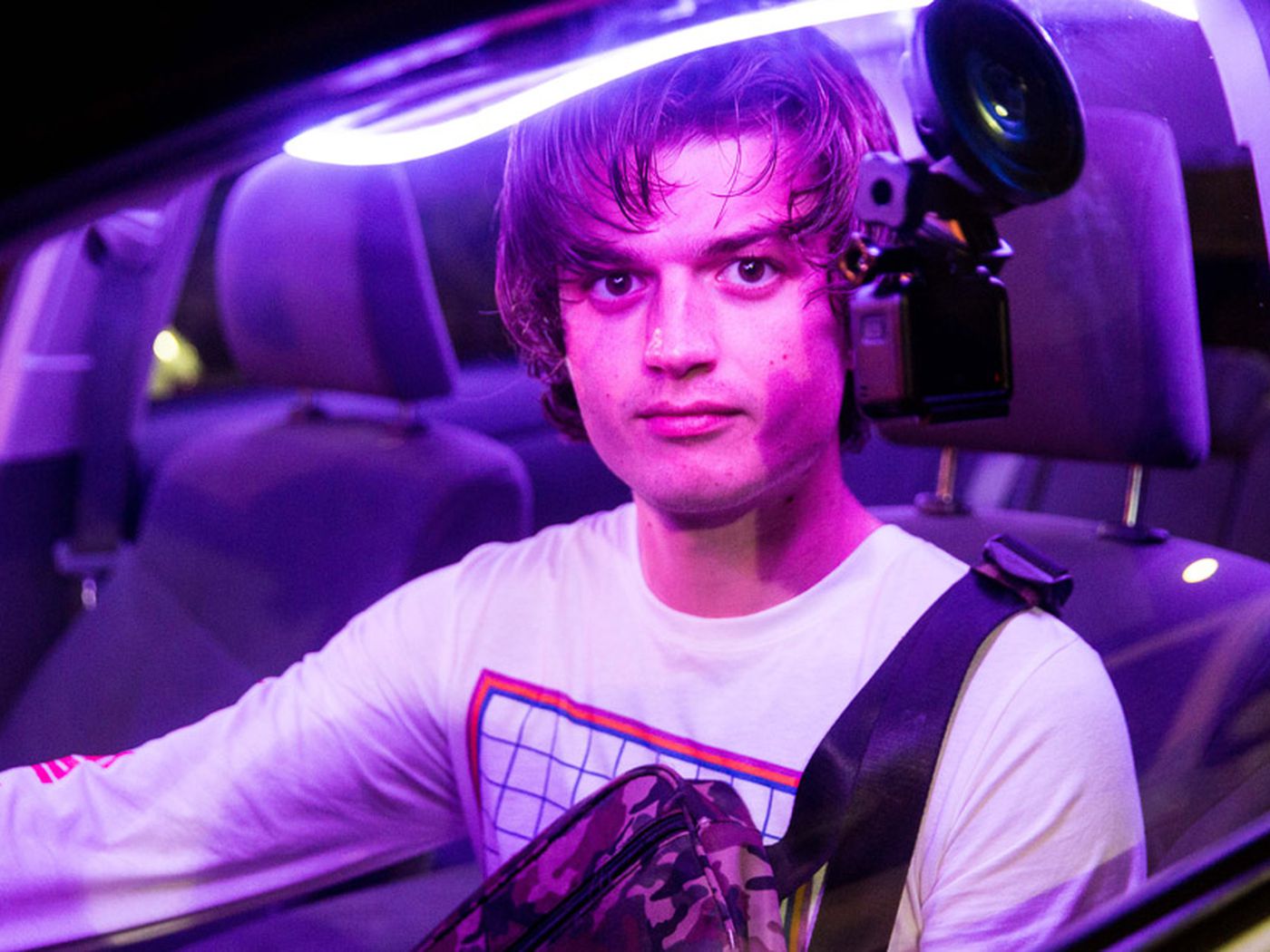
“Spree” is an uneven but intriguing cyber-thriller told from the perspectives of different livestreams, one of which is hosted by a pathetic loner named Kurt (played by Joe Keery). Kurt is obsessed to the point of making it big as a large social-media presence with thousands of followers–he’s tried everything by this point to bring in the views and nothing seems to work for him (even when he tries interfering with the streams of his frenemy Bobby (Josh Ovalle), who’s a mega influencer). But now he has the answer to get everyone’s attention…
As a driver for a rideshare app called Spree, Kurt documents himself picking up passengers…and instead of dropping them off to their destinations, he murders them! At first, no one watching (the numbers aren’t even in the double digits) thinks it’s real; they think it’s an act, causing Kurt to get more extreme with his victims. And of course, all Kurt cares about is gaining more and more followers/viewers, so he does everything he can to up his game (and the body count).
The social commentary is obvious and the film sags in the middle act particularly, but director/co-writer Eugene Kotlyarenko uses dark humor and a darkly brilliant leading performance from Joe Keery to keep things interesting. “Spree” has enough clever tricks up its sleeve to keep cyber-savvy viewers invested.
Wil Wheaton in “Rent-A-Pal”–can this “friend” be trusted?
Now…as for “Rent-A-Pal,” I didn’t know anything before streaming it on Hulu recently, aside from Wil Wheaton is in it and some critics have praised it as one of the best thrillers of 2020.
I didn’t realize I was getting into this deeply disturbing, brilliantly crafted, and truly twisted character study of a lonely 40-year-old named David (played very well by Brian Landis Folkins) who…well, I’ll keep it spoiler free, but I’ll just talk about the story’s setup.
The film is set in 1990. David, a bachelor who cares for his Alzheimers-stricken mother, uses a video dating service to try and find a romantic partner, but to no avail. He then buys another videotape called “Rent-A-Pal,” in which its host, a seemingly nice, charismatic guy named Andy (Wil Wheaton), sits in the middle of the frame, talks directly to the viewer, and leaves in pauses to simulate a conversation. It doesn’t do much for David at first, but the lonelier he gets, he more into the tape he becomes. He’s soon able to partake in conversations with Andy, which leads to Andy being his confidant and his best friend.
And…that’s all I’m going to describe for you. The idea of this sad, lonely, depressed man taking comfort in a friendship through someone in a TV screen is interesting enough…but where it goes from there is riveting. I don’t even know who’s creepier here–David, for having this seemingly one-sided relationship with a videotape he watches repeatedly, or Andy, whose friendly demeanor and prerecorded phrases seem to have alternative meanings. I’m going to have to go with Andy as the scarier choice, mostly because we don’t know anything about the person who made the video in the first place, and that itself gets unnerving, the more I think about everything I saw in the film before. (Something else I like about “Rent-A-Pal”–there are no easy answers at work here.)
Both “Spree” and “Rent-A-Pal” feature unbalanced main characters seeking purpose and companionship, whether personal or virtual…but of course, they’re both horror movies, so you can expect some nasty business. Both films work as parables of such a concept, and I recommend them both (particularly “Rent-A-Pal”) for giving us unique, original ways of putting us in the heads of each of those disturbing individuals.
Man, I wish I had seen this in a theater with an audience!
“The Wretched” has all the moments where something scary happens, such as when the Nun pops up in “The Conjuring 2,” and some woman sitting near you exclaims “OH SH*T!!!”
But also, this movie gave me CHILLS!
“The Wretched,” directed by the Pierce Brothers (Brett and Drew), is about a teenage boy, Ben (John-Paul Howard), who notices strange goings-on in the house next door. The more he looks into it, the more convinced he becomes that there is an evil witch taking the form of the neighbor…
The creature itself is a scary creation, and the makeup is truly impressive. But it’s what it can do, and what we learn she can do as the movie progresses, that truly put me on-edge. How many people can the kid save from this thing? How many are going to fall victim? And late in the film, it becomes a one-on-one as the witch becomes all too aware of the kid’s suspicions and manages to make him to be the one to fear. I love stuff like that, especially in horror films, when you don’t know who’s safe and who isn’t. Certainly, this main character, who has enough teen angst that it’s like he’s in a YA novel interrupted by an ’80s horror movie, isn’t safe from pure evil.
This movie also taught me a very valuable lesson–if I hit a deer with my car, I won’t take it home to prepare it for dinner. (I couldn’t do that in an apartment anyways.) Pro tip: hit a deer, just leave it…because there’s a chance there’s a monster living inside of it that will take you over and destroy everyone around you. (Also, the guts might spill out over your driveway.)
Also, this horror movie has a real good twist!…I just wanted to bring that up because so many horror movies lately lack a real good twist!
There’s a sappy, sugary holiday romcom exclusively on Hulu called “Happiest Season”…and I guess I have a soft spot for certain B-movies of this sweet, innocent sort because this one definitely worked for me.
Or maybe I just love the actors. Whatever the case, “Happiest Season” is a seasonal treat.
Kristen Stewart and Mackenzie Davis play Abby and Harper, a lesbian couple happily in love–so much so that Abby decides it’s time to pop the question after getting Harper’s father’s blessing first…but there’s a problem with that: Harper is still in the closet. It’s not until they’re en route to a holiday get-together with Harper’s conservative family that Harper drops the bomb to Abby that she never came out to her parents.
Annnnnnnd the mother (Mary Steenburgen) is this super uptight, extremely passive-aggressive type, and also the father (Victor Garber) is running for mayor, and ALSO Harper told everyone that Abby is her roommate (and an “orphan,” which practically translates to everyone as “alien from another planet”–I’m not joking; they keep referring to Abby as an orphan constantly).
So…hijinks ensue!
“Happiest Season” is as formulaic as you can get–I have to wonder if director/co-writer Clea DuVall (who I know has made it big as a character actor but I’m always going to remember her as Stokely in “The Faculty”) is a big fan of Hallmark Christmas movies. There’s a lot of misunderstanding. There’s a lot of coverups. There’s even a stereotypical helpful-gay-best-friend-with-no-life-of-his-own character (played by Daniel Levy). (I guess in order for this film to give us these two realistic LGBT characters for this formula, plus a dignified supporting role played by Aubrey Plaza, they had to give us one stereotype.) And then of course, there’s the big emotional resolution in which everyone’s secrets are revealed for better or worse.
I think you can guess the ending. You can guess so much of this movie. But I don’t care–because it works. It’s just a likable, pleasant comedy for my Christmas stocking and I recommend it because the actors are giving it their all (especially Steenburgen, who’s a riot as the mother), a lot of it made me laugh, and I did feel something for both Abby and Harper when things inevitably get tougher for them.
There are going to be 40something Hallmark holiday movies every year–not to be too judgmental of the subgenre (because I liked this one so much), but I recommend you use this as the standard.
“Happiest Season” is available exclusively on Hulu.
From the guys who previously made the brilliant cyberthriller Searching (director Aneesh Chaganty and co-writer Sev Ohanian), “Run” is about a wheelchair-bound teenage girl named Chloe (Kiera Allen) who has been homeschooled and sheltered by her overprotective mother (Sarah Paulson). After discovering a suspicious new pill as part of her medication, Chloe starts to suspect that there’s something her mother isn’t telling her…
“Run” is a slow burn with enough twists and turns to keep you guessing as the paralyzed but super-smart Chloe is forced to use her wits to go behind her mother’s back in order to get clarification as to what’s going on. It helps that both key roles here are portrayed wonderfully. Sarah Paulson, one of the best character actors working today, deserves credit for playing a motherly figure we’re not quite sure about. And Kiera Allen (who actually uses a wheelchair in real life) is excellent as Chloe–it’s a role that’s physically demanding to say the least, and she’s both up to the challenge and wonderful to watch at the same time.
When the answers are revealed late in the film, it’s disappointing because I saw the twist coming miles away. It’s important for a psychological thriller to always be ahead of their audience, and I was hoping that the guys behind “Searching,” which had me guessing all throughout, would give me something I didn’t expect. However, I still recommend “Run” for its two leading performances, its effective simplicity in telling the story, and Chaganty’s ability to keep me invested even after the inevitable reveal.
“Run” is available exclusively on Hulu, and I give it 3 stars out of 4. (Maybe my rating will change after a second viewing. There’s too much good in this film for me to complain about the twist being predictable.)




 Smith's Verdict