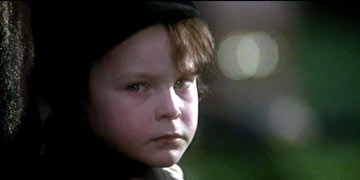
The Omen (1976)

6 Mar

500full

Smith’s Verdict: ***

Reviewed by Tanner Smith

“The Omen” is thought of as one of the best horror films ever made and it does have quite a few chilling moments, as well as an unsettling story idea. It imagines the arrival of the Antichrist. Read the Bible and you’ll know about the notion that someday, as the spawn of Satan, the Antichrist will rise to power and bring about the End Times. “The Omen” doesn’t tell that story. It tells the story of a married couple who learn that their adopted child is the Antichrist.

The couple—U.S. Ambassador to Great Britain, Robert Thorn (Gregory Peck), and his wife Katherine (Lee Remick)—has lost a child shortly after birth. They substitute it for an orphan baby whose mother died the same night. They name the child Damien and raise him as their own. But around the time of Damien’s fifth birthday, mysterious things start to happen. At his birthday party, the boy’s nanny hangs herself (while smiling and saying, “It’s all for you,” if you can believe it). When his parents bring him to church for the first time, he screams and acts violently before they take him inside. Baboons attack the boy and Katherine while they’re inside their car, at the zoo. Many people die around Damien, including a priest who has warned Robert that something is not right with Damien. And a big, snarling black dog hangs around the house, and is eventually brought to stay inside by the new governess Mrs. Baylock (Billie Whitelaw), who while the parents aren’t around comforts Damien by saying she’s here to protect him. Damien is responsible for an incident that causes pregnant Katherine to have a miscarriage. And more.

Photographer Keith Jennings (David Warner) starts investigating these events after noticing a few strange things about the pictures he took of the people who died. These pictures somehow predicted how they died and Robert and Katherine could be next, as well as himself. With Katherine in the hospital, Keith lets Robert in on the discovery and they are led on a series of discoveries, each of them furthering the conclusion that little Damien is indeed evil incarnate.

“The Omen” could technically also be called “Omens,” since there is more than one clear sign in plain sight throughout this movie—the obvious early stage of the Antichrist’s human form, the pictures that predict many deaths to come, and the further looking-into of the biblical prophecy, with a comet returning, the Jews coming back to Zion, and what about the Roman Empire? “That would be the European Common Market,” Robert realizes. Oh, and there’s also the number 666 that is Damien’s birthmark, as well as the infamous Number of the Beast. And of course, since Robert is a powerful man and has connections with the President, Damien could undoubtedly follow through. We can see in the end of the movie that there’s no escaping this prophecy.

Just imagine if your kid was Damien and you knew that he will grow up to do all of these horrible things once he comes into power over the country and even the world. What would you do in that situation? What would you feel? If you knew you had to kill your own child so that it doesn’t happen, would you? That’s a pretty heavy subject, and “The Omen” uses its final act to play with that idea. It’s always a chilling idea when characters get the notion to act out certain deeds now because of what they’re afraid will happen later, but this time there’s actually a legitimate. fearful reason.

I mentioned that “The Omen” does have its creepy parts. Here are a few in particular—the dog is very intimidating, the scene in which the first nanny commits suicide is unnervingly calm, the gruesome deaths are suitably horrific, the cemetery that Robert and Keith explore to find more answers is atmospherically creepy, and Billie Whitelaw, as Mrs. Baylock, brings a great sense of unease to her performance as Damien’s personal bodyguard. And the music! The sinister, choral “Ave Satani” theme, composed by Jerry Goldsmith, is one of the most unsettling movie music scores I’ve ever heard.

Aside from Whitelaw and David Warner who does a good job at mixing curiosity with fear, the acting is pretty much a blank slate. I’m sorry to criticize Gregory Peck’s leading performance, as he is such a powerful actor. But the truth is, as Robert, he’s flat, unconvincing, and probably bored—he always looks like he’d rather be somewhere else. Lee Remick doesn’t have much to show for her role, except for a few legitimate reaction shots. And the kid Harvey Stephens…well, I’ll let him slide because he is a kid and hey, at least he sells that “devilish” blank stare.

“The Omen” is a chilling, atmospheric horror movie that uses the biblical prophecy and insane ideas for some well-executed frightening moments.
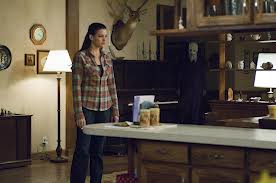
The Strangers (2008)

6 Mar

images

Smith’s Verdict: ***

Reviewed by Tanner Smith

1996’s “Scream” pointed out that horror movies featuring psychotic killers are much scarier when no motives are declared for their atrocious deeds. That may be true, but maybe a simpler motive than you’d expect has a creepier element to it. And here we have “The Strangers,” which features masked killers who invade a couple’s home and terrorize them. Why do they do this? “Because you were home.”

That’s it. That line hits a strong note because even in a horror film such as this, being at home won’t help you at all. You think you’re safe and alone, but you’re not. That is a very chilling thought. There are times when I’m home alone and I hear some noise outside and I don’t feel like I’m safe. It could just be a raccoon or something, but it could be someone trying to get in.

“The Strangers” is a chilling horror film about such a home invasion. It’s the debut feature of Bryan Bertino, who pulls out all the stops to create something tense and disturbing. The plot isn’t new, but Bertino’s cinematography makes for great production value and helps make “The Strangers” into something less than a geek show with a lot of blood and gore. There is more terror and suspense here than anything else, keeping the audience on edge throughout the film’s brisk 85-minute running time.

The film takes place in a cabin in the woods as Kristen (Liv Tyler) and James (Scott Speedman) arrive in the middle of the night after a wedding reception. James has proposed to Kristen, who has turned him down. So things are uncomfortable and uneasy for the two of them, and they awkwardly try to keep conversation to keep the night from being too unpleasant for both of them. But before they get a chance to make amends, there’s a knock at the door. It seems strange and they shrug it off, but before long, they realize that there are three people in masks who harass them and make their night miserable. With no one around to help and nowhere to run, Kristen and James find themselves fighting for their lives alone in this house.

“The Strangers” produces a great deal of chilling scenes. The most effective are the ones without music. Why? Because we don’t need it. Take a look at the scene in which you see a figure in the background as Kristen walks forward, not noticing. You don’t need a sharp music cue to show that the figure is there and that he or she means death. The audience will scream because it’s out of the ordinary. Sound effects also play a good part in the film, whether it’s banging on a door, record repetitions, shotgun blasts, etc. But it’s the cinematography that must be praised. It allows us to see things that shouldn’t be there and we’re surprised to see (like that scene I mentioned before), and it always shows purpose with each shot.

Something else I should bring up about the creepiness factor—those masks the killers wear are very freaky. They’re mostly blank white faces (hello, Michael Myers) that are enough to terrify and shock.

The characters—these two people played by Liv Tyler and Scott Speedman—are always engaging. I liked them and I hoped they would make it out of this scary situation alive. Sure, they make mistakes, but they are bright enough to know their limitations even though they come to them a little later than they expected. My favorite moment is when they find a shotgun and Speedman confesses he doesn’t know how to use it. “I’m not sure I even know how to load it.” “But I thought you said you went hunting with your dad.” “That…was just something I said.” And then, without giving anything away, when Speedman does something terrible by accident, I really felt bad for him.

I have to admit when “The Strangers” opened with a disclaimer saying it was inspired by true events, I rolled my eyes in disbelief. First of all, we know that’s not true and this isn’t “Fargo.” Second of all, don’t have someone read what we can. If Bertino (or whoever made this decision) is concerned about blind people seeing the movie, here’s a newsflash for you—most of the movie is silent anyway! Third of all, don’t start the disclaimer saying it was based on a true story and then end it with stating that the “brutal events that took place are still entirely known!” Are you trying to create controversy?

But then once “The Strangers” kicked in with the story, I got into it. It was chilling, disturbing, well-made, and very effective.

Poltergeist (1982)

6 Mar

poltergeist_remake

Smith’s Verdict: ***

Reviewed by Tanner Smith

Steven Spielberg had this to say about “E.T.,” which he directed, and “Poltergeist,” which he produced (both were released within the same year): “If ‘E.T.’ was a whisper, ‘Poltergeist’ was a scream.” Right you are, sir. While “E.T.” is a sensational family entertainment, “Poltergeist” is a scarefest that will most likely cause nightmares for any child under the age of ten. This is a movie in which almost every special effect Industrial Lights and Magic could create for two movies is squeezed into this one movie. We get killer trees, glowing ghosts, goo oozing from a doorknob, a portal appears in a closet, and more. All of these strange and scary events take place in a house inhabited by a family of five…and something else. This house is in suburbia, where every house looks the same. One of the reasons “Poltergeist” works as an effective thriller is having the horror occur in this typical, comfortable home is effective enough.

One of the best things about “Poltergeist” is that everything is seen through the eyes of the family that lives in the house. We don’t fully understand why these strange events occur and why these spirits are here. But neither do the family. We get a nice couple (Craig T. Nelson and Jobeth Williams) and their three kids. The youngest child of the family—a little girl named Carol Anne (Heather O’Rourke)—is the first to notice that something strange is happening. In the opening scene, she walks down the stairs and over to the TV just to say “hello.” She then tells her family, who are standing by and watching, that “they’re here.”

Who’s here? “The TV people.” How does she know they’re here? Um…

It seems like there are spirits living on a blank TV channel and they really are there too. They use parlor tricks to get their attention first. They stack chairs and propel little Carol Anne from one side of a room to the other. But soon, things get really dangerous and the spirits kidnap that little girl and take her to their realm. The doorway to their world is in her closet. So the couple need outside help to get their daughter back.

This is where even stranger events happen. A tree comes to life and tries to eat the middle child. A young doctor hallucinates himself tearing the skin off his face. Ghosts walk down the stairs. A clown doll tries to strangle one of the kids. A swimming pool has a life of its own. If there’s one explanation as to why this is all happening, it’s that the same villains in “Poltergeist” are the same villains in “Jaws.” They’re the town authorities. Instead of telling people it’s safe to go back in the water again, this time they’re telling people it’s OK to build houses on top of a cemetery.

All of this gains our attention because “Poltergeist” works as an effective thriller and as a scary thrill ride. The cast does well and the special effects are indeed special. Steven Spielberg is an executive producer for this movie and I should also mention that the director of “Poltergeist” also directed “The Texas Chain Saw Massacre.” What a good team. Spielberg works with effectiveness along with his special effects and Hooper specializes in realistic violence. But strangely enough, the movie is rated PG and it is definitely not for younger kids. Also strange is that for a horror film, nobody is killed or brutally hurt (the flesh-ripping is just a hallucination). But that’s not a criticism. “Poltergeist” is a little ridiculous but its reason for being is to scare us and make fear for this family. And it works at doing that. This is the haunted-house movie that “The Amityville Horror” wanted to be.

Something Wicked This Way Comes (1983)

6 Mar

jonprice

Smith’s Verdict: ***

Reviewed by Tanner Smith

For every life, there lives a desire. For every desire, there is a wish. For every wish, there is a price. That saying alone will let you know what you’re in for when you watch “Something Wicked This Way Comes,” a supernatural thriller that tells a story so compelling you can’t believe the Disney Studios would make a movie as frightening. Maybe they hope the two 12-year-old characters will lighten the mood. But the problem is, terrible events happen to these two kids—spiders surround them, an entire parade searches for them (with kid-sized coffins), and they become involved in a plot to grant people their dreams but take away their lives. This may frighten younger viewers but will probably delight older ones, especially adults because of the darker theme involving one of the kids’ fathers.

The film, based on a novel by Ray Bradbury, begins with a great shot of a train coming towards the camera in the dark. That shot alone tells us that we’re in for something that I don’t think the Disney Studios would want to make again. It lets us know that this is no family film. The film takes place in a small Midwestern town where the two boys—timid, sensitive Will (Vidal Peterson) and the more-outgoing Jim (Shawn Carson)—live. There are many other people in the town, including a cigar store owner who dreams of being rich, a barber who dreams of a thousand gorgeous woman coming to town and being with him, a one-armed, one-legged barman who dreams of playing football, and an old crone who dreams of being beautiful again. Then there’s Will’s father Charles (Jason Robards), who only dreams of being much younger. Will doesn’t particularly like living with an old father. Charles is unsure he can even live with himself.

The mysterious Darks Pandemonium Carnival comes to town and all of these characters (except Charles) arrive. The cigar store owner, the barber, the barman, and the old crone are fortunate enough to meet the Dust Witch (Pam Grier), who knows their dreams and tells their fortunes. It seems that the carnival’s biggest attraction is temptation and these people may be falling into a trap as they are tempted by the Dust Witch to give up something for their dreams come true. They get what they’ve been wishing for but there is a price that must be given—for example, the old crone becomes beautiful but she loses her eyesight. Then, I guess, they become slaves to the force that surrounds the carnival.

Only young Will and Jim realize that something creepy is happening. They run afoul of Mr. Dark (Jonathan Pryce), the tall, mysterious carnival owner who seems to be the ruler of this strange force. He has plenty of tricks up his sleeve and many carnival attractions that are interesting with special effects—including a merry-go-round that can spin backwards through time. He seems to will the ways of the devil, in the way that he can tempt people and then feed on their souls. When Mr. Dark declares that the boys have seen too much, he sends his forces of darkness after them.

It all comes down to the ending in which Charles is finally falling into Mr. Dark’s trap and he must fight it in order to save himself and the boys. Mr. Dark knows Charles’ wish and would make it come true and the temptation is too strong…

“Something Wicked this Way Comes” is a powerful horror film with the right mood of the original novel (although loosely based on the novel) and great performances, especially from Jason Robards and Jonathan Pryce. The young actors are just OK (sometimes, they seem to be a bit too precocious to the point of annoyance). There are some parts where the boys seem older, especially in the scene where they’re surrounded by hundreds of spiders—probably because of post-production reshoots. But it’s really Jason Robards that steals the show. He’s got that amazing voice that makes you want to listen to him and believe in him. Also, I love how the carnival’s being isn’t fully explained—there are some tidbits of explanation but not enough so that there’s exposition. Actually, I’d rather not know. Then there are the heartfelt conversations Charles and Will have in the middle of the night occasionally, which feel very real. That relationship between father and son pays off well.

There are times when it seems like the movie doesn’t know which way to go, especially in the final half, but this is a most unsettling movie with a terrifying atmosphere and a grim feel. It’s unlikely that the Disney Studios would want to make a movie like this again—this is not for younger children. If they see this movie, there’s a good chance they’ll have nightmares for quite a while.

Friday the 13th: The Final Chapter (1984)

6 Mar

friday-the-13th-the-final-chapter-2

Smith’s Verdict: **

Reviewed by Tanner Smith

“Friday the 13th: The Final Chapter” couldn’t have been a good movie. It suffers from being the fourth movie in a deplorable slasher-film franchise that only had teenagers getting picked off one by one by a killer with no personality. This is just like any other horrible movie with that same premise and somehow, four of these films share the same name and the same killer. I never understood what made the original “Friday the 13th” so special that it needed a series of sequels to go along after it. And it gets worse—this is not the final chapter. The ending is an open door for another sequel.

The killer Jason, who sports a hockey goalie mask now, is just a big guy with no personality and apparently no inner being—oh, and he has a knife, too. Actually, the thought of a killer with no inner thoughts is kind of scary, but after two films, it’s tiresome and not scary anymore. Just like in the previous films, it’s easy to know who’s going to die in “Friday the 13th: The Final Chapter.” This is a rule for slasher movies such as this—whenever a movie lingers on someone who isn’t a main character, that person is going to be killed. What’s tedious about the gimmick is how it lingers on that character before the killer finally attacks.

The slasher scenes are there just to be slasher scenes. The most unpleasant murder occurs after the teenagers in this movie pass by a female hitchhiker. The scene stays with that female hitchhiker right to Jason’s arrival and victimizing of that poor woman. Why was this necessary? Who was this woman? We’ll never know.

“Friday the 13th: The Final Chapter” does try to develop characters this time. We have the usual gang of teenagers that will undoubtedly become stalked by Jason, for no reason whatsoever. Only this time, they’re angst-ridden and that at least counts for something, which is more than I can say for a lot of the teenagers in the previous “Friday the 13th” films. But the real protagonist is more interesting—he’s a twelve-year-old horror film buff named Tommy Jarvis (Corey Feldman), who lives with his mother and older sister (Kimberly Beck—no bets on whether or not she’ll be the obligatory “final girl” who ends up fighting Jason) near that stupid Crystal Lake, where all those murders occurred in the previous films. Having a twelve-year-old kid around is strange enough for a slasher film.

(By the way, don’t you think the Jarvis family would have heard about them? Why didn’t they just move away?)

I suppose I should give away the ending of “Friday the 13th: The Final Chapter.” What should it matter, anyway? This isn’t really the “final chapter,” after all. Jason has picked off all of the teenagers who just came in for a good time at the lake and has now come after Tommy and his sister. After the sister has tried to fight him off, little Tommy, who grabs a machete and slices the originally invincible killer apart, rescues her. That’s right—the little kid has done what all the older teenagers should have done in the other movies. He kills Jason…but he’ll come back. You’ll see.

Phone Booth (2003)

5 Mar

phonebooth

Smith’s Verdict: ***

Reviewed by Tanner Smith

“Phone Booth” is among a certain type of thriller that places one character in one location for certain reasons that keep the plot going. Movies like this are fascinating for two reasons—1) It helps to show the talent of the actor playing that one person, since practically the whole movie has to ride on that performance. 2) It’s always interesting to see where the plot is going to go, since we, as an audience, are stuck in this location with the character. In the case of “Phone Booth,” we get a solid performance from Colin Farrell as he is trapped in a phone booth by a psychotic sniper who will shoot him if he leaves.
Joel Schumacher’s “Phone Booth” is pure thriller and very entertaining. It has a brisk pace, tight editing, a running time of 80 minutes, and twists and turns throughout. It even has the brave task of telling the story in real-time. It all begins with our introduction to slick, quick-thinking publicist Stu Shepard (Colin Farrell, sporting a designer suit and a fake luxury watch) making deals through his cell phone while walking the streets of Manhattan. He’s a fast-talker who can make anything up on the spot (he could probably make deals with the Mafia if he could), and he won’t take “no” for an answer. Once business is taken care of, he makes his daily visit to a telephone booth (which, according to the opening ominous narration, he’ll be the last person to use before it is torn down) to call a young actress, Pam (Katie Holmes)—he doesn’t want the call to appear on his cellular bill, which his wife Kelly (Radha Mitchell) checks every month.

After Stu makes the call, the phone in the booth rings. Of course, he decides to answer it, thus setting in motion the scheme devised by a psychotic. The voice on the other line is tough, derisive, and menacing, and warns Stu that he knows everything he needs to know about him. He wants Stu to confess to Kelly that he wants to sleep with Pam, or he’ll go ahead and do it for him. So, Stu tries to talk his way out of this situation, but it turns out it’s more complicated than it seems. It turns that the caller is a sniper and has a rifle aimed right at him from one of the many windows surrounding the city street. He warns Stu that if he leaves the phone booth, he will be shot unless he does what the voice tells him to do.

And so, Stu is trapped in the phone booth, looking for ways to talk and think himself out of this dangerous fix. Things get even more complicated when the sniper shoots a thug who messes with Stu while he’s in the phone booth, and so the police see Stu as a key suspect. Any sudden movements, and the police will shoot him. The location is filled with panic, as the police captain Ramey (Forest Whitaker) tries to handle the situation. He starts to believe that Stu is not the perpetrator, but a victim of something more than he expected. However, if Stu tells him what’s really happening here, he will be shot (and so will Ramey, as the voice threatens), and so he and Ramey have to communicate nonverbally while keeping the sniper from suspecting anything. That’s a clever move that keeps the tension level rising in this film.

It’s quite intriguing how the film is able to keep Stu inside that phone booth through a majority of the film’s running time. You would think that this predicament could be solved easily, but no—the writer Larry Cohen continues to find ways to keep him in there until the film reaches a suitable ending. Twist upon twist is thrown into the plot, and it just keeps going like that, keeping the suspense alive.

Colin Farrell is forced to carry this movie, and it’s a good, tough performance. He’s very effective in a performance that shows that confusion, fear, and unease can overcome even the most confident of men.

Kiefer Sutherland is the threatening sniper, as he does what he can with his limitations. The villain of “Phone Booth” is for the most part heard but not seen. Sutherland has one of those distinctive voices that you can’t help but listen to, even if he says something that you don’t want to hear.

There are a few things about “Phone Booth” that keep it from being great, however. For one thing, the women in Stu’s life are underwritten roles and it seems like any actress could play these parts. It’s hard to care for who Stu winds up caring for more when both their lives turn out to be in jeopardy later when they’re among the crowd, and the sniper plans to shoot someone else to further his point.

There’s also the hyperkinetic camerawork and editing styles that get pretty annoying after a while—it makes the film look more like a music video, as if director Schumacher wanted to try everything he could to keep the tension alive. Sometimes, it works; other times, it’s pretty irritating. But what really annoyed me, and thankfully went away quickly enough (though that’s not saying enough), was the overacting of a group of street hookers who, early in the central treacherous situation, constantly interrupt and annoy Stu by trying to get him out of the phone booth so they can “conduct their own business.” They never shut up! Their screeching complaining and ranting are enough to wish the sniper would just shoot them dead.

Thankfully, like I said, they’re out of the picture before they get even more aggressively annoying.

“Phone Booth” is a sharp, engaging thriller with a solid leading performance, a very menacing threat, and a story that keeps audiences on-edge. And as a plus, it’s over in just an hour and 20 minutes.

Dirty Dancing (1987)

5 Mar

Dirty-Dancing-lift_l

Smith’s Verdict: **1/2

Reviewed by Tanner Smith

So many people have told me to watch the 1987 movie “Dirty Dancing,” and I’m not usually one to give in to peer pressure, as I’ve heard of it six years before I finally got around to checking it out.

What is it about this movie that people just go crazy over? Well, the dancing is certainly fun to watch as the actors turn out to be good, lively dancers. The romance between the two star-crossed lovers seems to have people interested. What do I think of the movie, personally? Well, the dancing isn’t bad, like I said. The acting’s not bad either, and we have an engaging young couple, played by Jennifer Grey and Patrick Swayze, to follow. But as a story, “Dirty Dancing” tells us nothing new. This is all stuff we’ve seen before.

Let me give the gist of the story and you see if you can predict the rest of it. The story takes place in summer 1963, as 17-year-old “Baby” Houseman (Grey) is vacationing with her rich family at a resort in the Catskill Mountains. Her father is Dr. Houseman (Jerry Orbach), the personal physician of the owner of the resort (Jack Weston). The owner tries to set Baby up with his obnoxious son Neil (Lonny Price), but she doesn’t like him. Baby finds excitement in the after-hours parties thrown by the hotel staff. She’s intrigued by the “dirty dancing” and wants to get a lesson from hunky dance instructor Johnny Castle (Swayze).

At first Johnny is hesitant, as he doesn’t like the fact that this “cute little rich girl” is hanging around on his and his friends’ turf. But Johnny’s dance partner Penny (Cynthia Rhodes) is pregnant by a waiter who wants nothing to do with her. So Baby helps out by getting money from her father (not telling him what it’s for, but it’s OK—he trusts her) and paying for Penny’s abortion. Then, Johnny agrees to teach Baby and make her his dancing partner for the resort’s final show, and they form a secret relationship.

Can you guess where this is going? Misunderstandings? Attempts to keep them apart? Final reconciliation? The other people realizing their mistakes? Happy ending?

You bet!

Yes, later in the movie, the secret is out, and Baby’s father couldn’t be more disappointed. I was hoping for more understanding by this character, since in the first half of the movie, he seems like a good guy—he’s trusting, listening, and reasonable. But when he finds that Johnny is with his daughter, his ethics are practically nonexistent. Anyone can see that this is a good guy and wouldn’t hurt Baby in any way—anyone, that is, except him.

The “dirty dancing” in the title is somewhat false. Some moves are hot enough, but since the movie is rated PG-13, it doesn’t get much hotter than that. For a movie called “Dirty Dancing,” this is pretty tame.

Patrick Swayze and Jennifer Grey are likable, share good chemistry, and are actually great dancers. And “Dirty Dancing” does have its cute moments, as well as a nicely-done (though clichéd) final dancing sequence, taking place during the final show at the resort. So this isn’t a bad movie; but the story gave me nothing new. I wouldn’t mind so much except so much dwells on many clichés that there are many times when I didn’t really care about what was happening.

Dogma (1999)

5 Mar

dogma_1999_1

Smith’s Verdict: ***1/2

Reviewed by Tanner Smith

When “Dogma” was released in 1999, it was met with outrage even before it came out. Because of its subject matter—which looked like satire of religion and belief—“Dogma” caused organized protests and much controversy in many countries. It also (as I’m reading from the film’s Wikipedia page), the controversy delayed release of the film and led to at least two death threats against the film’s director/writer Kevin Smith.

Well, you know what, guys? God has a sense of humor. And that’s exactly what Kevin Smith’s disclaimer that comes before the film states, along with saying that ten minutes or so into the film might offend most people, and that the film is a work of comedic fantasy, “not to be taken seriously.” If you don’t want to see a comedic fantasy revolving around Catholic belief, then for the love of God (excuse me), don’t see it. If you can’t stand the profane language that runs throughout the movie, don’t see it. Don’t take it too seriously.

OK, so there’s basic news provided in this movie, stating that Jesus was black, there was a 13th apostle left out of the Bible, God’s a woman, She’s a skee-ball fanatic, Jesus had brothers and sisters (apparently, Mary didn’t remain a virgin), and are you still with me? I figured you’d have just stopped reading after that last piece of “news.” If you stayed, congratulations—you’re not ignorant.

Me being a born-again Christian, I’ll admit I was a bit nervous about watching this movie, but I didn’t express rage before I saw it…I had enough sense, even at the age of 16, when I first watched it. Is it offensive? Yes, I should say that right off the bat, it is offensive, though that’s mainly due to the constant use of the “F” word and sex jokes. But the movie is also strangely intriguing and, I’ll have to say, very funny. Kevin Smith has always had an ear for dialogue and uses it to mix the Bible with the modern times. The result is “Dogma,” a dialogue-heavy but weirdly entertaining movie about…(sigh) a possible loophole in God’s plans.

I’ll tread easily here to save my own soul.

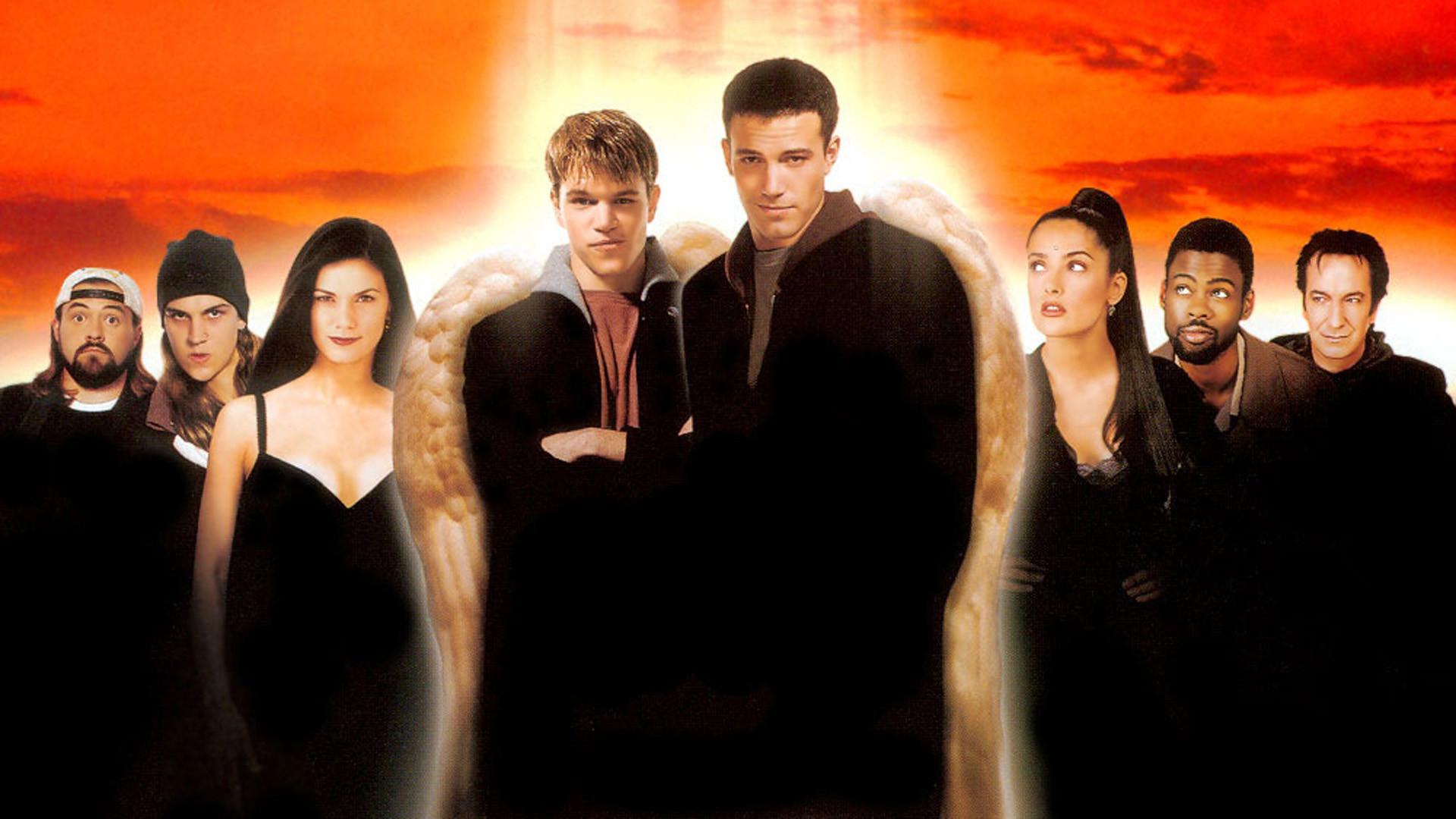
The movie’s story features two fallen angels named Bartleby (Ben Affleck) and Loki (Matt Damon). The two were banished to Wisconsin after thousands of years ago, Loki was the angel of death until Bartleby talked him into quitting (and giving God “the finger”). Now in the present day, they come across a loophole that could allow them back into Heaven. But that’s a huge problem, as explained by the Metatron (or the Voice of God, to be more accurate). The Metatron (Alan Rickman) explains to a cynical Catholic woman named Bethany (Linda Fiorentino) that if the two angels succeed, it would prove God to be infallible. When that happens, existence could be nothingness.

Bethany, dubbed the “last scion,” is sent on a crusade to New Jersey in order to keep that from happening. Helping her are a group of misfits—the 13th apostle named Rufus (Chris Rock), ticked off about his exclusion from the written word because he’s black; “prophets” Jay and Silent Bob (Kevin Smith’s running characters in his movies, again played Jason Mewes and Kevin Smith himself); and a muse in the form of a beautiful woman (Salma Hayek)…who has writer’s block.

The screenplay is full of ideas surrounding Catholic beliefs and it features many memorable lines, such as when Bethany asks Rufus if he knew Jesus Christ, and Rufus responds, “He owes me 12 bucks!” There are rules for angels, who can take human form and retract their own wings (oh, and they have no genitalia—Metatron states in a deadpan matter, “I’m as atomically impaired as a Ken doll”). There are many issues of religion as to how no one’s truly wrong as long as one has faith, as well as certain misreadings of the Bible that Rufus likes to point out. There’s even a scene in which Loki goes back to his original duties to try and please God—he and Bartleby go to a family-franchise studio and state the executives are idolaters but are in fact terrible human beings themselves. Instead of a fiery sword, Loki uses a gun. And there’s the constant difference to be noticed between Jay and Silent Bob. Jay’s a loudmouth who never shuts up about wanting to sleep with Bethany (or anything else, what little there is for him to talk about); Silent Bob is more sensible, but rarely utters a word.

The script is all over the map with its ideas and even provides villains for our heroes. You’d think Bartleby and Loki would be the only conflicted characters for Bethany and company to come across. No, the Devil isn’t involved in the story, but there are a group of demons—a muse-turned-demon named Azrael (Jason Lee), three rollerblading hockey punks, and a monster made entirely out of excrement—making sure that Bartleby and Loki do achieve their goal because they’d rather not exist than go back to Hell.

Strangely enough, even with everything that goes on in this story (and with the movie’s running time of 130 minutes), I was interested and wasn’t bored for a second. I listened to the movie. I realized that Smith isn’t a blasphemer—he creates a satire here, but like most great satires, they do wind up providing morals.

Smith may not be a director in respective terms, but he’s a darn good writer.

All of the actors are game for this material. Linda Fiorentino’s deadpan cynicism—her character believes God is dead in the beginning of the film—makes for an interesting heroine. Chris Rock is solid as the comic relief character—you know, aside from Jason Mewes’ obnoxious Jay character. Alan Rickman is fantastic and shows a great deal of game, particularly when he shouts lines like, “Stop a couple of angels and thus negating all existence—I hate it when people need it spelled out for them!” Ben Affleck and Matt Damon show enthusiasm, and even George Carlin, in a small role as a Catholic priest, has some nice moments.

The disclaimer followed by the story’s beginning states that within ten minutes or so, people would probably be offended. It does start out to live up to that promise—there’s a statue of the Buddy Christ (Jesus with a smile, a wink, and a thumbs-up), Loki telling a nun why he doesn’t believe in God (he claims to be an Atheist by using “The Walrus and the Carpenter” as his source), and then there’s that loophole (which, don’t worry, is resolved—I won’t say how). But the disclaimer also states not to take it seriously because it’s all for comedic fantasy, as noticed in the discussion—that also comes in the beginning—of dogmatic law and church law is defined and compared to each other. Just relax and enjoy the show.

Stargate (1994)

5 Mar

images

Smith’s Verdict: *1/2

Reviewed by Tanner Smith

Imagine you are one of many people who step into an ancient mystic stargate that is said to take you a million light years across the universe.

What would your reaction be? Awe? Amazement? Surprise? All of the above? My reaction would be “all of the above.” But unfortunately, the only reaction to the characters in the sci-fi action/thriller “Stargate” is “What a rush.” They step into the stargate, go through a weird trip in space and time, and find themselves inside a pyramid on a distant planet. They don’t even seem surprised that the stargate didn’t kill them on entry. They just walk about the land as if thinking, “OK, we’re here. What now?” How about taking in some of this discovery?

“Stargate” is a big-budget sci-fi romp that seems empty, despite the top-notch actors, the amazing sets and the nifty special effects. It’s the script that doesn’t take chances or even seem at all like this is going to be fun. Directed and co-written by Roland Emmerich, “Stargate” doesn’t seem to have thrills within its thrilling, mysterious storyline. This is one of those movies where the marketing is a lot more compelling than the actual film that is being marketed. The trailer for this movie showed that there is a mystical, otherworldly stargate that can send people from one world to another. It never showed where the stargate took them or what they found when they got there. This way of marketing left moviegoers wondering what was in store.

But sadly, the discovery is a disappointment. We learn that this distant planet (which looks a lot like Egypt, but the three moons indicate that it isn’t) is home to the human race that were left behind when the Sun God Ra created life on Earth, as well as the stargates. The stargates have been destroyed since and the people are slaves living in the desert. So you can probably guess by what I’m saying in this paragraph that, yes, aliens did create the Egyptian pyramids.

OK…so what?

The aliens themselves seemed too human to be interesting—that’s because they are humans who speak only Ancient Egyptian. Their ruler—the Son God Ra—is definitely not much better. Ra takes human form because it seems to suit him, but he looks more like a showgirl at a costume party and did not seem like any kind of a threat. And then when he talks (in his own language, of course, with English subtitles), his voice is distorted—it didn’t even seem like the voice fit him. Oh, and here’s a hoot—Ra is played by Jaye Davidson from “The Crying Game.”

As “Stargate” opens (in, as a caption informs us, “Egypt 1928”), Egyptologists discover the arch-like, mystic-looking stargate. We then flash to the “present day” (another caption—there are captions like that here) in which a nutty Egyptologist named Daniel Jackson (James Spader, complete with glasses and long blond hair) is brought into a top-secret government facility that has been storing the stargate all this time. He is hired to decode the hieroglyphics that could activate the stargate. Of course Jackson is able to but here’s my question—after all this time of trying to unlock this big secret, couldn’t they have found someone better than a young Egyptologist whose methods have been described as “nutty” through all these decades?

But I digress. Jackson joins the tough-as-nails Col. Jack O’Neil (Kurt Russell) and a team of soldiers armed with automatic weapons as the group steps into the stargate and arrives at this strange world. And it was, I might add, indeed a “rush.”

It’s here that many clichés are used—O’Neil shows a young alien a few modern conveniences, the aliens fear the newcomers but learn to accept them, and such. But the most overused is this—Jackson is mistaken for a god because he wears around his neck an ancient Egyptian heirloom given to him for “good luck.” Eventually, there must be a heavy-handed, special-effects filled, action-packed climax in which the humans and the aliens must fight against Ra and his henchmen. But the characters are so under-developed that I didn’t care for them when they had to fight for their lives. Plus, it’s a copout that the writers had the bright idea of having a stargate that could send people who step into it to travel one million light years away from home, but could only think of shooting everybody when they got there. Another thing I must mention about the story—Jackson claims that he knows how to get back home. Not once do any of the soldiers ask how he knows—he just knows because it’s convenient enough.

The actors do what they can with nothing roles. I like Kurt Russell and James Spader, but their characters are underwritten here. At least they tried. Jaye Davidson cannot be taken seriously as the ruler of the universe.

“Stargate” is a movie that is empty in its storytelling. The sets, cast, and special effects are there but the story needed a lot of adjustments. Why not have more interesting characters step into this intergalactic stargate and discover something wonderful and even more mysterious about the secrets of the known universe? Or even the unknown universe? The possibilities are endless. But all “Stargate” can think about is blowing stuff up. And in the way of something more interesting in the background of the plot, that’s not interesting.

Starsky & Hutch (2004)

5 Mar

The Flick Chicks Movie Reviews critics Starsky & Hutch

Smith’s Verdict: ***

Reviewed by Tanner Smith

You don’t have to be a fan of a TV show that a new movie is based off of. You don’t even have to have watched it. I was completely ignorant of the 1970s TV cop show “Starsky & Hutch,” and watching the 2004 movie adaptation of the same name, I didn’t care that I didn’t see the show. I laughed. Isn’t that enough for a comedy? I did laugh. I enjoyed this film for two reasons—1) it was funny, and 2) most of the fun came from the chemistry between the two actors Ben Stiller and Owen Wilson as the title characters.

Ben Stiller is the hyperactive, worrisome, ridiculously-curly-haired Starsky (“For your information, my hair is naturally curly. Feel it.”) and Owen Wilson is the more outgoing, blond-haired bad boy Hutch. Both men are cops, but Hutch knows more about life on the streets. Pretty soon, their police chief (Fred Williamson) believes they deserve each other, and so he assigns them as partners. At first, they aren’t very fond of each other—Hutch insults Starsky’s hair right away—but they become friends and go on a case that the movie requires them to figure out.

The bad guy in this movie is a drug dealer named Reese Feldman (Vince Vaughn). He and his assistant (Jason Bateman) have just created a new kind of cocaine that police dogs can’t sniff or track down. What gets Starsky and Hutch on the case is when they discover a dead body near the river—the dead body of a man killed by Reese.

Their investigation leads them to picking up a couple of cheerleaders (Carmen Electra and Amy Smart, “B-E-A-U-tiful,” as Jim Carrey would say) and taking them to their apartment so they can share a funny moment that reminds us that the movie takes place in the 70s. I like it when Owen Wilson croons a single originally sung by David Soul, who played the original Hutch in the TV show. Starsky and Hutch’s investigation also leads them to a scene that audiences seem to love and got a big laugh, but for me, I felt a little indifferent. Maybe I didn’t find it hilarious when Starsky interrupted Reese’s daughter’s Bar Mitzvah party, shot through the garage door, opened it to reveal a pony as a gift for the daughter, and then everyone sees the pony fall down dead. (“Are you OK, little pony?”) Maybe it rubbed me the wrong way.

This is one of those comedies in which a lot depends on the chemistry from the actors. This is the sixth movie featuring Ben Stiller and Owen Wilson in a movie together and they come off as a really effective comedy duo. Separately, you get almost too much of them. But when you put them together, they create the perfect comic timing. Owen Wilson was in another film adaptation of a TV show called “I Spy.” That movie didn’t do much for me and I didn’t laugh much. I did laugh a lot during “Starsky & Hutch.”

Todd Phillips, who also did “Old School,” has a movie that is rich with ideas. Also enjoyable is Snoop Dogg as Huggy Bear, a Superfly clone whose fashion remains in the 70s. And then there’s the running joke about Starsky’s great-looking Ford Gran Torino and Starsky’s attachment to it. There’s one scene in which Starsky and Hutch try the impossible that always seems to work in action movies. They try to drive the car really fast off a pier to land it on the bad guy’s boat. Does it make it? I will not say. What I will say is this—I love it when Starsky tries to rescue the car. Some ideas that don’t really work (for me, at least) include the pony scene. And then there’s a very weird cameo by Will Ferrell, which I will not give away. “Starsky & Hutch” is a fun, satisfying comedy.