Raiders of the Lost Ark (1981)

8 Mar

Raiders-of-the-Lost-Ark-in-IMAX

Smith’s Verdict: ****

Reviewed by Tanner Smith

“Raiders of the Lost Ark” is one of the best in a series of movies that feature action-packed adventures and a hero we can all root for. But there is a whole lot more to it too—it also features a great deal of imagination and a super-fast pace. This isn’t just a movie—it’s an event. We spend two hours having fun watching the main hero go through a series of adventures while also admiring what’s happening around him and then we get to go home. It’s as exciting as any sporting event. Watch it on the big screen, and tell me you’re not excited.

For a hero, we have Dr. Indiana Jones (Harrison Ford), an archaeologist/college-professor who always gets in way over his head as he goes through dangerous lengths to unearth a hidden historic artifact—he comes complete with bullwhip, Fedora hat, and leather jacket. Oh, and he also has a fear of snakes, but why am I telling you that? In an opening scene set in South America, we see him explore a booby-trapped cave to find a golden idol. The treasure is left out in the open—this seems way too easy. And when Dr. Jones attempts to take it, this sets up a course involving spikes shooting out of the walls, a chasm, a slow-closing door, and the biggest boulder you could imagine. How could he possibly get out of this? The best thing about this movie is that while we know that he is going to get out of every situation he couldn’t possibly get out of, it’s great to see how he does.

That scene is just a curtain-opener for what comes ahead. The main storyline for this movie is that Dr. “Indy” Jones has been hired by the US government to race to Brazil to unearth the lost Ark of the Covenant before the Nazis gain control of it first (this movie is set in 1936, so the Nazis are the main villains here). Many of us know the legend of the Lost Ark but for those who don’t, its origins are explained early in the film. But it must be noted that if the Ark is opened, the power of God is given to those who open it…for better or worse. Accompanying Indy in finding the Ark’s location is his ex-girlfriend Marion Ravenwood (Karen Allen), who hasn’t forgiven Indy for walking out on her many years ago but she still loves him anyway. His other ally is Sallah (John Rhys-Davies), a big, gentle man who gives Indy some advice he heard from the leader of the Nazi dig site, who happens to be Indy’s rival. He’s a Frenchman named Belloq (Paul Freeman) who, at the beginning of the movie, took Indy’s treasure, sneeringly stating, “There is nothing you can possess which I cannot take away.”

This sets up an exciting series of adventures, including a trap in near-darkness surrounded by hissing snakes and a chase scene involving a truck, a plane, and a horse. It all comes down to a race against time between Indy and Belloq as they race to retrieve the prize.

“Raiders of the Lost Ark” is also perfectly paced. In between the frantic action scenes is enough character development and minimum exposition. We get to know Indy and Marion and we fear for their lives. Credit editor Michael Kahn for creating such a fast pace and not making the movie seem out of control in its cuts. The performances are all solid. Harrison Ford, previously known for playing Han Solo in “Star Wars,” creates a different sort of action hero with strength and a taste for adventure as well as everyday man credibility. He’s also a rough scoundrel with a heart of gold. Karen Allen is the perfect ally for Indy. As Marion, Allen doesn’t play the worried girlfriend who is roped into these situations. She plays this character with energy and strength. Sure, she does scream from time to time but she’s definitely not the damsel in distress. She’s a strong, independent woman who can take care of herself most of the time.

There are also memorable small moments in the film, along with the big action sequences we aren’t bored with. Examples are these little moments are Indy’s line to Marion, “It’s not the years, honey, it’s the mileage,” and a very funny brief showdown between Indy and a swordsman. (You’ll know what I’m talking about.) The movie’s spontaneity is also one of the best things in the movie.

There are also plenty of special effects in this movie. The effects at the very end, a terrifying scene in which the Ark’s power is unleashed, are so realistic that they may frighten younger viewers. I am also very impressed at the stuntwork in the film. There is a scene in which Indy is being dragged along the ground behind a truck in a chase scene. I couldn’t tell which was Harrison Ford and which was his stunt double. But this whole scene was done without special effects—it was really happening. Someone really did get dragged along a road by that truck. There may have been pain but I suppose it was worth it to the actors and filmmakers to entertain us.

Oh, and I should also mention the “Raiders March,” the theme music score composed by John Williams, who also composed memorable music from “Jaws,” “Close Encounters of the Third Kind,” “Superman,” and “Star Wars.” He scores another notable (excuse the pun) music score here.

“Raiders of the Lost Ark” is an action movie with all the right ingredients—a smart script, a fast pace, a likable hero, a strong supporting cast of characters, incredible action scenes, a touch of comedy, a hint of romance, and not least of all, sharp direction by director Steven Spielberg and witty storytelling by George Lucas. Spielberg and Lucas have made an excellent piece of work together. I look forward to them making another collaboration.

The Hole (2012)

8 Mar

Joe-Dantes-The-Hole-Now-Scaring-Up-Thrills-in-Theaters-and-on-DVD

Smith’s Verdict: ***

Reviewed by Tanner Smith

Why Joe Dante’s “The Hole” didn’t get a US theatrical release is totally beyond me. Let’s look at the facts: Joe Dante directed this movie, as well as “Gremlins” and “Small Soldiers,” and I’m sure he still has some mainstream status today. What these movies have in common is the fun way they bring terror with a certain whimsy to what seems like our world. Audiences like that—“Gremlins” was a box-office hit and was also received positively by critics, and “Small Soldiers” did fine too. Are we just supposed to assume that it wouldn’t work again with “The Hole” and that’s why it’s facing difficulty with US distribution?

Also, the film was shot in 3D. Studios are fearless of advertising and releasing “The Nutcracker in 3D” while “The Hole (in 3D)” is left in the shadows? That’s kind of hard to believe. I mean, give props to not releasing “The Hole” as just a 3D gimmick, but now look at this little detail: this movie got a positive reception at the Toronto Film Festival and won the “Best 3D Film” award at 2009’s Venice Film Festival, beating “Up” and “Journey to the Center of the Earth 3D.” What more is there to convince studio executives that…I don’t know, maybe “The Hole” should be released?

Well, someone was convinced and it, in fact, did get a theatrical release…in the UK. D’oh!

OK now that that’s all said, let me review “The Hole.” I didn’t see it in a cinema, and so I didn’t see it in 3D. (It was finally released to DVD in October 2012, after a short-lived limited release in select theaters.) But the 3D is not missed. The truth of the matter is that “The Hole” is a treat—a fun, appealing, and even scary family-horror film. Like most good ones of this genre, younger kids may be scared by a lot of the material on screen, but older ones will most likely be delighted and parents will most likely be entertained as well.

The hole in the title refers to a seemingly bottomless pit in the basement of a suburban house in a small town called Bensonville. The original owner was an old man who is now reclusive, lives in an abandoned factory, and is given the name “Creepy Carl” by all the kids in town. The new owners are a single mother (Teri Polo) and her two sons—seventeen-year-old Dane (Chris Massoglia, “Cirque du Freak: The Vampire’s Assistant”) and ten-year-old Lucas (Nathan Gamble, “The Mist”)—who move around a lot for a mysterious reason that involves the past (not giving anything away).

Dane is bummed—of course, what teenage boy isn’t bummed about moving into a new house? But there is one good thing about this move: Julie (Haley Bennett), the smokin’-hot next-door neighbor whom Dane has his eye on. But the little smart aleck Lucas humiliates him in front of her, causing Dane to chase him into the basement, where they both find a strange door in the floor with six locks keeping it shut. They open the locks and look in the hole. This hole seemingly has no end to it. The boys drop a bucket of nails into it and never hear them drop. They tie a paint can to fishing line and the whole rod unreels. And then, they tie a doll to a rope and…something inside the hole grabs hold of it. What’s going on here?

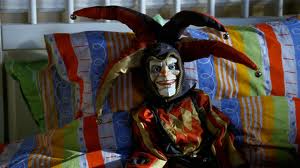
As the boys bring Julie in on their discovery, strange things start to happen: They lower a video camera into the hole and a strange eye is seen. Ghosts and monsters come out of the hole to scare the kids. A creepy jester clown puppet comes to life and attacks Lucas.

images

The setup of “The Hole” is fun, as the kids experiment with the “gateway to hell” in the basement. They even meet the so-called “Creepy Carl” (Bruce Dern) in a room with a dozen light bulbs surrounding him, to protect himself from the “darkness.” Later on though, the movie gets more interesting. Without giving away the secret of the hole, it causes the kids to confront their own pasts and conquer their fears. What makes “The Hole” interesting is that it’s more of a coming-of-age tale than a horror film. There are scares, but story and characters come first. There’s a sense of who these kids are and how they’ll grow in their misadventures with the hole.

The three young actors aren’t strangers to strangeness. Chris Massoglia traveled with a freak show as a half-vampire in “Cirque du Freak,” Haley Bennett was the protagonist of a much-lesser horror film called “The Haunting of Molly Hartley,” and Nathan Gamble encountered giant bugs in “The Mist.” All three are appealing here, but it’s Nathan Gamble that really stands out as the irrepressible but likable little brother.

“The Hole” isn’t a great horror film. Some of the choices the kids make are kind of dumb, like Dane and Lucas not telling their mother about the strange happenings. And also, the ending is not the right one—it’s supposed to resolve all that happened before, but it just feels like an anticlimax. But for the most part, “The Hole” is an entertaining movie with an intriguing story and some good scares along with likable characters to root for. And it still makes me wonder what it takes to get this film a US distribution, and how long it ultimately took.

NOTE: The MPAA rated this movie a PG-13 rating. After the PG-rated “Monster House” and “The Spiderwick Chronicles,” the MPAA is starting to understand that certain family-horror movies are likely to frighten younger kids—this one included.

ANOTHER NOTE: Or maybe they just rated it a PG-13 rating due to certain profanities like the “s” word.

THIRD AND FINAL NOTE: Every film directed by Joe Dante features an appearance by Dick Miller. Watch out for him as a pizza delivery guy in this movie.

Hoot (2006)

8 Mar

hoot

Smith’s Verdict: **

Reviewed by Tanner Smith

“Hoot” is the film adaptation of the Newbery Award winning novel of the same name, written by Carl Hiaasen, and it’s surprisingly faithful to its source material in terms of story and character. You would think that the movie would be just as good as the book in that sense, but I have two problems with that sense. For one thing, there’s just such a mediocrity to the execution of the movie that doesn’t make it seem very special. Also, and I know I might get a lot of flack for typing this, I don’t personally think that the novel itself is special to begin with. I’ll get to analyzing those problems the best I can later in this review, but let me explain the plot first.

A young man named Roy Eberhardt (Logan Lerman) and his family have moved again, this time from Montana to Florida. He already has problems with a husky bully, who has enjoyment in pressing the kid’s face against the school-bus window, but he finds interest in two kids his age. One is a soccer jock named Beatrice (Brie Larson), who is dubbed “Bear,” and a barefoot runaway nicknamed “Mullet Fingers” (Cody Linley) who is also Beatrice’s stepbrother and is constantly vandalizing a construction site, where a pancake-house corporation wants to build their newest restaurant in this small town. Roy decides to help him, along with Beatrice, because the construction site is filled with endangered burrowing owls and it’s up to the kids to save them.

I’m not quite sure where to begin. I mean, the premise is nice and the friendships between Roy and Beatrice and with Roy and Mullet Fingers are developed in an interesting way, both in the novel and film. But there are many quibbles I have with this story. First of all, the construction site is in the middle of the forest—why would anyone want to build a pancake house there? And who would want to go to a pancake house in that particular location?

Also, this family film is promoting a somewhat-environmental message. There’s nothing wrong with wanting to teach a lesson to kids if it’s done right, but the kids in this movie aren’t exactly the right role models for saving the environment. They commit felonies in order to save the day. They steal, vandalize (for example, they spray-paint a police car’s windows black), and even terrorize (with cottonmouth snakes and alligators that Mullet Fingers is able to handle—by the way, Mullet Fingers has been living on his own in the woods long enough, so how far does his animal-handling skills go?). On top of that, they’re not entirely convincing. I seem to be circling back to that Mullet Fingers kid—by the way, he’s called that because he can catch a mullet (a type of fish) with his bare hands. I would like to know exactly how Mullet Fingers survives on his own for what is said to be so long. And if he doesn’t want to be seen, then why does he constantly run on a public sidewalk where plenty of people are able to see him?

Oh yeah, and why is Roy the only one on the school bus who notices Mullet Fingers running by it? Is it because that ridiculous bully isn’t holding anyone else’s face against the window?

Here’s another problem with the story—there are too many side characters for unnecessary subplots. That beefy bully I mentioned is particularly boring and—get this—is afraid of one thing that fortunately Roy (or “Cowgirl” or “Tex” or “Eberhardt” as he’s constantly called every now and again) has on his side: Beatrice. Huh—or maybe he just doesn’t want to hit girls. (Yeah, that sounds about right.) But Roy breaks the bully’s nose after being held in a headlock, only to create an unnecessary subplot that distracts from Roy fitting into his new town and helping his new friends save the owls. Another side character, played by Luke Wilson whom gets top billing in this movie, is police officer David Delinko, a young and loyal cop who is called upon the site to investigate the vandalism reported by the foreman named “Curly” (Tim Blake Nelson). His main role is to be gullible and humiliated while Roy hides his secrets from him, even after he makes friends with him. He’s also the one whose patrol car is spray-painted black by Mullet Fingers while on a stakeout. Why not make this character smarter, or maybe a little funnier to make him more interesting? And then, we have the villain who is just a comic caricature. Chuck Muckle (Clark Gregg), the vice president of the pancake house corporation, knows there are owls and doesn’t care for any of Mullet Fingers’ antics to bulldoze the site. He’s over-the-top here. And of course, we have the dumb parents who know less than their children and their supposed heart-to-heart talks with Roy are pathetic.

What I’m basically getting at is “Hoot” is overstuffed. And Wil Shriner who thinks of this as a feature-length after-school special also executes it poorly with what-probably-isn’t-but-just-seems-like-it lazy direction. And the constant use of bland songs by Jimmy Buffett doesn’t help much either. And the climax has to be one of the most overly cutesy scenes in a recent family film. But to be fair, I believe “Hoot” is harmless enough for younger kids. The kids are actually kind of likeable and the owls are cute enough to be worth fighting for. But if you want a better family film that delivers subtle and more entertaining ways to bring messages across, this isn’t it.

Dazed and Confused (1993)

8 Mar

dazed3

Smith’s Verdict: ***

Reviewed by Tanner Smith

“If I ever say these are the best years of my life…remind me to kill myself.”

Those are surprisingly revelatory words spoken by high school senior Randy “Pink” Floyd (Jason London) to his stoned friends on their first night after high school. After a night of partying, drinking, smoking joints, and hanging with friends, Pink—a football jock—finds himself hanging with who the school coach dubs the “wrong crowd,” smoking marijuana on the 50-yard line at the school’s football field. He says these words and it’s possibly the one time any of the teenagers in this movie notice that they feel like something is missing.

But that’s not unlike teenagers. We were caught in states of confusion. We ignore them by simply hanging out and talking about other stuff without having to get too serious, just to have a good time. Only occasionally did we acknowledge what problems we had. As time goes by and we get older, we block out the pain and just remember the nostalgia.

This is probably why Richard Linklater, writer and director of “Dazed and Confused,” decided to set this film in the 1970s instead of the 1990s, when it was made. He’s recalling his own nostalgia and it comes through in this film, which is essentially plotless—it’s just chronicling these small-town teens on the night of the last day of school. They hang out. They party. They drink. They smoke marijuana. They talk. That’s it. That’s the movie. It doesn’t matter if the hero gets the girl, the nerd gets his moment, the bully gets his comeuppance, and whatever high-school-movie cliché you can mention. It has truthful elements to it.

Linklater introduces us to one set of characters and we hang around with them as they hang out with each other. Then we move to another set, stay with them. Then another. We get plenty of time to watch them develop, although I have to admit I think there were too many people to keep track of. Most notable are the aforementioned Pink, who is troubled that the coach insists that he sign a paper that keeps him off drugs and alcohol (and away from the “wrong crowd”), and thus invading his independence; Slater (Rory Cochrane), a stoned-out-of-his-mind party animal; Wooderson (Matthew McConaughey), a graduate from years back, still hanging around high school kids because they remind him of his best moments in life (which causes Pink to say the aforementioned quote); and Mitch (Wiley Wiggins), a freshman who is one of many to be harassed by the seniors as a cruel, time-honored initiation tradition (requiring wooden paddles to smack them on the rear), but ends up lingering with Pink and the guys.

“Dazed and Confused” gives us a lot of characters in the mix, although admittedly, only a few of them are likable (Mitch, in particular, is possibly the most identifiable and his tale is engaging, while a lot of the other teenagers grow kind of annoying with their mean-spirited talk). Linklater, however, apparently cares about each of them.

I don’t expect anybody who went to high school in the 1970s to enjoy this film at their next high school reunion. Or maybe they will, as the film does capture the nostalgia of that time as well (the rock-n-roll soundtrack makes perfectly clear of that). I was born in the early ‘90s, went to high school in the late 2000s, and what I got out of this movie was a miniscule but effective legacy of these “cool” high-schoolers.

NOTE: I have to wonder—if the ‘70s looked back on the ‘50s in “American Graffiti,” and the ‘90s looked back on the ‘70s in “Dazed and Confused,” should I expect the 2010s (would that be the ‘10s, the teens) to look back on the ‘90s?

Somewhere in Time (1980)

8 Mar

somewhere_in_time1

Smith’s Verdict: ***

Reviewed by Tanner Smith

If you can get past the strange concept that allows the possibility of time travel in “Somewhere in Time,” you’d be watching an admittedly cute movie about how one man falls in love…but only 68 years in the past.

Christopher Reeve, the likable star of the “Superman” movies, plays the man, named Richard Collier. He’s a playwright who is celebrating his first play when he’s approached by an elderly woman who hands him a gold pocket watch and simply says, “Come back to me” before leaving. Who is this woman? Richard finds that out eight years later as he stays at the Grand Hotel, after getting over a breakup and while suffering writer’s block. He sees a picture of a beautiful young actress, becomes enthralled, looks up her biography, and finds the latest picture of her, revealing herself to be the woman who gave him the pocket watch, which he still carries around with him.

Richard becomes obsessed with the idea of traveling backward through time, after discovering that the woman has read a book about the subject of time travel. The book was written by one of Richard’s old college professors, so he asks him how he can go back to the year 1912 and see that actress, named Elise McKenna (Jane Seymour).

And so, because this method of self-hypnosis could work for him, and because the movie doesn’t want any past/present misunderstandings, Richard buys an early 20th century suit, cuts his hair for the appropriate time setting, and rids himself of any modern conveniences. He goes to sleep, forcing himself to actually believe he’s no longer in his own time—he’s in the year 1912. It works, and he’s well dressed for the period. Now it’s time to find Elisa and win her affections.

So I guess the idea of this time travel method is that you have to record yourself saying that you’re where you want to be and if you have to keep anything modern out of sight (so you keep the recorder under your bed), or it won’t work. That may sound ridiculous, even confusing (for example, if it’s a dream, then how is there an effect in Richard’s present? Apparently, it’s not a dream, in that case), but getting down to it, it’s more noble than creating a time machine. It’s power of the mind, to say the least.

Eventually, Richard does meet Elisa and they fall in love, as Richard decides to stay in a time not his own just to stay with her. The developing relationship between these two is nicely done, especially considering the possibility that she’s been waiting for him to come along. The chemistry is there between these two actors—Christopher Reeve and Jane Seymour—and you root for their characters to be together. Both actors are good. In particular, Christopher Reeve shows more range here than in “Superman,” and he’s still as likable.

There is a villain in this movie—Elisa’s manager William Robinson (Christopher Plummer). He’s been keeping track of Elisa’s career since she was a teenager and keeps her isolated in order to keep her career going. He resents the arrival of Richard from the moment he sees him, believing that he’ll be the one to take her away from stardom to love. What doesn’t work about his character is that there are hints are to whether or not he knew about Richard’s real presence, but are never addressed. He’s either a time lord or a man obsessed with his managing job.

I should also credit the set and costume design by Jean-Pierre Dorleac for creating the feeling that we have indeed traveled back to 1912.

“Somewhere in Time” isn’t a great movie—aside from somewhat confusing time travel elements and a too-mysterious villain, I didn’t buy the ending very well—but it’s intriguing and sweet enough to win me over.

Red Eye (2005)

7 Mar

936full-red-eye-screenshot

Smith’s Verdict: ***

Reviewed by Tanner Smith

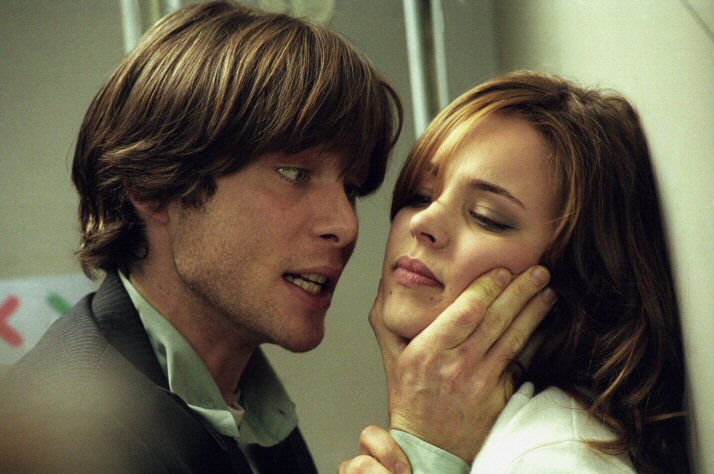
“Red Eye” is a psychological thriller that handles such elements of the genre the right way, while also admiring Rachel McAdams. She has turned so well into a movie star and as the Woman in Peril in “Red Eye,” the camera and script never let us stray away from seeing how plausible, convincing, and (let’s face it) beautiful she is. The Woman in Peril is a hard character to pull off in a movie like this. The wrong actress could easily overact to the terror happening to her character. But not Rachel McAdams—she remains convincing all the way through. Her weapons against a terrorist who made her red-eye flight miserable are a pen, a cane, and a hockey stick. Well of course, those are common weapons of choice.

McAdams plays Lisa Reisert, a hotel desk manager who catches a red-eye flight to Florida after bad weather cancels out her regular flight. Taking over her job temporarily at the hotel is her friend, who is not exactly qualified to handle situations that require…well, much thinking. At the bar in the airport, she meets a charming young man named Jack Rippner (get it?) and strikes up a conversation with him. And then they wind up sitting next to each other on the plane.

This sounds like the opening for a romantic drama. But Jack is definitely NOT the charming young man she met at the airport. Once the plane takes off and the two sit together, his personality transforms into something quite sinister. Jack is a terrorist and he tells her (softly) that her father is taken hostage and will be let go when she makes a call to the hotel to schedule a government agent to be booked in a different room than he already was. Then he will be assassinated. Lisa tries to find a way out of this nasty situation and goes through many threatening confrontations and conversations. It’s almost a wonder why these go unnoticed by the stewardesses, but then again this is a busy flight. The airplane scenes are handled in a plausible way.

Cillian Murphy plays Jack. He’s handsome, but his looks come with a warning. The way he handles Lisa in many moments in which she tries sneakily to get out of this situation is so sinister, it too is convincing. Cillian Murphy does a good job of switching tones in his personality. First he’s pleasant and polite. Then he’s…how many times do I have to use the word “sinister?” You get the point, I hope.

Now the final half of the film is your standard killer-in-the-house climax. I would’ve wanted something a bit more original. Who knows what you could do in an airport terminal? But still, McAdams remains plausible and convincing. I loved that her character was not dumb but a woman who is bright and thinks of what she would do; we feel for her. She has presence and credibility—she’s not one of those thriller victims are simply running around and screaming. She’s given something very specific to do and her scenes with Murphy are very effective. These two are great together.

Craven’s previous work included slasher films such as “Nightmare on Elm Street” and the “Scream” movies. Here, he gives us as little blood as possible and moves on to psychological tensions. The final half of the film may be a bit too conventional but for the most part of “Red Eye,” he succeeds in making a psychological thriller that works.

Unbreakable (2000)

7 Mar

unbreakable2nightchronicles

Smith’s Verdict: ***1/2

Reviewed by Tanner Smith

When you hear about writer-director M. Night Shyamalan’s follow-up to his masterpiece, the 1999 supernatural thriller “The Sixth Sense,” you either expect very much or very little. It’s that feeling you get when you watch the trailer of “Unbreakable” and you notice the writer-director’s name, as well as the somewhat similar tone that “Sixth Sense” had, what you can gather from the trailer. Oh yeah, and Bruce Willis is in both movies.

That said, I think “Unbreakable” is a wonderful movie. It’s eerie, original, and well put together.

It has that same uneasy feeling that was brought to life for the best in “The Sixth Sense.” Only this time, it isn’t a spin on the ghost story, but on the superhero origin story. The whole movie is scripted like the first half of a superhero movie and shot like a haunting portrait. Comic books featuring superheroes take on a major element of “Unbreakable,” but this is not a comic book movie. Far from it.

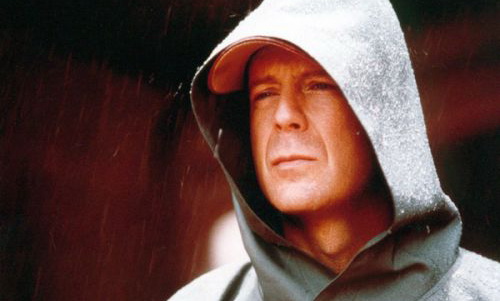
It begins as a security guard named David Dunn (Bruce Willis) is the sole survivor of a train derailment. Not only that, but he walks away from the crash completely unharmed, without breaking one bone in his body. This attracts the attention of comic book collector Elijah Price (Samuel L. Jackson), whose life has been nothing but misfortune. He was born with a disease that makes his bones extremely fragile and easily breakable. As a child, his classmates dubbed him “Mr. Glass”, because his bones “broke like glass.” His mother got him hooked on comic books as a child to keep him from sadness, and he has been studying them ever since.

Anyway, Elijah contacts David and tells him a theory that may or may not be possible. From studying comic books, he has a theory that if there is a man such as him, whose bones can break easily, then there should be a man who is in the exact opposite way of living—an unbreakable, invincible man.

At first, David dismisses Elijah’s theory as just a crazy idea. But soon, he begins to ask some questions about himself. He asks his boss if he’s ever taken a sick day from work, and he asks his wife Audrey (Robin Wright Penn) if he’s been sick in the entire time they’ve been married. (There was a nearly fatal accident he and Audrey have been in years ago, but even that has its secrets.) David’s son Joseph (Spencer Treat Clark) believes that Elijah is right and that his dad is some kind of superhero. He even goes to an extreme measure of attempting to shoot David with a pistol to prove to him that Elijah is right.

There’s a real amount of tension throughout “Unbreakable” that also comes when Audrey, a therapist, has Elijah for a patient and doesn’t know that he and David have already been in contact. There are many moments like that that just feel like there’s something eerie going on, but you’re not quite sure as to exactly what.

There are many touches that Shyamalan puts throughout the film. One is the use of glass around Elijah—you see him in a reflection off a TV or a glass case, and his own cane is made of glass. Then, there’s the constant use of lingering shots that just continue at their own pace—they’re well-directed, well-acted, and they take their time to continue. Another is the choice of clothing that these characters wear. I should explain what I mean by that, but I fear I might be spoiling something.

One could watch “Unbreakable” and appreciate what Shyamalan has done this time. It may not be up there with “Sixth Sense,” but what follow-up usually is? Then, one could watch the film more than once and piece the puzzle together after experiencing the twist ending the first time, as they did with “Sixth Sense.” Yes, there is a twist ending here, as there was in “Sixth Sense.” It features Elijah’s further characteristics, and I won’t give anything else about it away, but I will say this—When I watched it for the first time, I didn’t accept it because I couldn’t believe it. But I watched the whole film again and let everything piece together in my mind. What I realized is how tragic Elijah’s story is. It’s intriguing, the way that destiny could be either a good or bad thing, depending on how you look at it. That’s all I’ll say about the ending.

What “Unbreakable” might be missing, and I think this is what cost the film half-a-star from me, is a more confident, heartfelt relationship between David and his son. There isn’t that much of a sense of connection that we’re supposed to feel for these two. Actually, there’s some sense, but not enough. But what really makes “Unbreakable” stand out are the creative ideas put into the story, the consistent dark tone that comes with this type of storyline, and two great performances from Willis as the everyman and Jackson as the mysterious tragedy-personified.

The Amazing Spider-Man (2012)

7 Mar

images

Smith’s Verdict: ****

Reviewed by Tanner Smith

Two years ago, when a friend told me that he heard that the “Spider-Man” movie franchise was being “rebooted,” I didn’t believe him. But two years later, here it is—ten years since the original film, and five years since its latest film. I was aware that 2007’s “Spider-Man 3” failed to satisfy audiences with its many plot developments, but I had a feeling that the franchise would redeem itself with a fourth entry. But no—Columbia Pictures apparently wants to start from scratch, even with the same producer of the other films (Laura Ziskin).

Luckily, I was pleasantly surprised by this reboot of the Marvel Comics-based half-arachnid/half-human superhero. We all knew the origin story of Spider-Man/Peter Parker, but that doesn’t mean the story isn’t told as effectively as before. There are many twists and turns in the storytelling of this retelling of Spider-Man, all executed wonderfully.

My guess is that they made this reboot was because they didn’t know where to take the story from “Spider-Man 3” to a “Spider-Man 4.” But I am disappointed that they didn’t at least try—even Paramount’s “Star Trek” movies have gotten their way out of similar messes. So they better get it right this time with the inevitable sequels.

“The Amazing Spider-Man,” of course, retells the story of how high school geek Peter Parker became Spider-Man, but with different circumstances from the original film. (And no, I’m not going to go into great detail to explain the comparisons and contrasts.) It begins with Peter as a little boy playing an innocent game of hide-and-seek when he enters his scientist father’s office and discovers that it’s been ransacked. The parents, hoping for the best for their son, send Peter to live with his aunt and uncle (for reasons that will probably be explained in the sequel, but I’ll let it ride). Years later, Peter (Andrew Garfield) is seventeen, gawky, and somewhat of a loner (pretty much the last person you’d expect to become a superhero).

Peter finds an old satchel belonging to his late father and can’t help but go through it. He finds documents containing specific information about his cross-species-intersection experiment with Dr. Curt Connors (Rhys Ifans), who works as Oscorp Industries. Peter makes his way into the building to find out the real deal, when he is bitten by one of the experimental, radioactive spiders in Connors’ laboratory. On the way home, he experiences some intense side effects from the bite—he’s completely hyperactive (I suppose you’d call it “spider-like reflexes”), is unbelievably strong, and can even scale ceilings and walls.

These scenes in which Peter learns of his new abilities are well-handled and make for some comedic moments as well. He at first finds these powers difficult to control (he nearly destroys his own bathroom while trying to brush his teeth, he shoots a dangerous projectile of toothpaste, and also breaks the door). He does get the hang of his abilities by taking it slowly and easily, but he uses them irresponsibly, as when he humiliates the school bully on the basketball court. This causes his fatherly uncle Ben (Martin Sheen, very strong here) to tell him that just because he can do these things doesn’t mean he can perform them whenever he wants to.

Later, Uncle Ben is killed by a street thug and Peter realizes that he could use his powers to help people in need. So he dons a costume he made himself, creates man-made spider-web-slingers that cause him to swing around New York, and becomes a masked half-arachnid vigilante called Spider-Man. He protects people in need, keeps his true identity a secret, and of course the police see him as a menace.

But with every superhero, there must always be a villain for each tale. Origin stories are no exception. While most are coincided with the hero’s newly-developed powers, Peter is actually the cause of the supervillain in this movie. You see, earlier in the movie, he gave Dr. Connors his father’s secret algorithm that could make Connors’ cross-species project work. What it’s supposed to do is regrow lost limbs (three-legged mice are used as experiments). Thanks to the equation that Peter gave Connors, the experiment finally works. But later in the movie, Connors decides to use it on himself to regrow his disembodied right arm. And because some of the serum comes from lizard blood (if I remember correctly), Connors mutates into a man-size lizard that terrorizes the city.

Connors makes an intriguing villain and his plan is legitimately diabolical. His plan is to take the serum and take it to the top of the tower of Oscorp and unleash it all over the city, via a chemical cloud, so they undergo the same effects as he. He says he’s doing this to get rid of “weakness.” Connors is an interesting villain because he doesn’t do this just to be anarchic and chaotic. He’s doing it for what he thinks is for the good of mankind. (Though, let’s face it—none of us want to be transformed into giant lizards, of course.) This is a scientist who searches for further truth in his research and gets more than he bargained for. He becomes a monstrous beast as it all just toys with his own sanity. Rhys Ifans does a terrific job at making a three-dimensional villain, and the computer-effects design of his lizard form is gruesomely impressive as well.

The effects are first-rate. Sure, most of it is CGI, but it really did look like Spider-Man was flying around the city on those spider webs. And they, along with the camerawork, make the action sequences effectively intense and a lot of fun to watch. I can think of many final action climaxes where I feel worn out, just waiting for them to end. But there were enough turns in this film’s climax to keep me invested.

And I should also mention the change of tone this movie has, compared to the other three “Spider-Man” movies. The previous three were lighthearted, energetic romps. In this reboot, the attitude is suitably more dark and dramatic with a smoother look, although that doesn’t mean there isn’t room for comic relief (such as how Spider-Man, in a teenage boy fashion, mocks a car thief while thwarting him). Also, I have to give credit to the screenwriters (including Steve Kloves, who wrote all but one of the Harry Potter movies) for giving better reasons for Peter to become Spider-Man.

Andrew Garfield has been in movies like “The Social Network,” “Never Let Me Go,” and “Red Riding: 1974.” I can say that this actor can either be very likeable or very stiff. In some of his work, he seems to walk that line in between, seeming uncertain about a few things his characters go through. But as Peter, he’s pretty good here. He’s very convincing and just so likeable, and makes for a nice hero to root for. But I have to admit, the updated Spider-Man costume looks a little silly…or sillier.

And don’t think I forgot about Peter’s relationship with Gwen Stacy (Emma Stone), the pretty girl in the class. Every superhero story, as far as I’m concerned, has a girlfriend to support the hero, and “The Amazing Spider-Man” is no exception. Now, I have to admit that I didn’t really care much for Gwen in the first half of the story, nor was I interested in hers and Peter’s relationship. It was pretty awkward and they didn’t share much chemistry, mainly because Gwen wasn’t given much of a personality…until midway through the movie, when these two started to have realistic conversations and I actually started to care. Or maybe things just get more complicated when the police chief (Denis Leary, very good), seeking to arrest Spider-Man (who is actually Peter), is Gwen’s father.

And here’s what really made me care about Gwen—she’s smart. She’s not the typical damsel-in-distress you see in most superhero movies; she’s no Mary Jane Watson (from the original film). And there are many scenes that show that she is smart and can fend for herself. For example, there’s one scene in which she’s hiding from the Lizard in a locker in a laboratory, and you would think this would be predictable. You would think that she would be captured and Spider-Man would have to save her. But nope. She fights back; she sets the monstrosity on fire!

“The Amazing Spider-Man” is a welcome retelling of the Spider-Man origin story—darker, more complex, entertaining, and very amusing when it needs to be. I’d even put this is in a class with “Batman Begins” (which told Batman’s origin story) and that’s a very high class for me indeed. I loved this movie, and I look forward to its predestined sequel.

Christine (1983)

7 Mar

tumblr_krjgmxnI2G1qz72v7o1_500

Smith’s Verdict: ***

Reviewed by Tanner Smith

John Carpenter’s “Christine” is a nicely-crafted horror film about a teenage boy and his car. The boy is a high school nerd named Arnie who wears thick glasses, is very insecure, and is constantly picked on by the school thugs. The car is a ‘50s Plymouth dubbed “Christine” that Arnie finds rusting in a junkyard. He doesn’t care that its original owner killed himself in the car or that some folks around it have died tragically back in the day—he’s just entranced by the car. He buys it, rebuilds it, and develops a certain bond with it.

Of course, teenagers develop a bond with their first car. It becomes a part of them—they look out for their cars, they make sure not one part of it is scratched, and they even talk to their cars at times. But in Arnie’s case, it’s different. Not only does having this new car affect his social life (in that he actually develops one, finally) and boost his self-esteem (like talking back to people, including his overbearing parents), but it also turns out that Christine—the car—has a mind of its own. It moves on its own and even repairs itself after the bullies trash it to junk.

And so, Christine uses its willpower, without a driver, to chase after Arnie’s enemies and run them down—there’s a great scene in which it forces its way through a narrow alley to get to one of the bullies, and another in which another bully is desperately running down the street trying to outrun the car (set ablaze this time—the guy doesn’t have a prayer). But there’s a bigger issue in its “mind,” I should say—Arnie is dating the prettiest girl in school, which makes Christine so jealous that it takes many measures to try and run her down as well. Arnie himself develops into a real scuzzy personality, letting Christine’s power over him take what’s left of his meekness and replace it with a blend of super-coolness and madness.

It’s a nice work of fantasy and horror—the idea of a guy getting his first car that turns out to be alive is an exciting one. That it goes after its owner’s girlfriend may make the movie sound ridiculous, and it is. But I enjoyed it because with John Carpenter’s direction, the movie wants to play how it would occur if it were plausible. Carpenter also does a good job with the three central young actors—Keith Gordon as Arnie, Alexandra Paul as Arnie’s girlfriend, and John Stockwell as Arnie’s best friend, a likable jock that tries to pull Arnie out of Christine’s spell.

I also liked the use of old songs in the score. When someone tries to break into the garage where Christine is kept, its radio plays “Keep-a Knockin’ But You Can’t Come In” as a warning. And whenever Arnie is alone in the car, the radio plays old love songs. See, the radio only plays songs from the 1950s, since that’s when it was created and uses these songs to speak its mind. That’s a clever idea.

“Christine” is an ambitious, well-acted, well-executed horror movie that takes teenage fantasy as a deal with the devil. Yeah, the story is out there, and there are some things that don’t work (see NOTE), but there are many other moments that had me grinning and invested, right down to the final climax where it’s the ‘50s Plymouth Fury “Christine” versus a bulldozer.

NOTE: I’ve read a few posts on “Christine’s” IMDb message board and one of which, not caring much for the movie, said that there could be a remake that was closer to the original Stephen King novel it was based on. I’ve never read the novel, so I don’t know how close this movie adapts it. However, there are certain clichés that can be found in Stephen King stories and they are found here. One main clichéd element—everyone except for the main characters is a one-dimensional jackass. The bullies are the knife-wielding bores, the parents don’t listen (the mother, in particular, is over the top in authority), and the man who runs the body shop (played by Robert Prosky) is a suspicious old fart (though to his credit, he has a good reason to be suspicious of Arnie and his car). So I don’t know—maybe certain parts of the story were left out of the movie.

Spaceballs (1987)

7 Mar

MV5BOTg2OTg3OTYwMF5BMl5BanBnXkFtZTcwNjc0MjI3NA@@._V1._SX640_SY430_

Smith’s Verdict: ***

Reviewed by Tanner Smith

“Spaceballs” is a comedy by Mel Brooks which has a lot of jokes that are hit-and-miss, but also has just about the same amount of jokes that are hits in the way that I laughed. This is not one of Mel Brooks’ best films—it doesn’t rank up there with “Young Frankenstein.” Or rather, it’s not one of Mel Brooks’ best scripts. There are so many lame puns and juvenile humor. What had me laughing, however, were the visual gags and the behavior of some of the characters, especially the villains. So there are enough funny moments in “Spaceballs” that I’m giving it a mild recommendation.

The whole movie is a parody of the “Star Wars” movies. We have almost everything from the famous George Lucas saga spoofed here. We have Luke Skywalker/Han Solo type Lone Starr, the beautiful but stuck-up Princess Druidia (a “Druish” princess), a droid named Dot Matrix (oh yeah, and voiced by Joan Rivers), a half-man/half-dog Chewbacca replacement named Barf (“I’m my own best friend”), the short wise alien named Yogurt, and of course, the villain Dark Helmet. There are other characters, but I’ll get to them later.

The film begins with those “Star Wars” opening texts that scroll into space, explaining the back story of “Spaceballs” and ending with a fade-in saying, “If you can read this, you don’t need glasses.” That’s funny. But—and maybe I missed something here—there’s a long, tedious shot of the villain’s spaceship that goes on for a minute and a half and doesn’t seem to show anything…well, funny. But then we’re introduced to the villain Dark Helmet (Rick Moranis), who has a large dark helmet that brings his voice to a James Earl Jones baritone type. How do we know it’s Rick Moranis, though? Because Dark Helmet can’t keep the helmet on all the time (he can’t breathe, he can’t see straight, he has to drink a cappuccino, you name it). And he’s a nerd. One of the joys about “Spaceballs” is that Dark Helmet, his second-in-command Sandurz (George Wyner), and President Skroob of Spaceball City (Mel Brooks)—the three villains of the movie—are so dumb, you can’t believe that they’d lead any army. It’s very funny when they plan any evil plot in this movie.

The heroes are the rebellious Lone Starr (a very bland Bill Pullman) and his partner Barf (a very likable John Candy), who as I said is half-man/half-dog (with paws and a tail). They fly through outer space into a flighty Winnebago (nice visual gag) on the run from Pizza the Hutt, a Jabba the Hutt type except he’s a mountain of cheese and pepperoni. Pizza the Hutt is just as disgusting as Jabba the Hutt, but also the funniest gag in the whole movie.

Lone Starr and Barf are called upon by King Roland of Planet Druidia, which is in danger of being destroyed by the Spaceballs of Planet Spaceball—run by President Skroob (Dark Helmet is in charge of the spaceship Spaceball One). King Roland (Dick van Patten) needs the heroes to rescue Princess Vespa (Daphne Zuniga, “The Sure Thing”) and Dot Matrix from capture by Dark Helmet. They succeed, but find themselves lost on a desert planet, where Lone Starr and Princess Vespa argue as Barf and Dot Matrix look on and spew one-liners, and they meet a Yoda type named Yogurt (also played by Mel Brooks) who gives Lone Starr a special ring and gives them the phrase, “May the Schwartz be with you.” This constant repeating of the phrase is so hoping for memorable payoff that it isn’t funny.

As I said, “Spaceballs” has many jokes that are hit-and-miss. The script has a lot of puns and juvenile humor (there’s a difference here). But there are other jokes that do work in the way that I laughed joyfully and recommending the movie. I loved the Pizza the Hutt gag, I liked John Candy and Rick Moranis, Mel Brooks gives two wacky performances, I liked the gag where the villains  try to watch the movie itself to find the heroes, I liked the satire on stunt doubles, and uh…I think there are a couple more if I can think of them.