Archive | Three Stars *** RSS feed for this section

Disillusioned (Short Film) (2011)

17 Apr

images

Smith’s Verdict: ***

Reviewed by Tanner Smith

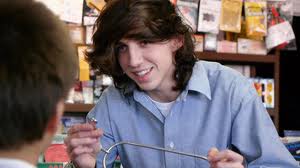
An aspiring magician (Seth Savoy) believes that the best magicians perform flashy tricks/illusions, instead of the simpler, more subtle ones he can do easily. While working at a magic shop, he constantly attempts to perform complicated tricks to customers. Unfortunately, he tries too hard and can’t seem to get them to work the way his idol, theatrical illusionist Ace Manhattan (Mark Cluvane), can. So his boss (Derrick Rose) tries to convince the boy it doesn’t take big magic to impress an audience. Upon ultimately meeting Manhattan face-to-face, he begins to see that fame isn’t everything.

The idea of a young man wanting to perform something bigger with his talent, and then realizing maybe settling for what he can do best (something smaller) is the best thing for him, isn’t really new. But it is welcome, and does make for some satisfying coming-of-age comedy/dramas. I must admit I’ve never seen it done with magic before, which is the case for “Disillusioned,” a 7-minute short film written and directed by Kim Risi. The result is an interesting, nicely-done short comedy.

I’ve always been a fan of magic. When I was a kid, I would perform the little ball-and-cup trick to my friends and family because it was the only trick I was able to pull off. The reaction I got still satisfies me, and so I would sometimes look into more tricks and wonder how the bigger, more complicated illusions were done. Even as I got older, I still enjoyed going to the occasional magician-workshop at certain events (a Baptist convention, particularly). Some things never get old. But I digress. Anyway, that’s why “Disillusioned” appealed to me, not only in the story’s metaphor that the message mentioned above doesn’t amount to just magic (but also to filmmaking, for those who thought I was just a film critic), but because of the comic ways in which the struggling magician attempted to free himself from handcuffs in five seconds or a straitjacket in 10. The disappearing ball works every time; try it sometime (but after a little practice first).

Not much acting is required in “Disillusioned,” but the one who really steals the show is Mark Cluvane, who is (for lack of a better word) amazing as Ace Manhattan. How do I properly describe his subtly manic portrayal of a flashy magician? I’m not convinced I can, so I’ll just state that he’s hilarious here.

(It was also an effective move to cast Seth Savoy who knew very little about magic, and Derrick Rose and Mark Cluvane who are both skilled magicians. Rose/Cluvane’s experience and Savoy’s inexperience make each magic-trick scene seem more or less real.)

“Disillusioned” may be somewhat predictable, but it is an appealing short film with some effective funny moments (the over-the-top commercial for Ace Manhattan is utterly hilarious), a neat motif with the soundtrack (classical music that shadows the opposite of Savoy’s character’s belief that “people don’t want classical music; they want rock n roll”), and an admittedly welcome-and-effective moral about selflessness.

NOTE: The film can be seen here: https://vimeo.com/27359862
Big Shots (1987)

17 Apr

images

Smith’s Verdict: ***

Reviewed by Tanner Smith

“Big Shots” comes across as a sort-of modern-day retelling of “Tom Sawyer” and “Huckleberry Finn.” The film features two young boys from opposite sides of the tracks—one (who’s white) is from a nice suburban home (he reminds me of Tom Sawyer in some sense) and the other (who’s black) is a street kid in Chicago (he, of course, reminds me of Huck). They team up to have all sorts of improbable yet enjoyable adventures and also become the best of friends.

We start off getting to know the suburbanite kid named Obie (Ricky Busker), who is about eleven years old. The film opens with him and his father going fishing in a boat on the lake. His father is trying to tell him about the birds and the bees but Obie disgustedly complains, “How come you gotta tell me this sick stuff all the time?” His father replies, “My father never told me at your age.” Obie asks, “Then why do you have to tell me?” In a few days, the father dies of a fatal heart attack, leaving Obie distraught with the only heirloom that his father would love for him to have—his watch. Obie runs away from his safe urban home and drives his bike into the streets of downtown Chicago. It isn’t long before he gets mugged, with his bike and his father’s watch stolen.

He meets Scam (Darius McCrary), a boy about the same age as Obie. He’s a homeless kid who lives in the basement of a hotel, lying to the desk clerk that his father is coming. He’s a smooth-talking, wise-cracking kid with a lot of tricks up his sleeves—like carrying cap guns to pose as threats and lying a lot. He decides to help Obie get his watch back. This leads them to a character named Johnny Red (Paul Winfield), a jive-talking hustler, and a crooked pawn shop owner (Robert Prosky). It also leads them to a series of adventures that would fit in at a lineup of TV cop shows. These two eleven-year-old kids are driving like they’re in a TV cop show. They have a chase scene where they race to escape the oncoming cops after they rob that pawn shop with realistic-looking cap guns.

Those scenes are improbable and ultimately ridiculous. And the movie shows a lot of adventures for these kids to overcome, like driving all the way to Louisiana with a car they stole. They search for Scam’s father but all they have to go on is an old driver’s license. Anyway, the stolen car belongs to two mobsters (Robert Joy and Jerzy Skolimowski) who chase the kids down to get their car back. Why? Because the car has a dead body in its trunk. The kids don’t know that. They just know these two guys are bad news.

Like I said, this is completely ridiculous. What I liked about “Big Shots” were the performances by Ricky Busker and Darius McCrary and the friendship their characters develop. They’re fun to watch, even through the action sequences. And there’s a heart to the story when the kids actually take time to talk about their own fathers—how one of them is dead and the other is gone away. Obie lost his own father and really wants to help Scam get to his—so there’s a sense of redemption. I liked these two kids. Ricky Busker is a bit annoying as Obie at first but as the movie progresses, so does he. Darius McCrary is appealingly wise-cracking as Scam.

I’m giving “Big Shots” three stars. It’s not a great movie but an enjoyable one. If the director Robert Mandel wanted a better movie, he would’ve actually told a story about these two kids instead of surrounding them with all sorts of ridiculousness.

D.A.R.Y.L. (1985)

17 Apr

4346

Smith’s Verdict: ***

Reviewed by Tanner Smith

If there’s a kid who can win video games at the first try, hit home runs in his first baseball game, and even correct test answers before they’re given, you can already guess that there is far more to this kid than meets the eye. “D.A.R.Y.L.” is a sweet little movie about a boy who is the perfect kid. The kid’s name is Daryl and he is just one sweet, caring, and very talented little boy.

As the movie opens, Daryl (Barret Oliver, “The Neverending Story”) is found in the woods. He lost his memory; he doesn’t remember his family, his friends, his school, but he remembers his name and how to speak. He’s taken in by a nice couple who have fostered young children for quite some time now. Mary Beth Hurt is Joyce Richardson, a loving piano instructor; and Michael McKean is Andy, Joyce’s husband who coaches a local little league team. Joyce and Andy take a care to Daryl and the kid across the street, named Turtle, becomes his good friend. Daryl surprises his new family and friends by being extremely nice without forcing himself, getting a high score on “Pole Position” on the first try, and hitting home runs at Andy’s little league team’s game.

But once everything goes perfect, Daryl’s real family comes along to take him back. As they take Daryl away from his loving foster family, it becomes discovered by the audience (this is not necessarily a spoiler) that Daryl is in fact a government experiment. Daryl is taken back to the lab he was created in. What is he? Well, “D.A.R.Y.L.” stands for Data Analyzing Robot Youth Lifeform. That’s right—the perfect kid is in fact…a robot (or a cyborg, to be more specific).

The D.A.R.Y.L. experiment was originally planned and funded by the military to be a soldier of advanced proportion. A scientist freed him because he knew that there was more for him to learn. Daryl has absorbed more about love and interaction to his family and other kids and the military consider him a failure. Their decision—to have him “terminated.” However, Dr. Stewart (Josef Sommer), one of Daryl’s designers, knows that Daryl is more than what he was created to be, so he decides to free him and take him back to the Richardsons…with the authorities hot on their trail.

“D.A.R.Y.L.” opens with some genuine sweetness. It’s a great portrait of the world’s greatest kid moving in with a new family and making a great impression. Also, the friendship between the kid and Turtle is sweet—there’s a really good scene where Turtle gives Daryl some advice about grownups. There’s also another great scene where Daryl believes he upset Joyce because he’s so perfect, so he strikes out at the game on purpose.

Then, the movie escapes that mode when Daryl is taken back to the facility where he was created and soon targeted for determination. It turns the movie into a thriller and surprisingly enough, it works. We fear for the kid’s life while he’s being chased by the government. As a thriller, “D.A.R.Y.L.” surprisingly works because it feels like there’s really something at stake. It helps that Barret Oliver plays the kid with credibility, and Josef Summer is quite solid as his protector.

People may complain that “D.A.R.Y.L.” doesn’t quite live up to its opening but not me. I liked where “D.A.R.Y.L.” went, although I sort of wonder how I would’ve went from the wonderful beginning if I made the movie myself. But mind you, that’s not a criticism but more of a thoughtful self-question. “D.A.R.Y.L.” is a nicely-done movie.

Snakes on a Plane (2006)

16 Apr

snakes-on-a-plane-2006

Smith’s Verdict: ***

Reviewed by Tanner Smith

“Snakes on a Plane” had received a lot of hype on the Internet for a long time. Now, it’s here and while it may not be the masterpiece that audiences would like to expect, it’s still a good way to spend a little more than an hour and a half. It’s like a cult movie that thrills audiences but bore critics (most of them, anyway). But I was sixteen when I became a critic—so I guess I’m a little bit of both. Therefore, I’ll give “Snakes on a Plane” three stars. It’s a fairly bad movie, I’ll admit, that interests. It’s like “The Mummy”—great trash, no, good trash, yes.

Most of the hype is about star Samuel L. Jackson’s biggest line in the movie that is probably going to be remembered for a long time—“I have had it with these mother—-snakes on this mother—–plane!” There is fun to be had with watching “Snakes on a Plane” and with a title like that, why wouldn’t there be? Unsuspecting passengers are already scared of flying, but then they have an encounter with snakes! And also, wouldn’t the snakes’ slithering inside of the plane somehow mess with the gears and the engines? Exactly.

Why are the snakes on the plane to begin with? Well, as the movie begins, a young surfer named Sean (Nathan Phillips) witnesses a murder committed by a mobster. Jackson plays Neville Flynn, an FBI agent who has to transport Sean from Honolulu to L.A. to testify against the culprit. But the murderer wants Sean dead and takes drastic measures—he smuggles hundreds of poisonous snakes onboard the plane on a crate and arranges for the crate to open when the plane is up in the air.

When that crate is opened, the snakes are loose and make their way up to coach where they attack all the passengers. They kill most of them in almost every way a snake can and about every way the filmmakers can think of—snake to the crotch, snake to the bosom, snake to the eye, snake to the tongue, snake to the arm, you name it. Now, it’s up to Flynn, Sean, flight attendant Claire (Juliana Margulies), and a group of survivors to destroy the snakes and land the plane safely.

All this is dumb fun and the secondary characters are the basic stereotypes—including Three G’s, who is a germ phobic rap star; smokin’ hot blonde flight attendant Tiffany (Sunny Mabry); the hostile Brit; and video game lover Troy (SNL’s Kenan Thompson)—but I guess that’s why I liked it. It’s preposterous, yes, but it’s fun. Jackson is forced to play the hero and Margulies is a flight attendant with an axe—watch out!

“Snakes on a Plane” is another one of those comedy-horror flicks and while it’s not up there with “Tremors,” the best in its category, in my opinion, it’s still a fun way to spend about 100 minutes.

OK, look. “Snakes on a Plane” isn’t a great movie. I shouldn’t even be giving it three stars but I’m going to anyway because I had some fun. It’s action-packed, it kept me interested, and it had some good moments. However, if you think it’s a waste of time, then just don’t waste yours. But I have enough time on my hands to waste anyway.

Beetlejuice (1988)

15 Apr

beetlejuice

Smith’s Verdict: ***

Reviewed by Tanner Smith

“Ghostbusters” was a unique piece of work—it mixed comedy with special effects and the macabre. Now comes “Beetlejuice,” an attempt to cash in on the “supernatural comedy” subgenre, but admittedly an amusing, good-looking, eerie horror-comedy with a lot of special effects. It’s a sort-of cartoon look at the way of the afterlife, and I like the energy and originality that was put into this film.

The movie stars Alec Baldwin and Geena Davis as a happily married couple named Adam and Barbara Maitland who spend vacation in their idyllic New England country home. They spend a happy life together, until they get in a deadly accident. When they return home, they realize that they no longer have reflections and find a strange book known as the handbook for the recently deceased. They realize that they are ghosts, and when they attempt to leave their house, they find themselves in a strange parallel dimension where giant sand-worms crawl under the ground. So they have nowhere to go.

Adam and Barbara’s peace is destroyed when a New York couple (Jeffrey Jones and Catherine O’Hara) and their Gothic daughter Lydia (Winona Ryder) move into the house and redecorate it. As ghosts, Adam and Barbara try to scare off the unwanted guests but they can’t be seen. Desperate for help, they find Betelgeuse (pronounced “beetle juice”), a bio-exorcist who loves to scare people away, but his methods may actually be dangerous and quite deadly.

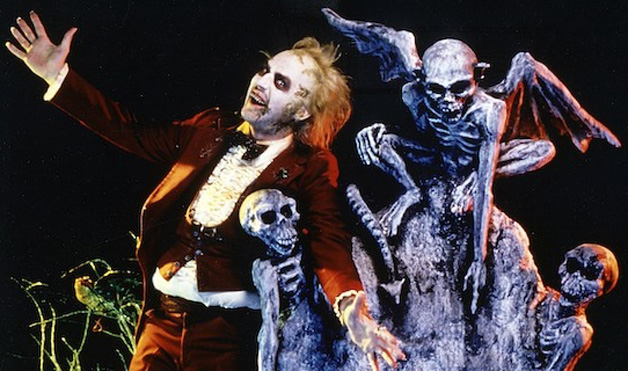
Betelgeuse is played by Michael Keaton, who is almost unrecognizable behind makeup. It’s a hilarious performance. Although, if the whole movie were about Betelgeuse, it would be a little irritating after a while. This guy is so manic that a little of this guy almost goes a long way. But it’s just so funny and he nearly stops the show.

But the movie isn’t all about that “ghost buster”—it’s about the relationship between two deceased lovers trying to cope with being dead and experiencing the most unbelievable stuff in the afterlife. When trying to scare off their new unwanted guests, they soon befriend Lydia who can see them because she’s “strange and unusual” and she can understand the weird Handbook. I like the energy and originality and gimmicks that were put into this movie. I love the way the afterlife looks, and how Tim Burton creates the illusion of an afterworld with great special effects, amazing set pieces, and dark cinematography.

Alec Baldwin and Geena Davis do terrific jobs as the couple, and Jeffrey Jones, Catherine O’Hara, and Winona Ryder are no slouches either as the New York family. And then, Keaton is there to liven—or deaden—up the party with his crazed performance of Betelgeuse.

“Beetlejuice” is crazy but wonderfully so. It’s a nicely-done mixed blend of comedy and horror. I liked the casting, I liked the production design, and I also liked the visual jokes put into the scenes involving the afterworld (a badly burnt ghost is smoking a cigarette, for example). Even if it goes overkill near the end, it’s still a good deal of fun.

Hancock (2008)

15 Apr

hancock3

Smith’s Verdict: ***

Reviewed by Tanner Smith

“Hancock” is an unusual superhero movie. Will Smith plays the title character John Hancock, who happens to have powers beyond belief and never grows old. I guess you could call him a superhero, but the trouble is that he has a really bad attitude, he’s an alcoholic, and he trashes everything surrounding him when he’s forced to stop trouble. It’s a nice premise. I mean, not all superheroes are nice guys, right? And he doesn’t even have a secret identity.

This isn’t a great movie, but Will Smith pulls it off with his usual attitude that makes all of his movies watchable.

Jason Bateman plays a public-relations agent/family man named Ray. He has a wife named Mary (Charlize Theron) and a young son. Hancock saves his life when he’s almost run down by a train (but also trashes his car and derails the train in the process). Ray owes him and decides to help him clean up his act. He takes him home; his son likes him, but Mary seems to know him from long ago, and keeps giving him a look, which doesn’t make this a spoiler. Hancock spends a few weeks in prison and Ray visits from time to time to counsel him and help him.

Soon enough, Hancock becomes a better man and tries not to trash the place when he foils a robbery when he’s released. However, things do not go so well for him afterwards. That’s just the first half of “Hancock.” There’s a big twist in the second half that makes us go “What?! Whoa!”

(I saw this movie in a theater with my friends and that was my real reaction to the twist.)

Will Smith is great in this role as the superhero with a hangover. He has this attitude and charisma that makes us laugh or care. From comedic roles in his infamous TV series “The Fresh Prince of Bel-Air” to tough guy roles in “Men in Black” to dramatic Oscar-nominated roles in “The Pursuit of Happyness,” Smith is a powerhouse performer and doesn’t seem to work hard to make his movies hits.

Also, Jason Bateman is quite good and relaxed as the nice guy who attempts to change Hancock. Charlize Theron is quite effective as Mary. She has nice moments as the wife who seems to have a history with Hancock. The only trouble with her character is we know that she has a history when we first see her on screen with Hancock.

The action scenes are big-budget and are spent as much time as the ones in “Spider-Man” or “Batman.” Most of Hancock’s antics, such as when he’s flying through the air and placing a car on top of a building (with people in it), are funny but most of them are also heartless. But luckily, director Peter Berg knows that the audience doesn’t care about him flying through the air throughout the whole running time. So, he puts in those moments when Ray is counseling Hancock and has a little secret and back story behind Hancock. Like I said, this isn’t a great movie but Will Smith makes it work for me.

Scream 2 (1997)

14 Apr

images

Smith’s Verdict: ***

Reviewed by Tanner Smith

Just as the terrific Wes Craven/Kevin Williamson horror film “Scream” featured characters who had seen other horror films and knew the basic formula, its sequel “Scream 2” not only brings back the survivors of the original film’s killings but also features characters who have seen a movie that was based on those killings (the title of that movie is “Stab”). Now they all trapped in another slasher nightmare in which a killer is out to make a real-life sequel.

This leads to two intriguing conversations about sequels. One takes place in a college film-class the day after the first murder has been committed, at the “Stab” premiere screening. The teacher argues that the movie influenced the murder, one student states that movies aren’t responsible for people’s actions (and indeed, if you recall in the first film, “Movies don’t create psychos—movies make psychos more creative!”), and another, film-buff Mickey (Timothy Olyphant), describes it as a “classic case of life-imitating-art-imitating-life.” Is it possible someone’s out to make an actual sequel to “Stab,” which was based on true-life slashings? “Stab 2?” actual-survivor Randy Meeks (Jamie Kennedy) asks. “Who’d want to do that? Sequels suck.” Of course he forgets about “The Godfather Part II.”

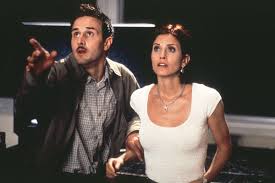
The other discussion occurs midway through the movie, as it turns out someone really is making a “sequel” to the original murders, as the body count continues to increase. Randy and visiting survivor, police deputy Dewey Riley (David Arquette), discuss “rules of the sequels”—the body count is always higher and deaths are bloodier (“carnage candy”). Who could be the killer? Whomever it is is already in their lives, so who can be trusted before they can they start to turn on each other? (Of course, they don’t—“If I’m a suspect, you’re a suspect.” “Good point; let’s move on.”)

“Scream 2” deserves credit for knowing that it’s an attempt to cash in on the success of the original “Scream” because that’s exactly what the killer of this “story” is attempting to do: increase the terror brought upon by the release of “Stab.” Not many sequels are as good as their predecessors, but “Scream 2” is about as good—it maintains the effective mix of scares and laughs in Kevin Williamson’s screenplay. (And if a scene needed to be scary, Williamson reportedly added in his script, “Wes Craven will make it scary.” A sad yet accurate distinction.)

Yes, there is a new slasher sporting the same black cloak and white-ghost mask, and he stalks a bunch of college freshmen, particularly Sidney Prescott (Neve Campbell), the heroine from the first movie. Randy is her classmate, and is still as knowledgeable about horror films as he was in the first movie. Dewey has come to aid in campus security once he hears about the murders. And Gale Weathers (Courteney Cox), the bitchy news reporter from the first film and who has written the best-selling novel based on the original killings, is here as well, along with a new cameraman (Duane Martin) after her original cameraman…well, never mind.

New characters include—Sidney’s dull, dim-witted, hunky new boyfriend Derek (Jerry O’Connell); the aforementioned Mickey (“the freaky Tarantino film student”); Hallie (Elise Neal), Sidney’s sassy roommate; Cici (Sarah Michelle Gellar), a sorority girl who may not last very long; and Debbie Salt (Laurie Metcalf), a reporter who rivals Gale for the inside scoop. Mainly suspected is Cotton Weary (Liev Schreiber), whom it turned out was wrongfully accused of the murder of Sidney’s mother two years ago. He wants his time to shine (fame for redemption) and practically stalks Sidney to help him out.

One of the strengths of the two “Scream” movies is that the characters are not cardboard cut-out caricatures just here to be killed off; they’re genuine characters that we come to care about. Even Gale, who can be beastly when she’s desperate for a story, shows signs of humanity so that she isn’t a one-dimensional snob. It’s hard not to care for these people.

The dialogue is still very smart the second time around—particularly engaging are the “sequel” discussions; a scene in which Gale’s African-American cameraman wants to bail (“I don’t want to be the news; brothers don’t last long in situations like this!”) while Gale attempts to calm him down; and in the prologue in which two black characters (played by Jada Pinkett and Omar Epps) discuss the lack of African-Americans in horror films.

I forgot to mention the prologue earlier—these two I just mentioned have come to the free premiere screening of “Stab” where so many horror-movie fans are excited and happy to be there, while also wearing the same killer costume that the actual killer wore. They’re all pumped and cheering in the murder scene of “Stab”…until they notice that Pinkett is at the front of the screen, having been stabbed by a real killer and dying and screaming in pain—that, of course, stops their cheer and laughter. That’s a very clever move; horror-movie fans want more violence and then they notice real-life violence and realize how wrong it was that they were cheering about.

And give Craven a lot of credit for openly parodying “Scream,” particularly when he gets to allow Robert Rodriguez to direct his own version of the Drew Barrymore shocker-opening from the original, and making that the opening scene for “Stab.” (The “Casey Becker” role is played by Heather Graham this time.) And there’s also a clip featuring Tori Spelling in the “Sidney Prescott” role that we see later on a TV. I wish there were more of those “Stab” scenes, and I also wish there could have been some acknowledgement that this horror film “Stab” has become exactly what “Scream” itself was lampooning.

The resolution of the killer’s identity is as effective here as it was in the original film. Actually, I think it’s even more thought-provoking. While it does have its wink at the audience (“Didn’t see it coming, did you?”), it also has a uniquely interesting argument about the killer that I wish I could give away in this review. But I wouldn’t dare ruin the surprise for you. Let me just say that the effect that young killers leave on certain people, especially those closest to them, leaves more a drastic impact than you might think.

Wes Craven really knows how to play with the horror genre, as much of an admirer of the genre as he is. With this, and also with “Scream” and “Wes Craven’s New Nightmare,” Craven can come up with enough clever ideas to make an entire TV miniseries dedicated to designing parallels between plot and reality. “Scream 2” allows him to take that notion for a sequel—if he had just taken it a step further, the movie would have been great. As it is, “Scream 2” is still pretty good.

Lemony Snicket’s A Series of Unfortunate Events (2004)

12 Apr

A-Series-of-Unfortunate-Events-2004-a-series-of-unfortunate-events-20504480-1706-960

Smith’s Verdict: ***

Reviewed by Tanner Smith

“Lemony Snicket’s A Series of Unfortunate Events” is based on a series of children’s books with warnings on the back saying not to read them because they are very depressing and disturbing. But of course, who could resist a warning like that? The movie, adapted from the first three books, opens with such a warning. It opens as a cartoon elf skips along its garden as flowers bloom (as a cheesy song plays) and it stops suddenly, so the film’s narrator, who is Lemony Snicket (voiced by Jude Law), states that the movie that will be shown, instead of this happy-go-lucky cartoon, is a dark and depressing tale about three orphaned children and a villainous actor. Snicket warns us to stop watching the film, but how can we not? The warnings on the back of the books and at the beginning of this film are incredible buildup.

The focuses of the story are the three Baudelaire children with different hobbies—one’s an inventor, one’s a reader, and one’s an odd biter. Despite these different traits, they have each other. One day when they are by the river near their mansion, they are met by Mr. Poe (Timothy Spall), the overweight and clueless manager of their estate, who grieves to inform them that a fire has destroyed their mansion…and killed their parents.

The children—the eldest inventor Violet (Emily Browning), her intelligent brother Klaus (Liam Aiken), and their toddler (“biting”) sister Sunny (Kara and Shelly Hoffman)—are left in the custody of their fourth cousin three times removed (or is he their third cousin four times removed)—an hamming, creepy actor who goes by the name Count Olaf (Jim Carrey). Count Olaf lives in a big, creepy mansion, shows no love for the children, and makes them do terrible chores all day. He desperately wants the family fortune and attempts to kill the kids for it, leaving the car stopped on the railroad tracks with them locked inside of it. The kids survive by using their wits and traits, but that’s only the beginning.

Before I go any further, let me warn you about Jim Carrey’s performance as Count Olaf. He overacts in this movie and he barely gets away with being a distraction to the kids, who are really the main focus of the film and are very smart and likable. However, I can say that most of his shtick is quite entertaining, especially when he shows that the character is such a bad actor. But when he delivers a few pop culture references in a movie that seems to be set in the early 1900s and when his “Ace Ventura” side takes over in a few scenes, it’s mostly distracting. But let me be fair and say this—this is the role that Jim Carrey was born to play.

After Olaf fails to kill the children, the kids are sent by Mr. Poe, who doesn’t see the act as a sign of attempted murder but as irresponsibility, to live with other relatives. But as they get comfortable in their new homes, Count Olaf arrives in disguise to try and take the children back. First they are sent to their friendly Uncle Monty (Billy Connolly), who has a bizarre obsession with snakes and weirdly unknown creatures. Uncle Monty knows what family is all about and wants to really relate to the children.

Then there’s Aunt Josephine (Meryl Streep), a paranoid, neurotic woman who is afraid of…pretty much everything. She lives alone in a house dangerously perched on the edge of a cliff over a leech-infested lake. (How could she not be afraid?)

Both of these relatives have a secret that the kids would like to know more about. All they have to go on is a spyglass. As they go from relative-to-relative, they find out more about it. However with Count Olaf coming along, overacting, and ruining everything from Monty to Josephine, it’s just more than these children can bear, to say the least. But when Count Olaf is around those times, Mr. Poe is such an idiot that he doesn’t see under his disguises. He simply dismisses the kids as imaginative half-pints.

“Lemony Snicket” keeps the darkness of the books. The kids have moments where they grieve over their parents’ deaths, the “unfortunate events” they run into are life-threatening (though almost predictably, they use their wits to survive), and their surroundings are rarely sunny. Count Olaf follows them everywhere they go and all he wants is their fortune and nothing else, even if it of course means killing them.

The kids are a fresh and likable bunch. Violet, played by Australian actress Emily Browning, is a bright 14-year-old girl who invents things frequently and knows that there is always something to make something out of. Klaus, played by Liam Aiken, is a smart young man who remembers everything he reads. Sunny, played by two-year-old twins Kara and Shelly Hoffman, bites and does nothing else except babble unintelligible words that are some of the funniest lines in the movie (English subtitles show what she says). The movie wants us to follow these kids and to root for them to outsmart their wicked relative. The actors playing the kids are a wonderful group and they really keep the movie going.

I’d say the main problem with “Lemony Snicket’s A Series of Unfortunate Events” is that it’s not so much a series of unfortunate events as it the same unfortunate event repeated, as the kids are passed around from relative to relative as they know Count Olaf is close by to mess things up again, and they use their wits to get out of a tricky situation every time. And there’s also a nasty, creepy addition near the end in which Olaf threatens to make things worse unless Violet agrees to marry him so he can inherit the Baudelaire fortune. I’d say to see what Roald Dahl would have done if he wrote the books this movie was based on.

While there are certainly dark currents under the surface of this fantasy, the director Brad Silberling doesn’t let them overtake the film. Yes, bad things happen—people die and children are in jeopardy. But there’s a dry wit that balances out and also a sense of fun in how the kids use their abilities to discover a new way to survive whatever comes next. “Lemony Snicket’s A Series of Unfortunate Events” is a strange, dark film, and I recommend it for being just that.

A Nightmare on Elm Street (1984)

12 Apr

A Nightmare On Elm Street 1

Smith’s Verdict: ***

Reviewed by Tanner Smith

“1, 2, Freddy’s coming for you…3, 4, better lock your door…5, 6, grab your crucifix…7, 8, gonna stay up late…9, 10, never sleep again…”

There’s a true boogeyman haunting the dreams of young people, and his name is Freddy—Fred Krueger, to be exact. With a horribly burned face and sporting a dirty red-and-green sweater, a Fedora, and gloves with knives for fingers, he’s the man of your (bad) dreams. But if he kills you in your dream, he actually kills you in reality, which pits the kids who dream about him into real danger. That’s the basic idea for Wes Craven’s “A Nightmare on Elm Street,” a surprisingly-effective slasher film with the most intriguing premise of the lot and more to offer than such films as “Friday the 13th.”

The movie is about a group of typical teenagers whose dreams are invaded by the supernatural boogeyman, Freddy (Robert Englund). It begins as Tina (Amanda Wyss) wakes up from one of these shockers only to find evidence that…maybe it wasn’t a dream.

Dun-dun-DUNNNNNN!!!

Tina tells her friend Nancy (Heather Langenkamp) about the dream, only to discover that she too dreamed about the same “creep.” (And one look on Nancy’s boyfriend Glen’s face indicates that he had the same dream as well.) That night, as she enjoys a rousing night of pleasure with her boyfriend Rod (Nick Corri), she then falls victim to Freddy and is ripped to shreds. (This is yet another example of how sex leads to death in horror movies.) Rod is sent to jail on a murder charge, although Nancy doesn’t quite believe he did it, as her nightmares only get worse and worse. She becomes convinced that Freddy is responsible for her friend’s death, and finds that she, Glen (Johnny Depp, in his first big-screen role), or Rod may be next. So the best way to stay alive is not to fall asleep.

The “nightmare” gimmick is usually not an effective element for a horror film because you see very often a scene in which a character dreams of certain doom and then wakes up in a cold sweat. Come on, who are they trying to fool, especially when it usually occurs early in the movie? It’s a tired, predictable, overdone gimmick that just doesn’t work anymore. But “A Nightmare on Elm Street” centers an entire movie around that element, in that even though you know for sure (and the characters know for sure) that there are many dream sequences, that is where the terror happens: in the notion that the doom in the nightmare becomes the doom in reality. But also, there are some parts (especially in the final act) in which no one, particularly the audience, surely knows what is real and what isn’t. The movie walks that fine line between fantasy and reality mostly, and that’s where the chills come from—uncertainty, suspense, and toying with expectations.

There are enough necessary (sometimes unnecessary) jolts and chills to make horror-film buffs tense, but it’s also a story that makes you really think about the situation. There’s a lot that people can read in the psychology of this idea (such as the notion that Craven based this idea from children who died in their sleep), and also how the gimmick can work in this movie. That way, audiences are attentive and interpreting.

The horribly-scarred Freddy Krueger has of course grown to become an iconic figure in the horror-film genre, thanks to his taking center-stage in the “Nightmare on Elm Street” sequels. Unlike “Halloween’s” Michael Myers/The Shape or “Friday the 13th’s” Jason Voorhees, Freddy does not wear a mask and is not silent. He has a sick, twisted personality that goes with his sick psychoticism. This is a truly an iconic horror-movie villain. But he’s not the center of this original “Nightmare on Elm Street” film, necessarily—he’s just more like the looming demon waiting to strike. We get part of a backstory, but that’s all we know about him in this movie. This makes it more effective, but the less we know about the killer that was Freddy Krueger, the more creepy he is. (The sequels, however, go into more detail stating more of his story and why he’s able to haunt dreams, which doesn’t make him scarier.)

“A Nightmare on Elm Street” is more about Nancy and how she tries to figure out how to save herself, even if it means trying to stay awake. Her police lieutenant father, Donald (John Saxon), is too much of a hardass to pay attention because he’s more concerned about keeping the small community, where they all live, safe from danger. Little does he know that his own daughter’s subconscious is the greater danger. But Nancy’s mother (Ronee Blakley) actually does know something about Freddy and eventually tells her what happened to him and why he’s after certain young targets. Nancy decides to fight back and find a way to bring Freddy out of the dream world and into the real world so he can be stopped.

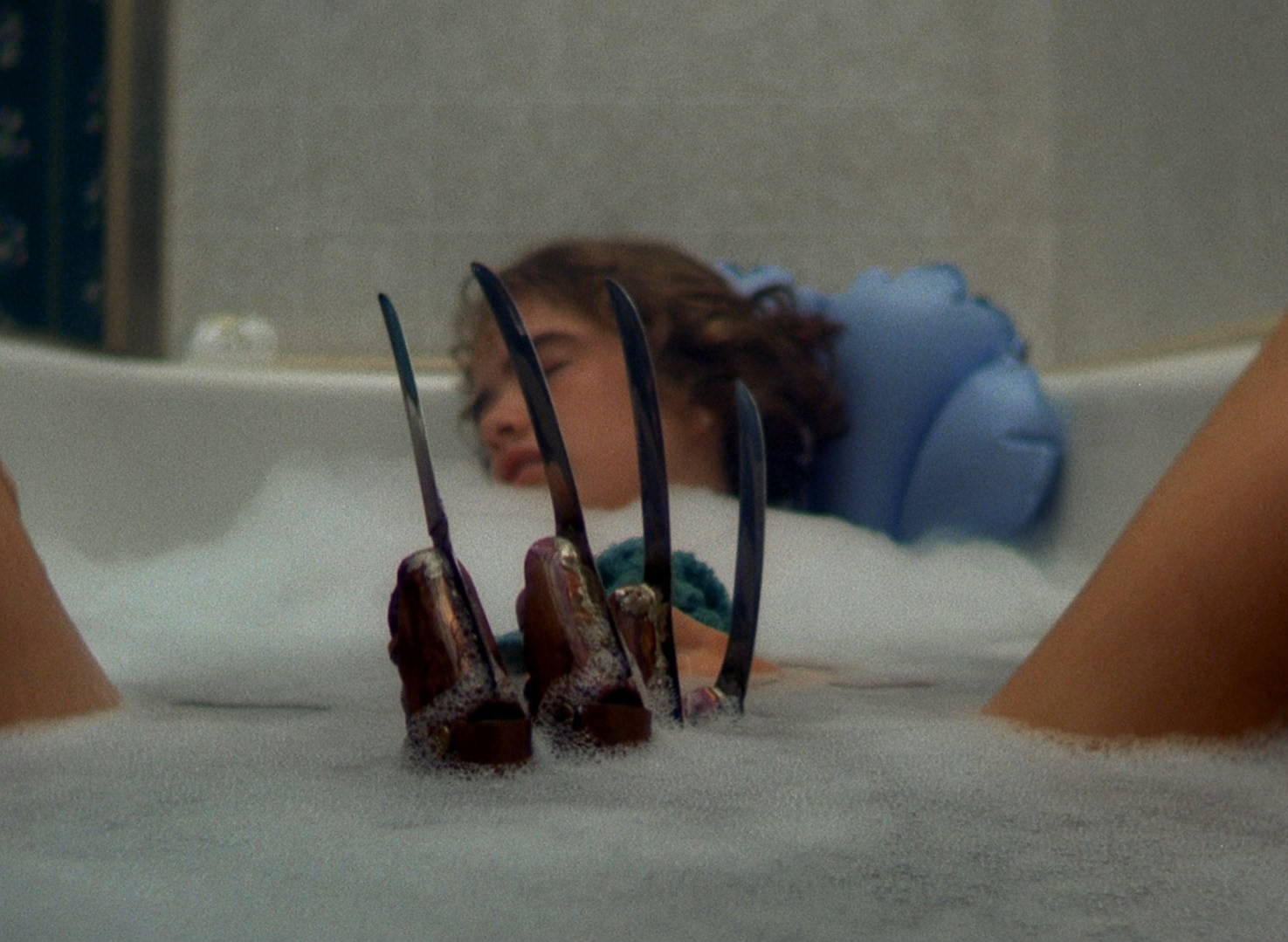
There are some effectively chilling sequences that occur in these nightmares (one of the most memorable involves a bathtub transforming into a bottomless pit), and like just about every good horror film, the terror is present thanks to a good deal of attention to atmosphere. The lighting is effectively done whenever the dream calls for a certain way. The special effects are good. And the music score is efficiently eerie for the movie.

“A Nightmare on Elm Street” is an effective horror film. The ideas are interesting, the tension is existent, and Nancy as a heroine is not a dumb, screaming idiot (she’s smart and resourceful), therefore able for us to like and root for her. I’m not quite sure I follow the ending, but I guess the point is to leave things open for interpretation. Craven does the material well, as it really seems he gets the genre and knows what his audience wants while also giving them something more in return. It’s a nicely-done chiller.

The Double McGuffin (1979)

12 Apr

Mcguffin11

Smith’s Verdict: ***

Reviewed by Tanner Smith

Alfred Hitchcock and Orson Welles used McGuffins in almost each of their own movies. A McGuffin, as described by Orson Welles’ narration at the beginning of “The Double McGuffin”, is a missing piece of a puzzle that leads to what the main characters in a story are trying to figure out. (“Usually there’s only one.”)

In “The Double McGuffin,” a children’s movie directed, written, and produced by Joe Camp (“Benji”), the heroes are a group of prep school kids who stumble upon the double “McGuffin.” One of them discovers a briefcase full of money and brings his friends to see it. Instead, they discover, to their terror, a dead body in its place. But when they bring police chief Talasek (George Kennedy) to its location, the body is missing. Then they notice a man carrying the same briefcase discovered earlier.

So, of course the kids are going to figure exactly what’s happening, and why, and everything leads to the discovery of a murder plot…but who is going to murdered? And why? And where? What makes the movie enjoyable is how bright these kids are and how fun it is watching them figure out a new clue whenever one comes up.

Ernest Borgnine plays the man with the briefcase. I really don’t see the point in casting a high-profile actor as a villain in a film that truly makes us want to follow along with the kids, who are appealing and very likable. He doesn’t have many scenes, but to give credit, despite being a children’s film, the adult actors—George Kennedy included—don’t dumb down their roles. Borgnine, in the few scenes he’s in, is calmly menacing and George Kennedy is convincing as the police chief who doesn’t like to be distracted. But Elke Sommer, as a mysterious woman, is given nothing special to do at all but to be stared upon constantly.

I mentioned that the kids were likable—these kids have to carry the whole movie and they do it very well. Dion Pride is Specks, the unofficial leader of the group; Greg Hodges is Homer, a spunky, witty young boy with a handy Swiss Army knife; Jeff Nicholson is Billy Ray, a young Texan who is probably the bravest of the group; Vincent Spano is Foster, the most enthusiastic of the group; Lisa Whelchel is Jody, the controlling, smart, pretty editor for the school newspaper; and Michael Gerard is Arthur, the stereotypical nerd. Now, it’s dangerous to use the word “stereotypical” in a positive review but I’ll take the chance because the kid is likable. All of these kids are well-cast and the movie works best when it’s alone with them.

What doesn’t quite work is the final half of the film. While not action-packed, the outcome is a bit confusing and set for a typical Hollywood ending.

But “The Double McGuffin” is a little treasure. It features kids and adults who are not dumb and a mystery that is actually worth investigating. I believed it when the kids solved something and was with them every step of the way.