I’m sure many of us who live near Kansas City, Missouri (such as myself) wish we could relive February 2, 2020 (the day the KC Chiefs won Super Bowl LIV) again and again…because due to the pandemic, it felt like we WERE living the same day again and again!
The time-loop story angle had been used before but not to this mainstream-comedy scale. The cleverly droll and also heartfelt writing from the late Harold Ramis (who also directed the film) resulted in a screenplay that was so good that of course the Oscars had to ignore it for Best Original Screenplay.
If I may quote Roger Ebert, who gave it three stars initially but then went on to include it in his Great Movies collection, “‘Groundhog Day’ is a film that finds its note and purpose so precisely that its genius may not be immediately noticeable. It unfolds so inevitably, is so entertaining, so apparently effortless, that you have to stand back and slap yourself before you see how good it really is.”
Do I even need to go on after that?
We all know how great “Groundhog Day” is, and I certainly know it too–I first watched it as a teen and loved how creative it was, I studied it in a screenwriting workshop, and it’s yet another example of my favorite type of subgenre: the “dramedy.” There are many parts that are funny and other parts that get me right in the feels, and they all feel like they’re part of the same movie.
Bill Murray is great at playing a jerk, but his role as jerko TV weatherman Phil Conners is probably Murray’s most difficult role to date. It’s also his most accomplished, as we go from hating this guy to laughing at him to empathizing with him and then finally to feeling happy for him. He has to repeat this horribly uneventful, mundane day over and over and over AND OVER again (according to Google, Phil endures the loop for over eight years)–Murray has to sell all the various stages of coping with such a strange and aggravating phenomena, especially when there’s no one he can share it with. That makes it all the more funny when he uses this ability to seduce women. But it’s also all the more heartwarming when he realizes that when he tries to copy something that was genuinely romantic before, it just doesn’t work again.
What’s even more interesting about this role is that Phil doesn’t become a different person–but he does become a better one.
Best Murray performances in my opinion: 3) “St. Vincent,” 2) “Lost in Translation,” 1) “Groundhog Day.” (“Broken Flowers” is a good #4.)
The time-loop concept has been used in other movies since–some to very good effect, like “Source Code,” “Edge of Tomorrow,” the “Happy Death Day” movies, and especially “Palm Springs” (the best of the “Groundhog Day” influences). But there is only one “Groundhog Day.” It’s a wonderful masterpiece for both Harold Ramis and for Bill Murray.
Strangely, I didn’t get so into Steven Spielberg’s “The Post” when I first saw it in a theater. I admired it for telling a serious story about a free press at the right time, but I didn’t get much from it apart from that. I think I made the mistake of comparing it to Spotlight–probably a fair comparison, since it’s the Oscar-winning film that set a new standard for “journalism movies” and both films share the same co-writer (Josh Singer). But it’s not really fair to THIS movie.
I’m glad I watched it again on DVD–I noticed a lot more that I didn’t before and grew a new particular fondness for it. In fact…I can admit that I think I spoke too soon when I said Bridge of Spies was my favorite Spielberg film of the 2010s.
There are some doses of romanticized sentimentality and melodrama (plus everyone likes to make fun of the somewhat-forced moment in which Katherine Graham is applauded by a mostly-female crowd as a new heroic figure), but in a lesser movie, those would bother me. The historical accuracy and attention to detail of the early 1970s are spot-on (and the DVD extras help my case there), and the whole film feels like a 1970s dramatic thriller, like “The China Syndrome” or (the most obvious comparison) “All the President’s Men” (to which this film is seen as a prequel). This is director Steven Spielberg and his usual crew (which includes cinematographer Janusz Kaminski and editor Michael Kahn) having a field day with this material. But they’re also telling a serious timely story at the same time, and Spielberg knew the importance of that. In fact, he halted pre-production on one project when he read screenwriter Liz Hannah’s Blacklist draft of “The Post” and immediately went to work on it. Within a year, he had a completed film released and ready for the Academy Awards (for which it was nominated for Best Picture).
That’s not to say Spielberg half-asses “The Post” at all. As I said, he gets a lot of the material spot-on–it’s just that as an added bonus, we get that special Spielbergian magic and edge to it. He cares very deeply about saying the right thing with the right film to be released at the right time. (That was the case with Munich, his take on the war on terror, and it’s the case here, in a film that has allusions to the presidencies of Richard Nixon and Donald Trump.)
“The Post” is set in the early 1970s, but it spoke to audiences in 2017-2018 because it was based on the true story of the Washington Post exposing Pentagon secrets and starting a movement for what we now call “free press,” at a time (during the Nixon administration) when a paranoid President feared such a concept. (Oh how far we hadn’t come…) And that’s why I now admire this film for its journalistic courage and recognition of the power of the First Amendment. (…I’m obligated to say, “Kinda like ‘Spotlight.'”)
At the time, the Washington Post wasn’t taken too seriously–it was seen more as a nice little local newspaper compared to the high standards of the New York Times. But editor-in-chief Ben Bradlee (played by Tom Hanks), who treats journalism like a highly competitive game, won’t stand for that. Things change, however, when one of his reporters, Ben Bagdikian (wonderfully played by Bob Odenkirk), comes across the top-secret documents that prove how the Vietnam War was set up. Bagdikian lets Bradlee in on the secret and he of course decides to go for it and print everything for the Post. (This was my biggest problem upon initial viewing of this film, that Bradlee seemed more concerned about beating the Times to this story than getting the story out there–but the more I watch the film, the more I realize, “This is Ben Bradlee–of course he has a clearer agenda than that.”) The Times has already exposed many of the Pentagon Papers–but when Nixon orders the paper to stop, Bradlee sees this as a chance for the Post to take a stand and remind everyone what freedom of speech means.
Meryl Streep stars as Katharine (“Kay”) Graham, heiress and publisher for the Post. We see the real-life Katharine Graham as a journalistic icon now, but back when this movie is set, she had to prove herself. One of the more intriguing aspects of the film is how Graham has to handle herself with an all-male board of directors who didn’t take her seriously and didn’t hide the fact that they didn’t want her in the way, making her unsure of herself. It’s even more interesting that she’s a long-time friend of Robert McNamara (Bruce Greenwood), the Secretary of Defense who played a major role in America’s involvement with Vietnam–if she gives Bradlee the go-ahead to expose the papers, she’d be turning her back on a friend. (She was also friendly with other Washington insiders–we see her mingling with them at many cocktail parties.) Therein lies the conflict of what’s more important to her (plus the high probability that both she and Bradlee could go to jail for going to print with this), which leads to a conference phone call that is the most suspenseful moment in the film. What results will change Graham for the better.
There’s a lot going on in “The Post” and a lot at stake for the characters and for the country in general. Bradlee knows that there has to be a free press, other people are with him, many people don’t want to risk it due to their own sense of integrities, others want to cover their own asses. It takes an intelligent and sharply written screenplay from Hannah and Singer to keep us on-edge because Spielberg keeps invested with his direction–and it helps further inspire those who dare to expose truth, secrets, or both.
Another thing to admire about “The Post”–the amazing ensemble cast. Even though Streep and Hanks are front-and-center of this film, they are aided by an excellent supporting cast. Aside from Bob Odenkirk (who, in fact, I wanted to see more of upon initial viewing–guess that’s what subsequent viewings are for), there’s also Tracy Letts, Bruce Greenwood, Sarah Paulson, Bradley Whitford, Matthew Rhys, Jesse Plemons, Alison Brie, Carrie Coon, David Cross (hey it’s a “Mr. Show” reunion!), Michael Stuhlbarg–just to name a few! They’re all brilliant here and hold their own with Hanks and/or Streep.
My favorite was Odenkirk’s Bagdikian because he played the type of reporter who went on this particular scoop to obtain these documents because he was truly the heart and soul of Bradlee’s newsroom and mainly cared about setting forth the truth.
And that’s what “The Post” is about: exposing the truth…OK, it may take some liberties here and there (as all films do), but its central message is clear. I may have gotten it back then, but I underrated the way it was delivered. And it’s a mistake I won’t make again.
Will anyone EVER forget the 2017 Oscars Best Picture controversy? No way. That was a total embarrassment for the Academy–they gave the presenters the wrong envelope for the biggest award of the night, the producers of La La Land had to surrender their trophies (which they did, with style and grace, thankfully), and the whole thing was a nightmare…but it was funny to watch!
Whatever. I think the Oscars are on their way out anyway…maybe.
Anyway, Moonlight won, instead of “La La Land.” And it made a lot of indie filmmakers very happy that the fancy-schmancy Academy of Motion Picture Arts & Sciences decided to honor a small film in this way. Did it deserve it?
Well, yeah. Obviously I think it’s a great film. I’m talking about it like it’s one of my top 300-350 favorite movies, aren’t I?
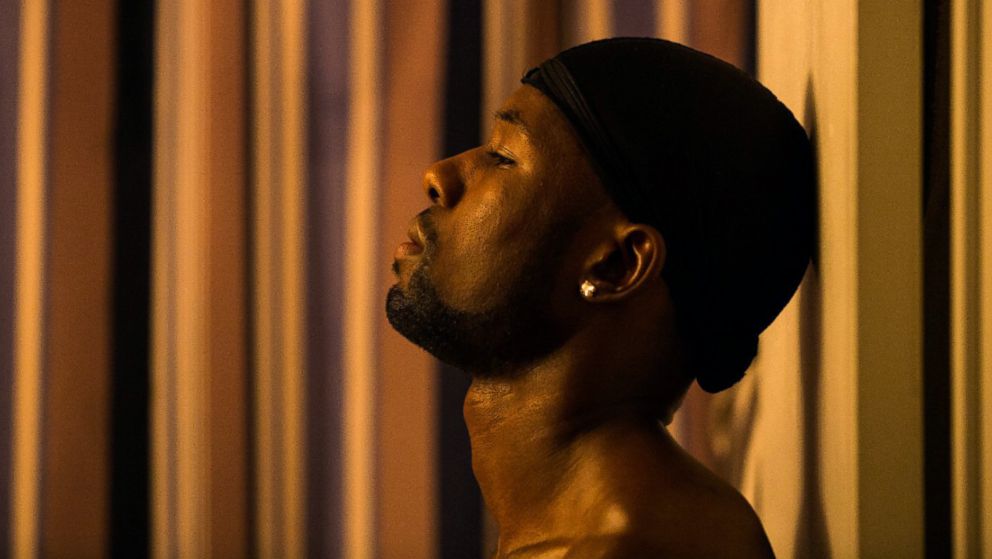
“Moonlight,” directed by Barry Jenkins, is the story of the life of an African-American gay man named Chiron, told in three parts–from boy to teenager to adulthood. But what is it truly about? It’s not merely an exploration of a man coming to terms with his sexuality. It’s a film that shows how important it is to love yourself before you can love others, especially in a world where it’s hard to embrace who you are because it makes others uncomfortable. It’s often said in other sources that if you don’t love yourself, the insecurities get the better of you, which leads to unpleasant confrontations with the people in your life. That would help explain the behavior of Chiron’s mother Paula (Naomie Harris)–when I saw this film a second time, the scene in which she goes through mixed emotions while on crack, I couldn’t help but wonder what was on her mind, how she grew up, what brought her to this, and more. This is a person who doesn’t love herself and thus doesn’t treat her son with the love he deserves. And once I considered that, that made their reunion many years later all the more powerful. (That’s all I’ll say about that.) And so here you have Chiron, who is going through so many issues in life, doesn’t have many people to call his friends or family, is confused about himself, faces intolerance and poverty, and could easily go down the wrong path for the rest of his life (which is why it’s alarming when he commits a certain act in his teenage years). With confidence and love, he can overcome these things and turn it all around, which is what we hope will be the case when he reunites with his old school friend Kevin.
Barry Jenkins knows just how to tackle this subject by making the themes universal so that even audience members who aren’t gay or black or even male can find something big in this small film that they can completely relate with. But of course, it’s one thing to have a gripping script with a look/feel that seems genuine; it’s another if the right actors can pull off these roles. And boy, do they. The cast is across-the-board excellent, with all three main actors capturing all three sides of Chiron brilliantly. Naomie Harris is also brilliant showing the angry and bitter but also human and sad sides of a single mother with too many problems of her own to show love and affection to her son. And last but certainly not least, Mahershala Ali is outstanding as Juan. It’s not a big role, as he’s only present for the first segment, but to say he makes the most of it would be an understatement.
Now, I have a little story I want to share, and it’s my favorite scene too—I missed seeing this film in 2016 and only saw it after it won the Best Picture Oscar; Ali’s Best Supporting Actor Oscar clip convinced me I had to see it as soon as possible. It’s a scene in which little Chiron confides in Juan that he hates his mother. Juan’s response: “I hated my mom too…I miss her like hell now, though.”
Ali is one of those actors that always gets my attention these days, because I think he’s one of the best–I DARE you to look at his performance in “Moonlight” and then look at his performance in Green Book, and tell me he doesn’t have a wide range!
“Moonlight” is a film that is absorbing, rich, and more importantly, real. Much of it is bleak, but that’s what’s needed for the more uplifting, sobering aspects to take effect. The ending successfully shows that in life, there are no ways of going back (and no reason to either), the things you go through make you who you are, and where you go from here on out is ultimately up to you. That it all comes a film that is this well-acted and well-executed makes it all the more powerful and deserving of the Best Picture win.
I talked about so many modern films recently, so now I’m going back to the 1950s with a film in my top-20: 12 Angry Men.
There are some snooty jerks who mock films that are “talky” and in which “nothing happens.” Well, I don’t associate with them, because if you have the right writing, acting, and directing, films that contain one long conversation after another can be the most insightful, powerful films ever made.
Sidney Lumet’s “12 Angry Men” is set almost entirely in one room–inside this room, a courtroom jury of 12 men are deciding the fate of an 18-year-old boy charged with murdering his father. Did he? 11 of them think the answer is clear: he’s guilty. But one (Henry Fonda) isn’t so sure–things don’t quite add up to him. Their decision has to be unanimous, so they spend the entire rest of the film putting more pieces together so they can determine whether or not the kid is truly guilty.
There are no clear answers here. There are merely deductions, possibilities, even contradictions to both facts and opinions. What if the boy really did kill his father and they’re arguing about whether or not he should be let go? You’d have to have a really strong case to prove otherwise, and the way the mystery leaves room open for more answers is truly fascinating. What’s the proper way to use a knife like the murder weapon? Can you hear someone shout at the top of their lungs over the deafening sound of a passing el train? Can you remember the last movies you saw in a moment of distress? Could those two distinct marks on the witness’ nose be made by anything other than eyeglasses?
A lot of discussion, a lot of conflict, and a lot of interest–and this is all coming from a jury that needs to do its job well or risk letting an innocent man die.
My favorite scene: without giving it away, it’s Juror #3’s moment of revelation, wonderfully acted by Lee J Cobb.
I have seen the 1997 made-for-TV remake by William Friedkin–it’s fine; it’s still the same dialogue delivered by great actors (and as good as Lee J Cobb was, George C. Scott is probably a step up as Juror #3), and it’s worth a watch if you love the original play and the ’57 film and are curious to see how it’s handled here.
The Rental was an honorable mention on my year-end top-20 list…seeing as how I’ve been watching it again and again just shortly after, maybe I should’ve found a spot for it on the list. And in the months that passed, I’ve watched it quite a few more times. I could say, “I’m not even sure it’s that good–I just like it a lot.” But…I do think it’s that good.
“The Rental” was the directorial debut of Dave Franco, who co-wrote the film (with mumblecore pioneer Joe Swanberg) based on his personal paranoia about house-sharing. I hope it was therapeutic for him, but at the same time, I can see some people watching this horror film and thinking twice before renting an Airbnb.
Before the blood hits the fan, “The Rental” works as a nicely-observant comedy-drama about two couples who rent a large remote seaside dwelling for the weekend. The renters are Charlie (Dan Stevens), his business partner Mina (Sheila Vand), his wife Michelle (Alison Brie), and his brother Josh (Jeremy Allen White), who is also Mina’s boyfriend. The film does very well at setting up these four main characters as real people with moral dilemmas…especially when they get high on ecstasy on the first night, leading to Mina and Charlie hooking up in the shower.
Well, that was a mistake, wasn’t it. Oh well, it won’t happen again and neither Michelle nor Josh need find out about it. But then Mina discovers there are tiny hidden cameras in the house…including one in that same shower.
I love it when a thriller eases you into the terror. For the first half-hour or so, “The Rental” is an indie dramedy as good as a writer like Swanberg has ever done (maybe even better), and Franco proves to be a solid director and knows to put interesting people at the center of the screen.
But now we’re getting into some tense stuff here. What about these hidden cameras? How many are there? Why are they there? Who put them there? What happens when Mina and Charlie try to figure it out without their significant others knowing their secret? (Btw, that’s why they don’t call the police right away. Priorities, I guess?)
I won’t give away what happens as the characters (as well as the audience) try to find answers to these questions. But I will say it works pretty darn well as a horror film, with lots of surprises and chills to come as things go from relaxing to uncomfortable to downright nightmarish for these people who just wanted to share a relaxing weekend together and have no idea what’s coming for them next.
“The Rental” probably isn’t for everybody, and when answers are revealed, I can see a lot of people turned off by its ability to negate many other parts of the film. But that’s another reason I really like it–it uses an old-fashioned Hitchcockian approach to unraveling this chilling mystery.
I will say this though. The Invisible Man was my favorite horror film of 2020, but there’s one scene in “The Rental” that scared me more than any horror film in 2020–and it happens during the end credits.
What can I say? “The Rental” truly grew on me. I liked it before; I love it now. And I look forward to seeing what director Dave Franco does next.
Ohh, how am I going to get across how great this film is without spoiling it?
“Dead Again” is a 1991 thriller directed by and starring Kenneth Branagh, best known for Shakespearean film adaptations. (And btw, if anyone’s wondering if I’ll be talking about any of those for this series, yes I am–“Hamlet’ and “Much Ado About Nothing”…I couldn’t really get into Henry V.)
Branagh plays a private investigator named Mike Church, whose recent case is finding the identity and memory of a pretty woman (Emma Thompson) who seems to have lost all sorts of either. A hypnotist (Derek Jacobi) decides to help by putting her under hypnosis to see if it helps any, believing that a past life might have led to trauma in her present life. (Interesting leap there, but whatever.) Sure enough, the woman, nicknamed “Grace,” has visions of the tragic romance of Roman and Margaret Strauss (also played by Branagh and Thompson), which ended with cold-blooded murder. Mike doesn’t believe in any of this, but then he gets hypnotized as well…and suddenly, his courtship with Grace could be dangerous.
Oh, and Robin Williams is in this too. (He asked for his name not to be included in the credits so his appearance wouldn’t mislead audiences–well, that didn’t prevent his appearances in the film’s trailer!) He brings a dark comic edge to his side character of a grocery employee who used to be a psychiatrist and warns of the possibility of the past coming back to haunt and harm the present. “The karma credit plan,” he states: “Buy now, pay forever.”
And…really, I should just stop right there. There are two key twists to this story. One of them is probably easily guessable, but honestly, upon subsequent viewings, it really works–especially when you see how tightly woven writer Scott Frank’s screenplay is is making sure everything fits together. It makes the ending and the overall resolution all the more fitting and fascinating (and pretty nasty too).
Btw, the present-day story is set in Northern California and both Branagh and Thompson hide their English accents rather well. Branagh, I was most surprised by–how is it that the most English of English actors sounds more convincing with an American accent than Benedict Cumberbatch and Hugh Laurie? Don’t you usually have to sport a Southern accent for that?
I admire Branagh’s Shakespearean works, but this Alfred Hitchcock homage is pretty damn good. Maybe it’s good that “Dead Again” is underrated, if it means the twists aren’t overtly spoiled for people coming into it cold.
Seriously. Check this one out. Even if you don’t believe in reincarnation, give it a chance and see how the movie plays with that angle. You might still be intrigued.
Here’s a film from a couple of years ago that I did not want to see, that I didn’t expect to see again (or even WANT to see again), and that I DEFINITELY didn’t expect to call it one of my new favorites!……And yet here we are.
A film about the hardships and awkwardness of experiencing eighth grade (even if it’s just from one eighth grader’s perspective) did not sound like my cup of tea. (I didn’t care if critics were praising it across the nation—critics also praised the well-crafted yet utterly miserable “Welcome to the Dollhouse,” a film about a shy 7th grade outcast.) My reason for this—I don’t have many fond memories of eighth grade, especially after a terrible seventh grade year (Though, that’s not to say there weren’t bright spots here or there.) Any film that effectively captures what it’s like to be an outcast in junior high school is not going to appeal to me.
Why do you think there are more movies about high-schoolers than middle-schoolers? Because who wants to remember what middle school was like??
But I’m glad I took a chance on this film: Bo Burnham’s Eighth Grade.
Many of us remember what it was like to be 13-14 years old. Even if we were popular in school, we still faced many a challenge within ourselves and within our social circles, such as going through puberty, finding our sexual identities, maintaining particular images for people, and other awkward, confusing aspects that come with the age. We went through hard enough times when we were alone—add school to it, and it makes things even more uncomfortable!
We know this. We went through it. And even though things are far different now (thanks to social media) than they were, say, 15 years ago, that doesn’t matter because today’s eighth-graders still go through it. Do I have to bring it up? Yes, for this reason—”Eighth Grade” is a sweet, intelligent, sometimes-funny, sometimes-unsettling, always-accurate slice of life that I think today’s eighth-graders will gain a lot of insight from in order to feel better about themselves. (Forget the “R” rating—this film was made for the teens who need it!)
But what would adults get out of it? Well, why did standup comedian Bo Burnham make it to begin with? Because he often suffered panic attacks before performances and wanted to create a story that dealt with anxiety. He chose the eighth-grade setting because he considers it a crucial period of self-awareness. He said in a Huffington Post interview, “I wanted to talk about anxiety and what it feels like to be alive right now, and what it is to be unsure and nervous. That felt more like middle school than high school to me. I think the country and the culture is going through an eighth-grade moment right now.”
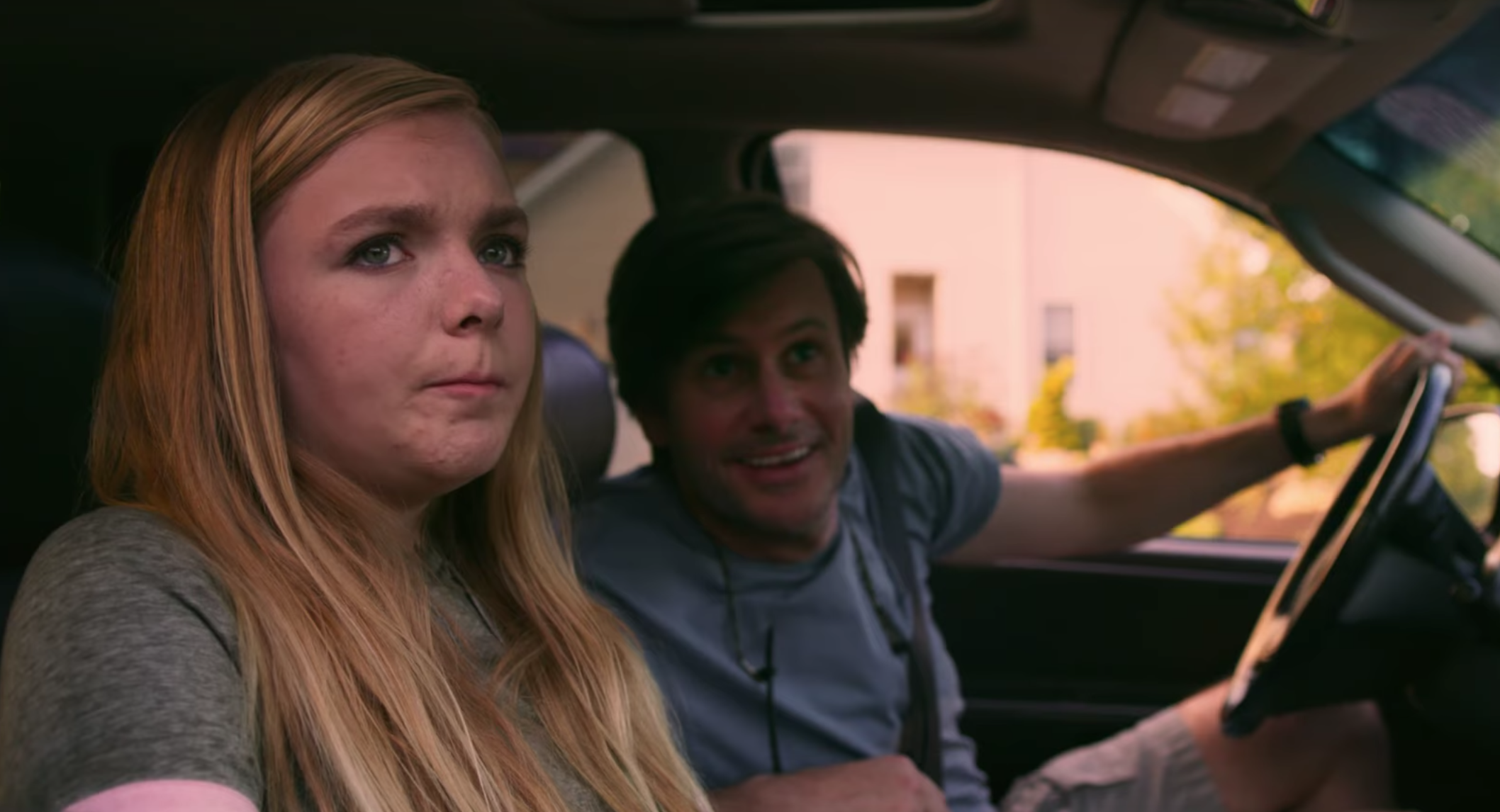
What did I get out of it myself? Why do I avoid “Welcome to the Dollhouse” like the plague and yet hold a special place in my heart for “Eighth Grade?” Because as honest and uncomfortable as “Eighth Grade” can be, it comes from a place of both love and hope. After this film’s end, I get the feeling that while Kayla (wonderfully played by Elsie Fisher) will still suffer anxiety attacks as time goes on and she gets older, she will not only overcome them but she will never be alone. I think she’s going to be OK.
My favorite scene: as much as I love the speech made by Kayla’s father (Josh Hamilton) near the end of the film (it’s a great “father” speech that reminded me of a similar one in Call Me By Your Name), my favorite scene is one that takes us right in the middle of Kayla’s anxiety, as she nervously enters the pool party and is unsure about what to do next.
Oh, how I wish I had seen this film in theaters in 2017.
Brigsby Bear is a WEIRD one to describe to people–so I usually start with, “It’s one of the most original films you’ll ever see!”
Or, “There is nothing quite like the feeling I have when I make movies with my friends. And this film captures that.”
Or, my mom’s personal favorite: “It’s dope as sh*t!” (which is a line from the movie)
Brigsby Bear is so creative that to try and summarize its plot would be difficult. (I’ve seen many overstuffed movies for which that WASN’T a good thing.) But I can describe what this film means to me personally.
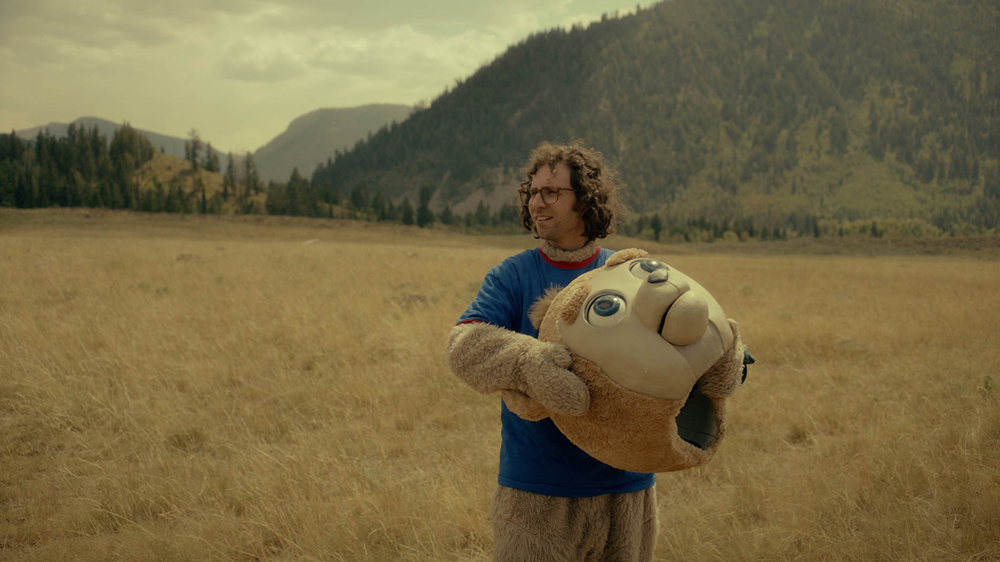
The main character James (played by SNL’s Kyle Mooney, who also co-wrote the film) is making a movie with his friends based on his hero since childhood (Brigsby Bear). They have very few resources, they get family and friends to contribute, they get a cop friend to steal props for them (don’t ask–it’s complicated), and they work together to make what they believe is an awesome piece of work.
I get it. Everything about that moment, in which they’re making their movie and hanging out together, I totally get. And what’s even better is this movie gets it too. What do I personally love more than making movies? Making movies with great people who want to make them with me.
If you haven’t seen this film, I won’t dare go into who exactly Brigsby is, how James ended up with him as a childhood idol, or what exactly James’ deal is and what led him to make this movie. Going into it blind is the best way to start out. And then seeing it again, you’ll get even more pleasure from it.
And fun fact: this is one of those movies I watched the most during Covid lockdown. I truly love this film.
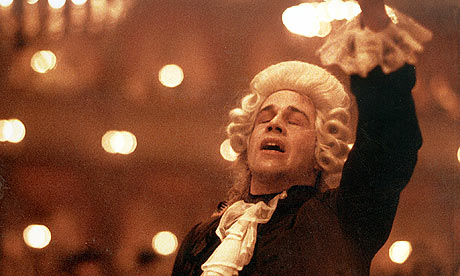
One time, I watched Amadeus with a friend who hadn’t seen it before. He’s such a movie buff that he thought he could guess exactly what was going to happen with Mozart and Salieri in this movie, and I kept having to tell him “no” or even lie and say “yes” just to see how he’d react. This is just one source, but it could show that what “Amadeus” isn’t is “predictable.” What it is is one of my all-time favorite films.
It’s funny, because I’m not that big a fan of classical music. Not that I dislike it (far from it); it’s just that I don’t listen to it that often. (There’s a difference.) But I still adore this movie both as a story about the creative process and a character study about an ingenious but immature artist and a mediocre but hard-working one who’s very envious of the other. Either way you look at it, it’s still an engrossing film (so engrossing that I constantly forget how long it is because it moves at a brisk pace–I can easily watch this 160-minute film in one sitting).
“Amadeus” isn’t entirely historically accurate, but so what? It’s historical fiction that captured the spirit of Mozart, so it can’t be taken that seriously. I learned that Mozart did put more effort into his work than this movie may have given him credit for, and it’s unlikely Salieri really wanted to murder him. But again, so what? It’s Salieri telling the story anyway, thus the film dabbles with the “unreliable narrator” element brilliantly, which makes it one of the more uniquely beautiful and innovative historical-fiction films ever made.
I haven’t seen the director’s cut, but frankly, I don’t want to. The film is perfect as it is and it doesn’t require additional material. I don’t need to see it either. It’s like Mozart would want it–if something is good enough not to be changed, don’t change it.
Before I start with “Cloverfield,” let me just state for the record that I’m not one of those movie reviewers (I’m not a “film critic” so much as “movie reviewer” nowadays) that are afraid to publicly change their opinions on certain movies–for that matter, I’m not afraid of rewatching those certain movies either. It happens. For instance, I may have given Cloverfield 3 stars out of 4 initially, and maybe my reasons still hold up–but you know what? It stayed with me. It stuck with me. I love revisiting it. I admire the craftsmanship. I get something new each time I watch it. Hell, I’ve even watched it at least 50 times in the past thirteen years since its theatrical release! Therefore, it’s a “favorite.” (So is its companion piece 10 Cloverfield Lane, but I didn’t underestimate that one right away–I gave it 3 1/2 stars.)
Watch a movie a few more times and your feelings towards it will probably change. And I’m not ashamed to admit it.
And this is why I have Revised Reviews…or reviews in which I revisit these films just so I can talk about why I love them after some time has passed. (Hence, “My Favorite Movies.”)
Anyway, back to “Cloverfield.”
I was there…I was one of the witnesses to the most devastating, confusing event I ever saw unfold in front of my eyes…the horror…everything seemed so normal, and then…buildings blew up…flaming debris flew all over the city…and then the head of the Statue of Liberty suddenly made its way onto the street!! But the most horrifying part of it all?
The trailer didn’t have a movie title! OH, THE HORROR!!
Yes, I was one of those moviegoers that was confused and yet intrigued by that infamous teaser trailer that came before the first “Transformers” movie back in 2007. The first-person camera perspective capturing all the mayhem happening in Manhattan added to the tension and made me want to see the movie so I can understand just what the hell was going on! There was no title in the trailer–just a release date: 1-18-08. (For a while, I thought “1-18-08” was the title!)
Six months later, we got “Cloverfield.”
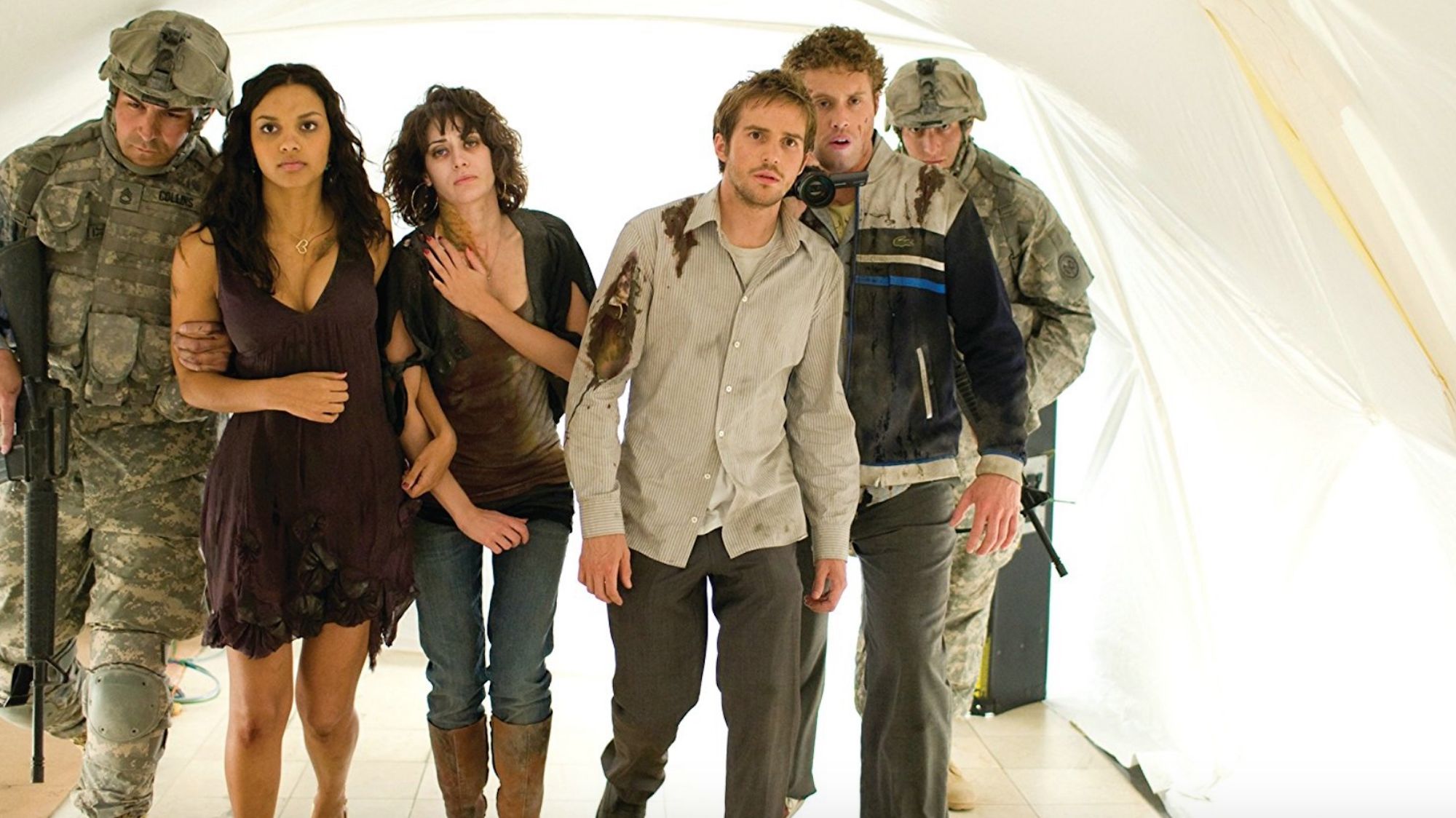
While The Blair Witch Project helped inspire this film’s look, “Cloverfield” was the film that helped make the “found-footage horror” subgenre popular (and the success of Paranormal Activity, which was made with even less money, would help even more a year later). What makes it effective is how slowly it builds everything up in the first 20 minutes. Everything seems normal, with a bunch of 20somethings hanging out at a party and going through some drama they have to talk each other through. And then suddenly, midway through a conversation, BOOM! The building shakes, there’s an explosion, the power goes out all over the city for a moment, everyone’s panicking and wondering what’s happening, they watch the TV news as soon as the power’s back on, they all go up the roof to find out more, A BUILDING BLOWS UP, THERE’S FLAMING DEBRIS HURLING ALL OVER THE CITY, EVERYONE’S SCREAMING AND YELLING AND GOING CRAZY–
I love that. Everything can seem so ordinary before it all goes to hell. “Cloverfield” captured that perfectly. And having it come from the first-person camera perspective helped a lot in making it effective–we are there watching the action happen. And what’s even more impressive is the production value–because the film looks cheap (in that this disaster movie is shot on ground-level with a handheld camera), it’s easy to forget that we’re bearing witness to many big-budget pyrotechnics that fit right at home in a “Godzilla” movie (blowing up the Brooklyn bridge, the military firing at the monster in the street, etc.). And because we’re seeing it at this level, it’s more disturbing and intriguing.
Once the film gets going, it hardly lets up. Our heroes, including Rob (Michael Stahl-David), Lily (Jessica Lucas), Marlena (Lizzy Caplan), and the camera-operator/comic-relief Hud (T.J. Miller), are in the middle of a city evacuation due to the presence of a gigantic monster that’s attacking the city. (And because we only see the monster from afar, we don’t get any info about it–the only explanation for its existence is merely implied.) But Rob has something else on his mind, as he decides to head deeper into the city to save his ex-girlfriend Beth (Odette Yustman), for whom he still has feelings. His friends decide to follow him (especially Hud, because after all, he’s got to film everything), and we’re treated to one scary situation after another.
There is a quiet moment in which our heroes are safe underground in a subway station–they separate from each other to take in everything that’s happened already and, in a truly disturbing effective moment, they listen to the action happening above ground and can only imagine what could be happening right now. I felt that moment, and the acting, especially from Lizzy Caplan, is spot-on.
The scariest scene for most people who see the film has nothing to do with the big monster (though we do get a nice “eating” moment with the beast near the end). It’s set in a dark subway tunnel, which our heroes have to walk through when most of the streets are blocked off. OK, fine, it’s dark and there are rats, but the trains aren’t running and the gigantic monster can’t fit in there anyway. What do they have to worry about?……There are smaller monsters that come from the big monster…and they find their way into the tunnel…and we don’t see them until the camera’s night-vision is turned on…and they attack!
Trying to make your way through a really dark place is scary enough. You never know what’s in the dark waiting for you…
Of course, people complain about the film’s shaky camera movements. (In fact, theater owners had to warn people who were prone to motion sickness not to sit in the front row when they saw the movie.) Director Matt Reeves wanted to capture a realistic amateur look, since the film is being shot by characters who hardly know how to operate a video camera in the first place. It is annoying, but when you really think about it, it’s sort of acceptable, especially in the scenes in which Hud is running for his life. I don’t think he’s as concerned about getting “the perfect flowing running shot” as he is about capturing “how it all went down.”
“Cloverfield” is a truly effective horror film, and I enjoy watching it more than I enjoy watching any recent “Godzilla” movie, honestly. It’s like a “Godzilla” movie in which the perspective is always from the witnesses of the mass destruction. And it would help give birth to other “found-footage” movies…for better or worse.




 Smith's Verdict