
Archive by Author

Cotton County Boys (Short Film) (2011)

18 Feb

timthumb.php

Smith’s Verdict: ***1/2

Reviewed by Tanner Smith

One of the films I looked forward to seeing at the 5th Annual Little Rock Film Festival in early June 2011 was “Cotton County Boys,” Collin Buchanan’s senior thesis film for the UCA (University of Central Arkansas) Filmmaking Program. What drew my attention to it was its clever, 70s-retro-style 3-minute trailer and its cast, which included Levi Agee (film columnist for the Arkansas Democrat-Gazette), Lynnsee Provence (actor in “Shotgun Stories”), and Natalie Canerday (the mother from “Sling Blade”).

So on June 5th, 2011 in Little Rock, I saw “Cotton County Boys” (which is 30 minutes long) when it was screened with five other short comedies made in Arkansas. I was hoping to like it…and fortunately I did. This is an enjoyable short comedy with a lot of laughs and many moments when I had a smile on my face. It also has a heart—the film fit right into its LRFF category title, which was “Hijinks and Heart.”

The titular Cotton County Boys are three dim-witted but well-meaning Southern brothers who still live with their mother and spend most of their time messing around and shooting each other with 4th-of-July rockets. That’s actually how the movie opens—one of the brothers smells the morning air in a brief tender moment right before the others playfully shoot fireworks at him.

The conflict of the story is that the Cotton family needs to come up with $12,000 to save the family house from foreclosure (it was originally $11,000 until one of the brothers broke the process server’s car’s back window). So the brothers—Bobby (Terrell Case), Bo (Levi Agee, who also co-produced this film and is credited here as “Reuben Agee”), and Sammy (Lynnsee Provence) Cotton—decide to go job-hunting. Bobby finds a job at a fast-food restaurant, where he develops a crush on the attractive co-worker Hattie (Kelsie Louise Craig), and Bo and Sammy find a job painting birdhouses. (This is shown in a montage, which features cameos by Arkansas Democrat-Gazette film critic Philip Martin and Candyce Hinkle, who played the landlady in “True Grit.”) Soon enough, though, they get the idea to win the money by making their own funny home videos and sending them into their mother’s favorite TV show, which can be seen as a clone of “America’s Funniest Home Videos.”

This results in multiple shots to the crotch and other injuries. Now, as tired as I am of the comedic “shots to the crotch” cliché, it works here because a) they’re still funny here and b) they help serve the story. The sequences in which the boys film their own stunts using the family video camera are amusing, fun to watch, and actually about something. This could have been a formulaic romp about cardboard characters who simply run around nearly getting themselves killed. But no—director Collin Buchanan is very careful in making us empathize with the characters. They’re not completely idiotic—in fact, Bobby, Bo, and Sammy are smart in their own way. And everything they do is for the family. This is where part of the film’s heart comes into place. There are also some brief awkwardly-funny but somewhat-sweet moments between Bobby and Hattie, although their relationship could have gotten a little further before the emotional payoff at the end. Actually, this is what cost the film half-a-star. Maybe if the film were a little longer so it could have a few more moments with Bobby and Hattie, this would have gotten four stars instead of three-and-a-half.

But the true heart of “Cotton County Boys” lies within the relationship of the Cotton family. Terrell Case, Levi Agee, and Lynnsee Provence give good performances as these likable characters and have a nice rapport with each other, as well as with Natalie Canerday, who plays their mother. They add to the humor and heart of this endearing short film. But wait! What review of a movie with ridiculous stunts could resist the joke, “Don’t try this at home?”
Foot Soldier (Short Film) (2011)

18 Feb

Foot_Soldier2-1317227267

Smith’s Verdict: ****

Reviewed by Tanner Smith

Oh boy… how am I going to talk my way through this one? To tell the honest truth, it’s hard for me to explain why this unusual short film “Foot Soldier” works. It just sort of does. It’s weird with its odd little touches that move the story along, but it’s also exceedingly original and very well-executed.

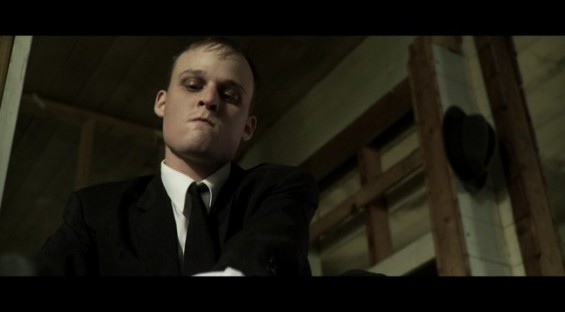
Foot Soldier” is a Southern Gothic tale with cinematography that captures the essence of the backwoods of the South. It’s desolate, yet comforting and wistful. Making his way through a small town with that sense is a door-to-door Bible salesman named Emmitt (Dustin Alford, giving an excellent performance with a convincing blend of innocence, gullibility, and sorrow). Emmitt is apparently homeless, as he wakes up in an abandoned house and has very little money in his pocket. He lives by his belief in God and by his door-to-door sales.

Oh, and he also has this habit of stuffing the inside of his shoes with pebbles and gravel, so that he’ll endure the pain to continue with his faith, while attempting to continue his sales. But it’s after an uncomfortable encounter with a sleep-around (Natalie Canerday) that Emmitt starts to lose his faith and see things in a new, twisted way. But his next attempt at challenging his own faith leads to a new view on life.

I don’t want to give too much away, except that after that encounter, Foot Soldier features Emmitt as he makes a ill-advised choice and then finds himself in the company of…well, about the one who delivers helpful advice, you will either accept, laugh at, or (possibly) be offended. In fact, the entire second half of “Foot Soldier” had me questioning why it worked as well as it did, considering the choices being made. But I am praising it for its originality and its sense of humanity. When “Foot Soldier” was over, I found myself wishing to see more of this protagonist’s journey, and oddly enough, I found myself enjoying the little things in life a little more.

The Conversation (Short Film) (2011)

18 Feb

mqdefault

Smith’s Verdict: ***1/2

Reviewed by Tanner Smith

The Conversation features the chronicles of a blind hit man, although he constantly reminds the reporter that’s interviewing him that he’s not “blind,” but “visually impaired.” And yes, it turns out there is a difference. The hit man — Trench (well-played by Chad Bradford) — explains it to the reporter (Paige Reynolds, whose overly polite manner in this film makes me wonder if she can play a psychopath) in honest terms, and that most people don’t know it. They either say to him, “Oh you’re blind — let me help you” or “You can see — get it yourself.”

The Conversation tells Trench’s story in just ten minutes and it’s a nicely-done dark comedy about the ups and downs of being visually-impaired and a mercenary. Flashbacks are shown as a way of answering the reporter’s questions. Does he use his disability as an advantage? How do his relationships work out? What are his thoughts on the blind and music? Where does he have the most problems dealing with people? Does he hire a driver to drive him to his hits? Do people pick on him?

All of these questions are answered in a very funny way, with fresh writing displayed here. My favorite is how he responds to the question of where he has the most trouble—“Restaurants.” I wouldn’t dare give away how he reads the food menu. These jokes make you laugh, but they also make you think. Just about every question that’s answered in this movie—broadly or subtly—serves as credible accuracy.

The Conversation was written and directed by Leon Tidwell, who himself is visually impaired. My guess is he wanted to show that “blind” and “visually impaired” are totally different. In an interview with Arkansas Democrat-Gazette film columnist Levi Agee, he claims that the inspiration for The Conversation was his own experiences. He’s not a hit man, but he did have frustrations in finding work because of his disability—it comes across through the character of Trench in this film. The Conversation is a terrific short film (at ten minutes, it’s not too fast or too slow; it’s just right); I look forward to Leon Tidwell’s further work.

NOTE: The interview with Leon Tidwell by Levi Agee can be found here

Ballerina (Short Film) (2011)

18 Feb

film_June

Smith’s Verdict: ****

Reviewed by Tanner Smith

“What I’m about to tell you is hard to believe — I only ask that you hear me out.”

This is the start of a bizarre conversation between two men—one of which is telling the other something that is indeed hard to believe. What he’s about to say will shatter one’s vision of reality. That’s the setup for the short film Ballerina, which tells a story in an unusual way—just telling the story. The whole film’s running time of 16 minutes is centered around these two men—one talks, the other listens and reacts. It works because it’s acted with such conviction and credibility, and filmed with a disturbing mood to sink us in, that I found myself (risking a little embarrassment here) mouthing the word “Wow.”

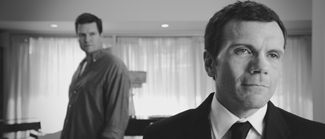
Presented in black-and-white, we see a man named Frank Gross (Dean Denton) sitting in his living room on a quiet afternoon, reading a book as his young daughter Katie (Weslee Denton) draws pictures. It seems like a quiet, normal day until the doorbell rings. Frank answers the door; a man in a suit—Dr. David Sinclair (Ed Lowry)—stands outside, asking for a moment of Frank’s time. What is this about, Frank asks. “What I’m about to tell you is hard to believe—I only ask that you hear me out.” Sinclair starts by performing a few parlor tricks, but are they really tricks? (“I’m bad at that sort of thing,” he explains.) For example, he tells Frank to pick up the book he was reading and pick two numbers between 1 and 20. He does, and then states what word is on what line and order with those same numbers! He then proceeds to state the family history, including Frank’s current job and his deceased wife. At this point, you’re wondering what is going on here, who this strange person is, why he’s here, what he’s going to say next, etc. What follows is quite unusual, very odd, and just so intriguing. Watching this film, you can either be very invested, very disturbed, or both.

How do I explain just how powerful Ballerina is without going into too much detail about the further-developed plot points, especially in a short film? Even though most of you reading this review have seen the film online by now, I stick to methods of reviewing.

Sinclair’s words dig deeper and deeper into the strangeness, and the fear he delivers to Frank is legitimate. Frank doesn’t want to believe what he’s hearing, but Sinclair sounds so convincing that neither he, nor we, can argue. Even when Frank is about to snap and say he’s wrong, he still isn’t so sure. And when he’s finally convinced, he knows that there’s no turning back from this. As the film progresses, you can really feel the uneasiness that is existent throughout. A lot of credit for that has to go to the cinematography (by Dave Calhoun) that actually manages to turn a living room into an effectively unpleasant setting; the screenplay (by David Koon, of The Bloodstone Diaries) for taking a intriguing, unique science-fiction story and mixing it with realism, making it all plausible (keeping it in this one familiar living-room area, the casual introductory talk before Frank and Sinclair begin their central talk, how Frank reacts to certain elements, etc.) and making for a great script; the director Bryan Stafford (cinematographer for the wonderful Gerry Bruno short Seven Soulsand Juli Jackson’s upcoming feature 45 RPM) for managing to get the most out of what little space there is to work with. And of course, credit must also be given to the two lead actors Ed Lowry and Dean Denton, who both deliver excellent work. Lowry has the most difficult role, being the one who has to deliver this speech about what will occur if a certain choice is or isn’t made. He pulls it off with chilling success.

Ballerina is so strange, so disturbing, and yet so effective that I’ll even go as far as saying it reminded me of the best “Twilight Zone” episodes. It’s a tense, intelligent short film that tells a gripping story, shows that any location (whether common or beyond) can be used to create a unique setting, is exceptionally well-made, and keeps us invested the whole time.

You can watch the film here: https://vimeo.com/34816825

The Bloodstone Diaries: Sleeper – The Bloodstone Diaries: The Thief of All Things

17 Feb

bloodstone-katysmall

Smith’s Verdict: ***

Reviewed by Tanner Smith

The Bloodstone Diaries: Sleeper, as I’ve heard, is the start of a possible Internet series, and right away, I want to state my gratitude for a web series with quality production. It also works nicely on the big screen, where is how I first saw it at the Ozark Foothills Filmfest in the spring of 2011. There’s a real professional look to the film, which would make it somewhat of a disappointment that this introduction to The Bloodstone Diaries is merely good, when it could have been great.

What I mean by that is that the story seems complex—that is, the tidbits we get from the story—for a ten-minute short film that leaves many holds barred and stops rather than ends. I’m guessing it’s setting up for the next entry in the series, but I think I’d be more satisfied if there was more closure to this one. I wanted more, which shows how interested I was in the dilemma that’s been set up. Luckily, I think I’ll get more when the next entry to this series is released, either on the screen at film festivals, or online.

The film starts with an opening-credit sequence—the credits are played over a black screen in an old-school fashion, but we get our introduction to our heroine Bettie Lawrence (Katy Allen, wife of “American Idol” Kris Allen) from the audio of a telephone call. She warns a mysterious man, whom she’s apparently tangled with in the past, that she has learned how to use a magic jewel called the Bloodstone and that it wouldn’t be wise to look for her (anymore). That’s it—that’s the introductory exposition we get. It’s very smart writing. A mysterious phone conversation during the opening credits is all we needed to set this up…all in 30 seconds, too!

When we see Bettie in person, she seems like a nice all-American girl with nothing particularly special about her, making her a credible heroine once we realize that the Government is hunting her because she gains possession of the jewel, which is what they want. They’ve killed her husband Sam, who tried to protect it in the past (at least I think that’s why they killed him—it’s never quite explained), and now she wants revenge. When they find her, she’ll be ready.

This setup is very intriguing—the mystery is there, the story sounds very interesting, the acting from Katy Allen is convincing, and the drama is legit. But that’s only the first six minutes out of a ten-minute film. The final three minutes (not including the end credits, taking the last minute of course) is just a showdown with the bad guys—the Men in Black—who arrive at her home and try to overtake her. As she escapes, she uses the Bloodstone to fight them. And because this climax is so short, there isn’t much room or time for either atmosphere or clarity in exactly what this Bloodstone is capable of. I guess it allows the holder of the stone to possess mind power (Bettie’s able to move a refrigerator without touching it), but what are we supposed to take from all of this? I guess Bettie will keep running and somehow on her quest, she’ll finally have her revenge. While this climax is admittedly well-shot and does have its brief moments, it’s too short and doesn’t take advantage of what should have been a dramatic payoff.

I would like to see “part two” to see where this is going to go. But I would particularly like to see an origin story. How did this young woman get involved in this craziness with the Bloodstone anyway? That would be a very interesting story arc.

You can watch this film here: http://www.youtube.com/watch?v=zl0Kx4jBg4I

————————————————————————————————————————-

bettie-and-sam

Smith’s Verdict: ***

Reviewed by Tanner Smith

The Bloodstone Diaries: The Thief of All Things is what I’ve been waiting for since I first watched its predecessor, The Bloodstone Diaries: SleeperThe Bloodstone Diaries is a supposed web series (I use the term “supposed” since it’s apparently screening at film festivals before hitting the Internet) that mixes fantasy with action. It’s about a young woman who possesses an ancient, magic jewel known as the Bloodstone and seeks revenge on those who killed her husband; these same people also seek her to possess the jewel themselves. Sleeper was a welcome beginning that left me wanting more. And I got more from The Thief of All Things, which is actually a prequel instead of a sequel. It shows the events leading up to most of what occurs in Sleeper.

We see the origins of Bettie Lawrence (Katy Allen), the heroine of the series. She lives in a homeless camp by the railroad tracks with her husband Sam (Ian Moore). Bettie is a standoffish, hostile person who doesn’t let anything get in her way (including the local reverend who preaches to most of the homeless) and is the one who goes into town to steal valuables from people’s cars, while Sam lives mainly by faith. Sam’s friend Anthony Pace (C. Tucker Steinmetz) lives the same way, as well as a belief in destiny. That’s why when he mentions the Bloodstone, said to be a jewel mostly formed of Jesus’ blood, Sam can’t help but be interested.

By the way, one of my favorite moments is when Sam researches the Bloodstone. How does Sam find out more about the Bloodstone? Wikipedia, of course! (Duh!) But it turns out that searching online for something mystical and said to be mythical gains the attention of the government. The next day, several men in black reach the homeless camp to hunt down Anthony and Sam, with Bettie in tow. But Anthony has a few tricks up his sleeve…

The central chase scene is well-executed and feels very intense. The special effects are seamless—there’s one slow-motion scene involving Anthony using the power of the Bloodstone to stop a pursuing car by making it float into the air, and it’s done so greatly that I wonder if Andrew McMurry of YouTube’s AndrewMFilms, with his After Effects skills, would be able to pull that off. There was a real quality put into this production, and the filmmakers obviously went all out to make this an exciting experience. For the most part, they succeed.

And it is nice to see the original owner of the Bloodstone, as well as the lives of Bettie and Sam before the events of Sleeper.

There are a few problems I have with the movie, though. For one thing, I can’t quite believe that the Bloodstone has been protected for centuries, one protector after the other. First of all, have the people before these men in black really had no avail whatsoever? And if they didn’t, wouldn’t they have just given up the search after seeing what the power of the Bloodstone can do? Other little weaknesses are the lame subtitles that appear over each new location—one of them being, “miles from nowhere” — and the unnecessary opening dream sequence that shows Bettie losing a fatally wounded Sam, obviously foreshadowing a future event.

It came as no surprise that both Sam and Anthony are dead by the end of The Thief of All Things, because of course, Bettie must be the new lone protector of the Bloodstone. But somehow, the ending of this film never really hit the right notes. It ended a little too quickly, and I could have used a little more development for Bettie, whose question of faith and sudden new responsibility have been set up for an emotional payoff that just isn’t there. Best we get is a deadly stare in Bettie’s eyes that closes the movie—To Be Continued to be sure; only the question is, to be continued in Sleeper or another story before or after Sleeper? Guess I’ll have to find out later.

Still Life (Short Film) (2012)

17 Feb

195063459_295

Smith’s Verdict: ****

Reviewed by Tanner Smith

“You ever feel like this place is just sinkin’ into the ground? I do everything I can to try to hang on to the edge of this hole, waitin’ on somebody to reach down and pull me out. But everybody that’s pulled me out’s down here with me.” –Line of dialogue from Still Life

Still Life is a touching, effective drama about a man who feels like he’s hit rock bottom and has to rely on his community to get everything on track. The man’s name is Daniel (Lynnsee Provence). He’s a widower who has just lost his job and has trouble making ends meet for him and his six-year-old son named Jack (Luke Ferguson).

The film is pretty much just about a day in which Daniel seeks work, guidance, and help. It takes place in the Arkansas Delta, which, from someone who has grown up in Northeast Arkansas (namely me), is an environment that makes you feel surrounded/trapped by everything around you because there’s something empty and yet at the same time something peaceful presenting itself. That’s how Daniel and many of the people he’s acquainted with, whom we meet as the film progresses, feel. Some are used to it; others are too busy thinking about more for themselves and their families to feel anything but resentment. Still Life shows a great portrait of that. It’s also effective in how it shows its supporting characters—Daniel’s sister-in-law Bethany (Raeden Greer) who sometimes looks after Jack while also dealing with a rough relationship (there’s a revealing moment when Daniel asks her to leave and she snaps, saying there’s nowhere else to go); Daniel’s old buddy (Terence Rose) and his wife (Jahquis Bailey) who are there for him but aren’t the best people to talk about tragedy; even Daniel’s landlady (Fran Austin) looks like there’s something missing in her life, judging from her emotionless face as she smokes a cigarette and asks for Daniel’s rent.

The film is the graduate thesis film of Allison Hogue, writer and director of the film, for the University of Central Arkansas Digital Filmmaking Master of Fine Arts Program. Hogue made last year’s Hitchhiker, a well-executed fantasy-mystery short. With Still Life, it’s her chance to tell a story more based upon reality. Hogue is a gifted filmmaker who succeeds at showing everything she was obviously getting across, and in a subtle way, too—not just exposition explaining exactly how everything went wrong. We can piece things together with almost every scene as the film progresses. Some things are obvious, but most aren’t shoved in your face.

Still Life opens and ends with quotations from Mark Twain—one from “Tom Sawyer,” the other from “Huckleberry Finn.” The first quote sets the tone for the movie—particularly the main character’s feeling of emptiness. The second one appears after an ending that is just right for the film. It doesn’t simply show that everything gets resolved. It’s merely hinted at. It tells us that life goes on and there will always be a way to deal with it.

Still Life ran for almost twenty-nine minutes. Considering some of the short films I’ve seen at the Little Rock Film Festival, where this was shown, it’s saying something when I say at no point was I checking my phone for the time. That’s the sign of a film that has you invested from beginning to end…and a film about life, at that.

NOTE: The film can be seen here: https://vimeo.com/75462622

The Man in the Moon (Short Film) (2012)

17 Feb

277791154_640

Smith’s Verdict: ***1/2

Reviewed by Tanner Smith

The Man in the Moon, made in association with the UCA Digital Filmmaking Program, had already caught my interest with its clever teaser trailer, featuring a strange, gray landscape with what looks like a golf cart making its way across, as the camera pans up to the sky … only to reveal the Earth. Yes, we are in outer space, the “golf cart” is a lunar rover, and this landscape is on the moon. It’s a great teaser, and the title suggests … well, take a guess.

This 20-minute short film is an imaginative, well-put-together science-fiction story that starts out as a futuristic prison fable and heads into different, even more interesting, territory once it unleashes that always-reliable moment in which a character digs for quite a time and then suddenly hears an unexpected THUD. (And of course, there’s another THUD to be sure of what he heard.)

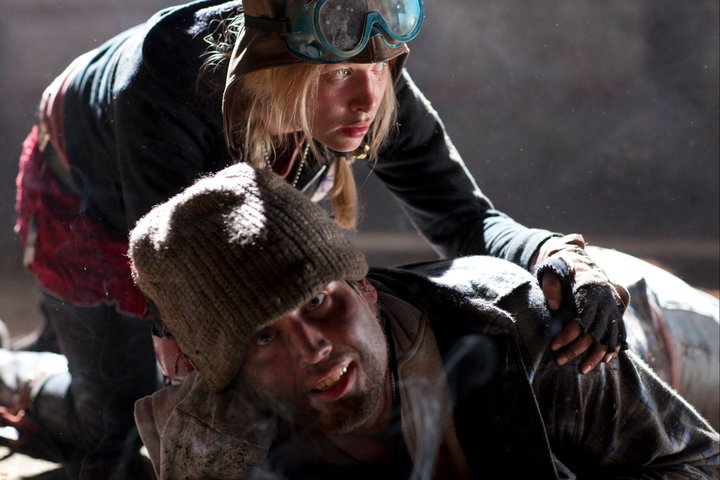
The character is named Dave; he’s part of a new prison program that sends convicts into complete isolation up to the moon. As one of those convicts, he is completely alone on the moon … or so he thinks. When digging for experimental dirt or stones (there’s a machine in his prison that somehow brings it back to Earth for experimentation — I’m not quite sure how that works, but oh well), he digs a little deeper and then…you guessed it — THUD.

Dave (Lynnsee Provence) discovers a doorway leading to the underground lair of the Man in the Moon, which is actually somewhat welcoming—it looks like the inside of a suburban house…in the 1960s, which makes things kind of unnerving and unsure. But the Man in the Moon, named Manuel (Leonard Schlientz), is a kindly old man with a generous hospitality. He takes Dave in, making him feel at home, but there seems to be something more that Manuel has in mind. For example, what is inside that forbidden room right beside the back bedroom?

The more mysterious The Man in the Moon gets, the more intriguing it is. I apologize for giving away what Dave finds beneath the lunar surface, but I stopped immediately at the plot device of the “forbidden room.” There’s a lot of creativity flowing through the story and I was interested throughout, to the point where I didn’t care much for questions such as how does that machine in Dave’s prison work, and where does Manuel get all of his food if he’s been secretly living in the moon?

The film has a nice visual style. The moon setting is terrific. I hear the scenes taking place on the moon landscape were actually filmed on a quarry with color digitally added in post-production to give the illusion of moon rocks, space dust, and emptiness of outer space. The result is very effective. Also of note are the interiors—Dave’s prison and Manuel’s home. Each is different, but interesting. Dave’s home has a rustic-if-retro look, suitable for an isolated prison on the moon, and Manuel’s home looks as if it was stuck in a ‘60s time warp—the appropriate colors and props really stand out.

An interesting story idea, a continuing guessing feel, and good performances from both Provence and Schlientz makes for a pretty good film. How much did I appreciate The Man in the Moon? Of the twelve short films I saw the night it premiered at the 6th Annual Little Rock Film Festival, this is the one that I was most fond of when the night was over.

John Wayne’s Bed (Short Film)

17 Feb

stills_JohnWaynesBed

Smith’s Verdict: ****

Reviewed by Tanner Smith

The short drama John Wayne’s Bed, right at the beginning, is said to be “inspired by a true story.” And whenever I see that subtitle in a movie, I get cynical — that’s even how I felt before I watched “War Eagle, Arkansas.” It’s just the sudden feeling of manipulation and heavy handedness (movies like Amelia and — sue me — The Blind Side come to mind). But like War EagleJohn Wayne’s Bed treats its subject material, as well as its audience, with enough respect that it doesn’t have to succumb to heavy dramatic clichés just to make us care. It just effectively tells the story. The acting is great, the cinematography is nice, the dramatic elements are well-handled, and it’s over in just 20 minutes.

John Wayne’s Bed is writer-director Sarah Jones’ thesis film for the University of Central Arkansas Digital Filmmaking Master of Fine Arts Program, but according to Jones in the“Indiegogo” blog supporting the film, it means a lot more to her than receiving her Master’s degree. The story behind the film is based upon her father’s friend who was diagnosed with Lou Gehrig’s disease, and made the most of his final days with his love for life and the help of his friends. Jones stated, “Even before I started studying filmmaking, I knew that this was a film that I needed to make.”

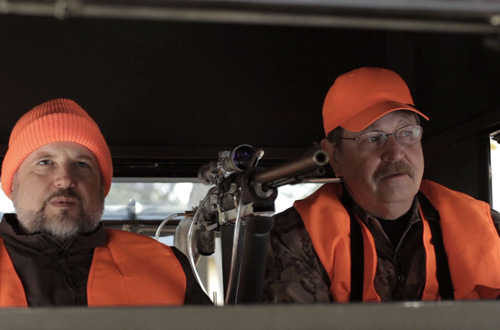
The film stars Alan Rackley as Allen, an Arkansan man who loves to hunt and fish and doesn’t let his disease slow him down. His best friend (Bob Boaz) helps him and accompanies him on the outdoor activities, and his wife (Angela Woods) provides for him, though she states that it’s getting more difficult to handle because he’s unable to perform most daily activities. Allen knows he’ll never be independent and he’ll most likely die soon, but his stubbornness and optimism keeps him going.

Allen’s luck picks up when he is accepted into a hunting program for mobility-impaired people. Accompanied by his wife and friend, he lives the perfect hunting trip for him—he has a rifle that doesn’t require pulling the trigger (there’s a tube he can blow into that fires the weapon) and even gets to sleep in John Wayne’s bed.

The approach that Jones took to this story is wonderful. This story is told in a moving but never condescending way, and it flows smoothly as we get from this setup at Allen’s home to his “dream-come-true” at the cabin. The actors do great jobs in defining these characters. By the time this film is over, we have spent twenty minutes in the company of real people. John Wayne’s Bed is a wonderful film.

NOTE: The film can be seen here: https://vimeo.com/67408995

Hitchhiker (Short Film) (2011)

17 Feb

459142_294920593909216_2141328867_o

Smith’s Verdict: ***

Reviewed by Tanner Smith

OK, we all know the story. An innocent person drives on an empty road in the middle of the night when along comes a hitchhiker, whom the innocent decides to take a chance on and give the stranger a ride. Only it turns out that this hitchhiker is quite different and may actually be a dangerous stalker. It’s an old campfire story that has also been included in many horror films, in which that element leads to certain doom.

But I don’t think there has been a hitchhiker story quite like this. In this ten-minute short film—aptly titled Hitchhiker — the innocent person may not be so innocent in the first place, the hitchhiker has something more on his mind that you’d like to know about, and there’s a neat, original twist revolving around redemption.

The film, written and directed by Allison Hogue, is set up in the middle of the night. A young woman (Courtney Howard) is out for a drive when she runs out of cigarettes. She comes around a man in a hooded sweatshirt on the side of the road, signaling for a ride. She stops, and asks the hitchhiker (J.D. Cariker) if he might have any cigarettes. He offers a pack for a ride into town. She agrees, and the two are in each other’s uncomfortable company. The hitchhiker asks her ominous questions, such as why she usually wouldn’t pick up a hitchhiker. After an awkward talk, you’d think this would be the moment when danger strikes. And at this point, I have to warn that SPOILER ALERTS are coming! SPOILER ALERTS are coming! Before reading the rest of this review, I ask that you check out Hitchhiker by Allison Hogue on Vimeo (or above) and come back. SPOILER ALERT!

The opening seems like standard stuff for this kind of story (although the soothing spiritual pop music manages to give a sense of ominousness). The reason I’m recommendingHitchhiker is the twist. The woman drops off the hitchhiker at his destination, only to find that that he is pursuing her. When he catches up with her at her house, she finds that a gun-wielding intruder (the late Keith Mulberry) has been waiting for him. It is then that the hitchhiker makes himself known as probably something not of this world, but possibly from the next world.

The characters are not how we expected. For example, the woman could be seen as the innocent that gives the hitchhiker a ride and finds herself in a bizarre situation she didn’t want to be in. But maybe she isn’t so innocent. When we first see her driving, we see someone who is either hiding something or trying to get over something she may have started in her life. Whatever it is has her somewhat bitter and cold. You can feel it in the scene in which she at first refuses to give a ride—she’d rather stop and ask a hitchhiker for cigarettes than give him a ride. That’s really low, if you ask me. Then, there’s the ending, in which she is redeemed and given a second chance. We’re not entirely sure of exactly what it was that she began with before this night—things are left somewhat vague. And also, who is that intruder? Is he a burglar in the wrong place at the wrong time? Or did he have connections to the woman? There’s a lot you can read into this.

Then, there’s the hitchhiker. At first, he seems like he can’t be trusted, but that’s because he’s asking the questions that would put you on edge. The reality is that he’s testing you when he asks those questions. Then, when he chases the woman home and saves her from the intruder, he gives her a Bible and a message saying that she deserves a second chance. And then he leaves, to find someone else to deliver the message to. The hitchhiker is not a madman. He has the motivations of a savior.

Hitchhiker begins as a typical horror film and turns into something more of a spiritual tale than anything else. It’s an effective short film that plays with the seen-before hitchhiker story element, and leaves with something special that you didn’t expect.

Watch the film here: https://vimeo.com/31127434

Harry Potter and the Chamber of Secrets (2002)

17 Feb

images

Smith’s Verdict: ****

Reviewed by Tanner Smith

When there is a list of most popular film franchises in the history of cinema, I believe there will be a spot for the “Harry Potter” films, based on the book series by J.K. Rowling. The first film, “Harry Potter and the Sorcerer’s Stone” was a triumph—I even called it a “classic.” And though I give the sequel—the film based on the second book of the series—the same star-rating as I gave its predecessor (four stars), I have to say that this film—entitled “Harry Potter and the Chamber of Secrets”—is even better than the first. The first film had a great deal of imagination in its visuals and in its storytelling and this second film has an even greater deal if you can believe it. It is, however, rather dark, just as “The Empire Strikes Back” was darker than “Star Wars.” Like the first film, “Harry Potter and the Chamber of Secrets” is rated PG and has a great deal of terror in many sequences. About the first film, I wrote in my review that it’s scary but not too scary. However, some moments in this film should have qualified the film for a PG-13 rating—those said moments might give some children nightmares, but delight others.

We’ve already gotten to know the characters in the first film and now we care even more about what they go through here. We again meet young Harry Potter, a year older with a deeper voice and on the brink of adolescence, as you can tell. Then, we again meet his friends Ron and Hermione. They haven’t seen each other in a while—and neither have we, for that matter. Their personalities remain the same, with a few touches put into them. One of the great things about this movie is watching these characters grow in this sequel. And then we again meet those wonderful teachers at Hogwarts School—headmaster Dumbledore (Richard Harris, in his last role), gentle giant and gamekeeper Hagrid (Robbie Coltrane), always-mysterious Snape (Alan Rickman), and professor McGonagall (Maggie Smith). But there are new characters brought into this sequel—there is a teacher who explains of mandrakes (played by Miriam Margoyles), bully Draco Malfoy’s (Tom Felton) even-slimier father (Jason Issacs), and a celebrity wizard named Gilderoy Lockhart (Kenneth Branagh) whose incredible resume (he wrote an autobiography called “Magical Me” as well a few other books about himself) brings him to Hogwarts to teach the class of defense against the dark arts. He’s more worried about feisty blue pixies messing up his self-portrait.

Harry (Daniel Radcliffe) is better-treated by his Muggle relatives (if you recall, “Muggle” is the term for humans), but that’s not saying much. He has his own room, as long he stays inside while the relatives throw a party. While he is in his room to keep from interrupting a similar party downstairs, he is visited by a house elf named Dobby—a special-effects creature that punishes himself by beating himself up—who warns Harry not to return to Hogwarts, lest he put himself in danger. It turns out that there is danger. The mysterious Chamber of Secrets, said to be the home of a monster, has been opened and many students (as well as a cat and a ghost) have been petrified by the sight of the monster. There are many questions to be answered and Harry, Ron, and Hermione are the ones who stand alone to find out what is really happening. They band together to find clues and answers to all of the questions that need them. Eventually, Harry finds a diary by a Tom Marvolo Riddle that provides clues in ghostly handwriting and allows Harry to travel back 50 years into the past to find some answers. The kids also encounter a swarm of giant spiders, change into Draco Malfoy’s friends to question Malfoy, and more.

This film is more than well-made with Chris Columbus’ direction—it’s alive. It’s about something. The computer animation is no distraction at all because it makes the movie as visually interesting as the cast and the sets. They blend in very convincingly. Even the Quidditch game is put on a larger scale than in the first film and that’s a great accomplishment—it’s also even more exciting because Harry has to outrun a runaway ball called a Bludger while also trying to catch the Golden Snitch and win the game.

I love how all of the plot elements draw together and how everything is cleared in the end. This film also doesn’t set up for the next Harry Potter adventure. It doesn’t have to. If these two films were the only films in the Harry Potter film series, it wouldn’t make much of a difference. “Harry Potter and the Sorcerer’s Stone” was the setup and “Harry Potter and the Chamber of Secrets” is the payoff. The characters we’ve grown to love are brought into intriguing action sequences, brilliant sets, and a powerful action climax in the third half of the film. There is more than action to be found here—there is a heart and most importantly, a brain. “Harry Potter and the Chamber of Secrets” is a highly satisfactory sequel.