Archive by Author

Harry Potter and the Goblet of Fire (2005)

19 Feb

images

Smith’s Verdict: ***1/2

Reviewed by Tanner Smith

Harry Potter may still be wide-eyed to every new magic element he observes around him, but he has gotten used to a lot of Hogwarts activity. He joins in with his friend Ron and his brothers as they chant for their favorite seeker in the famous Quidditch team (as we learn, Quidditch is a wizard-national sporting event now not just confined to Hogwarts) or when he’s learned almost every spell he can use with his wand. At age 14, he’s almost gotten used to Hogwarts School, but nothing can prepare him for what he has to encounter in the fourth “Harry Potter” film, entitled “Harry Potter and the Goblet of Fire.”

Not only is he for some unknown reason (unknown until the end of the film, anyway) chosen for the extremely dangerous Tri Wizard Tournament, but he later discovers that Lord Voldemort is on the rise. Even scarier, especially for a 14-year-old, is working up the courage to ask a girl to the Yule Ball.

It seems as though the “Harry Potter” series is getting darker and darker with each new installment. It really makes me wonder what will be in store for us in the final installment. This film ends with a setup to something even bigger. It also includes the line near the end muttered by Dumbledore, “Dark and difficult times lie ahead, Harry.” The foreshadowing is terrific.

But way before that, Harry (Daniel Radcliffe) and his best friends Ron and Hermione (Rupert Grint and Emma Watson) are in their fourth year at Hogwarts School of Witchcraft and Wizardry with only three years to go after this. Things are changing, for sure. Harry is having nightmares of Lord Voldemort (Ralph Fiennes) returning after many, many years; Ron is more nervous than usual; and Hermione is becoming a beautiful young woman (though still the intelligent bookworm). This year, there is a Tri Wizard Tournament to be held at Hogwarts, in which champion wizards from different schools (and different countries, I might add) compete for victory. Their names are drawn from the enchanted Goblet of Fire which chooses the winners to compete in the tournament. One is a tough-looking Quidditch seeker, another is a nice guy, and the other is a beauty queen—they are all 17 years old, which is a requirement for this tournament. But something weird is happening—Harry Potter’s name is drawn from the Goblet of Fire. He’s only 14 and he didn’t put his name in the goblet, but there’s nothing he can do about it.

So now he’s fighting for his life in this tournament—he fights a fire-breathing dragon, he must stay underwater for an hour to retrieve something from vicious (and ugly) merpeople, and go through a treacherous hedge maze that Jack Nicholson would have lost his mind in. He also befriends a weird new teacher who teaches defense against the dark arts (isn’t there always a new teacher in that class?)—This is Mad Eye Moody (Brendan Gleeson), a mysterious man with a robotic left eye that works as a zoom lens. But his biggest worry is finding a girl to ask to the Yule Ball. The scenes in which Harry and Ron attempt to find dates are so refreshing that it almost outshines the excellent action sequences with the dragon and the mermaids. It resembles the best of high school comedies…with young wizard crushes.

“Harry Potter and the Goblet of Fire” has finally earned a PG-13 rating in the series. The tone is darker than usual and the action is more intense. But as they were with the past three films, the action sequences are amazing—particularly the sequence in which Harry battles a dragon. The computer animation again works very well.

This is not a stand-alone film—the film reaches its final half in which Lord Voldemort makes himself seen for the first time as a whole (we only saw his face in the first film). We are not disappointed—he is pale, bald, ominous, and threatening. Ralph Fiennes makes an intriguing, terrifying villain that will make Voldemort even more so in later installments. He sets up his plotting for later installments in which Harry, Ron, and Hermione may eventually have to fight him in an epic battle. That’s one I can’t wait for. What I’m really concerned about is what will happen until that battle.

Oh, I can’t believe I almost forgot to mention another funny new character—Rita Skeeter (Miranda Richardson), the gossip columnist for the Daily Prophet who doesn’t stop until she gets her story. Richardson really makes the most of her limited role; she’s fantastic. I should also mention a nice touch at the Yule Ball—a sweet little relationship between the gentle half-giant Hagrid (Robbie Coltrane) and Madame Maxine (Frances de la Tour), who is even taller.

“Harry Potter and the Goblet of Fire” is a solid entertainment—it nicely blends fantasy with teenage comedies. The characters are growing and it will be nice to see them continue to grow until the “Harry Potter” series is over.


Edward Scissorhands (1990)

19 Feb

johnny-depp-as-edward-scissorhands-1990

Smith’s Verdict: ***

Reviewed by Tanner Smith

“Edward Scissorhands,” a weird fantasy fable by Tim Burton, has a unique and intriguing premise that begins with one gimmick, which is that the main character has scissors for hands. The premise is this: A young man named Edward was created in a mansion near a small town by a loving inventor, but the inventor died before he could finish his creation with hands. He is left “unfinished” with his scissors for hands. One day, Edward is found by a local woman, who brings him home and offers hospitality, and he becomes the talk of the town. This is an engaging premise and “Edward Scissorhands” plays it with magic realism and a real charm to it.

Johnny Depp stars as the title character, and it’s a more-than-successful creation. Sporting a fright wig, a plaintive expression, and a pure innocence within him, it is impossible not to care for Edward, played wonderfully by Depp. And as for those scissor-hands, it’s a great sight gag, even if it doesn’t make a lot of sense as a metaphor (if that’s what Burton was going for).

Edward has been living in the mansion alone ever since the death of his inventor (the fantastic Vincent Price, seen in flashbacks). His hands are the one aspect that the inventor was never able to create for him, leaving him with long, sharp razorblades. One day, he is found by the Avon saleswoman, Peg (Dianne Wiest), who feels sympathy towards this man and invites him to live at her home in the neighborhood nearby. When he’s there, he adapts to suburban life, becomes the talk of the street, impresses everybody with his skills with his hands (he can make gigantic hedge animals and give haircuts to the local women and their dogs), and also begins to fall in love with Peg’s teenage daughter Kim (Winona Ryder).

This is no ordinary neighborhood, mind you. This looks and feels like something out of a comic book or an animated sitcom. I admire the visual style that Burton shows throughout this film—every film he makes seems to turn our everyday world into something resembling a fairy tale, for example. But there is one thing that kind of bugs me. The early scenes that the strangeness of this movie’s suburban world, with the bright colored visuals (houses with bright paint colors and people dressed in practical-Technicolor, looking an awful lot like “Pee-Wee’s Big Adventure”), don’t leave us with that much wonder when we see the amazing-looking garden at the mansion—wonderful set design, with hedge animals and bright flowers. And thus, once we leave the mansion with Edward, the world just gets even stranger. That being said, I have to ask, wouldn’t it be more interesting to have Edward’s world collide with the real world? This is not the real world—this is a strange world in which the Avon lady looks at a creepy-looking mansion up on a hill and thinks there will be someone there who could use her materials, and just walks around the place and looks around for someone, saying “Avon calling.”  And some really strange people, too—the women in this weird neighborhood make “Steel Magnolias” look like a soap opera. At least the teenagers are normal enough, and react how anyone would react to a man with scissors for hands. Although, come to think of it, that means they’re less funny.

But here’s my major problem with “Edward Scissorhands” that almost kills the movie. It’s not that all the townspeople turn against Edward when they see how dangerous he can be with those scissor-hands, even if he doesn’t intend to hurt people. I get that; it’s like “Frankenstein,” which Tim Burton sort-of satirizes here. But that’s enough. Just give us the mob of local folks as a catalyst for conflict. And that brings us to the unnecessary, unwelcome addition to the villain role—Kim’s jealous, hostile, and unbelievably dull boyfriend Jim (Anthony Michael Hall). Good Lord, is this guy boring. We know that Jim is going to be jealous of Edward being in love with Kim, and know just about everything that he’s planning to do. Every time he shows up, I groan. No thought went into this character at all and it leads to a boring climax—a fight between hands and scissors.

There are enough things that “Edward Scissorhands” does right that I can marginally recommend it, despite that aforementioned boring element. I’ve already mentioned Depp’s great performance as the immensely-appealing Edward, but there’s also the sweetness that envelops around Winona Ryder. She does a really good job as Kim, who sometimes seems like the only person capable of loving Edward. The best, most touching moment in the movie is when she finds him and says, “Hold me.” Edward tries, but is too afraid of hurting her—“I can’t,” he says miserably. So, she helps him to let him hold her. That is a beautiful moment, and so is the sequence in which Edward uses his blades to scrape a giant ice block in such a way that it looks as if it’s snowing on Kim. The Danny Elfman music score in both scenes is very effective.

The first half is engaging in its weirdness of the locations and the characters, and lead to some nice sight gags and funny lines of dialogue—I love the bit in which Edward carves up some meat and offers some to one of Kim’s friends at the dinner table, and she says, “I can’t eat that—you used your hands.” I don’t even care about logic in this world, so I don’t even question how Edward is able to make shrubbery sculptures where no shrubs should ever grow. That’s just the kind of world this is. It’s a fantasy; deal with it.

There’s enough love and imagination to the making of “Edward Scissorhands” that I am recommending the movie for its strong, charming points. Sure, I hate the grudging boyfriend character and I kind of wish the ending was more about dealing with problems and accepting them, instead of resorting to an automatic fight scene. But until that point, the film is as innocent and appealing as the main character.

Throw Momma from the Train (1987)

19 Feb

ThrowMama46

Smith’s Verdict: ***

Reviewed by Tanner Smith

Not many movies inspired by other movies have the nerve to name their sources on screen, let alone have a character watch the source in a movie theater. But Danny DeVito obviously knows that and gives his character a scene in “Throw Momma from the Train”—a film that is sort of a comedic version of the Hitchcock film “Strangers on a Train”—in which he goes to a movie theater, sees that movie, and it inspires him to set up the plot.

“Strangers on a Train” was about two strangers who meet on a train and one proposes a plot to commit a murder for each other. In “Throw Momma from the Train,” there are also two strangers who have people they wish were dead. Writer Larry Donner (Billy Crystal) feels anger for his wife, who has stolen his book and published it with her name. Owen Lift (DeVito), who is somewhat of a pathetic schlub, lives with his overbearing mother, who is sort of a cross between Quasimodo and the Wicked Witch of the West. He dreams of killing her, but grows spineless at every attempt.

Owen is a student in Larry’s creative writing class. When he asks Larry what he can do to improve on his writing, he tells Owen to go see an Alfred Hitchcock film for inspiration. One day, at lunch, Larry’s wife is mentioned to Larry and he responds by exclaiming, “I wish she was dead!”

Owen goes to see “Strangers on a Train,” he gets the idea of the movie, and believes that the choice of the film was a message from Larry. Larry only says he wants his wife dead, but Owen takes him seriously. He supposedly (the murder is off-screen) kills Larry’s wife and expects Larry to “return the favor” and kill his mother.

And who could blame Owen for wanting his mother dead? Momma is a monster and Larry knows that too—he has a line later in the film, “She’s not a woman—she’s the Terminator.” Anne Ramsey goes all out with this performance, and she is more than game.

DeVito is the star of this movie. He delivers a performance of a man who really needs help and we start to care for the guy. He’s a good director too—he frames certain shots in which he almost looks like a small boy; he has a tendency to make the everyday world seem somewhat surreal; and he gets the material. The best scene in the film is a sweet one—it’s a scene in which he shows Crystal his coin collection. Those aren’t coins that are really worth anything but they remind him of places his dad used to take him. That’s a very good scene, with a real amount of whimsy put to it.

There are also a couple of big laughs in this movie—one of them involves Crystal at the river trying to find an opening line for his book. And the other involves DeVito and Crystal in DeVito’s house—they’re having breakfast in the kitchen, Crystal meets Momma, and without giving too much away, there’s a frying pan involved, and the scene delivers possibly the funniest moment in the movie.

Admittedly, the whole murder situation is a little uneven. But with a few sweet scenes, some good laughs, and good performances by DeVito, Crystal, and Ramsey, this is an enjoyable, entertaining comedy.

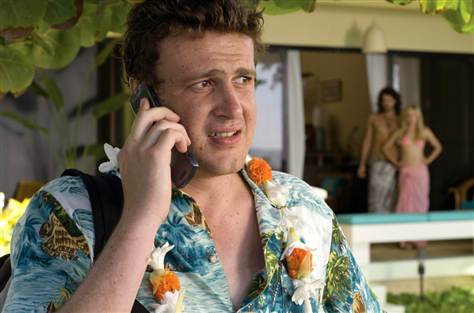
Forgetting Sarah Marshall (2008)

19 Feb

080416-forgetting-sarah-marshall-hmed-12p.grid-6x2

Smith’s Verdict: ***1/2

Reviewed by Tanner Smith

Well, it’s time for a new lovable loser to take over the writing in the comedies coming off the Judd Apatow assembly line. First came Judd Apatow himself, writing (and directing) the romantic comedies “40-Year-Old Virgin” and “Knocked Up.” Then came Seth Rogen and his buddy Evan Goldberg, writing the teenage comedy “Superbad.” Now for the Apatow-produced romantic comedy “Forgetting Sarah Marshall,” he calls back his former “Freaks & Geeks” cast member Jason Segel and introduces a newcomer—Nicholas Stoller—to direct.

Segel not only writes this material, but also stars in it as a guy named Peter, who has a great relationship with his TV-star girlfriend Sarah Marshall (Kristen Bell) and also provides the ominous background-music “tones” for her crime show. But when Sarah comes over to his apartment, saying “I love you” in a pitiful tone, that can only mean one thing.

So Peter and Sarah are broken up and Peter is not taking it very well. To call him a wreck would be an understatement. He’s advised to take a vacation in Hawaii to take his mind off of her. But there’s a problem—Sarah is there with her new boyfriend and staying at the same hotel!

Things are about as complicated as they could possibly get. Sarah’s new boyfriend—the British rock singer Aldous Snow (Russell Brand)—is a complete weirdo, and things get really awkward when Aldous invites Peter to eat with him and Sarah at a restaurant. But soon enough, Peter finds a friend and trace of hope in the attractive hotel receptionist, Rachel (Mila Kunis). She’s beautiful, sympathizes with Peter, and lends him a supporting hand.

All of the people on the island in this movie are just hilarious and there are a handful of characters to watch and enjoy. There’s not only the zany Aldous Snow. There’s also the constantly stoned surfing instructor (played with relish by Paul Rudd), the religious newlyweds who have trouble with sex, the waiter/stalker (Jonah Hill) who tries to get Aldous to take a listen to his demo tape, and the island’s butcher. I don’t know if this counts as “on the island,” but there’s also Peter’s stepbrother whom Peter constantly stays in touch with via Skype. He’s very funny as well.

“Forgetting Sarah Marshall” has a wonderful screenplay by Segel (who, remember, also stars as Peter). He’s not afraid of making Peter into a desperate schlub of a guy, which makes for very funny moments in the first act. And for that matter, he’s also not afraid of…how do I put this? Letting it all hang out. The scene in which Sarah breaks up with Peter features quick shots of Peter’s genitals, pushing just how far the MPAA rating system could go.

Segel also gives the side characters more than enough moments to shine and the actors are game enough to give them their all. Bill Hader, as Peter’s stepbrother, delivers some of the film’s funniest one-liners while mainly on the other end of a cell phone or a computer, and his sweet-natured wife is very likable, though her role is very brief. Russell Brand is simply hysterical as Aldous Snow, who, with his long hair, lion-like face, thick British accent, and calm-yet-nutty mannerisms, is a comic treat of a character on screen. Paul Rudd is winningly silly. Jonah Hill has some great moments as he stalks Aldous while he thinks he’s being subtle about it.

The two main women are also written well and portrayed even better by the actresses. Sarah isn’t written as a complete snob (a kinder word for “bitch”). She just believes that her relationship with Peter didn’t work out and would like to try something new. She doesn’t hate Peter and we, as an audience, don’t dislike her. Kristen Bell does a nice job of portraying Sarah Marshall as having more humanity than you would expect in this sort of role. Mila Kunis (of TV’s “That ‘70s Show” fame) is absolutely delightful as Rachel—she has a great sense of comic timing, is quite fetching, and makes Rachel the kind of girl I would like to get to know in a time of crisis.

Those previous three paragraphs have gone out of their way to give praise to the written characters of “Forgetting Sarah Marshall” and how the actors portray them, but what else does the screenplay give us? Only more and more quirks to make us laugh. I couldn’t find a single weak link when it comes to the comedy in this script. What can you say about a musical about Dracula…featuring puppets? Seriously, what can you say? I couldn’t say anything. Why? Because I was constantly laughing. Oh, and I should also mention that a majority of the jokes in this movie are not merely gross-out gags…they’re just sex jokes. To be honest, I’m actually kind of relieved.

But also, like in previous Apatow comedies like “40-Year-Old Virgin” and “Knocked Up,” the mix between raunchiness and romance is kept in check; carefully fashioned and convincing. Many of the moments that feature Peter and Rachel together reminded me of the finest moments in “When Harry Met Sally.” Segel and Kunis show a great deal of chemistry, they’re convincing throughout, and their comic timing is spot-on.

“Forgetting Sarah Marshall” is a hilarious and even heartfelt movie with a funny screenplay, likable acting, and a real heart to go with the humor. And the last thing to say is that if I wind up in a predicament like Peter’s and need a vacation to take my mind off it, I hope Mila Kunis is there to help me out.

Note: I might be wrong on this one, but if the shots of Peter’s nudity had stayed on a little longer, the R rating for this movie may have been replaced with an NC-17.

The Natural (1984)

19 Feb

11-top-sports-movies---The-Natural-jpg_1349001541229_162280_ver1.0_640_480

Smith’s Verdict: ***1/2

Reviewed by Tanner Smith

I love baseball. Who doesn’t? It’s a lot of fun to play and arguably even more fun to watch (yeah, I was never that good at the game, even when it was called “whiffleball” in P.E. class). Heck, it’s America’s pastime! You could show me a football game on TV or let me play in flag-football for fun, and I wouldn’t fully understand it. No, baseball is the sport I can easily get into. I mean, I’m not saying I collect baseball cards or even memorize statistics (or else I wouldn’t be much of a movie critic, would I?), but I really adore the sport itself. So when a movie that’s centered around a baseball player comes around, of course I hope that it gets everything right.

This is where “The Natural” comes in. This movie isn’t merely artistic and wonderfully acted. It’s also amazingly accurate about the game of baseball—not just in representation of what happens on the field, but also the spirit of the game. How can you not be excited when a character hits a home run in this movie? Or when the ball is mid-air, flying somewhat gracefully? That’s the spirit of the baseball game sequences in “The Natural.”

The movie is a fable that features a natural player named Roy Hobbs. As a young man, Roy played catch with his father and carved a wooden bat out of a fallen tree, dubbing the bat “Wonderboy.” As he gets older, he gets a chance to try out for a team in Chicago and even strikes out big-league ballplayer “The Whammer” in three pitches. It’s then that people see real talent in this person. Unfortunately, those people include a deranged woman who makes it her business to kill off “the best” in every sport.

Roy (Robert Redford) survives his encounter with the woman (Barbara Hershey), but it’s 16 years in oblivion before he finally appears as a thirty-something rookie. He signs up for the New York Knights, who can’t believe he’s on the team at his age. His manager Pop (Wilford Brumley) even states cynically that players his age retire rather than begin playing. Through half the season, Roy sits on the bench, but he eventually does make it into the starting lineup on the field and shows his skills. Everyone is impressed and amazed by him and want to find out more about him, for their own reasons.

It’s within the story of “The Natural” and the sport of baseball that these themes are represented—lighter ones like redemption, and darker ones like corruption, greed, and temptation. We have the redemptive tale of a man who steps out of nowhere after a deadly experience and uses baseball as the pathway to the right track. Within the darker themes, baseball brings about the joys (and dangers) of gambling, contracts, and fame. As the story progresses, Roy comes along corruptive characters like the Knights’ owner (known as the Judge, played by Robert Prosky) who will give Roy a long-term contract if he throws the next game, a sports writer named Max Mercy (Robert Duvall) who wants to know everything about this strange natural ballplayer, a gambler named Gus Sands (Darren McGavin) who manipulates Roy’s refusal to agree to anything dishonest, and his girl Memo Paris (Kim Basinger) who tempts Roy into all of their traps.

It’s Roy Hobbs who must make the right choices to make himself into a hero. But even if we know that Roy will aim to do the right thing, we wonder ourselves if the right thing is enough. It’s because of the writing by Roger Towne and Phil Dusenberry, based on the novel by Bernard Malamud, that the tension is there and we feel it in the scenes in which Roy must figure out what to do as he discovers he has something to prove.

Roy Hobbs is a great role model for young children—he’s not perfect, but an individual that shows character and principles as he sets out to fulfill his dreams. He’s played by Robert Redford in a believable, winning performance. He’s charming, but more importantly, he’s also convincing as a baseball player.

The movie has an outstanding supporting cast—Robert Duvall, Wilford Brumley, Kim Basinger, Robert Prosky, and Darren McGavin are all solid in their roles. There are two more important roles—Richard Farnsworth, just wonderful as the faithful bench coach Red, and Glenn Close, excellent as the angel-in-disguise: Roy’s old girlfriend Iris, a passive woman who dresses in white and wears a hat that represents a halo. Notice how she’s bathed in white light at Wrigley Field at the end of the movie. (I should also note that Barbara Hershey’s mysterious character is dressed entirely in black in her scenes, like a black widow spider about to attack her prey.)

But like I said, the very best element about “The Natural” is how well it accurately portrays baseball. This movie gets the feel just right in its ballgame sequences, and the final game is involving to say the least. The outcome is one of the most satisfying in any sports-movie big-game climax. Something it didn’t need was a heroic music score by Randy Newman, but I let it slide because it sounds great.

“The Natural” is one of the best sports films I’ve ever seen—a magical tale of the human element and a fable of a destined hero. Even if some cheesy moments and a few not-so-subtle touches (see two paragraphs above) seem a little “out there,” I enjoyed every minute of it.

Harry Potter and the Prisoner of Azkaban (2004)

18 Feb

harry-potter-and-the-prisoner-of-azkaban

Smith’s Verdict: ***1/2

Reviewed by Tanner Smith

It seems like young wizard Harry Potter is heading straight into darker territory. I think he is cursed in the way of never having a quiet year at Hogwarts. He’s 13 years old and he has already searched for the sorcerer’s stone and discovered the Chamber of Secrets. And now, he is being pursued by a Prisoner of Azkaban. OK, enough with the bad title references. You get my point though—Harry Potter will go through four more years after this and he will never have a quiet year at Hogwarts. Let’s just hope he is able to survive so he can graduate Hogwarts School. To think he is the Boy Who Lived possibly leaping towards certain doom—wonder what is in store for him in his seventh and final year at Hogwarts…assuming he lives that long.

I’m making the third entry in the “Harry Potter” series—entitled “Harry Potter and the Prisoner of Azkaban”—sound too grim. Indeed, Hogwarts has become menacing and even more dangerous than before. But this is probably nothing compared to what may happen in the later installments.

Harry Potter (Daniel Radcliffe) has grown as a person—he is not the poor young boy living a miserable life with his hateful relatives. This time, he’s developed an edge to himself. This is proven in the opening scene, in which he is fed up with an overly unpleasant relative invited to dinner and casts a spell that blows her up like a balloon and floats her away. This would’ve been one of the cruelest things a young wizard can do…but it’s just so funny.

Harry runs away to meet his old friends in time to leave for Hogwarts (this is after a wonderful scene in which he boards a fast-speed wizard bus with a Cockney guide and a shrunken head for a navigator). He is reunited with the still-cheerful Ron Weasley (Rupert Grint) and still-bookish Hermione Granger (Emma Watson). But something is wrong this year—the sinister Sirius Black (Gary Oldman) has escaped from Azkaban Prison. Sirius is said to have betrayed Harry’s parents and was the cause of their murderous deaths by Lord Voldemort, the late Dark Lord who killed Harry’s parents and failed to do so with Harry as a baby (hence the scar, in case you forgot, which you probably haven’t). On the search for Sirius are a swarm of Dementors, which are hovering, life-sucking demons that pay Harry unfriendly visits from time to time.

This year at Hogwarts, there are new faculty members. One is Professor Lupin (David Thewlis), the newest teacher of the defense against the dark arts. Harry knows that Sirius will finish what he started and come after him, so he asks Lupin to train him to protect himself. But it’s not so easy. Then there is the addition of Professor Trelawney (Emma Thompson), a psychic teacher who believes the blackness in Harry’s tealeaves means death. Also, Hagrid (Robbie Coltrane) is promoted to teaching—he has a large feathered animal named Buckbeak, which is a Hippogriff. Harry is to ride the bird-beast to set an example, but pathetic Draco Malfoy (Tom Felton) is too much of a show-off. This is why the audience cheers when Hermione finally gives him a punch right square in the face. “That felt good,” she says to her friends after Malfoy runs away whimpering. What a wimp Malfoy is.

This time, Harry doesn’t go looking for trouble, but trouble always seems to find him, Ron, and Hermione. Once again, they are propelled on another journey within school grounds and are met with many terrific action sequences. They encounter a shape-shifting dog, a werewolf, and (my most favorite) a living tree that tries to crush anyone who comes near with its branches and limbs. That tree is a beyond-terrific computer effect—I don’t believe real trees can shake off leaves in the fall and snow in the winter (I love it when the snow hits the camera).

And then there is an enchanted map that shows where people are within every minute of every day inside the school—it can be brought to life when Harry summons, “I solemnly swear that I am up to no good” and turned into a regular piece of paper when he says, “Mischief managed.” Also, there is the final half of the film—not giving anything away, but it fiddles with time in ways we’ve always admired in time-travel movies. It works here as well.

But the important thing here is that Harry, Ron, and Hermione are not children anymore. They are teenagers. Their characters have grown, but so have Radcliffe, Grint, and Watson. In later installments, they will still be likable even when they are young adults ready for something bigger in the final chapter of the final entry. Radcliffe is still a likable young hero, Grint is still cheerful but comically nervous when it comes to terror, and Watson has a way of taking charge no matter what. Coltrane as Hagrid continues to be lovable, Emma Thompson is a delightful addition to the movie, David Thewlis is great as the new teacher with a secret, and Michael Gambon, filling in for the late Richard Harris as Dumbledore, has the convincing mysticism of bearded headmaster Dumbledore.

Hogwarts may have gotten darker, but it’s still wonderful. And you do want Harry, Ron, and Hermione to be there when Hogwarts is under terror again. The series is approaching something bigger than this. It’s only a matter of which movie it will start. “Harry Potter and the Prisoner of Azkaban” is not quite up there with the first two films, but it’s still a terrific adventure.

Phantasm (1979)

18 Feb

396119_317996628300224_1279472888_n

Smith’s Verdict: ***

Reviewed by Tanner Smith

“Phantasm” has just about the best piece of marketing you could ask for in a horror movie—it has the great tagline, “If this one doesn’t scare you…you’re already dead!” Well, there are a couple scenes in “Phantasm” that did scare me, but I think the exaggeratory marketing that comes in all movies (not just horror movies) is starting to wear thin.

All the more, “Phantasm” is a well-made, fun horror movie directed by Don Coscarelli, who was in his early 20s when he made it. When he was a freshman in college, he started out with a film called “Jim, the World’s Greatest,” unseen by many people, including me. But then a year later, he made a sweet little gem called “Kenny & Company,” unnoticed by most people in America, but a success in Japan. Then, Don Coscarelli directed, wrote, and produced “Phantasm” in a way that shows us that he loves horror movies and just wants to thrill us by capturing the imagination of the kid in all of us. This is an R-rated horror movie yet with the mind of a young teenager that is obviously the film’s target audience.

“Phantasm” has just about everything a fun horror movie could ask for—two or more scary scenes, a tall boogeyman of some sorts, dwarfish lurkers, a cheesy flying creature, a mortuary, mystery, a haunting musical score, a plucky kid we can root for, some interesting characters who stand by the kid, and more. But this film also has one of the most ingenious killing devices ever put in a horror film. It’s a flying silver ball that senses body heat and charges for its victims in mid-air. Then it hooks to the victim’s forehead, and then the drill comes out of it and drills right into the victim’s brain—blood from the victim spurts out from the back of the sphere.

The film’s hero is a thirteen-year-old boy named Mike (Michael Baldwin, “Kenny & Company”) who is worried that his older brother and guardian (their parents are dead) Jody (Bill Thornbury) will leave him so he follows him everywhere. One day, he follows his brother to a funeral for Jody’s friend, who has just been murdered. When Mike spies through the bushes, he notices that after everybody leaves, a mortician comes along and carries the coffin without even breaking a sweat. Mike knows that something very strange is going on at the mortuary and there is something definitely not right with the mortician.

This character is known as the Tall Man. Apparently he is from another planet and to his aid are three-foot dwarves, who we learn are reanimated dead bodies crushed to half-size. Why are they crushed to half-size? I’m not sure I fully understand. Anyway, Mike gets Jody and Jody’s friend Reggie (Reggie Bannister), an ice cream man, to believe him and they try to get to the bottom of this and solve the mystery of the Tall Man.

This sets in motion a series of scenes set in one night in which the trio find different clues and try to solve them. Along the way, they run into their share of scares. There’s a mysterious Lady in Lavender, who seduces men before killing them. There are those cloaked, hooded dwarves that attack (one of them even drives and chases them). There is a cheesy-looking fly-like creature that morphs from one of the Tall Man’s dismembered fingers (the Tall Man can grow them back). All of this is fun but the Tall Man’s menacing look and stance and walk is what gives me chills. There is one scene in particular where Mike has a dream that the Tall Man is standing right above his bed and that part scared me. And then there’s that raspy voice he has when he says things like, “I’ve been waiting for you” and “BOY!!!” Played by Angus Scrimm, the Tall Man of the greatest bogeymen ever put in a horror film and he has a great weapon along with him—that flying silver ball.

Scary and fun moments aside, there’s a really satisfying scene where Mike gets Jody to believe him about the Tall Man. He cuts off one of the Tall Man’s fingers, with yellow blood oozing from the wound. Mike takes the finger home and shows it to Jody. The finger is still wiggling and Jody simply says, “OK, I believe you.” I love that Jody is so quick to believe Mike after being shown that finger.

My complaint was how it all ended. The script plays with the audience so many times that when the film ends, it feels like a cop-out. I won’t give away the ending but I will say that it’s most disappointing. A weak payoff for a terrific setup. I can say, “See it but prepare to be disappointed.” I won’t have much of a problem saying that because the setup in “Phantasm” is most fun.

Star Trek IV: The Voyage Home (1986)

18 Feb

vs8

Smith’s Verdict: ***1/2

Reviewed by Tanner Smith

“Star Trek” has been known as ideal science fiction—it’s an intriguing, fun presentation of ideas and creativity when it’s not filled with action and visuals like the “Star Wars” movies. The “Star Trek” TV show, created by Gene Roddenberry, may have been silly in execution, but you can’t deny that there was effort to try and make it work. There were interesting concepts and fun characters to follow, even if the effects were pretty cheesy.

Then, the movies based on the series came about. The first movie—“Star Trek: The Motion Picture”—had some creativity put into it, but was mostly a dull attempt to become the next visual treat (complete with long effects shots of the ship moving into space…slowly). The second movie—“The Wrath of Khan”—was an improvement, bringing back the imagination, the terror and excitement of the subjected “trek,” and the same chemistry among the characters seen in the series. The Vulcan Spock sacrificed his life to save his friends on the U.S.S. Enterprise at the end of that movie, leaving an open door for the third movie—“The Search for Spock”—that brought Spock back to life, but after the others deal with those menacing alien species known as Klingons.

That brings us to the fourth movie “Star Trek IV: The Voyage Home,” which in my opinion is the most imaginative and most enjoyable in the series.

“The Voyage Home” takes place where “The Search of Spock” left off. Spock is brought back to life on the Vulcan planet and the rest of the crew have to repair a stolen Klingon ship (after the Enterprise was destroyed in the previous movie) to get back. But there isn’t going to be a welcome back, as they’re approaching a court martial for blowing up their ship and disrupting the “peace treaty.” Yeah, ‘cause Klingons are known for peace after blowing up whatever they don’t understand, but I digress.

Now, see if you can follow this. A space probe threatens to destroy the Earth by draining all of its oceans, unless its call is responded to. The Enterprise crew, on their way back home, receives a distress call from Earth and discovers what the call means. Unfortunately, the call comes from the sound of humpback whales, a species extinct in the 23rd century. They have a new mission—to travel back in time to the late 20th century and pick up some humpback whales to bring back to the future with them so they can answer the probe, thus saving Earth.

It’s fitting that “Star Trek IV: The Voyage Home” would be released the same year as “Crocodile Dundee”—both movies have a plot element known as the “fish-out-of-water” tale. In “Crocodile Dundee,” an Australian jungle guide was brought to venture New York City. In “Star Trek IV: The Voyage Home,” the Enterprise crew—Admiral James T. Kirk (William Shatner), Mr. Spock (Leonard Nimoy), Dr. Bones McCoy (Deforest Kelley), Uhura (Nichelle Nichols), Sulu (George Takei), Scotty (James Doohan), and Chekov (Walter Koenig)—are in the year 1986 to explore San Francisco, California. When you know who these characters are and become accustomed to them, it’s a lot of fun to see them in strange places. What stranger place for them to explore than…ours?

All of this is good fun. I imagine the writers of “The Voyage Home” must have decided to forget the stuff with the Klingons and the family history involving Kirk (his son died in the previous movie), and decided to have some fun with this series. There are some very funny bits using the fish-out-of-water formula—Sulu, the pilot of the Enterprise, is now flying a simple helicopter; Scotty, the computer expert on the Enterprise, is working simple systems and baffling a curious computer operator in the process; and Chekov…well, let’s just say a Russian in the Cold War era asking where he can find nuclear vessels (to power the ship they came in) is not in good taste.

The funniest bits involve Mr. Spock as an alien come down to Earth. He uses a headband to cover his pointed ears, so people just think he’s some weirdo. He uses his sleeper hold on a punk who has his boombox turned up too loud on a public bus. And he can’t pass off as human—he learns from Kirk that adding profanity in every other sentence is effective; Spock can’t pull it off. He also can’t tell lies, so there’s constant banter between him and Kirk, particularly when they’re asked if they like Italian food—“Yes.” “No.” “No.” “Yes.”

The crew finds a pair of humpback whales held in captivity. A marine biologist (played with great spunk by Catherine Hicks) plans to release the whales into the ocean. It’s Kirk and Spock’s job to find out when that will happen so they can set out to find them and beam them aboard their ship (there’s a special tank for them, in case you’re wondering). This means that Kirk must ask her out to dinner.

This entire portion of the Enterprise crew in 1986 San Francisco is the best part of the movie. The setup is typical and the final climax is the least interesting part of the movie. But when they’re in San Francisco, the movie is a good deal of fun. It’s not just entertaining because of the situations the characters get into, but also because since it’s the fourth movie, there was time to develop the relationship between the crew, after a whole TV series and three feature-length adventures. There’s a sense of easy interaction among these characters; they talk with each other, gently joke with each other, and seem comfortable with each other.

“Star Trek IV: The Voyage Home” is fun and imaginative without having to resort to a real villain or a lot of action (the sequence at the end is a pushover). Instead, it tells an intriguing story that allows the characters to breathe (with an interesting romance between Kirk and the marine biologist) and enlivens comic situations that could have been silly in the wrong hands. “Star Trek IV: The Voyage Home” is a fun voyage indeed.

WarGames (1983)

18 Feb

wargames-hacker

Smith’s Verdict: ****

Reviewed by Tanner Smith

It’s a little tough to review “WarGames” without pointing out that this film is more like a time capsule from the 1980s. The technical aspects within the film’s story are really dated with how our computers worked back then, as opposed to the tremendous upgrades decades later. In fact, every year, our technology is growing more impressive, with new and expensive ways to advance our technology. We, as mankind, have gone pretty much to the point where we can’t progress without our computers, which is why many people were paranoid about the theory of Y2K.

But there is that fear that while our technology is advancing as time goes on, it could be getting to the point where it winds up destroying us. (Not that I believe it—how does technology expect to take over mankind if my cellphone keeps acting up on me?) That is why the story of 1983’s “WarGames,” still in the time of the Cold War, is still engaging and thrilling, even if its technical aspects have grown dated. It’s an entertaining film and an effective cautionary tale.

It opens brilliantly with a great teaser scene, in which a launch test brings about the tensions of being in charge of what could lead to a nuclear launch. The two men at the hand (played by Michael Madsen and John Spencer) don’t know that their current job is just a drill and they panic as they confront the possibility that they could be starting an international nuclear attack by order. It’s a brilliant scene—it sucks you in and keeps you on edge. However, the movie that follows doesn’t quite bring about what to expect from this opening.

Fortunately, “WarGames” gets on track as it leads to an action (as a reaction to the two men) that leads to the real story. And we’re already drawn in to see what’s coming next.

NORAD is relying more on computers for evaluating and preparing for nuclear attacks, so John McKittrick (Dabney Coleman) and a few other experts are called in to bring in a supercomputer named WOPR. It has a system that plays war games and strategizes appropriate responses to crises.

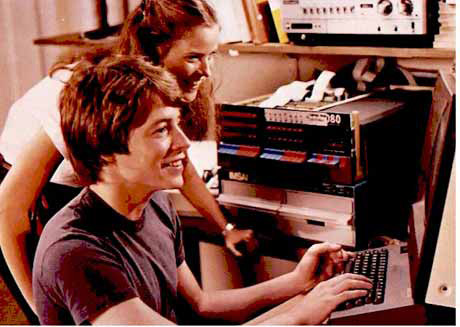
Enter our protagonist David Lightman (Matthew Broderick), a teenage computer hacker who can break into the school’s computer network from home and change his failing grades to passing grades. Along with his girlfriend Jennifer (Ally Sheedy), David is able to sneak into the WOPR system through a backdoor. David and Jennifer find some pretty interesting games in the computer and decide to play one particular war game called “Global Thermonuclear War.” But what they don’t know is that while playing this game, the computer is taking over NORAD and scaring the agents into nearly launching a strike.

McKittrick tracks down young David and forces into an interrogation. David’s story doesn’t sound convincing to him. McKittrick can’t believe that this high-school kid caused this chaos by himself and thinks he might be a spy. But David knows for sure that the computer is continuing to play the game on its own and force NORAD into launching DefCon1, resulting in Armageddon.

The tension that comes with the well-produced 1983 reality is outstanding. The idea that one little act from a high school kid has the possibility of an even bigger problem (for all of mankind, no less) is an uneasy one and “WarGames” handles it effectively, with a mix of intrigue and complexity. The film starts out fun, as David and Jennifer are playing with their computer before coming across all of this. It evolves into something more complex.

There’s also a fascinating sci-fi edge to it, as the computer is learning as it continues to play the game. David at one point asks the computer, “Is this a game or is it real?” The computer responds, “What’s the difference?” It’s thinking on procedural rules, not ethical ones. This leads to a tense climax in which David and the original creator of the machine, Dr. Falken (John Wood) must attempt to force it into learning that this game should not (or cannot) continue. And they have to do it before time runs out…

What also stands out in “WarGames” are the performances, particularly from Matthew Broderick, Ally Sheedy, Dabney Coleman, and John Wood. Broderick has a nice blend of cockiness and innocence that makes us sympathize with David. Sheedy is the kind of girlfriend teenage geeks hope for—cute, fun, and willing to listen to you talk about your computer skills. Coleman is sardonic but ethical as McKittrick, and Wood, showing up late in the movie, has an effective speech about natural selection.

That speech, by the way, is the setup for the climax. Dr. Falken makes that speech to David and Jennifer, after learning that they’ve played with his creation and is willing to accept his fate so that something else will rise after humans. David retorts by stating that it shouldn’t be this way if there’s a way to stop it.

The only thing I don’t like about the movie is the music score. With its overblown orchestral tune, it just sort of grows annoying. That aside, though, “WarGames” has a thrilling story with good acting and execution, and is a genuinely moving thriller. A lot of it may be dated, but it’s more of its time and can’t be complained about.

Amid Amor (Short Film) (2010)

18 Feb

mqdefault

Smith’s Verdict: ****

Reviewed by Tanner Smith

(Originally reviewed in Spring 2011)

“Amid Amor” is a most pleasant surprise. It’s a seven-minute short film made by teen-cousin filmmaking prodigies Andrew and Matthew McMurry for the 48 Hour Film Project in Little Rock, Arkansas. And I must say, it’s very impressive and surprisingly treasurable for a film with such a short length. This short film won the Audience B Award at the 48 Hour festival—it’s easy to see why.

Andrew and Matthew McMurry take unusual measures for this new project, compared to their other projects. For one thing, they don’t star in it—they have a unique screen presence in their previous work. For another, they have story help from Michael Scott, the filmmaker behind the “Scot Murray” film series (my guilty-pleasure films) on Vimeo. But some of their trademarks are present—the comedic effect of special effects (forgive that pun), the whimsical directing style, and the odd-but-charming storyline.

Michael Scott stars as Ben, who is actually Cupid. Yes, the Cupid. We see in an opening scene that he can shoot balls of light from his hands that cause a man and woman to fall in love—kind of a cheat, but hey it’s Cupid. Ben leads kind of a superhero life in the way he can’t tell anyone who he is or show his abilities. He’s also the person you’d least expect to be Cupid. He has no tutu, wings, or bow-and-arrow and he’s not the best-looking guy in town. But Michael Scott is a nice choice for the role. His personality and tone of voice would remind people of Barry White crossed with Bill Murray. In that way, he’s a perfect casting choice for Cupid—just a smooth-talking average Joe…who is anything but smooth.

Austin Blunk, star of the “Scot Murray” series, plays Ben’s best friend Geoff Cooke, a camp counselor who tells Ben about Camp Kettle (one of the 48 Hour requirements was to mention a camp counselor named Geoff Cooke). Ben and Geoff are sitting on a bench in the local park when a girl named Gina catches Ben’s eye—they both are reading John Grisham novels; nice touch. Ben is nervous talking to her—hey, just because Cupid can make people fall in love, that doesn’t make him a ladies’ man. So just this once, he tries to use his powers to make her fall in love with him. But the plan backfires and Gina instead falls in love with Geoff, so they spend a wonderful afternoon together while Ben can only watch.

And that’s not the end of the movie. I don’t know if you can believe that. I shouldn’t spoil the ending for you, but I will say that it has a good message—you can’t force love. It’s subtle and very sweet.

Austin Blunk isn’t given a lot to do in the acting department because he’s given very little screen time—well, what’d you expect when Cupid is the lead character in a seven-minute film? But given the circumstances, that’s amazing. Let me explain—as Scot Murray, Austin Blunk was the irrepressible, ruthless loudmouth who wouldn’t shut up. But here, he’s calm and relaxed. This is not the Austin Blunk I recognize.

Anyway, why is Gina worth it for Cupid to break his own rules? Because she’s played by Enji Wagster (credited as Angie Wagster), that’s why! She made this film on her day off from performing for my romantic-comedy-drama-fantasy, “Interior/Exterior.” That was the movie in which Enji played my character’s romantic interest, who was mainly a voice in my head until we saw how beautiful she was in a mirror in one scene. In this film “Amid Amor,” she has the same acting treatment as Austin Blunk, but hey, she’s beautiful and fun.

“Amid Amor” is solid proof—Andrew and Matthew McMurry are filmmakers. They have the equipment, they have the special effects (the balls of light that Cupid shoots out of his hands), they have the stories, and they have the direction. These are the guys responsible for two of my favorite short films, “9/19/2055” and “Dad vs. Boy” (both of which can be found on www.youtube.com/user/pinnaclepointstudios along with this one). “Amid Amor” is their best film and I will make room for it on my Best Films of 2010 list. I mean it; it’s that good.