Archive | April, 2013

Snakes on a Plane (2006)

16 Apr

snakes-on-a-plane-2006

Smith’s Verdict: ***

Reviewed by Tanner Smith

“Snakes on a Plane” had received a lot of hype on the Internet for a long time. Now, it’s here and while it may not be the masterpiece that audiences would like to expect, it’s still a good way to spend a little more than an hour and a half. It’s like a cult movie that thrills audiences but bore critics (most of them, anyway). But I was sixteen when I became a critic—so I guess I’m a little bit of both. Therefore, I’ll give “Snakes on a Plane” three stars. It’s a fairly bad movie, I’ll admit, that interests. It’s like “The Mummy”—great trash, no, good trash, yes.

Most of the hype is about star Samuel L. Jackson’s biggest line in the movie that is probably going to be remembered for a long time—“I have had it with these mother—-snakes on this mother—–plane!” There is fun to be had with watching “Snakes on a Plane” and with a title like that, why wouldn’t there be? Unsuspecting passengers are already scared of flying, but then they have an encounter with snakes! And also, wouldn’t the snakes’ slithering inside of the plane somehow mess with the gears and the engines? Exactly.

Why are the snakes on the plane to begin with? Well, as the movie begins, a young surfer named Sean (Nathan Phillips) witnesses a murder committed by a mobster. Jackson plays Neville Flynn, an FBI agent who has to transport Sean from Honolulu to L.A. to testify against the culprit. But the murderer wants Sean dead and takes drastic measures—he smuggles hundreds of poisonous snakes onboard the plane on a crate and arranges for the crate to open when the plane is up in the air.

When that crate is opened, the snakes are loose and make their way up to coach where they attack all the passengers. They kill most of them in almost every way a snake can and about every way the filmmakers can think of—snake to the crotch, snake to the bosom, snake to the eye, snake to the tongue, snake to the arm, you name it. Now, it’s up to Flynn, Sean, flight attendant Claire (Juliana Margulies), and a group of survivors to destroy the snakes and land the plane safely.

All this is dumb fun and the secondary characters are the basic stereotypes—including Three G’s, who is a germ phobic rap star; smokin’ hot blonde flight attendant Tiffany (Sunny Mabry); the hostile Brit; and video game lover Troy (SNL’s Kenan Thompson)—but I guess that’s why I liked it. It’s preposterous, yes, but it’s fun. Jackson is forced to play the hero and Margulies is a flight attendant with an axe—watch out!

“Snakes on a Plane” is another one of those comedy-horror flicks and while it’s not up there with “Tremors,” the best in its category, in my opinion, it’s still a fun way to spend about 100 minutes.

OK, look. “Snakes on a Plane” isn’t a great movie. I shouldn’t even be giving it three stars but I’m going to anyway because I had some fun. It’s action-packed, it kept me interested, and it had some good moments. However, if you think it’s a waste of time, then just don’t waste yours. But I have enough time on my hands to waste anyway.

Surf’s Up (2007)

16 Apr

images

Smith’s Verdict: ***1/2

Reviewed by Tanner Smith

Does anybody, aside from me, think that “Happy Feet” was a bit overrated? I liked “Happy Feet” OK, but I felt it was a little too much. After “Happy Feet,” I didn’t expect “Surf’s Up” to be any better. “Surf’s Up” is the first movie since “Happy Feet” to feature cute penguins in a computer-animation process and I was really surprised by how much I liked it. It’s charming, cute, and funny. I liked it more than “Happy Feet” because the penguins are cuter and they have a more interesting story to tell. And it’s told through the same documentary process as “This is Spinal Tap”—it’s a mock documentary.

A documentary crew makes a film about penguin surfing. They follow the events of Cody Maverick (voiced by Shia LaBeouf), a small boy-penguin who loves to surf, lives with his mom and jerk older brother, and lives in Shiverpool, Antarctica (a pun on Liverpool, England). His hero is the late, legendary surfer Big Z, and he wants to be just like him. He is noticed by a talent scout and he, along with a friendly chicken surfer from Wisconsin named Chicken Joe (voiced by Jon Heder), is to compete in the Big Z Memorial surfing contest.

Once arriving on the island, he runs afoul of another competitor—tough, self-absorbed Tank (voiced by Diedrich Bader, whom you might remember, from his gruff voice at least, as Rex from “Napoleon Dynamite”)—and develops a crush on the lifeguard Lani (Zooey Deschanel). After an injury in a competition between Cody and Tank, Lani takes him into the woods to her uncle nicknamed “Geek” (voiced by Jeff Bridges).

But as it turns out, Geek isn’t just a hermit. As Cody discovers, he is actually Big Z who went hiding after a failed surfing contest. Cody takes a liking—as you would if you met your idol—to Big Z, who gives him surf lessons, and as you would expect, he teaches a few life lessons as well. He teaches him these lessons in “Karate Kid” and “Big Lebowski” mode. The lesson, of course, is that winning isn’t everything. I love the scene in which Big Z teaches Cody to make his own surfboard out of a block of wood by informing him on the ways of Zen.

Kids will probably love the film but it would also keep parents entertained as well. The script is clever—it gives the movie some funny lines, a few memorable moments including the one I mentioned earlier, and a satire on sports TV shows with the archival footage of the original penguins surfing. I also love the “Spinal Tap” gimmick that it uses, the way that the camera shakes every now and then and there are questions asked by the cameraman (or camera-penguin, the movie never tells who’s making this film) and interviews with the characters.

“Surf’s Up” delivers the goods, and I admired it more than “Happy Feet” mainly because it wasn’t about penguins racing to save the world or embark on great journeys; they just want to catch some waves. It’s as simple as that. It’s funny, whimsical, witty, and a lot of fun. 

A Christmas Story (1983)

15 Apr

ralphieonslide

Smith’s Verdict: ****

Reviewed by Tanner Smith

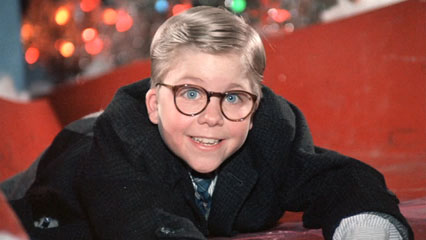
“A Christmas Story” is a delightful holiday movie that recaptures something that is so rarely done well in movies like this—childhood. This movie knows exactly what it’s like to be a child and how the world around the child is imagined. It brings innocence, fantasy, and humor to the screen. In treating the whole film with all three of those elements in a delicate way, it turns out as a modern-day classic. Today, it’s considered one of the most beloved holiday movies, if not the most beloved holiday movie. On Christmas Day, the TV channel TBS even shows it nonstop for the whole 24 hours.

The movie is told as a childhood memory as the old narrator looks back on his ninth Christmas season with joy. In the early 1940s, he was a young boy named Ralphie Parker, who knows the one Christmas gift he wants to find under the Christmas tree on Christmas morning—an Official Red Ryder Carbine Action 200 Shot Range Model Air Rifle (or in other words, a Red Ryder BB gun). His mother is not going to get him one, as she warns, “You’ll shoot your eye out.” So Ralphie continues his crusade, dropping hints on his father and writing a school theme about what he wants for Christmas.

We get a great deal of Ralphie’s family life as we view their comfortable routines around Christmastime. We have the father—or as he’s known, the Old Man—fighting a faulty furnace. We have the mother using subtle tactics to get her youngest son Randy to eat. We also see her trying to fit the kid into a winter coat that he has outgrown. We see them all go out to buy a decent Christmas tree at a…just-decent price.

The narrator, Jean Shepherd, who wrote the source material for this film—a collection of short story memoirs entitled “In God We Trust, All Others Pay Cash”, tells everything with a satirical reflection. Also, “A Christmas Story” is very funny because it remembers many events in childhood and slightly exaggerates them for comedic effect. Some are basic but taken further, like when the mother has Ralphie’s mouth washed out with Lifebuoy soap after he says a swear word. First of all, that moment when he cusses is censored with “fudge” and there’s no doubt that he heard the real word from his father. Second of all, following the scene where Ralphie’s mouth is blocked with soap is when the mother tries it herself out of curiosity and gags on it. That’s a great moment, but third of all, there’s Ralphie’s daydream in which he has become blind from “soap poisoning” and his parents feel guilty about objecting him to that punishment in the first place. Wonderful.

Then there are scenes that show something that a kid shouldn’t do but is curious about. Most particular is an early scene in which one of Ralphie’s school chums puts his tongue on a flagpole for a dare. Of course, it sticks. It’s painful to watch, but show it to any kid and they’ll get the idea never to do something like that. But there’s something all too familiar that brings us to what is arguably the funniest scene in the movie. It’s a trip to see a mall Santa Claus. It may seem like a delightful visit, but in truth, it can be unnerving and sometimes downright disturbing. That’s how Ralphie’s visit to Santa to ask for the BB gun goes—a complete nightmare. Santa looks all too red in the face, and his “ho-ho-ho’s” need toning down, while the “elves” are complete jerks. And when a kid goes up to see Santa before Ralphie and his brother, he screams in terror.

Peter Billingsley is perfect as the little protagonist Ralphie. He’s an energetic, adorable kid who tries desperately to get what he wants and thinks he can outwit the adults around him. Billingsley, with his smile, glasses, and wide eyes, is an absolute natural—he doesn’t seem to be acting at all. The parents are very well-drawn-out and wonderfully portrayed by Melinda Dillon as the mother and Darren McGavin as the Old Man. Dillon’s mother character may be overly controlling, but she’s also loving and caring. Her best moment, in my opinion, is how she cares for little Ralphie after he beats the school bully Scut Farkas in a fit of rage. She knows he’s hurting because of the bully’s verbal abuse and his rage was out of his control, so she nurtures him rather than scolds him. McGavin’s father character is an absolute hoot while his performance is flawless. He’s a gruff middle-class businessman, but he loves his family and finds joy in the small things that he feels are important. I love the scenes that show his desire for a leg-lamp he won in a contest, and how the mother uneasily reacts to it. When she unplugs the lamp as the family goes out, she tells the Old Man it’s to save electricity. We all know the real reason.

The movie’s time range is from a couple weeks to Christmas to the Big Day itself. And who would have thought that a story about a kid wanting a BB gun for Christmas could be suspenseful? With the spirit of this movie, it’s hard not to wonder whether or not he gets the gun on Christmas Day. However, it is hard to believe that the director of “A Christmas Story” was Bob Clark, the director of the previous year’s sleazy, smarmy, unpleasant comedy “Porky’s.” Then I came across this piece of information—apparently, the box-office success of “Porky’s” (which is a surprise to me) gave Clark permission to direct whatever movie he wanted to make. So he made “A Christmas Story,” a treasure of a movie that is so loveable and wonderful that it’s easy to forgive Clark for “Porky’s” (and even “Porky’s II: The Next Day,” released the same year as “A Christmas Story”). In my eyes, “A Christmas Story” is a perfect movie.

Secret Admirer (1985)

15 Apr

secret-admirer-original

Smith’s Verdict: **

Reviewed by Tanner Smith

The ‘80s comedy “Secret Admirer” features teenagers and a lot of them, as did “Fast Times at Ridgemont High,” “Porky’s,” “Valley Girl,” “Sixteen Candles,” and a few other titles I could mention (the worst of them being “Porky’s”). But rarely in a movie like this do you see adults who are given the same amount of screen time. In fact, if you split the scenes with the adults and teenagers apart, and then time them, you’d have almost the same length of each. The adults are the parents of the teenaged main character and his crush. They’re here because of a conflict that was the teenagers’ own business in the first place but became something more—something almost tragic. Read on and you’ll see why.

C. Thomas Howell plays Michael, a teenager who has the hots for the popular girl in school Deborah (Kelly Preston, who spends the duration of the film dressing like a slut—the movie’s target audience will love that), who is dating the tough college guy Steve. Michael’s best friend is Toni (Lori Loughlin), and she likes Michael more than a friend. But of course, Michael doesn’t catch on (they never do in these movies). Toni sends Michael a love letter, anonymously, but Michael believes that it’s from Deborah. So he decides to send his own anonymous letter to her and have Toni deliver it to her, much to Toni’s reluctance.

Now I know what you’re thinking. What does this have to do with their parents? Well, Michael’s little brother finds the letter that was written to Michael and brings it to the breakfast table. After he leaves, the mother (Dee Wallace-Stone) finds the letter, reads it, and suspects that her husband (Cliff de Young) may be having an affair. Then one of Michael’s letters to Deborah winds up with Deborah’s parents and each parent (played by Leigh Taylor-Young and Fred Ward) is suspecting that they’re both having an affair with Michael’s parents (de Young is in Taylor-Young’s night class). Then all of the adults are brought together at a bridge party and slapstick, cartoon violence ensues.

It’s satisfying to see adults put in the same length duration as the teenagers—their scenes are separate from the scenes that show Michael trying to score with Deborah. But why did they have to be treated like idiots? And why did they have to be victims of unfunny comic scenes? Why are they treated like this? But to be fair, they are well-acted—especially Fred Ward, who has a presence that is part-Terminator, part-goofiness.

I was interested in the teenagers’ story until it got to the predictable final half, in which everything is settled and redeemed after an hour of complication. Of course Deborah turns out to be a slut that Michael doesn’t want to bother with anymore. Of course Michael realizes how much Toni feels for him. Of course they’re going to wind up together. I wish I could tell you that how they wind up together was unpredictable…but it wasn’t.

The teenagers are well-played. C. Thomas Howell has an appealing personality, Kelly Preston is suitably attractive and sour, and Lori Loughlin (the best of the bunch) is wonderful and fetching. Then there’s another teenager, played by Casey Siemasko, who is a slob and a party animal who puts himself into the wrong situations every time he tries to smart off. Even he has some appeal.

I wish I could’ve seen these people in a different movie. “Secret Admirer” undermines their uniqueness and talent, which is too bad. I will say this though—this is a much better film that any of the “Porky’s” movies. But of course, that’s not saying much.

Beetlejuice (1988)

15 Apr

beetlejuice

Smith’s Verdict: ***

Reviewed by Tanner Smith

“Ghostbusters” was a unique piece of work—it mixed comedy with special effects and the macabre. Now comes “Beetlejuice,” an attempt to cash in on the “supernatural comedy” subgenre, but admittedly an amusing, good-looking, eerie horror-comedy with a lot of special effects. It’s a sort-of cartoon look at the way of the afterlife, and I like the energy and originality that was put into this film.

The movie stars Alec Baldwin and Geena Davis as a happily married couple named Adam and Barbara Maitland who spend vacation in their idyllic New England country home. They spend a happy life together, until they get in a deadly accident. When they return home, they realize that they no longer have reflections and find a strange book known as the handbook for the recently deceased. They realize that they are ghosts, and when they attempt to leave their house, they find themselves in a strange parallel dimension where giant sand-worms crawl under the ground. So they have nowhere to go.

Adam and Barbara’s peace is destroyed when a New York couple (Jeffrey Jones and Catherine O’Hara) and their Gothic daughter Lydia (Winona Ryder) move into the house and redecorate it. As ghosts, Adam and Barbara try to scare off the unwanted guests but they can’t be seen. Desperate for help, they find Betelgeuse (pronounced “beetle juice”), a bio-exorcist who loves to scare people away, but his methods may actually be dangerous and quite deadly.

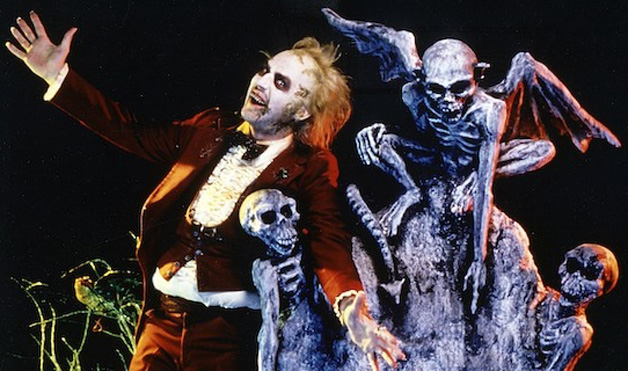
Betelgeuse is played by Michael Keaton, who is almost unrecognizable behind makeup. It’s a hilarious performance. Although, if the whole movie were about Betelgeuse, it would be a little irritating after a while. This guy is so manic that a little of this guy almost goes a long way. But it’s just so funny and he nearly stops the show.

But the movie isn’t all about that “ghost buster”—it’s about the relationship between two deceased lovers trying to cope with being dead and experiencing the most unbelievable stuff in the afterlife. When trying to scare off their new unwanted guests, they soon befriend Lydia who can see them because she’s “strange and unusual” and she can understand the weird Handbook. I like the energy and originality and gimmicks that were put into this movie. I love the way the afterlife looks, and how Tim Burton creates the illusion of an afterworld with great special effects, amazing set pieces, and dark cinematography.

Alec Baldwin and Geena Davis do terrific jobs as the couple, and Jeffrey Jones, Catherine O’Hara, and Winona Ryder are no slouches either as the New York family. And then, Keaton is there to liven—or deaden—up the party with his crazed performance of Betelgeuse.

“Beetlejuice” is crazy but wonderfully so. It’s a nicely-done mixed blend of comedy and horror. I liked the casting, I liked the production design, and I also liked the visual jokes put into the scenes involving the afterworld (a badly burnt ghost is smoking a cigarette, for example). Even if it goes overkill near the end, it’s still a good deal of fun.

Transformers: Revenge of the Fallen (2009)

15 Apr

2009_transformers_revenge_of_the_fallen_035-(2)

Smith’s Verdict: *

Reviewed by Tanner Smith

Man, is this movie a disappointment! Remember the big-bang action climax at the end of the original 2007 hit “Transformers?” I remember how bored I was with that, yet how entertained I was with what happened before that. And here, we have its sequel “Transformers: Revenge of the Fallen,” a boring, loud, obnoxious, stupid movie that is easily director Michael Bay’s worst movie since “Armageddon.” Both movies are incomprehensible and idiotic with nothing to show except for an endless amount of big-budget special effects and a poorly-constructed screenplay and heavy-handed direction. These special effects are indeed special but they’re just special effects. There’s hardly anything special ABOUT them because the story is lame and the characters are one-dimensional.

Once again, we have the continuing war between the good Transformers (the Autobots) and the evil Transformers (the Decepticons). The Autobots have the US Army on their side now as they go around searching for Decepticons because…I don’t know, maybe if one of them was around, they might rally more from their home planet and possibly destroy the Earth or something. The movie opens with an especially LOUD opening battle in which Autobots seek to destroy a couple of Decepticons but end up causing more damage than the Decepticons did.

The Decepticons leave the Autobots with a warning: “The Fallen will rise again.” There are always lines like that in big-budget blockbusters. What is the Fallen? Apparently, it’s some type of evil force that can even control the Decepticons and cause world domination. The Fallen is the MacGuffin—we have to watch out for it and keep our ears open. But the movie is so loud that we actually want to SHUT our ears! There are many battles like the one in the beginning of the film that seem to go on forever and grow tiresome and annoying. Sometimes, we will cut back to the original film’s returning teenage hero Sam Witwicky (Shia LaBeouf) as he deals with his parents (Kevin Dunn as the Dad, and Julie White, who seems to be trying hard for a Razzie as the Mom) and tries to settle things in his off and on relationship with his girlfriend Mikaela (the beautiful but bland Megan Fox). He is also trying to fit in on his first days of college but it’s hard to do when his roommate Leo (Ramon Rodriguez) is a techno geek who is attempting to expose the Transformers that the government “covered up.”

OK, let me stop for a moment. We learn in this movie that the big climax in the city at the end of the first “Transformers” was “covered up” by the Government. This makes no sense. There was a city full of witnesses who saw the Autobots and Decepticons fight and kill each other. How in the world could the Government have covered up something like that?

Sam, Mikaela, Leo, and another returning character (played by John Turturro) are caught up in this battle that leads the Transformers to the discovery and possible resurrection of the Fallen. Once again, Sam must save the world while the leader of the Autobots—Optimus Prime—and the US Army (with returning characters played by Tyrese Gibson and Josh Duhamel—both of which are just standard shoot-em-up guys) fight off the resurrected Megatron, the evil leader of the Decepticons. At one point, Sam and the group wind up in Egypt, where there is (of course) an action climax bigger than any of the big action climaxes that happened earlier in the film. John Turturro has to get to the top of a pyramid to get…something, I forgot. And while doing so, he makes this hammy speech, “The machine is buried in the pyramid! If it gets turned on, it will destroy the sun! Not on my watch!”

Also in this climax is a Transformer that works as a vacuum. At one point, Leo and Turturro are behind a car while this monster sucks everything into its mouth. The car is sucked in but Leo and Turturro run away like nothing is there. I’m no physics expert but I don’t think this is possible. If a car can get sucked into this huge vacuum, how can two lighter, moving subjects be unaffected? There are also many other moments in which Sam and Mikaela barely escape death without getting hurt. They even OUTRUN EXPLOSIONS. The only time someone is really injured in the midst of all this big-time action is when Sam is TELEPORTED into another place and breaks his arm (this was written into the story because of LaBeouf’s arm was actually broken during production).

This is just one big action climax and when it stops for comedy, it doesn’t really work. The humor is juvenile at best. We see one dog humping another (twice), we see Turturro’s butt cheeks at one point, we get moments of embarrassment with Sam’s bizarre mother (actually, Julie White is funny in her scenes), and Leo is there for no good reason except to have an annoying, racist stereotype. And speaking of racist stereotype, the most annoying “comic relief” comes from two twin Autobots who act as jive-talking black stereotypes. Their dialogue is spoken so fast that I couldn’t understand anything they were saying. And they NEVER SHUT UP. Then when the film tries to attempt drama, Megan Fox has to cry. No offense to this actress, but she can’t quite cut it here.

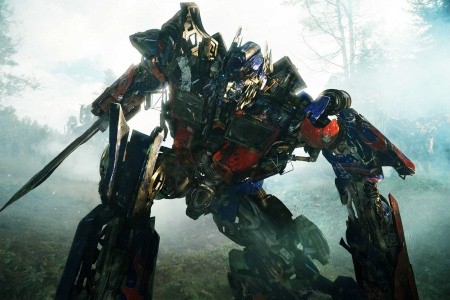
And if you think the human characters are boring, the Transformers are far worse. They’re dumb, clanky, and their dialogue is as dumb as any of the humans’. And while in the original film they were a sight to behold, they just look like a walking pile of junk this time around.

The problem with Michael Bay is that he spends too much time creating blockbuster elements that he forgets that other stuff is important. I enjoyed the original “Transformers” movie, and also Bay’s 1996 thriller “The Rock.” But with movies like “Armageddon,” “Pearl Harbor,” “Bad Boys II,” and now, “Transformers: Revenge of the Fallen,” it’s obvious what he really wants to do—impress and/or annoy the audience with blockbuster style. The style may be fresh, but the development is rotten.

Hancock (2008)

15 Apr

hancock3

Smith’s Verdict: ***

Reviewed by Tanner Smith

“Hancock” is an unusual superhero movie. Will Smith plays the title character John Hancock, who happens to have powers beyond belief and never grows old. I guess you could call him a superhero, but the trouble is that he has a really bad attitude, he’s an alcoholic, and he trashes everything surrounding him when he’s forced to stop trouble. It’s a nice premise. I mean, not all superheroes are nice guys, right? And he doesn’t even have a secret identity.

This isn’t a great movie, but Will Smith pulls it off with his usual attitude that makes all of his movies watchable.

Jason Bateman plays a public-relations agent/family man named Ray. He has a wife named Mary (Charlize Theron) and a young son. Hancock saves his life when he’s almost run down by a train (but also trashes his car and derails the train in the process). Ray owes him and decides to help him clean up his act. He takes him home; his son likes him, but Mary seems to know him from long ago, and keeps giving him a look, which doesn’t make this a spoiler. Hancock spends a few weeks in prison and Ray visits from time to time to counsel him and help him.

Soon enough, Hancock becomes a better man and tries not to trash the place when he foils a robbery when he’s released. However, things do not go so well for him afterwards. That’s just the first half of “Hancock.” There’s a big twist in the second half that makes us go “What?! Whoa!”

(I saw this movie in a theater with my friends and that was my real reaction to the twist.)

Will Smith is great in this role as the superhero with a hangover. He has this attitude and charisma that makes us laugh or care. From comedic roles in his infamous TV series “The Fresh Prince of Bel-Air” to tough guy roles in “Men in Black” to dramatic Oscar-nominated roles in “The Pursuit of Happyness,” Smith is a powerhouse performer and doesn’t seem to work hard to make his movies hits.

Also, Jason Bateman is quite good and relaxed as the nice guy who attempts to change Hancock. Charlize Theron is quite effective as Mary. She has nice moments as the wife who seems to have a history with Hancock. The only trouble with her character is we know that she has a history when we first see her on screen with Hancock.

The action scenes are big-budget and are spent as much time as the ones in “Spider-Man” or “Batman.” Most of Hancock’s antics, such as when he’s flying through the air and placing a car on top of a building (with people in it), are funny but most of them are also heartless. But luckily, director Peter Berg knows that the audience doesn’t care about him flying through the air throughout the whole running time. So, he puts in those moments when Ray is counseling Hancock and has a little secret and back story behind Hancock. Like I said, this isn’t a great movie but Will Smith makes it work for me.

The Accountant (Short Film) (2001)

15 Apr

MV5BMTMwMzM2OTMzMl5BMl5BanBnXkFtZTcwNjgyNTg2Mw@@._V1._SX640_SY512_

Smith’s Verdict: ****

Reviewed by Tanner Smith

One of the best ideas from the Academy of Motion Picture Arts and Sciences was to create an awards category for short films, because any good or great film at any length—long or short—can tell a story and create effectiveness all the same. This is especially true of “The Accountant,” a short film (about 35 minutes) that won the Academy Award for Best Live Action Short Film. Watching the film on DVD, it’s easy to see why.

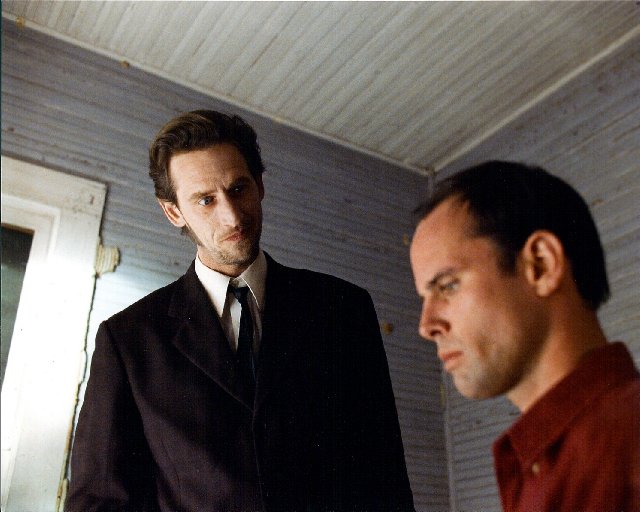
“The Accountant” takes place mainly on the O’Dell family farm in the South. Walton Goggins and Eddie King play brothers Tommy and David O’Dell, who call in an accountant (Ray McKinnon) to help save the farm. They get more than they bargained for, as the Accountant (whose name is never revealed) is a walking calculator who finds an amount in just about everything. He doesn’t even use a calculator—he figures numbers with his hands and feet. He also smokes chain and swigs beer like it’s no one’s business (he drinks a lot in this film and for those who are wondering when he has to take a leak, you’ll have a big laugh midway through the film).

The Accountant is a tall, well-dressed man who constantly leers at those around him, is intelligent, and also smokes, eats, and drinks a lot. He also has his own conspiracy theory about how things work in the South. Is he right? The strange thing is that he could be. I bought this character completely, and Ray McKinnon portrays the role excellently.

The other actors—Goggins and King—have good, convincing chemistry together. You really buy them as brothers.

Another great thing about “The Accountant” is the writing. This is an intelligently written film—not only does every line reading sound like the opposite of a line reading, but when these guys talk, we’re interested in what they have to say. Whether it’s listening to the Accountant’s unheard-of solution to the brothers’ problem (funny at first but shocking toward the end), the Accountant figuring the odds of David’s wife cheating on him (very funny), picking on Southern stereotypes (love the references to “Sling Blade” and “In the Heat of the Night”—by the way, all three actors guest-starred on an episode or two of that show, so that’s a neat in-joke), or ranting about the conspiracy that the South losing touch with its heritage, I loved listening to what these people had to say.

“The Accountant” was written and directed by McKinnon (that would definitely explain how he played the lead role so well); it was also produced by Goggins and McKinnon’s wife Lisa Blount. You can tell that they put their hearts into this film. It’s well-made, superbly written, and well-acted with a great blend of humor, quirkiness, and an effective message. It deserved the Oscar win.

Who Framed Roger Rabbit (1988)

14 Apr

roger_rabbit

Smith’s Verdict: ****

Reviewed by Tanner Smith

“Who Framed Roger Rabbit” is one of the most ambitious, visually impressive, narratively spellbinding movies I’ve ever seen. It’s one of those movies that is just absolute magic—a movie you’ll remember for years to come and just can’t bear to see only once. It just gets better with every viewing. It’s creative to say the least and showcases some great special effects that are not just there as gimmicks, but to serve the purpose of the story.

If you’ve seen “Song of the South,” “Mary Poppins,” or “Pete’s Dragon,” you’ll notice something similar in each of those movies—blending live human actors with cartoon characters. But you never really get the impression that the cartoon characters are really there with the people and interacting with them. This is what “Who Framed Roger Rabbit” does different. This blends human actors with cartoon characters, but in this movie, they really look like they’re there. They look more three-dimensional than their two-dimensional sketches, they cast shadows, and they occupy the same space as the people. It’s unbelievable. They’re so convincingly blended into the scene with the actors, and they’re able to move around the settings of the scene because the camera doesn’t just stay in one spot to make it easy—the camera moves all over the place, following the animated characters…sort of.

“Who Framed Roger Rabbit” is shot as and takes plot elements of a 1940s thriller. But it takes place in a Hollywood that hires cartoon characters, or “toons.” Nearby is ToonTown, where every toon lives. But some are in show business and have moved to Hollywood to star in their own cartoons. Wherever you look, there’s a toon. There’s black-and-white vintage Betty Boop in a bar, upset that cartoons have turned to color. There’s Disney’s Dumbo flying outside an executive’s window. There’s a series of dancing broomsticks, occupied by a saxophone player playing their theme from “Fantasia.” And look! There’s Warner’s Daffy Duck and Disney’s Donald Duck having a piano duel! How great is that! The best thing about the cartoon characters we recognize is that we don’t just see variations of them—including Disney’s Mickey Mouse and Warner’s Bugs Bunny; the only time they’ll ever be seen together. We see them. They are the cartoons we grew up with. They’re here in this world.

There are a few newcomer toons that should be welcomed among the more popular ones (although, in this world, they are). They’re Roger Rabbit—a wacky, zany, clumsy white rabbit with a bowtie; Jessica Rabbit—Roger’s wife, who is not a rabbit but a sexy femme fatale with a seductive voice provided by an uncredited Kathleen Turner; and Baby Herman—a tough-talking midget who plays the innocent baby in the Roger Rabbit cartoons.

As the movie opens, we see one of those cartoons and it’s a true delight. Roger has to babysit Baby Herman while Mother is out shopping, and immediately gets into trouble. There’s enough cartoon slapstick humor to cause laughter for a long time. The cartoon is a masterpiece. And we see that the director Raoul had to call “Cut!” because when a refrigerator drops on Roger’s heads, little birds fly around his head when he wants “stars, not birds!” And Baby Herman walks, complaining in a Brooklyn accent and asking for a cigar—hilarious.

Anyway, what’s the story of “Who Framed Roger Rabbit?” Well, like I said, it’s in the style of a 1940s thriller if intersected with toons. Private detective Eddie Valiant (Bob Hoskins) is hired to follow Jessica Rabbit from the Ink and Paint Club, where she performs as a nightclub singer, and catch in the act of cheating on her husband Roger (or in this case, playing “Pattycake”). Roger doesn’t take the news very well, and that’s why when the man who was seeing Jessica—a rich prankster named Marvin Acme (get it?)—is murdered by a toon, Roger is the prime suspect. Eddie doesn’t think much of it, since he has a prejudice against toons. You see, a toon killed his brother by dropping a piano on his head…is it wrong to say that that’s hilariously catastrophic?

But Roger finds Eddie’s office and is in desperate need of help. He didn’t commit the crime and knows that Eddie and his brother used to stand up for toons and give them justice. Nowadays, the justice system is more direct and diabolical. It’s mostly run by Judge Doom (Christopher Lloyd), who has found a way to kill toons—something called “the dip”; one drop burns them like acid. He and the slimy, cartoonish (haha) Weasels, who serve as his squad, are on the hunt for Roger to execute him. So Eddie decides to keep him hidden as he tries to solve the mystery, but the main problem is that Roger can’t be one place without causing a lot of attention. This proves to be a difficult task.

Perfect examples of how technologically groundbreaking this movie is are two scenes that just stand out. One is the scene in which we first see Jessica Rabbit. She really interacts with people. She squeezes Marvin Acme’s cheeks and plays around with his handkerchief, and then she takes off Eddie’s hat and shoves it right back in his face. It really looks like she’s there, doing these things. Another example is when Eddie tries to keep Roger hidden from the Weasels in his office. He and Roger are handcuffed together after a prank, and there’s no key to separate them. So Eddie hides Roger in the sink full of water, making the Weasels think Eddie’s cleaning his underwear. Roger, of course, can’t hold his breath very long (which is kind of odd, since he can’t feel pain and there’s only way to kill a toon, as the movie keeps suggesting), and panics in the water. The water splashes about, making it look like Roger is really there. How did director Robert Zemeckis and his crew do all of this? They always keep the toons in the right places and the actors look like they’ve been seeing toons for a very long time.

This is some of the best special effects I’ve ever seen. They’re far from simple. Every detail was plotted out and the result is just perfect.

Bob Hoskins does an excellent job as Eddie Valiant. He has the hardest part of the other actors—Christopher Lloyd as the villain and Joanna Cassidy as Eddie’s girlfriend—in that he interacts with the toons the most. He acts to pretty much nothing, except for a few wires that move certain things, and he has to imagine that he’s really looking at a cartoon character. He does an incredible job. Without the right credibility, it wouldn’t be convincing that there’s human interaction with toons. And Hoskins is also a great comic actor and for his character, he mixes gruffness with sincerity and gets a good amount of laughs as well.

The story goes through many turns as we get many hints of social commentary, all of which developed to the final act, in which Judge Doom (I’m not giving away that he’s the villain; you’ll know the first time you see him) has a plan to get rid of all toons as if they were secondary individuals and turn their world ToonTown into a “freeway.” There’s also a lot of inventiveness in ToonTown, seen near the end as Eddie gives chase inside. This place seems pretty cool—a whole world full of cartoon characters. It’s every kid’s dream come true. But the place is an insane, chaotic hell ride where everything is just completely nuts and even your favorite cartoon characters are…somewhat sadistic. Look at Mickey and Bugs skydiving while Eddie is free-falling—they offer him a spare parachute, and what do they give him? An inflatable tire!

From the first scene to the last, “Who Framed Roger Rabbit” is a joyous, funny, delightful, inventive entertainment. It’s a ton of fun and visually remarkable. I can imagine seeing this movie a hundred times and never getting tired of it. That’s the magic of the movies that comes through with this movie.
Sky High (2005)

14 Apr

Sky High 2005

Smith’s Verdict: ***1/2

Reviewed by Tanner Smith

“Sky High” is a pleasant surprise. It’s a smart, funny, utterly enjoyable family movie about superheroes and a school for superheroes. I never thought I would praise a movie with that admittedly-cheesy idea, but there you go. I would say that “Sky High” is intentionally cheesy and very well done. There’s a lot for me to admire about it.

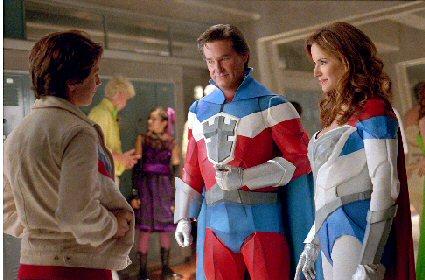
Michael Angarano stars as Will Stronghold, the fourteen-year-old son of the world’s greatest, most infamous superheroes—the invincible Commander (Kurt Russell) and high-flying Jetstream (Kelly Preston). Will’s “superparents” look forward to Will eventually joining them in helping save the world. There’s just one problem—Will doesn’t have any superpowers of any kind. But because of his parents’ reputation as the greatest superheroes on the planet, Will is accepted at Sky High School—a secret high school for the new generation superheroes (the school also hovers in the sky, hence the name—get it?). Will and his friends—Layla (Danielle Panabaker) who can communicate with plants, Zach (Nicholas Braun) whose body can glow in the dark, brainy Ethan (Dee Jay Daniels) who can melt himself at will, and Magenta (Kelly Vitz) who can morph into a guinea pig—are freshmen and because of their unimpressive powers (or shortage of powers), they are listed as “sidekicks.” You see, like all high schools, there are cliques—the cooler clique at Sky High is the “heroes,” the students who have very impressive (I dare even say “super”) abilities.

As the ads for this movie made quite clear, Will does eventually get his powers (he’s super-strong, like his father)—he becomes part of the “heroes” and has a chance with the girl of his dreams, Gwen Grayson (Mary Elizabeth Winstead). But he is neglecting his old friends and becoming more of a neglectful jerk.

This film contains elements from other films (such as “The Incredibles,” “Can’t Buy Me Love,” and a touch of “Harry Potter”), but has its own touches as well. They all work in this film, which lampoons the superhero genre while also becoming a member of it as well. I like the lesson it delivers that popularity is overrated and friendship is more important. (It’s not new, but it’s usually welcome if done right.)

I really like the writing here—a lot of in-jokes, suitable character names (such as “Warren Peace,” the name of the bully at the school), and lines such as “I’m not Wonder Woman, you know,” said by the principal of Sky High, coincidentally played by Lynda Carter (OK, maybe it’s not much of a coincidence after all).

There are some parts comedy, some parts action, and some parts drama. Each of them work well and it helps that the film continues at a consistently interesting pace. The special effects are impressive, the colors in the film are bright and good to look at around the school, the soundtrack is great (I like how Spandau Ballet’s “True” is used in certain scenes), and the film is innocent and for everyone—kids and adults. The PG rating is just right for “Sky High.”

“Sky High” also has an appealing cast—Michael Angarano is an appealing lead, Danielle Panabaker and Mary Elizabeth Winstead are effective as Will’s romantic-triangle subjects, Kurt Russell and Kelly Preston are brilliant as the superheroes who save the world in costume on duty and have secret identities as mild-mannered real estate agents and Will’s loving parents, Bruce Campbell and Dave Foley are amazing as two fun faculty members, Steven Strait strays far from the bully stereotype and becomes someone easy to like (when you don’t get on his bad side, that is—he’s a suitable bully for this movie), and Kevin Hefferman is just fantastic as the overweight school bus driver Ron Wilson. All of these actors look like they’re having a great time making this film.

“Sky High” is just a ton of fun. There are a lot of laughs and even more moments when I had a smile on my face. This is a fun movie with a sharp wit, a sense of humor, an eye for its fictional surroundings, and, again, a great sense of fun.