Lucas (1986)

15 Mar

tumblr_l3phddo2TP1qzcwkno1_1280

Smith’s Verdict: ****

Reviewed by Tanner Smith

I have seen many high school movies in which the jock gets the cheerleader, the class brain is harassed, and the football team wins the big game at the end. However, with “Lucas,” it is as if I have never seen it before. What I mean is that this is truly an original high school movie with teenagers not full of lust, selfishness, and hate. Those three traits are what Hollywood filmmakers think every teenager has. For “Lucas,” what we have here is something really special—that very first feeling of falling in love.

Lucas (Corey Haim) is a truly original character. He is a teenager who doesn’t look old enough for high school (“I’m accelerated,” he proudly states), wears thick glasses, is shorter than the other teenagers at school, and is really a sweet kid. Every day, he goes into the fields to look at insects—he does not collect them, only looks at them. He’s also sort of an outcast because his mouthing off about useless information makes him the butt of the football team’s jokes.

One day, Lucas walks near a tennis court and sees her—we all know “her;” she’s that girl we all see for the first time and start to fall instantly in puppy love with. The girl’s name is Maggie (Kerri Green) and she is astonishingly beautiful. Lucas meets Maggie and not only is she beautiful; she is also smart. They soon begin talking. Lucas becomes sort of a guidance counselor to her—saying that sports and cheerleading are just superficial. The two soon become fast friends. They play tennis, they have nice little talks, they even listen to classical music from inside a sewer tunnel. Lucas is deeply in love with Maggie, but she is two years older than him. Maggie sees him as a real good friend and declares him “special.”

Things go great until school starts. Other teenagers are out to make Lucas miserable and Maggie starts to fall for Cappie (Charlie Sheen), the captain of the football team. Then, she considers trying out for cheerleading. Soon, Maggie and Cappie go together to the school dance. That makes Lucas jealous. Therefore, he tries out for the football team to see if he will make an impression.

The film centers on the Lucas character—he’s not like one of those cute-boy roles who just look at the camera as if saying “Aren’t I cute?” He sports thick glasses, is skinny, and has a gift for talking himself into situations where he doesn’t belong. Corey Haim, who plays the kid, is excellent for the part. He gives us one of the most interesting and complicated portrayals of a teenager I’ve ever seen. Haim is wonderful as Lucas. Also, the other two main actors in this movie are Kerri Green (“The Goonies”) as Maggie the loved one and Charlie Sheen as the football captain. They’re both effective as well. Green gives a wonderful performance as sweet, sensitive Maggie and Sheen gives a nice surprise to his character in an especially effective performance. His character of the popular jock is original because he isn’t played as the jerk that practically rubs everything into everyone’s face and wins the heart of the girl with his position in the game. Instead, the original part and the surprising aspect is that he likes Lucas. He protects him from the bullies at school and does what he can to keep him from getting hurt and while he won Maggie away from Lucas, he still cares for the kid’s feelings. Sheen is given the most difficult role in the film and he pulls it off big time. All three performances by Haim, Green, and Sheen really make this film work.

The performances aren’t the only things that make “Lucas” work. There are many scenes in this movie that are just so well-written and so well-directed, it’s just so hard to decide which one is the best. Almost every scene in this movie works with great dialogue, terrific characterization, and excellent performances. The last half of the movie worries us a little because it revolves around the “big game.” Of course when a movie talks about football and has a couple of scenes of football practice, you’d expect a “big game.” And of course, you’d expect the underdog to impress the girl by winning the game and getting the respect he deserves and then, the credits start to roll. But you’d be wrong. As it turns out, the “big game” succeeds far from falling into predictability. What a relief too.

Director/writer David Seltzer has given us a real terrific piece of work. He obviously knows that not all teenagers are full of lust, selfishness, and vulgarity, but that there are a lot that are actually sensitive, innocent, and vulnerable. When the kids in this movie talk, we’re actually interested in what they have to say. “Lucas” is smart, funny, sweet, non-condescending, non-vulgar, and very well-done with the three great performances, well-executed sequences, and a terrific script. I love this movie.


Spider-Man 2 (2004)

15 Mar

2004_07_spiderman2

Smith’s Verdict: ****

Reviewed by Tanner Smith

Remember in “Superman II,” when Superman thought about living a human life, rather than a superhero life, just so he can have a relationship with Lois Lane? She must’ve been quite a woman—indeed, she was and you couldn’t blame Superman for wanting to retire from being Superman. Being a superhero is like carrying a burden with you. You can’t do the things you’d love to do some of the time, you can’t reveal your secrets to anybody because your enemies may come after them to get to you, and you think you’d be better off as a socialite rather than an independent, mysterious figure.

Peter Parker wonders the same thing in “Spider-Man 2.” For about two years now, he has led a double life. First, he’s Peter Parker (Tobey Maguire), the nerdy but likable college student. Then he’s Spider-Man, the web-slinging, costumed vigilante. Much like Clark Kent in “Superman II,” Peter realizes the burden he’s carrying as Spider-Man. It interferes with Peter’s life—it makes him late for class, it causes him to be fired from his pizza-delivery job, it alienates him from his friends (including Mary Jane and best pal Harry Osborn, played by Kirsten Dunst and James Franco), and never gives him a chance to live. He can never have what he wants while leading this double life. Maybe it’s time to give up being Spider-Man.

That central theme is one of many great aspects of “Spider-Man 2,” a thrilling, awesome, and—when it needs to be—touching superhero movie. “Spider-Man 2” has action, drama, and light comedy to keep it interesting. Thanks to a well-thought-out screenplay, masterful direction, and good acting, this is a top-notch superhero movie. It has interesting likable characters to watch and root for, and stellar action sequences that actually mean something. I can think of a few other superhero movies (or other action movies, for that matter, but I’ll keep the references short in this review) that share both of those elements—the first two “Superman” movies, Tim Burton’s “Batman,” 2008’s “Iron Man,” and especially Christopher Nolan’s “Dark Knight” trilogy (those last two references were released after this movie, of course). The original “Spider-Man” only had the interesting, likable characters, but was a little short on the action scale.

The villain in “Spider-Man 2” is also interesting—even more so than the Green Goblin in the original film. He is nicknamed Doc Ock (and played by Alfred Molina) because of his mechanical, artificially-intelligent limbs attached to his spine. He was a brilliant scientist on the brink of a breakthrough before something went terribly wrong and his machine was destroyed, the robotic arms took lives of their own (it’s not as silly as it sounds), and his wife was killed in the process. Therefore, he became the villain Doc Ock, recreating the machine that could harness the power of the sun, robbing banks to pay for some of the equipment. This is where he becomes Spider-Man’s arch-nemesis, as they fight for the life of Aunt May (Rosemary Harris), who is caught in the middle of all this and (it should be added) not afraid to strike at her captor with her umbrella.

This subplot involving Doc Ock is interesting—Doc Ock is being manipulated by the artificial intelligence of the mechanical arms. He’s not a monster; he’s just becoming one.

The action scenes are riveting. One sequence, in particular, is a standout—it involves Spider-Man in a desperate race to stop a runaway train before it runs off track. I don’t know how they managed to pull it off, but I don’t care. I just loved watching it. I was hooked, interested, and on the edge of my seat. The special effects are outstanding and much better handled than in the original. And while we’re speaking of top-notch special effects, I did believe there were metal arms attached to Doc Ock throughout the movie. Odd thing to praise, but OK.

The drama also works in “Spider-Man 2.” I already mentioned the central theme of the movie, which was Peter wants to give up his superhero life. Also noticed are the scenes in which Peter copes with the guilt he feels because of his uncle’s death. Then there’s the scene in which he finally tells Aunt May why it was his fault that Uncle Ben is dead. Also realized is the subplot involving Harry as he wants nothing more than for Spider-Man to be destroyed for killing his father, who, if you recall, was the Green Goblin in the original film. There’s a great sense of revelation in James Franco’s face in one particular scene.

“Spider-Man 2” is a rarity—a superhero-movie sequel that is better than its predecessor. I liked the first film fine (I gave that three stars), but I felt that there were some elements about it that were either overplayed or not played well enough. This sequel is just what I was looking for, and had just the right upgrades I felt it needed. The effects have upgraded, Spider-Man is just as interesting as the always-likable Peter Parker, and the villain is a complex character. It’s a highly satisfying sequel, and a great superhero movie.

Promised Land (1988)

15 Mar

MV5BMjA3OTI2NTk5MF5BMl5BanBnXkFtZTcwMDA4OTgwMw@@._V1._SX640_SY443_

Smith’s Verdict: ***

Reviewed by Tanner Smith

How many of us after we graduate high school turn out exactly the way we planned? How many of us remain the way we used to be in the good old days of high school? Not many, that’s for sure. There’s always that thing called the present that pushes us forward in life where we just have to carry on and realize that we’re not the same people we used to be. “Promised Land” is an indie drama that understands that and tells the story of two high school acquaintances—one of which has moved on, the other doesn’t want to.

The film begins at the last high school basketball game of the season and star Davey Hancock (Jason Gedrick) makes the winning shot. Hancock is going to college on an athletic scholarship, leaving his cheerleader girlfriend Mary (Tracy Pollan). But two years later, we see him as a police officer in his hometown and we learn that he was denied the scholarship to a better player. He was even less successful in his academics, and so he dropped out and moved back to town. Hancock still recalls his glory days of basketball and even plays around in the office with his co-worker Baines (Googy Gress), even though he makes sure Baines never scores (even when Baines does, fairly, Hancock calls foul). As for Mary, she’s going to college and plans to major in the arts. Hancock still likes to see her, but she is reluctant to continue a relationship with him since she is moving on with her life while Hancock is still stuck in the past. She may be successful than he’ll ever be.

Danny (Kiefer Sutherland) was the academic “nerd” with the nickname “Senator” because he was destined to become a successful politician. But now, he has become a drifter since he quit high school and moved to try a better life with a good job. Instead, he became a loser. His girlfriend Beverly (Meg Ryan) is a crazy young woman who is overbearing, wild, and unpredictable…Danny winds up marrying her. And when he does, Beverly just can’t stop laughing. Even though the trampy Beverly is a little more for Danny to handle, the two fit together because they are both lost souls looking to connect with each other.

The film goes back and forth between Danny’s story and Hancock’s. Even though Hancock’s tale is convincing enough to be grittily pathetic, a little of that goes a long way to the point where I didn’t really care that much for this true loser who just can’t go on through life. It’s the story featuring Danny and Beverly that is more interesting, as Danny plans to drive with Beverly back home to see his family on Christmas. Danny is as much a loser as Hancock, for different reasons, but you still care for him because he’s trying something new and not everything is working in his favor. And Beverly constantly makes Danny’s life complicated whenever she has an extreme idea, to the point where Danny is wondering if he’s with the right person and if he can tolerate her any longer. But as he realizes, he needs her to fill a void in his life—for better or worse.

There’s a lot of symbolism to be found in “Promised Land.” The production work is impressive with objects like hood ornaments, a statue with a broken wing, snow angels, the early chants in the last big game, etc. that indicate something coming. While this can become somewhat pretentious, I have to admit I admired it.

With only one exception, the acting is solid. Kiefer Sutherland delivers a good, convincing depth to his role—his scenes with his sickly father, nicely played by Oscar Rowland, are truly heartbreaking. Tracy Pollan does nice work as Mary. Googy Gress is more than comic relief as Hancock’s buddy. And Meg Ryan is joyfully effervescent as Beverly—she steals the show with her zaniness. But the one exception to an otherwise-strong cast is Jason Gedrick as Hancock. While he’s OK in his earlier scenes, he wears out his welcome as the film continues. When forced to carry an emotion, he’s pretty bland.

“Promised Land” leads to a tragic ending that I didn’t really buy the first time I watched it. But watching it again, I realized how everything was leading up to this, when you really think about it, inevitable payoff. In that way, it’s actually pretty damn effective and paints a good portrait of irony, frustration, and security in small-town life.

“Promised Land” is a well-acted, well-executed drama about believing in the American Dream, but have yet to see evidence of it. Maybe it’s there and they just didn’t look hard enough for it, or they just gave up on it because of their life experiences and their fears of failure that led to nothing. There are people like this in the world. “Promised Land” does a nice job at portraying them.

Funny People (2009)

15 Mar

31funny_600

Smith’s Verdict: ***1/2

Reviewed by Tanner Smith

With a title like “Funny People,” a writer/director like Judd Apatow, and a cast that features actors/comedians like Adam Sandler, Seth Rogen, Leslie Mann, Jonah Hill, Jason Schwartzman, and Aziz Ansari, you would expect this movie to be as raunchy and as funny as Apatow’s other writing and directing works like “The 40-Year-Old Virgin” and “Knocked Up” or his productions such as “Superbad” and “Forgetting Sarah Marshall.” Well, there certainly is raunch and humor in “Funny People,” but at the surface is a story of pure drama. Many of the characters in this movie are stand-up comedians, and everyone else is in some other sort of show business (like a sitcom), but the characters are all hostile towards each other—while showing friendship as well as dealing with life issues—and the story is mainly about how life off screen or off stage is every bit as difficult as is it is on screen or on stage.

“Funny People” is probably the closest Apatow has gotten to digging deeper into what his characters are going through. Each of his movies had plenty of humor but enough realism to show their lives. This film goes the extra mile. The result—an uneven but mostly endearing movie about how these “funny people” live their lives.

Adam Sandler delivers his best work in the leading role, and that’s saying something, considering his great work in dramatic roles such as “Punch-Drunk Love” and “Spanglish,” aside from his usual shtick in his juvenile-minded comedies. He plays a stand-up comedian named George Simmons. He enlivens the stage and has a huge fan base, but his life isn’t as lively. He lives alone in a big mansion, barely has any friends, and could possibly have bipolar disorder. Women fall to his feet and men have their cell phones ready to take pictures of him whenever he sees him. The problem is he’s all alone in living this celebrity’s dream. Things get worse when he hears the news from a doctor that he has a rare blood disease that’s killing him.

Enter Ira (Seth Rogen), an aspiring comic who lives with his buddies, one of which (played by Jason Schwartzman, who’s very funny here) is a self-indulgent TV sitcom lead, who is so proud of his moderate success that he leaves his paycheck on Ira’s pillow. (Jonah Hill plays the other roommate.) Ira is forced to follow George Simmons’ stand-up comedy act one night, but it comes easy, since George is so depressed that he literally dies on stage, while no one suspects that he’s dying in real life. Ira uses George’s somewhat-failure to his advantage, and that leads George to hire Ira to write some material for him to use. Later, though, Ira is the only one who knows of George’s sickness.

What follows is actually a well-told story of how George deals with his disease and how the relationship between George and Ira develops. There’s humor, but there are also some really touching moments here—George’s meltdown when he realizes he can’t waste another minute, George’s confiding in Ira, and the people from his life whom he comes to contact with. One of those people is the “one that got away”—a woman named Laura (Leslie Mann, Apatow’s wife) who despite everything still loves George and wants to spend some time with him, now that he’s dying.

All of this is well-told. Sandler does a terrific job of showing the dark side of this stand-up comic who faces his own mortality. Sometimes, he’ll look at it with a laugh, but like everybody, he’ll ponder his life and dread the end. The movie shows a nice job of showing parts of his career—for example, we see posters and clips of George Simmons’ movies that, believe it or not, look actually worse than the actual Adam Sandler comedies. One of them features him as a man-baby, with his head on a baby’s body, and another features him as a half-man, half-fish (a merman). I should also note the way this movie opens—it opens with home-video footage of George making crank calls with his college buddies (the footage was shot by Apatow himself and the buddies were actually Ben Stiller and Janeane Garofalo). This is funny because Sandler thinks it’s so funny, he’s enjoying what he’s doing and his friends are laughing uproariously as he does it. Then the movie starts and you see George many years later, alone in bed and tired. Times have changed. He has no one to share the laughs with. This is the life he leads now that he’s become rich and famous. It lets you know right away that “Funny People” isn’t merely a comedy. It’s saying something serious about fame.

Not to say the entire movie is serious. There are plenty of funny moments in this movie to balance the dramatic moments. There’s Adam Sandler’s guitar-playing mocking of Ira’s former last name (it’s spelt Weiner, but pronounced Whiner), James Taylor briefly mocking Ira’s sense of humor at a MySpace party, Jonah Hill’s description of how a popular video can lead to something more, Jason Schwartzman’s self-indulgence, and more pleasantries.

All of the actors do fine work. Seth Rogen does a surprising turn because he isn’t playing the loud, anxious best friend role that made him famous in Apatow’s movies like “40-Year-Old Virgin.” I’ve seen him play that role in many other movies and while he is funny and entertaining to watch, it’s so refreshing to see him actually try to act in this movie. And he does a convincing job. I bought Rogen as this bashful, clueless, good-hearted comic who tries to make George feel good about himself in his remaining days. Jonah Hill and Jason Schwartzman crack several one-liners; they’re very funny here. Also notably funny is the deadpan presence of Aubrey Plaza, a mousy female comic whom Ira has a crush on. Oh, I almost forgot about Aziz Ansari—he plays another desperate stand-up comic and while Ansari’s role is brief, he makes the most of it.

“Funny People” has all the material for a movie that deserves four stars. Unfortunately, this is only the first half of the movie. And from this part, I’d like to issue a SPOILER ALERT! Even though a major plot point I haven’t discussed yet is shown in the film’s trailers, I won’t take any chances. So finish the review right here and see the movie for yourself, but I should warn you the movie is two hours and twenty-six minutes long and when you realize why that is when you watch the movie, come back and read the review.

For those of you who stayed, I’m about to go into the second half of “Funny People,” which is surely less successful than the first half. It begins with George learning that he’s actually beat his disease. Actually, that could have been the end of the movie. I felt like I’ve seen the end of a movie as Ira yells in delight that George is cured. But no, there’s a little more than an hour left to watch. All that time leads to George’s new affair with Leslie Mann’s Laura. Laura learns that George is well and still has these feelings for George, but the problem is she’s married to an Australian hunk (Eric Bana). But he’s on the road most of the time, and George finds it more appropriate—to himself, anyway—to pay her a visit at her house, dragging Ira along with him. It’s an overnight that eventually becomes longer, much to the concern of Ira and to Laura’s two young daughters (played by Apatow’s and Mann’s real-life daughters, both of whom were also in “Knocked Up”).

The movie just becomes more of a family melodrama and becomes less of what has followed before. It only gets more complicated as Bana returns home and has his suspicions of George’s visit. I wanted George and Ira to just leave the house and go back to where the more interesting characters and story developments were.

What I’m getting at is that “Funny People” is a missed opportunity for a really great movie, and I feel like I’ve seen Apatow’s special “director’s cut” than the actual movie that, when you get down to it, was really the first half of the movie, which is so rich and funny and insightful that you wonder if Apatow could have saved the stuff with Laura’s family for a “Knocked Up” spinoff.

“Funny People” ends with a conclusion that is satisfying enough that you feel like you’ve enjoyed spending time with these characters. You may be relieved to go home, but at least, you have things to think about, related to most of what you’ve seen. The movie does have pacing issues and you wonder why the editors couldn’t have cut a few minutes out of certain scenes, but as it is, “Funny People” is a smart, endearing comedy/drama and is probably the closest Apatow has ever done as a writer and director to telling a real story. Apatow has made himself known as the modern king of comedy, and I always look forward to his next movie, whether it’d be one that he wrote or directed himself or simply one he produced (because he puts in his own creativity as well as the writers of those projects, and you always recognize it). “Funny People” is a near-triumph, but good enough. Oh, and did I mention that George dismissed absolutely everything he may have learned from his near-death experience? How often does that happen in a drama that features cancer? Just thought I’d point that out at the very end of this review.

Home Alone (1990)

15 Mar

tumblr_lvnyj0LfWd1qcoaf4o1_1280

Smith’s Verdict: ***

Reviewed by Tanner Smith

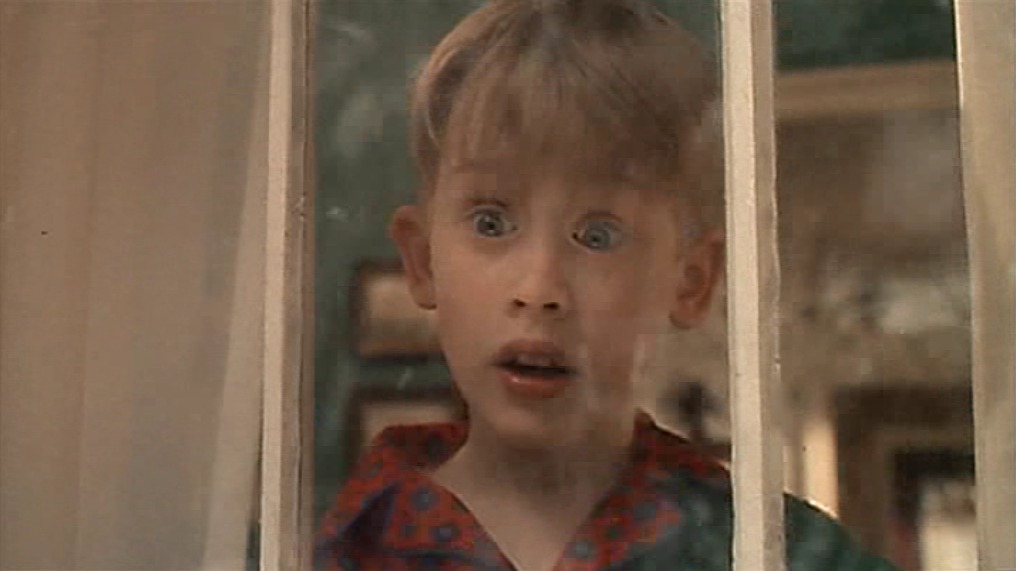
“Home Alone” is essentially based upon a kid’s fantasy of staying at home by himself without any adult supervision. Kids are fascinated by that special moment in their lives. The parents tell the kid to be careful and take responsibility; but let’s face it, when we were left alone for the first time, we raided the kitchen for junk food, watched violent R-rated movies, jumped on our parents’ bed, and went through our older brother’s secret stuff.

That’s what the young protagonist in this movie does when he’s left home alone in his suburban house in Chicago. His house is his own playground. But he isn’t left alone at his own will—he was accidentally left behind when his crowded family left for a Christmas trip to Paris. One morning, everyone in the McAllister house is rushing out of the house to make the plane that they forgot about the little eight-year-old named Kevin. Kevin (Macaulay Culkin) is confused at first, but then he realizes the beauty of the situation. He goes crazy, running around and playing. This is intersected with a subplot involving the family as they realize the mistake they’ve made and the mother (well-played by Catherine O’Hara) tries to get home to her son. She goes from airport to airport to get from Paris back to Chicago.

But there’s a problem back at the house—in another subplot, two burglars named Harry and Marv (Joe Pesci and Daniel Stern) have targeted the house for their next big hit. Kevin fools them numerous times to make them think he’s not the only one home. He should call the police, right? Well, the phones aren’t working because conveniently enough (actually, it’s a little too convenient) there was a storm the night before that trashed the phone lines. So he should go to a neighbor then, right? Well, the only neighbor that’s home at Christmastime is an old man who is described by Kevin’s older brother as a serial killer who kills people with his snow shovel.

So, of course, it’s up to Kevin to ultimately defend his house from the two bad guys and this brings us to the final half of the movie, in which Kevin sets up many booby traps around the house using many household objects—blowtorches, irons, paint cans, Micro Machines, and glass ornaments.

So you could say that “Home Alone” is inconsistent. With the touching family issues that follow when the family realizes they accidentally left Kevin alone, and the fun that a kid has when he’s left alone, there’s also a lot of slapstick humor, particularly in the final half when the burglars are breaking into the house and Kevin uses his traps to beat them up…badly. I would have to agree that it is inconsistent, but to be honest, I didn’t mind so much. The humor works for the most part, there are touching moments that work, and I thought the slapstick was just hilarious. I just love that this eight-year-old kid is able to take down these two men. But this is a plucky, resourceful kid—he stands up for himself, has a lot of tricks up his sleeve, and isn’t just running around screaming. And the traps are very inventive—how often does it happen when an iron comes crashing down when trying to turn on the light?

Macaulay Culkin turns in an excellent performance as Kevin. He’s resourceful, but he’s still a kid. He gets happy, sad, angry, whiny, and witty—Culkin shows great emotional range. He never takes a step wrong as a genuine child, and that’s because he is one. Catherine O’Hara plays her part of the mother wonderfully in scenes that are funny and touching. I love it when she just snaps at a Scranton airport clerk and says, “Even if I have to sell my soul to the devil himself, I am going to get home to my son.” As for Joe Pesci and Daniel Stern, it’s just fun to watch them get their butts handed to them. They play caricatures, to be sure, but goofy enough to make us laugh.

Another touching performance comes from the most touching scene in the movie. The performance comes from Roberts Blossom, who plays the neighbor who was said to be a killer, and the scene is when he and Kevin meet in a church. It turns out he’s a kind old man who has great respect for family, but has gotten into an argument with his son some years ago and they haven’t been on speaking terms since. (He’s at the church to watch his granddaughter sing in the choir, even though his son forbids him to come.) This is why he’s reclusive and rarely talks to people. Kevin learns something about family values from him. He realizes that he does miss his family and would just like to spend Christmas with them.

“Home Alone” is a small treasure that is entertaining and well-meaning…once you get past the paint cans being hurled at your head. With a likable young hero, some goofy slapstick, and a real sense of family connection when all is said and done, “Home Alone” is a charming family comedy.

The Goonies (1985)

14 Mar

goonies

Smith’s Verdict: ****

Reviewed by Tanner Smith

I’m going to state in this review right at the start that “The Goonies” is one of those movies that just get better and better to me every time I watch it. I loved it as a kid, and I still love it now. By this point, I must have watched it over a hundred times. I feel I have a tough grasp on everything in “Goonies trivia,” I’ve watched it that much.

Actually, I’ll just confess that I can’t just watch the movie itself anymore. I have to watch the DVD bonus features as well—the cast/director commentary, the deleted scenes, even the cheesy music video for Cyndi Lauper’s theme song (which I ironically hate).

You get the point—I love “The Goonies.” I can’t help myself. I understand that there are some obvious flaws and it’s not perfect, and I know people are rather split on this movie—some people love it, while others are incredibly annoyed by it. But I am going to give this movie four stars anyway, just for personal fondness.

(And for the record, I am probably at that point where personal fondness overtakes me—in fact, after watching “Runaway Train” so many times now, I’m even considering changing its rating from three-and-a-half to four.)

For so few of you who don’t know what “The Goonies” is (even modern-day kids have had this movie shown to them by their parents), it’s a 1985 fantasy-adventure flick about a group of young teenagers who find a lost pirate map, and they explore underground tunnels and brave treacherous traps as they set out for the treasure. Directed by Richard Donner of “Superman,” executive-produced by Steven Spielberg, marketed as an “Indiana Jones for kids,” and a controversial overuse of the “s” word, no kid in the ‘80s was going to miss seeing this on the big screen. It became a box-office hit, and since then, it has become a cult-classic and is still remembered with fondness today (mostly).

OK, enough of the “retrospective” shtick. On to the review…

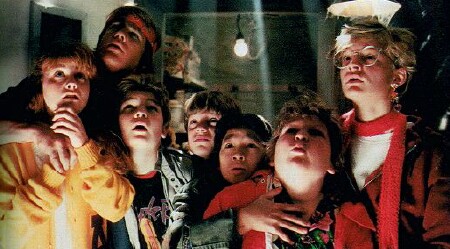
The story takes place in Astoria, Oregon. A neighborhood known as the Goon-Docks is known as the “poor part of town,” and the local kids who live there are dubbed the “Goonies.” Unfortunately, their homes are about to be foreclosed upon to expand Astoria’s country club. On the “last Goonie weekend,” a small group of Goonies—asthmatic Mikey (Sean Astin), his cool older brother Brand (Josh Brolin), overweight Chunk (Jeff Cohen), wisecracking Mouth (Corey Feldman), and little-Asian-genius Data (Ke Huy Quan, Short Round from “Indiana Jones and the Temple of Doom”)—hang out and explore the attic of Mikey and Brand’s house, where a lot of museum artifacts are stored (their father was a museum-curator). There, they discover an old map that supposedly leads to the lost ancient treasure of pirate One-Eyed Willy. So, seeing this as an opportunity to possibly save their homes, Mikey decides that they all should follow the map and retrieve the hidden loot.

Accompanied by two girls—Andy (Kerri Green), who has a crush on Brand, and Stef (Martha Plimpton)—the Goonies head to the first spot, an old restaurant just near the coast. They sneak around the basement, where they discover the secret entrance to a tunnel cave. But they also discover that the restaurant is also the hideout for a family of crooks, the Fratellis—Mama Fratelli (Anne Ramsey) and her two dim-witted sons Jake (Robert Davi) and Francis (Joe Pantoliano). They chase after the kids, hoping to get their hands on the pirate treasure themselves. As the kids venture further into the tunnels, getting closer to the tunnels and away from the crooks, they have to endure a series of life-threatening booby traps, just like in “Indiana Jones.” There are crashing boulders, sharp spikes, and many more.

It’s easy to admire the craftsmanship of these impressive cavern sets, as well as one hell of an ancient pirate ship that the kids come across later in the film. But it’s also just a ton of fun! These kids go through one entertaining adventure after another, and it’s just a thrilling rollercoaster ride all the way through. My favorite sequence features a piano made up of skeleton bones—there are notes on the back of the map that the kids must play, and every time they hit a wrong note, a large chunk of ground disappears into the deepest cavern. It’s a well-paced, well-edited, and quite tense sequence.

Some of you might be thinking, how is it even possible to make a piano like that? I don’t know, and frankly, I don’t care. It’s a fantasy, it’s an adventure! I don’t want to think about little details like, how is it that one rigged boulder conveniently crushes someone and yet, when the Goonies set off that trap, all of them come crashing down. Or how Data survives a fifty-foot fall into a cavern (nearly being skewered by spikes) by using plastic-chompers (“Pinchers of Peril,” he calls them) to grab onto the cave wall and save his life. (That’s a great sight gag, by the way.) Or even why the cavernous waterslide the Goonies slide through looks more like a Disneyland attraction. “The Goonies” doesn’t require you to ask questions like that; it just wants you to have fun. It’s not trying to insult audiences; it’s just telling an adventure story. You don’t ask these kinds of questions in “Indiana Jones” movies, do you? In fact, a lot of Steven Spielberg elements are found in “The Goonies”—the energy of the kids calls back to “E.T.,” the idea that the greedly land developers wanting to destroy the Goonies’ homes is a callback to “Poltergeist,” and of course, the adventures recall “Raiders of the Lost Ark.” Also added, and evident in “Jaws,” “Close Encounters,” “Gremlins,” etc., is a brisk pace to keep things interesting and intriguing from each setup to each payoff. There are shocks, comic relief, special effects, and thrills just about every minute of this movie. Some people will argue that this makes “The Goonies” quite noisy, but if you’ve gotten into the spirit of things by the time the adventurous second half comes around, it’s more appreciated. It’s a nice mixture of the joyful and the macabre.

I mentioned the overuse of profanity in this movie. Oddly enough, for a PG-rated family movie, the “s” word is said about 19 times, and this created a huge controversy when it was released. But it reminded me of the line in Spielberg’s “E.T.” when a kid called his older brother “penis-breath”—kids love to incorporate vulgarity into their everyday conversations because it just sounds cooler and more honorable to them. Plus, they can be funny when used right. Also, I should add that these kids act and talk like real kids should, right from the beginning. In the first half, they’re all constantly talking over each other, interrupting each other, arguing, trading insults—just like any group of kids would do!

I can’t deny that most of the Goonies are stereotypes—the wisecracking cutup, the Asian inventive genius, and of course, the fat kid. Every “fat-kid” stereotype that can be found in some family movies can be traced back to Chunk in this movie. He eats constantly, he loves to talk about eating, and constantly complains about everything. That doesn’t mean it doesn’t garner a few funny moments every once in a while, but the bit starts to become old…until when he’s captured by the Fratellis. Chunk is not with the others for most of the action; he’s locked inside the old restaurant with the other Fratelli—a deformed, Quasimodo-like figure named Sloth (John Matuszak) who is chained to the wall in the basement where he watches TV. And he’s just as hungry as Chunk is, which means they have something in common. This is where Chunk becomes less of a stereotype and more of a three-dimensional character, as he develops a sort of bond with Sloth (and they even share a Baby Ruth bar together).

The rest of the kids remain within their stereotypes, but they’re still likeable and quite memorable. Mikey is the brave leader, keeping the others in line, including his older brother; Brand is the strongest and oldest whose only concern is impressing Andy; Mouth and Stef deliver some witty one-liners; Data’s gadgets come in handy; and Andy…is pretty much the damsel-in-distress waiting for Brand to save her. If you thought Willie from “Indiana Jones and the Temple of Doom” did very little, Andy does even less. Though, to her credit, she is the one who plays the bone-piano and manages to play enough right notes to save everyone’s lives. (And she remembers the retrieve the map afterward when everyone else forgets about it—somehow, that little moment is quite satisfying.)

The soundtrack, by Dave Grusin, is fantastic as well—ranging from soft and whimsical to grand and adventurous.

“The Goonies” is fast, funny, cheerful, gruesome, and flat-out entertaining. The adventure sequences are a lot of fun, the sets are unique, the Goonies themselves are fun to watch as they solve clue after clue, Richard Donner’s direction is very brisk, and…you know, I could go on and on about how much I love this movie (despite its flaws I already mentioned), but this review is already so long that I have to quit while I’m ahead. Bottom line here—“The Goonies” is a real treasure.

Open Water (2004)

14 Mar

images

Smith’s Verdict: ***1/2

Reviewed by Tanner Smith

“Open Water” is one of those movies that uses what limited resources it has and yet somehow causes a strong effect on you. That effect is the experience of not merely watching a movie, but letting it happen to you. And in a horror film such as this, it works even stronger—you constantly have to make sure you’re in the theater or living room or wherever you’re watching it, just to make sure it’s only a movie.

Oh yes, “Open Water” feels realistic—the characters seem credible, the atmosphere is their atmosphere (becoming our atmosphere), and the scares are genuine. Nothing happens when we expect it to, and that’s what keeps the tension rising.

The movie, loosely based on true events, tells the story of a couple (Blanchard Ryan and Daniel Travis) who vacation in the Caribbean and go scuba-diving in the middle of the ocean. But when they surface, they’re met with the shock that the boat has left without them. There’s nobody around. They’re all alone. They’re just drifting in open water.

But it gets worse—the ocean is infested with things like jellyfish and worst of all, sharks. The man remembers only what he saw on TV documentaries featuring sharks, and warns the woman not to kick around or swim too much, because of the risk that a shark could come along and eat them. However, things get complicated and more deadly once the sense of anger and hopelessness has caught up with these people. There’s the sense of isolation brought upon by being left behind and forgotten—that sense is obvious throughout the movie.

“Open Water” was made on a shoestring budget, and you can easily tell by the film’s quality (or lack thereof). But luckily, most is made of filmmaker Chris Kentis’ limitations. He hired two good, convincing unknown actors to play these two characters we sympathize with, and it should also be noted that his use of digital cameras is effective in underwater shots. Also, his screenplay for this movie is composed of dialogue that sounds like realistic conversation given the circumstances. All of these elements make for a credible experience—a truly effective thriller.

Rumble Fish (1983)

14 Mar

RumbleFish-1

Smith’s Verdict: ***

Reviewed by Tanner Smith

There is a clock in each shot. Trickery is used for pivotal sequences. The film is in black-and-white, save for certain random things in color…or are they random? And here we have “Rumble Fish,” the self-proclaimed “art film for young people.” It’s an arty piece of work full of stunning cinematography, unique visual effects, and a lot of symbolism. It’s based on a novel by S.E. Hinton, which apparently no one thought could be filmable except for Francis Ford Coppola, one of the most inventive filmmakers around. But he found a way—the result is not an entertaining film, but a fascinating one nonetheless.

This is Coppola’s second collaboration with Hinton after “The Outsiders.” Apparently right after Coppola and his crew were through with production on “The Outsiders,” Coppola decided to go another round (this time, co-writing “Rumble Fish” along with Hinton, adapting her own novel). Why not?

Like most of Hinton’s stories, “Rumble Fish” is about a band of tough, hard-luck teenagers who get by in their own ways, for better or worse. This one is centered around two brothers—one who can’t live up to the other’s reputation, and the other who can’t live it down. Rusty-James (Matt Dillon) is a hothead who acts tough, but doesn’t have a real gang to follow him or even a real battle to fight. He’s not bright enough to be a leader, but dumb enough to get himself into trouble. He’s no different than Biff Wilcox (Glenn Withrow), a similarly pathetic thug who calls Rusty-James out.

Rusty-James’ brother is a heroic figure simply regarded as the Motorcycle Boy (Mickey Rourke). He’s a born leader and a trouper of gang warfare. He’s also very clever and intelligent—everything Rusty-James isn’t. After being gone for a few months, he has returned to give Rusty-James some life lessons. And he better, because their father, a lazy drunk (Dennis Hopper), is of no help at all. In and out of Rusty-James’ life are his sometimes-girlfriend Patty (Diane Lane); his nervous best friend Steve (Vincent Spano); a “Messenger of the Gods” type nicknamed Midget (Laurence Fishburne); and his unreliable friend Smokey (Nicholas Cage) who believes he could be a gang leader. That’s about as much of a story as we get, with the tired and self-reformed Motorcycle Boy here with one simple purpose—to show Rusty-James what he’s constantly getting himself into.

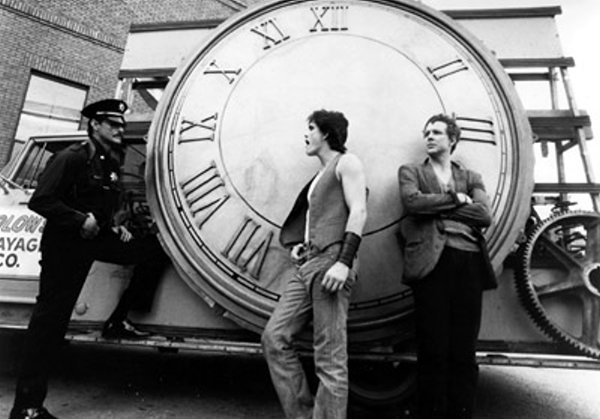
Symbolism in “Rumble Fish” includes clocks in nearly every scene (including two characters standing in front of a giant clock-face) and fast-moving billowy clouds (whether they be in straight shots or in reflections). This is obviously supposed to symbolize that time for Rusty-James is running out before he develops as big a reputation as the troubled Motorcycle Boy. It’s also great to look out—the exaggerated imagery actually amounts to something, rather than giving us something pretty to look at with no substance in the story. Here, I actually felt there was something being said within the imagery. There are also red and blue fish (the only objects shown in color throughout the film) that are supposed to represent the relationship between the two brothers. How the Motorcycle Boy explains what they represent is thought-provoking.

That’s not to say this form doesn’t have its flaws. Sometimes, the symbolism can be a little too obvious, while other times it comes off as pretty distracting. But for the most part, it does work effectively.

There’s one great effects sequence in which Rusty-James has an out-of-body experience after getting hit in the head. He levitates in the air as he literally watches his life drift by. However the filmmakers did that effect that made Matt Dillon float in the air is outstanding work on their part. Watch the scene, and tell me if you see any wires.

As an art film, the imagery and cinematography seems to overshadow the actors, but they hold up on their own. Matt Dillon has played dumb tough kids for quite some time (“Over the Edge,” “My Bodyguard,” and other Hinton film adaptations, “Tex” and “The Outsiders”), but he’s still pretty strong in the role that requires him to change from tough to weak. However, if there’s one actor that stands out among the rest, it’s definitely Mickey Rourke, who is just excellent as the Motorcycle Boy. He has such quiet authority in a role that could’ve been thankless, but he makes it into a sensible, intelligent, intriguing individual. He’s like a veteran actor who suddenly got tired of the fame that his past has brought him, and would rather live it down. Rourke is outstanding in this movie.

“Rumble Fish” is a showcase of allegory, dilemma, and emotion. It’s quite different from “Tex” and “The Outsiders” in that way, but that doesn’t mean it isn’t fascinating. It’s original, it moves, and somewhat to my surprise I found myself more invested in the tales of the reigning Motorcycle Boy.

The Boy Who Could Fly (1986)

14 Mar

MSDBOWH FE015

Smith’s Verdict: ***1/2

Reviewed by Tanner Smith

“The Boy Who Could Fly” is a movie with a great deal of sentimentality. But that’s the point. This movie didn’t need to hint out the moral to its story—it just says it out loud in the final scene. What you’ll be more impressed with is how magical it seems, given that it takes place in everyday suburban life. It’s touching, it moves, and you feel good by the time the movie is over. You either get into it, or you don’t. I did.

As the title suggests, there is a boy and he could fly. But here’s the real situation—the teenage boy, named Eric (Jay Underwood), is autistic and is constantly sitting out on his windowsill, pretending to fly. Sometimes he will even go to the roof of his own house and pretend. According to a teacher at school, Eric’s parents died in a plane crash and Eric started to pretend to fly at that exact moment, as if he could’ve saved them. Eric lives in an urban home with his constantly-drunken uncle Hugo (Fred Gwynne), who isn’t abusive but more confused because of the alcohol. He claims he has seen the boy fly, but then again, he sees a lot of things. And then there’s the story of how Eric may have flown up to a power pole to hide a neighbor’s BB gun, as well as a situation in which he is sitting at the main character’s window and when the main character turns away and back, he’s back on his own windowsill. Can he really fly? Who knows?

The main character—a 14-year-old girl named Milly Michaelson (played by Lucy Deakins)—is already told the stories about Eric’s parents and Eric’s actual flying. She also sees him pretend to fly while sitting on his windowsill. Since she moved into the house next door to Eric, she can’t help but wonder about him. She suddenly feels like it’s her responsibility to watch out for him—she’s the one who “rescues” Eric from the roof of the house (I used quotation marks because Uncle Hugo says later that he couldn’t fall). As time goes by, she and Eric become close with one another. She seems to be the only thing that can break Eric free of his world of fantasy. First he mimics her every move, then (slowly but naturally) realizes what he’s doing and tries to do his best around her. But the problem is, you never can tell what he’s thinking or even if he’s thinking. He only cares about flying…and right now, he also cares about Milly. At one point, he catches a fly ball that almost hits Milly in the head so you can tell he can set his mind to one thing, even if that one thing is caring for Milly’s wellbeing.

Then something happens. Milly is saved from almost certain death when she slips and falls off the side of the bridge while reaching for a flower. The only one that could have saved her life was Eric, who was with her at the time…and the only way he could’ve possibly saved her is if he flew.

“The Boy Who Could Fly” does a nice job of setting up its story by introducing the characters. Milly has moved into this urban neighborhood (complete with white picket fences and identical houses) with her single mother (Bonnie Bedelia) and little brother Louis (Fred Savage). The father, revealed in a scene with a cameo by Louise Fletcher as a psychiatrist, had committed suicide when he realized he had cancer, leaving the family in dismay. Milly is in high school trying to fit in with the snobby types all around her; her mother is back to doing her job in the insurance company but doesn’t know how to use a computer; and feisty Louis has his own little adventures as he tries to get around the block on his tricycle (bullies and a Rottweiler keep stopping him). We’re also introduced to Milly’s nice teacher (Colleen Dewhurst), who believes Milly can get through to Eric when no one else can.

This seems like the kind of movie Frank Capra would have liked to make—a movie that actually tells a story with compelling characters and a neat storyline. The ending, though, is somewhat preposterous but to be fair, you can already see it coming even if you don’t want to. But I was satisfied, nonetheless. In fact, before I was typing this, I was considering a three-star rating for this. I know now that I would much rather rate it three-and-a-half. That’s the kind of impression this movie left on me.

Another reason this movie works is acting, especially with the lead performance by Lucy Deakins. Deakins is wonderful as Milly. Every line of dialogue she says, you believe her. She’s so warm, empathetic, pretty, sensitive, and believable. I liked Jay Underwood, controlled and convincing as Eric; Bonnie Bedelia, convincing as a housewife mourning her dead husband; and Fred Savage who has a watchable kinetic energy to his performance.

I guess I should tell you the moral (if you want the movie to tell you itself, stop reading): if you believe and love long enough, anything is possible. It’s not subtle, but I got into it anyway because everything leading up to it. It earned its message, and “The Boy Who Could Fly” is a treasure of a movie.

Jungle 2 Jungle (1997)

14 Mar

jungle-2-jungle

Smith’s Verdict: **

Reviewed by Tanner Smith

“Jungle 2 Jungle” is the American remake of a notably terrible French comedy called “Little Indian, Big City,” and it should be noted that if you’re going to remake a movie, it’s probably best to remake a terrible one and make many adjustments for an improvement. While “Jungle 2 Jungle” isn’t necessarily a good movie, it does have its moments, which is more than I could say for the original film. This one is more mediocre than it is god-awful.

Tim Allen, the likable funnyman from TV’s “Home Improvement” (and fittingly enough, this movie is directed by John Pasquin, who has directed many episodes of that show), stars as…well, let’s face it—Tim Allen.

OK, his name is Michael Cromwell, but you’re never going to call him that.

He’s a stockbroker who wants to marry his materialistic girlfriend (poorly played by Lolita Davidovich). But in order to do so, he needs to finalize the divorce from his ex-wife Patricia (Jobeth Williams), who ran out on him thirteen years ago because he didn’t listen to her very much. Allen (er, Michael) is supposed to meet her at the airport in Venezuela, but is instead taken to a semi-Westernized Panari tribe in Canaima National Park, whom Patricia has been living with all this time. Upon arriving, Patricia reveals the news that Michael has a thirteen-year-old son named Mimi-Siku (Sam Huntington).

While staying with the tribe for a little while, Michael attempts to bond with his son after all these years of him not knowing about him. Mimi-Siku (whose name means “cat piss”—it was stupid in the original film and it’s as stupid in this remake) goes through a rite of passage that makes him a man (consider it the Panare equivalent of a Bar Mitzvah) and is given a task to go to New York City and bring back fire from the Statue of Liberty, which means Michael has to take him back to the city with him.

And thus, we have the comedic fish-out-of-water tale. Michael takes Mimi to the city, as Mimi has a hard time fitting in. He dresses the same as with the jungle tribe, shoots a bow and arrow at any pigeon that comes around, climbs alongside buildings at many stories up, scales the Statue of Liberty, and mistakes a lot of things for something else. He also has brought along his giant pet spider that attacks anyone who screams at it. (How Michael was talked into letting him bring that along is beyond me.) It traps the girlfriend in the bathroom because she can’t stop screaming at it and Mimi even sets it loose on his dad’s screaming boss.

And there’s also a dart blowgun that knocks people out instantly…how that got past airport security is beyond me. But it, along with the spider, is used for joke setups—only one of which I found kind of funny. I normally am not all for animal abuse, but the case of the girlfriend’s cat being hit by one of the darts and falling down like a rock got a laugh out of me.

With the exception of different locations (it’s New York City instead of Paris, France this time), the story is pretty much the same as the original. But certain aspects are deftly improved from the original—I laughed at a few good jokes, despite how predictable most of them were. And I surprisingly found myself invested in the family drama. Allen and the kid share a few good conversation scenes together, and there’s also a scene in which they’re dancing to street performers that I surprisingly enjoyed, despite its corniness.

What doesn’t work well is a whole subplot involving Allen and his partner, well-played by a nervously paranoid Martin Short, making deals (and misunderstandings) with the Russian Mafia, led by a cartoonish David Ogden Stiers. This leads to an uninspired climax in which they must fight them off when they take Short’s family hostage, after the Mafia thinks they’ve been cheated—the spider and blowgun come in handy here, of course.

Most of the comedy in “Jungle 2 Jungle” is more desperate than funny, particularly the slapstick humor (save for a few slight chuckles). And there are occasional repeats of the same joke, mostly involving the spider. They’re overused.

Also, I have to ask—with all these misunderstandings involving Mimi in the city, why is Michael the only one responsible for him, when Patricia should have come along to make sure he’s given the proper care? I guess it’s because she has to be with the tribe, but this is her 13-year-old son that’s going to a strange place. Sort out your priorities, lady.

“Jungle 2 Jungle” has a few good moments and has learned from the original’s mistakes in some certain ways, but the film is never as clever as we’d like it to be and fails in comparison to other fish-out-of-water stories; in fact, there were times when I was thinking that its main intention was to rip off “Crocodile Dundee.” This isn’t “Crocodile Dundee,” but I wish it wasn’t supposed to be.