September 30, 1955 (1977)

18 Mar

images-1

Smith’s Verdict: ***

Reviewed by Tanner Smith

The title “September 30, 1955” refers to the date of James Dean’s death. The actor was only 24 years old and his best movies (“Rebel Without a Cause” and “Giant”) hadn’t been released yet. But “East of Eden” took movie audiences by surprise—or rather, it was James Dean’s performance that took them by surprise. As “September 30, 1955” opens, we meet our main character—a young man named Jimmy J—as he watches “East of Eden” in a cinema. As he watches James Dean perform the touching final scene, a tear falls across his face.

Whether this is the first or one of multiple times he has seen this movie isn’t clear, but one thing is certain—Jimmy J feels that James Dean is a close friend. That is why when he hears that James Dean died in a tragic accident the very next day, it really hits him hard. His mother and friends don’t understand his grief. Jimmy J has to remind them that they really don’t. The worst anybody could say was that James Dean was only a movie star. He was more than that. That’s what anybody might have said on the actual date that people heard about the death of James Dean. There may be a lot of other people who feel the same way as Jimmy J, but this is a sleepy Arkansas town where an event like this isn’t very important. Quite odd—this could have been the most-talked-about event to come along in a long while. But with the upcoming homecoming (excuse that pun) at college, what’s more important?

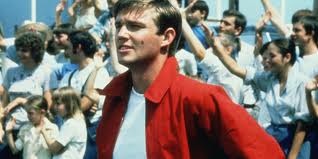
“September 30, 1955” does a nice job when it focuses on Jimmy J’s grief and interaction with his friends. Jimmy J is played by Richard Thomas (best known as John Boy on “The Waltons”) and while the character isn’t given much of a personality throughout the film, he nearly makes up for it in a bedside scene with a great amount of range. Strangely enough, the final half of this film is the best thing of the movie. The characters—including those played by Tom Hulce, Deborah Benson, and Lisa Blount—are given room to grow after a couple of painfully long sequences—one involving an attempted séance (the only saving grace is Lisa Blount’s Vampira exterior) and the following one involving an attempt to scare a couple of ex-friends with makeup. I felt if those scenes were trimmed down a bit, I’d be a bit more satisfied. I wouldn’t ask to delete the latter scene because it sets up the bedside scene (not giving anything away here).

So do I recommend the film? Well…it’s a close call, but I do. The director James Bridges has a good feel for the town that Jimmy J and his friends live in, the actors are good (especially Lisa Blount as Jimmy J’s ex-girlfriend who believes she can communicate with spirits), and the writing of the dialogue that these kids say is spot-on. There are flaws, of course—this is not particularly well-executed. As I’ve said, some sequences drag on for too long, some hints of comedy fall flat, and the final shot is unsatisfactory. But as a drama and a portrait of those grieving over the legendary actor James Dean, “September 30, 1955” works.

Hostage (2005)

18 Mar

images

Smith’s Verdict: ***

Reviewed by Tanner Smith

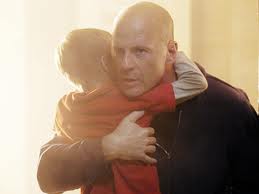
“Hostage” could be seen as another entry in the “Die Hard” series, seeing as how it is an action-thriller starring Bruce Willis, but you’d be wrong. On the one hand, it’s gripping, suspenseful, and well-made. On the other hand, it’s grim and dark (as opposed to the excitement among the violence in the “Die Hard” movies) with a much more conflicted Willis character than his infamous action-hero character John McClane. Instead of being the “fly in the ointment,” the “monkey in the wrench,” or the “pain in the ass,” Willis plays a troubled person stuck in a situation he was hoping never to fall into, after a similar terrible experience a year ago. (No, this isn’t a sequel.)

The film opens as LAPD hostage negotiator Jeff Talley (Willis) is called upon for a scene in which a madman endangers a mother and child. After trying to play it calm, his method doesn’t work, resulting in the deaths of each. One year later, we see that Talley has left the city and joined the police force in Bristo Camino, where he is police chief. He feels extreme guilt over the lives he could have saved that year ago and finds himself better off serving in a community where nothing much happens. His biggest concern as of now is dealing with his unhappy wife Jane (Serena Scott Thomas) and daughter Amanda (Rumer Willis, Bruce’s real-life daughter), who only live with him “part-time.”

Meanwhile, an accountant (Kevin Pollak) is driving his kids (teenage Michelle Horn, grade-schooler Jimmy Bennett) home from school when he is spotted by three teenage thugs who decide to steal his car. They follow him home and sneak in to steal his keys. The intruders are Dennis (Jonathan Tucker), his brother Kevin (Marshall Allman), and their companion Mars (Ben Foster). When they’re inside the house, what seems like a simple robbery turns into something else, as the accountant is knocked unconscious, the two kids are held hostage, and Mars shoots a patrolling cop, thus bringing the whole police force on the scene and leaving Talley to have to deal with it. Talley does what he can until someone else takes over in authority, but it turns out that there are darker matters at hand, as members of the mob hold Talley’s wife and daughter hostage. They will let them go if Talley deals with the situation involving the other hostages.

OK, so maybe I could have done without this second plot thread, as the scenes involving the three interlopers and the two young hostages are tenser. By comparison, this other element is still pretty tense, but doesn’t do the credibility of the rest of the film that much service. As a result, the final (inevitable) showdown between Talley and these other criminals just seems sort of ordinary. I will give credit, though, that they do connect with the story of the accountant, who is also there for the showdown as well. So, it’s not pointless. But it is somewhat unnecessary.

How “Hostage” handles the messed-up situation involving the three guys and the two hostages is quite effective. For one thing, they don’t make the little boy (Bennett) into a whining boor—he’s resourceful and quick enough to grab his sister’s cell phone, sneak through the air ducts, and make secret calls to Talley (after seeing him on TV), to give him helpful information. Although, I have to ask—how come nobody checks up on the kid to make sure he hasn’t escaped his room?

What I really liked is the original treatment given to the three teenage crooks. Dennis is the hothead of the group, making sure he’s the one in charge of the situation and covering the fact that he’s a scared kid. Kevin is the nervous conscience who didn’t want to go along with this plan in the first place, and is stuck with nothing to do about it, other than hope no one gets hurt. Mars, on the other hand, is a complete psycho. He has a tendency to act first and think later, and he has a criminal record. The reasons as to why things go from bad to worse are because of his actions.

Bruce Willis is outstanding, playing a much different version of the heroic cop that made him a noticeable action star in the “Die Hard” movies. You can totally buy him as this tortured cop looking for redemption and finding it in yet another near-tragic position. He completely sells the drama portrayed with this character. You enjoy spending two hours watching him sort through everything that occurs in “Hostage,” a gripping, nicely-done thriller.

Super 8 (2011)

17 Mar

Super-8-Movie-Image-2

Smith’s Verdict: ****

Reviewed by Tanner Smith

To get straight to the point before I type my review, “Super 8,” one of the most highly anticipated movies of the 2011 summer season, is a love letter to the summer blockbuster season—it has gripping action, first-rate special effects, and great acting. Take all of those elements up a notch and there’s a movie that deserves four stars from me.

“Super 8” clearly loves the tradition of the summer blockbuster. It reminds of how “Jaws” created that phrase. And that reference to Steven Spielberg’s 1975 hit brings us to this note: “Super 8,” which was produced by Spielberg himself, is also in the tradition of the early Spielberg classics, paying homages to “Jaws,” “Close Encounters,” “ET,” “Poltergeist,” and “The Goonies.” We have a likable bunch of kids as the film’s central heroes, an ominous threat, a small town, awe-inspiring visuals, and scary moments to boot. Writer-director J.J. Abrams, of “Lost,” “Mission: Impossible III,” and “Star Trek,” obviously has a great affection for Spielberg and “Super 8” is his way of showing that as a tribute to Spielbergian elements.

Abrams also shows his affection for filmmaking. When he was a kid, he was making movies in his neighborhood with an 8mm camera. Spielberg did the same, as the kids in “Super 8” do. The film takes place in 1979—no iPods, Smart Phones, or Internet are found here. Instead, the kids use whatever they can get ahold of, even if at one point it’s another kid’s dad’s Super 8 camera. The kids (each about 12 years old) are Joe Lamb (Joel Courtney), the makeup artist; Charles (Riley Griffiths), the intense director; Cary (Ryan Lee), the pyromaniac practical-effects expert; Martin (Gabriel Basso), the nervous leading actor; and Preston (Zach Mills), the lighting guy. They’re making a zombie movie in their small town of Lillian, Ohio, and they need a leading lady. So they recruit Alice Dainard (Elle Fanning, Dakota’s sister), one of the prettiest girls in school.

Alice is unsure of Joe because both their fathers—Deputy Jackson Lamb (Kyle Chandler) and Louis Dainard (Ron Eldard)—hate each other and their kids. You see, Joe lost his beloved mother to an accident at the factory she works in, and his father hates Louis because he couldn’t make his shift at that same factory and Joe’s mother had to fill in for him. Jackson blames Louis for the accident, and tells Joe, whom he barely connects with, to stay clear of Alice. Louis tells Alice to stay clear of Joe. But Joe and Alice, while making Charles’ movie, form a nice friendship together.

Anyway, the kids work on the movie secretly (it’s more fun that way, so no matter). They sneak out in the middle of the night (stealing Alice’s dad’s car) to film a dramatic scene near some train tracks. A train passes by, but this is coming to an advantage—“Production value!” Charles gladly exclaims to his friends. But something goes really, really wrong as the train derails while the kids are filming. In one of the best special-effects sequences I’ve seen recently, the kids nearly get killed as they outrun the train cars and debris crashing down. You’ve seen parts of this sequence in the trailer (and in FOX sneak peeks), but once you’ve seen the whole sequence, you’ll realize how “insane” the actual scene is. I mean it—when I saw that scene, I was close to hyperventilating, and I tell no lie. I was in complete awe and fright. Now, there’s a cinematic experience I’ll never forget.

OK, those who’ve seen the trailers and TV spots know that the train crash was no accident and that something escapes from one of the train cars. We don’t know what it is and we continue to not know until the final act of the film. Following the rule of “Jaws,” we see only glimpses of the monster until its big reveal much later in the film. But whatever it is, it scares all of the dogs in town away, steals almost every electrical appliance in town, and comes out only at night to attack people. What it is, where it came from, and what its true motivations are, I won’t give away.

Anyway, the US Air Force shows up after the big train wreck. At first, it seems as if they are going to clean up after it, but to Deputy Lamb, it becomes clear that they’re here for something more. When he asks Colonel Nelec (Noah Emmerich) if the cargo is anything to be concerned about, he gets the response, “I can assure you the answer is no.” He’s lying. Lamb and Nelec are in a constant battle of wits as Lamb tries to get some answers out of him and hopefully explain to the panicked townspeople exactly what is going on.

Kyle Chandler is so good in these scenes in which he tries to piece things together, much like police chief Martin Brody in “Jaws.” He also has to find way to get through to his son, since he wasn’t as much of a parent as his deceased wife. Chandler handles these scenes in an effectively strong way.

But he’s only in a supporting role. Most of the screen time is given to the kids. They try to get on with their lives after barely surviving witnessing the train derailment. But certain events happen that lead to them searching for clues and figuring out everything about the escaped creature. They’re on a crazy adventure that would make the Goonies envious.

These are some very talented young actors. When playing nerdy adolescents, they don’t seem to be acting at all. You really buy their friendship with each other, whether they’re singing “My Sharona,” playfully trading insults to each other, or just sitting at a diner and talking. They are always convincing and have the energy to carry the film. In particular, Joel Courtney is a promising newcomer whom I hope to see more of in the future, and Elle Fanning (who was last seen as Stephen Dorff’s daughter in Sofia Coppola’s “Somewhere”) really shows off some acting chops. There are some very touching moments when these two are together, including one in which Joe helps Alice with her zombie makeup and another in which they talk about the accident that killed Joe’s mother. The other kids—Riley Griffiths, Ryan Lee, Gabriel Basso, and Zach Mills—are likable, funny, and, like I said, convincing. I love how Griffiths handles this role of a bossy, yet chirpy and excited young director and shows a convincing jealous-adolescent side of the character when he knows that Alice likes Joe when he wanted her to like him. Then there’s Lee, who plays the character of a fireworks nut that parents tell their kids to be careful around, and Basso, who is always vomiting whenever he’s scared. It’s amazing these kids are still able to function after what they go through.

I say that last sentence in the previous paragraph because there are many scary moments in “Super 8”—this movie is rated PG-13 not only for its constant use of profanity, you know. This movie is not for those under the ages of 10 or 11. Maybe 12, like the kids in this movie, but I dunno. There’s one particularly frightening scene in which the creature attacks a bus with four of the kids in it. It’s even more effective because the monster still hasn’t been fully seen yet.

I really didn’t mind that the action hits harder when the film reaches the final act. It has to, or it wouldn’t be a summer blockbuster in the 21st century. But these action sequences are exciting and actually have purpose within them. Besides, the whole movie isn’t about action or the creature—it’s about the kids and how they react to this strange, terrifying situation. This is one of the best types of film—the characters are introduced and developed so that when the action happens, it amounts to something. “Super 8” is the best summer blockbuster to come around in a long time.
The Butterfly Effect (2004)

17 Mar

images

Smith’s Verdict: ***

Reviewed by Tanner Smith

There is a chaos theory that even the smallest thing, such as a butterfly’s wing fluttering, can cause disarray. That theory is quoted at the opening of “The Butterfly Effect,” a weird and disturbing film that intrigued me with interest and weird plot elements that are as strange as “Donnie Darko.” (And I mean that as a compliment.)

“The Butterfly Effect” is a thriller right from the start. As the movie opens, a man runs into a room and writes a message saying that he may be dead if anybody finds it, but he can “save her” if he can “go back to the beginning.” Then the movie flashes back to thirteen years earlier, to that man’s childhood at age 7.

The kid’s name is Evan Treborn and there is something very strange going on. He blacks out certain memories that may have been horrible. He doesn’t know why he holds a large knife at one point, he doesn’t know why his clothes are off in the basement of his friend’s father’s house, and he doesn’t know why his institutionalized father tried to strangle him on his visit. The thrilling aspect of this opening is that we don’t know why, either. We just have to wait and see…

Then the film flashes forward six years later. Evan is thirteen years old and has a crush on his friend Kayleigh, whose father is an abusive pervert and whose brother Tommy is a sadistic little snot. Evan has more blackouts this time—he doesn’t know why his friend Lenny went into shock after they, Kayleigh, and Tommy tried to blow up a mailbox with a blockbuster; and he doesn’t know why Tommy acts up whenever he’s asked about what happened that time. But he has another thing to worry about when he and Kayleigh really become close with each other, which leads Tommy to violence.

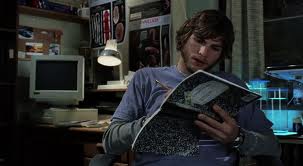
Then, the movie pushes forward seven years later. Evan is now a college student (and played by Ashton Kutcher) and hasn’t had any blackouts since he was thirteen. But something strange happens when he reads the journals he kept since his first blackout. He discovers that by reading the journals, he can experience the memories that he blacked out. But soon, he also discovers that he can change the way things turn out. When Kayleigh (Amy Smart), who has grown depressed, commits suicide, Evan decides to go back and change things to prevent that from happening.

But every time Evan tries to go back and fix things, he ends up making them worse—when he first changes things, he and Kayleigh are happily together, but he ends up killing vengeful Tommy (William Lee Scott) and going to prison; then he changes things and ends up making Lenny (Elden Henson) a murderer and Kayleigh a hooker; and he even brings a remarkably drastic change to himself after a disastrous alteration.

The gimmick here is that Evan can read the journals and go back to those memories, change things, and go back to the present where things have changed. But is it always a parallel present? Is it an alternate universe? “The Butterfly Effect” doesn’t fully explain how that works, but I guess we’re supposed to figure it out ourselves. That’s what makes it so interesting. This is a compelling and intriguing thriller—as good as “Donnie Darko” and way better than “Final Destination 2,” which have similar elements (also, “FD2” was written by the writers of this one).

Ashton Kutcher—whom I still haven’t forgiven for “Dude, Where’s my Car?”—isn’t who I would’ve picked for the lead character. He’s been just plain goofy in everything else he’s in and the question is, “Can this guy really take on a serious role?” Well, yes, he can. Kutcher is very good in this movie. We believe him when he goes through this weirdness, and he just plays the character as just a confused college student, which is very refreshing. Amy Smart gives a good performance as Kayleigh, who goes through a lot of personalities in these different parallel worlds while Evan stays the same. First, she’s a nice waitress, then she’s a sorority chick, then she’s a dirty hooker, and she also shares a scene with Evan near the end of the film where she shares how she really felt about Evan when they were younger kids and things can be different.

The ending is most upsetting, but I won’t give it away.

“The Butterfly Effect” works on the level of making us question the consequences for own actions. With its weird and intriguing plot, its good performances, and its grim look, “The Butterfly Effect” is a very good thriller that is effective and holds our interest.

Lassie (1994)

17 Mar

images

Smith’s Verdict: ***

Reviewed by Tanner Smith

It’s strange how 1994’s “Lassie” is not an adaptation of the TV series of the same name, or a remake of the film “Lassie Come Home” for that matter, and yet the dog in this movie shares the exact same characteristics of the infamous smart canine in the original media. How do I know it’s not an adaptation? Because the young hero’s younger sister watches the original show on TV (even though her brother would prefer her to watch MTV—“You’ll thank me when you’re older”). But here’s the thing—the dog in this particular “Lassie” (which, let me remind you, is not supposed to be a remake or adaptation of the original media) is exactly like Lassie! She’s a collie, she’s unbelievably smart for a dog, and it doesn’t help that it’s given the name Lassie, either. Why not just say it’s a modern retelling of the original “Lassie” media? Maybe it is, but why bother mentioning the original at all in this film?

Aside from that questionable element, I’ll admit that I really liked this version of “Lassie.” It’s cute, it’s innocent, and surprisingly well-executed and very well-acted. That, and it features a very smart dog, of course named Lassie.

Lassie has just adopted a city family that has moved to a small farm in the hills of Virginia, after her original owner died in a car accident. She’s given her name by the little daughter Jennifer (Brittany Boyd) watches the “Lassie” show on TV (of course). The family decides to keep her (“for a while,” according to Dad) as they move out into the country. The family’s troubled teenage son Matt (Thomas Guiry) is bored and would rather stay in bed, listening to his Walkman. But Lassie, being the good dog that she is, knows how to get him in the great outdoors. She snatches Matt’s headphones away and leads him to an old swimming hole near the house, with a rope swing that he enjoys using.

The plot thickens when Matt’s dad (Jon Tenney) loses his job. Matt, who grows to love his new home, gets the idea of raising sheep on the land between their farm and the rich Garland farm. The family, with the help of kindly Grandpa (Richard Farnsworth, always welcome) and of course Lassie (to help move the sheep), fixes up the own farmhouse as they all grow more accustomed to rural values.

But of course, there’s a problem in the form of the evil Garland clan. Sam Garland (Frederic Forrest) is a mean-spirited man who has raised two teenage boys who are just as nasty. They’ve made a hefty profit from raising sheep themselves, and are not too thrilled that their new neighbors are taking their sheep (though it’s explained that sheep have to be at a certain part of the spread to be considered property).

Oh, and did I mention they all wear black hats? Or that they have a nicely-decorated house? Or that the boys have fun by racing their ATVs at the sheep to frighten them? Did I even have to mention all that?

Aside from those clichéd characters (and an overwrought climax in the final act, partially caused by the two boys’ behavior), there’s a lot like about “Lassie.” One is how the film captures the essence of the countryside—the beauty of nature, if you will. The dog is a good sport, and the bond that the boy grows with it is in the great tradition of boy-meets-animal stories. And “Lassie” also needs to be credited for its family drama, particularly with the relationship between Matt and his new stepmother Laura (Helen Slater). Laura is sweet and warm; she loves Jennifer very much and would love for Matt to accept her as a new mother figure. But to Matt, the empty space left by his late mother can’t be filled by anyone and thus has trouble accepting this new woman in this family’s life. Eventually, Matt and Laura do share a nice moment together, when Laura tends to Matt’s wounds after being beat up by some local boys. Matt doesn’t want to call Laura “Mom,” but doesn’t want to call her “Laura” anymore either.

Despite being clichéd, “Lassie” works for the most part. It’s enough to grow on me, and worth another viewing. It’s just a cute, good-hearted, feel-good family movie that I can’t bring myself to hate. There’s a lot to like about it.

Oh, God! (1977)

17 Mar

3iEP0EnA6nffr5WRZgtjI7PnNYk

Smith’s Verdict: ***1/2

Reviewed by Tanner Smith

Upon meeting God Himself, a mild-mannered grocery clerk named Jerry is asked not to smoke as He adds, “Tobacco was one of my big mistakes.” Jerry, of course, thinks this is some sort of prank and plays along by asking if God has made any other mistakes. God’s response—“Ostriches—silly-looking things. And avocados—I made the pit too big.” Yes, the one who claims to be God has just declared himself fallible. But the crazy part is that he really is God. There’s no other way to explain it.

That’s how the writers of “Oh, God!” want to play it. Are they being blasphemous? Not necessarily. This is a satire on religion, but not in a mean-spirited, cheap-shot, or offensive way. God Himself isn’t given dumb treatment in this movie; in fact, as played by George Burns in human form, he’s like how we would imagine him if we were to meet Him. Be honest—don’t some of you imagine him as an old man wearing golf pants? (Well OK, He actually explains that he chose this form so that Jerry would be comfortable with his appearance.) “Oh, God!” is not trying to offend anybody—it has good nature and has a feel-good spirit to it.

The story of “Oh, God!” features Jerry (John Denver) as he receives a letter in the mail, granting him an interview with God. Jerry is curious, so he goes to the location he’s supposed to meet Him at. He at first thinks it’s a prank performed by a friend, but God pulls many tricks to convince him who He really is. (For one thing, he makes it rain inside Jerry’s car.) Now that Jerry is convinced that he is seeing God, what now? God wants Jerry to spread the word that God is alive and that things on Earth can be all right, if we want them to be. Pretty simple, but as you’d expect, when Jerry states that God has told him to repeat this message, he is met with skepticism as he hits first the news, then the media, and of course, the churches.

The screenplay to “Oh, God!” is winning in the way that it delivers many surprises while still being careful around its subject matter. My favorite line in the film is not about God’s mistakes, but about his last miracle—Jerry asks if God still performs miracles, to which He responds, “The 1969 Mets.” There are other funny scenes, such as the 10:00 news story featuring Jerry, and the final courtroom scene in which Jerry (and God) must present his case after many have accused him of blasphemy.

George Burns is wonderful in the role of God, with a twinkle in his eye and a trustworthy face and voice. John Denver, however, is a bore. His constant whining grew tiresome, as did Teri Garr as his equally skeptical but somewhat loyal wife. But Paul Sorvino, as the reverend who helps bring Jerry to court for his “blasphemy,” is well-cast and pretty funny.

“Oh, God!” could have easily been a low-brow, bad-taste satire or a Sunday morning church sermon, but this is a funny, tender, and pleasurable comedy with more human values than you might expect.

In Time (2011)

16 Mar

in-time-Justin-Timberlake-Amanda-Seyfried-1

Smith’s Verdict: ***

Reviewed by Tanner Smith

Someone has taken the phrase “time is money” way too seriously, in order to have the regular-Hollywood amount of time to create the sci-fi/action film “In Time.” I say that because in “In Time,” the currency of the future (or a parallel dimension, which I will accept more) is time. Thanks to genetic alternation, humanity stops aging at 25 and “time” to continue living can be transferred among individuals, shown on a timer-clock implanted on people’s arms—when the clock stops, the person dies. Think of it as a visible internal clock. You go and purchase something, you pay with your own time. You want more time, open an account at the “time bank.” Like money, be careful how you spend it; though in this case, be careful not to use it up and end your life.  The poor, with limited time to live for even a day, live in the ghettos of Dayton. The rich, who have enough time to live for centuries, live in the deluxe New Greenwich.

In the movies, it’s always miserable in the future, isn’t it?

If that genetic-altering element sounds even a little like the setup for a film such as “Gattaca,” it should be, as Andrew Niccol, who happened to make “Gattaca” in 1997, directed “In Time” as well. But “In Time” is a slick, entertaining, well-made film that has fun with its premise, does a great job of establishing the rules of this world, and gives us some real characters to root for and against.

Will Salas (Justin Timberlake) is 28 years old and lives with his mother Rachel (Olivia Wilde), who is 50 but still looks 25. They live day-to-day, but Rachel’s time has run out and she expires because she couldn’t get to Will in time for a “recharge.” At the same time, Will has been given an incredible amount of time by a wealthy stranger (Matt Bomer) who believes that people shouldn’t live forever and just make the most of their time. The stranger gives up almost all of his time before he dies. Provoked by his mother’s death, Will decides to go to New Greenwich to somehow gamble enough time for most people in the ghetto.

A “Timekeeper” (a “time cop,” if you will) named Raymond Leon (Cillian Murphy) accuses Will of murdering the stranger and corners him with the charges of murder and theft. To get away, Will takes Sylvia (Amanda Seyfried)—daughter of the wealthy Philippe Weis (Vincent Kartheiser)—hostage. They go on the run and eventually Sylvia becomes Will’s fugitive accomplice as they plan to rob the banks of time and deliver to the less fortunate.

This is when “In Time” switches gears and turns into a futuristic version of “Bonnie and Clyde” mixed with a Robin Hood tale. Surprisingly, this is not the downgrade I expected it to be. In many ways, it’s respectful that the story would continue as opposed to laying down new rules of this world. We’ve set up the story, and now we’re going on a little journey.

Some things are a little clumsy, like all the obvious puns involving “time” (though now that I think about it, “time is money” is never used at all). And also, I kept asking questions like, why age 25? Why not 35 or 40? I won’t question that anymore; it’s their logic, not mine. But I can ask why this way of life was chosen. What was the purpose of this to begin with?

What I did like are the ways in which this time-currency concept is developed, and it leads to some intriguing scenes of surprise. For example, there’s a scene in which Will and Philippe are playing a high-stakes poker game where time is on the line—you’re betting your life for this game. And I enjoyed the littler elements, such as these handheld cartridges that these people use to grant themselves more “time.”

Justin Timberlake has already established himself as a real talented actor, and while he’s not necessarily playing one with so many dimensions, he is likable and enough to hold our attention for almost two hours of running time. Amanda Seyfried (sporting an odd hair choice) is quite engaging as Sylvia. She starts out as a captive, but once she becomes an accomplice in Will’s plan, she’s allowed to have some genuine cool moments. Vincent Kartheiser is suitably creepy as Philippe and Olivia Wilde also deserves credit for being surprisingly credible as Will’s mother, given the circumstances (and also, Timberlake is actually three years older than Wilde in reality).

Is “In Time” worth your time? Well, if you have very little time to waste, I probably wouldn’t recommend it. For those with too much time on their hands, I would have to say…something other than “check out ‘In Time’” but otherwise, it’s fine. I can relate to both at certain points in life, and I do recommend “In Time.”

Cyrus (2010)

16 Mar

images

Smith’s Verdict: ***1/2

Reviewed by Tanner Smith

“Cyrus” has the plot of a family sitcom pilot—a single mother meets a new guy and her son tries to separate them for his selfish reasons. But make the story into a gritty independent comedy-drama, make the couple relatedly likable, and make the son an over-20, creepily-wholesome man-child, and you get “Cyrus.”

Despite the casting of John C. Reilly, Jonah Hill, and Catherine Keener, Judd Apatow was at no point involved with “Cyrus.” You’ll notice that just by the camerawork and gritty tone delivered by low-key indie directors Mark and Jay Duplass. It’s dark and subtle, with a few comic moments to even things out.

It starts out pleasant enough, as John (John C. Reilly), a relatively nice guy, is suffering an emotional blow. His ex-wife (but still-friend) Jamie (Catherine Keener) is marrying her boyfriend Tim (Matt Walsh). Even though they divorced years ago, the news that his ex-wife is marrying again is a bit much. But Jamie knows this and accompanies him and Tim to a party where she hopes he and a single woman will get along great. After some reluctance, John goes and meets Molly (Marisa Tomei). They hit it off pretty well, and even perform a karaoke version of “Don’t You Want Me” together. But after their first night together, she leaves a note where she should be on his bed. And when they see each other, she always leaves too early. With the slight suspicion that maybe she’s married or seeing someone else, John follows her home and discovers her secret—her grown son Cyrus (Jonah Hill) who lives with her.

Cyrus seems like a good-hearted, somewhat-normal guy, though he does have his creepy moments as he seems just a little too wholesome. And his relationship with his mother is a little too cute to be true (or comfortable). And quite possibly, he might have a mental disorder, as he sometimes freaks out in his sleep in the middle of the night. But he also has something else in mind as long as John continues to see Molly and soon, John and Cyrus are at wits with each other.

This is treated more seriously than you would expect, but there are some light comic moments for relief. The comedy is never broad or extreme—the raunchiness is never exploited (no nudity, though there is some sex). Instead, the humor comes from the realism of the situations that play off in this script and execution. These characters aren’t caricatures of other such characters in this sort of film (or story, at least); they’re treated as real individuals with plenty of interaction to give them all dimensions. Even Cyrus has his moments of humanity, despite his reputation as a creepy man-child.

All four principal actors are great. John C. Reilly is instantly likeable and is completely relatable throughout the movie. You totally feel that he is connected to this character and script. Here, he reminds us of why he became a well-respected actor in the first place, before he joined Will Ferrell in comedies such as “Talladega Nights” and “Step Brothers.” Marisa Tomei just has to smile, and she has us invested. She’s as delightful and appealing any other role she’s played. The always-reliable character actress Catherine Keener has more dimensions to Jamie than you might expect from an ex-wife character. But what really counts the most is the casting of Jonah Hill as Cyrus. Hill is absolutely perfect in this role. Instead of pulling his usual schtick you see in comedies such as “Superbad” and “Funny People,” it’s interesting to see what he does with this character of Cyrus—normal when he can be, slightly psychotic other times.

“Cyrus” is unusual, but with an effective mix of sweetness and peculiarity. It doesn’t treat its characters as a mockery and doesn’t go for the easy way out with the drama or the comedy. Sometimes it can be inconsistent, but mostly it’s a brilliant piece of work.

Knowing (2009)

16 Mar

knowing13

Smith’s Verdict: **1/2

Reviewed by Tanner Smith

“Knowing” is a science-fiction thriller directed by Alex Proyas. For those who don’t know, Proyas made the 1998 sci-fi film “Dark City” which served as a strong parable about how we sometimes don’t understand the world we live in. “Knowing” is like that in the way that it asks the question or whether the universe is random or deterministic. It’s a film about a man who discovers the answer…

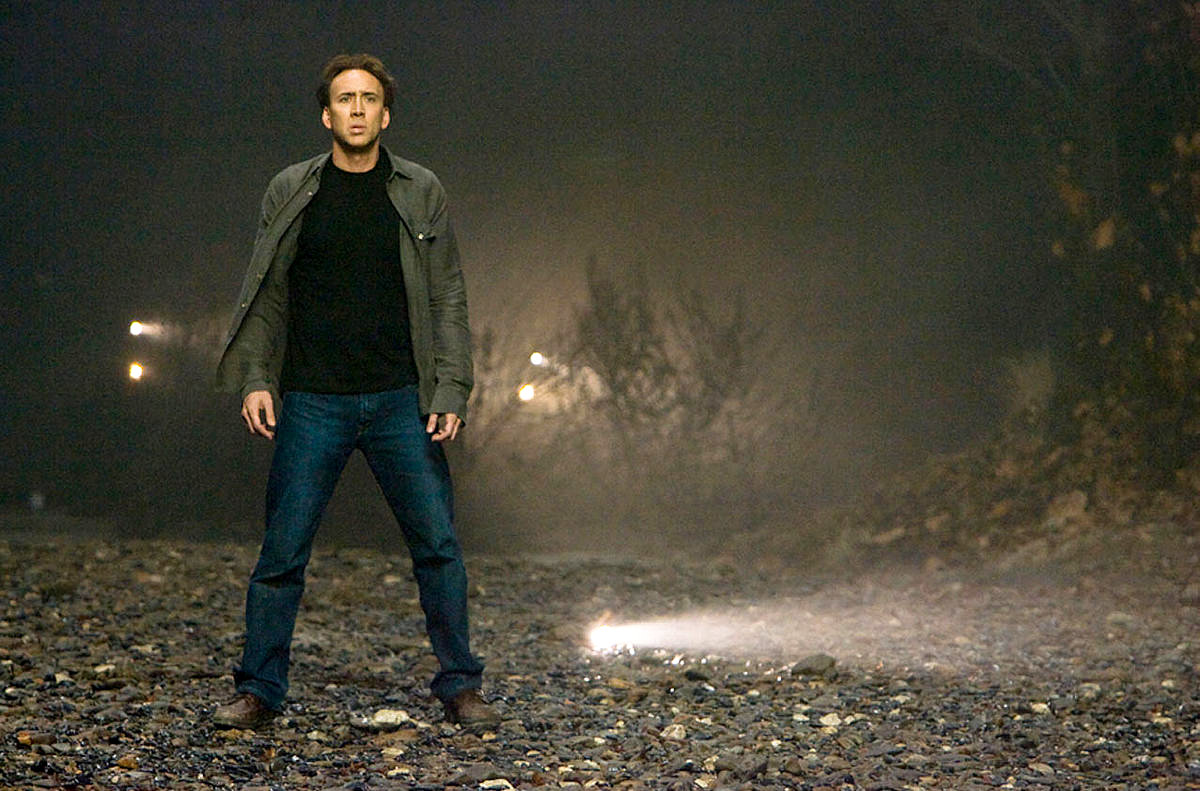
The film opens in 1959 at an elementary school, where students are asked to create drawings of what they think the future will bring. A girl named Lucinda (Lara Robinson) suddenly hears voices that instruct her to line her paper with random rows of numbers…or are they random? Fast-forward to 2009, where the time capsule is opened with all the drawings inside. Caleb Koestler (Chandler Canterbury) winds up in possession of Lucinda’s numbers and shows it to his father John (Nicolas Cage), an M.I.T. astrophysicist. Koestler becomes obsessed with this paper once he notices patterns in these numbers. He realizes that these numbers are warnings for death—dates, times, longitude/latitude, and even the numbers of victims who die at that time or place.

The setup of “Knowing” is investing and pretty intriguing. There’s a good deal of tension drawn in the scenes where Koestler figures things out, and Cage actually manages to sell his reaction scenes with credibility. There are interesting questions of fate and risk that come into place, as Koestler discovers that since there are events that happened long after the numbers were written, he could figure out what’s going to happen next, and possibly find a way to stop it. But is it possible to save lives of those who are predetermined? This is a dangerous question for someone who has previously believed that stuff just happens.

As Koestler digs further into the clues, he’s able to track down Lucinda’s daughter Diana (Rose Byrne) and granddaughter Abby (Lara Robinson again), hoping they’ll be able to help. As the story progresses, Caleb and Diana team up to discover what the last few numbers on the paper mean. But meanwhile, Caleb and Abby are being watched from afar by mysterious strangers who whisper in the night.

And it’s here that “Knowing” falls apart. The story stops being interesting and becomes more tiresome and really ridiculous. While the conflict is there as something bad unfolds for the Earth, the excitement isn’t present and the resolution is less than satisfying—it’s underwhelming. The truth behind these strangers and the numbers is beyond ridiculous. This is supposed to be the big twist to the story. I wanted a more complex ending.

Nicolas Cage is credible in the first half, but as things go downhill, so does his performance. He can’t stop yelling, which is understandable given the circumstances, but Cage is so over-the-top that it’s hard not to laugh at him. Rose Byrne, however, is consistently convincing and creates a sympathetic character opposite Cage.

The disaster sequences are nicely staged, but the use of CGI is always obvious. A train crash in the middle of the film doesn’t look very real, and there’s another scene in which a plane crashes, but while the plane looks real, the flames around it look incredibly fake. But it should also be said that the final effect—not giving anything away—is a genuinely horrific, but effective visual.

“Knowing” starts off by grabbing your attention, but diminishes midway through. Give it credit for not being an ordinary disaster movie and using an intriguing idea to play off of, but they should have thought more about a satisfying purpose.

Frailty (2002)

16 Mar

frailty

Smith’s Verdict: ****

Reviewed by Tanner Smith

Does anyone have the right to enforce their will on us in this world because of what they believe will happen in the next world? It’s a question that can work not only as the foundation for a documentary, but also for a gripping thriller. “Frailty” is such a film, and it’s a special case—an original, chilling story that sets itself apart from the standard serial-killer thriller.

In “Frailty,” here are a series of Texas murders simply known as the “God’s Hand killings.” There are no suspects and hardly any leads to begin with. Then one night, a scruffy young man, Fenton Meiks (Matthew McConaughey), appears in the office of FBI agent Doyle (Powers Boothe), who is investigating the continuing murders. Fenton claims he knows who the God’s Hand killer is. The killer is Fenton’s younger brother Adam, who has already killed himself. Doyle is curious about what else Fenton has to say about the killings, and also why Fenton waited until now to confess to anything—he states, “I’m here because I can’t live with what I know anymore.” So Fenton tells Doyle a tale about how it all started.

Seen in flashback sequences, we see Fenton and Adam as children living with their widowed father (Bill Paxton, who also directed the film) in a small Texas town. They seem to live a normal, happy life together, until Dad wakes the boys up one night to tell them about a “vision from God.” An angel has visited him, telling him that demons are walking the Earth and that it’s his and his family’s duty to destroy them. Fenton doesn’t know how to react to this, but Adam believes Dad and wants to help him. Fenton is even more frightened when Dad makes a list of demons to destroy—people’s names. Dad has three useful tools, “weapons from God”—an axe, a pair of gloves, and a metal rod. And then when Dad finally claims his first victim, Fenton wants to tell somebody, believing that Dad has lost his mind—“If you do, someone will die,” Dad warns his son. “The angel was very clear on this.” Fenton can only watch in horror as Dad claims more victims, becoming a serial killer with Adam helping and supporting his father wholeheartedly.

Are these people really demons, or just chance victims of Dad’s delusional mind? For that matter, is the angel real or was it originally just a bad dream? You certainly know that there’s something mystical afoot here, and certain things are left open for interpretation. Which is scarier—if it’s all real, or if it’s not? One thing’s for sure—the body count is definitely real.

“Frailty” is a very tense thriller—original and effectively creepy all the way through with the right blend of disturbing atmosphere and expository writing. And it does a great job of keeping the viewers invested all the way through. The situation itself is horrifying, and the story involving the two boys is probably the most disturbing, since they’re caught in a world they didn’t make where their father suddenly wants them to assist him in these murders (although Dad doesn’t call it killing people, but “destroying demons”). Fenton is constantly worried as things get worse, and constantly tries to convince Adam that “Dad’s brainwashed you; he’s a murderer, and you’re helpin’ him.” (Adam of course reacts the way a young child would—“Nuh-uh! I’m tellin’ Dad on you!”) Young Fenton and Adam are played by Matt O’Leary and Jeremy Sumpter, both of which are convincing and very effective—with the wrong duo of child actors, “Frailty” would not have worked as well.

Bill Paxton completely sells it with his performance in the film’s most prominent role. He doesn’t play Dad as a villain, but a sincere man who would never harm his children, though he believes that when God tells you to do something, you do it. Paxton is also a pretty good director. After having been directed by some very skillful directors in the past (Sam Raimi, Ron Howard, and James Cameron), this is the directorial debut for the high-profile actor. It seems as if he took lessons from the very people who directed his acting. He knows how to set mood and atmosphere, and uses suspense-tricks that even the late Alfred Hitchcock would have been envious of. For example, there’s one scene in which Fenton is sitting in a car with Dad, who is awaiting his latest victim to walk out of a nearby store. It’s a point-of-view shot—Fenton worriedly eyes back and forth from his father to the store entrance. You can feel that Fenton doesn’t want the man to exit the store, because he knows what will happen. From that shot, Paxton has me hooked and proves himself to be a more-than-capable director. (Also give him credit for having the murders occur off-screen.)

Paxton also does a great job with directing the present-day sequences, continuing the ongoing tension between the two characters of (older) Meiks and the FBI agent. Meiks is obviously going through a deep psychological trauma that came about because events that we see come into place, while he’s telling the story. But there might even be something going on with the FBI agent, who also challenges Meiks, thinking he’s hiding something from him. In that way, it’s more of a challenge of wits that ultimately comes together to put an end to the story. It’s cleverly handled, and keeps its consistently eerie tone.

I won’t give away the ending to “Frailty,” but I’ll admit that I didn’t see it coming. It manages to surprise us and mess with our expectations, and brings about new fascinating details about certain plot elements that kept us wondering. And yet, these new additions to the elements still keep us wondering because they also bring about something new to think about! Watch the film and you’ll see what I mean.