Darkman (1990)

26 Mar

Darkman_2

Smith’s Verdict: ***1/2

Reviewed by Tanner Smith

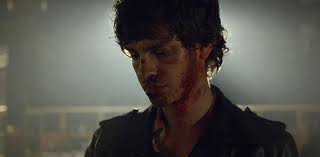
Sam Raimi’s “Darkman” is a rarity in the movies—a superhero story that didn’t used to be a comic book series at first. It feels like it could be a comic book series, or a graphic novel series, and has fun with its energetic story and appealing “origin story.” Every superhero requires an origin story—how the hero gained his or her powers or skill—and “Darkman” is a doozy from the start. It gets stranger as it goes along, but that’s what makes it so entertaining. It’s engaging from beginning to end.

“Darkman” opens with criminals making deals and killing off those who disappoint. One bad guy in particular has a weird habit of breaking (severing) his victim’s fingers and keeping them as trophies in a small case, like a jewelry box. Strange enough, but then we’re introduced to our protagonist—a scientist named Peyton Westlake (Liam Neeson) who is developing a new type of artificial skin to help burn victims. The experiment isn’t going very well, as the skin disintegrates after being exposed to light for 99 minutes.

We know that these two plot elements are going to come together soon enough. That they’re both equally strange story aspects keeps you curious about how they’ll be handled once the meat of the story kicks in.

Anyway, as dumb luck would have it, just as Peyton discovers that the best way the skin can stabilize if it stays in darkness (apparently, this synthetic skin is photosensitive), this is when his laboratory is invaded by mobsters who know he has an important document that proves that a real-estate developer is bribing members of the zoning commission (and wouldn’t you know it—Peyton’s girlfriend Julie, played by Frances McDormand, is an attorney who was responsible for the document).

Are you getting all of this? Are you still with me? If so, you’re a bright reader.

So the bad guys blow up Peyton’s lab and Peyton is horribly burned alive. He survives the tragic ordeal and escapes from the hospital, but his face and hands are horribly disfigured. Oh, and a lot of his nerves are severed, so he can’t feel pain. To exact revenge on the people who did this to him, he creates a new lab in a condemned building to make new masks. He makes one of his original face so he can be with Julie again, though not telling her of his condition. Other masks are created for his enemies—he can observe them and study them, and then use the masks to become them one-by-one, in order to thwart them. The problem is he has only 99 minutes with each mask.

This leads to some fun comic scenes in which Peyton keeps his cover while impersonating these people. And give credit to the actors for imitating Liam Neeson imitating them. In particular, there’s Larry Drake, who plays a mobster who catches Peyton in disguise. Playing against himself (if you will) is a challenge and it confuses us as well as the henchman who is trying to figure which one is which. (My favorite moment in the film is when they’re both held at gunpoint and one of them shouts, “Shoot him!” while the other shouts “Shoot him!”)

“Darkman” has fun with its creative storytelling and unique visual style—the kind that Raimi has specialized in the “Evil Dead” movies (particularly the second one, which had an appealingly bizarre visual taste). “Darkman” has that hazy, dim comic-book look resembling a dark Batman tale and goes about with neat, tricky shots of people or objects popping into the frame and out and intriguing camera angles that keep action scenes not only exciting but also comic. Nicely-handled special effects help as well.

Liam Neeson, as the conflicted hero Peyton, is solid. He makes an interesting individual to follow in this superhero tale and does great work at showing the lighter and darker sides of this person who has lost his looks, restored his intelligence, but also struggles with the feeling of revenge, whether or not he can control it. At one point, he’s on a date with Julie at a fair and gets angry for a simple thing such as a worker stiffing him from a prize, and his anger which comes from previous experience with his enemies, comes through in an effective way. Neeson is well-cast here, and so is Frances McDormand as Julie, who is consistently appealing and shares some good chemistry with the hero.

One major problem I have with “Darkman” is that Peyton never really becomes Darkman. It’s said at the beginning that Peyton’s masks are only stabilized in darkness, and yet he’s constantly using them in the daylight. This means that this never becomes a crucial point of the plot and so the film doesn’t have a clear motivation. Maybe “Darkman” should have begun right at the end, when Peyton realizes who and what he is.

But then again, now that I think about it, maybe I didn’t want “Darkman” to be so simple that Peyton would actually use his replicating inventions in the dark when it’d be easier. If he did that, we wouldn’t have a constant troublesome conflict of having to be rid of a mask after 99 minutes before he gets caught. And of course, this means “Darkman” wouldn’t be as much fun.

And that’s what “Darkman” is—fun. It’s an intriguing mix of superhero origin story and unique visuals. It’s its own creation for film, not based on a comic book, and it’s quite an effective thrill ride.
The Rescue (1988)

26 Mar

rescue_in2d

Smith’s Verdict: ***

Reviewed by Tanner Smith

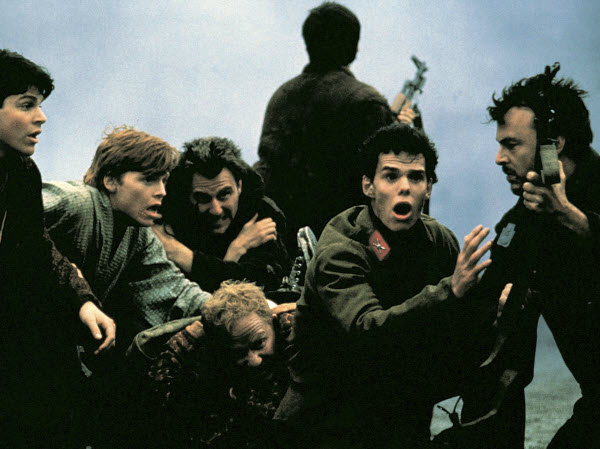
If a teenager can hack into the defense network system (“WarGames”), build his own atomic bomb (“The Manhattan Project”), and fly a jet into enemy territory to save his father (“Iron Eagle”), then why shouldn’t four teenagers and a younger kid be able to sneak into North Korea and save their Navy SEAL fathers from a Korean prison, while making little attempt to disguise themselves?

That’s the central story element of “The Rescue,” a gutsy, well-shot movie that has high spirits and a likable if unspectacular young cast. The whole idea of the movie may be preposterous and that’s most likely the word that almost every other film critic used in their negative reviews of this film. But strangely, I got into the movie. So what if it’s preposterous? So what if (spoiler) everything works out for these kids? It’s a teenage adventure movie—leave it at that and enjoy.

Four Navy SEALs stationed in South Korea are sent on a mission to destroy a disabled U.S. submarine in enemy North Korean waters. They succeed, but are captured and sent to a North Korean prison. A month passes and the imprisoned SEALs are scheduled for execution.

Teenagers Shawn Howard (Ned Vaughn) and Adrian Phillips (Christina Harnos) each have a father that is a prisoner. They use a friend’s homemade listening device to eavesdrop on a discussion of a rescue mission to go in and get the men back. But they are shocked to know that the plug has been pulled on the plan. They and the friend—Max Rothman (Marc Price, TV’s “Family Ties”), the son of the SEAL head—tell the news to rebel J.J. (Kevin Dillon), another son of a captured SEAL. J.J. comes up with the idea of stealing the government rescue plan and taking matters into their own hands. They’ll get a boat, escape the border patrol, find the mission operative, and get their fathers back. They have an unexpected ally—Shawn’s ten-year-old brother Bobby (Ian Giatti), who followed them to help.

“The Rescue” could be made as a silly kids’ movie, but it’s not dumb and it’s not boring either. A lot of that has to do with the masterful direction by Ferdinand Fairfax, who shoots with a great visual style. The climax is surprisingly well-handled, despite the preposterousness of the situation. But I felt involved—at one point, when the plane they use to escape in loses both engines and comes close to a nose dive, I even held on to my own stomach. That’s really saying something about the look of the film.

The young actors are fine and likable—even Marc Price, who was so obnoxious as the neighbor Skippy in “Family Ties,” is likable. Kevin Dillon (seen in “Platoon” and “The Blob”) is a convincing rebellious hero, Ian Giatti has a special enthusiasm that comes with the age, and Christina Harnos is spunky and has some karate moves to use on some (get this) Korean gangsters. The only problem is that their characters aren’t fully developed and neither one is given a chance to stand out.

So what if all of these kids have it easy with one too many close calls? It’s entertaining as a PG fantasy—you know nothing bad will happen to these kids, but let the direction by Ferdinand Fairfax guide you. “The Rescue” isn’t a great movie, but I liked it enough to recommend it. It’s a high-spirited teenage adventure film—deal with it.

Hot Shots! (1991)

26 Mar

500full

Smith’s Verdict: ***

Reviewed by Tanner Smith

Now here’s something strange—we have a parody film called “Hot Shots!” that mostly lampoons elements from a movie I didn’t like, which was “Top Gun,” and I liked this parody. Weird, how I’d prefer this ridiculous but often very funny film over the movie it borrows elements from, which had great-looking dogfights, but a boring human story. Maybe the filmmakers of “Hot Shots!” knew that some people felt that way, and made fun of that material and more. But whatever they did, it worked for me.

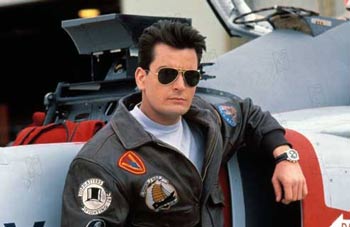
Charlie Sheen plays (and plays with) the Tom Cruise role in “Top Gun” for “Hot Shots!” and his poker face makes him right for the role of Topper Harley. Whenever people look at him, he just likes to show how tough he is by tightening his lip and keeping his eyes open. But when he isn’t trying to act tough, he’s just a macho buffoon, like he’s supposed to be in a film that is like films such as “Airplane,” “Naked Gun,” and not to mention “Top Secret.” These films are funny by giving us silly humor that makes us laugh rather than roll our eyes. In fact, some of the filmmakers of this film also made “Airplane” and the “Naked Gun” movies. You can’t stop yourself from laughing at a good joke and there are plenty in “Hot Shots!”—most notably, a scene in the beginning of the film in which Sheen, playing a young test pilot, passes by an attractive woman on horseback on his way to the air base and he copies her movements on his own motorcycle. That is truly hilarious and we would expect him to bump into a tree branch or fall off or run into that old comedy cliché of someone being distracted and then running into something, killing the infatuation. But he doesn’t and thank goodness he doesn’t—that joke of running into something while distracted is too old to be funny anymore.

Another good running gag is the vision of one of the test pilots, played by Jon Cryer—his vision is distorted by a bad case of “wall-eye.” He keeps missing something he reaches for.

That is all I wish to say about this movie, other than the fact that I laughed a lot during this movie. There are some parody scenes that aren’t that funny, but the funniest moments are when we’re caught by surprise. There are plenty of those moments in “Hot Shots!” We also get strong supporting, comedic work by Lloyd Bridges and Cary Elwes, not to mention as much work as we can get in a movie like this from beautiful Italian actress Valeria Golino as the love interest. But like I said, Charlie Sheen’s poker face will make you laugh.

Red Riding: In the Year of Our Lord 1974 (2010)

25 Mar

images

Smith’s Verdict: ***1/2

Reviewed by Tanner Smith

“Red Riding: In the Year of Our Lord 1974” is the first in a trilogy of British TV films, later released theatrically. But even most of it is setup material for the second and third entries, it can be taken as a stand-alone. Whether or not this will stand above the rest remains to be seen, as I haven’t yet seen the other films. But this is an effective first entry that works well on its own, but does have me interested in seeing the later entries.

“Red Riding: 1974” is a mystery fable, set apparently in 1974 (as the title suggests, though it could have taken place anytime, I guess). Its hero is a young reporter named Eddie Dunford (Andrew Garfield) based in the dark little town of Fitzwilliam, West Yorkshire. Eddie is given the task to report on the mysterious child killings. The police aren’t making much progress, though they say they’re working on the case. Eddie doesn’t particularly care much for the story, as he’s somewhat of a slacker. But there are two things that keep him interested—the romantic relationship he winds up sharing with Paula Garfield (Rebecca Hall), the mother of one of the dead girls; and the death of his friend Barry Gannon (Anthony Flanagan) who has stumbled upon something that could or could not related to this case. As Eddie digs deeper into the case, he runs afoul of certain characteristics with policemen and rich businessmen, particularly land developer John Dawson (Sean Bean) whom Eddie suspects of the murders.

“Red Riding: 1974” is more than a serial killer mystery. Without giving too much away, we can tell from the final act of “Red Riding: 1974” that this is a brutal tale of power and corruption, mainly involving police. And the later entries will no doubt dig further into that. Police corruption isn’t new in movies (or in life, for that matter), but the approach that’s given in this movie is so unbending and careless that it’s kind of sick, and yet effective at the same time. There’s a torture scene near the end of the film that’s especially fierce that is followed by a very tense moment involving two police officers taking joy in practically scaring the hero to death. And the hero learns the hard way that only one thing matters in this sick little world that he didn’t make—power.

This could have been great. It has a neat look—it was shot on 16 mm film and has chosen a suitably bleak town for its location. The acting is very good—particularly by Sean Bean and Rebecca Hall, while Andrew Garfield is merely OK. (He doesn’t make the strongest impression as the leading man.) The way the story develops into this heavy corruption tale is nicely-handled. The ending is uncompromising and memorable.

But if I have to criticize, I’ll say that the story isn’t precisely clear and there are some moments where I’m wondering how exactly we got to a certain spot. Maybe after another viewing of “Red Riding: 1974,” I’ll be able to understand it better and give it a more positive review. As it is the first time around, it is an effective introduction to a promising trilogy of films.

NOTE: Another little nitpick is that the thick British accents made it difficult to understand what some of the characters were saying. Is it weird that I think subtitles for an English film can be necessary sometimes?

Sylvester (1985)

25 Mar

syn__0023_sylvester

Smith’s Verdict: ***

Reviewed by Tanner Smith

The story for “Sylvester” is nothing new. It’s the story of a spunky young woman and her equally gutsy horse. The horse is reckless at first, but maybe it can be trained to become a champion. We’ve seen this before, particularly in “National Velvet” starring Elizabeth Taylor. But “Sylvester” has something going for it, and it’s not in the predictable story; it’s in the actors’ performances and the story around the girl and the horse.

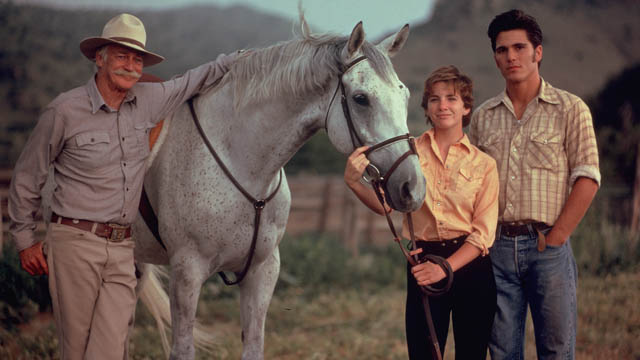
Melissa Gilbert, from TV’s “Little House on the Prairie,” turns in an excellent performance as Charlie, a sixteen-year-old orphan girl who cares for her two younger brothers by herself and works at a ranch. She wants to train horses and wants a challenge. She finds one, all right, in Sylvester Stallone (no, really—that’s what she names the wild horse of the bunch). This is a wild, unruly horse—not the kind of horse you’d see competing in the steeplechase trials.

But hey, maybe…just maybe…Sylvester will be able to do it.

OK, we all know the conflicts at hand here. Charlie has to deal with the court officials concerning her and her brothers living alone; they later live with the farmer who becomes a father figure; the father figure is skeptical about the horse being trained by Charlie; Charlie gets Sylvester in good riding form; and of course, with help from the farmer, her brothers, and her boyfriend, Charlie is able to compete in the steeplechases. We go through the checklist of events.

BUT among the formula and the obligatory scenes that come with it, we still have the pleasure of watching of viewing the actors portraying these characters. Melissa Gilbert is great in this movie—she has a unique star presence and brings conviction to the role of young Charlie. Richard Farnsworth is also great as the grizzled old farmer who takes her and her brothers in, showing more dimensions than we’re used to. Even Michael Schoeffling (“Sixteen Candles”), as the obligatory handsome boyfriend, does a nice job.

The horse is the least interesting element in the movie. He’s just there as a way to get the story and the heroine in the directions they’re supposed to go. But to be fair, I’m glad this isn’t one of those movies where the horse makes everything happy when the girl is sad. The horse isn’t a practically human reincarnate. It’s just a horse. The story isn’t about the horse, despite this horse’s name Sylvester being the title of the movie. It’s about the people this time.

“Sylvester” isn’t particularly original, except for when it’s dealing with Charlie’s issues and the development of the people around her. It is also harmless for kids and I think adults will enjoy the more mature aspects of the story. It’s a nice family film that could have been great, but as it is, it’s a good movie.

The Good Girl (2002)

25 Mar

425.goodgirl.lc.020711

Smith’s Verdict: ***1/2

Reviewed by Tanner Smith

“The Good Girl” is a story about a woman in crisis—stuck doing the same routine with nothing new in her life. She works at the local discount store in her hometown—as you’d expect, she hates her job. Her husband is a loser—a slacker who would rather sit on the couch and watch TV with his best buddy than be with his wife. Nothing is as it should be, and she goes about her day in a constant state of quiet and imprisonment.

The woman’s name is Justine and she’s played by Jennifer Aniston, an actress you wouldn’t expect to play the part, given her mostly-TV-based career, but proves herself to be more than capable. Aniston is nearly unrecognizable as Justine—you never see her as Rachel from “Friends”; you see her as Justine.

Justine’s working-class lifestyle is, as she puts it, like being in prison on death row. Her job as a retail clerk at a Wal-Mart knockoff, called “Retail Rodeo,” doesn’t mean anything to her and she feels crippled by it. Then there’s her husband Phil (John C. Reilly), who’s not a bad person, but a lazy, pot-smoking slacker who spends most of his time watching TV with his friend Bubba (Tim Blake Nelson). He’s not abusive and does care for Justine, but he just doesn’t seem like the man Justine married years ago.

Then, Justine meets Holden (Jake Gyllenhaal), a 22-year-old loner-poet who joins Retail Rodeo and keeps to himself, reading “Catcher in the Rye” (he says he’s named after the protagonist, but he really named himself after him). Justine sees that Holden is having the same problem as herself—feeling suffocated by routine. She draws herself to him, and they spend a lot of time together. This leads to an affair that these two felt desperate to have. But the more time they spend together, the further Justine notices that maybe Holden isn’t too well—he has an unstable mentality and impulsively says things like, “I want to knock your head open and see what’s inside” (which he thinks is a romantic come-on).

The screenplay for “The Good Girl” was written by Mike White (who also co-stars as a religious security guard); he creates a grim (though realistic) outlook on life, credible main characters, and quirky side characters that seem like people you would see working at a retail store. That particular third element includes a supporting character that steals the show—a profanity-spewing, deadpan-sarcastic co-worker played by Zooey Deschanel. Her spin on the “attention shoppers” announcements is hilarious. Moments like those inside the retail store make for effective satire.

Those expecting a lighthearted comedy starring Jennifer Aniston in her typecast-“Rachel” phase should just keep looking (or go rent “Picture Perfect”). “The Good Girl” displays Jennifer Aniston’s true acting talent—credible, dynamic, and effective. Those three adjectives describe the whole movie in general.

Reckless (1984)

25 Mar

aidan reckless

Smith’s Verdict: **1/2

Reviewed by Tanner Smith

“Reckless” is about a bad boy and a good girl who are attracted to one another, and it’s not as much a ripoff of “The Wild One” or “Rebel Without a Cause,” because really this sort of youth melodrama is its own genre. While “Reckless” deserves credit for its proficient acting and occasionally complex drama, and it’s certainly a step up from the awful “Tuff Turf” (a similarly-themed teen film released the same year as this one), It’s not as dramatically satisfying or revealing as we would like it to be.

Aidan Quinn stars in his film debut as Johnny Rourke, a high school teenager from the wrong side of the tracks. His fellow students think he’s weird because he mostly keeps to himself and likes to ride around on his motorcycle. Oh, and he’s a deadringer in every way for James Dean’s “rebel without a cause.” He’s handsome, he’s moody, he speaks in a soft monotone, and loves to mope around.

It’s the intention that Quinn resemble James Dean, and the truth is, Quinn completely pulls it off. This could easily have been a pale imitation, but Quinn plays it with enough authenticity and conviction that really makes the role of Rourke his own. He makes us feel for his pain and angst. He’s more the rebel with a cause—he has something difficult (if uncomfortable) to deal with, and the time he spends to himself makes him more comfortable. That’s my take on the character, anyway.

Rourke has to put up with his irresponsible, lazy, drunken father, as well as working at the steel mill, being blamed for something that isn’t entirely his fault (but because he looks rough, he’s immediately to blame), and being stared upon by his fellow students who refer to themselves as “normal” compared to him. But one day at a school party, he is paired up with the girlfriend of one of the football jocks, and they share a fun dance to new wave music. This is Tracey (Daryl Hannah, very good), a good girl who, after the dance with Rourke, realizes that he is everything she is not. She has never taken chances and is the “model girl.” Rourke’s recklessness attracts her, and they spend some time together causing trouble—breaking into the school, trashing the principal’s office and classrooms, and sharing an explicit sex scene in the boiler room to 80s rock music.

That sex scene is actually one of the more original parts of the movie, which is mostly utterly predictable. We can tell where this relationship is going to go, and we know they’re going to spend some time apart before ultimately getting back together after much convincingness. I wouldn’t mind so much except that the supporting characters don’t have dimensions of their own, so we’re pretty much stuck with these two characters who feel like they’ve got no direction—well, we certainly know where this is going, for sure. Rourke’s father (Kenneth McMillan) only has a couple scenes that give us the point—and he has only one note: drunken. The football coach (Cliff de Young) is too much of a hard-case. And Tracey’s boyfriend (Adam Baldwin) is too much of a stereotypical jerky boyfriend that he is just plain boring.

It’s not enough that we have two likable characters if we can tell where the story is going and they (or rather, the screenwriter) constantly kid us with it.

I liked Aidan Quinn and Daryl Hannah as the two central star-crossed lovers. And the cinematography and direction is well-done. But “Reckless” needed more work done on its screenplay if it was going to be as special as a film about a bad boy and a good girl can be.

Spider-Man 3 (2007)

24 Mar

images

Smith’s Verdict: **

Reviewed by Tanner Smith

Where do I even begin with “Spider-Man 3?” Maybe I can start by saying that there are too many plotlines and villains for one superhero movie. But the problem is that I didn’t care much for either of them. Whereas “Spider-Man 2” knew what to focus on and how to make me care for what was happening, “Spider-Man 3” is all over the map. So, all I had out of this movie were a few nicely-done special-effects action sequences…and not much else.

There are so many problems with this movie that I hardly know where to start. I guess I should start with Peter Parker and Mary Jane Watson, two of the most boring characters to come around in a superhero movie. While they were likable, charismatic characters in the previous films, they’re just dull saps here. And is it really time for Peter to propose after only a few kisses? Their romance is so uninteresting that the waiter (Bruce Campbell) is the best thing about a romantic scene. And he’s the comic relief.

Now let’s look at them individually. Peter (Tobey Maguire) is still Spider-Man, but while he was conquering his demons in the previous films, everything just seems so hunky-dory for him that it just gets to his head so much that I’m not convinced when he supposedly “has a moment.” This is the movie in which Tobey Maguire did what he didn’t in the previous films as Peter Parker and that was, bore me. Then, we have Mary Jane (Kirsten Dunst). What is her deal? She’s a somewhat talented actress who is constantly having an on-again/off-again relationship with Peter (oh, did I forget to mention THAT). Could she just pick and develop an emotion? After seeing her, I realized I would’ve loved to see more of Gwen Stacy (Bryce Dallas Howard), Peter’s pretty science lab partner who is put in jeopardy so Spider-Man can save her and make Mary Jane jealous!

Then, there’s the villain…and the other villain…and a third villain! That’s right—there are three villains in “Spider-Man 3.” Not one of them are developed or interesting enough. In action movies, it’s better to have an interesting villain to go with an interesting hero. But the hero isn’t interesting in this movie and neither are the villains. First, we have Flint Marko (Thomas Haden Church), an escaped convict who wants to make things better for himself and for his family. While running from the police, he winds up…some sort of testing area that isn’t explained. I guess the radiation and the sand in that pit mixed with him and transformed him into half-man, half-sand. This gives him the nickname The Sandman. Do we ever know how he feels? Does he have a personality? Is he excused from a contrived plot point, such as killing Peter’s uncle? The answer to all three questions is no. We never know how he feels, whether turning into a dust storm or becoming a gigantic sand mutant in the street. In “Spider-Man 2,” we always knew how the villain Doc Ock felt. We know very little about the Sandman in this movie.

Then, there’s Peter’s former best friend Harry Osborn (James Franco). If you recall from the previous film, Harry discovered that his buddy was Spider-Man and believes he killed his father, who was the Green Goblin in the first film. Now, there is a new suit and glider left for him (I suppose) so he can become the next Green Goblin, or whatever. There are a couple fights between him and Peter—only one of them is well-done on an action-packed level. But don’t people see these unmasked flying men fighting through New York? Nobody looks out their windows to see what the commotion is about? The second fight is…a fistfight. That’s right—a fistfight. This isn’t a “Spider-Man” movie—it’s an Abbott and Costello knockoff.

Then, there’s Venom, which should have been the most interesting part of the movie. It has enough back story to make its own movie. But it isn’t used well—and when it is, it’s not used well ENOUGH. You see, it begins when a slimy, black alien organism lands on Earth and follows Peter home—how did Peter not notice it with his spidey-sense? But I digress. Apparently, it’s some sort of parasite that attaches itself to a host and takes over a part of its mind. So it attaches itself to the Spidey suit, turning it black and changing Peter’s attitude. Peter suddenly believes he’s cool and struts down the city sidewalk, pointing and smiling as people pass by. Good grief—Peter isn’t even a convincing bad boy; he just seems like a dork. And then—I’m not kidding—he dances at a club. He dances all over the place—like I said, not a regular “Spider-Man” movie.

And then once Peter takes the alien slime off of himself and it lands on Eddie Brock (Topher Grace), who conveniently (or inconveniently) happens to be Peter’s arch nemesis as photographer for the Daily Bugle. Now, he turns into Venom and sets out to kill Peter. This whole subplot could’ve been its own movie and could’ve been right. But no. Instead of a serious look at this otherworldly substance taking over an individual, we get that weird dance I mentioned in the above paragraph.

Have I left anything out? I sure hope not because I’m tired of writing this review and listing all of these faults. Oh, I suppose I should list some positive things about “Spider-Man 3.” The special effects do look great—I love the sequence involving an out-of-control crane. And a few people may see the film as a silly action picture. I enjoy silly action pictures, but this is pushing it for me. To wrap up this review, I’ll sum up “Spider-Man 3” in one noun—mess!

Mystic Pizza (1988)

24 Mar

mystic01

Smith’s Verdict: ***1/2

Reviewed by Tanner Smith

“Mystic Pizza” is a coming-of-age story featuring three young women who fall in love. It’s usually in movies like this where young people meet somebody attractive and go through many lengths to get what they want, but in “Mystic Pizza,” they don’t merely fall in love; they learn about their own standards for love. It’s a nice, well-acted movie that deals realistically with these issues, but with a certain charm that keeps it from containing a gritty feel.

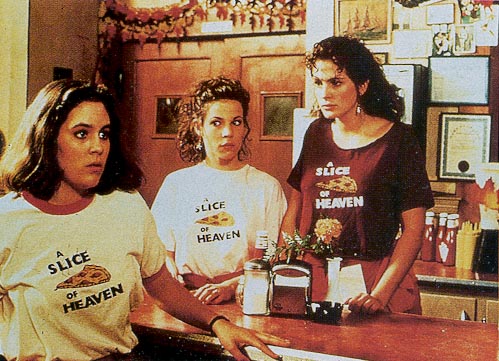
The title “Mystic Pizza” refers to the local pizzeria in a fishing town called Mystic, Connecticut. The three central characters work there as waitresses—Daisy Arujo (Julia Roberts), her sister Kat (Annabeth Gish), and their friend Jojo (Lili Taylor). Their boss is the sassy but friendly Leona (Conchata Farrell), whose pizza contains a special secret sauce that has people coming for more—she won’t even tell her employers what’s in the sauce. (We never find out, either.)

The girls have their own adventures/issues with romance. As the movie begins, Jojo is about to be married to her loving boyfriend Bill (Vincent Philip D’Onofrio) when she passes out from stress right there at the altar. She loves Bill, but just isn’t ready for a big commitment, like he is. (Huh—that’s also a change in the movies. Usually, it’s the guy that won’t commit.) As the movie continues, she tries to romance Bill many times, but Bill believes that they should wait til marriage before they get physical. Would Jojo stoop so low as to marry Bill just to have sex with him? Actually, no. But she would like more passion in their relationship.

Daisy is playing pool and drinking beer at a local hangout when she notices Pretty Boy walking in and asking her to play a set with him. He’s rich, nice, handsome, and has the name Charles Gordon Windsor (Adam Storke). (Oh, and he can also shoot three dart bullseyes in a row after having shots of tequila.) He tells Daisy that he’s currently in law school, but eventually comes clean and says he was kicked out for cheating on a final. (Huh—no wonder he can shoot darts so well; he’s had time to practice.) Daisy is the most standoffish of the three women and possibly the more slutty, but she’s not dumb and can read people well. She takes a chance on this rich boy, but then she learns something she didn’t need to know about him, in a scene near the end when Charles actually stages a dramatic dinner scene with her invited to the family dinner—he accuses his family of being snobbish and actually pulls out the tablecloth from under the dishes. It’s then that Daisy notices that maybe Charles is just looking for someone to look up to him, which isn’t exactly what she needs.

Meanwhile, Kat is babysitting the daughter of a 30-year-old Yale graduate named Tim (William R. Moses). He’s a nice, smart man whom Kat falls in love with, which can cause problems because not only is he twelve years older than her, but he’s also married. The wife isn’t around, so she won’t have to worry about it until later. But she does restrain herself from expressing her feelings towards him. He starts to like her too, for her intelligence (she’s been accepted at Yale). However, by the time she comes home, she realizes she doesn’t know how to handle the situation as it is.

“Mystic Pizza” follows these three couples through a long summer where everyone would just rather not be stuck in Mystic, but you make do with what you have. Lessons are learned, certain secrets are revealed, and hearts are broken. What Kat, Daisy, and Jojo learn is that they have each other and their job at the pizzeria.

The acting is wonderful, especially by the three lead actresses. Lili Taylor displays a comic presence in the way of her odd relationship with Bill—there’s human comedy in how she reacts to certain things, like how she nearly freaks out after Bill expresses his true feelings (she comes to work three hours early, and nervously unstacks the table chairs). Julia Roberts is a true beauty and has a fierce amount of energy—watch the scene in which she tries to imitate the hitchhiking scene from “It Happened One Night”; it’s pure delight. Annabeth Gish is my favorite of the performers, portraying Kat with intelligence but also with a little vulnerability. The supporting cast is solid, but it’s Conchata Ferrell as the pizzeria owner and Louis Turenne as an uptight food critic who really shine.

“Mystic Pizza” is an interesting, nicely-handled drama with good performances and a lighthearted screenplay. It shows that love may not be easy, but at least you know what you want. It succeeds in delivering that message.

Revenge of the Nerds (1984)

24 Mar

images

Smith’s Verdict: ***

Reviewed by Tanner Smith

Here’s another risqué comedy about young people who break the rules and often talk vulgarly. When done right (like “Animal House” and to a lighter extent, “Risky Business”), it can be less raunchy than it sounds. But when done wrong (“Porky’s,” “Porky’s II,” “Where the Boys Are 84”—I could go on and on, but I won’t for space), they can be real scuzz-pits. Then you have “Revenge of the Nerds”—that’s a clever title for a movie and a clever idea. This is a raunchy comedy that doesn’t focus on the slobs or the jocks, but the nerds—the geeky, twerpy guys who are smart but socially awkward. This film does not take place in the real world—this is a movie in which all jocks are stereotypical jerks who, of course, are the most-loved ones on college campus, and also know nerds when they see them wearing glasses or sporting pocket protectors on their shirt pockets. Oh, and most of the “nerds” are freshmen, which makes it hard to believe. No introduction necessary—they just shout “nerd” at you and make your life miserable. It doesn’t matter what you do; you will always be a nerd to them.

Just describing that one detail of “Revenge of the Nerds” makes it seem ridiculously stupid. But this is a surprise—yes, it features stereotypical jocks (and nerds, for that matter) and quite a lot of female nudity from the sexiest sorority girls. But it also features enough laughs and enough likable lead characters (the nerds) that I’m recommending the film. It’s stupid, but it’s playfully stupid.

So anyway, the trouble starts when the jocks’ idiotic behavior burns their frat house to the ground and the jocks invade the freshmen’s dorms, forcing the “nerds” to sleep in the gym. Then, when the nerds (I hate to call them this) have an opportunity to make into the only fraternity that’s left for them—an all-African-American fraternity called Lambda—those dumb jocks ruin their chances by crashing their party and humiliating them. This will not do. It’s time to stand up and retaliate. Led by Louis (Robert Carradine) and Gilbert (Anthony Edwards), the nerds panty-raid the jocks’ favorite sorority house, install hidden cameras in their dorm rooms, and put “liquid heat” in the jocks’ jockstraps. And if they win the Homecoming decathlon at school, they can take over the jock fraternity.

At that point, the film is predictable, but it’s honest and displays the message that nerds are people too. Some of the nerds are types—we have the slob, the horny Asian, the gay African-American, and the weak nerd—but the two leads, Louis and Gilbert, seem like real people and do earn our sympathies. The jocks—this includes the football coach, played over-the-top by John Goodman—are types, like I said. But in this case, they deserve their comeuppance. I know I smiled when seeing them in pain after the nerds put liquid heat in their jockstraps.

Some of “Revenge of the Nerds” is funny and some of it is heroic. That’s a good enough mix for me to recommend the film without going too crazy over it.