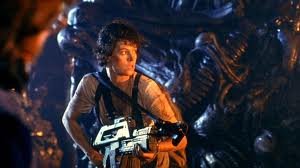
Aliens (1986)

31 Mar

images

Smith’s Verdict: ****

Reviewed by Tanner Smith

If 1979’s “Alien” is considered a science-fiction thriller, or rather a haunted-house movie set in space, then 1986’s “Aliens”—sequel to “Alien”—would be considered just a relentless series of sci-fi action sequences. And there’s not a thing wrong with that. “Aliens” is a gripping, adrenaline-fueled powerhouse of thrills, tension, and action. It throws just about everything it can think of right at you and hardly backs down.

Sigourney Weaver reprises her role as Ellen Ripley from the original “Alien.” She was the lone survivor of the terrifying events in “Alien”—when an alien creature found its way on a space ship and killed off the rest of the crew before Ripley was able to kill it. Now, a salvage crew has found the ship with her (and the loyal cat Jones) in cryonic sleep. Ripley is brought back to Earth, where she realizes how much time has passed and that her daughter is now deceased. She is also met with skepticism when she delivers her story about the alien. But an agent from the corporation—Burke (Paul Reiser)—has his suspicions when contact is lost on a vacation-planet, which also turns out to be the same planet where the alien was discovered. He plans to send a military team to check it out, and goes to Ripley to act as an advisor.

Reluctantly, she agrees, but only if none of the alien creatures of brought back to Earth.

That’s the setup to “Aliens,” which leads to absolute madness once Ripley, Burke, and the team reach the planet and discover just exactly what is living there. What they encounter are some of the nastiest, vicious, slimiest alien-monsters you’ll come across. And give special praise to Industrial Lights and Magic for making distinctive, realistic creatures that are so convincing that at times, you could actually be terrified of them, which is mainly the point of a monster movie.

Then the action picks up once the crew is forced to fight for their lives against an ever-growing army of aliens. With director James Cameron coming off the action-packed “The Terminator,” and Ridley Scott—director of the first “Alien” movie—not returning, it seemed necessary to let Cameron come in and see what he can do. Like “The Terminator,” Cameron uses a hostile, limited scenario to set up his action sequences before letting them upon us with suspense, tension, and just as important, a brisk pace. These are some pretty nifty action scenes.

Sigourney Weaver, reprising her role from the first “Alien” movie, is fantastic and makes an interesting heroine to follow. She plays Ripley as a psychologically distraught woman, stuck with the remorse of how everything on Earth has changed except for her, and now she’s forced to fight for her life, as well as the life of her surrogate daughter, on that planet. And speaking of the “surrogate daughter,” I forgot to mention the little girl that the team finds lost and alone on that planet. Her name is Newt (a nickname, I hope) and she’s put under the team’s protection as the aliens attack. This is where the human-interest part of the story kicks in—the mother/daughter relationship between Ripley and Newt. While the camaraderie among the rest of the crew is fun to watch, this relationship is the most touching in the film. I can think of many action films that don’t contain heart with its human characters amongst all the action and effects (and if the filmmakers realize that, they just force it anyway), but “Aliens” is not one of them.

The supporting actors do game jobs and their characters are fun and memorable. There’s Burke whom I’ve already mentioned, faced with the choice of doing the right thing while constantly…not. Then there’s the rest of the team—in particular, there’s Apone (Al Williams), subdued Hicks (Michael Biehn), smartass Hudson (Bill Paxton), and unflustered Vasquez (Jenette Goldstein). My favorite was Bishop (Lance Henriksen)—the quiet android on the ship that Ripley doesn’t trust, seeing as how the android on her last expedition tried to kill the crew himself in “Alien.” Ripley is on edge around him, though Bishop tries to keep his good nature and trying to remain trustworthy. Truth is, though, he may turn out to be more human than the actual humans, kind of like Mr. Spock in “Star Trek.”

From beginning to end, “Aliens” has us invested in its story. From the introduction to the discoveries to the many chases to the supposed final struggle to its twist ending, by the time this movie is over, we are exhausted by everything that has been thrown at us, but glad to have taken this journey. This is one wild ride.

Twilight Zone: The Movie (1983)

31 Mar

images

Smith’s Verdict: **

Reviewed by Tanner Smith

“The Twilight Zone” took television viewers where no one else ever imagined being before. Even though it was a TV show, we felt like it really took us through another dimension. Now many years later, here is the attempt to suck us in again with “Twilight Zone: The Movie.” This movie contains four short segments as long as the original “Twilight Zone” episodes, directed by four different directors—John Landis, Steven Spielberg, Joe Dante, and George Miller. But the surprise is that the best known of those four—Steven Spielberg—has made the worst segment in the movie.

There are two bad segments, one good third segment, and one great last segment. So as a whole, “Twilight Zone: The Movie” is only worth recommending for the second half, which doesn’t make for a positive recommendation as a whole.

The movie opens with a nicely-done prologue (also written and directed by John Landis) in which Dan Aykroyd is a hitchhiker and Albert Brooks is the driver that picked him up. They sing many well-known TV show themes before the unexpected (and very frightening) occurs. That’s a great opening scene that lets us know that we’re in another dimension. But then with the two segments that follow, the movie starts to falter.

The first segment features a racist man, played by Vic Morrow, who is taught a lesson the hard way when he finds himself in Nazi Germany and Vietnam. This one is so predictable and unsurprising that it’s weak. At one point, he finds himself at a Ku Klux Klan rally—what is trying to be said here? It also doesn’t help that we know that Morrow died in a helicopter accident during filming.

The second segment is directed by Steven Spielberg. This really brings the movie down. This segment is so whimsical and full of its whimsicality that it becomes…not very whimsical and more condescending. It stars Scatman Crothers as a mysterious old man who visits a nursing home and grants them the feeling of being young again. This segment looks great and its message is good (one lifetime is enough), but it’s just full of itself.

Then we come to the third segment by Joe Dante. The movie redeems itself after the bad segment that came before this. Kathleen Quinlan plays a schoolteacher making her way through a small town when she almost hits a young boy. This boy may look cute, harmless, and heartfelt, but he holds a secret in his house that brings the woman into another dimension where cartoon characters come to life and the boy’s wishes come true…for better or worse. This segment is so weird and offbeat but it’s also very inventive and great-looking. The special effects and the art direction are especially good when the most surreal events happen in this house.

And then at last, we arrive at the segment that is the real reason to see this movie—a remade version of the original “Twilight Zone” episode “Nightmare at 5,000 Feet.” This segment stands above the others. Made by George Miller, it’s well-made and powerfully-acted and also, very scary. This segment really gets into the “Twilight Zone” tradition—it really makes us feel like we’re in another dimension. John Lithgow is phenomenal as a man who has a phobia for flying and sees a monster on the wing of the airplane he’s traveling on—or does he?

The two last segments (especially the very last one) makes “Twilight Zone: The Movie” worth seeing. If you want a truly frightening modern-“Twilight Zone” type of experience, skip ahead to about 45 minutes. You won’t miss a thing and I’m sure you’ll enjoy the movie a whole lot more. I just can’t believe that Steven Spielberg would make the worst segment in the movie—maybe he should have watched some more episodes of the original “Twilight Zone.”

The House of the Devil (2009)

30 Mar

articleLarge

Smith’s Verdict: ***1/2

Reviewed by Tanner Smith

Filmmaker Ti West is obviously an enthusiast of classic horror films, and indeed, his film “The House of the Devil” feels like an affectionate homage to horror films of the 1970s and 1980s. He not only uses the same filming procedures to refabricate the style of these films, but he also used similar technology (for instance, a 16mm camera to give the film a vintage look). The film also opens with a disclaimer stating that it is based on “true unexplained events.” Isn’t that what the makers of “The Texas Chain Saw Massacre” wanted people to believe in 1974?

“The House of the Devil” also uses elements of the “haunted-house” story and the slasher-film subgenre. It also uses the plot element of the “satanic panic” that swept the 1980s and inspired Ronald Reagan’s infamous speech about good and evil.

Oh, and get a load of this—the film is also set in the 1980s. A specific year isn’t mentioned, but you can tell from all sorts of vintage basics that this isn’t set in the 2000s. There are gigantic Coke cups, payphones, answering machines, a Sony Walkman, and feathered hair.

With such ambition, “The House of the Devil” is a terrific old-school thriller with so many interesting touches put into it. This is the kind of callback to the old-fashioned horror films that I looked for and missed in Eli Roth’s “Cabin Fever.” Ti West seems to understand his elements more.

The setup involves an easygoing young woman, Samantha (Jocelin Donahue), who is saving money for her own apartment so she doesn’t have to deal with her skank of a roommate anymore. While checking posters on college-campus, she notices a call for a babysitting job and decides to take it. Samantha’s friend Megan (Greta Gerwig) drives her to the big Ulman house on the night of a full lunar eclipse…in the middle of a dark forest far from society.

Oh yeah! This isn’t going to go well!

Once Samantha introduces herself to the strange Ulman couple (Tom Noonan and Mary Woronov), she is told that there is no “baby” to look after—instead, it’s Mr. Ulman’s aged mother who stays upstairs. Nonetheless, Samantha stays to earn some much-needed cash, while Megan sees this as a red flag and practically begs Samantha to come back home with her. Samantha stays; Megan leaves, but promises to come back later (the Ulmans didn’t want to pay for two). How much do you want to bet that Megan isn’t coming back later?

Now, without giving much away, something shocking (and worthy of the first murder scene in “Psycho”) happens midway through the movie. And when it does, it raises the tension level for the rest of the movie, which is mainly Samantha roaming about the house, trying to relax and enjoy herself in the huge parlor. She doesn’t know what’s happened, but we know that something may or may not happen to her and the rest of the film keeps us on edge until she finally realizes that something is wrong.

The feeling of being alone in a strange house (though not entirely alone with “Mother” upstairs in her room) creates a constant feel of anxiety, so that when the scary stuff does happen, it doesn’t matter how long it’s been set up—when it finally happens, we’re still prepared for it. That’s how it was for me, anyway. It seems to me that West understands that the best thing about this sort of horror film is not the ultimate occurrence that is scary; it’s waiting for it. It’s the anticipation that something is bound to happen that is more fun than anything else. What does happen, and you’ll probably guess from the opening disclaimer (and even the title of the film) that it involves a satanic ritual, is not necessarily as successful as the buildup, but that’s sort of the point.

I loved Jocelin Donahue in this movie. She has such an appealing, easygoing presence, and made for a very likeable protagonist to follow and fear for. She has no trouble in earning our sympathy. Tom Noonan has been suitably creepy in many roles before; this is no exception, as Mr. Ulman. Greta Gerwig is likeable, and also scores a few laughs with the attitude she brings to her cynical character of Megan.

Ti West truly gets the horror genre and knows what it takes to make a satisfactory horror film. This is also true of his later feature “The Innkeepers,” and I wonder what his personal cut of “Cabin Fever 2” (which was not the cut that was ultimately released, leading to West disowning the film) was like, because I’m sure something that sounds as dumb as a sequel to “Cabin Fever” would get my attention if Ti West directed it. I really think he’s that good. And “The House of the Devil” is a terrific horror film, making Ti West a new potential “master of horror.”

Madison County (2012)

30 Mar

madison-county-movie-hiding-behind-a-tree-pig-mask

Smith’s Verdict: ***

Reviewed by Tanner Smith

Give the five central young people in the horror film “Madison County” credit—at least they don’t take the Obligatory Wrong Turn. Midway through their trip to Madison County in rural Arkansas, they encounter a Mysterious Pickup Truck Driver who asks where they’re going. He responds by giving his own directions. Do they take his advice? Surprisingly, no…but here’s a bigger surprise—they still endure all sorts of slasher-film-type torture nonetheless. Maybe it’s because I’ve seen so many movies, but that was a refreshing move.

To be sure, “Madison County” is standard stuff. A group of attractive young people embarks on a seemingly harmless trip far from home, and they stop at a practically-dead town, where they encounter the wrong guy who just wants to stalk and kill them. It goes all the way back to “The Texas Chainsaw Massacre.” (You could call this film “The Arkansas Axe Slaughter.”)

But that doesn’t make “Madison County” a bad movie. In fact, I found myself rather enjoying this film. It’s competently made and knows how to satisfy the average horror fan. I was surprised by how much I liked the film—it brought back fond memories of when I was exploring the slasher-movie genre for the first time as a young teenager (and yes, that included watching “The Texas Chainsaw Massacre”), and how since then (especially now that I’m a film critic) I’ve found some to be acceptable (with some sick, recognizing enjoyment to them) and others to be deplorable (that just feel like an overcoming sickness). The truth is, however, that slasher movies have existed for decades and there’s no sign of stopping anytime soon. But so few of them are as satisfactory as “Madison County.”

The film follows a group of college kids (Colley Bailey, Matt Mercer, Ace Marrero, Joanna Sotomura, and Natalie Scheetz) as they hit the road for a small mountain town called Madison County, Arkansas, in the hopes of interviewing the author of a novel that is based on a legendary murderer named Damien Ewell. One of the kids needs the interview for a class project, and yet he and his buddy bring their girlfriends along with them (with a fifth, the protective older brother of one of the girlfriends, in tow) in the hopes of having a good time. (And let’s face it, it’s also because a standard slasher movie requirement is to have five young, attractive people—not four or six; five! But I digress.)

Once they do make it to Madison County (again, without taking that Obligatory Wrong Turn), they snoop around private property, encounter a strange group of locals at the local diner (including an elderly woman who just seems all too polite), and are warned to turn back before they get into trouble. But wouldn’t you know it—while exploring the woods, trouble does find them. And it’s in the form of a psychotic killer with an axe and a pig-face mask.

I was surprised by how well the first half was set up to prepare us for what the blood hits the fan. It establishes the mystery that the characters are trying to find about, and by doing so, the first half of the film maintains a quiet level of creepiness and eases us into the violence that will occur in the second half, which is composed of the young outsiders racing to survive the predatory Damien. Also, I give the first half credit for setting up the characters in a plausible way, and I found myself liking them as well—they’re not the obnoxious goofballs you see in Eli Roth’s horror films; they’re people you want to root for. This isn’t really an actor’s movie, but the actors playing the five do adequate jobs—in particular, Ace Marrero as the broody, protective “older brother” (mentioned above) adds an unaffected confidence to the role that makes him stand out.

And the film is genuinely scary at times. In particular, there’s a chase between Damien and two young women in the woods, as Damien gets closer and closer to a hiding spot while the woman is too scared to run (and also, give the scene credit for having the other woman make herself a decoy to save the other one). That overly-polite woman at the diner that I mentioned steals every scene she’s in, because you know something just isn’t right with her. And I should also mention the film’s terrific opening scene that shows a young, half-naked, unconscious woman in the back of a moving pickup truck. She wakes up and has no idea where she is, and I’m thinking that I feel her pain. That opening scene got me hooked, and prepared me for what was to follow. (Who that woman was is part of the mystery, by the way.)

“Madison County” is certainly better than most independent slasher movies in recent memory, and most of the credit for that goes to the writer-director, Eric England. He knows that the slasher-horror genre is done to death (so to speak), and doesn’t do a lot to change most of its elements and gimmicks, making it all the more welcome in the way that most of its familiarity works in the film’s favor, in my opinion.

The Texas Chain Saw Massacre (1974)

30 Mar

142224__texas_chainsaw_lSmith’s Verdict: ***

Reviewed by Tanner Smith

When filmmakers dare to make a film as violent and as gruesome as “The Texas Chain Saw Massacre,” it’s hard to make it well with effectiveness. But “The Texas Chain Saw Massacre” is effective, well-made, and well-acted, yet violent and gruesome as I mentioned. As the title suggests, people die—teenagers, to be more specific—after being stalked by a maniac wielding a chainsaw (that never seems to run out of gas, but who cares?). Strange, yes, but what really got to me was the news at the beginning of the movie saying that this was based on factual events. I’m not quite sure I believe that, but with the things we hear about Ed Gein in the past, something like that might have happened.

“The Texas Chain Saw Massacre” focuses only on the five youths who fall victim to the maniac and his psychotic family. Not once do we identify the psychos—there is no motivation, no back story, and no proof that this happened before. That’s a risky move to make in a horror movie, but all the more disturbingly effective.

The five youths (one of which is in a wheelchair) are taking a drive through Texas in their camper van. These are just ordinary, everyday teenagers (or as ordinary teenagers could be in the mid-‘70s) who have something unordinary and something that DOESN’T happen everyday happen to them. It starts when they pick up a weird hitchhiker who likes to cut himself and talk about “head cheese” (the remains of animals’ heads when they’re slaughtered). He slices at the kid in the wheelchair and is kicked out of the van. Before he leaves, he smears blood on the van—an ominous sign that he will be seen again.

The teenagers stop at an old house in which two of them were raised. They decide to have a good time before they return home. But as two of them leave the house to find a swimming hole, they find instead an old shed. The Boy walks in and never comes out. The Girl is worried, so she goes to find him. She gets snatched too—well, she is hung by a meat hook. The Heroine’s Boyfriend sets out to look for the crazy couple after a while. He falls victim too. Soon, it is dark and the Heroine and her wheelchair-bound Brother are about to fall straight into terror, after looking for their friends.

This film is very violent—it shows characters being hit on the head with sledgehammers, clubbed on the hand, hung on meat hooks, and chased around by the chainsaw-wielding psycho. We see rooms with human bones all around, a decomposing skeleton sat upright in a cemetery, and if that’s not enough, there’s a sequence in which the Heroine is captured and tied to a chair, sitting with the psychotic, cannibalistic family, seeing just how sick and bizarre and weird and violent they truly are. She is going through pain and torture at the same time. I also should mention the bit in which the Heroine’s finger is cut so that the psychos’ corpse-figured grandfather will suck her blood. Ech…

“The Texas Chain Saw Massacre” is not for everyone; it may hardly be for anyone. It’s sick, depraved, and violent—But I’m recommending it because it is, like I said, well-made, well-acted, and effective. I can think of a lot of other movies that are also sick-minded, but those probably feature phony performances and too much rely on the villains. “The Texas Chain Saw Massacre” doesn’t feature any of that.

Mask (1985)

29 Mar

MASK19

Smith’s Verdict: ****

Reviewed by Tanner Smith

“Mask’s” opening scene in which the central, disfigured young character first appears on screen delivers a visceral reaction. With a strange face, he certainly doesn’t look like a normal teenage boy. But as he talks and goes about his day, we realize he is a teenage boy. His name is Rocky Dennis, and he’s just a normal kid with an unfortunate facial abnormality. He collects baseball cards, he has dreams of traveling the world, and there’s no reason as to why he shouldn’t attend public school like other kids his age.

Rocky’s face resembles that of a lion, as his disease is sometimes known as “Lion-itis.” It’s called craniodiaphyseal dysplasia, and it causes calcium on his skull to distort the face. People see him, and keep staring in disbelief, to which he likes to ask, “What’s the matter? You never seen anyone from the planet Vulcan before?” But just because he looks different doesn’t mean he’s any less special. He’s a good kid; just see the good in him. That’s why we accept Rocky almost immediately after we’ve seen what he looks like. And right away, you see the point “Mask” makes—don’t judge people by how they look.

Rocky does encounter people who judge too quickly. In an early scene, his mother, Rusty (Cher), registers Rocky at a new school district and sees the school principal who takes one look at the boy and suggests “special schools” that fit his “needs.” “Do you teach algebra, biology, and English here?” “Of course,” the principal responds reluctantly. “Those are his needs,” Rusty says with a grin. She shows him the report card from Rocky’s last school, which shows he’s a good student, and she practically calls him a jerk before giving the name of her “lawyer.” (She doesn’t really have one, but who doesn’t cringe at that word?)

That’s just less than 10 minutes into “Mask” and we’re already absorbed into the material. Right at that scene, you can see that Rusty is the ideal mom for Rocky. But that’s not to say she’s normal; far from it. She rides with a motorcycle gang, heavily takes drugs, brings strange men home with her night after night, and I wouldn’t guess she’s employed. She’s a free-spirited, wild, complicated, angry-at-the-world woman who does love her son, even if he sometimes gets on her nerves as he tries to get her to stop taking drugs. But she will if it will make him happy, or at least she’ll try. This is an outstanding character study, and Cher turns in an excellent performance as Rusty, bringing further effectiveness to an already well-written role.

Eric Stoltz, buried under a very convincing latex mask, does a terrific job at making Rocky into a normal teenager with a handicap, and not some special case like the Elephant Man. He’s very likeable and convincing, and we accept him as Rocky Dennis.

“Mask,” directed by Peter Bogdanovich and written by Anna Hamilton Phelan, shows us almost a year in the life of these characters. We spend time with them and get into their relationships—the relationship with Rocky and Rusty, the relationships they have with the motorcycle gang who acts as surrogate fathers to Rocky, the relationship between Rusty and her old lover Gar (Sam Elliott) whom she really loves, and also there’s even a sweet romance between Rocky and a cute blind girl (Laura Dern) who feels Rocky’s face and says, “You look all right to me.” (And unfortunately, wouldn’t you know it, her parents see his face and that’s all they notice of him.)

All of these make “Mask” into a unique, wonderful movie full of high spirits and good intentions, but never to a point where this could have been a stale Disease-of-the-Week TV movie. It’s smartly written, nicely-executed, and we like and care for the characters. The point of “Mask” is delivered effectively—looks don’t matter. Anyone who accepts Rocky right away at the beginning of the movie is most likely to apply that lesson to life.

The Book of Eli (2010)

29 Mar

book-of-eli_denzel-washington

Smith’s Verdict: ***

Reviewed by Tanner Smith

(Originally reviewed early 2010)

Is the end of the world really the subject that entertainment wants to thrill us with nowadays? With “Knowing” and “The Road,” movies that feature apocalypse just keep coming. Maybe after filmmakers realize they use too much of that subject in too many movies for one twelve-month period, they’ll get back to other stuff. With “The Book of Eli” and “Legion” seeming to finish off the twelve-month period of end-of-the-world movies, it seems as though the “genre” will be left alone for a long time. But “The Book of Eli” is a good movie—not as strong as “The Road” but not as confusing as “Knowing.” It’s a slick, well-made end-of-the-world Western, if you will.

A cataclysmic event, dubbed as “the war,” obliterated almost everything and everybody on Earth. What exactly happened? I’m not quite sure. I think there was a war that “tore a hole in the sky,” as a character says. How did this war begin and when did it end? I’m not quite sure of that one either. Anyway, 30 years later, survivors of the war try to make their best to survive this wasteland that was once America. Everything is valuable now, especially water. Everyone has to wear sunglasses because of the sun’s new rotation or brightness, or whatever. Some survivors, just like in “The Road,” have stooped to cannibalism. It truly is a mad world.

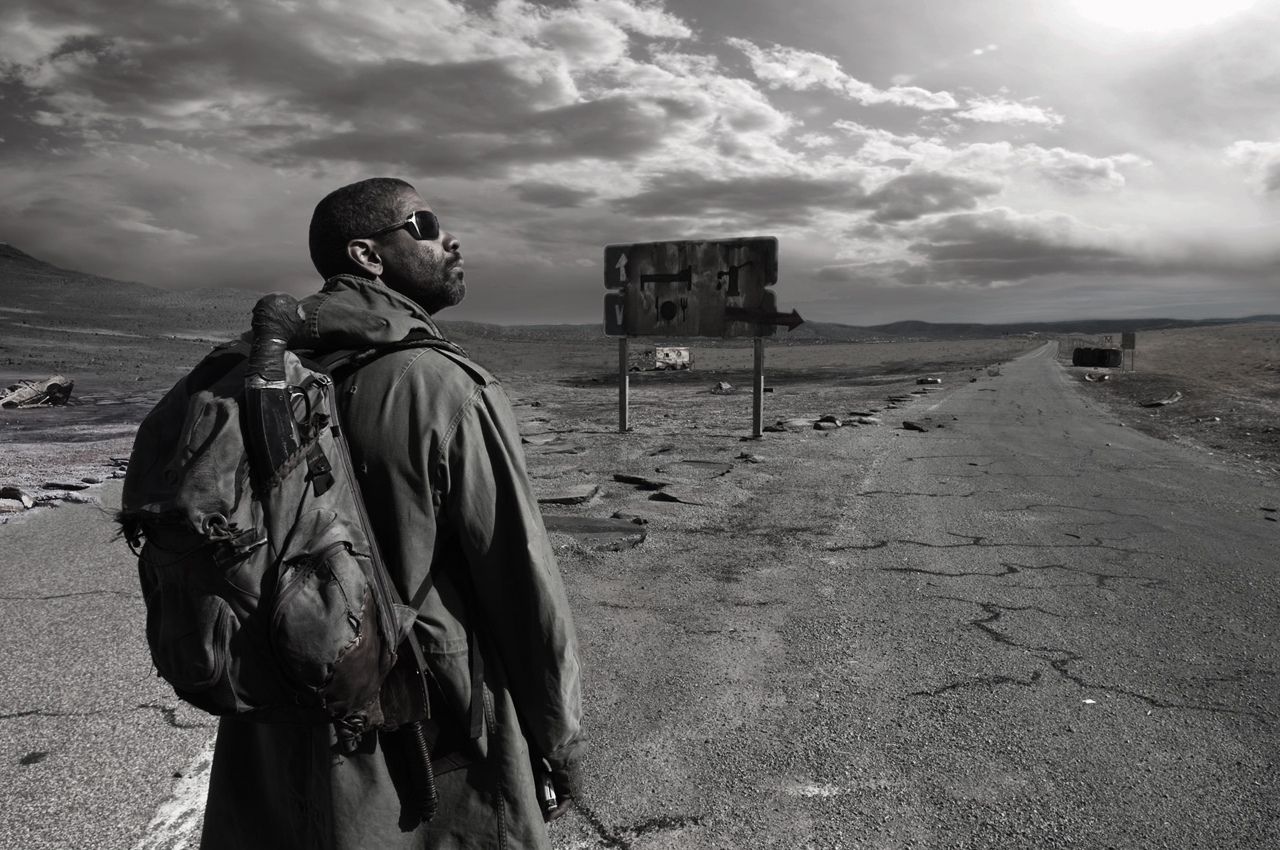
The main character is a man who should be called Eli (Denzel Washington) but strangely enough, we hardly ever hear his name. But since the movie is titled “The Book of Eli,” we are forced to refer to this man as Eli. He’s a mysterious traveler who walks nonstop, heading West where he believes that the last King James Bible, which he has in his possession and reads from time to time, will be safe from others who would use it to manipulate other people in this damaged world for the worse. Oh yeah, and Eli is also handy with a knife. In one scene in the beginning, he takes down a whole band of thugs with just ten seconds. He has also been heading West for a number of years, saying he walks by faith and not by sight. In that case, maybe he only thought he was heading West all these years.

Well, as it turns out, there is someone out to take possession of the King James Bible and has been looking for it since everyone burned them all during the war. This is Carnegie (Gary Oldman), the ruler of a Western town who, of course, has his own band of thugs by his side, including a bald muscleman and a scrawny wise guy. When Eli walks through this town and is given hospitality by Carnegie, it isn’t long before the Bible is discovered and a bloodbath is sure to be drawn for it.

Carnegie is an evil man but played by Oldman as a calm dictator who isn’t broad in a way that we wouldn’t believe he could possibly do such deeds. He is also married to a blind, abused woman named Claudia (Jennifer Beals) who wasn’t blinded by the war but was born this way and was in some way, lucky when the event occurred. Carnegie abuses Claudia to control her daughter Solara (Mila Kunis), who is a prostitute in Carnegie’s bar. Solara later accompanies Eli in his neverending quest to bring the Bible to safety. And there, they meet two characters who are as strange and deluded as anybody in “The Road”—a husband-and-wife survivalist couple named George and Martha.

But more on them when you watch the movie, which is bold, inventive, and powerful. It’s also phenomenal in the ways of the performances by the actors. Denzel Washington is at the top of his game here as Eli. He plays this complicated, mysterious person with the right note and with a great deal of edginess. Washington is great in this movie and Gary Oldman is brilliant as the villain, with a fine line between calmness and irrationality. I should also give special notice to the performances by Mila Kunis and Jennifer Beals, both of which carry the best performances of their individual careers.

Now, the final half of this movie is a bit flawed and sort of uneasy to follow. It also carries one of the most surprising plot twists in recent memory. But directed by the Hughes Brothers, who previously directed “Menace II Society,” it’s very well-made and the cinematography is suitably bleak, just like the scenes that followed in “The Book of Eli.”

The Man with One Red Shoe (1985)

29 Mar

M8DMAWI FE007

Smith’s Verdict: *1/2

Reviewed by Tanner Smith

I haven’t seen the French mistaken-identity comedy entitled “The Tall Blond Man with One Black Shoe,” so I can’t say how its American remake—entitled “The Man with One Red Shoe”—follows it. But it doesn’t matter. “The Man with One Red Shoe,” also about a case of mistaken identity, is a mess. It’s not very funny and what’s worse is that it’s boring.

It features an ordinary man walking his way through a story of CIA situations, as a violinist (played by Tom Hanks) is followed around, believed to be a spy for reasons that I can’t recollect. Apparently, they needed an innocent man to be their target and went for Hanks’ character because he walks around one day wearing mismatched shoes (yes, one of the shoes is red).

Wait—something is coming back to me. I think Dabney Coleman and Charles Durning played two CIA spies from different sides and Durning needed an innocent bystander to confuse Coleman and his team. So they pick this “man with one red shoe” and treat him as if he were spy who has information on Coleman. The running gag is that Hanks has no idea just what in the world is going on.

Things get even more confusing (and exciting) for him when a bombshell of a young female spy (Lori Singer) winds up falling for Hanks. There’s an uncomfortable scene in which they date each other and her hair is stuck in his pants zipper.

But the movie seems more focused on its spy story than its attempts to create written humor. I wouldn’t mind so much except that this isn’t a good spy movie. Good spy movies have a tendency to be exciting (even the bad ones do), but it’s still boring because very little thought went into creating a fully-detailed story. And then near the end, it has the gall to have a character say a line like, “This affair must end in a shooting match, just like all good spy stories.”

With a cast like Tom Hanks, Dabney Coleman, Lori Singer (“Footloose”), and Charles Durning, you’d expect a better movie than this. A cast can’t just carry a movie like this—the best comedies have scripts to support their performances. Tom Hanks, usually known for dramatic roles (and amazing at them too), has shown what he can do with comedy, but even he’s boring beyond belief. He plays it straight—with all that happens, this isn’t funny. Maybe Bill Murray would have pulled it off in this role. Coleman isn’t any better—all he does in this movie is scowl.

A word about Lori Singer as the seductive female spy—she isn’t the least bit convincing as a spy. It’s not because she’s so beautiful—I’m sure a spy can be as beautiful as that (I even know of a movie producer as beautiful as she, but I’m not naming names), but every line she says just sounds like it came from a script and worse, it sounds forced.

The only two amusing bits feature Jim Belushi as Hanks’ best friend. One scene has him chasing after the spies’ borrowed ambulance on his bike, because he hears the bugged recording of his wife (Carrie Fisher, so annoying here) putting moves on Hanks and…making “Tarzan” noises—don’t ask, you shouldn’t care—coming from inside the vehicle. That was kind of a funny chase scene.

Another funny bit is after Belushi tries to convince Hanks that there are dead spies on the floor in his apartment, but the ones that killed them keep hiding them from sight to the point where Belushi cries because he thinks he may be crazy and then takes a leak—a dead body is hanging from the bathroom door and his reaction is priceless: “Oh, come on!”

Those are the only funny bits in this depressing, boring picture called “The Man with One Red Shoe.” The only thing left to say in this review is that the French filmmakers (who made the film this was based on) should sue.

Defending Your Life (1991)

29 Mar

defending-your-life

Smith’s Verdict: ***1/2

Reviewed by Tanner Smith

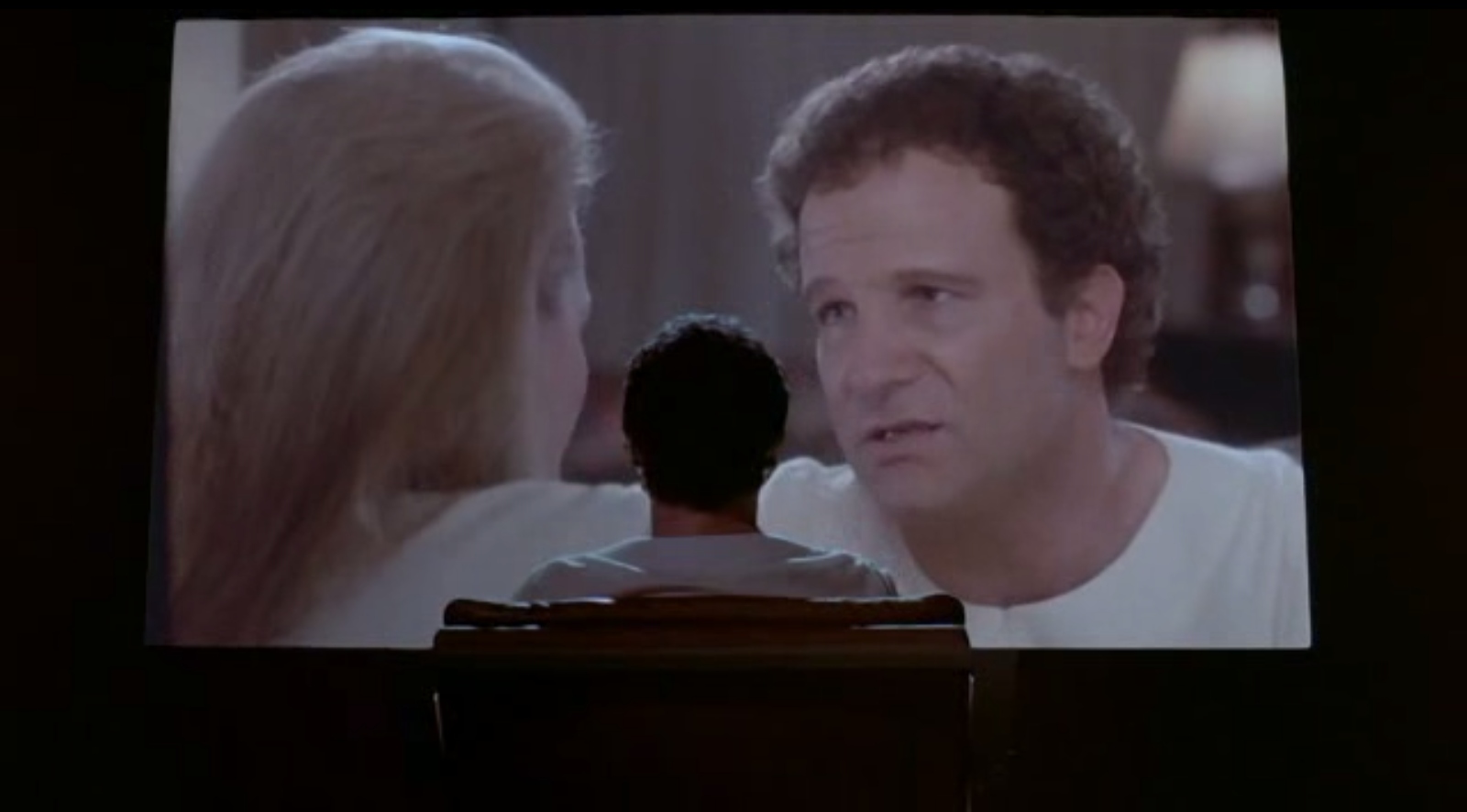
Everybody has their own visions of it, and Albert Brooks decides to share his vision in a film he wrote, directed, and starred in called “Defending Your Life,” a film with wonderful ideas about life after death.

Just imagine if you will. You just bought a new convertible and decide to give it a drive around the city. You listen to the radio and you’re just so happy. But then something drops on the floorboard of the passenger side and you bend down to pick it up while the vehicle is in motion. And then, as luck would have it, an oncoming bus hits you. Whoops. That’s funnily tragic, but then you wake up in Judgment City. That’s exactly what happens to Brooks’ lead character Daniel Miller in the first few minutes of “Defending Your Life.”

You see, apparently there is no heaven or hell (although there isn’t the decision that there isn’t a God). There is only Judgment City. And what a place it is. This city could just be heaven, though nobody wants to admit it. It makes you smarter the longer you stay there and it has the best-tasting foods you could imagine. And get this—apparently, you can eat as much as you want and never gain one ounce of weight. The restaurants are all-you-can-eat. Its one downside—a lackluster comedy club.

Well, there’s another downside. If you’re a Little Brain (which residents call those who have just died and came here), then you have to “defend your life.” It’s like being put on trial for your fears in life on Earth. It’s explained that because people use so little of their brains, their lives function mainly on fear. If the Judgment court has decided that you’ve conquered your fears, then you get to stay in Judgment City and become as smart as them. Otherwise, you’re sent back to Earth as a reincarnation to try again to get past fear.

Daniel has a defense attorney, Bob Diamond (Rip Torn), who explains all of this to him. He is called into a room where Diamond defends against a tough prosecutor (Lee Grant), as we see flashbacks of Daniel’s life. The court uses these clips to show whether Daniel has fear or just dignity, and Daniel gets chances to explain himself.

This is an inventive premise and there are many delights in how it’s all played out. But “Defending Your Life” is also a love story. Daniel roams around the city and meets a wonderful, sweet woman named Julia, who has a smile and manner that only Meryl Streep can deliver. Indeed, Streep plays Julia and her romance with Daniel is beautifully handled. They have warm conversations and enjoy each other’s company—a very sweet romance.

The ending of “Defending Your Life” is dramatically satisfying with the right emotional payoff. “Defending Your Life” is a success in fantasy mixed with romance. It has an inventive premise that delivers on its product and just got more intriguing as it went along.

Johnny Be Good (1988)

29 Mar

johnny-be-good

Smith’s Verdict: *

Reviewed by Tanner Smith

What has Coach Hisler done to deserve such rotten treatment? Huh?

Here’s a nice guy that coaches football and hopes for the best for his star high school football player, wanting him to go to a better, smaller school than his brat of a star shoots for. And yet, he’s the butt of the player’s jokes and even at one point, the brat, along with his buddy, come over and seemingly asks for help in his English class, but no—it was a setup for a prank, in which pizza delivery boys bring along about 200 pizzas, and an elephant is delivered. And I’m pretty sure I remember Hare Krishnas dancing about the kitchen while the brat and buddy laugh uproariously.

The coach is the guy I’m supposed to hate? The brat is supposed to be our hero? The coach is the only likable character in this piece-of-crap, dim-witted teenage comedy “Johnny Be Good” and I don’t think it was intentional.

Wow, is this movie bad. And it’s far from funny. The laughs aren’t there, hardly any gag works, lines of dialogue are either forced or clichéd, and reality gives way to scenes that are either uncomfortable or unfunny. I have to wonder if this is a first draft. These are the people who wrote “Revenge of the Nerds,” an offbeat teenage comedy that had its share of funny moments. There’s nothing here that I remember even slightly chucking at.

Anthony Michael Hall is best-known as the teenage geek character in movies like “Sixteen Candles,” “The Breakfast Club,” and “Weird Science.” I guess he took this role to keep from being typecast. Which role am I referring to? The football hero. That’s right—Anthony Michael Hall as a high school football hero. Yeah…right.

I don’t mind that Hall wants to change his image, but he is completely miscast here as Johnny (Be Good, get it?…I don’t). He’s so bland that I was wishing his SNL persona would take over, or that Robert Downey, Jr. would smack some funny into him. Indeed, Robert Downey, Jr. co-stars as Johnny’s buddy. Downey, Jr. can be very funny, but he just doesn’t have much to work with here.

I didn’t care about popular Johnny’s quest for college—from Texas to California. I didn’t care about his relationship with his girlfriend (Uma Thurman in an all too generic role). I didn’t care that he was forbidden to see her because her father’s a hard-headed cop. I just didn’t care, nor did I ever laugh.

Paul Gleason plays the aforementioned coach, and you know you’re in trouble when you care more for the supposed antagonist.

“Johnny Be Good” is a bad movie that deserves no more words.