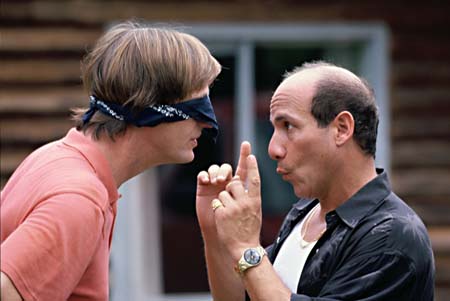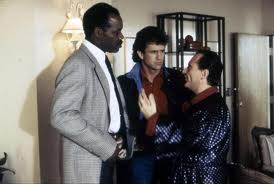
Jumanji (1995)

2 Apr

jumanji_1995_2

Smith’s Verdict: ***

Reviewed by Tanner Smith

“Jumanji” is an unusual family movie. It has a fantasy-adventure plot mixed a few elements of “It’s a Wonderful Life.” That’s not bad, but the film contains images and scenes that could frighten younger kids. The film could have been rated PG-13 because it really has that PG-13 feel of it.  Older kids may be entertained by “Jumanji” and maybe some adults as well.

The movie is based on the short children’s book by Chris van Allsburg. It opens in 1869 as two boys bury a crate in the ground in the middle of the night. One asks the other, “What if someone digs it up?” The other prays for them in a dark tone. Then the movie flashes forward a hundred years later to a nice little town called Brantford, New Hampshire. A young boy named Alan Parrish (Adam Hann-Byrd) finds that same crate, opens it, and finds an ancient board game called Jumanji. He takes it home and plays it with a friend. But there’s something unusual about this game—the pieces stick to the board and move by themselves, and then in a mystic manner, a message appears in the middle of the game. The game is magical and has a mind all its own. Unaware of the game’s awesome power, Alan rolls the dice and is sucked into the game with his friend being chased by bats set free from the game.

Now, the movie flashes forward twenty-six years later, Alan’s big house is bought by a woman named Nora (Bebe Neuwirth), who wants to fix the place up for a bed-and-breakfast. She moves in with her adopted niece Judy (Kirsten Dunst) and nephew Peter (Bradley Pierce). Judy and Peter find that same game Jumanji in the attic and begin to play. But when playing, they unleash Alan, now a grown man played by Robin Williams, from the jungle within the board game. Alan is shocked to realize that his parents are dead and the whole town may as well be—everything is closed and practically broken.

But there’s not much time for sympathy; before Alan was set free, a few of Jumanji’s jungle animals have been set free. They are roaming around, hurting people, and slowly but surely destroying the town. Now Alan, Judy, and Peter must finish the game in order to make everything back to normal again. They find Alan’s friend Sarah who started playing the game with him, also now grown up to be played by Bonnie Hunt, and she reluctantly agrees to help.

That leads to one scary event after another as the jungle creatures of Jumanji pop out after every player’s turn. What happens could scare younger children, but others may have a good time with the film—just when you think, “What could possibly happen next,” something bigger happens. The game takes the heroes on an adventure of disastrous proportions, but the destruction will not stop until the game is over.

“Jumanji” is full of ambition—in fact, so full that it gets so close to wearing out its welcome. The special effects are quite special and the heroes react as if they weren’t special effects—that is the effect that is most special, when the cast acts right with them. Also, the second half when everything comes out of the game is a good deal of fun. Among the inhabitants of Jumanji are a rhino stampede, wild monkeys, a lion, giant live pod plants, and giant spiders. Also from the game is a rifle-wielding people-hunter named Van Helt (Jonathan Hyde, who also played Alan’s uptight father) who wants to hunt Alan and kill him.

However, the movie is not just wall-to-wall special effects extravaganza. The movie also has an “It’s a Wonderful Life” feel to it in the way that when Alan is rich and young, the town is lovely. Yet when he returns, he sees what the town is like without him around (his rich shoe factory owner dad spend every cent trying to find him after he disappeared and went broke). Then maybe when all this is over, he can change it all back to perfection. It took me a while to come to that point and it did. That’s what makes “Jumanji” actually kind of innocent and heartwarming to balance out the darker material. The characters are innocent enough for us to root for them and the actors do a good job portraying them. Robin Williams tones down his manic comedic persona and manages to effectively it straight—he’s very likeable here as a result. Bonnie Hunt, Kirsten Dunst, and Bradley Pierce are also good as Williams’ allies. I can also say the same for David Alan Grier, who gives comic relief to this movie as the freaked-out patrol officer.

“Jumanji” isn’t for everyone, or anyone who may get creeped out by a lot of moments in this movie that could scare them. There are some parts of the movie where you’ll crack up but other parts where small children could possibly hide in their parent’s lap while trying to watch it. Like I said, this is a PG-13 movie and if you see this movie and see what happens when giant mosquitoes attack, Van Pelt hunts Alan, or when a giant pod attacks Peter, you’ll know what I mean. Those creepy moments with Joe Johnston’s direction remind us of those creepy moments from those real old children’s movies. “Jumanji” is a good movie with good fun, a fast-paced thrilling edge, and a heartwarming subplot that makes it more special than you might think.
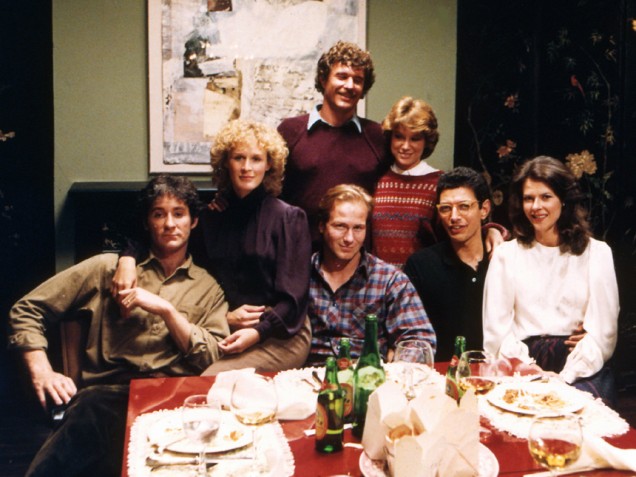
The Big Chill (1983)

2 Apr

tumblr_mgfwwlXU6W1rcgfbao1_1280

Smith’s Verdict: ****

Reviewed by Tanner Smith

I’m not entirely sure why I love “The Big Chill” enough to give it a four-star rating, so I’m going out on a limb trying to explain why. It’s a film about a reunion of old friends and…that’s about it. We’re basically just in the company of these people as they reminisce their past and consider their present selves. The screenplay is entirely in dialogue for these conversations to take up the whole film. There’s hardly any payoff to be had. And it seems more like an exercise than an actual mainstream drama—an exercise in writing and directing a movie with eight of the brightest up-and-coming actors at the time.

But the exercise worked. I found myself invested in the goings-on of these people. I liked watching them and listening to them.

The friends, veterans of the activist 1960s, reunite briefly in 1983 to attend the funeral of their friend who has committed suicide. They’re all between laughter and tears. The men, especially, crack jokes at their deceased friend’s expense and one of them takes notice of this and asks, “Are we afraid to express our feelings?” Well apparently, they’re not afraid to express their feelings, since they acknowledge that they are survivors of the 1960s and their lives have indeed changed in their 30s.

The friends are suitably diverse—Sam (Tom Berenger) is a TV star and a nice guy; Karen (JoBeth Williams) is a housewife bored by her husband Richard’s (Don Galloway) devotion; Michael (Jeff Goldblum) is a toady journalist who previously wanted to be a novelist; Meg (Mary Kay Place) was once a dedicated public defender who abandoned her lesser clients to succeed further as a lawyer. The ones who fare better than the rest are Harold (Kevin Kline) and Sarah (Glenn Close)—they married, live a suburban lifestyle, and have good paying jobs (he’s a shoe-retailer; she’s a physician). The most complicated of the group is Nick (William Hurt), a drug addict who was a radio psychologist, and a Vietnam veteran. His life has no ambition.

Completing this group is a newcomer to the group—their deceased friend’s girlfriend Chloe (Meg Tilly). She’s pretty (and about a decade younger than the rest), but she’s not very big-picture. The death of her lover hardly phases her—there’s one scene in the beginning where she tells Karen that Alex’s death caused a real mess, but Chloe assuredly states “It’s OK—we cleaned it up.” There’s another funny bit in which she says she’s disappointed to ride from the funeral in an ordinary car instead of a limousine. She’s unconcerned about the passing of time that the others are concerned about, and when everyone is eating at Harold and Sarah’s dinner table and feeling bad for their loss, notice that she’s the only one that’s eating.

Oh, and she also exercises quite often. Call me immature, but…her flexibility does it for me.

All of these actors do great jobs and they all share a convincing camaraderie that comes through to their characters. In particular, the actors that stand out the most are Tom Berenger as this nice guy embarrassed by his starring role in a TV show, William Hurt as the aimless (and impotent) Vietnam vet, and Meg Tilly who has fun as this dizzy broad, who when you really think about it is actually the narrative’s center (she’s the observer and reactor to the others).

“The Big Chill” also has a very funny screenplay. To keep the drama from being monotonous, there are many great one-liners for everyone in the cast to deliver. One of my favorites is the funeral’s reception, in which Michael states, “They throw a great party for you on the one day they know you can’t come.” (I’m sorry to say I used that line at my own grandfather’s funeral. Very sorry.) These jokes come across as pretty frank, too. It’s like the humor that these people give from the screenplay are reflecting their emotions between laughter and tears, like I mentioned before.

Actually, this is why I love “The Big Chill” the way I do. It’s not just a drama about the reunion of a group of friends who talk about their past and present; it’s a comedy as well. The laughs are there to serve as comic relief, keeping the film from what could have been monotonous. I cared about these people, the actors are perfect, the screenplay is great, and by the end of the movie, I feel like I was in the company of people I’ve gotten to know, and I’m not as bored as I, or you, might think.

Slither (2006)

2 Apr

slither1

Smith’s Verdict: ***

Reviewed by Tanner Smith

The ads for the science fiction-splatter movie “Slither” say that every horror film that came before it were “wusses.” That may not be true, but then again, “Slither” isn’t really a flat-out horror flick. It is a horror B-movie that has a comedic edge to it. The movie carries almost the same gimmick as the 1986 B-movie “Night of the Creeps.” That movie was about alien slugs invading people’s minds on a college campus. This time, the filmmakers say, “Forget the boring teenagers. We’ve seen too many of these teenaged splatter movies. Let’s just have town locals come in and see how they react to these disgusting situations.” Now keep in mind—this movie does get pretty disgusting. Read on and you’ll know what I’m talking about.

As the movie opens, we meet the folks in a Southern small town. We meet Starla Grant (Elizabeth Banks), a gorgeous blonde. We meet Grant Grant (Michael Rooker) as the rural tycoon that Starla married, even though he may be a bit too old for her. But who cares? Then, we meet Bill Pardy (Nathan Fillion), the town sheriff who has a bit of a crush on Starla. There’s also the town mayor whose opening scene gets a laugh. He cusses out a person who is in his driving zone then he sees a woman and her children look at him blankly and then he greets them, making them say, “Good morning, Mayor.”

Grant is infected by a kind of alien being and he becomes a brainwashed creature with an immense craving for meat. Pets have gone missing, as well as a local woman, and Starla is starting to know that there is something very, very wrong with Grant. And who wouldn’t when we see him later, this time as a blob resembling Jabba the Hutt.

The special effects are pretty impressive, making the ick factor even more ick-ish. There’s a scene later in the movie where that local woman I mentioned earlier that was missing is found as a huge sphere-shaped thing the size of a barn, and suddenly, hundreds of monster slugs explode out of her. And this is when things get even more crazy, as the slugs attack by entering people’s mouths and taking over their minds.

This movie really gets disgusting and the movie barely gets away with being too disgusting. But it’s all just good fun. Writer/director James Gunn was obviously shooting for making this movie the way it is and he succeeds. “Slither” isn’t for everyone, but I thought it was a fun splatter movie that kept my interest.

Superbad (2007)

1 Apr

Superbad-2007_gallery_primary

Smith’s Verdict: ***1/2

Reviewed by Tanner Smith

Welcome back to John Hughes ‘80s teen movie territory…if John Hughes had more vulgarities and risqué material in mind. The territory is welcomed back with “Superbad,” made in 2007 but feels like it was made in the ‘80s, the time of many high school teen movies. I’d say that “Superbad” is (arguably) even funnier than any movie from that category you can think of. It’s a profane, vulgar, risqué, raunchy comedy with a heart and even a brain. Director Greg Mottola and producer Judd Apatow, as well as the writers (which I will mention later), deliver the sort of teen comedy John Hughes would make if he had help from Quentin Tarantino.

As I’ve learned, the writers of this movie—Seth Rogen and Evan Goldberg—wrote the script when they were thirteen and discovering girls in school. The main characters of “Superbad” are named after them. They have different personalities, but they’re best buddies because they’ve known each other for so long. They are the loud, obnoxious, unpopular, pudgy Seth (Jonah Hill) and the sweet, sensitive Evan (Michael Cera, George Michael from “Arrested Development”). They’re high school seniors who are facing the last three weeks of their high school days and worried that they won’t have sex in the next three weeks, and therefore will go to college never to have had sex.

Seth is the most worried, talking nonstop about how much he would like to be the mistake that girls make when they get drunk at parties. He wants Evan to join him, but Evan is more sensitive to the feelings of the girl he likes, named Becca (Martha MacIsaac). Then, on Friday night, they are invited to a party by a nice popular girl named Jules (Emma Stone), whom Seth likes. She asks Seth to supply alcohol for the party.

That leads to a wild night of many misadventures while trying to get booze and make it to the party in time for Seth and Evan to get the girls they want. Having his own adventure on this wild night is Seth and Evan’s even-less popular friend Fogell (Christopher Mintz-Plasse), who is unpopular even by them. His awkwardness/irritation steals many scenes and his fake ID used to help his pals get booze names him as—oh, yeah!—McLovin! Unfortunately, his attempt to get booze is upstaged and separates him from Seth and Evan, who attempt to get booze themselves. While they are at an adult party, trying not to be severely injured by the host, Fogell is cool with the most original characters in the movie—two partying cops (Rogen and Bill Hader, playing the Belushi/Aykroyd-type roles). They show Fogell a good time. Their adventures seem like their own movie—I loved watching these guys; they were hilarious and fun to watch.

It’s a teen movie through and through; with the exception of Evan’s mother, it’s a parent-free zone. Many of Seth and Evan’s problems ring true. Seth is upset because Evan is going to a different college than he is. After all these years of being friends, they may lose each other. These characters are real and convincingly played by the young actors who portray them. Michael Cera is terrific as Evan. He’s an average high school teenager who is unpopular, mostly because he’s friends with Seth. He delivers his lines as if he’s sincerely afraid he’ll say something stupid. He’s so sincere, it’s impossible to dislike him. It is possible, however, to dislike Jonah Hill because Seth is just plain loud and obnoxious. But there are moments when he reacts the way anyone reacts—for example, in a scene where he dances with a kinky older woman at the adult party, he notices “something” on his pants and acts like anyone else would react…though I don’t anyone else had this happen before. I won’t say what’s on his pants—I wouldn’t dare ruin the hilarity of that moment. The script never falls for the tired teen movie caricatures and makes the dialogue more profane and clever and the situations seem real. Another surprise: the popular girl Jules, Emma Stone, isn’t played as the usual snobby girl who’s out to get the unpopular crowd—she’s a caring soul.

“Superbad” is definitely not for everyone, especially anyone who would cringe at the sights of multiple penis drawings. But like Judd Apatow’s previous comedies, “40-Year-Old Virgin” and “Knocked Up,” it’s a funny, smart movie—hilarious, well-acted, well-made, and “supergood,” also with a catchphrase you won’t forget easily: “I am McLovin.” Yes, he is.

Randy and the Mob (2007)

1 Apr

RandyandtheMob

Smith’s Verdict: ***1/2

Reviewed by Tanner Smith

The best filmmakers don’t make the same film over and over. The smartest filmmakers don’t want to (or rather, feel they don’t need to). There is one filmmaker that falls into both descriptions. His name is Ray McKinnon, the Southern filmmaker/actor who directed, co-wrote, co-produced, and co-starred in the short farm comedy “The Accountant” (which won an Oscar for him and one of his creative partners—his wife Lisa Blount) before he took a serious, dark turn with the feature “Chrystal” (which starred Blount in the title role). Both films took place in the South, which McKinnon and Blount apparently have affection for.

So, after the art that was “Chrystal,” McKinnon, Blount, and Walton Goggins (co-producer of the previous films) decided to do something different with a new movie. The result is a lighthearted comedy named “Randy and the Mob,” a movie that mixes the mob with Southern droll. This is clever, and who better to deliver most of the film’s Southern droll than director/writer/co-producer Ray McKinnon as the title character Randy?

McKinnon plays two characters in “Randy and the Mob.” One is Randy, a good ol boy trying to keep track of his various businesses in a small Georgia town. The other is his twin brother Cecil, a gay man who stays in this town because he has deep respect for his family (despite a nosy grandmother). I guess the budget was so low that they couldn’t use split-screen to show both characters in the same shot. But strangely though, it didn’t seem necessary. We know both characters are there and they interact with each other convincingly. And it’s brilliant that McKinnon, like Nicolas Cage in “Adaptation,” is able to show difference in both characters.

In the film, Randy’s latest plan to keep the businesses going involves a loan shark. But his businesses aren’t making enough money and Franco (Paul Ben-Victor), a loan shark for the mob, wants to collect the money. Randy can’t deliver, but the mob has a plan for him. They will use his businesses to move some of their goods, arranging for mob enforcer Tino Armani (Goggins) to take care of things.

Tino Armani is a curious case. Played by Walton Goggins in a terrific comic performance that may remind you of Stooge Larry crossed with Karl Childers of “Sling Blade,” Tino is an uptight, barely emotional deadpan who emphasizes all of his words in a droll Southern accent. At one point, Randy wonders why he doesn’t sound Italian with a name like “Armani.” Tino addresses, “It’s-called-stereotyping. I’ve-dealt-with-it-my-whole-life.” Viewers may have a bit of trouble accepting this character (or rather, his voice) at first, but it grew on me as a truly effective comic character (not a “caricature”). Tino comes into Randy’s life and the lives of Randy’s family and friends. He impresses everybody with his insight on human life (he even has something to say about Randy’s nearly-unlikable attitude), the way he cooks Italian food, and how he keeps Randy’s businesses afloat.

This is all done with a real Southern authenticity. There are no stereotypes or caricatures to be found—these people seem like real people and true originals. These characters are the real source of the comedy in this movie—it’s not just the clever one-liners and slapstick situations; it’s the people. Cecil, the gay brother, isn’t given the stereotype treatment either—not even when he wears a pantsuit in the middle of nowhere at a family cabin. Then, there’s his life partner Bill (Tim DeKay) who won’t let people talk bad about Cecil, Randy’s depressed wife (Blount, wonderfully droll) who glares and stares whenever something is…well, off. And finally there’s the police deputy (Brent Briscoe) who won’t let Randy forget that he beat him up in grade school and would like people to know that.

“Randy and the Mob” is a pretty entertaining movie—well-developed, funny, and subtle

Breaking Away (1979)

1 Apr

Breaking-Away_-Cutters-Boys

Smith’s Verdict: ****

Reviewed by Tanner Smith

“Breaking Away” is a funny, cheerful, and unpretentious movie that is one of the great feel-good movies that I’ll always remember. It has a wonderful screenplay, great acting, sharp direction, and most importantly, it has a spirit that leaps out at you, but doesn’t seem to slam in your face and force you to be pleased by what it has to offer. That’s what makes “Breaking Away” a small masterpiece.

It’s a coming-of-age tale featuring four kids living in Bloomington, Indiana. These kids are just out of high school and labeled as “cutters.” A “cutter” is a slang term to describe the workers of the town’s limestone quarries; most of them are “townies” who never went to college. That fits these four nineteen-year-old boys who want to spend one last summer with each other before making valuable choices in life, like college and jobs. They’re slowly but surely breaking away from each other, as it seems.

The main focus of the lead characters is Dave Stoller (Dennis Christopher), who not only wants to be a champion bike racer, but an Italian one. He has it in his head that he can simply be Italian and drives his father (Paul Dooley, who is easily the standout of the actors in this movie) to near madness. His mother (Barbara Barrie) is more passive, but his father can hardly seem to stand to further hear Italian opera, eat “ini” foods (zucchini, fettuccini, etc.), and listen to his son talk in an Italian accent, saying words like “ciao” and calling him “papa.”

Dave has his own racing bike and trains for a big race against some Italian champions, who are coming to town for a big race. But in the meantime, he sincerely tries to win his father’s respect again (and even works at the car lot where his father cons college students into buying lousy used cars). And he also is hopelessly in love with an attractive college student named Katherine (Robyn Douglass), who really believes that he’s an Italian exchange student. That’s how far Dave has taken his Italian interests.

Dave’s friends each have some sort of ambition in life. The former high school football jock Mike (Dennis Quaid) would love to play college ball, but may just stick around town. He likes to say he isn’t interested in playing college ball, but he really is. The tall, goofy Cyril (Daniel Stern) has very little ambition in life, but wallows in knowing so. And the short-for-his-age Moocher (Jackie Earle Haley) is secretly planning to marry his girlfriend. But for them, it really does feel like something is missing in their lives and we wonder, as much as they do, what really is in store for them in the future.

A lot happens in “Breaking Away” and most of it is with offbeat humor and characterization. All of the characters are fully realized and have their own quirks and personalities. The dialogue in the screenplay by Steve Tesich mixes realism with comedy to make it seem like these are everyday jokes that young people trade amongst each other in reality. We know the film is scripted, but it doesn’t seem so, even though the dialogue includes some weird humorous lines of dialogue.

But the film has moments of cheerfulness, including one sequence in which Dave races a semitrailer truck on his racing bicycle, along the highway. That scene is wonderfully directed by Peter Yates, who knows how to direct action scenes (one of his films is “Bullitt”). That scene, and a few others, takes a hint at potential disaster that doesn’t occur. They’re well-directed moments of pure pleasure. And then, we get to a big bicycle race—not with Dave and the Italians, but with the four cutters and the college students. This would have been impossible to direct, even after the scene I mentioned before with the truck, but it’s shot and directed with as much high energy to make us want to cheer for the cutters to win the race.

On to the acting—this is a wonderfully acted ensemble piece. Dennis Christopher is likable and gets our attention in his misadventures, whether it’s with his father, with his new girlfriend, or with bicycle racing. He’s great here, and so are the actors playing his friends—Dennis Quaid, Daniel Stern, and Jackie Earle Haley. They effectively capture the lack of confidence they have in their lives as they watch, with resentment, what college students have for themselves. Paul Dooley is hilarious in the role of Dave’s father who just can’t seem to take anymore of Dave’s Italian attentions to family. He rants and raves, even yelling to the cat that his name is “Jake” and not “Fellini,” as if he’s about to explode. It’s a very funny running joke. But he’s also a “cutter” just as much as his son and his friends. There’s a cute scene in which he and his son walk around a college campus and he and his son talk about what has been, what could be, and what could have been—these are two generations of Bloomington natives talking about their thoughts of a big university. And last but not least, Barbara Barrie, as Dave’s mother, is sweet and loving, but she also has to play straight to Dooley’s outbursts. When that is done, she’s quite funny too.

“Breaking Away” is a wonderful, endearing movie—one of the best coming-of-age films I’ve ever seen. It made me feel good inside and it has a sincerity that comes with quirkiness, realism, and high spirits. Count that with the acting, writing, and direction and “Breaking Away” is a small masterpiece.

Angel Heart (1987)

1 Apr

6a0120a721c2d7970b0133f4c6b7d6970b-800wi

Smith’s Verdict: ***

Reviewed by Tanner Smith

“Angel Heart” is a thriller that starts out as a film-noir private-eye tale and then suddenly turns into a bizarre horror movie about something far more supernatural than neither its hero—nor us—could come to grips with until we start to really think about what has just happened once the movie is over. Nothing was as simple as we were led to think it was. We’ve seen the private eye in this movie go from place to place, looking for his subject and encountering many weird things along the way. But its ending brings things to a whole new perspective that “Angel Heart” becomes more shocking than we were led to expect. And heck, we’ve seen many dead chickens!

It’s a strange, unsettling horror movie that starts out as a regular film noir piece. We get the street-savvy private eye—a Brooklyn private detective named Harry Angel (charismatically played by Mickey Rourke)—getting an assignment to find somebody and receive pay for doing so. But his client is someone quite unusual—a strange man named Louis Cyphre (Robert De Niro) who has a neatly trimmed black beard, an elegant black suit, long fingernails, and slicked back hair. All that’s missing is a sign saying “I am the Devil” because his appearance and manner would make people believe that he is evil personified. Anyway, Cyphre assigns Angel to find a missing person for him, for about five grand. Angel accepts the assignment and finds himself in a mad, mad world. His leads are stale and unreliable, more bodies pile up wherever he goes, and the police begin to suspect him for murder.

OK, that all sounds standard enough for a private-eye story, except for the curious De Niro character. But I didn’t mention the voodoo ceremonies in which people dance around crazily and sacrifice chickens, hence the aforementioned “dead chickens.” All of this is weird enough, but trust me—we’re at the tip of the iceberg. But for the sake of keeping things spoiler-free, it’s probably best you don’t know too many details of the plot.

I should bring up the infamous bloody sex scene in the movie. The most memorable, disturbing scene is the controversial one—a sex scene featuring Rourke and Lisa Bonet as a young New Orleans woman whose mother knew the missing person. This scene was almost given an “X” rating by the MPAA ratings board. I wouldn’t blame them—it’s freaking insane. It starts out as an erotic sex scene (with multiple shots of Bonet’s bare breasts), only with a few leaks of rain near the bed. But then instead of rain leaking on them, it’s blood. Rourke and Bonet, I think, don’t notice that they’re being soaked in blood and the whole scene is edited in such a bizarre way as the sex gets even more graphic as it goes along.

The story for “Angel Heart” leads up to a shocking, revealing final act that is just insane. It’s one of the strangest, disturbing, chilling endings I’ve ever seen in a movie. I did not see it coming, nor did I want to know once it was revealed to me. Everything that followed didn’t really prepare me for it, which is why it was so shocking. What else I can say about it is that director Alan Parker tries everything to keep you interested and how he handles the ending is going all out to make it his own. The result is a messed-up movie, but a memorable one. That alone grants “Angel Heart” a recommendation.

Lethal Weapon 2 (1989)

31 Mar

images-2

Smith’s Verdict: ***1/2

Reviewed by Tanner Smith

“Lethal Weapon 2” is a sequel that is just as good as the original film, “Lethal Weapon.” “Lethal Weapon” was a smartly written, well-portrayed, gripping, and action-packed buddy-cop movie and “Lethal Weapon 2” brings back the wonderful main characters, has as much intriguing action as the original, has a certain intelligence that made the original film work, and adds more comedy in a fantastic supporting character that serves as terrific comic relief.

Danny Glover and Mel Gibson are back in the saddle as the cops who are different in personality but similar in themselves. Glover returns as Sergeant Murtaugh, who may be “too old for this <bleep>,” but that doesn’t stop him from getting into more <bleep>. In the meantime, he’s a family man with retirement plans. Oh, and he isn’t too happy to know that his teenage daughter is the star of a condom commercial. Gibson returns as Riggs, who still lives in a trailer near the beach and enjoys making people think he’s crazy. He’s not as tense as he was in the original film, but that’s not saying much. The relationship between Murtaugh and Riggs remains at the center of both this film and the previous film. It’s an interesting balance of trust and irritation.

But the movie’s best character—in that he’s the funniest and most memorable—is Leo Getz (Joe Pesci), a fast-talking accountant who barely stands at five feet tall. Murtaugh and Riggs are assigned to protect him because he has found a way to swindle illegal drug money and has the dealers coming to kill him. I described him as “fast-talking,” didn’t I? Well, not only that. He never shuts up. That makes Murtaugh and Riggs’ job of protecting him a little more than they can bear.

Leo is a likable guy, though. He’s just trying to make people like him. But he tries too hard and that’s why people like Murtaugh and Riggs can’t stand him. Joe Pesci plays Leo with a great deal of enthusiasm (I love his indistinct shouts during a car chase scene) and I guess that’s why he’s so funny and leaves an impact.

The villains of the film are ruthless South African diplomats. Murtaugh and Riggs stumble onto their plot to illegally deal gold…or something like that. A weakness of the film is that I wasn’t quite sure that their plan was. But these are real villains—actual characters, and not just violent bad guys. Riggs makes them his own personal enemies—watching them like a hawk until he finally comes across at least one piece of evidence to prove what they’re doing. At one point, he makes his way into their building and shoots their fish tank. Along the way, he strikes up a relationship with Rika (Patsy Kensit), their secretary. Riggs tells Murtaugh that she reminds him of his deceased wife.

“Lethal Weapon 2” has some good action scenes, including a car chase that didn’t bore me but got me excited (that’s also the same car chase that I mentioned has Leo rambling, loudly and indistinctly). Then there’s the scene that has suspense and comedy in which Murtaugh’s toilet is booby-trapped…with Murtaugh on it, pants dropped and all. And the entire bomb squad (and some press, too) comes into the bathroom trying to save him.

Then there’s the explosive action climax that you would expect in a film like this. It features Murtaugh and Riggs fighting all the bad guys and rescuing the kidnapped Leo. It’s not as interesting as anything else in the movie, but it is still kind of exciting.

“Lethal Weapon 2” isn’t like most sequels that try to repeat the previous film to attempt to recreate whatever magic they accomplished the first time. They have the two main characters continuing their relationship while going a different, new crazy adventure. This isn’t a retread, but more of a continuation. Glover and Gibson keep their characters real and exciting, the wit is nice, the action is compelling, and of course, credit has to be given to the great comic relief delivered by Joe Pesci as the irrepressible Leo Getz. “Lethal Weapon 2” is a thoroughly entertaining movie.

The Seeker: The Dark is Rising (2007)

31 Mar

images-1

Smith’s Verdict: **

Reviewed by Tanner Smith

“The Seeker: The Dark is Rising” is supposedly based on the second in a series of popular fantasy novels by Susan Cooper—apparently so popular that J.K. Rowling actually used them as partial inspiration for her “Harry Potter” book series (I believe so, anyway). And this film adaptation is also proof that if you want a dignified, on-the-numbers book-to-film adaptation, don’t give the project to Fox. From what I’ve seen in “A League of Extraordinary Gentlemen” and “Eragon,” adaptations that apparently have little to do with their source materials, Fox has little interest in expressing the interests of the followers of the original material, and just trying to give what they think the audiences will go for. This can’t be a coincidence.

But seriously, just say the project’s name, and a majority of the audience will come running because most are fond of the original. When you practically thrash the source material, and you show how you’ve done it in the film’s trailers and TV spots, you don’t get a very large audience. That would explain why “The Seeker: The Dark is Rising” was a box-office bomb.

I’ve read the original novel, entitled “The Dark is Rising.” It’s a great read. It’s a fantasy tale playing with Arthurian legend and telling a compelling story of a boy who discovers his true identity through an ancient magical process. A great film could have been made from this novel—this isn’t it.

Will Stanton (Alexander Ludwig) is a young American boy living in England with his huge family—he has many siblings, including an older brother who comes home from college and takes over Will’s bedroom, forcing him into the attic. Will is nothing special—he’s socially inadequate and very shy around girls. His fourteenth birthday arrives and he experiences certain changes—more than just puberty. He learns from a group of mysterious rich folks, who are actually a secret group of Old Ones who serve the power of the light, that he is actually the Seeker for the Old Ones. This means he has the power to travel through time and collect these mystical little trinkets called Signs that, when put together, can restore the power of the Light and vanquish the Dark before it rises again and covers the world completely in darkness.

Will’s main enemy in the army of darkness is the Rider (Christopher Eccleston). The Rider rides his horse throughout the outskirts of London, and sends many menacing subjects to stop Will from succeeding in his mission. In particular, he sends ravens, snakes, and a mysterious hooded figure, to be revealed later.

The way that the movie handles Will as being an Old One is very clumsy. See if you can follow this—the leader Merriman (Ian McShane) tells Will that he is the “seventh son of a seventh son.” Then why isn’t Will’s father (a “seventh son,” apparently) an Old One? What are the limits? Does the power just skip a generation or something? And wait a minute—Will claims he isn’t a seventh son because he only has five brothers. But wait a minute! He finds a hidden box in the attic where he lives, and his mother (Wendy Crewson) reveals that Will was a twin. Apparently, when Will and his brother were babies, someone came into the house (presumably the Rider) and stole the other twin away.

Are you serious? Will is just finding out now that he was a twin all his life? How does that slip by? But there you go—Will is a seventh son, and therefore, he is the Seeker. By the way, why is he the one chosen to be the Seeker? Were the other Old Ones just not special enough or something? I don’t get it.

Then there are the time-travel sequences themselves. Each sequence begins with the camera spinning around the actors until they’re suddenly in a certain location in the past. And then, Will winds up in places that should be interesting, but are unfortunately background spots for battles. Look at the scene in which Will and his older brother (Gregory Smith), who is a dropout in college and has just been controlled by the Dark. They travel through time together, and engage in one of the worst choreographed fight scenes I’ve seen in a long time. And never mind that we’re in a Viking village at this point—we have this to watch.

By the way, since we’re going with time travel and family involvement, there’s something that just bugs me. Will and his younger sister Gwen (Emma Lockhart) are suddenly back in time and in the middle of a slaughter. Will has to protect Gwen from the oncoming attackers while still trying to find the Sign. What happens after this grand adventure? They never talk about it again. They don’t even say one word to each other after that. Gwen never questions why her brother has these powers. She just sort of…forgets about it.

Other flaws include: A girl character that Will falls for, and whose intentions will be obvious to anyone with a brain cell; a forced subplot involving Will’s physicist father who had his own search of the Light and the Dark; and of course, the lack of explanation as to what will happen if the Dark wins—I guess the world will end. But then what?

There are a few things that “The Seeker: The Dark is Rising” does do right by its own standards, and it’s fair to point them out. One is that the film actually deals with the issues of a fourteen-year-old teenager having to play savior to the world, despite the fact that he is no superhero. There’s even a nice scene in which Will actually talks to Merriman about this new great task he’s been given. (Merriman, however, is no help—most of this role is to constantly tell Will that he is the Seeker. OK, OK, we get it already.) Some of the action scenes are pretty good—though, strangely enough, they have nothing to do with the time travel. The first time Will is chased by the Rider in the woods is pretty intense (although the camerawork is all over the place—extreme closeups, upside-down cameras). And also, there’s a frightening scene in which Will is cornered by security guards in a mall, who are actually ravens in human form working for the Dark, and a gritty sense of tension in the scene where Will is being interrogated and being told to give them “the Sign.” And also, there’s a scene involving giant impaling icicles that threaten the lives of Will and his family in the final act, before the big battle between Will and the Rider, that’s well-put-together and quite thrilling.

Of the acting, nobody really stands out except for Christopher Eccleston, and that’s because he’s more funny than frightening, particularly when his supposedly-menacing character of the Rider is posing as the town doctor to fool Will’s parents as he visits Will’s home. His jolly accent used to fool them just cracks me up, and I love his line as he leaves—“Cheer up, Will. It’s not the end of the world…not quite yet.” And he smiles during that line too! I loved that!

Alexander Ludwig as Will is OK, while Ian McShane as Merriman is just doing the same thing over and over again that be summed up in four words—“You are the Seeker”—because that’s practically all he seems to say for advice.

I’ve already mentioned a lot in “The Seeker: The Dark is Rising” and I may have left something out. The point, though, is that this film adaptation of the popular novel is not only a very loose adaptation, but also a muddled and confused mess of events.

NOTE: By the way, if they were trying to start a film franchise from these “Dark is Rising Sequence” books, then why start with the second story?

Time After Time (1979)

31 Mar

time_after_time

Smith’s Verdict: ***1/2

Reviewed by Tanner Smith

Here’s a wonderful premise for a movie. H.G. Wells, author of “The Time Machine,” has actually created a working model of a time machine, only to have Jack the Ripper come in and use it to escape into the future—our time. And so, Wells must use the device to travel into the future to track him down, finding himself amongst this strange world of automobiles and fast food, among other things. That’s a great idea for a movie and that movie is “Time After Time,” which is just about as delightful it sounds.

The first twenty minutes takes place in London, England, 1893. Jack the Ripper (David Warner) is on the loose, murdering women he meets on the street. He’s also one of the guests of a special dinner party hosted by H.G. Wells (Malcolm McDowell), who knows nothing of his friend’s deeds. He shows his guests the time machine, kept down in his basement, and explains every detail to them (and to us). He announces that he plans to use the machine to travel into the future, which he’s sure will become a social utopia.

Soon, Scotland Yard detectives search the house for the Ripper, who makes a quick and easy escape via the time machine. So, Wells decides to follow him to the year 1979 and somehow track him down and take him back to 1893.

He awakens in the history museum in San Francisco, California, inside the model of the time machine at the H.G. Wells display. Though the city is not exactly what Wells thought of when he expected “utopia,” he finds joy in exploring this new territory (and new time) and solving every riddle he can come across—he sees a newspaper headline “Colts Maul Rams,” attempts through the banking system to get some money, orders a “Big Mac, fries, and a tea to go, please,” and in the movie’s funniest bit, tries his hand at hailing a taxi.

The main joy of “Time After Time” comes from the fish-out-of-water portion that takes up a lot of the movie. It’s great to see this bright, intelligent Englishman from the past exploring the cultures of America’s future. Because Wells is so smart, innocent, and quick-witted, it’s easy to sympathize with him as he goes through all of this. The screenplay by Nicholas Meyer (who also directed this film) also has a share of sly wit in the dialogue, such as a scene in which Wells is told by his lunch date that she likes his suit—“Is that what they’re wearing in England?” she asks. “It was when I left,” he says. It also allows some social commentary in which Wells meets the Ripper in a hotel and is taught why he belongs there and Wells doesn’t—he shows him violence on TV and proclaims that he’s home. “The world has caught up with me and surpassed me,” the Ripper explains. “90 years ago, I was a freak. Today I’m an amateur.”

The screenplay also allows a romance to take place amongst the comedy of the fish-out-of-water tale and the quick action of H.G. Wells’ pursuit of Jack the Ripper. It occurs between Wells and a helpful, flirtatious banker named Amy Robbins (Mary Steenburgen), who later in the movie finds herself about to be the Ripper’s latest modern-day victim.

The romance is written well, and so is the character of Amy, I suppose. But the problem I have with this movie is Mary Steenburgen’s performance. Steenburgen speaks her lines in such a flat, artificial matter that you have to wonder how this fun actress was directed to play the role. She’s just too awkward and uncomfortable in this movie. That’s a strange criticism, because I would have expected Steenburgen, a wonderful actress, to be one of the best things in the movie. Now, she’s my least favorite element of the movie.

But the two lead actors—Malcolm McDowell and David Warner—own the screen. McDowell is wonderful in this role of the intelligent H.G. Wells. And he’s funny when he doesn’t know he’s funny, which means he owns the comedic moments. David Warner is suitably menacing as Jack the Ripper, playing it straight.

If I am going to complain about Mary Steenburgen’s performance, I should point another quibble I have with this movie. There’s a crucial plot point that is so obviously set up at the beginning, only to have us wait and wait until it pays off at the end. And since we know the outcome of the plot point, there’s no surprise.

But “Time After Time” does have a lot to like about it—particularly Malcolm McDowell and the fish-out-of-water story. This is a fun movie about time travel with an appealing lead character and a sharp-witted screenplay.