Star Wars Episode VI: Return of the Jedi (1983)

25 Nov

returnofthejedibdcap9_original.jpg

Smith’s Verdict: ***

Reviewed by Tanner Smith

It’s often that the final chapters of trilogies are usually the weakest (with a few exceptions, of course), with examples usually being “The Godfather Part III” and “Star Wars Episode VI: Return of the Jedi.” The possible answer as to why that’s usually the case is the filmmakers/storytellers played their cards too early and what brilliance they crafted before pale in comparison due to less innovation and so few new things to offer. In the case of “Return of the Jedi,” the last chapter of the original “Star Wars” trilogy (and the end of the series, for that matter, until “The Force Awakens” is released next month), its success rides on seeing familiar characters gain resolution and its failure comes from what it takes to get to said-resolution. It’s sad to say this is kind of a “hokey” film with quite a few silly and/or disappointing moments but just enough good moments in it that keep it from being “bad.”

Let me put it this way—would I care about “Return of the Jedi” if Luke Skywalker, Han Solo, Princess Leia, Darth Vader, Chewbacca, C-3P0, R2-D2, and Lando Calrissian were replaced by characters we were newly introduced to? My answer is “no,” and that is my biggest problem with “Return of the Jedi”—it only feels like a “Star Wars” film because these characters are still involved. I’ll get to my biggest issues with the film soon, but for now, I’ll list some positive things about it.

For one thing, the actors have truly grown into their roles. In particular, Mark Hamill’s Luke Skywalker has grown up and is not the whiny farmer boy he was in the first “Star Wars” film—Hamill does a good job showing Luke’s maturity and delivers a strong performance. Luke’s conflict (knowing Darth Vader is his father and wanting to save him without turning to the dark side) is a fascinating one and it’s portrayed very well. His resolution is also very satisfying, without giving anything away.

For another positive aspect, the first 40 minutes are exciting, as Luke, Leia, C-3P0, R2-D2, and Lando rescue Han Solo from the clutches of Jabba the Hutt, a big, disgusting blob who is a crime lord for the planet of Tattooine. It’s a tense opening half with a truly nasty antagonist and a mysterious intenstine-like monster in the sand of the desert.

There’s also the Emperor, played by Ian McDiarmid. McDiarmid plays the Emperor as evil incarnate—a cunning, devil-like ruler who knows just what to say in order to manipulate people and get what he wants (it’s no wonder Luke’s father was able to turn to the dark side; this is also made clearer in “Episode III: Revenge of the Sith” released many years later, but I’ll get to that later). And he’s clearly enjoying every minute of it. He may even be more intimidating than Darth Vader ever was. The scenes in which he tries to win Luke over to the dark side are very tense.

And of course, the characters are the friends and enemies we have come to know. Han and Leia still have good chemistry, C-3P0 and R2-D2 are still funny, Chewbacca is still loyal, Lando gives us another human hero to root for, and Darth Vader is still imposing (though not as much as in the previous films).

And now for the negative things I have to say about “Return of the Jedi”…

Is it any surprise that among them are the Ewoks? Many people seem to hate these indigenous teddy-bear-like creatures, and I can see why. They’re unbearably cute and were probably only brought in to bring more kids in after the dark turn the series took with “The Empire Strikes Back.” That’s another problem with this film—after the complex darkness introduced in the previous film, it’s disappointing that this film decided to play the “cute” route.

Another big issue I have with the film is the resolution involving the love triangle between Luke, Han, and Leia. Luke’s relationship with Leia is unbelievably forced, as if George Lucas didn’t want to think too much about how this small conflict could be resolved with Han getting the girl, so he took the easiest way out, worthy of soap-opera status. (Though, I do love Han’s reaction upon hearing from Leia who Luke is in relation to her.)

Then there’s the final battle between the rebels and the Empire. It’s underwhelming; you don’t feel nearly as much weight as you should, given what was being built up all this time.

On top of all that, the special effects don’t hold up as well today. There’s too much obvious green-screen action and not enough practical effects to satisfy. The central chase sequence in which enemies chase heroes through a forest with hovercraft is not entirely convincing and it’s distracting enough to notice the white outlines on actors’ bodies.

But with that said, “Return of the Jedi” is undoubtedly the weakest entry in the original “Star Wars” trilogy, but it’s still a fun watch. It doesn’t have the same sense of enjoyment as the original “Star Wars,” but it’s still, in a way, a worthy chapter in the trilogy, if not the best one to go out on. It still has the familiar characters, some good sci-fi action, and enough entertainment to make the running time of two hours and 11 minutes go by quickly. It’s enjoyable even if it might not be what most “Star Wars” fans were expecting.

Star Wars Episode V: The Empire Strikes Back (1980)

24 Nov

the-empire-strikes-back-luke-skywalker-and-yoda

Smith’s Verdict: ****

Reviewed by Tanner Smith

When you make a sequel to a largely successful film, you have to take it in new directions. Bring back the characters if you must, but take them somewhere new and raise the stakes in their shared situations. After the surprise success of “Star Wars,” George Lucas was determined to create two following chapters to complete a trilogy as a whole, knowing that millions of people will see the sequel and will most likely see a third one. With Lucas’ story brought to life by new writers (Lawrence Kasdan and Leigh Brackett) and a new director (Irvin Kershner), “The Empire Strikes Back” (which Lucas called “Episode V” when he saw potential in telling three additional episodes as back-story, which would come years later) removes the joyfulness of the original “Star Wars” and takes the series in a dark, thought-provoking direction.

And boy, what a direction it took! Who doesn’t know the identity of Luke Skywalker’s father by now? It was the most shocking twist in not just the history of science-fiction but also film in general (arguably), and many people had to tell their friends and family either about the twist or to see the movie for themselves. (And they also quote it…or misquote it: “Luke, I am your father,” instead of “No. I am your father.”) To add on to the darkness, when you think there may be hope for good to triumph in this one, evil gets the upper hand and things have gotten even worse for our heroes. That was not the case in “Star Wars”—will it be the case in “Return of the Jedi,” the trilogy’s end?

But I’m getting ahead of myself. The film is set a while after the Death Star has been destroyed and Luke (Mark Hamill) and Han Solo (Harrison Ford) have been with the Rebellion, whose base is on the ice planet of Hoth. But when an Imperial Probe Droid arrives, the Rebels must evacuate before it’s too late. But before long, the planet is invaded, as Darth Vader (David Prowse; voiced by James Earl Jones) is certain his adversary, Luke, is present. Luke gets a vision from the spirit of his late advisor, Obi-Wan Kenobi (Alec Guinness), and so he escapes with his faithful droid, R2-D2, to the planet of Degobah to learn the ways of the Jedi from wise Jedi master Yoda (Frank Oz). Meanwhile, Han, Princess Leia (Carrie Fisher), Han’s first mate Chewbacca (Peter Mayhew), and worried droid C-3P0 (Anthony Daniels) are having problems of their own, going through an asteroid field, barely escaping a strange gigantic creature, and dealing with a bounty hunter named Boba Fett, who is hunting Han for Jabba the Hutt (who Han owes money) and is in cahoots with Darth Vader.

The film cuts back-and-forth between these two stories, and it was a smart move to show both sides go through so much and bring more to this universe that we’re still learning about. They’re both intriguing in their own way. For Luke’s side, it’s learning to stretch all emotions in order to conquer his nemesis and not let his anger get the best of him. Yoda tries his best to teach him, but Luke is too aggressive and impatient to concentrate on the tasks at hand. For Han and Leia, it’s getting from one dangerous situation to another. So we have one story that’s psychological and another that’s action-packed. They intersect at the end, when both sides of the story come into place with a race to save companions and a lightsaber battle with Darth Vader. By the end, evil has almost triumphed, but there’s a ray of hope as Luke reunites with at least most of his friends, as they set off to rescue Han from Jabba the Hutt and find some answers to new questions.

The aforementioned twist is the defining moment in the film. It occurs near the end of the film, after Luke nearly gets himself killed fighting Darth Vader, having fallen into a trap which used his friends in danger to lure him in. it’s no secret now, with the prequel trilogy showing how it came to be, but back in 1980, audiences gasped and were shocked. Even today, it’s a tragic moment when Luke realizes who Darth Vader is and would rather die than join him. It’s the most complex, compelling scene of any “Star Wars” film.

All the actors do fine work, having grown into their roles (and Billy Dee Williams, as a conflicted friend of Han’s named Lando Calrissian, is a welcome addition). But I can’t get through this review without talking about Yoda. This character is a masterpiece of state-of-the-art puppetry. I can tell this thing is Muppet-like, but at heart, I see Yoda as a real character—it even appears like his facial expressions change when they need to. Frank Oz’s Grover-like voice he lends to the role really helps a lot as well.

I also can’t let the review end without even a mention of John Williams’ fantastic score (which I, like an idiot, neglected to mention in my original “Star Wars” review). Williams’ score provides one of the best movie soundtracks of all time—rousing, dark, exciting, etc. This is also the first appearance of his infamous “Imperial March,” Darth Vader’s theme that brings the film to a darker, more operatic level.

And of course, the visual effects still hold up, with the exception of one—when Luke is falling through a tube, it doesn’t look convincing by today’s standards. But that’s one little nitpick I found in an excellent film. “The Empire Strikes Back” is easily the best film in the “Star Wars” franchise and one of the best, most rousing, brilliant science-fiction films ever to grace the screen. And so, Lucas has opened a door to another sequel that would provide the answers we’ve been waiting for, which would be released three years later (a long time to wait but better late than never). How would “Return of the Jedi” turn out? Join me in the next review.

Star Wars (1977)

22 Nov

movies_star_wars_episode_iv_a_new_hope_1

Smith’s Verdict: ****

Reviewed by Tanner Smith

What can I say about “Star Wars” (or as it has since been called, “Star Wars Episode IV: A New Hope”) that no one else has said about it before? It was a cinematic game-changer when it originally released in 1977. It changed the way we look at film. Many have tried to imitate its brilliance with little to no success. It made the science-fiction genre respectable again. It began a revolution in special effects, thanks to Industrial Lights and Magic. And it’s still influential now, even after almost 40 years since its original release.

I agree with everything said by those who have hailed it as a masterpiece. In fact, it’s one of my all-time favorite movies. So what can I say about it that no one else has? Probably nothing. But I’ll review the film anyway.

There is one thing I will say about it. I have never seen the Special Edition, and frankly, I don’t care to either. Seeing what was done with “updated effects” in “E.T.” was painful enough, and so I felt I didn’t need to see Jabba the Hutt’s appearance in an extended version or the possibility that Greedo shot first instead of Han. With that said, I am reviewing the original theatrical cut (which was titled “Star Wars” without the subtitle “A New Hope”) because that’s the only version I’ve seen and held in high regard.

With that said, the effects back then still hold up pretty well. I believe I am seeing starships soaring into space; I believe I’m within the vastness of space; I believe I’m seeing a real battle in space; and the practical effects are outstanding as well, adding more to the universe. The technical aspects from back in the day still look impressive even now. (Some of the computer graphics are noticeably dated, but even then, I don’t mind too much.)

For those who don’t know the story, even if it’s a rare few, the film is about a civil war in the galaxy. The Rebel Alliance is in hiding and the evil Darth Vader (performed by David Prowse, voiced by James Earl Jones) seeks them out after they’ve stolen plans for the Galactic Empire’s Death Star, a space station with enough power to destroy planets. Rebel leader Princess Leia (Carrie Fisher) hides data containing the information in a droid called R2-D2, which escapes with fellow protocol droid C-3P0 (Anthony Daniels), before she is taken prisoner. R2-D2 and C-3P0 manage to make their way onto a desert planet, Tatooine, where they are captured by traders and sold to moisture farmers, where they meet Luke Skywalker (Mark Hamill), the farmers’ young nephew. Luke receives the message Leia left in R2-D2 and thinks he knows who the message is intended for—an “Obi-Wan” Kenobi, who may be an old family friend named Ben Kenobi (Alec Guinness).

Believe it or not, that’s only the first half-hour of “Star Wars.” While we’re introduced to these new worlds, we’re getting a good sense of back-story. It was a masterstroke on writer-director George Lucas’ part to begin the film from the perspective of these two droids—two strange beings we’re learning about and learning from. And the opening shot is just brilliant—a Rebel fighter ship being overpowered by a much larger Empire ship; it lets you know right away that the Empire has the upper hand. I also like that Luke, despite being the main character, isn’t introduced for about 20 minutes. It keeps us guessing in that sense.

Anyway, Luke meets the aging Ben Kenobi and learns that he was once known as “Obi-Wan” when he was a Jedi Knight. He’s a teacher of the mysterious Force, a mystic energy that can help bring balance to the universe. Luke also learns that his late father, who he never knew, was once a Jedi Knight before he was destroyed by the dark side. Kenobi convinces Luke to join him and the droids on a quest to rescue Leia, join the Rebels, and destroy the Death Star. They hire a smuggler/pilot, named Han Solo (Harrison Ford), and his first mate, hairy Chewbacca (Peter Mayhew), and they set off into space to carry out the mission.

At the heart of “Star Wars” is a science-fiction coming-of-age tale with Luke in the center of the action, accepting his destiny as a soldier in the fight for freedom in the galaxy. He gets his chance to join the battle against evil and is not the same person he was by the time the movie ends. It’s a strong arc that gets better by the film’s second sequel.

The performances are adequate but suitable for the material. (Sometimes I have to wonder what Lucas’ intent was when he was directing Fisher, who delivers an on-again/off-again British accent.) They play familiar types with enough personality to make them individuals and their portrayals are improved upon in the sequels, “The Empire Strikes Back” and “Return of the Jedi” (both of which, I’ll get to later). Mark Hamill is the would-be hero with some learning to do, Harrison Ford is the cocky, wisecracking ally, Carrie Fisher is the kind-hearted but stubborn warrior princess, Alec Guinness is the wise old leader, Anthony Daniels is the worried comic-relief, Peter Cushing (as villainous Governor Tarkin) is a leader that’ll remind you of a Fuhrer Nazi, and David Prowse/James Earl Jones is an intimidating dark lord who will use the Force to get what he wants and doesn’t care who stands in his way. They’re interesting enough so that you want to know where they go from point-one. And I give the actors credit for not sleepwalking through their roles in order to cash nice paychecks—they feel like they belong in this universe.

“Star Wars” has been copied many times to capture the same magic and style and tone, but many filmmakers forget that “Star Wars” was famous for being its own thing while paying homage to various sources—Greek mythology, religion, adventure serials, Akira Kurosawa, even World War II, among others. Lucas took these ideas and crafted a story within certain traits that made “Star Wars” his own. Compare that to most filmmakers who practically rip off other movies. “Star Wars” is its own thing. It has a unique blend of adventure, masterful storytelling, appealing characters, inventive concepts, and new worlds. It was the beginning of something special that would make its mark in motion picture history, and for good reason.

Letters from Iwo Jima (2006)

13 Nov

Letters-From-Iwo-Jima-1-16x9-1

Smith’s Verdict: ****

Reviewed by Tanner Smith

It’s very rare for an American-made war film to portray a battle from the failures’ perspective—it’s something else to practically make the US armed forces the “enemy,” from their point of view. But director Clint Eastwood has made something unique and special with “Letters from Iwo Jima,” the companion piece to his “Flags of Our Fathers.” That film showed the same battle from the Americans’ perspective, how iconic symbols can be formed, and asked the question of what it means to be a “hero.” “Letters from Iwo Jima” is the film that completes the portrayal of the 1945 Battle of Iwo Jima. (Both films were released a few months apart in 2006.)

Ken Watanabe delivers a brilliant performance (one I think was overlooked by the Oscars) as General Tadamichi Kuribayashi, who arrives on Iwo Jima in late 1944, months before the big battle. Knowing the Americans will target the island, the Japanese set up surprise attacking maneuvers, diversion tactics, and dig tunnels in preparation. But Kuribayashi’s tactics are unusual to his fellow soldiers, beginning with taking artillery from the beaches to the higher ground, and so while some of his men see him as smart, others see him as weak.

It shouldn’t surprise anyone that the Japanese end up losing the ultimate battle, and most of the platoon will be dead by the time the end credits roll. But it’s nice to see things most of us Americans already knew about seen from the other side, such as when the Japanese spot the raising of the flag on top of the mountain. It’s interesting to understand both mindsets of these opposing forces, which is probably the reason why Eastwood made both this film and “Flags of Our Fathers” back to back: to take notice of similarities as well as differences. What is surprising is how vulnerable the Japanese were, especially after seeing “Flags of Our Fathers” and assuming they were a faultless (faceless) force to be reckoned with. Here, we see the dangers they faced on that island, having to deal with sickness, shortage of food and water, loss of ammunition, no air cover, and no reinforcements when needed. They had much more to deal with than most people acknowledge. There are also some soldiers with mutiny on their minds, some with surrender on their minds, and some who claim that Kuribayashi isn’t on their level.

What’s also surprising is how they reacted to the inevitable. The main theme in the film seems to be “honor” and it’s precisely clear in each scene in which Kuribayashi’s orders to fall back are ignored and many soldiers force themselves and others to take such extreme alternatives to surrender, including suicide attacks and blowing themselves up with grenades. This is where audiences can ask themselves what honor really is, especially in the face of war. What is dying with honor and what is a wasteful charge?

Two characters in the film stick out and are helped with flashbacks to help build character. First is Kuribayashi, who has strong points even if some of his tactics do end up backfiring (you get the feeling that if he had more outside assistance, he would’ve had more advantage). And the other is Private First Class Saigo (Kazanari Ninomiya, very good here). He wakes up to everything surrounding him and starts to wonder why he’s even there. At one point, he considers surrendering; but his platoon, crossed with his own honor, won’t let him, seeing it as a crime to be what they label a “coward.” You see a lot of the action through his eyes—he’s just an ordinary young man who doesn’t know why these battles are even needed and just wants go home to be with his wife and daughter.

The look of the film is striking. Most of it is monochromatic with only instances of color in things such as explosions; you could almost see the movie as being in black-and-white. When the explosions do come, they look and feel all the more real and horrifying.

“Letters from Iwo Jima” is not propaganda, nor is it even pro-war. It’s not even that hard-hitting a war drama but rather a thoughtful representation of people who knew even before going to the island that their next stand could be their last. Instead, it’s a straightforward, powerful interpretation of an important part of history from a side we don’t often hear about, and it’s more pro-humanity. There are no forced debates about war; everything we need to know is shown to us effectively, and we see both sides of human nature layered within the film and its characters. The film also demonstrates Clint Eastwood’s continuing restrained maturity as a director; with this and “Flags of Our Fathers,” he clearly respects (or at least acknowledges) what went on in the heads of each soldier (particularly the “vulnerable” ones) on each side of the Battle of Iwo Jima. “Letters from Iwo Jima” is one of Eastwood’s best directorial efforts and it’s undoubtedly one of the most gripping, beautifully done war films I’ve ever seen.

The End of the Tour (2015)

10 Nov

the-end-of-the-tour

Smith’s Verdict: ****

Reviewed by Tanner Smith

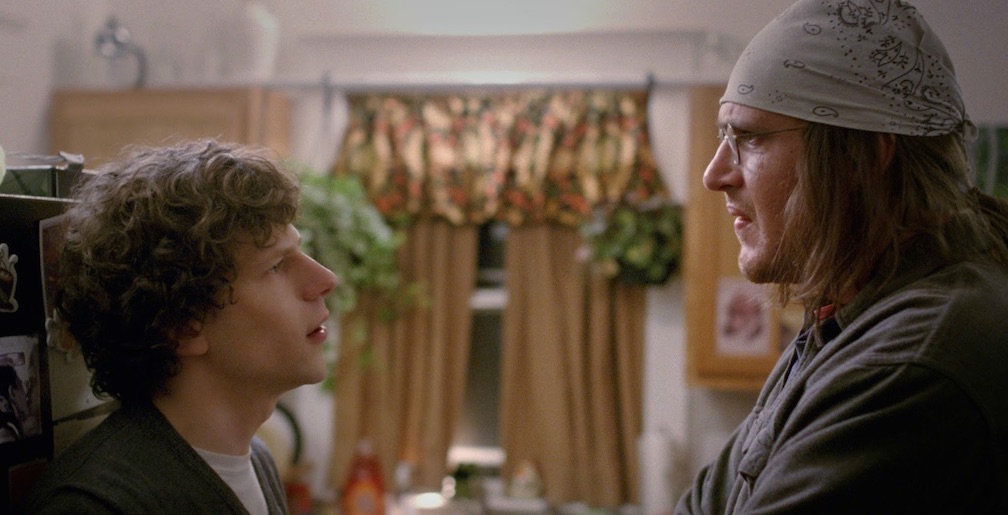
Okay, confession time, guys—before seeing “The End of the Tour,” I had absolutely no knowledge of either David Foster Wallace or his significant novel, Infinite Jest. After watching the fictional film about a few days in his company (which, as far as I can tell, is mostly accurate), I feel like I should read the novel and get into Wallace’s mindset even further.

Directed by James Ponsoldt (whose previous film was “The Spectacular Now,” one of my new personal favorite films), “The End of the Tour” is not a biopic about the life of a troubled artist but a slice-of-life film about a reporter’s interpretation of said-troubled artist while spending five days with him. The result is a comedy-drama that is honest, insightful, a great balance of drollness and pathos, and brilliantly acted. It’s one of the best films of 2015.

The story is told in flashback in 1996, when writer David Lipsky (played by Jesse Eisenberg) is assigned by Rolling Stone to join David Foster Wallace (Jason Segel) on the last few days of his multi-city book tour. He gets to know the offbeat Wallace, keeps his tape recorder handy and running most of the time, and the more he gets to know what kind of person he is, the more hesitant he is to ask him what his editor is demanding to know: was Wallace addicted to heroin?

I’ve always liked Jason Segel in his comedic roles, but with his performance as Wallace, he shows a side I haven’t seen before. He’s brilliant, portraying an artist who is trying to hide from the world while observing modern (or, pre-9/11-modern) society’s pros and cons (at one point, it’s revealed that he himself is addicted to trash TV), and he’s terrified of fame for numerous reasons (some obvious, others understated). There are many levels to Segel’s performance that are fascinating to interpret; to see this film is to admire this performance.

Jesse Eisenberg’s role, who is technically the film’s main character, doesn’t require a stretch in range for the actor who has given similar performances before—as the twitchy, brainy, self-absorbed, quick-witted person who has a heart of gold—but Eisenberg still does an effective job here.

Also to be admired is the screenplay by Donald Margulies, adapted from the real David Lipsky’s reflective novel, Although Of Course You End Up Becoming Yourself. The conversations Lipsky has with Wallace are great and fascinating to listen to, with a great amount of pitch-perfect dialogue. It’s a long shot for the film to get a Best Adapted Screenplay nomination come Oscar-time, but I would cheer if it did.

With a fantastic script, a remarkable performance from Segel, and numerous effective moments that are dramatic, humorous, or both, “The End of the Tour” is a film I won’t forget anytime soon. I see a spot open in my year-end list for the best films of the year. I love this movie.

Ex Machina (2015)

6 Nov

08014398-photo-ex-machina

Smith’s Verdict: ***1/2

Reviewed by Tanner Smith

From “2001” to “Blade Runner” to “Her,” artificial intelligence has been a common theme in science-fiction films. I think back to a line in a scene from “Prometheus,” in which an android asks a human he serves why he was made: “We made you because we could.” To say the least, there’s something so enthralling about the ability to play God and create life that the notion of said-life developing a soul is usually glanced over. That notion can pave the way for creative writers to explore its full potential, and with “Ex Machina” writer-director Alex Garland, best known for penning the screenplays for such films as “28 Days Later” and “Never Let Me Go,” explores this idea to create a spellbinding, thought-provoking fable about what it means to be “human.”

The film begins as Caleb (played by Domhnall Gleeson) is chosen to participate in a test conducted by reclusive computer-scientist Nathan Bateman (Oscar Isaac), who is CEO of the search-engine company Caleb works for. Caleb is brought to Nathan’s remote estate to stay for a week. Why is he there? Because Nathan has created an A.I. prototype named Ava (Alicia Vikander) and he wants Caleb to interact with Ava for seven daily sessions and see if she can pass for a human.

To get this out there right away, the special effects involving Ava are quite outstanding. She’s covered partially in metallic skin with a human-like face, and we can also see through her to see her skeletal structure. It’s really impressive.

Ava is self-aware, speaks in a pleasant, robotic tone not unlike Siri, and seems very real, in Caleb’s eyes. He is astonished by how well she can pass as human and even becomes strangely attracted to her. This gets the attention of Nathan, who sees this as a development in the test, while Caleb starts to get suspicious of Nathan’s intentions toward Ava. Who is in control of this experiment? Who is being controlled? Who is manipulating who? Who is being manipulated?

The less I say about the story of “Ex Machina,” the better. I walked into this film cold and was constantly intrigued by each direction the complicated story took. Yes, the story is a bit complicated but only in terms of the characters and their incentives. It avoids the usual scientific talk about how Nathan created Ava and instead pushes it into symbolic-dialogue territory, with Nathan telling Caleb his reasoning for creating A.I. and what he plans to do with Ava to make way for more improvements. This has Caleb worried, since he sees her to be as human as he, while Nathan sees her as just a machine that can be replaced. Nathan loves to create life, even if he doesn’t see them as “being” or “unique,” so Caleb sees his meanings as problematic.

What I like most about “Ex Machina” is that it’s a little film about grand concepts. It’s kept in this one huge compound with four characters (Caleb, Nathan, Ava, and Nathan’s housekeeper whose identity would be a spoiler to describe) and we stay there for a majority of the film. The set itself is a suitably-unsettling place to spend an hour and 40 minutes of running time, especially at night, when it feels like a prison, with surveillance, key cards, and emergency shutdowns that happen ever so often, strangely. And the film isn’t an action film with a ton of special effects (the effects, which mostly bring Ava to life, have a purpose and are understated); instead, it’s a film about construction, philosophy, value, and character, and it’s the characters and the script’s brilliant dialogue that help bring these themes across in a very effective way. It also helps that Garland builds an edgy, disquieting tone that keeps the audience unnerved and guessing throughout the film.

“Ex Machina” also benefits from strong performances as well. Alicia Vikander provides the strongest performance as Ava, keeping the audience guessing as to whether she’s mimicking human emotions or genuinely feeling them. Oscar Isaac is brilliant as Nathan. He doesn’t play him as a typical mad-scientist type by constantly shouting and spewing exposition; he just plays him as an eccentric, deadpan, alcoholic narcissist who has a brilliant mind but is also kind of insane, especially when it comes to his fascination with playing God. Domhnall Gleeson is fine as the outsider/straight-man who isn’t sure exactly what to believe.

With intriguing concepts, smart dialogue, a low-key approach, a contained feeling, and numerous surprises, “Ex Machina” is not a film I will forget anytime soon. Some of the concepts have been explored before but not quite like this. It is one of the best films of the year.

The Stanford Prison Experiment (2015)

10 Oct

the-stanford-prison-experiment-640x321

Smith’s Verdict: ***1/2

Reviewed by Tanner Smith

SPOILER WARNING (but this is based on a real study)

Imagine if you were placed in a situation where it was “you” versus “them.” What would you do? What would you say? What would you feel?

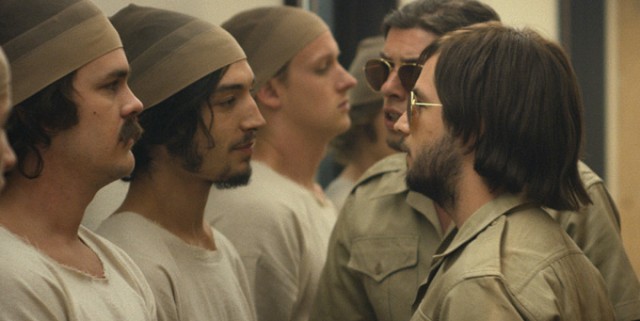
Some high-school or college psychology classes tend to teach about the Stanford Prison Experiment, which was an experiment ran by Dr. Philip Zimbardo in the early 1970s to investigate the cause of conflict between prisoners and guards by hiring 18 male Stanford students and dividing them up into one group or the other. A campus building basement was transformed into a makeshift prison and the guards took turns as three at a time kept the prisoners in order. It was supposed to last for two weeks, but due to the constant bullying to the point of psychological pain brought on by the guards, Zimbardo pulled the plug on the experiment after only six days. What did he want to prove? That the personalities of the guards and the prisoners tied with the brutality within prison settings? That people can and will change under pressure, given similar circumstances such as environment? Maybe both? Either way, it shouldn’t have happened in the first place, and he must’ve known it shouldn’t go on for another week. After only six days, it had already become violent and unpredictable; who knows what could’ve happened later?

The experiment has been the subject of many documentaries and a few narrative films (as well as term papers, for that matter), and with “The Stanford Prison Experiment,” director Kyle Patrick Alvarez and writer Tim Talbott’s fictional interpretation, based on Zimbardo’s book, “The Lucifer Effect,” may be the definitive narrative film about the subject, eyeing conflicts from both sides, the watchers (Zimbardo and his staff) and the watched (not just the prisoners but the guards as well), with a cold, objective tone. As a result, it’s chilling, shocking, and thought-provoking; one of the most disturbing films of the year.

It’s helped not only by the skillful filmmaking but also by the acting. Billy Crudup makes Zimbardo less than noble as an observer oddly compelled to keep going, despite himself becoming part of the experiment as well. Nelsan Ellis is strong in a role as an actual former prisoner who has some advice about the experiment and backs out when he becomes the very thing he hated for a long time. Olivia Thirlby shines in a brief but pivotal role as Zimbaro’s girlfriend who is appalled at what she sees. That leaves very impressive ensemble work from the many young actors playing prisoners and guards. Since they are not there to have characters of their own, only a few stand out—Michael Angarano, who is very chilling as a sadistic guard who takes influence from Strother Martin in “Cool Hand Luke”; Ezra Miller, who is heartbreaking as a prisoner who cracks as he realizes the authenticity of the experiment; Tye Sheridan, a rebellious prisoner; and Thomas Mann, a replacement prisoner who tries to cut through the “experiment.”

Alvarez and Talbott must have followed the source material closely, as we see almost exactly how the experiment gradually fell apart. There aren’t many clear answers, but the best thing about the film is how many questions it raises about human nature, as we ourselves interpret how the guards and prisoners acted certain ways because we can imagine how we would act in a similar situation. When I left the theater after I saw this film, I had a forty-minute drive home. The whole time I was driving, I kept imagining how I would behave if I was a guard or a prisoner. If I were a prisoner, would I be passive and take it or stand up for myself and fight back? If I were a guard, would I just do my duty or would I lose my head and get rough? I had to look deep within myself. That’s the effect “The Stanford Prison Experiment” had on me. It’s a film I won’t forget anytime soon. I hope to see it a second time with someone I could discuss it with to see what we both come up with in our conclusions.

Escobar: Paradise Lost (2015)

10 Oct

foto_escobar-paradise-lost-74297

Smith’s Verdict: ***

Reviewed by Tanner Smith

I guess I should start this review by saying that the title, “Escobar: Paradise Lost,” makes it seem like Pablo Escobar is the central focus of the film. That is not the case. Like “The Last Kind of Scotland,” “Me and Orson Welles,” and “My Week With Marilyn,” “Escobar: Paradise Lost” is less about the historical figure and more about how a young person sees him or her during a life-changing experience. I think “Me and Escobar” or “Escobar and Me” or even “The Escobar Supremacy Ruined My Life” would’ve been better (just kidding).

Because the performance by Benicio Del Toro as Escobar is so brilliant, people have complained that this film fell back on its potential by having its main character be a less-than-interesting young man trapped in Escobar’s world. But for what it is, I think “Escobar: Paradise Lost” is still a riveting drama with a lead that is unfairly evaluated. At its core is the story of a young man who realizes too late what he’s gotten himself into, leading to confusion and betrayal. This story’s been done before, but if done right, it can still work effectively, which I believe is the case here.

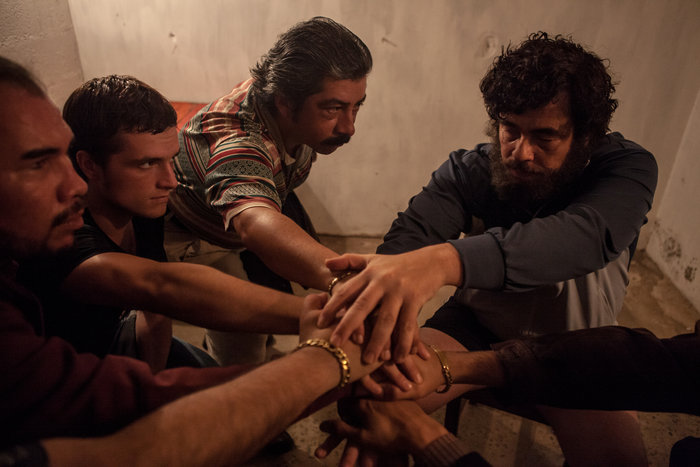
Josh Hutcherson stars as Nick Brady, a young Canadian surfer who lives in a surf shack on a beach with his brother (Brady Corbet) and his family. When Nick meets and becomes involved with a young beauty named Maria (Claudia Traisac), she invites him to meet her family, including her uncle, Pablo Escobar. Nick is naïve enough to believe that Escobar’s cocaine trade is for medicinal purposes and he’s only exporting “the national product,” so he falls in with the family. But as time goes by, little does he know that Escobar has been gradually luring him into his circle of influence, and by the time he understands the danger he’s in and is about to leave town with Maria, he’s called in to hide the “goods” to a secret location, where he must shoot and kill a local who will take him there.

This leads to a very well-done, extended, suspenseful sequence after which Nick meets the guide he is supposed to kill…and it’s a kid. The tension mounts over a long period of time, as horrified Nick is nervously trying to think of what to do. The back half of the film is the most powerful portion, with action, suspense, and even drama.

Benicio Del Toro is only on screen for I’d say about half of the film, but his presence dominates the entire film with a creepy blend of allure and malice, as he orders death with straightforwardness while holding family and God close to heart. Del Toro plays a monster in human form.

Josh Hutcherson, one of my favorite young actors working today, is quite believable in a role that may not have been written well but is surpassed by his credibility. There’s a scene late in the film where he comes to a hasty decision in order to attempt to save someone, and he plays it very effectively. Because of his performance, I didn’t mind that this was our lead and Escobar was merely second-billing.

My only problems with the film involve the supporting cast. There aren’t many memorable characters in either Nick’s family or Escobar’s circle, and this can welcome criticism with an obvious comparison (“The Godfather”), but then again, this isn’t that film, though it would’ve been nice to meet someone else on the same level as Del Toro. As for the relationship involving Nick and Maria, it falters because Maria starts out interesting but then becomes less of a character as the film moves along.

And something else people complain about with this film is that it’s two movies at once—a true story of the notorious Colombian drug lord of the early 1990s and an action-thriller about an innocent trapped in a web of violence. I would agree with that, but I’m not going to judge too harshly on it, because the film begins with Escobar telling Nick what he needs him to do while hiding the drugs and then flashes back to Nick’s surfing days before he even met Maria. So it keeps the tension level up by telling us something important, showing how it came to this, and then catching back up to where it left off. So I didn’t mind.

Maybe a biopic starring Del Toro as Pablo Escobar would’ve been intriguing because Del Toro does such a good job in the role, but for what it is, I recommend “Escobar: Paradise Lost,” due to Del Toro’s powerful performance, Hutcherson’s charisma, and a skillfully crafted second half.

Me and Earl and the Dying Girl (2015)

10 Oct

me-and-earl-and-the-dying-girl

Smith’s Verdict: ***

Reviewed by Tanner Smith

I might use this review as an opportunity to write about two pet peeves I have with some recent quirky, independent comedy-dramas. One is what I like to call Kind of Aware But Not Quite; that’s when a film is so self-aware of itself that it has a character point out the clichés, thinking that commenting on it will make it less of a cliché. The other is Excessive Comic Relief: desperate side characters thrown in by screenwriters who don’t think the comic relief they have already isn’t funny enough—these people tend to A) appear as if they’ve come from another planet of social skills, B) distract away from the plot & leads, as if they should have a movie of their own, and C) are not very funny. (There’s also D) all of the above.)

It may seem a little odd that I’m going into these pet peeves in a review of a movie I like rather than a movie I dislike, but I decided to because…I came close to disliking “Me and Earl and the Dying Girl.” This film has its heart in the right place, is visually interesting, and has a fresh, engaging trio of young people to focus on. It’s also a little too self-indulgent and features some strange, off-putting side characters that I’m sure are funny to some but just strange to me. (But hey, it apparently worked for everyone at Sundance, seeing as how it received the Grand Jury Prize and the Audience Award.) But honestly, after watching this film twice, the material I like, I find I really like. It makes up for some of the things I find off-putting in this film.

Based on the novel by Jesse Andrews (who also wrote the screenplay), “Me and Earl and the Dying Girl” centers on a high-school senior named Greg (Thomas Mann). He’s narcissistic, socially awkward, has little to no ambition in life, is very neutral on school grounds (so he doesn’t make any friends or enemies), and is a classic-film lover. He also makes bad home movies, which are parodies of classics (for example, “Brew Vervet” for “Blue Velvet”), with his only friend, Earl (R.J. Cyler), whom he doesn’t label as his “friend” even though they’ve known each other since kindergarten.

Greg’s classmate, Rachel (Olivia Cooke), is diagnosed with leukemia. Greg hardly knows her, but his overbearing mother (Connie Britton) insists that he pay her a visit. With his honest, offbeat, oddly charming manner, he manages to get through Rachel’s defenses and soon enough, they become close friends. One of the best things about this film is the relationship between Greg and Rachel. It’s not romantic; it’s platonic and very sincere. It starts out awkward (though believably so) and gets better for them along the way. You could argue that maybe they do love each other, but their interaction and bond is stronger than that in terms of friendship, and we never even see them kiss. What makes it all the more interesting and tragic is that Rachel needs a close friend or some kind of emotional asset now that her mortality is more seeming than ever. Greg doesn’t know it, but he needs one too.

The underlying drama is the best part of the film, but some of the comedy works well too. I laughed at a few lines of dialogue and some situations (such as when Greg and Earl are accidentally stoned at school). What don’t work so well for me are the captions that tell us which scene we’re in (for example, “The Part I Meet a Dying Girl”) and how deep we are into the “Doomed Friendship,” as Greg (our narrator) labels it. The film borders on being too cute for its own good; using voiceover narration, Greg also winks at clichés the film inevitably uses—it doesn’t really work, especially when it tries to make something predictable unpredictable. And then there are the “characters” of Greg’s weird father (Nick Offerman, often a victim of the Excessive Comic Relief—when will he find a good movie role?) who moseys about the house in his robe, cooking up strange meals; Greg’s mother who is so overbearing that it’s kind of humorous (which I guess is the point); and Rachel’s mother (Molly Shannon), who would be more interesting if we got more of a sense of how she feels about her daughter dying but is instead a strange woman who’s often with a drink in her hand and lusts over Greg at first sight, calling him “delicious” and “yummy.”

What does work in “Me and Earl and the Dying Girl” is the interaction between Greg and Rachel, Greg and Earl, and Greg, Rachel, and Earl (though all three don’t get that much screen time together as a unit). Their dialogue sounds natural, their offbeat personalities are appealing, and their performances are very strong. Thomas Mann plays Greg almost like the complete opposite of who John Hughes was looking for in a high-school teen; the “anti-Ferris-Bueller” who doesn’t want to be noticed and wants to live in his own world without any worries or fears or even ambitions. When he gets an awakening, it feels less than artificial and forced, and it’s to Mann’s credit that he’s able to make us feel when he realizes something unique. Also, He’s not afraid to make Greg even unlikable at times, but he never loses sympathy and he’s always believable. “Believable” is also too big of an understatement to describe Olivia Cooke’s performance as “the dying girl.” She’s more credible than many cancer patients I’ve seen in movies and is very charming as well. The terrific newcomer R.J. Cyler starts out as central comic relief (comic relief that is essential to the movement of the plot and the growth of the lead character) and develops into something more as the story continues. God bless Nick Offerman and Molly Shannon, but they never felt believable to me, especially in comparison to these three fine young actors.

The look and feel of this film reminds me of a Wes Anderson production in the way the camera moves or where it is placed, and that really works, especially when the film is being “cute.” It’s a good balance that makes the overall film charming. It’s when I mention the look that I realize it’s a film that really wants me to like it and tries everything to win me over, and I just can’t help myself.

Without giving the ending away (though you probably know the inevitable result), it hammers in effectively the importance of friendship and ambition, and it delivers a true wakeup call for Greg (and without dialogue too). It’s sad, but the film really earned its sadness by this point.

Oh, and of course, I can’t forget to talk about the home movies made by Greg and Earl. Glimpses of them are seen here and there, and they are brilliant! That’s all I’ll say about it.

“Me and Earl and the Dying Girl” may suffer from Kind of Aware But Not Quite and Excessive Comic Relief, but it has strengths apart from them. It’s charming, has winning lead characters, is well-directed by Alfonso Romez-Rejon, is well-constructed, and has more than enough for me to recommend despite my pet peeves.

Napoleon Dynamite (2004)

7 Oct

napoleon_dynamite

Smith’s Verdict: ****

Reviewed by Tanner Smith

“Vote for Pedro.” I challenge you to find anyone who doesn’t immediately get that reference.

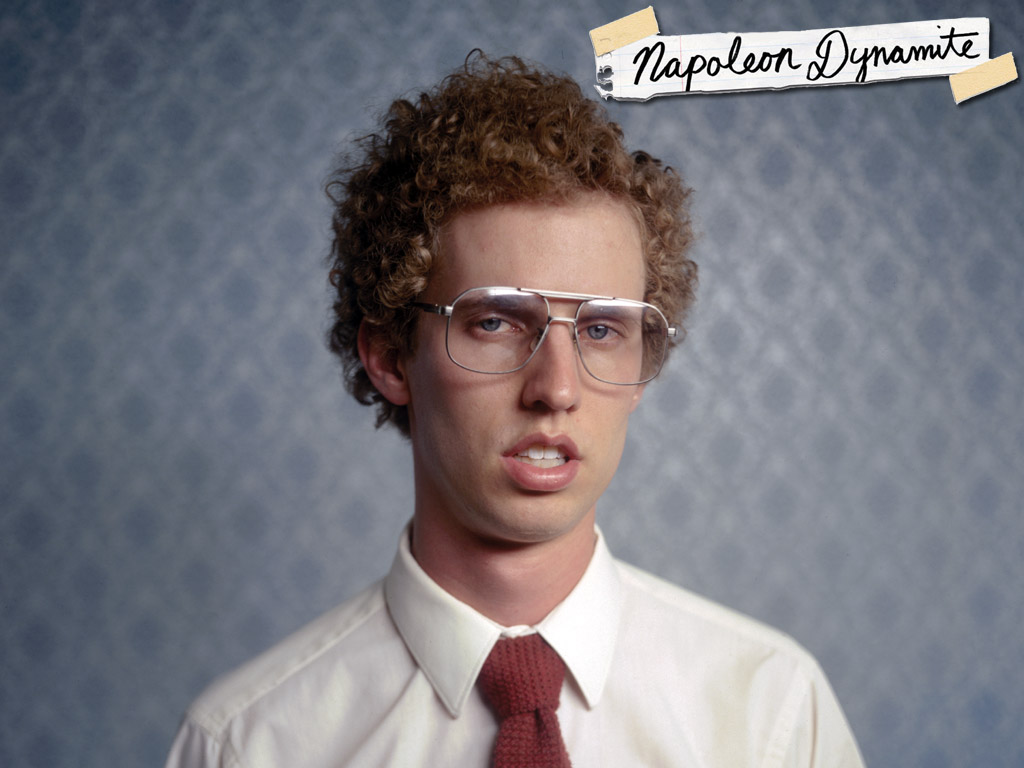
“Napoleon Dynamite” is certainly a strange film. I tend to refer to it as the “anti-teen-movie” or the “anti-coming-of-age-movie.” It’s a slice of life centered around some particularly strange characters who live in worlds all their own. These people are so off-putting that they’re the very reason people either love it or hate it. If you can’t tell by the Verdict rating, I belong to the former group.

The title character is a high-school teenager who would be classified as a “nerd” due to his outward appearance (thick glasses, odd fashion sense, and hair that must’ve taken hours to look bad), deadpan monotone, and asocial behavior, but you might be far off. This kid, Napoleon Dynamite (Jon Heder), wouldn’t even fit in with the other nerds at school because he’s so repellent and aggressively obnoxious. This isn’t one of those high-school dramas that portray teenage outcasts as tragic figures; we see more than enough of Napoleon to realize he probably deserves to be an outsider.

And yes, he is the protagonist of “Napoleon Dynamite,” and in any other movie, he would be one of the worst movie characters in history. But with this film, it strangely works, because the film itself is so low-key and with a good amount of biting satire that it’s easy for me to admire the decisions director-writer Jared Hess and his wife, co-writer Jerusha Hess, make with it and their characters. They have conveyed a tone in this film that really works because everything is underplayed and so is everyone. Let me put it this way—the comedy in “Napoleon Dynamite” works not because the actors are playing their parts or the material for laughs but because they aren’t, and as the movie goes, their characters grow on us. (State a quote from this movie, and there’s no doubt many people won’t know who or what you’re referencing.)

Who else in this group of strange characters can we count off? Well, there’s Napoleon’s older brother, Kip (Aaron Ruell), who is almost as asocial as he is. He still lives with Napoleon and their grandmother, and his daily life revolves around an Internet Chat Room. (Their grandmother gets very little screen time, but I’d like to know more about her, especially considering what we see of her social life.) Then there’s Uncle Rico (Jon Gries), a pathetic 30-something ex-jock who constantly lives in the past and hopes to relive his glory days of playing football; after Grandma is hospitalized, Uncle Rico stays at the house with Napoleon and Kip (anything to get away from his trailer), and he and Kip go into business as door-to-door salesmen, selling the most bizarre products.

Pedro (Efren Ramirez) is Napoleon’s only friend. He’s the new kid in school and has as much trouble fitting in as Napoleon. What’s so strange about their friendship is that they are often together and exchange words with each other, but they rarely show any emotion whatsoever. Then there’s Deb (Tina Majorino), a shy, awkward girl who has a crush on Napoleon for…reasons, I’m sure. Pedro asks her to the upcoming dance, so Napoleon, having been stood up by his date, has to cut in for one dance.

There isn’t much that happens in “Napoleon Dynamite.” The closest thing it has to a story is introduced in the back half, in which Napoleon and Pedro start a campaign for Pedro to become Class President, with Napoleon as Pedro’s campaign manager. His opponent is a stuck-up popular girl, Summer (Haylie Duff), who Pedro once asked to the dance. (By the way, I love how she responds.) But even that doesn’t have much of a focus, nor does the buildup to the dance or hardly anything else. It just leads to a payoff where Napoleon ultimately gains some kind of victory (though not on the account of anything you might expect, keeping in consistency). “Napoleon Dynamite” is mainly an episodic slice-of-life where we spend an hour-and-a-half spending time with odd, quirky characters, particularly the sadsack loser Napoleon. Strangely enough, there are even side-spots which we’re not even sure why they’re there in the first place. For example, Napoleon and Kip visit a steroid-built dojo owner named Rex (Diedrich Bader), who shares his unorthodox advice on how to defend yourself. What does this have to do with anything? I’ve never figured this out, but it just adds to the “stuff-happens” element that the film offers.

The film doesn’t force us to hate these characters, because it doesn’t necessarily mock or even hate them. It shows its heart near the end and we can appreciate any hint of redemption these people might have in their lives. The film isn’t about that, mind you, but it does show a bit of hope seeping underneath the surface.

As someone who is generally a fan of coming-of-age/slice-of-life movies, I find “Napoleon Dynamite” to be very funny and even more admirable in the way they go against what this type of film usually offers and delivers. Maybe that’s why people seem to be split on it. Some people look at it like I did—a charming, unusual comedy with amusingly disconcerting characters. Others have seen it a different way, because they’re turned off by the film’s characters and tone, they don’t find it funny, and/or they expected something different and more generic. The former group has turned the film into a cult classic. I’m happy to call myself a part of that “cult.”