V/H/S (2012)

27 Aug

VHS - Lily I Like You.png

Smith’s Verdict: ***

Reviewed by Tanner Smith

The “found-footage horror” genre is very hit-and-miss. It’s an excuse for filmmakers to turn out a product with a shoestring budget. Some of them do it well, bringing viewers into the hyper-realism style of execution. Others do it horribly, just using it as an attempt to cover up that they have very little to offer in terms of story, characters, or even scares. “V/H/S” is a found-footage horror anthology that is very hit-and-miss, in that some chapters in the saga are effective while some are…well, not as much.

“V/H/S” tells six stories (each told from a different director), neither of which ties in at all to anything except for the wraparound story which is mostly composed of people watching the other segments anyway. (That’s a clumsy tie-in, but whatever.) The wraparound story (or “Tape 56,” director by Adam Wingard, whose film “The Guest” I really enjoyed) involves a criminal gang (who film their activities for some reason—not a smart idea, guys) as they break into a house in search of a special videotape. While searching, they find a body seated in front of a TV set with a VCR and many unlabeled tapes. So they watch the tapes…

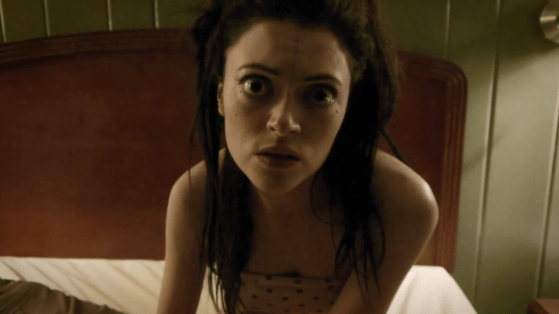
The first tape (“Amateur Night,” directed by David Bruckner) shows three guys out on the town, one of whom has a hidden camera on his glasses with which they hope to make an amateur porn video. They manage to pick up a particularly strange young woman who turns out to be a succubus with a taste for human blood. This is one of the two most effective segments in the series, as well as the most fun. Its ability to hold the action in one shot (from the POV of the character wearing the camera-glasses) is impressive, the ultimate make-up on the succubus in monster/humanoid form is well-done, and the gore was enough to make me wince/cringe (that’s no small feat).

Side-note: This isn’t really an actor’s movie, but the casting for the succubus was very effective. The actress, Hannah Fierman, has a great blend of adorableness and uneasiness (and her wide-eyed stare is unsettling as well).

The next tape (“Second Honeymoon,” from one of this generation’s most promising horror filmmakers, Ti West) shows a couple on their second honeymoon. They film themselves doing silly things, but things get creepy when someone breaks into their hotel room (in a genuinely disturbing scene). This segment is one of the weakest, as it leads to an unsatisfying payoff. A disappointment from West. (OK, not “Cabin Fever 2”-disappointing, but still disappointing.)

The third tape (“Tuesday the 17th,” by Glenn McQuaid) has an interesting idea but isn’t portrayed in an interesting-enough way. It features a group of obnoxious teens exploring some woods which supposedly have a horrific history to them, when it turns out the killer is only able to attack when there’s a camera on him. One girl knows about it and tries to prove it by…filming her friends being killed by this digital slasher. (Not a great plan.) I like the idea of the killer only being seen through the interference in the camera’s viewfinder, but it’s just not enough to be exciting or scary.

The fourth tape (“The Sick Thing That Happened to Emily When She Was Younger,” by mumblecore-protégé Joe Swanberg) is my favorite. It’s told entirely through Skype, as a scared woman believes her house is haunted and tries to convince her boyfriend of what’s going on. I won’t reveal the twists here, but I found them chilling and even fascinating.

Finally, we get the final entry (“10/31/98,” by Radio Silence), in which four guys in search of a Halloween party find themselves in a haunted house, where a Satanist ritual seems to be happening. When they realize it’s not a joke and they’re at the wrong party, they find themselves in a terrifying situation. To put it in the best, most positive way, the ending of this segment is the film’s mike-drop.

The wraparound story has its chilling little touches when the film cuts back to it, such as things that weren’t there before but are suddenly there or the other way around. But unfortunately, its resolution is weak at best. In fact, I would barely even call it a “resolution.”

As a whole, “V/H/S” is half-intriguing and half-annoying. Three segments are unnerving and enjoyable in their way, while the other three have their scary moments at times while each of them don’t necessarily satisfy as its own piece. They all barely connect. They just have one thing in common—they were made by promising horror filmmakers who pride themselves in visceral shocks and scares. Not that I would say these short segments show the best of their craftsmanship, but I appreciate the effort given with their limitations of the “found-footage” genre. So, in a way, I would recommend “V/H/S” as a fun thrill ride if you and your friends are bored and feel like checking out an ambitious horror film with good scares to offer. That’s about as high a recommendation as I can give without necessarily letting it slide with a “mixed review.”

Tallulah (2016)

23 Aug

6840c860-4efc-11e6-86d5-59965f7b75f9_20160721_Tallulah_Dead.jpg

Smith’s Verdict: ***1/2

Reviewed by Tanner Smith

I must confess, when I started watching Sian Heder’s Netflix Original film “Tallulah,” I had no idea what it was about. I knew it starred Ellen Page and Allison Janney…and that was it. As it was establishing the main character, I was invested. She’s a drifter named Tallulah aka Lu (played by Page) who lives in a van and roams from place to place. Where’s her family? I don’t know. Where was she from? I don’t know. How does she get by? I don’t really know that either. She has a boyfriend in tow, Nico (Evan Jonigkeit), who tires of her lifestyle and ends up abandoning her, causing her to feel more alone (and it’s to Page’s credit as an actress that she can really show that in a scene in which she has very little dialogue). As the film continued for another 15 minutes or so, I was still curious where this person (along with the film) was going. Then it got to the point (which isn’t a spoiler, because it’s more or less the film’s “hook”) in which she snatches a baby from its mother and tries to care for it. That’s when I thought to myself, “Oh no, you’re not really going here, are you?” I worried maybe this was going the clichéd melodramatic path I expect from a premise like this.

Yet, I didn’t turn the film off. I was curious to see where it might be going, just in case it surprised me. And surely enough, it did. “Tallulah” turned to be one of the most moving films I’ve seen in quite a while. Much of that has to do with how this material was handled. It could have easily been bland, overwrought melodrama, but thanks to a carefully fashioned script, its grounded sense of direction, and brilliant performances by Page and Janney, it instead became something special.

The conflict begins as Lu goes to New York City, in search of Nico. All she has to go on is his mother, a divorcee author named Margo (Janney) who has enough problems in her life without a strange young woman asking for help. Lu steals room-service food from a nearby hotel and is mistaken for housekeeping by a young mother named Carolyn (Tammy Blanchard). While tipsy and preparing to go out on a date, she asks Lu to look after her one-year-old daughter Madison. Carolyn comes off to Lu like an irresponsible mess, so Lu, even though she has no experience in caring for children let alone babies, decides to take the gig of babysitting. But when Carolyn returns drunk and passes out, Lu is concerned for Madison’s wellbeing and takes her away with her. Not knowing what to do, Lu takes Madison to Margo’s apartment, claiming the child is Nico’s and is her granddaughter. Margo reluctantly lets them stay for a little while.

From that point starts a bond that gradually forges the more time these people spend together. Lu continues to look after the child while Margo finds Lu is a bit of a handful as well. But Lu and Margo find ways to relate to one another that neither of them would have expected. This is where the film really shines: the development of the relationship between Lu and Margo. Both Page and Janney do extraordinary work and play off each other wonderfully. And this growth is important to the story, because it plays on the theme of motherhood and what it means to truly care for someone. Neither of these two have definite answers to questions of sacrifice and stress, but through each other, maybe they can find them together.

Of course, you know the truth about the child has to be revealed to Margo near the end of the film. While I was dreading that moment, I had hope in how it would play out, given how good everything was turning out so far. But thankfully, even though the moment does come, it’s surprisingly underplayed, allowing the characters to progressively think things through before they can really talk about the issue at hand. Sian Heder, who also penned the script, knows what we’re tired of seeing and has done something with tired material that feels fresh.

And that surprisingly also includes the subplot involving the child’s worrying mother! I was shocked to find how heartbreaking and compelling Carolyn’s story was turning out, given how we started seeing her as a caricature of an irresponsible mother. But you see how she feels throughout this turmoil of missing her baby and how she could’ve prevented something like this from happening eats her up inside. I truly felt for her.

The film isn’t entirely successful, however. A subplot involving the doorman (Felix Solis) of Margo’s apartment building goes nowhere. (Even if his exit from the film was the punchline to a joke…I didn’t get it.) Take that part out of the film, and I don’t think anything would have been missed.

By the end of “Tallulah” comes much warranted and appreciated character development from the title character. She learns what it means to be responsible for someone else after spending so much time looking after herself, and it turns out she may even be a little better looking out for someone else than she has for herself. When the film was over, I felt glad to be in the company of good people who I felt grew through difficult circumstances. “Tallulah” isn’t a film I’ll forget anytime soon.

Devil (2010)

21 Aug

Devil-2010-movie-4.jpg

Smith’s Verdict: **1/2

Reviewed by Tanner Smith

God works in mysterious ways. But so does the Devil. From what I’ve heard in Sunday school growing up, the Devil is cold, calculating, seductive, ruthless, and very subtle in his schemes of drawing people over to the dark side before consuming their souls in hell. This supernatural thriller, “Devil,” does not represent him well, for reasons I’ll go into shortly. But to be fair, it is kind of fun. This is a “guilty pleasure” for me, to say the least (or the most).

Based on a story by M. Night Shyamalan, “Devil” is as much “Shyamalan” as you could expect. It has a spiritual message, it has tormented characters finding redemption after going through a paranormal occurrence, and you may recognize a few silly elements he used in “Lady in the Water” or “The Happening” (to be fair, those are two of my guilty pleasures too). Just to get this out of the way, I don’t hate M. Night Shyamalan. I love “The Sixth Sense” and “Signs,” “Unbreakable” gets better and better each time I see it, “Lady in the Water” and “The Happening” are too goofy for me to hate, and he came back from a career slump in a major way last year with “The Visit.” I didn’t see the critically panned “After Earth,” but I despise “The Last Airbender,” which seemed to make even his defenders turn their backs on him. “Devil” came out the same year as “The Last Airbender,” and there was a hate train chugging along because even though it wasn’t directed by Shyamalan (it was directed by John Erick Dowdle), it had his fingerprints all over it. But I can’t hate it—like “Lady in the Water” and “The Happening,” it’s too goofy for me to hate.

The premise sounds fantastic until it gets to the fine print. Five strangers are trapped in a broken-down elevator. But one of them is a killer. The power is faulty, and the killer strikes whenever the lights go out. Police and maintenance race to save the remaining bunch of claustrophobic people before they too are killed off one by one. Sounds like a Hitchcock or an Agatha Christie scenario, doesn’t it? Well…I don’t think Hitchcock or Christie would’ve made the killer the Devil.

And yes, the hook is that the Devil is one of the people trapped in the elevator, and that’s where the horror is supposed to come from, I suppose—not just that there’s a sadistic killer on board, but that person must also be the Devil come to take the rest to hell. How do we know this? Well, one of the building’s security guards (Jacob Vargas), a highly religious type, points out the signs that direct to the situation due to a story told to him as a child by his grandmother. But that’s not all—what else does he have to prove the Devil is near? He takes a piece of toast with jelly on it and throws it up in the air, and it lands jelly-side down. “When he is near,” he shakily concludes, “Toast falls jelly-side down.” I get what the writer is trying to do—use mundane materials to point toward the supernatural (like in “Signs,” with the baby monitor picking up an otherworldly signal)—but some ways of doing it are more lame than others (remember the Simon game in the fifth “Paranormal Activity” movie?).

As I said before, five people (Logan Marshall-Green as a mechanic, Jenny O’Hara as a crabby old lady, Geoffrey Arend as an unctuous salesman, Bokee, Woodbine as a temp security guard, and Bojana Novakovic as a manipulative woman) are trapped in an elevator in a Philadelphia high rise. Working on the problem are two security guards (Vargas and Matt Craven) and police detective Bowden (Chris Messina), who can see them via security cam. After a while, one of them is murdered, with no telling of whom of the remaining four did it. Every time the lights go out due to defective power, one of them ends up dead. While the race is on to get the elevator working again and save whoever is left, Vargas gives Bowden his conclusion that the killer is the Devil in disguise. Naturally, Bowden doesn’t believe him at first, but the further things escalate, the less he can deny the truth.

It turns out to be true—the Devil has decided to send some people to hell today and, for some reason, it takes him all day to do it, and it’s not even in a secretive way, seeing as how it’s all happening on closed-circuit cameras. When you really think about it, it doesn’t make any sense. And it gets sillier from there, with images of monstrous faces showing up in the surveillance monitor, one of the women being “bitten” by the Devil, and even a preposterous, laughable death by hanging. And with the security guard constantly speaking script-talk for “the Devil is near,” we get an angel in disguise, just so we can have an understanding of what we’re dealing with here.

To the film’s credit, all of the actors are uniformly good and Shyamalan-regular Tak Fujimoto’s cinematography is well-done. And even some of the spiritual elements are surprisingly interesting, despite them being too convenient especially in the film’s climax.

Despite this missed opportunity to create a truly chilling, claustrophobic thriller, I find myself enjoying “Devil,” mainly for the things I laugh at, in addition to the things in it that are consistently good. It just so happens the laughable things are consistently laughable, so it all balances out. Like “Lady in the Water” and “The Happening,” “Devil” is a guilty pleasure I can’t help but enjoy each time.

A Girl Like Her (2015)

15 Aug

cast_of_a_girl_like_her.jpg

Smith’s Verdict: ***1/2

Reviewed by Tanner Smith

Afterschool Specials. Lifetime movies. ABC Family (er, sorry—Freeform) Original Movies. Some of the films in either of these categories are well-done. But they have a reputation among many for throwing out several manipulative, bland, not-especially-well-made films that tell stories that deal with important issues that aren’t as effective they should be, as a result of being insipid. How do you make a film that tackles an important issue while making it well?

Simplest answer: make it well. Focus on the writing, the characters, the direction. Take the issue from a clear-eyed point-of-view. Write people who could be you or people you know. Don’t just base it on what you see/hear; base it on what others see/hear too, maybe. Hell, take risks. Think outside the box (the box within which most of the offenders continue to think).

Take school-hallway bullying. This is still a big problem in society, and for as long as it’s been around, I’m sorry to say it shows no sign of disappearing anytime soon. Making a film about bullying and the tragedies that result from it is not an easy task, as most films that try to tackle the issue end up being either wishy-washy or flat-out ordinary. Not that any film is going to make something go away, no matter what it is, but there needs to be some good attempts.

Amy S. Weber’s “A Girl Like Her” is a very good attempt. This is the kind of film teachers should show their students that just could maybe—maybe—raise a few eyebrows.

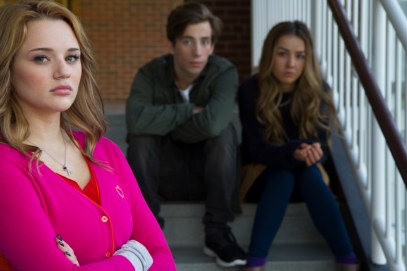
“A Girl Like Her” is a “mockumentary” (a fictional story told in documentary-style fashion), but it might as well be real; its emotional honesty about an important subject made me forget that everything was scripted and actors were playing roles (even though I’d seen one of them—Jimmy Bennett—in many other movies before, like “Orphan” and “Trucker”). The high school portrayed in the film could be any high school. The students feel real. And so on. Even if it doesn’t entirely work (I mean, it is possible some people would forget cameras are rolling on them and say certain things, but it is unlikely), I praise it for attempting to understand the mindset of both of the school bully and the bully’s victim.

A documentary is being filmed at a high school that is being proclaimed as one of the top 10 in America. The documentary’s director (played by the director herself, Weber) finds an interesting angle after student Jessica Burns (Lexi Ainsworth) attempts suicide and rumors indicate that the harassment she received from popular girl Avery Keller (Hunter King) might be responsible.

The film constantly switches points of view by showing additional footage from time to time—footage recorded by Jessica, her best friend & video geek Brian (Bennett), and even Avery herself, as she’s asked by the director to show what her life is like. We learn that Avery has in fact harassed Jessica countless times in the halls and even through text messaging and email. Brian gave Jessica a secret camera hidden in a necklace (and he filmed some things with his own camera as well), because he felt this behavior had to be exposed somehow. We also learn that Jessica didn’t want it brought to light, because she thought things would only get worse rather than better. And more importantly, we see what Avery’s home life is like: she comes from a dysfunctional family with an overbearing mother who demands too much, and she tries to hide it as best as she can. And of course, when more and more rumors pile on about her part that led to Jessica’s attempted suicide, she’s in denial, claiming she couldn’t have done that much damage.

Anyone remember the 2012 documentary “Bully?” (You know, the one that caused that ridiculous MPAA rating controversy?) Anyone else think that should have been called “Bullied” instead? After all, it didn’t focus on any of the bullies; just the victims of bullying. What did the bullies go through in their lives? What caused them to inflict harm onto others? “A Girl Like Her” mercilessly shows a lot of the physical and verbal abuse perpetrated by Avery onto Jessica (and it’s pretty hard to watch—the movie doesn’t shy away from it, which is another honorable element to its success), but then in the last third, it pulls off an incredibly surprising trick: making us empathize with the bully too, as the gravity of the true hurt Avery caused comes crashing down on her, internally and externally. It leads to an ending that may be a little too immaculate, but it is very effective nonetheless and adds to the cautionary-tale aspect. And Hunter King portrays the part extraordinarily well in a final monologue that led to chills running down my spine.

“A Girl Like Her” is a powerful film with three winning performances (King, Ainsworth, and Bennett) and a careful examination about a problem still being faced today. Will it change the way things are? Probably not. But as I said before, it’s a real good attempt.

Left Behind (2014)

15 Aug

Left-Behind-2014-film-images-27c7d71b-ae16-471b-a0bf-48ccac54cb3.jpg

Smith’s Verdict: 1/2*

Reviewed by Tanner Smith

The End is near.

That’s what I had to remind myself every few minutes as I was watching this film—“The end [of the movie] is near, the end [of the movie] is near…”

You would think that a disaster movie in which the priceless enigma known as Nicolas Cage (who can either be a very gripping actor or a wacky presence that brings most bad movies up a notch) desperately tries to find his family while also trying to land an airplane when the world is in shambles would at least be entertaining in a so-bad-it’s-good sort of way. But this re-adaptation of the popular “Left Behind” Christian book series is so lifeless and boring that it makes the original 2000 adaptation (starring Kirk Cameron) look like “Casablanca.” And unfortunately, Cage doesn’t help—he seems half-asleep throughout the entire movie, when all that could be done to raise this movie to entertaining levels is a trademark Cage freak-out performance.

It shocks me that this remake was directed by the director of the previous version, Vic Armstrong. It’s almost as if he was wondering how he could possibly make it even worse than before. Give the original film some credit—the political intrigue presented in the dawn-of-the-Antichrist story gave some indication that there was some effort to make it thought-provoking. This remake is just throwing “Airport”-type clichés in with fundamentalist Christian theologies repeated over and over to make sure we get the point.

And I’m not kidding—much of this movie consists of spelling out the evangelical Christian message that the Rapture is coming, the End is near, etc. and so on. It’s like the makers of this film want to remind us who made this piece of uninspired propaganda.

Oh, and there are a few car crashes, a prop plane crash, and a big explosion thrown in just to try and wake up the small audience outside its target demographic.

Oh right, the story. Well, Nicolas Cage is a pilot named Ray Steele, who is called into work on his birthday, just as his adult daughter, Chloe (Cassi Thomson), arrives in town. Chloe believes her father is having an affair with a flight attendant, Hattie (Nicky Whelan), and tries to reconnect with her newly religious mother (Lea Thompson), but differing beliefs (and ignored warnings from mother to unaffiliated daughter) cause more friction between the two. The Rapture occurs while Cage’s plane is in mid-air and Chloe is taking her little brother to the mall. The brother is gone (in fact, all the children are gone all over), many passengers on the plane are gone, much of the townspeople have vanished as well, and it becomes clear to many that these disappearances have happened all over the world. Cage’s co-pilot has gone as well. With help from investigative journalist Buck Williams (Chad Michael Murray, who I’ll give credit to for trying to make something out of a nothing role), Cage tries to land the plane safely before the remaining, scared passengers go even crazier with paranoia.

“Left Behind” feels so proud of its portrayal of the first stage of the End (first is the Rapture, next is the Tribulation, and on and on until finally, Judgment Day) that it ends on a blatant cliffhanger. How blatant? Well, it ends with this exchange—“Looks like the end of the world.” “No. I’m afraid this is just the beginning.” I don’t think so. I sat through this thing, I don’t intend on sitting through it again, and I definitely don’t intend on seeing this story continue any further.

And to think this thing came out the same year as “Joe,” the film that reminded us how good of an actor Cage can be.

Lights Out (2016)

15 Aug

lights-out-slice1-600x200

Smith’s Verdict: ***1/2

Reviewed by Tanner Smith

If you’re in the light, you’re safe. But when the lights are off, you’re doomed. It’s a gimmick, of course; one that can generate some good scares in a horror film. But if that were all “Lights Out” had to offer, the gimmick would probably wear out quickly. Thankfully, while this is a very effective scare-fest with neat ways of showing both how easy and how hard it is to escape the mysterious entity that lurks in the dark, there’s more to the film than just scares. Surprisingly, it has a family-drama story to tell also, and Swedish director David F. Sandberg (making his feature debut based on his popular short film of the same name) does a good balancing out the family dilemmas and the supernatural terror.

“Lights Out” lets us know right away what kind of terror we’re up against, in a chilling prologue in which the husband (Billy Burke) of a mentally unstable woman (Maria Bello) falls victim to some form of creature or other, which kills him in the dark, as it can’t come into the light. His wife, now a widow, apparently knows this thing and often talks to it in the shadows, which seriously unnerves her pre-teenage stepson, Martin (Gabriel Bateman). (By the way, that’s a great twist to the “imaginary friend” horror-movie trope: instead of the child befriending a supernatural threat, it’s the child’s parent this time.) Too scared to sleep at night, Martin approaches his grown-up stepsister, Rebecca (Teresa Palmer), for help. Rebecca doesn’t feel fit to handle responsibility as a surrogate parent and she doesn’t know what to do about her mother’s erratic behavior which she’s been trying to avoid since she left home, but she knows she has to try and do something. Then she and her boyfriend, Bret (Alexander DiPersia), encounter the shadow figure and find themselves not only fighting for the wellbeing of Rebecca’s mother and Martin but also their own lives.

2016 has been a pretty good year for smart horror so far. From Netflix treats such as “Stranger Things” and “Hush” to sleeper hits such as “10 Cloverfield Lane” and “The Witch,” not to mention the exceptional sequel “The Conjuring 2,” we’ve had smart filmmakers tell us gripping, well-written stories with well-established characters to go along with well-executed terror. “Lights Out” is no exception. We gradually get an interesting explanation about the monster as the film continues and we get to know the characters through it all as well. The more we learn about them, the more empathetic they become. Even the mother isn’t as antagonistic as she seems; she’s merely a pawn being used in a deadly game. We also see an interesting growth from the character of Rebecca as she learns the importance of family she wishes she learned before. I even cared for Bret, who could’ve been just the throwaway boyfriend character in another movie. But I liked this guy; he’s supportive and reliable, but also surprisingly bright and resourceful. That’s another thing I liked about this movie—these characters are smart. They don’t make the dumb mistakes most horror-movie characters make. I especially like the moments in which they need to get light quickly before they’re caught by the monster. The film is also well-made, with ominous atmosphere adding on to the creepy tone.

And on top of that, the film is short—it barely makes it to the 80-minute mark. That’s because the makers of this film knew to keep the film simple and tight.

Problems I have with “Lights Out” are minor. Teresa Palmer’s performance started out a little stiff to me, but I think maybe that was intended to show how lost she is as a character, having no idea what’s going on with her family and being pressured by her boyfriend to commit to a relationship. (She does get better as the film goes on, even if that wasn’t the case.) As far as horror aspects go, I sort of question how this thing is able to move around when the lights are off, since it can appear just about anywhere. But I think the biggest problem I have with the film is the reveal of the monster. Not that it was bad, but it looked like the typical decrepit, decaying old-age makeup job we’ve seen in several recent horror films already. I would’ve preferred not to see the monster up close; my imagination through the buildup was enough to give me the chills.

Fear of the dark is a very common phobia indeed, and “Lights Out” plays with it in a very neat way. Those expecting a scary movie will definitely get it, but they’ll probably get something more from it too. This is a creepshow with actual story and characters, and it really works.

Ghostbusters (2016)

19 Jul

Ghostbusters-2016

Smith’s Verdict: **1/2

Reviewed by Tanner Smith

I feel like I’m walking a tightrope here, making this my first review in almost two months. This “Ghostbusters reboot” has garnered a huge amount of controversy, mostly from Internet trolls, before it was even seen by the public. Well…here goes.

The 1984 version of “Ghostbusters” is a beloved comedy classic (and one of my personal favorite movies of all time). The 1989 sequel, “Ghostbusters II”…not so much. It was made simply to cash in on the “Ghostbusters” name; that it was created by the same minds behind the original made it even more disappointing. But the original is still regarded as a wonderful film that can never be replaced.

A good sequel could be made. But the idea of a reboot or remake made fans cringe. When the first trailer for “Ghostbusters 2016” was released, it became one of the most disliked videos on YouTube, most likely because it wasn’t very funny. This was a major sign of trouble for “Ghostbusters” fans.

And playing the “sexist/misogynist” card when the Ghostbusters are all female made things even worse, causing an uproar among many, many people on the Internet.

Having seen the movie, I can say “Ghostbusters 2016” doesn’t deserve such hatred. Nor does it deserve high praise. Did I laugh? Yes, a few times. Other times, well…let’s get to the review already.

In this “reboot” of “Ghostbusters,” three paranormal researchers (played by Kristen Wiig, Melissa McCarthy, and Kate McKinnon) discover ghostly activity in New York City (sound familiar?). Using makeshift equipment they can use to capture apparitions, they, along with a fourth member (Leslie Jones), decide to start a business for which they rid the city of peeving ghosts (again, sound familiar?). But little do they know that this is actually the beginning of something bigger and more destructive that could wipe out the city and possibly even the world (again, sound familiar?). As you can tell, this movie is following the same formula of “Ghostbusters” and “Ghostbusters II.” As we’ve seen with the “Indiana Jones” movies and the more recent “Star Wars” flick, there’s nothing necessarily wrong with recreating a formula, if you can bring in some new things that make us want to keep watching this movie and not just watch the movie it’s reminding you of. What does this “Ghostbusters” reboot have? 1) The deadpan secretary from the original is replaced by a dunderhead model (played hilariously by Chris Hemsworth) who understands nothing about his job but has a body Wiig can’t stop staring at. 2) The Ghostbusters have more advanced weapons than proton packs & shooters—they have ghost-effective grenades, vacuums, and even gloves that allow them to hit ghosts hard. 3) I will admit, the action in this film is more effective here than in the original (and that might be because of those new weapons, which the Ghostbusters use in a sequence in which they fight ghosts in Times Square).

Unfortunately, that isn’t enough. And neither is the presence of some very talented comediennes. There is a good movie trying to get out. I did laugh at some quirky lines of dialogue, some neat gags, and especially whenever Kate McKinnon (who is freaking hilarious on SNL) was on-screen, playing the brainy, eccentric wildflower of the bunch who reminds me of a mix between Greta Gerwig and Ed from “Cowboy Bebop.” And admittedly, when the film was trying to be a new “Ghostbusters,” some parts of it do work—the opening scene is in that same scary/funny tradition; a mannequin coming to life and chasing Jones is the same way; there’s some sharp modern commentary about how the public don’t believe in ghosts even when the Ghostbusters post documented footage on YouTube (hey it’s 2016, am I right?). But when it doesn’t work is when callbacks to the original film are forcibly thrown at us—the logo, the Ecto-1 car, the fire station, the cameos from actors/actresses who don’t reprise their original roles (By the way, why have them then? Why couldn’t this movie have just been a sequel?), the Stay Puft Marshmallow Man, Slimer, etc. The film feels like a blend of “Ghostbusters” callbacks and newer material, and it’s a mess. It feels like a watered-down version of the original “Ghostbusters.” Also, in terms of story conflict, the difference between this film and the original is that I don’t feel there’s a lot at stake in this film. That might have to do with a lack of an interesting villain—the best we get is a sleazeball wimp played by Neil Casey. Not that the idea of a wimpy villain who happens to have supernatural forces at his control, but it needed a more charismatic actor.

The actresses aren’t given a lot to work with in this script. Wiig’s character seems like she’s going to go somewhere, but she’s very underused and also kind of awkward. McCarthy’s fine, but she’s in the same boat as Wiig when it comes to displaying her true talents. McKinnon is having a ton of fun with what she has. And Jones is suitably sassy as a subway worker whose info about the city layout comes in handy (but not for long, however). But when these four are together on-screen, their chemistry sparkles.

I won’t say much about the special effects. They’re there, they range from decent to bad, Slimer looks…slimier, and that’s about it. What’s a “Ghostbusters” movie without some cheesy-looking spirits?

I think the biggest problem with this movie is, whenever “Ghostbusters 2016” references “Ghostbusters,” it’s a constant reminder that we should be watching “Ghostbusters.” When it tries something different, which is only once in a while, it reminds us that there’s a decent film trying to make itself known. It’s better than “Ghostbusters II,” but not by much. With a more clever script, this could have worked. As it is, it’s not bad, but it’s not something I’ll revere as much as the original “Ghostbusters” either.

The Dirties: What Does This Underrated Indie Flick Say About Media and Society?

18 Jun

dt

By Tanner Smith

WARNING: This editorial contains spoilers for the film in question, “The Dirties.”

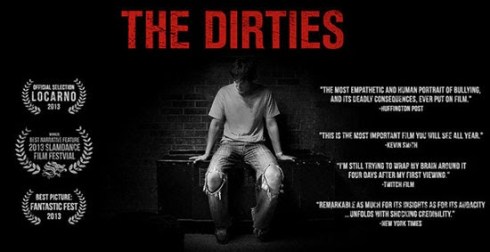
In 2013, an independent Canadian film called “The Dirties” premiered at the Slamdance Film Festival. Since then, filmmaker Kevin Smith helped with distribution by way of his company, Kevin Smith Movie Club, and it has since been released on home media and video-on-demand. Those who have seen it are rather split about it—some say it’s a fresh, compelling take on bullying while others either call it either a self-praising “meta-mockumentary” or an irresponsible look at a risky topic that shouldn’t be touched upon. That topic in question is “school shooting.”

There’s no doubt that whenever those two words are mentioned, people’s minds are at unease. People recall numerous horrifying occurrences in which students were killed by gunmen on campus, which then leads them to wonder why they happened to begin with. The answers from media and society are usually unclear, so people come to their own conclusions, mostly having to do with mental disorders or TV/film violence. “The Dirties” is a controversial film that raises similar questions but also manages to deliver its own interpretation as well.

The film is told through the perspective of a video camera and is about a teenage movie buff named Matt (played by writer-director Matt Johnson) wanting to make his own movie. He buys wireless microphones to use and has someone film him and his best (and only) friend, Owen (Owen Williams), presumably all the time. The movie he wants to make is a wish-fulfillment fantasy in which he and Owen exact revenge on a gang of bullies in their high school, whom they dub The Dirties. When that movie is complete, Matt comes up with an idea to make another movie—a more realistic one in which he actually brings a gun to school and shoots The Dirties. Owen doesn’t take Matt’s idea seriously at first, but he starts to question his sanity when he not only continues to play-act in front of the camera (as if living his own movie), but also has blueprints of the school and has been firing guns for target practice.

the_dirties_trailer_2_screen

The main character of Matt is trying to become a movie star of his own creation. He’s constantly making film references that no one else understands, tries to become the thing he’s referencing, and as the film goes on, he thinks less of what famous people would do and what he would do, since he has become what he usually references. And thanks to the obscure cameraman (whose identity is never revealed), he’s never alone. This is a modern problem in today’s society, that today’s kids film themselves and act in front of the camera. But Matt, who faces issues of bullying and alienation, actively puts himself on camera 24/7, and so he’s always trying to perform and he can’t seem to break out of it. Even when Owen acknowledges what he’s doing is insane, Matt can’t bring himself back to reality and instead wants to further his own interpretation of reality and continue making his movie.

Owen, meanwhile, would rather try something else than keep making a movie with Matt. He wants acceptance among his peers, which is something Matt clearly quit trying to achieve. He longs for the attention of a girl he likes; he wants to make new friends; he wants to try something new. The biggest turning point in his life is when Matt is so obsessed with his art that he never talks to Owen like a real person anymore and, even scarier, actually seems serious about conducting his own school shooting.

600

When looking for someone or something to blame for school shootings, media and society sometimes like to point the finger at violence portrayed in TV and movies, suggesting that watching it can make someone want to commit destruction. But this film shows how that’s actually never the case. What it tries to address is the issue of youth psychology and how it’s never always how we interpret it. According to filmmaker Johnson in an interview with cinema-scope.com, “The news always tells you the story of the kid starting at the last chapter of his or her life: that kid was a loner, or whatever. Which is really irrelevant to what happened. If you actually wanted to know what happened to the kid, you look at the first 200 pages of his life.”

That leads into the film’s ending. Some people complain that the film ends anticlimactically with no clear reasoning or logic. It ends with Matt, after having shot The Dirties in the school hallway and scared away his classmates, finding Owen cowering in a corner. He says, out of breath, “What are you doing? It’s me.” The scene cuts to black, the end credits roll, and that’s the end. But if you really think about it, it ends where the typical news story would start. The news story would start where the tragedy ends, but the film is a representation of what happened beforehand, which no one would want to talk about.

“The Dirties” may be one of the most important films of recent years, delivering a compelling portrait of disaffected youth and a descent into sociopathic behavior. It accurately portrays kids with real issues—being bullied, isolation, moving on, drifting apart, and even at some points, being bullies to each other and eventually to their own bullies. When the promising sociopath feels like a real person, instead of a standard, cold, distant, ruthless, cold-hearted killer, that makes it overall tragic; when a funny, artistic, even empathetic guy is also bullied and more, that can cause him to take drastic measures for vengeance.

“The Dirties” is not merely an unflinching portrayal; it’s also a cautionary tale. The back half of the film is laced with misfortune (albeit with an underlying comic tone, brought on by Matt trying to keep things lighthearted). One scene features Matt telling Owen he thinks he might be a “psychopath”—is this a cry for help or more play-acting? Whatever it is, Owen doesn’t listen. Shortly after, Owen has moved on and become just another face in the halls and another member of society the film specifically criticizes—his mind is elsewhere and he doesn’t see Matt as a friend in distress. So, in a way, it’s Owen, Matt’s best and only friend, who actually drives Matt to do what he ends up doing in the end of the film. As Owen fears for his own life when he sees what Matt has become, Matt doesn’t understand what’s changed and why he can’t see him for what he is, hence the line, “What are you doing? It’s me.” It’s a truly sad moment. We know what’s really going on, but no one else does. Even Matt doesn’t see the trouble in what he’s done.

7823798324uhrwehiuew978234

It’s a challenging concept when the victim is the one with the gun, at least in this film. Many people who see the film arguably miss the point of it (or they’re too busy questioning the identity of the cameraman), but those who don’t can’t help but wonder: Who’s really to blame for occurrences like this? Are they portrayed the exact opposite way? Etc.

More people should seek out “The Dirties,” which is available on demand. It’s the kind of film that will force them to ask questions and find answers they’re uncomfortable about, and it also emphasizes the importance of reaching out and helping those who need assistance and companionship. If society chooses to ignore or mishear cries for help, even from their own friends, it can lead to damage to themselves and/or others. That’s the theory Johnson tried to portray in “The Dirties,” and it’s hard to argue that it’s far off.

My original review: https://smithsverdict.wordpress.com/2015/09/19/the-dirties-2013/

Deadpool (2016)

18 May

deadpool-movie-poster-2016

Smith’s Verdict: ***1/2

Reviewed by Tanner Smith

Comic-book movies have come a long way in the past decade, in that they’re taken more seriously and can have a nice balance of action and comedy (meaning they don’t have to take themselves seriously all the time). The heroes are more relatable, the stories are more intense, technology helps the action sequences look better, a good amount of comedy is supplied without getting too distracting, and we find ourselves long past the era in which the concept of a superhero movie was laughed upon. Of course, some of these superhero movies work more than others—for every “Captain America,” there’s a “Green Lantern”; for every “Guardians of the Galaxy,” there’s a “Fant4stic”; for every “The Dark Knight,” there’s a “The Amazing Spider-Man 2”; and so on. But the point remains—superhero movies in general are getting more respect (and it’s going to take something bigger than “Fant4stic” to kill audiences’ excitement for them). It’s an especially good time for Marvel, with Disney’s Marvel Cinematic Universe delivering such awesome entertainments as “Iron Man,” “The Avengers,” and the “Captain America” movies, among others.

But as fun as they are, I think we can all agree we know what most of them are doing. Many of these movies try so hard to be taken seriously that we can’t help but talk back/make wisecracks to the movies. That’s especially true of origin stories—the stories that show how Super-Somebody became Super-Somebody. They usually involve these tropes we’ve all seen before: the death of a loved one; the villain rising to power not long after the hero gains abilities; loved ones are kidnapped by the villain; the hero learns very quickly; anything is possible as long as there’s some scientific babble to back it up; there’s a big fight between the hero and villain; the hero always survives, no matter what; and of course, the reluctant hero doesn’t want to be a superhero but ends up becoming one anyway. It’s interesting to see where a hero gets his or her start, but these origin stories are mostly predictable.

That’s why when something as flat-out entertaining as “Deadpool” comes around, it’s all the more welcome. Why exactly, you may ask? Because this is a superhero origin-story movie in which all the tropes are present and the story is as standard as can be, and not only does it know it but it revels in knowing it. It has fun with it—the hero is a smarmy jerk who breaks the fourth wall, makes one goofy wisecrack after another, is actually an anti-hero, swears up a storm, and pretty much says and does many things you wouldn’t hear or see in any other superhero film. It’s almost like he’s (gasp!) one of the audience members (except I think he says most things we wouldn’t think to say; he has that much to say)!

“Deadpool” is based on the Marvel comic-book character, although it’s hard to imagine this playing any part in Disney’s MCU (this film is presented by 20th Century Fox; they redeem themselves after the Marvel mess that was “Fant4stic” last summer). But maybe that’s for the best, because “Deadpool” is what it is and its audience is appreciative for it. The film is immature, crude, and in bad taste…and I enjoyed it from start to finish. (What can I say? I need as much a good chance of pace as superhero-movie audiences.)

The hero is a rebel—a simple-minded, angry, wisecracking anti-hero who has one thing on his mind: vengeance. We see his origin story (yes, we get the darned “origin story” here) through flashbacks and see how Deadpool became Deadpool. Before becoming invincible due to mutation and spawning a red spandex outfit and mask to become Deadpool, Wade Wilson (played by Ryan Reynolds) was a mercenary in New York City. He fell in love with an escort, Vanessa Carlysle (Morena Baccarin), and they were going to be married. But when Wade developed cancer, he didn’t want to put Vanessa through the stress and left her. He sold his body to a shady scientific experiment, run by a British scientist named Francis Freeman (Ed Skrein), or Ajax as he prefers to be called despite Wade always mockingly calling him by his legal name, and his superhuman sidekick Angel Dust (Gina Carano). He realizes too late that he’s not being transformed by these bizarre mutation tests to be a superhero, but a super-powered slave. His cancer is healed, but side effects, in addition to strength and invincibility, include his face and body becoming horribly disfigured. He managed to escape, destroying most of the factory in the process, but sees himself as a freak whom he’s certain Vanessa wouldn’t take back. That brings us to now, where Deadpool is hunting Francis (er, “Ajax”) down to get a cure for his disfigurements (and kill him after he’s cured), mowing down his sidemen one by one. Watching from afar are two X-Men (yes, there are two X-Men in this movie)—Russian metallic giant Colossus (a CGI creation voiced by Stefan Kapicic) and an attitudinal energy-boosting teenage girl aptly named Negasonic Teenage Warhead (Brianna Hildebrand). They try to bring Deadpool to join them, but Deadpool doesn’t care about being a hero and just wants his girl (and his face) back…as well as Francis impaled by a sword or two. And he doesn’t care who he has to kill in order to get his life back to normal.

“Deadpool” is respectful of its source material. Deadpool is known for being very profane and committing graphic acts of violence—a PG-13 rating simply wouldn’t do for a faithful Deadpool movie (something every fanboy made clear when actor Ryan Reynolds pranked them on Twitter, fooling them into thinking it would be PG-13 instead of R). Sorry, parents who have no idea who Deadpool is and just wanted to take their kids to see a superhero movie on Valentine’s Day weekend. “Deadpool” is rated R for good reasons.

The offbeat style of “Deadpool,” which includes pop cultural references, fourth-wall breaking, one-liners, etc., is especially welcome now, because in our day and age, we have seen so many superhero films (and enjoyed so many as well). Reynolds, director Tim Miller (making his feature debut), and writers Rhett Reese and Paul Wernick thrive in self-awareness and have fun with the superhero conventions. While I always have my guard up when it comes to this humor (read my “Me and Earl and the Dying Girl” review), it works here. Obviously, there are some jokes that don’t work, which usually happens when there’s one after another; but a great amount of the humor really worked for me, because a lot of it felt fresh and new. I didn’t feel tired of the peculiarity. I enjoyed it throughout.

(Oh, I should also mention the most original use of opening credits I’ve ever seen…but I won’t. See for yourself. The less you know beforehand, the better.)

Speaking of things I usually tend to try and resist, Ryan Reynolds is nothing short of terrific as the title role. While I like Reynolds in more subdued roles, like in “Buried” and “Adventureland,” he usually doesn’t do much for me, especially when he’s trying to be funny—he seems rather bland while desperately trying to make me think he’s funnier than he actually is. I can’t put my finger on it, especially when Reynolds is really trying to be funny here, but somehow he succeeds as Deadpool. Maybe I’m used to his style of acting, maybe he’s heightened up the amount of comic timing in his performance, but I think Reynolds is perfect in this movie. He’s not only able to make us understand what he’s going through but he is also flat-out hilarious throughout. Even despite his unorthodox, homicidal methods, he makes us surprisingly care for Deadpool, making for a very effective anti-hero.

“Deadpool” is a different kind of movie, to say the least. It pays homage to familiar tropes in the superhero-film genre, but it also chews them up, spits them out, and eats them back up again (sorry for the disgusting mental image). Is it closer to satire or parody? That’s a difficult question to answer, but either way, “Deadpool” is a definite comedic treasure for the comic-book audience and one of the best surprises of the year so far.

Hush (2016)

11 May

HUSH16REV

Smith’s Verdict: ***1/2

Reviewed by Tanner Smith

How do you make the Home-Invasion Thriller feel fresh again? Make the heroine a survivalist who disposes of the invaders left and right (“You’re Next”)? Have it occur on the one night in which all crime is legal (“The Purge”)? Well, either of those could work (…and unfortunately, they didn’t work for me—I didn’t particularly like “You’re Next” or “The Purge,” two more recent home-invasion thrillers), but the point is there needs to be something fresh and new about a very familiar setup. When I heard this detail about “Hush,” director Mike Flanagan’s take on the Home-Invasion Thriller, I immediately wanted to see it—the woman in distress, whose home is being invaded by a psychopath, is deaf and mute.

Comparisons to the 1967 Audrey Hepburn thriller “Wait Until Dark” have been tossed around in reviews. But aside from a vulnerable woman making the most of her handicap in order to fend off people trying to hurt her in her home, there really isn’t much of a comparison. “Hush” and “Wait Until Dark” are two different films with different styles, different material, different situations, and even a different handicap. I think “Wait Until Dark” is the better film of the two, but “Hush” is still a well-done, effective chiller with enough tension and scares to make for a suitably unpleasant viewing when you’re alone at night. (I watched “Hush” alone in my room at night, with the lights off, to see how effective it would be.)

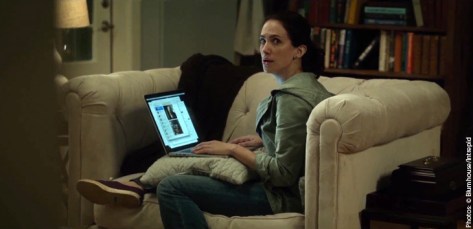
Like I said, the main character, a writer named Maddie (well-played by co-writer Kate Siegel), is both deaf and mute. She lives a quiet life while trying to finish her second novel in a nice, isolated house in the woods. Of course, this is the perfect place for a homicidal maniac to attack at night, and that’s exactly what happens. A masked man (John Gallagher, Jr.) arrives and starts to toy with her psychologically, sending her pictures he took from her phone to the laptop she’s using and severing all connections to potential help. She realizes what’s happening and finds herself in further danger when she discovers the body of a person the masked man has already killed and the masked man reveals his face, just so he can have reason to kill her. From that point on is a deadly game of cat-and-mouse with the deranged man sneaking around outside the house and the vulnerable Maddie desperately trying to outsmart him. Eventually, she finds the courage to fight back, having accepted her deafness as an advantage to inner strength.

“Hush” is director Mike Flanagan’s follow-up to an underrated supernatural chiller called “Oculus,” and he is a true talent in the horror-film genre. He does a terrific job at making the most out of a familiar premise. He sets up the character and the environment, with some background, in the opening, and then he really kicks things into gear with one eerie, tense scenario after another. While the final half is somewhat standard, Flanagan still remembers it’s important to make his audience wonder how something will happen in the outcome of the climax even when they have a good idea as to what could happen. He handles it all pretty well with a good amount of suspense and enough surprises to keep me engaged. I’m curious to see what he comes up with for his next film.