Jeepers Creepers (2001)

23 Oct

netnrr2jdc2qwx_1_b

Smith’s Verdict: **

Reviewed by Tanner Smith

You ever hear that expression “less is more?” “Jeepers Creepers” would have sufficed well with a lot less explaining and more subtlety. This is a horror film that begins as an interesting, tense, scary first half, and as it continues, it becomes even less successful while doing so. How? By explaining too much, and in the most improbable, silly ways too. Half of what is said about what’s going on here, and the motivations behind it, you can’t possibly take seriously because it’s all too ridiculous. This is not the film we started out with.

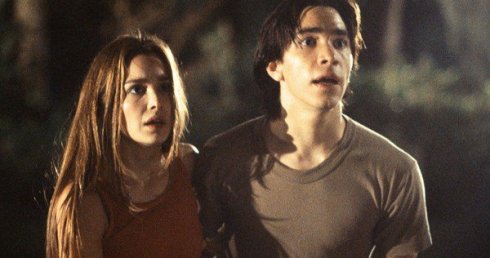
The film does start out fine, as we’re introduced to two likable characters—a college-age brother and sister driving home together for spring break. Played by Justin Long and Gina Philips, Dary and Trish engage in friendly, convincing sibling-banter and feel like real people. While they can be a little annoying at times with their ways of passing the time (exchanges of “nuh-uh” and “uh-huh” over and over again, for example), they are mostly likable enough for us not to want anything bad to happen to them.

On their drive, they encounter an intimidating truck whose (unseen) driver messes with them in a dangerous way. They survive, but later they spot that same truck, where the driver seems to have thrown a body down a pipe. Being out in the middle of nowhere with hardly another car and no way to call for help (and apparently there’s no cell phone service either), Dary bravely (though rather stupidly, but that’s what Trish acknowledges) decides to look into the pipe and see what’s down there. When he accidentally falls into it, that’s when he comes across a most grisly discovery. And that’s only the beginning…

And when Dary escapes and he and Trish make it to the next town, this is where “Jeepers Creepers” starts to go off track. Where do I begin?

Well, first of all, it seems the supernatural is an important element to this “driver.” It has its own theme song (“Jeepers Creepers,” no matter what tempo it’s being played at), and it apparently has its own omens too, like hundreds of crows and cats.

Second, it turns out it’s not a man at all. It’s some kind of winged beast that apparently eats body parts to compensate for what it doesn’t already have (eyes so that it can see, lungs so that it can breathe, etc.). All I’m thinking is, “What? Where did this come from, and how am I supposed to take this movie seriously anymore?”

Third, there’s a psychic. That’s right—there’s a crazy old lady in town who serves as the town psychic who can spew more exposition than you can think of, and probably more than she can even think of. Sometimes, I even think she might be making some of this stuff up—every 23 years, for 23 days, it gets to eat? You know, I think I give up asking.

I was rooting for “Jeepers Creepers,” as it began with atmosphere, tension, and actual character development (things that most horror films hardly bother with). And it is competently made. But while it certainly is ambitious, and while the monster itself would make an intriguing villain in a different light, it’s overdone and as a result is just plain silly.

Lady in the Water (2006)

23 Oct

1200

Smith’s Verdict: **1/2

Reviewed by Tanner Smith

“’Lady in the Water’ and ‘The Happening’ are too goofy for me to hate” –excerpt from my “Devil” review

I can’t rationally defend M. Night Shyamalan’s “The Happening”; on a critic’s level, I gave it one-and-a-half stars. But on a personal level, it’s one of the most fun so-bad-it’s-good movies I could pop in every once in a while. We all have our guilty pleasures. But I do feel bad for holding guilt over enjoying three movies under Shyamalan’s name (“Lady in the Water,” “The Happening,” and “Devil,” all of which are silly in many different ways). I know this filmmaker is an easy target for ridicule and mockery, but remember: this is the same guy that brought us “The Sixth Sense,” “Unbreakable,” “Signs,” and “The Visit.” (I don’t even mind “The Village.”) Yes, I hated “The Last Airbender,” but I can’t hold that over his head like most people on the Internet do.

“Lady in the Water” is a film people use to mock Shyamalan for making it. But is it really deserving of much hatred?

This was Shyamalan’s departure from Disney Studios, having Warner Bros. present the film instead. Even though Disney was going to fund the movie anyway due to Shyamalan bringing them hit after hit after hit, Shyamalan took offense at the executives who took a look at his script and said they didn’t understand it, and he left. So let’s see what they didn’t understand…

Based on a fairy tale Shyamalan told his children before bed, “Lady in the Water” brings depressed apartment-building superintendent Cleveland Heap (Paul Giamatti) in the middle of a strange “bedtime story” come to life, once he meets a water nymph that comes from the swimming pool. She is a “narf” named Story (played by Bryce Dallas Howard), who has come from the Blue World to inspire a budding writer who lives in the building and whose writing will change the world for the better. Once that is done, a giant eagle known as the Great Eatlon will come and take her back home. One of the tenants, Young-Soon (Cindy Cheung), is reminded of an Eastern story like this, and so, she brings her mother (June Kyoko Lu) in to tell him the story so he (and we) can fill in the blanks to find parallels to what’s happening here. There are also monsters lurking outside near the pool—wolf-like Scrunts who leave poison with their scratches, and monkey-like Tartutics who serve as the Blue World’s peacekeepers who attack Scrunts. Cleveland agrees to protect Story, as he searches the building and tries to determine which of his tenants is the writer and which of the rest of the tenants are chosen to assist Story in her journey home—a guardian who can fend off the Scrunts, an interpreter who can read messages in mundane features, a healer who can heal Story’s wounds, and a group of helpers.

I will give this movie credit for its originality. All this talk about the things in this “bedtime story” combined with modern-world parallels is intriguing, even if some of it does seem ridiculous. (And I’m not going to lie…it is kind of ridiculous. Even Cleveland laughs at how silly some of this is on some occasions.) And I do like how this movie establishes its environment within this apartment building, with many different characters with different purposes banding together to help save this “narf.” (Even that word “narf” sounds ridiculous.) But the problem is this story contains so many essentials that it gets kind of hard to follow. On top of that, we never see the Blue World. We only hear about it as we follow Cleveland and learn things as he goes and finds out more. The more that becomes thrown at us, the more lost people can become. Sad to say, this may be what turned Disney off on the script.

(Oh, and the said-interpreter who can read messages in mundane features? It turns out to be a little boy who can decode secret messages through cereal boxes… Yeah.)

So, who plays this specific author whose storytelling will better humanity’s future? M. Night Shyamalan himself, of course. This was not a good move. It’s not because Shyamalan is wooden in the role but because it enforces his detractors’ general view of his probable egotism. I mean, think about it—Shyamalan is playing a writer who isn’t fully understood yet but his book about world views will many years later inspire a future leader (and someone will take his life because of it). That’s…a little too easy.

Shyamalan has also included a character who is a snooty, cynical film critic named Farber (Bob Balaban). Farber is a critic who complains about everything, thinks he knows what’s going to happen here and there (whether it’s in a movie or not…or this movie), is so full of himself, and (SPOILER ALERT) gets brutally murdered by a vicious beast. Obviously, this is a stereotype of people might think a film critic is like, because very few critics in real life are like this. So I like to think this is Shyamalan’s way of making fun of people whom he thinks don’t understand his work some of the time (and maybe, since Farber points out some self-aware commentary about the goofiness the situation may seem, it’s his way of addressing the film’s criticisms before the critics could get to it). I’m thinking to myself, “OK, this is kinda fun. Shyamalan’s making jokes about critics.”

That’s why it baffles me when people take it seriously, like Shyamalan was taking non-subtle jabs at his hecklers and saying no one will understand him and they don’t deserve to. I didn’t have a problem with it—they’re just jokes. So what?

Let’s get to more of the positives, now that I’ve described the problems people have with “Lady in the Water.” As I said, I like certain elements of this story being told, but I also really cared for the person learning all of these things. Paul Giamatti does a great job as this depressed man who lost his wife and children to a burglar/murderer. His mannerisms are convincing (even his stutter, which sounds remarkably realistic) and you feel like you reach out and touch this guy, like pat his shoulders and tell him everything’s going to be OK. Some of the side actors playing the tenants are really good as well, such as Bob Balaban as the critic, Jeffrey Wright as a crossword-puzzles whiz, and Sarita Choudhury as Shyamalan’s character’s helpful sister. Unfortunately, I can’t say the same for Bryce Dallas Howard, whose character of Story is ineffective as merely a plot device who doesn’t really do anything herself, aside from whimper and whisper throughout the entire movie. I’m not saying this is Howard’s fault; she just has so little to work with, despite the movie being named after her.

What else do I like? The music score by James Newton Howard. The music is outstandingly good; it becomes a character of its own. I wouldn’t mind listening to this soundtrack and coming up with my own movie based around it.

I also admired the spiritual aspect of the movie. According to Young-Soon, the moral of the bedtime story is no one knows for sure who they are, and it takes everyone in the movie to understand their place in this world in order to save the day.

I notice the flaws of “Lady in the Water” and I can see why people make fun of it, but there’s just something so fascinating about it. I admire what Shyamalan was trying to do, even if some of what he did backfired. I hear there’s a book about the making of this film (entitled “The Man Who Heard Voices: Or, How M. Night Shyamalan Risked His Career On a Fairy Tale”), and I’d be interested to read it. This movie garnered enough interest for me to find out more about it. And this is a guilty pleasure I certainly hold guilt on but I enjoy watching every once in a while as well.

Ouija: Origin of Evil (2016)

22 Oct

ouija-origin-of-evil.jpg

Smith’s Verdict: ***

Reviewed by Tanner Smith

I didn’t write a full review of 2014’s “Ouija,” because it can be summed up very quickly. It’s lame, dumb, badly-written, and contains a nonsensical twist that makes it worse. Dumb, bland teens play with a Ouija board, bad things happen, they get picked off one by one by a malevolent spirit. You’d think these idiots would’ve seen the “Paranormal Activity” movies to learn not to mess with things they don’t understand. It’s a boring movie with very little to it, other than…the filmmakers wanted to see if they could make a movie about playing a supernatural board game. (Unless it’s Jumanji or Zathura, I don’t care much.)

Side-note: Yes, I know people are terrified of the Ouija board game, but if it was a real hazard to everyone, do you think they would’ve kept it stocked in toy stores all these years? Besides, according to renowned demonologists Ed and Lorraine Warren, it’s not the board game itself that lets in demons; it’s you inviting them in. (You could basically do the same thing with Checkers pieces or a Twister dial, or, if you saw “The Conjuring,” a music box or a doll.) The Ouija board is just a toy. But due to the spiritualistic elements surrounding it, it’s easy for filmmakers & storytellers to try and use Ouija for purposes usually relating to horror elements, which leads us to…

Even though “Ouija” was universally panned by critics, it made a bundle at the box office, leading to the studio getting a half-baked idea that it might warrant a sequel. I have no idea what the planning process was like, but I like to think that studio executives, as well as producer Michael Bay (yes, THAT Michael Bay, whose track record with the horror films he produces is very off-putting), knew there was nowhere for this “franchise” to go but up, and so maybe they knew they had to make this new one as good as possible. Who’s a good director who knows how to make horror movies? Who can take what little the original film had to begin with and make something gripping and scary out of it?

Mike Flanagan is the one they chose to take Ouija in a new direction. His previous horror films include the underrated chiller “Oculus” and my favorite horror film of 2016 by far, “Hush,” so I’d say that was a very good choice. And if you saw my Verdict rating above, you know I think Flanagan did a very good job with “Ouija: Origin of Evil,” a prequel to the 2014 film. I was surprised by how smart and how genuinely chilling this movie is, especially considering its deplorable predecessor.

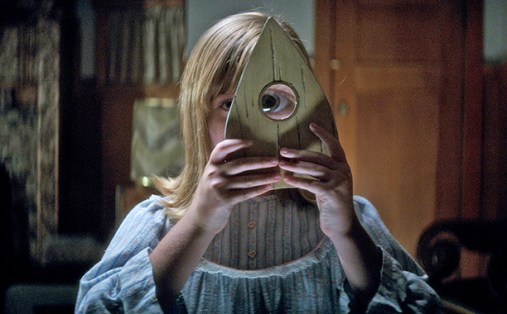
Set in 1967 (47 years before the other film), “Ouija: Origin of Evil” focuses on one family (as opposed to a group of stock dead-meat teen characters in the first film). California medium Alice Zander (Elizabeth Reaser) is a widowed mother to rebellious 15-year-old Lina (Annalise Basso) and adorable 9-year-old Doris (Lulu Wilson), all of whom are adjusting to life after the sudden death of her husband/their father. Alice hosts séances at home for clients, and her daughters help make the illusion more practical. But they mean well; Alice assures her children that they’re not scammers and they do it to help people, even if their methods are showy. But they themselves would appreciate a real way of connecting to the afterlife.

Alice buys a Ouija board game (property and trademark of Hasbro, whom I hope has a sense of humor in allowing their product associated with grisliness) and rigs it for use at séances. But when Doris begins playing with it, the family discovers to their amazement that they can really communicate with authentic spirits, including the man they lost.

This is a very intriguing premise so far, as we see people using phony methods of connecting with spirits and are bewildered by the discovery of something more real than they expected. But it’s not fun for long, as Doris is in contact with spirits who are much less than friendly. Soon, she is possessed by a black-skinned demon (Doug Jones…of course, Doug Jones). Alice is still blinded by the amazement she feels for the whole ordeal, but Lina is suspicious and seeks help from priest Father Tom (Henry Thomas), who discovers there is far more sinister going on with poor little Doris than Lina or Alice ever expected.

Flanagan has fun with the ‘60s setting, littering the film with retro callbacks, such as space-program references, retro fragments such as the roman numerals (of the date) at the bottom of the title card, the classic Universal logo that opens the film, and even inserting little black blips at the top-right of the screen to make it appear as if it was projected on film. With the exception of an obvious CGI figure that (thankfully) only pops up about 2-3 times, “Ouija: Origin of Evil” looks and feels like a film that was made and released in the late-‘60s. But Flanagan also knows how to use scares effectively. He uses jump-scares scarcely (I think the first fake-out scare was intended to be funny rather than annoying, thank goodness), he eases people in with tension and a creepy feeling without overloading the buildup with falseness (a problem most horror movies face today), and then, in the overbearing climax, that’s when he pulls out all the stops. That’s what a good horror film is supposed to do: ease the audience into its weirdness/creepiness and let it all out when the time is right, by which point the audience is very much on-edge.

But wait, you may ask. How is it scary? Flanagan uses creepy visuals, even out of focus in the background. He shows horrific things happening. And like I said, he uses false jump scares scarcely—when there are real jump scares, there’s actually something to be scared of. (I know, a shocking concept, right?) And overall, it’s creepy. It leaves you with the knowledge that there are dangerous forces at work and are playing with Doris’ mind and haunting Alice and Lina’s lives, and it builds its suspense from there. The climax is a little overbearing, with everything becoming a threat around every corner of this house (including a creepy basement and a hidden room), but it deserves to be by that point.

But a horror movie wouldn’t be nearly as effective if we didn’t care about the characters this stuff is happening to. Flanagan manages a win with this as well, picking three very good actresses (Elizabeth Reaser, Annalise Basso, and Lulu Wilson) who successfully deliver a family dynamic and play people we care about and fear for. Henry Thomas is also solid as well, playing a man of God who is also looking for otherworldly answers ever since his wife died.

It’s important to note that no one needs to see the 2014 “Ouija” film before seeing this “prequel.” This works perfectly well as a stand-alone story, and its predecessor needs no more attention than it already got. “Ouija: Origin of Evil” is much better than it deserves to be. Not that I would want another “Ouija” movie to come from this—I mean, after all, just like there was nowhere for the franchise to go but up, this franchise seems like it can only go downward from here.

The Final Girls (2015)

14 Oct

1474240819793074470

Smith’s Verdict: ***

Reviewed by Tanner Smith

“The Final Girls” wants to be both a satire and a loving homage to ‘80s slasher horror films, but I don’t recall any “Friday the 13th” or “Sleepaway Camp” film (and yes, I’ve seen my share of those films) with a universe so…colorful. Let me explain—“The Final Girls” is about a bunch of modern teenagers who are magically transported into the world of an ‘80s slasher film they were watching, and this new dimension is the mid ‘80s in full Technicolor. The flowers are artificially colored, the leaves are brightly green, the characters wear bright colors, and so on. This is more like “Hot Tub Time Machine’s” interpretation of the ‘80s than, say, “The House of the Devil.” (Both “The Final Girls” and “Hot Tub Time Machine” apparently picked the same ‘80s year too: 1986. Odd coincidence.)

But no one should be complaining too much, because the overly-retro look of the exaggerated movie-‘80s adds to the fun. We can associate it with the ‘80s, and that’s good enough. “The Final Girls” is meant to be a spoof rather than a genuine horror film. And while it lampoons its own nostalgic callbacks with self-awareness, it embraces them with admiration too. We get the stereotypes (the jock, the slut, the token minority, etc.) lined up for slaughter by a silent, demented killer in a secluded summer camp, accompanied by present-day young people who observe the madness.

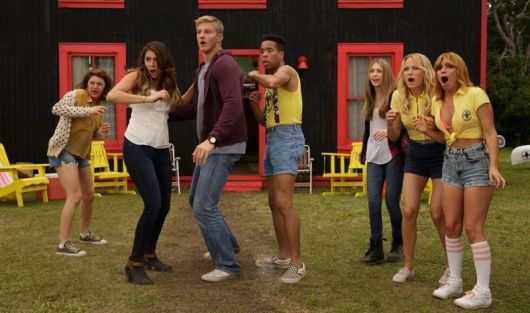
The main character of “The Final Girls” is Max (well-played by the appealing Taissa Farmiga), a college student whose mother (Malin Akerman) played one of the many victims in a popular mid-‘80s slasher film, entitled “Camp Bloodbath.” A year after her mom dies in a car accident, Max reluctantly agrees to appear at a “Camp Bloodbath” retrospective as a favor to Duncan (Thomas Middleditch), the nerdy stepbrother of Max’s sarcastic hipster friend Gerty (Alia Shawkat, “Arrested Development”) who arranges the screening at a local theater. Accompanying Max, Duncan, and Gerty are Max’s sensitive-jock crush, Chris (Alexander Ludwig), and an unwelcome Vicki (Nina Dobrev), who can’t seem to get over the fact that she and Chris are broken up. Soon after the movie starts, the theater is caught on fire, and the five kids try to escape behind the screen. They realize too late they have actually escaped through the screen and into the movie itself.

They find that the movie plays on a loop and the only way to get out of it is to go through it with the central characters. This proves to be a difficult task, as things seem too real in this world, especially the killer who waits in the woods for the perfect (and appropriate—or inappropriate) moments to strike. Now they have to try and make it through the film without becoming victims themselves.

Another difficulty in this journey is the reunion between Max and her mother—er, her mother’s character, in her early 20s. Max wants to make sure her mother doesn’t fall victim to the killer, thus trying everything possible to change the course of the film. The relationship between Max and her mother is very strong and helps bring an emotional backbone to a film that is otherwise a joyful romp. The film is surprisingly serious-minded when it comes to this aspect’s themes of loss, redemption, and fear of losing again. On top of that, both actresses play their roles very well. And this relationship also has light comedic purposes, such as Max having to play mother to her own mother, whose character is eager to lose her virginity to the class-A horn dog Kurt (Adam DeVine), which will of course result in her murder by the on-looking killer. That’s funny, but it’s also emotional when you consider that she feels the need to protect her from the hardships of the real world.

One of the film’s running gags is that these five central millennial characters have to play practical parental roles to these ‘80s-movie archetypes such as teaching the airhead slut Tina (Angela Trimbur), And these types are more than exaggerated, which should irritate me but strangely left more of an impact on me as it went on. Maybe it had to do with the context of 2015 archetypes going through all this—somehow, it makes me wonder what people are going to make of this young generation decades from now. What would they see in us (or in our movies) that we simply don’t see ourselves today?

Wow, I just wrote myself into a philosophical topic in a review of a broad comedy.

You know what? I’ve said enough. Check out “The Final Girls.” It’s entertaining. It’s funny. It’s cute. It’s even touching at times. It’s well-written, and it’s worth nothing one of the writers was Joshua John Miller, whose father was Jason Miller (well-known as Karras of “The Exorcist” fame); maybe he developed the character of Max as a way of dealing with his own parental loss. And of course, it’s very colorful. Metaphorically and literally.

Evil Dead II (1987)

13 Oct

evil-dead-2-movie-image-2.jpg

Smith’s Verdict: ***1/2

Reviewed by Tanner Smith

I’m sure some people are looking at the “Smith’s Verdict” rating and thinking, “What?! This so-called ‘critic’ didn’t give ‘Evil Dead II,’ one of the best movies ever made in the history of mankind, a four-star rating? Or even a FIVE-star rating?! I’m so mad, I’m going to unsubscribe from his blog right now! That’ll show him for giving ‘The Goonies’ a higher rating than this movie!” There is an explanation for that—a selfish reason, but still a reason all the same. “Evil Dead II,” Sam Raimi’s sort-of sequel to his 1981 gory, goofy horror classic “The Evil Dead,” is a hell of a good time—a slapstick comedy in the guise of a horrific supernatural shocker. It is a relentless, outrageous (and yes, also groovy) romp with lots of blood, gore, slapstick, gags, practical effects, crazy camerawork, fast editing, energetic spirit, an awesome hero, and an overall uncompromisingly zany style to it. Since then, it has become a cult classic like no one’s business, with many, many people praising it to high heaven (ironic, considering this movie features many, many demons in it), watching it every Halloween, showing it to their friends, and calling it one of their favorite movies. It was definitely the movie that put Sam Raimi in the spotlight, causing him to make another sequel (“Army of Darkness”) and eventually make more mainstream movies (such as the “Spider-Man” trilogy later on), and I think it’s safe to say it made actor Bruce Campbell the star we know him as today.

The film is technically a sequel to the original film, but it’s more of a remake. It was supposed to take place where the original left off, but the sequel’s new studio couldn’t get the rights to footage from the original for a recap, and so, they shot new footage for a prologue, explaining why Ash (Campbell) is at that creepy cabin in the woods and how the Necronomicon Ex-Mortis (or “Book of the Dead”) has brought forth an evil entity that threatens to consume his soul. He barely survives but can’t escape the evil, and he’s left to face off against whatever this force can throw at him in a night of battle against non-stop over-the-top macabre components. Ash isn’t one to give up so easily—even when he is forced to cut off his right hand, which was possessed by a demon, he eventually has it replaced…with a chainsaw. Is that “groovy” or what?

The film is similar in style to the original “Evil Dead” but not necessarily in tone. The original intent of “Evil Dead” was to be legitimately scary, while the main intent for “Evil Dead II” is to be ludicrously comical. Raimi and his crew pull out every trick in the bag to make something so absurd into something so fitting, and it really works. This movie is a lot of fun to watch as a result, and that’s why people love it so much. Absolute slapstick (such as when Ash’s hand punches him in the face or grabs his head to smash against dishes and windows) and one-liners (such as when Ash shotguns a demon who wants to “swallow [his] soul”—“Swallow this”) add to the humor aspects of the movie. “Evil Dead II” can unsettle you if you don’t like nasty, creepy-looking, possessed people or mangled deer heads coming to life and laughing maniacally (yes, that’s in this, if you haven’t seen the movie already) or lots and lots of blood (sometimes in different colors even), but it’s not here to scare you or even to necessarily gross you out—it’s here to make you laugh.

So, what do I think would make “Evil Dead II” a better movie (and by that, I mean a four-star movie rather than a three-and-a-half-star movie)? Well…if it had no one else except Bruce Campbell in it. I mean it—if it was just the ever-awesome Bruce Campbell taking center-stage throughout, fighting off many supernatural beasties (or “Dead-ites”) with no outside help whatsoever, I would’ve given the movie a four-star rating. But instead, Raimi decided to bring in some annoying visitors for the demons to kill. They are Annie (Sarah Berry), whose father owns the cabin; her boyfriend (Richard Domeier); and a redneck couple (Dan Hicks and Kassie Wesley). I get that they’re here to be picked off one-by-one, and they’re supposed to be funny, I suppose. But I wasn’t amused by them and I found them annoying and too dumb for me to care. The stuff with Ash fighting off the forces of darkness is great on its own; if the movie was just about this macho-dude-turned-badass-hero against an army of demons, then I would’ve given it four stars. That’s a compliment to Bruce Campbell, who is so much fun to watch in a movie that is so much fun to watch, despite my nitpick about the other characters.

The Martian (2015)

12 Oct

The-Martian

Smith’s Verdict: ***1/2

Reviewed by Tanner Smith

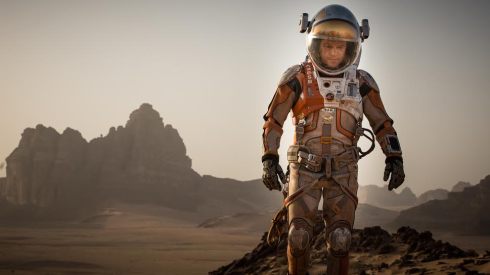
“The Martian” has an intriguing premise: an astronaut is left behind on Mars after a fierce storm caused his crew to believe he was dead. Now he’s alone and stranded on a desolate planet and must rely on his skill, inner strength, and wit to survive and find a way to contact Earth. From there, it’s a question of whether or not he can leave Mars and get home.

One of the biggest pleasures of this science-fiction drama, based on the novel by Andy Weir, is the humor that allows itself within it. It’s relatively realistic and believable in its science (at least, for me—I’m not a scientist) and its dramatic moments are warranted and very effective. But at the end of the movie, it’s easy to realize it was still a lot of fun. The film has a sense of humor, with a clever, sharp script, which requires the characters to say many witty lines of dialogue.

Some examples:

  • “Mars will come to fear my botany powers,” states astronaut Mark Watney (Matt Damon) when he realizes he has to “grow food on a planet where nothing grows.” Luckily, he’s a botanist.
  • “They say once you grow crops somewhere, you have officially colonized it. So, technically, I colonized Mars. In your face, Neil Armstrong!”
  • “I’m going to have to science the shit out of this.”
  • At the time NASA officials finally realize one of their astronauts is stranded on Mars, one of them (played by Chiwetel Ejiofor) wonders “what this does to a man psychologically.” The immediate cut back to Mars results in probably the funniest moment in the movie (which I will not reveal here).

I wasn’t surprised by this welcome comic angle to what would otherwise be just a tense, dark sci-fi thriller when I realized who wrote the screenplay—Drew Goddard, who wrote and directed the delightfully entertaining “The Cabin in the Woods.” However, I was surprised to find it was directed by Ridley Scott, who has made films such as “Alien,” “Blade Runner,” and “Prometheus,” neither of which are as cheerful or even as adventurous or hopeful as “The Martian.” I still like those movies, but I kind of appreciated this change of pace more.

And that’s really what it comes down to, more than the movie being humorous—it’s hopeful. The main character is an optimist. Even though he’s trapped on a desolate planet with very few resources on hand, he simply states, “I’m not going to die here.” So he does everything possible to make sure everything’s going to be fine (and also that he believes it himself). Even when things are at their darkest and he starts to doubt himself, he knows that it’s better to die fighting than not try to survive. I admire stories that show how a lone survivor in a dire situation copes with seclusion (like “Cast Away,” “Gravity,” “127 Hours,” “Touching the Void,” among others), and “The Martian” has a real good share of challenges, both internally and externally, and they’re all captivating.

The film cuts back and forth from Mark’s experiences on Mars to the many attempts of NASA on Earth seeking to find a way to save him. A month after mission controller Vincent Kapoor (Ejiofor) and NASA director Teddy Sanders (Jeff Daniels) made the news of Mark’s death public, they do become aware of his survival, and they find ways to communicate as they race to find a solution to the problem. This is, of course, after stick-in-the-mud PR director Annie Montrose (Kristen Wiig) mentions how bad it would make NASA look if they announced they were wrong about Mark’s death—nice sense of priorities there. (Commentary!) The film also cuts to Mark’s crew in space (played by Jessica Chastain, Michael Pena, Kate Mara, Sebastian Stan, and Aksel Hennie), as they realize what’s happened as well and have to make a choice to either defy authority to turn around and go back for Mark or continue straight on to Earth and hope for the best.

Another statement about the humor—it’s low-key. The film doesn’t lose sight of the urgency of the situation at hand, but it also knows to lighten up at times, which I greatly appreciated. But the main reason it works perfectly in a story that would otherwise be a dark, deep, depressing exploration of a man’s awareness in a remote area is because these characters feel like real people. Many of the things they say feel like what most of us would say, even the one-liners; in fact, especially the one-liners—most of us like to joke in order to relieve ourselves of some stress at times. (I know I do.) The scenes in which Mark expresses himself in his video logs leave opportunity for this humor to shine in particular. Even in the scenes set on Earth, even though they’re not widely comedic, they are played with a relaxed susceptibility.

I could relate to Mark easily; he feels like a real, likable, easy-going person and not merely a plot device. A lot of credit for that goes to Matt Damon, who turns in one of his truly best turns in a long career of strong performances (right up there with “The Departed” and “Good Will Hunting”). He shines brightly in a movie in which he’s allowed to, having only himself to work with. He has to portray every emotion imaginable in this ordeal—fear, optimism, enjoyment, hopelessness, anxiety, agony, whatever…and he does it all brilliantly. There isn’t a false note in this performance at all.

Of course, I can’t talk about a movie set on Mars without talking about the look—Mars looks suitably unwelcoming as is expected, the special effects are top-notch, and the visuals are nicely done. What else can I say? But then again, what all do I want to say? The effects aren’t the focus of the movie, which is always a refreshing change of pace for a sci-fi film.

I mentioned “The Martian” in my “2015 Review” post. I said, “With this and the new Star Wars film, maybe now we’re moving toward an era where our sci-fi blockbusters can have characters most of us optimistic wiseasses can actually relate to.” What I meant was, if these movies can continue to have their characters say things most general audiences would say if they were in the same situations, that makes the characters more relatable and therefore more sympathetic, and therefore they make us more willing to care for them. Keep this up, filmmakers of mainstream blockbusters, and we’ll be out of a cinema slump that people on the Internet claim we’re living in. (By the way, guys, that’s not true—just keep looking for movies like this one.)

United 93 (2006)

11 Sep

MCDUNNI EC034

Smith’s Verdict: ****

Reviewed by Tanner Smith

There is a particular film I will only watch about once a year because even though I see it as a great piece of work that affects me prominently with each viewing, it’s not a film I need to watch repeatedly. That’s because when I watch it once in a long while, its impact doesn’t leave me.

That film is “United 93,” a film directed by Paul Greengrass that takes us back to the day we faced evil so early in the 21st century: September 11, 2001. But the film is not here to exploit the horrible memories of that infamous date or take advantage of the guilt the survivors feel. It’s not a melodrama—it’s a grounded, documentary-like, fact-based account of the reactions of people witnessing horrific things in New York City as well as the events that transpired on United Flight 93, one of the hijacked airplanes. On top of that, the film is here for a very important reason: on the day America faced terror, there was still room for courage and heroism.

Three planes were hijacked by terrorists. One struck the Pentagon. Two struck the Twin Towers of the World Trade Center. The fourth, Flight 93, didn’t reach its target, the Capitol Building, due to the heroic actions of its passengers, who revolted against their captors. This film tells that story on that plane (from its boarding to its inevitable end), as well as witness-based accounts of people in other places such as NORAD and air traffic control centers in New York and Boston. It’s through these people we see situations advance, and it’s through the people on board Flight 93 we see others advance. And that’s it—we don’t see any hints of a conspiracy theory or patriotism or “the big picture”; we simply witness settings transpire, from the witnessing of the World Trade Center being destroyed to the pressing race against time to make important decisions (such as closing off US airspace) to the frightening hijacking of Flight 93 to the passengers’ rebellious attempt to gain control to its unfortunate (and inevitable) demise.

“United 93” is technically perfect. It strives on realism and feels like it’s really happening, which makes it even more haunting when you find yourself living what was by far the darkest day of the 21st century. Thanks to director Greengrass’ choice of using the documentary approach, you get a pretty good idea of what it must have been like seeing these terrible things for the first time, because you feel like you’re there. In addition to that, there are no recognizable actors to be found here (…except Olivia Thirlby, who plays one of the Flight 93 passengers, but this was before she developed a solid acting career). And the people portrayed in the film aren’t stock disaster-movie types. They’re just people, with no character biographies/histories. We only get to know these people as if they were strangers on that airplane or inside the National Air Traffic Center or the airport and so on, and only the slightest traits are developed. That also works in the film’s favor.

I want to use the portrayal of the destruction of the World Trade Center as an example of how this film works. When you first see the unforgettable image of the North Tower of the World Trade Center in smoke, your first instinct is to gasp, as you recognize what it means. This film perfectly portrays how the reactions must have been for the people seeing it for the first time, from afar. When you first see the smoking Tower in this film, it’s from a distance, through a window. An airport worker notices, and simply says to his co-worker in a somewhat awed manner, “Hey, look at the Trade Center.” As more people notice, there’s the amount of confused murmuring that grows into frightened exclamations when they get closer visuals on TV news. The fear escalates and grows stronger as they see another plane strike the South Tower, which results in the expected reaction, and it feels as real as when it actually happened. This film made me forget I was watching a film.

I didn’t see “United 93” on a big screen. I was even afraid to see it until five years ago, when I rented it on DVD. But A) watching it on a small screen still left an impact on me, and B) even though I was afraid to see it because I knew what it was about, much like people in 2006 who felt the release of this film was “too soon,” I saw the importance of why we needed this film. As much as we would like to, we will never forget the things we saw on 9/11/2001, whether on TV news or even firsthand. But we should never forget what the passengers of Flight 93 died for: our country. They were ordinary people who faced a horrifying situation, and together they stood to strike back against the terrorists or die trying. If not for them, the terrorists would have used the plane to strike the Capitol Building in Washington, D.C. Instead, the plane crashed in a field, as the passengers couldn’t get control of the plane as they reached the cockpit.

“United 93” is a film I will never forget, and aside from the film being powerfully haunting in the ways it portrays the tragedies of 9/11, maybe that’s why I choose to watch it only once a year. Its meaning and reason for being stays with me as time goes on. But I do choose to watch it occasionally to remind myself that on the day America encountered terror, there were still ordinary people who rose to the occasion and foiled a terrorist plot.

Contracted: Phase II (2015)

27 Aug

ContractedPhase2b.jpg

Smith’s Verdict: ½*

Reviewed by Tanner Smith

Before I begin my review of “Contracted: Phase II,” I should clarify something from my review of its predecessor, the 2013 body-horror film “Contracted.” I refrained from using a certain word that other reviewers were using; just one word that gave me a pretty good idea of how the film was going to end. Since this film picks up where the first one left off, I might as well just use said-word now. (And if you’re reading this, chances are you saw the first film to begin with.) The word used by critics was “zombie.” The main character, Samantha (Najarra Townsend), has been going through bizarre, scary changes, including her body falling apart, and guess what—she turns into a zombie. I bet you thought it was just a very messed-up sexually-transmitted disease, didn’t you?

Yes, apparently B.J., the sicko who gave Samantha the sickness to begin with (and is not played by Simon Barrett this time), is the carrier for a would-be zombie apocalypse.

Our hero in this sequel is Riley (Matt Mercer, reprising his role from the original). If you saw the original, you remember him as the guy who barely had a role aside from having a hopeless crush on Samantha, and it led to the point in which Samantha presumably gives him the disease near the end of the film. I remember writing in my review that I didn’t think that was warranted, since we hardly knew anything about him. And it’s amazing to see that even though most of this sequel is centered around him, I still don’t know a damn thing about him, nor do I care. He’s dull, uninteresting, and unsympathetic—he made me wish for the return of the comic-relief druggie from the original film. (That guy, played by Charley Koontz, does come back late in the film—I really wish he took center stage in this one.) I don’t blame Mercer for this; he just has nothing to work with.

Anyway, “Phase II” picks up where “Contracted” left off, with Samantha becoming a zombie and attacking her mother (Caroline Thompson) before being shot dead by police. And like I said, Riley now has the disease Samantha had in the original. His body’s falling apart, he feels a strange sensation despite his doctor saying he’s clean, and he tries to find answers as to what’s happening to him.

There’s really nothing to this movie. It’s pretty pointless, to say the least. The questions raised from the first film are answered, but they were answers most of us have figured out before we saw this second one anyway. There are some disgusting gory moments to gross the audience out, such as when Riley pulls a broken fingernail out of a claw mark on his back or when his nosebleed becomes too messy (and even leaks into cheese dip at a memorial service—blech) or even pulling out a maggot from under his skin…but then what? What else is there to this movie? There’s no mystery to keep us invested, either with Riley or with the police detective, Crystal (Marianna Palka, sporting an on-again/off-again American accent), investigating mysterious dead bodies, because we know what’s happening to Riley and we know what the detective is going to find. If nothing new could be added, why make a sequel at all? The original ended at just the right moment—nothing more was needed.

All the titular “Phase II” turns out to be is spreading the disease around, which was already implied in the original film—we understood that very quickly; B.J. was going to be responsible for creating more (sigh) zombies. (“Mankind is a bacteria that needs to be obliterated,” he says at one point.) The film tries to take a new interesting turn by having Riley attempt to track down B.J. and kill him, but even that doesn’t work because nothing about this development in both the story and the character of Riley turning into a public avenger seems interesting, let alone convincing.

The first “Contracted” worked as a character study with some horrific body-horror elements attached. This second film is not only a retread (minus interesting characters) but also a failed zombie movie—tame, weak, and ironically bloodless (figuratively). Needless to say, “Contracted: Phase II” suffers from the disease shared by most unnecessary horror films—the Pointless Sequel Syndrome.

Don’t Breathe (2016)

27 Aug

82c6KE9hGwj84cggRS6Swi-970-80.jpg

Smith’s Verdict: ***1/2

Reviewed by Tanner Smith

I wrote in my “Lights Out” review that 2016 was becoming a great year for smart mainstream horror. I also notice it’s been a banner year for confined thrillers—“10 Cloverfield Lane” has a maniac in a basement; “Hush” takes place at one house in which a deaf woman is vulnerable against a psycho (or is she?); the action in “Green Room” mostly takes place in a tight room in the back of a bar; and now, we have “Don’t Breathe,” in which unlucky burglars are trapped in a locked-down house with a blind war vet trained to kill.

“Don’t Breathe” brings a neat twist to the Home-Invasion Thriller. Of course, the particular example I think of is the 1967 thriller, “Wait Until Dark,” in which Audrey Hepburn is a blind woman terrorized by three thieves searching her home for something specific; they underestimate her and she manages to fight back. In this film, however, the thieves are our protagonists. And it’s not sweet Audrey Hepburn’s house they’re burgling—it’s rough-as-sandpaper Stephen Lang. He apparently has a stash of cash hidden somewhere in his house in the middle of a lonely neighborhood. The thieves—three arrogant teenagers (Jane Levy, Dylan Minette, and Daniel Zovatto)—hear about this and figure this will be their last score if they can pull it off. Because Lang is blind, they see this whole idea as an easy task, aside from the pet Rottweiler they have to sedate temporarily.

But in the middle of the gang’s search, the Blind Man (who’s never given a name) awakens after their chloroform bomb fails and knows there are people in his house. That’s when the teens realize they burgled the wrong house and messed with the wrong guy. And from that point, things go really, really wrong…

From that point, the film turns into a tense, chilling thrill ride that grabs you by the throat and doesn’t let go. From the cinematography to the sound design to the “how-the-hell-are-they-gonna-get-outta-this-one” situations (one after the other), “Don’t Breathe” is a nail-biting experience that hardly lets up once it gets started. When Stephen Lang is walking blindly in his house while looking for these kids, I feel like I should be holding my own breath, making sure I’m not heard either. The suspense is palpable throughout many of these sequences, and you wonder, from one scene to the next, how these kids are going to get out of each tight spot they’re stuck in. You really feel these kids’ mutual fear as they realize too late they made a huge mistake in thinking they could rob a blind person who may in fact be a psychopath, and you do root for them to either find a way out of that house without being caught somehow or even to steal the loot. (How often does a film come along in which you forget stealing money from a blind guy is a bad thing? To be fair, we do get early character-establishment scenes that show why these kids, particularly Levy’s character, need the money; so we at least have some understanding why she takes a chance at times.)

When it comes to messages, we see it mostly done in melodramas which most of us would rather not watch because a lot of them are portrayed in a very manipulative way. I feel with horror films, you can get the message out stronger. It can be summed up like this: “If you do this, you’re screwed.” The best way to sum up “Don’t Breathe” is, “Don’t underestimate the blind, because if you do, you’re screwed!”

OK, OK, so the film tries to stretch it out even longer by giving the Blind Man more psychotic tendencies (to say the least—but I won’t spoil anything here), but the point still remains: don’t underestimate the blind.

“Don’t Breathe” is a well-made, well-acted, exciting hell-ride that helps me further my statement that 2016 is a very good year for horror. We have four months left, so let’s wait and see what else we can get.

V/H/S/2 (2013) – V/H/S: Viral (2014)

27 Aug

VHS2-Short-Safe-Haven-Still.jpg

V/H/S/2

Smith’s Verdict: ***

Reviewed by Tanner Smith

As someone who enjoyed the found-footage horror anthology “V/H/S” as more-or-less a “guilty pleasure,” I was curious to see what could be done as a follow-up. Would “V/H/S” be a worthy horror franchise or would it wear out quickly after a desperate cash-grab attempt?

“V/H/S/2” (or “S-V/H/S,” as it was originally called) is about on par with “V/H/S” in that it’s uneven yet enjoyable for the best parts (just enough for me to recommend). There is one big difference, however—“V/H/S/2” has a middle segment that is creepier, more outrageous, and more fun than any of the other segments in either of the two “V/H/S” films. It itself is a terrific horror film worthy of a recommendation.

Once again, the wraparound story for the anthology involves people sneaking into a house and watching unsettling VHS tapes. While I thought the previous film’s connective tissue had some chilling subtle moments, I felt it was weak overall with a lack of clever resolution. But with this one (directed by Simon Barrett), I surprisingly found myself more involved in what was happening, as once again, little things change here and there that had me edgy—the surprise was I thought the twist was actually unique and well-done. My only problem with it is after the characters watch the segments in between. The things they see don’t seem to faze them very much; they just seem to shrug it off and continue to the next one each time.

The first segment (“Phase 1 Clinical Trials,” directed by Adam Wingard) is shown through a man’s ocular implant with a camera. The doctors warn him that the implant is experimental (hence the camera, to see how things go at first). Shortly after he gets it, he starts seeing visions of people who shouldn’t be there. It’s an unsettling, effectively done chiller with an ending that made me look away.

The second segment (“A Ride in the Park,” directed by Eduardo Sanchez and Gregg Hale) is shown mostly from the POV of a Go-Pro attached to a bicyclist’s helmet. The bicyclist is attacked by a zombie and soon becomes one himself. He turns others into zombies and they set off in search for fresh meat. This is a neat twist on the zombie-movie, with enough visceral gore to appease genre fans.

The third segment is the aforementioned best: “Safe Haven,” directed by Timo Tjahjanto and Gareth Huw Evans. The narrative here is more intricate than any of the previous segments, and it definitely works as its own short horror film. It involves a news crew getting the scoop on a cult run by an Indonesian deportee (played chillingly by Epy Kusnandar) who promises immortality to his followers. I could tell where this was going as soon as I knew a cult was involved, and it seemed to lead to where I thought it would. But after that, there was still about 15 minutes left to go…and man, I was way off! Would you believe me if I said Kool-Aid was the least of the worries here? This segment has a ton of surprises, neatly horrific developments, and unforgettable additional elements that make it worth recommending for all genre fans, if they can take it.

Unfortunately, after that, we get to the weakest segment in the series: “Slumber Party Alien Abduction,” from Jason Eisener (best-known for “Hobo With a Shotgun”). With a goofy fun-sounding title like that, I expected much more than what I got. Maybe it was because nothing could top “Safe Haven,” but I just wasn’t interested in this part at all. It’s fairly straightforward—teens have a sleepover, aliens invade, they try to get away, they get abducted, the end. Oh, and there’s a camera attached to a dog. It might be enjoyable for some, and it may not be fair comparing it to “Safe Haven” after all, but I expected a better end portion than this.

I recommend the film overall, but it really comes down to “Safe Haven.” It’s worth seeing just for its own insanely entertaining bit of craziness.

But then we take a step down in quality and quantity; the ultimate end of a promising horror franchise; the final nail in the coffin…
url.jpg

V/H/S: Viral

Smith’s Verdict: *

Reviewed by Tanner Smith

“V/H/S: Viral” is not merely bad—it’s obnoxious. With the previous films, you could tell they were labors of love from indie filmmakers having fun with this style of “hyper-realistic” horror. But with this, you can tell it’s a feeble cash-grab attempt. I don’t feel any passion put into this at all, and everyone else seemed to agree with me, as no future “V/H/S” films were planned since this film’s release.

I think what this film is trying to say is that we’re all obsessed with viral videos and many members of our generation are looking to capture the next best online hit. I think (but I’m not sure, as the motivations are muddled at best) that was the intention of the wraparound story to present that message. But the result is so confused and baffling that it’s hard to find the sense in it. Even the ending, which should spell out what it means, left me scratching my head. But on the plus side, it made me feel better to know it was over and I didn’t have to think about it anymore.

From what I could gather, it’s about teens trying to make their own viral videos and weird things happen that endanger their lives…and that’s all I got.

There’s no structure of people finding VHS tapes and watching horrific shorts. It’s just a bunch of random shorts thrown in between this strange supposed-wraparound.

(Just to state up front—I won’t list any names of the directors of these segments. I like to think I’m doing them a favor.)

The first random short is “Dante the Great,” which is about a magician who obtains a mystical cloak that truly is magic and gives him unbelievable power, which goes to his head. His assistant has to confront him and fight him one-on-one and somehow gain the upper hand against his real magic. This actually would be a neat idea and the effects are decent, but its execution is all over the place. Sometimes, it’s shown as a documentary. But then there’s hidden camera footage that no one could have gotten. There’s cheating in “found-footage,” and then there’s this.

The second segment is “Parallel Monsters” is a little better. It has an intriguing concept of a guy unlocking a portal to another dimension and switching places with his counterpart, only to find that it’s not what he expected at all. What he finds is creepy enough and it leads to some effective imagery. But unfortunately, it ends on a disappointing note.

After the passable “Parallel Monsters,” we are then cursed with the most detestable part of the film: “Bonestorm,” about a bunch of loud, rude, crude, vulgar, obnoxious, detestable skateboarders who go to Mexico and fight off a bunch of cult members looking for a sacrifice (I think; it was hard to tell exactly what was happening). This is what got me over the edge, as I facepalmed myself and wondered if it was even worth sitting through the rest of this thing. But I faced it head-on, as painful as it was. “Bonestorm” was such an aggressively bad short. Its shot choices are repetitive and with no style put into it, making it painful to look at—even skateboard videos and video games have more style than this thing.

Even the message of the film makes no sense! I just realized that even though there’s this stupid wraparound story that’s supposed to talk about young people and their obsession with “going viral,” neither of these three segments have ANYTHING to do with that in the slightest! They’re just random shorts trying to recapture that spirit of the previous films and failing miserably. No thought went into this at all. “V/H/S: Viral” is a lazy, badly-done conclusion of a “trilogy” made by people who I would guess didn’t care for what it was going to be as much as how quickly they could turn it in. I hated this movie.