Walk Hard: The Dewey Cox Story (2007)

18 May

539w

Smith’s Verdict: ***1/2

Reviewed by Tanner Smith

Let’s just get this out of the way. There’s a penis shown on screen for what feels like too long for a mainstream comedy, which in this case is “Walk Hard: The Dewey Cox Story.” It’s an unexpected, uncomfortable sight, everyone’s gone crazy about it upon the film’s release, and it seems executive producer/co-writer Judd Apatow has an odd obsession with showing the male anatomy (either that or his sometimes-collaborator Seth Rogen is an influence; see “Superbad,” for example). There, I’ve addressed it. Now let’s talk about how awesome the rest of this movie is.

Remember the golden age of parody movies when you could make fun of tropes in a particular film subgenre while also pay homage to them? Movies like “Airplane” and “Spaceballs” are within that particular field. But unfortunately, many of the parody movies we know of nowadays are the ones that merely mention what’s popular at the time and put more emphasis and effort on that than story and humor, which both need to be the biggest factors. But then along comes a gem known as “Walk Hard: The Dewey Cox Story,” a film that makes fun of musician-biopic stories while knowing what it means to parody something properly and be entertaining along the way.

You know the formulas of many music biopics and how overly earnest the films are in painting the portrait of tortured yet successful musicians. “Walk Hard” goes through all the conventions with an extreme lampooning style.

John C. Reilly stars in oddly enough one of his very best roles as Dewey Cox, a marginally talented country rocker who comes from a humble Southern background, where he experienced a tragic occurrence that cost the life of his brother. (He accidentally cut him in half while the boys were having a machete fight. What makes the scene even more hilariously tragic is the fact that the boy is still alive briefly after being “halved.”) Dewey’s father (Raymond J. Barry) hates him (and is always grumbling about how “the wrong kid died”) and he lost his sense of smell. But he can play guitar efficiently and sing well enough to get attention of some people, which leads to more people, which leads to a following, which leads to fame, which leads to drugs, sex, all that stuff you expect.

“Walk Hard” has it all: A) the disapproving parent, B) the cynical first wife (Kristen Wiig, very funny) who always reminds Dewey he’s “never gonna make it” even though he’s already successful, C) the drug pusher (Tim Meadows, also very funny) who’s always telling Dewey “You don’t want none of this shit” and yet somehow always convinces Dewey that DOES want “this shit,” D) a second wife (Jenna Fischer, also very funny) who has her own struggles with him such as resisting her own sexual urges, E) the ups and downs of fame and fortune, even going through Bob Dylan/Brian Wilson struggles in music and creativity, F) rehab, and finally G) redemption with a heartfelt song about Dewey’s life as a whole. What else does it have? Surprisingly, there’s heart in the midst of all the zaniness. I think a good reason for that is John C. Reilly doesn’t merely play Dewey Cox as a running joke but as sincere as possible, which surprisingly works—it makes the jokes more funny and you care somewhat about him too. Dewey Cox is just so…sweet! It’s hard not to care for him. The film was directed by Jake Kasdan, who co-wrote the script with Judd Apatow, and it’s clear they have some affection for Cox…don’t say that out loud, reader.

Many of the songs are heavy on the double-entendre fueled lyrics, making them highly amusing, particularly the title song “Walk Hard” (a play on “Walk the Line”) and especially “Let’s Duet,” a duet with John C. Reilly and Jenna Fischer. Say this out loud: “Let’s duet in ways that make us feel good.”

There are many other funny bits I haven’t even mentioned in this review, including a recording scene that feels very similar Brian Wilson’s (of the Beach Boys) drug-induced creative state, a callback to the Bob Dylan documentary “Don’t Look Back,” and especially the cameos from comedic actors portraying famous past musicians. (I’ll leave it for you to find out.) “Walk Hard: The Dewey Cox Story” is consistently clever, very funny, and represents the man, the myth, the legend that is Dewey Cox in a way that would make him proud if he were a real musician.
Sleight (2017)

17 May

sleight-2017-movie-image

Smith’s Verdict: ***

Reviewed by Tanner Smith

“Sleight,” directed and co-written by J.D. Dillard, is a film that tells the familiar dangers of urban society that we’ve seen in other films and even on the news, but in doing so, it inserts a fascinating element of trickery: the troubled young man caught up in trouble with gangs and drugs is masterful at illusion.

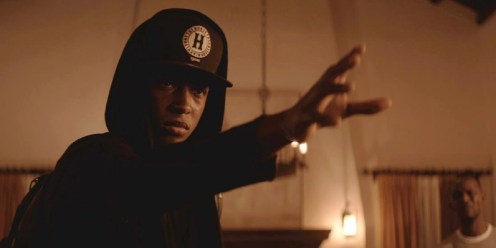
He’s a street magician, performing card tricks, floating quarters, and making swift motions. And he’s excellent at it. But being the sole provider for his younger sister requires more than spare change on the street for performing magic tricks. So, he’s a street performer by day and a drug dealer by night, making runs for a local crimerunner.

You expect things to go wrong for this 18-year-old kid, and they do. Soon, he, his sister, and his girlfriend are in danger, and he figures the best way to escape them is to face them. Predictable, yes, but the way “Sleight” goes about bringing this story to life is intriguing, particularly it comes to how the kid is able to perform these tricks and what he must do to get out of this mess.

An engaging lead helps a lot too. Jacob Latimore stars as the kid, named Bo, and his performance is nothing short of brilliant. He forces you to feel his plight (see what I did there?) and understand what he does and why he has to do it to survive. Even when things are at their most deadly, in a particularly tense scene in the middle, you see him balance the fear he feels with trying to keep a game face in front of people who will otherwise kill him. The supporting characters are good too, with Bo’s sister Tina played by Storm Reid and Bo’s girlfriend played by Seychelle Gabriel. Latimore and Reid play off each other perfectly, and you buy them as brother-and-sister. Gabriel plays an appealing love interest, who doesn’t know Bo’s nightly duties and is able to listen and understand when he finally comes clean.

Then there’s Dule Hill, a character actor who has done great work as mild-mannered schmoes in TV shows like “Psych” and “The West Wing.” Here, he plays the gang leader Angelo, and he’s quite effective at playing a straight-up A-hole, perhaps channeling Giancarlo Esposito’s despicable character in the similarly-themed 1994 film, “Fresh.”

Everything builds to an inevitable climax in which Bo must use his hidden abilities against Angelo and his gang in order to get control of his life back and protect the people he loves, after everything has gone almost completely to hell. By then, I forget about how expected the outcome will be and remember that the most important thing is how Bo is going to pull it off. By that point, I am engrossed in the character and all I care about is him making it out of this messy situation.

I’m recommending “Sleight” for what isn’t easy to do, which is to take something familiar and keep it engaging and intriguing. But after seeing it, do yourself a favor and forget about the “open-ended” ending. It’s highly unneccesary, especially when taking into consideration that “Sleight” already told a full story with hardly any loose ends to be tied in a sequel. “Sleight” told the whole story. There is a fitting epilogue that gives closure, and then everything almost feels botched by just one last scene that ends the film on an ambiguous note when it didn’t need to.

I know Jacob Latimore will be forgotten by the Academy when it comes down to announcing next year’s nominees for Best Actor, but he won’t be forgotten by me, because I think his is one of the best performances of the year. “Sleight” may be forgotten by most people because it’s a small film being released so early in the year (from what I can tell, the Academy has an attention span of 3-4 months maximum), but I can’t forget good work by talented people. And that is the greatest trick of them all.

Ridge Runners (2017)

7 May

11990460_1473819749611482_2363094005148470548_n

Smith’s Verdict: ***1/2

Reviewed by Tanner Smith

Recently, I saw filmmaker Hunter West’s debut feature “Ridge Runners” again (my third time seeing it at a film festival). At the Q&A following the screening, West mentioned how difficult it was to get the finished film out there, due to its content. The issue that takes center-stage in this tense dramatic thriller is a little girl as a victim of child sex trafficking.

“Ridge Runners” is a very disturbing film, and that’s not just because of the subject matter. In fact, none of the deeds associated with the central crime are portrayed on-screen (thank God). What is chilling and unsettling about the film is what is suggested throughout the film and what our protagonists (who are a duo of police detectives investigating the disappearance of a little girl) are trying to find out about. And there are some characters whose true colors are revealed late in the film—they truly made my skin crawl in the ways they explain what’s happening and why.

So, there you go—the film is well-made and very ominous, and the horrifying stuff is only implied. And yet it was a tough sell…think about that for a moment.

The message of “Ridge Runners,” directed by West and written by Austin Lott, is “Human Trafficking happens everywhere,” as stated by the film’s website (http://www.ridgerunnersfilm.com/) and a truly unsettling prologue (followed by a caption that states one in five human trafficking victims is a child). Our protagonists, police detectives Rachel Willow (played by Jennica Schwartzman) and Rob Shepherd (Austin Haley), discover this horrible truth upon investigating the mysterious disappearance of a 12-year-old girl. The more they uncover, the more horrifying the truth becomes. West reportedly was inspired to make this film because he heard of actual sex trafficking happening in his small town (and the film also takes place in a small town), and so he and Lott set out to make a film as a warning that this type of thing isn’t just an international problem or even a city problem—it can happen anywhere.

But it’s one thing to make a public service announcement about it; it’s another to make it work well. How’s the film itself? It’s essentially a TV-crime-show episode doubled in length and with arguably more detail in description (though not even that much). But it’s very effectively done, and the credit for that goes to West’s directing, Lott’s writing, and the acting, which also includes chillingly good performances by Charlee Graham as the girl’s mother coping with her daughter’s disappearance and Jason Thompson as her employer at a racetrack called The Ridge, among other fine supporting players. A good portion of the film is dialogue and performance, and while some parts are veering close to overuse of exposition (particularly early in the proceedings, when the girl’s mother is questioned by the detectives), it still works overall.

Some would say the film goes for the easy way out in the final act, but the outcome satisfied me, and I’m certain it satisfied many other festival audience members as well. I won’t go into it here, lest I give away potential spoilers, so I’ll just leave it at that.

“Ridge Runners” is an intriguing, effective and chilling tale about how evil can exist anywhere. And it wasn’t done in a preachy or overdone manner; instead, it was handled in a relaxed manner, more dignified than you’d expect with this material. The film is currently playing in festivals at this time, but it is now set for distribution. You can catch more news about that as it surfaces on the film’s website and also on Facebook: http://www.facebook.com/RidgeRunnersFilm/ It’s definitely worth checking out.

Chef (2014)

4 May

chefstill

Smith’s Verdict: ***1/2

Reviewed by Tanner Smith

I admire the work of Jon Favreau. As an actor (best known for films like “Rudy” and “Swingers”), he’s fun to watch, and as a director (best known for films like “Iron Man,” “Elf,” and “The Jungle Book”), he comes across as a man who knows and loves movies. So, it was interesting to see a film starring & directed/written by Favreau and even more interesting to make comparisons to Favreau’s career within said-film…even if Favreau reports that these parallels are coincidental.

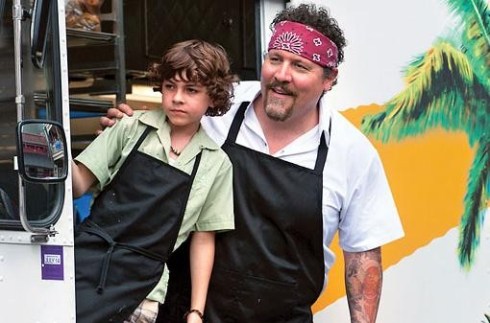
The film is called “Chef,” written and directed by Favreau, who gets away from Hollywood for a while to create this film independently. In the film, he also stars as Carl Casper, a passionate, talented chef who feels burned out from his job at a fancy L.A. restaurant run by pushy Riva (Dustin Hoffman). Carl works hard but isn’t given an opportunity to get creative, as Riva wants him to stick to the menu. But when a popular food blogger (Oliver Platt) pans the menu (and makes a horrid remark at Carl about his weight), this makes Carl snap. Upon getting a Twitter account and angrily calling the blogger out to return, his chance at redemption is ruined when Riva demands he stick to the menu or lose his job, and it’s made even worse when a video of Carl angrily confronting the blogger goes viral.

Carl is having trouble finding work, which leads to an idea from his ex-wife Inez (Sofia Vergara) for him to get his own food truck and travel across the country to serve the food he makes. Carl, Inez, and their 10-year-old son Percy (Emjay Anthony) go to Miami, where Carl got his start as a culinary artist, and manage to get a truck. Inez goes back home, giving Carl and Percy plenty of much-needed father-son time, as Percy helps Carl fix up the truck and cook & serve Carl’s food. As their relationship grows, Carl goes back to his roots.

So, let me get this straight. Jon Favreau (er, I’m sorry—chef Carl Casper) started out as a happy, independent filmmaker (er, culinary artist) making films (er, treats) such as “Swingers” and “Made” (er, Cuban sandwiches), but then he found success in California with “Iron Man” (er, as a master chef at a trendy eatery), only to make “Cowboys and Aliens” and “Iron Man 2” (er, predictable, standard menu options) and annoy film critics (er, food critics), and so he steps away from the Hollywood system (er, the L.A. restaurant) and decides to try something more like the days in which he started out, and so he makes an independent film called “Chef” (er, he gets a food truck and makes his own food the way he wants it done)…

Obviously, I’m not the only one to think “Chef” was an allegory to Favreau’s career as a director by going back to his independent roots after “Cowboys and Aliens” failed at the box-office. And even though Favreau has denied this comparison, it’s difficult to believe that Favreau didn’t have some part of that in mind while putting the film together at the start. I can’t help but think he wanted (and needed) to try something new, away from Hollywood, and he succeeded in making an independent film that is both funny and endearing…and also will make anyone who watches it hungry for Cuban sandwiches. (Seriously, don’t watch this film on an empty stomach—there are plenty of close-up shots of food being grilled, served, whatever.)

Favreau turns in his finest performance to date, playing a chef with the right amount of passion and devotion, leaving room for regret as he realizes he isn’t spending as much time with his son, who admires him. Speaking of whom, Emjay Anthony is perfect as Percy, turning in a natural juvenile performance. I buy the two as father and son, and I thought the scenes that deal with their bonding were well-done. The rest of the cast consists of big names all of which do well in smaller roles. Among them are the aforementioned Vergara, Hoffman, and Platt, but also featured are John Leguizamo who’s quite good as Carl’s friend and fellow kitchen master, Scarlett Johansen as a former co-worker/part-time lover of Carl’s, Bobby Cannavale as a sous chef, and Robert Downey Jr. in a very brief but funny turn as Inez’s (other) ex-husband.

“Chef” is a small film with big-name actors, and it’s entertaining, funny, and will make you hungry for some damn good food afterwards. And if you doubt this was Favreau’s way to take a step back before returning to Hollywood, just remember the critical/financial success of “The Jungle Book,” released two years after “Chef.” The man needed a break, and to make “Chef” was to make the right call.

Hoop Dreams (1994)

7 Apr

HoopDreams_ArthurAgee1

Smith’s Verdict: ****

Reviewed by Tanner Smith

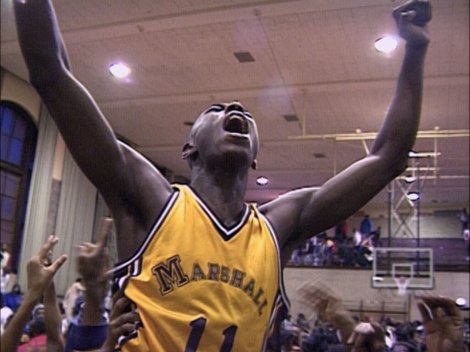
Following your dreams is not an easy road to take. That’s the overall message of the three-hour documentary “Hoop Dreams.” This film chronicles five years in the lives of two teenage boys (from their freshman year of high school to their freshman year of college) as they pursue a dream that proves to be more difficult than they imagined; that dream is to play professional basketball. At the beginning of the film, they are 14 years old, they’re high school basketball players, and they each have the confidence that they will make it to the NBA in the future. And by the end, they have learned the hardships of inner-city life and it’s never easy to blend your fantasy with reality.

The boys are Chicago youths named William Gates and Arthur Agee. We get to know on and off the court. We meet their families and learn just how hard it is balance basketball with academics and family crises. We learn what great games will mean to each of them. We learn what one injury can mean to a player who needs to keep playing to maintain success. We even see the struggles their families go through to just to survive at home. Through the five years registered on film, we as an audience are caught along a documentary journey that plays like narrative fiction. We get to know these people and hope for the best for them,

And we feel sorry for them when it seems they won’t make it the way they thought they would. Sure, they’re stars on their high-school basketball teams, but that doesn’t mean they’re automatically going to be moved over to the NBA. And we see how hard they have to be pushed in order to be greater than they are in their talent on the court—William, constantly pushed by Coach Pingatore at St. Joseph High School and even suffers a series of knee injuries, even states at one point, “It became more of a job than a sport to play.”

There’s a reason “Hoop Dreams” has gone on to its beloved status as one of the best documentaries of all time (even championed by the late Chicago film critics Roger Ebert and Gene Siskel as the best film of 1994; and Ebert went on to call it the best film of the decade). Its real drama is captivating, and anyone & everyone can identify with these people because we all have dreams and hopes, and sometimes we need rude awakenings, not unlike what William and Arthur go through. We have ambitions and goals, but life gets in the way sometimes and our dreams can get harder to accomplish. To see this film is to feel the poignancy of these characters because you realize these aren’t merely “characters” thought up by a screenwriter—they’re real people being captured on camera by filmmakers like director Steve James to tell an important story about the difficulties of following dreams.

You could see “Hoop Dreams” as a sports movie or a feel-good drama, but “Hoop Dreams” is really a film about the struggles of life. It’s involving, compelling, and made me think more about my own dreams and what it truly means in the attempt to accomplish them. It’s one of the best documentaries I’ve ever seen; one that deserves to be treasured.

Exorcist II: The Heretic (1977)

10 Mar

Exorcist-II-The-Heretic-1

Smith’s Verdict: **

Reviewed by Tanner Smith

Here at Smith’s Verdict, I (Tanner Smith) try to bestow through words an enlightened point of view on the films I choose to review. (Or, at least, that’s what I try to do nowadays—do you know how many of my earlier reviews I would like to rewrite/revise?!) With that said, let’s talk about what many critics and audiences declared one of the worst films ever made—John Boorman’s “Exorcist II: The Heretic.”

How badly was this film received? Within ten minutes of its Chicago critics’ screening, the crowd chased the executives away in anger. At a theater in Hollywood Blvd., the audience threw things at the screen (at least these people actually stayed through the film to the end). On the night of the premiere, audiences straight-up laughed at the film, as they couldn’t take it seriously. And among the critics who slammed it harshly, Gene Siskel wrote in his review for the Chicago Tribune, “’Exorcist II’ is the worst motion picture I’ve seen in almost eight years on the job [as a film critic].” (I feel sorry that Siskel saw worse films in his remaining 22 years of life ‘til his death in ‘99.) Is it truly worth the hate it receives? Let’s take a look…

It should be noted that despite taking the opportunity to direct a sequel to “The Exorcist,” one of the greatest (and most profitable) horror films of all time, director John Boorman did not care for the original film, calling the original script “rather repulsive.” For the sequel, he set out to make a film in his own vision—one that would take risks while sending the audience on a journey that was “positive, about good, essentially” (according to Boorman in an interview). So, where did he go wrong and did he succeed in some way(s)?

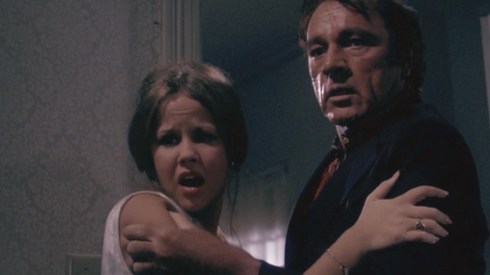
Before I answer that, I’ll talk about the story. Four years after the exorcism of Regan O’Neil, which resulted in the death of Father Merrin (Max Von Sydow) (oh, and also the death of Father Kerras, but never mind about him until “Exorcist III,” if you can help it), a preacher struggling with his faith, named Lamont (Richard Burton), is sent to investigate what truly happened back then, after Church authorities declare they don’t want to acknowledge that demons and Satan exist. The now-teenaged Regan (Linda Blair) is monitored by a psychiatric institute because she claims she doesn’t remember anything from the experience. Psychiatrist Gene Tuskin (Louise Fletcher) believes her memories are simply repressed and has a method that can help find them.

OK, this is where you really have to suspend your disbelief when this method is introduced—it’s a device that can apparently cause two people to go under hypnosis and visit each other’s minds…I’m not entirely sure that’s how that works.

Tuskin wants to use the machine to find out what really happened to Regan. While continuing his investigation, Lamont becomes involved and tries questioning Regan, which Tuskin doesn’t see as doing as much good as harm. Things get even more complicated when Lamont hooks himself up to the machine with Regan, which leads to more questions needing to be answered.

So, you can probably spot the first point in which “Exorcist II: The Heretic” goes downhill. This machine, a “synchronizer,” seems highly implausible, especially after the first film had such a gritty, realistic feel to it and made the supernatural elements feel more plausible with each scene. The way this device is set up feels more at home in a science-fiction film. I would believe in hypnotherapy as an attempt to solve the problem of interpreting Regan’s past trauma, but not this thing. In fact, this was the very thing I mentioned before that caused audiences to give up and laugh at its premiere. It seemed to start out fine, with an exorcism prologue that is creepy enough for audiences…and then it cuts to Regan being introduced to Tuskin’s machine. Odd segue, eh?

Is that the only problem with “Exorcist II: The Heretic?” Well…no. As much as there is scientific babble about how the machine “synchronizes brain waves,” there’s a lot of spiritual babble as well. Much of it is actually kind of fascinating (which I’ll get into later), but for the most part, it’s either not written well or not delivered well. It’s a little difficult to understand what the film is saying for the most part because of confusing dialogue. I think I have some idea of what the film was building up to, but I’ve seen the film twice now (once out of curiosity, twice to review it) and I can say this: when Tuskin delivers one of the final lines of dialogue, “I understand now but the world won’t,” I was confused because I was still a little lost, much like “the world.”

It also doesn’t help that Richard Burton, who takes up a good chunk of the film’s spiritual aspects, delivers his lines like he’s talking in his sleep. Burton looks like he’d rather be anywhere else than in this film. His character is supposed to be a troubled priest seeking answers beyond his comprehension, but the way Burton plays it gives off the impression that he could use a drink. Hearing him say the central demon’s name “Pazuzu” multiple times out of what is supposed to be fear just comes off as silly. (But to be fair…the demon’s name is “Pazuzu.” I dare you to say that name at least twice without cracking up.)

And while it has its talk of the spirit world, the demon world, exorcism, and so forth, “Exorcist II: The Heretic” also shows a little of the “terror.” But the problem there is, as “The Exorcist” proved successfully, less is more. There are many laughable visuals in the film, most notably a giant locust that flies around Africa in search of a new victim. And there’s also James Earl Jones in a locust costume…need I say more?

So I’ve talked about the confusion the film generates, the ridiculous plot device that’s literally a device, and Richard Burton’s embarrassing performance. Is there anything positive to say about this film that most people called one of the worst of all time?

I think so. For one thing, I admire that the film is a continuation (even if four years after the original event is a little too long) and they don’t try the same things the original did. The narrative allows more to be discovered, such as when Regan develops somewhat of a psychic ability and has an interesting conversation with Lamont about it and about how it can used to someone’s advantage before it can be used for evil. And when Lamont goes from place to place, country to country, finding out more than he expected, I was interested to find out more of what was beneath the surface of the mystery (even if the name “Pazuzu” is off-putting). And there are some chilling moments, such as the prologue and Lamont’s encounter with James Earl Jones’ Kucomo. But those chilling moments make way for conversations that sound false and moments that seem silly rather than frightening (such as loud chanting when the characters are in Africa). “Exorcist II: The Heretic” isn’t trying to be a horror film, necessarily, but more of an odd, unusual, spiritual journey in which characters find themselves facing against the Devil. And considering one of these characters (Regan) spent an entire film (the original “Exorcist”) with a demon inside her, that journey is all the more fascinating, especially when she develops her psychic gift (or is it a curse?). It almost feels like she’s being tested by God to make the right choices.

But sadly, Boorman doesn’t execute that intriguing element well, and it leads to a confusing climactic scene in which, again, I’m not entirely sure what happened and what was learned from it. I just know…there were a lot of locusts.

“Exorcist II: The Heretic” is a very strange film, but it’s not one of the worst movies ever made. There are parts I find interesting to watch and other parts I find maddening to watch, as well as parts that are simply absurd (such as when Regan casually says the line, “I was possessed by a demon”). I think if the plot was tighter, the people behind the making of the film were more confident about what they were trying to accomplish here, and, like I said, hypnotherapy was involved in the story (instead of that ridiculous machine), people would think differently about it. As is, it’s a mess, but it’s an intriguing mess.

Serenity (2005)

9 Mar

Serenity-Movie-Wallpaper

Smith’s Verdict: ****

Reviewed by Tanner Smith

Let’s talk about the one-season cultural-favorite TV show called “Firefly.” Created by the always imaginative Joss Whedon (who was also the mind behind the beloved TV series “Buffy the Vampire Slayer” before he went on to delight even more audiences with the “Avengers” movies), “Firefly” is an entertaining series that was ahead of its time, and it’s a shame it was cancelled after only 14 episodes (only 11 of which aired from late 2002 to early 2003). Set in the distant future, after an intergalactic civil war, “Firefly” followed the adventures of a rebel spaceship crew. They pick up a young doctor as a passenger, who brings on board his telepathic younger sister to protect her from the government that has secretly been training her as a weapon. The main story arc of the show revolves around keeping the girl protected before ultimately welcoming her as part of the “family” the crew has created for themselves. Undoubtedly due to the series’ witty sense of humor and flair for adventure, the series grew a large fan base.

After “Firefly’s” cancellation, neither the fans nor Whedon and his devoted cast were ready to let go. So, Whedon wrote a screenplay that served as a continuation of the series and sold it to Universal Studios. That screenplay became the exciting 2-hour-long sci-fi adventure known as “Serenity,” which delighted “Firefly” fans and, even better, got more people to find the series and check it out themselves.

You don’t have to have seen “Firefly” to understand the background of the setting and the characters (though, if you have, it helps enrich the viewing experience even further). The prologue sets up the story nicely and effectively, as we learn we are in the distant future, after mankind left an overpopulated Earth to colonize a new solar system. The Alliance from the central planets is an all-powerful, authoritarian-like government that seeks to govern everyone. A schoolteacher explains it to one of her pupils, a little girl who refers to the Alliance as “meddlesome”: “We’re not telling people what to think—we’re just trying to show them how.” That pupil grows up to be River Tam (Summer Glau), a 17-year-old telepath who is forcibly manipulated by the Alliance to become a psychic assassin. Her brother, Simon (Sean Maher), rescues her and they both find refuge onboard the Firefly ship, called Serenity.

Serenity is captained by Mal Reynolds (Nathan Fillion), who was among the Independents of the outer planets who fought the Alliance in a civil war. Now he, along with his crew which includes second-in-command Zoe (Gina Torres), pilot Wash (Alan Tudyk), enforcer Jayne (Adam Baldwin), and mechanic Kaylee (Jewel Staite) cruise through the galaxy, looking for as many jobs as possible on different planets, in order to keep flying and surviving. River’s ability to read minds becomes useful during heists, and thanks to Simon’s medical training, he proves his worth as well. But having them both on board becomes riskier when River’s mental state becomes even more questionable and dangerous, as it seems she can turn into a killing machine when an Alliance-approved advertisement sends her a subliminal message. The situation gets worse when it turns out the Operative (Chiwetel Ejiofor) has been sent by the Alliance to capture River and return her. But the crew gets defensive and faces off against him and other galactic baddies to protect River and solve a prolonged Alliance-involved mystery.

“Serenity” is very entertaining as a space-opera (and it keeps in the tradition of the series with delightfully witty lines of dialogue), but it’s also surprisingly thought-provoking. It raises questions such as what it means to live in society, what rules to follow and/or break, and when one finds individual freedom. The main problem with the Alliance is that they want to control everyone and make them think the same as they do. The Serenity crew make their own decisions, but they’re mostly bad decisions. But the film is very clever in showing what the world can be like “without sin,” as it’s described later in the climax, and it means that it’s important to have compromise rather than complete control, because taking away free will makes for an unhealthy environment, which is something the Alliance doesn’t want to believe.

The Operative is a most intriguing villain (not seen previously in the series). He represents the morally-wrong mindset of the Alliance as one person: a man who will do anything to create “a world without sin.” But in continually doing his deeds, which involve brainwashing and even killing people, he loses more of his humanity. What’s even more interesting about this character is that he knows what he’s doing is wrong (he even admits it to Mal at one point), and yet he continues to do it because he believes in a higher goal.

The Operative provides an effective contrast for Mal. In the series, Mal befriends another Serenity passenger, a pastor named Book (Ron Glass, who reprises the role briefly but still significantly in the movie), despite Mal not having faith, which is an “elephant in the room” when these two are alone together. So, it continues in “Serenity” that he still hasn’t found his faith, but by the end of the story, he has come so far in his renegades with his crew that he ultimately believes in himself, and he believes that everyone should find their own self-worth and that alone is worth fighting for.

I’ve said enough about the natures of both the protagonist and the antagonist without giving away spoilers, but I should probably mention the Reavers, who were introduced in the series as cannibalistic savages that dwell just outside of civilized space. They’re in the film too, and they play a crucial part in the climax…and all I’ll say is that knowing the origin of Reavers makes the themes all the more stronger.

As you could tell from my lengthy analyses, there’s a lot to be found beneath the surface of “Serenity.” (And to be fair, you would probably have to see the movie more than three times to find more than is easily delivered to you…like I did.) But the film is still a ton of fun, whether you look deep enough or not. The central characters, the Serenity crew, are appealing and they share great chemistry together—think the trucker/outlaw equivalent of the USS Enterprise crew. And the script is littered with numerous funny lines of dialogue, most of which are delivered by Jayne, the mercenary of the group who is just as dumb, impatient, and rough as Animal Mother in “Full Metal Jacket” (maybe that’s why Adam Baldwin got the part in the first place). Among my favorites is his very first line: “We’re gonna explode? I don’t wanna explode!”

Here’s a humorous exchange between Mal and Jayne in the middle of an argument: “You wanna run this ship?!” “YES!” (pause) “Well…you can’t.”

The action is also nicely handled (which is no surprise, considering how bombastic the action is in Whedon’s “The Avengers,” seven years after “Serenity”), from the fistfights to the spaceship battles. But “Serenity” isn’t about action and space battles—it’s about story and character, which it has an abundance of. It’s sad to say that “Serenity” wasn’t a box-office success, because I would’ve loved to see a film franchise that continues the adventures of these likable characters with wit. But if “Serenity” is the ultimate conclusion to “Firefly,” it’s a damn great one. To put it another way, I would much rather have this movie than nothing at all after the 14 TV episodes that came before it. “Serenity” is one of my all-time favorite science-fiction films and a more-than-worthy successor to a beloved (albeit short-lived) TV series.

Get Out (2017)

24 Feb

la-et-hc-get-out-horror-peele-20161004-snap

Smith’s Verdict: ***1/2

Reviewed by Tanner Smith

In the horror film “Get Out,” a white woman, Rose (Allison Williams) takes her black boyfriend, Chris (Daniel Kaluuya), to the countryside to introduce him to her family. They’re all accommodating, seemingly well-meaning white people who try to make Chris feel welcome, but something feels wrong. Things start off as awkward when Rose’s liberal parents (Bradley Whitford and Catherine Keener) and jock brother (Caleb Landry Jones) deliver one cringe-inducing (albeit benign) race-related comment after another. But when Chris meets the only other black people in town, he notices odd behaviors about them, which causes discomfort that only raises when the family’s friends gather at the house for a picnic…and that’s all I’ll say about “Get Out.” If you haven’t seen the trailer, just see this movie—the less you know about the story, the better.

That’s as much of the story as I’ll describe here, so I’ll just continue with the review. “Get Out” is the debut feature of writer-director Jordan Peele, best-known for comedic acting & writing, especially for the sketch comedy series “Key & Peele.” I’d say it’s an interesting departure for Peele to make a film like this, but then again, a good chunk of the first 45+ minutes of “Get Out” reminded me of a prolonged “Key & Peele” sketch, in which race relations (or lack thereof) is a factor and there is humor to be found in the sheer awkwardness/discomfort of one moment after the other. And the humor is also there to offset the more uncomfortable moments that leave audiences believing there is something wrong here but not knowing what it is, what will happen, when it will happen, and so on—to get to its ultimate final act, the audience has to endure one awkward moment after another as they try to determine what’s really happening here. The best way to relieve tension in these scenes is with laughter.

“Get Out” is a great mix of comedy and horror. It’s not downright satiric nor does it become overly serious; it’s just the right amount of both that entertains and also makes nearly every stomach in the theater churn. Peele is a bright-enough filmmaker that he’s actually able to approach the material with as much discretion as possible to make it work. He also doesn’t go too deeply into the subject of race relations and the pomposities and resentment that can sometimes come into play. He does have something to say about it all, but overall, it’s used to craft a unique story that I think Peele does a brilliant job putting together.

He gets great aid from his actors as well. Daniel Kaluuya is easily relatable as a man feeling out of place without knowing precisely why. Bradley Whitford and Catherine Keener as both funny and chilling, whenever they need to be each (or both). And I can’t neglect to mention the comedic highlight of the movie, and that is Lil Rey Howery as Rod, Chris’ best friend who is able to conduct his own detective work when Chris calls him via cellphone with clues. He provides the film’s biggest laughs himself.

What does all the oddness and awkwardness amount to? I won’t give it away here, but what I will say is much is revealed with effective twists, and while the final act may be paced a little too slow, I have to credit it for making me even more tense as I was A) waiting for answers and B) desperately wanting Chris to make it out the messed-up situation once those answers were revealed (and C) making me want to see the movie again, now that I have the answers). As is the case with the best slow-burn thrillers, I can’t wait to see “Get Out” again, knowing what I know now. And in addition, I also can’t wait to see what Jordan Peele comes up with next.

A.I.: Artificial Intelligence (2001)

21 Feb

maxresdefault

Smith’s Verdict: ***1/2

Reviewed by Tanner Smith

SPOILER WARNING!

In 2001, one of the most highly anticipated movies in renowned filmmaker Steven Spielberg’s career was to be released. Why was it so heavily awaited? Because it was Spielberg’s attempt to bring his own version of a Stanley Kubrick film to life. The late Kubrick, director of such stylistic, mostly bleak & calculating films as “2001” and “A Clockwork Orange,” admired (and maybe even envied) Spielberg’s vision (and vice versa, I believe). So, when Kubrick brought his idea of a “sci-fi version of ‘Pinocchio’” to light, he wanted Spielberg to direct it. Both directors went through years of collaboration (and arguments about which of them was better to direct the film), and Kubrick wrote a 90-page story treatment. When Kubrick died in 1999 (the same year his film “Eyes Wide Shut” was released), Spielberg decided to bring Kubrick’s vision to life himself.

The result was “A.I.: Artificial Intelligence,” a film that many audiences & critics saw as an ambitious mess upon theatrical release. They saw it as a clash of two different directing styles from a director trying to mimic another director’s trademarks. Spielberg was traditionally seen as a sentimentalist/optimist, and for him to go more artful and deep by way of Kubrick (who seemed to have a dim point of view about human nature) caused people to scratch their heads. (We’ll get to the ending…)

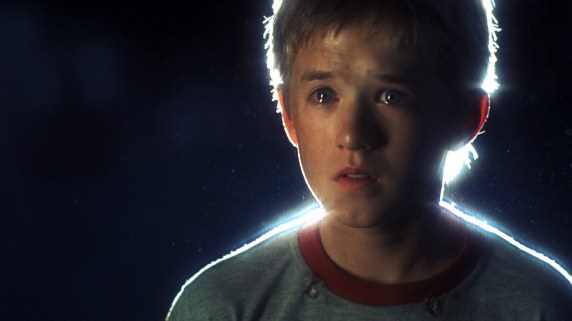
The story is set in a distant future and centers around David (Haley Joel Osment), a robotic (or “mecha”) child who is the first of his kind—a mecha programmed only to love, invented after its creator (William Hurt) discovered a robot can feel pain. David is brought home to Monica Swinton (Frances O’Connor) by her husband Henry (Sam Robards), who works at Cybertronics (the mecha factory) in New Jersey. David is a test project for Cybertronics and somewhat of a substitute for Monica and Henry’s natural son Martin (Jake Thomas), who is in a coma. David and Monica form somewhat of a bond, but complications arise when Martin awakens and gets David into trouble, causing things to go awry and Monica to get rid of him. But rather than take David to be dismantled, she instead leaves him in the woods where he and his robotic toy bear (named “Teddy”) have no choice but to brave the world they aren’t familiar with. This includes becoming part of an event that destroys mechas (called a Flesh Fair), a travel through Rouge City (imagine Las Vegas if it was taken over by “The Fifth Element”), and a journey to an underwater Manhattan. By his side is Gigolo Joe (Jude Law), a mecha designed for prostitution purposes who David meets at the Flesh Fair.

Where the “Pinocchio” aspect comes into play is when Monica has already read the story to David, who has become genuinely fascinated by the concept of The Blue Fairy. When he is taken out into the world because he feels his “Mommy” doesn’t love him anymore because he’s a machine, David embarks on a journey to find The Blue Fairy and wish to become “a real boy.”

Think about what I just wrote—“David [a mechanical child constructed by man] is ‘genuinely’ fascinated” and “he ‘feels’ his ‘Mommy’ doesn’t love him anymore.” Why would a machine care or feel about anything other than what it was designed to do? For that matter, how can “love” be programmed at all? I don’t know, but in science-fiction, there’s always the reasonable answer of machines learning just as humans do, the more times interaction is a factor. David could have simply developed more than he was programmed to, by simply watching, listening and learning. That reasoning would also help explain why Gigolo Joe, who when we first see him seems like he’s being framed for murder of one of his clients, runs away when he could have stayed with the body, because after all, why else would a robot feel the need to save himself? And then later, when he joins David on his quest, he can’t help but express cynicism about the concept of a real Blue Fairy.

But then again, it can be argued that these emotions are simply part of the coding, because after all, artificial intelligence is simply that: artificial. All these machines can do is run programs that may fool us by being like them. So, perhaps, rather than actually learning and thinking, these androids are advancing in their programs—David furthers along his journey because he’s programmed to love and he’s taking it to the highest degree; Gigolo Joe is cynical and self-preservative because he’s supposed to behave like anyone would in a city like Rouge City.

I don’t know; no one knows for sure. But this kind of thing is fun to think about and discuss with fellow audience members. Far be it for me to bring up a lesser movie, but there is a line of dialogue in an ‘80s family film called “D.A.R.Y.L.” that actually sums up this film’s idea perfectly: “A machine becomes human when you can’t tell the difference anymore.”

What turned many people off when they first saw this film was the fact that it’s not always easy to determine the concepts of a robotic child programmed to “love” and it left them with more questions than answers… Isn’t that a good thing? Shouldn’t entertainment leave audiences wanting more? Well…that’s not the only thing. As I mentioned above, Spielberg and Kubrick were on opposite sides of the directing field, so audiences were uneasy with one trying to replicate the other. They felt Spielberg’s vision contradicted with that of Kubrick’s. But what really confused and angered many audiences about the film was its epilogue. Let me explain:

David and Teddy are trapped in a vehicle underwater where they find a statue of The Blue Fairy at a submerged theme-park attraction. David stares at The Blue Fairy as time goes on and on, wishing his dream of becoming a “real human” will come true. Does this make him less human or more human? It could be argued…both. 2,000 years later, humans are extinct and now-highly advanced mechas roam the world. David and Teddy are found and are thought of as special, as they are the only surviving mechas to know humans, thus giving them understanding to their existence. They reward David by bringing Monica back to life, so he can spend a single day with her as her son. Monica tells him she always loved him, David feels more or less real, and they lie peacefully together in bed as David’s journey to become real has finally come to a close…

It’s a highly sentimental (and as some would say, “schmaltzy”) ending that broke the film for most audiences, especially those who thought it was unnecessary, false, and went against what Kubrick would have originally intended. They put the blame on Spielberg because they believed Kubrick would have ended the film with David underwater wishing and praying, and Spielberg added on the extra half-hour to give David a happier ending. Even film critic James Berardinelli of reelviews.net stated in his original review, “There is no doubt that the concluding 30 minutes are all Spielberg.” What they didn’t realize until later was that the whole story was from Kubrick, and that included the much-maligned ending. Spielberg has gone on record saying that he tried his best to bring his late friend’s vision to life as best as he possibly could, even when his collaborators thought it wouldn’t work. He felt that if he didn’t do it, he’d be betraying him, and he simply couldn’t do that.

kubrick_vs_spielberg

There is a lot you can read into this—like Kubrick wanting to make the Spielberg movie he always wanted, Spielberg understanding Kubrick more than we thought, and so on. And even if the movie doesn’t work for someone, it can’t be argued that there wasn’t a lack of understanding behind the scenes.

And thankfully, people who didn’t particularly care for “A.I.” before have since revisited the film, which resulted in softened views and opinions. Roger Ebert only gave it a slight positive review upon initial release (only to include it in his Great Movies collection ten years later). Doug “Nostalgia Critic” Walker has softened up on it, as seen in his 40-minute video review of the film. English film critic Mark Kemode even apologized for maligning the film severely, years after he first saw it.

There’s something special about “A.I.: Artificial Intelligence,” whether it be in front of me or behind the scenes. The visuals are outstanding, Spielberg’s ability to duplicate the style of visual storytelling Kubrick was also known for is remarkable, the concepts of what makes someone human are fascinating to think about and discuss with people, and the story of Spielberg working hard to make his late friend’s wish come true is something to be admired. I thought differently about this film too, when I first saw it like many other people. But also like those people, upon second viewing, I found myself with a deeper appreciation for it that has me coming back to it every once in a while.

NOTE: If you think for a moment that Spielberg was defending himself for the ending by putting all the blame on the late Kubrick, think about two things. One is, it makes sense that Kubrick would end a sci-fi film with human extinction (which is essentially what it adds up to, being in a world dominated entirely by super-advanced robots) because if you look at many of his films, you can see a pattern containing actions of the worst of humanity (possibly even a reflection of what he saw in the world he lived in). The other is, Kubrick was Spielberg’s dear friend to the end. Spielberg tried his absolute best to bring Kubrick’s vision to life, by copying styles and atmosphere Kubrick himself was infamous for. Why would he add on anything more than what Kubrick originally intended? Think about it.

La La Land (2016)

17 Feb
LLL d 29 _5194.NEF

LLL d 29 _5194.NEF

Smith’s Verdict: ****

Reviewed by Tanner Smith

Damien Chazelle’s “La La Land,” Chazelle’s follow-up to the award-winning “Whiplash,” is both in the tradition of the old-fashioned Hollywood Musical and yet at the same time, it’s not quite. It’s in the tradition in that it features singing and dancing as well as stellar cinematography and choreography, it tells a compelling story while doing so, it has the feel of a musical like “Singin’ in the Rain” and “West Side Story” among others, and it enchants the audience. But Chazelle doesn’t rely on all that to make the film great. In fact, he actually moves past the traditional old-school Hollywood-happy-ending to continue the story for an additional half-hour or so, and in doing so, he delivers something far more compelling in the final act than audiences would have expected.

But I’m getting ahead of myself. “La La Land” is the best musical (or at least, best non-animated musical) to come around in a long time. It’s more energetic, nostalgic, and heartfelt than other musicals from the past decade or so (like “Les Miserables” and “Chicago”), while at the same time, it’s something more.

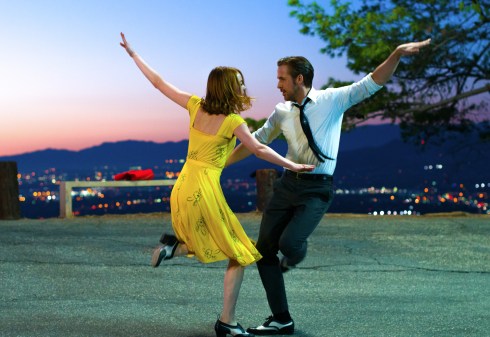
“La La Land” is gloriously made. You could swear Chazelle copied the entire rulebook of moviemaking from the 1950s-1960s. It’s wonderful to look at, with magnificent color pallettes, masterful camerawork that continues for long takes and doesn’t stop moving, and of course, being a musical, fun choreography for the lead actors, Ryan Gosling and Emma Stone, to shine through. You’d think this film was made in that popular era of musicals—even though “La La Land” is set in modern times, it doesn’t feel like it. (And that’s not a bad thing.) The opening scene alone is a masterstroke of nostalgia and effervescence—a musical number on a jammed freeway, where drivers, rather than express anger at their shared predicament, sing and dance together.

The story takes place in Los Angeles and focuses on two struggling artists—jazz musician Sebastian (Gosling) and actress Mia (Stone). They meet in the opening traffic jam (well…sort of; watch the movie, you’ll see what I mean). As time goes on, they spend more and more time together until they eventually fall in love and share a relationship.

It’s basically a love story in which boy meets girl, but here, we see something that you don’t often see in most boy-meets-girl stories—the complications of maintaining the relationship when you’re pursuing your own personal dream. They learn this the hard way when Sebastian can’t play the type of old-school jazz he wants to perform and he works for modern jazz performer Keith (John Legend) just to make some much-needed money. This causes a rift between Sebastian and Mia’s relationship as Sebastian isn’t happy doing what he does, Mia is still struggling in her pursuit of her own dream, they don’t see each other very much anymore, and hearing him talk about how upset he is about his job is too much for her.

Can I just say how ingenious the commentary is, with the Keith-jazz subplot alone? Sebastian wants to cling to his jazz heroes of the past by playing in their style, but Keith, who plays jazz for a more commercial demographic to bring in modern audiences, lets it down harshly that if artists (such as jazz musicians) don’t update for the future, that means people who celebrate the past too much will kill the art. That can actually be a bold statement for “La La Land” itself, because while Chazelle does use many elements of past inspirations for his craft, he tries his best (and succeeds) at bringing in a new way of delivering his own art—taking the things that inspired him, using what modern techniques he learned as a budding filmmaker, and blending them both resulted in something as beautiful as “La La Land.”

The back half of “La La Land” is nothing short of brilliant. If Chazelle really wanted to cling to the traditions of the past, he would’ve ended the film early on and given the audience a lovely happy ending. But no—the film continues for another 30-45 minutes to show the harsh truths of what happens after the couple thinks they’ve had their “happily ever after.” It shows how hard it is for two people who have different goals and ambitions, as well as the even harsher truth that all dreams come with a price. And when trying to be the best at what you can do is not as easy it seems and even harder than people say it is.

There is something I am curious about: what did Chazelle have to go through before he made it big as a filmmaker? Thinking about the films he’s made so far, I notice a pattern. In “Whiplash,” there was a young drummer who got brutally pushed to his limits to be “great,” and it showed the pain the poor kid had to go through to achieve recognition. In “Grand Piano,” which he wrote, Elijah Wood played a pianist who was threatened with death if he hit a wrong note while performing a difficult piece at a concert. And now, we have “La La Land,” in which Chazelle’s characters pursue their dreams, just as his previous characters in “Whiplash” and “Grand Piano” had pursued theirs, and their happy ending is not at all what they expect, and they don’t know how to feel about it. With this pattern, I have to wonder if Chazelle’s films are autobiographical at all…

I don’t want to make “La La Land” sound very depressing, because really, what I just wrote was all in interpretation. The ending, which I won’t give away, is actually rather beautiful and thought-provoking (while it may be upsetting for some audiences who expect something they’re more used to). In fact, it could serve as a short film by itself. It stirred an emotional response from me and my girlfriend when we first saw it—we left the theater talking about it immediately after.

The songs are all great, two in particular stay fresh in my memory (“Audition,” which is Mia’s theme, and “City of Stars,” which Sebastian sings to himself when pondering the future), but it’s Gosling and Stone’s movements, energy, and acting that overcome and astound me. Gosling and Stone aren’t the best singers, but that’s not important—what’s important is how they play every single number, which they do to the best of their abilities. These are performances that make other actors jealous.

There’s no other way to put it—I love “La La Land.” I love everything about it. I love the mixes of the past and the future. I love the energy put into it. I love the rich necessities that make the story more compelling. I love the performances. I love the style and look of it all. I simply love it. It is the best musical I’ve seen in a long time.