My First Published Feature Film (Not a Review!)

6 Nov

It should have occurred to me long before that I don’t have to use this blog just for movie reviews. I’m a filmmaker too–I should be as open on my blog as I am on my own Facebook page. So, here goes: I made a micro-budget independent feature film and got it published on Amazon Prime.

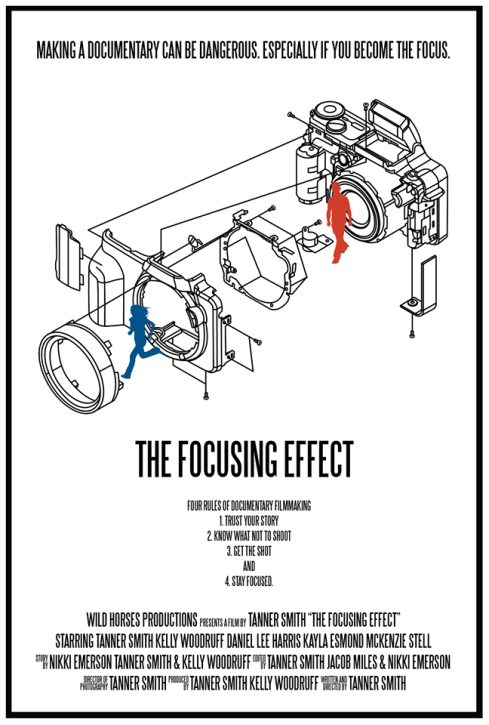
It’s called “The Focusing Effect.”
16831095_632137090328095_8816392290593603791_n.png

The premise goes like this: A film-student (played by yours truly, Tanner Smith) wants to succeed as a filmmaker and jump-start a career with a great documentary. This documentary project is called “The Dumpers and the Dumpees,” and it’s about getting both sides of particular breakup stories amongst his classmates. With help from his girlfriend (Kelly Woodruff) and his sister/roommate (Kayla Esmond), he makes the film and decides to make it even stronger by including a new story: one involving a surly classmate (Daniel Lee Harris) and his snobby ex-girlfriend (McKenzie Stell). But when a disturbing secret is revealed and developed, things go from bad to worse as the lives of our main characters are in jeopardy…

“The Focusing Effect,” made entirely in Central Arkansas, is presented in first-person perspective and edited like a faux-documentary, with interviews, v-logs, and candid footage telling the story. In telling a narrative-fiction story using this style, this posed a stressful (which is to say, “exciting”) directing challenge, because it meant takes had to go on for extended periods of time, which meant the acting had to be on-point (and not “100% realistic,” just “realistic enough”). Casting myself in the lead role seemed like it made perfect sense, since it was my script (from a story thought up by me, Kelly Woodruff, and our friend/co-editor Nikki Emerson) and I took it to heart, so I was determined not to screw it up. (Though, that’s not for me to decide whether or not I screwed it up.) Kelly Woodruff plays my character’s girlfriend, and she was my girlfriend in real-life (and now, she’s my fiancee)–we didn’t have to worry about perfecting our chemistry, but we did have to take the time to convincingly convey the proper emotions in the scenes in which our characters argue. The other key players are Daniel Lee Harris and Kayla Esmond, both of whom have acted in several made-in-Arkansas films. These two were game, professional actors, and they helped elevate the material one way or the other. As for crew, it was mostly just my friends who were willing to help out, many of which also appear in the film as the fake-documentary’s interviewees.

FE169retry7.png

“The Focusing Effect” was a micro-budget passion-project my friends and I made just out of film-school (the University of Central Arkansas film program), and I didn’t want to just make a “found-footage horror film.” I had made plenty of documentary shorts (mostly behind-the-scenes stuff) and two doc features while planning this film, and I wanted to come up with a narrative-fiction story that’s portrayed as if it was edited by a film student from his candid camera footage. (Matt Johnson’s “The Dirties” was also an inspiration.) It was basically a way of using our limited resources to our advantage in order to make this movie.

At its surface is a thriller story about an amateur documentary filmmaker who risks his relationship with his girlfriend (and his life) to push the envelope for a film that could’ve just been a fun project all by itself. But at its core is a cautionary tale about how far documentary filmmaking can go in terms of finding the perfect topic, story, and resolution. Even when my character looks back at the comedic parts of his film, he realizes it’s not so fun anymore because he’s exploiting his interview subjects’ embarrassments and selfish wants/needs–and he’s in danger of falling into that same trap with his own girlfriend.

And that’s before we get to the grisly final act, in which the blood hits the fan…

The film was a lot of fun to make. We broke a lot of rules and made our own choices in the whole process of making it, because we felt we could get away with it. That feeling of freedom reminds me of why I love making movies.

But it is a horror film in a way, and one of the challenges I was glad to meet was finding new ways to use the first-person camera perspective to induce fear. I think we found a few effective ones, but my favorite one is Kelly’s contribution. It’s a scene midway through the film, in which our characters are discussing the potential dangers of continuing the project…unaware that there’s someone in the background watching them! (They don’t realize it until later when they look at the recorded footage.)

By the way, this is why the film is called The Focusing Effect. It’s a reference to a psychology term that indicates how people put so much focus on one thing that they neglect to recognize something more important happening around them.

15965281_611260075749130_703672253361465947_n.jpg

“The Focusing Effect” is available on Amazon: https://www.amazon.com/Focusing-Effect-L-Tanner-Smith/dp/B07JQ58N6H/ref=sr_1_2?s=instant-video&ie=UTF8&qid=1541528930&sr=1-2&keywords=Focusing+Effect

If you hate the film, if you decide to check it out, you never have to take me seriously as a movie reviewer ever again. At the very least, I hope it makes you understand my passion for both film and filmmaking.

Thanks for reading!
Can You Ever Forgive Me? (2018)

5 Nov

98522909-18f7-4e6c-8c50-91b3062e77e0-CYEFMMobile.max-2000x2000.jpg

Smith’s Verdict: ****

Reviewed by Tanner Smith

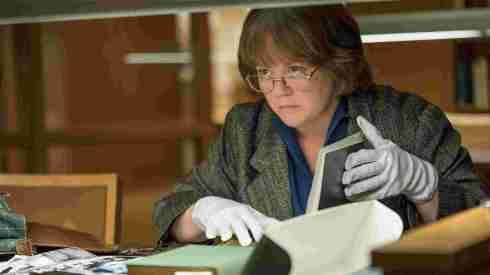
Reclusive author Lee Israel is a miserable case. She used to have one of her novels on the New York Times bestseller list, and now she’s in her early 50s, lives alone with her 12-year-old cat, has her previous books selling for 75% off at a nearby bookstore, and can’t get her agent’s attention. When she finally barges into her agent’s office to ask for a $10,000 advance for a new book she’s writing so she can pay her bills and provide healthcare for her cat, the agent bluntly tells her that she couldn’t be able to give her a $10 advance because hardly anyone will buy her book. Lee smarts off to her, and her response is she’s not successful enough to be a bitch.

This is a scene set early into the proceedings of the indie drama “Can You Ever Forgive Me?,” a film that tells Lee Israel’s story based on her own autobiographical novel of the same name, and I knew right away that director Marielle Heller (“The Diary of a Teenage Girl”) and screenwriters Nicole Holofcener & Jeff Whitty knew what they were doing here. And the rest of the film didn’t disappoint.

“Can You Ever Forgive Me?” is a drama with little bits of dark comedy and cynical wit sparkled throughout, which is something I always appreciate in a film that strives for a realistic feel (and something most “serious” filmmakers also need to keep in mind). Sharp writing and solid direction keep it flowing, but the most important ingredient that makes “Can You Ever Forgive Me?” truly memorable is the leading performance by Melissa McCarthy as Lee Israel.

McCarthy is best known for starring in mainstream comedies like “Bridesmaids,” “The Heat,” “Spy,” “Identity Thief,” “Tammy,” and “Ghostbusters (2016).” She occasionally plays it straight, such a solid supporting performance in “St. Vincent,” but she’s best known for her crass mouth and constant improvisation (which grates on me from time to time). Here, for “Can You Ever Forgive Me”, she takes center-stage, playing this loner, depressed, angry author who could easily be the life of the party (like McCarthy usually plays in other movies) but chooses not to be. And McCarthy does brilliant work here, in a performance that should land her an Oscar nomination.

The story for “Can You Ever Forgive Me?” involves Lee Israel as she discovers a get-rich-quick scheme that gets her good money for a while: to forge letters “written” by talents such as Dorothy Parker and Noel Coward and sell them to collectors for a hefty price. She’s able to convince just about everyone she sells them to…for a while. Before it’s too late or too soon, the authorities catch wind of Lee’s scam. So, she enlists the help of her friend, the charming, flamboyant Jack Hock (Richard E. Grant, very good here) to take over the task of selling her future fakes. (Another thing I love about this film: McCarthy and Grant are fabulous together.) But soon after that, the jig is up…

“Can You Ever Forgive Me?” is based on a true story from the early-1990s, and the real Lee Israel (who died in 2014) wrote about the whole experience in a novel, which inspired the screenplay. You can tell how much detail was put into the production. There are enough biting insights to keep anyone who has only the slightest bit of interest in writing invested, you get a good sense of the world of collectibles and memorabilia, and cinematographer Brandon Trost also has a great eye for the era as well. And director Heller, who’s now helming the upcoming Tom Hanks Mr. Rogers biopic, has a bright future ahead of her. But first and foremost is Melissa McCarthy’s stellar leading performance as Lee Israel—she’s funny but also bitter and nonetheless earns our empathy. It’s one of the finest performances of the year in one of the best films of the year; a film that effectively blends comedy and drama without getting distracting.

Halloween (2018)

5 Nov

landscape-1528469196-aa68-d023-01113-r.jpg

Smith’s Verdict: ***

Reviewed by Tanner Smith

40 years ago, we got John Carpenter’s 1978 classic “Halloween,” a truly scary low-budget thriller about a killer that continued to lurk in the dark and stalk (and kill) unsuspecting teenagers. It was scary because it represented the looming presence of fate and death and ended on a chillingly ambiguous note: that evil is still out there and while we can evade it for some time, it can still come for you at any time…

Since then, there have been countless sequels (including one that tried a different story—“Halloween III”), neither of which I can recommend. (It was also remade in 2007 by Rob Zombie; I can’t recommend that one either.) And now, in 2018, we get a sequel that pretends all of the other sequels don’t exist. It’s a “Halloween” sequel, directed by talented filmmaker David Gordon Green, that’s directly following the original film 40 years later.

Already, we’re off to a good start…though simply giving it the same title as the original is confusing. (I get that they can’t call it “Halloween II,” because there were already two movies by that name…but now, there are three movies titled “Halloween”!)

The killer, Michael Myers, is no longer the brother of survivor Laurie Strode (Jamie Lee Curtis). He’s simply Michael Myers, an enigmatic figure that stalks and kills—the “boogeyman,” if you will. Four decades after killing a few people in Haddonfield, Illinois (actually, he’s killed more people if you include “Halloween II”…but they’re not including it, so I won’t either), Michael Myers has been institutionalized and studied long since then. Meanwhile, survivor Laurie has led a life of ruin and misery since then—she’s a nutty survivalist, living in a fortress-like secluded house, carrying a ton of armory hidden underneath, and obsessing over the possibility that Myers will escape and come for her and finish what he started.

That’s a very slim possibility, especially after 40 years of Myers being locked up and Laurie continuing to wait for him. But if he didn’t somehow escape, we wouldn’t have a movie, would we? Anyway, he escapes a bus filled with other mentally ill prisoners and makes his way back “home”…

And of course this happens on the night before Halloween, so that Myers can come to Haddonfield and stalk new victims on Halloween night!

In the process of Myers’ lurking and killing, we get some neatly executed horror moments, such as how he retrieves his infamous mask and when he walks through a suburban neighborhood filled with trick-or-treaters. And we also get some nice, funny moments too, such as when one of Myers’ potential victims reassures the boy she’s babysitting that everything’s fine when the kid knows better. (That kid, played by Jibrail Nantambu, is an absolute riot—I wish he had more screen time!) But we also get a lot of uninteresting moments too, particularly with Laurie’s teenage granddaughter Allyson (Andi Matichak) and her friends (Virginia Gardner, Dylan Arnold, Miles Robbins, and Drew Scheid) who we all know are generic teens lined up to be stalked, killed, or both.

Oh, and there’s also the creepy Dr. Sartain (Haluk Bilginer), the psychiatrist who looked after Myers long after Dr. Loomis (the doctor from the original, played by the late Donald Pleasance). Where he falls into this story is as uninteresting as it is blatantly odd (and random).

However, as we learn, the film isn’t really about them. It’s about Laurie’s chance at closure, getting a chance to fight back at the one that’s the cause of her turmoil and misery for four decades. (Though, I think she got off easy, as her friends were murdered forty years ago, while she survived—but I think you could call that “survivor’s guilt.”) We saw something like this in “Halloween H20,” in which Laurie fought Michael 20 years after the original incident, but it was merely a glimpse. This “Halloween” sequel delves deeper into the concept of “victim empowerment,” and it leads to a neatly executed final act in which Laurie has to protect her granddaughter, as well as her daughter (well-played by Judy Greer), and ultimately face her foe as an avenging angel. The roles are reversed this time—originally, Myers was the hunter, but now, Laurie is. What results is a climactic final act that is both fun and suspenseful.

For all the moments in “Halloween (2018)” that don’t work, there are still plenty of other moments that really do. Credit for that goes to director David Gordon Green and his collaborators, one of whom was John Carpenter himself—they know how to shoot the horrific moments and keep the tension flowing, and I appreciate the new direction they were willing to take this story, while paying callbacks to the original that don’t feel forced. (One callback in particular made me smile—it involved one character looking down below at another in a similar way at the end of the original. That’s all I’ll say about it.) Jamie Lee Curtis plays the most interesting character, which makes almost everyone else hardly relevant outside of playing “dead meat,” but it just makes every moment she appears on-screen more special because it’s building up to something big with her. And I like that producer Jason Blum (of Blumhouse Productions, which mostly specializes in horror films) was able to add a modern spin on the popular Halloween franchise, so that modern terrors and old-school suspense combine for an effective horror film. “Halloween (2018)” is the “Halloween” sequel I was waiting for. Do I wish there was a little less predictability with many of the side characters? Yes. But considering all the other “Halloween” sequels that this particular one ignores, I’ll take what I can get.

Baghead (2008)

5 Nov

baghead1.jpg

Smith’s Verdict: ***

Reviewed by Tanner Smith

“Baghead,” written and directed by brothers Jay & Mark Duplass, is an independent film that is both made on the cheap and delightfully aware of how cheap it is. It even opens with our main characters attending a film festival, where a micro-budget short film screened and its director gloats about his limited resources in making the film, right down to having his actors improvise their dialogue rather than provide them with a completed script… That is almost exactly how the Duplass Brothers managed to make “Baghead.”

This style of micro-budget filmmaking is commonly known as “mumblecore,” but if you listen to the Duplass Brothers’ audio commentary for the film, you’ll learn they don’t particularly care for that term.

Our main characters in “Baghead,” desperate actors looking to star in something, are inspired by this filmmaking method that they decide to rent a secluded cabin (in the woods, of course) and come up with a screenplay for a low-budget indie film in which they will all star. When they’re not working on ideas for the script, Matt (Ross Partridge), Chad (Steve Zissis), Catherine (Elise Miller), and Michelle (Greta Gerwig) do all the typical things young people do when they have a weekend to themselves in a cabin in the middle of nowhere—they get drunk, get high, pal around, go swimming, and then eventually collaborate on ideas. One night, Michelle has a nightmare about a killer with a bag over his head (a “baghead” killer, if you will), and this inspires Matt to write a horror script about this very concept.

What happens next requires a leap of faith the Duplass Brothers had to take for their audience to continue watching “Baghead” all the way to the end. It seems there really is a baghead lurking outside in the woods. In the film’s creepiest scene, he appears in Michelle’s room and watches as she flirts with who she thinks is Matt playing a game…and he just stands there, watches, and leaves. No one is sure whether it’s one of the four playing games or if there really is a stalker outside watching them…and with a bag over his head. What are the odds that there would actually turn out to be a baghead appearing around the same time these people start to write a script that features a baghead? Well, I won’t give away how this came to be, but it will either make or break the film for most people. It didn’t break it for me; if anything, it added more creativity than anything else.

“Baghead” has a wonderful amount of self-awareness, with art imitating life imitating art, as it comments on the world of filmmaking (particularly micro-budget filmmaking, in which “Baghead” belongs). The Duplass Brothers clearly love to create art and will do whatever it takes to do it with whatever they have. And they get clever mileage out of how they comment on how they even make their own film within said-film.

Of all four main actors, who were previously second-tier actors, only one managed to make it in the big time: Greta Gerwig. At the time, Gerwig was known for several films of this sort (she became known as “the Mumblecore Queen”) before she managed to break out, get more roles in bigger-budgeted indie films (at least, in comparison to “mumblecore” films) and mainstream movies, and even get recognition from Oscar for her directorial debut “Lady Bird.” But she started out with a bubbly, quirky personality that differentiated her from several of her peers. (Many critics had a problem with that—one of the critics of “Baghead” called her “fingernails-on-the-blackboard awful.”) I think she’s a delight in “Baghead”—not to slam her three co-stars, but Gerwig is the true star of the film. She’s funny and charming throughout the whole film.

Much of the film is improvised heavily, with many awkward pauses as the characters try to figure out what to say to one another and find ways to make it feel as real as possible. While it is grating at times, I admire the effort to insert realism into the mix. (That’s generally what “mumblecore” is all about—making the most out of minimal material.) The clumsy handheld camerawork adds to it as well. Though, I will say a lot of what the characters say is not particularly interesting, and I’m constantly waiting for something more juicy to come along and break the monotony. I do care about whether or not Chad and Michelle will end up together, but I’m not sure I needed the passive-aggressiveness of a potential love-triangle to make things more complicated.

I have yet to mention the tension that comes with the very real possibility that there is a baghead walking around outside, leading to a “Blair Witch” style of a sequence that leads to our characters roaming through the woods in fear. By that point, I was comfortable with the way the film was going. The Duplass Brothers were able to milk tension out of the simplest situations, and it truly works.

“Baghead” is essentially a low-budget horror-comedy, and the Duplass Brothers clearly had fun making it. Many people will have trouble with the final twist in the final act, but I didn’t really have much of a problem with it. I was simply appreciative that they didn’t go for any of the easier ways out of a bind.

An American Werewolf in London (Revised Review)

5 Nov

an-american-werewolf-in-london-watching9-videoSixteenByNineJumbo1600-v2.jpg

Smith’s Verdict: ***1/2

Reviewed by Tanner Smith

I remember seeing John Landis’ “An American Werewolf in London” on VHS when I was 16. I remember being so mad at the way it ended that I told myself I didn’t like the movie…and then, shortly after that, I bought the DVD and a T-shirt with “BEWARE THE MOON” (a line from the movie) sewn onto it. Yet, I was still convinced I didn’t like the movie…which is why I watched it countless times since then?

It took longer than I’m proud to admit for me to realize I did like the movie…I just didn’t like the ending.

“An American Werewolf in London” is a horror film with a sharp satirical sense of humor that makes for some uncomfortably funny moments. It begins with two American college students—David (David Naughton) and Jack (Griffin Dunne)—being dropped off in English country with a truckload of sheep…considering everything that happens to these two, I won’t even call this “subtle” foreshadowing.

David and Jack reach a local pub (called The Slaughtered Lamb) in a small village, a place that already seems disconcerting without the angry glares from the patrons and the barmaid. Before they leave, they’re warned to keep walking on the roads, stay off the moors, and “beware the moon.” Well, it’s a full moon out that night, and they ignore the warning and walk away from the road…and that’s when they are attacked by a ferocious creature in the dark.

Jack is killed, while David is hospitalized in London after being mauled by the creature. But the problem is no one, not even the police, believes his story that it was a large wolf that attacked them, since it was the corpse of a man that was uncovered at the scene of the crime, not a monster. While David is recovering from his injuries, he suffers a series of strange, harrowing nightmares, all of which involve him attacking animals and eating them (among other horrific details). But things get even stranger when Jack, now a decomposing corpse walking in limbo as one of the undead, visits David and warns him that he is becoming a werewolf. It was a werewolf that killed Jack and merely mauled David, and now, the curse has been passed on to David. If David doesn’t kill himself before the next full moon, he will become a monster and kill people.

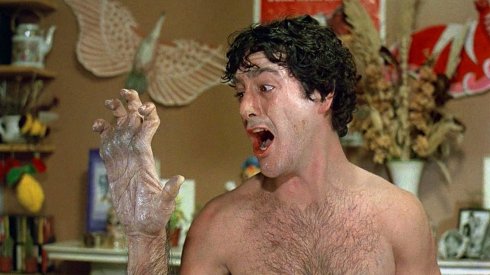
It turns out Jack was right (of course), and on the next night of the full moon, David transforms into a werewolf and goes on a rampage. What everyone remembers from “An American Werewolf in London” is the transformation sequence, which shows the painful process of becoming the wolf-like creature. Makeup-artist/creature-creator Rick Baker supervised the effects, working with the makeup and prosthetics, and the result is not only effective but also one of the most amazing, memorable, lasting moments of its kind I’ve ever seen in any movie of its sort. (Baker won the Oscar for Best Makeup for this film, becoming the first winner for the category that was new at the time.) Carefully chosen cinematography and effective acting from Naughton make you feel the pain and suffering David is going through as his body goes through slow, numerous changes before ultimately becoming the American Werewolf in London.

“An American Werewolf in London” works well as a horror film, not only because of its effectively done scary set pieces (such as the boys’ first werewolf attack or a later attack in a Subway station) but also because we care for the character of David and feel sorry for him while he’s in this uncontrollable situation. But it also works as a black comedy, thanks to director Landis (who’s known for outrageous comedies like “Animal House” and “The Blues Brothers”) who inserts many nice elements that are fun to laugh at. The most memorable and relevant of such elements comes with the character of Jack, who after his death visits David three times. Even though he looks worse and worse with each visit, as his body is slowly wasting away, Jack maintains the persona of a perky college student that makes for great comic relief.

Something else that keeps the rooting interest of the film going is a nice little romance between David and his nurse, Alex (Jenny Agutter), who takes him in after David leaves the hospital. It’s sweet without being sugary, and you feel the attraction between the two. Much of the reason we want David to find some way to get through the curse is because we know Alex feels deeply for him. And then there’s David’s doctor, Dr. Hirsch (well-played by John Woodvine), who discovers there may be more to David’s story than he initially thought and does his own investigating. This subplot would be uninteresting if the part wasn’t played by an interesting actor who helps keep the film grounded in reality.

OK…let’s talk a little about the ending. Without giving away what happens, I still don’t like it. I feel like the film does so well, right up until this final minute or so. It feels so anticlimactic that it made me wonder why I spent so much time leading up to it. It let me down with how abrupt it was. But the more I thought about it (and I’ve watched this film several times), I might give the film a little bit of credit that there might not have been any other way it could’ve resolved itself…but I don’t know if I can forgive the film for immediately cutting straight to the credits with an upbeat pop song that tried to make me forget the utterly dire resolution I was just subjected to!

However, I can’t let something like that get in the way of the delightful horror-comedy I enjoyed for years (even if many of those years were spent in much denial). “An American Werewolf in London” is very well-made, contains Landis’ trademark blend of lightheartedness and weightiness, and may just be the best “werewolf movie” I’ve had the pleasure of seeing.

Signs (revised review with spoilers)

8 Oct

webANXsigns.jpg

Smith’s Verdict: ****

Reviewed by Tanner Smith

I would issue a “SPOILER ALERT,” but how many people who read my blog don’t know about “Signs?”

When I first reviewed M. Night Shyamalan’s 2002 hit “Signs,” I was naïve enough as a young reviewer (I think I was about 17 when I wrote the review) to try not to give away any spoilers for a film that was already getting a heap of backlash. “Signs” is a film that was receiving a lot of love before it was getting a lot of hate. And I didn’t even acknowledge the backlash in my review; it was one of the worst reviews I’ve ever written that, for some reason, I decided to post in my blog years later when I started it. Rather than go in-depth about a film that everyone was picking on left and right, I was heavily inspired by Roger Ebert’s review. He gave “Signs” the same star-rating I did (four stars out of four), and he kept it spoiler-free in his review. (I wish I could explain to 17-year-old Tanner Smith the difference between taking inspiration from someone’s work and ripping it off.)

Anyway, “Signs” is a film that gets a lot of criticism that I think is unwarranted. I’m keeping the four-star verdict for this “Revised Review,” because Shyamalan’s “Signs” is one of my personal favorite movies.

I’m not kidding—I love “Signs” un-ironically and wholeheartedly. So now, I’m going to give it the Smith’s Verdict treatment that it deserves.

The film centers on a rural-Pennsylvania family (“20 miles outside Philadelphia,” a caption states)—widower father Graham Hess (Mel Gibson), his younger brother Merrill (Joaquin Phoenix), and Graham’s two children Morgan (Rory Culkin) and Bo (Abigail Breslin). One morning, they awaken to find that in their cornfield are mysterious shapes bent from several of the crops. From above, they look like crop circles. If this were a prank, it’d be one thing; but apparently, it’s happening all over the world and it all seems to be a warning sign for a global invasion from an otherworldly force. Aliens are coming, it seems, and Graham isn’t sure whether to believe it or not, but the others are more than willing to accept the possibility. Before long, the looming danger draws closer and the family has to survive the night…

OK, here goes—it turns out there really are extraterrestrials that come to Earth and mean harm towards mankind. Let’s start off with the ultimate masterstroke in telling this particular alien-invasion story: it keeps the focus on just one part of the world, with one family knowing as much as they can possibly know, from listening to the radio broadcasts, watching TV broadcast news, and even encountering some aliens themselves. Therefore, we as an audience only know what they know. Unlike in “Independence Day,” which featured a large variety of characters in different parts of the world witnessing the extraordinary events as they unfold, in “Signs,” we’re given the absolute minimum of the attack. And I think that’s great—sometimes, less is more.

Unfortunately, this is probably the source of a lot of the complaints & questions people have about “Signs” that they just won’t let be. The aliens have trouble with wooden doors. Water seems to be the only thing that can hurt them. Why would they come to a planet mostly covered with water? Why didn’t they bring any weapons? Because we know so little about the invasion itself, aside from what the group of characters only hears about, many of us are too quick to assume that these are mere plot holes that can’t be filled. But I think they can be…

For one thing, the criticism of the water being the thing that burns the aliens like acid has never been warranted, in my opinion. Think of it like this—if we were on a whole other planet in a whole other galaxy, we could come across something that could be very lethal to us; something that is a natural resource to the planet’s inhabitants. I never understood why people find it hard to believe that the aliens would have a deadly reaction to something they haven’t encountered before.

As for the question of why they would attack Earth, a planet that is mostly composed of water, I refer you to a scene in which the characters listen to a radio broadcast, in which a witness believes that they didn’t come to take over our planet but rather to harvest humans. They couldn’t care less about our planet; they just want as many of us as they could get before they left. And they seemed to have left in a big hurry, leaving only their wounded behind, most likely because of the water. Again, we don’t know for sure because we’re only limited to what we see on this family’s farm, but if some of the aliens landed somewhere where it rained, for example, that’d be enough for a slaughter, a distress call, a retreat, anything.

The final encounter in the film comes when a wounded alien has made its way to the house and nearly kills Morgan with its poisonous gas (luckily, Morgan, having suffered an asthma attack prior, didn’t inhale it because his lungs were too closed up). This is the alien that Graham encountered the previous day at a neighbor’s house, before removing its fingers with a carving knife. So, obviously, because its brethren scattered quickly and left their wounded behind, the alien, after having busted out of the house pantry where he was locked up, must have followed the closest crop circle and found its way to this house. It’s a desperate act that people have also questioned.

Oh, and what about the wood? These things seem to have trouble with wooden doors. (“Scary Movie 3” even mentioned this at one point: “They mastered space flight, but they can’t get through a wooden door?”) But here’s the thing—they have no weapons to aid them. It’s possible that they didn’t find any use for them, because they were only here for us, not for our planet. And here’s the other thing—they did get through the doors! When the family is holed up in the basement, how do you think the aliens ended up outside the door? They busted through the doors upstairs (and the boarded-up windows too—you can see the broken planks near the end of the film). And more importantly, the wounded alien at the end was the same alien that was locked in a kitchen pantry before…so, he obviously broke out. (It’s going to take some effort, guys.)

Something else people love to complain about is how everything seems to come together at the end, with Graham, a former preacher, suddenly gaining his faith back after it seems his wife’s dying words were warnings for the future, leading up to this moment in which Merrill must kill the alien with his treasured baseball bat. (“Merrill…swing away.”) People complain that it’s an unneeded premonition that is forced rather than revealing. Maybe Shyamalan was going for a way for God to provide help, thus restoring Graham’s beliefs (and there’s even a scene early in the film about how there may not be coincidences in the world). But I never saw it as that big a deal. I just saw it as Graham figuring out the best way to save the day while considering the possibility that this is no coincidence. Everybody has their reasons to believe.

And while I’m on the subject, people also complain about Graham leaving the cloth because he originally lost his faith after his wife died. He’s a flawed man, as you can see as the film continues. There are moments, particularly when he talks with Merrill (and especially their conversation about hope and fear), that indicate not only is he not so sure about whether or not we’re all alone in the world with no one to look after us and protect us, but also that he was never entirely sure even when he was a priest. No one is perfect. That’s what I got out of it, anyway.

I will give the critics a little bit of credit—it is a bit odd that the concept of crop circles, something that was dismissed as a big hoax in real-life (and even mentioned in this film at one point), is something that the aliens in this film actually decided to perform (for use of navigational purposes). Kind of coincidental, isn’t it? But then again, don’t some people wonder what would happen those crop circles really were from otherworldly sources? It is the movies, after all—what’s wrong with some wish-fulfillment?

I’ve already mentioned in my previous review how effective the acting is from all four principal actors, how striking the production design is (right down to the stained cross on the wall, which I did not recognize before), how deeply unsettling it is the way Shyamalan uses silence to elevate tension, and how wonderful James Newton Howard’s music score is. But they deserve mentioning again because I think just about everything about “Signs” works. As with “The Sixth Sense” and “Unbreakable,” “Signs” was a case of a filmmaker like M. Night Shyamalan putting his faith into his audience and telling a story using both big and little elements to both satisfy them and make them ponder. It’s just unfortunate that a lot of people didn’t fall for it. But I did, and I’m all the more glad that I took the time to truly think about all the things I mentioned in this review, rather than let the questions linger on in my mind before I decided I didn’t like “Signs.” I love “Signs,” and I will continue to love “Signs” to my dying day. It’s one of my favorite movies, and I will shrug off any more complaints I read about it. To those complaints, I say: it’s not a problem if it can be explained.

The Exorcism of Emily Rose (2005)

21 Sep

MV5BMTU4MTc1NDQxOV5BMl5BanBnXkFtZTYwNjcxMDc2._V1_.jpg

Smith’s Verdict: ***1/2

Reviewed by Tanner Smith

“Based on a true story.” The Hollywood studio system loves to use those five words in an attempt to sell their products even further outside their target demographic. Even if the films they’re promoting only sound slightly similar to events that have taken place one way or another in reality, they will find some way to include that old familiar saying. (They may even remove a word and alter the tag to “inspired by true events.”) When it comes to horror films, particularly those that delve into the supernatural, using that tag creates a very thin line between what audiences are willing to believe and what they’re choosing to ignore. Take “The Conjuring,” which was marketed as “based on a true case files of the Warrens”—are we really supposed to believe that the events portrayed in that film really happened the way the filmmakers interpreted it?

That is why something as unique as Scott Derrickson’s (“Sinister,” “Doctor Strange”) underrated courtroom-drama/supernatural-thriller “The Exorcism of Emily Rose” cannot be ignored.

From that title, what do you expect to see in this film? Exorcism. Demonic possession. Death. All sorts of odd, ominous, spiritual elements going bump in the night. And a girl named Emily Rose, who indeed is part of an exorcism. If the film were as simple as that, it’d be just another supernatural-horror film. But it’s not as simple as that. Why? Well, let me explain the story first.

“The Exorcism of Emily Rose” is loosely based on a German woman named Anneliese Michel, who in the mid-1970s underwent a Catholic exorcism not long before her death. She had already been diagnosed with epilepsy and given many psychiatric treatments, neither of which proved effective. As her condition got worse and she claimed to hear voices (among other things), her family believed her to be possessed by a demon and thus called for two priests to perform the deed. When she died of dehydration and starvation, her parents and the priests were found guilty of negligent homicide. Since then, there have been posthumous notes that point to her being under the influence of a demonic being.

So then lies the question of whether or not Anneliese truly was possessed. Are the simplest answers always the true ones? Is the way I described the event sounding more credible? I believe that there are things in this world that we may never fully comprehend and that things are never as simple as all that. Maybe she was really sick, as her psychiatrists have testified. But what about the priests and the exorcism? The Roman Catholic Church doesn’t take the concept lightly, as far as I know; so, they must’ve had some idea that something was more wrong than trained professionals have thought. Then there’s the audiotape of the exorcism, which was handed in as evidence during the trial—it’s pretty unnerving and points more toward the possibility of something supernatural overtaking this girl, but it also could have been evidence of enabling the psychiatric torture she must have been going through also.

“The Exorcism of Emily Rose” knows this. How do I know it knows this? Because it chooses a brilliant method in telling the story—instead of going for a straightforward approach in telling this story, in which one side of the belief system is obviously right, it looks at it from both sides. This is a masterstroke of storytelling for this kind of film, because it allows us, the audience, to decide for ourselves what we choose to believe. The best part is the film doesn’t cheat in ways that make everything so easy for one to believe something in particular. It shows why something must have happened this way or why it also could’ve happened another way. One way is the simpler way of explaining, but is it the most true? That’s the beauty of it—we’re the judges.

The protagonist of the film is defense-attorney Erin Bruner (Laura Linney), who has been brought on as the lawyer of Father Moore (Tom Wilkinson). Father Moore is a priest on trial after the death of a teenage girl named Emily Rose (Jennifer Carpenter) following an exorcism he attempted onto her. The church doesn’t want the public attention, and so, he’s advised to plead guilty to reckless endangerment. But Father Moore doesn’t wish to plead guilty, because he wants Emily’s story to be told, not caring in the slightest about the consequences for himself. Thus, we get an intriguing court case, in which Bruner, an agnostic, is forced to carry through the ordeal and defend her client, and the prosecutor, a churchgoer named Ethan Thomas (Campbell Scott), has to prove against what can’t be easily proven. Emily Rose was possessed. Emily Rose was sick. Father Moore made things worse. Father Moore did too little. Who’s right? Who’s wrong? Is there a “right”? Is there a “wrong”?

Taking influence from “Rashomon,” we’re told the story of Emily Rose through various perspectives, each being told from witnesses taking the stand in court. They all contradict each other, so that we see the supernatural side of things (and get our traditional modern supernatural horror movie this way) and then see what can easily be proven to non-believers. It’s a “look-at-it-this-way” scenario each time we cut back to the courtroom, and it really works.

Bruner represents the general moviegoer—someone who needs proof in order to believe in something. Father Moore assures her that “demons exist whether you believe in them or not,” and the further she dives deeper in this case, the more complicated things get. By the end of the film, she isn’t entirely a believer, but she has found herself open to more possibilities. This results in a remarkable, telling closing-statement that is so well-crafted, I found myself rewinding the film and listening to it several times. (I’m not kidding.)

Belief and proof do not always interconnect. There are differences between facts and possibilities. And what makes “The Exorcism of Emily Rose” special is that it stands by those two statements from beginning to end. That, plus the top-notch acting (especially from Linney and Carpenter), makes up for most of the film’s problems (such as the slow pacing and some standard horror tropes). The good outweighs the not-so-good here, and “The Exorcism of Emily Rose” is a film that I think more people should talk about. “Based on a true story”? You be the judge.

The Gotham Knights Event – Part One – All That’s Left (Short Film)

14 Sep

41650176_2119584691393507_4518168130668724224_n.png

Smith’s Verdict: ***

Reviewed by Tanner Smith

It’s been years since I reviewed a short film…here goes.

We’ve seen many incarnations of Batman the Dark Knight of DC Comics, from silly & campy to dark & complex. Then we get a chance to see fans (who are also micro-budget filmmakers) do their own take on it, creating a nonprofit fan-made web series called “Gotham Knights.”

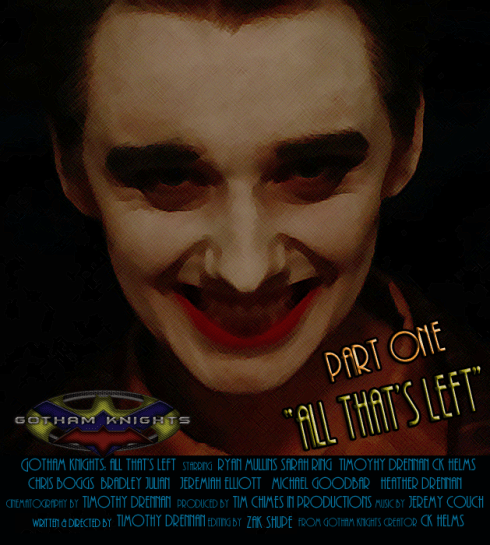
Available on YouTube*, “Gotham Knights,” created by CK Helms and Timothy Drennan, is a slickly made, enjoyable series of short films centered around characters based on the DC Comics characters—Bruce Wayne (Batman), Dick Grayson (Robin), the Joker, the Red Hood, and more. Picking up where the series’ 4 previous shorts left off, we have Part One of a new story, titled “The Gotham Knights Event.” Batman has been missing for a couple of years, Barbara Gordon and Dick Grayson are trying to live normal lives while struggling with grief, and the Joker has returned to Gotham. Those are the basic essentials for the story so far. Part One, titled “All That’s Left,” is merely a setup for something bigger to come. There isn’t much I can say about it, except to say whether or not it had me interested enough to want to see the rest of the oncoming series. And did it?

Thankfully, the answer is “Yes.” I enjoyed “All That’s Left,” though the element I enjoyed in particular was the actor playing the Joker: the film’s director himself, Timothy Drennan. When he’s first introduced here, there’s a quick moment in which he murders a henchman midway through playing friendly towards him—in that moment alone, Drennan captured the spirit of the Joker and carried it through the rest of the film. (I replayed that part repeatedly, I thought it was so funny.) Wherever the story goes from this point, I’m willing to follow.

Much of the film involves Dick (Ryan Mullins) and Barbara (Sarah Ring) as they discuss where they are in their own lives and how they can work together for the future. It’s not particularly interesting, but it’s only Part One; maybe it’ll get better. (Though, further considering the ending “All That’s Left” goes with, I can almost guarantee it will be more interesting, whether I know what happens or not.)

“Gotham Knights” is basically “Batman” with a small budget. There’s definitely passion put into each episode, and that passion continues with “The Gotham Knights Event.” It’s what makes the series interesting and fun to watch, and I’ll be interested to see what comes next, in Part Two…

*The Gotham Knights YouTube channel can be found here: https://www.youtube.com/channel/UCFiLCqpUd-3GlCb4cl4KhtQ

A Ghost Story (2017)

24 Aug

p04qh89p.jpg

Smith’s Verdict: ***1/2

Reviewed by Tanner Smith

What was it I said in my 2017 Review post about David Lowery’s experimental supernatural-based film “A Ghost Story”?*

“I just didn’t get it. I know many critics are praising this film as one of the best of the year, and I admire what director David Lowery attempted to do with this untraditional “ghost story.” But it just didn’t do anything for me, except cause me to wonder, “I hope Rooney Mara truly enjoyed that pie.” But I dunno, maybe I need to see it again…”

Oh, and see it again, I did…about five or six times. No joke—I checked out the DVD from my local library about five or six times, simply because…I wanted to see it again. Maybe “see it again” isn’t the right expression; “experience it again” is more appropriate for this film.

Here’s how it goes. Casey Affleck (“C”) and Rooney Mara (“M”) play a young couple living a comfortable life in rural Texas. Their relationship is rocky, as he’s an aspiring musician who is so wrapped up in his craft that he puts most things aside, including her. Before we even have much of a chance to get to know them, he dies in a car accident. After she identifies the body at the hospital, he rises in the very sheet he’s covered with. (Thus, the ghost spends the rest of the film looking like a child’s Halloween costume, complete with two oval-shaped holes for his eyes to see through.) From that point forward, the silent and unseen C goes on an existential journey, going back to the house where he watches as M grieves and tries to go on with her life and ultimately becomes witness to events that occur in the present, the future, and even the past. (We also get somewhat of an answer as to why ghosts tend to make a mess of things in haunted houses in horror movies.)

The first time I saw “A Ghost Story,” it threw me off. I wasn’t sure what I was seeing, and I wasn’t sure writer-director Lowery was even sure of what he wanted his film to be. It’s a nontraditional ghost story that I think had something to say about existence and time, as it simply shows (with as little verbatim as possible) what a deceased person experiences in the afterlife. Even when I was watching it for the first time, I knew there were parts of it that were simply beautiful in effectively disturbing ways…then there were other parts that I thought could have been summed up a lot quicker than the film thinks we could understand. I mentioned in the aforementioned quote that “I hope Rooney Mara truly enjoyed that pie”—that’s in reference to a scene in which Rooney Mara, playing a widow in mourning, sits alone on her kitchen floor and, in one unbroken take, eats a pie in real time. We get it—she’s grieving, expressed through stress-eating. But we’re stuck watching this scene go on and on to the point where instead of feeling the appropriate emotions for the character, all I’m thinking is…”I hope Rooney Mara truly enjoyed that pie.”

(Side-note: She apparently did not. Who could blame her? It was made of vegan chocolate, according to IMDb Trivia.)

But yes, critics did praise “A Ghost Story” as one of the best films of 2017. Having it given it a few more chances, I can definitely say I see why. The film is a unique experience. It’s perhaps a little too full of itself, but I can’t deny it’s still unforgettable. Maybe I was a little too fidgety when I first saw it and wasn’t ready for this small film to enthrall me with its intriguing vision of the mysteries of life and death (and after that). But now, I admit, albeit ambivalently perhaps, that “A Ghost Story” is one of a kind and worth recommending. (I can’t even work up the nerve to give a three-star rating, so three-and-a-half it is.)

Lowery apparently loves to take us on a neat ride, with many twists and turns as he takes us through time, whether it’s forward or backward. It’s to his credit as a filmmaker that breaking traditions in a film’s usual timeline is one of the important things that makes “A Ghost Story” all the more intriguing. More importantly, he’s also not afraid to challenge viewers to think about their own existence as well as existence in general. We don’t get any easy answers, but the questions are worth discussing about. (Though, I could’ve done without the scene in which a would-be philosopher practically spells out the basic theme of the film—that’s the one scene that seemed forced to me.)

Better late than never. I may have misunderstood “A Ghost Story” the first time around. Maybe I didn’t even want to understand it. Either way it goes, here’s my apology for my first viewing…and also my apology to you for never taking Smith’s Verdict seriously again.

*2017 Review: https://smithsverdict.com/2018/01/09/2017-review/

Black Panther (2018)

18 Aug

black-panther-alamo-drafthouse-advance-ticket-record-1079726-1280x0.jpg

Smith’s Verdict: ****

Reviewed by Tanner Smith

It’s no secret that “Black Panther” was going to be a big box-office hit. Ever since Chadwick Boseman’s African badass T’Challa clawed his way through “Captain America: Civil War,” fans were wondering when they would see him again in the Marvel Cinematic Universe. Would they have to wait for “Avengers: Infinity War”? Nope. Along came director/co-writer Ryan Coogler (who made the excellent “Fruitvale Station” and “Creed”) to give them a stand-alone dramatic action-thriller, simply titled “Black Panther.” But what was it that kept movie theater audiences coming back to it?

The answer, I’m afraid, doesn’t warrant much of an analysis. Everyone knows it—it’s because “Black Panther” is REALLY freaking good.

What’s especially impressive is that the previous MCU entry was “Thor: Ragnarok,” which was overall a fun, silly comedy (standing out among the other MCU movies which are mostly serious with comedic elements) and mostly poked fun at itself. “Black Panther,” on the other hand, is played almost 100% straight. It has a goofy moment here or there (mostly having to do with one of the key villains, played by Andy Serkis), but even then, it’s not forced in an attempt to wake the audience up if they were getting too bored. (The humor mostly comes from the human-interest-like interactions among the characters.) “Black Panther” didn’t need forced comic relief to be “good”—it just had to be GOOD in order to be “good.”

But maybe “good” isn’t enough to completely get across how I feel about “Black Panther.” Let me put it this way—I’m a big fan of “Iron Man” and “Captain America: The Winter Soldier,” my two favorite MCU movies, and I think “Black Panther” is every bit as good as those two (if not better).

“Black Panther” is more or less self-contained (though there are a couple slick callbacks to one or two MCU elements—don’t forget the usual after-credits scene). There’s no origin story to show us how this superhero, T’Challa/Black Panther (again played by Boseman), became who he is, but it is the story of an important time that allowed the character to understand the highs and lows of becoming who he is. It’s more or less a “real” story, with many twists and turns among conflicting issues and a few extra details delivered along the way. Oh, and there are some bombastic CGI blockbuster-appropriate battles too. The film has it all, it makes for a great time at the movies and one of my (and several moviegoers’) favorite films of the year so far.

What else does it have? In my opinion, it also has the best MCU villain by far. Let’s face it, Loki is fun, but he’s more of a clown that wants what he wants. And Michael Keaton’s Vulture (of “Spider-Man: Homecoming”) is sympathetic only to a point. But for “Black Panther,” we have Killmonger (Michael B. Jordan, who’s becoming director Coogler’s trademark actor, having starred in “Fruitvale” and “Creed”). He has revenge on his mind and he’s a red-blooded killing machine, but when you learn more about him, you understand why he acts the way he does throughout the film. You see, Wakanda, where most of the key characters reside and T’Challa is ascending to the throne, is a hidden, independent African nation with many secrets that could benefit the rest of the world, including the most highly advanced technology that assists Black Panther and his companions, such as scientist sister Shuri (the scene-stealing Letitia Wright), superspy Nakia (Lupita Nyong’o), and warrior Okoye (Danai Gurira), on their missions. Killmonger is appalled that Wakanda’s leaders keep the nation’s magnificence to itself when its resources could help thousands of millions of people in need or maybe even the entire population of the world.

The guy isn’t someone you want to mess with and at times, he needs to be taken down. But there’s also more to him than what I’ve already said about him, and by the end, he’s the best villain because he wants different things for complex reasons and will take drastic measures in order to do so.

And that’s what makes the best MCU movies so great (I’m moving away from the word “good” this time). In “Captain America: The Winter Soldier,” a hero who wants to do good is conflicted because the answers aren’t so easy. In “Black Panther,” T’Challa learns that same lesson, but there’s also more for him to learn, because he’s become King. He learns the hard way that the most difficult task in ruling a nation is to also be a good person. And that’s all I’m going to say about that.

Everything leads up to a huge battle between T’Challa’s loyal subjects and Killmonger’s growing army. It’s a lot of fun and visually pleasing, but…come on, we already knew that was going to be the case. But I won’t fault it for being done well either.

What have I left out? Two things. One is, the rest of the supporting cast is spectacular, including Forest Whitaker as T’Challa’s wise uncle Zuri, Angela Bassett as T’Challa’s mother Queen Ramonda, Daniel Kaluuya as T’Challa’s best friend W’Kabi, Martin Freeman as a trustworthy CIA agent who gets in on the action eventually, and Andy Serkis hamming it up as unethical mercenary Ulysses Klaue. The whole ensemble cast is especially incredible. The other is, Wakanda itself. Just when I think there’s no other visually-pleasing cinematic world to take me to, I marvel (forgive the pun) at the attention to detail given to this otherworldly place. Wakanda may join Hogwarts and Middle Earth as the great movie locales of the 21st century.

We all knew “Black Panther” was going to be good, but I’m not entirely sure we knew it was going to be THIS good. And yet, here we are. And we keep coming back to it after it graced us with its presence on DVD/Blu-Ray, and the year isn’t over yet! I’m certain people will still talk about it at the end of the year and maybe even after that. I know I will.