If there’s anything more important than a comedy that can make you laugh, it’s one that makes you feel. “The Farewell” is a wonderful comedy-drama that goes for both the comedy and the drama at high goals, and succeeds at both.
“The Farewell” is a semi-autobiographical film from writer-director Lulu Wang, about a young woman, named Billi (well-played by Awkwafina, who stole scenes in last year’s “Crazy Rich Asians”), who doesn’t know how to feel about her Chinese family keeping her beloved grandmother’s fatal illness a secret. The grandmother (Shuzhen Zhou) is unaware that an entire wedding ceremony is happening in Changchun, China, just so everyone in the family can be there with her one last time. Billi, who’s spent most of her life in America (and lives in New York), sees a moral dilemma here (as did I—I didn’t know this was a common cultural thing with Chinese families) and wonders if she should tell her or not.
Where to start with this film? For one thing, the family dynamic is wonderfully presented. It feels real, is written and acted beautifully, and reminds me of the complicated, ridiculous, and overall loving aspects of many extended families, such as my own.
The acting is spot-on. Awkwafina is truly moving as the underachieving, emotional Billi—so much so that I had to keep reminding myself that this was the same hilarious loony from “Crazy Rich Asians.” (She has impressive range as an actress.) Shuzhen Zhou as Nai Nai (“Grandma”)…it’s a cliche to say someone in this type of role will “melt your heart,” but I can’t help it—she’s adorable and she melted my heart. Also good are Tzi Ma and Diana Lin as Billi’s parents who are dealing with this distressing secret while hiding under a shield.
I love that this family can just take a moment every now and again and just talk—and I’m interested in what they have to say. There’s an extended dinner sequence in which the family talks about whether or not moving from China to America is the right thing. Is the American Dream a myth? Some think so, others don’t. It’s one of the best scenes in the film.
And last but not least, this film knows when to bring the levity. It’s not always a downer—sometimes, it’s very funny. But like with “50/50,” another “dramedy” that deals with heavy issues, this film knows death and cancer are never funny but the different ways people react to a situation like that can be humorous—and not with cheap laughs, either.
“The Farewell” is both appealing and emotional, and it’s one of the best films of 2019. I can’t recommend it enough.
Oh, and it’s rated PG! Remember when you could tell a mature story without containing adult language or imagery? So does Lulu Wang.
I admitted in my review of Abrams’ 2009 “Star Trek” that seeing that film was my first time seeing ANYTHING “Star Trek”-related. And it got me to watch other “Star Trek”-related stuff. I saw a few episodes from the ’60s TV series (on a “best-of” DVD) and a few episodes of “The Next Generation” too (it’s been on my Netflix list for years–I should really watch more of it), and in between, I watched the other movies. (I didn’t review them all, but I see them all.) Here are my quick thoughts on the pre-Abrams Star Trek movies:
“The Motion Picture”–boring+beautiful=beautifully boring “The Wrath of Khan”–terrific film, one of my personal favorite movies (#215 in my Top 250 Favorite Movies) “The Search for Spock”–overall pretty solid, though with a few awkward spots here and there “The Voyage Home”–fun stuff (“Well, a double dumb-ass on YOU!”) “The Final Frontier”–a pretty lousy movie with hardly anything accomplished…but it contains one of the best moments in any Star Trek movie (“I don’t want my pain taken away! I NEED my pain!” Pretty powerful stuff.) “The Undiscovered Country”–…I remember seeing it…but I don’t remember what happens in it. (I’ll see it again sometime, surely.) “Generations”–underrated “First Contact”–VERY good “Insurrection”–boring “Nemesis”–meh
(And no, I haven’t seen a single episode of “Enterprise” or “Deep Space Nine” or whatever other spinoff series there was.)
Then came J.J. Abrams’ “Star Trek,” which something old and brought in something new, which resulted in a fun adventure that respected the familiar characters. He was called back to make a new film, which became “Star Trek Into Darkness.”
What am I getting at with all of this? “The Wrath of Khan” is the film that I (and a lot of other movie lovers) get the most out of when it comes to quality “Star Trek” entertainment. And I feel like “Into Darkness” came really (and I mean REALLY) close to being the “Dark Knight” of the rebooted franchise.
But it failed. Why?
Because it ended up with nothing more than a reminder of how great “The Wrath of Khan” is. Can we say “irony”?
I rewatched “Star Trek Into Darkness” recently. It was my first time seeing it in six years, since it was first released, when I wrote the review. I forgot how much I truly enjoyed the first 90 minutes (or so) of this two-hour-12-minute movie. I loved it! It was taking the characters in deeper waters than expected, the action was just as exciting as the previous film but even more tense because the stakes were raised, the villain was great and I loved the parallel connections between him and Kirk…why didn’t I watch this film again in the last six years??
Oh, right…the ending. The final 20 minutes brought the whole film down like a house of cards. (Even so, I still can’t pan the movie overall, but everything that came before it was entertaining as hell. So…3 stars, I guess.)
It ticks me off, because I keep thinking of other ways this could have worked. Keep what they were going for, but throw out the “Wrath of Khan” callbacks (in that they recite the lines of dialogue practically word-for-word!!)…and have NO dialogue in the scene! Just focus on the emotions alone–everything that we’ve seen before would’ve been part of a puzzle that this would have been part of!
And most importantly, THROW OUT THE EPILOGUE! That’s the part that REALLY killed the movie for me. It’s like everything that we’ve been through before and everything we’ve learned (everything the characters themselves learned in the process)…suddenly meant nothing. If the writers (who also wrote “The Amazing Spider-Man 2″…that makes so much sense the more I think about it) wanted to leave a memorable impact on movie audiences, they should’ve given us more to think about than easy resolutions.
If they had, again, this could have been the “Dark Knight” of the rebooted “Star Trek” franchise! But alas…it made me want to watch “The Wrath of Khan” again.
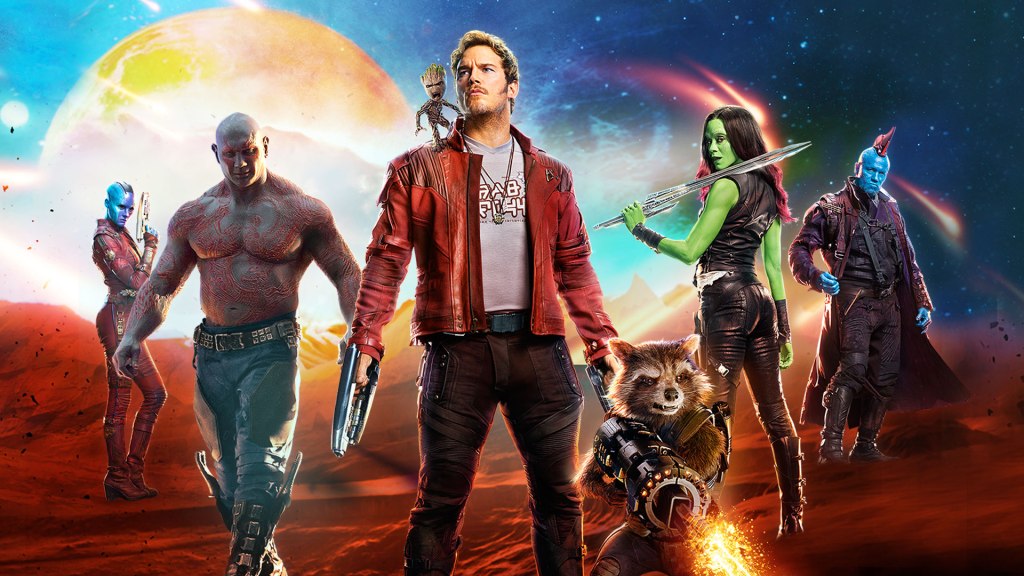
As fun as “Guardians of the Galaxy” was upon first viewing, much of it sort of wore off on me after watching it again. But “Guardians of the Galaxy Vol. 2,” which I have seen about four times now, is just about every bit the comedic, insane, energetic sci-fi romp that I like to revisit from time to time. (Not quite up there with “Serenity” for me–that’s the high standard I hold for this kind of fun sci-fi movie–but there are a lot of times when it reminded me of such.)
Yes, there are some things that still bug me about the Guardians themselves (especially Peter Quill’s arrogant personality), and yet…they don’t bug me AS MUCH as they should. Instead, I’m just having fun embracing this movie’s sense of humor, its vibrant colors, its effects, its pacing, and even its drama–and its characters are fun enough to get me through it.
The Guardians of the Galaxy–Peter Quill aka Starlord (Chris Pratt), Gamora (Zoe Saldana), Drax (Dave Bautista), Rocket (Bradley Cooper), and Groot (Vin Diesel), only this time he’s been regenerated and is now Baby Groot, designed to sell toys–are back and on the run. Looking for a place to hide, they encounter a celestial named Ego (Kurt Russell), who it turns out is Peter’s father. He can create anything much like a god (and can also destroy them if he wants) and seems like a good guy, so they crash with him. But as follows the formula for this kind of Marvel movie, something about Ego just doesn’t feel right. Peter doesn’t see it at first, of course, because he’s glad to find his father and bond with him, as well as discover who he himself is.
Yondu (Michael Rooker), the space pirate who sort of raised Peter as a drunk, abusive father type, is back into the mix, although his connection with Peter is called more into question, making for an interesting family dynamic. Other family dynamics are considered here. For example, one of the Guardians’ captives is Nebula (Karen Gillan), Gamora’s vengeful sister who wants to break free so she can kill her; the longer she’s with these people, the more she wants to assist them. And the Guardians consistently bicker and try to one-up each other in the downtime–one of them brings up that they’ve become like a “family” as a result. That’s actually a pretty telling statement. This movie is more than just intergalactic battles–it’s about relationships. And I admire this film for that.
Oh, and there’s a giant Pac Man that attacks…because that kind of thing works in a movie like this.
Everything in “Vol. 2” feels elevated from the first movie. The sense of humor is upped, the effects (from captivating to cheesy) are better, the emotions are more present, the worlds are more visually impressive, and it just overall feels more fun.
I mentioned Peter’s abrasive personality before, and sometimes, his ego is too much–sometimes, I want to smack some sense into this jerk. But I get that it’s part of his character and it’s a question of where he goes with certain choices he’ll have to make in the future. He does at least get when others are about to cross the line (otherwise, he wouldn’t be a Marvel superhero)–he even asks Rocket at one point, “What is your goal here? To get everyone to hate you?” So…I guess I give it a break here.
BUT as for his actions in “Avengers: Infinity War”…I’ll get to that later.
What else can I say but…”I’m Mary Poppins, y’all!”
“Doctor Sleep” is the sequel to “The Shining”…but is it a sequel to Stephen King’s novel “The Shining” or Stanley Kubrick’s cinematic “The Shining”? It’s no secret that Kubrick took a lot of creative liberties with King’s original ideas, to which King expressed his disappointment—on the other hand, it’s hailed by a majority of cineastes as one of the greatest horror masterpieces of all time because its atmosphere and execution caused us to fill in many blanks that we actually cared to fill in. (There’s even a documentary, “Room 237,” about all of the fan theories surrounding many of the film’s ambiguities.)
King wrote a sequel to his original novel, titled “Doctor Sleep,” and writer-director Mike Flanagan, who established himself as a modern master of horror with movies like “Hush,” “Ouija: Origin of Evil,” and another King adaptation, “Gerald’s Game,” as well as a hit Netflix horror series, “The Haunting of Hill House,” is making it into a film. But not only is it to be a faithful adaptation of the “Doctor Sleep” novel—it also has to work as a sequel to Kubrick’s “The Shining,” because that’s what movie audiences who love the original want to see. That’s a really tough challenge to take: appeal to both Kubrick fans and King fans—and you thought Steven Spielberg’s “A.I.: Artificial Intelligence” (based on a Kubrick script) was ambitious!
Well, no need to worry. It works wonders either way you look at it. “Doctor Sleep” is a terrific horror film and one of Flanagan’s most successful in an already-long line of gripping horror films.
Our main character is Dan Torrence, who was the little boy (“Danny”) that was terrorized along with his mother (Alex Essoe, playing the Shelley Duvall role from the original film). Played by Ewan McGregor, he’s an aimless, alcoholic drifter who one day decides to get away from himself, as the experiences that haunted his childhood, which he’s tried to keep locked up using his psychic abilities (or “shine”) for many years, are still getting to him. After trying to drown out the senses of his gifts with booze, he wants to use it to help people (and himself). He travels to the small town of Frazier, New Hampshire, where he attends AA, gains a friend in his sponsor, named Billy Freeman (Cliff Curtis), and gets a job in hospice to care for dying people. (He knows when people are about to die and, using his shine, gives them each one last moment of peace and reassurance that there is life after death.)
Fade to eight years later, when Dan has now cleaned up and bettered himself, and he also communicates telepathically with someone else who has the same psychic ability: a teenage girl named Abra (Kyleigh Curran), who is afraid to make her gifts known even to her parents. When a pack of nomadic, monstrous, humanistic beings is caught on her radar, Abra comes to Dan for help in stopping them from causing any more damage than they’ve already caused. Dan is reluctant as it seems these “people” are too dangerous, but before long, he knows he can’t let them get away with their doings.
Let’s talk about these guys, shall we? They roam the country to capture, torture, and kill psychic children to feed off of their souls (or their “Steam,” as they call it)—they keep what’s left of the children’s essences in containers to feed off of when they need it. In return, they live longer lives than the average person. They may look ridiculous as somewhat of a ‘60s touring hippie rock band (complete with tour bus), but they are terrifying—especially in a gruesome sequence in which they snatch an innocent Little-Leaguer (Jacob Tremblay) and torture him to death to feed on more steam. They’re led by Rose the Hat (Rebecca Ferguson, wonderfully, subtly diabolical here), named for the black hat she always wears. Rose is near-immortal as she knows the ways of getting more steam (mostly by astral projection to seek more targets).
Oh, and there’s a member on their team who can easily manipulate people’s minds by speaking to them. This is Snakebite Andi (Emily Alyn Lind), a 15-year-old new member of the pack. Having her around makes things even more unsettling as she can easily convince someone to fall into one of their traps.
They learn of Abra’s power, particularly that it’s stronger than they’ve ever faced before. Despite the possibility that she could fight back and overpower them, Rose insists on going after her to feed off her steam. Dan agrees to help Abra go against them when the time comes.
What surprised me most about “Doctor Sleep” (and what shouldn’t surprise me about any Mike Flanagan film by now) is that it put character and atmosphere ahead of terror and jump-scares. So much of the film depends on the acting, the writing, and the directing to keep us invested. They all work terrifically. Ewan McGregor is excellent as Dan Torrence, who is trying to move past his childhood traumas through alcoholism and then by getting away from himself before ultimately using his shine to help those in need. Up-and-comer Kyleigh Curran “shines” (forgive the pun) as Abra, a sweet, bright girl who is ready for battle when someone deserves to suffer for the horrific deeds they’ve done. We’re given plenty of time to witness the establishment of both interesting characters before they’re thrust into madness with Rose the Hat and co. Once that gets going, it’s an entertaining ride that also isn’t afraid to delve into deeper territory at times.
As for the question as to whether this film is more “King” or “Kubrick,” I’d say it’s more “King.” Most of the time, watching the film is equal to the same experience as reading one of his stories. It’s more accessible than Kubrick’s work, which is to say that it’s more narratively polished and straightforward. But there are many visual cues that remind viewers of his work on “The Shining,” so that it still feels like a fitting sequel. And what’s even better is that it doesn’t rely TOO much on people having seen the original film (though it’s more of an interesting experience if you have seen it), and the scenes that call back to it (which have unfairly been dubbed as “fan service” by other critics) are satisfying because of its context within THIS story and not the previous story.
I loved “Doctor Sleep” for being what it is and being a lot better than it could have been. How does it rank against “The Shining?” That’s both a fair and unfair question, but one is obviously all Kubrick and the other is obviously King (and Flanagan, obviously)—so, I guess it comes down to the question of are you fine with a more-than-suitable companion piece with more emotion than anticipated? I’m more than fine with it, which is why “Doctor Sleep” is one of my favorite films of 2019.
I went into Bong Joon Ho’s “Parasite” as cold as possible. (And thankfully, the film’s trailer was vague enough.) I came out of it feeling like I had experienced something rather amazing.
There were so many things in this funny, insightful, clever, ambitious story that I couldn’t see coming, and then by the end of it, I realize it was all inevitable. And it was masterfully done by a director whose work I’ve admired before (“Snowpiercer,” “Okja”)—“Parasite” is most definitely his magnum opus.
“Parasite” is a darkly funny, totally insightful, intelligent social satire with so many narrative twists and turns that kept me on edge for a majority of its running time and (HYPERBOLE ALERT) made me very appreciative of the art of innovative cinema. This has always been Bong’s strength—even when we think we know where something is going when the rug has ALREADY been pulled out from under us, he always finds another way to keep us invested until the very end.
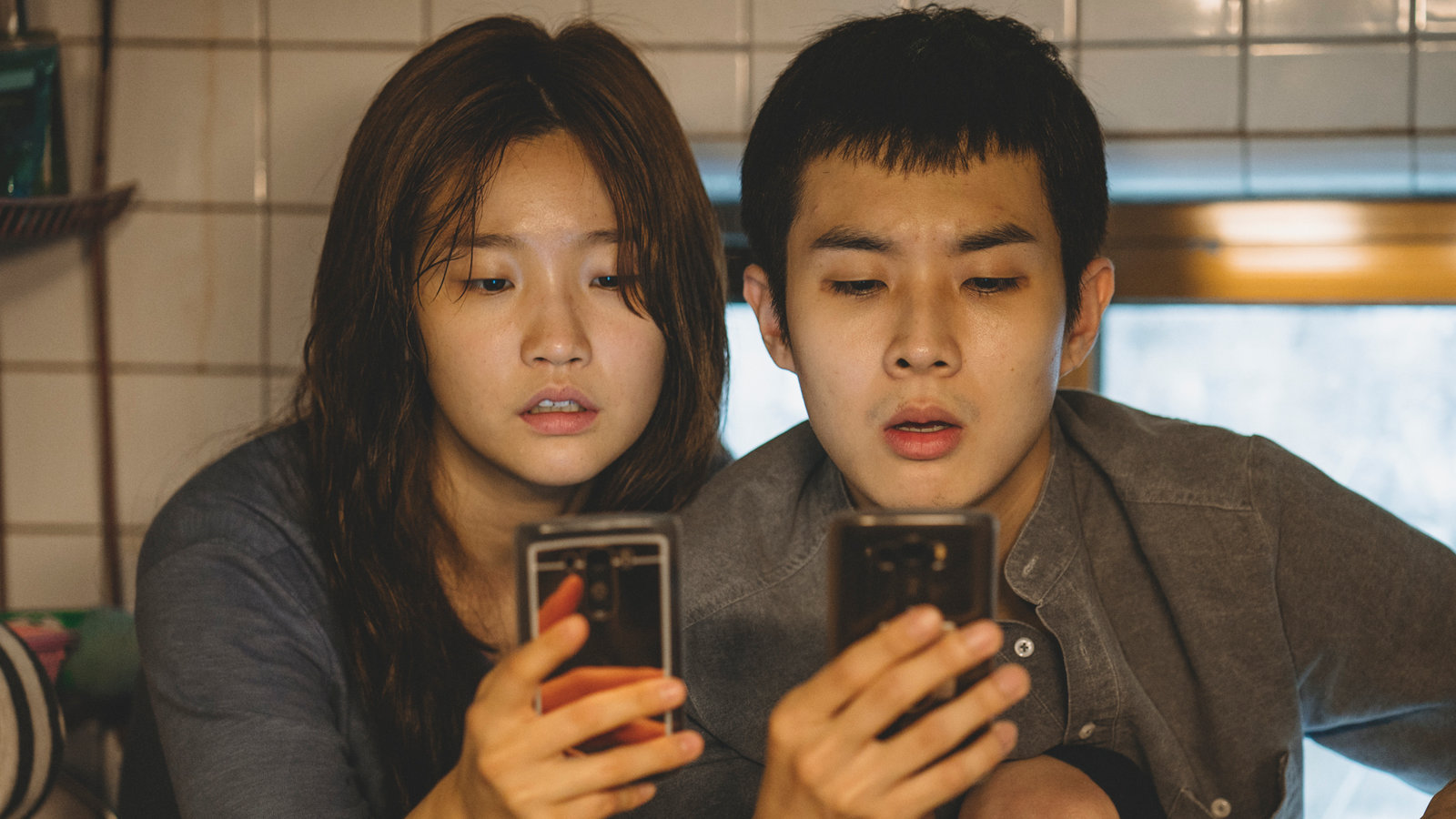
I will be as spoiler-free as possible—as I mentioned, you should go into this one knowing as little as I did. I won’t even dig deep into the film’s setup aside from what’s in the trailer. Speaking of which, this is the story of two four-person families in South Korea. One family is super poor, the other super rich. (And as a clever touch to the setting, the rich live high up on a mountain and the poor live below the streets—wait until you see what can happen in a rainstorm.) Our main protagonists lie within the poor family, as the film opens by showing us the only spots available in their cramped basement home where the Wifi connection is strongest. Dad (Song Kang-ho) and Mom (Jang Hye-jin) are unemployed and not very motivated, but son Ki-Woo (Choi Woo-sik) is an ambitious go-getter and daughter Ki-jung (Park So-dam) is an aspiring con artist—both teens take their shots wherever they can and are very good at what they do. The next opportunity comes with Ki-Woo is hired as an English tutor for the wealthy, privileged Park family (the aforementioned rich family). His student is Da-hye (Jung Ji-so), the teenage daughter of Park Dong-ik (Lee Sun-kyun) and Yeon-kyo (Jo Yeo-jeong), whose common sense (or tact) don’t match their wealth. Ki-Woo is able to earn their trust, which leads to a complicated con. He’ll bring in Ki-jung as an “art therapist” for the odd, rambunctious little son of the family, and the family never has to know she’s related to Ki-Woo. (And all she knows about “art therapy” is from studying Google results, but damn if she doesn’t act like she knows exactly what she’s talking about!) So that leaves their parents—how to get them hired by the family for any purposes such as chauffeur and housekeeper…
OK, we have an interesting thing going on here, especially when the “have-nots” experience the perks of the “haves” like a family of this sort would. They even take time out to analyze the situation, such as how would the Park family act if they were as poor as this family? We get to know all members of both families—there’s even a quiet domestic drama unfolding underneath the surface of this seemingly happy rich married couple, as Dad tries to manipulate some answers out of Dong-ik. We get to know the prejudices between classes. We learn a few things that could be used for or against certain characters (there are some great clues here, looking back on the film after seeing it initially). All of that is interesting and intriguing. And then…
Whoa. Definitely didn’t see that coming.
And from that point on, it’s an unpredictable series of twists and turns that grabbed me and wouldn’t let me go until it was done with me. As crazy as it is, it still feels real because the characters feel like real people, even when they do things that aren’t the best (or even morally sound) decisions. We’re with them when they go through one crazy situation after another and while I’m wondering how they’re going to get out of this, I’m also wondering how things could possibly get worse. Bong Joon Ho’s storytelling here is nothing less than creatively brilliant.
“Parasite” is one of the best films of 2019 and one of the best films of the 2010s—the acting is excellent across the board, the directing is top-notch to say the least, the writing is brilliant with many different layers to it, the visual style is lovely, and the whole film overall just reminds me that there are gems like this hitting the screens that it would be a shame to miss.
It’s good that even if I can’t get too deep into the story for a spoiler-free review, I can still get across how it affected me.
I remember attending the 2010 Little Rock Film Festival. I was almost 18 years old and I had just received a scholarship from the festival awards gala. There, I heard about an indie film set in the Ozarks called “Winter’s Bone.” It was the festival selection everyone was talking about. It received the highest award in the festival–the Golden Rock Narrative award. I met one of the film’s actresses, Shelley Waggener, who told me and my family how proud she was of how far the film has come so far. And so, I thought, this must be a hell of a film! So I look it up–it was a smash at Sundance, it’s been getting a ton of critical praise, and my favorite film critic, Roger Ebert, had just rated it 4 stars out of 4! That was when I knew I had to see this film.
Oh, and of course, one of the questions on my mind was, “Who’s Jennifer Lawrence?”
“Winter’s Bone” got a limited theatrical release soon after, but it wouldn’t come near my hometown in Northeast Arkansas. So I had to wait a few more months for it to hit DVD before I could check it out. And it didn’t disappoint. It was a gripping, compelling dramatic thriller with one of the most heroic cinematic protagonists of the decade: Ree Dolly (played by Lawrence), a 17-year-old Ozark Mountain girl who has to take it upon herself to find her father in order to save her family home. You see, her father, a meth manufacturer, has jumped bail–and if he doesn’t appear for his court date, Ree, her mentally ill mother, and her two younger siblings will lose the house because it was put up as part of his bond. Ree has been looking after her mother and brother and sister for a long time, and this is now her biggest challenge to make sure they all stay in her care for a while longer.
Ree doesn’t even flinch when she’s told the news that she has only a short time to think of a plan to stay–she simply says, “I’ll find him.” And that’s what she sets out to do. She starts with her meth-addicted uncle Teardrop (John Hawkes), who warns her not to go after his brother because trouble will come of it. Then, she tries some distant kin, who are some of the most paranoid asses you’ll find in a movie–they make the meth cookers in “Breaking Bad” (name your pick) look like the most relaxed people in the world.
Ree digs herself deeper and deeper to find her father or find out what happened to him, and the less answers she receives, the more determined she is to take more risks. She even gets the stuffing knocked out of her in one gruesome scene when the family, including the local crime boss Thump Milton (or, as I like to call him, Tiny D*ck), tries to decide what to do with her since she’s asked too many questions and won’t stop. Kill her? Maybe. Anything else. “Help me,” she said. “Ain’t no one’s had that idea, have they?”
The higher the stakes are for Ree and her family, the more I want to see Ree succeed in her quest. And she couldn’t have been played by a better actress. This was Jennifer Lawrence’s breakout performance, and it led to numerous accolades (including an Oscar nomination–only her first), which as we all know led to a very successful career. And she’s excellent here, aided by a top-notch director, Debra Granik, who gave Vera Farmiga her time to shine in 2006’s “Down to the Bone” and later introduced us to Thomasin McKenzie in “Leave No Trace”–I’d say Granik has a knack for finding new female talent.
Also, I gotta talk about how impressive John Hawkes is in this role. After seeing him in other movies like “The Sessions” (and then being astounded that he was in “From Dusk Till Dawn,” which I had seen many times before “Winter’s Bone”), it’s like his performance in “Winter’s Bone” is from someone completely different. He is a damn good actor. And his character has a great arc as well. He starts off as super serious and kind of fearsome, almost like he’s meant to be the story’s antagonist. Then he loosens up and decides to step in and help Ree, leading to an interesting father-daughter type of relationship that it’s obvious Ree hasn’t experienced.
Also, there’s a theory I read that Teardrop killed his brother and that’s why he felt the need to step in and help Ree find him out of guilt. At first, I thought there was something to that theory, but then I thought, I don’t think the people who helped Ree with the body’s remains would have let the night pass without letting that little detail slip.
“Winter’s Bone” is a gritty, atmospheric and altogether terrifically made film. I loved it 9 years ago when I first saw it, and I still love it today.
I’m going to get to writing about “Frozen” soon enough, because it’s Disney’s biggest hit (to say the absolute least!!). I already talked about “Tangled,” a very enjoyable romp. Other terrific Disney animated films from the 2010s include “Zootopia,” “Moana,” and “Wreck-It Ralph”–but today, I want to talk about what I think is their most “pure fun” animated film from this decade: “Big Hero 6.”
Remember when the Oscars didn’t nominate “The Lego Movie” for Best Animated Feature? Well, I feel a little better about that since they gave Disney’s “Big Hero 6” the honor.
“Big Hero 6” is conventional, cliched, and kind of predictable…but damn it if it also isn’t a ton of fun!
It’s an origin story for a team of superheroes, as a lovable collection of techno-savvy geeks band together and decide to suit up as a super-team to go up against a techno-savvy baddie. To their aid is a robotic companion, now programmed to kick some serious butt. Along the way, there’s tragedy, comedy, and of course, a life lesson that our main hero has to learn as well as the main villain.
Would it surprise you that this is based on a Marvel comic? Didn’t really surprise me, either.
Oh, and it also takes place in a future city known as San Fransokyo, a hybrid of San Francisco and Tokyo–there’s not any explanation for this joining, but it makes for a pretty visual sight when we go to some different spots of this world here and there.
It begins as Hiro Hamada (voiced by Ryan Potter) is convinced by his older brother Tadashi (Daniel Henney) to join his science college to better his creative mind. Hiro comes up with a unique robotic invention and unveils it at a science fair, but it seems someone is out to get it for himself and starts a fire in the building that claims the life of Tadashi. (It wouldn’t be a Disney movie without some sort of tragic death, right?) Hiro is left with Tadashi’s own robotic invention–a portly Pillsbury Doughboy lookalike designed as a health care robot, named Baymax (Scott Adsit). At first, Hiro doesn’t want to admit he needs help in any way, even though he’s clearly suffering from loss of his brother. But when it becomes clear to him why his brother died (that it was no accident), he decides to get to the bottom of it. He rallies Tadashi’s genius classmates–cowardly laser specialist Wasabi (Damon Wayans Jr.), quirky chemist Honey Lemon (Genesis Rodriguez), bitter engineer Go Go (Jamie Chung), and comic-book loving slacker Fred (T.J. Miller)–to help him out, and he also reprograms Baymax to become a lean (er…OK, not lean), mean (actually, he maintains his calm manner) fighting machine (thanks to karate styles in movies) to back him up.
Baymax is adorable. He speaks in a soothing voice, has many resources (including hugs) to help those in need of medical attention, and is the perfect toy for Disney to sell to children.
They go through all the motions of the origin story. They encounter a masked supervillain that they think is someone in particular but really turns out to be someone else for another reason. And of course, the villain’s motivation mirrors the hero’s selfish desire, which leads to a moral that both need to learn before the credits roll. Yes, admittedly, “Big Hero 6” doesn’t have much that’s “new,” per se, but when it works, it’s not only one of the most entertaining animated movies of the decade–it’s also one of the most touching. By the end, I wanted to tell Hiro that everything’s going to be OK and we all suffer and get through loss at some point of our lives.
Hiro is the most well-developed of the kids, which mostly comprise of generic types–the stoner, the goth, the wuss, the loony. But I like them all for the same reasons I like the kids in “Honey, I Shrunk the Kids,” who were also generic types. They’re more than likable enough to follow and they add to the fun. They each get their time to shine.
The action is fun and wonderfully animated (like I would expect anything less from Disney animation). The themes of loss and redemption are well-done. And when it’s all said and done, it doesn’t matter what we have or have not seen before in other movies before–what matters is how well it’s all handled. “Big Hero 6” is a ton of fun.
Also, stick around after the end credits (this is a Marvel movie, after all). It’s a pretty golden moment that follows.
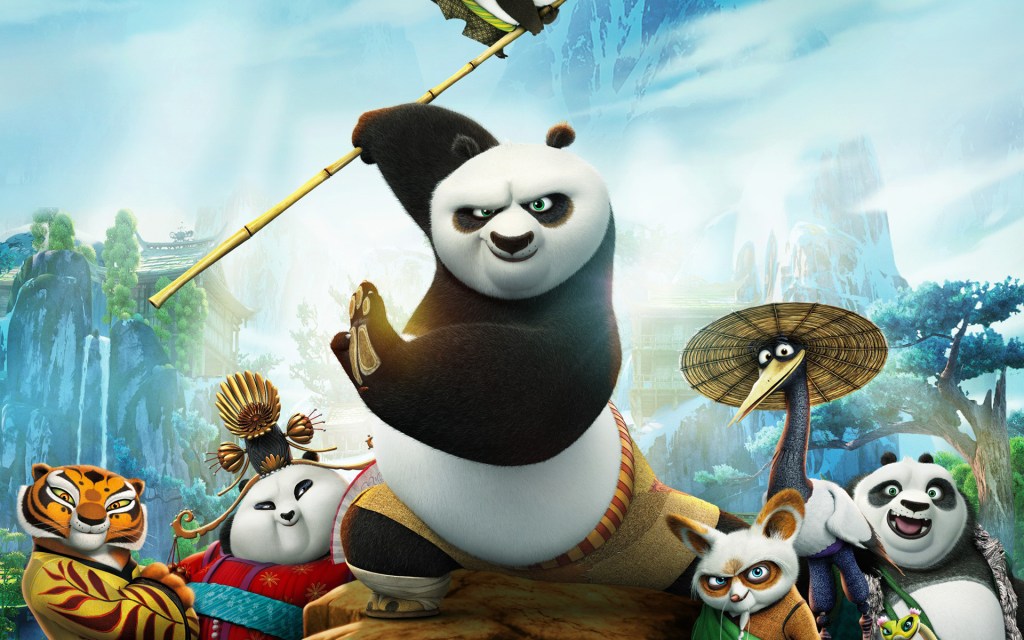
One of the best, most surprising animated treasures of the 2000s was DreamWorks’ “Kung Fu Panda,” starring Jack Black as a panda who learns kung fu…thinking about what I just wrote baffles me for how stupid it seems and yet delighted that it actually worked.
And it definitely worked. Released in 2008, “Kung Fu Panda” was not only beautifully CG-animated and very funny AND wonderfully choreographed (for animation, providing as many kung fu styles as possible takes incredible skill)…but it was also rather moving and beautiful when it needed to be, and it taught a valuable lesson that speaks to both kids and adults: we all have unique skills that help make us who we are.
Three years later, in 2011, we got “Kung Fu Panda 2,” which was even better. More atmosphere, more action, more visual treasures, and most surprising of all, more emotions–you will believe Jack Black as Po the Kung Fu Panda will make you feel things!
I could make a Looking Back on 2010s Films post about “Kung Fu Panda 2,” but honestly, I think I’d rather write about “Kung Fu Panda 3,” my favorite of the trilogy.
Yes, it’s a trilogy with a conclusion…unless DreamWorks decides to go the PIXAR/”Toy Story 4″ route and meet back up with familiar characters years later. (I’d be fine with that, if it’s done well, like with “Toy Story 4.”)
With each passing film, we see a neat progression in Po’s character. In the first movie, Po was a mere kung fu enthusiast (and flabby panda) who was chosen to become the Dragon Warrior to combat a dangerous villain and bring peace to the valley. No one believed in him until he was able to find the skills within himself to get the job done.
But with “Kung Fu Panda 2,” we’re reminded that it’s not as simple as that to become what you desire to be. Po had to search within himself to find out who he truly is and not just who he wants to be. (Oh, and he also had to find out about his origins, as his father’s a duck who obviously adopted him.) Through it all, he finds inner peace. A satisfying resolution for an even more satisfying sequel. Where can we go from there?
Well now we have “Kung Fu Panda 3.” What are we going to tackle with this one? Well, this time, Po has to be a teacher. Already, I’m intrigued. Po is still excitable and energetic. He has mastered many of the ways of kung fu, but we see he still has a lot more to learn. Now, Master Shifu (voiced by Dustin Hoffman) is stepping down as master of the Furious Five and appointing Po as the new guy in charge. But even Po knows he’s not ready for this responsibility–and thankfully, we get a scene early on in which Master Shifu states the reason he wants Po to teach is so Po himself can learn something new, because he shouldn’t get used to what he already knows. Pretty good point there.
Anyway, Po is visited by another panda in the valley, named Li (Bryan Cranston), who it turns out (GASP!) is Po’s birth father! It’s a happy reunion that turns into more than that when it turns out Li may be able to help in defeating a new all-powerful villain, the chi-stealing warrior Kai (J.K. Simmons). You see, pandas possess the hidden secrets of the power of “chi,” which translates to “life force” or “energy flow.” The more Kai can possess from those he comes across, the more powerful he becomes. Thus, Po has to travel with Li to the secret panda village to learn chi. But it’s going to be harder than it seems, as Po is interacting with his own species and finally learning how to be…a “panda,” for the first time in his life.
Oh, and Po’s adoptive father–you know, the goose (James Hong)–is understandably jealous of Po’s new attachment to the father he never knew. Thankfully, this subplot isn’t as annoying or even as distracting as it could have been. And its resolution is actually kind of touching…but not as effective as…
You know, it’s baffling and kind of disconcerting that “Kung Fu Panda 3” didn’t get the attention it deserves. Critics recommended it mildly at best. It was released in January, when it could/should have been a fitting summer release. And of the three “Kung Fu Panda” movies, this was the only one not to be nominated for the Best Animated Feature Oscar.
People just see it as just another “Kung Fu Panda” movie, which is a shame, because…I love this movie.
Why do I favor this one over the previous two? Because it’s a definite proper conclusion in this sense: it’s the only one in the trilogy that came through with its original promise. You ever notice that what usually defeats the previous villains is some kind of magic that was never fully explained, defeating the purpose of the message the films try to get across, that it’s best to find your own inner strengths? Well, this time, even though the mystic Wuxi finger hold (which I still don’t get) plays a role in the climax, the focus is still on what Po is able to teach his fellow pandas in the ways of kung fu. He teaches them to use their abilities to their advantage, and in a fresh, inventive way, it truly works. There’s an ancient Chinese saying that kung fu lives in everything we do–this is a Kung Fu Panda showing us how! As strange as that may sound, it’s truly effective.
Now, I can just predict some troll commenting, “Haha I’m writing an angry comment on your blog–is THAT kung fu? XP” To that, I say, “It just might be.”
And as Po learns who he himself really is, it’s actually very emotionally satisfying. I can’t help it–the “Kung Fu Panda” trilogy is better than it had any right to be. With the right skills and writing and technical wizardry, you can make even the silliest ideas work wonders.
Hayao Miyazaki’s swansong, this was said to be. Well, a few more years will change anyone’s mind, as he seemingly has another film in the works. But it wasn’t the first time he announced retirement anyway. Who am I to complain? If he wants to keep making films, let him.
“The Wind Rises” is one of Miyazaki’s best. It shows his strengths as a visionary animation director. It’s visually stunning, has a beautifully told story, and is just an overall fantastic film. It’s also the first time Miyazaki tackled a “true story,” so that’s just as impressive. It’s a story loosely based on aviation engineer Jiro Horikoshi, who came up with the design of the Japanese Zero fighters, which were used in WWII.
Thankfully, neither the character nor the film have a political agenda to get across. We know what damage and tragedies came from this creation, with many lives lost at the hands of the fighter pilots. But the character of Jiro didn’t know that would happen–he just felt happy to create something unique and special…it just turned out that “something” was a weapon.
The film doesn’t focus on the controversies that spawned from what this creation led to, but it doesn’t ignore them either. It instead focuses on the wonder and majesty of bring something new and innovative to life. That is what the film is about–it’s a fable about dreams, creativity, and passion.
And the way the film explores the creative process is imaginative. We see Jiro’s dreams and fantasies (in which he converses with his hero, a late Italian aviator voiced by Stanley Tucci), and we also see little things that inspire him, even something as small as a curvy fish bone that inspires his ultimate design.
But the film is also very downplayed. Characters talk about what should be done and what needs to be in order to make it work, in realistically effective fashion. The visually amazing sequences that Miyazaki does best are saved for dream/fantasy sequences, which was a wise decision for a film like this.
Oh, and here’s an interesting tidbit: human voices are largely used as sound effects, such as engine roars. I don’t know exactly why, but I think that’s ingenious.
So maybe Miyazaki hasn’t called it quits yet. Whatever his next film turns out to be, I’ll be interested in seeing it.
One of the bonus features on my Criterion DVD/Blu-Ray collection for Richard Linklater’s “Before” trilogy is a wonderful video essay called “On Cinema and Time.” It looks at many of Linklater’s films (including the “Before” trilogy, of course) and Francois Truffaut’s “Antoine Doinel” film series (spawned by “The 400 Blows”) to look into the styles of distinctive filmmakers who can be labeled as “auteurs.” And it was done brilliantly. (Side-note: please watch it here.)
Who made the video? A filmmaker best known for his video essays, simply known as Kogonada (or, : : kogonada). He’s all about content, form, and structure of film, and his video essays are about trademarks and aesthetics used by filmmakers. Other sources for his essays include Wes Anderson, Quentin Tarantino, Stanley Kubrick, among others.
I remember thinking, this is a fascinating “movie buff” (for lack of a better word) and he should write/direct a feature film some day. Well, he did–a wonderful conversation-driven comedy-drama called “Columbus.”
The film takes place in Columbus, Indiana. One of our two main characters is Casey (Haley Lu Richardson), a young architecture enthusiast who graduated high school, works at the local library, likes to walk around local architecture and pretend she’s a tour guide providing important information to people, and also cares for her mother, who is a recovering drug addict. The other is Jin (John Cho), an American who works in South Korea translating literature to English and comes to Indiana to care for his estranged father, who is now in a coma after he was supposed to give a lecture about architecture.
Jin and Casey meet by chance, strike up conversation, and find they share a rapport. Jin hates architecture, leading Casey to tell him about her favorite buildings, which then leads Jin to ask WHY they’re her favorite structures. In talking about this stuff, they also open up about themselves, such as how Jin feels resentful towards his father since he buried himself into his work and how Casey would love to pursue her dreams of working in architecture but feels pressured to look after her mother. The two help each other out, even when they both stubbornly state they don’t need help.
I mentioned the “Before” trilogy and how Kogonada’s video essay was used to illustrate Linklater’s style of presenting philosophy and time through cinema. Watching “Columbus,” I can’t help but feel like this is the style Kogonada took inspiration from. Most of it is not so much “dialogue” driven as it is “conversation” driven, as the “Before” trilogy was. That’s not to say he steals Linklater’s style; he just puts his own spin on it, with his own writing, characters, and style. He’s telling his own story through words, and he’s also doing it through architecture–many of the film’s static shots are framed in such a way that we can appreciate the design of the setting just as Casey appreciates the structures of her favorite buildings. He’s practically forcing you to look at what he has to show you.
Jin and Casey are two interesting people communicating both through conflict and despite conflict. They need each other to talk with/to, and as a result, we learn more about each one of them and what they have to go through. That makes the scenes in which they’re with other people, such as Jin with his father’s assistant (Parker Posey) and Casey with her coworker Gabriel (Rory Culkin), all the more interesting when you note the contrast between they want to talk about and what they’re afraid to talk about. Thus, each time Jin and Casey revisit each other to talk some more, I’m all the more invested in what they have to say next.
John Cho is very good as Jin–it’s great to see the guy who was known as the “MILF guy” in the “American Pie” movies and the first half of “Harold & Kumar” get opportunities to shine as a dramatic actor. (He was even better in “Searching” in 2018.) But the real star of the film for me is Haley Lu Richardson as Casey. I’ve liked her in movies like “The Edge of Seventeen,” “Split,” and “Support the Girls,” among others–“Columbus” gives her the role she was born for. She’s brilliantly natural, she has great screen presence, I feel for her character from beginning to end, and she delivers a true heart to the film that I can’t praise enough. I want to hug her when she’s upset, I want her to follow her dream, I feel bad for her when something goes unexpectedly, and I smile for her when she does something she even remotely likes. She’s nothing short of wonderful here.
There’s a lot of sadness in “Columbus,” which is why Jin and Casey need their outlets to let out their emotions. But there’s also a lot of possibilities for them to move past it all and embrace what they have and what they could get. Much of it has to do with love–the sacrifices for it as well as the avails…kind of like what goes into architecture as well.
Kogonada has another feature in the works: a science-fiction drama called “After Yang,” starring Colin Farrell. With this guy at the helm, I look forward to seeing that film as well.






 Smith's Verdict