Looking Back at 2010s Films: Black Panther (2018)

25 Nov

By Tanner Smith

It’s the superhero movie that finally convinced the Academy that mainstream action fare can count as “Best Picture worthy” too! Not “The Dark Knight.” Not “Logan.” But “Black Panther.”

And I freaking LOVE it. In fact, “Black Panther” is one of top 3 favorite Marvel Cinematic Universe movies. When I heard it was nominated for so many Oscars (including Best Picture), I cheered and applauded. I would be mad at the Academy for excluding “The Dark Knight” and “Logan” from consideration for the highest category (and they are in many ways superior films), but what’s done is done, so let’s move along.

I gotta be honest–even though the character arc for T’challa aka Black Panther (Chadwick Boseman) in “Captain America: Civil War” was both strong and satisfactory, I wasn’t really rushing to see a “Black Panther” movie. (But can you blame me? Spider-Man’s movie was coming!) But when I saw it, I was blown away.

First and foremost, the world of Wakanda is outstanding! Wakanda is a secret land in Africa that possesses the most advanced technology hidden from the rest of the Earth. It’s this advanced city hidden with a cloak, and I’m guessing this is where the effects budget went, because it looks amazing.

We can add Wakanda to the fictional worlds we’d like to explore, along with Hogwarts, Middle Earth, Narnia, Asgard, Pandora, among others–now, we have Wakanda (forever!).

T’challa is prince of Wakanda, about to be appointed king to keep the peace within the kingdom. (Though, usually, there’s a brutal fight for the throne–guess that’s just the way it goes for peace.) But then along comes Killmonger (Michael B. Jordan), who has a history with Wakanda and hates that their technology that could benefit mankind is kept secret. So, he comes up with a plan to rally as many Wakandans to his side to invade and attack those who abuse their power, starting with battling T’challa in a duel for the throne.

My second favorite thing about “Black Panther”: Killmonger. Played with such conviction by Michael B. Jordan, Killmonger plays a villain whose motivations you can surprisingly get behind. You understand why he does what he does even if he does push it beyond morals and ethics, and he’s easily identifiable even though he’s the villain. When he takes charge, you buy it. When he reveals who he is to the public, you feel a little sorry for him. When he reveals his ultimate plan, you see why people would stand by him.

My ranking of the MCU villains are as follows: Thanos, Killmonger, Vulture (“Spider-Man: Homecoming”)–what a relief; I thought Loki was the best they could come up with in terms of villainy.

The director of this film was Ryan Coogler, who also directed Michael B. Jordan in “Fruitvale Station” and “Creed.” I think this director knows how to play to the actor’s strengths.

I also like the side characters, including T’challa’s sister, who comes up with many different gadgets for her brother to use as Black Panther in battle. She’s a lot of fun. And I also liked Martin Freeman as an American CIA agent who suddenly experiences firsthand what Wakanda is all about–first, he’s confused and even bitter about what he sees; but soon enough, his discovery turns into an enlightening journey. (Oh, and Andy Serkis plays a nasty schemer who thinks Killmonger is working for him but really he’s the one being scammed–do I even need to say Serkis is a ton of fun in this role?)

The visual effects…are not particularly strong. Even I will admit I’ve seen better, especially in other MCU movies. But they’re not TOO bad either, and they’re still put to good effect, especially in the gripping car chase midway through the film–that sequence is still strong, in my opinion.

But that’s really the only thing I have to complain about “Black Panther,” and thankfully, the effects are not what’s important with the movie. You could even argue that T’challa is the least interesting character in the movie, which is unfortunate considering the film is named after his alter-ego. But we do get a sense of who he is, and I think what’s more important is the way those around him (whether they stand by him or against him) react to his decisions, which will affect the future of Wakanda’s hierarchy.

So, in that regard, “Black Panther” is more about interesting ideas and character than it is about pyrotechnics, whether real or CG. And that’s why it’s become so well-regarded by critics, audiences, and even the Academy.
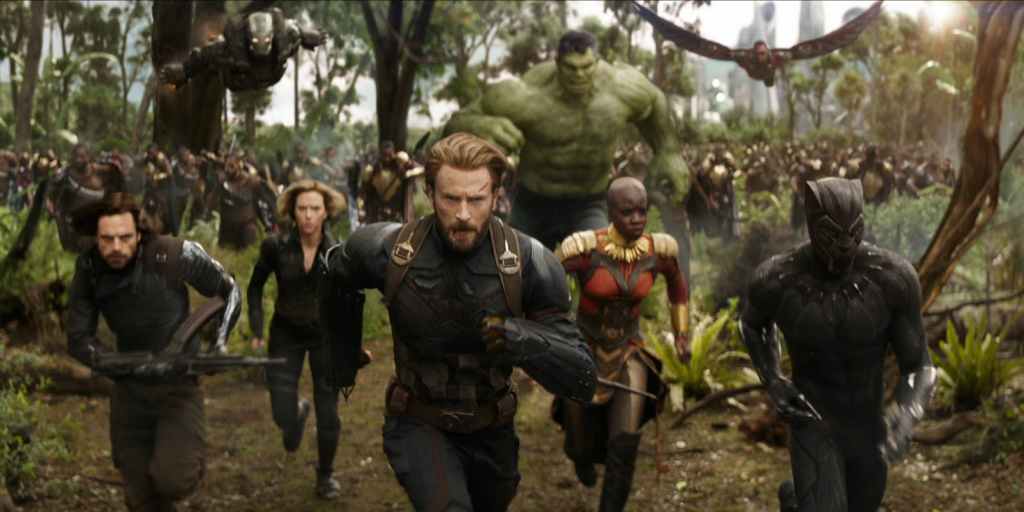
Looking Back at 2010s Films: Avengers: Infinity War (2018)

25 Nov

By Tanner Smith

As much as I would love to talk about “Thor: Ragnarok,” one of my favorite entries in the Marvel Cinematic Universe, I decided to skip over it for two reasons. 1) It’d just be a collection of my favorite scenes that made me laugh and smile (plus an analysis of Bruce Banner aka The Incredible Hulk, who’s put to great use in the flick). 2) “Avengers: Infinity War” sort of varies actions and motivations in “Thor: Ragnarok” rather…pointless–and that’s just within the first 10 minutes! (That’s kind of a bummer.)

But seriously, I love “Thor: Ragnarok.” It’s the “Thor” movie I didn’t know I wanted. There. Review over. Let’s talk about “Avengers: Infinity War.”

I can imagine that in 1980, movie audiences rushed to see “The Empire Strikes Back,” the sequel to one of their favorite movies (“Star Wars”), expecting something just as incredible…and I can also imagine that they were totally scarred by the uncompromising misery brought on by its dark twists and turns.

Well, in 2018, movie audiences felt the exact same thing. We went into “Infinity War,” expecting something big and epic and worthy of something to make us feel great inside…but alas, we left the theater feeling sad and empty and lost. And I’m certain many fanboys (or “fanatics”) retreated to their parents’ basements and sobbed, “WHY, MARVEL, WHY?!”

I may be wrong, but “Avengers: Infinity War” was probably the most hyped mainstream blockbuster since “Star Wars: The Force Awakens.” We’ve spent many Marvel movies building up the coming of the otherworldly villain Thanos and these things called the Infinity Stones. Well now, he’s definitely here and he’s trying to get all the Stones so that he can wipe out half the population of the whole galaxy. And not only that–this time, I’m actually interested! I got so tired of the “foreboding” moments that warned us of Thanos; I wanted him to actually do something for once! Well now, he’s been built up so much, I had to wonder what’s so special about him.

As it turns out, Thanos is the best, most complex villain the MCU has to date. As played with incredible motion-capture work by Josh Brolin, he’s always the most interesting person on screen–and that’s saying something, considering we’ve spent several movies with the Avengers themselves! (But don’t worry–the Avengers themselves are still great heroes to follow. A hero’s only as great as their villain, after all.)

As the film begins, Thanos has appeared on Thor and Loki’s ship, destroying everyone on it. (Yeah…”Thor: Ragnarok” was all about saving the people on that ship. See what I mean now?) He beats up the Hulk and sends him down to Earth, where he transforms back into Bruce Banner and warns the Avengers that “Thanos is coming” (for real this time). Thanos is looking for the Infinity Stones so that he can fit them onto the Infinity Gauntlet, which will gain him godlike powers, thus allowing him to fulfill his lifetime goal of wiping out half of all living things. Everyone is called into action: Iron Man, Black Widow, Doctor Strange, Spider-Man, Captain America, Scarlet Witch, Hulk, War Machine, Falcon, Black Panther, and yes, the Guardians of the Galaxy. The Stones are spread out throughout the universe, and so, they’re all split into groups to try and gain the upper hand, hoping to track down Thanos and/or each of the Stones before he can grab them.

SO much happens in this two-and-a-half hour long movie, it’s easy to miss something. But that’s not a bad thing–I’m always interested in whatever each group is up to, and whenever it cuts back to one, I’m not wondering why we’re not cutting back to another right away. We’ve spent many movies getting to know the Avengers, and now they’re in the ultimate fight with so much at stake. And they’re up against the ultimate bad guy. This movie’s gonna be awesome!

And a lot of it IS awesome, with intense superhero action and intergalactic battles and battles on land and more! The rest of it is pretty moving, as we see even Thanos has something to lose as well–we don’t condone his actions or his intents at all, but we understand why he wants to do all of this.

So, for about two hours and 10 minutes, we’re enjoying ourselves with this intense, compelling, enjoyable Marvel flick…and then, the ultimate tragedy occurs.

And thus, many children in the audience are scarred for life just as their parents were in 1980.

OK, let me get to one personal gripe: I can’t help but think back to a moment in which Peter Quill aka Starlord clearly had the upper hand and could have managed to stop everything once and for all, but no, his damn ego got in the way AGAIN.

Grrrr…….remember in my “Spider-Man: Homecoming” review, when I talked about how much Tony Stark aka Iron Man learned from his terrible mistakes brought on by his own ego and tried to better himself through his actions for the team (and for Spider-Man, for whom he was a mentor)? Well, the main thing I look forward to in “Guardians of the Galaxy 3” is that Starlord grows the hell up…especially after he returns in “Avengers: Endgame,” he still holds onto his ego!! Seriously, this is getting old. I don’t find it funny or charming anymore–this guy pisses me off just like Iron Man pissed me off long ago. But if Iron Man can change, Starlord can change…maybe.

Whew! Had to get that off my chest. Anyway, “Avengers: Infinity War” was a big movie that paid off. And it gave audiences both what they wanted and what they needed. They wanted a big story with big battles and higher stakes–they got that. They needed something that would make them ponder and think about how they got to the inevitable resolution–they DEFINITELY got that. What could possibly happen with the Avengers in their next movie? We had to wait a whole year to find out!

Would it be worth the wait? Well…I’ll get to “Avengers: Endgame” soon enough.

Looking Back at 2010s Films: Super 8 (2011)

25 Nov

By Tanner Smith

2011–J.J. Abrams’ “Super 8” was one of the biggest hits of the summer and one of my new favorite films. I saw it three times in the theater, I had a great time each viewing, I watched it several more times on DVD, I absolutely adored this movie…

Well, now that time has passed, I don’t think I would rate it four stars today. But I still enjoy it and I’d only tone the verdict down to three-and-a-half stars.

When I first saw this film in a theater, it blew me away. The effects were great (that train crash is still spectacular!), the mystery is well-handled, the buildup is nice, the kids are perfectly portrayed (that pyromaniac kid Cary constantly cracks me up), and it’s just the Spielberg-Abrams collaboration I was waiting for and got….But with that said, there are some major problems that became more clear to me, watching this again. First and foremost is the subplot involving the personal “vendetta,” if you will, Deputy Lamb (Kyle Chandler) has against this one guy, Louis Dainard (Ron Eldard). Maybe it’s just me, but his reasons for feeling (and acting) this way toward not only him but his generally nice daughter could be stronger. I know that it’s because Lamb’s wife had to fill in for Dainard at work and she was killed in an accident as a result, but really, it wasn’t his fault. I get it; Lamb’s a flawed man, as is Dainard, but I just couldn’t sympathize with him, because of his incredibly harsh attitude toward him and his daughter (as sort of guilt by association, I guess). This plot element simply doesn’t work for me anymore and I fast-forwarded through any scenes that bring it up.

That’s my biggest problem with the film. Other little problems include certain plot elements that don’t pay off as well as they should, and…I’ll just say it, I think the ending is kinda anticlimactic. There, I finally admitted the very thing that people have the most issues with about this film. (Though, I still think the last scene is clever and leads to a heartbreaking moment where Joe has to let go of his late mother once and for all, so that made up for it.)

With that said, I still enjoy “Super 8” for much more reasons than my personal issues with it. I still recommend it, just…slightly less highly than I did before? Take that for what it’s worth.

P.S. The kids’ short film played during the end credits? Awesome!

Looking Back at 2010s Films: Frozen (2013)

25 Nov

By Tanner Smith

It’s the big one! “Frozen” became Disney’s most popular, most profitable, most phenomenal animated film since “The Lion King.” For the past six years, it’s been impossible to get away from it–with a ridiculous amount of merchandising in every retail store, theatrical re-releases with sing-along pop-up lyrics for the musical numbers, and of course…”Let It Go,” an inescapable song so overplayed that it even drives people who like the film crazy just from the first few opening notes alone!

Because of the insane amount of popularity “Frozen” has received, there came the inevitable backlash. Is it really that good? Does it deserve this much attention? And so on.

Personally, I don’t think any movie deserves THAT much attention–sometimes, a movie should just be a movie; other times, a movie should be more than a movie; the case for “Frozen” is that it’s even more than that, so of course it’s going to welcome a crazy amount of backlash. So, even with all of that in mind, what do I think of “Frozen”?

It’s very good. In fact, much of it is great. So let’s talk about it.

Anna (voiced by Kristen Bell) and Elsa (Idina Menzel) are two princesses who grow up separated from each other in their large castle, because Elsa has a magical ability that controls the cold and she almost killed Anna with it while they were playing together (and Anna’s memory of both that and Elsa’s power was wiped out). The two grow up as polar opposites–Elsa is an introvert after keeping her powers secret for so long, and Anna is a wild extrovert, ready to open herself to anyone who will give her attention. During Elsa’s coronation as queen, Elsa’s powers are accidentally revealed, causing her to run away and leave the kingdom in ice. Anna sets out after her so she can convince her to come back and fix everything, with help from an iceman named Kristoff (Jonathan Groff), his reindeer Swen, and a magic, live snowman named Olaf (Josh Gad).

OK, what do I talk about first? Well, I guess I can start with what I haven’t mentioned yet: Anna’s fiance Hans (Santino Fontana). I don’t even think an hour has passed upon Anna and Hans meeting each other before deciding to marry–not too surprising for an animated fairy tale from Disney. What IS surprising and VERY refreshing is everyone’s reaction to it. Wouldn’t you know it, everyone is shocked and appalled that Anna would marry someone she just met! (Imagine that!) This is something Disney romances usually never touch upon, so that’s one of the things that make “Frozen” fresh and worth talking about.

And it actually follows through with a valuable life lesson about being careful who you trust. (I would issue a SPOILER ALERT here, but…eh, why bother? You’ve seen the movie, I bet.) Hans turns out to be the villain–a surprise villain in a Disney movie is not so surprising anymore. But here, it works, because Anna was so open to new ideas and possibilities, including agreeing to marry someone she met in a short amount of time. Put this much trust in somebody, and you’re asking for trouble. Especially for children who watch this movie, that’s a very good lesson.

But it’s not just a lesson for extreme extroverts. Elsa’s extreme introverted nature has consequences as well. Because she never socially interacted, she found herself truly alone with very little means of survival. Good lessons for both sides.

Neither of these two characters are annoyingly extreme, either. Anna is very funny and a lovable lead to follow, and Elsa is respectable and smart. And the side characters are fun too. Kristoff is a bright, resourceful, deadpan sidekick (who also sometimes talks for Swen–this Disney animal sidekick doesn’t talk, which is refreshing). And Olaf…yeah, a lot of people are annoyed by him too. Sometimes, he is a little aggravating, but I don’t mind him overall–for one thing, he’s quieter than most Disney comic reliefs; for another, he’s selfless; and last but not least, his song about waiting for summer (not knowing what the sun will do to a snowman like him) is still funny after all these years.

But that’s only from “Frozen.” For all I know, he’s gratingly obnoxious in “Frozen II,” which I haven’t seen (yet).

OK…let’s talk BRIEFLY about “Let It Go.” It’s a good song. It’s catchy, has a good melody, and is meaningful in terms of serving both the story and character…but WAY overplayed! But to be fair, there are worse songs that have become popular.

The animation is lovely and the visuals are gorgeous–not that I would expect anything less from Disney animation nowadays. The winter in this movie looks like the winter I wouldn’t mind living in. It’s beautiful.

So, yeah. “Frozen” is a very good movie. It’s not its fault people have overpraised, overhyped, and overbought every bit of it…OK, part of that is its fault, as Disney surely loves to manipulate its target audience. But you know what else is overdone in productivity? “A Christmas Story.” “Star Wars.” The Marvel Cinematic Universe. That’s just part of the game, I suppose. I’ll watch “Frozen” again this Christmastime (it is a fitting Christmas movie) and enjoy it just as much as before.

Looking Back at 2010s Films: Spider-Man: Homecoming (2017)

25 Nov

By Tanner Smith

With “Spider-Man: Homecoming,” the Marvel Cinematic Universe gave us a lighthearted teenage coming-of-age story in which a charismatic high-school kid wants to become an Avenger and sets out to prove himself by becoming a neighborhood friendly Spider-Man. How did it turn out?

Well, as per my typical response to a really good Spider-Man movie (“Spider-Man 2,” “The Amazing Spider-Man”), I thought it was the best Spider-Man movie to come. The story of Spider-Man has always appealed to me, so I’m always looking for that one movie that not only does it right but also does it differently from the others.

In “Homecoming,” Peter Parker aka Spider-Man (played by Tom Holland) is only 15-16 years old, so he still has a lot of growing up to do as Spider-Boy before he becomes Spider-Man. That itself is a journey I’m interested in, especially for the MCU, in which his mentor is not Uncle Ben but Tony Stark aka Iron Man (Robert Downey Jr.).

Neither Uncle Ben nor his murder are even mentioned in “Spider-Man: Homecoming,” so we don’t really know what drives Peter to help people outside of Iron Man recruiting him for the events in “Captain America: Civil War” and Peter wanting to prove he can still do great things for the Avengers. The closest we get is a scene from “Civil War,” in which Tony asks Peter why he wants to be Spider-Man and Peter replies that he wants to “stand up for the little guy.”

The Avengers ghost Peter, who continues to call and check in, despite no one answering his calls unless he’s about to do something that’s going to look bad for everybody. So, he sets out to prove himself by investigating a series of strange robberies performed with alien technology left over from the attack in “The Avengers.” He tries to trace the source of the weapons and comes across a villain known as The Vulture (Michael Keaton), who is really a blue-collar worker who wants revenge for his job being ruined. Stark wants Peter to stay out of this because it’s too big for him, but Peter insists that he knows something he doesn’t and sticks to it.

Oh, and there’s a Homecoming dance his school is preparing for, and Peter wants to ask his classmate Liz (Laura Harrier) to go with him. Plus a house party run by bully Flash (Tony Revolori), who’s actually more dorky than Peter and his best friend Ned (Jacob Batalon) combined. Plus a field trip to Washington, D.C. that goes awry. Director Jon Watts (“Cop Car”) and his team of screenwriters have taken an MCU superhero movie and included a John Hughes teen formula into it, making for a fresh, funny, very enjoyable Marvel movie.

I mentioned in my original review that I really like Tony Stark’s progression as a character, since he’s made terrible mistakes as Iron Man in a few MCU movies prior before seeking to redeem himself in “Civil War” and then becoming Spider-Man’s mentor by basically warning him not to fall into the same traps he did. Every high-school coming-of-age story usually includes a mentor/student bond–here, it’s between Spider-Man and Iron Man. And it would only get more interesting and even heartbreakingly effective as the MCU would continue in the next two years.

Tom Holland is my favorite Peter Parker, Michael Keaton makes for an intriguing villain (especially when you learn his true identity), many of the side characters are likably goofy in their unique New York way, and when Peter has to rise to the challenge of becoming the hero he needs to be (rather than the hero he *wants* to be), it’s easy to root for him. So, I thoroughly enjoyed “Spider-Man: Homecoming” even more than “Spider-Man 2” and “The Amazing Spider-Man” simply because of how charming and likable it is.

But little did I know that something very special was waiting for me…and I’ll get to that awesomeness soon enough.

Looking Back at 2010s Films: Drive (2011)

23 Nov

By Tanner Smith

Did you know some disgruntled movie patron tried to sue the filmmakers of “Drive” because it wasn’t what she expected it be?

No, I’m serious–she said it “bore very little similarity to a chase, or race action film … having very little driving in the motion picture”.

To be fair, the film’s trailer made audiences believe it was some type of typical action picture, when really, the film itself only had about two car chases, slow-building tension, atmospheric quiet moments, and some very, VERY violent sequences.

“Drive,” directed by arthouse aficionado Nicholas Winding Refn, won high honors at the 2011 Cannes Film Festival–I don’t think Cannes would even want to recognize your “typical action picture.” (There are exceptions, obviously–they did premiere “Kingdom of the Crystal Skull.”)

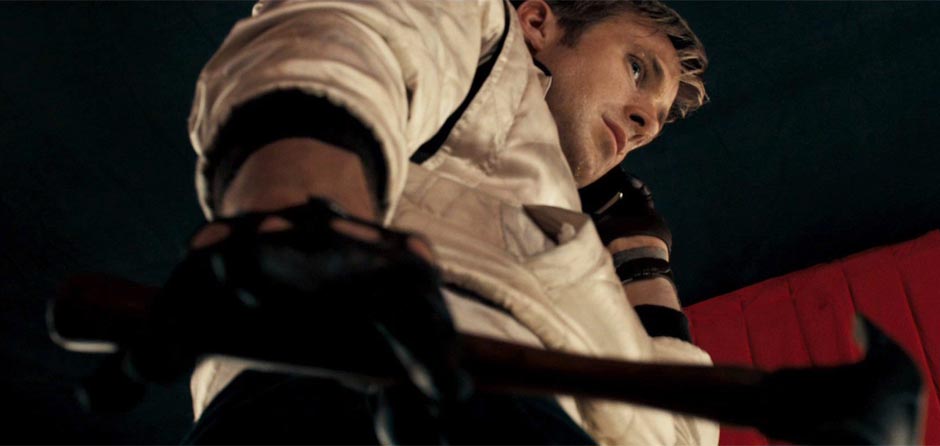
Ryan Gosling shines in the lead role, known only as The Driver. With minimal dialogue and hardly any background, everything we need to know about him is through his actions and his facial reactions (sometimes, not even that–mostly, his face is emotionless). What we catch onto is that he’s an anti-hero. He will get his hands dirty when he knows there’s a way out and if no one gets hurt (and if it pays well), but what he wants for the most part is a quiet life.

We see in the opening scene that he has things figured out pretty quickly. He’s a getaway driver for a robbery, which leads to the scene everyone remembers–the camera remains with the car as it escapes and is pursued by police, making for one of the most suspenseful car chases in film history.

That’s the scene movie-theater audiences remember because it’s exactly what they wanted. Then, “Drive” is going to give them something different.

Two things happen to the Driver that get the story going–one is he meets his neighbor Irene (Carey Mulligan) and her son Benicio; the other is he meets the mobster Bernie Rose (Albert Brooks), whom the Driver’s friend Shannon (Bryan Cranston) convinces to purchase a car for the Driver to race. The Driver doesn’t trust Rose, especially after finding out that he might have been connected with Shannon’s limp. When he’s with Irene and Benicio, his world is much brighter–he finally has companions; people in his life. But now, Irene’s husband Standard (Oscar Isaac) is being released from prison, and the Driver’s world starts to unravel. Standard gets attacked by some criminals who want him to pull off a new heist. The Driver agrees to help in order to protect him, Irene, and Benicio. But something goes terribly wrong, which results in the Driver’s descent into darkness…

The Driver knows he tends to do some bad things–nowhere is that clearer than in a scene in which he watches TV with Benicio and asks if a cartoon shark is “a bad guy.” Benicio says yes, because he’s a shark. “Aren’t there any good sharks?” the Driver asks. He wants to be a good guy, but he knows he hasn’t done much to declare himself in that regard. And when things go from bad to worse, he snaps and does some very, VERY nasty things towards his antagonists.

All of this is told with great directing from Refn, subtle understated acting from Gosling, and a great deal of atmosphere. Admittedly, as a movie theater patron, I was perplexed. But as a film lover, I was fascinated. And it took just one more viewing for me to declare “Drive” as something special.

Oh, and the soundtrack? Fantastic. “Nightcall,” “Under Your Spell,” and especially “A Real Hero”–all of these techno songs add to the style and grit “Drive” is going for. (I work at a theater where the “Drive” soundtrack often plays over the stereo–my attention is always drawn to it when I should be getting back to work!)

Looking Back at 2010s Films: War for the Planet of the Apes (2017)

22 Nov

By Tanner Smith

In 2011, we had a surprise hit with “Rise of the Planet of the Apes,” a sort-of prequel (kind of a reboot) to how the “Planet of the Apes” of its popular film series came to be. I certainly didn’t need this “sort-of prequel” but I was very surprised at how interesting and fresh it turned out to be. In 2014, we got a sequel: “Dawn of the Planet of the Apes,” a darker, more compelling man-versus-ape story than I ever would have anticipated. Then, in 2017, we got a concluding chapter for this “Planet of the Apes prequel trilogy.” “War for the Planet of the Apes.” It seemed to be building up to something, which should be obvious to us all that it doesn’t end well for mankind. From “rise” to “dawn” to “war”…let’s see what “War for the Planet of the Apes” has for us…

“War for the Planet of the Apes” is, in my opinion, the best “Planet of the Apes” movie ever made, maybe even better than the 1968 classic that started it all.

Talk about saving the best for last. (I don’t think there’s anywhere else for this franchise to go after this, so that’s a high compliment.)

This is a hell of a film. It’s powerful. It’s gripping. It’s complex. It’s brutal. it’s heartbreaking. It’s everything I didn’t know a “Planet of the Apes” movie could be. It even made me forget about how great “Dawn of the Planet of the Apes” was, because this one topped that!

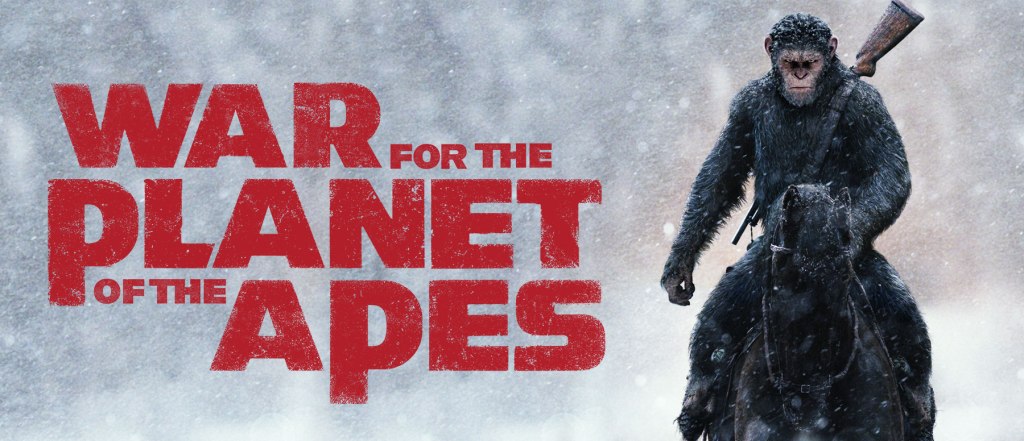
The story, told from the apes’ perspective, involves Caesar (Andy Serkis) and his army of apes still having to fend for themselves against human soldiers who want to hunt and kill them. Caesar has tried time and time again to have peaceful coexistence between humans and apes, but the Colonel (Woody Harrelson) wants nothing more than to wipe every single last one of them out. Seeing no other alternative, Caesar embarks on a suicide mission to track down and kill the Colonel.

As the title suggests, “War for the Planet of the Apes” is building up to the end-all of one final battle between man and ape. But director Matt Reeves (who also directed “Dawn of the Planet of the Apes”) has something more on his mind, such as what it all means for both man and ape. The evils and casualties of war. The question as to whom is the true animal. Racism allegories. What it means to exact revenge. The sacrifices that are made. And so on. This doesn’t feel like a mere “Planet of the Apes” movie; it feels like a genuine war movie!

And it’s all done RIGHT. When the action kicks in, it’s exciting. When the drama settles in, it’s very moving. When characters are allowed to sit and discuss a few things, it means something. Even its comic relief, a scared, abused ape named Bad Ape (Steve Zahn) whom Caesar and his crew come across, is done exactly right. In any other movie, this would have been akin to Jar Jar Binks.

The film can also take some time out to warm your heart. One of Caesar’s partners is Maurice (Karin Konoval), a wise orangutan who always has the right answers for Caesar. Along the way, Caesar and co. encounter a young mute girl (one of the wild humans they come across), and Maurice is the one to take care of her during the journey. I loved Maurice in the previous “Planet of the Apes” film, and seeing him care for this little girl melted my heart.

Notice how so far, I’ve talked so much about every other aspect that makes this film successful except for the effects factor? Well, how do the apes look? How do you make it credible? Well…if I thought they were put to great use in “Dawn of the Planet of the Apes,” then they’re put to SPECTACULAR use in “War for the Planet of the Apes.” Caesar, Maurice, Bad Ape, every one of the “apes” look amazingly REAL. It’s the best motion-capture work I’ve ever seen in a film. And it was so wonderfully done that I wanted Andy Serkis to get an Oscar nomination just for bringing Caesar to life with much expression and dignity. How often do you see a bunch of CG creations and NOT notice that it’s computers at the source of them? It’s outstanding for all the right reasons.

I prayed for this one to win Best Visual Effects at the Oscars. (I didn’t take into account the first-rate effects of “Blade Runner 2049.”)

Where CAN the “Planet of the Apes” franchise go from here? It’s hard to tell. Maybe…remake 1968’s “Planet of the Apes,” with the updated technology? I don’t know. But I guess I’d be curious to find out if there IS something planned.

Looking Back at 2010s Films: Chronicle (2012)

22 Nov

By Tanner Smith

Well, before director Josh Trank’s name became a punchline thanks to the messy blockbuster “Fantastic Four” (or “Fant4stic,” as people like to call it), he had a sleeper hit with the 2012 found-footage superhero teen film “Chronicle.”

Honestly, I feel bad for the guy for what happened with “Fant4stic.” He probably could’ve had something special if not for the studio interference. (Again, the studio system strikes.) Let’s see if he’s doing anything else.

*quick Google search*

Oh OK, he’s doing an Al Capone film with Tom Hardy, called “Fonzo.” Sounds good. Wonder when that’s coming out.

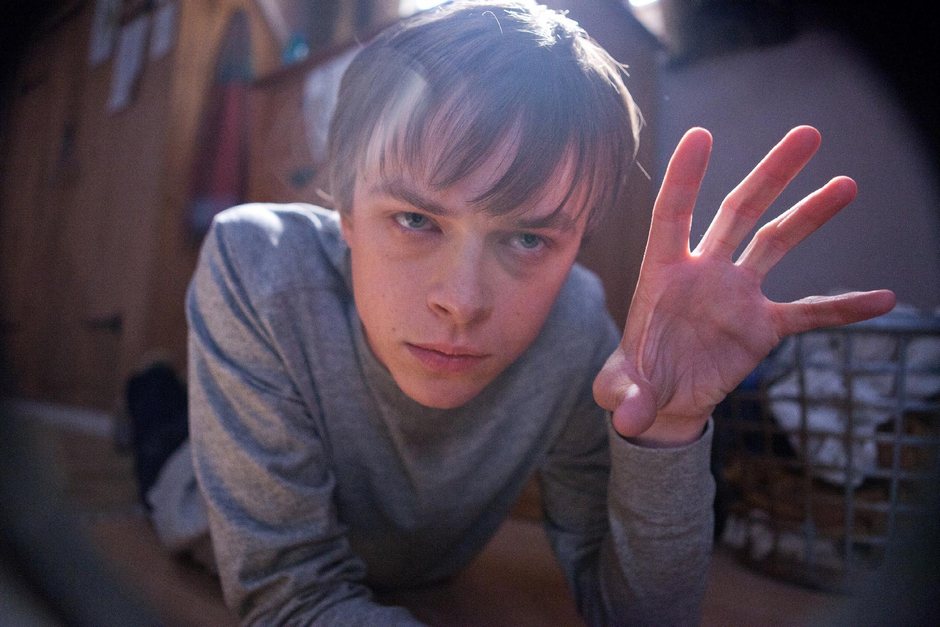
But back to “Chronicle.” “Chronicle” is a film about three high-school students–Andrew (Dane DeHaan), Matt (Alex Russell), and Steve (Michael B. Jordan)–who come across some sort of otherworldly portal that leads them to a force that gives them superpowers. They have telekinesis, they can fly, and they’re stronger the more they use their abilities (“like a muscle”). Because it’s a found-footage movie (though from the perspective of different cameras to tell the whole story), they document it all–the kid holding the camera for the most part (Andrew) even operates it without touching it (meaning there’s very little shaky cam here!). But Andrew, who comes from a broken home and is constantly bullied in school, starts to feel dangerous urges with his new strength and uses them to get back at people who do him wrong.

The first half of “Chronicle” is lots of fun to watch over and over. The kids are played as real kids, they work off each other brilliantly, and they behave the way I think real kids would behave if they suddenly gained superpowers. (Although, wouldn’t it be more interesting if they showed it to their classmates? I digress.) The effects are nicely done, especially for the low budget. (The flying sequences are a little dated, but they’re not terribly done.) And I love seeing them experiment with their abilities–pranking people, flying around, catching a baseball mid-air through mind powers, and even the damage they can cause if they’re not careful…which brings me to the second act, which is very dark and grisly. Much of it has to do with Andrew’s loss of control, which if you go back and watch the film again is inevitable rather than sudden. It bothered me when I first saw “Chronicle”–it doesn’t anymore.

What I like best about “Chronicle” overall is that it tells the full story. It doesn’t set up for a sequel. There’s an obvious beginning, middle, and end, with all the right buildups and just about every right payoff, and it’s told very satisfyingly.

With that said, I do wonder what Matt found when he set off on his quest to find out what happened to him and his friends–what was that thing down there in the tunnel? Where did it come from? But on the other hand, maybe it’s best to keep wondering. I like “Chronicle” just the way it is.

Spider-Man: Far From Home (2019)

22 Nov

Smith’s Verdict: ***1/2

Reviewed by Tanner Smith

Hooray! Spider-Man’s back after being “snapped” from existence in “Avengers: Infinity War” and brought back to kick some spidey ass in “Avengers: Endgame!” Speaking of which, spoilers for “Avengers: Endgame!” (Not just that Spider-Man is back, obviously—that’s kind of a given.) You’ve been warned. 

Even with more Marvel Cinematic Universe movies in the works, “Avengers: Endgame” worked wonderfully as a finale for all the MCU material we’ve seen in the past eleven years. But even so, “Spider-Man: Far From Home,” which takes place after those events, works as an effective epilogue to “Endgame.” (It’s also much lighter than the heavy epic scale of “Endgame”—not that there’s anything wrong with that.) 

Directed by Jon Watts (who also directed “Spider-Man: Homecoming”) and led by Tom Holland (the best live-action Spider-Man representation), “Spider-Man: Far From Home” is more practical and refreshingly so—lighthearted with a down-to-earth, humorous touch (I mean, for a Marvel superhero movie). 

Peter Parker (aka Spider-Man) and his high-school friends, including his best buddy Ned (Jacob Batalon) and potential love interest M.J. (Zendaya), are “blipped” back to existence after Thanos finger-snapped half the Earth’s population away in “Avengers: Infinity War” (and the Avengers brought them back in “Avengers: Endgame”)—how convenient; most of their old classmates have already aged five years in their absence. (There’s a funny bit when we find out Peter’s Aunt May (Marisa Tomei) mentions she vanished as well before she was suddenly brought back into her old apartment, which is now rented by someone else.) 

I personally would like to see more of what that must be like for others who were “blipped” away for five years. Think about it—if you were 16 and your little brother was 13, and you were suddenly blipped while time went on for everyone else including your brother, if you came back after five years, your brother would suddenly be older than you. How would that sibling dynamic work for you nowadays? That’d be an interesting story to follow. 

But I digress.

Peter is still mourning the loss of his mentor, Tony Stark aka Iron Man (Robert Downey Jr.), who died in the final battle of “Endgame.” He still wants to prove himself worthy of being Iron Man’s protege—a friendly neighborhood Spider-Man, if you will—but he also wants to have somewhat of a social life as a high-school kid as well. He joins his classmates on a trip to Europe, and he couldn’t be more excited, mostly because he hopes to get closer to his crush, M.J. 

But uh-oh! Something serious is happening here. Venice is being torn apart by a mysterious, huge, seemingly water-based monster, causing Nick Fury (Samuel L. Jackson) and Maria Hill (Cobie Smulders) to recruit him to save the day. They also brought in someone else to help: Quentin Beck (Jake Gyllenhaal), who has his own supersuit as well as his own skills, resources, and charisma that match Peter’s late mentor. He even gets a hero name: Mysterio.

Is it really a spoiler to say Mysterio isn’t really on the up-and-up? 

I have a complicated relationship with the “Spider-Man” movies—whenever a good one comes out, I always tell people it’s “the best ‘Spider-Man’ movie.” Sam Raimi’s “Spider-Man 2,” Marc Webb’s “The Amazing Spider-Man,” “Spider-Man: Homecoming,” and especially the wonderful, animated, highly energetic “Spider-Man: Into the Spider-Verse.” Well, I was perfectly satisfied to say that “Spider-Man: Far From Home” was “a good Spider-Man movie.” But then…we get the mid-credits scene. Every MCU movie has something extra to keep audiences through the end credits to tease the next adventure. This particular one made me drop my jaw before I exclaimed to myself, “Holy cow, WAS that the best Spider-Man movie??” I won’t give it away here, but I will say that now I’m REALLY curious to see the next Spider-Man movie, just to see what happens!

Maybe I’m overreacting. But still, “Spider-Man: Far From Home” is a solid Spider-Man flick. Tom Holland is still a highly charismatic Peter Parker and the film goes deeper into the anxieties that comes with the responsibility of being Spider-Man. Whenever the film deals with Peter trying to have a social life as himself while still doing what he can as Spider-Man, it’s great. My favorite scene is when, without giving much away, he literally ends up in a maze of illusions that present his own fears and insecurities. 

I’m not a huge fan of Jake Gyllenhaal’s Mysterio, because he’s more interesting before he reveals his true nature and then he just becomes another villain. But that’s really more of a nitpick because the reveal does lead to some cool action and also some nicely-done character moments (including my favorite scene I just mentioned). 

The overall focus of “Spider-Man: Far From Home” is still where it should be: with the burden of being Spider-Man getting heavier and heavier for this kid who’s becoming a man in the process. And I’m always going to be interested in seeing the journey progress…especially after that mid-credits scene. (Seriously, I have to know! That was a hell of a cliffhanger!) 

Joker (2019)

22 Nov

Smith’s Verdict: ****
Reviewed by Tanner Smith

I can’t say “Joker” is one of the most “fun” movies I’ve seen this year, but it’s definitely one of the most unforgettable.

I don’t know whether to laugh or cry. It’s just so demented and disturbing and tense and twisted and oddly fascinating at the same time…in other words, it’s the perfect Joker movie!

Oh wait, I’m supposed to come out of this movie wanting to commit heinous crimes and partake in bloody anarchy–that’s what the media told people to be afraid of, right?

Btw, don’t say anything like that about a movie unless you’ve actually seen it, because that makes you look pretty stupid.

“Joker” is a dark, gritty, violent character study that serves as the origin story for one of the most devious comic-book villains of all time: the Joker. I’ve seen comic-book movies that ask complex questions about the hero, such as where does one draw the line in the ways of vigilante action and whatnot. But Joker asks more challenging questions that most people wouldn’t want to know the true answers to, such as…what roles do WE play in the creation of a killer?

In that sense, this isn’t a film that glorifies violence–it’s not even a sympathetic origin story. Instead, it’s more of a cautionary tale about a guy who feels left out by society that doesn’t want to understand or help him, which causes things to go from bad to total horrific sh*t-storm.

But if you do see this movie and are appalled by something that could be seen as irresponsible or dangerous, that’s fair enough. Not everyone is going to have the same reaction. But see the movie before you decide.

Joaquin Phoenix is brilliant as Arthur Fleck, the sad, mentally-unstable clown-for-hire who doesn’t know what to do with his life…until he commits his first act of horrific violence and suddenly feels more alive because of it. Slowly but surely, we see this guy transform into one of the most storied, psychopathic comic book villains of all time.

A major surprise for me was that it was so easy for me to forget I’m watching a DC comic-book movie. Compared to the tone of this film, “The Dark Knight” feels more like your typical comic-book film. This film was directed by Todd Phillips (who was previously best-known for comedy hits like “Road Trip,” “Old School,” and the “Hangover” movies), and a lot of people have compared his storytelling to a Scorsese film (particularly “Taxi Driver” and “The King of Comedy”)–but I don’t see it as a Scorsese-ripoff either. I think Phillips was inspired by touches of those films and added some touches of his own without copying Scorsese’s style.

The way the story develops was so chilling that there were times when I couldn’t move. Usually, I twitch in my seat or shake my legs out of nervousness during a good scary movie–but not this time. This time, there were numerous sequences during which I was frozen in place, just shocked at what was happening and what could happen next.

It’s a nightmare, and a well-crafted one at that.

Like I said, “Joker” is not necessarily a “fun” movie. If I want an entertaining film from DC, I’ll just watch “Shazam!” again.

Last thing I’ll say for now is there’s a moment I can’t help but appreciate from early in the film. It’s when Arthur watches a standup comedy show and takes notes on how to be influenced for his own performance–one of the notes he takes struck me to the core, that to win over the audience (which serves as a metaphor for general society), you have to act like you don’t have a mental illness.

The word I think I’m looking for is DAMN!