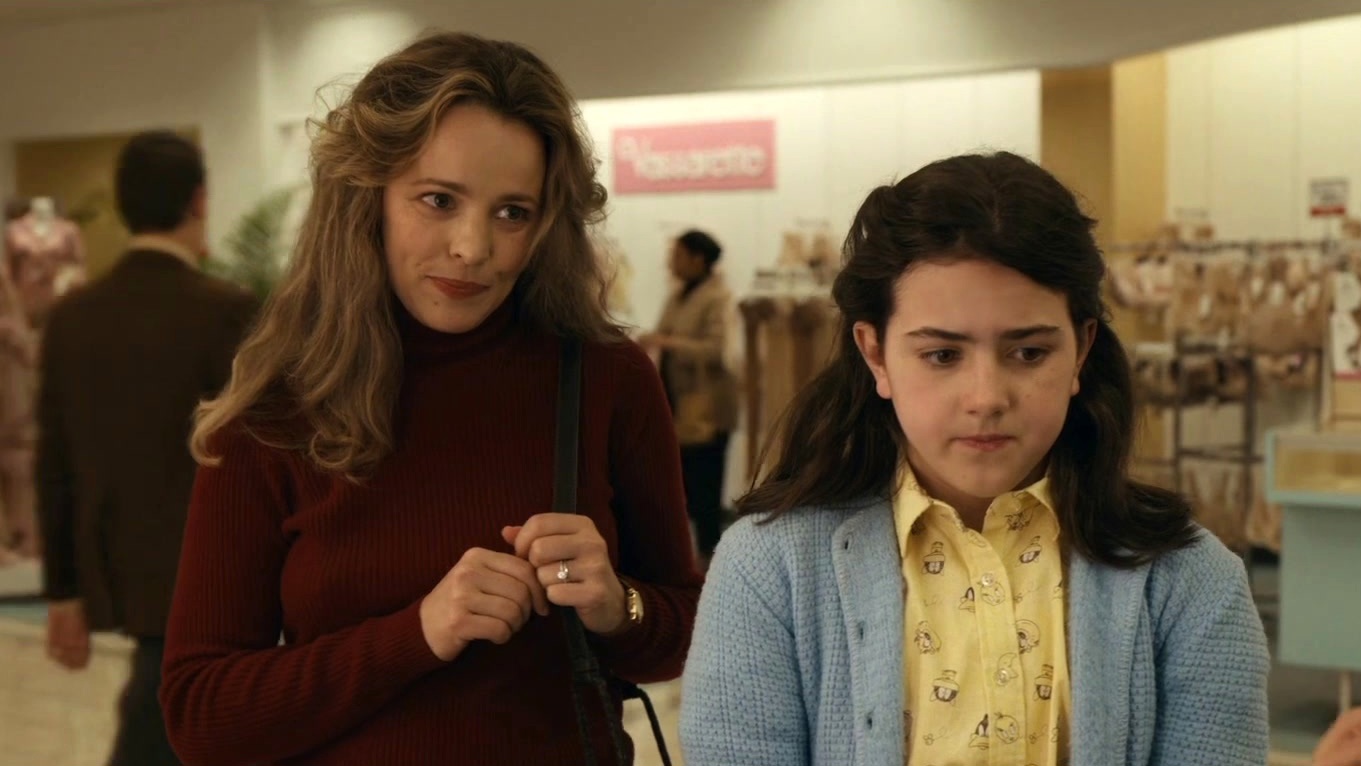
I don’t know why it took so long for a film based Judy Blume’s great, challenging novel “Are You There God? It’s Me, Margaret” to come about, but the film we got more than 50 years after the book’s publication is very much a perfect adaptation. It’s heartfelt, hilarious, inspiring, authentic, and relatable.
I was looking forward to this because it was written and directed by Kelly Fremon Craig, who made The Edge of Seventeen, another great film about young people. I knew she’d be able to portray both the comedy and trauma of coming of age in film just as Blume did in the novel. (She also made the perfect choice of keeping the original story’s 1970 setting instead of modernizing it.)
The film is very funny (I laughed out loud at least 3 times, I kid you not–in particular, one scene set at a pharmacy had the whole theater in stitches), but it doesn’t back down from its serious moments. Both the comedy and the drama feel like they belong in the same film–that’s not easy to do, and this film does it flawlessly.
Everyone in this cast is superb. Abby Ryder Forston gives a natural and lovable performance as our 11-year-old heroine Margaret Simon, who’s in such a hurry to grow up that she’s in danger of missing out on special moments. (She’s aided by other child actors who are also very natural and winning.) And the adult actors don’t half-ass it at all–Kathy Bates is great as Margaret’s grandmother; Rachel McAdams & Benny Safdie are wonderful as Margaret’s parents; and I would’ve liked to see more of Echo Kellum as Margaret’s 6th-grade teacher who encourages her to explore religion. (Part of Margaret’s journey in this story is her exploring Judaism and Christianity, as her mother is Christian and her father is Jewish but neither one is religious and they let her choose her own path when she’s older.)
There’s a subplot that I don’t think was in the book about Margaret’s maternal grandparents–I won’t give away what happens, but even that worked so well in this film because it helps add to Margaret’s big ball of confusion and thus aided in her resolution at the end.
I get the feeling this film adaptation of “Are You There God? It’s Me, Margaret” will be just as relevant as its source material to audiences of all ages, and I highly recommend it.
One of the most entertaining films I’ve seen in 2023…is a film about the invention of the first smartphone.
Doesn’t sound so interesting or entertaining, but…
I was hooked on seeing “BlackBerry” simply because it’s the latest film from auteur filmmaker Matt Johnson. His first feature The Dirties is one of my personal favorite films, I also really liked his second film Operation Avalanche, and I also admired his Viceland series Nirvanna the Band the Show–I will see ANYTHING that he does, even if it’s about the creation of the BlackBerry.
This isn’t another film about what corporate greed and hubris do to a creative, idealistic person, nor is it a film that encourages us to demand to take back the BlackBerry phone. (And you wouldn’t want to give up your iPhone, would you?) It’s a film about someone who has a great idea that changes the way we communicate in the world…until someone else (let’s call him Steve Jobs) comes up with a better idea. And it can be taken any way you want it, whether it’s about how the characters went about it, or the little things they overlooked in making it, or even WHY they wanted to do it in the first place, or whatever.
Johnson avoids his trademark faux-documentary approach and instead gives us a fly-on-the-wall technique, with his usual cinematographer Jared Raab shooting the proceedings like a docudrama. But he’s such a movie buff, I wouldn’t doubt he simply wanted to make his own biopic along the lines as “The Social Network” or “All the President’s Men.” And because he’s so good at grabbing an audience with his vision, “BlackBerry” hooked me and wouldn’t let me go until the end…actually, not even the end, because I’ve seen this film at least five other times since.
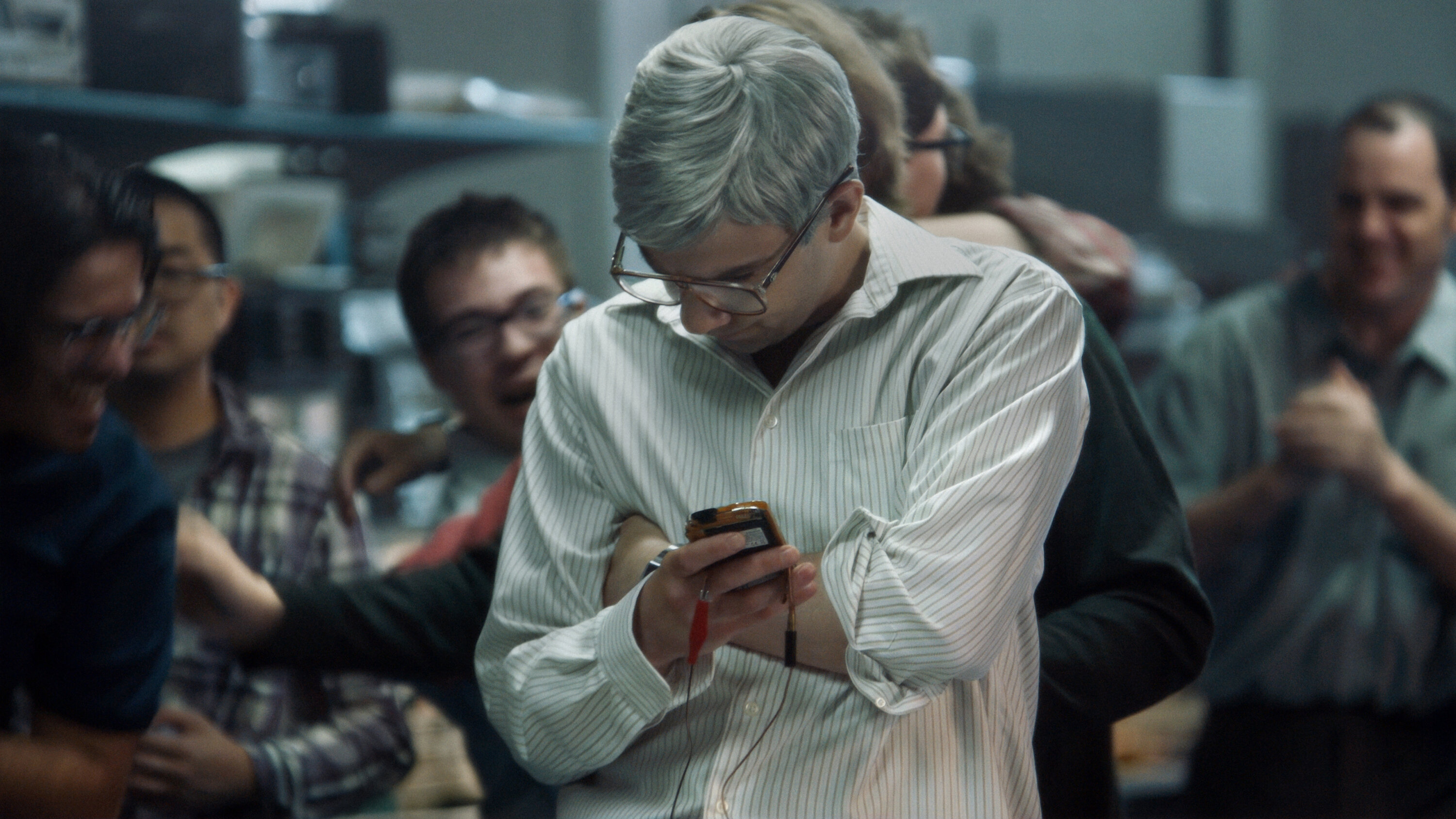
Jay Baruchel stars as Mike Lazaridis, the awkward but brilliant co-founder of the Canadian software company Research In Motion. (Johnson, who always appears in his own films, co-stars as Doug Fregin, the goofy man-child co-founder of the company.) RIM (as it’s abbreviated) is going out of business, but in comes Jim Balsillie (Glenn Howerton), a ruthless businessman. He was fired from another tech company for stealing a coworker’s presentation–at that point, the moviegoer sitting next to me muttered, “Dick!”–and is willing to take Mike’s idea of a BlackBerry mobile device seriously if it means big money.
Well, it DOES mean big money…but for how long? And I was expecting “BlackBerry” to be a cautionary tale about what greed and pride do to people–instead, it’s more about a great idea that stays a great idea…until someone comes up with a better idea. And how it affects these characters was what kept me engaged throughout the back half of the film.
Jay Baruchel and Matt Johnson are both great as the hopeful entrepreneurs who find themselves in over their heads and in danger of losing their souls in the process. But it’s Glenn Howerton who practically steals the film from everyone he shares the screen with. This guy has so much fun showing the ruthless and reckless natures of this character, who is such a jerk and pretty much a megalomaniac–and he’s never boring; I always looked forward to seeing what he would do next!
“BlackBerry” has a great amount of energy to it, from the documentary-like camerawork to moments that show how the geek-culture unwinds (such as playing/dancing to “Return of the Mack” to celebrate a victory or having “emergency movie night” in the office when things don’t go as planned).
There’s just such a great energy and ambition to this film (from a filmmaker whose last two films were already energetic and ambitious) that I embrace wholeheartedly. I loved “BlackBerry” from beginning to end.
There’s a new film now streaming on Hulu that I checked out–and it’s a solid contender for my year-end list. It’s called “How to Blow Up a Pipeline,” and it’s a riveting, character-driven, most likely controversial thriller that is set in the here and now but is also in the great tradition of thrillers from the ’70s and ’80s in terms of tone and pacing.
Think less “Sound of Freedom” and more “3 Days of the Condor.”
And I was about ready to call this film “Woke Fetish” when its statements about climate change, eminent domain, and selected sabotage (more property over people so that no one gets hurt) make themselves known fairly early on. But this film values character and ethical interpretation over all else, and so I was never bored.
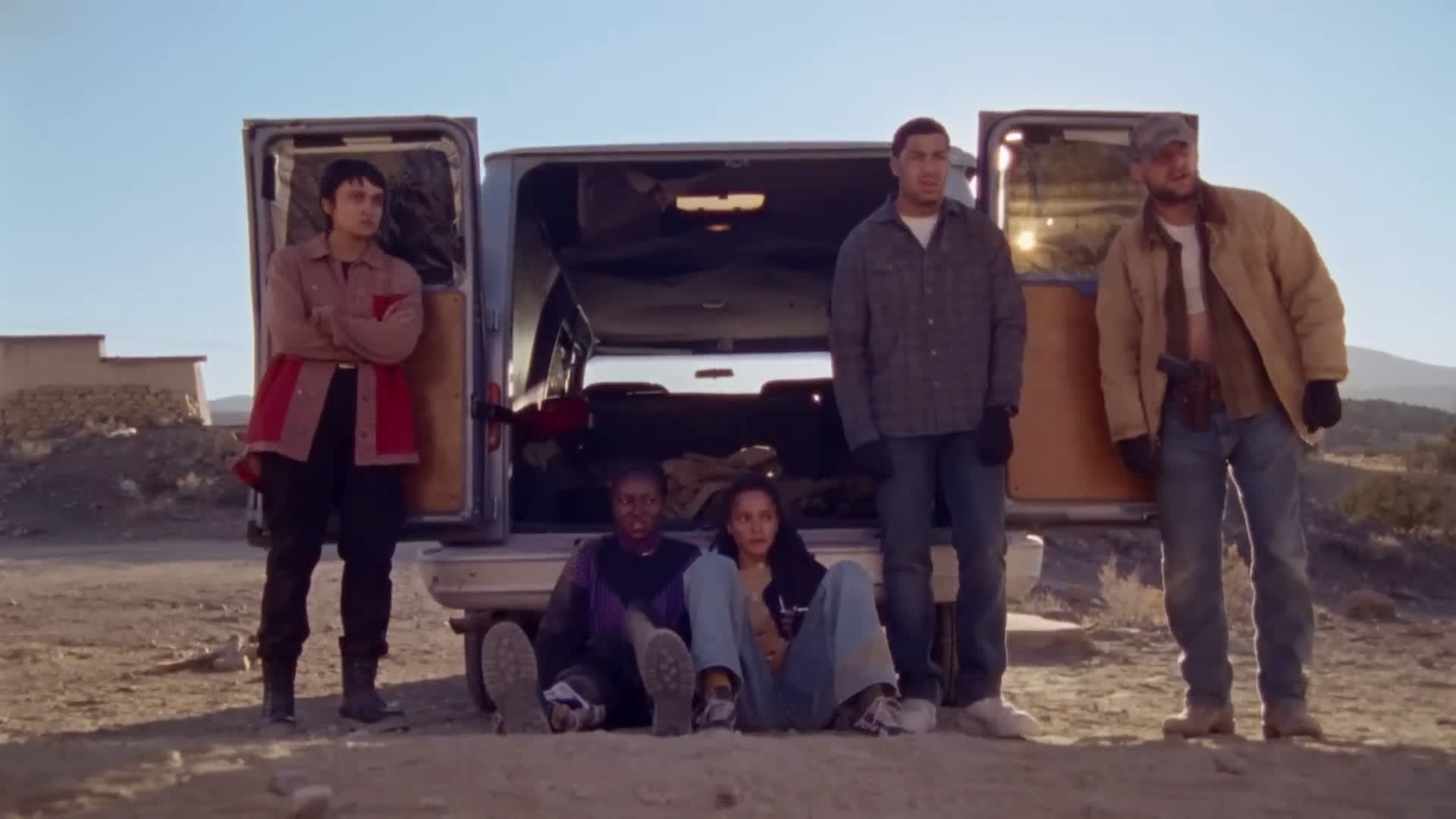
The film, based on a non-fiction book of the same name, is more or less a political manifesto (or an eco-thriller) done like a heist thriller. It follows a group of environmental activists who have a plan to blow up an oil pipeline–two, actually; one in Texas, the other in California. One of the Texas “eco-warriors” (played by Jake Weary) has a very specific reason for targeting the oil company: to get back at them as they try to run a pipeline through his family homestead by abusing “eminent domain” laws that let governments seize private property for construction projects. The California ringleader (played by the script’s co-writer, Ariela Barer of “Runaways” fame) rallies a group of individuals (a film student, an explosives expert, and others) for a very specific plan after being in the shadows of Long Beach refineries for too long.
Or, as someone cynically puts it: “She reads a book, and suddenly she thinks she can save the world?”
The film is told in non-linear fashion as we begin with the characters about to carry out their plan, and them BAM! We flash back to see where one particular character is coming from. The main story is told chronologically while we randomly get character backgrounds that often get distracting but mostly make way for a unique plot twist or two.
Each of these characters has a reason to join–one has terminal cancer from toxic chemicals and of course the US health system isn’t helpful (this film likes to show connections wherever they can be found); one is a Native American whose people in North Dakota have been given the s**t end of the stick for centuries; one seeks to get away from privilege and further into individualism; and so on. The only one to show any signs of nervousness is the girlfriend of one of the crew (played by Jayme Lawson), who really has no reason to be there except for support.
All of the actors are strong, but I especially liked Forrest Goodluck (whom I’ve liked in films like “The Revenant,” “I Used to Go Here,” and “The Miseducation of Cameron Post”) as Michael, the most extreme member of the bunch, and Kristine Froseth (“Sharp Stick,” “Looking for Alaska”) as Rowan, one-half of a wisecracking Bonnie-and-Clyde duo, who are more like idealized youngsters in over their heads, whose mission is to shut off the pipeline flow–Rowan’s story might arguably be the most complicated, and that’s all I’ll say about that.
“How to Blow Up a Pipeline” teaches a good amount of discipline in how revolutionary groups go about these acts of environmental terrorism. Don’t get distracted, don’t mess up, plan ahead, stick to the schedule, etc.–otherwise, these people are likely to get arrested or worse. And what’s important that this film captures is that for all the characters’ talk about why they do all of this, who they compare themselves to while doing this, and, yikes, historical comparisons…these are all just young adults who are still roughly adolescent and think more on instinctive than intellectual levels. And yes, some things go according to plan–but others do not, and they just have to wing it because they’re committed to the cause.
Now, here’s where the film will probably draw controversy: the film doesn’t ask you to judge these people; in fact, it can be argued that it endorses their ideas, which may rub people the wrong way.
But you know what? I’ll take a film that isn’t afraid to take those chances if it means those in big business could be coerced to keep a tighter lid to what is hazardous to people and do the revolutionaries a favor by actually giving a damn about the people–especially when the alternative is a film that simply plays it too safe.
As Sam Cole’s story in “Shudderbugs” begins, she arrives at a secluded farmhouse in Upstate New York. This is a place that feels familiar yet alien at the same time to her: her childhood home, which she hasn’t visited in so long. She was supposed to be here to celebrate an upcoming birthday with her mother. But her mother has died, due to unclear circumstances. Sam looks around the house, soaks in all the familiar surroundings and memories (her bedroom is also decorated with childhood mementos, like drawings and a broken dollhouse), and yet feels uneasy because her mother is not here, she’s not sure what to do next, she doesn’t even know what’s changed around here and what hasn’t, and she doesn’t know how long it will take to get to that particular place of certainty and comfort.
Sam Cole may know where she’s going–but she doesn’t know when she’ll be there.
“Shudderbugs” puts us in Sam’s current place of uneasiness and confusion right from the start (we don’t learn much about where she’s visiting from–we can only speculate from nightly phone calls to someone back home), and it feels so much like a thriller in that sense. Because of that, when new aspects relating to the mother’s death start to pile up (such as Sam’s shady neighbor being the one who discovered the body and Sam not knowing the cause of death while continually calling for a medical examination), I think I know where it’s going.
But as the film continues, I’m more interested in what Sam is feeling throughout all of this than what traditional thriller elements I feared would come along and, while not necessarily “ruin” the proceedings, possibly sour a very interesting character study. While seeing “Shudderbugs” at the Bare Bones International Film & Music Festival in Muskogee, Oklahoma, I’m sitting with intrigue and putting my trust in the filmmaking team behind it that they had created something better than that.
I couldn’t be happier that I did stay with it, because “Shudderbugs” is a remarkably moving and wonderfully made meditation of grief, remorse, and recovery. This is the type of film I would watch even if I was going through grief myself.
I won’t go into further plot details of why Sam is here, what she uncovers, or what that mysterious neighbor Noah (Brennan Brooks) is or was up to–instead, I’ll just say how mesmerized I was by the filmmakers’ ability to balance out thriller and drama so effectively that it feels like a disservice to refer to “Shudderbugs” by either genre. It is that impressive.
Now, about “the filmmakers,” as I keep vaguely referring to them. They are writer-director/co-producer Johanna Putnam, who also stars in a brilliant performance as Sam, and co-producer/cinematographer Brennan Brooks, who plays Noah (and also quite well, I should add). They, along with a skeleton film crew, utilized every bit of their resources to make this film in a farmhouse they had easy access to, made great use of their isolated environment, and crafted a film that is purely from the heart.
I also appreciated that they included levity to even out the story’s grim subject matter. There’s a running gag involving a VA (called Brenda) that doesn’t feel forced and a subplot involving aggravating phone calls with a prying insurance agent, the punchline of which had me applauding in the theater. But there’s also a beautiful scene that begins as a lighthearted moment of frolic and ends as probably the most touching part of the film. (I won’t give it away here, but it involves a butterfly.)
We see Sam Cole struggle with so many emotions, modify so many scenarios as a result, and rise up after continuing to struggle, modify, and learn about herself and her environment. The way the story progresses and the way Johanna Putnam plays the character, I felt like I would follow her anywhere. I was pleased to follow her in “Shudderbugs” and felt grateful to be in her company, to the point to where when she left (i.e., the end credits rolled), I wished her the absolute best–wherever “Ms. Cole” may go.
I loved, loved this film, and I embrace it wholeheartedly. And as soon as it’s released via streaming, I’ll update this article so you can enjoy it too. (And you can keep track of its progress here.)
Confession time–I’m not entirely sure what I understand Luca Guadagnino’s “Bones and All”…but after seeing it four times as of writing this review, I’m fascinated enough to want to understand it.
This is especially because director Guadagnino’s “Call Me by Your Name,” arguably his best known film, was so deep and heartwarming and lively that I still gain more input from it five years later. (It’s a new favorite of mine now.) And his follow-up film, “Suspiria,” may have been annoyingly alienating in many ways but rather hauntingly beautiful when you look beneath the surface. (I’ll admit, it took a while for me to warm up to it because it was so slow and off-putting–but when I gave myself to it, I found it wonderful.) “Bones and All” is like a happy medium of both films, in terms of tone and atmosphere, which can either work for the film or against it. (And indeed, most of the critics who hated “Suspiria,” like Reelviews’ James Berardinelli and Chicago Sun-Times’ Richard Roeper, don’t much care for this one, either.) There’s also a mainstream appeal to this one in that it involves our two young leads embarking on a road trip while partaking in a very strange romance–so much so that the marketing campaign practically tried to sell “Bones and All” as a new version of “Twilight.” (Judging by the film underperforming at the box office, I don’t think the strategy worked.)
There’s just something to “Bones and All” that continues to intrigue me and keep me wondering about what it all means. Maybe it’s because it looks good or it feels good or I’m just remembering many striking moments from it–but I’m just saying, there’s something special to this film that I can’t shake off.
How strange that a film about cannibals on the road would leave such an impression. But here we are.
And yes, that is what “Bones and All” centers on: cannibalism. Based on the novel of the same name by Camille DeAngelis, “Bones and All,” set in 1988, focuses on teenager Maren (Taylor Russell), who has an uncontrollable urge to devour human flesh, as evidenced when she’s invited to a slumber party by a girl from school…and she bites down on the girl’s finger. Not a great way to make friends. Her father (Andre Holland) is aware of her particular hunger, and after this incident, he and Maren pack up and leave town (something they’ve apparently done a few times before).
When Maren is safe, her father abandons her, leaving her with cassette tapes and other information regarding her backstory. So, Maren sets off to find her mother who abandoned her years ago. Along the way, she comes across a strange fellow named Sully (Mark Rylance)–he’s a cannibal (or “eater,” as he puts it) just like her, only he can smell others like him from a distance. And trust me, that’s not even the creepiest part about him–I won’t even mention his special continuous keepsake from each of his victims.
I don’t know what exactly Mark Rylance is doing with this performance, as a somewhat timid persona (with long, stringy hair and an exaggerated Southern drawl) covering unbelievable psychopathic tendencies. But I’m sure not going to forget it anytime soon, either. (And thankfully, the Film Independent Spirit Awards agree–he was nominated for Best Supporting Performance for his memorable work here.)
After getting away from Sully (although, that’s not the last we see of this scary person), Maren encounters a young rebellious emo-type about her age named Lee (Timothee Chalamet). He’s another “eater,” who often cruises unsuspecting victims–though, he has particular standards, such as not eating anyone with a family. He seems more trustworthy than Sully, so Maren rolls with him. Naturally, while on the road together, a relationship sparks between the two, and they start to wonder what it would like to settle down together and live a “normal” life. But how long can a “normal life” last when the hunger for people returns?
Naturally, being a road-trip story, Maren and Lee encounter other bizarre characters aside from the scary Sully. There’s a couple of backwoods eaters (Michael Stuhlbarg, hardly recognizable here, and David Gordon Green, best known for directing*), one of whom doesn’t share the other’s cravings and just likes to be a cannibal. There’s Lee’s sister Kayla (Anna Cobb), who lives in Kentucky, is unaware of Lee’s cannibalism, and doesn’t understand why Lee has to leave the family ever so often. And there’s also Maren’s mother (Chloe Sevigny), who also has a problem with “eating” to the point where…well, I won’t give it away, but it’s very disturbing.
It’s a bizarre, strange, and unusual journey that reminded me of “Badlands” crossed with “Near Dark,” and I was interested in taking the ride. Maybe part of the reason I was invested is because we don’t often we get a story like this–and yeah, most people don’t want to see a story like this because parts of it are disgusting and one can only imagine the harm that eating people can do to one’s digestive system. Maybe it’s because of Guadagnino’s direction, solid leading performances from Taylor Russell as Maren (she was also great in films like “Waves” and “Words on Bathroom Walls”) and the always interesting Timothee Chalamet (Guadagnino’s star from “Call Me by Your Name” and who continues to impress me with each film), gorgeous cinematography from Arseni Khachaturan, a good feel of small-town America, and a haunting score from Trent Reznor & Atticus Ross…that I was fooled into thinking “Bones and All” is truly about something when, for all I know, it’s merely an experimental presentation of depravity.
But that’s a key reason to celebrate film: it’s whatever you want it to be. Is it a poetic self-discovery tale? Is it a romance horror film? Is it an allegory for being an outcast in society? Is it a shocking arthouse film? Whatever it is, I like it a lot. It’s something I feel, and it’s the reason I keep coming back to it.
*David Gordon Green was originally set to direct “Suspiria.” Maybe Green and Guadagnino found common ground? Whatever the case, it was good to see him here.
What a special gem this was to behold at the 2023 Kansas City FilmFest International—a wholly original film that made me grin, ponder, and ultimately feel. With a deft and delicate touch given by director/writer/co-star/cinematographer (among other credits to this film alone) Tyler W. Moore, “Personal History” manages to deliver a nicely-observed gentle comedy along the same lines as a Christopher Guest mockumentary crossed into the territory of an existential parable. And I promise to you, I am not making this up…
It even brought a tear to my eye.
Yes, “Personal History” went places that I didn’t expect. And it fooled me, delighted me in doing so, and made me feel things.
“Personal History” is a faux-documentary feature, in which the story is crafted by filmmaker Josh Harmon (Moore). His primary focus is his friend Monica (Samantha Montero), a history major who is researching for a grant and comes across an interesting discovery within a home-building business. Upon close inspection of the business’ photographs from decades past, there seems to be one constant: a man named Arthur D. Perkins (Patrick Poe), who looks exactly the same despite appearing in photos ranging from the 1950s to the modern day.
It’s true, Arthur D. Perkins has not physically aged in over 100 years. As Monica interviews people involved with the business (as documented by Josh, who makes sure to capture on camera everything he feels is important to a certain narrative—the faux-documentary approach really works well here), it’s only by luck that Monica is able to conduct a sit-down interview with Arthur himself.
The initial interview doesn’t quite go as she expected. Despite Arthur having experience serving in both World Wars (WWII was when he started to notice he wasn’t aging), Arthur doesn’t have much to say that is of interest to Monica. But Josh, still documenting the progress, pushes her to dig deeper and capture the true essence of what it means to be immortal.
Where “Personal History” goes from there, I won’t give away. But I will say that where the film goes, once Monica and Josh interview Arthur again and find themselves more into his life, takes the audience along on an emotional journey. We find ourselves questioning the concept of immortality and how we perceive it. We think about how hard it must be to outgrow our loved ones—the best scene in the film illustrates how tough it was for Arthur’s “gift” of immortality to take its toll in his marriage with loving wife Judith (Lolo Loren). (That’s where the aforementioned tear came from.) And when Monica and Josh learn more about what Arthur has done with his long life and how he lives today, they find themselves asking those very questions.
There’s a subplot involving Josh’s sister Mae (Bryna Vogel), with whom he seems to interview with his camera often, that seems ineffectual at first—but then it becomes one of the most emotionally gripping parts of the film. That’s all I’ll say about it.
There are not enough words to describe just how good Patrick Poe is in the role of Arthur. In playing a person who has lived for about 120 years or so, he has the body language down (he moves sort of slowly as if the youth left his looks years or decades ago), he portrays the mix of pain and wisdom in his voice, he makes subtle glances when he’s asked difficult questions, and maintains a calm manner throughout, making me constantly wonder what the character is thinking in this particular moment. I admired Poe’s work in Almost, Sorta, Maybe (which he co-directed with Loren), in which he played a completely different type of character—with “Personal History,” he shows more of his versatility as an actor. He’s great here.
The ending to “Personal History” pulled the rug out from under me (and also a friend who was in the same theater as me). As soon as it was over, I had to approach this talented filmmaker, Tyler W. Moore, and the star, Patrick Poe, both of whom were at the screening I attended, and congratulate them both on a job well done. “Personal History” is a beautiful film.
In 2022, actor-filmmaker Lena Dunham had two new feature films released a few months apart. A majority would agree the better of the two is Catherine Called Birdy–and I agree, too. Watching it again on Amazon Prime recently, it’s even better than I remember it the first time. It’s witty, memorable, and could even be labeled as a new classic in the YA-story camp. It’s also Lena Dunham’s best work.
Dunham’s other film, released a couple months before “Catherine Called Birdy,” was “Sharp Stick.” This is what opened people’s eyes, as it was Dunham’s first film in 12 years (since the appealing “Tiny Furniture” in 2010). Most people were not impressed by what Dunham offered within “Sharp Stick,” and I’ll admit I wasn’t either–in fact, look back at my “Catherine Called Birdy” review and you’ll find me using words like “unpleasant” and “confused” to describe how I felt about it.
Well…after I rewatched “Catherine Called Birdy,” I gave “Sharp Stick” another viewing. Lena Dunham wanted to say something with this film–it is her first film in over a decade, after all. She deserves my time and attention. So, has my opinion changed on this film?
You saw the three-and-a-half star rating above. So you know I like it. Very much.
What was my problem with it initially? Well, the main character, played by Kristine Froseth, kept turning me off. Why does she dress the way she does? Why is she so naive? How is someone in their mid 20s this out of touch when it comes to sexual exploration? And is it really probable that she would put herself out there to try every position she finds out about online–just like that?
See, that’s not fair, is it? I realized that. So, what changed my mind?
Severe health issues are brought to the foreground. 26-year-old Sarah Jo (Froseth) had an emergency hysterectomy at age 15 and menopause at 17. That kind of medical crisis that young would probably cause someone to have severe embarrassment about their own body, and thus, Sarah Jo hasn’t pursued any intimate or romantic relationship because of such. And she lives at home with her hippie mother Marilyn (Jennifer Jason Leigh) and influencer-dancer adopted-sister Treina (Taylour Paige, “Zola”) because they welcome her and because she’s always felt a sense of security with them. When I keep all of that in mind, I stop asking why she, as Chicago Sun-Times film critic Richard Roeper put it, “dresses as if she’s an Amish pre-teen and has the emotional and intellectual maturity of someone half her age.” It’s more complicated than that, and I won’t pretend to have all the answers–but seeing the film again, with this knowledge in mind, I care more than enough to ponder them.
Oh, and I guess this is a good time to mention the controversy this film generated upon its premiere at the Sundance Film Festival in January 2022. People thought Sarah Jo was on the spectrum due to her extreme naivety and social awkwardness, got all up in arms about it, and caused Dunham to issue a statement saying, “Nothing about Sarah Jo was coded to suggest or convey neurodivergence.” The movies are generally subjective and you could look at the character as being a representation of something (there’s even a category on TV Tropes called “Diagnosed by the Audience”), but let me just say that I don’t think the statement was necessary and I don’t think it made things better for the complainers either. Maybe Sarah Jo is on the spectrum, maybe she’s not, but let’s move along.
Anyway, Sarah Jo is an emotional and exploratory virgin and “Sharp Stick” is all about her pursuing this part of life that she never thought about before. And why not? She’s 26, she’s kept a guard up for so long, she feels so many gaps in her life, and she’s going to explore it. Now, is moving from a secret affair with her employer, a “cool-dad” type (played hilariously by Jon Bernthal) who is the father of the special-needs kid Sarah Jo often looks after, to a list of many sexual acts with strangers pushing it? Yeah, one would definitely ask, “Where did this come from?” But again, it’s her exploration. It may be extreme, but it’s not so improbable to imagine how she gets there.
Now, as for Dunham telling this story through a fairy-tale-like lens, with sporadic animated sequences illustrating Sarah Jo’s feelings, I can see how people can find the shift from extreme realism to inner fantasy somewhat jarring. But if it went even further with no realism and all shiny visuals, I think I’d find it even more confusing. There’s a scene early in the film in which Marilyn tells Sarah Jo and Treina their “origin stories,” and while Sarah Jo is listening in awe as if she’s listening to a bedtime story, I can feel the emotional weight in Marilyn’s voice as we learn that this person has been there and done all of that–she’s been married five times, she wanted to be a starlet, she speaks freely about her sexuality, and more. Maybe it’s the way Jennifer Jason Leigh plays it so convincingly as well, but I believe Dunham was hinting at something more with this scene–it’s a setup to the pleasure and pain that Sarah Jo herself will face as the film continues.
See what happens when you give a movie another chance? This time around, I found “Sharp Stick” to be funny, honest, and heartfelt. I admired the deeply layered lead character of Sarah Jo and thought actress Kristine Froseth did a wonderful job. Bernthal handled both the comedic and heavy moments very well, playing a guy who never really grew up. Scott Speedman is hilarious as Internet porn star Vance Leroy, whom Sarah Jo declares is her favorite upon doing more “research” online–it’s because his masculinity doesn’t come off as toxic as most of her male callers as of late. And Dunham’s script is smarter than I initially gave it credit for.
So yes, I like “Sharp Stick.”
Lena Dunham is doing good work. As a filmmaker, she’s 3 for 3. I can’t wait to see what she does next.
Steven Soderbergh’s 2012 sleeper hit “Magic Mike” was a winning film. It had a good mix of arthouse and mainstream appeals, it took the audience into the world of a male stripper who had other aspirations (it also helped that it was loosely based on its star Channing Tatum’s experiences as a stripper before he became an actor), and I’m sure it also spoke to a certain demographic that just loved to see scantily clad men put on a show in scene-stealing numbers.
I don’t think it needed a sequel, especially one as silly as 2015’s “Magic Mike XXL.” But it was enjoyable enough for what it was, and it was nice seeing Mike in a different light while returning to the spotlight for “one last dance.” (But I still think it would have been more interesting if Cody Horn’s love-interest character from the first film returned–I don’t know what fans were talking about in their hatred towards her.)
Now, over a decade since the original film, we have “Magic Mike’s Last Dance,” which has a mix of the grittiness of the original and some of the wacky antics of the second. (But despite differing tones, all three films feel like they belong in the same universe. Credit for that goes not only to Soderbergh, who produced but didn’t direct the second film and returns to the director’s chair for this one, but also screenwriter Reed Carolin, who wrote all three.)
Maybe it’s because I admire what Soderbergh, Carolin, and returning star Channing Tatum bring to this franchise that I don’t mind the tonal shifts and I still rather enjoyed “Magic Mike’s Last Dance” even more than “Magic Mike XXL.”
When we first see Tatum’s Mike Lane in “Last Dance,” he’s a bartender for a catering company, after the global pandemic caused his furniture business to crash. (I like that this film shows us characters struggling in economic crisis, just as the original “Magic Mike” was a statement about the post-2008 economic crash.) In a fun little cameo appearance, Caitlin Gerard’s Kim returns from the original film as one of Mike’s former clients–Mike pretended to be a cop to put on a show for her. Kim works as a lawyer for business mogul Maxandra “Max” Mendoza (Salma Hayek Pinault), who is hosting the fundraising event for which Mike is tending bar. When Max, who is depressed and struggling herself, hears of Mike’s former vocation (the stripping, not the furniture business), she invites him inside her luxurious Miami estate and pays him to give her a dance.
And does he ever, proving that even in his 40s, Channing Tatum still has some moves. He puts on a hell of a show for Max, and wouldn’t you know it–this is only the beginning…
Max pays Mike to accompany her to London for some time. (But nothing physical is to happen–how much you want to bet something physical does happen between these two? I joke, but Tatum and Hayek do share good chemistry together.) It’s only when Mike is in London with her does he realize why he’s there: to direct a stage show at a theater called the Rattigan, owned by Max’s divorced husband Roger (Alan Cox). Though reluctant at first, Mike accepts Max’s request to turn a stuffy period-piece romance into a wild male-stripper fantasy show with a message of female empowerment.
It’s very much “hey-kids-let’s-put-on-a-show” as Mike and Max bring in new dancers to turn this show into something special. But it’s not as flashy as you’d think–it’s surprisingly subdued in the scenes where they rehearse and put their all into it. Any other film, it’d feel more joyous–but this is “Magic Mike,” after all.
Although, the influence of “Magic Mike XXL” does come in a strange moment where the dancers must convince an uptight bureaucrat on a bus to approve the theatre renovations in preparation for the big finale. That felt a bit out of place in this film, but…eh. It made me laugh, so it gets a pass.
And the show, which takes up the film’s final act, is wild enough that it was worth the wait. It’s well-choreographed, well-shot, and rather exciting.
So maybe “Magic Mike’s Last Dance” isn’t as gritty or as sexy as the original film, but why criticize it as such? I enjoyed it more than “Magic Mike XXL,” which I liked for what it was, and I enjoy “Magic Mike’s Last Dance” for what it is. And even if I can see Mike and Max’s romance coming a mile away, I still applaud it. Mike deserves some happiness in his life–I think Salma Hayek Pinault can give it to him.
But you uptight “Magic Mike” fans better not cause her to be written off like you did for Cody Horn’s character! (Yeah, I don’t think I’ll get over that.)
To begin my review of Patrick (“I Am Lisa”) Rea’s new micro-budget horror film, “They Wait in the Dark,” I would like to mention how refreshing it is (for me, anyway) when a young child is terrified rather than enchanted by a mysterious, ghostly presence. Does that annoy anyone else, when a kid in a horror film is too dumb to believe this is more than some “imaginary friend”? (Remember Lights Out? The film in which the kid is too scared to sleep at night because of his mother’s malevolent “imaginary friend”? Could we get more of that, please?)
Well, in “They Wait in the Dark,” young Adrian (Patrick McGee) has one strange encounter with an invisible force during his first night in an abandoned house; the following night, he meets it again and repeatedly shouts at it to “GET OUT!”
But, of course, the kid’s mother doesn’t believe there’s anything haunting this house except for bad memories. So, there they stay. Let’s see what happens.
Adrian and his mother, Amy (Sarah McGuire, The Stylist), are fleeing from Amy’s ex-girlfriend, Judith (Laurie Catherine Winkel). We don’t get a lot of backstory of what led to Amy & Adrian’s situation (thankfully, filmmaker Patrick Rea’s script keeps us guessing), but we do get an idea what they’re avoiding as we get the sense that Judith is abusive and unhinged and we also see how good she is with a knife, as well as what happens when one unfortunate trucker catcalls her. (Oh, and Amy is treating what looks like a stab wound at her side. Yeah, I think it’s safe to assume Amy & Adrian are better off without Judith.)
Amy reunites with an old friend, Jenny (Paige Maria), who helps them get refuge at Amy’s old family farmhouse in the middle of nowhere. It’s not Amy’s ideal hiding spot, but it’s also unlikely Judith will find them there. As more about Amy’s troubled past comes to light and her own parenting towards Adrian becomes questionable (for every moment she’s kind towards him, there’s a moment in which she’ll randomly snap at him), it quickly becomes clear to us (and to the kid) that there’s most likely something sinister dwelling in this house.
Who or what is to be feared the most? I love it when a supernatural thriller poses that question. It makes for a film that is as intriguing as it is disturbing, and “They Wait in the Dark” is no exception. The main reason for its effectiveness comes down to the character of Amy–most notably actress Sarah McGuire’s excellent performance as well as director-writer Patrick Rea’s careful guidance. Amy’s enough of a mystery to keep us wondering and enough of a human being to be engaging, and with more than enough complexities for McGuire to tackle head-on. It’s a remarkable character study.
When character and atmosphere share the same importance as terror and gore in a horror film is when I appreciate the filmmaker’s endeavors even more. (“They Wait in the Dark” was made for peanuts in rural Kansas. I can tell this was a labor of love for Rea and his cast/crew–and it looks great too, with help from cinematographer Hanuman Brown-Eagle.) But I don’t want to deny the fear factor either–for instance, the first (visible) sign of the haunting presence pushed me back into my seat the moment it appeared. (Very well-done jump scare.)
From the film’s mysterious opening to its eerie middle to its volatile finale, “They Wait in the Dark” kept me invested in these questions: which threat is to be feared more, whether Adrian will be safe or not, and even whether Amy is to really be trusted or not. I was not disappointed by the answers. And I was grateful to see that this film had a lot more on its mind than I was anticipating.
I told myself I wouldn’t make my year-end 2022 list until after I’ve seen White Noise, Women Talking, and Glass Onion: A Knives Out Mystery–but I’ve been real busy this holiday season, I’m very tired, and I decided instead to publish my list as is before celebrating New Year’s Eve. (To quote Greg in Me and Earl and the Dying Girl, “Please appreciate how honest I was just now.”)
Besides, I liked many films this year and I feel my list is very solid as is. Why waste time? Let’s get going!
As with my 2021 Review last year, I’m listing my selections in alphabetical order. Beginning with the honorable mentions, they are:
And this year…I’m going with a Top 25! So, here they are–my Top 25 Favorite Films of 2022 (in alphabetical order):
7 Days This year, we had a couple of comedies set during the early days of the COVID-19 pandemic–Judd Apatow’s The Bubble and the Indie Spirit Award winner 7 Days. Maybe it’s because the latter was simpler and sweeter than the former, but to me, Roshan Sethi’s endearing indie romcom 7 Days is unquestionably the superior film. Short, funny, and sweet, and with winning performances by stars Karan Soni (who also co-wrote the film) and Geraldine Viswanathan, it’s a neat blend of screwball comedy and realistic drama–it’s also one of the films I rewatched the most this year.
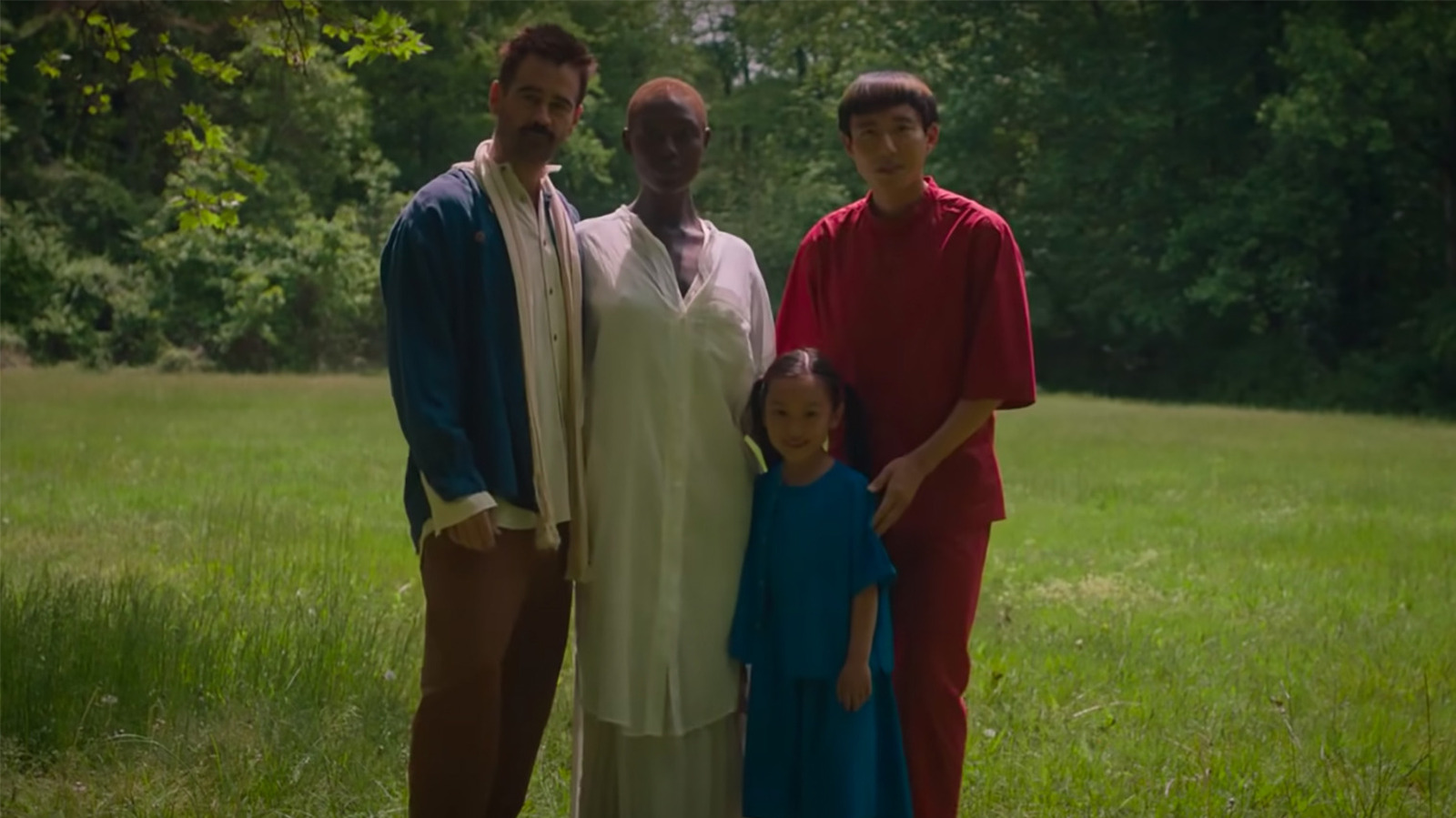
2. After Yang Do androids dream? If so, what purpose did they truly serve in the grand scheme of things? What truly matters when a person and a machine are one and the same? As those questions are pondered in the wonderful, moving sci-fi drama After Yang, brought to us by visionary filmmaker Kogonada (whose previous film was Columbus, also wonderful and moving but for different reasons). And with one of the best performances from Colin Farrell starring as a father hoping to repair the family’s beloved malfunctioning humanoid companion (named Yang), I was pleased to ponder the questions along with him.
3. Apollo 10 1/2: A Space Age Childhood More of a modest memoir than a glorified space opera, I thoroughly enjoyed director Richard Linklater’s latest nostalgia trip. This one has a sci-fi conspiracy twist–NASA put a space module too small for grown-up astronauts and trained and sent a fourth-grade boy up to the moon in it. (Hey, I’ve heard crazier theories.) Available on Netflix.
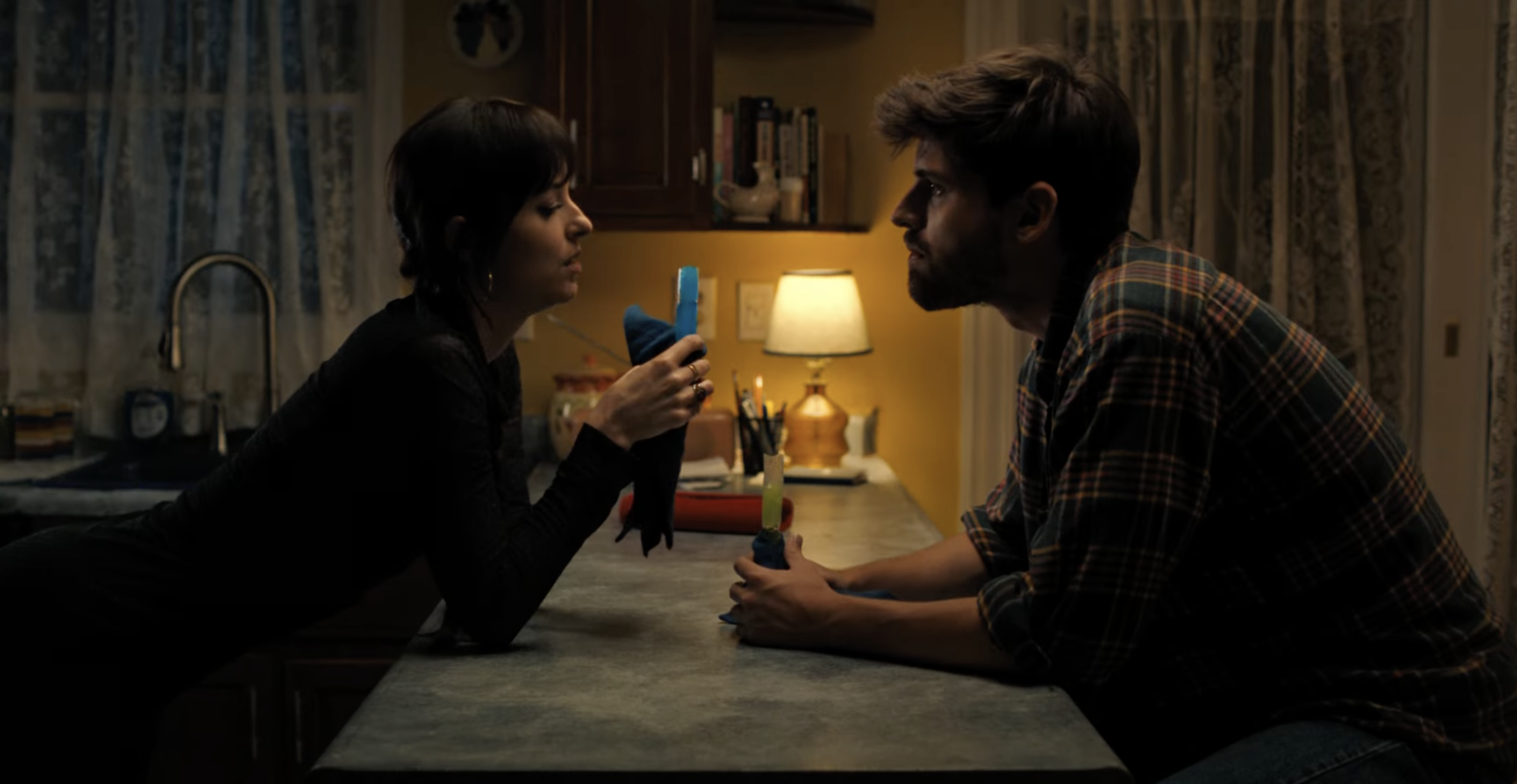
4. Barbarian As many film reviewers have pointed out before me, 2022 was a very impressive year for horror. And I include Zach Cregger’s strange, unsettling, unpredictable, even occasionally laugh-out-loud funny Barbarian on this list because I simply cannot get it out of my head. (I know that doesn’t sound like a ringing endorsement, and indeed there are better horror films on this list–but I’ll not dare give away the fun and horrifying secrets this film has to offer, even for a brief retrospective.)
5. The Batman Don’t ask me exactly where I’d rank this latest cinematic outing of DC Comics’ Caped Crusader (given to us by director Matt Reeves, who already brought dignity back to the Planet of the Apes franchise) among the other Batman films–but it’s up there with the superior ones, like The Dark Knight and Batman: Mask of the Phantasm. I love its dark mystery, its moody atmosphere, and its gritty performances (especially from Robert Pattinson as a damn good Batman and Zoe Kravitz as a complex Catwoman). Let’s see where it goes next.
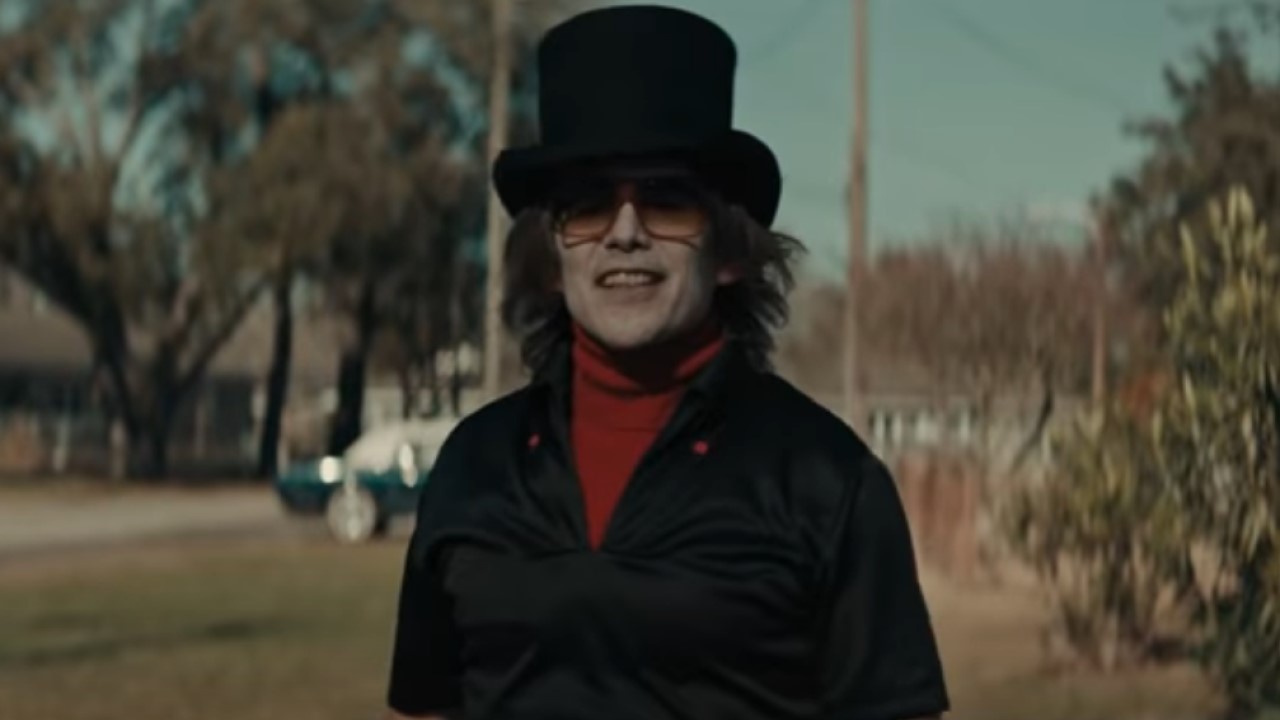
6. The Black Phone Well, THIS was chilling! Chilling for its late-1970s slasher-movie vibe, the usually-affable Ethan Hawke portraying pure evil as The Grabber, and keeping me on the edge of my seat as the pre-teenage protagonists attempt to escape The Grabber’s grasp and solve his deadly mystery–Scott Derrickson’s The Black Phone gave me the chills many different times in its 103-minute runtime. Of all the unique and exceptional horror films released in 2022, this one got to me the most.
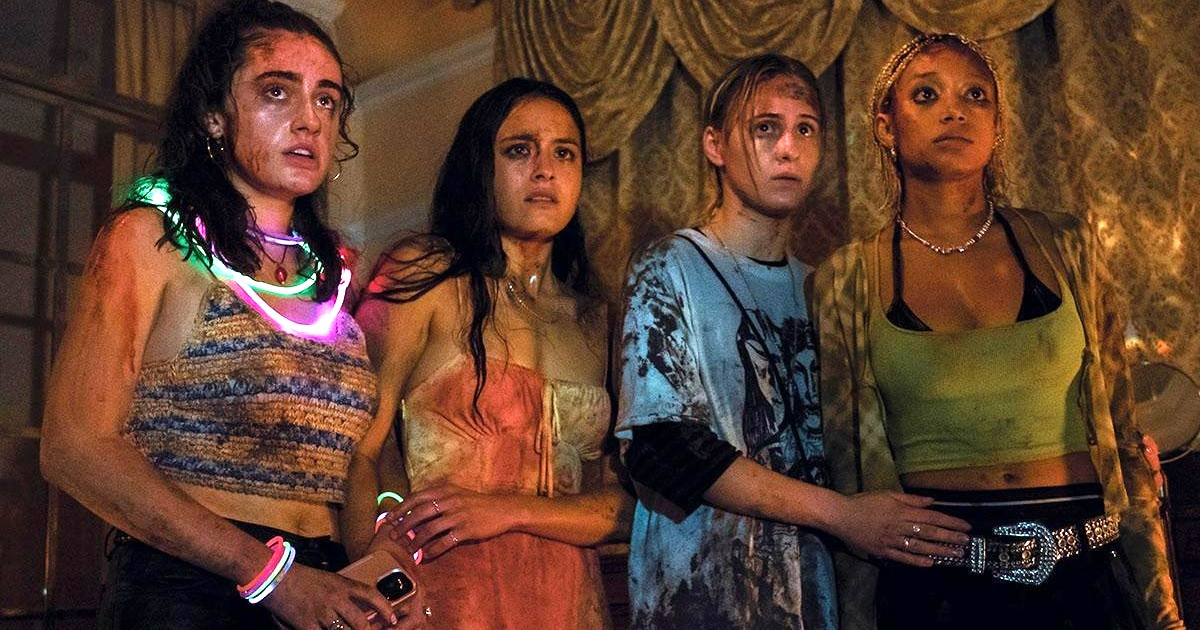
7. Bodies Bodies Bodies I LOVED this crazy movie! Halina Reijn’s horror-comedy Bodies Bodies Bodies kept me intrigued as many times as it made me laugh. Picture Scream mixed with an Agatha Christie mystery, and you have a sharply satirical horror-comedy about a group of young people (in this case, Gen-Zers) who band together for a good time in a big house–only to turn against each other when they get killed one by one. In a time when so many young people live in the moment, cling to their smartphones for comfort and guidance, and completely miss what’s happening around them, this example of social commentary couldn’t be more effective if Zoey Deutch’s narcissistic character from Not Okay suddenly entered the picture. And the ending–PERFECT. That’s all I’ll say about it.
8. Cha Cha Real Smooth Cha Cha Real Smooth is the sophomore effort from exciting new actor-filmmaker Cooper Raiff, after the refreshingly original 2020 college-dramedy S#!%house–after these two remarkable feats, I’ll happily see what else he has in store for us. Fresh new voices can add something special to familiar stories–for S#!%house, it was coming of age through the college experience; for Cha Cha Real Smooth, it’s coming of age post-college graduation; and in both films, there’s something special to be found. Keep up the good work, Mr. Raiff. Available on Apple TV+.
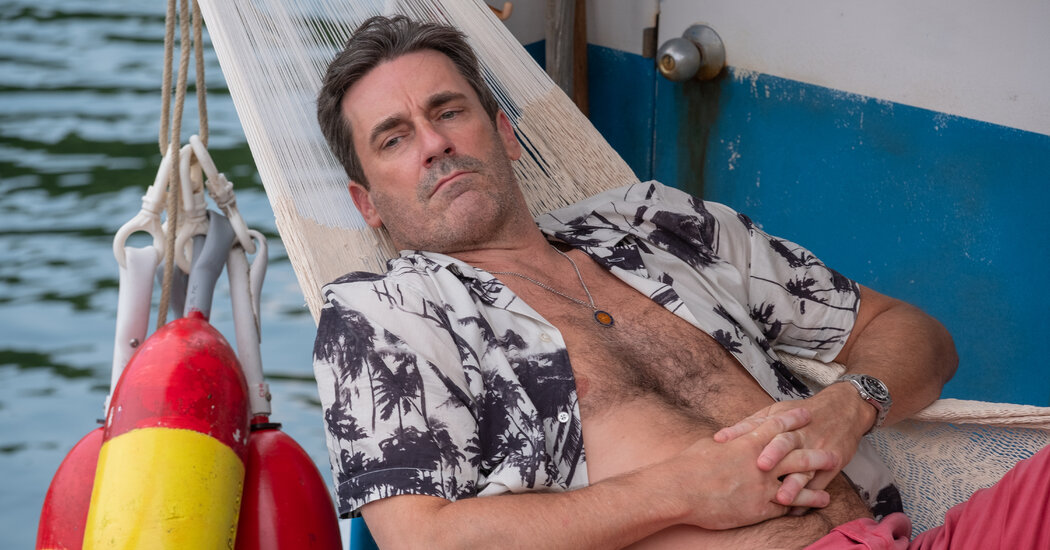
9. Confess, Fletch My personal pick for the funniest film of the year. I could credit it to the direction from Greg Mottola (The Daytrippers, Superbad, Adventureland), the sharp screenplay from Mottola and Zev Borow, and/or the colorful supporting cast (which includes Marcia Gay Harden and Kyle MacLachlin)–maybe even the source material, Gregory McDonald’s 1976 novel of the same name. But it really comes down to Jon Hamm taking the lead as Fletch–he IS this movie.
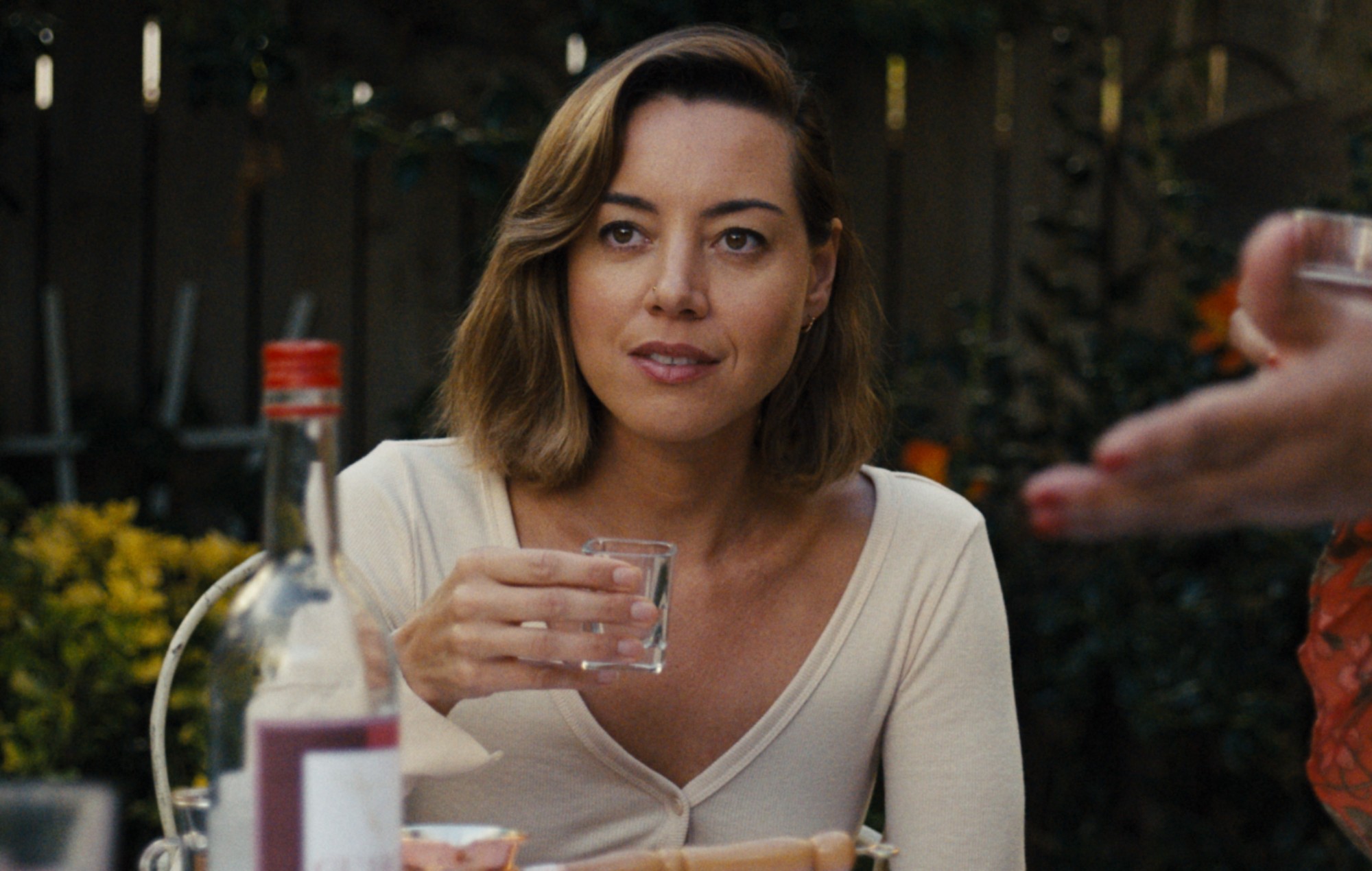
10. Emily the Criminal This film contains the best monologue of the year, delivered by the wonderful Aubrey Plaza in the title role, about why unpaid internships don’t mean a thing to someone who’s heavy in student loan debt. (Stolen credit cards and fake IDs…I guess they ARE the most practical way to make some easy money.) John Patton Ford’s neo-noir crime thriller is as telling as it is involving–and the great performances from Plaza and Theo Rossi (as Emily’s semi-boss) help too.
11. The Fabelmans This is the film I’ve been looking forward to all year–a semi-autobiographical portrait of the early days of Steven Spielberg, one of my filmmaking heroes. I remember when I was a kid, I read up on how Spielberg was inspired to make his own films as a youngster and what would become the seeds that would bloom such beautiful artworks as E.T. and Schindler’s List, among others.
And five years ago, there was a wonderful HBO documentary, simply called Spielberg, that went in-depth about WHY he made his films–and a lot of his youth experiences had to do with it. (Check it out if you have HBO–it’s a great doc.)
Now, Spielberg himself has made The Fabelmans, which is not only a love letter to his growth in filmmaking but also a moving memoriam of his parents (his mother died in 2017, his father in 2020). He even wrote the script, which means something since he doesn’t usually write his films and it also says something about how much of his heart and soul went into this one. (He co-wrote it with Tony Kushner, the playwright who also penned Spielberg works such as Munich, Lincoln, and West Side Story.) But it is based on his childhood, so who better to write it than the man himself?
And it shows. Only a visionary and exciting director like Steven Spielberg can take a coming-of-age story and make it such a visual and aural entertainment. Do I care about the characters? Yes. Am I intrigued by their story? Yes. Does it feel long at 2.5 hours? No. So, add all of that to the usual Spielberg flair, and what do you get?
One of the best films of the year.
12. The Fallout For me, the most emotionally involving film of 2022 was released in January–that film was The Fallout, which is about school-shooting survivors attempting to overcome trauma and guilt. By the end of the film, we get the feeling it’s going to take more than one movie to get through it–but there is a hopeful sense that they will in the future. A wonderful filmmaking debut from actress Megan Park and a remarkable leading performance from 2022’s busiest actress Jenna Ortega (Wednesday, X, Scream). Available on HBO Max.
14. Hustle A Happy Madison production released on Netflix…and it’s GREAT?? OK, OK, I don’t want to sound too snobby about it–but I mean it when I say Hustle took me completely by surprise. It’s not merely great in the same way I enjoy funny Adam Sandler-produced comedies like Happy Gilmore, The Wedding Singer, and Click (as opposed to stuff like Jack and Jill, Just Go With It, and quite a few Netflix comedies released under his studio banner Happy Madison Productions)–it’s great in the way that actor/producer Sandler and director Jeremiah Zagar (We the Animals) found a story deep inside themselves that they wanted to tell in the best way they could. (And given Sandler’s love for the NBA, setting the story within the pro-basketball circuit makes me wonder why it took so long for him to make this film.) It’s a feel-good story of hope and belief with enough gentle comedy (and your typical Sandler fashion of product placements) that truly got me in the heart. This is more than a layup, in basketball terms–it’s a freethrow that wins the game. I loved it. Available on Netflix.
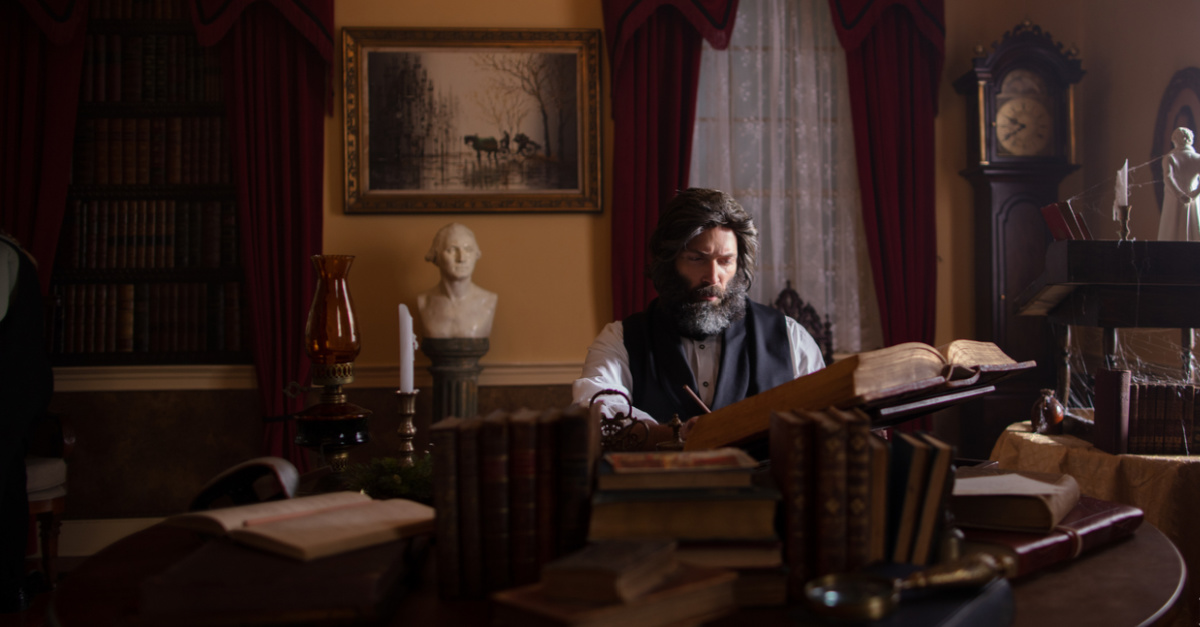
15. I Heard the Bells I Heard the Bells, the first cinematic production from Sight & Sound Theatres, tells the story of the origin of the well-known poem “Christmas Bells” by Henry Wadsworth Longfellow. It’s a story of a man who had his faith and his passion challenged before ultimately embracing both. And it’s a warm, uplifting fable that was just what I needed during the holiday season.
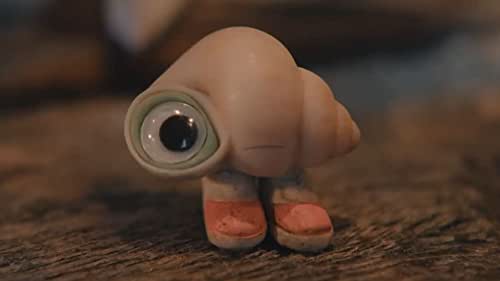
16. Marcel the Shell with Shoes On Well, THAT was interesting and wonderful! How did I feel feelings for a mockumentary about a talking, walking shell named Marcel?? Just…what…how…why… I mean, not that I’m complaining, but wow, Marcel the Shell with Shoes On is kind of a beautiful film! There’s a lot of heart, poignancy, and earnestness here. There’s a lot of humor, but it’s more gentle and quiet than I expected. But most importantly, there was rarely a moment throughout this film where I didn’t have a smile on my face.
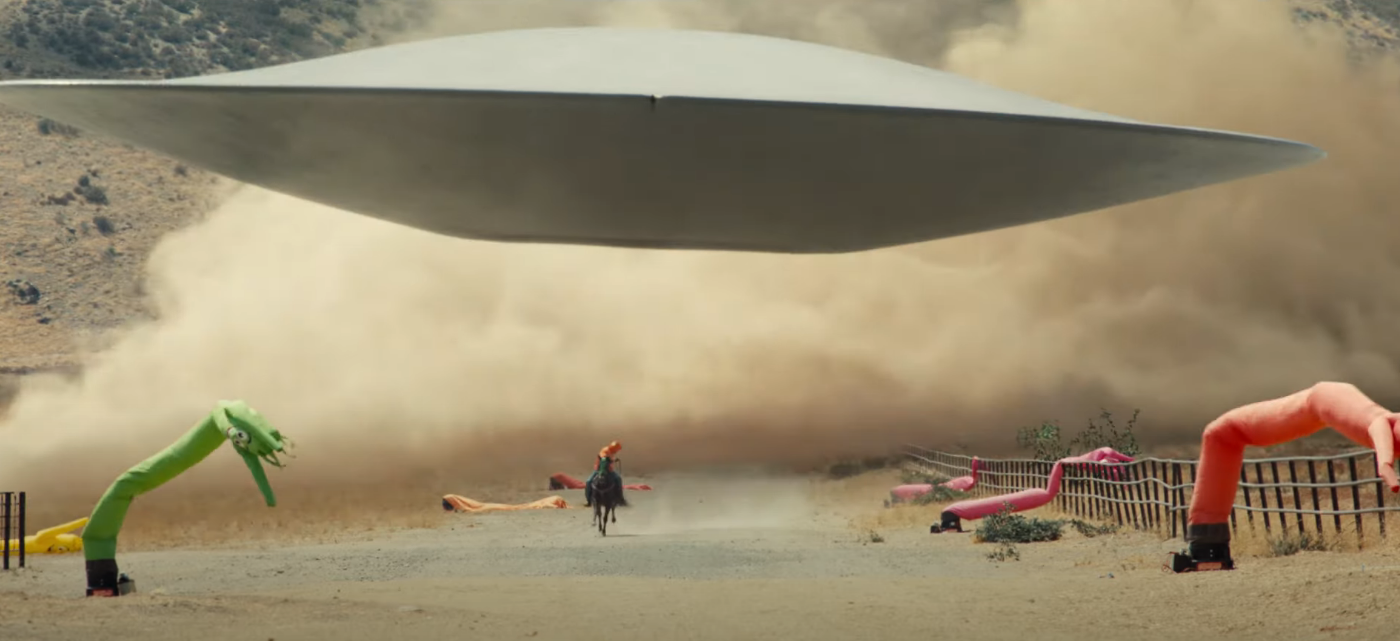
17. Nope Like Jordan Peele’s previous films (Get Out and Us, both of which I love), Nope is another deeply layered horror film that also demands a second viewing. (I rewatched it with my dad–we both got much more out of the film that time.) But as we know, it takes a very entertaining first viewing to warrant one. And Peele is 3 for 3.
This film also contains the most disturbing sequence of any horror film I saw this year–you probably already know the scene I’m talking about: the one that takes us inside…well, if you don’t know, you’ll see when you see it (or see it again).
18. On the Count of Three It’s gonna take a lot of analysis to get into why I endorse this film wholeheartedly, especially if you saw the Hulu ads and assumed that it’s a dark comedy about suicide. It’s much more than that. Trust me, I wouldn’t recommend the film there wasn’t a whole lot more to it. Director-star Jerrod Carmichael and his writing duo Ari Katcher and Ryan Welch knew exactly what they were doing and gave us a complex story about life and death. Available on Hulu.
19. Pearl I wasn’t even that frightened of Mia Goth as Pearl in X because she was a frail old woman (who killed people)–and honestly, if I didn’t know that was her underneath all that old-person makeup in X, I would never have guessed. But here in this origin story, called Pearl, in which we see Mia Goth as a younger version of Pearl…yikes is she scary! I don’t think I’m ever gonna look at her smile the same way again (especially after that last shot…I’m gonna have nightmares about this film’s last shot!!).
It’s a performance that is determined to give a casual moviegoer chills and even the biggest fan of X shivers–and Mia Goth is giving it her all; I see her winning numerous awards for this complicated, multilayered role that she must’ve had a ton of fun playing at the same time.
Spoiler alert–X is on this list too; if this list wasn’t alphabetical, I’d include both X and Pearl as a tie.
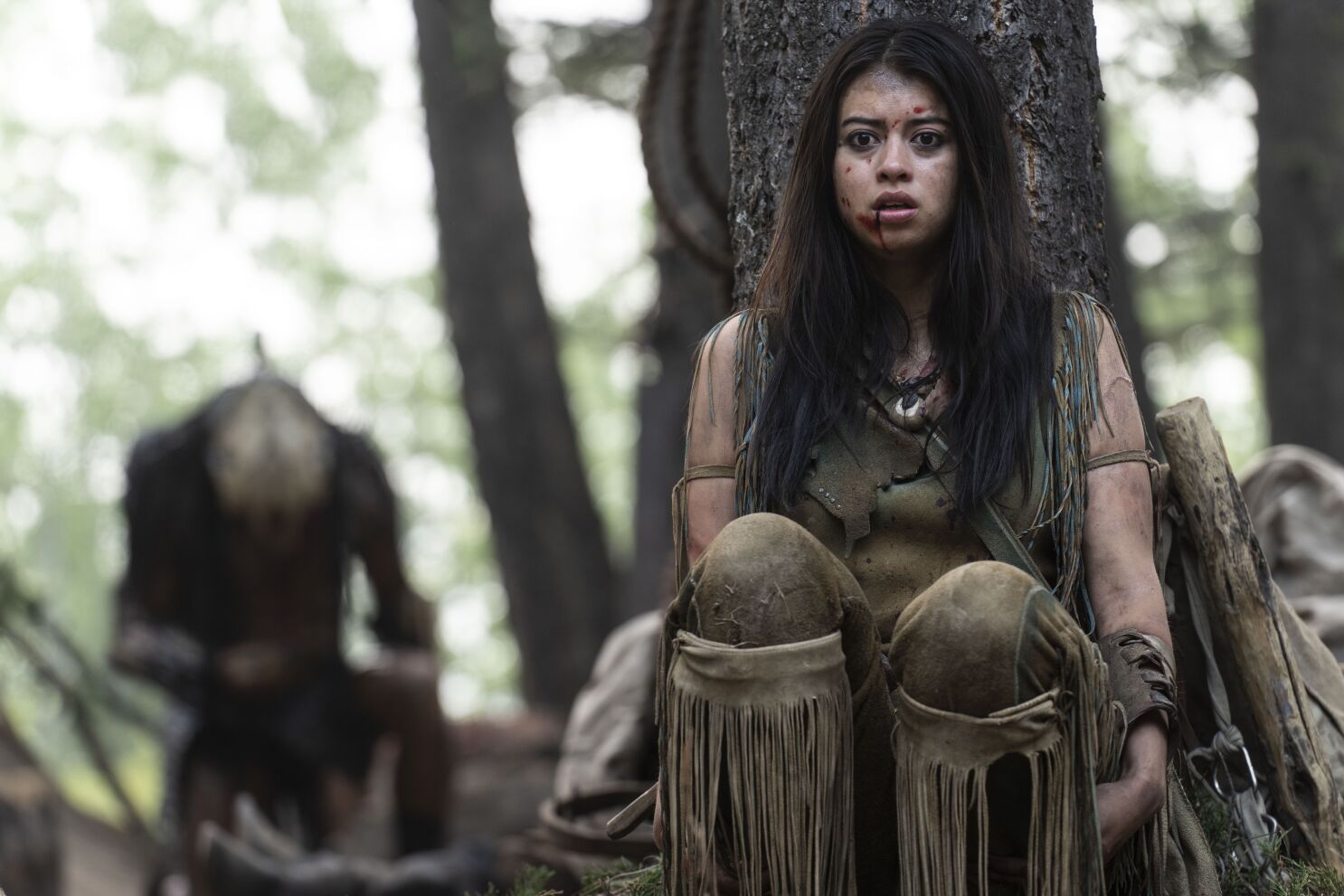
20. Prey All it takes is a change of scenery (in this case, Comanche territory in the 1700s) to get people invested in the Predator franchise again–and I dunno if this will actually happen, but I’d be down for a Predator-vs.-Samurai film too!
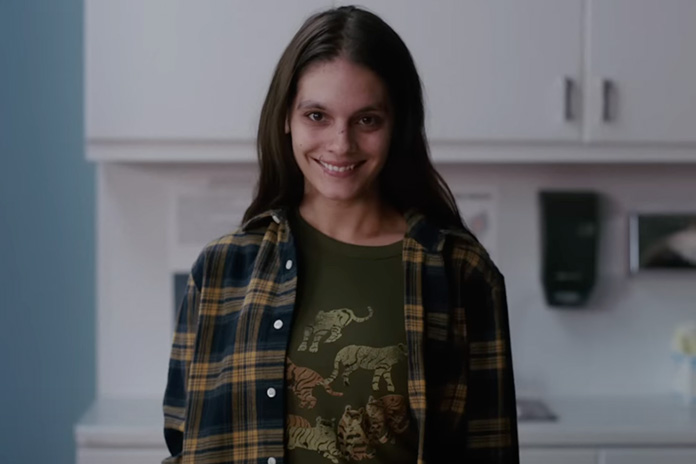
21. Smile Another pleasant surprise in the horror category for 2022 in film, Parker Finn’s Smile is more than a cash-grab or a simple scarefest–it’s a unique, intriguing, disturbing, and yes, quite chilling commentary on people around you trying to force you to “smile” (i.e., be happy) while your inner demons continue to torment your every being. Good stuff here.
22. Soft & Quiet If I Heard the Bells showed me a glimpse of heaven, then Soft & Quiet is like taking a 90-minute tour in hell. (This may have been the scariest film of the year for me due to its frank and realistic manner in which evil is personified.) But thanks to the ambiguous yet optimistic end of the film, we remember that no matter what horrific and inexcusable deeds are committed towards our neighbors here on earth (by other neighbors–in this case, neo-Nazi Karens), no one can get away with them.
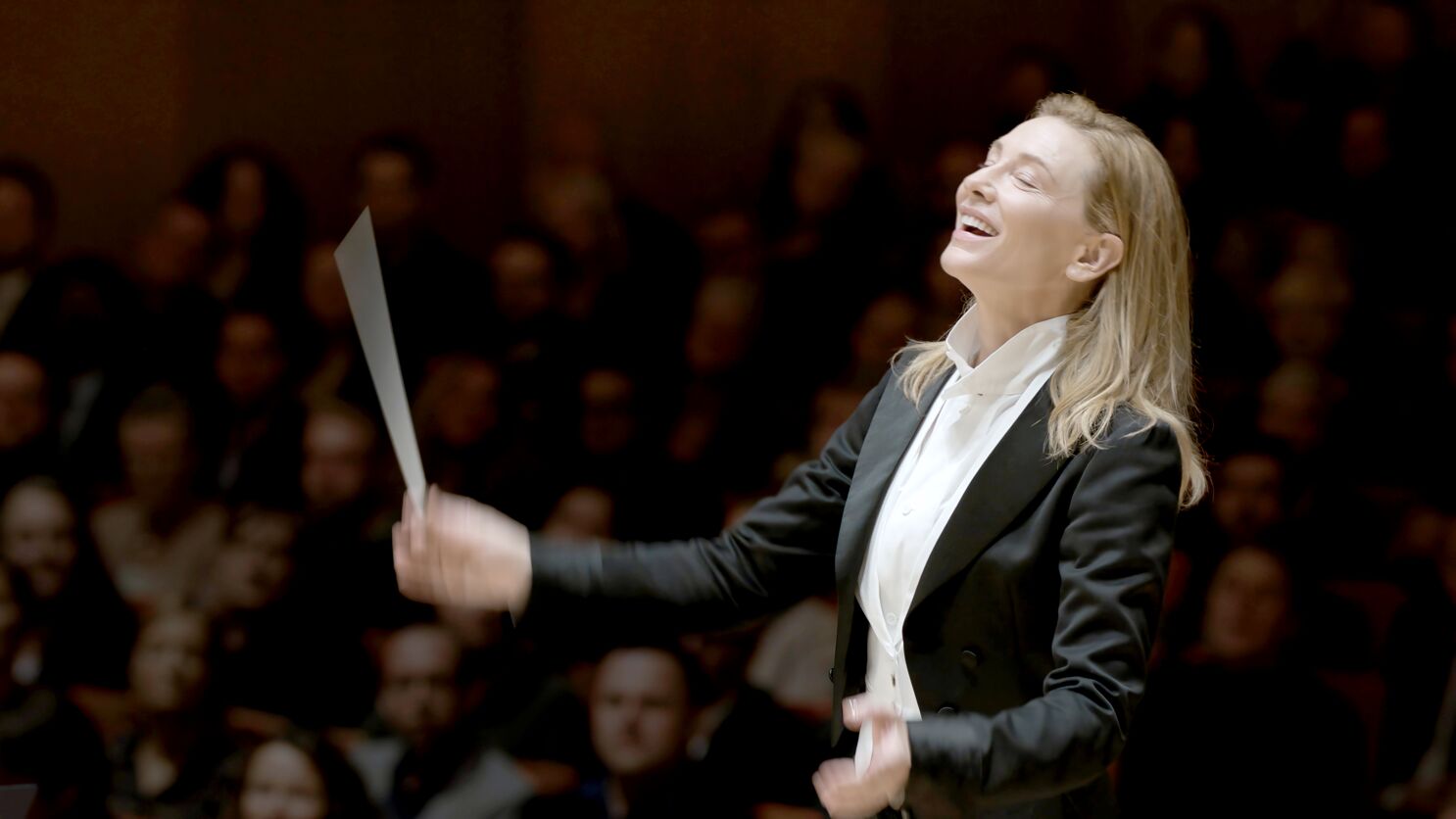
23. TÁR So what is TÁR? A cancel-culture fable? A ghost story? A riches-to-rags tale? A meditation of classical music? Well, the beauty of film is it can be whatever you want it to be. And with Todd Field’s amazing, haunting epic drama with a spectacular powerful performance from Cate Blanchett, I don’t mind pondering what it’s truly about as long as I’m still thinking about it. And I doubt I’ll forget it anytime soon.
24. Top Gun: Maverick Well, THAT was awesome! There’s nothing I can say about this surprise-smash blockbuster sequel that no one else has said already–so I might as well move on.
25. X With X and its prequel Pearl, filmmaker Ti West not only shows his versatility as a director but also outdoes himself with a new iconic horror franchise. While stylistically different, both films are wicked, darkly funny, blood-splattered, and chilling to the bone. And it began with X, the “Texas Chainsaw Massacre” to Pearl’s…”Wizard of Oz” (see, that’s how different they are–I love it), a horrific look at how dark and deep the hole of loneliness, old age, and repression can get…while giving us some multidimensional characters to see through it and some gory murders to see THEM through. What a wild ride. And I can’t wait to see “MaXXXine,” the new entry in the franchise.
Whew! This one was exhausting to make and it’s time to rest for a while. I can’t wait to see what treasures 2023 will deliver either on the big screen or on the streaming channels. However you see it, let’s enjoy it!












 Smith's Verdict