Not enough people talk about Rocky II, I don’t think. That’s a shame, because I think it’s one of the best movie sequels.
It was criticized for giving Rocky Balboa (again played by Stallone, who also directed this one) his happy ending, which critics argued went against what was set up in the prior film. Rocky wins the rematch against Apollo and thus earns the World Heavyweight Champion title. Well, why not? After everything I’ve experienced as a film viewer with this appealing character who just kept doing his best at what he was good at, I would’ve been disappointed if he lost again!
He earned it. He pushed it to the limit. I can’t help but feel happy for him! (“YO, ADRIAN!” he shouts to his wife. “I DID IT!!!”)
The first “Rocky” movie was about a nobody who wanted to prove his worth. This second movie, “Rocky II,” shows what happens after. Rocky marries Adrian and he thinks it’ll be a happily-ever-after. But new problems arise, starting when he spends money he thinks he can earn back with endorsements, but he can’t play to the camera (in a really painful scene; it’s funny but it’s also sad at the same time). Well OK, maybe he can fight again–actually, no, because his eye is too damaged for it. Reality hits Rocky real hard, and what makes “Rocky II” so interesting to watch is seeing how Rocky and Adrian cope with what should have been a fairy tale ending.
This of course leads to the big rematch between Rocky and Apollo Creed (Carl Weathers), who is humiliated because everyone thought he was too fair to Rocky in the previous fight. I’m more invested in this fight because it feels like there’s more at stake this time around.
I love “Rocky II.” It’s emotional, heartbreaking, and still knows when to bring out the positives in a negative situation. And it leads to a resolution that is definitely well earned because Rocky is still a realistic heroic figure worth cheering for.
My favorite scene: Rocky’s proposal to Adrian. I am a sucker for this scene, guys. It’s one of the sweetest, most romantic scenes I’ve ever seen in any movie in my life.
Now, what about the other sequels? Obviously, they don’t really match up, but there is still something to them. “Rocky III” has its enjoyable moments and “Rocky IV” is crazy in its silliness. “Rocky V”…has SOME good moments, but is still kind of a missed opportunity. “Rocky Balboa,” the first “Rocky” movie I saw in a theater, is decent enough and felt like a satisfying farewell to Rocky’s boxing career.
Finally, Rocky Balboa was brought back to train another fighter, Apollo Creed’s son Adonis, for the 2015 film Creed, which was a terrific revival and a brilliant new direction. (I also like Creed II. A few more viewings, and it might join “Rocky,” “Rocky II,” and “Creed” for a spot as one of my new favorites. Maybe.)
It’s kind of ironic that a small film about “going the distance” surpasses “the distance.” Rocky is about a guy who’s given a shot to show the world what he’s all about next to the best in his field, and while he doesn’t win (in fact, he barely survives), he gains respect, self-assurance, and the love of his life.
That guy was a boxer named Rocky Balboa, and he was portrayed by the film’s screenwriter Sylvester Stallone, who himself had something to prove. The studio bought Stallone’s script, but they didn’t have faith in a film with Stallone as the lead. Stallone, however, got the last laugh–everyone fell in love with “Rocky.” Critics and audiences adored it, everyone spread the word around resulting in box office success, and as if all that wasn’t enough, it even triumphed at the Academy Awards with the top honor of Best Picture.
Yeah…I’d say it did more than go the distance! That sort of goes against the initial purpose of “Rocky,” but who am I to complain? It’s awesome!
“Rocky” is basically a fairy tale about a boxing bottomfeeder, Rocky Balboa aka The Italian Stallion, who fights (mostly for money) because he has trouble with everything else. That’s especially true when he tries to court the shy Adrian (Talia Shire), but he keeps trying his best, and soon enough, his efforts win her affections. When the World Heavyweight Champion, Apollo Creed (Carl Weathers), handpicks this “Italian Stallion” as his opponent for a big New Year’s match. Suddenly, this no-name boxer has a shot at the title. But winning the fight isn’t the first thing on Rocky’s mind–the most important thing to him is that he shows Apollo and the large crowd that he can go the distance.
There’s a time when a lot of us can relate to Rocky. We often think about how great it would be if we won something that would gain respect from most people. But sometimes, we also realize that it’s less about winning than it is about trying. And in the end, what’s more important is the people in our lives who are with us during this particular challenge–in this case, it’s Adrian for Rocky, which makes the final scene all the more heartwarming. Rocky doesn’t win the fight, but he does win Adrian’s heart.
My favorite scene: I guess I have to pick a Rocky-Adrian moment here and I know everyone loves the ice-skating scene between Rocky and Adrian–it is a great scene, but my personal favorite between the two characters is their first kiss soon after.
There’s hardly anything I can say about “Rocky” that hasn’t been said by everyone else already. Stallone’s Rocky is an appealing character, the love story between Rocky and Adrian is great, the sports-film cliches feel fresh in this realistic setting, the supporting cast is great, the theme song “Gonna Fly Now” is iconic, et cetera and so on. It’s a great film and a feel-good classic, and I love watching it.
Now, what about the sequels? Well…join me in the next post.
People say the best movie sequels are “The Godfather Part II” and “The Empire Strikes Back.” I may agree those are the “best”…but my “favorite” is and always has been “Terminator 2: Judgment Day!”
No joke–this movie is in my top 15 personal faves. It’s my favorite action flick!
“T2” is what I call a gold standard for the action film genre. It is really. Freaking. Awesome!
The first “Terminator” was a surprise hit people loved. So naturally, there had to be a sequel. But what would it be about? Is Sarah running from a Terminator again? Are there more signs to an ongoing threat to wipe out mankind? Will there be a lot of callbacks? It doesn’t sound like too many possibilities to be found.
But here we are at “T2,” a sequel that could possibly stand on its own because it doesn’t totally rely on callbacks to the original. (In fact, I watched this before I watched the first movie. I was 11, saw a few clips on TV, LOVED what I saw, asked my parents to buy both movies, watched “T2” all the way through, THEN watched the first movie.)
The film opens with the threat of human extinction as we’re told billions of people died in a nuclear war in 1997. In 2029, the war between the defense computer system and the human resistance continues, led by John Connor. The machines have sent a Terminator (a killer cyborg disguised as human) back in time to kill John as a child. The resistance has also sent someone back in time to protect John.
Cue the holy-crap-this-still-haunts-me-to-this-day opening credits! These opening credits….WHOA! From the haunting theme music accompanied by five pounding notes that get you all pumped up to the shots of a playground ablaze to the extremely menacing stare of a Terminator endoskeleton to close us out…I’m already stoked before Schwarzenegger even shows up!
Speaking of which, we cut to the mid-1990s, in which Arnold Schwarzenegger’s Terminator is back…but not quite. This is a different model. He’s still imposing and poses a threat to others (that scene in the bar is still unbelievable–btw, get used to me gushing over how much of this movie holds up!), but this time, he’s not out to kill our hero. He’s been reprogrammed to be young John Connor’s protector.
Man, I wish I didn’t know that when I first saw this. I wonder if I would’ve been as surprised as theater audiences in 1991 when Schwarzenegger turned out to be the good guy!
Anyway, John (Edward Furlong), who’s supposed to be 10 years old in this film but looks about 12-13 (maybe even 11), has been brought up by his gun-loving mother Sarah (Linda Hamilton) to believe that he will grow up to lead mankind in the battle against the machines. Well, now his mother has been institutionalized because of her warnings about the future, and John would just rather be a normal kid and not have to worry about anything at all…but then the T-1000 (Robert Patrick) shows up.
Since the Terminator we were used to seeing before is now the hero, “T2” needed a memorable villain…and WOW IS THE T-1000 A GOOD VILLAIN! (Sorry, it’s just…I love this movie.) He doesn’t have personality, but again, if you watched this movie not knowing the true identities of these characters at first, you’d think he was the hero. He acts like an everyday dude, can appear human when need be, seems like he’d be an OK guy. But nope–he’s a machine; actually, a more advanced cyborg than Schwarzenegger and even made from liquid metal. When he needs to kill, that’s when he goes full Terminator mode! His limbs can form weapons, he can dissolve into liquid, he can become other people, and what’s even worse is he seemingly can’t be destroyed–you shoot a hole in him and it closes up quickly, you slice him up and he closes back up to, you can even BLOW HIM UP and he’ll still pull himself back together. Man, and I thought the original Terminator was scary…
Oh, and he’s a cop! I wouldn’t trust the police after seeing this guy in action!!
I think the movie I drew myself to this film as an 11-year-old was because it starred a kid my age at the center of things. He’s the one the T-1000 is chasing after, the weight of a lot of scenarios throughout the film are riding on his shoulders, and what’s even cooler is the Terminator has to do whatever he tells him to do because that’s how he’s programmed. At first, John thinks it’s cool, as would any kid–but then he learns pretty quickly that his protector is indeed a Terminator, which results in an interesting dynamic in which the kid has to play the parent and teach the Terminator why he shouldn’t kill people. He can even teach him the value of human life as well, and the Terminator even takes some of it to heart (despite not having a heart).
Soon enough, the Terminator and John help Sarah break out of the institution (in one of the most suspenseful sequences in the movie) and together the three set out to prevent the nuclear war (labeled Judgment Day) from happening, with the T-1000 not too far behind.
There’s real stuff at stake here. The fate of the human race, for instance! Sarah and John want to stop the war from happening, the Terminator has to learn the importance of existing, and they each have their own little arcs in the process. Sarah even at one point becomes as cold as a Terminator when she considers killing the one man responsible for the central computer, at which point John must help her snap out of it, again playing the parental role (to his own mother, for crying out loud).
But enough of that drama and character development and emotions and stuff I’ve come to look for in movies as I got older! Gimme that awesome chase sequence in the LA aqueducts! Gimme the escape from the mental asylum! Gimme Arnold Schwarzenegger with that awesome minigun! Gimme the chase on the LA streets! Gimme the chase through the steel mill! HELL YEAH THESE SCENES ARE AWESOME!!!!!!!!
You see what this movie does to me? I started this review off by stating it was the best action flick I’ve ever seen and it took me until one paragraph ago to mention the best action sequences in it! But that should say something–“Terminator 2: Judgment Day” has more on its mind than action…but when the action happens, it’s (I’ll say it again) really. Freaking. Awesome!
I won’t be talking about any of the sequels in this series about My Favorite Movies, so I’ll just sum my quick thoughts about them:
“Terminator 3: Rise of the Machines”–has its moments but nothing special. “Terminator Salvation”–I don’t even remember much from this one, other than Anton Yelchin as young Reese and Schwarzenegger’s sort-of return. “Terminator: Genisys”–even its fun moments remind me I could be watching the first two movies again. “Terminator: Dark Fate”–I won’t lie, this one would’ve been fine…but I just can’t get behind it starting (casually, I might add) with John Connor’s death. It didn’t matter to me how good the rest of the movie may be; within the first few minutes of the movie, it LOST ME!!
But “The Terminator” and “Terminator 2: Judgment Day,” I’ll always treasure.
“Terminator 2: Judgment Day” is one of my top 15 favorite films of all time…but before I get to that awesomeness, I want to talk about THIS awesomeness: James Cameron’s 1984 sci-fi-horror sleeper hit “The Terminator!”
The film no one expected to become a classic hit gave birth to one of the scariest and most badass villains in the history of cinema: the Terminator, played memorably by Arnold Schwarzenegger. What’s more terrifying than a killer? A killer that can’t be reasoned with, is heavily persistent, and won’t stop for anything at all until they kill you!
The Terminator is a cyborg sent from the future to exterminate the would-be mother of who would grow up to become the leader of a human resistance against a hierarchy of defense-network computers turned against mankind. (Or, as another fighter from the future states, it’s “one possible future, from your point of view.”) Schwarzenegger plays him as a ruthless killer–a machine with no purpose other than to hunt and kill his target. And what’s worse? He seemingly can’t be killed, seeing as underneath his living human tissue is a metal endoskeleton!
Yikes! Someone’s out to kill me, they have lots of weapons, and they can’t be killed–I’d be running for my life and saying my prayers constantly!
Plus, as director James Cameron pointed out, Schwarzenegger’s Austrian accent adds to the effect–it does sound like a machine computing and processing, in a sense.
The Terminator’s target is Sarah Connor (Linda Hamilton), a meek, mild-mannered waitress who simply can’t believe it when she learns she’ll give birth to the leader of the world, a killer robot is stalking her, and her only hope is a fighter from the future human resistance, Kyle Reese (Michael Biehn), who lays down so much info on her in one night. It’s a lot to take in, and what I love about Sarah’s arc in this movie is how much the adrenaline of the chase between the Terminator and her and Reese gets her to grow. By the end of the film, she fights back and even gets to order Reese to keep going because they’re not finished yet.
If the Sarah Connor of this movie turned into the Sarah Connor of the sequel in just one movie, it wouldn’t be believable–but here, it makes sense. She doesn’t become a full-on badass, but she does accept what she has to do to become said-badass.
Even though “The Terminator” is more of a horror film than an action film, there are still some really well-executed chase sequences to be found here, especially for its low budget. I especially like when Reese and Sarah are on foot while the Terminator now has a huge truck. (I remember as a kid being like, “Holy sh*t! How are they gonna get out of this??”)
Now…I have to share this one tidbit about the film I really hate: “You Got Me Burnin’,” the song in the Tech Noir club. Man, is it bad. The singer sounds like the Heart lead vocals on absinthe. And for whatever reason, the people who picked the song list at the theater I worked at thought THAT would be nice to listen to every once in a while!
But that’s just a nitpick, really. “The Terminator” is still great–great monster, clever script, likable heroes, intriguing story, one of the best the ’80s had to offer!
Now, its sequel, on the other hand? That’s one of the best the ’90s had to offer! (I’ll get to it soon…)
I always liked “Good Morning, Vietnam” and called it one of my “ALMOST-favorite” movies, but now I can’t help but look at it in a whole new way that’s not only fascinating but worth analyzing. Thus, its placement here.
I mean, I don’t spend a whole lot of time analyzing the whole deal with the Vietnam conflict and the contradiction of love in the time of killing. That’s obvious, especially since this film was criticized for being “a comedy about the Vietnam War.” No, I’m talking about Robin Williams and his performance.
I’ll get to that. Anyway, it started when I binged a lot of old “Siskel & Ebert” reviews and came across their review of “Good Morning, Vietnam.” Ebert talked about what intrigued him more about Robin Williams’ performance as radio DJ Adrian Cronauer:
“He plays a guy who is all words. There is a wall between whoever is inside that character and his words. He uses the humor, the standup comedy, the one-liners–to hold people off. And at the end of the movie, curiously enough, we know a lot about the personalities of all of the supporting characters, but that central Robin Williams character is still a complete mystery. There is no glimpse into it. And that, to me, is brilliant, because it shows a certain kind of comic personality that I haven’t seen in the movies before, where the comedians are using the humor to say, ‘Don’t look inside. I’m going to keep you laughing the whole time.'”
Considering what we know about Robin Williams now (or what we concluded, anyway), it’s kind of eerie how spot-on that statement is. If only Ebert knew that was probably the kind of person Williams was in real life…
I’ve seen the movie about 6 or 7 times in my life, and that thought about Williams’ character never crossed my mind. I just saw it as Robin Williams at the top of his game in terms of hilarity–right up there with his Genie character. Listening to Ebert’s analysis about him inspired me to check it out again. So, I did…
Ebert’s right. We DON’T know that much about Adrian Cronauer (and if you know the true story about the real Adrian Cronauer, that’s probably for the best–but it’s a movie; let them take liberties). I think the closest we get is a scene in which Adrian is caught in a traffic jam with soldiers prepared to fight and he gives an impromptu “broadcast” right there on the spot, much to their appreciation. This is after he’s been suspended from the station and descended into a drunken stupor, and now he has this moment in which you could argue he realizes how important his job is at making the troops laugh. You can see a little hint of what he’s about in this scene. And that also leads to a revelation in the final act, in which one of his best friends turns out to be a VC operative and Adrian’s heart is just broken, which he makes clear in one last meeting with him. Aside from that, he just cracks jokes, doesn’t play too serious, and keeps his guard up. He’s still a mystery, and Williams’ approach is something worth thinking about.
I also realize we know less about Adrian than we do about Private Edward Garlick (wonderfully played by Forest Whitaker in one of his early film roles) who befriends Adrian, tries to keep up with him, and supports him–we know Garlick is goofy but by the book too, cracks wise and has a sense of humor but knows when to keep quiet and focus, and gains self-confidence through his friendship with Adrian, even though he too doesn’t know Adrian’s deal–but he does know what Adrian stands for with his radio persona. Garlick is the anchor for the audience–he’s a wonderful character played wonderfully by Forest Whitaker.
And again, I’ve seen this movie before, so I already knew I liked Williams and Whitaker’s performances–it’s just that now I have other reasons to like them.
The film is already highly recommended for being so funny in Adrian’s radio broadcasts and for being a biting commentary about the Vietnam War at the same time (and this came out just after “Platoon” and “Full Metal Jacket,” which were all about the hell that was Vietnam–this film has a different approach to it but is still pretty effective). And now…I guess I’m going to call it one of my favorite movies now!
My favorite scene: Adrian’s first broadcast starting with “Gooood moorrrrning, Vietnaaaam!” Robin Williams supposedly ad-libbed all of the broadcasts in this film, and it’s amazing to see him go to work here.
I thought Siskel and Ebert’s vintage reviews couldn’t influence me anymore, now that I’m older. I’m glad they can still surprise me after all this time.
I don’t write many negative reviews anymore. But when I was starting out with this blog, I had a pretty good balance of positive and negative. Sometimes, I would purposefully seek out supposed “bad” movies just so I could add on to their piles of bad reviews.
I was too influenced by other film critics such as Siskel & Ebert and Richard Roeper. But they got/get paid to see movies and give their two cents about them. I just did it so I could stay active.
But the thing is, I’m an artist too. I’m a filmmaker. And I’ve grown a lot since I started this blog. I’ve also learned…that if you look for something to dislike about a movie, you’re going to find it. It’s easy. And it’s lazy. What takes effort is crafting the art and looking for the good things in other art.
What I’m trying to say is that it’s just not fun for me to write negative reviews anymore.
What movie did I say I hated most? Freddy Got Fingered. Well, you know what? Tom Green deliberately set out to make a troll movie and he succeeded big-time. I will never see this movie again…but I will strangely admire Green for his efforts.
What other movies was I too harsh on?
Reality Bites. I don’t hate that movie nearly as much as I did before. In fact, I still own it on DVD for the good things in it plus the interesting audio commentary from director Ben Stiller and writer Helen Childress.
Paranormal Activity: The Marked Ones. Everything that bugged me about this intriguing chapter in the “Paranormal Activity” franchise don’t bother me anymore. In fact, watching it again recently, I think I like it.
The Happening. So much of this movie doesn’t work, but I can see what M. Night Shyamalan set out to accomplish. Why fault him for that?
Armageddon. C’mon…it’s goofy as hell and I think that was Michael Bay’s intent.
Angels in the Outfield. I grew up with this movie. My criticisms still hold true, but it didn’t do anything to harm me at all.
Evil Dead. I needed to see this movie for what it was and not what I wanted it to be. It’s a decent remake.
Short Circuit. I still like “Short Circuit 2” more, but still, why give one-and-a-half stars to Johnny Five?
Toy Soldiers. This movie could have been written a lot better. But look at all the pyrotechnics that was put into it!
Three Amigos! Really, past-Tanner? It’s not THAT bad.
Even “North,” the film that inspired Roger Ebert’s “I Hated, Hated, Hated This Movie,” I don’t particularly care for it but at the same time I think director Rob Reiner and writer Alan Zwiebbel suffered enough because of it. And they just wanted to make a fun comedy–they didn’t intentionally set out to make a bad movie.
Oh, and 2 stars to Good Burger?? C’mon, you love that movie and you know it! Oh, and 2 stars to the 1990 miniseries Stephen King’s It? Is that why you watch it every once in a while–just to make sure you don’t like it? (Boy, I’m glad I didn’t review “Hocus Pocus” at all.)
I think what I’m ultimately trying to say is that I shouldn’t have tried kidding myself back then about being a “serious” film critic. I’m both a movie lover and a filmmaker, and I’ll never forget that for the rest of my life.
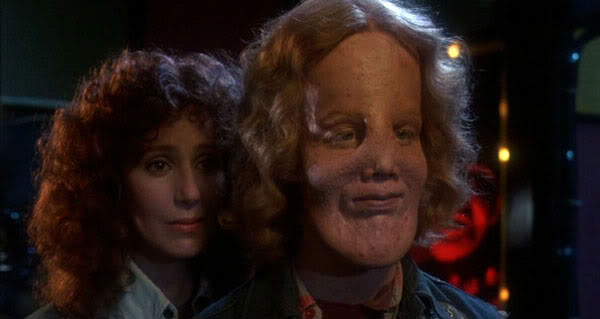
I remember watching Peter Bogdanovich’s “Mask” for the first time at age 16 on TV and thinking to myself, “Huh…this isn’t like most coming-of-age teenage films…it’s mostly just people living their lives…I like watching these people…I care about them…this story isn’t going anywhere I expect…and I love it…wow…hey Dad, can we go to Hastings so I can buy the director’s-cut DVD?”
“Mask” is a wonderful film based (loosely) on the life of Rocky Dennis, who was a regular kid albeit with a facial deformity. In Siskel & Ebert’s initial review of the film in 1985, Siskel said it best: “Put a regular face on this kid, and you still have a terrific picture.” That was a testament to how much both he and Ebert admired the film’s characters and the filmmakers’ attempts to make them as real as possible.
Speaking of that review, I have to mention something that really bugs me–apparently, in marketing this film, the boy’s face was hidden in the trailers and advertisements. Both Siskel and Ebert hated that ploy too and I hate it too, because it made the kid look like a carnival freakshow, which totally goes against what the movie is about!
Thank God the marketing team behind the delightful 2017 film Wonder, also about a child with an unusual face, knew not to treat it like a gimmick. It’s the little things you have to appreciate to understand how far we’ve come in society.
Anyway, Siskel & Ebert were definitely right because once we’ve gotten past the initial shock of seeing what this kid Rocky looks like (and it’s a first-rate makeup job too), we get to like him as soon as we get to know him a little–and that’s only in the first few minutes; the rest of the film gives us an immensely likable character played beautifully by Eric Stoltz.
As I mentioned above, “Mask” is simply about how Rocky and his tough, messy, but overall loving mother Rusty (Cher) live their lives. We see Rocky getting by in a new school district and making some new friends who are of course turned off by his appearance at first (but like the audience, they accept him because he’s cool). We see Rusty hanging out with her motorcycle-riding friends and feeding a bad drug habit. And it’s even more interesting when it comes to the relationship between this mother and son, especially when Rocky tries to get his mother off drugs and she isn’t having it. We meet other people in their lives, such as Rusty’s complicated lover Gar (Sam Elliott) and a blind girl named Diana (Laura Dern) whom Rocky meets at a summer camp where he counsels. And…that’s pretty much the movie. It’s about how these people relate and go about their days. And because they’re such interesting characters, I’m all in.
Even when I first saw this film at age 16, I had to give kudos to this film for just being a slice of life.
And yeah, I know this is very loosely based on the true lives of these real-life people and Bogdanovich took some liberties in telling their story, but you know what? I don’t really care, because the movie still works as is.
Star Wars and The Empire Strikes Back are two of my top 100 personal favorite movies–but if I had to extend that list to a top 400-500, I would make room for two other “Star Wars” movies in particular. And one of them is definitely Rogue One.
“Star Wars” (or “Episode IV: A New Hope”) showed our space-traveling heroes using the newly-received plans for the galaxy’s Rebel Alliance to find a weakness in the Imperial Starfleet’s Death Star and blow the big mother up. But who got hold of the plans in the first place and how did they get out? That’s what “Rogue One” is about–you could call it “Episode 3.9,” since it ends where “A New Hope” begins.
And while “A New Hope” was a fun, rousing space adventure, “Rogue One” feels more like a war film–still a rousing space adventure but with a darker edge to it. A lot of the action is on ground-level, which gives it a great sense of scale. When the Imperial Walkers are storming the beach, I get a sense of how big they are; when the Death Star is seen from below, it’s a tense moment because we know what it means; when shooting goes on in the streets, you get a sense for how quickly they have to think with a blaster; and so on. Watching this “Star Wars” movie, I felt like I was there.
The setup is buildup as our key heroic characters go from place to place, finding one answer after the other, barely escaping death, finally knowing what they’re up against, etc. Then late in the movie, it picks up even more as they decide to step up and take a huge risk in bringing the Death Star plans to light. What results is what even the film’s detractors will label as (I’m gonna go a little crazy here) A FREAKING AWESOME CLIMAX OF EPIC PROPORTIONS!!!!
OK, I’m calm now.
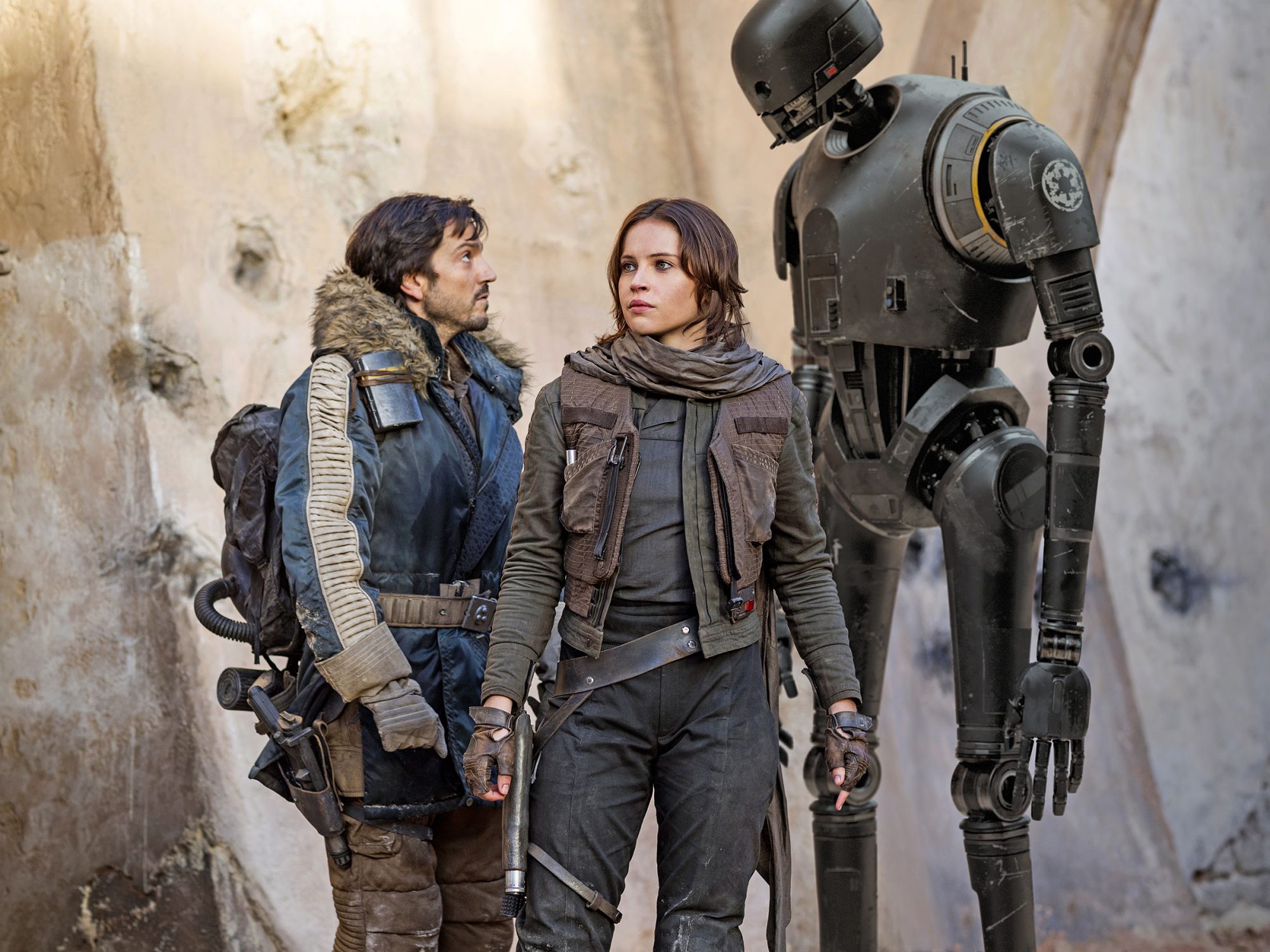
I’ve already seen a lot of backlash towards this movie, specifically for it being short on character and thus short on depth. This is just my opinion, but I think that’s unfair. Sure, we don’t know Jyn Erso or Cassian Andor or Chirrut Imwe as well as we know other “Star Wars” characters such as Luke Skywalker, Han Solo, Leia Organa, Rey, or Finn–and how could we, considering we got to know the latter characters for more than one movie? But it’s not like the former have no character, and I, for one, knew just enough about them to want to keep following them to the end. I liked Jyn’s attitude (and how it changes through her arc of finding reason for hope in the galaxy), I liked Cassian as an intriguing anti-hero (he shoots first and asks questions never), I liked the friendship between Force-minded Chirrut and mercenary Baze Malbus, and I especially like the anti-3PO mannerisms of the droid K-2SO. (There’s also Bodhi Rook, the defected Imperial Pilot–we don’t know why he defected, but c’mon, do you need a reason to stick around with the Empire?) They’re acted wonderfully, they’re likable, and they’re a diverse group of heroes I was glad to see in action.
And because (spoiler alert) you know none of them are going to make it out alive during this important mission, what was also important was how big their ultimate sacrifice felt. For me, it worked very well.
The rest of the backlash came for the film’s writing and plot holes…I don’t care, OK? No film is perfect, and the strengths for all of my favorite movies outweigh the flaws.
However…I have to talk about the CGI to bring back Peter Cushing as Grand Moff Tarkin. Have I changed my mind about how the effect looks almost five years since my initial review? Well…not really. I mean, it’s still impressive and the uncanny valley doesn’t distract as much as other similar effects–there are some instances, however, where it gets a little weird. (But I will say it’s better than the effect of bringing back young Carrie Fisher as Princess Leia for about 10 seconds.) At least now, I can talk about how great the effect is for K-2SO–actor Alan Tudyk had to wear a green suit, stand on stilts, and wear robotic-like armor while filming the scenes, and then computers handled the rest of the effects work. That’s a great exercise in using both computers and practical effects. (Phoebe Waller-Bridge underwent the same method as droid L3-37 in “Solo: A Star Wars Story.”)
So they brought back Grand Moff Tarkin–that’s not who I remember most. I remember…the return of Darth Vader. His big scene near the end of the movie is still chilling and excellent even today. In this moment, I’m reminded of why he was one of the scariest movie villains in history.
In my original review, I criticized the villainous Orson Krennic for being “weak” and “not as memorable as Darth Vader or Kylo Ren.” (Yeah, way to compare, idiot past-Tanner.) Since then, I’ve seen this actor, Ben Mendlesohn, in other things like The Land of Steady Habits, “Mississippi Grind,” and the TV series “The Outsider,” and…I dunno, seeing him again here as the villain, I can’t help but smile, perhaps with recognition. Maybe he’s still a weak villain and I just like seeing this actor play him. I don’t know…but this series is called “My Favorite Movies,” so I shouldn’t really care either.
Overall, I just love “Rogue One” for being what it is: a spectacular, fast-paced, rousing thrill ride (though, again, with some real heaviness brought to the mix). It’s not just “A Star Wars Story”–it should be called “A Hell of a Star Wars Story!” I liked it when I first saw it in a theater; I love it even more now.
NOTE: I will say, for all the things I love about this movie, I don’t like Bor Gullet. I get that the Rebels are very paranoid and are using extreme measures against a former enemy pilot who came to them for help, but…really? They’re using a giant squid creature that senses your feelings, lies, wrongdoings, etc.? Why is that here??
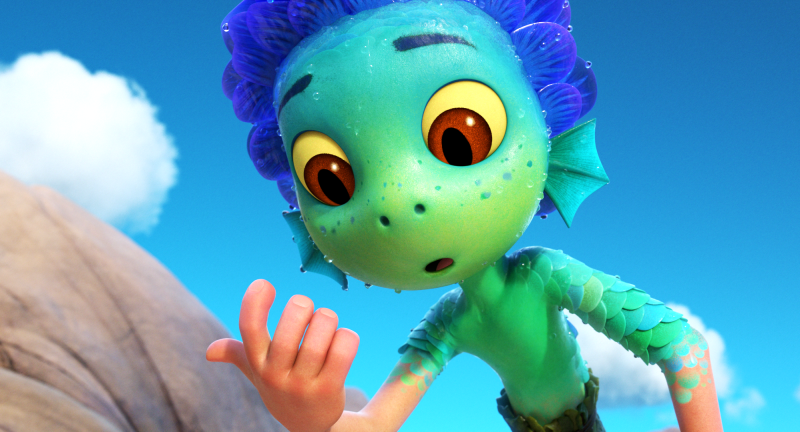
While the latest Disney/Pixar film “Luca” (now available on Disney+) is getting decent reviews from critics, a lot of ’em are still declaring it one of Pixar’s weakest films, to which I say, “Oh so picky.”
What do you want me to say, that it’s not as heartwarming as “Soul” and “Coco,” as clever as “The Incredibles” and “Ratatouille,” as groundbreaking as the “Toy Story” movies, “Up,” and “Inside Out?” OK, it’s not, there you go. Now I can talk about how awesome it is as “Luca.”
“Luca” is the latest Pixar film to make something cute and lovable out of what we would normally find frightening and repulsive. As was the case with the monsters in “Monsters, Inc.,” the dead people in “Coco,” and the rats in “Ratatouille” (…actually, the rats are still a tad repulsive), I don’t see little kids being frightened by the sea creatures in “Luca,” even after a “Jaws”-inspired opening in which fishermen are met by a quick-witted creature and quickly get away from the “horrifying monster.”
Luca is the name of our main character (voiced by Jacob Tremblay), a “sea monster” who is as offbeat-adorable as many Pixar protagonists. Much like Ariel the Little Mermaid, Luca has a fascination with the surface world while his parents (Maya Rudoplh and Jim Gaffigan) forbid him to explore beyond the underwater world because (of course) humans are the real ones to fear.
Things change when Luca makes a new friend in another sea creature, Alberto (Jack Dylan Grazer), and discovers that all sea creatures can pass as human when they’re out of the water. As real boys, Luca and Alberto become the best of friends and get into all kinds of misadventures in their own little world above surface, which involves a lot of “Jackass”-like stunts with makeshift Vespas. Their want for a REAL Vespa drives them to a fishing village, where they learn that if they win prize money in an annual sports competition, they can buy their own Vespa and travel the world! (Makes sense to me.)
Thus begins their literal fish-out-of-water story as Luca and Alberto befriend a local girl named Giulia (Emma Berman), train for the competition (which involves bicycle-racing and fast-eating), and attempt to fit in with the townspeople–as long as they don’t get wet, their secret is safe. (Oh, and did I mention the competition also involves swimming?) Meanwhile, they have to put up with a local bully named Ercole (Saverio Raimondo), who unlike most Pixar bullies such as Randall (“Monsters, Inc.”) and Chef Skinner (“Ratatouille”) is consistently funny (he’s like Gaston of “Beauty and the Beast,” only without the muscles). And Luca’s parents, who also approach the surface, try to find their son. (The parents’ methods of finding Luca by splashing water onto all the local boys are some of the funnier parts of the movie.)
Yeah, some of this is standard stuff, but as is the case with the best Pixar movies, there’s something special underneath (forgive the pun) the surface. That is the bond between Luca & Alberto and the developing relationship between Luca & Giulia which threatens that bond. What started off as a classic “Little Mermaid” story became Pixar’s equivalents of “Stand By Me” and “The Kings of Summer.” As a result, it grabbed my heart and wouldn’t let go.
“Luca” is a great summertime movie, not just because it includes people having fun and adventure in the season, but because summer is the season in which solid bonds are formed and tested. And that is what is at the heart of the story of “Luca”: the relationship between Luca & Alberto and what other desires could break them apart. And of course, having Jacob Tremblay (who’s been acting in movies since preschool) and Jack Dylan Grazer (so entertaining in “Shazam” and the “It” movies) supply the voices helps too.
“Luca” was the directorial debut of Enrico Casarosa, who usually does art work for other Pixar movies, and I was also pleasantly surprised to find that frequent Pixar writer Mike Jones’ co-writer for this one was Jesse Andrews, best known for writing both the novel and film adaptation of “Me and Earl and the Dying Girl.” They add to the charm and humor of this coming-of-age fantasy that is of course, as is typical of Pixar, also beautifully animated.
Yeah, I know I mentioned the animation last in this review of a Pixar film, but c’mon, it’s Pixar–would you expect anything less than stellar visuals? Even “The Good Dinosaur” had pretty imagery.
What is the greatest sequel of all time? “The Godfather Part II” or “The Empire Strikes Back?” Well…it’s easy to say either one, but I’ll go with The Empire Strikes Back simply because it had more to prove.
I mean, “The Godfather Part II” had a lot to follow up with too, since its predecessor was a Best Picture winner. But “The Empire Strikes Back” had more to lose (and…yeah, I guess it did lose people upon initial theatrical release, but I’ll get to that in a bit) because it was a sequel to the highest-grossing film of all time and it had to bring in both the kids and the adults. The first movie already entertained the kids highly–simple themes, black-and-white aspects, nothing but adventure, and so on–and it helped bring in older audiences because of its added simplicity. But with the sequel, they needed to show that they weren’t here for the moment–they were here to stay. Audiences needed to be entertained, but they needed to leave this film wanting more and thinking even more about what they already saw.
What resulted was one of the greatest films of all time. (I should apologize for the hyperbole, but…I won’t.)
“The Empire Strikes Back” is entertaining, for sure. The battle against the Imperial Walkers, the chase into the asteroid belt, the lightsaber battle between Luke Skywalker and Darth Vader, among other sequences, are just as thrilling as anything in “A New Hope.” But there’s something else to this movie too. Under the guidance and teachings of wise Jedi master Yoda (which is still the greatest muppet work I’ve ever seen in any movie–the way it’s able to communicate even nonverbally is outstanding!), Luke Skywalker (Mark Hamill) has to learn more about what it truly means to master the arts of the Jedi. In any other movie, he’d go through some tough scrapes, then go in to fight the villain at the end, and come out victorious…but not in this movie.
“The Empire Strikes Back” does not end happily. The heroes are beaten and defeated (and one of them is captured), the villains are more powerful, and we now know more about the connection between Luke and Vader than what we ever could have expected (with what is still probably the greatest twist in any movie)…and audiences had to wait three years before learning what would happen next in “Episode VI: Return of the Jedi.”
And that’s where audiences were split on the film in 1980. Many people weren’t especially happy that they didn’t get the “Star Wars” movie they wanted. (Oh, how times haven’t changed.)
Quick side-note: I like to think the emotional responses left from audiences match the ones I went through as an audience member for 2018’s “Avengers: Infinity War.” (At least we only had to wait one year for that film’s conclusion.)
But other people knew back then that what they just saw in “The Empire Strikes Back” took a lot of guts and left them thinking and discussing with others about everything. And in the years since, people have come back to it with a better mindset. It’s the darkest “Star Wars” movie we’ve gotten and it’s also the greatest–and it’s one of my top 30 favorite films of all time.
Now, about Star Wars Episode Vi: Return of the Jedi–I love parts of it, but other parts of it could’ve been cut out or expanded upon or simplified or whatever. It’s still an entertaining film for what it is and I still like it, but that’s about as far as it goes for me.
There are two other “Star Wars” movies that I’ll talk about in this series in the future because I can’t help but place them in my personal top 400-500 favorite movies (and yes, that is as far as the list goes–I’m not sorry, I love movies so much)–but I had to start with the two “Star Wars” movies in my top 100: “Star Wars” and “The Empire Strikes Back,” both of which the Force is still strong with.



 Smith's Verdict