
Premium Rush (2012)

12 Mar

24PREMIUM_SPAN-articleLarge

Smith’s Verdict: ***1/2

Reviewed by Tanner Smith

I have thought about it and no, I don’t recall many action chase movies in which bicycling is the subjective way to go. And now that I think about it, it seems like a nice idea for a thriller—a cat-and-mouse chase, only with the hero chased on a bicycle. And on a busy city street, no less. David Koepp, probably one of the best-known successful screenwriters (scripts on his resume include “Jurassic Park,” “Panic Room,” and the first “Spider-Man”), has taken this idea to the screen for the exciting, well-crafted chase picture “Premium Rush,” which he directed as well as co-wrote.

“Premium Rush” centers on New York City’s daredevil bicycle messengers. The best is Wilee (Joseph Gordon-Levitt), fast on his two wheels and smart on the fly. His bike doesn’t have any brakes, because he fears they would cause him to wipe out at some point. But he’s fast—very fast. Fast enough to be cocky and reckless.

Wilee, along with his on-again off-again girlfriend Vanessa (Diana Ramirez) and the awesome Manny (Wole Parks), ride around the city, delivering letters in a hurry for thirty bucks a job. Wilee is asked specifically by Vanessa’s roommate Nima (Jamie Chung) to quickly deliver an envelope to Chinatown, to a person who will make an important call to China. Wilee accepts the job, but is cornered by a crooked cop, Bobby Monday (Michael Shannon), who politely asks for the envelope. Wilee says no, and Monday cuts the crap and gets rough, leading to Monday chasing Wilee on his bike and trying to overtake with his car. Wilee constantly has the upper hand, but not without suspense of trying to get out of what should be dead ends.

Forget the standard schlock action flicks that use chase scenes to attempt the story going, but instead manage to bore an audience to sleep, and just remember that chases can be fun. With the right amount of pacing, a good dose of tension, and very impressive stunt work, a chase scene can be very exciting to watch. Some movies recall this; others don’t. “Premium Rush” definitely does. There is a good dose of entertaining chase scenes in this movie, and they’re all very effective adrenaline rushes. Aside from the remarkable stunt work (for once, I don’t believe that a lot of CGI was used for this action movie—if they did, I have to admit I was fooled then), the camerawork is extraordinary. As Wilee is racing down the street on his bike, we’re subjected to point-of-view shots, mid-range shots, and above shots. Add that to some nifty editing and we’ve got one hell of an exciting chase picture. Also of note is a fair amount of clever moments, such as when Wilee is sorting out in his mind the exact routes to take as alternatives (if he takes a wrong turn, he’ll get hit by a vehicle—we see visions of the alternatives, some of which are quite amusing). Try doing that when you’re on a time limit.

“Premium Rush” is not all chases, however. There’s enough in this hour-and-a-half-long film to make room for a story involving why this envelope is important, why it needs to be delivered, why this dirty cop wants it so badly, etc. Most of it is told in flashback and intersects with certain parts of the movie we’ve seen before. I have to admit I almost didn’t want to see this flashback at first, since I kind of wanted to keep with the bicycle chase stuff. But as it progressed, I didn’t mind. In fact, I actually found myself caring for what was at stake.

Joseph Gordon-Levitt is one of the more reliable actors nowadays, and here he gives a top-notch performance. His character of Wilee is cocky and reckless (sort of like Chris Evans’ beach-bum character in “Cellular,” except he’s a daredevil), but he’s also likable enough for us to root for him. How much real bicycle stunt work Gordon-Levitt was able to do is beyond me, though Gordon-Levitt reportedly needed about 30 stitches after an accident with a taxi. (Stick around for a post-credits shot of the aftermath of the accident.)

And what can I say about Michael Shannon as the dirty cop Monday, other than he is just wonderful in this movie? Shannon is clearly having a lot of fun with his performance, creating a sleazy villain we love to hate. He even provides a lot of the bleakly comedic moments in “Premium Rush.”

There’s not exactly any insight in human nature or depth in much else, but “Premium Rush” isn’t exactly supposed to contain those elements. It just wants to take us on an adventure. This is a fun, exciting, energetic action film that anything but routine.


Red Dawn (2012)

12 Mar

GGT_24-11-2012_SCREENLIFE_01_SCN091112Red3_fct1025x631x78_t460

Smith’s Verdict: ***

Reviewed by Tanner Smith

Suspend your disbelief. Sit back and relax…and then next thing you know, you’re on the edge of your seat in the middle of intense action! That is the best way to enjoy “Red Dawn”—at least, that’s how it was for me. Yes, it’s true—I rather enjoyed this modern retelling of the popular 1984 war film (also called “Red Dawn”), while most critics found it to be disposable entertainment. But here’s the obvious wrong element to that phrase—it’s still entertainment in my eyes. With nicely orchestrated action sequences, and a go-for-it style and tone, I found “Red Dawn” to be a suitably energetic action flick.

For those who don’t recall the original 1984 film, it was about a group of high school teenagers who transform into soldiers when their hometown is in the hands of a foreign army. The idea of young people being able to perform great heroic deeds to defend their home and freedom is still a very intriguing idea, and I’m always interested in checking out what the newest movie of such elements has to offer. Earlier this year, I enjoyed the Australian teenage action/adventure “Tomorrow, When the War Began.” Now about eight months later comes “Red Dawn,” the modern remake of the 1984 film of the same name. And I’ll state right now—I understand the film’s flaws. I get it, OK? The war element is defined in an improbable way. The characters aren’t developed enough. The shaky-cam gimmick that they use gets old, as it usually does. The pacing is a bit rushed. The ending feels more like the end of a first-entry in a franchise (which there probably won’t be).

I get it. I don’t care. I know that’s weird of me to say, but…I don’t care. I was entertained. The action was very intense and it kept me interested in what was going to happen. The teenage characters, while not really developed enough, are still likable enough for us to root for them, and they’re played by appealing young actors. The first sights of jets and paratroopers arriving, as seen looking from a suburban front lawn, are chilling and visceral. And I even bought some of the dramatic moments as well.

Instead of the Russians occupying the hometown of our young heroes, and with connections to other parts of America, it’s North Korea that has become our invaders. (Although, it’s said that Russians have helped—and by the way, don’t ask. You shouldn’t care.) They land in Spokane, Washington the morning after a hard-fought high-school football game. The “Wolverines” star player—Matt Eckert (Josh Peck)—has just cost the game, and goes home in misery, while the next morning, he and his visiting older Marine brother Jed (Chris Hemsworth) are awakened by the thud of bombs. They look outside, see the chaos appearing from the sky as enemy troops attack, and get the hell out of dodge, along with a few friends—including Robert (Josh Hutcherson); Daryl (Connor Cruise); Toni (Adrianne Palicki); Danny (Edwin Hodge); Julie (Alyssa Diaz); and Greg (Julian Alcaraz).

The setup is probably the best part of the movie. Introducing these kids as regular teenagers before putting them in this heavy situation was a smart move—in this way, it plays like the regularity of “Friday Night Lights,” with a neatly-cinematographed football game sequence, as well a brief scene involving small-town mingling, that suddenly gets interrupted by a Roland Emmerich/Michael Bay type of invasion. The sequence in which the attack arrives, recalling 9/11 moments, is very well-done and makes for a very forceful action scene in which Jed, Matt, and friends desperately race to escape town before it gets even worse. But did they really have to shake the camera so much?

So with the town in control of the communistic invaders, and most of their parents already killed (and Daryl’s father is the mayor who has no choice but to help the interlopers), Jed takes charge of the small group and ultimately decides to fight. Thankfully, he has military training and so he trains the younger ones to become soldiers as they plan their moves as a guerilla hit-and-run defense force. They use their name—the Wolverines—as a term of rebellion.

Where’s the US Army, you may ask? Well, they help in the background, and the Wolverines do come across a small group of American fighters, led by Lt. Tanner (Jeffrey Dean Morgan), who can’t believe that a group of small-town teenagers could possibly be the great line of defense they’ve been hearing about. (Hey, it could happen. And who knows—maybe other football team members have decided to rebel as well.)

I mentioned that the pacing of “Red Dawn” was somewhat rushed. I could have used more scenes in which Jed trains these inexperienced kids how to fight, instead of a quick montage, and I also am a bit confused as to whether or not this is a national invasion or a local invasion. I think they explained it, but it was somewhat brief and I wasn’t sure what was happening to the rest of the United States. There’s the supposed evolving of young Robert as he makes his first kill and then has a supposed “change”—we never see enough of that, nor do we know what he’s going through. The storyline is not easy to figure out once the Wolverines have made themselves known, and that’s what made it more fun, as they race about in one combat sequence after another, and finally planning what they hope to be a final blow (which we all know it is not) as they sneak through the local police station that the enemy has taken as their headquarters.

We still have moments among the characters—not much, but they’ll do. Most of which involve Jed and Matt’s sibling rivalry, as Matt is a class-A screwup trying things his way and unwittingly putting the rest of the team in danger (most of which, from earlier, are attempts to rescue his captured girlfriend Erica, played by Isabel Lucas). Then there’s a very brief subplot in which Toni develops a crush on Jed, and wouldn’t you know it—just before they’re about to get intimate, there’s an explosion in the distance.

Chris Hemsworth plays the strong, effective leader type as well as Patrick Swayze did in the original film 28 years ago. Adrianna Palicki could have had more to do, but she makes the most of her underwritten role. The constantly-working young actor Josh Hutcherson is fine, while newcomer Connor Cruise is adequate at best. Josh Peck’s mumbling sort of got annoying, as did his character’s ego, but the performance kind of grew on me after a while.

I guess I’ll also say this about this “Red Dawn” remake (although I get the feeling I’m never going to live down this positive review)—it’s consistently entertaining. It knows it’s a movie and never tries to become reality, unlike the original film which tried too hard to play at both the violent angles and the dramatic elements to the point where it sort of put itself in the “strong first half/lackluster second half” category. Here, “Red Dawn” is a popcorn movie through and through. It’s fun, it’s exciting, it’s intense—just don’t expect too much in the sense of logic and you won’t be disappointed.

NOTE: Years later, I took back this positive review. Read the Revised Review here.

White Water Summer (1987)

12 Mar

water_stl_4_h

Smith’s Verdict: **

Reviewed by Tanner Smith

Before I review “White Water Summer,” I want to say something. When I was a young teenager, and I rented this from a local video store, I fell in love with it. I felt like I just had to watch it again, rent it again, and soon enough I bought it on DVD. And yet it’s one of those cases that really get to you when you look back on it, especially for a review, because this is one of those “childhood faves” that just don’t hold up as well as you liked it to be.

I realize now that when I was a kid, I mostly liked the soundtrack. It’s a sad thing to admit, but while the movie itself is watchable and mostly even memorable, it’s the soundtrack that always stood out. But mainly, that was because there are several montage sequences in which a different hit from the ‘80s is playing over the action. What have we got? We’ve got “Life in a Dangerous Time,” by Cutting Crew. We’ve got “On the Western Skyline,” by Bruce Hornsby and the Range. We’ve got “Aphrodisiac Jacket,” by The Cult. And I even stayed during the end credits because of “Be Good to Yourself,” by Journey (and this was my introduction to the band, and hence my introduction to “Don’t Stop Believin’”). Each of these songs stays fresh in my mind because of this movie. I admit, I even hum “On the Western Skyline” to myself when I think no one’s listening.

Now on to the movie, “White Water Summer.” How does it hold up? Not as well as I would like it to be. The film is nicely-shot (the director of photography was John Alcott, who previously worked on several Stanley Kubrick films), and that’s possibly a given considering the film mostly takes place in the great outdoors and the essence must be captured. And there are some genuinely tense moments that come with the characters and the environment they’ve put themselves into. Other than that, “White Water Summer” is somewhat unfocused, even annoying at times, and ultimately put on autopilot for the climax (or rather, anti-climax).

“White Water Summer” stars Kevin Bacon as Vic, a wilderness guide who leads a group of teenage boys on a month-long trek in the Sierra-Nevada Mountains. The only boy who isn’t full on-board is city-boy Alan (Sean Astin). He’s annoyed by Vic’s life lessons, and his defiance constantly has him and Vic butting heads with each other. The main problem that ensues is that Alan’s insolence only makes Vic’s aggressive lessons even more aggressive, and thus Alan is a target in extreme obstacles.

“White Water Summer” wants to be a film about taking time from your normal life and embrace the beauty in the isolation nature has to offer. After seeing this movie, I’m not sure anyone would want to go camping again. There are many hazardous obstacles that the boys and their guide come across and barely survive. One is a dangerous rope bridge over a 200-ft. gorge—the ropes they hang on to seem sturdy enough, but the bridge is mainly just a series of planks nailed onto one another. With such a thin footing, they have to cross with one foot directly in front of the other and never let go of the ropes. This is part of the safely-guided nature trail the kids signed up for?!

To be fair, that sequence is quite a nail biter. It’s nicely shot and really gives you a sense of vertigo. As a person who’s terrified of heights, I found this to be an effective sequence. And I really winced when the inevitable close-call (in that Alan nearly falls off the damn thing) happened.

There’s another sequence in which Vic takes the boys on a rough climb on a mountain called Devil’s Tooth. When they run out of rock, they are forced to pendulum across to the nearest surface rock. This is also well-shot and I was fooled into thinking that the real actors pulled off this stunt, and not stunt doubles. It seems fun, because they think it’s fun…everyone except Alan, who unfortunately slips and hangs on for dear life while he dangles on the edge of a rock face.

It’s here that the movie turns Vic into a villain, and the plot turns from a coming-of-age wilderness story into a standard rescue story. Aside from a little whitewater rafting that serves as the film’s climax (and it’s one painfully-dull sequence), I don’t think any of the boys have learned much about the wilderness, except that it’s best to stay within the confines of your home in the suburbs or the city. OK, you could argue that Vic learns more about patience when dealing with a city kid who has no interest in the wild life. But what about Alan? He states in a painfully-forced (and incredibly obnoxious) cutaway narration (in which Astin is a couple years older) how much he hates camping until we just want to deck him, especially because we’ve already seen the point he was trying to make.

The outcome of the climax is painful. It’s too coincidental, comes right out of nowhere, and the movie stops rather than end properly. And just as a joke, they show end credits before older Alan interrupts by saying, “You hear music, you see credits, you think it’s over?” I was hoping.

What I get out of “White Water Summer” now is beautiful photography, good-enough acting from Kevin Bacon, Sean Astin, and the other three young actors (Jonathan Ward, Matt Adler, K.C. Martel), and a kick-ass ‘80s soundtrack. But when you get down to it, the movie never comes to a coherent point. It doesn’t quite know what it wants to be, and what it is is adequate at best.

Fright Night (2011)

12 Mar

????????????

Smith’s Verdict: ***

Reviewed by Tanner Smith

First, I’ll state that I liked the original 1985 horror-comedy film “Fright Night” as a clever mix of horror and comedy. It wasn’t a masterpiece in the horror genre, but it was still kind of fun. But more importantly, I think this 2011 remake is just as good. Hey, seeing as how good vampire movies come in short supply nowadays, that’s good enough in my book…or review.

The main protagonist is a teenager named Charley Brewster (Anton Yelchin, “Star Trek” and “Terminator Salvation”). He used to be a high school nerd until he started dating the hottest girl in school—Amy (Imogen Poots, “28 Weeks Later”)—and avoided his nerdy ex-best friend Ed (Christopher Mintz-Plasse—yes, McLovin from “Superbad”). Now he’s a jerk who ignores Ed’s cries for help.

Why does Ed want Charley’s help in the first place? Well, he believes that Charley’s new next-door neighbor in their suburban neighborhood—a smooth-talking brooder named Jerry—is a vampire. He also believes that he has killed many people in town, including their friend (whom we saw get murdered in an unnecessary opening scene).

“That is a terrible vampire name,” Charley scoffs in disbelief. “Jerry?”

But it turns out that Ed’s right. Jerry really is a vampire, as Charley discovers a little later. Jerry knows that Charley knows his secret and begins stalking him before setting out to slaughter him, his girlfriend, and his mother (Toni Collette). Charley sets out to protect them (and himself) from the all-powerful Jerry. But he needs help, so he turns to a British illusionist named Peter Vincent (David Tennant, channeling Mindfreak) for help. He knows a lot about vampires, you see. The only problem is, he doesn’t believe they’re real. What he does believe in are his booze, his tricks, and his sex life. But who knows? Things could happen that could bring him in the middle of this madness.

Colin Farrell plays Jerry, and it’s a good, tough performance. He is menacing as an invincible fanged man, but seems normal as a man who is merely mysterious. He lives in a suburban house outside of Las Vegas—his windows are blacked out, but there’s no use in questioning why since most people who live near Vegas work nights and therefore sleep during the day. He seems cool and smooth to those who give a friendly “hello” (including Charley’s mother). But when he thinks that people know about his secret, he scares them until he knows for sure that they know (at least, that’s what I believe), and then if he believes they’ll become smart enough to fight him, he goes after them. That’s what happens with him and Charley. Jerry seems cool towards Charley, yet when Charley discovers that Ed may be right about him, Jerry seems to know that Charley may be a little suspicious and plays with his mind a little bit. It’s a chilling scene that sets up everything else involving Charley pushing himself (and those around him) deeper into trouble.

“Fright Night” has to be noted for its antagonist as an interesting vampire. As Ed puts it, “He’s not brooding or love-sick. He’s the shark from ‘Jaws.’ He’ll kill anyone who gets in his way.” That’s true, and it’s not cheated at. Chris Sarandon may have been a little more subtle in hiding his secret as the vampire in the original 1985 film, but Colin Farrell seems more threatening and menacing when it comes to showing himself as a vampire. But while Farrell has a menacing presence, he also has fun with the role by playing it with a dry sense of humor. It’s as if he’s messing with his prey and having a good time because he knows he’ll get it soon enough.

Now, I think I know what you’re thinking and yes, “Fright Night” does get back to the traditional vampire mythological traits—wooden stakes, crucifixes, fire, jokes about garlic omelets, sunlight that burns the vampires to ashes, bites to the jugular, etc. No vampire sparkles in this movie.

Anton Yelchin, as the hero, is a definite improvement over William Ragsdale’s boring performance in the original film. It takes a while to like him, but that’s really the point seeing as how Charley starts out as a jerk. Imogen Poots, as his girlfriend, is a somewhat improvement over Amanda Bearse’s whiny, annoying performance in the original film—sure, she’s prettier and doesn’t bug her boyfriend as much, but really that’s just it about her until the final half of the movie. (The less said about that, the better.) Toni Collette has a dopey-mom role, but that’s a lot better than the valium-high (and barely visible) mother in the original film. I wasn’t sure how Christopher Mintz-Plasse would handle the role that was played by Stephen Geoffreys with such hilarious intensity as the best friend Evil Ed in the original film. But he’s quite amusing in this remake, mainly because he makes it his own character.

And for those who have seen the original film, don’t think I’ve forgotten about Peter Vincent. Let’s face it—he was the best thing about the original “Fright Night,” played by Roddy McDowell in a terrific comic performance. Peter Vincent was a Hollywood B-actor who is out of a job because no one wants to see vampires or vampire slayers in movies anymore, and then gets involved in a crazy run-in with a real vampire. David Tennant plays Peter Vincent in the remake as more droll and self-indulgent. He’s a foul, rude, aggressive playboy who lives in a Las Vegas penthouse occupied with a lot of vampire artifacts (and silver bullets—you know, for werewolves). And when a vampire first confronts him, Peter does what the true Peter Vincent doesn’t do on stage for his horror show—scream and run. But eventually, he does team up with Charley and sneak into Jerry’s lair because he’s so drunk he’ll do anything. (I love the bit where they reach the basement and he says he’s probably not drunk enough for this.)

“Fright Night” is an ambitious, well-made horror movie with some real production value. However, it’s not a great horror film. There’s an unnecessary introductory scene that features a character that is so obviously going to be killed—I’m tired of scenes like that. The early scenes that show Charley interacting with his friends in high school don’t look or feel the least bit convincing. And while some of the CGI is impressive, more of it (like when Jerry transforms into an ugly beast or some vampires explode in sunlight) just seems so flashy and unrealistic. The prosthetic makeup is more impressive—Jerry’s two simple fangs look frightening enough. “Fright Night” is suitably scary, nicely acted (particularly with strong work by Colin Farrell and David Tennant), good-looking, and funny when it needs to be. I recommend this remake as an energetic horror film.

Misery (1990)

12 Mar

misery-1990-01-g

Smith’s Verdict: ***1/2

Reviewed by Tanner Smith

“Misery” is the film adaptation of the popular Stephen King novel that played to the obsessiveness of artists’ fans. Let’s imagine that you are very famous for your work—in this case, you’re an author—and you happen to be in a situation where you’re with someone who states is his “number-one fan.” Man, the phrase alone is creepy. “Number-one fan” indicates a real obsessiveness to you because of your work. You’re admittedly flattered for a while, until you realize just how much this obsessiveness goes for being a “number-one fan” and you realize that maybe you’d rather like to bid a polite farewell and continue on.

But in “Misery,” adapted to the screen by director Rob Reiner (his second Stephen King adaptation after the wonderful “Stand by Me”) and screenwriter William Goldman, the author Paul Sheldon can’t leave.

Paul (James Caan) is a successful author, whose series of novels centered around a popular character named Misery Chastain has garnered a great deal of recognition. But feeling that he’s had enough of writing these books, he has just finished a manuscript of a different novel, while up in the mountains. But just when he leaves, a blizzard hits and he is in a car accident that breaks both of his legs.

Paul wakes up in a bed in the remote home of Annie Wilkes (Kathy Bates), a seemingly kind and gentle nurse that nurtures Paul to health. She informs him that the roads are closed, that the phone lines are down, that she’s been nursing him for a couple of days while he was unconscious…and that she’s his “number-one fan.” Paul doesn’t really have a problem with this, since Annie has been nothing but kind to him and is flattered to hear her kind compliments toward his creativity.

But soon enough, just as Paul starts to get a little curious about how obsessive this woman is (she even has a pig named after Paul’s central character), Annie shows a dark side just as she realizes that Paul has killed off Misery in the final book. She turns from kind, gentle soul to shouting, crazed psychopath just like that. “You murdered my Misery!” she exclaims in anger. And just after that outburst, she lets Paul know in a matter-of-fact tone, “Don’t even think about anyone coming for you…because I never called them. Nobody knows you’re here. And you better pray nothing happens to me…because if I die, you die.”

As Paul realizes that his life is in the hands of a sure lunatic, and he can’t escape because of his broken legs, Annie forces Paul to burn his new manuscript and write a new Misery novel, bringing the character back to life and pleasing her. And he has to ease himself out of certain situations in order to keep Annie from going crazy…especially when something inevitably brutal starts to occur.

“Misery” is a tense thriller that plays well with this situation. The film has a good deal of chilling moments with this scenario, mostly having to do with Annie’s constant moving back-and-forth between personalities. She can be an angel at one point, and then a demon the next. But then she switches back again. This is what makes the performance of Kathy Bates so frightening. It’s not that Annie is a psycho-in-disguise (in fact, the shouting can go a bit over-the-top on certain occasions)—it’s the fact that anything can set her off. You never know when she’s going to do something mad, but you’re constantly on edge whenever she seems nice, because you just know that the transition is going to come again.

The film also gives us a character that could possibly be Paul’s rescuer, in a subplot involving the local sheriff named Buster (Richard Farnsworth), who believes there may something more going on here than the media can cause to believe. They think he’s dead; Buster has a different idea. Can he fit all the pieces of the puzzle together before it’s too late? Richard Farnsworth has a warm, friendly screen presence that makes him easy to like. Other supporting characters are Buster’s wife, nicely played by Frances Sternhagen), and Paul’s literary agent (Lauren Becall, in a credited “special appearance”). They all have their little moments.

But what it all comes down to in the acting department is the performances by Kathy Bates and James Caan, since the characters of Annie and Paul are the central conflicted characters. Bates’ role is undeniably tricky, as I’ve described, since her differing personalities switch to and fro—she owns it big time. But James Caan takes a role that is relatively simple—either being bed-ridden or in a wheelchair while reacting to his captor’s behavior. Caan doesn’t play it like that. He plays it even riskier—playing it brighter than you’d expect. This is a smart man who knows he has a lot to go through and relies on his limitations and wits in order to try and get himself out of this situation. Caan and Bates make a great acting duo.

“Misery” is also great as a work of craftsmanship. The cinematography by Barry Sonnenfeld makes the whole film watchable, due to the focusing of little things in contrast to the big things. Every shot in this movie has purpose. Rob Reiner, as director, and William Goldsman, as screenwriter, bring about a certain element of personal gain from this story, which is pretty much all Stephen King, and it’s surprising to see exactly how much the two are able to capture and bring forth to the screen.

All of these elements and a good story help us to pay attention to “Misery” the whole way through. It’s involving, tense, sometimes gruesome (especially the film’s most horrific scene, in which Annie “hobbles” Paul’s ankles with a sledgehammer to make sure he never escapes), and very well-acted and well-executed. “Misery” is an engaging thriller that works on almost every level.

The Sixth Sense (1999)

11 Mar

sixth-feat

Smith’s Verdict: ****

Reviewed by Tanner Smith

“The Sixth Sense” is more of a psychological thriller than a traditional ghost story. It has its gruesome moments, its tense moments of terror, and even some ghosts, but they exist to serve the story and its characters. This is a call back to those original ghost stories that featured ordinary people in unbelievable situations they couldn’t quite understand. Probably one of the more notable aspects of the stories was that children were more attentive of the ghosts, while the adults are more skeptical. “The Sixth Sense” is about a little boy who claims he can “see dead people.” And he really does.

The story begins with a child psychologist named Malcolm Crowe (Bruce Willis) who is celebrating with his wife Anna (Olivia Williams) after he receives an award for his work. But he encounters an intruder, who is actually a patient from many years ago, now completely cracked and believing that Malcolm failed him. The intruder shoots Malcolm before pulling the gun on himself.

Cut to the next fall, when Malcolm has somewhat recovered from the encounter. I use the term “somewhat” because he seems more dedicated to his work while his life at home with Anna seems to have no special meaning anymore. He works on a new case—a small, odd boy named Cole Sear (Haley Joel Osment), who seems to have the same problems that Malcolm’s earlier patient did. He hopes to get it right this time as a form of redemption.

Cole reveals his deep secret to Malcolm, that he sees ghosts. They frighten him, never seem to go away, and are even capable of physical harm towards him. Malcolm doesn’t quite believe the kid’s stories and thinks he might be intensely disturbed. But Cole knows things that others shouldn’t know and Malcolm can’t deny the truth.

One of the great things about “The Sixth Sense” is that it eases us into the scary stuff. There’s always a great deal of tension underlying the story, from one scene to the next. It takes its time to develop the characters and the terror that most of them experience, and then delivers the payoffs. The result is chilling and quite fascinating in the way it continues straight with the story, instead of resorting to mindless violence and smoke-and-mirrors.

We don’t see the ghosts right away—it would have sucked away the film’s credibility. But we can feel that they’re there because of certain strange occurrences (for example, the mother leaves the kitchen for a few seconds and comes back to see every cupboard door mysteriously opened). When we finally do see them, they are as frightening as Cole makes them out to be and we feel his fear. But then the story asks a question you rarely hear in a ghost story—what do the ghosts want from him? Why do they make themselves visible to him? Ghosts are not just there to be seen by people who delight in seeing them. Ghosts don’t just appear to scare people. They want something they weren’t able to finish in the time they were alive, so they can rest in peace. Malcolm uses his attempt at understanding to convince Cole that the best way to be rid of them is to help them.

I haven’t mentioned the writer-director—I have to. It’s M. Night Shyamalan, who proves with this movie that he can write and direct the best sort of thrillers. He doesn’t care about simple gimmicks to keep the story going and get the audience invested. Instead, he uses rules, clues, and sensibility to cover those two important qualities. I also love the way he stays focused on characters in a single scene, just letting the scene play out. He lets the actors feel their characters and thus make the relationships between them feel natural—Malcolm and Cole, Malcolm and Anna, and Cole and his mother (Toni Collette).

The acting is first-rate. Bruce Willis, in my opinion, delivers his best work here. He’s been appealing in action movies, but in “The Sixth Sense,” he delivers some serious acting chops and is more than capable of delivering a dramatic role. He has a real quiet sensitivity and a true sense of trust that makes you believe in him. Haley Joel Osment is a very good young actor and a lot of the story rides on him. He fully succeeds in getting the motions of Cole exactly right. He’s odd, yes, but he’s scared, reactive, and believable. We feel for this kid and just hope that he doesn’t have to be scared anymore. Osment proves he can play heavy scenes with older, more experienced actors. Also, Toni Collette is great as Cole’s mother Lynn, in the way she reacts to her son’s behavior—her final scene with Cole is especially heartbreaking and wonderfully acted by both Collette and Osment. Of the rest of the supporting cast, both Olivia Williams as Anna and Donnie Wahlberg as Malcolm’s former patient Vincent deliver solid work.

There’s a twist ending at the end of the movie, which I would not dare give away, even if you already know it from other people who saw this movie and blabbed about it. For those who don’t know the twist, it will most likely surprise you as it did me. What’s great about it is not that you didn’t see it coming, but that there were a lot of hidden clues throughout what was leading up to it that you can understand the second or third time you watch it. This is a movie that has you thinking, asking questions, talking about it—I love that kind of movie.

Actually, now that I think about it, the more I watched this movie, the more unnerved I become because I know what is going to happen. I especially get nervous when I think about the connection between Cole and Vincent. I understand the full meaning of Vincent when he delivered his final words in a shouting, panicked manner, and worry about what would happen if Malcolm failed Cole—would Cole have ended up like Vincent? And without giving too much away, there’s an element of coldness throughout the story. Whenever someone says it’s getting cold, I let my guard up, even when I know what’s happening.

“The Sixth Sense” is a masterful thriller—great screenplay, credible performances, skillful direction, involving story, and some truly scary moments that amount to something. There’s hardly a moment where it steers wrong and it serves as one of the very best thrillers I’ve ever seen.

Saw (2004)

11 Mar

saw1

Smith’s Verdict: ***

Reviewed by Tanner Smith

There’s a new unique serial killer in the horror movie genre these days and he’s labeled only as the Jigsaw Killer. Jigsaw is known as a mysterious person who kidnaps people and brings them to his deadly traps that they can get out of by doing inhumane (mostly gruesome) deeds. The victims are people he sees as being wasteful of their lives and his games are their ways of redemption, if they make it out alive. Jigsaw never kills any of his victims—he sets it up so that they can either live or die by these tests. Do they have the will to survive, is his key question.

He cuts a jigsaw puzzle piece into the flesh of his unsuccessful subjects, hence the nickname Jigsaw Killer. Nobody knows his true identity—his only distinguished manners are his deep, raspy voice and his demonic-looking clown puppet doll that “speaks” for him on video. As if that wasn’t creepy enough, he’s rigged to ride a tricycle to “congratulate” his survivors.

The Jigsaw Killer is one of the more distinctive villains in horror movie history—ranking with Hannibal “The Cannibal” Lector and the killer from “Seven.” He makes himself known in the film “Saw,” a slick, suitably gruesome, tense thriller that is both psychological and gory. There’s blood and gore, but there’s also emotional tension and stress that keeps this from being a freak show.

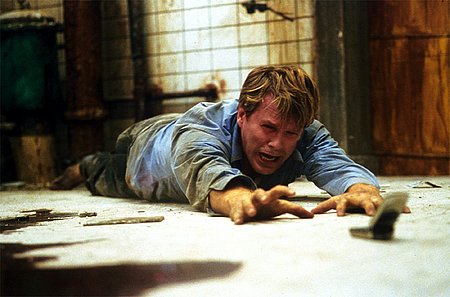
Two men—Adam (Leigh Whannell, who also co-wrote the screenplay with director James Wan) and Lawrence (Cary Elwes)—awaken to find themselves chained by their ankles to pipes in a long-forgotten bathroom. Trapped, with a dead body lying in the middle of the floor, the two try to figure out why this happened and what they should do. They have instructions from their captor, as it’s all part of a game. If they don’t play it by Jigsaw’s rules, one or both of them will die.

Riddles and tools have also been left for Adam and Lawrence, including a gun, a tape recorder, and two hacksaws. What are the hacksaws for? “He doesn’t want us to cut through our chains,” Lawrence declares somberly. “He wants us to cut through our feet.”

The danger grows beyond the bathroom for Lawrence, as he learns his wife (Monica Potter) and daughter have been captured as well. Lawrence’s clear instruction is to kill Adam, or they’ll die. Meanwhile, the killer is being tracked by Detective Tapp (Danny Glover), looking to avenge his late ex-partner Sing (Ken Jeung) who fell victim to the killer. And we also get flashbacks to other bizarre occurrences set up by Jigsaw, including a drug addict (Shawnee Smith) who survived her “game” and claims that it actually helped her to see the finer things in life. And there’s a creep named Zep (Michael Emerson) who works as the hospital, where Lawrence is a surgeon, who may or may not be the killer.

A lot of these elements being thrown at us make “Saw” an overstuffed picture. Actually, I could have done without the subplot involving the detectives and the many twists that continue on. And I hated the rough editing that occurs whenever we flash back to a victim—the frantic fast-motion editing does nothing for me in those scenes. But the real tension comes from the two men in that bathroom and how they’re going to find ways to save themselves. “Saw” does a great job at keeping the suspense alive during these scenes. Also, the scenes of the drug addict getting over her near-death experience are effectively done. This sets the status for this intelligent psychopath who chooses his victims by what they do and how they act, and he puts them into these games as a bizarre act of irony and as a way of possibly surviving by doing horrible things that they could do if they had the willpower.

Really think about it—if you were given the choice to die or cut off your chained foot, what would you choose?

“Saw” is not only psychological; it’s also very gory. Those with weak stomachs should stay away from this film, because there are many disturbing images displayed in “Saw.” Enough to keep an R rating, but others that are a mere inch from an NC-17—in particular, the drug addict is forced to retrieve something from her dead fellow captive’s stomach with a knife, and we actually see the intestines as she pulls them out. Tell me that’s not NC-17 material.

The ending is unforgivable albeit effective. It’s a shocking development that reminded me of what I’ve endured and that the film did indeed work for me. “Saw” is a well-crafted thriller that introduces a new memorable killer to the cinema and terrifies in doing so.

Magic (1978)

11 Mar

Magic-Richard-Attenborough-1978_portrait_w858

Smith’s Verdict: ***1/2

Reviewed by Tanner Smith

“Magic” is an unsettling but well-made thriller with a nice take on the possessed ventriloquist’s dummy story. And it’s always fun to create stories featuring dolls or dummies with some sort of supernatural entity surrounding them, because they themselves are so wholesome-looking when they’re still that they have to have something sinisterly wrong with them.

Anthony Hopkins stars as Corky, a nervous novice magician who has failed in his attempt at professional magic. Knowing he needs a new gimmick, he comes back as a combination magician and ventriloquist with a foul-mouthed dummy named “Fats.” His act is successful, as he gains an agent (Burgess Meredith) who wants to sign him for his own TV show. Afraid of success, he takes off to the mountains, where he meets an old high school crush Peggy Ann Snow (Ann-Margret), stuck in a loveless marriage with Corky’s high school friend Duke (Ed Lauter).

Corky brings Fats with him, and he uses it to amuse Peggy. While Duke is gone, and Corky and Peggy get reacquainted, they develop the relationship that they would’ve had in high school if Corky weren’t so shy. But they also believe that they are soul mates and they wind up making love, leading to the jealousy of…Fats. As it seems, Corky cannot control Fats off-stage, and Fats even talks him into performing murderous deeds to save himself.

The genius of the film is that it’s never fully explained if the dummy “Fats” is alive, let alone evil. While it may seem that Fats may have developed a malevolent personality of its own, it’s never quite clear. Corky and Fats do have unsettling conversations; however, Fats’ lips don’t move unless Corky is controlling him, and yet he still continues to talk. That’s a very clever move and makes “Magic” more of a psychological thriller than a horror film—it presents the implication that maybe Corky is of two minds: the innocence that we see and the psychotic instability that comes from the notion that Corky doesn’t want to go back to the way he was. In that case, it’s really quite fascinating. There’s a lot you could read into this—is the doll alive or just a manifestation of Corky’s id? And how far will it go? Will it go so far that Fats won’t allow Corky to make his own decisions?

The direction by Richard Attenborough and the writing by William Goldman, based upon his own novel, is effective enough to make the story of a possible possessed malevolent doll seem somewhat plausible. There are many eerie, troubling scenes centered around Corky’s unstable mind as he talks with Fats about doing what he wants to do to stay with Peggy, and the way it continues to develop further and further into the horror element is efficiently well-done. Also, the little moments such as Corky teaching Peggy a magic card trick have their own charms.

Anthony Hopkins turns in an excellent performance as Corky, a man who appears to be innocent and balanced, but also disturbed and sad. And of course, I should also credit his work as the voice of Fats, sounding much like a British TV comic (fittingly enough, since he’s made for show business). Hopkins is great in this movie, and so is Ann-Margret, who is fun and charming as the potential love interest. She sparkles throughout the movie.

“Magic” is a terrific thriller with an eerie feel, a strong leading actor, and a suitably creepy doll. I can predict that even those who won’t find this movie scary will still see it as a brilliant character study and psychological case.

Matinee (1993)

11 Mar

matinee_1993_2

Smith’s Verdict: ***1/2

Reviewed by Tanner Smith

Where do I even start with this movie? “Matinee,” directed by Joe Dante and written by Charlie Haas, is a wonderful comedy with so many things going for it, and most of it surprisingly meshes really well with each other. What do we have? We have the Cuban Missile Crisis, young love, nostalgia, a schlocky filmmaker/showman, the premiere of his latest B-movie, several teenagers (including a jealous boyfriend), and even manages to bring in legitimate family drama as well. How are Dante and Haas able to pull all of this off in one terrific movie?

The movie is set in Key West, Florida in the fall of 1962—a time when B-movies represented innocence and imagination (and great silliness). Anything can happen in these movies, mostly thanks to gamma rays and radiation that manages to turn insects into gigantic monstrosities that terrorize cities. But suddenly, all that “nuclear stuff” doesn’t seem too innocent now that America has learned from President Kennedy that Cuba is armed with nuclear missiles, and the U.S. Navy is blockading against an oncoming Russian fleet. This of course gets the people in a panic, especially those in Key West, which is just 90 miles away from Cuba.

Enter exploitation filmmaker Lawrence Woolsey (John Goodman), who specializes in grade-B horror movies and theatrical gimmicks. With the panic going on in Key West, Woolsey sees this as the perfect time and place to premiere his latest schlocky production, a monster movie about a man who mutates into a giant ant—“Mant!”—due to, you guessed it, radiation. For teenage army-brat Gene Loomis (Simon Fenton), whose father is on one of the Navy blockade ships, the film’s premiere date is going to be a great day since he is a monster-movie fan. He sees Woolsey as a hero.

Gene is so much a fan of monster movies that he recognizes a B-movie actor when he sees one—that’s why he’s the only one to recognize one of the people who publicly denounces “Mant” a couple nights before its premiere, an out-of-work actor hired by Woolsey to further publicize the movie. (You see, it turns out that boycotters only make people further want to see the movie—I guess times haven’t changed since 1962.) Gene calls Woolsey up on the con and in exchange for keeping the secret, Woolsey shows Gene around the theater for a behind-the-scenes tour to see what tricks he has in store for his audience on Saturday afternoon.

While this is going on, there are numerous subplots in the real world—one involves Gene as he and his family (his mother and little brother Dennis) cope with the knowledge that the man of the house is now in the danger zone; another involves Gene’s new buddy Stan (Omri Katz) as he asks the “nice girl in the class,” Sherry (Kellie Martin), out on a date for Saturday, only to be threatened by a hoodlum (James Villemaire) who used to date Sherry; and another involves Gene as he befriends Sandra (Lisa Jakub), the daughter of a pair of beatniks who defend the “Mant” premiere. Sandra has her own ways of acting out—particularly, she’s the only one in school who states aloud that the classic “duck-and-cover” protection against the nuclear bomb won’t save anybody. (This even gets one of the kids in the hall to whisper, “That girl’s a Communist!”)

Everything leads to the final half-hour of “Matinee,” in which every plot development comes together. Gene, his little brother, Stan, Sherry, and Sandra end up seeing “Mant” on Saturday afternoon, there’s a large crowd because of the publicity, and Woolsey can use many of the surprises he prepared for this event—there are buzzers in the seats and a new process called “Rumble Rama” that has the theater shaking like it’s in an earthquake. He’s giving his audience a real show, and he’s loving every minute of it. Thankfully, so is a head studio executive who admires Woolsey’s childlike spirit.

And it’s easy for us to care so much for Woolsey throughout the movie. It’s obvious that this guy loves to make his movies, no matter how bad or laughable they might be, and he just wants to put on a show. John Goodman does a fantastic job at playing Lawrence Woolsey with a sense of enthusiasm and demented zaniness. How can you not love the bit in which he notices a stuffed alligator at a busted gas station, and immediately has an epiphany? (“She-Gator, Alli-Gal, GAL-a-Gator!”)

My favorite scene involves Woolsey telling Gene about his theory of “the first monster movie.” The way he puts it, a caveman is chased by a mammoth and barely makes it back to his cave alive. So he wants to tell people about the experience, and he draws a picture of the beast on his wall. But when he realizes people are coming to see it, he knows he has to make it look scarier (“make the teeth longer and the tusks bigger”). “Boom! The first monster movie,” says Woolsey. “That’s probably why I still do it. You make the teeth as big as you want, then you kill it off, everything’s okay, the lights come up…” It’s a wonderful scene that gives an even bigger sense of what this guy’s all about.

By the way, the movie-within-the-movie (“Mant”) is quite a treasure. We see a lot of clips from the movie on the screen (or screen-within-the-screen), and it’s a worthy parody of those actual B-movies of the time. There are silly creature effects, a lot of “scientific” exposition, and inane lines of dialogue, such as when the mant’s worried wife tries to tell the Army general that “Bill” is only a shoe salesman, not a monster—the general replies, “Would you let THAT fit you in a pump?” It’s a joy to watch, when we’re able to.

matinee_3

Also funny is a one-scene parody of ‘60s children’s movies, about a man that turned into a shopping cart and shakes up crooks (who wear ski masks and fall down in comedic fashion, while being covered in paint and having quirky-happy music playing in the background).

Anyway, about the movie’s final act involving the big premiere, I can only reveal that everything that could go wrong does go wrong in ways you couldn’t begin to expect. (I won’t even go into how the jealous hoodlum boyfriend gets into the mix.) There are so many things happening all at once, and it kept my attention throughout. I was laughing and smiling at the creativity of the screenplay; everything set up before has paid off ultimately.

John Goodman does a great job, as I already mentioned. And the other actors do good work as well. The young actors (Simon Fenton, Omri Katz, Kellie Martin, Lisa Jakub) are very likeable and appealing. And Cathy Moriarty, as Woolsey’s girlfriend and leading-lady in his film, is excellent as the bored, deadpan, busty blonde who always complains about how his man is too much of a dreamer to face the reality that their careers are “going nowhere.” (Of course, this doesn’t stop her from dressing up in a nurse’s uniform at the premiere and getting kids to sign “medical consent forms” in case they get too scared.) Also funny is Robert Picardo as the overly-nervous theater manager, who has a radio by his side in case the bombs come falling (he even has a fallout shelter in the theater basement designed just for him).

“Matinee” is chuck-full of surprises and pleasures, and I enjoyed it thoroughly. It’s fun, amusing, imaginative, dramatic when it needs to be (particularly when it comes to Gene’s family), and rather brilliant.

Big (1988)

10 Mar

Tom-in-Big-tom-hanks-9828233-1024-576

Smith’s Verdict: ****

Reviewed by Tanner Smith

If “Back to the Future” brought up the idea that teenagers don’t think their parents were ever young and that their parents never think they’re old, then “Big” brings up the idea that teenagers should embrace their youth and shouldn’t hurry to become old.

“Big” is a wonderful comedy-drama and it comes with a surprising story idea that has been done in so many other movies around the time this movie was released. It’s a body-swap movie—a movie in which one person turns into somebody else, and sometimes it’s vice versa. This string of movies started in October 1987, when “Like Father, Like Son,” a bad reimagining of the OK 1977 Disney comedy “Freaky Friday,” was released. Then, in early 1988, two other movies were released around the same idea—the terrific “Vice Versa” and the bland “18 Again!” One can imagine the pleasantly surprising success of “Big.” With a funny, intelligent screenplay and an excellent performance by Tom Hanks as a young boy’s mind inside an older man’s body, “Big” is a triumph—a most appealing comedy that’s amusing, insightful, and a lot of fun.

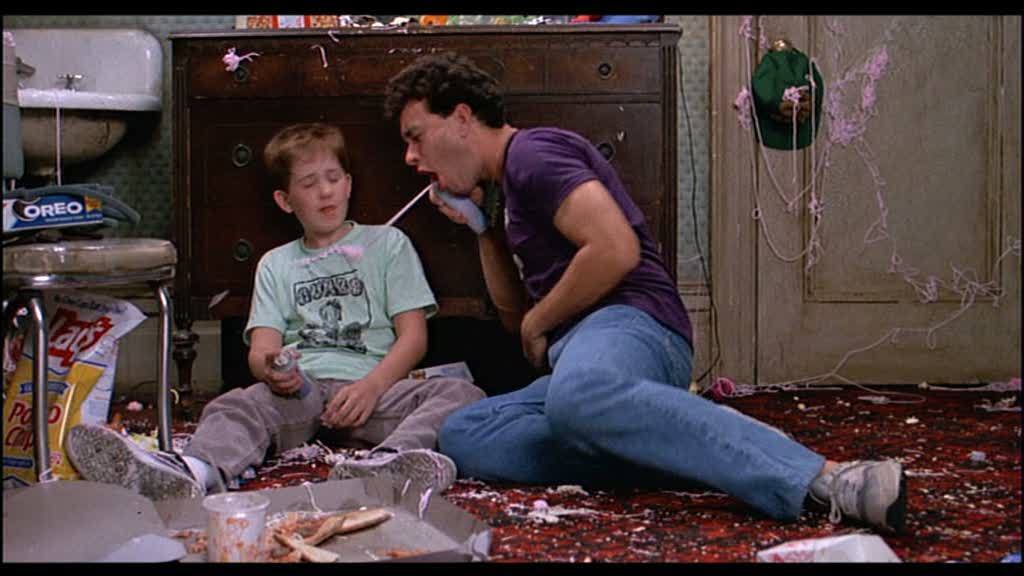
Josh Baskin (David Moscow) is your typical, average 13-year-old boy. He hangs out with his best friend Billy (Jared Rushton), hates doing household chores, and has a crush on the tall popular girl in school, but is too nervous to talk to her. He gets his chance to talk to her while in line for a carnival ride, but he’s embarrassed when he’s told he’s too short to ride the ride. While walking in misery, he comes across an arcade game—a strange fortune-telling machine that isn’t plugged in, but still seems to work, as it asks Josh to make a wish. Josh wishes to be “big” and gets a fortune saying his wish is granted.

The following morning, he’s surprised to realize that his wish has come true. He no longer looks like 13-year-old Josh anymore; he’s 30-year-old Josh (played by Tom Hanks), though he still has his 13-year-old mind. When his own mother doesn’t recognize him, Josh turns his buddy Billy for help. Billy believes that this strange man really is Josh and helps him find the same game to wish himself back to normal.

Josh goes to New York City to find the game anywhere he can, but has to wait six weeks for a list of all carnivals and arcades so he can track it down. This means he’ll have to live in the city, so he has to find a job and he gets one, working as a data processor for McMillan Toys. He meets the boss (Robert Loggia), who likes his energy and enthusiasm around the office, at FAO Schwartz, where he’s pleased to see how much Josh knows about toys and moves him up to Vice President of Product Development. Billy can’t believe Josh’s good fortune—they pay him to play with toys and report on them, to which Billy playfully replies, “Suckers!” I wouldn’t blame him; it’s a kid’s dream come true.

As Josh continues with his job, he meets a co-worker named Susan (Elizabeth Perkins), the floozy who, as hinted, has slept with almost everyone at the company. She plans to do the same with Josh, but is genuinely attracted to his child-like innocence as he invites her over to his new apartment, that has what every kid would want in his own place, which include a free-Pepsi machine (by that, I mean the machine is rigged), a pinball machine, and a giant trampoline. Josh falls for Susan and Susan is surprised to feel the same way towards him.

That human-interest story is surprisingly well-handled. They lead to sweet, lighthearted moments in which we feel for the characters and realize what exactly was missing from the other body-swap movies released around this time. Credit for that must go to the writers Gary Ross and Anne Spielberg (Steven Spielberg’s sister) for taking their time to develop the characters as well as the situations. There are a lot of great scenes in the movie that either lead to laughs or smiles. Examples—the scene in which Josh gives an idea for a toy in a board meeting; Josh’s response to Susan first saying she wants to spend the night with him (“OK…but I get to be on top!”); Josh and Susan jumping on that trampoline in Josh’s apartment, and more. There are also moments of convincing drama, such as Josh’s first night in the city and Josh calling his mother to hear her voice because he misses her.

Also, the movie has no real villains. I mean, sure, there’s a co-worker—Susan’s ex-boyfriend named Paul, played by John Heard—who wants to humiliate Josh for getting all the attention. But it isn’t pushed further; he’s just an office jerk. And that’s actually kind of refreshing. “Big” doesn’t need a villain. The only conflict that should be focused upon is developed in the final act. The final act is when Josh is too much in tune with his new body, new job, and new girlfriend, and then Billy comes along to remind him of who he really is and why he came to the city in the first place. This brings the question of whether or not Josh will make the decision to wish himself to be young again or stay the way he is, losing his teenage/young adult years.

Before “Big” was released, most people have labeled Tom Hanks as just OK in the early 1980s. Many critics thought he was bland in comedies like “Splash” and “The Man in One Red Shoe” (and I’d be lying if I said I didn’t see what they meant). But in “Big,” he gives a star-making performance. Tom Hanks is brilliant as a young boy trapped in an older man’s body. He behaves like a kid, talks like a kid, and has the innocence of a kid. Therefore, the audience is convinced that they’re watching a “big” kid. The way Hanks acted in this performance was very clever—the director Penny Marshall rehearsed many of Hanks’ scenes with the young actor David Moscow’s scenes, so that Hanks could observe how Moscow would act in those scenes and copy him. The result is Tom Hanks’ excellent performance.

The supporting cast members do nice jobs. In particular, Elizabeth Perkins is convincing as Susan, Jared Rushton is appealing as Billy, and Robert Loggia, with a twinkle in his eye, is wonderful as the boss who admires this strange man’s energy. In the best-looking scene in the movie, Josh and his boss play/dance to “Heart and Soul” together on a giant carpet piano in the middle of the toy store, as everyone watches. It’s a wonderful scene—good-looking, funny, and played wonderfully, while Hanks and Loggia perform without stunt doubles.

“Big” is a treasure of a movie—pleasant, enjoyable, funny, well-written and well-acted.