Archive | Two stars ** RSS feed for this section

Hoot (2006)

8 Mar

hoot

Smith’s Verdict: **

Reviewed by Tanner Smith

“Hoot” is the film adaptation of the Newbery Award winning novel of the same name, written by Carl Hiaasen, and it’s surprisingly faithful to its source material in terms of story and character. You would think that the movie would be just as good as the book in that sense, but I have two problems with that sense. For one thing, there’s just such a mediocrity to the execution of the movie that doesn’t make it seem very special. Also, and I know I might get a lot of flack for typing this, I don’t personally think that the novel itself is special to begin with. I’ll get to analyzing those problems the best I can later in this review, but let me explain the plot first.

A young man named Roy Eberhardt (Logan Lerman) and his family have moved again, this time from Montana to Florida. He already has problems with a husky bully, who has enjoyment in pressing the kid’s face against the school-bus window, but he finds interest in two kids his age. One is a soccer jock named Beatrice (Brie Larson), who is dubbed “Bear,” and a barefoot runaway nicknamed “Mullet Fingers” (Cody Linley) who is also Beatrice’s stepbrother and is constantly vandalizing a construction site, where a pancake-house corporation wants to build their newest restaurant in this small town. Roy decides to help him, along with Beatrice, because the construction site is filled with endangered burrowing owls and it’s up to the kids to save them.

I’m not quite sure where to begin. I mean, the premise is nice and the friendships between Roy and Beatrice and with Roy and Mullet Fingers are developed in an interesting way, both in the novel and film. But there are many quibbles I have with this story. First of all, the construction site is in the middle of the forest—why would anyone want to build a pancake house there? And who would want to go to a pancake house in that particular location?

Also, this family film is promoting a somewhat-environmental message. There’s nothing wrong with wanting to teach a lesson to kids if it’s done right, but the kids in this movie aren’t exactly the right role models for saving the environment. They commit felonies in order to save the day. They steal, vandalize (for example, they spray-paint a police car’s windows black), and even terrorize (with cottonmouth snakes and alligators that Mullet Fingers is able to handle—by the way, Mullet Fingers has been living on his own in the woods long enough, so how far does his animal-handling skills go?). On top of that, they’re not entirely convincing. I seem to be circling back to that Mullet Fingers kid—by the way, he’s called that because he can catch a mullet (a type of fish) with his bare hands. I would like to know exactly how Mullet Fingers survives on his own for what is said to be so long. And if he doesn’t want to be seen, then why does he constantly run on a public sidewalk where plenty of people are able to see him?

Oh yeah, and why is Roy the only one on the school bus who notices Mullet Fingers running by it? Is it because that ridiculous bully isn’t holding anyone else’s face against the window?

Here’s another problem with the story—there are too many side characters for unnecessary subplots. That beefy bully I mentioned is particularly boring and—get this—is afraid of one thing that fortunately Roy (or “Cowgirl” or “Tex” or “Eberhardt” as he’s constantly called every now and again) has on his side: Beatrice. Huh—or maybe he just doesn’t want to hit girls. (Yeah, that sounds about right.) But Roy breaks the bully’s nose after being held in a headlock, only to create an unnecessary subplot that distracts from Roy fitting into his new town and helping his new friends save the owls. Another side character, played by Luke Wilson whom gets top billing in this movie, is police officer David Delinko, a young and loyal cop who is called upon the site to investigate the vandalism reported by the foreman named “Curly” (Tim Blake Nelson). His main role is to be gullible and humiliated while Roy hides his secrets from him, even after he makes friends with him. He’s also the one whose patrol car is spray-painted black by Mullet Fingers while on a stakeout. Why not make this character smarter, or maybe a little funnier to make him more interesting? And then, we have the villain who is just a comic caricature. Chuck Muckle (Clark Gregg), the vice president of the pancake house corporation, knows there are owls and doesn’t care for any of Mullet Fingers’ antics to bulldoze the site. He’s over-the-top here. And of course, we have the dumb parents who know less than their children and their supposed heart-to-heart talks with Roy are pathetic.

What I’m basically getting at is “Hoot” is overstuffed. And Wil Shriner who thinks of this as a feature-length after-school special also executes it poorly with what-probably-isn’t-but-just-seems-like-it lazy direction. And the constant use of bland songs by Jimmy Buffett doesn’t help much either. And the climax has to be one of the most overly cutesy scenes in a recent family film. But to be fair, I believe “Hoot” is harmless enough for younger kids. The kids are actually kind of likeable and the owls are cute enough to be worth fighting for. But if you want a better family film that delivers subtle and more entertaining ways to bring messages across, this isn’t it.

Friday the 13th: The Final Chapter (1984)

6 Mar

friday-the-13th-the-final-chapter-2

Smith’s Verdict: **

Reviewed by Tanner Smith

“Friday the 13th: The Final Chapter” couldn’t have been a good movie. It suffers from being the fourth movie in a deplorable slasher-film franchise that only had teenagers getting picked off one by one by a killer with no personality. This is just like any other horrible movie with that same premise and somehow, four of these films share the same name and the same killer. I never understood what made the original “Friday the 13th” so special that it needed a series of sequels to go along after it. And it gets worse—this is not the final chapter. The ending is an open door for another sequel.

The killer Jason, who sports a hockey goalie mask now, is just a big guy with no personality and apparently no inner being—oh, and he has a knife, too. Actually, the thought of a killer with no inner thoughts is kind of scary, but after two films, it’s tiresome and not scary anymore. Just like in the previous films, it’s easy to know who’s going to die in “Friday the 13th: The Final Chapter.” This is a rule for slasher movies such as this—whenever a movie lingers on someone who isn’t a main character, that person is going to be killed. What’s tedious about the gimmick is how it lingers on that character before the killer finally attacks.

The slasher scenes are there just to be slasher scenes. The most unpleasant murder occurs after the teenagers in this movie pass by a female hitchhiker. The scene stays with that female hitchhiker right to Jason’s arrival and victimizing of that poor woman. Why was this necessary? Who was this woman? We’ll never know.

“Friday the 13th: The Final Chapter” does try to develop characters this time. We have the usual gang of teenagers that will undoubtedly become stalked by Jason, for no reason whatsoever. Only this time, they’re angst-ridden and that at least counts for something, which is more than I can say for a lot of the teenagers in the previous “Friday the 13th” films. But the real protagonist is more interesting—he’s a twelve-year-old horror film buff named Tommy Jarvis (Corey Feldman), who lives with his mother and older sister (Kimberly Beck—no bets on whether or not she’ll be the obligatory “final girl” who ends up fighting Jason) near that stupid Crystal Lake, where all those murders occurred in the previous films. Having a twelve-year-old kid around is strange enough for a slasher film.

(By the way, don’t you think the Jarvis family would have heard about them? Why didn’t they just move away?)

I suppose I should give away the ending of “Friday the 13th: The Final Chapter.” What should it matter, anyway? This isn’t really the “final chapter,” after all. Jason has picked off all of the teenagers who just came in for a good time at the lake and has now come after Tommy and his sister. After the sister has tried to fight him off, little Tommy, who grabs a machete and slices the originally invincible killer apart, rescues her. That’s right—the little kid has done what all the older teenagers should have done in the other movies. He kills Jason…but he’ll come back. You’ll see.

Stephen King’s It (1990) (TV)

27 Feb

Send_in_the_Creepy_Clowns_Just_in_time_for_Halloween_a_gallery_of_13_scary_clowns

Smith’s Verdict: ** (Part 1: *** – Part 2: *1/2)

Reviewed by Tanner Smith

I make it almost a rule not to review made-for-TV movies, let alone TV miniseries’. But the three-hour TV miniseries “It,” adapted from Stephen King’s best-selling 1986 novel, has become so popular (for good and bad reasons that I shouldn’t go into) that I decided to give it a shot. It’s hard to review a movie like this, especially when it is split into two parts and one part is far more interesting than the other. But here’s my shot at it.

In part one of the miniseries, events are being set to take place in apparently part two. “It” begins with Mike Hanlon (a quite effective Tim Reid), the librarian of a small town in Maine called Derry (notice that a lot of Stephen King’s stories take place in Maine), who is at the crime scene of the murder of a little girl. Apparently, this is not the first child murder or disappearance. Mike knows that something is terribly wrong and comes to a conclusion. What is it? We have to wait and see.

Mike spends Part 1 of the story calling his childhood friends, telling them to come back to Derry and explaining “It’s back.” They know what he means. With each friend Mike calls, we experience different flashbacks that seem to be in chronological order. The flashbacks tell the story of the “Lucky Seven”—seven young outcasts who become best friends and stick by each other. There’s Bill (Jonathan Brandis); Ben (Brandon Crane); Eddie (Adam Faraizl); Richie (Seth Green); Stan (Ben Heller); Beverly (Emily Perkins); and Mike (Marlon Taylor), who is the last to join the club after the other kids save him from a sadistic bully named Henry Bowers (Jarred Blancard). All seven of these kids keep to themselves in the barren areas of town, building a dam. These scenes are intersected with scenes in the future as each friend (grown up to become successful individually—for example, Bill is a best-selling author) remembers their experience with the “it” that Mike refers to when he calls.

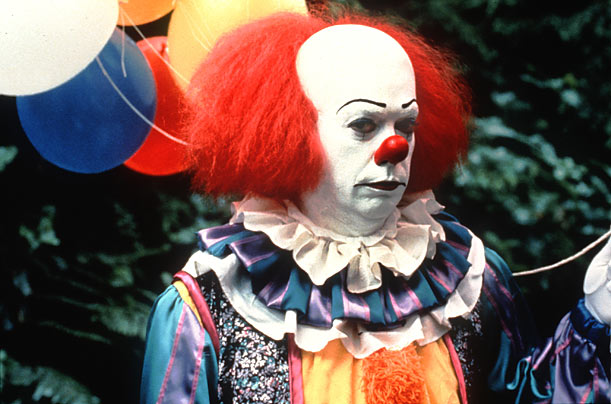
Who or what is “it?” Well, It is a clown named Pennywise (played by Tim Curry)…or is it? You see, Pennywise kills kids after either using his image to fool them or taking the shapes of their fears. Pennywise is some kind of creature that reads minds and becomes your fears before it eats you. And only children can see it, and not adults. Why? (“You grow up,” young Bill says. “You stop believing.”) Each of the seven kids is silent about their own experiences with “it,” which scares them like a cat-and-mouse game, until it finally frightens them all at once. They realize that they have to stop it, so they venture into the sewer tunnels to kill it.

This first part of the “It” miniseries is very interesting in the way it draws you into the story. The kids are all very good actors, especially Brandon Crane who avoids the “fat kid” stereotype as the overweight, sensitive Ben. And their characters are interesting as well. Also, Tim Curry, as the clown, plays it so over-the-top that it’s almost funny when being frightening at the same time. It’s unnerving just to think about a clown coming after these kids. Tim Curry is great as Pennywise. And also, the scenes in the tunnel in which the kids are finally faced with Pennywise is interesting because it’s fun to see them come together and confront their fears. Is it a great climax? Well, no. But this is more about feeling than about gimmick.

This brings us to Part 2, in which all of the adult versions of the Lucky Seven reunite in Derry Maine—Bill is played by Richard Thomas, Ben is John Ritter, Eddie is Dennis Christopher, Richie is Harry Anderson, Stan is Richard Masur, and Beverly is Annette O’Toole. They have forgotten most of their experiences with Pennywise and became successful, but when Mike calls them back saying it’s come back, they have new experiences that make them remember. This is fine, but we also get a series of ludicrous back stories that really slow the movie down. These back stories take a long time to be explained and the viewer is left shaking his or her head. And then when it tries again for horror (like when Pennywise comes back every now and then), it’s just dull instead of frightening. Also, the characters that were compelling as children have become dullards this time around. It doesn’t help that half of these adult actors are badly miscast. And then when the apparent final climax arrives, it’s just silly, silly, silly. It also has one of the worst creature effects in the history of TV movies.

You’d think that with a strong first half, you’d have a second half to be just as strong, especially when the running time is 192 minutes. But “It” doesn’t succeed. The first half (with maybe only the flashbacks) could have made a whole movie and I would’ve recommended it as a whole—I liked the kids, Tim Curry was fun, and there were a couple scenes that scared me, believe it or not (like the scene in which young Bill mourns the death of his kid brother and something creepy happens). But the second half is bogged down to horror clichés, dull plotlines, horrible special effects, and melodrama. Not even the presence of reliable actors Tim Reid and John Ritter could help.

So in conclusion, “It” is a mixed bag—strong first half, insipid second half. I have not read the novel so I can’t quite make comparisons to that. But there are a lot of Stephen King book-to-film adaptations that hardly capture the flavor of King’s stories (examples are “Cujo” and “Children of the Corn”). This is one of those adaptations, although I guess I should be kind enough to say that this is in the same league as “Cujo” and better than “Children of the Corn.” Oh, and don’t get me started on “Pet Sematary.” That’s a review all its own.

A Good Day to Die Hard (2013)

15 Feb

A-Good-Day-To-Die-Hard-Trailer-2013

Smith’s Verdict: **

Reviewed by Tanner Smith

1988’s “Die Hard” is considered one of the very best action films ever made, and their sequels have their shares of thrills as well. Though, it’s hardly a secret that the first film’s exhilaration has since diminished with each sequel…and unfortunately, its fifth installment, “A Good Day to Die Hard,” is enough evidence to show that the franchise is dying…hard.

“A Good Day to Die Hard” doesn’t even seem or feel like a “Die Hard” movie. It just seems all too generic—here’s a conflict no one should care about; here’s a few generic bad guys who love to shoot everything up; and here’s a load of explosions, and lots of ‘em! Add the wisecracking hero and an annoying sidekick, and…really? This is “Die Hard?” The other movies had more going for them than this—characterization, proper setups-and-payoffs, and memorable villains. Those elements are what made “Die Hard” and some of its following sequels fun to watch—they added to the excitement of the action sequences so we cared about what was happening on-screen.

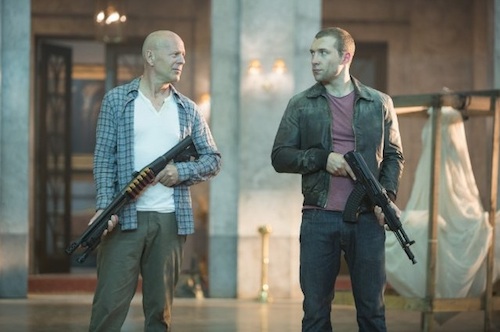
But at least we have Bruce Willis, again playing the hero cop Det. John McClane and again finding himself in one unusual predicament after another. And to be fair, he’s the best thing in this movie. Sure, he’s noticeably aged, but his wisecracking personality is still welcome. (He even says his “yippie-ki-yay” line, which I’m sure people missed in the previous “Die Hard” film.) However, there’s one question regarding his character—why is he suddenly so freaking invincible?! Remember when in the first movie, his feet were torn to shreds after having to escape barefoot on shards of broken glass? Now, whenever he crashes through plate-glass windows or survives car crashes, he only has a few scratches instead of ten or fifteen broken bones! Did John McClane just turn into the Terminator, as he got older?

But I digress. The action takes place in Moscow, Russia. John’s son Jack (Jai Courtney), a CIA agent, has been arrested for murder and is awaiting trial. John and Jack haven’t spoken to each other in years, but John wants to travel to Russia to…actually, I just realized I have no idea what his original plan was. Was he going to try and negotiate with the authorities? What can he say? He’s obviously out of his jurisdiction, to say the least. On top of that, he can barely speak a word of Russian. So what was he going to do originally? Plan a jailbreak? He’s clearly working alone!

I don’t know; and frankly, I don’t care. But it doesn’t matter anyway because as John gets to the courthouse, all hell breaks loose and Jack manages to escape Russian justice. Along with him is a political dissident, Komarov (Sebastian Koch), who has some sort of…”McGuffin,” I guess, that a band of terrorists are trying to get their hands on. John ends up in the mix, and thus we get to add awkward father/son bonding to standard, generic, shoot-em-up, action-movie elements. Oh. How. Exciting.

While the “Die Hard” movies have had some pretty effective villains (the one that particularly comes to mind is Alan Rickman’s Hans Gruber from the first movie), there is no real villain in this movie, strangely. There are just certain villainous characters who seem to one-up each other for complicated reasons, along with several henchmen. When the top villain is finally unmasked, however, it comes as no surprise (you’ll figure it out early on). Motivations are clumsily written, and so it’s hard to follow everything that’s being thrown at us. The action, as a result, comes across as (broken record) generic.

Bruce Willis is Bruce Willis, and he’s still likeable as always. But as his sidekick in the action, Jai Courtney is just a crushing bore. He’s whiny, annoying, and ultimately bland. Oh, and here’s the worst thing about him. He’s the central figure of this “Die Hard” movie—not John; he’s merely there for support. Yeah, because I’m sure we want to see this guy backed up by the iconic Bruce Willis character!

“A Good Day to Die Hard” at least has a few good-looking action sequences, and director John Moore is evidently a capable action director. But the main thing missing from this action film is the energy and creativity that the original film had. It just feels like a throwaway action flick that is subjected to our minds and then leaves very little impact. Maybe it’s time for this “Die Hard” franchise to…”die hard.”

The Good Son (1993)

12 Feb

images

Smith’s Verdict: **

Reviewed by Tanner Smith

“The Good Son” is a thriller that features a good nephew, but not a good son. But as the parents see it, it’s the nephew that concerns them more than the son, whose deeds are surprisingly unnoticed by them. Of course, he seems like the sweet innocent kid that the parents would like to think they’ve raised him to be. But instead, the boy—named Henry—is a diabolical little demon that makes his cousin Mark’s life a living hell while also causing great harm to family members, innocent bystanders, and a dog.

As if poor Mark didn’t have enough to go through already. He’s already lost his mother after making a promise that he wouldn’t let her die. His father leaves him in his time of need at his brother’s house on an island in Maine for a couple of weeks so that on his business trip, he’ll have enough money for them both to be set for life. Mark gets along well with his aunt and uncle, and their two children—one of whom, of course, is the little demon spawn named Henry. Henry and Mark become good friends and hang out around the island. But later on, Mark has his suspicions of Henry’s true nature as Henry kills a dog with an invention he made that shoots nails and screws. He becomes even more convinced that the kid is sick when he throws a man-size dummy on a highway, causing multiple cars to crash into each other.

Henry’s sole explanation as to why he’s this way is revealed only to Mark, as he tells Mark that he was as scared as he was before he found ways to get away with doing certain things. But those “certain things” wind up harming innocent people. Wouldn’t it be more interesting if the screenplay had been written so that another part of Henry’s influence was watching violent action movies? Wouldn’t it make a more effective, chilling message if movie violence were the cause of the development for a child’s sociopathic mind?

But no—Henry is just plain evil at a shockingly young age, and I suppose that’s enough reason for us as a movie audience to be frightened by him. Henry is played by Macaulay Culkin, the sweet, charming kid from the family hit movie “Home Alone.” He’s playing against type in “The Good Son,” but sometimes it works, and other times it doesn’t. In the first half of the movie, he does very well at keeping the balance between guilt and innocence. He just seems like the kid whom everyone his age would like to be friends with, but he still gives hints about his true nature that would fool them. The development that leads Mark to really see his true nature is handled effectively as well. Mark befriends Henry, they hang out together, Mark is suspicious of him after a while, and then he sees something that really convinces him that Henry is not a “good son.” But the problem is that Culkin isn’t convincing when playing sinister. He speaks in a monotone voice and with a deep, twisted philosophy that a James Bond villain would have—only to Mark, of course. Where did he learn to talk like this? His parents are good-natured, he doesn’t watch TV, and he’s already stated that he doesn’t read comic books. This can’t be natural, but to be fair, I think this has more to do with the writing rather than Culkin himself.

Culkin does seem like an innocent child whom you wouldn’t suspect of any wrongdoing, so that gives him an edge. And when Mark tries to tell people about the boy’s psychotic antics, no one believes them. They don’t want to—they want to believe that Henry is the good little boy that he only pretends to be. And soon, it is Mark they all come to fear. But here’s the main problem with “The Good Son”—with his sophisticated speech that I’ve already mentioned, Henry doesn’t seem much like a kid. No kid talks the way he does. And it’s hard to believe that later in the movie, the parents and even a child psychologist can’t tell that this little robot is lying.

The script has many problems like that. One in particular is with that scene in which Henry and Mark watch the cars pile up after the dummy falls onto the street. We see a brief news report about the incident, but the dummy is never mentioned. Neither are the two kids who were in plain sight on the bridge above. There’s another moment in the middle of the movie that is inexcusable. It’s when Henry takes his little sister (played by Culkin’s real-life sister Quinn) to go ice-skating on a frozen pond and then pushes her onto some thin ice, which she falls through. Get this—she falls through the thin ice and yet her rescuers walk on it fine…and use an axe to break through it and save the girl! What conveniently thin ice.

Elijah Wood, as Mark, gives the film’s best performance. He’s the kind of kid that Henry’s parents see Henry as, and Wood has a natural screen presence that doesn’t bore us or make us want him to go away. It’s so hard not to feel sorry for Mark in this truly messed-up situation.

The ending is the more suspenseful piece of filmmaking to be found here. It involves the two boys and Henry’s mother (Wendy Crewson) on top of a cliff. Without giving too much away, it leads to a masterful climax. But then immediately following it is the film’s final line, which is completely unnecessary and kind of sick, the way it asks about the mother’s choices. To sum up “The Good Son” is like this—Elijah Wood’s performance is effective, the setup is good, the photography is lovely (the way it captures the island as if it were a painting), and the climax is suspenseful; but the writing is devoid of substance and reality. And the question that it all comes down to is, “Do we really want to see Macaulay Culkin in an R-rated movie about a young killer?”

Star Trek: The Motion Picture (1979)

11 Feb

star-trek-the-motion-picture

Smith’s Verdict: **

Reviewed by Tanner Smith

“Star Trek,” the TV series created by Gene Roddenberry, is a delight. It’s a great mixture of neat science fiction, creative ideas, and memorable characters. No one would ever link it to something like “Star Wars,” which is about nonstop sci-fi action and thrills. With “Star Trek,” the characters and story always came first. It’s not about tense action and stunning visuals. And what “Star Trek” is certainly not is an out-of-body experience, like Stanley Kubrick’s great sci-fi epic “2001: A Space Odyssey.”

Unfortunately, when world-renowned director Robert Wise decided to direct a first film adaptation of the series, he thought to bring to appeal to the “2001” or “Star Wars” crowd, since elements of each film are noticeable. When you put them both together, it kind of distracts from the notion that you’re watching a “Star Trek” movie, and the first one, at that. Even though it has its moments that feel like a “Star Trek” union, the film has a lot of moments that make the film as a whole into a grand space opera. At times, it’s thought-provoking and visually impressive, but mostly, it’s a bore. It has a slow pace and doesn’t even try to give us a rousing adventure, let alone that “Star Trek” lighthearted character interaction that was the best part of the show.

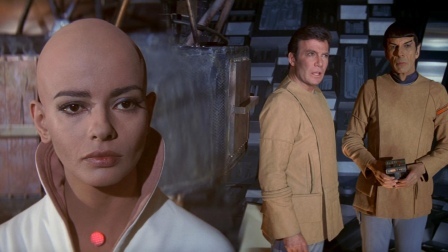
Instead, we have long (and I mean LONG) sequences in which we’re supposed to marvel at something. They are long, slow, and undoubtedly supposed to create for us a visual marvel and an out-of-body experience. The tone of this film is all wrong. Those memorable characters, including Admiral Kirk, Mr. Spock, Dr. McCoy, and such, are trapped in a “2001” wannabe, and are not at home here.

I can’t fault the technical aspects of “Star Trek: The Motion Picture”—the visuals are outstanding, the special effects are top-notch, and the Jerry Goldsmith music score that pulses throughout this movie has a haunting feel. And in keeping in spirit with “Star Trek,” there are some clever ideas here. In particular, the central conflict—a space anomaly known as V’ger—is pretty interesting as it makes its way with destruction, and Kirk and crew have to find it and face it. Actually, once we get to the reality of V’ger, the movie finally starts to feel like a “Star Trek” story some of the time. The origin of V’ger produces some food for thought.

But when you have to stare at the visuals and listen to that music score for minutes at a time, you care less and wonder why anyone thought to create “Star Trek: The Motion Picture” with this sort of treatment. The result is a sometimes-intriguing but mostly-sleep-inducing mess that results in an out-of-body experience into dreamland. Those expecting a “2001” kind of movie is obviously not a “Star Trek” fan; those expecting a “Star Wars” type of movie is going to be disappointed; and those expecting a “Star Trek” movie will be disheartened.

Jack (1996)

11 Feb

427

Smith’s Verdict: **
Reviewed by Tanner Smith

“Jack” is a movie about a little boy trapped in an older man’s body. However, it’s not through a magical occurrence, like in “Big,” but through a rare medical condition that causes a kid’s cells to accelerate four times the normal rate. At age 10, he looks like a full-grown 40-year-old man. That’s the setup for “Jack” and it’s a nice one that could have resulted in an engaging drama. But as it is, it’s one of the clumsiest lost opportunities I’ve seen. While there are a few cute moments in the movie, there are many moments that are unnecessary, others that are uncomfortable, and worst of all, moments that are uncomfortably unnecessary.

Robin Williams is admittedly an ideal casting choice for the title role of Jack, the little boy in a grown man’s body. I guess that’s because Williams, a comic known for his goofy antics, never seems to have grown up. He’s like a live-action cartoon that only takes time to relax when held in check. It’d make sense that he portray the role in this movie.

The movie begins with Jack’s birth. He’s fully-developed after a two-month pregnancy and it turns out that he has an unusual internal clock. He will age four times as fast as a normal person. Ten years later, Jack has been mostly kept in the house by his loving parents (Diane Lane and Brian Kerwin) as other kids his age stare at his bedroom window, thinking he’s a “freak.” His home-school teacher Mr. Woodruff (Bill Cosby) thinks it’s time for Jack to go to public school, but Mom is scared that Jack will never fit in with the other kids, since he’ll be the only one in the fifth grade that shaves.

They of course decide to give Jack a chance to see how well he adjusts to school. At first, he’s picked on by the other students and has a miserable first day. But the next day, the other kids discover that he’s a good basketball center and can also help them out with other favors, like picking up a “Penthouse” magazine without any sort of ID. “I just don’t shave for a day so I look like I’m 50,” Jack explains. He has a new best friend in a kid named Louie (Adam Zolotin), who invites him join in with his treehouse club.

The low point of the movie is a subplot involving Louie’s trampy mother, played by Fran Drescher. Jack meets her while posing as the school principal as a favor to Louie. In that scene, it’s uncomfortable with the misunderstandings, as Drescher’s character doesn’t know that Williams’ character isn’t a grown man and is yet flirting with him. Robin Williams doesn’t really play the scene as a 10-year-old would, it seems more like lines from failed versions of his standup. And Fran Drescher is as irritating as you imagine she’d be outside of TV. That’s not the end of her character, however. There’s an entire sequence that lasts about twenty minutes that features him meeting up with her in a bar where she works as a waitress. There’s more uneasy flirtation going on, more misunderstandings, and of course, a bar fight. This sequence doesn’t have anything to do with the rest of the movie. Take it (and Fran Drescher) out of the movie, and you wouldn’t miss a thing.

There’s also a great deal of awkwardness in a scene in which Jack attempts to ask his pretty fifth grade teacher Mrs. Marquez (Jennifer Lopez) to the school dance. How am I supposed to feel during that scene? Am I supposed to laugh, because Jack looks like a grown man when we know he isn’t and he’s asking out his cute school teacher? Is this a dramatic moment? I wasn’t sure of it.

I think the movie might have been more effective if it focused on Jack’s mortality. There are moments when you think they’re going to dig deeper into it (there’s a deep moment in which Jack is asked what he wants to be when he grows up—“Alive”), but there’s never a big dramatic payoff.  When the movie was over, I didn’t feel anything or learn anything. I mainly saw pointless moments and forced comedy with obvious payoffs. It’s like they thought why look more into Jack’s internal clock when there’s a bar fight to commence? Or why go further into the kids’ introduction to “Penthouse” when their treehouse can collapse? And of course, we have Robin Williams in a classroom asked to take a seat in a small wooden desk—let’s break it! Then let’s do it again! See, while they’re thinking that, I’m thinking, “Really? This was directed by the great Francis Ford Coppola?”

Francis Ford Coppola, I imagine, wants to try something new with his films, like every filmmaker should. So, one shouldn’t be necessarily surprised to see his name attached to a director’s credit in “Jack.” However, it’s necessary to surprised to see his name because of how inept the movie is. It has some cute moments (such as when Jack is sharing his Gummi Bears with his teacher, or Jack is hanging out with his friends, and a rare few others) as well as moments of appropriate drama (like that “Alive” moment I mentioned, as well as Mr. Woodruff’s speech about why Jack is so special), but as a whole, “Jack” isn’t what we expect from a great director like Coppola, and doesn’t even come close.

Cujo (1983)

4 Feb

images

Smith’s Verdict: **

Reviewed by Tanner Smith

Reportedly, Stephen King was drinking rather heavily when he wrote his novel “Cujo,” about a rabid killer dog, and apparently has no recollection of writing it. I don’t know what mood he was in when he wrote the novel, but he must’ve had it pretty bad, for him to drink so much. What other excuse would there be for Stephen King to create such an uncomfortable story? I realize the point of horror stories is to unnerve and scare, but “Cujo” goes too far by basically taking a friendly, gentle dog and turning it into a vicious killing machine. Being a dog lover myself, I speak only from a personal standpoint. And that’s pretty much how this review of the film adaptation of the same name is going to be. If you think you’re going to be annoyed by my objections, I suggest you stop reading.

I can’t necessarily knock the novel, as I haven’t read it. But I can knock the movie instead. The idea for this story is one of the cruelest for a horror story, possibly worse than a story about a psychotic killer child. It begins in a cruel way, as the lovable 200-pound St. Bernard named Cujo (what kind of name is that, anyway?) playfully chases a rabbit across a field behind his owner’s house, at the end of a dead-end road. Next thing he knows, he gets his head stuck in a small cave full of bats and actually getting himself bitten by one of them.

Cujo isn’t feeling very well and hasn’t gotten his rabies shots. As days go by, he seems to get worse and worse. And here’s one of the problems with logic in the movie—neither Cujo’s young owner nor his parents seem to notice the nasty bat bite on the poor dog’s nose. If they did, Cujo wouldn’t get rabies and we wouldn’t have a story. And surely enough, Cujo becomes rabid and vicious. He kills the man of the house, mechanic Joe Camber (Ed Lauter), and a friend (Mills Watson). This leads us to the second half of “Cujo,” in which Donna Trenton (Dee Wallace, giving the best performance in the movie) and her five-year-old son Tad (Danny Pintauro) drive out to the house, in the middle of nowhere, in a faulty Ford Pinto. Surely enough, they are trapped in the car by the newly-formed beast, because the car’s alternator dies.

This is actually the part of the movie that is admittedly suspenseful. I consider myself a sucker for movies that feature characters limited to one spot—the claustrophobia and vulnerability aspects make for effective terror. Donna and Tad are trapped for days, knowing that Cujo will somehow make his way into the car to get them. The owner is dead, the others have left, the mailman isn’t coming around anytime soon (because mail is supposed to be on hold for a while), and no one knows where they are…except Cujo. This is a convincing setup and has some tense, frightening moments. It’s just too bad we had to see this formerly cute dog transformed into a monster in order for it to come about.

What does “Cujo” really amount to? Is it telling us to make sure that our dogs have all of their shots? Well, that’s effective enough, but you’d think that that would have happened already. Basically, “Cujo” requires its characters to be idiots for all of this to happen in the first place, and even the protagonists aren’t all that bright, as Donna just continues to stand around while trying to escape, even after given enough time to see if the coast is clear.

As hard as it is to admit, the dog isn’t consistently convincing. Sometimes it’s vicious enough, but other times it just looks like a dog playing around with snarling-dog sound effects. It doesn’t matter how bad they make the dog look after it transforms into the killer dog, drenching him with blood and foam (speaking of which, I felt sorry for the dog having to go through all of that). Whatever Stephen King was thinking when he wrote “Cujo” and inspired this movie, I can only say that this deserves to be put down.