Archive | Two stars ** RSS feed for this section

Superman Returns (2006)

4 Apr

superman_returns_2006_3

Smith’s Verdict: **

Reviewed by Tanner Smith

Oh, I so wanted to like “Superman Returns.” This is the fifth entry in the “Superman” series and the return to the big screen for the American superhero since 1987’s awful “Superman IV: The Quest for Peace” and it’s unfortunate to be as disappointing as 1983’s lackluster “Superman III.” The special effects are there and some of the actors are game, but with little story material unnaturally stretched out, it only makes “Superman Returns” encourage apathy.

Superman’s been gone for quite a while, off to find other survivors from the demised planet Krypton, where he came from. Clark Kent’s been gone as well, since well…Clark Kent is Superman. It’s kind of odd that no one working for the Daily Planet realizes that when Clark comes back to work, Superman is back in action. Shouldn’t somebody make some kind of connection? To be fair, that’s not exactly a criticism to be had, since you can’t ask questions like that in a superhero movie. (Otherwise, Bruce Wayne’s cover as Batman would be blown instantly.)

Anyway, Clark Kent returns to Metropolis and finds that things have changed. But I had trouble figuring out if the reasons that things are so different in Metropolis is because Superman’s been gone for a long time, or because the writers didn’t think things were different from the other movies. The Daily Planet is now crowded with corporate sellouts, the shutterbug Jimmy Olsen isn’t as chip as he used to be and is somewhat dumber, and Lois Lane—the spunky reporter/sometimes girlfriend of Superman in the past—is without energy. But to be fair, I think that last one is because Lois isn’t enjoying herself with her fiancé Richard White, who is dull and definitely without energy.

Once Clark Kent returns, as does Superman, beginning with the rescue of Lois and several other passengers of an airplane about to crash. That sequence is actually well-crafted—it’s thrilling, fun, and keeps you on the edge of your seat. It gives a sense of how this modern-day Superman movie could have gone had it kept that energy level.

But what made the good Superman movies work, as well as its action scenes, were the human relationships, particularly with Clark/Superman and Lois Lane. In “Superman” and “Superman II,” there was a real sense of chemistry between Christopher Reeve as Clark/Superman and Margot Kidder as Lois. In “Superman Returns,” Brandon Routh and Kate Bosworth play their characters as tongue-tied as an awkward soap opera teen romance. I didn’t feel any chemistry between them and individually, they’re pretty bland. Brandon Routh has the resemblance of a young Christopher Reeve, but has little to no personality. Kate Bosworth isn’t much better. She looks too young and too innocent and just isn’t as much fun as Margot Kidder played the role years ago. I also didn’t buy her relationship with James Marsden’s boring Richard White in the slightest.

Coincidentally enough, when Superman returns, the villainous Lex Luthor escapes from prison with yet another plan to destroy Superman and rule the Earth. But his plan will either be too ridiculous or too confusing. If I have this right, Lex’s plan is to use crystals from kryptonite to raise up a new continent in the mid-Atlantic and flood most of the populate world’s surface. Once he’s done that, he’ll have his own place. (Well, who’s going to go to go to this rugged and uninhabited landscape anyway?) Kevin Spacey plays Lex Luthor and he’s the best actor in the movie. He has the same kind of fun that Gene Hackman had as this overplotting, egotistical menace.

The plan leads to a climax that just goes on and on and on until I just checked out of the movie entirely. The effects are there, but the excitement is missing in action. Even with the revelation that Lois’ young son (sorry, forgot to mention him) could have Superman’s powers, there’s a real lack of interest.

Yes, Lois has a son, about five or six years old. I mentioned he could have Superman’s powers. That’s because it’s obvious that Superman is the father (remember the scene in “Superman II” when Clark and Lois finally “got together?”). Now, why couldn’t there be more with this kid? He rarely speaks and constantly stares off into space—not interesting.

“Superman Returns” is an attempt to bring Superman into a darker universe, as what was done with Batman and Hulk. But if you’re going to do that, you need better characterization, human relationships, and better paced action sequences (with the exception of the scene where Superman saves the plane). Superman is a duller in this movie and the supposed thrilling climax is at the same level. They ultimately make “Superman Returns” a lackluster return.

Superman III (1983)

2 Apr

super300

Smith’s Verdict: **

Reviewed by Tanner Smith

When you cast a likable comedian like Richard Pryor in a movie, you better have good use of him. Write a good character for him and give him room to breathe more than what the script limits him to, so he’ll feel comfortable. If all that’s done, then there shouldn’t be a problem. And at first, there seems to be promise. There’s a funny opening scene in “Superman III” in which Pryor—playing a down-on-his-luck dishwasher named Gus—faces the unemployment line, and it seems like this could be something special.

Then came the Rube-Goldberg-esque chain of accidents that goes through the opening credits (or is it the opening credits going through the chain of accidents?), and Superman must finally come in to save the day. Look at the credit-sequence and look back at Pryor’s introduction—would you connect these to a Superman movie?

So it seems like “Superman III” is going more for comedy this time around, hence the appearance of Richard Pryor. There isn’t a real sense of human interest that we felt in the previous “Superman” movies. Actually, this could be described as what the first Superman movie could have been—the first Superman movie and its sequel “Superman II” had real charms by mixing this fantasy with reality and without becoming shallow and silly. That was saved for this third entry, apparently.

There’s not only more comedy, but also more action. There are more action sequences and special effects to be found here, and they’re not put to good use. They don’t seem all that exciting and just feel like they’re stretched out. The one exception is a scene midway through the film in which for reasons too complicated to explain, Clark Kent (Christopher Reeve) ends up fighting his own alter-ego Superman. This is actually kind of interesting because it does show Clark Kent confronting his demons in this expressive way and it has us wondering what Superman would (or could) have been like without Clark Kent’s humanity. And speaking of human interest, there’s a new romance introduced here. Since Lois Lane is off on vacation and Clark has gone back to Smallville for his high school reunion, a romance develops between him and a former pal named Lana (Annette O’Toole). It’s sweet, but not as interesting as the previous film’s relationship with Superman and Lois.

The villains aren’t as interesting or as memorable as Lex Luthor and his minions. Here, Robert Vaughn plays a mad billionaire who wants to use satellites to control the Earth’s crops and become even richer. And in case you’re wondering, I did use that description from Roger Ebert’s review of the film. I needed help because I couldn’t remember a darn thing about Vaughn or his scheme.

But back to what I was saying about Richard Pryor. When you get past the opening scene aforementioned and see his character Gus more and more, you realize that he doesn’t create a character to care about. Maybe that’s because this role wasn’t meant for Pryor. Gus is trying to play a likable schmoe to play off the villains (his character is forced to help the Vaughn character with his new-found computer skills) and he just comes across as a man/actor/comedian searching for a laugh. I don’t know whether to place the blame on the writer, the director, or even going on an unfair note to blame Pryor, but Gus just isn’t funny, nor does Pryor make the best attempts. Maybe if he really was despicable and less innocuous, it could somehow make things better and more interesting for Pryor. The strange thing is, it seems like Pryor has as much time on screen as Superman, if not more time on screen.

“Superman III” is just a muddled mess of a movie, trying to jam many things into one movie and not making the best effort. And to think I got through this review in just one page.

The Seeker: The Dark is Rising (2007)

31 Mar

images-1

Smith’s Verdict: **

Reviewed by Tanner Smith

“The Seeker: The Dark is Rising” is supposedly based on the second in a series of popular fantasy novels by Susan Cooper—apparently so popular that J.K. Rowling actually used them as partial inspiration for her “Harry Potter” book series (I believe so, anyway). And this film adaptation is also proof that if you want a dignified, on-the-numbers book-to-film adaptation, don’t give the project to Fox. From what I’ve seen in “A League of Extraordinary Gentlemen” and “Eragon,” adaptations that apparently have little to do with their source materials, Fox has little interest in expressing the interests of the followers of the original material, and just trying to give what they think the audiences will go for. This can’t be a coincidence.

But seriously, just say the project’s name, and a majority of the audience will come running because most are fond of the original. When you practically thrash the source material, and you show how you’ve done it in the film’s trailers and TV spots, you don’t get a very large audience. That would explain why “The Seeker: The Dark is Rising” was a box-office bomb.

I’ve read the original novel, entitled “The Dark is Rising.” It’s a great read. It’s a fantasy tale playing with Arthurian legend and telling a compelling story of a boy who discovers his true identity through an ancient magical process. A great film could have been made from this novel—this isn’t it.

Will Stanton (Alexander Ludwig) is a young American boy living in England with his huge family—he has many siblings, including an older brother who comes home from college and takes over Will’s bedroom, forcing him into the attic. Will is nothing special—he’s socially inadequate and very shy around girls. His fourteenth birthday arrives and he experiences certain changes—more than just puberty. He learns from a group of mysterious rich folks, who are actually a secret group of Old Ones who serve the power of the light, that he is actually the Seeker for the Old Ones. This means he has the power to travel through time and collect these mystical little trinkets called Signs that, when put together, can restore the power of the Light and vanquish the Dark before it rises again and covers the world completely in darkness.

Will’s main enemy in the army of darkness is the Rider (Christopher Eccleston). The Rider rides his horse throughout the outskirts of London, and sends many menacing subjects to stop Will from succeeding in his mission. In particular, he sends ravens, snakes, and a mysterious hooded figure, to be revealed later.

The way that the movie handles Will as being an Old One is very clumsy. See if you can follow this—the leader Merriman (Ian McShane) tells Will that he is the “seventh son of a seventh son.” Then why isn’t Will’s father (a “seventh son,” apparently) an Old One? What are the limits? Does the power just skip a generation or something? And wait a minute—Will claims he isn’t a seventh son because he only has five brothers. But wait a minute! He finds a hidden box in the attic where he lives, and his mother (Wendy Crewson) reveals that Will was a twin. Apparently, when Will and his brother were babies, someone came into the house (presumably the Rider) and stole the other twin away.

Are you serious? Will is just finding out now that he was a twin all his life? How does that slip by? But there you go—Will is a seventh son, and therefore, he is the Seeker. By the way, why is he the one chosen to be the Seeker? Were the other Old Ones just not special enough or something? I don’t get it.

Then there are the time-travel sequences themselves. Each sequence begins with the camera spinning around the actors until they’re suddenly in a certain location in the past. And then, Will winds up in places that should be interesting, but are unfortunately background spots for battles. Look at the scene in which Will and his older brother (Gregory Smith), who is a dropout in college and has just been controlled by the Dark. They travel through time together, and engage in one of the worst choreographed fight scenes I’ve seen in a long time. And never mind that we’re in a Viking village at this point—we have this to watch.

By the way, since we’re going with time travel and family involvement, there’s something that just bugs me. Will and his younger sister Gwen (Emma Lockhart) are suddenly back in time and in the middle of a slaughter. Will has to protect Gwen from the oncoming attackers while still trying to find the Sign. What happens after this grand adventure? They never talk about it again. They don’t even say one word to each other after that. Gwen never questions why her brother has these powers. She just sort of…forgets about it.

Other flaws include: A girl character that Will falls for, and whose intentions will be obvious to anyone with a brain cell; a forced subplot involving Will’s physicist father who had his own search of the Light and the Dark; and of course, the lack of explanation as to what will happen if the Dark wins—I guess the world will end. But then what?

There are a few things that “The Seeker: The Dark is Rising” does do right by its own standards, and it’s fair to point them out. One is that the film actually deals with the issues of a fourteen-year-old teenager having to play savior to the world, despite the fact that he is no superhero. There’s even a nice scene in which Will actually talks to Merriman about this new great task he’s been given. (Merriman, however, is no help—most of this role is to constantly tell Will that he is the Seeker. OK, OK, we get it already.) Some of the action scenes are pretty good—though, strangely enough, they have nothing to do with the time travel. The first time Will is chased by the Rider in the woods is pretty intense (although the camerawork is all over the place—extreme closeups, upside-down cameras). And also, there’s a frightening scene in which Will is cornered by security guards in a mall, who are actually ravens in human form working for the Dark, and a gritty sense of tension in the scene where Will is being interrogated and being told to give them “the Sign.” And also, there’s a scene involving giant impaling icicles that threaten the lives of Will and his family in the final act, before the big battle between Will and the Rider, that’s well-put-together and quite thrilling.

Of the acting, nobody really stands out except for Christopher Eccleston, and that’s because he’s more funny than frightening, particularly when his supposedly-menacing character of the Rider is posing as the town doctor to fool Will’s parents as he visits Will’s home. His jolly accent used to fool them just cracks me up, and I love his line as he leaves—“Cheer up, Will. It’s not the end of the world…not quite yet.” And he smiles during that line too! I loved that!

Alexander Ludwig as Will is OK, while Ian McShane as Merriman is just doing the same thing over and over again that be summed up in four words—“You are the Seeker”—because that’s practically all he seems to say for advice.

I’ve already mentioned a lot in “The Seeker: The Dark is Rising” and I may have left something out. The point, though, is that this film adaptation of the popular novel is not only a very loose adaptation, but also a muddled and confused mess of events.

NOTE: By the way, if they were trying to start a film franchise from these “Dark is Rising Sequence” books, then why start with the second story?

Twilight Zone: The Movie (1983)

31 Mar

images

Smith’s Verdict: **

Reviewed by Tanner Smith

“The Twilight Zone” took television viewers where no one else ever imagined being before. Even though it was a TV show, we felt like it really took us through another dimension. Now many years later, here is the attempt to suck us in again with “Twilight Zone: The Movie.” This movie contains four short segments as long as the original “Twilight Zone” episodes, directed by four different directors—John Landis, Steven Spielberg, Joe Dante, and George Miller. But the surprise is that the best known of those four—Steven Spielberg—has made the worst segment in the movie.

There are two bad segments, one good third segment, and one great last segment. So as a whole, “Twilight Zone: The Movie” is only worth recommending for the second half, which doesn’t make for a positive recommendation as a whole.

The movie opens with a nicely-done prologue (also written and directed by John Landis) in which Dan Aykroyd is a hitchhiker and Albert Brooks is the driver that picked him up. They sing many well-known TV show themes before the unexpected (and very frightening) occurs. That’s a great opening scene that lets us know that we’re in another dimension. But then with the two segments that follow, the movie starts to falter.

The first segment features a racist man, played by Vic Morrow, who is taught a lesson the hard way when he finds himself in Nazi Germany and Vietnam. This one is so predictable and unsurprising that it’s weak. At one point, he finds himself at a Ku Klux Klan rally—what is trying to be said here? It also doesn’t help that we know that Morrow died in a helicopter accident during filming.

The second segment is directed by Steven Spielberg. This really brings the movie down. This segment is so whimsical and full of its whimsicality that it becomes…not very whimsical and more condescending. It stars Scatman Crothers as a mysterious old man who visits a nursing home and grants them the feeling of being young again. This segment looks great and its message is good (one lifetime is enough), but it’s just full of itself.

Then we come to the third segment by Joe Dante. The movie redeems itself after the bad segment that came before this. Kathleen Quinlan plays a schoolteacher making her way through a small town when she almost hits a young boy. This boy may look cute, harmless, and heartfelt, but he holds a secret in his house that brings the woman into another dimension where cartoon characters come to life and the boy’s wishes come true…for better or worse. This segment is so weird and offbeat but it’s also very inventive and great-looking. The special effects and the art direction are especially good when the most surreal events happen in this house.

And then at last, we arrive at the segment that is the real reason to see this movie—a remade version of the original “Twilight Zone” episode “Nightmare at 5,000 Feet.” This segment stands above the others. Made by George Miller, it’s well-made and powerfully-acted and also, very scary. This segment really gets into the “Twilight Zone” tradition—it really makes us feel like we’re in another dimension. John Lithgow is phenomenal as a man who has a phobia for flying and sees a monster on the wing of the airplane he’s traveling on—or does he?

The two last segments (especially the very last one) makes “Twilight Zone: The Movie” worth seeing. If you want a truly frightening modern-“Twilight Zone” type of experience, skip ahead to about 45 minutes. You won’t miss a thing and I’m sure you’ll enjoy the movie a whole lot more. I just can’t believe that Steven Spielberg would make the worst segment in the movie—maybe he should have watched some more episodes of the original “Twilight Zone.”

Stolen Summer (The Project Greenlight Movie) (2002)

28 Mar

ppqPV65sRyRrOjQ3qO6k8SYZdYd

Smith’s Verdict: **

Reviewed by Tanner Smith

“Stolen Summer” was filmed out of competition for the “Project Greenlight” contest, sponsored by Ben Affleck, Matt Damon, and Chris Moore (under their production name Liveplanet). Aspiring writer-director Pete Jones’s screenplay “Stolen Summer” was chosen to be made into a film for Miramax, under the condition that Jones allow pre-production, production, and post-production to be filmed by a documentary crew for the HBO TV series that went behind-the-scenes of the project. The series, “Project Greenlight,” showed Jones as was able to direct his film with help from more experienced crew members, as they got together to make it with the small budget they were given. Throughout the series, we were with the people as they talked through their problems of filmmaking and we were able to understand what they were going through because the complications were just part of a first-time project. “Stolen Summer” was given a limited theatrical release (of course, with the tagline “The Project Greenlight Movie”), and anyone could tell you it’s not as compelling as the TV series that showed it being made. But how is it as a movie itself? How do I put this delicately? It’s not very good.

There’s a reason people like to mention the term “afterschool special” with a mocking sense. ABC Afterschool Specials may have tackled subjects that should have been faced in order to deliver lessons for kids, but they were also clumsily-handled, broadly-written, overly-dramatic, and as a result, easy to make fun of. What makes it more distracting is the notion that buried not too deeply beneath the surface of these TV movies, there were elements of moving stories to be told. But as they were told, for the most part anyway, they were relentlessly manipulative and not subtle in the slightest.

Unfortunately, the same can be said about Pete Jones’ “Stolen Summer.” I’m not denying that Jones has talent as a filmmaker, but this does somewhat reek of “first-project” status. And this film does have that “afterschool special” feel—it’s trying to be a heartwarming tearjerker while also trying to teach something, but it’s all too generic and so wholesome in spirit and tone. As a result, it’s somewhat flat.

The plot: Set in Chicago in the mid-1970s, second-grader Pete O’Malley (Adi Stein) is out of Catholic school for the summer just after a nun tells him to walk along a path towards Jesus and away from the Devil. Pete takes this warning a bit too seriously, as he sets out on a “quest” to make sure he gets into Heaven. He makes a goal to help someone else get to Heaven as well, and so he decides to convert a Jew to Catholicism, as he believes that Catholicism is the true path to Jesus and Heaven. He meets the rabbi of the local synagogue, Rabbi Jacobson (Kevin Pollak), and also makes friends with his son, Danny (Mike Weinberg), who is dying of leukemia. Pete is convinced that Danny is the perfect subject for conversion, so he decides to help him get to Heaven by proving his worthiness to God.

Is this really what a Catholic-school second-grader would think about when faced with the subjects of religion? Actually, it might be. Pete is just a kid; he reacts to these two religions—Judaism and Catholicism—as a test he wants to take, and he learns more about both of them as the film continues. He’s just a kid; he doesn’t know how it all works, or much of how life works for instance, but he’s impressionable.

Now, this part is more of a personal feeling—Pete’s talks with his Irish-Catholic father (Aidan Quinn), the Rabbi, and the Catholic priest (Brian Dennehy) can be either be seen as very charming or just too cute to the point of annoyance. I’m afraid I fall into the latter category, although I did find a few one-liners regarding certain elements of the religions to be amusing. For example, when Pete wonders if the priest gets paid to do what he does, and curiously asks if he takes from the collection—his response: “No. *chuckles* Why, did anybody tell you that?” Other than that, I felt that some of these scenes lacked a little tact, and while they’re not entirely offensive, they’re still not entirely in good taste.

The talks that Pete’s parents share with each other about Pete’s crusade, and also the talks that the Rabbi shares with his wife about the same subject, are the most interesting part of the movie, and even more so when both fathers confront each other about what this is doing for them (people question Pete’s lemonade stand in front of the synagogue; Pete’s father believes Pete is too young to be thinking about this sort of thing, etc.). Even though these scenes are somewhat broadly-written, they are admittedly assisted by capable actors to go through them. Aidan Quinn is quite good as Pete’s fireman dad, Joe, who was raised to work hard and take no nonsense. This character could have been portrayed as a stereotypically cynical Irishman, but Quinn’s performance is credible enough to make the character more of a human being. Kevin Pollak delivers solid work as the friendly Rabbi Jacobson who lets Pete continue with this “quest” because it still gives his own son Danny a possible last chance to act like a normal kid. At the same time, he’s worrying about how much time Danny has left, and even breaks down and cries (and prays) in one certain scene. Pollak has a lot to do with this role—he’s able to pull it off. Also good is Bonnie Hunt as Margaret, the mother of the O’Malley children (there are about eight, including Pete of course, if I didn’t lose count), who plays the role with a sardonic wit. Hunt has arguably the most truthful bits, especially in the beginning when she gets the family ready for church, and when one of her unruly sons mouths off, she points him forward assuring him that she isn’t going to hit him, and then smacks him in the head. Also quite strong is “American Pie” alum Eddie Kaye Thomas as Patrick, the oldest O’Malley son who tries to find a manageable way to work despite his father’s decisions to keep him away from college (he believes Patrick will wind up sleeping late and smoking pot, like most college students he heard about).

Actually, I realize that the reason that “Stolen Summer” doesn’t work so well is because of the central story of the kids and how almost everything has to be played around it. I would rather see a story more based around the people I mentioned in the previous paragraph—Joe, Margaret, Rabbi Jacobson, Patrick (and also the priest, well-played by Brian Dennehy). Played by these game actors, they’re able to step out of the material they’re given and manage to make their characters their own. And they do have a genuinely effective scene every once in a while. But the big problem I have with the story of the two kids, I’m real sorry to say, are the young actors playing them—Adi Stein and Mike Weinberg. I hate to criticize child actors, but these two just aren’t very good here, and because a lot rides on these two to pull off as much generic material as their older, more experienced co-stars are able to, much of “Stolen Summer” sinks when it should have floated.

“Stolen Summer” right from the opening lighthearted piano score to the generically hopeful final shot just has that feel of an afterschool special. The actors are fine (for the most part, as I’ve said) and a couple of scenes work, but it’s too manipulative and tries way too hard to get its audience teary-eyed after watching it.

Spider-Man 3 (2007)

24 Mar

images

Smith’s Verdict: **

Reviewed by Tanner Smith

Where do I even begin with “Spider-Man 3?” Maybe I can start by saying that there are too many plotlines and villains for one superhero movie. But the problem is that I didn’t care much for either of them. Whereas “Spider-Man 2” knew what to focus on and how to make me care for what was happening, “Spider-Man 3” is all over the map. So, all I had out of this movie were a few nicely-done special-effects action sequences…and not much else.

There are so many problems with this movie that I hardly know where to start. I guess I should start with Peter Parker and Mary Jane Watson, two of the most boring characters to come around in a superhero movie. While they were likable, charismatic characters in the previous films, they’re just dull saps here. And is it really time for Peter to propose after only a few kisses? Their romance is so uninteresting that the waiter (Bruce Campbell) is the best thing about a romantic scene. And he’s the comic relief.

Now let’s look at them individually. Peter (Tobey Maguire) is still Spider-Man, but while he was conquering his demons in the previous films, everything just seems so hunky-dory for him that it just gets to his head so much that I’m not convinced when he supposedly “has a moment.” This is the movie in which Tobey Maguire did what he didn’t in the previous films as Peter Parker and that was, bore me. Then, we have Mary Jane (Kirsten Dunst). What is her deal? She’s a somewhat talented actress who is constantly having an on-again/off-again relationship with Peter (oh, did I forget to mention THAT). Could she just pick and develop an emotion? After seeing her, I realized I would’ve loved to see more of Gwen Stacy (Bryce Dallas Howard), Peter’s pretty science lab partner who is put in jeopardy so Spider-Man can save her and make Mary Jane jealous!

Then, there’s the villain…and the other villain…and a third villain! That’s right—there are three villains in “Spider-Man 3.” Not one of them are developed or interesting enough. In action movies, it’s better to have an interesting villain to go with an interesting hero. But the hero isn’t interesting in this movie and neither are the villains. First, we have Flint Marko (Thomas Haden Church), an escaped convict who wants to make things better for himself and for his family. While running from the police, he winds up…some sort of testing area that isn’t explained. I guess the radiation and the sand in that pit mixed with him and transformed him into half-man, half-sand. This gives him the nickname The Sandman. Do we ever know how he feels? Does he have a personality? Is he excused from a contrived plot point, such as killing Peter’s uncle? The answer to all three questions is no. We never know how he feels, whether turning into a dust storm or becoming a gigantic sand mutant in the street. In “Spider-Man 2,” we always knew how the villain Doc Ock felt. We know very little about the Sandman in this movie.

Then, there’s Peter’s former best friend Harry Osborn (James Franco). If you recall from the previous film, Harry discovered that his buddy was Spider-Man and believes he killed his father, who was the Green Goblin in the first film. Now, there is a new suit and glider left for him (I suppose) so he can become the next Green Goblin, or whatever. There are a couple fights between him and Peter—only one of them is well-done on an action-packed level. But don’t people see these unmasked flying men fighting through New York? Nobody looks out their windows to see what the commotion is about? The second fight is…a fistfight. That’s right—a fistfight. This isn’t a “Spider-Man” movie—it’s an Abbott and Costello knockoff.

Then, there’s Venom, which should have been the most interesting part of the movie. It has enough back story to make its own movie. But it isn’t used well—and when it is, it’s not used well ENOUGH. You see, it begins when a slimy, black alien organism lands on Earth and follows Peter home—how did Peter not notice it with his spidey-sense? But I digress. Apparently, it’s some sort of parasite that attaches itself to a host and takes over a part of its mind. So it attaches itself to the Spidey suit, turning it black and changing Peter’s attitude. Peter suddenly believes he’s cool and struts down the city sidewalk, pointing and smiling as people pass by. Good grief—Peter isn’t even a convincing bad boy; he just seems like a dork. And then—I’m not kidding—he dances at a club. He dances all over the place—like I said, not a regular “Spider-Man” movie.

And then once Peter takes the alien slime off of himself and it lands on Eddie Brock (Topher Grace), who conveniently (or inconveniently) happens to be Peter’s arch nemesis as photographer for the Daily Bugle. Now, he turns into Venom and sets out to kill Peter. This whole subplot could’ve been its own movie and could’ve been right. But no. Instead of a serious look at this otherworldly substance taking over an individual, we get that weird dance I mentioned in the above paragraph.

Have I left anything out? I sure hope not because I’m tired of writing this review and listing all of these faults. Oh, I suppose I should list some positive things about “Spider-Man 3.” The special effects do look great—I love the sequence involving an out-of-control crane. And a few people may see the film as a silly action picture. I enjoy silly action pictures, but this is pushing it for me. To wrap up this review, I’ll sum up “Spider-Man 3” in one noun—mess!

The Rage: Carrie 2 (1999)

20 Mar

936full-the-rage-carrie-2-screenshot

Smith’s Verdict: **

Reviewed by Tanner Smith

“The Rage: Carrie 2” is the supposed sequel to the 1976 thriller “Carrie,” but it very clumsily tries to establish a connection to the original film. Maybe if it were a remake, it wouldn’t be too bad. But the film itself still suffers by the weak attempt to “continue the story,” odd choices of camera angles and cinematography, and just a carbon copy of the original film.

The protagonist is Rachel (Emily Bergl) who, like Carrie, is among the “bottom-feeders” in her high school. She’s a loner—her home life is an unhappy one with foster parents (her birth mother is locked away in an institution) and she has one friend, a fellow loser named Lisa (Mena Suvari). But soon, her world is torn apart when Lisa, heartbroken after losing her virginity to a complete jerk, commits suicide by jumping off the roof of the school building. It’s then that Rachel realizes her power to move things with her mind. She mostly does it when she gets angry or nervous.

Rachel has no one, until friendly jock Jesse (Jason London) finds himself attracted to her and asks her on a date, which she accepts. They see each other for quite a time, making his snobby ex-girlfriend jealous. So she, her friends, and a few jocks come up with a plan to mess with her. But with Rachel’s developing (and deadly) telekinetic abilities, they’re in for a real surprise that can only end in bloodshed…

What doesn’t work at all is the forced connection between Carrie and Rachel. Obviously, they’re both telekinetic, but then it turns out that they’re related—Rachel is Carrie’s half-niece. Sue Snell (Amy Irving, reprising her role as one of the survivors of the massacre at the end of the original film) is a school counselor trying to find some answers regarding Rachel’s power and sees her mentally insane mother (nicely played, given the circumstances, by J. Smith Cameron) to ask some important questions. These scenes are weakly written and serve no purpose. Why not try and make this movie a “re-imagining” rather than a sequel?

The camerawork and editing are all over the map. There are insane closeups, move-ins, “funhouse-mirror-type” imagery added to scenes, and also black-and-white shots that serve no purpose other than…being shot in black-and-white. This makes the violent climax hard to watch and really jumbled into a muddled mess, when it should have been either as chilling as or better than the climax in the original film (at least, in that climax, the only gimmickry was a split-screen effect).

There are some things that the movie does do right. In particular, Emily Bergl does a good job at portraying this high school outcast looking to belong. And the relationship between Rachel and Jesse is well-developed and the actors do show good chemistry together. You can see that Jesse genuinely likes Rachel, and is not in on the joke or seeing her because someone asks her to. (That’s an upgrade from the original film, which used the relationship between the girl and boy as a pity date.) I was more interested in this opposites-attract relationship than with any of the telekinesis stuff. And there are some nice touches of foreshadowing, like a song called “Backstabbing Liar” being played just before Rachel is about to be humiliated.

“The Rage: Carrie 2” is just a mess. There’s too many things going on, only very few to care about, and despite winning performances by Emily Bergl and Jason London, there’s nothing really memorable about it. While the original film wasn’t perfect, it knew how to set up the horror aspects of a teenage girl’s powers taking over. “The Rage: Carrie 2” just knows how to set up an unpleasant orgy of carnage.

Prince of Darkness (1987)

19 Mar

POD Catherine

Smith’s Verdict: **

Reviewed by Tanner Smith

“Prince of Darkness” is a thriller by John Carpenter, who clearly knows how to set up a story for such. His eye for relativity and terror in the more ordinary settings and situations is what made the thriller “Halloween” so special. And “Prince of Darkness” does have an intriguing idea and a promising setup—using scientific experiments that result in bringing the Devil back to life. You can play a lot to that. But unfortunately, the movie results in predictable jump-scares, too much mumbo-jumbo, and a climax in which a possessed person bangs a person’s head against a wall when he should be tearing it off. It doesn’t become exciting or suspenseful. Heck, it doesn’t even become cheesy. It just becomes boring.

It’s about a priest (Donald Pleasance, from “Halloween”) who enlists the help of a physics professor (Victor Wong) and his students to work on something peculiar in the basement of his church. Pleasance believes that the Devil’s return is near and it must be prevented. Wong (in on the theory) arranges for experiments that could stop the Prince of Darkness from appearing, without telling his students what they’re really doing. But who can ignore the big green thing in the giant glass tube that seems to be growing? Oh…may it be a life form?

So here we have a potential battle between certain science and the chaotic supernatural. But unfortunately, that’s not what we get. What we get is a horror movie, in which the evil force possesses each of the good guys and the ones that are left are forced to fight for their lives. When we hear about the Prince of Darkness about to rise, we expect something very interesting. But it turns out to be a washout. I don’t want vicious zombies taking over here. I want a fear of Armageddon. But no such luck. And of course, there’s a violent conclusion, followed by a twist ending that I really don’t follow very well.

Also, the movie’s pacing is poor. Everything moves so slowly, and not even a rock music score can keep it going. In fact, the music, co-composed by Carpenter himself, is quite terrible and hardly ever shuts up.

The setup is promising as the characters are introduced and the theory of the differences between our world and the supernatural is quite intriguing. But “Prince of Darkness” shows itself as pretty thin and lazy very quickly once we get into the story’s “conflict.”

NOTE: The opening credits lasts for nine minutes—that’s got to be some sort of a record, right?

Jungle 2 Jungle (1997)

14 Mar

jungle-2-jungle

Smith’s Verdict: **

Reviewed by Tanner Smith

“Jungle 2 Jungle” is the American remake of a notably terrible French comedy called “Little Indian, Big City,” and it should be noted that if you’re going to remake a movie, it’s probably best to remake a terrible one and make many adjustments for an improvement. While “Jungle 2 Jungle” isn’t necessarily a good movie, it does have its moments, which is more than I could say for the original film. This one is more mediocre than it is god-awful.

Tim Allen, the likable funnyman from TV’s “Home Improvement” (and fittingly enough, this movie is directed by John Pasquin, who has directed many episodes of that show), stars as…well, let’s face it—Tim Allen.

OK, his name is Michael Cromwell, but you’re never going to call him that.

He’s a stockbroker who wants to marry his materialistic girlfriend (poorly played by Lolita Davidovich). But in order to do so, he needs to finalize the divorce from his ex-wife Patricia (Jobeth Williams), who ran out on him thirteen years ago because he didn’t listen to her very much. Allen (er, Michael) is supposed to meet her at the airport in Venezuela, but is instead taken to a semi-Westernized Panari tribe in Canaima National Park, whom Patricia has been living with all this time. Upon arriving, Patricia reveals the news that Michael has a thirteen-year-old son named Mimi-Siku (Sam Huntington).

While staying with the tribe for a little while, Michael attempts to bond with his son after all these years of him not knowing about him. Mimi-Siku (whose name means “cat piss”—it was stupid in the original film and it’s as stupid in this remake) goes through a rite of passage that makes him a man (consider it the Panare equivalent of a Bar Mitzvah) and is given a task to go to New York City and bring back fire from the Statue of Liberty, which means Michael has to take him back to the city with him.

And thus, we have the comedic fish-out-of-water tale. Michael takes Mimi to the city, as Mimi has a hard time fitting in. He dresses the same as with the jungle tribe, shoots a bow and arrow at any pigeon that comes around, climbs alongside buildings at many stories up, scales the Statue of Liberty, and mistakes a lot of things for something else. He also has brought along his giant pet spider that attacks anyone who screams at it. (How Michael was talked into letting him bring that along is beyond me.) It traps the girlfriend in the bathroom because she can’t stop screaming at it and Mimi even sets it loose on his dad’s screaming boss.

And there’s also a dart blowgun that knocks people out instantly…how that got past airport security is beyond me. But it, along with the spider, is used for joke setups—only one of which I found kind of funny. I normally am not all for animal abuse, but the case of the girlfriend’s cat being hit by one of the darts and falling down like a rock got a laugh out of me.

With the exception of different locations (it’s New York City instead of Paris, France this time), the story is pretty much the same as the original. But certain aspects are deftly improved from the original—I laughed at a few good jokes, despite how predictable most of them were. And I surprisingly found myself invested in the family drama. Allen and the kid share a few good conversation scenes together, and there’s also a scene in which they’re dancing to street performers that I surprisingly enjoyed, despite its corniness.

What doesn’t work well is a whole subplot involving Allen and his partner, well-played by a nervously paranoid Martin Short, making deals (and misunderstandings) with the Russian Mafia, led by a cartoonish David Ogden Stiers. This leads to an uninspired climax in which they must fight them off when they take Short’s family hostage, after the Mafia thinks they’ve been cheated—the spider and blowgun come in handy here, of course.

Most of the comedy in “Jungle 2 Jungle” is more desperate than funny, particularly the slapstick humor (save for a few slight chuckles). And there are occasional repeats of the same joke, mostly involving the spider. They’re overused.

Also, I have to ask—with all these misunderstandings involving Mimi in the city, why is Michael the only one responsible for him, when Patricia should have come along to make sure he’s given the proper care? I guess it’s because she has to be with the tribe, but this is her 13-year-old son that’s going to a strange place. Sort out your priorities, lady.

“Jungle 2 Jungle” has a few good moments and has learned from the original’s mistakes in some certain ways, but the film is never as clever as we’d like it to be and fails in comparison to other fish-out-of-water stories; in fact, there were times when I was thinking that its main intention was to rip off “Crocodile Dundee.” This isn’t “Crocodile Dundee,” but I wish it wasn’t supposed to be.

White Water Summer (1987)

12 Mar

water_stl_4_h

Smith’s Verdict: **

Reviewed by Tanner Smith

Before I review “White Water Summer,” I want to say something. When I was a young teenager, and I rented this from a local video store, I fell in love with it. I felt like I just had to watch it again, rent it again, and soon enough I bought it on DVD. And yet it’s one of those cases that really get to you when you look back on it, especially for a review, because this is one of those “childhood faves” that just don’t hold up as well as you liked it to be.

I realize now that when I was a kid, I mostly liked the soundtrack. It’s a sad thing to admit, but while the movie itself is watchable and mostly even memorable, it’s the soundtrack that always stood out. But mainly, that was because there are several montage sequences in which a different hit from the ‘80s is playing over the action. What have we got? We’ve got “Life in a Dangerous Time,” by Cutting Crew. We’ve got “On the Western Skyline,” by Bruce Hornsby and the Range. We’ve got “Aphrodisiac Jacket,” by The Cult. And I even stayed during the end credits because of “Be Good to Yourself,” by Journey (and this was my introduction to the band, and hence my introduction to “Don’t Stop Believin’”). Each of these songs stays fresh in my mind because of this movie. I admit, I even hum “On the Western Skyline” to myself when I think no one’s listening.

Now on to the movie, “White Water Summer.” How does it hold up? Not as well as I would like it to be. The film is nicely-shot (the director of photography was John Alcott, who previously worked on several Stanley Kubrick films), and that’s possibly a given considering the film mostly takes place in the great outdoors and the essence must be captured. And there are some genuinely tense moments that come with the characters and the environment they’ve put themselves into. Other than that, “White Water Summer” is somewhat unfocused, even annoying at times, and ultimately put on autopilot for the climax (or rather, anti-climax).

“White Water Summer” stars Kevin Bacon as Vic, a wilderness guide who leads a group of teenage boys on a month-long trek in the Sierra-Nevada Mountains. The only boy who isn’t full on-board is city-boy Alan (Sean Astin). He’s annoyed by Vic’s life lessons, and his defiance constantly has him and Vic butting heads with each other. The main problem that ensues is that Alan’s insolence only makes Vic’s aggressive lessons even more aggressive, and thus Alan is a target in extreme obstacles.

“White Water Summer” wants to be a film about taking time from your normal life and embrace the beauty in the isolation nature has to offer. After seeing this movie, I’m not sure anyone would want to go camping again. There are many hazardous obstacles that the boys and their guide come across and barely survive. One is a dangerous rope bridge over a 200-ft. gorge—the ropes they hang on to seem sturdy enough, but the bridge is mainly just a series of planks nailed onto one another. With such a thin footing, they have to cross with one foot directly in front of the other and never let go of the ropes. This is part of the safely-guided nature trail the kids signed up for?!

To be fair, that sequence is quite a nail biter. It’s nicely shot and really gives you a sense of vertigo. As a person who’s terrified of heights, I found this to be an effective sequence. And I really winced when the inevitable close-call (in that Alan nearly falls off the damn thing) happened.

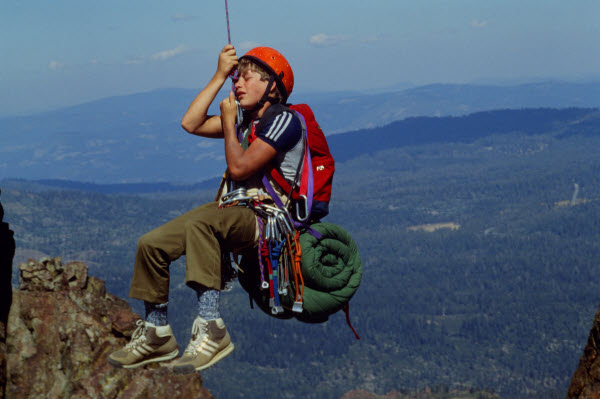
There’s another sequence in which Vic takes the boys on a rough climb on a mountain called Devil’s Tooth. When they run out of rock, they are forced to pendulum across to the nearest surface rock. This is also well-shot and I was fooled into thinking that the real actors pulled off this stunt, and not stunt doubles. It seems fun, because they think it’s fun…everyone except Alan, who unfortunately slips and hangs on for dear life while he dangles on the edge of a rock face.

It’s here that the movie turns Vic into a villain, and the plot turns from a coming-of-age wilderness story into a standard rescue story. Aside from a little whitewater rafting that serves as the film’s climax (and it’s one painfully-dull sequence), I don’t think any of the boys have learned much about the wilderness, except that it’s best to stay within the confines of your home in the suburbs or the city. OK, you could argue that Vic learns more about patience when dealing with a city kid who has no interest in the wild life. But what about Alan? He states in a painfully-forced (and incredibly obnoxious) cutaway narration (in which Astin is a couple years older) how much he hates camping until we just want to deck him, especially because we’ve already seen the point he was trying to make.

The outcome of the climax is painful. It’s too coincidental, comes right out of nowhere, and the movie stops rather than end properly. And just as a joke, they show end credits before older Alan interrupts by saying, “You hear music, you see credits, you think it’s over?” I was hoping.

What I get out of “White Water Summer” now is beautiful photography, good-enough acting from Kevin Bacon, Sean Astin, and the other three young actors (Jonathan Ward, Matt Adler, K.C. Martel), and a kick-ass ‘80s soundtrack. But when you get down to it, the movie never comes to a coherent point. It doesn’t quite know what it wants to be, and what it is is adequate at best.