Archive | Two-and-a-Half Stars **1/2 RSS feed for this section

Reckless (1984)

25 Mar

aidan reckless

Smith’s Verdict: **1/2

Reviewed by Tanner Smith

“Reckless” is about a bad boy and a good girl who are attracted to one another, and it’s not as much a ripoff of “The Wild One” or “Rebel Without a Cause,” because really this sort of youth melodrama is its own genre. While “Reckless” deserves credit for its proficient acting and occasionally complex drama, and it’s certainly a step up from the awful “Tuff Turf” (a similarly-themed teen film released the same year as this one), It’s not as dramatically satisfying or revealing as we would like it to be.

Aidan Quinn stars in his film debut as Johnny Rourke, a high school teenager from the wrong side of the tracks. His fellow students think he’s weird because he mostly keeps to himself and likes to ride around on his motorcycle. Oh, and he’s a deadringer in every way for James Dean’s “rebel without a cause.” He’s handsome, he’s moody, he speaks in a soft monotone, and loves to mope around.

It’s the intention that Quinn resemble James Dean, and the truth is, Quinn completely pulls it off. This could easily have been a pale imitation, but Quinn plays it with enough authenticity and conviction that really makes the role of Rourke his own. He makes us feel for his pain and angst. He’s more the rebel with a cause—he has something difficult (if uncomfortable) to deal with, and the time he spends to himself makes him more comfortable. That’s my take on the character, anyway.

Rourke has to put up with his irresponsible, lazy, drunken father, as well as working at the steel mill, being blamed for something that isn’t entirely his fault (but because he looks rough, he’s immediately to blame), and being stared upon by his fellow students who refer to themselves as “normal” compared to him. But one day at a school party, he is paired up with the girlfriend of one of the football jocks, and they share a fun dance to new wave music. This is Tracey (Daryl Hannah, very good), a good girl who, after the dance with Rourke, realizes that he is everything she is not. She has never taken chances and is the “model girl.” Rourke’s recklessness attracts her, and they spend some time together causing trouble—breaking into the school, trashing the principal’s office and classrooms, and sharing an explicit sex scene in the boiler room to 80s rock music.

That sex scene is actually one of the more original parts of the movie, which is mostly utterly predictable. We can tell where this relationship is going to go, and we know they’re going to spend some time apart before ultimately getting back together after much convincingness. I wouldn’t mind so much except that the supporting characters don’t have dimensions of their own, so we’re pretty much stuck with these two characters who feel like they’ve got no direction—well, we certainly know where this is going, for sure. Rourke’s father (Kenneth McMillan) only has a couple scenes that give us the point—and he has only one note: drunken. The football coach (Cliff de Young) is too much of a hard-case. And Tracey’s boyfriend (Adam Baldwin) is too much of a stereotypical jerky boyfriend that he is just plain boring.

It’s not enough that we have two likable characters if we can tell where the story is going and they (or rather, the screenwriter) constantly kid us with it.

I liked Aidan Quinn and Daryl Hannah as the two central star-crossed lovers. And the cinematography and direction is well-done. But “Reckless” needed more work done on its screenplay if it was going to be as special as a film about a bad boy and a good girl can be.

Russkies (1987)

23 Mar

images

Smith’s Verdict: **1/2

Reviewed by Tanner Smith

“Russkies” is a good-natured film that has a cute setup and some nice ideas to follow through with it, right up until the ending climax that made the film seem desperate.

The movie, set in Key West, Florida, at a time when the Cold War is still going on, features three pre-teenage boys who find a Russian sailor. The Russian is stranded after being washed ashore and the boys are the first ones to find him. The boys—Danny (Joaquin “Leaf” Phoenix), Adam (Peter Billingsley, “A Christmas Story”), and Jason (Stefan DeSalle)—have been reared by military families and raised on a series of anti-foreigner comic books called “Sgt. Slammer,” so naturally, their first instinct is to believe that this Russian radio operator is a Commie spy. They’re able to hold him at gunpoint with the Russian’s own gun and threaten to turn him into the authorities, but soon enough, they discover that Mischa—the Russian, played by Whip Hubley—is actually a nice guy and decide to let him hang around with them.

This is good stuff—the way these kids interact with this stranger is handled in a fun way and not a disturbing way. The kids are well-cast and Whip Hubley has appeal and a certain credibility as a Russian—sometimes, he’s not entirely convincing as a Russian, but close enough mostly. And it is nice to see how Mischa reacts to America—he eats Big Macs, gets used to Jeans and collar shirts, plays video games, rides go-carts, and even develops a relationship with Adam’s sweet older sister Diane (Susan Walters)—but also would love to return home somehow.

While the setup is fun, “Russkies,” unfortunately, has a dim-witted payoff that is implausible and seems like a pale imitation of the climax in “E.T.” Without going into much detail, much of it involves a sadistic drunken fisherman, the kids’ idiot parents, and two real Russian spies in a boat chase for separate reasons. I did not need this climax and I particularly did not need a mean drunk to be the real bad guy here.

What “Russkies” has that makes it work are fun scenes set in the kids’ point of view, mixing comic books with comedy and adventure. They are what I liked about “Russkies,” but the rest of the film has run out of ideas and energy, and so I can’t recommend it.

Shiloh 2: Shiloh Season (1999)

21 Mar

Zachary-Browne-Shiloh-2-Shiloh-Season-shiloh-2-shiloh-season-1999-30555098-608-336

Smith’s Verdict: **1/2

Reviewed by Tanner Smith

I hate to knock a feel-good family movie that has good intentions and positive messages to convey. But the main problem with “Shiloh 2: Shiloh Season,” sequel to the terrific 1997 family drama “Shiloh” and based upon the novel “Shiloh Season” by Phyllis Reynolds Naylor, is that it felt the way you couldn’t label about the first film (or at least, most people couldn’t say about it), and that is “preachy.” This just felt to me like generic, wholesome fluff with nothing too memorable to gain from it.

The original film, “Shiloh” (which I loved), had its morals and messages too. But they were in a film that was written more intelligently and with more subtlety than what the filmmakers of this sequel were going for. I don’t mind that messages from the original film are carried over a little further if it’s done right. But throughout the movie, I felt as if I was being had—as if I was being hammered with the ultimate lesson this movie had to deliver. And I never felt that way about the original film. And I know what you might be thinking—“It’s a kid’s movie! They’re supposed to hammer the message down hard on the kids watching it!” A) It’s supposed to be a family movie, not a “kid’s movie.” B) I don’t think kids like to be manipulated by what they watch as much as their parents like to imagine.

Maybe I’m being a little too harsh. After all, at least these issues are addressed in this movie, and they are ethics that kids can identify with. (I give credit to the original “Shiloh” novels for that.) The “Shiloh” stories are about protectiveness, determination, and helpfulness in the tale of a boy protecting a dog from its cruel owner (the original film) and seeing if the owner can change his cruel ways (this film).

“Shiloh 2: Shiloh Season” brings back the characters from the original film, including young Marty Preston (Zachary Browne, taking over for Blake Heron) who is still learning life lessons while protecting his dog, the cute, adorable beagle Shiloh, which Marty earned from its mean owner, Judd Travers (Scott Wilson, reprising his role from the earlier film). Judd is so unpleasant that even the local women are secretly talking about boycotting him away from town. He gets drunk constantly, he shoots what he doesn’t care is in season or not, and has a resentful attitude toward Marty for now having his dog.

Someone is pulling pranks on Judd—letting loose his hunting dogs, scratching his pickup truck, and knocking over his mailbox. Judd thinks Marty’s to blame, and this leads to many confrontations between Judd and Marty, and Judd and Marty’s dad, Ray (Michael Moriarty, also reprising his role from the earlier film).

Also back is the character of Marty’s mother (Ann Dowd), who does what she’s required to do, same as in the original film. There’s also Doc Wallace from the original film (again played by Rod Steiger) who is still around to give helpful advice, and while the character does seem like more of a fortune cookie this time around, he does manage a couple convincing helpful scenes with Marty. New characters include Marty’s rapscallion school chum David (Joe Pichler) and his new middle school teacher, Miss Talbot (Dawn McMillan), who knows how to teach the right ethical lessons to her class.

Of the acting, Scott Wilson is the most interesting performer in the cast, but that’s probably because his Judd Travers has always been the most interesting character in these stories. He has the role of a pathetic man—mean and lowly only as a way of not showing how he really feels. He was kicked around as a child, and now he kicks his dogs around and he’s a lonely man who feels better when he’s drinking or hunting. That doesn’t leave much for society to bear with him; he’s seen as a mean SOB. But can he change? Is anybody truly cruel forever? Can a troubled past keep a man troubled for the rest of his life? For all the machinery that this movie is composed of, Wilson manages to give a solid performance here.

Mainly, what it comes down to with the teachings of the morals & ethics for “Shiloh 2: Shiloh Season” is whether or not you buy it. I guess I didn’t for the most part. It does have its moments, when it’s mainly focused on the Judd Travers character, and the ending kind of works. But it’s too wholesome and generic, and not convincing enough to accept what we’re supposed to take from it.

Knowing (2009)

16 Mar

knowing13

Smith’s Verdict: **1/2

Reviewed by Tanner Smith

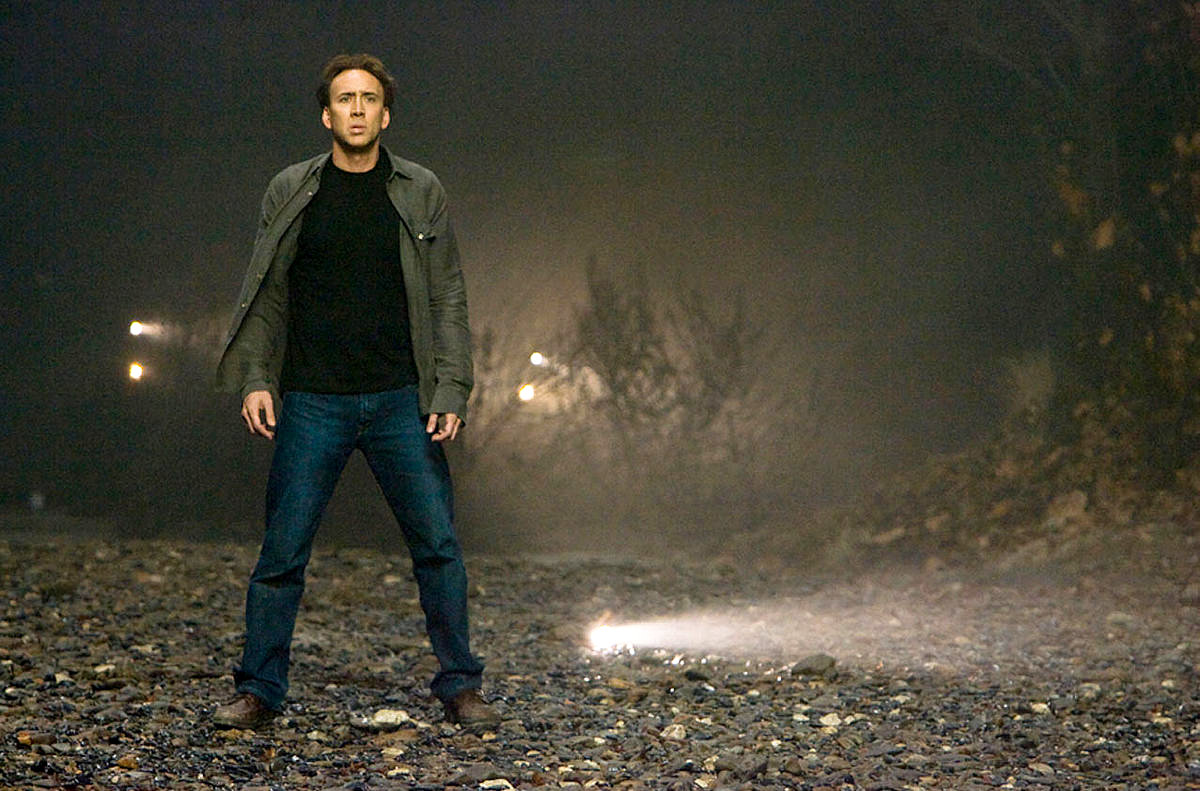
“Knowing” is a science-fiction thriller directed by Alex Proyas. For those who don’t know, Proyas made the 1998 sci-fi film “Dark City” which served as a strong parable about how we sometimes don’t understand the world we live in. “Knowing” is like that in the way that it asks the question or whether the universe is random or deterministic. It’s a film about a man who discovers the answer…

The film opens in 1959 at an elementary school, where students are asked to create drawings of what they think the future will bring. A girl named Lucinda (Lara Robinson) suddenly hears voices that instruct her to line her paper with random rows of numbers…or are they random? Fast-forward to 2009, where the time capsule is opened with all the drawings inside. Caleb Koestler (Chandler Canterbury) winds up in possession of Lucinda’s numbers and shows it to his father John (Nicolas Cage), an M.I.T. astrophysicist. Koestler becomes obsessed with this paper once he notices patterns in these numbers. He realizes that these numbers are warnings for death—dates, times, longitude/latitude, and even the numbers of victims who die at that time or place.

The setup of “Knowing” is investing and pretty intriguing. There’s a good deal of tension drawn in the scenes where Koestler figures things out, and Cage actually manages to sell his reaction scenes with credibility. There are interesting questions of fate and risk that come into place, as Koestler discovers that since there are events that happened long after the numbers were written, he could figure out what’s going to happen next, and possibly find a way to stop it. But is it possible to save lives of those who are predetermined? This is a dangerous question for someone who has previously believed that stuff just happens.

As Koestler digs further into the clues, he’s able to track down Lucinda’s daughter Diana (Rose Byrne) and granddaughter Abby (Lara Robinson again), hoping they’ll be able to help. As the story progresses, Caleb and Diana team up to discover what the last few numbers on the paper mean. But meanwhile, Caleb and Abby are being watched from afar by mysterious strangers who whisper in the night.

And it’s here that “Knowing” falls apart. The story stops being interesting and becomes more tiresome and really ridiculous. While the conflict is there as something bad unfolds for the Earth, the excitement isn’t present and the resolution is less than satisfying—it’s underwhelming. The truth behind these strangers and the numbers is beyond ridiculous. This is supposed to be the big twist to the story. I wanted a more complex ending.

Nicolas Cage is credible in the first half, but as things go downhill, so does his performance. He can’t stop yelling, which is understandable given the circumstances, but Cage is so over-the-top that it’s hard not to laugh at him. Rose Byrne, however, is consistently convincing and creates a sympathetic character opposite Cage.

The disaster sequences are nicely staged, but the use of CGI is always obvious. A train crash in the middle of the film doesn’t look very real, and there’s another scene in which a plane crashes, but while the plane looks real, the flames around it look incredibly fake. But it should also be said that the final effect—not giving anything away—is a genuinely horrific, but effective visual.

“Knowing” starts off by grabbing your attention, but diminishes midway through. Give it credit for not being an ordinary disaster movie and using an intriguing idea to play off of, but they should have thought more about a satisfying purpose.

Sex Drive (2008)

13 Mar

sexdrive

Smith’s Verdict: **1/2

Reviewed by Tanner Smith

Just about every year, we get a new teenage sex comedy to relieve us from gravity and also harmlessness. 2008’s is “Sex Drive,” a movie about as raunchy and vulgar as the “American Pie” movies. Looking at the trailer for this movie, I thought I was in for yet another formulaic teen movie. But somehow, “Sex Drive” is fresher than it seems, mainly because the lead characters in the film are so appealing and likable. That’s a nice surprise for a movie like this.

The movie centers around an awkward eighteen-year-old named Ian (Josh Zuckerman) who strikes up a Chat relationship with a hot girl he met…online. She thinks he’s a jock, but the truth is, he’s kind of a dork. He doesn’t get respect at work (he’s forced to go around the mall and sell coupons for a doughnut shop…while dressed as a giant doughnut with eyes and a moving mouth that Ian operates himself) or at home. He always gets himself in embarrassing situations that bring his stepmom to think that he’s weird and unpleasant.

Ian’s best friends are Lance (Clark Duke) and Felicia (Amanda Crew). Lance is pudgy, wears glasses, and has zits…but he scores with a dozen girls because he’s so confident. He’s one of the popular guys in school who tries to give Ian some enough confidence to be with a girl. Felicia is a rebel girl who acts tough enough not to wear a dress for her cousin’s wedding, is best friends with Ian, and secretly has a crush on Lance.

Ian’s online “girlfriend” asks Ian to come down to Knoxville, Tennessee, where she promises him the best time of his life. Lance talks him into stealing his older brother’s hot-looking GTO (nicknamed “The Judge”) and travel all the way from California to Tennessee and get lucky with this girl. In tow is Felicia, who doesn’t know why they’re going to Tennessee but loves the ride.

The movie borrows a few traits from “The Sure Thing”—a teenager travels far just to save sex with someone he barely knows and winds up through a series of misadventures with his passengers. “Sex Drive” isn’t up there with “The Sure Thing.” It’s also not entirely good either. The script has some jokes that are hit-and-miss, and are neither funny nor convincing. “Sex Drive” has issues with supporting characters—there’s an older brother (played by James Marsden) who is constantly on testosterone. Like many annoying older brothers in movies, he’s obnoxious and picks on his younger brother, calling him gay because he’s still a virgin. The punchline for this character may be funny, but the character just isn’t. He’s just irritating. Then, there are the hillbillies that they run into. Then, there’s the hitchhiker they pick up. Then, there are the Amish folk that the characters meet—that whole sequence is somewhat distasteful. And there are many more uneven characters in this movie, to distracting and disturbing effect. It seems like the characters these three teenagers meet are from another planet. That makes “Sex Drive” not so pleasant an experience.

One exception to the uneven supporting characters rule is the Amish character played by Seth Green. Sporting a funny-looking beard, Green plays an Amish fellow who happens to know a thing or two (or a hundred) about fixing motor vehicles. He comes in handy when the heroes’ car breaks down. I like the scene where he and Lance have a talk about his trip to Las Vegas while riding in a horse-drawn carriage.

What’s refreshing about “Sex Drive” are the three teenagers. Ian, Lance, and Felicia are appealing and well-played by Zuckerman, Duke, and Crew. Duke and Crew, in particular, get the frequent share of one-liners and they pull through with great comic personalities. And their characters all have some unique developments (especially Lance who finally finds someone to love). Too bad they’re in a movie that exploits them rather than tries to love them.

NOTE: I really liked that doughnut suit that Ian wears a few times in the movie. That alone gets a big laugh.

SpaceCamp (1986)

9 Mar

joaquin phoenix SpaceCamp

Smith’s Verdict: **1/2

Reviewed by Tanner Smith

“SpaceCamp” had the misfortune of being released around the time of the tragic 1986 Challenger accident. The movie features a group of kids accidentally sent into space after a failure engine test on a shuttle, and the movie handles it very tensely so you couldn’t help but have flashbacks of that terrible occurrence with the Challenger. So the film wasn’t necessarily dead on arrival, but it certainly was doomed on arrival.

But how does the film itself hold up nowadays? Better, but that’s not saying much.

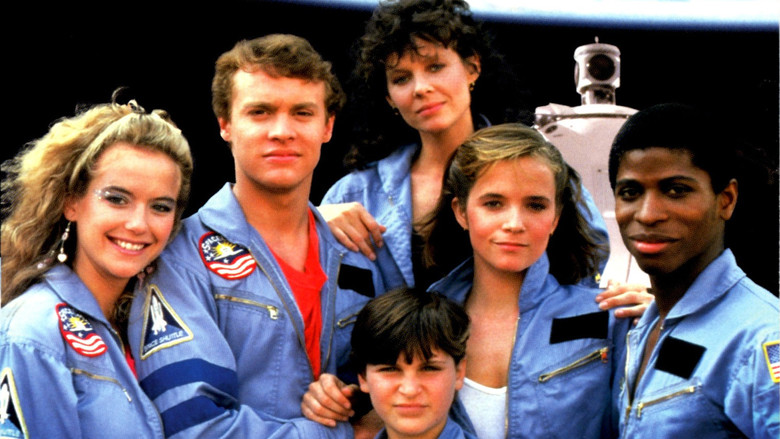
The movie is about a group of teenagers at NASA Space Camp. On a roll call by their astronaut host Andie (Kate Capshaw), there’s Kathryn (Lea Thompson, “Back to the Future”), a space enthusiast who really wants to be shuttle commander for the camp’s shuttle simulation, but is shifted to pilot; Kevin (Tate Donavan), a ne’er-do-well slacker who only signed up for Space Camp for his own Jeep, and has the hots for Kathryn; Tish (Kelly Preston), a new-age girl with a photographic memory; Rudy (Larry B. Scott) who lacks confidence; and Max (Joaquin Phoenix), the younger kid who is also a “Star Wars” fanatic and loves to spew its references.

In the first half of the movie, we see them go through the standard Space Camp procedures, though not standard to most of us watching it. Actually, this is one of the pleasures of the film—watching certain detail of the technical aspects at this camp has a real appeal. In particular, there’s a flight simulator and a pilot mechanical chair that spins about. I would have liked to see more of these elements, but they make way for moments of teenage melodrama, including a romance between Kevin and Kathryn that isn’t as interesting as what they’re going through with the camp activities.

I’ve heard arguments that the kids aren’t very bright and they make many mistakes. Well…some of these kids are first-timers. What do you expect? But then again, Andie puts a lot of pressure on them, like she expects more from them after what I guess is a week! No wonder they mess up badly in the simulator.

And if you can believe this, the Camp thinks this group is the right one to actually sit inside an actual shuttle during an engine test. How they were chosen after the washout simulator test is beyond me. And on top of that, why would NASA allow real kids to sit inside a real shuttle while real rockets are being fired? Shouldn’t they have taken into consideration that something could go wrong—something like, say…thermal curtain failure?

For those who don’t know, the movie explains that thermal curtain failure is very rare and it means that only one rocket will launch the shuttle and cause it to crash. Surely enough, through the efforts of an annoying robot (voiced by Frank Welker) befriended by Max that takes everything too literally, the thermal curtain does fail and NASA is forced to launch the shuttle, lest the shuttle crashes with the kids inside it.

So the kids, along with Andie, are thrust into space. At first, it seems like a dream come true. In a marvelous scene, we see them float around the cabin and get a great view of the sun setting on Earth. But there’s the issue of getting home without burning up in the Earth’s atmosphere. There’s no radio contact and there’s only one tank of oxygen left that won’t leave enough time for them to make the nearest window home. Luckily, Andie is an experienced astronaut and there’s a currently-under-construction space station that’s nearby with plenty of oxygen tanks.

The film has its share of chilling moments that should have been exciting. For a family film, this conflict is too heavy. We have many scenes that come across as unsettling. Like, how about we let the little boy out into space to help get the oxygen tanks from the unfinished space station?! Let’s have him suddenly lose control and fly out into space so Andie can save him! Then let’s have the conflict of hooking up the tank the right way! Then let’s have the final climax in which Kathryn must get the shuttle through the atmosphere without incinerating everyone on board! This is supposed to be a high-powered family adventure, right?

So I’m guessing people didn’t like “SpaceCamp” because it reminded them too much of the risks of being in space rather than being bewildered by the amazing emptiness of it all, not just because of the Challenger accident. While the special effects are impressive and the acting isn’t so bad (Kate Capshaw stops whining for once and Lea Thompson shows a sense of conviction to her role), “SpaceCamp” isn’t as wonderful as we’d like to think a movie about kids going into space would be. Maybe if it was just about a group of juvenile space nuts and their lives at space camp—learning all the technical aspects while also adjusting their social lives—it would be a nice, entertaining movie. As it is, it’s a half-baked adventure.

Dirty Dancing (1987)

5 Mar

Dirty-Dancing-lift_l

Smith’s Verdict: **1/2

Reviewed by Tanner Smith

So many people have told me to watch the 1987 movie “Dirty Dancing,” and I’m not usually one to give in to peer pressure, as I’ve heard of it six years before I finally got around to checking it out.

What is it about this movie that people just go crazy over? Well, the dancing is certainly fun to watch as the actors turn out to be good, lively dancers. The romance between the two star-crossed lovers seems to have people interested. What do I think of the movie, personally? Well, the dancing isn’t bad, like I said. The acting’s not bad either, and we have an engaging young couple, played by Jennifer Grey and Patrick Swayze, to follow. But as a story, “Dirty Dancing” tells us nothing new. This is all stuff we’ve seen before.

Let me give the gist of the story and you see if you can predict the rest of it. The story takes place in summer 1963, as 17-year-old “Baby” Houseman (Grey) is vacationing with her rich family at a resort in the Catskill Mountains. Her father is Dr. Houseman (Jerry Orbach), the personal physician of the owner of the resort (Jack Weston). The owner tries to set Baby up with his obnoxious son Neil (Lonny Price), but she doesn’t like him. Baby finds excitement in the after-hours parties thrown by the hotel staff. She’s intrigued by the “dirty dancing” and wants to get a lesson from hunky dance instructor Johnny Castle (Swayze).

At first Johnny is hesitant, as he doesn’t like the fact that this “cute little rich girl” is hanging around on his and his friends’ turf. But Johnny’s dance partner Penny (Cynthia Rhodes) is pregnant by a waiter who wants nothing to do with her. So Baby helps out by getting money from her father (not telling him what it’s for, but it’s OK—he trusts her) and paying for Penny’s abortion. Then, Johnny agrees to teach Baby and make her his dancing partner for the resort’s final show, and they form a secret relationship.

Can you guess where this is going? Misunderstandings? Attempts to keep them apart? Final reconciliation? The other people realizing their mistakes? Happy ending?

You bet!

Yes, later in the movie, the secret is out, and Baby’s father couldn’t be more disappointed. I was hoping for more understanding by this character, since in the first half of the movie, he seems like a good guy—he’s trusting, listening, and reasonable. But when he finds that Johnny is with his daughter, his ethics are practically nonexistent. Anyone can see that this is a good guy and wouldn’t hurt Baby in any way—anyone, that is, except him.

The “dirty dancing” in the title is somewhat false. Some moves are hot enough, but since the movie is rated PG-13, it doesn’t get much hotter than that. For a movie called “Dirty Dancing,” this is pretty tame.

Patrick Swayze and Jennifer Grey are likable, share good chemistry, and are actually great dancers. And “Dirty Dancing” does have its cute moments, as well as a nicely-done (though clichéd) final dancing sequence, taking place during the final show at the resort. So this isn’t a bad movie; but the story gave me nothing new. I wouldn’t mind so much except so much dwells on many clichés that there are many times when I didn’t really care about what was happening.

Silent House (2012)

28 Feb

2012_silent_house_004

Smith’s Verdict: **1/2

Reviewed by Tanner Smith

For about the first forty-five minutes, the thriller “Silent House” delivers what you expect to find in a thriller—a sense of creepy atmosphere, a legitimate fear aspect, some good scares and unnerving moments, a main character to root for, and a large amount of tension. “Silent House” has all of that and it makes for one of the best, most intense horror movies I’ve seen recently. Unfortunately, that’s only the first half of “Silent House” which means there’s a second half to the movie that will undermine what it had going and end on a scene that is not only anticlimactic, but also very disappointing and unbelievably stupid. And it brings the movie down with it.

It’s a shame too, especially considering the talent in front of and behind the camera. First, let’s start with the technical style. “Silent House” has been shot using long takes that can create what appears to be one unbroken shot, thanks to some clever editing. This is undoubtedly a callback to Alfred Hitchcock’s “Rope,” which used the same technique. And thanks to today’s technology, we have an upgrade—in fact, the film’s opening shot (or rather, start of the shot that consists of the whole movie, practically) is spectacular, as it starts from high above our protagonist and then eases its way down to join her as she walks and continues to follow her from there.

This inventive technique is handled effectively because we are with our protagonist the entire time. No time-lapses or motioning over to something less important—our attention is focused on who it should be focused upon: our female protagonist. Her fear becomes our fear. However, this style does manage to wear out its welcome once we realize we’re in the middle of a project with a shaky handheld camera. Very shaky indeed.

The setting is an old country house in the middle of nowhere where most of the action takes place, thus giving us the hint of claustrophobia. There’s no cell phone service, no electricity, and most of the windows and doors are padlocked. (Don’t say nobody tries to escape from the house when things go wrong.) A young woman named Sarah (Elizabeth Olsen, showing extraordinary work here), her father (Adam Trese), and her uncle Peter (Eric Sheffer Stevens) hope to sell it sometime soon. But later that day, Sarah and her father are alone in the house and when Dad investigates a strange noise coming from upstairs, Sarah hears a loud thud and calls for him, with no answer. Soon, she realizes that there is someone in the house and that “someone” has Sarah’s father, is looking for her, and there is hardly a way for her to escape.

This is the part of the movie that is very frightening. We follow Sarah to many hiding spots throughout the dark house and we know just as much as she does that someone is following her and will find her if she doesn’t keep moving. It’s so tense and unnerving that you need to chuckle a little bit to relieve the tension. This whole first half is borderline “Halloween” territory. I mean it—it’s that good.

As underwhelming as the second half is, I have to give it credit for one utterly fearsome sequence that comes later in the film. It’s when Sarah is surrounded by complete darkness and has to use her Polaroid camera to create a little flash of light so she can see where she is. We know that once in those flashes of light, we’re going to see something shocking and we don’t want to see it. That was a disturbing scene that worked.

“Silent House” would have been great, if not for the disappointing ending. It’s supposed to shock us with something we haven’t picked up on before, but the result is clumsily handled and very weak. If you’re willing to accept it for what it is, and if you’re a hardcore horror fan, “Silent House” will probably please you. It didn’t do much for me, except for the first half. After that, you’re on your own.

2012 (2009)

13 Feb

2012moviebooks

Smith’s Verdict: **1/2

Reviewed by Tanner Smith

John Cusack plays Jackson Curtis, a talented but struggling author of adventure novels who is divorced from his wife Kate (Amanda Peet). Kate has a new boyfriend (Tom McCarthy)—a nice guy who loves their two small children (Liam James and Morgan Lily) as much as Jackson, who spends very little time with them. Now something is destined to bring this broken family together and Roland Emmerich doesn’t disappoint with a simple solution. What is the solution? Well, seeing as how it’s a Roland Emmerich movie, you know it has something to do with massive destruction. But here’s something that makes it even harder—it’s the whole planet that’s now a hazard! We’re talking violent earthquakes, monster tsunamis, and a massive volcanic eruption that destroys all the major cities in the world like Los Angeles, Las Vegas, and Washington, D.C. We also get annihilation on Mount Everest, in which everyone must be protected from the grandmother of all tsunamis.

Wow! What a trip! Roland Emmerich and his co-writer Dean Devlin have done it again—they destroyed a lot of popular landmarks and killed dozens of people. Only this time in the movie “2012,” they’ve really gone too far—they’ve turned the whole world into the Poseidon ship from “The Poseidon Adventure.” This makes their earlier end-of-the-world movie “The Day After Tomorrow” look simple. This movie, “The Day after Tomorrow,” and “The Poseidon Adventure” are all disaster movies in which something hazardous occurs and a colorful group of people must set aside their differences in order to survive together.

But is “2012” as good as those other two disaster movies? I’m afraid, not quite. There is hardly a sense of quality character development (then again, there is hardly any quality in this movie), there are many scientific inaccuracies that would have been OK if it didn’t seem too silly, and the movie runs for almost 2 hours and 40 minutes which seems way longer, even through what the characters have to go through in the final half. But there are things I found pleasurable about “2012.” One is, even though these characters aren’t particularly well-developed, I still get an adrenaline rush watching them survive one disaster after another, barely escaping death about…2,012 times! I’ve always liked John Cusack, who is one of the most reliable actors not to get to an Oscar nomination yet, and he makes his writer character likable enough for us to root for him. The best performance in the movie goes to Chiwetel Ejiofor, who carries the movie’s major subplot. You see, while Cusack is racing to keep his family safe as the world collapses around them, Ejiofor is a geologist who really knows what’s going on and constantly argues with his superior (Oliver Platt), telling him that they need to save as many people as possible. But Platt is telling him that there’s no time and that they need to save the people they reserved for seats in secret arks (don’t ask) and not to worry about the other people. So while Cusack races to save his family, Ejiofor races to save what’s left of humanity and that’s kind of interesting to me. Plus, Chiwetel Ejiofor is an actor who has one of those voices that you can’t help but listen to in times of warning and trouble.

There are some pretty nifty disaster scenes, including the destruction of Los Angeles. These special effects are definitely top-notch. The adventure is set in motion when Jackson grows suspicious after what he had heard from wacky radio operator Woody Harrelson (a hoot), who warns Jackson of the coming apocalypse and shows him a video he made indicating when it would happen (reminds me of the video in “Jurassic Park”). So when Jackson returns home in a stretch limo, he picks up his wife, her new boyfriend, and the kids and they drive away right when the monstrous earthquakes (excuse the pun) shake everything up. To me, it’s fun when you’re driving away from something and there’s someone shouting, “Car! Tree! Donut!” (The big plaster donut rolls along the streets of LA.) There are also attempts at black humor, such as when the big Randy’s Donuts plaster donut comes sliding down the street and when the boyfriend says to take the freeway, there’s an instant cut to the freeway being destroyed as well. Now, it’s impossible to outrun falling buildings and earthquakes in a stretch limo, but I have to admit I didn’t care. All I kept thinking was, “GO GO GO!!!”

There are many more disasters these characters must face. Will they survive all of them? Well, let me say this. This is another Roland Emmerich disaster movie that makes you feel good at the end. Billions of people may have died, but as the feel-good music is heard, you feel a sense of redemption and relief. But there is a sense of creeping past billions of people who are definitely not going to make it out alive while you’re rooting for the main characters (including kids and a little dog) to survive. While I can’t recommend “2012,” I do have some affection for it. This is kind of a black joke at prophecy and disaster movies themselves and at that level, I guess I enjoyed it. But as a whole, the movie tries too hard and gets too silly that it’s almost tiresome.

The Outsiders (1983)

7 Feb

283965_1251572218752_295_300

Smith’s Verdict: **1/2

Reviewed by Tanner Smith

“The Outsiders” is a film based on a best-selling young adult novel written by S.E. Hinton, who specializes in teenagers as complex characters (also read “Tex”). Francis Ford Coppola made this beloved book (beloved particularly by junior high and high school students) into a film at the request of a junior high English class who all signed a letter, asking Coppola to adapt this book. The result is a mixed bag.

The narrator is a fourteen-year-old “greaser” named Ponyboy Curtis (C. Thomas Howell) whose friends are all greasers. Greasers are the social outcasts on the north side of Tulsa, Oklahoma—most of which are hoods and they all have greasy hair. “Socs” (pronounced “soeshes”) are the rich kids from the south side of town—most of which have fun jumping greasers. There’s a conflict among them and occasionally, they throw rumbles to fight each other.

Ponyboy is basically a nice, smart kid—he reads books, keeps his mouth shut, and tries to stay out of trouble. His best friend is Johnny Cade (Ralph Macchio), a scared sixteen-year-old greaser who was beat up terribly by a soc long ago. Both wind up in a nasty situation after Ponyboy and Johnny pick up a couple of soc girls and their boyfriends catch them. This results in the murder of one of the boyfriends (committed by Johnny, who wouldn’t hurt a fly before) and the scared kids are forced to run away.

There are many characters among the greasers. There’s Two Bit (Emilio Estevez), a likable scalawag who has his fair share of screen time. There are Ponyboy’s older brothers Darrel (Patrick Swayze) and Sodapop (Rob Lowe). And last but certainly not least, there’s Dallas Winston (Matt Dillon), the rebel without a cause. Dallas helps Ponyboy and Johnny hide out after the murder.

All of the actors are great in their roles—the central trio of Howell, Dillon, and Macchio are convincing. But the problem comes with the story and development. The story is not particularly convincing and most of the characters aren’t developed properly. I didn’t really buy the conflict between the greasers and the socs. And some of the greasers who are in the film’s advertising don’t even have time to breathe—they just appear briefly. I bought the friendship between Ponyboy and Johnny, but not so much of the relationships with Ponyboy and his brothers. Here’s another thing wrong with the movie—Ponyboy talks about his brothers a lot more than he talks with them to the point where he just seems like annoying exposition. Sodapop just seems invisible throughout the movie. And then, there’s the plot thread in which Ponyboy is possibly going to be taken away from Darrel and Sodapop and must go to juvenile court for running away. That element is dropped and never spoken of again. It didn’t matter much because I didn’t care much about the brothers anyway.

I also didn’t like the music composed by Carmine Coppola. It’s all over the map here and, along with Francis Ford Coppola’s direction, seems like “The Outsiders” is trying this generation’s “Gone with the Wind.” I wouldn’t mind so much if it wasn’t distracting.

So I can’t recommend “The Outsiders” mainly because of its execution. I like Ponyboy, Johnny, Dallas, and Two Bit. I like Coppola’s direction. I love the book—the original making of this film was to cover the whole novel, which tells the story better. Apparently, Warner Bros. thought it’d be too long for the young audience’s interest and asked for the film to be cut from nearly two hours to an hour and a half, which isn’t enough time to tell this story. I’ll just quote Roger Ebert and argue that a good film isn’t long enough. And I’ll also say that “The Outsiders” needed more material to be a better movie.