Archive | Three Stars *** RSS feed for this section

Snow Angels (2008)

2 Jul

snow_ang_row

Smith’s Verdict: ***

Reviewed by Tanner Smith

“Snow Angels” is a film about highs and lows of human relationships, with different stories and an ensemble cast surrounding a central tragedy. It begins as a high-school marching band rehearses their version of Peter Gabriel’s “Sledgehammer” on the football field, when suddenly, gunshots are heard in the distance. It’s inevitable that we see what builds up to those shots, beginning, as the caption puts it, “weeks earlier.” We meet one of the band members, Arthur (Michael Angarano), a shy, insecure high-school student, as he works in a Chinese restaurant (which I just realized has no Chinese employees) with his former babysitter, Annie (Kate Beckinsale). Arthur hasn’t had a girlfriend yet, possibly because he’s always had a crush on Annie who loves to tease him about their time together (“I totally used to give you baths”). And the timing couldn’t be more perfect, as Arthur’s parents are going through a divorce (because it turns out his father is having an affair), and as his dad moves out of the house, a nerdy, fun transfer-student, Lila (Olivia Thirlby, wonderful here), notices Arthur, comes into his life, and becomes his girlfriend.

This story about Arthur is undoubtedly my favorite part about “Snow Angels,” as it shows depth and weight in presenting this kid going through a tough time in his life and finding his first love, helping him deal with it. I recall Chicago Tribune film-critic Michael Phillips, when reviewing the film as guest-critic on “Ebert & Roeper,” described this appearance of Lila as “a gift from heaven,” and that always fascinated me because that is pretty much what this is about. Here is this gloomy situation involving parents’ divorce, and Arthur knowing the truth about his dad well before his mom realizes it, and in comes this newcomer who bonds with him and they share something for one another. This is one of the best high-school romances I have ever seen—it’s very sweet, and yet it seems real in the personalities of these two characters and how they playfully joke with one another, building up to a moment later in which Lila softly, ultimately states how she feels about Arthur, and Arthur can’t help but feel the same way, despite not knowing how to react.

Unfortunately, that is merely a subplot constantly pushed aside by the darker, gloomier aspects of the story within “Snow Angels,” which mostly has to do with the issues of Annie. Annie has gotten out of a failed marriage with Glenn (Sam Rockwell), the father of her 4-year-old daughter, whom constantly makes things difficult. Ever since his suicide attempt, Glenn has quit drinking, turned to Jesus, and tries to do the right thing. But he hasn’t changed for the better, it seems. The reason Annie left him was because he’s incredibly awkward, can’t hold a job, has violent tendencies, and is an alcoholic. And now, as he sometimes looks after their daughter every now and then, he wants Annie back. But Annie isn’t about to let him back into her life. Meanwhile, she is currently having an affair with Nate (Nicky Katt), the husband of her best friend, Barb (Amy Sedaris). Soon enough, the affair is revealed, bringing further complications into Annie’s life, even before her daughter winds up missing.

If Arthur and Lila’s story represents the highs of human relationships, then everything involving Annie and Glenn represents the lows. But it’s not only emotional conflict, adultery, and anger; it’s also guilt, violence, and loss. And it only gets more depressing as it continues, building up to the tragedy that was set up in the beginning of the film.

And this is where I am a bit uncertain when it comes to deciding a “Verdict” for this film. Maybe it’s because the lighter romantic moments with the high-schoolers won me over so much, but it’s somewhat hard for me to get into the darker material surrounding the adult characters. I mean, those scenes are well-acted, smartly written, and well-directed, and I’m not saying that because it’s a downer, it’s a failure. I mean, a good solid portion of films are muted and downbeat. But when you have to have a cohesive narrative driving the emotional aspects forward for an effective payoff…I don’t know. It seems to be building up to something, and while that inevitable dramatic payoff is there, I’m not sure it all comes together in a way that fully makes us understand what has happened and for us to take in the tragic climax. The power isn’t there behind it, in my opinion, and as a result, I feel like I sat through much ado about nothing.

I understand that “Snow Angels” is based on a novel, and to my knowledge (having not read it), writer-director David Gordon Green was faithful to the source material when adapting it for the screen. But when I get down to what I really think about “Snow Angels,” I think there’s a perfectly satisfying story within the teen-romance material and around Arthur. There’s an interesting short film here trapped in a dark, gloomy story about the lows of adult relationships, when there’s a cohesive story about a kid (Arthur) finding a special-someone to be with, and questioning relationships in the process (there’s some drama in there, in how he feels about his dad going back and forth between home and elsewhere, and also in how he doesn’t know how to comfort someone who needs assistance). Right there is an interesting, full-circle story structure trapped in an uneasy story about a few seriously disturbed individuals.

And I know what they’re trying to do—trying to contrast young relationships with older. So it either works for you, or it doesn’t. For me, it is true that it is acted well (though there are some parts when you feel that Beckinsale was probably miscast, and Rockwell is hard to watch at times) and a lot of moments ring true. And it is an effective representation of ordinary people going through ordinary problems before they realize they can’t deal with it anymore. So despite my personal issues with the structure, I give “Snow Angels” a mild recommendation because of that. Sure, it’s inconsistent and without Arthur and Lila’s romance, it’d just be OK; but there are many individual moments that convince to keep watching it, so I can’t recommend it. I like “Snow Angels.” I wanted to love it, though.

The Iceman (2013)

27 Jun

the-iceman-01_THE-ICEMAN_Courtesy-of-Mille.JPG

Smith’s Verdict: ***

Reviewed by Tanner Smith

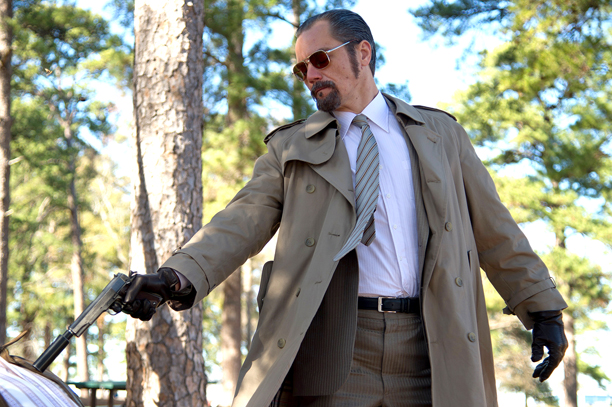
It seemed somewhat inevitable that the story of notorious serial killer/mob enforcer Richard Kuklinski, known for killing over 100 people in the ‘70s and ‘80s, be told in a feature film. Based on the book “The Iceman: The True Story of a Cold-Blooded Killer” by Anthony Bruno, director Ariel Vromen’s film “The Iceman” tells this story chronologically and the results are quite effective, if somewhat underdone.

Richard Kuklinski (Michael Shannon) is presented as a man of two personalities—loving husband and father with a wife and two daughters, and dangerous killer with hardly a hint of remorse. Neither his wife, Deborah (Winona Ryder), nor his two daughters suspect his murderous deeds, although Deborah at one point is convinced that something is not quite right with her husband, because sometimes he comes off as emotionally distant. (“Richard!” “What happened to ‘Rich’?” “I don’t know!” A great exchange.)

Even while first meeting Deborah, whom we see him woo in an opening scene set in the early ‘70s, Kuklinski is a vile killer. Soon after his date, he’s mocked at a bar, which causes him to slit the scorner’s throat. Now, I must admit, at first I thought that was too unneccesary in showing that Kuklinski was to be a killer, but it is hinted that Kuklinski has already killed before that moment, so it makes a little sense that a simple thing could set him off.

Years later, Kuklinski has gone from dubbing porn films for the mob to executing hits for Roy De Meo (Ray Liotta) of the Gambino Family. (And I’m guessing Deborah doesn’t ask many questions about his job as long as he pays the bills and gives her and the kids a nice suburban house in Jersey.) But due to the escape of a witness to one of Kuklinski’s hits, Kuklinski is laid off, leading to him working with another hitman, Mr. “Freezy” (Chris Evans, hardly recognizable). But it turns out this partnership causes trouble with the mob, and so the lives of Kuklinski and his family are in jeopardy.

What helps make the portrayal of Kuklinski so chilling is that it seems that anything can cause him to turn to a new kill. And you already know how much this guy sickly enjoys doing what he does, so it’s quite uncomfortable when seeing him in a calm mood with his family. Granted, he’s never violent towards his family, but it’s still unnerving when you know what he does. How much does he enjoy killing? When assigned to kill a sleazebag who begs and prays for mercy, Kuklinski uses this for his own entertainment, allowing him a minute to pray and see if God will stop him. What an…iceman.

Michael Shannon is this movie. With the wrong actor giving the wrong type of performance this role requires, “The Iceman” would have been a much lesser product. I can’t think of any other actor doing a better job at playing the role than Shannon. This guy is freaking excellent. His portrayal of a homicidal killer is never sympathetic, but it comes across as deeper and more insightful than you might imagine. It’s emotion versus habit with him, only the “habit” happens to be constant murder. This may be the closest thing we get to a three-dimensional killer (go ahead—insert “Dexter” joke here), and Shannon nails it with this performance.

“The Iceman” has its flaws, though. Winona Ryder, despite trying, can’t seem to do much with the clichéd role of a hitman’s concerned wife. The mob aspects aren’t fully realized, so there were times when I was wondering which connections were consistent with whom or what. And I sort of wanted a few more scenes that got into the backstory of Kuklinski’s incarcerated brother (Stephen Dorff).

Oh, and by the way, was anyone else wondering why Jimmy Hoffa is never mentioned?

“The Iceman” presents the tale of Richard “The iceman” Kuklinski in a chilling, effective way with a great leading performance by Michael Shannon. It’s straightforward, doesn’t cheat in presenting past-and-future events (the story is told in order), and suitably unsettling. Even if I may forget certain other aspects about it, there’s no doubt that by the end of this year, I’ll still remember Michael Shannon’s performance and his portrayal of a real-life bloodthirsty killer.

Going to the Mat (2004) (TV)

8 Jun

images-2

Smith’s Verdict: ***

Reviewed by Tanner Smith

Far be it for me to review a “Disney Channel Original Movie,” though to be honest, I have certain nostalgia for a lot of them (no matter how stupid I found a lot of them to be later on), having grown up watching the Disney Channel. But there is actually one that I can find myself reviewing and recommending because I genuinely find it to be a solid family-oriented sports film. That is “Going to the Mat,” released to the small screen in early 2004.

The story: Jace Newfield (Andrew Lawrence) is a blind teenager who has moved from New York City to a small town in Utah. Fearing the students at his new school will mock him for his blindness, he attempts to impress them all by bragging about his old home and making fun of jocks before they have a chance to tell “blind” jokes. However, it turns out that no one cares much that he’s blind because they’re already turned off by the notion that he’s acting like a jerk. He has two friends—Vincent “Fly” Shu (Khleo Thomas) and Mary Beth Rice (Alessandra Toreson)—who tell Jace that the best way to fit in around here is to be a jock. Music isn’t going to impress anyone, as Jace is a good drummer, mainly because the music teacher, Mr. Wyatt (Wayne Brady), is also blind. So finding a sport seems to be a new priority. Mary Beth suggests wrestling, as her father (D.B. Sweeney) is the coach. With Fly accompanying him, Jace tries out for the wrestling team. Of course, the other members of the team give him a hard time and think he’s on the team to play the “freak” angle for the local newspaper (which is not the case, as the coach is a no-nonsense guy). But Jace is determined to earn his spot on the team and works hard to improve on the wrestling skills throughout the course of the season.

What really stands out about “Going to the Mat” is the message. It’s probably obvious, but it’s actually very effective as well. It’s all summed up in one line, said by Jace later in the movie after he’s already scored a couple points for the team—“You know what really ticks me off, when people tell me how brave and courageous I am for doing things that sighted people do every day.” That’s a good, solid point. Just because a person is blind doesn’t mean he can’t do everything that sighted people can. And this is a problem that Jace didn’t have to deal with in New York City, as he was able to find ways to do what his friends did. Note the opening scene. He’s playing in a band in front of a large audience and they get good reception. In this scene, you wouldn’t even guess that Jace was blind as he plays the drums. But the next scene shows signs of his blindness, as he plays baseball with his friends. Jace is up to bat, and the ball that they use is a special one that makes beeping sounds for Jace to use his other senses to hit it when it’s pitched to him. Then, Jace goes to pitch the ball and sound is used here as well—the thudding sounds a fist makes when the catcher hits the mitt, giving Jace a target. All throughout this scene, they’re just having ordinary conversation; nothing except how they play the game is made of Jace’s blindness, even when Jace needs assistance as they grab a snack nearby. This is a really good scene; it’s executed and acted pretty realistically for a “DCOM.”

Anyway, now that Jace is in these new surroundings and having to prove himself because most people see him as a blind guy. One of the team is angry because Jace is taking his place (though to be fair, it’s because the coach doesn’t want the kid to hear himself before a big meet), and just sees the whole thing as a joke. Jace has to work even harder not only to score points for the wrestling team, but also to fit in with those that gave him a hard time from the start. And eventually, he does manage to succeed in earning respect, as well as points. What fascinates me about “Going to the Mat” is that this is actually a credible situation—maybe a little too credible for a DCOM (in that maybe it could have had a theatrical release instead).

Fly is also able to earn respect. He joins the wrestling team along with Jace, and is also picked on because of his short stature. But as Jace gets better with wrestling, so does Fly. Both boys are able to beat the odds and relieve themselves of the “underdog” status. This is something that sports-movies usually love to play off of—the underdog angle. There’s a ne’er-do-well group of misfits who try out for a certain sport and improve until they are able to earn regard from everyone. Surprisingly, while there are a few clichés present in “Going to the Mat,” the film doesn’t necessarily dwell on them. Jace and Fly’s “underdog” story arcs are played convincingly so that it’s easy to follow along their practice. The coach doesn’t take any bull from anybody, but he isn’t the one-dimensional jerk—in fact, he’s far from it. The bullies are surprisingly well-developed characters, particularly the wrestling-team captain, John (Billy Aaron Brown). While he does give Jace a hard time, the two grow to form a nice friendship because Jace is able to help him with his Spanish-class grade in order for John to continue being on the team. In return, John helps Jace practice. Even Mary Beth, which is what could have been the thankless role of high-school love-interest, is three-dimensional—kind, but not dim; helpful, but within limits; falls for Jace, but knows there’s a bit of a risk, seeing as how her father is Jace’s coach. Also, it’s refreshing that she knows a lot about wrestling.

Andrew Lawrence stars as Jace, and it’s a solid, charismatic performance. He’s completely convincing as a blind kid seeking to fit in. He’s tough, but sensitive too. He’s cocky and brave, but also knows when to keep his mouth shut and focus. And he doesn’t back down, though he knows his own limitations of his disability. He’s very good here and he’s also another very important reason why this film works. Khleo Thomas is not as successful, as he is sort of a generic best-friend character, but he is likable nonetheless. Alessandra Toreson is good as well, Billy Aaron Brown is a convincing jock, and Wayne Brady is also solid as the blind music teacher who informs Jace that it’s not sight that makes you who you are—it’s obvious, and the speeches are kind of hokey at times, but they’re effective at getting the point across.

Also, I’m kind of glad that the ultimate wrestling match at the end of the movie is a playoff match and not a final. It doesn’t even matter whether Jace wins or loses; it’s how Jace is able to handle it against one of the best high-school wrestlers in the state. In the end, he gains respect and no one sees him as just a blind person anymore. Yes, it is predictable, but I didn’t mind so much.

I’m not sure whether or not this is based on a true story, but to tell the truth, it wouldn’t really surprise me. What does surprise me, however, is how serious the story is treated. Maybe it’s not treated too seriously, for the sake of keeping kids invested. But there’s nothing handled in a dumb way, so I wouldn’t imagine many adults rolling their eyes at the film (like they would do with many other DCOMs). I liked “Going to the Mat” as a kid; watching it now, it turned out to hold up surprisingly well.

Star Trek Into Darkness (2013)

28 May

images-1

Smith’s Verdict: ***

Reviewed by Tanner Smith

With 2009’s big-budgeted reboot of “Star Trek,” director J.J. Abrams and screenwriters Roberto Orci and Alex Kurtzman introduced a new look at the popular saga originated from Gene Roddenberry’s imagination—darker, more kinetic, very exhilarating, and very action-packed, while also keeping true to the spirit of the original TV series in terms of creativity and of the memorable characters. 2009’s “Star Trek” was a big hit, and so it was inevitable that a follow-up in the same style and tradition would be constructed. Four years later, we have “Star Trek Into Darkness,” which is believe it or not, a bigger, more bombastic sequel than its predecessor.

And to get it out of the way, the first hour-and-a-half or so of this two-hour-and-12-minute sci-fi blockbuster is just incredible. The action scenes are tense and very exciting; the characters are all solid (Spock is pretty badass in this “Star Trek” entry); the villain is great; and there’s good social commentary among all the madness that ensues in this story, and it’s not unlike the best “Star Trek” movies or TV episodes. But then in its final half-hour, it’s as if something went wrong. Usually in big-budget action films with strong buildups, it’s usually the payoffs that are lacking in substance. But here, it’s just a lack of knowing any better. There is twist upon twist, and I wouldn’t mind so much if it wasn’t trying to straight-up copy an easily-remembered sequence from one of the earlier “Star Trek” movies. Then there’s a silly chase scene that results in a fistfight. Then there’s a total copout to what has been built up before with that aforementioned “copied scene.” Then there’s a rushed epilogue so that it’s hard to feel exactly what Abrams and co. were going for.

I didn’t give much away, but you get my point. I was really enjoying this movie, ready to call it one of the best films of the summer so far. I was so into the story and the action and what all the characters were doing and etc. and so on. This was “Star Trek,” and I loved it. Then it all goes downhill in its final act. Abrams and co. deserve credit for the first hour-and-a-half-or-so and why it works so well, in my opinion. But they also have to take the blame for what happens to the movie.

The film starts with a bang in a fabulous scene set on an alien planet. The crew of the USS Enterprise are sent to save the primitive natives of this world from an erupting volcano. In the process, Spock (Zachary Quinto) is in peril and Kirk violates the Federation’s prime directive in order to save him. Because of his insubordination, Kirk is demoted from Captain to First Officer. But shortly after, the Federation is under siege by a fugitive, a rogue Starfleet officer named John Harrison (Benedict Cumberbatch), who murders Admiral Pike (Bruce Greenwood) in his attack. Kirk wants revenge and requests to go after Harrison. Admiral Marcus (Peter Weller) agrees and puts Kirk back in his ranking, but with simple instructions to track down Harrison and kill him. Kirk rounds up his crew, including Spock, Dr. McCoy (Karl Urban), Uhura (Zoe Saldana), Sulu (John Cho), and Chekov (Anton Yelchin) (Scotty, played by Simon Pegg, joins later after being unsure about this mission), and heads to Kronos, the Klingon planet where Harrison is sure to be located.

There’s a lot to like about this movie, and among the chief aspects is the villain. This is not a one-dimensional bad guy. At first, he seems like a standard action-flick terrorist that just wants to blow stuff up. But there’s actual reason to his actions here, and the more they’re developed, the more they make us understand why he’s doing all of this even if we don’t tolerate it. There’s a good amount of depth to how this character is portrayed, and Benedict Cumberbatch plays the role so well.

(By the way, even though most people will know the villain’s true identity before its reveal, I won’t reveal it here. All I can say is that I think it works really well.)

The heroes are all as appealing as their original counterparts (though without the truer sense of camaraderie that will probably be further developed in later installments). In particular, Kirk has a credible story arc about doing what he believes must be done, even if it isn’t the best thing for everyone else around him. Whatever he’ll do, he’ll do it to save his friends and crewmembers. And in a way, he and the villain, without giving too much away, are practically the same person in motivation, which makes things more interesting. But if there’s a flaw in this arc, it’s that its resolution is not strongly-handled, which is one of the many flaws with the film’s final act.

Spock has already been established as half-human/half-Vulcan and constantly walking that fine line between logic and emotion. He doesn’t quite understand why Kirk risked his job and life to go and save him in the opening sequence, and Kirk must convince Spock what the meanings of being human and forming friendship mean. Spock goes through a lot in this movie, continuing to walk that line. And it does pay off in an emotional way, to the credit of the final act.

(By the way, Leonard Nimoy shows up in a brief cameo as “Spock Prime.” While it’s pointless, it results in a great reaction when Spock asks if he knows who the villain is.)

Being a summer blockbuster, “Star Trek Into Darkness” moves with a fast pace that only breaks when it needs to. It stops at the most appropriate times for the audience to breathe and take in what we’ve just endured. And there are some terrific action scenes—along with that opening scene, we also have a desperate battle between Enterprise crew and Klingons (yes, there are Klingons in this movie), and an attempt to get from the Enterprise ship to a space station through space, if only Scotty could open the airlock in time. This is an epic journey that works as a glorious space opera—we have space battles, distant planets, all sorts of conflicts and interruptions along the way, and many surprises along the way.

There are many other old-“Star Trek” references making appearances. There’s a Tribble that McCoy experiments with (and Good Lord, could the payoff to this thing be any more obvious in the final act?); there are a few throwaway memorable quotes (“Shut up, Spock! We’re rescuing you!”); there are models of old Enterprise ships in Admiral Marcus’ office; and (possible spoiler alert) many, many references to the “Star Trek” TV episode “Space Seed.” Also introduced in this rebooted franchise is Dr. Carol Marcus (Alice Eve), who, for those who are familiar with the early-‘80s “Star Trek” movies, will become the mother of Kirk’s son. (By the way, for those who say she’s underused in this movie, calm down—it’s just her introduction.)

And then, there’s the final half-hour, which almost completely ruined the whole movie for me. While some parts of it aren’t bad, everything else about it hit the wrong notes, in my opinion. It begins with a segment borrowed from one of the earlier “Star Trek” films, and it’s practically repeated word-for-word (except with a role reversal). I wouldn’t mind this so much, as it is a powerful scene that does pay off with certain character arcs in this movie (and I would have looked forward to it being resolved in a third movie if they just took it easy from here on out). But from that point, it all goes downhill. I can’t help but wonder why they had to go this route (I think it may have been for the fans, but I think some of the most diehard fans might feel let down).

So, do I recommend “Star Trek Into Darkness,” despite a disappointing resolution? Well…it’s a close call, but I suppose I do. A good majority of the movie is entertaining and exhilarating, and I was having a great time up until that point of no return. So marginally, I recommend checking it out. But as a warning, you may feel like watching “Star Trek II: The Wrath of Khan” afterwards (you’ll know why).

Code of Silence (1985)

28 May

1361805476_tumblr_m77o8mFMJg1rwq85xo1_500

Smith’s Verdict: ***

Reviewed by Tanner Smith

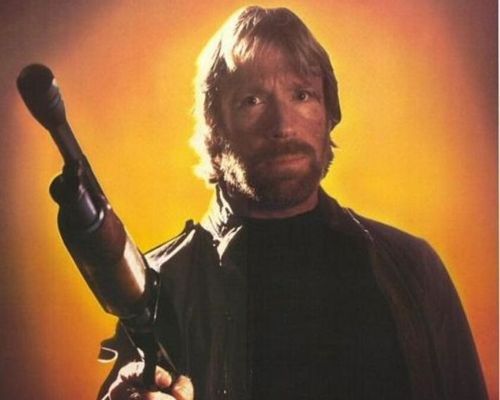
Chuck Norris has pretty much become a human punchline, hasn’t he? Anytime the bearded martial-arts “god” is mentioned, no one can help but crack one of those infamous Chuck Norris jokes (my favorite being, “There’s only another fist under Chuck Norris’ beard”), and yet he’s always labeled as “awesome.” And when I think about it…yeah. He is rather awesome, isn’t he? While he seems like a nice guy (and probably is a nice guy), he can also kick some serious ass with his fighting moves (including a roundhouse kick…to the face?). How is he as an actor though? That’s a little tougher to describe. The reason he was a movie star was because of his image and multiple fights without a stuntman. His acting is not very impressive, as he has a very limited range.

But given a good director, Norris can give a solid performance. And he found one in Andrew Davis, who cast him in the lead role in 1985’s “Code of Silence,” which itself was a breath of fresh air at the time of its release. At a time when Norris was constantly doing schlocky karate flicks, he’s cast here in an intense thriller as he plays a good cop “having a very bad day” (as the tagline states). Norris is surprisingly solid here, and the movie itself is quite thrilling.

The film takes place in Chicago, as straight-arrow cop Eddie Cusack (Norris, even though you’ll never call him “Cusack” in this movie) who is caught up in a Mob war after a sting operation goes wrong, resulting in Italian and Latino mobsters out for each other’s blood. Norris is worried about the safety of a mobster’s innocent daughter, a young artist named Diana (Molly Hagan), and decides to protect her. But she gets kidnapped and Norris decides to save her.

While all that’s going on, there’s also a subplot involving a “code of silence,” which is a police officer’s cover whenever that officer makes a mistake or is corrupt. In this case, there’s a hearing for an alcoholic old officer (Ralph Foody) who has accidentally murdered a young man in action and then planted his weapon on the victim, so that he can say it was done in self-defense. A rookie cop (Joseph Guzaldo) witnessed the incident and attempts to cover it up. Norris decides to back the kid up at the hearing.

It’s interesting how much goes on in “Code of Silence” and how complicated most of it is, and yet how less than obligatory and simple it all seems. It’s as if the usual clichés are downplayed, if still existent at all. Interesting characters, capably performed by good actors, help with that, as well as intense direction from Davis.

The action in “Code of Silence” is very well-done. You can see it fine and are surprisingly invested in what’s occurring on-screen. There’s a solid 15-minute opening scene that is all about the preparation and resolution of a drug-bust (and it does set up the story). There’s a fistfight on top of an elevated train going through Chicago, after which both Norris and the crook dive into the Chicago River. There’s also a nicely-done barfight late in the movie, in which Norris takes down several roughnecks at a time (and even delivers a roundhouse kick to one of them—awesome). The stuntwork in this movie is quite incredible.

There are amusing moments as well—my favorite being a duo of robbers who plan to overtake a bar, only to discover that just about everyone in that bar is packing. And there’s also a crime-fighting robot created by the police to mow down criminals with an advanced armory. This is known as the Prowler, which looks like one of those mobile NASA food-delivery robots if it was packing. It comes to the unexpected assistance of Norris in the film’s climax.

Not everything about “Code of Silence” works, though. You can follow the story fine, but some parts just sort of pass by really quick. And while most of the action scenes are riveting, the others seem rather inexplicable.

But what it really comes down to is the spirit of things with “Code of Silence,” and holding it all together is Chuck Norris, who is solid and surprisingly convincing as a cop. He’s able to show off some fighting moves some of the time, as Davis has him in check, but all in all he has a unique, rock-solid presence. He’s terrific; the whole film is terrific, and it’s arguably the best of the “Chuck Norris movies.”

Cirque du Freak: The Vampire’s Assistant (2009)

26 May

images-1

Smith’s Verdict: ***

Reviewed by Tanner Smith

Web critic James Berardinelli (of www.reelviews.net) put it best when defining a “guilty-pleasure”—“Guilty pleasure (n): a film that a critic shamefacedly admits to liking even though the prevailing opinion, as put forth by serious members of the profession, is that the movie is a piece of crap.” (from his “National Lampoon’s Christmas Vacation” review)

I was 17 years old when “Cirque du Freak: The Vampire’s Assistant” was released in cinemas in the fall of 2009. I saw it and, despite many film critics’ opinions of it, found myself very much enjoying it. Even my friends at school were thinking I was crazy for recommending it, although to be fair, some of them were disappointed mainly because they had read the book series this film is (loosely) based on. I hadn’t read the books until a few months later, when I started to read the first four (out of I forgot how many). As a film itself, my opinion still didn’t change. I still thought it was quite entertaining, despite what everyone else said. So…yes, I would call “Cirque du Freak: The Vampire’s Assistant” a “guilty-pleasure.”

But for the record, I wouldn’t call this film “flawless.” There are a few things wrong about “Cirque du Freak: The Vampire’s Assistant” that I notice with each viewing—flaws that should tick me off to my boiling point and make me create a scathing review of it instead of a semi-positive one. But for some reason, those never seemed to deliver that effect on me. I was never sure why. Maybe I’m a sucker for a coming-of-age story involving the supernatural and this is just a pushover for me. Maybe the good parts about the film overthrow the bad in the end. Maybe I see something here that hardly anyone else who saw the movie did.

OK, enough of that. To get into the review…actually, where do I even start?

Well, first I’ll start with the biggest noticeable flaw in the movie. It’s clearly intended to be the first installment of a franchise, meaning there are so many loose ends, so many elements built up to nothing—just a cliffhanger ending with very little resolution. It’s as if all the filmmakers had in mind for this movie was to set up a possible “Cirque du Freak” franchise. And what makes it worse is that this movie did poorly at the box-office, meaning—guess what—there was no chance of a sequel. I guess we were supposed to read the books to fill in the rest of the story, if we cared enough. But there’s one major problem with that—the first half of the movie is based somewhat upon the first two books, while the second half of the movie was entirely made up on the spot. So those who do read the books to find out what happens after the all-too-ambiguous ending are going to be lost and confused. So mainly what it comes down to is that this movie cannot stand alone.

This sort of confidence that a film based on a popular book can do well worked for “The Lord of the Rings” and “Harry Potter” and even “Twilight.” (And as I can tell, it’s also working for “Percy Jackson.”) But what about “Eragon?” What about “The Golden Compass?” And now this. Give Fox’s lackluster “The Seeker: The Dark is Rising” credit for keeping its story somewhat cohesive. And their “City of Ember,” which I find quite underrated, actually (and for the record, I hold no guilt in liking that one). (How odd is it that I’m defending 20th Century Fox, despite their tendency not to adapt from their source material all that well.)

Well, this “positive” review is not starting out well, is it?

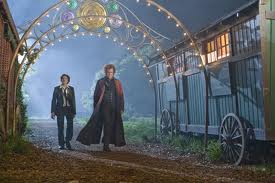
The story involves a high-school teen named Darren Shan (sharing the same name of the author of the original book series). Darren is more or less a “perfect kid.” Darren (Chris Massoglia) listens to his parents, he gets good grades, and he’s popular in school. He does, however, have a weak link in his otherwise-perfect life—a bully-for-a-best-friend named Steve (Josh Hutcherson) who constantly gets Darren into trouble. (Oh, and Darren also has a bizarre fascination with spiders, which is patently explained early on, just as how Steve is obsessed with vampires.) Darren and Steve come across a flyer for a freak show, known as Cirque du Freak, appearing in their hometown. Steve convinces Darren to sneak out of the house at night to check it out.

The freak show is a marvel of talents and grotesque visuals—there’s an overweight man with “two bellies” that crafts a tricycle out of spare parts he swallows himself; a teenage boy with scaly skin and a large snake; a woman who can grow limbs back after they’ve been chopped or bitten off (wait, wha…?); and a bearded lady, among others. Steve recognizes one of the talents—a spider wrangler named Larten Crepsley (John C. Reilly)—as a vampire (funny how no one seemed to notice that, apparently), and goes backstage to ask to become one himself. But what he didn’t know was that Darren was hiding in Crepsley’s dressing room and stolen his spider (a rare breed that brings certain death with one bite). Darren gets away, but the spider winds up biting Steve (who doesn’t become a vampire, because he has “bad blood”). So he goes back to Crepsley to beg him to help save him. Crepsley accepts, but on one condition: that Darren becomes a half-vampire and work as his assistant while traveling with the Cirque.

As if that setup wasn’t full enough, there’s also a mysterious large man known as Mr. Tiny (played by Michael Cerveris) who apparently has great powers and wants to see a war between good Vampires (such as Crepsley) and evil Vampaneze (vampires who kill whom they need their blood from). He has his sights set on Darren and Steve, because apparently, there’s some sort of prophecy that states that two boys on opposing teams will start the war. So while Darren becomes a vampire, he goes to Steve in order to convince him to turn into a Vampaneze (anybody else think that name sounds silly?). To Tiny’s aid is a vicious Vampaneze known as Murlaugh (Ray Stevenson), who sharpens his fangs with a small cutting tool (OK, that’s kind of cool).

And believe it or not—that’s just the first half of the movie I just described. I haven’t even mentioned Darren faking his own death in order to join the Cirque; the Vampaneze attacking Crepsley and Darren because they know Darren will ultimately do something for them; Darren joining the Cirque and getting to know them; Steve becoming a Vampaneze; and many more. I have to admit this movie is overstuffed. There’s too much going on here, and unfortunately, due to the lack of resolution for the most part, that doesn’t make it fully satisfying, admittedly.

There are also changes in the vampire legend here. Half-vampires are able to walk in the daylight (useful as a vampire’s assistant) and all vampires are able to “flit” (run with super-fast speed with a colorful trail of smoke following them). Also, these vampires don’t kill whoever they feed on, because after all, Crepsley must be the guy to root for and Murlaugh must be the one for us to root against.

I like the character of Larten Crepsley; he’s quite interesting in how he is a man who seems to have been cursed with this identity from the start and sometimes has difficulty coping with it. Therefore, while sometimes he uses the Cirque as a way of pleasure through entertainment, he also has his surly moments as well. He has a romance with the Bearded Lady (Salma Hayek) and his scenes with her allow him to reveal some of what he’s going through—if he gets too attached to her, even though he’ll live much longer than her, what does that leave him with? I thought John C. Reilly did a credible job at playing the role, and also provides some of the movie’s laughs and funniest lines of dialogue.

But “Cirque du Freak: The Vampire’s Assistant” is more of Darren’s story, as he changes from “Mr. Perfect” to “Vampire’s Assistant.” This is more of a superhero origin tale than a “Dracula” story. While many critics have found Darren to be bland and all too generic, and found Chris Massoglia’s acting to be mediocre, I really didn’t have much of a problem with him. I didn’t mind Massoglia’s acting (though, he is noticeably better in Joe Dante’s “The Hole”) and didn’t think it was the purpose for Darren to be the most interesting person in the movie. Massoglia plays him as an average teenager that goes through all of this madness (or “freakiness”), and while he’s not exactly memorable, he is likeable. And I liked watching him interact with the members of the Cirque, including a girl with a Monkey Tail with whom he shares a little romance with. He also befriends the aforementioned “boy with scaly skin” named Evra (Patrick Fugit). And I’m just going to come out and say it—I hate this character. From the moment he stepped on-screen in the freak show sequence, and complained about how no one will let him play music, I knew I wouldn’t like him. People have a problem with Darren, but this kid is just whiny and obnoxious throughout.

Mr. Tiny is probably the most interesting character in the movie, and Michael Cerveris is completely game at playing him. He says he’s not the villain, but simply wants to be a bystander to a coming apocalypse. But look at him—he reads the Book of Souls, feels joy when he realizes what could happen, manipulates young men into falling into this new prophecy, and the whole idea of wanting destruction says it enough; he’s a villain. And what is he and where is he from? We’re not sure. We know about many things he can do (such as reanimate corpses by crushing them down to half-size—hello, “Phantasm”), but what is the extent of his abilities? That, this guy is downright creepy. He looks like a man preparing to go to the opera; you wouldn’t suspect anything by looking at him. But talk to the man and you know something is wrong. This is an intriguing villain.

Murlaugh is intimidating at first, but becomes just sillier and sillier as the movie continues (though it is fun watching Ray Stevenson overact), while Steve is pretty boring. He becomes a villain late in the proceedings, now a Vampaneze, and his portrayal reminded me of Harry Osborn’s mediocre characterization in “Spider-Man 3.”

Who else is in this movie? Let’s see—there’s Willem Dafoe in what can be described as a cameo in the role of Gavner Purl, a friend of Crepsley’s; Ken Watanbe as Mr. Tall, a seven-foot caretaker for the Cirque; Frankie Faison as the aforementioned “two-bellied” one; and many others. They’re not on screen for very long, but they make the most of their time.

Good Lord, I’m hardly done describing certain things about “Cirque du Freak: The Vampire’s Assistant” and this review is already so long. I didn’t even mention the CGI dwarves that bite people at freak-show admission stands…apparently, not many people were bothered by that, as Darren and Steve walk into an auditorium full of people. And what about the climactic confrontation between Crepsley and Murlaugh and between Darren and Steve (one of which has a winning finish)? And the message that was seemed put in at the last minute—“It’s not about what you are; it’s about who you are.” Oh, and what about the extras in Darren and Steve’s high school, who are not the greatest actors as they don’t seem natural in the slightest? Man, this movie is so full!

You know…I realize while writing this unbelievably long review (probably the longest I’ve written) that this movie is not as good as I remember it. It was somewhat obvious when I watched it again before this review. And yet, I still feel somewhat positive towards it. Does that technically mean I should give this a mixed (2.5 rating) review?

What do I like about the movie? Well, there are some appealing characters in the mix—while most of them are barely developed, what we do see of them is entertaining enough. The world they’re in is appealing as well, and the visuals are impressive enough—the production design and the costumes really pop. The (intentional) comedy works well, for the most part (particularly with the freaks). There’s a nice cast that keeps things interesting. I liked seeing Darren learn to fit into the Cirque, this society of freaks, and how he becomes a member. And…I don’t know, I sort of bought into the spirit of things with this movie.

So, like I said, I do kind of like “Cirque du Freak: The Vampire’s Assistant,” despite its many flaws. You can call it a guilty-pleasure, as I already have. I understand its flaws, don’t get me wrong. It’s somewhat clumsy, especially in how it doesn’t necessarily have a beginning, a middle, and an end. But I did find something to enjoy about this movie, and I’m going to stand strong in defending it whenever it’s brought up in a derogatory manner.
Newsies (1992)

26 May

images

Smith’s Verdict: ***

Reviewed by Tanner Smith

“Newsies” is based on a true story. However, it’s a story I couldn’t care less about. Here it is so I’ll set it up for you: In 1899 in New York City, when publishers Joseph Pulitizer and William Hearst raised the price of the newspapers that the homeless, orphaned children are forced to sell, the newsboys went on strike and won.

Not a very exciting idea for a lively family movie produced by the Disney studio, is it? And get ready for this—“Newsies” is also a musical. It was Disney’s first live-action musical, in a long, long time. At the time, it was followed by successful animated Disney musicals “The Little Mermaid” and “Beauty and the Beast,” with “Aladdin” still to be released soon. And get this—the songs in “Newsies” are actually composed by Alan Menken, who provided the songs for the two titles I just mentioned. With this talent writing the songs for a live-action musical for Disney, you’d expect something great.

But the story is what really let it down. Why the Disney studio, along with director/choreographer Kenny Ortega (responsible for the choreography for such films as “Xanadu” and “Dirty Dancing”), chose this story with their new big production is beyond me. And what’s worse is that they tell the story loosely, which I wouldn’t mind if it meant to add more tension into the mix—but why turn the people into caricatures?

Most of the newsboys are stereotypes, to start with. But then there’s Joseph Pulitzer, played by Robert Duvall. He gets the worst of the treatment, written as a one-note tyrant of the newspaper business and just a slimy villain. Performed by Duvall (under a fake beard), he does an inconsistent job—when he’s not stiff, he’s over-the-top. It’s an off-putting performance.

Before I get into another big problem with the movie, let me make it clear very fast—I like this movie. There’s more to the movie than the story, the stereotypes, and…another bad performance I’ll get to later. There’s a real lightheartedness to it. It’s energetic, it’s fun, it’s upbeat. Most of the characters are likable. And what’s more important for a musical—the movie is at its liveliest when the music arrives. The production values are present and the choreography is impressive, with some outstanding dance numbers (the young actors, in particular, had to endure weeks of training, learning how to dance).

And as the production numbers impress, the songs are quite enjoyable and memorable. In particular, “Carrying the Banner,” which is the opening medley for the newsies, is a pretty appealing tune and the song that appears in the middle—entitled “I’m the King of New York,” sung by the newsies and a friendly reporter (played by Bill Pullman)—is incredibly entertaining. But my favorite is a number featuring Christian Bale, as the leader of the newsies, solely performing and dancing to the song “Santa Fe,” in which he enacts his fantasy of leaving New York and making his own free living in Santa Fe. This musical number is a tribute to the choreography of lone stars dancing in the street—think of the leads in “Oklahoma” or “Singin’ in the Rain.”

OK, here it is, now that I’ve been building this up—the absolute worst thing in an otherwise entertaining movie. It’s a performance by the usually comfortable Ann-Margaret in a most uncomfortable performance as a nightclub singer who acts as the newsies’ chum. But there isn’t a clear description of this character, because she only has two scenes (both of which feature production numbers), and there’s a slight indication that there may have been something going on with the boys that Disney isn’t allowed to show. Ann-Margaret is so awkward and so over-the-top in this role. And here’s the worse part—are you ready for this one? Her character serves no purpose whatsoever to the story, and with her limited number of scenes, you could take her out of this movie entirely and not have missed a single thing.

Oh, and should I add that her second musical number has the worst song in the movie, “Hard Times?” I forgot about this song when mentioning the others. I was hoping not to remember it, because it’s so annoying. But it’s stuck in my head because it’s so catchy. Thanks a lot, guys.

While Duvall and Margaret are both completely off-putting, the young actors do good jobs. Christian Bale has a charming screen presence and turns in a truly fine performance as Jack, the newsies’ bad-boy-turned-good leader. The others—including David Moscow (“Big”) as Jack’s bright new friend David, Max Casella (Vinnie from “Doogie Howser, M.D.”) as the wise-guy Racetrack, and Gabriel Damon as Brooklyn bad boy Spot Conlon—perform good solid work.

So the musical numbers and the likable spirit of things is enough reason for me to recommend “Newsies.” Is it a triumph? As a musical, yes. As a story and as a historical drama, it’s better off being tampered with. While the film does indeed have its flaws, it’s an innocent, enjoyable way to spend two hours.

Twinkletown (Short Film)

23 May

547667_380113565370260_1794727755_n

Smith’s Verdict: ***

Reviewed by Tanner Smith

The tagline for the short film “Twinkletown,” written and directed by Scott McEntire, states, “Absolute power corrupts absolutely in a small Southern town.” And knowing that tagline doesn’t make the subject matter for this film seem necessarily “new,” but there is something oddly captivating about a premise that mostly involves greed and power taking over a small (Southern) town almost as if it were a run of the Mob. With that said, “Twinkletown” is satisfying in the way it handles this premise, and is able to overcome its minor flaws.

“Twinkletown” (which is 20 minutes in running time) opens with three men chained in a warehouse, where they are tortured by Eve Wallace (Kristie Pipes), the latest of the corruptive Wallace family, who has run a small town in the Arkansas Delta for years. Eve learns that these three men have stolen Wallace money, as she and her henchmen, including her right-hand man Max (Johnnie Brannon), torture and kill the other two. The last one alive, a young man named Terrence (Dustin Alford, “Foot Soldier”), is given a chance to save himself. But as Eve allows him to settle things, Terrence’s grandfather (Tucker Steinmetz) suddenly becomes involved and this leads to a complicated situation that Terrence must get himself out of before he puts himself in more danger with the Wallaces.

One thing that stands out about “Twinkletown” is that there is a real feel for the sort of system that this town seems to run through. Eve and Max are broadly developed, but that’s what makes them memorable and their presences impactful. Particularly, there’s a scene in which Eve talks with the town sheriff (Don Pirl), and it’s clear where everyone seems to stand in this town. You either accept the melancholies here, or your ass is grass if you’re desperate enough to make the wrong choices in order to escape. No one can mess with Eve, and you’d have to be as crazy as Terrence’s grandfather to go up against her.

But really, what “Twinkletown” fully seemed to represent is an effective metaphor for the differences between the rich and poor in small Southern towns, taken to the level of a crime drama about the Mob, practically. In that sense, it’s more intriguing.

But there is a problem I had with “Twinkletown,” and unfortunately, it had to do with Terrence’s story. Terrence is merely a clean-cut kid who fell with the wrong crowd, and that’s why he found himself in this situation. As a result, the character is not very interesting. Maybe it’s just a personal preference, but I wonder how it would have been if a member of that “wrong crowd” was put in this situation himself. That’d be interesting because he’d have to rely on his wits and question his own morals and ethics, as well as the Wallaces’. As it is, Terrence is boring (though not exactly the fault of talented actor Dustin Alford, who was great in “Foot Soldier”), but I think his grandfather makes up for it (though that probably has to do with Tucker Steinmetz’s delightful overacting).

Kristie Pipes is enjoyable to watch as this despicable, unsympathetic woman who does anything to get her way and keep the family in power (even to the point, such as the case in the opening scene, of mocking sympathy to toy with somebody in order to receive some answers). At times, Pipes comes close to overacting, but for the most part, she’s quite good here. Johnnie Brannon underplays the role of Max, Eve’s cold-blooded associate. He doesn’t say much, or do much, and yet surprisingly he really leaves an impression. He’s great here. Tucker Steinmetz…to say his role here is more flamboyant than his “Antiquities” character would probably be an understatement. But to be honest, it did sort of grow on me. Sure, he’s over-the-top, but he does put a lot of energy to the role, and I admire him for that.

It would seem as if there are some roles that are somewhat one-dimensional, but there is a twist at the end of “Twinkletown” that changes that, for the most part. It shows there were further motivations than what may have been declared earlier. And without giving away certain details, it does bring the film full-circle in a satisfying way. While “Twinkletown” does have its flaws, it impressed me with its story structure, its moments of humor and danger, and some nice camerawork as well.

Back to the Future Part II (1989)

22 May

images

Smith’s Verdict: ***

Reviewed by Tanner Smith

I said in a previous post that “Back to the Future” is my all-time favorite movie. I truly love it because it kept me invested and entertained throughout, while also playing to certain emotions that it’s hard to fully describe how much it worked. So with that being the movie I can watch a hundred times and never get tired of, that must mean I hate the sequels by comparison, right? I mean, they are more broad and definitely goofier in tone than the first film, so with the strong way I feel towards the first film, I should necessarily hate the sequels, right? Well…I don’t. No, I really don’t. I think they’re very entertaining films in their own way, not necessarily in comparison to the original. They’re just fun action films that maybe don’t have the emotional impact of the original, but still some good treats that make them enjoyable. They’re imaginative, fun movies that I do enjoying watching every now and then, but for different reasons than the first.

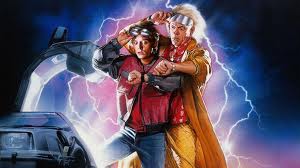
Let’s start with “Back to the Future Part II.” “Back to the Future Part II” picks up right where “Back to the Future” left off, as teenager Marty McFly (Michael J. Fox) has just returned home (to 1985) after a trip to the past (in 1955) via a time-traveling DeLorean motorcar invented by zany scientist Doc Emmett Brown (Christopher Lloyd). Marty’s reunion with his girlfriend, Jennifer (Elisabeth Shue, replacing Claudia Wells this time), is quickly interrupted by Doc Brown and his DeLorean as Doc frantically asks Marty to accompany him to the future and handle a situation involving his children.

So, Marty and Doc travel to the Hill Valley, California of the year 2015 so that Marty can impersonate his own teenage son and prevent an incident that would jail his son and ruin the family’s life. They succeed, but Marty now has a new goal. He buys a sports’ almanac that covers statistics for fifty years, and comes up with the idea that if he bets on the winner of a sporting event back in his own time, there’s no way he can lose. Doc talks him out of it (“I didn’t even invent the time machine to win at gambling; I invented the time machine to travel through time!”), but it turns out that old Biff Tannen (Thomas F. Wilson), the bully from the original film, was listening in on the idea, and winds up stealing the almanac and the time machine to go back in time and use it to change history. Once Marty and Doc are back in 1985, their hometown is a hellish area where Biff is rich and corrupt and married to Marty’s mother (Lea Thompson).

And so as Marty finds out that this present-Biff got the almanac from the old-Biff when he was actually young-Biff in the year 1955, he and Doc go back to 1955 and race to retrieve the almanac and set things right with the time-space continuum. Are you getting any of this, by the way?

One of the pleasures of “Back to the Future Part II” was just how much time-travel is used. It was fun watching these characters that we’ve grown to like from the first film now in the middle of a runaround through time. First, they travel to 2015; then, they go back to 1985; then, they go back to 1955 to fix a future that wouldn’t have been altered if Biff didn’t switch it to appear this way in 1985 after first traveling back from 2015…wow, describing it like that makes it even more confusing, now that I think about it. But I got into the spirit of it and wound up having a good time.

Now, it is true that the relationship between Marty and his father, George McFly, which one of the most refreshing things about the first film is missed here (in fact, George is hardly ever seen, and when he is, he’s played by a different actor than Crispin Glover). And also, when you get down to it, this sequel really is just a romp. It’s more of a complicated comedy than anything else. But in its own goofy way, it is a ton of fun. Michael J. Fox and Christopher Lloyd are very game and appealing in their well-known characters, and Thomas F. Wilson has a ton of fun playing all versions of Biff—young (1955), middle-aged (1985), and old (2015). He’s an amusing villain as well.

Oh, and while we’re on the subject of an actor playing different roles (and yet the same role), I might as well mention that Michael J. Fox not only plays Marty, but also his 2015 counterpart, his teenage son, and…even his teenage daughter (yeah, it’s as creepy as you’d expect).

The look of the futuristic Hill Valley in the year 2015 is incredible. Even though it’s 2013 and we’re not even close to half the things that are invented here, it still makes for a good fantasy and a nostalgic imagination-fuel that the filmmakers must have felt. They apparently went all out to make this world look credible, and it is a marvel with many things to behold. There are flying cars, hence a “skyway” (a highway in the air). There are holographic movie ads (“Jaws 19,” with a CGI shark that “attacks” passersby). There’s even a nostalgic diner called “Café 80s,” which is chuck-full of ‘80s material—there are video waiters that look like either Michael Jackson or Ronald Reagan, there are multiple TV screens that play old ‘80s sitcoms (like “Cheers” or “Taxi”), and there’s even a “Wild Gunman” arcade game that kids in the future call a “baby’s toy,” much to Marty’s surprise. Oh, and let’s not forget the wardrobe—Nike sneakers that lace themselves up to fit; a jacket that is able to fit anyone; and a multicolored reflective cap. Oh, and how about the hoverboard? There are literally so many surprises to be found in this future world that it’s hard not to admire the production design and creativity behind these props and sets.

“Back to the Future Part II” is a different movie than the original film in that it’s more of a screwball comedy. But it’s still a good, enjoyable movie that I recommend for what it is rather than just focusing on the comparisons to the first film. It’s not as emotionally involving, but it is still good fun.

Death of a Superhero (Short Film)

21 May

532557_197176317063003_661340127_n

Smith’s Verdict: ***

Reviewed by Tanner Smith

“Death of a Superhero” is a 10-minute short film that asks the question, what happens when a superhero loses his powers? Of course, he would have to give up the job (and throw away the costume) and reduce himself to his regular human alter-ego permanently. That’s the case with John Jameson, a.k.a. Captain Amazing. After an intense battle with his arch-nemesis, Dr. Disaster, Amazing loses his powers and therefore his identity of a superhero.

After his battle (which I’m assuming he easily ran away from after the final thrashing), Amazing (well-played by Ed Lowry) is bloodied and beaten as he returns to his apartment. Now without his strength and whatever those cool-looking lightning/laser effects that Amazing shot out of his hands were supposed to be (yeah, what were those again?), he is forced to live with his identity of John Jameson. He burns the Captain Amazing attire (which include cape and mask), his identity is declared dead by the media, and John prepares to accept a relatively normal life. However, it turns out that it isn’t so easy, as he still finds himself listening to a police band waiting for a crime he can stop. He does try to foil some thieves, but gets his ass handed to him. It’s then that he comes to grips with the concept that Captain Amazing is now dead. But is there a way a normal person can become a hero without superpowers?

For a 10-minute film, it’s intriguing how “Death of a Superhero” was able to tell an admittedly complex story and manage to tell it within certain limits so that it doesn’t feel rushed. There’s no padding involved, so there’s nothing really slowing it down, which works to the film’s advantage. The Amazing/Disaster battle is simply overlooked in the opening credits, but with enough intensity to deliver the point. This means the story gets rolling real quick, as John comes to his apartment, realizes his loss of identity, interacts with people (including a little girl who lives in the same apartment building), tries to bring himself back to being a hero, and then there’s the ending, which is satisfying with a positive (and subtle) message that isn’t forced in the slightest.

I think what I really liked about “Death of a Superhero” was that while it was about a superhero, it wasn’t a superhero movie in the traditional sense in that there’s a supervillain and a big climax. There is a climactic moment near the end, and something close to a villain (in the form of an abusive husband/father), but it’s played in a realistic way and, in a clever move, in a way that mirrors the opening battle. So we have three fights in this short film—one that serves as a traditional superhero duel (with some good visual effects by Brandon Bogard, who also provided FX for the short film “The Man in the Moon”…and unfortunately with a lot of camera-shaking so that those effects are not fully appreciated); one that serves as a standing point for the failed hero midway through the film; and another that gives the hero a moment of redemption, as a person. It’s a clever structure that works.

“Death of a Superhero,” which was made by student filmmakers of the Digital Film program at the University of Central Arkansas, is an effective short that serves as a metaphor for how modern, everyday people can be heroic in their own form or fashion. It’s a touching, well-made film with a respectable message delivered successfully.

NOTE: You can see the film here: https://vimeo.com/44162407