Archive | Three Stars *** RSS feed for this section

Gregory’s Girl (1982)

27 Sep

GREGORY'S GIRL 1981 film still

Smith’s Verdict: ***

Reviewed by Tanner Smith

In the early 1980s, there was a trend in the movies called “teenage-sex movies.” Ever since “Porky’s” was released in 1982 and became a huge box-office hit, studios have tried to cash in on its success by simply making comedies about horny teenagers, usually boys, looking to “get lucky” with the opposite sex. They claim to be about growing up and becoming a man, when really, they’re really about unlikable jackasses who would nothing better than to have sex. They’re not looking for love or friendship with a member of the opposite sex; they see them as mysterious creatures or objects to obtain or hunt (or jump). So few movies about teenagers at the time were about real teenagers with real relationships and problems and so on—one in particular I can think of at the top of my head is “Tex,” which is one of my favorite movies; that film wasn’t about sex, but it was about coming of age and becoming a man.

Another film released around this time, and undoubtedly a breath of fresh air for critics and audiences looking for that type of film, was a Scottish film called “Gregory’s Girl,” made by Bill Forsyth. This is a film about an awkward, weird, not particularly handsome young man, named Gregory (Gordon John Sinclair), and his misadventures through life and through love. He’s curious about the girl he likes, but just wants to get to know her better, unlike his friends who would just do anything to get girls to notice them, even if it’s not particularly charming topics of conversation. (We all had friends like that in high school, didn’t we? My friend would often quote “Austin Powers” to try and impress a girl. Don’t try that, by the way. But I digress.)

Gregory is on the soccer team (though, it’s actually known as “football” there, of course), but his lack of skill and coordination on the field puts him down to the position of goalie. Taking his place is Dorothy (Dee Hepburn), an attractive, athletic girl who is a very talented soccer player. No one can believe how well “a girl” can play, especially the coach, but Gregory notices it as “modern” and sees her true athletic skills. But also, he immediately falls in love with her. He can’t stop thinking about her, he likes the way she plays, he likes the way she smells, he likes everything about her. He even likes her scars—there’s one scene in which Gregory and Dorothy show each other scars and injuries from their pasts. That’s a great scene—the chemistry is perfect, the body language is accurate, and you can really get a sense of what these two feel towards each other, as they’re polite during certain feelings they go through in this sequence.

So, we know that Gregory likes Dorothy a whole lot, but how does Dorothy feel about Gregory? Well, truth be told, I’m not sure. You can tell she likes him a little, and she knows he likes her, and she’s not above flirting with him while also making friendly conversation. You’re not quite sure of what she feels, but you know what? I was never sure how any girl in high school really felt; there’s hardly a way of knowing for us guys. Despite the title “Gregory’s Girl,” the film is not necessarily about Dorothy, but more about how Gregory reacts to these feelings he has now developed and how he works up the courage to ultimately ask her out on a date. The last 20 minutes of the film, in which he does have the courage to ask out Dorothy and what happens after he does, do not go in the way you’d expect it to be, but without giving too much away, you do feel Gregory’s confusion that slowly but surely turns into happiness.

Now, to be sure, this isn’t a complete success. Sometimes, it can be a little too cute in its humor and sometimes tries a bit too hard, particularly whenever Gordon John Sinclair does some bizarre improvisations (like mimicking a cat’s meow repeatedly) to make us laugh at him. And there’s also a disturbing subplot that sneaks its way in later in the film and is never made of anything again—is it me or did it seem like the soccer coach was flirting with Dorothy?

When “Gregory’s Girl” focuses on the mixed, messed-up emotions that real adolescents have in their lives, it works as comedy and drama, with gentle goofiness and a sense of sincerity. There are funny moments to be sure, but there are more sweet moments. I didn’t even mention the conversations Gregory has with his precocious 10-year-old sister, who herself is oblivious to boys (there is one, however, that does pine for her). They add to the charm and humor of this nicely-done film.

That Sinking Feeling (1984)

27 Sep

hqdefault

Smith’s Verdict: ***

Reviewed by Tanner Smith

How can I properly describe, in detail, the charm of Bill Forsyth’s “That Sinking Feeling?” Well, to begin with, in its droll, matter-of-fact way, it’s quite funny and appealing. It has an odd premise—a bunch of bored teenagers band together to plan a heist and steal some kitchen sinks. And its humor is offbeat (and also quite broad, particularly when it features characters in drag). But “That Sinking Feeling” is presented in a way that is engaging and peculiarly true-to-life and makes it interesting to watch.

The film is set in a Scottish small town called Glasgow, where a group of unemployed, broke, bored young people live. They’re so bored that one even tries to kill himself…by drowning himself with his breakfast of Corn Flakes and milk (that is darkly hilarious). But he comes to realize, “There’s got to be something more to life than committing suicide.” And there is, as he notices a stainless-steel sink being sold for 60 pounds. He rallies his friends and some other teenagers in town to come up with a plan to rob the local sink factory.

Most of the film is showing the kids preparing the robbery. They learn complicated hand signals that aren’t as easy to learn or remember for a crucial point. They gain inside information. They get an idea to distract the building’s night guard…by having two of the boys dress in drag. You might be asking yourself why they didn’t just get their girlfriends to do it, and at times this subplot can get pretty disturbing, but watching one of the boys slip in and out of character when he should or shouldn’t is worth sitting through it.

There’s also the matter of the truck they need to store the sinks in after they’ve robbed the place. One of the kids has concocted a “sleeping potion” so that the driver of a bakery truck will pass out with enough time for the amateur thieves to borrow it for a while. And surely enough, the potion works and the driver is immobile and snoring the whole time…though he doesn’t seem to wake up.

Watching a couple of Bill Forsyth’s other films made around the time this was released (“Local Hero,” “Gregory’s Girl”), you can tell that this is a director who likes to tell stories and execute them with gentle goofiness, with some parts practicality and other parts black comedy. Early on in “That Sinking Feeling,” which he made before those two other films, you can definitely see that in the scene in which one of the kids is expressing himself to a statue of a war hero, and just when he gets angry at himself and the statue, he awakens a bum who was sleeping at the nearest bench. And just a couple scenes later, he and two other boys his age are conversing in a car, talking about contemplating suicide (one tried to drown himself with Corn Flakes and milk), and it’s soon revealed that they’re in a wrecked car in a vacant lot instead of a parked car somewhere public.

The film is full of great, droll moments like that and some funny lines of dialogue—my favorite line comes from the nurse who states that the comatose driver will wake up in the year 2068, with the plus that he’ll be rich with hospital benefits! There’s also a nice payoff to a foot chase, as one of the kids is chased by a cop who turns out to be an old friend, and they eventually engage in friendly conversation, asking how “the gang” is doing. (“I’m not in a gang!” the kid exclaims.)

The actual heist itself isn’t as interesting as the buildup to it; actually, what happens after it is more interesting and funny, particularly how not just Scotland Yard is baffled by the heist, but also the plumbers (and because the police find a woman’s shoe, they suspect a female gang is involved). And things don’t necessarily work out the way the kids plan, but…eh, screw it, they’re easygoing enough not to care about it nonetheless.

“That Sinking Feeling” is an effectively low-key film with honest portrayals of people with too much time on their hands and enough idle speculation and funny dialogue to pass off to one another. It’s an original piece of work with likable characters, a nicely-done execution, and a scheme that is absurd enough for us to laugh and even care because we come to care about these kids.

Scarface (1983)

31 Jul

images

Smith’s Verdict: ***

Reviewed by Tanner Smith

“Scarface” is one of the more fascinating films I’ve watched recently. But I’m not entirely sure why that is. And for that matter, I’m not even sure whether or not I like it. On the one hand, it’s an ambitious, gloriously-shot, high-quality, riveting crime-drama epic that managed to keep me invested in the storyline, even with a running time of two hours and fifty minutes. On the other hand, it’s also an over-the-top, sometimes cartoonish-silly, inconsistently-acted “Godfather” wannabe with a lead character who is a blowhard that becomes an even bigger blowhard (oh gee, talk about a three-dimensional character arc) and is acted with an inconsistently interesting leading performance by Al Pacino.

And yes, I know that Pacino’s role of Tony Montana in “Scarface” is as iconic as they come—his exaggerated, over-the-top Cuban accent and mannerisms are usually imitated for fun, as is his most infamous line of dialogue, “Say hello to my little friend!” But let’s be honest—when I say “usually imitated for fun,” you know what I’m talking about. The Pacino performance is so over-the-top that it seems like he’s doing a parody of this type of macho gangster character who is a jerk from the start and an even bigger one the more powerful he becomes. Everything about this “character” seems overly exaggerated—it’s a live-action cartoon, to say the least. It’s a one-note performance that I don’t think was written that way, but Pacino just felt free to do whatever the hell he wanted to do with it. He’s a heavy scenery-chewer, he’s aggressive even when he should just calm down and think for a moment, and it doesn’t help that he snorts cocaine constantly through most of the film. I know that last part is supposed to emphasize why he behaves this way, but he was already aggressive at the start of the movie, and he gradually progresses to “asshole” status. Pacino’s character of Michael Corleone in “The Godfather” is more of a character than Tony Montana, because at least he had something to start with before becoming what he had to be known for. (And I don’t think that’s the only “Godfather” comparison people would think back to when talking about this film and that.)

Maybe some of the reason for how over-the-top Pacino is in this role has to do with director Brian De Palma. Maybe De Palma wanted him to keep going on like this, to keep the intensity of the film alive, as the director always likes to keep things intense with his work. And indeed, his filmmaking here is not subtle at all, but it is interesting enough to keep me invested. I can also say the same for Oliver Stone’s screenplay, which is written a lot better than it’s being executed here. You can follow everything fine and you can see a genuine arc here. Maybe if a more low-key actor (not too low-key, just consistently intriguing enough) was cast as Tony Montana, “Scarface” would be a more credible film, so maybe that’s the thing—maybe Pacino was miscast.

But let’s be honest—Pacino’s hammy acting is the very reason why the performance stays in your mind. That’s why it’s iconic, that’s why people love to imitate him, and that’s why Tony is so memorable. And truth be told, when I mean to say that Pacino’s performance is “inconsistent,” I mean that Pacino does manage to pull off a few scenes credibly without having to go over-the-top (though, to be fair, I think the best of those are the ones that don’t feature him talking). So he has his good moments and his bad moments, which is why I call his performance “inconsistent.”

“Scarface” is about the rise and fall of this gangster Tony Montana, as it opens with him coming to America from Cuba along with his friend Manny (Steven Bauer) and ends with him high in power and paying the ultimate price that comes with the position. Tony and Manny come to Miami find themselves a job working for crime boss Frank Lopez (Robert Loggia) after finding that washing dishes and flipping burgers at a diner doesn’t cut it for them. Their new job working for Frank requires shipping cocaine. But after a deal goes wrong, Tony and Manny make it out with the stash and money, which impresses Frank and causes him to make Tony one of his more reliable men to carry out missions for him.

Tony, of course, wants to try for something even bigger with his work. This means attempting to put himself higher than Frank and also taking Frank’s woman Elvira (Michelle Pfeiffer). And when he becomes a little too much for Frank, enough for him to send two henchmen to try and kill him (in one of the film’s best scenes), this is enough reason for Tony to kill Frank, take Elvira, and take control of all the cocaine in all of Miami. And surely enough, Tony Montana is risen to power and, wouldn’t you know it, unbearable enough to make enough enemies to try and gun him down.

I mentioned before that “Scarface” is impressive in how its story is told, and while it may come off as “standard” the way I’m describing it to you, it is sort of standard. But that doesn’t mean that it doesn’t have room for surprises, and with De Palma’s direction, there are some neat, nifty twists to the usual stuff and an interesting look at the more violent aspects of the film. Indeed, the blood and gore keeps things interesting, especially in the ending which has Pacino at his most overzealous. Is it intended to be serious? Sure. But sometimes it almost seems like a parody of gangster-picture endings. Either way, it’s interesting to watch, if you can stomach it. Other fascinating scenes involve heavy amounts of violence, one of which involves a chainsaw that is used in an interrogation scene.

The supporting cast can’t get away untouched. Aside from Pacino’s acting, there are some performances that seem rather off. Michelle Pfeiffer is fine as Elvira (and has one particularly satisfying moment when she exclaims just how “boring” Tony has become), but Steven Bauer (the only Cuban actor playing a Cuban character, by the way) is bland, Robert Loggia isn’t the slightest bit convincing as the former Cuban drug lord, and Mary Elizabeth Mastrantonio, as Tony’s sexy sister who is off-limits to anyone if Tony can help it, is awful with a never-convincing Cuban accent. That last one, I neglected to mention, has a weird relationship with Tony, or maybe it’s just how Tony is afraid to see her. I won’t go into detail about it, but let’s just say her final moment in this movie is beyond bizarre.

There is a fascination to the character of Tony Montana in that he just keeps going and going until he gets what he wants, and then when he ultimately does, he falls because he just doesn’t know when to stop. That, I believe, was the intention of the character, and possibly in how Pacino played him. When I think about it, in that respects, the performance sometimes works. I recommend “Scarface” because despite what I’ve said about Pacino, he is still fun to watch, and the film itself is beautifully shot and edited, even if it is over-the-top. It stuck with me, and it may stick with me even more after a second viewing.

The Conjuring (2013)

22 Jul

images-1

Smith’s Verdict: ***

Reviewed by Tanner Smith

You know, I can believe that if there are spirits or demonic presences that haunt or lurk about certain surroundings, then they would prefer to just joke around with the human inhabitants because these things have nothing else to do except cause misery to counterbalance their own woes. Then maybe they’ll attack or wait a long while until they either give up or someone who has experience in exorcism or disposing of these sort of supernatural means will finally come along and make things peaceful for the people again. These spirits, they never really get to the point quick enough, do they? Well, if they did, I guess everyone who has said to be in contact with such entities wouldn’t last very long (and to be sure, reportedly, a lot of them didn’t). Maybe it’s a notion of the more terrified you are, the more vulnerable you are and therefore the easier you are to ultimately be taken over by those same spirits until you are lost entirely, physically or mentally.

When going to see a “demon movie” or “ghost story” or “haunted-house movie,” it’s probably best to have a good idea of what you can gather from the (mostly-) invisible presence of darkness or evil, because while the film characters can give their interpretation, they’re usually not too sure or their arguments don’t make much sense. I bring this up because James Wan’s new horror film “The Conjuring” features protagonists who actually do know more or less what they’re dealing with when it comes to the “haunted” aspect. They are “demonologists” who have explored and searched many different places for any traces of supernatural elements, and they know quite a few things from experience, but they’re not quite sure of much of everything they’ve encountered. And I found that to be a refreshing move, because while these paranormal investigators are experienced, they don’t pretend like they know everything; they just go with what they’ve gone through with past occurrences. And that’s something you can also bring for yourself when seeing another one of these supernatural-horror movies (not knowing exactly what’s going on, but keeping an open mind if it’s interesting enough).

These people are Ed and Lorraine Warren (played by Patrick Wilson and Vera Farmiga), an infamous demonologist couple, and “The Conjuring” is more or less an interpretation on one of their more interesting and disturbing cases from decades past. For those who don’t know, Ed and Lorraine Warren were real-life people who did study and investigate the paranormal (one of their more infamous cases is the controversial “Amityville” haunting). “The Conjuring” tells about their investigation in a farmhouse in rural Harrisville, Rhode Island in 1971, and the film does go the “based-on-true-events” angle, which I’m not sure is going to fool anybody because when it comes to these types of films, cynics love to snicker at that tag on the poster. And just to get this out of the way, “The Conjuring” is not a perfect horror film. Maybe it’s because I’ve seen quite a few of these supernatural-horror elements before in many other movies, but when I saw them appear on screen, I was constantly taken out of that “based-on-true-events” concept. I know that this is based on real people and I know there really was a paranormal investigation and a supposed exorcism, but it’s kind of easy to tell what’s fact and what’s fiction…for the most part.

But I shouldn’t really nitpick on that little detail because after all, “The Conjuring” is an interpretation on the story and of course is on hand for an effective horror film. I liked “The Conjuring”; I can be honest and say that it’s my favorite horror film since “Sinister” about eight months ago. This is one that relies on atmosphere, characterization, and execution to build suspense and tension and terror rather than just going for the blood and gore, unlike, say, something as junky as the “Evil Dead” remake. “The Conjuring” is creepy and tense without having to result to gross, visceral visuals to scare people. It’s smarter than that. No slicing. No dicing. No “torture porn.” Not even a high body count. And even when a character will do something ill-advised just once in a long while, you’re still on edge because you’re not entirely sure what exactly is going to happen. That alone makes “The Conjuring” worth watching and a nicely-done chiller.

A good chunk of the credit for why “The Conjuring” works has to go to the director James Wan, who has made himself known for starting the “Saw” franchise and 2011’s haunted-house film “Insidious” (whose sequel “Chapter 2” is coming soon). Wan clearly loves the horror genre so much that he has studied what can make a film like this work, and he’s more than competent in crafting a suspenseful, scary production. I’m not sure how Wan does it, but he manages to even make an overdone “video-camera point-of-view” moment, midway through the movie, unnerving.

But we can also get into “The Conjuring” because the people in this movie are likable and feel like real people (which, of course, is a given, since these were based on actual people), so that we care for them while also finding ourselves wrapped in this bizarre situation along with them. I like these two demonologists, who keep a certain level of rationality despite what they deal with, and also the family that they’re assigned to help. This is the Perron family—father Roger (Ron Livingston), mother Carolyn (Lili Taylor), and their five young daughters—who are victim to many, many strange things happening in a rural farmhouse. You name it—bumps in the night, skin bruises, unusual noises, suicidal birds, a dead pet, and a twist to a family game called “hide-and-clap.” When it gets to be too much, the family turns to Ed and Lorraine for help and hope that they can protect them from this demonic presence before it’s too late, and before someone even more serious grabs ahold of them and never lets go. There are some quality character moments, particularly in how Lorraine and Carolyn are able to connect with each other in a certain scene where their similar love for their children (Ed and Lorraine have one daughter) by sharing a pleasant family memory. Good acting is an important asset to the reason we accept the characters in “The Conjuring.”

The camera movement is precise and wonderful, in how it moves from one side of an interior to another and especially how it sometimes tracks the characters to (maybe) something eerie coming their way. The music score is just right. The tension is existent. Effects are not overused. There are some neat scares. That and more make “The Conjuring” a worthy supernatural-horror film, and it satisfied me to where I was hoping that it wouldn’t become a franchise that will become a brand that is damaged by constant profiting. Well, even if it does, I still have a decent scary flick to turn to and remember the “good old days.” Time will tell. Who knows for sure?

Get Him to the Greek (2010)

20 Jul

Film Title: Get Him to the Greek

Smith’s Verdict: ***

Reviewed by Tanner Smith

The formula for the comedies that come off the Judd Apatow assembly line seems to be that the characters and their situations must be as vulgar and crude as possible, but also must have vulnerable, quiet moments that show they are not so vulgar and crude; they’re just misunderstood and confused. This is something that quite a few comedies nowadays seem to forget, as Apatow’s R-rated comedies influence many other R-rated comedies that focus more on everything else except for appeal. I always have high expectations when I come see an Apatow production, whether or writes/directs or simply produces it, because you can see hints of his insight among the writer’s and director’s vision(s). I can expect hilarity and even some convincing drama.

“Get Him to the Greek,” written and directed by Nicholas Stoller (who also directed the 2008 Apatow-produced comedy “Forgetting Sarah Marshall”), is one that I personally find to be one of the least of the bunch. That’s not to say it’s not good. On the contrary. It’s just that some parts don’t mesh well with others, which leads to a few distracting qualities about it. But it’s not so much that I can’t laugh at it or like most of the antics involved, and it is an enjoyable watch.

“Get Him to the Greek” is a follow-up to “Forgetting Sarah Marshall,” in that it makes a major role out of the scene-stealer from that movie—the eccentric British rock legend Aldous Snow, played very memorably by Russell Brand. Aldous Snow was a weirdo, despite NOT being stoned or drunk at all in that movie (he had a tattoo that declared him “seven years sober”), and he managed to provide us with a lot of very amusing bits, with his personality, his thick British accent, and the double-entendres of his song lyrics. But if you ever wondered who Aldous Snow was as a person, “Get Him to the Greek” brings the character back and adds more to it to make him three-dimensional. Did Aldous Snow need further characterization? Well, we thought we knew all about him in “Forgetting Sarah Marshall,” but then again, how much can you know about a supporting character? So not only can the guy make us laugh, but he can also tell us more about him.

Russell Brand reprises his role from “Forgetting Sarah Marshall” for “Get Him to the Greek,” and yet his co-star Jonah Hill, who played a waiter/stalker who admired Aldous Snow, does not. He’s a different character than the one he played in the previous movie. Here, he’s Aaron Green, a recording company suit. He has been sent by his boss, Sergio Roma (Sean Combs, a.k.a. P. Diddy) to bring Snow from London to Los Angeles, so he can perform a concert at the Greek Theater for a full comeback after not only a terrible previous album, called “African Child,” but also succumbing to substance and alcohol and, as we will learn, a couple resentments and heartbreaks. When Aaron travels with him, he finds that Snow is quite difficult to handle, as all he wants to do is party, do drugs, and drink, rather than think about performing and continue traveling. Aaron tries to get the upper hand and bring Snow down to earth so they can continue on the journey, but he’s pretty much spineless and has trouble speaking out.

But along the journey, Aaron and Snow form an unlikely bond, mainly because Snow has no one else to accept him and Aaron sees how much of a mess this guy is. And we do too. We come to like Snow because we can see his development as a character. In “Forgetting Sarah Marshall,” he was a caricature more than anything else. But here, he’s a three-dimensional individual with moments of vulnerability underneath his partying persona. He’s a self-destructive time-bomb who may go off at any moment, pretty much because he has no one to connect with. He takes drugs and drinks a lot because everyone in his life has broken his heart—British pop singer Jackie Q (Rose Byrne), who was the love of his life, and even Snow’s father (Colm Meaney), who has only used Snow for his fame and fortune.

These heavier dramatic moments in “Get Him to the Greek” balance with the comedic moments, which serve as relief with belly laughs (most of which comes from dialogue that comes so fast that you’ll wish you had a tape recorder). While I admit that the poignancy of the scenes that have to do with Snow’s life are effective in presenting some legitimate human drama into the mix, sometimes I feel it doesn’t really work because it seems as if some of these issues don’t really belong in the same movie that features outrageously funny moments such as when Aaron gets the upper hand by stuffing a bag of heroin into his behind so Snow can’t use it (and Snow has to use force to retrieve it). And I’m not entirely sure I liked the payoff involving Jackie Q. It’s played realistically, but I can’t help but feel that it was missing something a little more significant.

But on the other hand, “Get Him to the Greek” doesn’t forget that it’s a comedy and continues with more energy with a race to catch the Today Show (with Aaron stoned out of his mind and rushing to give Snow lyrics for a song he must perform), a drug-induced sequence to the tune of Dexy’s Midnight Runners’ “Come On Eileen,” and an uncomfortable, forced threesome with Aaron, Snow, and Aaron’s girlfriend Daphne (Elisabeth Moss), just to name a few.

Russell Brand does a nice job bringing Aldous Snow to life and Jonah Hill brings a certain likability that he can be known for when he isn’t loud and obnoxious. But the biggest surprise in the acting department comes from Sean “P. Diddy” Combs, who is hilarious and provides some of the film’s funniest lines and moments. (One has to wonder when we’ll see a full movie about this guy, just as this one stars a character from a different movie.)

One other thing I want to mention is the soundtrack, particularly the songs by Aldous Snow and Jackie Q, designed specifically for the movie. Among Snow’s vulgar lyrics for something like the admittedly-catchy “The Clap,” we also have glimpses of Jackie Q’s music videos, including the string-quartet-mixed-with-techno-beat “Supertight” and the unbelievably ill-mannered “Ring ‘Round my Posey.” (Rose Byrne is particularly hilarious and you can tell she has game, doing this.)

Much like an Apatow comedy, “Get Him to the Greek” allows us to laugh and also to care. It may not be as effective when compared to the likes of “Forgetting Sarah Marshall,” but it works mainly because you can still feel what was accomplished more than what has been attempted.

She’s Having a Baby (1988)

14 Jul

1988-having-a-baby_1914271i

Smith’s Verdict: ***

Reviewed by Tanner Smith

“She’s Having a Baby” is a different look for John Hughes—insight into the adult life of relationships and conflict, rather than the high school teenagers’ side of such (see “The Breakfast Club” or “Ferris Bueller’s Day Off,” among others). And while the results are somewhat uneven in tone, it’s still a funny and insightful (sometimes both at the same time) film about marriage and commitment. Maybe it tries to be a little too broad to ease up on certain heavier issues by giving us one too many comedic gimmicks, but a few of them did make me laugh, which means they did work. As a result, I find myself liking and recommending “She’s Having a Baby.”

The story for “She’s Having a Baby” begins on the wedding day of a young couple, Jake and Kristy (Kevin Bacon and Elizabeth McGovern). Jake, who narrates the story, is very nervous about what he’s about to do, as we see in a daydream sequence that exaggerates what the marrying preacher asks him to do for his wife-to-be before ultimately saying “I will.” This is one of many flights of fancy in this movie that represent certain “ordinary” aspects in these characters’ lives. Daydream fantasy sequences, nightmares, imaginary conversations, and even a musical number involving the neighbors of the suburban neighborhood in which the now-married couple moves.

These moments can sometimes seem distracting, and I’ll admit I was mouthing the words “what the hell” during the musical number. They make the tone of this film inconsistent; whether or not “She’s Having a Baby” is intended to be a comedy, a drama, or a comedy-drama is not necessarily clear. Then again, Hughes has been known for having his share of cheesy moments in his teen films, so maybe it’s the change of pace for the “adult-world” that threw me off a bit. (And for the record, at least Hughes’ film before this, “Planes, Trains & Automobiles,” starring Steve Martin and John Candy, was intended to be a comedy.)

Anyway, back to the story. Actually, I should switch that term “story,” because essentially, there isn’t much of one. It’s just mainly about this couple as they take up responsibilities of adulthood, even though Jake isn’t entirely willing to. He’s not ready for the responsibility of supporting his wife, becoming a working-class man, and eventually the idea of starting a family. But he knows it’s too late to do anything else, so he reluctantly accepts it. Years pass, as Jake has conned his way into a job at an advertising agency (though he spends nights writing a novel because his work doesn’t interest him), the marriage is going fine even though he and Kristy argue at times and Jake sometimes imagines sexual fantasies, and compared to his best friend’s (Alec Baldwin) adventurous life in New York, he finds his so-called “yuppie” life to be less than satisfying.

And then comes the issue of Kristy wanting to conceive a child and Jake not knowing whether or not he’s ready to be a father. He does give in, ultimately, as Kristy is pregnant. Although, instead of going through the usual ways of pregnancy (because Kristy is never the narrator with her own focus), we instead get a montage that speeds through some of what they go through. If that’s not effective enough, then the last 20 minutes of the movie, involving the baby-making, certainly makes up for it. This is where the risks come with the heavy drama. And strangely enough, this sequence works. Without giving anything away here, it made me feel for Jake, who finally realizes his priorities and finds himself fully ready to be an adult. It’s a well-done final act.

There are some very funny bits in “She’s Having a Baby.” For example, I love Jake’s reaction when Kristy tells him that she’s been off the pill for weeks. There’s also a nicely-written comic scene in which Jake sits with the neighborhood men who go on and on about their lawnmowers, which is intersected with a conversation with Kristy and a couple neighborhood women who go on about other meaningless suburban stuff. There are also some good, funny one-liners, and a few other comedic scenes that I will not reveal in this review in an attempt to make it funnier. Just say you won’t be thinking of the song “Chain Gang” the same way anymore.

Oh, and also the in-laws (William Windom & Cathryn Damon and James Ray & Holland Taylor) are pretty funny as well. They have some very nice, comedic moments.

There are, however, a few scenes that feel uncomfortable. One in particular comes in the middle, as Jake is at a photo-shoot for the ad agency he works with, and he has to pose with a baby whose mother doesn’t seem to be around. As he searches for the baby’s mother, he comes to the woman’s dressing room and becomes infatuated with the women putting on their stockings and underwear and such. As if the sensual temptations of a strange, attractive woman Jake meets at a disco (actually, he meets her in the john—funny), they had to throw this in. I guess it’s to add to Jake’s sudden need for excitement in his sex life, but this is pushing it. (The baby’s awkward reaction shots added to the intense editing of this scene don’t help either.)

“She’s Having a Baby” can be seen as a movie in which Hughes’ young characters have grown up and now have to face reality. In that case, I find the movie to be more interesting and effective in how this couple is developed. Within the fantasy and satire, there is a sense of realism in how these situations are represented and they seem quite believable in principle. “She’s Having a Baby” is funny and serious at the same time, and while it may seem like an uneven production, I liked it enough to care for it.

In the Land of Women (2007)

8 Jul

images

Smith’s Verdict: ***

Reviewed by Tanner Smith

“In the Land of Women” is a character-based film that relates to the feelings and redemptive aspects that are felt after a breakup. After a relationship ends, sometimes a person needs a change of scenery. In that change of scenery, that person runs into situations or people who either help him or need his help (sometimes, it’s both) and in this process, each person involved in this experience has a chance to get over their plight. This is essentially what happens in Jonathan Kasdan’s “In the Land of Women.” With good acting, convincing drama, and an understated manner, this is an effective film.

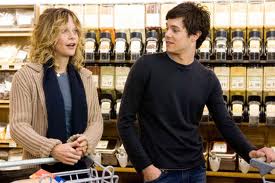
Adam Brody plays Carter Webb, a struggling young writer who writes softcore porn. His girlfriend, Sofia (Elena Anaya), has just dumped him, leaving him heartbroken and uncomfortable. In order to get over this recent breakup, he decides to leave town for a while, and uses the excuse to visit his senile grandmother (Olympia Dukakis) who believes she is dying. He becomes her caretaker for his time spent in this Michigan town, and thus he finds himself “in the land of women.” Aside from his grandmother, two other women come into Carter’s life, and they live right across the street. They’re Sarah (Meg Ryan), with whom Carter becomes friends as they share casual walks around the neighborhood, and her oldest daughter Lucy (Kristen Stewart), who is going through the confusing times of dating in high school and sees Carter as kind of a “big brother,” if nothing more. (There’s also the precocious younger girl in the family, Paige (Makenzie Vega), who develops a crush on Carter. A small flaw in the movie—this subplot goes nowhere.)

Sarah is going through a rough, reflective time in her life, having discovered she has breast cancer and also that her husband is having an affair, which even Lucy knows. And she also feels that Lucy does not love her very much, which she herself blames for certain mistakes in the past. Lucy is having trouble finding the right guy to date in high school, and even dates the complete-jerk of a football-quarterback when she should be dating the kid’s friend, who is actually nice, attentive, and shy. With each woman’s issue, Carter finds he is able to comfort the vulnerable Sarah and give advice to Lucy, even when it may seem that Lucy may actually have a crush on him. Does she or is she even more confused?

Despite what I’ve just described, “In the Land of Women” is not a love story. This came as a pleasant surprise, because while watching this film, I thought I could predict the typical “romcom” aspects that would come with the territory. But no, it’s just that these sweet moments between Carter and Sarah and Carter and Lucy serve as ways in helping each other out through either harsh or unclear points in life. They learn a couple things from one another, Lucy and Sarah can reconcile as mother-and-daughter, and Carter grows as a person. There are many effective scenes in this film that go with that amount of feel, and the film as a whole becomes touching without seeming manipulative. At times, though, it can be a bit too much. The payoff involving the Olympia Dukakis character feels forced and unconvincing. And also, a few scenes turn out to be arguably a little too cute.

The actors are quite good in “In the Land of Women.” Adam Brody is very likable as the nice, reactive leading man; Kristen Stewart is very appealing as Lucy; and Meg Ryan delivers her best performance in quite a while—she has the same Meg-Ryan appeal that made her famous in romantic comedies (such as “When Harry Met Sally”), but more importantly, she shows a greater sense of maturity that makes her more than what she’s usually known for. She’s great here. Also good is Makenzie Vega as grade-schooler Paige, Lucy’s sister and Sarah’s youngest daughter—she’s precocious but not annoyingly so. These actors add to the charm and realism of this effective, understated drama.

10 Things I Hate About You (1999)

6 Jul

images-1

Smith’s Verdict: ***

Reviewed by Tanner Smith

Mix William Shakespeare with John Hughes, and you get “10 Things I Hate About You.” But despite how insipid that may sound, it’s more entertaining and funny than you might expect. This is a charming, amusing high-school comedy that takes elements from Shakespeare’s “The Taming of the Shrew” and brings them to the modern times of late-‘90s high school comedy-drama. The results are an amusing, smart script and talented actors to follow.

The “Shrew” is commonly known as Kat Stratford (Julia Stiles), a high school senior who is a nonconformist (which we immediately figure out in an opening scene where she listens to old hard rock while other girls listen to the hipper tunes) and antisocial. She’s hostile towards certain people, argues in her English class, and is sometimes referred to as “the wild beast.” Her younger sister Bianca (Larisa Oleynik), on the other hand, is the exact opposite of Kat. She’s popular, pretty, and superficial. She wants to date, but her strict father (Larry Miller) won’t allow her to unless Kat does. The shy new kid Cameron James (Joseph Gordon-Levitt), who has an instant crush on Bianca, finds out about this rule. So he and his friend Michael (David Krumholtz, very funny) decide to find a date for Kat. They hire the slick, rich, vain pretty-boy Joey Donner (Andrew Keegan), who also wants to date Bianca, to hire somebody to take her out. He chooses a possible candidate in Patrick Verona (Heath Ledger), the school’s mysterious bad-boy, paying him to date Kat. But this proves to be complicated as Kat immediately thinks nothing of Patrick, other than disgust, and on top of that, Patrick actually starts to fall for Kat. So with some help, he attempts to “tame the shrew.”

If the story sounds like an updated (for 1999) version of “The Taming of the Shrew,” that’s exactly what it is. But not only that—there are many references to Shakespeare throughout the movie. A few lines of the original source are said jokingly (“I burn, I pine, I perish” is what Cameron says when he first notices Bianca); Michael dresses up in Shakespearean-era wardrobe to impress a girl he likes (who also reads “Macbeth”); the high school is called Padua High; sonnets are used as rap lyrics by the English teacher, played by Daryl “Chill” Mitchell; and so on and so forth. It’s all pretty clever in how the film knows that it’s in a Shakespearean story and yet doesn’t go so far that it becomes annoying. It works and delivers a few laughs.

The characters are some of the more interesting individuals you can find in a high-school comedy. Kat is not a one-dimensional “shrew” used as a tool to get the story going; she has reasons for being rebellious and actually does have feelings, which are stated in some early stages, but revealed further as the film continues. Of course we all know early on that Patrick will turn out to become a nice guy underneath the tough exterior, but a refreshing take has it so that Patrick can use it to his advantage. He’s not so much of a blowhard—there’s more to him than meets the eye, which even Kat comes to find. Bianca realizes her conceitedness that popularity brings her to being part of, and discovers she genuinely likes Cameron, who tries everything just to date her. At first, Cameron is a bit selfish and kind of a dork, but when he realizes certain flaws about Bianca’s personality, even he becomes three-dimensional. Michael is kind of an outcast on campus, but at least he knows his place in high school and uses it to his advantage. And then there’s the villain, Joey. I usually hate cardboard-cutout bullies that spoil everything in romantic comedies, but this kid cracks me up because he knows he’s a villain and has fun with his persona. (He’s also a model, which leads a very funny line after being hit in the nose: “I’m shooting a nose-spray ad tomorrow!”)

All of the actors play their parts well. Julia Stiles and Heath Ledger share undeniable chemistry, Larisa Oleynik brings more than meets the eye with her part, Joseph Gordon-Levitt is likable, David Krumholtz is funny, and Andrew Keegan is suitably slimy. Adult actors include Larry Miller as Kat and Bianca’s strict father, who gets a few funny lines every now and then; Daryl “Chill” Mitchell as the wisecracking English teacher; and Allison Janney who is funny as the sex-obsessed guidance counselor (by the way, she only gets two scenes early on and is never seen throughout the rest of the movie—why?). They add to the charm and humor of “10 Things I Hate About You.”

NOTE: I think the Allison Janney character had scenes that were cut out of the movie to give it the PG-13 rating. There are already lines of dialogue that include double-entendres and sexual references (and a drawn penis on Michael’s face), so more of Janney’s sexual talk would probably grant the movie an “R.”

The Karate Kid (2010)

6 Jul

images

Smith’s Verdict: ***

Reviewed by Tanner Smith

I remember reading an online article about a project in development—a Jaden Smith vehicle called “The Kung Fu Kid.” I also remember rolling my eyes at the title, so I decided not to look further into it. Then when I saw the trailer for a Jaden Smith vehicle called “The Karate Kid,” I thought to myself, “Aw come on, really? They’re remaking ‘The Karate Kid?’ Jaden Smith is Daniel and Jackie Chan is Mr. Miyagi?” But you know, you shouldn’t judge before you see the movie. In other words, you don’t have to see a movie, but don’t pretend like you know right away that it’s going to suck. And I was surprised to discover that this modern version of the wonderful (and iconic) 1984 film, which originally starred Ralph Macchio and Pat Morita, is actually a well-made, entertaining film. I’m glad to say that it’s more enjoyable (and more watchable) than any of the original film’s three sequels.

It’s also a pretty good remake. It carries over familiar elements of the original, but is able to tell a new story and allow certain differences that allow it to work as a stand-alone film. Maybe it does share the same sort of hokey sports-drama story that the original sort of introduced to the big screen for the first time in 1984; but when it works, just let yourself be entertained, if you’re willing to accept what’s in store for you.

There is one major problem, though. Despite being called “The Karate Kid,” karate is not the martial art that is being taught here. Here, it’s kung fu—because that’s kind of false advertising, calling a film “The Karate Kid” when karate has nothing to do with the story, and despite that cheesy title I remember reading, maybe it could have just stayed with the title “The Kung Fu Kid.” Ah well, what can you do? People would’ve attacked it at the start either way.

In the original film, Ralph Macchio played 16-year-old Daniel Larusso who moved with his single mother from New Jersey to California, where he has trouble fitting in. In the remake, Jaden Smith plays 12-year-old Dre Parker who moves with his widowed mother (Taraji P. Henson) from America to China, where he is unable to speak the language, doesn’t understand the culture, and of course has trouble fitting in. He does meet one girl, Meiying, who takes an interest in Dre (she likes his hair, particularly) and thankfully does speak English. But their little puppy-love attraction doesn’t do well with the jealous school bully, Cheng, who immediately doesn’t like Dre and beats him up on their first encounter. Like the original film, this bully hangs with a group of friends, and they all study under a psychotic martial-arts instructor (like I said, the original was karate while this one is kung fu) and they’re taught to fight, fight, fight.

When the beatings get to be too much for poor Dre, his unexpected rescuer turns out to be the apartment maintenance man, Mr. Han (Jackie Chan), who as it turns out knows kung fu. Mr. Han agrees to talk with the bullies’ kung fu teacher, but because it doesn’t go well, Mr. Han arranges for Dre to fight the bullies in an upcoming kung fu tournament. It would seem cruel, but Mr. Han decides to actually teach Dre “real kung fu” to prepare for it.

In the original film, the teacher, Pat Morita’s Mr. Miyagi, managed to teach Daniel karate by showing him what can come from manual labor (for example, waxing the car (“wax on, wax off”) enables Daniel to block hits, as it turns out). Here, because Mr. Han noticed Dre’s defiance to his mother for never hanging up his jacket, and so he constantly has him hang it up, put it down, pick it up, and do the same thing over and over again. But as with the original film, there’s a secret method to doing this.

There isn’t anything perfectly fresh about this remake, mostly because much of the material was used in the original. And being a modern sports-drama, it’s fairly easy to figure out whether or not Dre is going to be able to beat the bullies in the tournament, earn respect from his peers, and so on. But there are some neat story aspects that keep it interesting, mainly involving the styles of kung fu. We get a lot of training sequences, all of which are amusing and even insightful (and because Jackie Chan is playing the teacher, you know that what you’re seeing is mostly true), and we even get to see the origins of kung fu, where Dre is introduced to a certain psychology within the art. For example, he notices an exercise involving a woman and a snake—is the snake controlling the woman, is the woman controlling the snake, or are they working as one? It’s a unique psychological element that Dre can of course learn to his advantage, and I think that’s what made the final battle more interesting, because by this time Dre has learned the art all too well and is able to use this ability to play to his opponent’s understanding.

I mentioned that “The Karate Kid” is a well-made movie and it is impressive, particularly in its visuals. Taking place in Beijing, China, you get a lot of great Chinese locations, including the Forbidden City where Dre goes on a field trip in one scene. And you also get the mountains and the Great Wall, which add to the nicely-photographed visual style.

Jaden Smith is a likable kid with a natural screen presence. The movie is a vehicle set up by his parents, Will and Jada Pinkett who serve as producers, but he deserves it. Jackie Chan delivers one of his best performances as Mr. Han, who is actually more complex of a character than you might expect. Mr. Han is not merely as eccentric as Mr. Miyagi was; he’s surlier and more bitter because of some tragic incident that in one scene, he ultimately tells Dre about. (That scene, by the way, is a very powerful scene and it leads to a perfect conclusion that has to do with that same psychology I mentioned above.) Chan is able to pull off a dramatic moment and it’s one of those rare moments that I didn’t see Chan in a performance.

The film is not without its flaws. I already mentioned a sort of lack of freshness in certain elements, but there are some parts that seem overstuffed, including the puppy-love relationship between Dre and Meiying. And admittedly, it is sort of unsettling seeing Dre get beat up brutally by the bullies in the early parts of the film, and also to see Mr. Han able to cause the kids to beat each other up thanks to some clever maneuvers. It probably has to do with the age, but seeing kids get beaten even by each other is not easy to watch. In fact, I’m surprised this film got away with a PG rating; the violence is a bit much for a family-friendly film.

But for the most part, “The Karate Kid” is a well-done remake to an iconic predecessor—keeping nostalgia alive for adults who are familiar with the original film, but not annoying for those aren’t familiar with the source. It’s a nicely-done, entertaining sports-drama that once again shows you don’t judge a book by its cover (or its title).

The Rocker (2008)

3 Jul

24647_gal

Smith’s Verdict: ***

Reviewed by Tanner Smith

Rainn Wilson is usually known for his deadpan-comedic roles, particularly with his memorably downplayed-and-funny role as tight-ass Dwight Schrute in TV’s “The Office.” And I don’t know about you, but to me, it’s refreshing to see him perform in a broader style of comedy, which is the case in “The Rocker.” This is the kind of energetic, physical comic-style acting that Jack Black uses to unique effect. And while there are flashes of Black in Wilson’s portrayal of rock-n-roller Robert “Fish” Fishman in “The Rocker,” you still see Wilson, and he’s more than welcome to entertain us in this way.

I can see a lot of people, or critics are something close to “people,” calling “The Rocker” a shameless ripoff of “School of Rock.” But to me, that’s like saying “Superbad” is a shameless ripoff of “American Pie.” Elements are similar, but execution and added themes and story elements make what you can take from whichever, in this case. Doesn’t every film nowadays have to be inspired by something out of other films? It’s what you can add to it that matters.

Besides, I don’t even see much of “School of Rock” in “The Rocker,” aside from the central character being a washout rocker that gets his redemption. So I can’t exactly argue further with that concept. I’d just wind up becoming lost and confused in the point. Instead, I’ll just review “The Rocker” as it is.

“The Rocker” begins in 1986, which the colorful set design of the stage where we see a rock band performing doesn’t let us forget. That rock band is known as Vesuvius, the hottest band to score a heavy record deal. Unfortunately, that deal requires them to sell out and drop their drummer, Robert “Fish” Fishman (Wilson), to have an executive’s son take his place.

(By the way, that leads to a very funny horror-film type of scene in which Fish chases down the rest of the band as they attempt an escape. I don’t care if Fish running as fast as their van is very silly; it still made me laugh because of Wilson’s wide-eyed determination and the band’s screaming reactions. And it gets better when Fish uses his drumsticks as lethal weapons.)

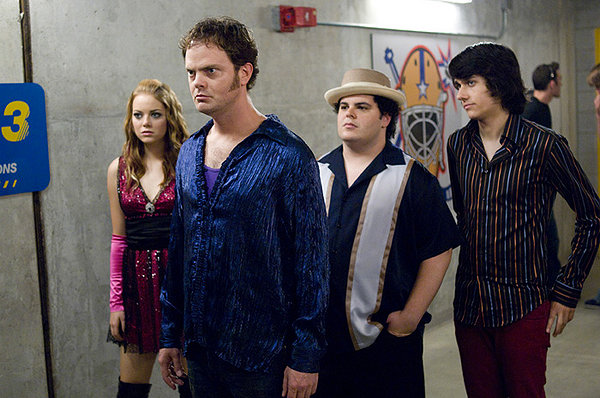
Cut to 20 years later, when Fish has anger issues, particularly whenever Vesuvius, now hotter than ever and earned a spot in the Cleveland Hall of Fame, is mentioned in front of him. Now he’s lost a(nother) job, has been dumped by his girlfriend, and is now living in his sister’s attic. His nerdy teenage nephew, Matt (Josh Gad), plays keyboard in a band with his friends, broody singer-songwriter Curtis (Teddy Geiger) and Goth bassist Amelia (Emma Stone), calling themselves A.D.D. Needing a drummer to play for the high school prom, Fish agrees to step in and play with them…leading to a meltdown when Fish loses control as the band performs Peter Gabriel’s “In Your Eyes.” Feeling guilty, Fish decides to help A.D.D. in landing a gig to make the band known to the public. But fate runs its course as a YouTube video featuring the band practicing (with Fish drumming naked—don’t ask) suddenly becomes viral and A.D.D., with Fish as drummer, has a chance at a career.

We get the standard stuff here with what you’d expect when A.D.D. becomes big—they play different gigs, they become better-known, they go on tour, they film a music video, and eventually, they go through conflicts such as having to ultimately open for Vesuvius. There isn’t anything terribly new in “The Rocker,” but it’s still entertaining and funny and even touching in certain spots. There are many quotable lines of dialogue and very amusing moments, such as why the tour bus driver (Howard Hesseman) uses citizen-band radio, the music-video director’s (Demetri Martin in a funny cameo) overly precise direction, and arguably the funniest, any time Jason Sudeikis is on screen as the band’s slimy manager. Sudeikis gets the funniest one-liners in the movie, including “John Lennon’s rollin’ over in his grave to hide the boner you just gave him!”

There are many moments I found amusing and fun in “The Rocker,” but there is also room for character development, not only with Fish but also with the young band members. Curtis has abandonment issues, which serves as a tool for writing his songs, and now that he’s gaining success because of his words and vocals, he sometimes forgets what Fish of course recalls along the way, that they don’t rock just for fame and fortune. Amelia is a non-smiling punk-girl who becomes more emotional and happier as the film progresses. Matt is an insecure geek that eventually gains confidence and hooks up with a cute fan. I liked these characters. They seemed like real teenagers; their dialogue and interactions with each other seem credible. The actors—Teddy Geiger, Josh Gad, and Emma Stone—play them in an effectively earnest way.

There are other game actors that do well with what they have in “The Rocker.” There’s the standard love-interest that takes a liking to the man-child Fish. She’s actually Curtis’ mom, adding more to the awkwardness that Curtis has to go through later on. Christina Applegate plays the role and she does a fine job, although I have to admit, the relationship between her and Fish feels rushed and not completely fleshed out. But there’s also Fish’s brother and sister, played very well by Jeff Garlin (very funny in a doofus sort of way) and Jane Lynch (in a “tough-love” sort of way). And then, there’s Will Arnett in a brief role as the leader of Vesuvius—without giving away his change of personality in his return late in the film, Arnett is freaking hilarious here.

Sometimes, “The Rocker” will miss its mark on a few jokes/gags (particularly a pratfall early on that seems pretty forced) and a few pop-culture references come close to overdoing it. But mostly, thanks to a steady tone by director Peter Cattaneo (of “The Full Monty” fame), a load of flat-out funny moments, an admittedly-catchy soundtrack (I have to say, I was humming a few of these songs), and a zanily wonderful leading performance by Rainn Wilson, “The Rocker” is gentle, as well as fun, and it rocks. But for goodness sake, stop comparing it to “School of Rock.” True, that film may be superior, but this is a lot of fun too.