Archive | Three Stars *** RSS feed for this section

Ouija: Origin of Evil (2016)

22 Oct

ouija-origin-of-evil.jpg

Smith’s Verdict: ***

Reviewed by Tanner Smith

I didn’t write a full review of 2014’s “Ouija,” because it can be summed up very quickly. It’s lame, dumb, badly-written, and contains a nonsensical twist that makes it worse. Dumb, bland teens play with a Ouija board, bad things happen, they get picked off one by one by a malevolent spirit. You’d think these idiots would’ve seen the “Paranormal Activity” movies to learn not to mess with things they don’t understand. It’s a boring movie with very little to it, other than…the filmmakers wanted to see if they could make a movie about playing a supernatural board game. (Unless it’s Jumanji or Zathura, I don’t care much.)

Side-note: Yes, I know people are terrified of the Ouija board game, but if it was a real hazard to everyone, do you think they would’ve kept it stocked in toy stores all these years? Besides, according to renowned demonologists Ed and Lorraine Warren, it’s not the board game itself that lets in demons; it’s you inviting them in. (You could basically do the same thing with Checkers pieces or a Twister dial, or, if you saw “The Conjuring,” a music box or a doll.) The Ouija board is just a toy. But due to the spiritualistic elements surrounding it, it’s easy for filmmakers & storytellers to try and use Ouija for purposes usually relating to horror elements, which leads us to…

Even though “Ouija” was universally panned by critics, it made a bundle at the box office, leading to the studio getting a half-baked idea that it might warrant a sequel. I have no idea what the planning process was like, but I like to think that studio executives, as well as producer Michael Bay (yes, THAT Michael Bay, whose track record with the horror films he produces is very off-putting), knew there was nowhere for this “franchise” to go but up, and so maybe they knew they had to make this new one as good as possible. Who’s a good director who knows how to make horror movies? Who can take what little the original film had to begin with and make something gripping and scary out of it?

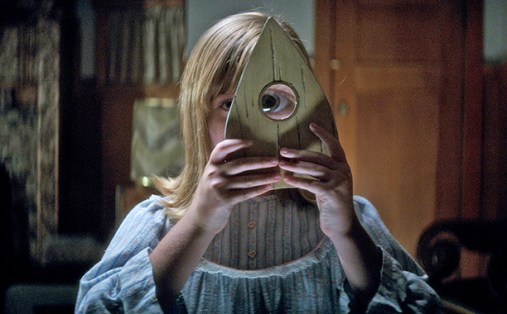
Mike Flanagan is the one they chose to take Ouija in a new direction. His previous horror films include the underrated chiller “Oculus” and my favorite horror film of 2016 by far, “Hush,” so I’d say that was a very good choice. And if you saw my Verdict rating above, you know I think Flanagan did a very good job with “Ouija: Origin of Evil,” a prequel to the 2014 film. I was surprised by how smart and how genuinely chilling this movie is, especially considering its deplorable predecessor.

Set in 1967 (47 years before the other film), “Ouija: Origin of Evil” focuses on one family (as opposed to a group of stock dead-meat teen characters in the first film). California medium Alice Zander (Elizabeth Reaser) is a widowed mother to rebellious 15-year-old Lina (Annalise Basso) and adorable 9-year-old Doris (Lulu Wilson), all of whom are adjusting to life after the sudden death of her husband/their father. Alice hosts séances at home for clients, and her daughters help make the illusion more practical. But they mean well; Alice assures her children that they’re not scammers and they do it to help people, even if their methods are showy. But they themselves would appreciate a real way of connecting to the afterlife.

Alice buys a Ouija board game (property and trademark of Hasbro, whom I hope has a sense of humor in allowing their product associated with grisliness) and rigs it for use at séances. But when Doris begins playing with it, the family discovers to their amazement that they can really communicate with authentic spirits, including the man they lost.

This is a very intriguing premise so far, as we see people using phony methods of connecting with spirits and are bewildered by the discovery of something more real than they expected. But it’s not fun for long, as Doris is in contact with spirits who are much less than friendly. Soon, she is possessed by a black-skinned demon (Doug Jones…of course, Doug Jones). Alice is still blinded by the amazement she feels for the whole ordeal, but Lina is suspicious and seeks help from priest Father Tom (Henry Thomas), who discovers there is far more sinister going on with poor little Doris than Lina or Alice ever expected.

Flanagan has fun with the ‘60s setting, littering the film with retro callbacks, such as space-program references, retro fragments such as the roman numerals (of the date) at the bottom of the title card, the classic Universal logo that opens the film, and even inserting little black blips at the top-right of the screen to make it appear as if it was projected on film. With the exception of an obvious CGI figure that (thankfully) only pops up about 2-3 times, “Ouija: Origin of Evil” looks and feels like a film that was made and released in the late-‘60s. But Flanagan also knows how to use scares effectively. He uses jump-scares scarcely (I think the first fake-out scare was intended to be funny rather than annoying, thank goodness), he eases people in with tension and a creepy feeling without overloading the buildup with falseness (a problem most horror movies face today), and then, in the overbearing climax, that’s when he pulls out all the stops. That’s what a good horror film is supposed to do: ease the audience into its weirdness/creepiness and let it all out when the time is right, by which point the audience is very much on-edge.

But wait, you may ask. How is it scary? Flanagan uses creepy visuals, even out of focus in the background. He shows horrific things happening. And like I said, he uses false jump scares scarcely—when there are real jump scares, there’s actually something to be scared of. (I know, a shocking concept, right?) And overall, it’s creepy. It leaves you with the knowledge that there are dangerous forces at work and are playing with Doris’ mind and haunting Alice and Lina’s lives, and it builds its suspense from there. The climax is a little overbearing, with everything becoming a threat around every corner of this house (including a creepy basement and a hidden room), but it deserves to be by that point.

But a horror movie wouldn’t be nearly as effective if we didn’t care about the characters this stuff is happening to. Flanagan manages a win with this as well, picking three very good actresses (Elizabeth Reaser, Annalise Basso, and Lulu Wilson) who successfully deliver a family dynamic and play people we care about and fear for. Henry Thomas is also solid as well, playing a man of God who is also looking for otherworldly answers ever since his wife died.

It’s important to note that no one needs to see the 2014 “Ouija” film before seeing this “prequel.” This works perfectly well as a stand-alone story, and its predecessor needs no more attention than it already got. “Ouija: Origin of Evil” is much better than it deserves to be. Not that I would want another “Ouija” movie to come from this—I mean, after all, just like there was nowhere for the franchise to go but up, this franchise seems like it can only go downward from here.
The Final Girls (2015)

14 Oct

1474240819793074470

Smith’s Verdict: ***

Reviewed by Tanner Smith

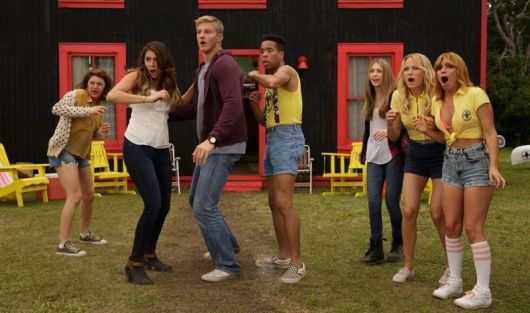
“The Final Girls” wants to be both a satire and a loving homage to ‘80s slasher horror films, but I don’t recall any “Friday the 13th” or “Sleepaway Camp” film (and yes, I’ve seen my share of those films) with a universe so…colorful. Let me explain—“The Final Girls” is about a bunch of modern teenagers who are magically transported into the world of an ‘80s slasher film they were watching, and this new dimension is the mid ‘80s in full Technicolor. The flowers are artificially colored, the leaves are brightly green, the characters wear bright colors, and so on. This is more like “Hot Tub Time Machine’s” interpretation of the ‘80s than, say, “The House of the Devil.” (Both “The Final Girls” and “Hot Tub Time Machine” apparently picked the same ‘80s year too: 1986. Odd coincidence.)

But no one should be complaining too much, because the overly-retro look of the exaggerated movie-‘80s adds to the fun. We can associate it with the ‘80s, and that’s good enough. “The Final Girls” is meant to be a spoof rather than a genuine horror film. And while it lampoons its own nostalgic callbacks with self-awareness, it embraces them with admiration too. We get the stereotypes (the jock, the slut, the token minority, etc.) lined up for slaughter by a silent, demented killer in a secluded summer camp, accompanied by present-day young people who observe the madness.

The main character of “The Final Girls” is Max (well-played by the appealing Taissa Farmiga), a college student whose mother (Malin Akerman) played one of the many victims in a popular mid-‘80s slasher film, entitled “Camp Bloodbath.” A year after her mom dies in a car accident, Max reluctantly agrees to appear at a “Camp Bloodbath” retrospective as a favor to Duncan (Thomas Middleditch), the nerdy stepbrother of Max’s sarcastic hipster friend Gerty (Alia Shawkat, “Arrested Development”) who arranges the screening at a local theater. Accompanying Max, Duncan, and Gerty are Max’s sensitive-jock crush, Chris (Alexander Ludwig), and an unwelcome Vicki (Nina Dobrev), who can’t seem to get over the fact that she and Chris are broken up. Soon after the movie starts, the theater is caught on fire, and the five kids try to escape behind the screen. They realize too late they have actually escaped through the screen and into the movie itself.

They find that the movie plays on a loop and the only way to get out of it is to go through it with the central characters. This proves to be a difficult task, as things seem too real in this world, especially the killer who waits in the woods for the perfect (and appropriate—or inappropriate) moments to strike. Now they have to try and make it through the film without becoming victims themselves.

Another difficulty in this journey is the reunion between Max and her mother—er, her mother’s character, in her early 20s. Max wants to make sure her mother doesn’t fall victim to the killer, thus trying everything possible to change the course of the film. The relationship between Max and her mother is very strong and helps bring an emotional backbone to a film that is otherwise a joyful romp. The film is surprisingly serious-minded when it comes to this aspect’s themes of loss, redemption, and fear of losing again. On top of that, both actresses play their roles very well. And this relationship also has light comedic purposes, such as Max having to play mother to her own mother, whose character is eager to lose her virginity to the class-A horn dog Kurt (Adam DeVine), which will of course result in her murder by the on-looking killer. That’s funny, but it’s also emotional when you consider that she feels the need to protect her from the hardships of the real world.

One of the film’s running gags is that these five central millennial characters have to play practical parental roles to these ‘80s-movie archetypes such as teaching the airhead slut Tina (Angela Trimbur), And these types are more than exaggerated, which should irritate me but strangely left more of an impact on me as it went on. Maybe it had to do with the context of 2015 archetypes going through all this—somehow, it makes me wonder what people are going to make of this young generation decades from now. What would they see in us (or in our movies) that we simply don’t see ourselves today?

Wow, I just wrote myself into a philosophical topic in a review of a broad comedy.

You know what? I’ve said enough. Check out “The Final Girls.” It’s entertaining. It’s funny. It’s cute. It’s even touching at times. It’s well-written, and it’s worth nothing one of the writers was Joshua John Miller, whose father was Jason Miller (well-known as Karras of “The Exorcist” fame); maybe he developed the character of Max as a way of dealing with his own parental loss. And of course, it’s very colorful. Metaphorically and literally.

V/H/S/2 (2013) – V/H/S: Viral (2014)

27 Aug

VHS2-Short-Safe-Haven-Still.jpg

V/H/S/2

Smith’s Verdict: ***

Reviewed by Tanner Smith

As someone who enjoyed the found-footage horror anthology “V/H/S” as more-or-less a “guilty pleasure,” I was curious to see what could be done as a follow-up. Would “V/H/S” be a worthy horror franchise or would it wear out quickly after a desperate cash-grab attempt?

“V/H/S/2” (or “S-V/H/S,” as it was originally called) is about on par with “V/H/S” in that it’s uneven yet enjoyable for the best parts (just enough for me to recommend). There is one big difference, however—“V/H/S/2” has a middle segment that is creepier, more outrageous, and more fun than any of the other segments in either of the two “V/H/S” films. It itself is a terrific horror film worthy of a recommendation.

Once again, the wraparound story for the anthology involves people sneaking into a house and watching unsettling VHS tapes. While I thought the previous film’s connective tissue had some chilling subtle moments, I felt it was weak overall with a lack of clever resolution. But with this one (directed by Simon Barrett), I surprisingly found myself more involved in what was happening, as once again, little things change here and there that had me edgy—the surprise was I thought the twist was actually unique and well-done. My only problem with it is after the characters watch the segments in between. The things they see don’t seem to faze them very much; they just seem to shrug it off and continue to the next one each time.

The first segment (“Phase 1 Clinical Trials,” directed by Adam Wingard) is shown through a man’s ocular implant with a camera. The doctors warn him that the implant is experimental (hence the camera, to see how things go at first). Shortly after he gets it, he starts seeing visions of people who shouldn’t be there. It’s an unsettling, effectively done chiller with an ending that made me look away.

The second segment (“A Ride in the Park,” directed by Eduardo Sanchez and Gregg Hale) is shown mostly from the POV of a Go-Pro attached to a bicyclist’s helmet. The bicyclist is attacked by a zombie and soon becomes one himself. He turns others into zombies and they set off in search for fresh meat. This is a neat twist on the zombie-movie, with enough visceral gore to appease genre fans.

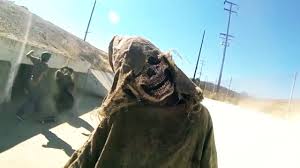
The third segment is the aforementioned best: “Safe Haven,” directed by Timo Tjahjanto and Gareth Huw Evans. The narrative here is more intricate than any of the previous segments, and it definitely works as its own short horror film. It involves a news crew getting the scoop on a cult run by an Indonesian deportee (played chillingly by Epy Kusnandar) who promises immortality to his followers. I could tell where this was going as soon as I knew a cult was involved, and it seemed to lead to where I thought it would. But after that, there was still about 15 minutes left to go…and man, I was way off! Would you believe me if I said Kool-Aid was the least of the worries here? This segment has a ton of surprises, neatly horrific developments, and unforgettable additional elements that make it worth recommending for all genre fans, if they can take it.

Unfortunately, after that, we get to the weakest segment in the series: “Slumber Party Alien Abduction,” from Jason Eisener (best-known for “Hobo With a Shotgun”). With a goofy fun-sounding title like that, I expected much more than what I got. Maybe it was because nothing could top “Safe Haven,” but I just wasn’t interested in this part at all. It’s fairly straightforward—teens have a sleepover, aliens invade, they try to get away, they get abducted, the end. Oh, and there’s a camera attached to a dog. It might be enjoyable for some, and it may not be fair comparing it to “Safe Haven” after all, but I expected a better end portion than this.

I recommend the film overall, but it really comes down to “Safe Haven.” It’s worth seeing just for its own insanely entertaining bit of craziness.

But then we take a step down in quality and quantity; the ultimate end of a promising horror franchise; the final nail in the coffin…

url.jpg

V/H/S: Viral

Smith’s Verdict: *

Reviewed by Tanner Smith

“V/H/S: Viral” is not merely bad—it’s obnoxious. With the previous films, you could tell they were labors of love from indie filmmakers having fun with this style of “hyper-realistic” horror. But with this, you can tell it’s a feeble cash-grab attempt. I don’t feel any passion put into this at all, and everyone else seemed to agree with me, as no future “V/H/S” films were planned since this film’s release.

I think what this film is trying to say is that we’re all obsessed with viral videos and many members of our generation are looking to capture the next best online hit. I think (but I’m not sure, as the motivations are muddled at best) that was the intention of the wraparound story to present that message. But the result is so confused and baffling that it’s hard to find the sense in it. Even the ending, which should spell out what it means, left me scratching my head. But on the plus side, it made me feel better to know it was over and I didn’t have to think about it anymore.

From what I could gather, it’s about teens trying to make their own viral videos and weird things happen that endanger their lives…and that’s all I got.

There’s no structure of people finding VHS tapes and watching horrific shorts. It’s just a bunch of random shorts thrown in between this strange supposed-wraparound.

(Just to state up front—I won’t list any names of the directors of these segments. I like to think I’m doing them a favor.)

The first random short is “Dante the Great,” which is about a magician who obtains a mystical cloak that truly is magic and gives him unbelievable power, which goes to his head. His assistant has to confront him and fight him one-on-one and somehow gain the upper hand against his real magic. This actually would be a neat idea and the effects are decent, but its execution is all over the place. Sometimes, it’s shown as a documentary. But then there’s hidden camera footage that no one could have gotten. There’s cheating in “found-footage,” and then there’s this.

The second segment is “Parallel Monsters” is a little better. It has an intriguing concept of a guy unlocking a portal to another dimension and switching places with his counterpart, only to find that it’s not what he expected at all. What he finds is creepy enough and it leads to some effective imagery. But unfortunately, it ends on a disappointing note.

After the passable “Parallel Monsters,” we are then cursed with the most detestable part of the film: “Bonestorm,” about a bunch of loud, rude, crude, vulgar, obnoxious, detestable skateboarders who go to Mexico and fight off a bunch of cult members looking for a sacrifice (I think; it was hard to tell exactly what was happening). This is what got me over the edge, as I facepalmed myself and wondered if it was even worth sitting through the rest of this thing. But I faced it head-on, as painful as it was. “Bonestorm” was such an aggressively bad short. Its shot choices are repetitive and with no style put into it, making it painful to look at—even skateboard videos and video games have more style than this thing.

Even the message of the film makes no sense! I just realized that even though there’s this stupid wraparound story that’s supposed to talk about young people and their obsession with “going viral,” neither of these three segments have ANYTHING to do with that in the slightest! They’re just random shorts trying to recapture that spirit of the previous films and failing miserably. No thought went into this at all. “V/H/S: Viral” is a lazy, badly-done conclusion of a “trilogy” made by people who I would guess didn’t care for what it was going to be as much as how quickly they could turn it in. I hated this movie.

V/H/S (2012)

27 Aug

VHS - Lily I Like You.png

Smith’s Verdict: ***

Reviewed by Tanner Smith

The “found-footage horror” genre is very hit-and-miss. It’s an excuse for filmmakers to turn out a product with a shoestring budget. Some of them do it well, bringing viewers into the hyper-realism style of execution. Others do it horribly, just using it as an attempt to cover up that they have very little to offer in terms of story, characters, or even scares. “V/H/S” is a found-footage horror anthology that is very hit-and-miss, in that some chapters in the saga are effective while some are…well, not as much.

“V/H/S” tells six stories (each told from a different director), neither of which ties in at all to anything except for the wraparound story which is mostly composed of people watching the other segments anyway. (That’s a clumsy tie-in, but whatever.) The wraparound story (or “Tape 56,” director by Adam Wingard, whose film “The Guest” I really enjoyed) involves a criminal gang (who film their activities for some reason—not a smart idea, guys) as they break into a house in search of a special videotape. While searching, they find a body seated in front of a TV set with a VCR and many unlabeled tapes. So they watch the tapes…

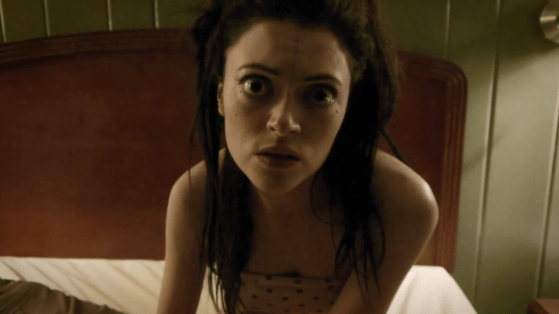
The first tape (“Amateur Night,” directed by David Bruckner) shows three guys out on the town, one of whom has a hidden camera on his glasses with which they hope to make an amateur porn video. They manage to pick up a particularly strange young woman who turns out to be a succubus with a taste for human blood. This is one of the two most effective segments in the series, as well as the most fun. Its ability to hold the action in one shot (from the POV of the character wearing the camera-glasses) is impressive, the ultimate make-up on the succubus in monster/humanoid form is well-done, and the gore was enough to make me wince/cringe (that’s no small feat).

Side-note: This isn’t really an actor’s movie, but the casting for the succubus was very effective. The actress, Hannah Fierman, has a great blend of adorableness and uneasiness (and her wide-eyed stare is unsettling as well).

The next tape (“Second Honeymoon,” from one of this generation’s most promising horror filmmakers, Ti West) shows a couple on their second honeymoon. They film themselves doing silly things, but things get creepy when someone breaks into their hotel room (in a genuinely disturbing scene). This segment is one of the weakest, as it leads to an unsatisfying payoff. A disappointment from West. (OK, not “Cabin Fever 2”-disappointing, but still disappointing.)

The third tape (“Tuesday the 17th,” by Glenn McQuaid) has an interesting idea but isn’t portrayed in an interesting-enough way. It features a group of obnoxious teens exploring some woods which supposedly have a horrific history to them, when it turns out the killer is only able to attack when there’s a camera on him. One girl knows about it and tries to prove it by…filming her friends being killed by this digital slasher. (Not a great plan.) I like the idea of the killer only being seen through the interference in the camera’s viewfinder, but it’s just not enough to be exciting or scary.

The fourth tape (“The Sick Thing That Happened to Emily When She Was Younger,” by mumblecore-protégé Joe Swanberg) is my favorite. It’s told entirely through Skype, as a scared woman believes her house is haunted and tries to convince her boyfriend of what’s going on. I won’t reveal the twists here, but I found them chilling and even fascinating.

Finally, we get the final entry (“10/31/98,” by Radio Silence), in which four guys in search of a Halloween party find themselves in a haunted house, where a Satanist ritual seems to be happening. When they realize it’s not a joke and they’re at the wrong party, they find themselves in a terrifying situation. To put it in the best, most positive way, the ending of this segment is the film’s mike-drop.

The wraparound story has its chilling little touches when the film cuts back to it, such as things that weren’t there before but are suddenly there or the other way around. But unfortunately, its resolution is weak at best. In fact, I would barely even call it a “resolution.”

As a whole, “V/H/S” is half-intriguing and half-annoying. Three segments are unnerving and enjoyable in their way, while the other three have their scary moments at times while each of them don’t necessarily satisfy as its own piece. They all barely connect. They just have one thing in common—they were made by promising horror filmmakers who pride themselves in visceral shocks and scares. Not that I would say these short segments show the best of their craftsmanship, but I appreciate the effort given with their limitations of the “found-footage” genre. So, in a way, I would recommend “V/H/S” as a fun thrill ride if you and your friends are bored and feel like checking out an ambitious horror film with good scares to offer. That’s about as high a recommendation as I can give without necessarily letting it slide with a “mixed review.”

True Story (2015)

14 Mar

JonahHillJamesFrancoTrueStory1

Smith’s Verdict: ***

Reviewed by Tanner Smith

“True Story” couldn’t be more aptly titled. When one hears another tell a story about something, especially when that something is a serious crime, it’s hard to tell if the person telling the story is telling the exact truth or an exaggeration of the truth (if not lying entirely) and even harder for the listener to know what to believe, especially when there is no second side to the story, or at least no one to hear it from. In this film, journalist Mike Finkel was booted off the New York Times for fudging some facts of an important story he wrote for them, after he had defended himself by saying he got enough important details from the experience (but with no notes to back it up). His attempt to redeem himself comes when convicted killer Christian Longo steals Finkel’s identity and Finkel, oddly flattered by the fact that someone knew of him, decides to visit him from time to time to know more about him and get his true side of the story behind his crime of murdering his wife and children. Finkel plans to write about his meetings with Longo for a book, titled “True Story.” But the more Finkel learns about Longo and about the crime, the more he questions what’s true, what’s fabricated, and what’s exaggerated. What is truth? What are lies? What is manipulation? Is the title “True Story” accurate or ironic? You can wonder if the story within the film is true even of itself. (Surely, some liberties were taken, of course.)

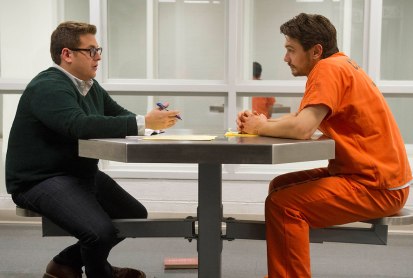
“True Story,” based on the actual Michael Finkel’s 2005 book of the same name, is less of a crime story and more of a drama about the codependent relationship/twisted friendship between Christian Longo (convicted killer) and Mike Finkel (his biographer), each of whom begin their relationship with an agenda, though it’s unclear whether they’ve achieved it or not. That’s one of the things that makes the film all the more fascinating, on top of the efficiently understated performances by the actors playing the parts: James Franco as Longo and Jonah Hill as Finkel. Both these actors are known for comedic roles, but their low-key approaches to these serious roles suit them rather well. Hill is believable as a writer who’s sure about his brilliance in his craft, which makes it even more believable when he feels he’s been duped. And Franco delivers one of his very best performances in an unsettling turn as a master manipulator who is so sure of himself as someone who may be able to win over a jury with his charm at a murder trial.

Also very good in this film is Felicity Jones as Finkel’s girlfriend, Jill, who stands by her man when things are tough and mostly stays out of things until a crucial moment late in the film when she meets Longo for herself and decides to tell him a thing or two. I normally grow tired of the cliché in which a secondary character stays quiet for a majority of the film until late in the game when he or she finally says something of significant importance, but when it works, it really works. And that is certainly the case here—Jones nails this scene and her dialogue is choice.

True_Story_2015_Blu_Ray_1080p_mkv_004859000

But this also brings up a problem I have with “True Story”: the script. It may sound odd to you, but I think the script “True Story” is too good. It’s a weird criticism, I know, but a good deal of the dialogue sounds too carefully written. Take this introductory exchange between Longo and Jill when they first meet: she tells him, “I thought you’d be taller.” “Why?” “I don’t know. Maybe because [Mike] looks up to you.” Something about that sounds rehearsed, like it’s part of a play, and her story she tells to Longo, as tough as it sounds, still sounds staged.

But wait…she’s telling a story to get something important across to Longo, much like how Longo has been telling stories to get points across to Finkel and the trial jury. So…isn’t that kind of the point and I’m contradicting myself with this criticism?

Well, another problem with the script is that it can be a little heavy-handed, with obvious statements to make, sometimes repeatedly. And the scene I praised before probably wouldn’t plausible without Longo getting some chance to defend myself, no matter how hard Jill’s words may hit home for him.

Maybe I’m a little unfair with that criticism, because the overall film is very powerful and a solid drama with respectable performances and neat direction by Rupert Gould. It’s an interesting portrait about biography, human conduct, and how it’s not always easy to get what you want no matter how high the stakes are raised. Especially in the aftermath of a heinous crime.

The Visit (2015)

19 Jan

the-visit-03

Smith’s Verdict: ***

Reviewed by Tanner Smith

M. Night Shyamalan is a talented filmmaker who has made his mark with “The Sixth Sense” and followed it up with hits such as “Unbreakable” and “Signs.” But after “The Village,” which has split audiences right down the middle in terms of opinion, he has taken many bad spills in his career, resulting in him being the punchline of many movie-related jokes. (These spills are titles such as “Lady in the Water,” “The Happening,” “The Last Airbender,” and “After Earth.”) He was in desperate need for a comeback—if not a home run, then a solid base hit at least. Thankfully, he accomplished a double-base hit with “The Visit,” his best film in at least ten years.

What made his bad films bad? For one thing, they were so damn self-serious. He successfully made it work in his heyday, but after that, he turned in some pretentious, forced filmmaking elements that made his last few films insufferable. That’s why it’s such a relief to actually laugh at the very entertaining “The Visit” because I’m actually supposed to. It is a horror film and it is unnervingly chilling, but at the same time, it’s very funny. I haven’t seen a film work with that kind of balance before, and I applaud Shyamalan for not taking himself too seriously like he did before.

I’m getting ahead of myself. The story: Becca (Olivia DeJonge) and Tyler (Ed Oxenbould) are suburban teenage siblings visiting their grandparents, who haven’t spoken with their daughter, the kids’ mother (Kathryn Hahn), in decades. Becca is an aspiring filmmaker and decides to make a documentary about the visit, these people, and the effect their rejection had on her mother. The kids like their grandparents, Nana (Deanna Dunagan) and Pop Pop (Peter McRobbie)—they seem nice, they’re funny, they seem like grandparents you find in a storybook. But soon enough, they start to notice something isn’t quite right here. Pop Pop keeps going out to the barn by himself. Nana asks Becca to climb all the way into the oven to clean it. The kids hear ominous sounds coming from outside their bedroom at night. And so on. (One of the few problems I have with this movie is whenever the kids tell their mother how “weird” their grandparents are being, she uses the excuse: “they’re just old.” Right.)

As is typical of a Shyamalan film, there is a twist that is revealed late in the proceedings—what IS the deal with these kids’ grandparents? I was watching this movie like a hawk, looking for clues and hints that could lead to what the twist could probably be. Imagine how surprised I was when I didn’t guess it correctly. I’ll be honest—I was so shocked, I felt the world expand around me as the reveal became clear. Then I facepalmed myself for not seeing it coming. (Watching the film again, knowing the twist, actually made the film even more entertaining, which is a huge plus.)

The film is very good at balancing horror and comedy. For example, early in the film, there’s a chilling scene in which Nana chases the kids in a crawlspace under the house, but it turns out she was just playing a game. Moments like this keep the audience guessing, glued to their seats, and wanting to know what’s going on, and it leads to a most entertaining final act; the less I say about that, the better.

The film is shot in found-footage style. Since the film is supposed to be put together like Becca’s documentary, we see everything through the perspective of her camera. This was probably Shyamalan’s biggest risk to take, since this style is wearing out its welcome (though, that’s what people said three years ago and yet films like this are still being made). But he managed to inject some energy into this approach, making executional flaws excusable. (Among the flaws: the video and sound are TOO good for a kid making a documentary, so it’s a little hard to get a natural feeling from the entire film.)

Dunagan and McRobbie are a hoot as Nana and Pop Pop, playing the roles with exaggerated delight. DeJonge is fine as a budding filmmaker who can be pretentious at times, explaining things to her brother like “mise en scene” and “the elixir” and so on. Oxenbould is a riot as Tyler. I forgot to mention this kid wants to be a rapper and often replaces swear words with pop-artist names (for example: “Sarah McLachlan!”)—he raps a few times in the film. Oh and he’s a germophobe…and I won’t even begin to mention how that quirk comes into play later in the film.

Shyamalan hasn’t made the film totally natural. (I already nitpicked the technical aspect, and while I’m at it, sometimes the dialogue and deliveries aren’t entirely convincing.) But he has learned to lighten up with his craft. In doing so, he redeemed himself, making his remaining fans (such as me) wonder what he’ll come up with next. “The Visit” is a lot of fun, even if it isn’t a complete success.

Star Wars Episode VI: Return of the Jedi (1983)

25 Nov

returnofthejedibdcap9_original.jpg

Smith’s Verdict: ***

Reviewed by Tanner Smith

It’s often that the final chapters of trilogies are usually the weakest (with a few exceptions, of course), with examples usually being “The Godfather Part III” and “Star Wars Episode VI: Return of the Jedi.” The possible answer as to why that’s usually the case is the filmmakers/storytellers played their cards too early and what brilliance they crafted before pale in comparison due to less innovation and so few new things to offer. In the case of “Return of the Jedi,” the last chapter of the original “Star Wars” trilogy (and the end of the series, for that matter, until “The Force Awakens” is released next month), its success rides on seeing familiar characters gain resolution and its failure comes from what it takes to get to said-resolution. It’s sad to say this is kind of a “hokey” film with quite a few silly and/or disappointing moments but just enough good moments in it that keep it from being “bad.”

Let me put it this way—would I care about “Return of the Jedi” if Luke Skywalker, Han Solo, Princess Leia, Darth Vader, Chewbacca, C-3P0, R2-D2, and Lando Calrissian were replaced by characters we were newly introduced to? My answer is “no,” and that is my biggest problem with “Return of the Jedi”—it only feels like a “Star Wars” film because these characters are still involved. I’ll get to my biggest issues with the film soon, but for now, I’ll list some positive things about it.

For one thing, the actors have truly grown into their roles. In particular, Mark Hamill’s Luke Skywalker has grown up and is not the whiny farmer boy he was in the first “Star Wars” film—Hamill does a good job showing Luke’s maturity and delivers a strong performance. Luke’s conflict (knowing Darth Vader is his father and wanting to save him without turning to the dark side) is a fascinating one and it’s portrayed very well. His resolution is also very satisfying, without giving anything away.

For another positive aspect, the first 40 minutes are exciting, as Luke, Leia, C-3P0, R2-D2, and Lando rescue Han Solo from the clutches of Jabba the Hutt, a big, disgusting blob who is a crime lord for the planet of Tattooine. It’s a tense opening half with a truly nasty antagonist and a mysterious intenstine-like monster in the sand of the desert.

There’s also the Emperor, played by Ian McDiarmid. McDiarmid plays the Emperor as evil incarnate—a cunning, devil-like ruler who knows just what to say in order to manipulate people and get what he wants (it’s no wonder Luke’s father was able to turn to the dark side; this is also made clearer in “Episode III: Revenge of the Sith” released many years later, but I’ll get to that later). And he’s clearly enjoying every minute of it. He may even be more intimidating than Darth Vader ever was. The scenes in which he tries to win Luke over to the dark side are very tense.

And of course, the characters are the friends and enemies we have come to know. Han and Leia still have good chemistry, C-3P0 and R2-D2 are still funny, Chewbacca is still loyal, Lando gives us another human hero to root for, and Darth Vader is still imposing (though not as much as in the previous films).

And now for the negative things I have to say about “Return of the Jedi”…

Is it any surprise that among them are the Ewoks? Many people seem to hate these indigenous teddy-bear-like creatures, and I can see why. They’re unbearably cute and were probably only brought in to bring more kids in after the dark turn the series took with “The Empire Strikes Back.” That’s another problem with this film—after the complex darkness introduced in the previous film, it’s disappointing that this film decided to play the “cute” route.

Another big issue I have with the film is the resolution involving the love triangle between Luke, Han, and Leia. Luke’s relationship with Leia is unbelievably forced, as if George Lucas didn’t want to think too much about how this small conflict could be resolved with Han getting the girl, so he took the easiest way out, worthy of soap-opera status. (Though, I do love Han’s reaction upon hearing from Leia who Luke is in relation to her.)

Then there’s the final battle between the rebels and the Empire. It’s underwhelming; you don’t feel nearly as much weight as you should, given what was being built up all this time.

On top of all that, the special effects don’t hold up as well today. There’s too much obvious green-screen action and not enough practical effects to satisfy. The central chase sequence in which enemies chase heroes through a forest with hovercraft is not entirely convincing and it’s distracting enough to notice the white outlines on actors’ bodies.

But with that said, “Return of the Jedi” is undoubtedly the weakest entry in the original “Star Wars” trilogy, but it’s still a fun watch. It doesn’t have the same sense of enjoyment as the original “Star Wars,” but it’s still, in a way, a worthy chapter in the trilogy, if not the best one to go out on. It still has the familiar characters, some good sci-fi action, and enough entertainment to make the running time of two hours and 11 minutes go by quickly. It’s enjoyable even if it might not be what most “Star Wars” fans were expecting.

Escobar: Paradise Lost (2015)

10 Oct

foto_escobar-paradise-lost-74297

Smith’s Verdict: ***

Reviewed by Tanner Smith

I guess I should start this review by saying that the title, “Escobar: Paradise Lost,” makes it seem like Pablo Escobar is the central focus of the film. That is not the case. Like “The Last Kind of Scotland,” “Me and Orson Welles,” and “My Week With Marilyn,” “Escobar: Paradise Lost” is less about the historical figure and more about how a young person sees him or her during a life-changing experience. I think “Me and Escobar” or “Escobar and Me” or even “The Escobar Supremacy Ruined My Life” would’ve been better (just kidding).

Because the performance by Benicio Del Toro as Escobar is so brilliant, people have complained that this film fell back on its potential by having its main character be a less-than-interesting young man trapped in Escobar’s world. But for what it is, I think “Escobar: Paradise Lost” is still a riveting drama with a lead that is unfairly evaluated. At its core is the story of a young man who realizes too late what he’s gotten himself into, leading to confusion and betrayal. This story’s been done before, but if done right, it can still work effectively, which I believe is the case here.

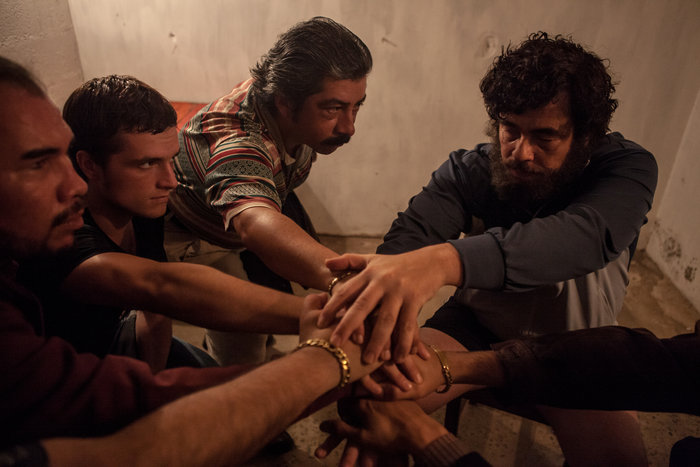
Josh Hutcherson stars as Nick Brady, a young Canadian surfer who lives in a surf shack on a beach with his brother (Brady Corbet) and his family. When Nick meets and becomes involved with a young beauty named Maria (Claudia Traisac), she invites him to meet her family, including her uncle, Pablo Escobar. Nick is naïve enough to believe that Escobar’s cocaine trade is for medicinal purposes and he’s only exporting “the national product,” so he falls in with the family. But as time goes by, little does he know that Escobar has been gradually luring him into his circle of influence, and by the time he understands the danger he’s in and is about to leave town with Maria, he’s called in to hide the “goods” to a secret location, where he must shoot and kill a local who will take him there.

This leads to a very well-done, extended, suspenseful sequence after which Nick meets the guide he is supposed to kill…and it’s a kid. The tension mounts over a long period of time, as horrified Nick is nervously trying to think of what to do. The back half of the film is the most powerful portion, with action, suspense, and even drama.

Benicio Del Toro is only on screen for I’d say about half of the film, but his presence dominates the entire film with a creepy blend of allure and malice, as he orders death with straightforwardness while holding family and God close to heart. Del Toro plays a monster in human form.

Josh Hutcherson, one of my favorite young actors working today, is quite believable in a role that may not have been written well but is surpassed by his credibility. There’s a scene late in the film where he comes to a hasty decision in order to attempt to save someone, and he plays it very effectively. Because of his performance, I didn’t mind that this was our lead and Escobar was merely second-billing.

My only problems with the film involve the supporting cast. There aren’t many memorable characters in either Nick’s family or Escobar’s circle, and this can welcome criticism with an obvious comparison (“The Godfather”), but then again, this isn’t that film, though it would’ve been nice to meet someone else on the same level as Del Toro. As for the relationship involving Nick and Maria, it falters because Maria starts out interesting but then becomes less of a character as the film moves along.

And something else people complain about with this film is that it’s two movies at once—a true story of the notorious Colombian drug lord of the early 1990s and an action-thriller about an innocent trapped in a web of violence. I would agree with that, but I’m not going to judge too harshly on it, because the film begins with Escobar telling Nick what he needs him to do while hiding the drugs and then flashes back to Nick’s surfing days before he even met Maria. So it keeps the tension level up by telling us something important, showing how it came to this, and then catching back up to where it left off. So I didn’t mind.

Maybe a biopic starring Del Toro as Pablo Escobar would’ve been intriguing because Del Toro does such a good job in the role, but for what it is, I recommend “Escobar: Paradise Lost,” due to Del Toro’s powerful performance, Hutcherson’s charisma, and a skillfully crafted second half.

Me and Earl and the Dying Girl (2015)

10 Oct

me-and-earl-and-the-dying-girl

Smith’s Verdict: ***

Reviewed by Tanner Smith

I might use this review as an opportunity to write about two pet peeves I have with some recent quirky, independent comedy-dramas. One is what I like to call Kind of Aware But Not Quite; that’s when a film is so self-aware of itself that it has a character point out the clichés, thinking that commenting on it will make it less of a cliché. The other is Excessive Comic Relief: desperate side characters thrown in by screenwriters who don’t think the comic relief they have already isn’t funny enough—these people tend to A) appear as if they’ve come from another planet of social skills, B) distract away from the plot & leads, as if they should have a movie of their own, and C) are not very funny. (There’s also D) all of the above.)

It may seem a little odd that I’m going into these pet peeves in a review of a movie I like rather than a movie I dislike, but I decided to because…I came close to disliking “Me and Earl and the Dying Girl.” This film has its heart in the right place, is visually interesting, and has a fresh, engaging trio of young people to focus on. It’s also a little too self-indulgent and features some strange, off-putting side characters that I’m sure are funny to some but just strange to me. (But hey, it apparently worked for everyone at Sundance, seeing as how it received the Grand Jury Prize and the Audience Award.) But honestly, after watching this film twice, the material I like, I find I really like. It makes up for some of the things I find off-putting in this film.

Based on the novel by Jesse Andrews (who also wrote the screenplay), “Me and Earl and the Dying Girl” centers on a high-school senior named Greg (Thomas Mann). He’s narcissistic, socially awkward, has little to no ambition in life, is very neutral on school grounds (so he doesn’t make any friends or enemies), and is a classic-film lover. He also makes bad home movies, which are parodies of classics (for example, “Brew Vervet” for “Blue Velvet”), with his only friend, Earl (R.J. Cyler), whom he doesn’t label as his “friend” even though they’ve known each other since kindergarten.

Greg’s classmate, Rachel (Olivia Cooke), is diagnosed with leukemia. Greg hardly knows her, but his overbearing mother (Connie Britton) insists that he pay her a visit. With his honest, offbeat, oddly charming manner, he manages to get through Rachel’s defenses and soon enough, they become close friends. One of the best things about this film is the relationship between Greg and Rachel. It’s not romantic; it’s platonic and very sincere. It starts out awkward (though believably so) and gets better for them along the way. You could argue that maybe they do love each other, but their interaction and bond is stronger than that in terms of friendship, and we never even see them kiss. What makes it all the more interesting and tragic is that Rachel needs a close friend or some kind of emotional asset now that her mortality is more seeming than ever. Greg doesn’t know it, but he needs one too.

The underlying drama is the best part of the film, but some of the comedy works well too. I laughed at a few lines of dialogue and some situations (such as when Greg and Earl are accidentally stoned at school). What don’t work so well for me are the captions that tell us which scene we’re in (for example, “The Part I Meet a Dying Girl”) and how deep we are into the “Doomed Friendship,” as Greg (our narrator) labels it. The film borders on being too cute for its own good; using voiceover narration, Greg also winks at clichés the film inevitably uses—it doesn’t really work, especially when it tries to make something predictable unpredictable. And then there are the “characters” of Greg’s weird father (Nick Offerman, often a victim of the Excessive Comic Relief—when will he find a good movie role?) who moseys about the house in his robe, cooking up strange meals; Greg’s mother who is so overbearing that it’s kind of humorous (which I guess is the point); and Rachel’s mother (Molly Shannon), who would be more interesting if we got more of a sense of how she feels about her daughter dying but is instead a strange woman who’s often with a drink in her hand and lusts over Greg at first sight, calling him “delicious” and “yummy.”

What does work in “Me and Earl and the Dying Girl” is the interaction between Greg and Rachel, Greg and Earl, and Greg, Rachel, and Earl (though all three don’t get that much screen time together as a unit). Their dialogue sounds natural, their offbeat personalities are appealing, and their performances are very strong. Thomas Mann plays Greg almost like the complete opposite of who John Hughes was looking for in a high-school teen; the “anti-Ferris-Bueller” who doesn’t want to be noticed and wants to live in his own world without any worries or fears or even ambitions. When he gets an awakening, it feels less than artificial and forced, and it’s to Mann’s credit that he’s able to make us feel when he realizes something unique. Also, He’s not afraid to make Greg even unlikable at times, but he never loses sympathy and he’s always believable. “Believable” is also too big of an understatement to describe Olivia Cooke’s performance as “the dying girl.” She’s more credible than many cancer patients I’ve seen in movies and is very charming as well. The terrific newcomer R.J. Cyler starts out as central comic relief (comic relief that is essential to the movement of the plot and the growth of the lead character) and develops into something more as the story continues. God bless Nick Offerman and Molly Shannon, but they never felt believable to me, especially in comparison to these three fine young actors.

The look and feel of this film reminds me of a Wes Anderson production in the way the camera moves or where it is placed, and that really works, especially when the film is being “cute.” It’s a good balance that makes the overall film charming. It’s when I mention the look that I realize it’s a film that really wants me to like it and tries everything to win me over, and I just can’t help myself.

Without giving the ending away (though you probably know the inevitable result), it hammers in effectively the importance of friendship and ambition, and it delivers a true wakeup call for Greg (and without dialogue too). It’s sad, but the film really earned its sadness by this point.

Oh, and of course, I can’t forget to talk about the home movies made by Greg and Earl. Glimpses of them are seen here and there, and they are brilliant! That’s all I’ll say about it.

“Me and Earl and the Dying Girl” may suffer from Kind of Aware But Not Quite and Excessive Comic Relief, but it has strengths apart from them. It’s charming, has winning lead characters, is well-directed by Alfonso Romez-Rejon, is well-constructed, and has more than enough for me to recommend despite my pet peeves.

Three Colors: White (1994)

22 Sep

Three-Colors-White-Karol-Dominique-Romance

Smith’s Verdict: ***

Reviewed by Tanner Smith

“White” is the second entry in Krzysztof Kieslowski’s “Three Colors Trilogy.” It works fine as a stand-alone film, but it’s even better when seen as a middle chapter in a trilogy of films about liberty, equality, and fraternity. (“White” is about equality, while its predecessor, “Blue,” is about liberty.) It’s lighter in tone than the previous film, but it’s still droll enough to have you believe it’s a part of this series, while not being as emotionally consistent as “Blue.” But mind you, that’s only a nitpick mostly in comparison to “Blue” and the final film in the trilogy, “Red.”

Polish actor Zbigniew Zamachowski stars as shy, insecure Karol Karol, who has lost everything after his Parisian wife, Dominique (Julie Delpy), left him in humiliating circumstances. Down on his luck, he becomes a beggar at a train station until a fellow countryman, named Mikolaj (Janusz Gajos), befriends him and decides to help bring him home to Poland, where Karol owned a hairdressing salon. There, he gets a job, rebuilds his life, and eventually plans revenge against Dominique. But when it comes to that time, will he go through with it? Does he still love her? Does she love him?

One of the problems people have with “White” is that we don’t see very much of Dominique (which is kind of surprising, given that she’s on the poster & DVD cover; you’d think Julie Delpy was the star of the film, which is not the case). What makes this a problem is the argument that the resolution isn’t as successful as it should be. We see so much of Karol and get a good sense of who he is as a person, but we know very little about Dominique. The reason it doesn’t work so well here rather than “Blue” is that in “Blue,” we knew very little about Julie but gradually got an idea of her mindset while following her on her journey in life. Here, we’re too sure of Karol and still pondering about Dominique when she isn’t the main focus. And what we see of her looks like an immensely interesting character we’d like to know more about. Something that could’ve fixed this “flaw” (again, this could be argued) is a few more scenes with her back in France while Karol is in Poland; give us a little more of her and more or less reason she has revenge coming. She doesn’t have enough screen time, in my opinion.

With that said, Karol is fine as a character. We get an accomplished portrait of a man who was happy with his wife, distraught when he lost her, regretful when he dedicated everything to her, afraid when he has to go to some heavy measures just for a job, and ultimately, in a wonderful ending, remorseful when his plan worked all too well. I may have some problems with “White,” but I can’t deny it’s a nicely-done character study. And I guess us not fully understanding his feelings toward Dominique compensates for our lack of knowledge toward Dominique.

While “Blue” was an anti-tragedy, “White” is anti-comedy. By that, I don’t mean it’s not funny but that the humor comes from the irony and the unpredictability of human nature. For example, the funniest scene in the movie is not one that many would predict. Karol makes it home to Poland by smuggling himself in a suitcase. What happens to that suitcase, I’ll leave you to find out.

Again, as with “Blue,” using color to spell out the theme was a bold and effective choice. “White” of course uses white objects in nearly every shot to spread the theme of equality, just as “Blue” used color for the theme of liberty.

“White” might need to be seen twice to fully understand the “equality” theme a little more. I didn’t get it so much the first time, but the second time made me notice more about the story and characters, and therefore made me ask more questions, enriching the experience a third time. Maybe “White” doesn’t have the same impact as “Blue” or “Red,” but it’s still effective in its own way.

Side-note: if you noticed in “Blue,” Zamachowski and Delpy make brief appearances, and likewise, in “White,” Juliette Binoche, the star of “Blue,” has a blink-and-you-miss-it cameo. All three actors appear at the end of “Red,” bringing everything in the trilogy together in a subtle, brilliant way. But I’ll get to that in the Red review.