Archive | Three Stars *** RSS feed for this section

Back to School (1986)

26 Jan

images

Smith’s Verdict: ***

Reviewed by Tanner Smith

“Back to School” is a comedy starring comedian Rodney Dangerfield—that it’s delightful is a rarity since many movies featuring the hilarious Dangerfield tend to underplay his talent, rather than glorify it. Dangerfield is a very funny guy. He not only looks funny (which I mean in the nicest way possible—I mean, he looks funny because he widens his eyes and sweats whenever he’s anxious). He is funny. His infamous one-liners hit almost every time he delivers.

But about “Back to School”—Rodney Dangerfield is this movie. The movie is as routine as you’d expect, but it is pleasant enough and Dangerfield has a lot of fun playing center stage. He plays Thornton Melon, a wealthy clothing manufacturer (he owns a chain of Tall & Fat Shops) who cares for his son Jason (Keith Gordon, playing it sincere), a college student. Melon believes his son is a fraternity member and a star of the diving team. But when he arrives at the university for a surprise visit, he finds that Jason is actually the campus wimp who “don’t get no respect.” (By the way, I love this line Dangerfield delivers when Jason reveals that he lied about his popularity—“I’m your father. You don’t lie to me—you lie to girls.”)

Jason tells his dad that he’s thinking of dropping out. To change his mind, Melon decides to enroll himself as a freshman, to show Jason how important and easy it is to stay in school (which has the obvious flaw, since Melon never had a full education). Thanks to the venal administrator (get this—he’s referred to as “Dean” Martin), he’s able to take classes and show Jason the ropes while also playing by his own rules.

“Back to School” has its share of predictable stock characters—the bland but attractive bombshell that Jason pines for (who is a brunette instead of a blonde—a change for the 80s teen movie genre); the mean-spirited jock who always gives Jason and his punk buddy Derek (Robert Downey, Jr.) a hard time; and of course, the stuffy, overdressed professor (Paxton Whitehead) who, of course, doesn’t find Melon’s charm and humor appealing and sees Melon as a threat to a prestigious institution. (Oh, and did I mention that he has a snooty British accent?) While these three are obligatory and not that entertaining, other side characters are obligatory but also welcome and well-cast. One is that “punk buddy” character I mentioned, played by Robert Downey Jr., who has a unique comic presence; one is Ned Beatty as “Dean” Martin; another is Burt Young as Lou, Melon’s chauffer; there’s the reliable character actor M. Emmet Walsh as the diving instructor; and of course, there’s the sweet romantic interest—Sally Kellerman as the English teacher who shares a relationship with Melon as the story continues. But my favorite has to be Sam Kinison as a crazed Vietnam-veteran/history-teacher. He has very little to do, but his moments are very amusing.

The story is as standard and predictable as the characters, but it still has its funny moments, mostly thanks to fresh touches provided by the film’s writers (Steven Kampmann, Will Porter, Peter Torokvei, and Harold Ramis) and of course Dangerfield’s improvisations. For example, get a load of the scene in which Melon has to buy his books, using many credit cards—“Shakespeare for everybody!” he exclaims to everyone present. How about when he is assigned term papers? Who do you get to help? Kurt Vonnegut, Jr., of course! And I won’t give away more of the film’s gags. This isn’t going to one of those reviews of comedies that spoil gags to make the review funnier.

What it all comes down to is Rodney Dangerfield as Melon. He is what makes “Back to School” delightful. He’s hilarious every time he’s on screen. His improvisational one-liners are enough to make anyone smile, and it seems that everyone in the movie (aside from the snooty professor who practically has no soul) smile and chuckle, while the rest of us are laughing more. He makes this movie work.
Cellular (2004)

25 Jan

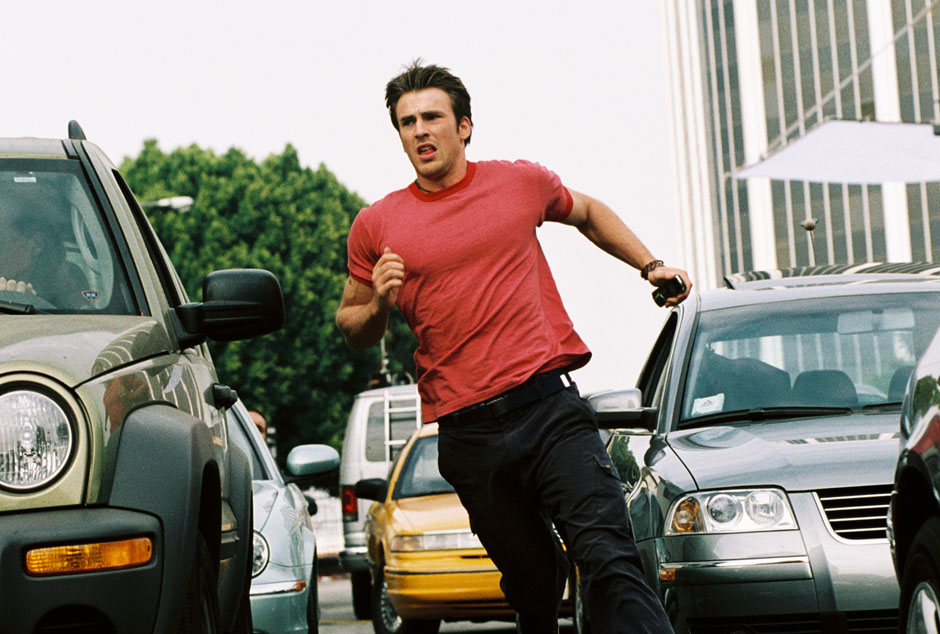
Chris-Evans-in-Cellular-2004-Movie-Image

Smith’s Verdict: ***

Reviewed by Tanner Smith

When rushed for time, either going to a certain location or staying at a certain spot, it’s the journey that matters the most in the case of constructing an action-thriller. Examples include “Speed,” which had the concept of a bus that will explode if traveling below 50mph, and “Phone Booth,” which had the concept of a man held by a sniper to remain inside a phone booth lest he get shot. It’s always the high-concept gimmicky-setups that interest people in seeing the film and it takes skill on the filmmakers’ part to keep it on its toes in order to keep the audience on the edge of their seats. That is why despite how dated “Cellular” might be with its central portable technology, which has been through constant upgrades (and is still increasing in new developments), the film still holds up as a tense, adrenaline-filled thrill ride.

“Cellular” practically opens by showcasing its 2004 “new, edgy improvements in technology.” As people walk about the boardwalk in Los Angeles, they’re admiring their new cellphones, amazed that they can take pictures of chicks in bikinis and send them to other people’s phones. (Ah, the good old days when we were impressed.) But once that’s out of the way, the story for “Cellular” kicks in. We meet our hero—a hunky surfer-type named Ryan (Chris Evans)—who is walking about the beach with his even-less-ambitious buddy (Eric Christian Olsen) and trying to make amends with his ex-girlfriend (Jessica Biel). But soon enough, his cellphone rings. He answers it and it’s the desperate call for help from a schoolteacher who has been kidnapped. The teacher, Jessica Martin (Kim Basinger), has been kidnapped by corrupt cops, led by Greer (Jason Statham), who know that her husband has stumbled upon one of their operations. She doesn’t know what they want, and believes they have the wrong family. Convinced that they’ll kill her once they get what they want, she manages to use a smashed phone (by touching a couple wires together) to make a random call and see if she can get some help. And so, Ryan winds up on the other end of the line, and while he doesn’t quite believe her, her desperate pleas keep him from hanging up. So he agrees to take his phone to the police and have her talk to them about the situation. But when a cop named Mooney (William H. Macy) listens to Jessica’s story, he’s interrupted and distracted, leaving Ryan to take charge of the rescue and thus thrusting him into a race to save the day.

Ryan must keep Jessica on the phone, or else he’ll lose her and be of no help in rescuing her. (Jessica’s phone doesn’t dial normally.) This of course sets off the inevitable series of events that get in the way. Just about every cellphone cliché you can think of comes into play here. Signals get crossed, the battery is dying, the signal is poor, other calls come in at the wrong times, etc. “Cellular” stays alive by thinking of new ways in creating obstacles that get in the way of Ryan, forcing him to outwit and maneuver every which way, all while he has to make Jessica’s husband and child aren’t kidnapped as well, and following different clues that lead to her and the bad guys. But things get even more complicated once Greer learns that Ryan is involved, and also when Mooney discovers some things about the situation he knows very little about that doesn’t hold water, leading him to do his own investigation.

There are chases (both foot and car), drawn fire, fistfights, and other elements that make “Cellular” a regular action-packed thrill ride. It’s never boring, and it even takes a few rest stops, most of which include Mooney as he is planning out his and wife’s new “day spa,” but different circumstances force him into investigating the central situation. Unfortunately, this also leaves room open for exposition. All of this builds up to an over-the-top (albeit inevitable) climax in which Ryan and Mooney join in ultimately saving the day. At an hour-and-a-half of running time, “Cellular” is an enjoyable, entertaining movie that packs many thrills by using clever gimmicks in its action sequences. It’s nicely developed, action-packed, and it doesn’t matter if your phone now is different than phones back then. If your phone has new apps, the situation can still be the same. Stop laughing and enjoy the movie.

Innerspace (1987)

25 Jan

images

Smith’s Verdict: ***

Reviewed by Tanner Smith

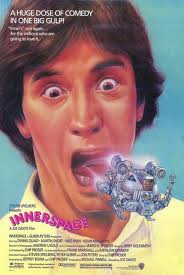
“Innerspace” is a movie full of ideas—perhaps too many ideas that don’t work entirely. But still, there are enough intriguingly silly ideas that are executed well and acted with enough game that I’m recommending the movie as absurd fun.

It’s a blend of science fiction, comedy, thriller, action, and romance that begins with a crazy idea: test pilot Tuck Pendleton (Dennis Quaid) has volunteered for a secret government experiment that involves a miniaturization device and a capsule suited for it. The experiment would cause surgeons to operate on patients from inside them. To test it out, Tuck is supposed to be miniaturized to about the size of a molecule (by estimation, at least) so that he’ll be injected into the bloodstream of a lab rabbit.

It works, and Tuck (and the capsule) is placed inside a syringe. But there’s a problem—high-tech thieves send their hit men to break in and steal the technology from the experiment. One of the scientists run off with the syringe holding Tuck and as he’s shot and killed by one of the hit men, he uses his final action to inject Tuck and the capsule into a random passerby—a grocery clerk named Jack Putter (Martin Short). As we see in introductory scenes, Jack is nervous enough. How’s he going to take the news that someone is inside him?

Tuck wades through Jack’s bloodstream and discovers soon enough that he’s inside a stranger. He uses a little gizmo to stick to one of Jack’s eyes in order to see from a screen inside the capsule exactly what Jack sees, and he also uses a communications system to talk to Jack from inside. Jack at first thinks he’s hearing things—“I’m possessed!” Jack exclaims—but eventually comes to grips with the situation and decides to help Tuck out.

If you’re following this, you’re a smart reader. But believe me—things get even stranger.

That’s mostly what’s part of the fun. There’s a limit to how long Tuck can stay inside the capsule before his oxygen runs out; the villains get closer and closer, and must be outwitted each time; the villain’s new hit man enters into the scene—a bizarre character named The Cowboy (Robert Picardo); and soon, Tuck’s former girlfriend Lydia (Meg Ryan) gets involved.

Oh, but that’s not all. Jack develops a crush on Lydia and constantly forgets that Tuck—Lydia’s former boyfriend—is still around, much closer than he thinks, to say the least.

The plot goes all over the place in “Innerspace.” Most of it is fun, and directed with a sense of silly amusement by Joe Dante (director of “Gremlins”), but you kind of wonder what would happen if the editing was tighter (the movie’s running time is 120 minutes). And there are a few holes that are kind of hard to overlook—there’s a “face-change” that is difficult to explain, and Tuck is as small as the molecules in the liquor that Jack drinks for him but it doesn’t look or seem that way. At the same time, there’s a lot to like in “Innerspace.” Not just the chances the story takes, but also the special effects and the acting.

There are many wonderful visual scenes in which Tuck travels through Jack’s bloodstream. It looks remarkable and surprisingly realistic. The computer-animated effects here are definite first-rate. Though, I would’ve liked to see Tuck fight some white-blood cells or antibodies. No such luck here, but he does eventually have to fight off a hit man who’s been miniaturized and place inside the body to get to him. Oh, and there’s also a sequence involving the heart that’s probably the best sequence in the movie. It looks realistic, as the effects involving Tuck’s capsule were combined with actual footage of a beating heart. “That’s a hell of a pump you got there,” Tuck tells Jack.

Dennis Quaid’s character of Tuck could’ve been a bore, as he spends most of his time confined to the capsule. But with his personality and constant one-liners, it feels like he’s still here. Quaid plays a hero who can’t move while Martin Short plays a nerd who wasn’t expected to be the hero. Quaid and Short have nice moments in developing their friendship.

Martin Short, the manic “SNL” alum, is wonderful in this movie. He’s extremely likable, very funny without being too manic, and is fun to watch throughout this movie. It’s hard not to like this guy.

The love story in “Innerspace” is surprisingly nicely done, and Meg Ryan makes a fun, plucky woman put into the confusion of everything. How would she handle the news that her old boyfriend is inside this nerdy guy she’s just met?

“Innerspace” is completely ambitious. It may have worn me out, and the scenes with the thieves aren’t as interesting as the relationships between Tuck, Jack, and Lydia (with the exception of the Cowboy’s scenes, which are manic), but it still provided a good time for me with its intriguing special effects, good acting, and constant use of story twists.

Waterworld (1995)

24 Jan

screenshot-med-01

Smith’s Verdict: ***

Reviewed by Tanner Smith

The most expensive movie ever made at its time, 1995’s “Waterworld” is known as one of the all-time bombs—up there with productions like “Heaven’s Gate” that didn’t even come close to making its money back. That doesn’t necessarily mean it’s one of the all-time worst movies. Actually, it’s a pretty decent action flick with nicely-handled sequences and great sets that give atmosphere.

Though, with the label of “most expensive movie,” it’s easy to see why people were disappointed by the outcome of the production. Even disappointing to me, actually—for a movie of this budget, perhaps being merely “decent” is a disappointment. But you take what you can get.

“Waterworld” takes place in the distant future, as we see a change in the opening Universal logo with the polar ice caps melting, and a brief narration stating that most of the world is covered with water. Thus, we have Waterworld, a place filled with drifters, terrorists, and falling civilizations—all survivors now living on manmade boats, one large ship, and large docks. No land in sight. Freshwater and dirt are now valuable trading. People and brotherhood aren’t what matter to the survivors anymore.

Kevin Costner stars as Mariner, a drifter who lives on his own, sailing on a boat of his creation. He trades for some dirt and sells it in a civilization made up on a big floating “atoll.” However, upon closer inspection, the people there see that he’s a mutant—he has gills and webbed feet. But while the people want him executed, a barmaid named Helen (Jeanne Tripplehorn) and her adopted daughter Enola (Tina Majorino) believe he has seen Dryland, assuming from most of the materials he has traded. So they join him on a journey to get there. However, a terrorist group called the Smokers, led by one-eyed, nasty Deacon (Dennis Hopper), is after Enola (quite an unusual name—it’s “alone” spelt backward) because she has markings tattooed on her back that might actually be directions to Dryland (though no one can decipher them).

“Waterworld” has some intriguing ideas. As we see in the beginning of the film, we see how Mariner is able to stay hydrated and healthy—he processes his own urine, drinks it, gargles, and spits on his little lime tree. That’s very clever. We also see many of the technical aspects of this world—there are a lot of shots focused on how many gadgets work. I love the focus on the mechanics in this world.

But there are some pretty dumb moments with “Waterworld” as well. For example, why would the people on the atoll try and kill Mariner after finding out about his mutation, when HE WAS JUST ABOUT TO LEAVE? What did they have to worry about? And also, why is there a prejudice against people with gills in this world? With some experimentation, couldn’t there be some problems solved around this man who can breathe underwater, in a world that is maybe entirely covered in water? Nothing is made clear of this. There are also moments involving stunts involving jetskis in which the movie looks like a TV spot for Seaworld.

The action sequences are mostly well-staged, particularly the Smokers’ attack on the atoll as Mariner, Helen, and Enola must escape. Even if the stuff with the jetskis looks commercial-like, there is some impressive stuntwork there. I also really liked the final sequence in which Mariner must storm the Smokers’ ship in order to rescue Enola from Deacon’s clutches (and hammy speeches).

Kevin Costner is probably not the best choice to play this part—as the anti-hero, Costner doesn’t particularly come across with as much energy as Mel Gibson with his “Mad Max” movies, nor does he have the goofy one-liners that Schwarzenegger could deliver. Sometimes, he’s just kind of a bore. But as an unsmiling action hero, he’s mostly effective. He does have his share of badass moments. Dennis Hopper, as the villainous Deacon, is deliciously over the top and also serves as weirdly effective comic relief. Jeanne Tripplehorn is fine and Tina Majorino, while kind of annoying at first, gets better as the role progresses.

“Waterworld” has its problems, but has its action and sets to make up for them. This may be one of the bigger bombs in the past thirty years, but it’s far from one of the worst movies in the past thirty years. It’s just decent.

Young Sherlock Holmes (1985)

24 Jan

Ysh_poster

Smith’s Verdict: ***

Reviewed by Tanner Smith

“Young Sherlock Holmes” imagines what it would be like if Sir Arthur Conan Doyle’s notorious detective characters Sherlock Holmes and Dr. Watson met as young men. And even if the screenplay calls for young Holmes and young Watson to embark on an adventure of Spielberg proportions not necessarily worthy of the Doyle tales (indeed, Steven Spielberg was one of the film’s producers), it’s a pretty entertaining watch.

The introduction of young Holmes and young Watson is wonderful—a real treat. Young Watson is the new-boy-at-school in every sense—he’s near-sighted and slightly round. His first encounter with a fellow student is a young genius named Holmes. Just as Watson is about to introduce himself, Holmes stops him, saying “Let me.” After an awkward pause, Holmes, without stuttering, states proudly, “Your name is James Watson, you’re from the North of England, your father is a doctor, you’ve spent a considerable amount of leisure time writing, and you have a particular fondness for custard tarts. Am I correct?” He was right about everything except that Watson’s name is John. Watson asks how he did that, to which Holmes responds that it was clear, elementary deduction from a close look at his belongings.

“The name tag on your mattress reads J. Watson. I selected the most common name that belongs with ‘J’—James. John would have been my second choice.”

The boarding school that Holmes and Watson attend is in the great tradition of English locations used in fiction, in which a great sense of unconventionality is always visible. In particular, living in the school, is a retired old professor, Dr. Waxflatter (Nigel Stock). He has many bizarre, clever, wonderful inventions in his workplace. His latest is a contraption much like a one-man pedaling airplane—however, his many tests have proven unsuccessful.

And let’s not forget that nosy dark-cloaked figure that stalks the grounds and uses a blowpipe to shoot special thorns into his victims. The thorns are dipped in a solution that causes those exposed to it to experience frightening hallucinations. The victims seem to be killing themselves to escape their drug-induced nightmares—these include a gargoyle that comes alive and attacks; a coat hanger that turns into snakes; and the most impressive (although definitely underused) special effect, a stained-glass-window knight that jumps off the window and walks toward the victim. (For you trivia buffs out there—That knight is the first entirely computer-generated character to be released in a feature film.)

When Waxflatter falls victim to the hallucinations, Holmes and Watson are left important clues. Holmes is determined to get to the bottom of this foul play, as he, Watson, and Holmes’ girlfriend Elizabeth race to solve the mystery.

What they find, I’ll admit, is not worthy of Holmes and Watson. It’s a secret Egyptian religious cult that partakes in human sacrifice of young female virgins, inside an underground pyramid. Just call this “Young Sherlock Holmes and the Temple of Doom” and you get the idea. (Fittingly enough, in some countries, this film is entitled “Pyramid of Fear.”)

“Young Sherlock Holmes” is essentially Doyle mixed with Spielberg, and it does more justice to Spielberg than it does to Doyle. But there are many Doyle elements to enjoy—such as the references to the Holmes/Watson elements we know of (Holmes’ pipe, his cloak, his violin-playing, etc.). The characters of young Holmes and young Watson are portrayed and written convincingly in the great spirit of Doyle, and played wonderfully by Nicholas Rowe as the charismatic young genius and Alan Cox as the loyal Watson. They’re effective so that Holmes purists won’t be offended.

There’s one element that fans will notice doesn’t fit into this Holmes story and that’s the character of Elizabeth (Sophie Ward), a beautiful young woman who lives at the school and serves as Holmes’ love interest. She’s beautiful, nice, and attentive; but you can tell where the character is going so that no woman will ever touch Holmes’ heart again, hence his bachelor lifestyle. However, to her credit, if anyone were to be the only woman for Holmes, it would have to be Elizabeth.

Even if the special effects don’t belong in a Holmes story, they’re still fun, and so is this movie. “Young Sherlock Holmes” gives us interesting heroes to root for, an engaging mystery for us to follow, and more-than-capable execution from director Barry Levinson, writer Chris Columbus, and cinematographer Stephen Goldblatt.

The Stepfather (1987)

23 Jan

500full

Smith’s Verdict: ***

Reviewed by Tanner Smith

“It’s like I have Ward Cleaver for a dad.”

In the low-budget thriller “The Stepfather,” teenager Stephanie Blake doesn’t know the half of it when she delivers that simile about her new stepfather. This new man in hers and her mother’s life seems like the perfect family man, or he just wants the perfect family. It seems like he wants his family to be like those in “Father Knows Best.” But there’s something we know that Stephanie and her mother don’t. The stepfather Jerry is undoubtedly an unstable, sick mind. As we see in a creepy, gripping opening scene, this man has murdered his family (we don’t see the murders, but we do see the bodies in the living room), changed his appearance (shaved his beard and wears contact lenses), and went off to find a new family. One year later, he has changed his identity and remarried Susan Blake (Shelley Hack) to come across, possibly yet again, as an ideal family man. Susan falls for it, but daughter Stephanie (Jill Schoelen) sees right through him—she complains to her mother, “It’s not even our house anymore—it’s his.”

The stepfather goes through the notions of an ideal family man, fooling everybody in the neighborhood. He hosts dinner parties with his real-estate clients, gives Stephanie a puppy as a present, and even calls her Pumpkin, which creeps her out even more. Stephanie’s therapist (Charles Lanyer) thinks she’s just having trouble adjusting to having a stepfather to replace her deceased father, and her acting up in school—and getting expelled—doesn’t make her any more credible. But she knows that something is wrong with this man.

“The Stepfather” has its share of effectively disturbing moments—the most memorable is that opening scene I described. Just as tense is the scene in which Stephanie comes across the stepfather having a mental breakdown before immediately snapping back into character when he sees her. But it also has one other, very important thing going for it, and that is the performance by Terry O’Quinn as the stepfather. O’Quinn is great in the role—chilling, subtle, and even strangely likable at some points. He’s convincing as a psychopath who acts as a normal person but has an unbalanced mind that resorts him to murder when everything goes wrong. The tension is always there when he’s on screen.

Not particularly strong is the subplot involving the brother of his latest victim trying to track down the killer, by using a newspaper reporter and a police detective to try and track him down. It’s not particularly interesting and pretty distracting, compared to the family aspects and tension.

What really satisfied me about the film was that the characters weren’t necessarily idiots to figure this guy out, especially when the film shows the audience right from the start. I feel like this man could fool anybody; of course, that includes Susan. And Stephanie does her own detective work. She has a sure plan to figure him out, which backfires, making her feel like she was wrong about him. This helps raise the tension level.

“The Stepfather” isn’t like the usual slasher films you come across. Sure, it does have a rising action that comes down to a climactic confrontation between the psychotic killer and his family, and you could use that for the climax for any other film of this sort. But what makes “The Stepfather” special is the characterization and performance of the title character, its successful scary moments and haunting feel, and a sharp script by Donald Westlake. It’s an effective thriller.

The Client (1994)

23 Jan

TheClient1

Smith’s Verdict: ***

Reviewed by Tanner Smith

It’s easy to see why John Grisham writes best-selling novels. His stories may not be particularly new, but his characters are fresh, original, and three-dimensional. It helps to have memorable, compelling characters to follow in any story. This is true of his book “The Client,” which was adapted into a film in 1994. The film—named “The Client”—is just what you’d expect. The story is told in a credible-enough way right before it drifts into improbable territory at the end, in which all of these appealing, three-dimensional characters are thrust beyond their credibility. There are enough things to praise in “The Client” that I’m going to recommend the film for its strengths.

As the movie opens, the eleven-year-old hero Mark Sway and his little brother are playing in the woods near their trailer park in Memphis, Tennessee (Grisham’s usual Southern setting). A black car drives into the woods and the brothers sneak over to see an overweight lawyer get out of the car, stick one end of a garden hose into the exhaust pipe, and another end in a window. Mark realizes what he’s attempting to do and tries to stop him, but is caught by the lawyer (named Jerome “Romey” Clifford) who puts him in the car with him and tells him why he’s committing suicide—he also tells him something he definitely shouldn’t know that involves the Mafia and the whereabouts of a missing dead body.

Mark escapes and the lawyer offs himself. When Mark calls the police and sneaks back to watch them take away the body, he gets caught and is questioned. But this is a smart (though frightened) kid who knows that if he tells them that he was in the car and that Romey told him what he knows, he and his family will be in danger by the mob. He tries to cover his experience by lying, but there’s evidence against him. Also, there’s an FBI agent named Roy Foltrigg, known to the public affectionately as “Reverend Roy” because of his tendency to quote scripture during court. Luckily, the kid is smart enough to know that he needs a lawyer. And he finds one—a tough-as-nails female lawyer named Reggie Love who only costs a dollar for Mark. But can Mark keep his secret?

If the story isn’t enough to suck you in, the characters and their performances from the actors really are. Brad Renfro, as Mark, is a natural actor—there doesn’t seem to be a moment when he’s acting. He’s a tough Southern kid who is very resourceful and wise for his age. Then, there’s Susan Sarandon, who plays Reggie Love. She’s as tough as lawyers come, but has her own demons to conquer—she has a troubled back story. Sarandon is great here. And then, there’s Tommy Lee Jones, who plays Reverend Roy in an over-the-top performance. How can you not like him when he snaps in court? “What hubris is this?! Speak, child, now! Lyin’ lips are an abomination to the Lord!”

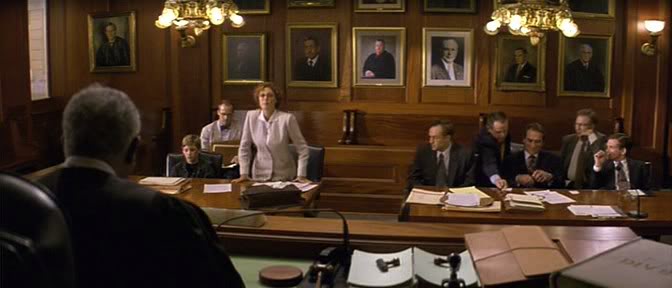
The film falls short of being a great thriller and winds up being only good. Oh, there are great sequences in the movie, to be sure. Three, in my opinion, are most memorable. The first one comes right at the beginning, when Mark is stuck in a car with the suicidal lawyer who plans to do away with the kid before himself—there’s great tension with the music and the atmosphere, particularly. Another great sequence is the first meeting of Mark and Reggie—Renfro and Sarandon share a great rapport with each other in almost every scene when they’re together, but this is the strongest, I believe. The third great sequence is the courtroom scene in which Mark must finally decide whether or not to tell what he knows—Ossie Davis is especially good as the judge in this scene, as he cuts through Reverend Roy’s bull. These sequences are spectacularly well-handled and well-shot. But the major flaw with the movie is with the villains—generic mobsters, led by Barry the Blade (Anthony LaPalgia). They want to silence the kid, to kill if necessary…and that’s about it. Nothing exciting or original there; nothing of substance. Also, the final half isn’t believable—it’s just a “Hardy Boys” scenario in which Mark and Reggie are sneaking around the boathouse in New Orleans searching for clues. No points for guessing correctly whom they encounter.

“The Client” is a good film, but not as great as it leads up to be. I wouldn’t place the blame on John Grisham, who wrote the source material. I can possibly place the blame on Akiva Goldman, who co-wrote the screenplay with Robert Getchell. They should’ve known that the final half wouldn’t be as credible as what came before it. Maybe purists of Grisham’s novels would’ve thanked them for making something different. (Then again, I could be wrong.) But I can still go back and rewatch “The Client” and see it for its strengths rather than its flaws.

La Bamba (1987)

22 Jan

bamba-1987-06-g

Smith’s Verdict: ***

Reviewed by Tanner Smith

“La Bamba” tells the story of late rock star Ritchie Valens, who at the age of seventeen and in the time span of six months, had three hit songs that made him famous and a declared rock-n-roll sensation. And because that isn’t quite enough material for a biopic such as this, most of the events that took place in the lives of Ritchie and his family are stretched out for the film, mostly to effective results.

In the 1950s, Ritchie Valens (whose real surname was Valenzuela) was a Mexican-American who was raised in migrant labor camps in Northern California, idolized his older, motorcycle-riding half-brother, and had a deep admiration for his music. When he moved to a suburb in Southern California, along with his mother and siblings, he performed wherever he could until he finally got himself noticed by more and more people to become something special.

I guess you could consider “La Bamba” to be a follow-up to the great “The Buddy Holly Story,” which told the events of rock star Buddy Holly, because Buddy Holly, Big Bopper, and Ritchie Valens on February 3, 1959. That day was described as “the day the music died.” Maybe it didn’t die, but it was a dreadful event for all three individuals. It was all the more tragic, in that Ritchie was only seventeen years old when he died.

So how does “La Bamba” fare out, telling the story of Ritchie Valens this time? Well, just fine.

What problems do I have with “La Bamba,” which is otherwise a sweet-natured feel-good movie about a kid following his dreams and becoming famous for his music? Well, there are two issues I have with this movie, and unfortunately, they are major. For one thing, adding that Ritchie has nightmares about plane crashes, thus increasing his fear of flying, makes it kind of sick, considering that we know that Ritchie Valens (along with Buddy Holly and Big Bopper) died in a plane crash. When Ritchie takes that fateful trip, he seems relaxed over his fear by now. Why was this necessary?

The other problem I have is with the music. I mean, the music sounds nice—of course, they’re memorable tunes by Ritchie Valens (“Come On, Let’s Go,” “Donna,” and of course, “La Bamba”). But the real issue with the musical performances in this movie is that I really didn’t believe that what I saw on screen was actually being performed. It was just so obvious that the performances were overdubbed, which I realize must be done in movies like this. But the trick is to hide the fact that the music is being dubbed over; “La Bamba” doesn’t succeed. There are some exceptions, though. For example, when Ritchie and Bob visit Tijuana for a night, the folk performing the original “La Bamba” (which inspires Ritchie’s rock-n-roll version) sounds nice and credible. And the concert performing of Ritchie’s “La Bamba” does indeed sound like a genuine concert performance. Other than that, however, I was never convinced I was seeing Ritchie Valens sing or hearing him perform—I just saw actor Lou Diamond Phillips acting like him.

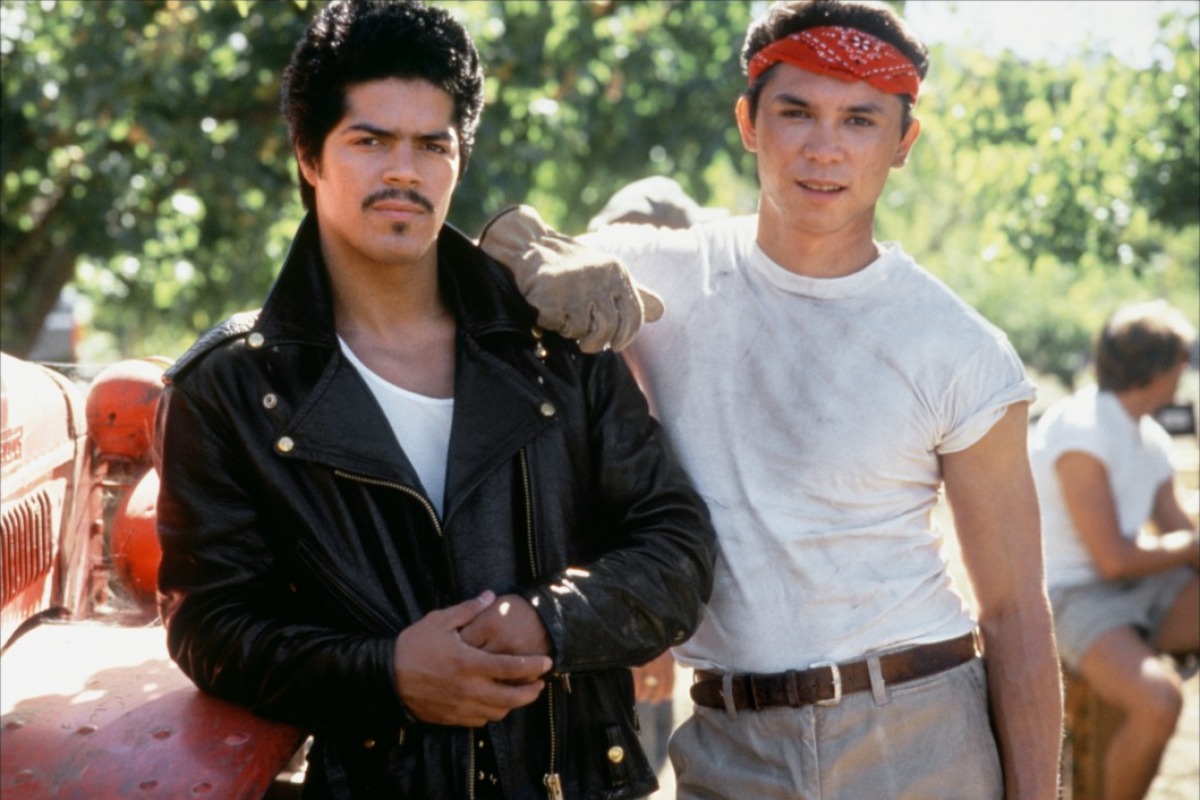
What do I like about “La Bamba?” To tell the truth, I liked the stuff that had nothing to do with the music, particularly the family aspects and conflicts. Ritchie (Lou Diamond Phillips) has help from his hard-working, caring mother Connie (Rosana DeSoto) to get his music career going. She works as his manager for small stuff, like performing at a bar, until Ritchie gets an agent—Bob Keene (Joe Pantoliano), who is a wise-guy type but reliable nonetheless. But then, there’s Ritchie’s rebellious half-brother Bob (Esai Morales). There are times when he is supportive of his younger brother’s fame, but other times when he’s resentful. He becomes a source of certain trouble for the family and Ritchie’s career. There’s also a sweet relationship between Ritchie and his Anglo girlfriend Donna (Danielle von Zernick), whose father don’t approve of Ritchie either because of his race or because of his “jungle music,” which the father calls it. Each of these scenes have a nice sentimental quality to them and they make the movie work, despite its flaws. They give a nice portrait of everyday life and there are good actors playing these roles. Lou Diamond Phillips is appealing as Ritchie, Rosana DeSoto is convincing and winning as the mother, and Esai Morales is excellent as the older brother who both loves and resents his brother. “La Bamba” isn’t the great movie that it could have been, but its sweet, fun moments weigh a little more than the unnecessary parts.

War of the Worlds (2005)

17 Jan

war-of-the-worlds

Smith’s Verdict: ***

Reviewed by Tanner Smith

“War of the Worlds” is an updated version of the famous H.G. Wells story, and it’s by far the loudest and most tense version to come to the screen. Written by David Koepp (“Jurassic Park,” “Panic Room”) and directed by Steven Spielberg, “War of the Worlds” is mildly successful, but a pretty good time.

It’s a mediocre screenplay; I’m not going to lie. In fact, Koepp comes across better as a storyteller, and the story is well-paced and well-put-together. But it is merely an alien invasion thriller and we get the usual stuff we expect from this sort. (Although, there are a few nice little touches thrown in.) However, give Spielberg the job of directing this feature and you’ve got…a mediocre screenplay executed by a great director. But hey, it’s a nice attempt.

“War of the Worlds” is a summer blockbuster and you get the thrills and chills that come with the best feelings of such. The entire film is intense with underlying feelings of suspense, terror, and madness. The big action sequences are masterfully created with top-notch special effects and they just keep you on the edge of your seat. This is really the best way to watch “War of the Worlds”—see it on the big screen. It’s a great cinematic experience that the feelings of tension come with. (I was 13 years old when I first saw it in a cinema—it blew me away!) Even in the quiet moments, there’s still a good deal of tension because we know at any minute that something could go wrong and the heroes have to be one step ahead of it so they can survive.

The film centers around a divorced father named Ray Ferrier (Tom Cruise) who is left in charge of his two kids for the weekend by his ex-wife (Miranda Otto). The kids are rebellious, teenage Robbie (Justin Chatwin) and accepting, younger Rachel (Dakota Fanning). Ray doesn’t have the best relationship with them—in fact, Robbie sort of hates him and always calls him “Ray” instead of “Dad.” Things are awkward and uncomfortable for them, and then things get even worse once the lightning storm hits.

It starts out somewhat peaceful, like a big light show in the sky with a big funnel cloud that doesn’t seem to be harmful. Ray even brings his daughter outside to “see something cool,” assuring her that it’s like the 4th of July. But then the lightning hits just a little closer and that’s when things start to get scary. “Lightning doesn’t strike twice in the same place,” he calmly assures Rachel. Well, it does today.

Like everyone else, Ray goes to town to see what has happened. And then, something rises up from the ground and brings death to all. Ray survives the attack and, expecting another very soon, packs up the kids and everything he has in his house to get the hell out of dodge.

When did Spielberg become so cynical about his alien figures? This is the man who has shown through movies like “E.T.” and “Close Encounters of the Third Kind” that life “out there” can be full of hope and friendliness. But not here; not with “War of the Worlds.” These aliens in this movie are as ruthless as the shark in “Jaws.” They hunt, they feed, and they don’t stop.

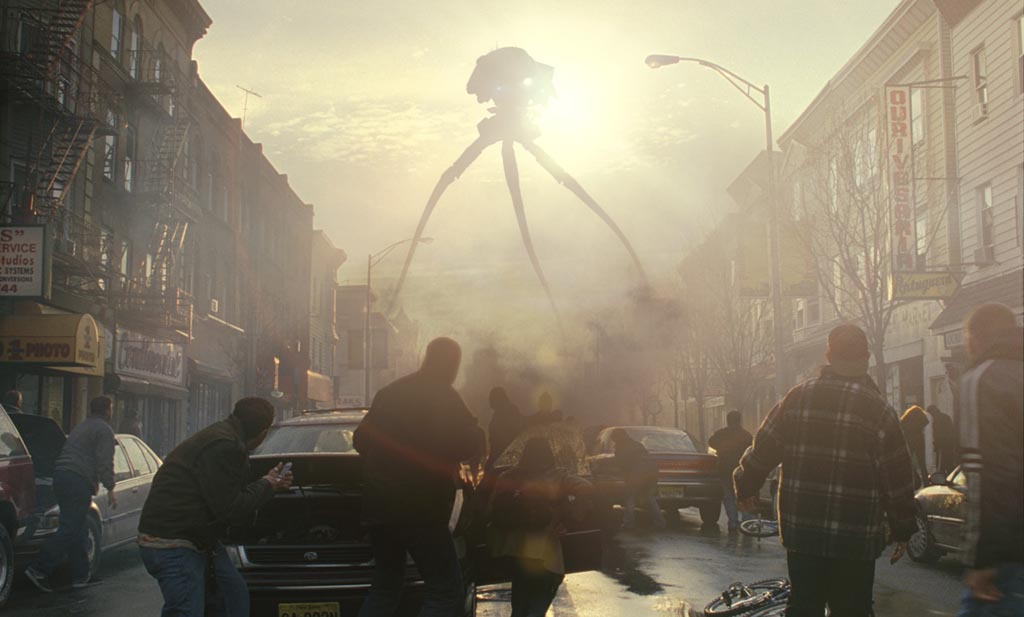
These aliens leave a great amount of dread whenever you don’t see them. You just see their mechanical giant tripod death machines for the first hour or so, and you even see a probe searching all over for the heroes while they hide, and that somehow still keeps you on the edge of your seat. But once you see the actual aliens, the fear is gone. The aliens look the same as any other alien you see in any big-budget alien-invasion picture—they look like something the cat threw up, nothing like Spielberg’s original alien creatures.

There’s something I don’t understand, though. These aliens apparently want our blood—to exterminate and harvest us. But when they first arrive, they’re using heating rays to zap everyone on the streets to ashes. I don’t get it—why destroy what you want to eat later?

There are some great visual shots in the film—in particular, there’s one featuring a fast-moving train with each car on fire, another featuring dead bodies flowing along a river, and another in which Ray exits a house he hid inside during a bigger occurrence to find a crashed plane that has trashed the place. And the audio aspects of the picture make the film even more intense—the sound editing and mixing aid the visuals to create an intense, visceral experience. Listen to the tripods’ roar in surround sound—it’s genuinely frightening.

Tom Cruise has a physical presence that he has shown particularly in the “Mission: Impossible” movies, but I have to admire the fact that his main character of Ray is not an action hero. He’s a lousy, divorced father and a hard-time working man. When the aliens attack, he relies on his quick wit and thinking to keep his kids safe and stay alive himself. Cruise acquits himself nicely in the role. The two young actors are fine, although I tire of Dakota Fanning’s precociousness too easily. There are times when I wanted her to just shut up. There’s a suitably chilling performance by Tim Robbins as a survivalist who provides shelter for Ray and Rachel, and whose head may not be tightly screwed on. There’s a question of trust in his scenes.

The ending doesn’t quite work. It ends too quickly and without the right satisfying note. It’s a clever twist, mind you, but I would have liked to see a more compelling conclusion.

“War of the Worlds” is not about fighting the enemy. It’s about fighting to survive. Our heroes are not the typical heroes who man up and fight against the monstrous aliens (although near the end, Ray does get inside a tripod to save his daughter when she gets captured—but even that’s just selfless bravery and the end of Ray’s character arc). It’s cinematically dramatic and visually interesting. And though it has its flaws, I enjoyed “War of the Worlds” as an intense action picture.

X-Men: First Class (2011)

17 Jan

xmen first class cast group

Smith’s Verdict: ***

Reviewed by Tanner Smith

The X-Men have always been kind of an interesting band of superheroes because instead of one hero, we have many. We have a group of interesting, likable characters with some pretty neat superpowers to follow adventures with in the comic book franchise in their name, the animated TV series, and the four “X-Men” action movies. For those who don’t know, the X-Men are mutants—genetically altered people with a special power, kind of like the new evolution of man.

With all superhero tales, the origin story is always the most crucial, although we’ve already gotten a movie featuring the origin story of the mutant Wolverine (the one with the metallic razor-sharp “fingernails”) and that didn’t turn out well with most movie audiences. So now, we have “X-Men: First Class,” which follows the origin story of Professor X and Magneto. For those who don’t know, both characters are teachers for the other mutants…but on opposing sides. One side wants mutants to live alongside normal people, the other wants to destroy the humans.

I know, we’ve seen how all of that goes in the first three “X-Men” movies. But if I’m going to write the review for “X-Men: First Class,” certain details have to be acknowledged.

“X-Men: First Class” opens in a Nazi concentration camp, during World War II, where we see a young boy named Erik Lehnsherr (later to be known as Magneto). The Nazi Sebastian Shaw (Kevin Bacon) learns of the boy’s newly developed mutant powers as a telepath—able to read minds and manipulate objects, particularly metal, without touching them—and kills his mother as a way of showing that anger can bring his powers to life. Years later, in the early 1960s, Erik (Michael Fassbender) is a young man bent on vengeance against Shaw.

We also see the young Charles Xavier (later to be known as Professor X) and his stepsister Raven (later to be known as Mystique). Xavier (James McAvoy) is a telepath who has his own theory of mutants in this world, hence the nickname “Professor,” while Raven (Jennifer Lawrence) is a shape-shifter whose true form is a blue-skinned creature with golden eyes, but takes the form of an attractive blonde. (And she’s probably actually a lot older than she looks, as a line of dialogue hints at later on.)

OK, this is why I hate reviewing superhero origin stories that are released years after the first few movies. I bet so many readers of this know who these people are and what powers they have. But bear with me; I’m getting to the story.

A CIA agent named Moira MacTaggart (Rose Byrne) needs the help of Xavier, with his expertise of mutation. It turns out Shaw is assembling his own team of mutants, and he himself is a mutant—a telepath who can absorb any sort of energy, even from a live grenade. Shaw’s intention is to launch hundreds of nuclear missiles to strike Russia and launch a nuclear war, eliminating the humans and putting mutants in the lead. Xavier agrees to help stop him, as he and Erik meet each other and form as allies, among other recruits that include a young scientist with hands for feet and a taxi driver who learns to adapt, hence the name…Darwin.

“X-Men: First Class” is about as good as an “X-Men” movie can get, which is to say it’s the best one in the franchise. The setup is effective, the acting is nice, it’s proficiently made, and the action—especially the climax, surprisingly—is well-staged and pretty intense. The heroes are admirable and appealing, with the exception of one whose intentions run deeper than the others would think, and the villain is effectively ruthless. All I’ve mentioned feature elements that good superhero movies should feature.

That’s not to say the movie doesn’t have problems. While continuity connected with the other “X-Men” movies isn’t a major problem in the first half, there are moments in the second half that don’t seem possible, given that you’ve seen the other movies. (I won’t give those errors away.) Actually, that’s a minor criticism—there are only a few big errors, meaning less than smaller ones, making it somewhat passable. Also, as much as I love Jennifer Lawrence as an actress, she doesn’t have much to do with the character of Mystique, with the exception of full-body blue, scaly makeup some of the time (which I have to admit is strangely attractive—shut up). I feel like her character was underdeveloped and I don’t feel much of Lawrence coming through. Another problem, and let’s face it now—some of the mutant powers you see in this movie are pretty silly.

But for the stuff that doesn’t work in “X-Men: First Class,” there are things in the movie that really do. For one thing, it’s nice to see Professor X and Magneto, before they were known as such, in their beginnings and as allies, no less. The relationship between these two is interesting, compelling, and always risky. In some ways, they’re on the same mission to stop Shaw from starting World War III, but in other ways, they have different views on how to handle things, given their abilities. Xavier believes that mankind and…mutantkind (?) can live in peace, while Erik is taken over by his violent nature and believes that it doesn’t matter if this nuclear war is prevented—it will happen either way—as long as he exacts his revenge on Shaw. Because of their differing ethics, it makes it more tragic that their friendship will not end well, to say the least. James McAvoy is likable as Xavier, and Michael Fassbender is excellent—Fassbender has a forceful screen presence that practically demands you to watch him for two hours, and that’s a sign of a great actor.

The villain is an interesting, truly cold-blooded antagonist, and played by Kevin Bacon with efficient sliminess. The character is interesting because he takes different sides in order to make sure that he comes out on top, no matter what the case may be. And as a mutant, he has his own insane ideas of how the idea of man and mutant should be handled. In that case, he’s a respectable role model for Erik, who has pretty much the same ideas. “Unfortunately,” Erik states, “You killed my mother.” So it’s not hard to see where this will go, if you haven’t seen the other movies—it’s no question that Shaw is the early Magneto (and even has the same ridiculous headgear to keep his mind intact).

Also, there are training sequences in which Xavier teaches the other mutants, brought in to become the alliance against Shaw and his group, to control their powers. These are also fun to watch and well-edited—it makes a bold choice in showing them back and forth and surprisingly works.

The climax is extremely well-done. The scale seems huge here. It really does feel like a lot is at stake as all this madness is occurring. And the best part—we’re involved. We actually care about what’s happening. The pacing is carefully done to make sure we don’t miss anything. This is one of the best action climaxes I’ve seen in a superhero movie with an epic feel and impressive special effects. What follows are heartbreaking decisions, but is expected, given the knowledge from the other movies.

“X-Men: First Class” runs two hours and 10 minutes—it doesn’t feel that long. This is an exciting superhero flick that I would actually like to see more stories based upon. And I don’t just mean watching the first three movies again—there’s another story with the young versions of these characters to be found. They just need to find it. I’d be excited to see it.