Archive | Three Stars *** RSS feed for this section

Throw Momma from the Train (1987)

19 Feb

ThrowMama46

Smith’s Verdict: ***

Reviewed by Tanner Smith

Not many movies inspired by other movies have the nerve to name their sources on screen, let alone have a character watch the source in a movie theater. But Danny DeVito obviously knows that and gives his character a scene in “Throw Momma from the Train”—a film that is sort of a comedic version of the Hitchcock film “Strangers on a Train”—in which he goes to a movie theater, sees that movie, and it inspires him to set up the plot.

“Strangers on a Train” was about two strangers who meet on a train and one proposes a plot to commit a murder for each other. In “Throw Momma from the Train,” there are also two strangers who have people they wish were dead. Writer Larry Donner (Billy Crystal) feels anger for his wife, who has stolen his book and published it with her name. Owen Lift (DeVito), who is somewhat of a pathetic schlub, lives with his overbearing mother, who is sort of a cross between Quasimodo and the Wicked Witch of the West. He dreams of killing her, but grows spineless at every attempt.

Owen is a student in Larry’s creative writing class. When he asks Larry what he can do to improve on his writing, he tells Owen to go see an Alfred Hitchcock film for inspiration. One day, at lunch, Larry’s wife is mentioned to Larry and he responds by exclaiming, “I wish she was dead!”

Owen goes to see “Strangers on a Train,” he gets the idea of the movie, and believes that the choice of the film was a message from Larry. Larry only says he wants his wife dead, but Owen takes him seriously. He supposedly (the murder is off-screen) kills Larry’s wife and expects Larry to “return the favor” and kill his mother.

And who could blame Owen for wanting his mother dead? Momma is a monster and Larry knows that too—he has a line later in the film, “She’s not a woman—she’s the Terminator.” Anne Ramsey goes all out with this performance, and she is more than game.

DeVito is the star of this movie. He delivers a performance of a man who really needs help and we start to care for the guy. He’s a good director too—he frames certain shots in which he almost looks like a small boy; he has a tendency to make the everyday world seem somewhat surreal; and he gets the material. The best scene in the film is a sweet one—it’s a scene in which he shows Crystal his coin collection. Those aren’t coins that are really worth anything but they remind him of places his dad used to take him. That’s a very good scene, with a real amount of whimsy put to it.

There are also a couple of big laughs in this movie—one of them involves Crystal at the river trying to find an opening line for his book. And the other involves DeVito and Crystal in DeVito’s house—they’re having breakfast in the kitchen, Crystal meets Momma, and without giving too much away, there’s a frying pan involved, and the scene delivers possibly the funniest moment in the movie.

Admittedly, the whole murder situation is a little uneven. But with a few sweet scenes, some good laughs, and good performances by DeVito, Crystal, and Ramsey, this is an enjoyable, entertaining comedy.

Phantasm (1979)

18 Feb

396119_317996628300224_1279472888_n

Smith’s Verdict: ***

Reviewed by Tanner Smith

“Phantasm” has just about the best piece of marketing you could ask for in a horror movie—it has the great tagline, “If this one doesn’t scare you…you’re already dead!” Well, there are a couple scenes in “Phantasm” that did scare me, but I think the exaggeratory marketing that comes in all movies (not just horror movies) is starting to wear thin.

All the more, “Phantasm” is a well-made, fun horror movie directed by Don Coscarelli, who was in his early 20s when he made it. When he was a freshman in college, he started out with a film called “Jim, the World’s Greatest,” unseen by many people, including me. But then a year later, he made a sweet little gem called “Kenny & Company,” unnoticed by most people in America, but a success in Japan. Then, Don Coscarelli directed, wrote, and produced “Phantasm” in a way that shows us that he loves horror movies and just wants to thrill us by capturing the imagination of the kid in all of us. This is an R-rated horror movie yet with the mind of a young teenager that is obviously the film’s target audience.

“Phantasm” has just about everything a fun horror movie could ask for—two or more scary scenes, a tall boogeyman of some sorts, dwarfish lurkers, a cheesy flying creature, a mortuary, mystery, a haunting musical score, a plucky kid we can root for, some interesting characters who stand by the kid, and more. But this film also has one of the most ingenious killing devices ever put in a horror film. It’s a flying silver ball that senses body heat and charges for its victims in mid-air. Then it hooks to the victim’s forehead, and then the drill comes out of it and drills right into the victim’s brain—blood from the victim spurts out from the back of the sphere.

The film’s hero is a thirteen-year-old boy named Mike (Michael Baldwin, “Kenny & Company”) who is worried that his older brother and guardian (their parents are dead) Jody (Bill Thornbury) will leave him so he follows him everywhere. One day, he follows his brother to a funeral for Jody’s friend, who has just been murdered. When Mike spies through the bushes, he notices that after everybody leaves, a mortician comes along and carries the coffin without even breaking a sweat. Mike knows that something very strange is going on at the mortuary and there is something definitely not right with the mortician.

This character is known as the Tall Man. Apparently he is from another planet and to his aid are three-foot dwarves, who we learn are reanimated dead bodies crushed to half-size. Why are they crushed to half-size? I’m not sure I fully understand. Anyway, Mike gets Jody and Jody’s friend Reggie (Reggie Bannister), an ice cream man, to believe him and they try to get to the bottom of this and solve the mystery of the Tall Man.

This sets in motion a series of scenes set in one night in which the trio find different clues and try to solve them. Along the way, they run into their share of scares. There’s a mysterious Lady in Lavender, who seduces men before killing them. There are those cloaked, hooded dwarves that attack (one of them even drives and chases them). There is a cheesy-looking fly-like creature that morphs from one of the Tall Man’s dismembered fingers (the Tall Man can grow them back). All of this is fun but the Tall Man’s menacing look and stance and walk is what gives me chills. There is one scene in particular where Mike has a dream that the Tall Man is standing right above his bed and that part scared me. And then there’s that raspy voice he has when he says things like, “I’ve been waiting for you” and “BOY!!!” Played by Angus Scrimm, the Tall Man of the greatest bogeymen ever put in a horror film and he has a great weapon along with him—that flying silver ball.

Scary and fun moments aside, there’s a really satisfying scene where Mike gets Jody to believe him about the Tall Man. He cuts off one of the Tall Man’s fingers, with yellow blood oozing from the wound. Mike takes the finger home and shows it to Jody. The finger is still wiggling and Jody simply says, “OK, I believe you.” I love that Jody is so quick to believe Mike after being shown that finger.

My complaint was how it all ended. The script plays with the audience so many times that when the film ends, it feels like a cop-out. I won’t give away the ending but I will say that it’s most disappointing. A weak payoff for a terrific setup. I can say, “See it but prepare to be disappointed.” I won’t have much of a problem saying that because the setup in “Phantasm” is most fun.

The Bloodstone Diaries: Sleeper – The Bloodstone Diaries: The Thief of All Things

17 Feb

bloodstone-katysmall

Smith’s Verdict: ***

Reviewed by Tanner Smith

The Bloodstone Diaries: Sleeper, as I’ve heard, is the start of a possible Internet series, and right away, I want to state my gratitude for a web series with quality production. It also works nicely on the big screen, where is how I first saw it at the Ozark Foothills Filmfest in the spring of 2011. There’s a real professional look to the film, which would make it somewhat of a disappointment that this introduction to The Bloodstone Diaries is merely good, when it could have been great.

What I mean by that is that the story seems complex—that is, the tidbits we get from the story—for a ten-minute short film that leaves many holds barred and stops rather than ends. I’m guessing it’s setting up for the next entry in the series, but I think I’d be more satisfied if there was more closure to this one. I wanted more, which shows how interested I was in the dilemma that’s been set up. Luckily, I think I’ll get more when the next entry to this series is released, either on the screen at film festivals, or online.

The film starts with an opening-credit sequence—the credits are played over a black screen in an old-school fashion, but we get our introduction to our heroine Bettie Lawrence (Katy Allen, wife of “American Idol” Kris Allen) from the audio of a telephone call. She warns a mysterious man, whom she’s apparently tangled with in the past, that she has learned how to use a magic jewel called the Bloodstone and that it wouldn’t be wise to look for her (anymore). That’s it—that’s the introductory exposition we get. It’s very smart writing. A mysterious phone conversation during the opening credits is all we needed to set this up…all in 30 seconds, too!

When we see Bettie in person, she seems like a nice all-American girl with nothing particularly special about her, making her a credible heroine once we realize that the Government is hunting her because she gains possession of the jewel, which is what they want. They’ve killed her husband Sam, who tried to protect it in the past (at least I think that’s why they killed him—it’s never quite explained), and now she wants revenge. When they find her, she’ll be ready.

This setup is very intriguing—the mystery is there, the story sounds very interesting, the acting from Katy Allen is convincing, and the drama is legit. But that’s only the first six minutes out of a ten-minute film. The final three minutes (not including the end credits, taking the last minute of course) is just a showdown with the bad guys—the Men in Black—who arrive at her home and try to overtake her. As she escapes, she uses the Bloodstone to fight them. And because this climax is so short, there isn’t much room or time for either atmosphere or clarity in exactly what this Bloodstone is capable of. I guess it allows the holder of the stone to possess mind power (Bettie’s able to move a refrigerator without touching it), but what are we supposed to take from all of this? I guess Bettie will keep running and somehow on her quest, she’ll finally have her revenge. While this climax is admittedly well-shot and does have its brief moments, it’s too short and doesn’t take advantage of what should have been a dramatic payoff.

I would like to see “part two” to see where this is going to go. But I would particularly like to see an origin story. How did this young woman get involved in this craziness with the Bloodstone anyway? That would be a very interesting story arc.

You can watch this film here: http://www.youtube.com/watch?v=zl0Kx4jBg4I

————————————————————————————————————————-

bettie-and-sam

Smith’s Verdict: ***

Reviewed by Tanner Smith

The Bloodstone Diaries: The Thief of All Things is what I’ve been waiting for since I first watched its predecessor, The Bloodstone Diaries: SleeperThe Bloodstone Diaries is a supposed web series (I use the term “supposed” since it’s apparently screening at film festivals before hitting the Internet) that mixes fantasy with action. It’s about a young woman who possesses an ancient, magic jewel known as the Bloodstone and seeks revenge on those who killed her husband; these same people also seek her to possess the jewel themselves. Sleeper was a welcome beginning that left me wanting more. And I got more from The Thief of All Things, which is actually a prequel instead of a sequel. It shows the events leading up to most of what occurs in Sleeper.

We see the origins of Bettie Lawrence (Katy Allen), the heroine of the series. She lives in a homeless camp by the railroad tracks with her husband Sam (Ian Moore). Bettie is a standoffish, hostile person who doesn’t let anything get in her way (including the local reverend who preaches to most of the homeless) and is the one who goes into town to steal valuables from people’s cars, while Sam lives mainly by faith. Sam’s friend Anthony Pace (C. Tucker Steinmetz) lives the same way, as well as a belief in destiny. That’s why when he mentions the Bloodstone, said to be a jewel mostly formed of Jesus’ blood, Sam can’t help but be interested.

By the way, one of my favorite moments is when Sam researches the Bloodstone. How does Sam find out more about the Bloodstone? Wikipedia, of course! (Duh!) But it turns out that searching online for something mystical and said to be mythical gains the attention of the government. The next day, several men in black reach the homeless camp to hunt down Anthony and Sam, with Bettie in tow. But Anthony has a few tricks up his sleeve…

The central chase scene is well-executed and feels very intense. The special effects are seamless—there’s one slow-motion scene involving Anthony using the power of the Bloodstone to stop a pursuing car by making it float into the air, and it’s done so greatly that I wonder if Andrew McMurry of YouTube’s AndrewMFilms, with his After Effects skills, would be able to pull that off. There was a real quality put into this production, and the filmmakers obviously went all out to make this an exciting experience. For the most part, they succeed.

And it is nice to see the original owner of the Bloodstone, as well as the lives of Bettie and Sam before the events of Sleeper.

There are a few problems I have with the movie, though. For one thing, I can’t quite believe that the Bloodstone has been protected for centuries, one protector after the other. First of all, have the people before these men in black really had no avail whatsoever? And if they didn’t, wouldn’t they have just given up the search after seeing what the power of the Bloodstone can do? Other little weaknesses are the lame subtitles that appear over each new location—one of them being, “miles from nowhere” — and the unnecessary opening dream sequence that shows Bettie losing a fatally wounded Sam, obviously foreshadowing a future event.

It came as no surprise that both Sam and Anthony are dead by the end of The Thief of All Things, because of course, Bettie must be the new lone protector of the Bloodstone. But somehow, the ending of this film never really hit the right notes. It ended a little too quickly, and I could have used a little more development for Bettie, whose question of faith and sudden new responsibility have been set up for an emotional payoff that just isn’t there. Best we get is a deadly stare in Bettie’s eyes that closes the movie—To Be Continued to be sure; only the question is, to be continued in Sleeper or another story before or after Sleeper? Guess I’ll have to find out later.
Hitchhiker (Short Film) (2011)

17 Feb

459142_294920593909216_2141328867_o

Smith’s Verdict: ***

Reviewed by Tanner Smith

OK, we all know the story. An innocent person drives on an empty road in the middle of the night when along comes a hitchhiker, whom the innocent decides to take a chance on and give the stranger a ride. Only it turns out that this hitchhiker is quite different and may actually be a dangerous stalker. It’s an old campfire story that has also been included in many horror films, in which that element leads to certain doom.

But I don’t think there has been a hitchhiker story quite like this. In this ten-minute short film—aptly titled Hitchhiker — the innocent person may not be so innocent in the first place, the hitchhiker has something more on his mind that you’d like to know about, and there’s a neat, original twist revolving around redemption.

The film, written and directed by Allison Hogue, is set up in the middle of the night. A young woman (Courtney Howard) is out for a drive when she runs out of cigarettes. She comes around a man in a hooded sweatshirt on the side of the road, signaling for a ride. She stops, and asks the hitchhiker (J.D. Cariker) if he might have any cigarettes. He offers a pack for a ride into town. She agrees, and the two are in each other’s uncomfortable company. The hitchhiker asks her ominous questions, such as why she usually wouldn’t pick up a hitchhiker. After an awkward talk, you’d think this would be the moment when danger strikes. And at this point, I have to warn that SPOILER ALERTS are coming! SPOILER ALERTS are coming! Before reading the rest of this review, I ask that you check out Hitchhiker by Allison Hogue on Vimeo (or above) and come back. SPOILER ALERT!

The opening seems like standard stuff for this kind of story (although the soothing spiritual pop music manages to give a sense of ominousness). The reason I’m recommendingHitchhiker is the twist. The woman drops off the hitchhiker at his destination, only to find that that he is pursuing her. When he catches up with her at her house, she finds that a gun-wielding intruder (the late Keith Mulberry) has been waiting for him. It is then that the hitchhiker makes himself known as probably something not of this world, but possibly from the next world.

The characters are not how we expected. For example, the woman could be seen as the innocent that gives the hitchhiker a ride and finds herself in a bizarre situation she didn’t want to be in. But maybe she isn’t so innocent. When we first see her driving, we see someone who is either hiding something or trying to get over something she may have started in her life. Whatever it is has her somewhat bitter and cold. You can feel it in the scene in which she at first refuses to give a ride—she’d rather stop and ask a hitchhiker for cigarettes than give him a ride. That’s really low, if you ask me. Then, there’s the ending, in which she is redeemed and given a second chance. We’re not entirely sure of exactly what it was that she began with before this night—things are left somewhat vague. And also, who is that intruder? Is he a burglar in the wrong place at the wrong time? Or did he have connections to the woman? There’s a lot you can read into this.

Then, there’s the hitchhiker. At first, he seems like he can’t be trusted, but that’s because he’s asking the questions that would put you on edge. The reality is that he’s testing you when he asks those questions. Then, when he chases the woman home and saves her from the intruder, he gives her a Bible and a message saying that she deserves a second chance. And then he leaves, to find someone else to deliver the message to. The hitchhiker is not a madman. He has the motivations of a savior.

Hitchhiker begins as a typical horror film and turns into something more of a spiritual tale than anything else. It’s an effective short film that plays with the seen-before hitchhiker story element, and leaves with something special that you didn’t expect.

Watch the film here: https://vimeo.com/31127434

In & Out (1997)

16 Feb

1852104

Smith’s Verdict: ***

Reviewed by Tanner Smith

“In & Out” stars Kevin Kline as a high school English teacher who is neatly-dressed, reads Shakespeare, watches Barbra Streisand movies, and is somewhat of a wimp. Those four traits are thrown in the way of his masculinity when everyone in the movie thinks he’s a homosexual.

It begins as Kline’s character Howard and his fiancée Emily (Joan Cusack) are watching the Oscars, rooting for one of their former students, who is one of the Best Actor nominees. He’s apparently so successful that Glenn Close spends so much time talking about how great he is, and then just says the other actors’ names as if they’re not important. (By the way, who would have thought Steven Seagal would be nominated alongside Paul Newman, Clint Eastwood, and Michael Douglas? Nice joke, though.)

Anyway, the actor—a goof named Cameron Drake, played by Matt Dillon—wins the Academy Award for playing a gay soldier, and in his speech dedicates it to Howard, “who is gay.” This comes as shocking news to everyone, including his fiancée, his parents (Wilford Brimley and Debbie Reynolds), his students, and the high school principal (Bob Newhart). But Howard keeps telling everyone that he isn’t gay. His students want to believe him, but they consider the facts about his personality and aren’t so sure. He hasn’t even made love to his fiancée in the three years they’ve been engaged—even the Parish priest he goes to believes he’s gay. The premise may sound like dark-comic indie-crowd fare, but “In & Out” is a jolly PG-13 mainstream comedy that’s about as innocent as it can get, given its subject matter. The result is a mostly funny and well-acted, though flawed, comedy.

When Kevin Kline turned into Jim Carrey is beyond me, though I suppose winning the Oscar for his nutty character in 1988’s “A Fish Called Wanda” helped a lot. The movie’s funniest scene is when he proves his masculinity to himself by playing a self-help tape, but can’t resist those distracting showtunes thrown in as tricks. The tape shouts back as if it’s talking right at him. Kline’s very funny here. He’s well-suited with Joan Cusack as his fiancée who has lost about 75 pounds working out to Richard Simmons’ workout videos, and now feels her world falling apart when she thinks she doesn’t know as much about Howard as she thought.

In a movie that has a solid cast and interesting character development (including Matt Dillon as the actor, who had no intention of ruining Howard’s life and whose intentions are revealed later), the best performance in the movie goes to Tom Selleck as a celebrity gossip TV journalist who believes Howard is gay and arrives to this small town in Indiana to make a documentary about his eventual coming-out. Selleck is perfect in his role—effectively convincing throughout as this dedicated TV personality out to get the real story. There’s not a moment when he steers wrong.

“In & Out” has humor and heart, but what didn’t work for me was the ending. It bogs down into a cornball confrontation that interrupts a high school graduation ceremony to allow Howard to win the people’s respect again. It involves everyone shouting “I’m gay” to get at the principal, who just can’t find a good explanation for firing Howard other than he’s gay. It was too uplifting that it wound up as just cloying. But give the scene credit for not taking place in a courtroom.

There are a few slight problems such as the cheesy feel-good music that tells you what to feel when the actors are doing a well-enough job of that. And also, I could see a few things coming a mile away. But what I couldn’t see coming were the movie’s best jokes—a bachelor party that goes unexpectedly, a hilarious snap at Barbra Streisand, that self-help tape scene I mentioned above, and some terrific one-liners. All of the actors are solid, the writing is sharp, and the movie has an overall positive feel to its subject matter. “In & Out” is a certified crowd pleaser.

Child’s Play (1988)

16 Feb

images

Smith’s Verdict: ***

Reviewed by Tanner Smith

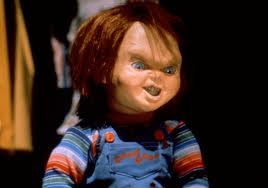
There are many horror-slasher movies with villains that are scary and villains that look scary. “Child’s Play” has a villain of both sides. At first, this “doll”—you read right, it’s a “doll”—looks nice and friendly (and it’s called a Good Guy), but then he was inhabited by the human soul of a serial killer…and now, he looks and acts like someone’s worst little nightmare! With a blade in his hand, a different, scary smile, and a voice that could be Jack Nicholson’s (but it’s actually Brad Dourif’s), we have Chucky…

You know those three heavy musical notes that play in the movies and on TV that are played when someone says something that scares people? Those would fit great if I gave my review on an Internet video.

I don’t really like Freddy Krueger (of “Nightmare on Elm Street”) as a villain; I just see him as a comedic scarface trying to be the big shot. And Jason Voorhees (of the “Friday the 13th” sequels) is still a hard person to figure out. Even the Shape (you know, Michael Myers of the “Halloween” movies), who I thought was scary in the original “Halloween,” tires me with his ridiculous sequels. But Chucky, whose name when he was human was Charles Lee Ray, scares me in appearance and in spirit. This little guy is everybody’s worst little nightmare.

“Child’s Play” begins with Ray, a notorious voodoo-educated serial killer, getting shot by a cop and dying. He’s not ready to die. He screams a revenge threat at the cop and tries to get out of the toy store he’s in so he can find somebody to use his voodoo knowledge on so he can possess the person, but instead he finds one of the Good Guy dolls, a nice, friendly-looking, red-haired doll. After a freak accident, we can assume that he’s now the doll…

The doll, nicknamed “Chucky,” is bought by Karen Barclay (Catherine Hicks) as a present for her six-year-old son Andy (Alex Vincent). The doll comes off as just a doll, staying quiet and whatever the Good Guy dolls are supposed to do. But when Andy’s babysitter is pushed out a who-knows-which-story window, Andy can only say “Chucky did it.” It’s the truth, but his mother and the police don’t believe him and start to be concerned about him. Nobody believes him until his mother discovers that Chucky is talking even though he doesn’t have any batteries in him.

Then, the police don’t believe Karen when she tells them that Chucky is alive. But the movie kicks into more horror when the cop barely escapes Chucky’s wrath and especially when we learn that Chucky needs to possess Andy or else be stuck in the doll’s body forever.

Why is “Child’s Play” worth recommending? Because it’s well-made, contains very good performances from Hicks and Vincent as the scared family, and the villain is a psychotic doll. How else can I explain Chucky except for telling that every time I see his picture on a poster or a cover of a video box, a shiver crawls my spine?

I also like the plot gimmick they use here, such as when Andy tries to tell his mother and the police, they don’t believe him. And then, when his mother founds out the truth by discovering no batteries in him, she tells the police and they don’t believe her either. Then, the cop—Detective Mike Norris (Chris Sarandon)—is attacked by the little devil and barely survives.

And also, that scene in which Karen finds out the truth is a real scary scene.

She’s walking in with the doll, very depressed. Then, she leaves the doll in the living room and goes into the kitchen. She’s about to throw away the box, when…uh-oh–batteries fall out. Then, she slowly walks into the room, cautiously picks up the doll, opens the battery case, and sees nothing…then the doll turns its head and says in a child’s computerized voice “Hey, wanna play?!” The mother screams and drops the doll then Chucky really makes himself known…

That is one creepy scene and also, one of the great things about the movie is the good-looking demonstration of the mad slasher genre. When you think the killer is dead, he really isn’t. You could shoot him multiple times, stab him multiple times, and even burn him to a crisp…he still isn’t dead. The way they do it here is quite interesting.

The director of the film Tom Holland delivered the goods in 1985’s “Fright Night”; he does it here too. He knows how to make an audience go for horror films and he treats them right. Both movies mix some funny dialogue with some flat-out horror and work. Although the gimmick of the “child-in-jeopardy” is sort of cheap, it works here because the little boy played by Vincent isn’t just screaming for his mommy. He has something to do and he stands up to the little devil. Once again, I really like the way the filmmakers made that doll from a nice-looking cute doll to a more horrifying, ugly thing. “Child’s Play” is a well-made horror film with an actually scary villain.

Star Trek III: The Search for Spock (1984)

16 Feb

621_356_star_trek_3_the_search_for_spok

Smith’s Verdict: ***

Reviewed by Tanner Smith

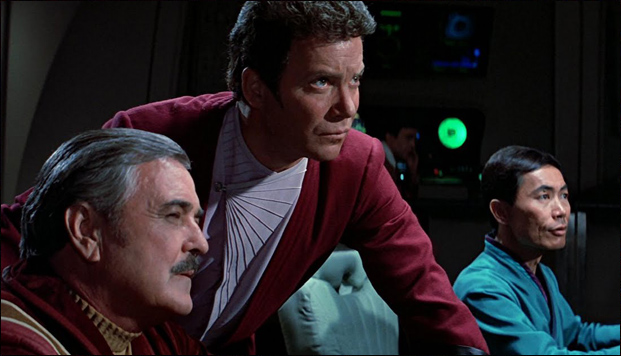
The third “Star Trek” movie is subtitled “The Search for Spock,” leading to the possibility that by the time this movie is over, Mr. Spock will return to join the USS Enterprise crew once again. But it starts out with Spock not merely missing—in fact, for those who don’t recall the end of the previous movie (if you don’t, this movie recaps the moment), Spock sacrificed his life to save the ship and the crew. The crew threw a funeral for him, launched him out into space, and fans of the series undoubtedly cried at the fact that Mr. Spock (Leonard Nimoy), arguably the most famous character in the “Star Trek” franchise, has died. But in the movies, anything can happen—thus, we have “Star Trek III: The Search for Spock,” in which Admiral Kirk and his crew are going to find Spock and bring him back from wherever he is.

Strangeness occurs that gets the search underway. For one thing, Dr. Bones McCoy (DeForest Kelley) seems to be of two minds, so to speak. It seems as if some of Spock’s memories have been stored into McCoy’s mind. He begs Kirk (William Shatner) to find Spock on the Genesis planet, where it turns out Spock has been reborn due to the planet’s growth. (At least I think that’s how it worked—certain parts of the story seem kind of odd to me.) For those who remember, the Genesis planet, from the previous movie, was created for new life. Kirk and the crew are to be reassigned and are forbidden by the Federation to go to the planet to search for Spock. But they disobey their orders and go for it anyway. However, they run into trouble with a ship of aggressive Klingons, led by the ruthless Kruge (Christopher Lloyd), who want to steal the secret to Genesis.

The search is a good deal of fun, though the scenes leading up to it could’ve used either tighter editing or a simpler script. There’s a great deal of heavy exposition involving the location and rebirth of Spock, mostly by Spock’s father (Mark Lenard), and they go on for quite a while. But once Kirk steals the Enterprise from the Federation, in a terrific ten-minute sequence, the movie gets on its feet and gets more interesting. The afore-mentioned sequence is quite impressive and very well-paced. There’s some tension on the planet, as Kirk’s son David (Merritt Butrick) and Vulcan Saavik (Robin Curtis, taking over for Kirstie Alley) make their own expedition on the planet for inspecting a “mysterious life form.” The Klingons continue to zero in on the heroes, such as when the Enterprise is met with a Klingon bird-of-prey. And of course, everything must come down to a battle between Kirk and the nasty Kruge, and once that’s done, we can deal with the matter of Spock’s return.

Christopher Lloyd’s Kruge is just an OK villain—he doesn’t really have the same kind of menace that Ricardo Montalban’s villain had in the previous movie. Sometimes, with Lloyd’s eyes bugging out half the time, it’s hard to take him seriously. And when you’re familiar with the actor’s other work, hearing him speak Klingon (which sounds like a cat throwing up half the time) is, let’s face it, quite hilarious.

I won’t be spoiling anything when I say that Spock does return at the end. What, did you expect the Enterprise crew do go on this search and not find him? This isn’t that kind of movie, guys. I’ll praise the scene involving his return because it reigns as one of the more satisfying moments in the “Star Trek” series—I was glad to see him again.

“Star Trek III: The Search for Spock” isn’t as great as “Star Trek II: The Wrath of Khan”—there are some overlong scenes, some moments that are silly, and the villain isn’t particularly compelling. But the theme of sacrifice is still present—like how Kirk has to sacrifice just about everything to save his best friend—and the action is still tense and exciting, while leaving for the beloved character interaction “Star Trek” fans have grown accustomed to. This is a good “Star Trek” movie, but not a great one. Still, like all good movies, that doesn’t mean it doesn’t deserve to be checked out.

The Borrowers (1998)

15 Feb

MSDBORR EC007

Smith’s Verdict: ***

Reviewed by Tanner Smith

“The Borrowers” is based upon a series of books (by British novelist Mary Norton) centered around a premise that has always fascinated me ever since I was a child. You know how little things around your house seem to go missing? We naturally think we merely misplaced them and can’t remember where we placed them before, but what if there was another reason? What if there are little people living under the floorboards or within the walls, and they pilfer these objects when we don’t notice? These tiny people are known as “Borrowers,” as they “borrow” (kind term for “steal,” in their case) their survival needs—just little things lying around the house. The idea is intriguing and any book or movie centered around it interests me.

Now to be sure, this 1998 film adaptation “The Borrowers” from director Peter Hewitt is very, very loosely based on its source material. The only elements that remain the same are the central idea and the “Borrower” characters. But I don’t care how little it has to do with the book; as a stand-alone movie, it’s a charming, entertaining family film. It has fun with its premise, has top-notch special effects, and is flat-out entertaining.

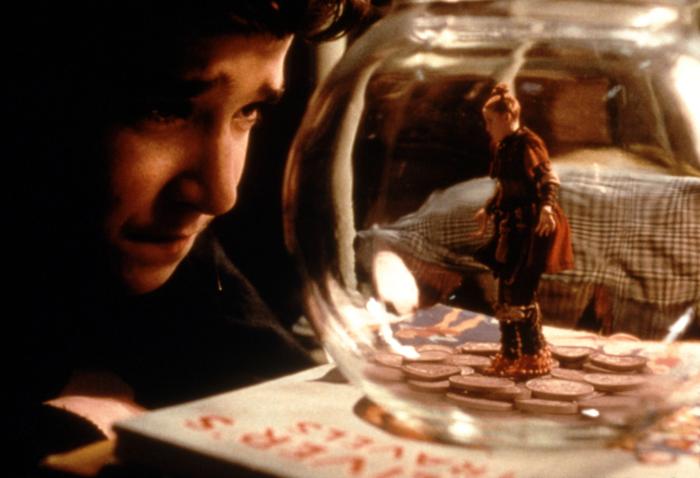
The four-inch Borrowers that serve as the central characters of the movie are the Clock family—Pod (Jim Broadbent), his wife Homily (Celia Imire), and their two children Arrietty (Flora Newbigin) and Peagreen (Tom Felton). They live under the floorboards of the Lenders’ house, unbeknownst to the Lenders who serve as their human “beans” who unknowingly provide them with things to borrow, but will squish them once they see them. At least, that’s how it goes. Arrietty goes exploring the bedroom of Pete (Bradley Pierce), the child of the “beans,” and winds up being seen. But when she finds that the boy doesn’t want to hurt her, she’s able to convince her parents to let him help them out of the house, which is about to be demolished.

However, on the way to their new location, Arrietty and Peagreen are accidentally separated from Pod and Homily. The kids make it back to the house in time to notice that an evil lawyer, Ocious Potter (John Goodman), has in fact cheated the Lenders out of their house by lying about the will for the house never showing up. It turns out Potter has found it and wants to destroy it. But the Borrower kids mess with his plan by “borrowing” the will in hopes of saving the day. So Potter, along with an exterminator (Mark Williams), comes after them.

This leads to several events in which the kids are placed in more danger by the gigantic bean, but always have the upper hand in comic fashion. Actually, you could call this movie “’Home Alone’ with tiny people” in the way these four-inch children (later joined by another young Borrower, named Spiller) constantly outsmart the normal-sized lawyer in a sort of live-action cartoon violence. Potter is covered in burning insecticide foam; he’s slightly electrocuted; he has a needle stuck in his behind; and so on. Neither of these is terribly harmful, compared to the “Home Alone” movies, but they are enthusiastically exaggerated and still force chuckles out of the ingenuity of the idea that these “little” kids always have the upper hand on this guy.

This fantasy-adventure is brought to life with sensational special effects and amazing-looking, greatly-imagined sets. The sets that make the everyday world, with everyday items all around, look giant. Most of the charm comes from these set pieces alone. And the more complicated effects, integrating the humans with the Borrowers (including one complicated shot that looks like a steadycam shot of Pete looking down and talking to Arrietty who is standing on a table), are competently well-done.

There are many creative, adventurous sequences that follow as the plot continues. Most of these involve little Peagreen. One has him clinging for dear life onto a dangling light bulb, as Potter turns on the light and is ready for the bulb to burn his hands so he can fall. And Arrietty has to save him with a tape measure.

Another, quite possibly the most exciting scene in the movie, is the sequence in which Peagreen ends up in an empty milk bottle and taken to a dairy plant. Arrietty and Spiller (Raymond Pickard) must race to save him before it fills up with milk and is capped shut.

All of this is good fun, and it moves at a brisk pace. I admire the visual imagination and the creative storytelling that went into this film. Although, a minor drawback is that because it’s so fast-paced, that it’s kind of easy to miss something in the plot. We never even see Arrietty convincing her family to trust a previously-feared human “bean” to let him help them; they’re just in the back of the moving truck, and Pod just sort of trusts Pete. Other little details like that get kind of annoying, but I didn’t mind all that much.

Solid characterizations are given to the Borrowers and the beans, and they make the film more successful than it already is. And the characters are well-played by an ensemble of game actors. John Goodman is clearly enjoying himself, playing the nasty Potter who will stop at nothing to get his way; Flora Newbigin is excellent as the feisty, teenage Borrower Arrietty; Jim Broadbent is entertaining as Pod, who winds up barking orders at the human-sized Pete in order to find his and Homily’s children; and Mark Williams (as Potter’s henchman “Exterminator Jeff”) and Hugh Laurie (as a patrol cop) are on hand for effective comic relief.

Director Peter Hewitt has shown in “Bill and Ted’s Bogus Journey” that he’s game for visual imagination and creative storytelling, and he’s just as solid in exhibiting it this time, though maybe on a larger scale (so to speak). “The Borrowers” is a delightful, entertaining fantasy-adventure that makes great use of its fascinating premise and delivers the goods.

Some Kind of Wonderful (1987)

14 Feb

images

Smith’s Verdict: ***

Reviewed by Tanner Smith

“Some Kind of Wonderful” is written by John Hughes and has a similar story to Hughes’ other screenplay, “Pretty in Pink.” The story itself is old, but people will see the connection from “Some Kind of Wonderful” to “Pretty in Pink” because they were both written by John Hughes and they both feature teenagers. (Both movies also have the same director—Howard Deutch.) What’s the story? A high school outcast has a crush on a more popular student, while the outcast’s best friend (of the opposite sex) has a crush on the outcast and situations follow that could or could not bring them together. You know, the protagonists in these movies never know better than to just go with the pal—see “Secret Admirer,” see “The Sure Thing,” even see “Lucas” and you’ll see what I mean.

The story follows a high school senior named Keith (Eric Stoltz), who comes from a working-class family, loves art, works at a gas station, and is an outcast at school because of all of the above. His best friend is a tomboy named Watts (Mary Stuart Masterson), who cares about two things—her drum-kit and Keith. But of course, Keith doesn’t even know about Watts’ feelings towards him, because he has a crush on Amanda Jones (Lea Thompson), the school’s rich “uptown girl.” He gets his chance to ask Amanda out on a date when her boyfriend Hardy (Craig Sheffer) cheats on her and she says yes to Keith.

Keith finds out that if he goes on his date with Amanda, then Hardy and his friends will humiliate him that same night, but Keith decides to continue with the date and hopefully find some way to teach Hardy a lesson. But on his date with Amanda, he asks himself what he should have been asking himself before. Is he interested in Amanda’s soul or just her body? In fact, that’s exactly what Amanda asks Keith on their date to an art museum, after Keith hangs up his own painting of her. And what about Watts…? This is the movie’s more intriguing concept—to ask the question of whether or not the guy deserves the girl, not merely the question of will the guy get the girl?

While all this is going on, Keith is constantly pushed by his father (John Ashton) to start applying to different colleges, so he’ll get into at least one. But Keith doesn’t want to go to college—his father never went to college, and Keith would rather devote his life to artwork. And here we have a rarity in John Hughes’ teenager movies—an adult character that is just as interesting as the teenagers. I can only remember two before “Some Kind of Wonderful”—the father characters in “Sixteen Candles” and “Pretty in Pink”—here’s another one. (The principal in “Ferris Bueller’s Day Off” was only interesting in that movie’s first half.) And it’s pleasing to see how the situation resolves—not with a shouting match, but with a civilized argument.

There are problems with “Some Kind of Wonderful”—some scenes progress slowly, and some characters are pretty standard; particularly Hardy, who’s a one-dimensional snobby, begrudging rich kid. But it’s pleasing to see Keith make friends with someone who could have been a villain—a punk kid named Duncan (Elias Koteas) whom Keith meets in detention. I suppose that’s supposed to make it OK that the rich Hardy is the villain of this movie. There’s also Keith’s incorrigible junior-high-aged sister (Maddie Corman), who, like most junior high girls, is a brat who just wants to be cool.

(By the way, the funniest scene is when the sister just flat-out SCREAMS when her father says, “Hi, honey,” outside her classroom at school. Tip for junior high school kids—if you want to be cool and not be made fun of, don’t scream in the classroom.)

The three central young actors are appealing—Eric Stoltz is dim but likable as Keith, and Lea Thompson isn’t the snob that Amanda could have been. But my favorite is Mary Stuart Masterson as Watts. As a tough tomboy, she’s a lot of fun, though she has a tough exterior but a soft interior. She’s dedicated to the things she cares about. She even volunteers to chauffer Keith and Amanda around on their date—it’s weird, but kind of sweet. And who could forget the look in her eyes when she sees the other two together? There are a lot of scenes in which Masterson must feel one way about something while pretending to feel another way, and she’s a fully capable actress.

“Some Kind of Wonderful” is an improved version of “Pretty in Pink,” which was too full of itself, in my opinion. “Some Kind of Wonderful,” for it’s faults, actually takes more chances for us to like the characters and has an ending that is near perfect for the movie. It’s a movie about insecure teenagers making smart and dumb decisions and dealing with rejection and acceptance. It’s a nice movie.

Disney’s The Kid (2000)

12 Feb

images

Smith’s Verdict: ***

Reviewed by Tanner Smith

Adding the name “Disney” to the title of your movie must mean that families will automatically rush to the theater for some good, solid family entertainment from the Magic Kingdom. But you could call “Disney’s The Kid” just “The Kid” and it wouldn’t make much difference. Either way, this is a nice little movie that’s good for the family. It has its comic moments that entertain the kids, but it also has thankfully mature moments for the adults. It’s an involving, sweet, innocent family film—a feel-good story that Disney has been known for—and not just a kids’ movie, despite it having the “Disney” name in the very title.

The story is centered around hard-edged image consultant Russ Duritz (Bruce Willis). He focuses on his own image, while consulting the image of others—mostly celebrities and politicians. He gives brash-but-somewhat-helpful advice to his clients about omitting “self-pity” and also gives enough insults to everyone he meets, so that they all call him “jerk.” Not a day goes by without someone calling him “Jerk” either behind his back or right at his face. He alienates himself from family, he tyrannizes his personal assistant Janet (Lily Tomlin), and is even dismissive to his co-worker Amy (the always-delightful Emily Mortimer) who could be his girlfriend if he wasn’t such a “jerk.”

A few days before his 40th birthday, something strange happens. He’s visited by a little boy—a chubby lively kid named Rusty (Spencer Breslin). But this isn’t just any kid. As they both realize, Rusty is really Russ, at age eight. Somehow, Rusty has traveled forward in time to meet his 40-year-old self. Rusty is not so thrilled at his future self’s occupation—he doesn’t have a family, nor a dog, and has a job that just isn’t very exciting. “I grow up to be a loser,” the kid grimly states.

You can tell where this is going—Russ is going to realize through this kid what led him to become a loser and, with help from his past, is going to learn how he can become a better person. Now, I’m sure kids won’t appreciate this story very much, but they’ll still have the kid to identity with and the occasional slapstick humor that comes long (most of it is tame). The adults will get more out of it—this is their fantasy of revisiting their past. Yeah, the plot gets a little corny as it goes along, with story elements that seem added on for further drama, such as the subplots involving Russ’ on-again/off-again relationship with Amy and the heavy deal with Rusty being told that his mother is going to die from cancer. But most of the material does work, and leads to good lightly comic moments (most of which playing with Russ and Rusty’s relations with each other, or the question as to why the moon sometimes look orange), as well as effective dramatic scenes.

The acting helps give the movie its credibility. Bruce Willis is an effective leading man and shows dimensions far from being a deadpan, wisecracking beatnik (a role he’s usually known for). He shares terrific moments with Spencer Breslin, who is very appealing as Rusty the kid. Of the supporting cast, Emily Mortimer is always a delight to watch, Lily Tomlin is quite droll as Russ’ bored assistant, Chi McBride has a nice moment as a boxer/client who teaches bullied Rusty how to fight, and even the appealing Jean Smart, who has the least amount of screen time, has some wonderful moments as a Southern newscaster, who is one of Russ’ clients and gives him helpful advice about dealing with his own past.

“Disney’s The Kid” nearly ends with the message that learning to fight leads to a successful life. And I’m glad it didn’t go that route, because that seems to be the staple for movie messages in a lot of movies; particularly action films. It seems like it’s going to go that way, in a scene in which Rusty uses his new fighting skills on school bullies. But then we get to the satisfactory happy ending in which Russ and Rusty realize the true meaning and ambition of their lives, and Russ realizes that if he can’t change his own life by having his past self deal with his present self, then maybe the best is yet to come.