Archive | Three Stars *** RSS feed for this section

Transformers (2007)

28 Feb

images

Smith’s Verdict: ***

Reviewed by Tanner Smith

Michael Bay is a director with maybe too much ambition with his work, to say the least. He doesn’t even hold a good track record with his films (examples are “Bad Boys,” “Armageddon,” “Pearl Harbor,” and “Bad Boys II”). He has many trademarks of his own—swift camera movements, frantic editing, two-and-a-half hours of running time, colorful stereotypes, intense slow motion shots of characters, tight close-ups, intense music cues, and even more notably, over-the-top visuals. He made one terrific film so far out of all of those elements—a solid thriller called “The Rock.” Now here’s Michael Bay’s “Transformers,” which almost serves as a parody of Michael Bay’s earlier films. We get just about every trademark from Michael Bay, with a handful of CGI metal robots called Transformers, based upon a popular toy franchise by Hasbro.

This is a totally preposterous and goofy-fun movie in which good Transformers and evil Transformers fight on our world, and a group of central human characters are caught in the middle of the war and race to aid the good Transformers (called Autobots) in holding the key to Earth’s survival.

These Transformers are marvelous creatures to behold. They fold and unfold like Rubik’s cubes from automobile to giant robot and then back again. Both races of robots are drawn to Earth because decades ago, the fearsome leader of the evil Transformers (called Decepticons) named Megatron crash-landed there. It is said now that he holds the All-Spark, a cube that is the key to the rebirth of their dying home planet Cybertron.

The central human characters are introduced in different subplots. We meet armed services, including Sgt. Lennox (John Duhamel) and Tech. Sgt. Epps (Tyrese Gibson), who are attacked by a helicopter that transforms into a Decepticon. These guys are under the impression that this ten-foot-tall metal robot can be put down easily with automatic gunfire, and much later, they’re fighting a scorpion-like Decepticon in the middle of the desert. Then we meet the Secretary of Defense (Jon Voight) who is trying to figure out what exactly attacked the armed forces, with help from computer whizzes, including the beautiful, Australian blonde Maggie (Rachael Taylor) and optimistic hacker Glen (Anthony Anderson, overacting but funny). The political satire of this movie is that the Secretary of Defense is seemingly running the country while the President is relaxing on Air Force One, asking for a Ding-Dong.

There’s another character that is crucial to the story. His name is Sam Witwicky (Shia LaBeouf) and he’s a teenager who just bought his first car—a rundown yellow Camaro with racing stripes and apparently, a mind of its own. He uses it to try and pick up the popular girl in school named Mikaela Banes (Megan Fox, not entirely convincing as a high school student, but wow, is she great to look at) and the radio pretty much plays what Sam is thinking, kind of like Herbie the Love Bug. But it turns out that the car is actually an Autobot named Bumblebee. His job is to protect Sam from the Decepticons because apparently, he holds the key to Earth’s survival—a pair of glasses with a sort of map imprinted in the lenses that leads to the All-Spark (I would like to explain why there is a map on the glasses, but I’m almost getting exhausted trying to piece together the plot myself).

Oh, and I should also mention the character of the secret ops guy (John Turturro) who runs a top-secret government facility called Sector Seven and is holding the now-frozen Megatron underground. He has the priceless line, “Do you want to lay the fate of the world on a kid’s Camaro?”

All of these character plotlines lead down to the big epic battle between the Autobots and the Decepticons. And that’s when I started to grow tired and bored. I loved the setup—the characters were colorful and appealing, if not fully-developed, and the action sequences in which the armed forces shoot up Decepticons in the desert is fun. And these Transformers look great. Created by Industrial Lights and Magic, they are truly sights to behold. In their true forms, you can still see the outside parts of the automobile they transformed from—hubcaps, windshields, and all metal. Their movements are incredible and their transforming is amazing. There is also a spiderlike robot that creeps around Air Force One, hacking into the computer for information about the All-Spark. I loved watching these creations but even so, it was hard to pay much attention to the big battle in the final half. The robots fight each other in the big city, causing millions of dollars damage to buildings and cars. The military is firing at the Decepticons. The music is extremely intense. I’m thinking, “OK, OK, calm down a little bit.”

This, I think, is Michael Bay’s weakest point—giving us never-ending epic battles that don’t catch our attentions. The movie is 144 minutes. By the way, I have to ask—why does Michael Bay always love his films to be two-and-a-half hours long? Does he think one of his films will be the next big epic, this side of “Titanic?”

The CGI is impressive in the climax, but I think if the scene was trimmed down in the editing a little bit, this movie would’ve been something great. Instead, “Transformers” is only something good and worthy of three stars.

Anchorman: The Legend of Ron Burgundy (2004)

28 Feb

Anchorman The Legend of Ron Burgundy movie image Will Ferrell

Smith’s Verdict: ***

Reviewed by Tanner Smith

I can’t deny it—Will Ferrell is a very funny guy. Watching him run naked on a street in “Old School” or acting like a man-child in a tight elf suit in “Elf,” I can see that Will Ferrell is not afraid to take chances in making us laugh. He has a goofy, likable presence and proves he can carry a movie well with his gift. With “Anchorman: The Legend of Ron Burgundy,” he brings his goofy charm to a new (maybe even unhealthy) level. He plays Ron Burgundy, a self-absorbed, legendary top news anchor residing in San Diego. His catchphrase: “You stay classy, San Diego.” He’s the main character in “Anchorman: The Legend of Ron Burgundy,” a vulgar, slapstick, satirical comedy that is very funny and is helped by Ferrell and the strong supporting cast. However, the laugh ratio is only half as funny as Ferrell’s previous films, but it’s still a pretty good ratio.

“Anchorman: The Legend of Ron Burgundy” takes place in the 70s, a time before cable and VCR—a time when everyone listened to the news, only men were allowed to anchor the news, and everyone was as classy as a clown on his day off, so to speak. While “This is Spinal Tap” was a satire about rock music, “Anchorman’s” satirical subject matter is broadcast television in the 70s. First, we get a narration by Bill Curtis, and then we see the typical TV intros to the “Channel 4 News Team,” in which Ron Burgundy and the three other team news members seem like one big happy family. There are also these silly news stories they have to cover, such as a waterskiing squirrel and a Panda Watch to make sure the news is able to capture on camera a panda giving birth.

The other news team members are Brian Fantana (Paul Rudd), Brick Tamland (Steve Carell), and Champ Kind (David Koechner). They get together with Ron to talk about vulgar subjects, swap manly stories, and, yes, even sing “Afternoon Delight” when they’re alone. They are all talk when it comes to women, while they are secretly terrified of them. And then they start to get cold feet when a striking blonde woman named Veronica Corningstone (Christina Applegate) is hired by Ed, the station’s news manager (played by the always-reliable Fred Willard), to bring “diversity” to the station. They have a problem because she’s a WOMAN and only MEN are allowed to say the news. The dumbest of them, Brick, warns the others that, “women’s periods attract bears.” Ron and Veronica are attracted to each other, but as co-workers, they keep getting involved in many brawls.

This is a funny movie that almost comes close to being tedious when we see the ridiculousness of this news team one time too many. But they’re a likable and funny bunch. After all this, Ron does turn out to be a nice guy. And Veronica, while trying to keep her reputation as a serious anchor on the line, still loves this dim person.

It’s also funny for the obvious reason—the actor’s improvisations are funny. Every comic actor knows that they can come up with better lines of dialogue than most of what the script has to offer, and so they just go all out. And also, there are many scenes that are very funny and quite memorable. One features Brian as he tries to impress Veronica by wearing cologne that smells “worse than the time the raccoon got in the copier.” And then there’s the brawl in an alleyway involving every news team in San Diego, complete with cameos by actors I will not give away. You’ll know them when you see them, don’t worry. Oh, I should also mention that this brawl has a heavy amount of violence. Mostly, it’s played for laughs.

Steve Carell, Paul Rudd, and David Koechner make for some effective comedic foil, Christina Applegate is fantastic as the sort-of Cameron Diaz type of comedic female role, and Fred Willard, as if predictably, is invaluable. But it’s really Will Ferrell who scores big time here. He becomes this character and makes him into such a great comedic presence. He makes “Anchorman: The Legend of Ron Burgundy” his own movie.

Tomorrow, When the War Began (2012)

28 Feb

Tomorrow-When-The-War-Began-A

Smith’s Verdict: ***

Reviewed by Tanner Smith

To tell the truth, the idea has always fascinated me. Imagine being a teenager, and you and your high-school friends are the last line of defense against an army of soldiers who invade your home. It’s a great characteristic of the term “unlikely heroes” in that the heroes are all teenagers with hardly any experience in military tactics. 1984’s “Red Dawn” is a classic example of that idea—in that film, a high school football team became America’s guerilla force when foreign armies invaded.

But now it’s time for teenagers from Down Under to take charge in “Tomorrow, When the War Began.”

Based on the first entry in the “Tomorrow” novel series, “Tomorrow, When the War Began” introduces a group of Australian teenagers who ultimately decide to turn the tables on the foreign army that has taken over their home.

It all begins when they skip the Australia Day festival to go on a camping trip in a remote land dubbed “Hell.” Why is it called Hell? Well…they say it’s because people give uninviting names to places they don’t understand, but let’s be honest—they call it “Hell” so they have fun with saying what a paradise “Hell” is. They even share a toast, “To Hell!”

One night, they notice military aircraft racing over them and don’t think much of them until they all return home to learn that the electricity is out, their houses are empty, the phone lines are down, and their families and friends have been taken, some of which executed, by a faceless enemy. The only lights on in town are the hospital and the fairgrounds, where the people are held.

Who is this army? Why do they pick this place to invade? I don’t know. They don’t address it. If they did, they did it briefly. Unlike in “Red Dawn,” there’s no movement of Communism to be found here—in fact, we never even have a scene featuring just the enemy. We just stay with these teenagers as they’re forced to do whatever they can to survive their attack and find some way to strike back.

This is fun. This is just what I wanted in this idea—teenagers banding together to fight an army. The idea is fun and there are some well-crafted action sequences for us to endure throughout the movie, as the teens use their limited resources to fight. For example, in the middle of the film, three of the kids are being chased by enemy soldiers in these really nifty armed buggies, and having to escape by driving a garbage truck. But it’s OK, because the farmer girl can drive a tractor! How hard can a big truck like this be?

Oh, and what do they do to slow the enemy down? Dump the rubbish, of course!

“Tomorrow, When the War Began” doesn’t require a lot of thinking on our parts. The best way to enjoy this movie is to accept it as a film about teenagers who know their home better than these heavily armed, totally overpowering foreign soldiers, and use that to their advantage. The climax is quite fun, as they come up with a plan to blow up the Heron Bridge so nothing more from the enemy will be deposited (easily) from outside. The funniest part of this sequence—two of the girls talk about their crushes, turn off their two-way radios in embarrassment, and are unable to hear their friends’ warnings that a few soldiers are approaching their way. In this way, it’s interesting to see a culture brought into something that they were clearly not prepared for, and that could describe the whole movie.

And give it some credit for actually having a conscience about the issue of killing human beings in order to stay ahead. Is it right to kill in battle? Who’s to decide, really?

Almost all of the young heroes look as if they stepped out of an Abercrombie & Fitch ad, but they’re all pretty good actors and make decent, ironic use of their characters’ stereotypes (for example, one’s a Christian pacifistic girl who will eventually pick up a gun when she has no choice). In particular, Caitlin Stasey, as the protagonist Ellie, shows a great mix of anger and vulnerability. The other actors are Rachel Hurd-Wood (“Peter Pan”) as Ellie’s best friend Corrie, Lincoln Lewis as the cowardly Kevin, Deniz Akdeniz as bad-boy Homer, Chris Pang as Ellie’s romantic interest Lee, Ashleigh Cummings as the aforementioned Christian pacifist Robyn, and Phoebe Tonkin as rich-girl Fiona.

Oh, and I forgot to mention their school chum Chris (Andy Ryan), whom they meet midway through the film. He’s a stoner character who is of absolutely no purpose except to display poor comic relief. This character is not only useless; he’s also very obnoxious.

The ending is weak, obviously setting up for a sequel. The book series this is based upon has seven entries and this ending to the first adaptation is obviously so confident that it will spawn a sequel. That is probably my biggest pet peeve when it comes to adapting “firsts” in a series of books, because just setting up for a sequel doesn’t automatically guarantee one. As I’m typing this, plans for a sequel to “Tomorrow, When the War Began” aren’t exactly in demand. We’ll just have to wait and see what happens.

Jack’s Back (1988)

27 Feb

et_jacks_back_james_spader

Smith’s Verdict: ***

Reviewed by Tanner Smith

Warning: Possible Spoiler Alert

1988—a century since the serial murders committed by Jack the Ripper. This time around, someone is repeating those same murders—a copycat killer. It doesn’t really help that the obvious killer’s name seems to be “Jack.” If that premise sounds like it’d never work as a film, “Jack’s Back” is surprisingly effective in never giving us the obvious, expected elements. This is a gripping thriller—not an exploitation film.

The poster and trailer don’t make “Jack’s Back” seem as interesting as it is. The poster, in particular, has this tagline: “One hundred years ago, in the city of London, a man shocked the world by raping, murdering, and mutilating women…He was never caught.” The marketing for this movie must have thought we were dumb. It’s an insult to movie audiences’ intelligence.

James Spader stars in “Jack’s Back” as two characters—twin brothers who are linked to these new murders. One brother is a medical student named John and the other is a rebel named Rick who runs a shoe store and has been in trouble with the law in the past. (This may be a spoiler, since we don’t find out until the first half-hour that there is another brother.) It’s interesting how Spader creates two different personalities.

John discovers one of the murderer’s victims and Rick is a prime suspect. How could they think Rick is a suspect instead of John? Well…(possible spoiler alert) John is killed a half-hour into the film. This is after John discovers of the murderer’s victims. John was seen leaving the room while chasing after the possible murderer named Jack. Since John and Rick are twins, Rick is suspected for the murders.

And so as the movie’s second half comes into place, Rick is chased by the police and races to clear his name. To his aid is a possible love interest—an attractive medical student named Christine, played by Cynthia Gibb. But she may be the killer’s new target.

“Jack’s Back” does a great deal in interesting us with his many plot gimmicks (there’s an unexpected surprise in the plot every ten or twenty minutes) and the idea of someone copying the Jack the Ripper murders is creepy on its own. And then there’s the ending, which I wouldn’t dare give away. (No spoilers beyond the half-hour mark of the film will be exposed here!) This is a hard move to make for a thriller and it doesn’t do a great job, but a good one. What really makes this movie worth watching, aside from the interesting plot gimmicks, is the performance by James Spader. He’s a great actor who makes his twin-brother characters seem extremely different. And because he plays two good guys, this doesn’t mean he has to be dull or boring. For example, John (who is supposedly the better one of the two brothers) has his share of one-liners and kidding charisma—he’s not the stuck-up, serious medical student you’d expect. And with Rick, he’s not the delinquent we’d expect him to be. He’s just a good guy who gets into trouble at times because he can’t help himself at times. But when he rises to the occasion, we do like him. James Spader is fantastic in this movie.

Cynthia Gibb is also good as the love interest. Her timing with Spader is very effective. Both Spader and Gibb play three-dimensional characters who don’t dumb down their roles. That’s a very tricky performance for one, let along two, in a movie that is a thriller.

“Jack’s Back” is a thriller through and through. What’s surprising is that most of the time, it’s not as routine as we’d expect. I enjoyed “Jack’s Back”—I enjoyed the performances from Spader and Gibb and the contrivances of the plot.

The Mummy (1999)

27 Feb

images

Smith’s Verdict: ***

Reviewed by Tanner Smith

“The Mummy” is a special-effects action movie that is not by any means a great piece of work, hardly anywhere in the same league as “Raiders of the Lost Ark.” It’s trash, yes, but it is good trash that entertained me from start to finish. I had a good time with this silly action flick.

Actually, beneath the action/adventure elements, there is a great deal of comedy—so much that you have to wonder if the filmmakers were intending on creating a parody of these action-adventure stories. To take “The Mummy” seriously would be as ridiculous as anything the story has to offer. As a thriller, it doesn’t work. As a campy, special-effects filled, funny action movie, “The Mummy” does work. I wasn’t bored in the two hours of the film’s running time. I was very entertained.

The film begins with a flashback to (“insert year here”) BC with heavy-handed narration from a very deep voice within scenes that explain the back story to us. We all love it when that happens, don’t we? We also love it when the narrator informs us that a mummy will rise.

Then we flash forward to many centuries later to the early 1920s in Cairo. A clumsy British librarian named Evelyn (Rachel Weisz) and her immature, pickpocketing brother Jonathan (John Hannah) have found a map that leads to the lost city of Hamunaptra in Egypt, also known as “The Land of the Dead” (whoa, not a good sign). Joined by American adventurer Rick O’Connell (Brendan Fraser), they decide to take a trip down there to retrieve a lost treasure within its tombs. But also racing to retrieve the treasure is a band of American fortune hunters, led by a nervous traitor named Beny (annoyingly played by Kevin J. O’Connor with a less-than-convincing Arabic accent). Threatening to kill both teams to protect the treasure is a band of black-robed horsemen.

While down there, Rick, Evelyn, and Jonathan come across an ancient sarcophagus and a book known as the “Book of the Dead.” (Uh-oh.) And wouldn’t you know it? They open the book, unleashing the ten plagues of Egypt, although I only counted less than 10 that actually happen in this movie—I’ve seen fireballs, locusts, blood flowing in rivers, earthquakes, and flies. There are also many, many flesh-eating beetles, although I’m unsure if they’re part of the plagues or if they just live in the caves. Also unleashed from the grave is the mummy Prince Imhotep, which starts out as a disgusting skeleton, but can reproduce organs just by taking them from the rival American team. Once he is complete, he will raise his dead girlfriend and rule the world. Of course Evelyn is captured by the mummy, which causes Rick to set out and “save the girlfriend, kill the bad guy, and save the world.”

All of this is good dumb fun. As I mentioned above, there is also a great deal of comedy within the action/adventure stuff. One of the best moments is at the beginning, in which we get a glimpse of Evelyn’s clumsiness—she accidentally knocks over a bookshelf and the rest of the shelves come crashing down, much like the domino effect. Another funny bit is when she hears a strange noise in the museum: “Abdul? Mohammed? Bob?” There are many other funny moments like those; I won’t give away all of them. There is also a heavy amount of action that didn’t bore me, mainly because we have a likable hero in this series of battles with mummies, most of which are comical. Brendan Fraser plays Rick as a low-rent Indiana Jones and he has fun with the character and performance. Also fun to watch is Rachel Weisz as his could-be girlfriend—she projects a great deal of comedic timing.

The special effects work very well. That really does look like a decomposing mummy threatening to kill the main characters and conquer the world. But a flaw in “The Mummy” is that it seems like a half-hour too long. “Men in Black,” which also featured special effects and a comic undertone, featured the best it could with a half-hour too short of running time. But “The Mummy” maybe needed less of a good time. But even during tidbits of the final climax, such as when Jonathan is stumbling trying to help “save the day,” I wasn’t bored. To sum it up, I was entertained by “The Mummy,” even when the dumbness took over the thriller aspects. It’s a fun ride that I do not regret taking.

Dredd (2012)

26 Feb

Dredd_01

Smith’s Verdict: ***

Reviewed by Tanner Smith

I never considered “Judge Dredd” a household name when it comes to comic book lovers, but then again, I myself am not a comic book lover (not that there’s anything wrong with being one), so I’m not one to talk. Maybe there is a fan base out there, though I’m certain if there is, they didn’t take well to the cheesiness of the 1995 film adaptation “Judge Dredd,” starring Sylvester Stallone as the title character. That being said, this 2012 “second try” to adapt the comic book series—simply entitled “Dredd” or “Dredd 3D”—is probably the best film adaptation those people could ask for.

To put it simple, “Dredd” is a heavily-stylized, extremely-violent action film that kicks ass. It’s an insanely forceful thrill ride from start to finish, with a dose of intense violence mixed with dark comic streaks. Once the action picks up, it never lets up—in fact, by the time this movie was over, I was exhausted by what was being thrown at me.

It’s an odd thing for me to say “being thrown at me,” since I didn’t wind up seeing it in 3D. Speaking of which, I’m glad I didn’t. Forget that 3D kind of makes things unbearable in movies; even if “Dredd” did it right, I would still be suffering vertigo nonetheless. We get towering, hovering, panning shots above and below great tower heights, among many instinctual visuals done greatly by cinematographer Anthony Dod Mantle. His artistic style to “Dredd” is unbelievable and the action scenes, as a result, are suitably graphic and well-choreographed. “Dredd” is a visual treat, to say the absolute least.

But it’s also not for the faint of heart. An example of this style comes early in the film (and which makes a few reprisals here and there)—you don’t just see a bullet enter someone’s face; you see every blood drop explode outward, in slow-motion.

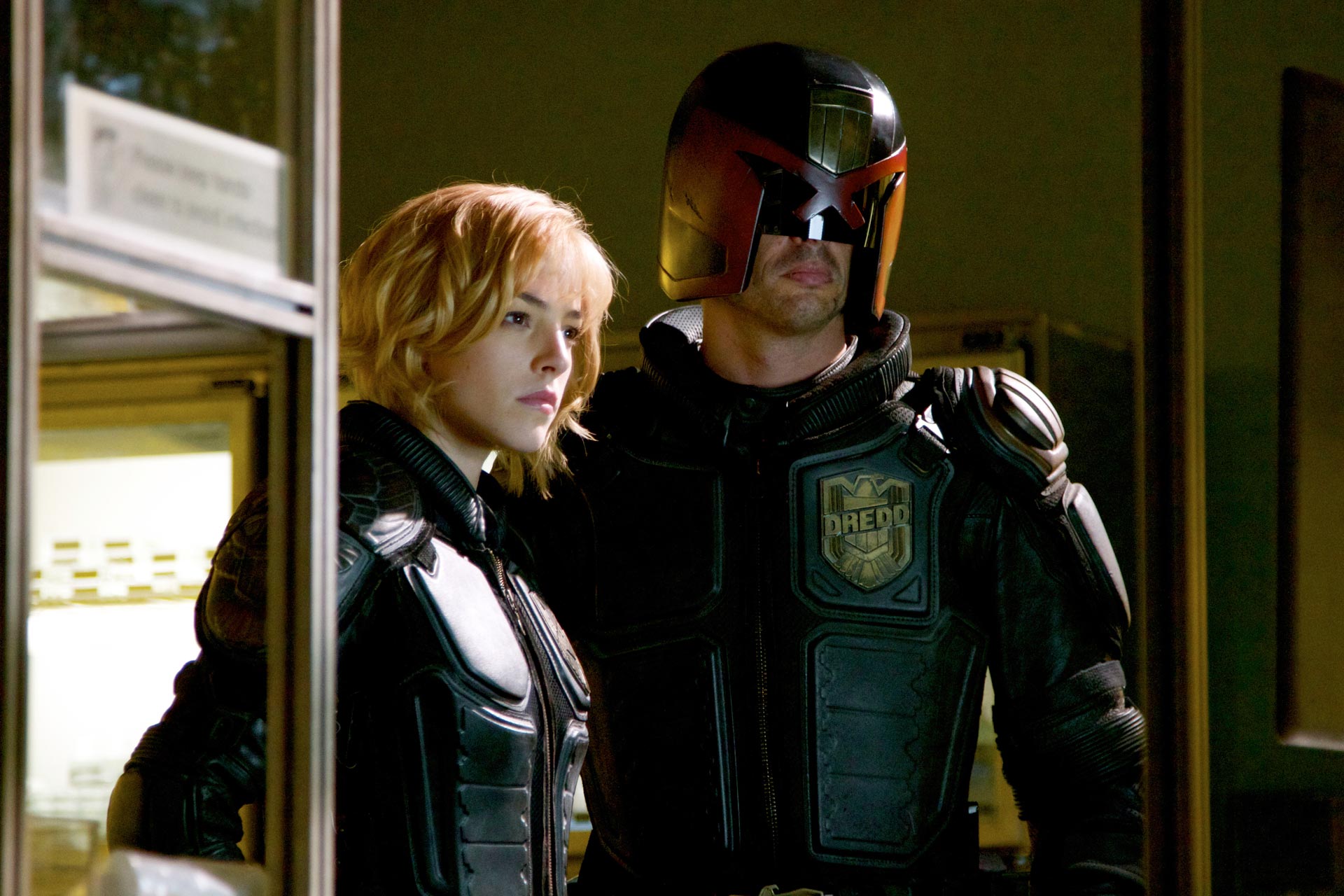
The story takes place in the future, which of course sucks. It’s always lousy in the future in the movies, isn’t it? In this “cursed Earth,” a dystopian large city, the law enforcers serve as judge, jury, and executioner all in one. The baddest of them all is Judge Dredd (Karl Urban)—with a cool uniform, a helmet that covers the top half of his face (we never see him take the thing off), and a cold, monotone voice recalling Clint Eastwood and Batman.

Karl Urban is unrecognizable as Dredd. That’s not just because we never see his face partially covered by that helmet, leaving his mouth and chin exposed, but because of his deep growl and his deadpan persona. You’d never link this man to the 2009 “Star Trek” (he played young Bones McCoy). He’s also grimly funny too, as he delivers one-liners in the most depraved situations he runs into, providing some very big laughs.

Also a lot of fun is Olivia Thirlby, best known for her indie roles as “Juno’s” best friend and the pretty high school girlfriend in “Snow Angels.” Here, she plays a blonde mop-haired psychic “mutie” (slang for “mutant” in this world—I guess stealing “muto” from “Waterworld” was too much) who becomes the rookie Judge Anderson. Thirlby displays a calm (yet somewhat ethereal) yet confident screen presence, whether it’s looking danger in the eyes or through their heads (because she has the power to enter your mind and mess with it to seek information—now that’s awesome). She’s a ton of fun and delivers some badass moments as well. She is no damsel in distress.

The real story begins as Dredd and Anderson respond to a disturbance at the 200-tower Peach Trees housing complex and interrupt a party where the latest drug is being used—a drug that allows everything in your perspective to slow down time (this is where a lot of slow-motion visual styles come into place). Facial-scarred drug-lord Ma-Ma (Lena Headey) has been killing her subjects by enforcing the drug onto them, and pushing them out the window from the top floor, making their fall seem longer than it is. Dredd and Anderson take a suspect (Wood Harris) into custody. Knowing that they will interrogate him for information, Ma-Ma forcefully arranges for the entire building to be locked down and insists that she’ll keep it this way until the Judges are caught and killed.

This sets up a series of events that lead to close calls, strikebacks, shootouts, and just about everything else you’d expect to see here. “Dredd” pulls out all the stops and then some. This film is alive with energy as Dredd and Anderson find new ways to outsmart the heavily dangerous thugs looking to shoot anything that moves. But it’s OK—the Judges have specially designed guns that have voice command and many features (automatic fire, stun, double-whammy, and more). That gives them advantages that lead to some impressive developments.

“Dredd” is violent, bloody, heavily-stylized…and it’s just so freaking cool. There’s never a dull moment, it’s visually exciting, the action is top-notch, and it’s just an intense thrill ride from beginning to end. I look forward to a sequel, and I think there will be one, seeing as how audiences are hungry for mindless entertainment. I guess I could describe “Dredd” as precisely that, but that would be considered an understatement. This movie just kicks ass.

Paranormal Activity (2009)

24 Feb

paranormal-activity-dwrks2

Smith’s Verdict: ***

Reviewed by Tanner Smith

Any horror film that forces Steven Spielberg to watch it in the daylight, rather than at night, deserves to be checked out. The story of how the extremely-low-budget independent thriller “Paranormal Activity” got its release is quite interesting—apparently, the film was shown at several film festivals for a couple of years before it was acquired by Dreamworks, who wanted to remake the film with a bigger budget. Spielberg got a DVD copy of the film and watched in his home at night, and was so scared to continue that he waited until morning light to finish it, after which he called the executives, saying, “We shouldn’t remake this—we should release it!” Paramount Pictures picked up the film and released it to the public.

“Paranormal Activity” is a welcome addition to the horror genre—maybe not a complete success, but enough clever moments and more importantly, terrifying moments. No doubt it’s a great movie to see with a crowd, with screams and laughs—it’d be very entertaining, but when you watch it alone in your house, what you have seems like a typical horror film. Not much fun is left. But still, it’s an effective chiller.

“Paranormal Activity” uses the first-person perspective used in other thrillers such as “The Blair Witch Project” and “Cloverfield.” It pretends to be “found documentary footage” and is seen only in a first-person perspective, from a video camera owned by one of the main characters. And better yet, all of the actors are unknowns, making it more effective—the actors use their real first names for their characters.

This first-person gimmick also creates atmosphere—much like how “The Blair Witch Project” created atmosphere with its first-person perspective in the middle of the woods, “Paranormal Activity” uses the same gimmick inside a seemingly normal suburban house.

Inside this house live a young couple—Katie (Katie Featherston) and Micah (Micah Sloat)—who have just moved in. They’re experiencing a haunting of some sort, so Micah decides to buy a new camera to see if he can record anything out of the ordinary, like an amateur paranormal investigator. He’s excited about this ordeal, but for Katie, this is nothing new, as she has experienced something like this in the past.

Micah films around the house during the day and also sets up a tripod in the bedroom to record them (with the help of a computer) while they sleep. And surely enough, the camera does capture some strange happenings, like a mysterious shadow or a moving door. Micah and Katie keep trying to figure stuff out—Katie even calls a psychic to come down and see what he thinks. He concludes that this spirit is a demon and it only wants Katie, and not the house.

Every night, things get creepier and more tense. It just gets worse as it goes along, and Micah is in no way making things better. He provokes the demon! I’ve seen horror movie characters do stupid things before, but…he brings out a Ouija board to try and communicate with the demon, even though he has been specifically told not to! He’s a brave guy, all right…no, he’s just an idiot. And most of his antics pay off in a way that you just want to smack him. If you don’t yell at the screen, “Get out of the house!,” you might still feel obligated to yell, “Get a clue!”

There are many scary moments in “Paranormal Activity.” As with “The Blair Witch Project,” the fear comes more from what we don’t see. When we hear something going on elsewhere, it comes out of nowhere. We hear someone—or something—walking up the stairs and it fills us with unease. And so on. There are many hints as to what’s going on throughout the movie and it gives the audience time to try and figure out exactly what’s happening. Also, just the idea of something supernatural happening in a typical suburban house at night is creepy enough. There’s something I’d like to mention too—there’s a time code at the bottom of the screen (or viewfinder, if you will) every time the camera records them sleeping. The numbers will speed up, meaning that we’re fast-forwarding through time (usually to a few hours later). When the numbers stop…you know something is going to happen, but you don’t know what. That’s a great idea.

And then there’s the ending, or rather the final image—I won’t give it away, but I guarantee it will make even horror movie fans uneasy.

This is an effective horror film, and a terrific one in that it uses its limited resources to give us something satisfying. Both lead actors are totally convincing their roles (and Katie Featherston can let out a hell of a scream, I tell you that), the setting of one house filmed with one camera is surprisingly fitting, and of course, the scares are there.

Harry Potter and the Half-Blood Prince (2009)

21 Feb

bilde

Smith’s Verdict: ***

Reviewed by Tanner Smith

After being somewhat disappointed by “Harry Potter and the Order of the Phoenix,” which was the fifth film in the popular “Harry Potter” series, I found myself pleased with the sixth film, “Harry Potter and the Half Blood Prince.” This film sets up the final act (“Harry Potter and the Deathly Hallows,” which is released in two parts—part 1 in November 2010 and part 2 in July 2011) and leaves us enchantment, terror, and a few laughs along the way.

Everyone in the Hogwarts world is now convinced that the evil Lord Voldemort has returned. We all know that there must be a huge climactic battle between Harry Potter and Lord Voldemort. But before that happens, we get “Harry Potter and the Half Blood Prince,” in which Harry and headmaster Dumbledore must receive information from the past in order to find a way to vanquish Voldemort. But it can be assured that the battle will not begin here—in fact, Voldemort doesn’t even appear in this film. Instead, he has his army of Death Eaters to make sure things are going according to plan. And there is a plan, mind you.

The whole movie is a foreboding of what may occur in the final entry (or entries, considering the seventh and final book in the series is going to be adapted into two films instead of one). But this is necessary—you have to pay attention to what is happening so what you’ll see in the final entries will make more sense.

The Death Eaters are on the move and are on the path of destruction. As the movie opens, we see that they are the cause of a bridge collapsing with many innocent Muggles walking along it. Then we cut to Harry Potter (Daniel Radcliffe) reading a newspaper in a subway diner—the headline reads, “Is Harry Potter the Chosen One?” “Who’s Harry Potter,” a cute waitress asks Harry. Harry has a crush on this girl and just says that Harry Potter is nobody. She tells him she’ll be off work at 11. But a possible date will have to wait because Dumbledore awaits Harry nearby.

Dumbledore (Michael Gambon) gives Harry an important assignment for Harry’s sixth year at Hogwarts—to retrieve any kind of information from Professor Horace Slughorn (Jim Broadbent) about what he has told Tom Riddle a long time ago. Tom Riddle, as you recall, was the young wizard who became Lord Voldemort. Dumbledore shows Harry a collection of memories from Voldemort’s past as a boy—when Dumbledore first met him and a distorted discussion of forbidden magic between the boy and Slughorn. Dumbledore leaves Harry to the task of befriending Slughorn and somehow getting him to reveal what Slughorn has told him. This information could be useful in the final entries. It contains a key as to how Voldemort can be defeated.

Meanwhile, Harry’s student enemy Draco Malfoy (Tom Felton) is being initiated into joining Voldemort’s army of Death Eaters. But that’s not all—Professor Snape (Alan Rickman) is making sure nothing bad happens to him. Snape has joined the army as well, but still, Dumbledore trusts him. This is a sign that Dumbledore is reaching his weak points. Also back is Bellatrix Lestrange (Helena Bonham Carter), who killed someone very important to Harry and is continuing to raise hell. But at school, while Harry is trying to persuade Slughorn, he and his friends are faced with teenage angst. Harry is attracted to Ron’s sister Ginny (Bonnie Wright); Ron Weasley (Rupert Grint) is in a relationship with the school vixen; and Hermione Granger (Emma Watson) is jealous because she has developed somewhat of a crush on Ron, though she won’t admit it. I love that Harry’s best friends are interesting again, seeing as how they were basic bystanders in the previous film.

The whole movie is a setup, but we’re interested because we have grown to love these characters after five movies and we just can’t wait to see what happens here before we can’t wait to see what happens in the final entries. Jim Broadbent is an absolute delight as Slughorn—he’s a brilliant character actor and somehow I had the feeling he’d show up in a Harry Potter film sooner or later. The stuff with the kids is interesting because it gives us more rooting interest and Dumbledore has become even more appealing than Harry in this film. Michael Gambon plays Dumbledore as a wizard of action (a la Gandalf in “Lord of the Rings”) and is given much more to do than before. Also given more to do than before is Alan Rickman as Snape—his character is more chilling this time around. The final half is amazing—it takes place in a dark cavern where danger awaits, and then it returns back to Hogwarts in a great conclusion that reaches the emotional impact of the tone. Also, the cinematography in that cave is truly amazing. “Harry Potter and the Half Blood Prince” ends with a bang, although a “To Be Continued” sign would have been appropriate.

And in the final entries—“Harry Potter and the Deathly Hallows Part 1” and “Part 2”—it will be Harry, Ron, and Hermione, the three engaging wizards we care about, in the mix of something bigger awaiting. But in the end, it will be Harry Potter alone, dead or alive. What will happen?

NOTE: Don’t let the PG rating fool you—the “Harry Potter” films get darker and darker. This is no exception.

Harry Potter and the Order of the Phoenix (2007)

20 Feb

order_phoenix_dvd_1211

Smith’s Verdict: ***

Reviewed by Tanner Smith

“Harry Potter and the Order of the Phoenix” is the fifth film in the “Harry Potter” series. It is also my least favorite in the franchise. That’s not to say I didn’t enjoy it. I am giving it three stars. But with a new Harry Potter film, you expect more than this.

“Harry Potter and the Order of the Phoenix” begins as now-15-year-old Harry Potter (Daniel Radcliffe) is sitting by himself on a swing set in a playground. He feels—as we do—that opportunities for nicer, more innocent times are gone. It’s especially so when Lord Voldemort (Ralph Fiennes) is back and looking to make himself known to Hogwarts’ world again. Nobody believes Harry saw him rise and even fought him at the end of “Harry Potter and the Goblet of Fire,” except Dumbledore (Richard Gambon). A minor problem with this film is that it can’t possibly stand on its own. There are two many references to past events—this is not a good film to start with if you’re a newcomer to the series. But that’s not exactly a problem, since this is made for regular viewers of the “Harry Potter” series.

Harry is in trouble for saving his cousin Dudley from a vicious Dementor using a Patronus spell. You see, it’s against the law to use magic outside of Hogwarts School. Harry is called to the Ministry of Magic for a hearing to see if he should be allowed to go back to Hogwarts for his fifth year. Things don’t go so well at first because most of the jury still doesn’t believe him or Dumbledore about Voldemort’s return to life. But nevertheless, Harry wins appeal from most of the jury and is allowed to return to Hogwarts.

But Voldemort is back and Harry learns that the battle lines are drawn. There is a defense group known as the Order of the Phoenix while Voldemort raises his army of Death Eaters. Harry wants to fight, but the Order won’t allow him since he’s “just a boy.” At Hogwarts, things go really bad due to the arrival of Delores Umbridge (Imelda Staunton), sent from the Ministry of Magic to put an end to this “conspiracy” and keep all students in line. She seems sweet, but she is a total nightmare that eventually costs Dumbledore his job. Then she sets her sights on Harry, who in the meantime, is gathering his own army with his friends. Harry teaches many of his friends to improve on spells to defend themselves against the dark arts, since Umbridge won’t allow them to be taught in class anymore.

Harry is still growing as a character. He even has his first kiss with the attractive Cho (Katie Leung). “How was it,” his friend asks. “Wet.” It’s not much, but it shows that these characters are more than young wizards—they’re teenagers.

The problems I had with “Harry Potter and the Order of the Phoenix” are mild, but they stop me from giving a rating higher than three stars. One is, Harry’s best friends Ron and Hermione (Rupert Grint and Emma Watson) are more like bystanders this time around—they aren’t given anything special to do, save for a few short scenes of humor. And it’s annoying when Hermione is correcting Harry for something he knows is right. That’s where young Luna Lovegood (Evanna Lynch) comes in. Another problem I had—I’m sorry, but I didn’t like Luna Lovegood. It’s a one-note-loony role that just plain annoyed me.

Also, there are many moments in the story that just felt rushed, which is odd considering the running-time length. Though, to the film’s credit, the brisk pacing is welcome.

But, in the new installments, we’ll get the unforced feel of unity with Harry, Ron, and Hermione that we should have gotten since four movies have already passed by. I don’t want them to be stooped to artificiality.

But I did like Daniel Radcliffe as Harry Potter, as I always do. Alan Rickman has more creepy moments as Professor Snape—even creepier than Fiennes’ Voldemort. I love the performance from Imelda Staunton as Umbridge, bringing menace and sweetness to the role. And I love the final half in which Harry and his friends (including the nervous Neville Longbottom from earlier films) fight against Death Eaters (including feisty, deadly Bellatrix Lestrange, played by Helena Bonham Carter) and the brief mental battle between Harry and Voldemort which shows more emotion than you’d expect. I am recommending “Harry Potter and the Order of the Phoenix,” but I have to say, I wanted more magic.

Edward Scissorhands (1990)

19 Feb

johnny-depp-as-edward-scissorhands-1990

Smith’s Verdict: ***

Reviewed by Tanner Smith

“Edward Scissorhands,” a weird fantasy fable by Tim Burton, has a unique and intriguing premise that begins with one gimmick, which is that the main character has scissors for hands. The premise is this: A young man named Edward was created in a mansion near a small town by a loving inventor, but the inventor died before he could finish his creation with hands. He is left “unfinished” with his scissors for hands. One day, Edward is found by a local woman, who brings him home and offers hospitality, and he becomes the talk of the town. This is an engaging premise and “Edward Scissorhands” plays it with magic realism and a real charm to it.

Johnny Depp stars as the title character, and it’s a more-than-successful creation. Sporting a fright wig, a plaintive expression, and a pure innocence within him, it is impossible not to care for Edward, played wonderfully by Depp. And as for those scissor-hands, it’s a great sight gag, even if it doesn’t make a lot of sense as a metaphor (if that’s what Burton was going for).

Edward has been living in the mansion alone ever since the death of his inventor (the fantastic Vincent Price, seen in flashbacks). His hands are the one aspect that the inventor was never able to create for him, leaving him with long, sharp razorblades. One day, he is found by the Avon saleswoman, Peg (Dianne Wiest), who feels sympathy towards this man and invites him to live at her home in the neighborhood nearby. When he’s there, he adapts to suburban life, becomes the talk of the street, impresses everybody with his skills with his hands (he can make gigantic hedge animals and give haircuts to the local women and their dogs), and also begins to fall in love with Peg’s teenage daughter Kim (Winona Ryder).

This is no ordinary neighborhood, mind you. This looks and feels like something out of a comic book or an animated sitcom. I admire the visual style that Burton shows throughout this film—every film he makes seems to turn our everyday world into something resembling a fairy tale, for example. But there is one thing that kind of bugs me. The early scenes that the strangeness of this movie’s suburban world, with the bright colored visuals (houses with bright paint colors and people dressed in practical-Technicolor, looking an awful lot like “Pee-Wee’s Big Adventure”), don’t leave us with that much wonder when we see the amazing-looking garden at the mansion—wonderful set design, with hedge animals and bright flowers. And thus, once we leave the mansion with Edward, the world just gets even stranger. That being said, I have to ask, wouldn’t it be more interesting to have Edward’s world collide with the real world? This is not the real world—this is a strange world in which the Avon lady looks at a creepy-looking mansion up on a hill and thinks there will be someone there who could use her materials, and just walks around the place and looks around for someone, saying “Avon calling.”  And some really strange people, too—the women in this weird neighborhood make “Steel Magnolias” look like a soap opera. At least the teenagers are normal enough, and react how anyone would react to a man with scissors for hands. Although, come to think of it, that means they’re less funny.

But here’s my major problem with “Edward Scissorhands” that almost kills the movie. It’s not that all the townspeople turn against Edward when they see how dangerous he can be with those scissor-hands, even if he doesn’t intend to hurt people. I get that; it’s like “Frankenstein,” which Tim Burton sort-of satirizes here. But that’s enough. Just give us the mob of local folks as a catalyst for conflict. And that brings us to the unnecessary, unwelcome addition to the villain role—Kim’s jealous, hostile, and unbelievably dull boyfriend Jim (Anthony Michael Hall). Good Lord, is this guy boring. We know that Jim is going to be jealous of Edward being in love with Kim, and know just about everything that he’s planning to do. Every time he shows up, I groan. No thought went into this character at all and it leads to a boring climax—a fight between hands and scissors.

There are enough things that “Edward Scissorhands” does right that I can marginally recommend it, despite that aforementioned boring element. I’ve already mentioned Depp’s great performance as the immensely-appealing Edward, but there’s also the sweetness that envelops around Winona Ryder. She does a really good job as Kim, who sometimes seems like the only person capable of loving Edward. The best, most touching moment in the movie is when she finds him and says, “Hold me.” Edward tries, but is too afraid of hurting her—“I can’t,” he says miserably. So, she helps him to let him hold her. That is a beautiful moment, and so is the sequence in which Edward uses his blades to scrape a giant ice block in such a way that it looks as if it’s snowing on Kim. The Danny Elfman music score in both scenes is very effective.

The first half is engaging in its weirdness of the locations and the characters, and lead to some nice sight gags and funny lines of dialogue—I love the bit in which Edward carves up some meat and offers some to one of Kim’s friends at the dinner table, and she says, “I can’t eat that—you used your hands.” I don’t even care about logic in this world, so I don’t even question how Edward is able to make shrubbery sculptures where no shrubs should ever grow. That’s just the kind of world this is. It’s a fantasy; deal with it.

There’s enough love and imagination to the making of “Edward Scissorhands” that I am recommending the movie for its strong, charming points. Sure, I hate the grudging boyfriend character and I kind of wish the ending was more about dealing with problems and accepting them, instead of resorting to an automatic fight scene. But until that point, the film is as innocent and appealing as the main character.