Archive | Three Stars *** RSS feed for this section

Spaceballs (1987)

7 Mar

MV5BOTg2OTg3OTYwMF5BMl5BanBnXkFtZTcwNjc0MjI3NA@@._V1._SX640_SY430_

Smith’s Verdict: ***

Reviewed by Tanner Smith

“Spaceballs” is a comedy by Mel Brooks which has a lot of jokes that are hit-and-miss, but also has just about the same amount of jokes that are hits in the way that I laughed. This is not one of Mel Brooks’ best films—it doesn’t rank up there with “Young Frankenstein.” Or rather, it’s not one of Mel Brooks’ best scripts. There are so many lame puns and juvenile humor. What had me laughing, however, were the visual gags and the behavior of some of the characters, especially the villains. So there are enough funny moments in “Spaceballs” that I’m giving it a mild recommendation.

The whole movie is a parody of the “Star Wars” movies. We have almost everything from the famous George Lucas saga spoofed here. We have Luke Skywalker/Han Solo type Lone Starr, the beautiful but stuck-up Princess Druidia (a “Druish” princess), a droid named Dot Matrix (oh yeah, and voiced by Joan Rivers), a half-man/half-dog Chewbacca replacement named Barf (“I’m my own best friend”), the short wise alien named Yogurt, and of course, the villain Dark Helmet. There are other characters, but I’ll get to them later.

The film begins with those “Star Wars” opening texts that scroll into space, explaining the back story of “Spaceballs” and ending with a fade-in saying, “If you can read this, you don’t need glasses.” That’s funny. But—and maybe I missed something here—there’s a long, tedious shot of the villain’s spaceship that goes on for a minute and a half and doesn’t seem to show anything…well, funny. But then we’re introduced to the villain Dark Helmet (Rick Moranis), who has a large dark helmet that brings his voice to a James Earl Jones baritone type. How do we know it’s Rick Moranis, though? Because Dark Helmet can’t keep the helmet on all the time (he can’t breathe, he can’t see straight, he has to drink a cappuccino, you name it). And he’s a nerd. One of the joys about “Spaceballs” is that Dark Helmet, his second-in-command Sandurz (George Wyner), and President Skroob of Spaceball City (Mel Brooks)—the three villains of the movie—are so dumb, you can’t believe that they’d lead any army. It’s very funny when they plan any evil plot in this movie.

The heroes are the rebellious Lone Starr (a very bland Bill Pullman) and his partner Barf (a very likable John Candy), who as I said is half-man/half-dog (with paws and a tail). They fly through outer space into a flighty Winnebago (nice visual gag) on the run from Pizza the Hutt, a Jabba the Hutt type except he’s a mountain of cheese and pepperoni. Pizza the Hutt is just as disgusting as Jabba the Hutt, but also the funniest gag in the whole movie.

Lone Starr and Barf are called upon by King Roland of Planet Druidia, which is in danger of being destroyed by the Spaceballs of Planet Spaceball—run by President Skroob (Dark Helmet is in charge of the spaceship Spaceball One). King Roland (Dick van Patten) needs the heroes to rescue Princess Vespa (Daphne Zuniga, “The Sure Thing”) and Dot Matrix from capture by Dark Helmet. They succeed, but find themselves lost on a desert planet, where Lone Starr and Princess Vespa argue as Barf and Dot Matrix look on and spew one-liners, and they meet a Yoda type named Yogurt (also played by Mel Brooks) who gives Lone Starr a special ring and gives them the phrase, “May the Schwartz be with you.” This constant repeating of the phrase is so hoping for memorable payoff that it isn’t funny.

As I said, “Spaceballs” has many jokes that are hit-and-miss. The script has a lot of puns and juvenile humor (there’s a difference here). But there are other jokes that do work in the way that I laughed joyfully and recommending the movie. I loved the Pizza the Hutt gag, I liked John Candy and Rick Moranis, Mel Brooks gives two wacky performances, I liked the gag where the villains  try to watch the movie itself to find the heroes, I liked the satire on stunt doubles, and uh…I think there are a couple more if I can think of them.
The Omen (1976)

6 Mar

500full

Smith’s Verdict: ***

Reviewed by Tanner Smith

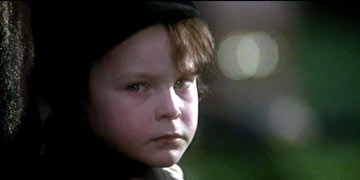
“The Omen” is thought of as one of the best horror films ever made and it does have quite a few chilling moments, as well as an unsettling story idea. It imagines the arrival of the Antichrist. Read the Bible and you’ll know about the notion that someday, as the spawn of Satan, the Antichrist will rise to power and bring about the End Times. “The Omen” doesn’t tell that story. It tells the story of a married couple who learn that their adopted child is the Antichrist.

The couple—U.S. Ambassador to Great Britain, Robert Thorn (Gregory Peck), and his wife Katherine (Lee Remick)—has lost a child shortly after birth. They substitute it for an orphan baby whose mother died the same night. They name the child Damien and raise him as their own. But around the time of Damien’s fifth birthday, mysterious things start to happen. At his birthday party, the boy’s nanny hangs herself (while smiling and saying, “It’s all for you,” if you can believe it). When his parents bring him to church for the first time, he screams and acts violently before they take him inside. Baboons attack the boy and Katherine while they’re inside their car, at the zoo. Many people die around Damien, including a priest who has warned Robert that something is not right with Damien. And a big, snarling black dog hangs around the house, and is eventually brought to stay inside by the new governess Mrs. Baylock (Billie Whitelaw), who while the parents aren’t around comforts Damien by saying she’s here to protect him. Damien is responsible for an incident that causes pregnant Katherine to have a miscarriage. And more.

Photographer Keith Jennings (David Warner) starts investigating these events after noticing a few strange things about the pictures he took of the people who died. These pictures somehow predicted how they died and Robert and Katherine could be next, as well as himself. With Katherine in the hospital, Keith lets Robert in on the discovery and they are led on a series of discoveries, each of them furthering the conclusion that little Damien is indeed evil incarnate.

“The Omen” could technically also be called “Omens,” since there is more than one clear sign in plain sight throughout this movie—the obvious early stage of the Antichrist’s human form, the pictures that predict many deaths to come, and the further looking-into of the biblical prophecy, with a comet returning, the Jews coming back to Zion, and what about the Roman Empire? “That would be the European Common Market,” Robert realizes. Oh, and there’s also the number 666 that is Damien’s birthmark, as well as the infamous Number of the Beast. And of course, since Robert is a powerful man and has connections with the President, Damien could undoubtedly follow through. We can see in the end of the movie that there’s no escaping this prophecy.

Just imagine if your kid was Damien and you knew that he will grow up to do all of these horrible things once he comes into power over the country and even the world. What would you do in that situation? What would you feel? If you knew you had to kill your own child so that it doesn’t happen, would you? That’s a pretty heavy subject, and “The Omen” uses its final act to play with that idea. It’s always a chilling idea when characters get the notion to act out certain deeds now because of what they’re afraid will happen later, but this time there’s actually a legitimate. fearful reason.

I mentioned that “The Omen” does have its creepy parts. Here are a few in particular—the dog is very intimidating, the scene in which the first nanny commits suicide is unnervingly calm, the gruesome deaths are suitably horrific, the cemetery that Robert and Keith explore to find more answers is atmospherically creepy, and Billie Whitelaw, as Mrs. Baylock, brings a great sense of unease to her performance as Damien’s personal bodyguard. And the music! The sinister, choral “Ave Satani” theme, composed by Jerry Goldsmith, is one of the most unsettling movie music scores I’ve ever heard.

Aside from Whitelaw and David Warner who does a good job at mixing curiosity with fear, the acting is pretty much a blank slate. I’m sorry to criticize Gregory Peck’s leading performance, as he is such a powerful actor. But the truth is, as Robert, he’s flat, unconvincing, and probably bored—he always looks like he’d rather be somewhere else. Lee Remick doesn’t have much to show for her role, except for a few legitimate reaction shots. And the kid Harvey Stephens…well, I’ll let him slide because he is a kid and hey, at least he sells that “devilish” blank stare.

“The Omen” is a chilling, atmospheric horror movie that uses the biblical prophecy and insane ideas for some well-executed frightening moments.

The Strangers (2008)

6 Mar

images

Smith’s Verdict: ***

Reviewed by Tanner Smith

1996’s “Scream” pointed out that horror movies featuring psychotic killers are much scarier when no motives are declared for their atrocious deeds. That may be true, but maybe a simpler motive than you’d expect has a creepier element to it. And here we have “The Strangers,” which features masked killers who invade a couple’s home and terrorize them. Why do they do this? “Because you were home.”

That’s it. That line hits a strong note because even in a horror film such as this, being at home won’t help you at all. You think you’re safe and alone, but you’re not. That is a very chilling thought. There are times when I’m home alone and I hear some noise outside and I don’t feel like I’m safe. It could just be a raccoon or something, but it could be someone trying to get in.

“The Strangers” is a chilling horror film about such a home invasion. It’s the debut feature of Bryan Bertino, who pulls out all the stops to create something tense and disturbing. The plot isn’t new, but Bertino’s cinematography makes for great production value and helps make “The Strangers” into something less than a geek show with a lot of blood and gore. There is more terror and suspense here than anything else, keeping the audience on edge throughout the film’s brisk 85-minute running time.

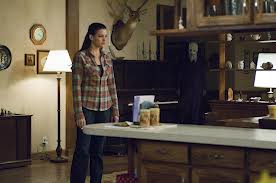
The film takes place in a cabin in the woods as Kristen (Liv Tyler) and James (Scott Speedman) arrive in the middle of the night after a wedding reception. James has proposed to Kristen, who has turned him down. So things are uncomfortable and uneasy for the two of them, and they awkwardly try to keep conversation to keep the night from being too unpleasant for both of them. But before they get a chance to make amends, there’s a knock at the door. It seems strange and they shrug it off, but before long, they realize that there are three people in masks who harass them and make their night miserable. With no one around to help and nowhere to run, Kristen and James find themselves fighting for their lives alone in this house.

“The Strangers” produces a great deal of chilling scenes. The most effective are the ones without music. Why? Because we don’t need it. Take a look at the scene in which you see a figure in the background as Kristen walks forward, not noticing. You don’t need a sharp music cue to show that the figure is there and that he or she means death. The audience will scream because it’s out of the ordinary. Sound effects also play a good part in the film, whether it’s banging on a door, record repetitions, shotgun blasts, etc. But it’s the cinematography that must be praised. It allows us to see things that shouldn’t be there and we’re surprised to see (like that scene I mentioned before), and it always shows purpose with each shot.

Something else I should bring up about the creepiness factor—those masks the killers wear are very freaky. They’re mostly blank white faces (hello, Michael Myers) that are enough to terrify and shock.

The characters—these two people played by Liv Tyler and Scott Speedman—are always engaging. I liked them and I hoped they would make it out of this scary situation alive. Sure, they make mistakes, but they are bright enough to know their limitations even though they come to them a little later than they expected. My favorite moment is when they find a shotgun and Speedman confesses he doesn’t know how to use it. “I’m not sure I even know how to load it.” “But I thought you said you went hunting with your dad.” “That…was just something I said.” And then, without giving anything away, when Speedman does something terrible by accident, I really felt bad for him.

I have to admit when “The Strangers” opened with a disclaimer saying it was inspired by true events, I rolled my eyes in disbelief. First of all, we know that’s not true and this isn’t “Fargo.” Second of all, don’t have someone read what we can. If Bertino (or whoever made this decision) is concerned about blind people seeing the movie, here’s a newsflash for you—most of the movie is silent anyway! Third of all, don’t start the disclaimer saying it was based on a true story and then end it with stating that the “brutal events that took place are still entirely known!” Are you trying to create controversy?

But then once “The Strangers” kicked in with the story, I got into it. It was chilling, disturbing, well-made, and very effective.

Poltergeist (1982)

6 Mar

poltergeist_remake

Smith’s Verdict: ***

Reviewed by Tanner Smith

Steven Spielberg had this to say about “E.T.,” which he directed, and “Poltergeist,” which he produced (both were released within the same year): “If ‘E.T.’ was a whisper, ‘Poltergeist’ was a scream.” Right you are, sir. While “E.T.” is a sensational family entertainment, “Poltergeist” is a scarefest that will most likely cause nightmares for any child under the age of ten. This is a movie in which almost every special effect Industrial Lights and Magic could create for two movies is squeezed into this one movie. We get killer trees, glowing ghosts, goo oozing from a doorknob, a portal appears in a closet, and more. All of these strange and scary events take place in a house inhabited by a family of five…and something else. This house is in suburbia, where every house looks the same. One of the reasons “Poltergeist” works as an effective thriller is having the horror occur in this typical, comfortable home is effective enough.

One of the best things about “Poltergeist” is that everything is seen through the eyes of the family that lives in the house. We don’t fully understand why these strange events occur and why these spirits are here. But neither do the family. We get a nice couple (Craig T. Nelson and Jobeth Williams) and their three kids. The youngest child of the family—a little girl named Carol Anne (Heather O’Rourke)—is the first to notice that something strange is happening. In the opening scene, she walks down the stairs and over to the TV just to say “hello.” She then tells her family, who are standing by and watching, that “they’re here.”

Who’s here? “The TV people.” How does she know they’re here? Um…

It seems like there are spirits living on a blank TV channel and they really are there too. They use parlor tricks to get their attention first. They stack chairs and propel little Carol Anne from one side of a room to the other. But soon, things get really dangerous and the spirits kidnap that little girl and take her to their realm. The doorway to their world is in her closet. So the couple need outside help to get their daughter back.

This is where even stranger events happen. A tree comes to life and tries to eat the middle child. A young doctor hallucinates himself tearing the skin off his face. Ghosts walk down the stairs. A clown doll tries to strangle one of the kids. A swimming pool has a life of its own. If there’s one explanation as to why this is all happening, it’s that the same villains in “Poltergeist” are the same villains in “Jaws.” They’re the town authorities. Instead of telling people it’s safe to go back in the water again, this time they’re telling people it’s OK to build houses on top of a cemetery.

All of this gains our attention because “Poltergeist” works as an effective thriller and as a scary thrill ride. The cast does well and the special effects are indeed special. Steven Spielberg is an executive producer for this movie and I should also mention that the director of “Poltergeist” also directed “The Texas Chain Saw Massacre.” What a good team. Spielberg works with effectiveness along with his special effects and Hooper specializes in realistic violence. But strangely enough, the movie is rated PG and it is definitely not for younger kids. Also strange is that for a horror film, nobody is killed or brutally hurt (the flesh-ripping is just a hallucination). But that’s not a criticism. “Poltergeist” is a little ridiculous but its reason for being is to scare us and make fear for this family. And it works at doing that. This is the haunted-house movie that “The Amityville Horror” wanted to be.

Something Wicked This Way Comes (1983)

6 Mar

jonprice

Smith’s Verdict: ***

Reviewed by Tanner Smith

For every life, there lives a desire. For every desire, there is a wish. For every wish, there is a price. That saying alone will let you know what you’re in for when you watch “Something Wicked This Way Comes,” a supernatural thriller that tells a story so compelling you can’t believe the Disney Studios would make a movie as frightening. Maybe they hope the two 12-year-old characters will lighten the mood. But the problem is, terrible events happen to these two kids—spiders surround them, an entire parade searches for them (with kid-sized coffins), and they become involved in a plot to grant people their dreams but take away their lives. This may frighten younger viewers but will probably delight older ones, especially adults because of the darker theme involving one of the kids’ fathers.

The film, based on a novel by Ray Bradbury, begins with a great shot of a train coming towards the camera in the dark. That shot alone tells us that we’re in for something that I don’t think the Disney Studios would want to make again. It lets us know that this is no family film. The film takes place in a small Midwestern town where the two boys—timid, sensitive Will (Vidal Peterson) and the more-outgoing Jim (Shawn Carson)—live. There are many other people in the town, including a cigar store owner who dreams of being rich, a barber who dreams of a thousand gorgeous woman coming to town and being with him, a one-armed, one-legged barman who dreams of playing football, and an old crone who dreams of being beautiful again. Then there’s Will’s father Charles (Jason Robards), who only dreams of being much younger. Will doesn’t particularly like living with an old father. Charles is unsure he can even live with himself.

The mysterious Darks Pandemonium Carnival comes to town and all of these characters (except Charles) arrive. The cigar store owner, the barber, the barman, and the old crone are fortunate enough to meet the Dust Witch (Pam Grier), who knows their dreams and tells their fortunes. It seems that the carnival’s biggest attraction is temptation and these people may be falling into a trap as they are tempted by the Dust Witch to give up something for their dreams come true. They get what they’ve been wishing for but there is a price that must be given—for example, the old crone becomes beautiful but she loses her eyesight. Then, I guess, they become slaves to the force that surrounds the carnival.

Only young Will and Jim realize that something creepy is happening. They run afoul of Mr. Dark (Jonathan Pryce), the tall, mysterious carnival owner who seems to be the ruler of this strange force. He has plenty of tricks up his sleeve and many carnival attractions that are interesting with special effects—including a merry-go-round that can spin backwards through time. He seems to will the ways of the devil, in the way that he can tempt people and then feed on their souls. When Mr. Dark declares that the boys have seen too much, he sends his forces of darkness after them.

It all comes down to the ending in which Charles is finally falling into Mr. Dark’s trap and he must fight it in order to save himself and the boys. Mr. Dark knows Charles’ wish and would make it come true and the temptation is too strong…

“Something Wicked this Way Comes” is a powerful horror film with the right mood of the original novel (although loosely based on the novel) and great performances, especially from Jason Robards and Jonathan Pryce. The young actors are just OK (sometimes, they seem to be a bit too precocious to the point of annoyance). There are some parts where the boys seem older, especially in the scene where they’re surrounded by hundreds of spiders—probably because of post-production reshoots. But it’s really Jason Robards that steals the show. He’s got that amazing voice that makes you want to listen to him and believe in him. Also, I love how the carnival’s being isn’t fully explained—there are some tidbits of explanation but not enough so that there’s exposition. Actually, I’d rather not know. Then there are the heartfelt conversations Charles and Will have in the middle of the night occasionally, which feel very real. That relationship between father and son pays off well.

There are times when it seems like the movie doesn’t know which way to go, especially in the final half, but this is a most unsettling movie with a terrifying atmosphere and a grim feel. It’s unlikely that the Disney Studios would want to make a movie like this again—this is not for younger children. If they see this movie, there’s a good chance they’ll have nightmares for quite a while.

Phone Booth (2003)

5 Mar

phonebooth

Smith’s Verdict: ***

Reviewed by Tanner Smith

“Phone Booth” is among a certain type of thriller that places one character in one location for certain reasons that keep the plot going. Movies like this are fascinating for two reasons—1) It helps to show the talent of the actor playing that one person, since practically the whole movie has to ride on that performance. 2) It’s always interesting to see where the plot is going to go, since we, as an audience, are stuck in this location with the character. In the case of “Phone Booth,” we get a solid performance from Colin Farrell as he is trapped in a phone booth by a psychotic sniper who will shoot him if he leaves.
Joel Schumacher’s “Phone Booth” is pure thriller and very entertaining. It has a brisk pace, tight editing, a running time of 80 minutes, and twists and turns throughout. It even has the brave task of telling the story in real-time. It all begins with our introduction to slick, quick-thinking publicist Stu Shepard (Colin Farrell, sporting a designer suit and a fake luxury watch) making deals through his cell phone while walking the streets of Manhattan. He’s a fast-talker who can make anything up on the spot (he could probably make deals with the Mafia if he could), and he won’t take “no” for an answer. Once business is taken care of, he makes his daily visit to a telephone booth (which, according to the opening ominous narration, he’ll be the last person to use before it is torn down) to call a young actress, Pam (Katie Holmes)—he doesn’t want the call to appear on his cellular bill, which his wife Kelly (Radha Mitchell) checks every month.

After Stu makes the call, the phone in the booth rings. Of course, he decides to answer it, thus setting in motion the scheme devised by a psychotic. The voice on the other line is tough, derisive, and menacing, and warns Stu that he knows everything he needs to know about him. He wants Stu to confess to Kelly that he wants to sleep with Pam, or he’ll go ahead and do it for him. So, Stu tries to talk his way out of this situation, but it turns out it’s more complicated than it seems. It turns that the caller is a sniper and has a rifle aimed right at him from one of the many windows surrounding the city street. He warns Stu that if he leaves the phone booth, he will be shot unless he does what the voice tells him to do.

And so, Stu is trapped in the phone booth, looking for ways to talk and think himself out of this dangerous fix. Things get even more complicated when the sniper shoots a thug who messes with Stu while he’s in the phone booth, and so the police see Stu as a key suspect. Any sudden movements, and the police will shoot him. The location is filled with panic, as the police captain Ramey (Forest Whitaker) tries to handle the situation. He starts to believe that Stu is not the perpetrator, but a victim of something more than he expected. However, if Stu tells him what’s really happening here, he will be shot (and so will Ramey, as the voice threatens), and so he and Ramey have to communicate nonverbally while keeping the sniper from suspecting anything. That’s a clever move that keeps the tension level rising in this film.

It’s quite intriguing how the film is able to keep Stu inside that phone booth through a majority of the film’s running time. You would think that this predicament could be solved easily, but no—the writer Larry Cohen continues to find ways to keep him in there until the film reaches a suitable ending. Twist upon twist is thrown into the plot, and it just keeps going like that, keeping the suspense alive.

Colin Farrell is forced to carry this movie, and it’s a good, tough performance. He’s very effective in a performance that shows that confusion, fear, and unease can overcome even the most confident of men.

Kiefer Sutherland is the threatening sniper, as he does what he can with his limitations. The villain of “Phone Booth” is for the most part heard but not seen. Sutherland has one of those distinctive voices that you can’t help but listen to, even if he says something that you don’t want to hear.

There are a few things about “Phone Booth” that keep it from being great, however. For one thing, the women in Stu’s life are underwritten roles and it seems like any actress could play these parts. It’s hard to care for who Stu winds up caring for more when both their lives turn out to be in jeopardy later when they’re among the crowd, and the sniper plans to shoot someone else to further his point.

There’s also the hyperkinetic camerawork and editing styles that get pretty annoying after a while—it makes the film look more like a music video, as if director Schumacher wanted to try everything he could to keep the tension alive. Sometimes, it works; other times, it’s pretty irritating. But what really annoyed me, and thankfully went away quickly enough (though that’s not saying enough), was the overacting of a group of street hookers who, early in the central treacherous situation, constantly interrupt and annoy Stu by trying to get him out of the phone booth so they can “conduct their own business.” They never shut up! Their screeching complaining and ranting are enough to wish the sniper would just shoot them dead.

Thankfully, like I said, they’re out of the picture before they get even more aggressively annoying.

“Phone Booth” is a sharp, engaging thriller with a solid leading performance, a very menacing threat, and a story that keeps audiences on-edge. And as a plus, it’s over in just an hour and 20 minutes.

Starsky & Hutch (2004)

5 Mar

The Flick Chicks Movie Reviews critics Starsky & Hutch

Smith’s Verdict: ***

Reviewed by Tanner Smith

You don’t have to be a fan of a TV show that a new movie is based off of. You don’t even have to have watched it. I was completely ignorant of the 1970s TV cop show “Starsky & Hutch,” and watching the 2004 movie adaptation of the same name, I didn’t care that I didn’t see the show. I laughed. Isn’t that enough for a comedy? I did laugh. I enjoyed this film for two reasons—1) it was funny, and 2) most of the fun came from the chemistry between the two actors Ben Stiller and Owen Wilson as the title characters.

Ben Stiller is the hyperactive, worrisome, ridiculously-curly-haired Starsky (“For your information, my hair is naturally curly. Feel it.”) and Owen Wilson is the more outgoing, blond-haired bad boy Hutch. Both men are cops, but Hutch knows more about life on the streets. Pretty soon, their police chief (Fred Williamson) believes they deserve each other, and so he assigns them as partners. At first, they aren’t very fond of each other—Hutch insults Starsky’s hair right away—but they become friends and go on a case that the movie requires them to figure out.

The bad guy in this movie is a drug dealer named Reese Feldman (Vince Vaughn). He and his assistant (Jason Bateman) have just created a new kind of cocaine that police dogs can’t sniff or track down. What gets Starsky and Hutch on the case is when they discover a dead body near the river—the dead body of a man killed by Reese.

Their investigation leads them to picking up a couple of cheerleaders (Carmen Electra and Amy Smart, “B-E-A-U-tiful,” as Jim Carrey would say) and taking them to their apartment so they can share a funny moment that reminds us that the movie takes place in the 70s. I like it when Owen Wilson croons a single originally sung by David Soul, who played the original Hutch in the TV show. Starsky and Hutch’s investigation also leads them to a scene that audiences seem to love and got a big laugh, but for me, I felt a little indifferent. Maybe I didn’t find it hilarious when Starsky interrupted Reese’s daughter’s Bar Mitzvah party, shot through the garage door, opened it to reveal a pony as a gift for the daughter, and then everyone sees the pony fall down dead. (“Are you OK, little pony?”) Maybe it rubbed me the wrong way.

This is one of those comedies in which a lot depends on the chemistry from the actors. This is the sixth movie featuring Ben Stiller and Owen Wilson in a movie together and they come off as a really effective comedy duo. Separately, you get almost too much of them. But when you put them together, they create the perfect comic timing. Owen Wilson was in another film adaptation of a TV show called “I Spy.” That movie didn’t do much for me and I didn’t laugh much. I did laugh a lot during “Starsky & Hutch.”

Todd Phillips, who also did “Old School,” has a movie that is rich with ideas. Also enjoyable is Snoop Dogg as Huggy Bear, a Superfly clone whose fashion remains in the 70s. And then there’s the running joke about Starsky’s great-looking Ford Gran Torino and Starsky’s attachment to it. There’s one scene in which Starsky and Hutch try the impossible that always seems to work in action movies. They try to drive the car really fast off a pier to land it on the bad guy’s boat. Does it make it? I will not say. What I will say is this—I love it when Starsky tries to rescue the car. Some ideas that don’t really work (for me, at least) include the pony scene. And then there’s a very weird cameo by Will Ferrell, which I will not give away. “Starsky & Hutch” is a fun, satisfying comedy.

Spider-Man (2002)

4 Mar

Spiderman-Kiss

Smith’s Verdict: ***

Reviewed by Tanner Smith

Every superhero must have an origin story and “Spider-Man” is an intriguing one. Spider-Man, of course, is the popular superhero from Marvel Comics. As many of his fans will know, Spider-Man is young Peter Parker when he’s not saving lives. This first film adaptation of the comics tells us how Peter Parker became Spider-Man. The result is quite entertaining.

The best thing about “Spider-Man” is the casting of Tobey Maguire as the hero. I’m not sure they could have picked a better young actor to make Peter Parker likable and convincing (except maybe Jake Gyllenhaal). Peter is a nerdy high school senior who hardly gets any respect. His best friend is Harry Osborn (James Franco), the underachieving son of rich scientist Norman Osborn (Willem Dafoe). And his crush is Mary Jane Watson (Kirsten Dunst), who lives in the house next to his Aunt May (Rosemary Harris) and Uncle Ben (Cliff Robertson). Oh yeah, and she’s currently dating Harry.

One day on a school trip to a lab at Columbia University, Peter is bitten by a spider of unknown species. That’s when things really start to change. He develops arachnid powers. He can see without his glasses, he is suddenly strong, he has spider-like reflexes, he can make webs appear out of his hands, he can climb walls, and he has amazing agility. At first, Peter wants to use his powers for personal gain (fighting a wrestling match for three thousand dollars so he can buy a car to impress Mary Jane—he wins the fight, but he gets conned). But after a serious tragedy occurs, Peter learns that “with great power comes great responsibility.” He creates a suit suitable for his powers and becomes New York’s arachnid superhero Spider-Man, fighting crime and rescuing people in need.

But it wouldn’t be a full superhero movie without a villain to develop powers coincidentally as Peter gets used to his own. Norman Osborn has been creating a new kind of energy source for superhuman strength and a jet-powered one-man glider. But something goes very wrong and Norman develops a sort of “Jekyll and Hyde” double personality. Norman is constantly controlled by something strange and sinister (I don’t know what—the movie calls for a certain suspension of disbelief). He becomes the Green Goblin, complete with that same glider and a horrific-looking metal suit. This is where the movie actually starts to falter.

The first half of the movie is better than the second. It’s so much more interesting to see Peter learn to use his powers accurately (or as accurate as can be). He stands up to the school bully and has enough confidence to have occasional conversations with Mary Jane. But more importantly, he learns that because he has these amazing powers, he has to use them responsibly. The second half is full of action and there are times when I could tell a CGI Spider-Man from a live actor, mainly because at times, Spider-Man moves almost like a cartoon character than a flesh-and-blood hero.

“Spider-Man” was directed by Sam Raimi, who also made the superhero tale “Darkman,” as well as the “Evil Dead” movies. He has fun giving the characters comic-book reactions to Peter/Spider-Man when something amazing happens. How can you not like the moment when Peter quickly rescues Mary Jane after she slips over some apple juice split on the cafeteria floor? He’s able to catch all the condiments on Mary Jane’s lunch tray before they drop to the floor so that Mary Jane can say, “Wow—great reflexes!”

I did enjoy Willem Dafoe’s “Jekyll and Hyde” persona, but as the Green Goblin, he’s not an effective villain. Take the scene where he makes himself known for the first time—in appearance, he looks like he would fit in through an episode of “Power Rangers.” And when he goes over the top, he really goes over the top, although his manic persona does cause a few good laughs.

One of the best things about “Spider-Man” is surprisingly not the action sequences, but the more quiet, simpler scenes that are touching, memorable, and great to watch. Peter’s talks with the supporting characters and the kiss between Spider-Man and Mary Jane are among those (that kiss is the most memorable—he’s upside down and she’s standing in the street, she takes half of his mask off, revealing his mouth and chin, and kisses him). Also, Peter and Mary Jane make a cute couple. But since Mary Jane is someone Peter really cares about, that puts her in more sticky situations than Lois Lane.

I want to say more about Tobey Maguire—he’s brilliant in this movie. He has never, to my knowledge, turned in a bad performance. As Peter, Maguire brings a lot of appeal and emotion depth. He never seems to be overacting. He takes the situation how any average teenager would react if he discovered he was half-spider. We are with Peter throughout this movie and we care for him. Also in times of tragedy, Maguire doesn’t hit a wrong note. I think Tobey Maguire is a part of perfect casting. Kirsten Dunst is suitably spunky as Mary Jane. James Franco, however, is a bit stiff as Harry.

“Spider-Man” is not one of the best superhero movies. But I am giving it three stars because I was intrigued by the origins of Spider-Man and the casting of Tobey Maguire as Peter Parker. You can enjoy it for what it is.

First Blood (1982)

4 Mar

sylvester-stallone-first-blood-431x300

Smith’s Verdict: ***

Reviewed by Tanner Smith

“First Blood” is a movie about a Vietnam vet/war hero who fights in a new war—this time, in the woods outside a small town against its police force. That premise alone sounds like it’d make an intriguing action film while also making for some legitimate drama, and for the most part, “First Blood” succeeds. Sure, there’s implausibility in many of its stunts and tactics, but they work mainly because Sylvester Stallone, acting as the hero, makes it work. Already making his mark as the physical-type title role in “Rocky,” Stallone also made his mark as one of the great physical actors. In “First Blood,” we can believe that he can escape an entire police force in their station simply because he wills it. That leads to the chase outside of town, into the woods, and into a situation he shouldn’t be able to escape. Even that, no matter how implausible it is, seems believable enough because that’s how Stallone plays it.

Stallone is easy to catch our attention in “First Blood”—he owns the screen. He plays John Rambo, a drifter who is also a returned Vietnam veteran that we learn later has experience in survival. He’s just passing through a small town, hoping to meet one of the people from his troop only to discover that he died of cancer. Realizing he’s the lone veteran in his troop, he walks sullenly through town. However, the local sheriff Teasle (Brian Dennehy) is suspicious of him. He stops Rambo and gives him a ride to the town limits, hoping he’ll go away and non-subtly hinting that “his kind” aren’t welcome in this town. But Rambo doesn’t want to leave just yet without getting something to eat, and Teasle places him under arrest.

This is where things get pretty intense. Rambo’s interrogation is not handled well and the cops’ behavior evokes painful memories from his experiences in Vietnam, so Rambo escapes and makes his way outside the town and into the forest, with the police force in pursuit. However, what they didn’t count in was Rambo’s resourcefulness. He’s able to make things miserable for these people, and he does this because they deserve what they get coming to them. He wasn’t even a threat to them before, and yet they treat him as such. Even when Rambo unintentionally kills one of them and tries to give himself up so no one else will die, they continue to open fire at him. Sheriff Teasle will not let it go, but Rambo’s skills turn out to be too much for his men. And so, the military arrives, led by Rambo’s former commanding officer in Vietnam, Colonel Trautman (Richard Crenna).

The first half of “First Blood,” in which Rambo lives off the land and uses his skills to nab the hunting police, is well-done. We feel sympathy for Rambo and anger for Teasle and his men. We want Rambo to give it to these jackasses. There are many ways Rambo is able to outsmart them—even by camouflaging himself (in a hurry, I’d guess) in the green so he can strike and then sink back into invisibility.

But the second half has its problems. For one thing, the action isn’t as intense or even as interesting as two other main elements it has to it. One of those two elements is the character of Trautman, whose loyalties are in question. He wants to help the man he trained into this fighting machine, but at the same time, he’s in charge of those looking to bring him down as Rambo starts his own war with them. This is intriguing irony and makes for some good moments. The other element that I felt was very strong was Rambo’s final speech to Trautman about how he’s haunted by his nightmares of Vietnam, but will never survive in this society because of what he was taught. He feels like he belongs in a world of war, not in a peaceful society. That’s a powerful speech, but it was followed by an action sequence that wasn’t particularly well-done as Rambo finally raises all hell on the town. It’s not that it isn’t shot right or anything, but it’s that it’s mainly just executed as a bore, especially compared to the stimulating first half.

Mostly though, “First Blood” is a good movie. It’s not merely about an action hero walking around, kicking ass. It’s about something more than you’d expect from hearing about it—how one chooses to live through one society after the nightmares conveyed by the past. It’s treated with more intelligence than you’d expect. Stallone’s great, but also, Richard Crenna is strong and Brian Dennehy plays the sheriff character as so hateful that you anticipate his comeuppance. “First Blood” is a well-acted, well-paced action film.

One on One (1977)

4 Mar

628x471

Smith’s Verdict: ***

Reviewed by Tanner Smith

“One on One” is a sports film that is utterly predictable, but has its heart in the right place. It’s a feel-good comedy that is quite engaging, getting past the clichés seen in most sport movies. If the story of a small-town jock making it into a big-city university and hoping to win the girl of his dreams sounds familiar, it basically is. It’s a reliable formula that audiences are interested in. Audiences can guess (and mostly guess correctly) who will the big game at the end of s sports film, but it’s the journey that leads up to it that really matters most. “One on One” is a good movie—it’s well-acted, funny, and has a good sense of its environment, particularly when the environment is a basketball court.

Robby Benson, who co-wrote the screenplay at age 21 with his father, portrays the protagonist, a small-town, high school basketball player named Henry Steele. He’s a shy, naïve teenage boy with wide eyes, certain gullibility, good nature, and, of course, great skills in basketball. He’s only 5 feet 10 inches, but the coach from a big university thinks he could use him. The coach grants him a scholarship (and a new car), which Henry accepts.

Henry is welcomed into the system and is given a tutor, an alumnus big brother, and a spot on the team. His tutor is a cute young woman named Janet, played by Annette O’Toole with great appeal. In this film, O’Toole shows a remarkable screen presence and an appealing personality so that when Henry surely falls in love with her midway through the film, we don’t doubt it. Their scenes are the best thing about “One on One.” They’re played with soft humor and genuine sweetness. At first, this naïve kid doesn’t know how to feel around this cute grad student. But the next time they meet for a tutoring session, he impresses her—she says that he’s the first jock she’s met that has read “Moby Dick.”

Then later in the film, Janet breaks up with her boyfriend—a bearded professor for whom she’s a teaching assistant—and gives Henry support off the court. As their relationship develops, she even asks him to move in with her. (I love how Henry silently mouths, “Wow!,” after being asked to move in with this gorgeous grad student,)

But there’s a problem—Henry, who started out playing well on the team, is playing lousily and it becomes revealed that that’s because he’s constantly thinking of Janet. At one point, his friend helps him by taking him to a party—this doesn’t go well and it leads to the coach’s secretary (Gail Strickland, very funny) making a pass at Henry…in a very big way, let’s just leave it that. Also, the same friend gives Henry some speed to make him play basketball with manic energy.

This leads to the coach (G.D. Spradlin) into believing he’s made a mistake in granting this kid a four-year sports scholarship. He asks Henry to give up the scholarship. Henry refuses, so the coach does many things to humiliate/hurt him. What do you call a guy like this, without typing a certain seven-letter word for “jerk?” Well, believe me—“jerk” isn’t enough to a guy as despicable as is portrayed in this film.

All I’ve mentioned is handled well. As predictable as this film can be, particularly with the final climax involving the big game, “One on One” is still sweet and funny. Robby Benson is likable in the main role, Annette O’Toole is engaging, and on top of this, the film’s message about not giving up isn’t thrown in your face. “One on One” is a nicely-done feel-good movie.