Archive | Three Stars *** RSS feed for this section

Short Circuit 2 (1988)

28 Mar

syn_shortcircuit2_0

Smith’s Verdict: ***

Reviewed by Tanner Smith

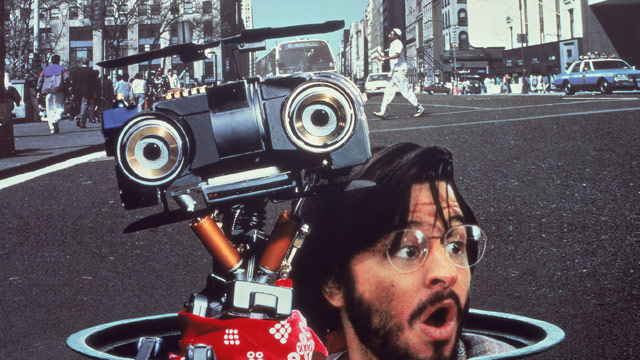
This is not how it goes. Sequels are not supposed to succeed far above their original films. But that’s the case with “Short Circuit 2,” a far better movie than its predecessor “Short Circuit.” The only thing that movie had going for it was a cute robot with an appealing comic personality. The problem was it was sidelined with an idiotic plot and Steve Guttenberg. But now, with “Short Circuit 2,” the robot—now named Johnny Five—is in a movie worthy of him. Yes, I called the robot “him.” Why? Because the robot is alive. Johnny Five has a mind of its own. You might recall in the original film, he got struck by lightning and was brought to life magically.

“Short Circuit 2” also features Fisher Stevens, whom you might remember from the original film as the Indian man named Ben. He’s the one who helped Guttenberg construct Johnny Five in the first place. Ben is now selling goods on the streets of New York—in this case, he’s selling six-inch lookalikes of Johnny Five. They’re real treats to have. The attractive Sandy (Cynthia Gibb), who is a worker for a toy company, notices these little robots and is very impressed. She and Ben strike a deal—if Ben can make a thousand of these little robots by the end of the month, they will be marketed and purchased. Ben agrees, and to his reluctance, he gains assistance from a wise-cracking street hustler named Fred (Michael McKean) and gets himself an abandoned building to gain a factory to work inside. But things don’t go well and burglars keep trying to get in because there’s a tunnel under the floor of that building that may lead to a bank vault. Are you still with me?

Anyway, Johnny Five is sent in a package to Ben and Fred to help. He does a spectacular job too. But Johnny Five is always hungry for more “input” and when he realizes he’s in a city, he constantly comes out of the factory to explore. In one funny scene, he comes across a street gang and unwittingly helps them steal lots of car radios. I like the way he imitates a crazed car salesman when he shows the gang the radios he stole. You see, Johnny Five can get a lot of input from reading books in just a few mere seconds. But mostly, he just imitates what he sees on TV. This is charming. Don’t we all imitate what we see on TV every once in a while?

Of course the people in the city make fun of the robot. This is where “Short Circuit 2” gets its seriousness. Johnny Five, since he has a mind of his own, feels left out of society. He has thoughts and feelings and now he feels that as a robot, he’s not human. And nobody in the city is treating him like a human. All he wants is respect. Don’t we all?

But since this is a robot, you have to ask yourself this question—“Do you care if the creature’s life is in jeopardy?” The answer is yes. Johnny Five unwittingly helps the burglars get to the bank vault (he trusts their leader) and the leader of the burglars sees Johnny Five as a witness that can identify them. That brings us to the intense showstopping scene in which Johnny Five is being smashed by the bad guys. That scene shocked me and frightened me, so I really did care for this robot’s “life.”

“Short Circuit 2” isn’t just about that robot. The characters of Ben and Fred are actually kind of interesting. Ben is an Indian man waiting to become an American citizen and Fred is trying to get rich but he knows what’s right in the end—the refreshing thing about his character before that point is that he’s not a bad guy. Then there’s the crush Ben has with Sandy, who of course feels something for him too. There’s a funny scene where Ben is given help from Johnny Five (with Johnny Five flashing sentences on a billboard) in order to talk to Sandy on their first date.

There’s another scene I want to mention. When the burglars lock Ben and Fred up in a freezer of a Chinese restaurant, Ben has access to a phone but can’t talk on it. So he calls Sandy and uses the numbers to match tones of popular songs. Those songs work as a map for Sandy to follow and find Ben. That’s a fun scene.

“Short Circuit 2” is a much better film than the original “Short Circuit.” The filmmakers really put some thought into it, there’s a fun tone to it, and that robot is just so darn likable. It’s great to look at and funny to listen to. Voiced by Tim Blaney, the robot has an appealing personality. Johnny Five is finally in a movie that is worthy of him.

Amazing Grace and Chuck (1987)

27 Mar

MCDAMGR EC002

Smith’s Verdict: ***

Reviewed by Tanner Smith

Wouldn’t it be nice if one small boy reached out for people to listen to him about the way the world is with nuclear weapons, and a high-profile NBA star immediately followed? Of course with the NBA star following this kid’s way of reaching out to the world, the public would be telling the story to the world, making them both heard…but not exactly followed. In the case of “Amazing Grace and Chuck,” the kid is a Little League pitcher named Chuck (Joshua Zuehlke) who is disturbed by what he sees on a tour of a nuclear missile base. He is so disturbed that he makes a vow that until the bombs go away, he won’t pitch Little League baseball.

Chuck doesn’t have a big plan. No, he just says he “can’t play because of nuclear weapons.” This makes him the object of mockery by his classmates and some of the adults in town. His parents try to convince him that this won’t solve anything. But Chuck doesn’t care—he just won’t play.

When someone stops doing the thing that someone does best because of the existence of nuclear weapons, you can expect it to be on the news. Chuck’s story reaches Boston and catches the ear of a Celtics star named Amazing Grace Smith (Alex English). He comes all the way down to Chuck’s hometown out west to meet with the kid and announces that he’ll do the same thing—that is, he’ll quit playing basketball until the bombs go away. And so, the national news is all over this story. People are upset by Amazing’s decision, including Amazing’s agent (Jamie Lee Curtis).

But when a movement like this (as short as it is) goes public, both sides of the world have a little bit of conflict that may grow into something bigger. Before anything (that includes the movie itself) can go too far, the President of the United States (Gregory Peck) speaks with Chuck and tries to convince him to quit this protest. Now this is where the movie is really surprising. This is the point where the movie is supposed to give up on itself and give us cheesy situations and corny dialogue. A movie is in trouble when the President needs to tell a kid to stop what he’s started. But the surprising thing is, Gregory Peck plays the President so well that there isn’t a false note within the performance. He is utterly convincing in this role.

The script doesn’t let him or the kid down either. Something I should have mentioned earlier—Chuck is quiet through most of the movie. He speaks only when he needs to (there are rare moments when he wants to). Eventually, everyone notices this when Chuck is silent through the final half of the film. This works for many reasons—1) We don’t get any scenes of the kid whining about how this is turning out. 2) In being quiet, power is given. 3) He is also quiet when with the President. There are no arguments between the kid and the President to force the President to change his mind about things. There are no big explanations, there aren’t a lot of questions answered, and there is hardly any corny dialogue. And strangely, it works. This is a fresh script.

I also liked the friendship between Chuck and Amazing, the relationship between Chuck and his father, and the exchange of angry words between Amazing and the father, who is jealous that Amazing is seemingly taking his place as role model. I also felt that the Jamie Lee Curtis character was credible.

Just because I felt the relationships between the central characters and Gregory Peck as the President were credible, the story is not entirely credible. This kind of thing about a world peace movement started by one little thing doesn’t happen as easily. But “Amazing Grace and Chuck” is a pleasant little movie that doesn’t expect us to believe that this is realistic. We can buy it as fantasy certainly. But still…wouldn’t it be nice? And that’s the question that the film ends with.

The Rescue (1988)

26 Mar

rescue_in2d

Smith’s Verdict: ***

Reviewed by Tanner Smith

If a teenager can hack into the defense network system (“WarGames”), build his own atomic bomb (“The Manhattan Project”), and fly a jet into enemy territory to save his father (“Iron Eagle”), then why shouldn’t four teenagers and a younger kid be able to sneak into North Korea and save their Navy SEAL fathers from a Korean prison, while making little attempt to disguise themselves?

That’s the central story element of “The Rescue,” a gutsy, well-shot movie that has high spirits and a likable if unspectacular young cast. The whole idea of the movie may be preposterous and that’s most likely the word that almost every other film critic used in their negative reviews of this film. But strangely, I got into the movie. So what if it’s preposterous? So what if (spoiler) everything works out for these kids? It’s a teenage adventure movie—leave it at that and enjoy.

Four Navy SEALs stationed in South Korea are sent on a mission to destroy a disabled U.S. submarine in enemy North Korean waters. They succeed, but are captured and sent to a North Korean prison. A month passes and the imprisoned SEALs are scheduled for execution.

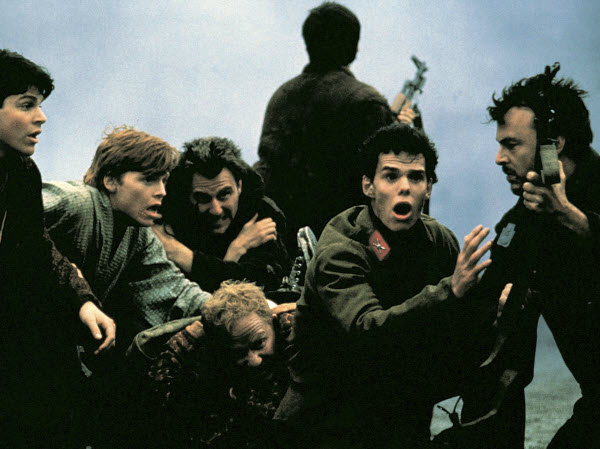
Teenagers Shawn Howard (Ned Vaughn) and Adrian Phillips (Christina Harnos) each have a father that is a prisoner. They use a friend’s homemade listening device to eavesdrop on a discussion of a rescue mission to go in and get the men back. But they are shocked to know that the plug has been pulled on the plan. They and the friend—Max Rothman (Marc Price, TV’s “Family Ties”), the son of the SEAL head—tell the news to rebel J.J. (Kevin Dillon), another son of a captured SEAL. J.J. comes up with the idea of stealing the government rescue plan and taking matters into their own hands. They’ll get a boat, escape the border patrol, find the mission operative, and get their fathers back. They have an unexpected ally—Shawn’s ten-year-old brother Bobby (Ian Giatti), who followed them to help.

“The Rescue” could be made as a silly kids’ movie, but it’s not dumb and it’s not boring either. A lot of that has to do with the masterful direction by Ferdinand Fairfax, who shoots with a great visual style. The climax is surprisingly well-handled, despite the preposterousness of the situation. But I felt involved—at one point, when the plane they use to escape in loses both engines and comes close to a nose dive, I even held on to my own stomach. That’s really saying something about the look of the film.

The young actors are fine and likable—even Marc Price, who was so obnoxious as the neighbor Skippy in “Family Ties,” is likable. Kevin Dillon (seen in “Platoon” and “The Blob”) is a convincing rebellious hero, Ian Giatti has a special enthusiasm that comes with the age, and Christina Harnos is spunky and has some karate moves to use on some (get this) Korean gangsters. The only problem is that their characters aren’t fully developed and neither one is given a chance to stand out.

So what if all of these kids have it easy with one too many close calls? It’s entertaining as a PG fantasy—you know nothing bad will happen to these kids, but let the direction by Ferdinand Fairfax guide you. “The Rescue” isn’t a great movie, but I liked it enough to recommend it. It’s a high-spirited teenage adventure film—deal with it.

Hot Shots! (1991)

26 Mar

500full

Smith’s Verdict: ***

Reviewed by Tanner Smith

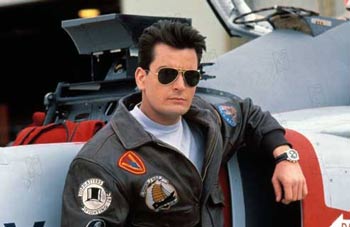
Now here’s something strange—we have a parody film called “Hot Shots!” that mostly lampoons elements from a movie I didn’t like, which was “Top Gun,” and I liked this parody. Weird, how I’d prefer this ridiculous but often very funny film over the movie it borrows elements from, which had great-looking dogfights, but a boring human story. Maybe the filmmakers of “Hot Shots!” knew that some people felt that way, and made fun of that material and more. But whatever they did, it worked for me.

Charlie Sheen plays (and plays with) the Tom Cruise role in “Top Gun” for “Hot Shots!” and his poker face makes him right for the role of Topper Harley. Whenever people look at him, he just likes to show how tough he is by tightening his lip and keeping his eyes open. But when he isn’t trying to act tough, he’s just a macho buffoon, like he’s supposed to be in a film that is like films such as “Airplane,” “Naked Gun,” and not to mention “Top Secret.” These films are funny by giving us silly humor that makes us laugh rather than roll our eyes. In fact, some of the filmmakers of this film also made “Airplane” and the “Naked Gun” movies. You can’t stop yourself from laughing at a good joke and there are plenty in “Hot Shots!”—most notably, a scene in the beginning of the film in which Sheen, playing a young test pilot, passes by an attractive woman on horseback on his way to the air base and he copies her movements on his own motorcycle. That is truly hilarious and we would expect him to bump into a tree branch or fall off or run into that old comedy cliché of someone being distracted and then running into something, killing the infatuation. But he doesn’t and thank goodness he doesn’t—that joke of running into something while distracted is too old to be funny anymore.

Another good running gag is the vision of one of the test pilots, played by Jon Cryer—his vision is distorted by a bad case of “wall-eye.” He keeps missing something he reaches for.

That is all I wish to say about this movie, other than the fact that I laughed a lot during this movie. There are some parody scenes that aren’t that funny, but the funniest moments are when we’re caught by surprise. There are plenty of those moments in “Hot Shots!” We also get strong supporting, comedic work by Lloyd Bridges and Cary Elwes, not to mention as much work as we can get in a movie like this from beautiful Italian actress Valeria Golino as the love interest. But like I said, Charlie Sheen’s poker face will make you laugh.

Sylvester (1985)

25 Mar

syn__0023_sylvester

Smith’s Verdict: ***

Reviewed by Tanner Smith

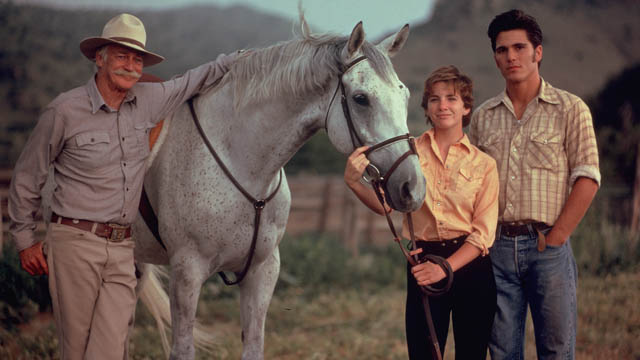
The story for “Sylvester” is nothing new. It’s the story of a spunky young woman and her equally gutsy horse. The horse is reckless at first, but maybe it can be trained to become a champion. We’ve seen this before, particularly in “National Velvet” starring Elizabeth Taylor. But “Sylvester” has something going for it, and it’s not in the predictable story; it’s in the actors’ performances and the story around the girl and the horse.

Melissa Gilbert, from TV’s “Little House on the Prairie,” turns in an excellent performance as Charlie, a sixteen-year-old orphan girl who cares for her two younger brothers by herself and works at a ranch. She wants to train horses and wants a challenge. She finds one, all right, in Sylvester Stallone (no, really—that’s what she names the wild horse of the bunch). This is a wild, unruly horse—not the kind of horse you’d see competing in the steeplechase trials.

But hey, maybe…just maybe…Sylvester will be able to do it.

OK, we all know the conflicts at hand here. Charlie has to deal with the court officials concerning her and her brothers living alone; they later live with the farmer who becomes a father figure; the father figure is skeptical about the horse being trained by Charlie; Charlie gets Sylvester in good riding form; and of course, with help from the farmer, her brothers, and her boyfriend, Charlie is able to compete in the steeplechases. We go through the checklist of events.

BUT among the formula and the obligatory scenes that come with it, we still have the pleasure of watching of viewing the actors portraying these characters. Melissa Gilbert is great in this movie—she has a unique star presence and brings conviction to the role of young Charlie. Richard Farnsworth is also great as the grizzled old farmer who takes her and her brothers in, showing more dimensions than we’re used to. Even Michael Schoeffling (“Sixteen Candles”), as the obligatory handsome boyfriend, does a nice job.

The horse is the least interesting element in the movie. He’s just there as a way to get the story and the heroine in the directions they’re supposed to go. But to be fair, I’m glad this isn’t one of those movies where the horse makes everything happy when the girl is sad. The horse isn’t a practically human reincarnate. It’s just a horse. The story isn’t about the horse, despite this horse’s name Sylvester being the title of the movie. It’s about the people this time.

“Sylvester” isn’t particularly original, except for when it’s dealing with Charlie’s issues and the development of the people around her. It is also harmless for kids and I think adults will enjoy the more mature aspects of the story. It’s a nice family film that could have been great, but as it is, it’s a good movie.

Revenge of the Nerds (1984)

24 Mar

images

Smith’s Verdict: ***

Reviewed by Tanner Smith

Here’s another risqué comedy about young people who break the rules and often talk vulgarly. When done right (like “Animal House” and to a lighter extent, “Risky Business”), it can be less raunchy than it sounds. But when done wrong (“Porky’s,” “Porky’s II,” “Where the Boys Are 84”—I could go on and on, but I won’t for space), they can be real scuzz-pits. Then you have “Revenge of the Nerds”—that’s a clever title for a movie and a clever idea. This is a raunchy comedy that doesn’t focus on the slobs or the jocks, but the nerds—the geeky, twerpy guys who are smart but socially awkward. This film does not take place in the real world—this is a movie in which all jocks are stereotypical jerks who, of course, are the most-loved ones on college campus, and also know nerds when they see them wearing glasses or sporting pocket protectors on their shirt pockets. Oh, and most of the “nerds” are freshmen, which makes it hard to believe. No introduction necessary—they just shout “nerd” at you and make your life miserable. It doesn’t matter what you do; you will always be a nerd to them.

Just describing that one detail of “Revenge of the Nerds” makes it seem ridiculously stupid. But this is a surprise—yes, it features stereotypical jocks (and nerds, for that matter) and quite a lot of female nudity from the sexiest sorority girls. But it also features enough laughs and enough likable lead characters (the nerds) that I’m recommending the film. It’s stupid, but it’s playfully stupid.

So anyway, the trouble starts when the jocks’ idiotic behavior burns their frat house to the ground and the jocks invade the freshmen’s dorms, forcing the “nerds” to sleep in the gym. Then, when the nerds (I hate to call them this) have an opportunity to make into the only fraternity that’s left for them—an all-African-American fraternity called Lambda—those dumb jocks ruin their chances by crashing their party and humiliating them. This will not do. It’s time to stand up and retaliate. Led by Louis (Robert Carradine) and Gilbert (Anthony Edwards), the nerds panty-raid the jocks’ favorite sorority house, install hidden cameras in their dorm rooms, and put “liquid heat” in the jocks’ jockstraps. And if they win the Homecoming decathlon at school, they can take over the jock fraternity.

At that point, the film is predictable, but it’s honest and displays the message that nerds are people too. Some of the nerds are types—we have the slob, the horny Asian, the gay African-American, and the weak nerd—but the two leads, Louis and Gilbert, seem like real people and do earn our sympathies. The jocks—this includes the football coach, played over-the-top by John Goodman—are types, like I said. But in this case, they deserve their comeuppance. I know I smiled when seeing them in pain after the nerds put liquid heat in their jockstraps.

Some of “Revenge of the Nerds” is funny and some of it is heroic. That’s a good enough mix for me to recommend the film without going too crazy over it.

The Phantom (1996)

24 Mar

images

Smith’s Verdict: ***

Reviewed by Tanner Smith

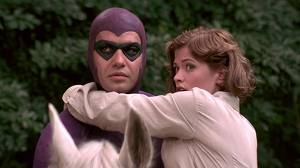
“The Phantom” is based on the superhero comic strip originated in the 1930s, which means this is probably one of the very first superheroes, if not the first (I regret not knowing the history of Batman or Superman). The Phantom—or the Ghost Who Walks—is not one of the well-known heroes, and the film adaptation shows how dated the hero is. The movie apparently knows this too, as it takes place in the same time period as when the comic strip was first released. The movie is true to the Phantom’s origins. When he’s not the mild-mannered Kit Walker (Billy Zane), he’s the Phantom. He doesn’t have the strength, speed, or flight of Superman or Batman’s cool gadgetry, and he’s not very stealth either. He’s a man who is quick-witted and fast on his feet, but not incredibly super. He’s called the Phantom, or the Ghost Who Walks, but he’s not a ghost. He’s human—he can’t live forever. Apparently, he’s the 21st in a long line of Phantoms who live a skull cave in the jungle. Phantoms have a vow to fight evil and thievery, and thus whenever someone comes sneaking around the jungle trying to obtain something hidden, the “Ghost Who Walks” is there to thwart them.

OK, why he’s called “Ghost Who Walks” is beyond me. Is “Ghost Who Works” really supposed to sound scary? Why not “Ghost Who Kills?” That’s as silly, but more threatening than…a ghost who walks. But more importantly, there’s the issue of the Phantom’s silly purple costume and eye mask. Yeah, it’s pretty silly-looking and you know purple never blends into anything, let alone the jungle. But let it slide—the movie is entertaining enough to forget that.

“The Phantom” features an evil industrialist named Xander Drax (Treat Williams), who plans to find a few of these mystical skulls that, when combined, can create unbelievable power and thus give him the ability to overpower mankind. Onto him is a Big Apple newspaper publisher (Bill Smitrovich) who investigates along with his daughter Diana Palmer (Kristy Swanson). But Diana gets captured by Drax’s pirates, including Catherine Zeta-Jones as an exotic bad girl whom Diana constantly tries to get to join the good side because…she’s a woman, I guess. The Phantom rescues her, and he helps on the quest to stop Drax from locating the skulls. And by the way, here’s a “small-world” moment for you—Kit Walker, the Phantom’s human identity, actually had a relationship with his damsel-in-distress Diana in the past. Small world, huh?

“The Phantom” lets loose a lot of fun action sequences—chases, fights, and other stunts that are quite impressive. My favorite is a central sequence in which the Phantom and Diana get away from the villains’ ship, using one of their planes, and having to land on the Phantom’s fast horse before the conveniently-extremely-low-on-fuel plane crashes. (This horse and the Phantom’s wolf who runs at the same speed have to be the fastest animals in the world.) There’s also a showdown in a creepy cavern, a struggle with a truck on an unstable suspension bridge, and other neat action scenes that are quite fun. No wonder, considering the writer of this movie—Jeffery Boam—was the writer of the third Indiana Jones movie.

Billy Zane is a terrific casting choice for the Phantom. He’s sly, suave, bright, and just finds the right tone for the role. Kristy Swanson, as Diana, doesn’t just play the damsel-in-distress. She has enough spunk and nice moves to make the character as interesting as she can. Treat Williams is an absolute riot as the slick villain Drax—you can tell he’s having a ton of fun with this role. And also on hand is Catherine Zeta-Jones, who has plenty of gusto as the woman working for the bad guys, but could maybe be useful for the good guys.

Even if “The Phantom” gets pretty silly (and you have to admit, that silly purple costume doesn’t make the Phantom look particularly threatening), it is still a modestly entertaining movie with game performances and some nifty action scenes as well.

George of the Jungle (1997)

23 Mar

images

Smith’s Verdict: ***

Reviewed by Tanner Smith

I wasn’t a fan of the original animated TV series “George of the Jungle.” In fact, I never saw it. All I know about it is its catchy theme song that goes “George—George—George of the Jungle.” But the show’s film adaptation of the same name “George of the Jungle” is so fresh and funny that I don’t think I want to watch the show. I should probably quit while I’m ahead.

One of the best things about the movie “George of the Jungle” is the casting of Brendan Fraser. He’s the type of guy who might be seen posing as Tarzan on a GQ magazine cover, but he’s also convincing as a doofus. He plays George, who was separated from his human family as a baby and raised by apes in the jungle. He has grown to manhood as king of the jungle. The running gag is that George loves to swing on vines, much like Tarzan, only he crashes into trees, even after someone warns him, “Watch out for that tree!”

Exploring his jungle is a young woman named Ursula (Leslie Mann) and her self-absorbed fiancé Lyle (Thomas Haden Church) as they hunt for a legendary White Ape (which is probably George). They are attacked by a lion, and when Lyle is knocked unconscious when running away, George comes to the aid of Lyle’s lovely fiancée in a very funny scene in which George fights with the lion. When I heard the boxing bell ring three times before the fight, I laughed and knew I was in for a treat. This scene is a real treat—George clotheslines the lion, spins it on his finger (“George not even trying hard”), and even body slams the animal. The way it’s handled is cartoonish, but very funny.

When George takes Ursula back to his tree house, he introduces her to his “brother”—a walking, talking, and even intelligent ape named Ape (voiced by John Cleese). Then he introduces her to the funniest creature in the movie. This is George’s “dog” Shep, who is really an elephant who thinks he’s a dog because George trained him to be a dog. When I saw this elephant run and bark over to George, I laughed and laughed and laughed and had trouble stopping. The scene gets even funnier when George plays fetch with Shep by throwing a huge log to where he can fetch it with his trunk.

“George of the Jungle” is full of good cheer and delivers with humor and charm. The charm of the film comes from the funny moments and also the love story that develops between George and Ursula. George has never seen a human female before so this attraction to her is all too new for him. It’s sweet the way their relationship becomes something more. And the movie really is funny. I love the elephant and the ape has more comic timing than the gorilla from “Congo” (you know, the gorilla trained to speak sign language and drink martinis). It’s also funny the way the script kids itself with the flimsy material. I love how the narrator kids with the characters and the storyline through most of the movie. Here’s an example:

NARRATOR: They reacted with awe. CHARACTERS: Awwwwwwww… NARRATOR: I said “awe.” A-W-E. CHARACTERS: Ooooohhhh… NARRATOR: That’s better.

The movie does start to head downhill when George is taken to Ursula’s jungle—the city of San Francisco. George has never seen anything outside the wildlife before so he attempts to fit in but of course it’s not easy. The whole episode of that concept is funny at first, kind of like a “Crocodile Dundee” situation, but then it starts to grow a little tedious and the energy doesn’t quite pick up until George is forced to go back into the jungle and rescue Ape from poachers.

“George of the Jungle” is alive and suitably silly. It has many funny gags and a lot of charm. Even if the whole “fish-out-of-water” subplot doesn’t exactly work, the rest of the film is still fun to watch.

Birdy (1984)

21 Mar

MV5BMjA3NzIzMzk2MF5BMl5BanBnXkFtZTcwOTM3NDQyNA@@._V1._SX640_SY433_

Smith’s Verdict: ***

Reviewed by Tanner Smith

There’s a beautiful movie surrounding Alan Parker’s fantasy-drama “Birdy,” and it just needs to be found. But as it is, it’s still intriguing, strange, and surprisingly moving, given its subject matter. It’s about two friends from South Philadelphia who have served in the Vietnam War—one of them, Al (Nicolas Cage), is called to a mental institution to try and reach his best friend, nicknamed “Birdy” (Matthew Modine), who is trapped inside of his own mind. If Birdy is proven mentally unstable, he will be taken away.

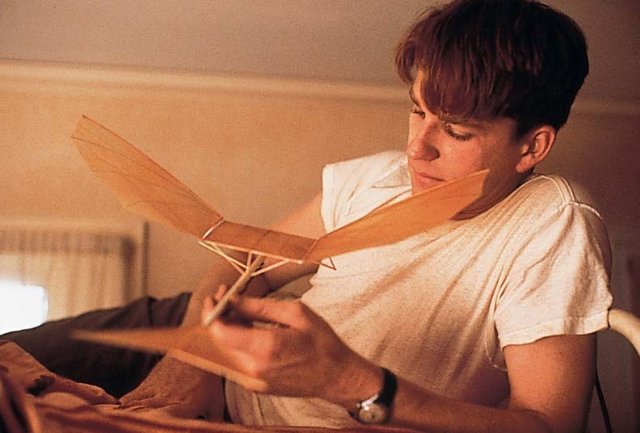
There’s nothing new to be said about the Vietnam War here, but that isn’t important. What is important is the friendship between these two friends who wind up serving in it. They both arrive back, scarred—one physically (Al has disfigured his face, so he keeps bandages covering most of it), the other mentally. Most of their story is told in flashback sequences as we see what led to this. The boys grew up in South Philadelphia. Al is a smooth guy with self-confidence and a natural ability to pick up women. Birdy is a different story—he’s an oddball who is weirdly fascinated with birds and dreams of flying himself. He has a pet canary, he has a pigeon suit to try and capture pigeons (while hanging upside down from elevated tracks), creates an ornithopter (a small flying device), and even some homemade wings to try out in hopes of flying.

Al and Birdy become great friends, as we see in the flashbacks. Although, they become somewhat separated by their pursuits for different things—for Al, it’s more women; for Birdy, it’s a further obsession with flying. But they’re still good friends with each other and share some unique adventures together.

In the present time, however, Birdy has apparently been pushed over the edge, presumably because of his experience in the war. He’s at the point where he actually thinks he’s a caged bird, with his cell as his cage. He looks sideways, looks longingly at the window to see birds fly free, has his head cocked to the side, and doesn’t even say a word. Al is trying to reach him by making him remember the good times they had together and make sure he’s not crazy, but he is not sure what he’s thinking, or even if he’s thinking.

“Birdy” is successful in its storytelling, as it doesn’t tell the story in chronological order, rather than let us figure out for ourselves in what order these events—past and present—happened so we can understand a certain thing about the other. It’s fascinating that way. We also get some deeply effective moments that go deep into Birdy’s perception. We can understand how much he wants to fly, and notice his “transformation” as it continues to develop. We realize his love for birds, as well as his hopes of being free to fly out of this miserable world he lives in, what with a difficult mother and other people (including a girl Al pushes him into dating) calling him weird. This Birdy is quite a terrific character, and played so well by Matthew Modine. I’m surprised his performance wasn’t nominated for an Oscar—I really think it’s an Oscar-caliber performance.

I get the feeling there was a lot more to “Birdy” than what was ultimately released to cinemas and home media. There are many parts of the movie that either feel rushed or not developed at all. For example, in an early flashback scene showing when the two boys first meet, it’s a misunderstanding and then a bit of confusion. Then, we get a montage of the two boys hanging out together, as if all of a sudden, they’re just best friends now. We never saw what made them really connect with each other in the first place. So in that way it is somewhat hard to believe that Al would hang out with Birdy all this time, despite his odd obsession with birds and flying. I also could have used more of Al teaching Birdy to be more sociable in high school. And I also would have loved to see how these two reacted to serving in Vietnam—we only get just a few brief scenes, and that’s not particularly good enough. And the ending is just too ambiguous—it was as if I was reliving my thoughts on the anticlimactic ending for “An American Werewolf in London.” What I’m saying is I could have used a lot more of this material, and that’s saying something, especially considering that this movie is two hours long. I would have watched an extra half-hour if they had something to deliver.

Like Mike (2002)

21 Mar

1

Smith’s Verdict: ***

Reviewed by Tanner Smith

“Like Mike” is an entertaining movie that brings a kid’s fantasy to life. A lot of kids dream to be like Michael Jordan—though I think I can omit the word “like” and just say they want to be Michael Jordan. Kids even wore Air Jordans because they thought these sneakers contained a special super power that made them like Mike. “Like Mike” is a movie in which that actually happens, and more.

“Like Mike” is about a thirteen-year-old kid living in an orphanage and hoping to be adopted by a loving family some day. His name is Calvin Cambridge (rapper Lil Bow Wow), who has an undying optimism and a real love for basketball. The problem is, he’s not very good at it—he’s small and not very coordinated. In the film’s opening scene, he’s humiliated on the group home’s back court by his enemy Ox (Jesse Plemons).

Calvin comes into possession of Michael Jordan’s old sneakers he wore when he was a kid (that would explain why they fit Calvin perfectly…or not). How does he know it’s Michael Jordan? He’s told the shoes belonged to the “tall, bald basketball player,” and the initials “M.J.” are written inside the tongue. Who else could it be? But Ox throws the sneakers so they hang by their laces over a power line. That night, Calviin goes to retrieve them during a thunderstorm. Lightning strikes and somehow Calvin and the sneakers are magically linked together so that when Calvin puts them on, he’s “like Mike.”

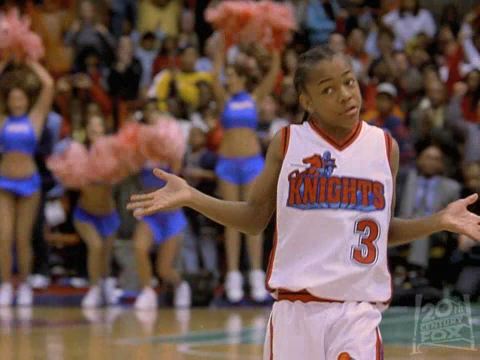
When Calvin and his friends Murph (Jonathan Lipnicki) and Reg (Brenda Song) receive tickets to an L.A. Knights basketball game, Calvin wins a contest at a halftime show and is called down to the court to play a game of one-on-one with Knights player Tracey Reynolds (Morris Chestnut). Because of the sneakers, Calvin is unbeatable. He scores twice (one of those shots from forty feet away) and then on the final shot, stuns everyone watching by actually dunking the ball after flying up to the hoop! This gets the attention of the Knights owner’s representative (played by Eugene Levy, who scores a few laughs) who convinces the coach (Robert Forster) to sign him onto the team. At first, it’s for public appearance to sell a lot more tickets. But Calvin does end up on the court and becomes the youngest NBA superstar. (Actually, because of his amazing skills in flying and dunking, he makes Michael Jordan look bad compared to him.)

The story, of course, leads to many, many games in which Calvin helps the Knights win and leads them to the finals. And of course, once someone very unreliable finds out about Calvin’s magic sneakers, this becomes a major complication. It’s the orphanage’s sleazy caretaker Bittleman (Crispin Glover) who signs to be Calvin’s legal guardian and get about half of Calvin’s investments.

However, this does bring the question, why would he later bet on the Knights to lose the Big Game, when he has enough money already? Why bother stealing Calvin’s sneakers so they’ll be sure to lose? And who appointed this man as the caretaker of an orphanage? He’s so evil that he even nearly burns Murph’s only picture of his late mother while interrogating him to find the sneakers in the first place. What a slimeball.

Another complaint I have is that among the cameos by real-life NBA players, such as Jason Kidd and Allen Iverson, Michael Jordan isn’t among them. OK, I guess the one-line joke about “losing to the Bulls” is supposed compensate for that. But I kind of missed him. I wonder what the movie would have been like if suddenly he realized Calvin’s secret and recognized his sneakers. Wouldn’t that be very interesting?

For what it is, however, “Like Mike” is an entertaining movie. A lot of credit must go to Lil Bow Wow, whose energetic charisma brings a lot of charm to the screen. He’s able to carry a movie. He’s confident, relaxed, funny, and convincing, as well—he plays this fantasy as if it were real.

I also enjoyed the kid’s relationship with Morris Chestnut’s Tracey Reynolds. At first, Tracey is annoyed by this kid after being beaten by him, and even more irritated by having to room with him. But they do form a nice friendship together that eventually turns into a father/son type relationship, which is obligatory but still nicely handled and well played by the two actors.

“Like Mike” isn’t terribly original with its standard scenes involving the bully, the relationship with an adult mentor, the orphanage situations (potential parents only want to adopt the smaller children), and the Big Game. But it does have a few things going for it, like a winning performance by the right young actor, a nice attempt at playing to a kid’s fantasy, and a sharp wit to the script as well.