Archive | Three Stars *** RSS feed for this section

Rocky IV (1985)

5 Apr

rocky iv 1985

Smith’s Verdict: ***

Reviewed by Tanner Smith

I want to ease into reviewing “Rocky IV,” the fourth entry in the “Rocky” film series, because I really shouldn’t rate it three stars (out of four). I should give it two-and-a-half stars—it’s not a good movie, but not a bad one either. But I won’t give it a mixed review because to me, this is a certain guilty pleasure. That’s what the “Rocky” series has stooped to—silliness yet a great deal of fun. The Academy Award-winning original film, “Rocky,” is an all-American classic, the second film is about as strong, and the third one was only decent. You notice how the films are descending from “all-American classic” to “just as strong” to “only decent” to “silliness yet a great deal of fun?”

Yet, I just can’t help myself. I enjoyed “Rocky IV” as a silly sports film. Yes, it’s predictable. Yes, it’s full of sports film clichés—hammy motivational speeches and training montages (there are many to be found here). Oh, and there’s more…

“Rocky IV” takes place a few years after the climactic fight between Rocky Balboa (Sylvester Stallone) and Mr. T. He, his wife Adrian (Talia Shire), and their 8-year-old son attend a birthday party for Rocky’s brother-in-law Paulie (Burt Young). Apparently, Paulie doesn’t have a lot of friends, seeing as how Rocky, Adrian, and Rocky Jr. are the only ones that are there. If that’s not enough, here’s the most bizarre part of this scene—Rocky’s birthday present for Paulie is a robot that apparently understands human statements and responds to them. All I’m thinking is—what was Sylvester Stallone thinking when he wrote the screenplay for this film, like he wrote the first three films? Did he really think a talking robot was necessary for the “Rocky” films? I mean, you don’t even see something like that in “Staying Alive,” which Stallone directed.

Five minutes in and there you go: the most bizarre thing you’ll find in a sequel to an “all-American classic.”

Then, we meet Drago (Dolph Lundgren), a 6 ft. 4, 261-pound Russian genetically-altered boxer. (This guy could make a great video game villain.) He comes to America to take on some great American fighters. So Apollo Creed (Carl Weathers), feeling like he’s lost his strength, decides to fight the giant monster himself. Needless to say, this doesn’t go too well, so Rocky spends the rest of the film training to take on Drago for a big climactic fight in Russia.

So there you go. The robot and the “super boxer” make the first half into something bizarre for the “Rocky” films. Then, in the second half, we get Adrian’s worrying (as usual), Paulie’s comic relief (as usual), and the climactic fight (as usual). Don’t think I forgot the training montages because I’m going to say that there are a lot of them in this movie—no exaggeration whatsoever. The rich dialogue and characters from the original “Rocky” are gone—“Rocky IV” is a silly sports film. It even has the people of Moscow chanting, “Rocky! Rocky! Rocky!”

What’s fun about this movie? Well, the fact that Rocky’s rival-turned-buddy Apollo Creed and Rocky’s soon-to-be opponent Drago are fighting each other for a match is fun even of itself, but before the fight begins, James Brown comes along and sings “Living in America”—I couldn’t help but smile during that scene. Rocky is still the man he was and played by Stallone with gusto. Dolph Lundgren is suitably menacing as Drago, though I’d like to see another side of him, preferably with his wife, played by Brigette Nielsen. And of course, I’ll never get tired of Paulie.

Oh yeah, and just to make sure the film doesn’t end as the first three movies did (the fight ends, the victory music is played, and Rocky hugs Adrian), the screenplay finds it fitting for Rocky to give a hokey speech about how people can change.

I am dead serious. Rocky makes a speech about world peace after he and Drago pummel each other almost to death. I want to hate this movie, but I just can’t!
Cold Tracker (Short Film) (2012)

4 Apr

stills_ColdTracker2

Smith’s Verdict: ***

Reviewed by Tanner Smith

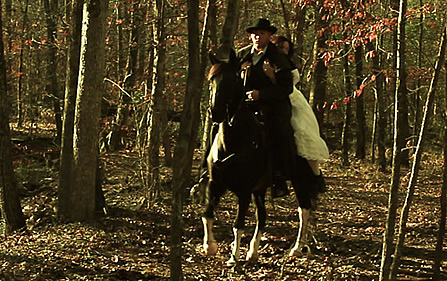
“Cold Tracker” is a short Western, set in the American Civil War era, about a man who returns home to rural Arkansas after serving in the war, only to find that his wife had been murdered only the day before. With the law unwilling to go after the bandits responsible, the man takes matters into his own hands and sets out to track them down himself.

It sounds like a standard story for a Western, but what makes it interesting is the way the titular cold tracker (Scott McEntire) is struggling with the conflict of dealing with the loss of his wife (Mandy Fason), whom he knows he could have protected if he returned just one day earlier. While he’s on this crusade to track down her killers, he is accompanied by a vision of his wife that aids him as he continues. This leads to the choice of what to do when he actually finds them. Will he kill them in order to avenge his wife, or will he let the law do the job?

All of this occurs in a running time of 13 minutes (well, 12 minutes, excluding the credits), creating a brisk pace and not stopping for anything pointless. The flashbacks are placed properly in intersecting with the ongoing story, and the film even manages to leave room for one effective dramatic scene—a flashback in which the tracker leaves for war and tells his crying wife goodbye. This makes his journey all the more effective in that you know how much guilt he feels in knowing that was the last time he would see her alive.

My only quibbles with “Cold Tracker” are minor. Some line-readings are a bit stilted (but for the most part, they’re spot-on). And also, being a 13-minute short with enough story material for 20 minutes (at least), parts of the film felt a bit rushed, and unfortunately so does the ultimate resolution/redemption for the hero. It’s there, but it feels hurried. But to the film’s credit, the ending, what follows that scene, does have enough weight to continue to feel for what has occurred before.

“Cold Tracker” was written and directed by Leon Tidwell, the visually-impaired Arkansas filmmaker who also made the amusing short “The Conversation.” That was a film that allowed him to show, in a narrative metaphorical way, the frustrations in finding work because of his disability. With “Cold Tracker,” it’s clearer that this is a guy who truly loves movies and is determined to keep making movies despite his visual impairment. And I further look forward to seeing his latest work, because “Cold Tracker” is a good short film that continues to showcase the talent of this skillful filmmaker.

NOTE: The film can be seen here: https://vimeo.com/68456516

Class (1983)

4 Apr

class 1

Smith’s Verdict: ***

Reviewed by Tanner Smith

I don’t understand why most critics seem to have a grudge against the adult drama and the teenage comedy in the film, “Class,” which seems to have both. I think, with this storyline, they needed both. I didn’t have much of a problem with the dramatic parts like those who didn’t like “Class” did. I thought they sort of fit.

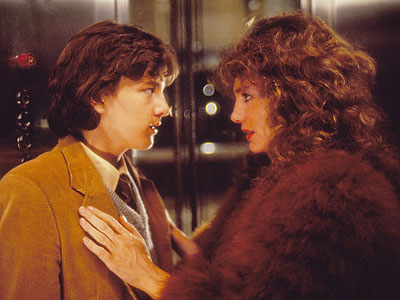
The storyline is this—a shy 17-year-old virgin named Jonathan (Andrew McCarthy) moves into a boarding school. His roommate and best friend Skip (Rob Lowe) gives him some money to go into the city to find some excitement. Jonathan goes to the city and finds excitement, alright…in the form of an attractive (and much older) woman, played by Jacqueline Bisset. As the days go by, he and the woman have an affair together. Jonathan is suddenly the stud at school now (word gets around), but there’s a problem. A huge problem…

And that’s all I’m going to say about that. Even though the advertisers went out of their way to make sure everyone who saw this film in cinemas knew the secret that comes midway through the film, I won’t give it away here. I myself knew what the secret was, but that was on the fault of the advertising, not the movie itself. It’s very discreet in setting up the twist.

“Class” is like a prep-school retread of “The Graduate,” but it has more comedy in the scenes involving Skip, Jonathan, and their friends as they pull practical jokes on each other. Those scenes are pretty funny. Also, the film has a solid characterization of students and teachers. Then we have the more dangerous stuff. The scenes involving Jonathan and the Bisset character are handled delicately, after a gratuitous sex scene that shows up in almost every teen movie in the 80s. Jonathan is proud of his popularly at the prep school (while the woman thinks he’s attending college) and likes being around this gorgeous, nice woman, so it’s not just about losing his virginity. But then when she founds about who he is (and how young he is), he really misses her. Then when the secret is revealed, Jonathan is caught up in complications that he can’t seem to handle.

To be sure, this isn’t a great movie. Sometimes, it seems like the Jacqueline Bisset character is a bit confused. Also, the film is somewhat inconsistent with some of the comedy and drama, and the ending comes off as flat—this film doesn’t have a real payoff. But most of “Class” did work for me. Rob Lowe and Andrew McCarthy are both good, appealing young actors and most of the scenes involving them and their friends are funny (they’re more appealing than the teenagers in “Porky’s”). The drama works nice, save for the moments I criticized above. So I recommend “Class” with three stars out of four.

Up the Creek (1984)

3 Apr

MSDUPTH EC001

Smith’s Verdict: ***

Reviewed by Tanner Smith

“Up the Creek” is among the “slob comedies” that has been around since 1978’s “Animal House” introduced a group of slobs who got laughs just for being what they were. It even features actors from some of those said “slob comedies”—Tim Matheson and Stephen Furst from “Animal House,” Dan Monahan from “Porky’s,” and Sandy Helberg from “History of the World: Part 1.” The film borrows elements from “Animal House,” “Porky’s,” and maybe even “Meatballs”—we have competition between colleges, booze, parties, bare-chested women, casual sex, and psychopathic enemies. So basically, “Up the Creek” has all the ingredients of a “slob comedy” but the surprise is that it’s still funny and I liked it. It’s not up there with “Animal House,” but it’s much better than “Porky’s.” It’s stupid, but a likable kind of stupid.

In the movie, four students of Lepetomane University (which is said to be “the single worst educational institution in the country”) are chosen by the dean to race in an intercollegiate whitewater rafting race. These four are told that if they win, they are granted a degree of their choice.

These central characters are the usual types—the Relaxed but Wisecracking Leader (Tim Matheson), the Overweight Eating Slob (Stephen Furst), the Horny Ladykiller (Dan Monahan—don’t worry; he’s more likable here than in “Porky’s”), and the Nervous Nerd (Sandy Helberg). The opening scenes aren’t particularly subtle. They each try to shoot a morning crow with different weapons only to hit other things (and people) and in another scene, when the fat guy throws his sandwich out the car window, it hits a motorcyclist and causes him to lose control and fall off the road. But hey, that’s supposed to happen in movies like these, right?

Even though these guys are types, they are quite likable and play their parts with a good deal of enthusiasm. Tim Matheson, in particular, keeps his charm from “Animal House” and has a nice relationship with the Blonde Babe (Jennifer Runyon)…or as nice as a relationship can be in a movie like this.

The rivals of the race are the defending champions from a military academy, who is later disqualified after a terrible sabotage attempt (I love how it goes wrong—the Leader of the good guys throws the grenade back at the thrower saying, “Hey you dropped this”). So they go through ridiculous lengths just to throw off the good guys as revenge for…not being sabotaged? I dunno. Another rival group is from the Ivy League, who of course are blond and everyone’s favorite.

The race is amusing and fun to watch—real effort was put into the filming of the protagonists going through some tough whitewater rapids. Tricky photography and cinematography was used to make those scenes seem real. The amusing bits are when the rival teams are trying their hardest to throw off the protagonists—the Ivy League even has torpedoes. But it wouldn’t be a positive slob comedy if the slobs didn’t find their way back up, now would it?

Uh-oh! I cannot believe I almost forgot to mention the best character in the movie—a smart dog named Chuck, played by Jake (he deserves credit). He understands human emotions and may even be smarter than anyone else in the movie. The movie’s best scene is when the military academy team kidnaps one of the heroes and Chuck has to play charades to tell the others where he is. I loved that scene, I liked “Up the Creek.” It’s silly, goofy, idiotic, and predictable, but it’s still quite funny.

Jumanji (1995)

2 Apr

jumanji_1995_2

Smith’s Verdict: ***

Reviewed by Tanner Smith

“Jumanji” is an unusual family movie. It has a fantasy-adventure plot mixed a few elements of “It’s a Wonderful Life.” That’s not bad, but the film contains images and scenes that could frighten younger kids. The film could have been rated PG-13 because it really has that PG-13 feel of it.  Older kids may be entertained by “Jumanji” and maybe some adults as well.

The movie is based on the short children’s book by Chris van Allsburg. It opens in 1869 as two boys bury a crate in the ground in the middle of the night. One asks the other, “What if someone digs it up?” The other prays for them in a dark tone. Then the movie flashes forward a hundred years later to a nice little town called Brantford, New Hampshire. A young boy named Alan Parrish (Adam Hann-Byrd) finds that same crate, opens it, and finds an ancient board game called Jumanji. He takes it home and plays it with a friend. But there’s something unusual about this game—the pieces stick to the board and move by themselves, and then in a mystic manner, a message appears in the middle of the game. The game is magical and has a mind all its own. Unaware of the game’s awesome power, Alan rolls the dice and is sucked into the game with his friend being chased by bats set free from the game.

Now, the movie flashes forward twenty-six years later, Alan’s big house is bought by a woman named Nora (Bebe Neuwirth), who wants to fix the place up for a bed-and-breakfast. She moves in with her adopted niece Judy (Kirsten Dunst) and nephew Peter (Bradley Pierce). Judy and Peter find that same game Jumanji in the attic and begin to play. But when playing, they unleash Alan, now a grown man played by Robin Williams, from the jungle within the board game. Alan is shocked to realize that his parents are dead and the whole town may as well be—everything is closed and practically broken.

But there’s not much time for sympathy; before Alan was set free, a few of Jumanji’s jungle animals have been set free. They are roaming around, hurting people, and slowly but surely destroying the town. Now Alan, Judy, and Peter must finish the game in order to make everything back to normal again. They find Alan’s friend Sarah who started playing the game with him, also now grown up to be played by Bonnie Hunt, and she reluctantly agrees to help.

That leads to one scary event after another as the jungle creatures of Jumanji pop out after every player’s turn. What happens could scare younger children, but others may have a good time with the film—just when you think, “What could possibly happen next,” something bigger happens. The game takes the heroes on an adventure of disastrous proportions, but the destruction will not stop until the game is over.

“Jumanji” is full of ambition—in fact, so full that it gets so close to wearing out its welcome. The special effects are quite special and the heroes react as if they weren’t special effects—that is the effect that is most special, when the cast acts right with them. Also, the second half when everything comes out of the game is a good deal of fun. Among the inhabitants of Jumanji are a rhino stampede, wild monkeys, a lion, giant live pod plants, and giant spiders. Also from the game is a rifle-wielding people-hunter named Van Helt (Jonathan Hyde, who also played Alan’s uptight father) who wants to hunt Alan and kill him.

However, the movie is not just wall-to-wall special effects extravaganza. The movie also has an “It’s a Wonderful Life” feel to it in the way that when Alan is rich and young, the town is lovely. Yet when he returns, he sees what the town is like without him around (his rich shoe factory owner dad spend every cent trying to find him after he disappeared and went broke). Then maybe when all this is over, he can change it all back to perfection. It took me a while to come to that point and it did. That’s what makes “Jumanji” actually kind of innocent and heartwarming to balance out the darker material. The characters are innocent enough for us to root for them and the actors do a good job portraying them. Robin Williams tones down his manic comedic persona and manages to effectively it straight—he’s very likeable here as a result. Bonnie Hunt, Kirsten Dunst, and Bradley Pierce are also good as Williams’ allies. I can also say the same for David Alan Grier, who gives comic relief to this movie as the freaked-out patrol officer.

“Jumanji” isn’t for everyone, or anyone who may get creeped out by a lot of moments in this movie that could scare them. There are some parts of the movie where you’ll crack up but other parts where small children could possibly hide in their parent’s lap while trying to watch it. Like I said, this is a PG-13 movie and if you see this movie and see what happens when giant mosquitoes attack, Van Pelt hunts Alan, or when a giant pod attacks Peter, you’ll know what I mean. Those creepy moments with Joe Johnston’s direction remind us of those creepy moments from those real old children’s movies. “Jumanji” is a good movie with good fun, a fast-paced thrilling edge, and a heartwarming subplot that makes it more special than you might think.

Slither (2006)

2 Apr

slither1

Smith’s Verdict: ***

Reviewed by Tanner Smith

The ads for the science fiction-splatter movie “Slither” say that every horror film that came before it were “wusses.” That may not be true, but then again, “Slither” isn’t really a flat-out horror flick. It is a horror B-movie that has a comedic edge to it. The movie carries almost the same gimmick as the 1986 B-movie “Night of the Creeps.” That movie was about alien slugs invading people’s minds on a college campus. This time, the filmmakers say, “Forget the boring teenagers. We’ve seen too many of these teenaged splatter movies. Let’s just have town locals come in and see how they react to these disgusting situations.” Now keep in mind—this movie does get pretty disgusting. Read on and you’ll know what I’m talking about.

As the movie opens, we meet the folks in a Southern small town. We meet Starla Grant (Elizabeth Banks), a gorgeous blonde. We meet Grant Grant (Michael Rooker) as the rural tycoon that Starla married, even though he may be a bit too old for her. But who cares? Then, we meet Bill Pardy (Nathan Fillion), the town sheriff who has a bit of a crush on Starla. There’s also the town mayor whose opening scene gets a laugh. He cusses out a person who is in his driving zone then he sees a woman and her children look at him blankly and then he greets them, making them say, “Good morning, Mayor.”

Grant is infected by a kind of alien being and he becomes a brainwashed creature with an immense craving for meat. Pets have gone missing, as well as a local woman, and Starla is starting to know that there is something very, very wrong with Grant. And who wouldn’t when we see him later, this time as a blob resembling Jabba the Hutt.

The special effects are pretty impressive, making the ick factor even more ick-ish. There’s a scene later in the movie where that local woman I mentioned earlier that was missing is found as a huge sphere-shaped thing the size of a barn, and suddenly, hundreds of monster slugs explode out of her. And this is when things get even more crazy, as the slugs attack by entering people’s mouths and taking over their minds.

This movie really gets disgusting and the movie barely gets away with being too disgusting. But it’s all just good fun. Writer/director James Gunn was obviously shooting for making this movie the way it is and he succeeds. “Slither” isn’t for everyone, but I thought it was a fun splatter movie that kept my interest.

Angel Heart (1987)

1 Apr

6a0120a721c2d7970b0133f4c6b7d6970b-800wi

Smith’s Verdict: ***

Reviewed by Tanner Smith

“Angel Heart” is a thriller that starts out as a film-noir private-eye tale and then suddenly turns into a bizarre horror movie about something far more supernatural than neither its hero—nor us—could come to grips with until we start to really think about what has just happened once the movie is over. Nothing was as simple as we were led to think it was. We’ve seen the private eye in this movie go from place to place, looking for his subject and encountering many weird things along the way. But its ending brings things to a whole new perspective that “Angel Heart” becomes more shocking than we were led to expect. And heck, we’ve seen many dead chickens!

It’s a strange, unsettling horror movie that starts out as a regular film noir piece. We get the street-savvy private eye—a Brooklyn private detective named Harry Angel (charismatically played by Mickey Rourke)—getting an assignment to find somebody and receive pay for doing so. But his client is someone quite unusual—a strange man named Louis Cyphre (Robert De Niro) who has a neatly trimmed black beard, an elegant black suit, long fingernails, and slicked back hair. All that’s missing is a sign saying “I am the Devil” because his appearance and manner would make people believe that he is evil personified. Anyway, Cyphre assigns Angel to find a missing person for him, for about five grand. Angel accepts the assignment and finds himself in a mad, mad world. His leads are stale and unreliable, more bodies pile up wherever he goes, and the police begin to suspect him for murder.

OK, that all sounds standard enough for a private-eye story, except for the curious De Niro character. But I didn’t mention the voodoo ceremonies in which people dance around crazily and sacrifice chickens, hence the aforementioned “dead chickens.” All of this is weird enough, but trust me—we’re at the tip of the iceberg. But for the sake of keeping things spoiler-free, it’s probably best you don’t know too many details of the plot.

I should bring up the infamous bloody sex scene in the movie. The most memorable, disturbing scene is the controversial one—a sex scene featuring Rourke and Lisa Bonet as a young New Orleans woman whose mother knew the missing person. This scene was almost given an “X” rating by the MPAA ratings board. I wouldn’t blame them—it’s freaking insane. It starts out as an erotic sex scene (with multiple shots of Bonet’s bare breasts), only with a few leaks of rain near the bed. But then instead of rain leaking on them, it’s blood. Rourke and Bonet, I think, don’t notice that they’re being soaked in blood and the whole scene is edited in such a bizarre way as the sex gets even more graphic as it goes along.

The story for “Angel Heart” leads up to a shocking, revealing final act that is just insane. It’s one of the strangest, disturbing, chilling endings I’ve ever seen in a movie. I did not see it coming, nor did I want to know once it was revealed to me. Everything that followed didn’t really prepare me for it, which is why it was so shocking. What else I can say about it is that director Alan Parker tries everything to keep you interested and how he handles the ending is going all out to make it his own. The result is a messed-up movie, but a memorable one. That alone grants “Angel Heart” a recommendation.

Madison County (2012)

30 Mar

madison-county-movie-hiding-behind-a-tree-pig-mask

Smith’s Verdict: ***

Reviewed by Tanner Smith

Give the five central young people in the horror film “Madison County” credit—at least they don’t take the Obligatory Wrong Turn. Midway through their trip to Madison County in rural Arkansas, they encounter a Mysterious Pickup Truck Driver who asks where they’re going. He responds by giving his own directions. Do they take his advice? Surprisingly, no…but here’s a bigger surprise—they still endure all sorts of slasher-film-type torture nonetheless. Maybe it’s because I’ve seen so many movies, but that was a refreshing move.

To be sure, “Madison County” is standard stuff. A group of attractive young people embarks on a seemingly harmless trip far from home, and they stop at a practically-dead town, where they encounter the wrong guy who just wants to stalk and kill them. It goes all the way back to “The Texas Chainsaw Massacre.” (You could call this film “The Arkansas Axe Slaughter.”)

But that doesn’t make “Madison County” a bad movie. In fact, I found myself rather enjoying this film. It’s competently made and knows how to satisfy the average horror fan. I was surprised by how much I liked the film—it brought back fond memories of when I was exploring the slasher-movie genre for the first time as a young teenager (and yes, that included watching “The Texas Chainsaw Massacre”), and how since then (especially now that I’m a film critic) I’ve found some to be acceptable (with some sick, recognizing enjoyment to them) and others to be deplorable (that just feel like an overcoming sickness). The truth is, however, that slasher movies have existed for decades and there’s no sign of stopping anytime soon. But so few of them are as satisfactory as “Madison County.”

The film follows a group of college kids (Colley Bailey, Matt Mercer, Ace Marrero, Joanna Sotomura, and Natalie Scheetz) as they hit the road for a small mountain town called Madison County, Arkansas, in the hopes of interviewing the author of a novel that is based on a legendary murderer named Damien Ewell. One of the kids needs the interview for a class project, and yet he and his buddy bring their girlfriends along with them (with a fifth, the protective older brother of one of the girlfriends, in tow) in the hopes of having a good time. (And let’s face it, it’s also because a standard slasher movie requirement is to have five young, attractive people—not four or six; five! But I digress.)

Once they do make it to Madison County (again, without taking that Obligatory Wrong Turn), they snoop around private property, encounter a strange group of locals at the local diner (including an elderly woman who just seems all too polite), and are warned to turn back before they get into trouble. But wouldn’t you know it—while exploring the woods, trouble does find them. And it’s in the form of a psychotic killer with an axe and a pig-face mask.

I was surprised by how well the first half was set up to prepare us for what the blood hits the fan. It establishes the mystery that the characters are trying to find about, and by doing so, the first half of the film maintains a quiet level of creepiness and eases us into the violence that will occur in the second half, which is composed of the young outsiders racing to survive the predatory Damien. Also, I give the first half credit for setting up the characters in a plausible way, and I found myself liking them as well—they’re not the obnoxious goofballs you see in Eli Roth’s horror films; they’re people you want to root for. This isn’t really an actor’s movie, but the actors playing the five do adequate jobs—in particular, Ace Marrero as the broody, protective “older brother” (mentioned above) adds an unaffected confidence to the role that makes him stand out.

And the film is genuinely scary at times. In particular, there’s a chase between Damien and two young women in the woods, as Damien gets closer and closer to a hiding spot while the woman is too scared to run (and also, give the scene credit for having the other woman make herself a decoy to save the other one). That overly-polite woman at the diner that I mentioned steals every scene she’s in, because you know something just isn’t right with her. And I should also mention the film’s terrific opening scene that shows a young, half-naked, unconscious woman in the back of a moving pickup truck. She wakes up and has no idea where she is, and I’m thinking that I feel her pain. That opening scene got me hooked, and prepared me for what was to follow. (Who that woman was is part of the mystery, by the way.)

“Madison County” is certainly better than most independent slasher movies in recent memory, and most of the credit for that goes to the writer-director, Eric England. He knows that the slasher-horror genre is done to death (so to speak), and doesn’t do a lot to change most of its elements and gimmicks, making it all the more welcome in the way that most of its familiarity works in the film’s favor, in my opinion.

The Texas Chain Saw Massacre (1974)

30 Mar

142224__texas_chainsaw_lSmith’s Verdict: ***

Reviewed by Tanner Smith

When filmmakers dare to make a film as violent and as gruesome as “The Texas Chain Saw Massacre,” it’s hard to make it well with effectiveness. But “The Texas Chain Saw Massacre” is effective, well-made, and well-acted, yet violent and gruesome as I mentioned. As the title suggests, people die—teenagers, to be more specific—after being stalked by a maniac wielding a chainsaw (that never seems to run out of gas, but who cares?). Strange, yes, but what really got to me was the news at the beginning of the movie saying that this was based on factual events. I’m not quite sure I believe that, but with the things we hear about Ed Gein in the past, something like that might have happened.

“The Texas Chain Saw Massacre” focuses only on the five youths who fall victim to the maniac and his psychotic family. Not once do we identify the psychos—there is no motivation, no back story, and no proof that this happened before. That’s a risky move to make in a horror movie, but all the more disturbingly effective.

The five youths (one of which is in a wheelchair) are taking a drive through Texas in their camper van. These are just ordinary, everyday teenagers (or as ordinary teenagers could be in the mid-‘70s) who have something unordinary and something that DOESN’T happen everyday happen to them. It starts when they pick up a weird hitchhiker who likes to cut himself and talk about “head cheese” (the remains of animals’ heads when they’re slaughtered). He slices at the kid in the wheelchair and is kicked out of the van. Before he leaves, he smears blood on the van—an ominous sign that he will be seen again.

The teenagers stop at an old house in which two of them were raised. They decide to have a good time before they return home. But as two of them leave the house to find a swimming hole, they find instead an old shed. The Boy walks in and never comes out. The Girl is worried, so she goes to find him. She gets snatched too—well, she is hung by a meat hook. The Heroine’s Boyfriend sets out to look for the crazy couple after a while. He falls victim too. Soon, it is dark and the Heroine and her wheelchair-bound Brother are about to fall straight into terror, after looking for their friends.

This film is very violent—it shows characters being hit on the head with sledgehammers, clubbed on the hand, hung on meat hooks, and chased around by the chainsaw-wielding psycho. We see rooms with human bones all around, a decomposing skeleton sat upright in a cemetery, and if that’s not enough, there’s a sequence in which the Heroine is captured and tied to a chair, sitting with the psychotic, cannibalistic family, seeing just how sick and bizarre and weird and violent they truly are. She is going through pain and torture at the same time. I also should mention the bit in which the Heroine’s finger is cut so that the psychos’ corpse-figured grandfather will suck her blood. Ech…

“The Texas Chain Saw Massacre” is not for everyone; it may hardly be for anyone. It’s sick, depraved, and violent—But I’m recommending it because it is, like I said, well-made, well-acted, and effective. I can think of a lot of other movies that are also sick-minded, but those probably feature phony performances and too much rely on the villains. “The Texas Chain Saw Massacre” doesn’t feature any of that.

The Book of Eli (2010)

29 Mar

book-of-eli_denzel-washington

Smith’s Verdict: ***

Reviewed by Tanner Smith

(Originally reviewed early 2010)

Is the end of the world really the subject that entertainment wants to thrill us with nowadays? With “Knowing” and “The Road,” movies that feature apocalypse just keep coming. Maybe after filmmakers realize they use too much of that subject in too many movies for one twelve-month period, they’ll get back to other stuff. With “The Book of Eli” and “Legion” seeming to finish off the twelve-month period of end-of-the-world movies, it seems as though the “genre” will be left alone for a long time. But “The Book of Eli” is a good movie—not as strong as “The Road” but not as confusing as “Knowing.” It’s a slick, well-made end-of-the-world Western, if you will.

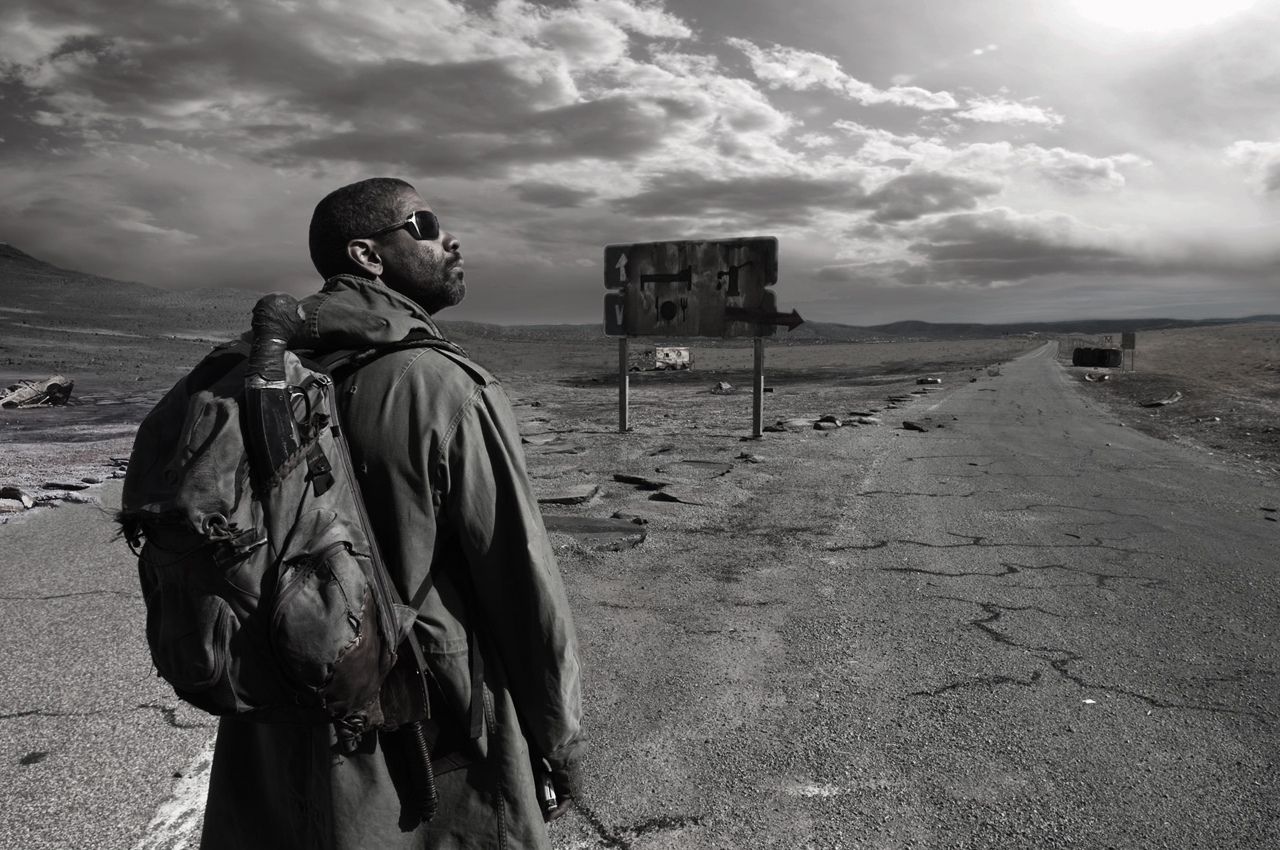
A cataclysmic event, dubbed as “the war,” obliterated almost everything and everybody on Earth. What exactly happened? I’m not quite sure. I think there was a war that “tore a hole in the sky,” as a character says. How did this war begin and when did it end? I’m not quite sure of that one either. Anyway, 30 years later, survivors of the war try to make their best to survive this wasteland that was once America. Everything is valuable now, especially water. Everyone has to wear sunglasses because of the sun’s new rotation or brightness, or whatever. Some survivors, just like in “The Road,” have stooped to cannibalism. It truly is a mad world.

The main character is a man who should be called Eli (Denzel Washington) but strangely enough, we hardly ever hear his name. But since the movie is titled “The Book of Eli,” we are forced to refer to this man as Eli. He’s a mysterious traveler who walks nonstop, heading West where he believes that the last King James Bible, which he has in his possession and reads from time to time, will be safe from others who would use it to manipulate other people in this damaged world for the worse. Oh yeah, and Eli is also handy with a knife. In one scene in the beginning, he takes down a whole band of thugs with just ten seconds. He has also been heading West for a number of years, saying he walks by faith and not by sight. In that case, maybe he only thought he was heading West all these years.

Well, as it turns out, there is someone out to take possession of the King James Bible and has been looking for it since everyone burned them all during the war. This is Carnegie (Gary Oldman), the ruler of a Western town who, of course, has his own band of thugs by his side, including a bald muscleman and a scrawny wise guy. When Eli walks through this town and is given hospitality by Carnegie, it isn’t long before the Bible is discovered and a bloodbath is sure to be drawn for it.

Carnegie is an evil man but played by Oldman as a calm dictator who isn’t broad in a way that we wouldn’t believe he could possibly do such deeds. He is also married to a blind, abused woman named Claudia (Jennifer Beals) who wasn’t blinded by the war but was born this way and was in some way, lucky when the event occurred. Carnegie abuses Claudia to control her daughter Solara (Mila Kunis), who is a prostitute in Carnegie’s bar. Solara later accompanies Eli in his neverending quest to bring the Bible to safety. And there, they meet two characters who are as strange and deluded as anybody in “The Road”—a husband-and-wife survivalist couple named George and Martha.

But more on them when you watch the movie, which is bold, inventive, and powerful. It’s also phenomenal in the ways of the performances by the actors. Denzel Washington is at the top of his game here as Eli. He plays this complicated, mysterious person with the right note and with a great deal of edginess. Washington is great in this movie and Gary Oldman is brilliant as the villain, with a fine line between calmness and irrationality. I should also give special notice to the performances by Mila Kunis and Jennifer Beals, both of which carry the best performances of their individual careers.

Now, the final half of this movie is a bit flawed and sort of uneasy to follow. It also carries one of the most surprising plot twists in recent memory. But directed by the Hughes Brothers, who previously directed “Menace II Society,” it’s very well-made and the cinematography is suitably bleak, just like the scenes that followed in “The Book of Eli.”