Archive | Three Stars *** RSS feed for this section

Mystery Men (1999)

12 Apr

mystery_men_1999_2

Smith’s Verdict: ***

Reviewed by Tanner Smith

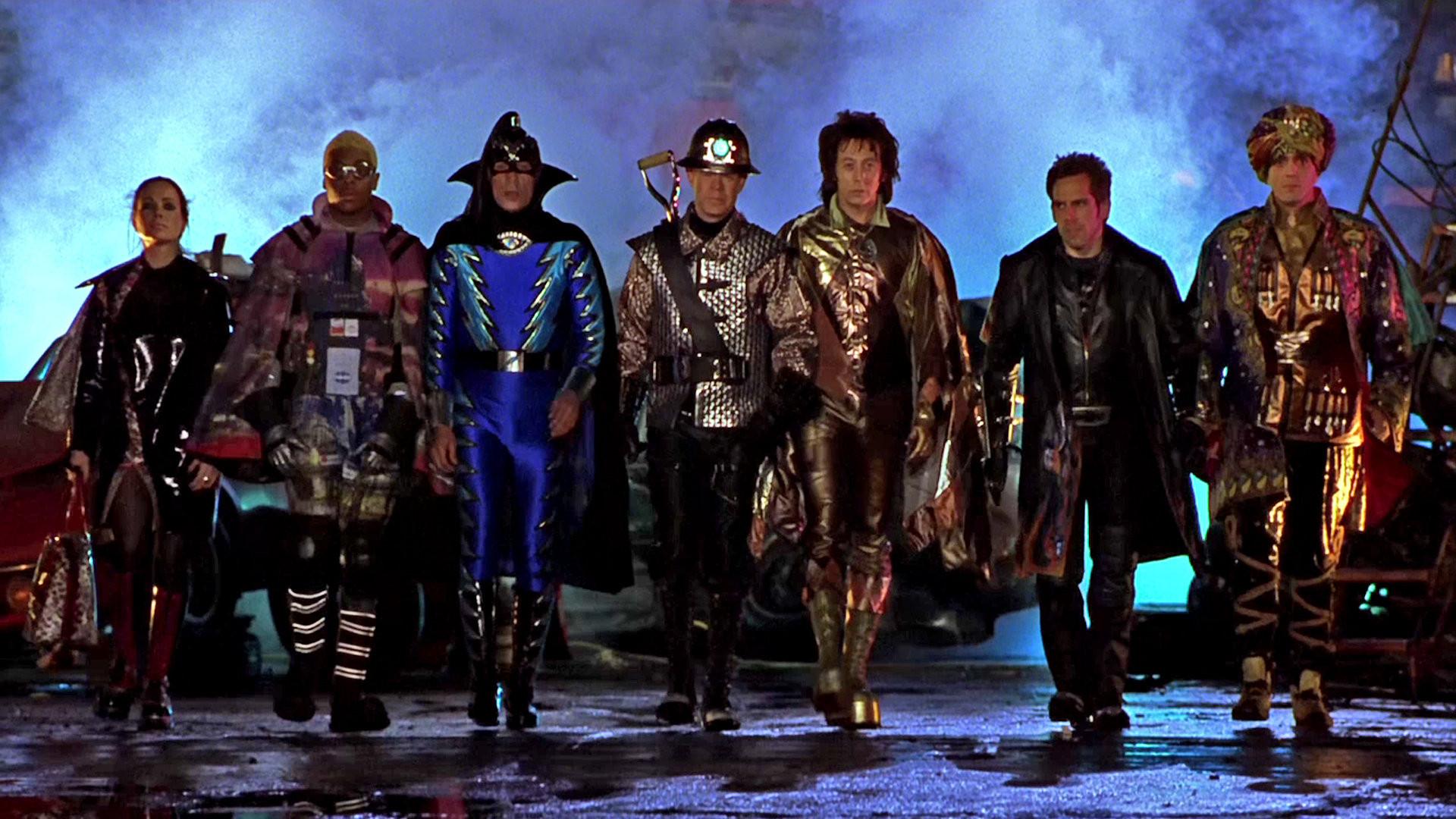
Every kid in the world dreams of being a superhero—they know their superheroes, such as Batman, Superman, and Spider-Man, among others. They believe they have their own powers within them, but it’s very rare that the adults in the world would have their own fantasies too. But then again, there are adults that are just plain bored. “Mystery Men” features a group of adults who band together to become the Mystery Men in their home Champion City, a metropolis nearly resembling Gotham City. They have no powers and neither does Captain Amazing, Champion City’s lone costumed vigilante. However, Captain Amazing has a ton of gadgets and swift energy, as does Batman in Gotham City. And he also has a fan base, which is where the Mystery Men come in.

A trio of superhero wannabes—Furious (Ben Stiller) who gets his “powers” from extreme rage, Shoveler (William H. Macy) who is known as the “best shoveler in the world,” and Blue Raja (Hank Azaria) who hurls silverware (forks and spoons but never knives) with great strength—have a dream to become the backup crew for Captain Amazing (Greg Kinnear) some day. But it seems like they will have to be Amazing’s rescuers as Amazing is captured by his arch enemy from jail Casanova Frankenstein (Geoffrey Rush), a disco-loving villain who is released because Amazing thinks it’d make for great publicity—it’s refreshing to see that this superhero is not very smart.

So it’s up to the second-rate superheroes to save Amazing. They recruit new members on their team—they get Invisible Boy (Kel Mitchell) who can only turn invisible when no one is watching, Spleen (Paul Reubens—yes, it’s Pee-Wee Herman) whose weapon is unbearable flatulence, Bowler (Janeane Garofolo) who hurls a fast-speed bowling ball with her deceased father’s skull inside it, and The Sphinx (Wes Studi) whose power is cliché-spewing dialogue. They band together, borrow some unique nonlethal weapons from a friend, plan to infiltrate Casanova Frankenstein’s disco lair and rescue Amazing (and soon, rescue their city from mass destruction).

All of this is good fun and the actors look like they’re having a good time. Greg Kinnear hams it up as Captain Amazing (respectively), Ben Stiller in usual likable straight-man mode, William H. Macy and Janeane Garofolo have the film’s best lines, Geoffrey Rush is a hoot as the villain, and Hank Azaria, Kel Mitchell, Paul Reubens, Wes Studi are all fun company. And the best part—the actors portraying the Mystery Men portray their roles with straight faces.

Also, there is humor for everyone. There are puns, sight gags, satirical dialogue about the superhero gimmicks, and juvenile humor. And there are some good memorable moments, such as the superhero interview, the first attempt to rescue Amazing, and the Invisible Boy’s “time to shine” (or in this case, time not to be seen). Some scenes are uneven, but as a whole, “Mystery Men” is a satisfying ride to take.

The Man with Two Brains (1983)

11 Apr

tumblr_m9nqrmRBrP1qd3oh7o1_400

Smith’s Verdict: ***

Reviewed by Tanner Smith

So it’s 1983—Steve Martin, in the few years since his big break in 1979’s “The Jerk,” is either a guy you love or you hate. In movies like “The Jerk” and “Dead Men Don’t Wear Plaid,” he comes across as a comic actor who REALLY doesn’t know when to quit or control himself. In 1983’s “The Man with Two Brains,” he has toned down just a little bit (emphasis on “little bit”).

Martin plays Dr. Hfuhruhurr, a brain surgeon. Right away, you can see what kind of movie this is and know right away that his character’s last name is going to be mispronounced as a running joke throughout the movie.

Hfuhruhurr accidentally hits an attractive temptress (Kathleen Turner) who ran out in the middle of the road, chasing after her latest victim who is fed up with her (after she cooks one of his own goldfish). Hfuhruhurr has no idea what kind of woman she is and performs an operation that saves her life. Later, they get married but their sex life is dull, mainly because…there is no sex. That drives Hfuhruhurr crazy.

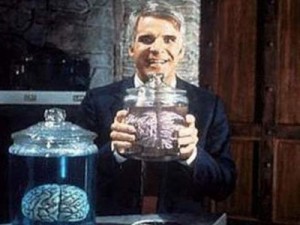
In an attempt to finally make love, he arranges for a honeymoon in a strange hotel. How strange? The elevator doesn’t hit the bottom floor, so Hfuhruhurr has to climb out halfway down. There’s also a mysterious Elevator Killer that kills people before they reach the top floor. But that’s just the beginning. There’s a secret laboratory in which Dr. Necessiter (David Warner) is conducting the strangest experiments ever. An example is there are several brains in jars that are kept alive, even though their bodies are dead. And that brings us to the second half of the film, which is ultimately silly yet funny and kind of charming in a bizarre way—Hfuhruhurr falls in love with one of the brains (voiced by an uncredited Sissy Spacek) while tired of his married life with Turner and discovering he can speak to this brain via telepathy. So he puts lips on the jar to make “her” more human.

The second half of “The Man with Two Brains” is the best thing about this movie. I must admit, when the movie started, I felt the movie was trying to be more like “The Jerk” in the way Martin behaves and the script was giving us some tired gags (with the exception of one big laugh involving his superior and his fingers close to his own face). But once we are in that laboratory, “The Man with Two Brains” becomes both funny and sweet. And I love the sincere goofiness of the situation in which Hfuhruhurr is in love with this brain while he still has Kathleen Turner’s character, who is a complete tramp.

Kathleen Turner and David Warner have a lot of fun with their roles and Steve Martin, as Hfuhruhurr, has learned to tone down his scene chewing and becomes a more likable person. It’s about time someone told him that behaving like his character in “The Jerk” was not a good career move. “The Man with Two Brains” is funny and goofy and though I was unsure of where it was going, it came back with a good second half—so good that I’m giving the movie three stars.

Harold and Kumar Go to White Castle (2004)

11 Apr

harold-and-kumar-go-to-white-castle-1

Smith’s Verdict: ***

Reviewed by Tanner Smith

“Harold and Kumar go to White Castle” features two stoner minority characters named Harold and Kumar that do go to White Castle, but not without a bunch of misadventures along the way. This is an enjoyable comedy with two likable leads and funny situations.

Harold and Kumar are two roommates who smoke more pot than I think any other stoner duo could handle (hello, “Cheech and Chong”). Harold Lee (John Cho) is a hard-working, Korean-American accountant who is shy towards women. Kumar Patel (Kal Penn), an Indian-American slacker, is way more outgoing than Harold—he’s a party animal whose parents are in the medical profession, yet he knows a lot about medicine although he’d rather smoke pot all day. In his introduction, Kumar is interviewed by a dean of medical school (Fred Willard) and impresses him at first until he calls Harold and tells him his plan to be “blitzed out of their skulls tonight” right in front of the dean. That forces the dean to reject him.

So, Harold and Kumar are getting stoned one night and when they get the munchies, Kumar states that he wants the “perfect food.” That’s when a commercial for White Castle appears on the TV screen and hypnotizes them into a slider obsession. Kumar says there is a White Castle nearby, so they decide to drive there and eat. Unfortunately, the White Castle has been replaced by another burger joint. The guy at the drive-thru (Anthony Anderson) tells them that there is a White Castle about forty-five miles ahead.

So, the guys drive to get those sliders and along the way, they get involved in all sorts of adventures—they save a man’s life, wind up in jail by racist cops, encounter a mechanic with a really bad complexion, and come across a hitchhiking Neil Patrick Harris.

Neil Patrick Harris plays himself in this movie, and Harold and Kumar know him best from his “Doogie Howser” persona. There are some jokes about the show in this movie, particularly about asking if he had sex with “the hot nurse.” Harris is hilarious in this movie and way weirder than these guys. He wants sex, he wants to roam free, and he even steals Harold’s car. (“Did Doogie Howser just steal my car?” Harold asks.) He steals his car for a good reason too—so that when they meet again, Harold can ask, “Dude, where’s my car,” and reference the director Danny Leiner’s previous directorial effort, “Dude, Where’s my Car?”

HAROLD: Dude, where’s my car?

KUMAR: Where’s his car, dude?

While there are a lot of laughs in this movie, one particularly distasteful moment occurs when the boys arrive at Princeton and share a bathroom scene that is so disgusting that it makes you cringe. I was afraid of where the film was going after that scene. Also, there are a lot of racism jokes in this movie—a running gag keeps the boys running into American jerks who tease the boys’ backgrounds—and most of them are not that funny. Luckily, the movie redeems itself with the likability of these two characters, some big laughs that come unexpectedly, and a nice subtext that if you want something, you just have to go for it.

The Day After Tomorrow (2004)

10 Apr

Jake-Gyllenhaal-as-Sam-Hall-in-The-Day-After-Tomorrow-2004-12

Smith’s Verdict: ***

Reviewed by Tanner Smith

Well here it is—a movie that tries to warn us about what would happen if we mess up our lovely planet any longer. We use up our resources, we’re partially responsible for global warming, and we may be headed for a nightmarish, cataclysmic future. “The Day after Tomorrow” is a movie that tries to warn us of that, and it cannot be taken entirely seriously, but it’s an entertaining, touching, and scary apocalyptic drama from Roland Emmerich, who apparently loves the planet in many ways to destroy it. In his previous movies, he blew up the White House (“Independence Day”) and set a giant lizard monster loose on Manhattan (“Godzilla”). Now he brings upon the Ice Age in North America. It may be as scientifically accurate as “Godzilla” (those who are new, that means “inaccurate”), but “The Day after Tomorrow” works for me.

We all hope that North America doesn’t freeze over, but if it does, you might want to move away from national monuments because Roland Emmerich has a tendency to destroy those. The very best things about “The Day after Tomorrow” are the special effects. Tornadoes rip through Los Angeles and rip apart the Hollywood sign. A tidal wave crashes through New York, barely putting the head of the Statue of Liberty underwater. All the buildings in the major cities freeze up and their windows crack. Snow nearly buries all the major cities. They look so real, they’re scary. Oh, and there are also shots seen from a space station of the Earth with violent storm fronts.

And we all know from previous disaster movie experiences that the characters the camera and story focus on are going to survive and the rest—billions of the rest—are going to perish in the catastrophic events that occur due to global warming finally threatening humanity. We meet Jack Hall (Dennis Quaid), a climatologist who sees it all coming when his computer models the new ice age. Then we are introduced to his teenage son Sam (Jake Gyllenhaal), who is headed to New York for an academic decathlon with his schoolmates Laura (Emmy Rossum) and Brian (Arjay Smith). Then we meet another kid in the same competition—a nice kid named J.D. (Austin Nichols). Then we meet Jack’s divorced wife Dr. Lucy Hall (Sela Ward), who is treating a young cancer patient. And then there’s Jack’s friend Jason (Dash Mihok) and an old Scottish meteorologist named Prof. Rapson (the always reliable Ian Holm). The movie switches tracks on who to follow and when Sam and his friends are trapped in a library in New York, Jack and Jason are forced to walk across the snow to rescue them.

Jack tries to warn many people. Of course they ignore him. Here’s a lesson we can all take—US government, if a scientist, geologist, or, in this case, climatologist tells you that the world is headed for disaster and there’s a chance for evacuation, then for goodness sake, just listen to the guy! What if he isn’t crazy? What if he just knows what he’s talking about? Just listen, Vice President Becker (Kenneth Walsh)!

But can Jack and Jason really trek across the snow from Philadelphia to New York? Well they believe they can. And we can too. It’s ridiculous, I know, but the movie has enough good energy to make us almost believe it. And then, there’s the whole plan of evacuating everyone to Mexico. But if North America was to really freeze over, would Mexico really be a safe place to be? And also, is it really worth trying to get your passports when a tidal wave? And then there’s a scene in which Sam and his friends encounter wolves that escaped from a zoo which is also ridiculous.

I am recommending “The Day after Tomorrow” for three reasons. 1) The special effects are downright fantastic. 2) All of these characters are likable and we actually want them to survive. And 3) The movie works as a cautionary tale. It delivers a pro-environment message that I think worked well, despite the possible scientific inaccuracies. I am not quite sure I believe that global warming is real but I do not want to start a statement of my own about it so let’s just leave it at that. I do know that if North America does freeze over, I’ll have only one mind on my mind: stay alive. And thank goodness “The Day after Tomorrow” doesn’t go for the easiest ways out. There are no groups of scientists or astronauts racing to stop it from happening. Nothing could have prevented this from happening. We did this to ourselves. All the main characters have to do in this movie is stay alive. And when the movie ended, I just had to smile. The music builds up, (possible spoiler alert) we see the characters moving forward to new lives (end of possible spoiler alert), and we feel like it’s going to be all right again.

Looney Tunes: Back in Action (2003)

9 Apr

looney-tunes-back-in-action

Smith’s Verdict: ***

Reviewed by Tanner Smith

If you’ve seen Joe Dante’s films, you’d know that there are at least three cartoon elements within each of them. His directorial credits include “Gremlins” (mixing humor with horror), “Explorers” (in which aliens turned out to be cartoonish), “Small Soldiers” (what can I say?), and the third segment of the Twilight Zone movie (in which a kid lives in his own cartoon world). Now, with “Looney Tunes: Back in Action,” he has made the movie that he has been waiting for—a movie that mixes live-action actors with animated Looney Tunes. The result is a silly, entertaining romp.

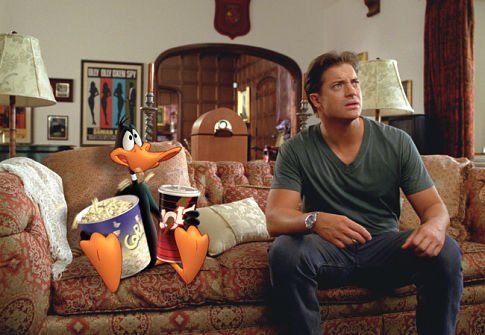
The last movie that mixed the Looney Tunes with live-action characters was “Space Jam,” which really highlighted Michael Jordan more than the Looney Tunes. This time, Bugs and Daffy are given a lot to do and they’re really the highlights of this fun movie. But the human actors they star alongside with are no slouches either. They have fun with their roles. Brendan Fraser is DJ Drake, a stuntman who is looking for work. (I love this line he delivers: “I’m a stuntman! Did you ever see those ‘Mummy’ movies? I’m in them more than Brendan Fraser is!”) Jenna Elfman is Warner Bros. executive Kate Houghton, “Vice-President, Comedy.”

DJ and Kate, along with Bugs and Daffy, are roped into a mission. The plot of the movie: the evil Chairman of the Acme Corporation (a hardly-recognizable Steve Martin) has a plan to steal a rare, magic diamond called the Blue Monkey, which will allow him to turn everyone in the world into monkeys. DJ’s actor father (ex-007 Timothy Dalton), who turns out to be a secret agent, is kidnapped by the Chairman and so, it’s up to DJ, Kate, and their cartoon partners to save him and the world.

The movie is just plain fun. It has fun with making the Looney Tunes (Bugs, Daffy, Elmer Fudd, Porky Pig, etc.) exist in the same world as Hollywood executives. Of course the Looney Tunes would most likely have their own trailers. The film opens with a board meeting, with the Warner brothers (two overweight men with glasses) and Bugs and Daffy discussing the new movie (yes, it’s another “Wabbit season” movie). Daffy is distraught and wants more credit. Other cartoon characters are in the mix too. I like the bit where the cartoon Shaggy and Scooby Doo rip into Shaggy’s live-action counterpart Matthew Lillard while having lunch. And of course, the Chairman has his own animated henchmen, such as Yosemite Sam, Wile E. Coyote, Elmer Fudd, and the Tasmanian Devil.

I said that Bugs and Daffy are the highlights of the movie and they bring terrific comic timing, as you’d expect them to have. Bugs is the relaxed, wisecracking straight-man (or “straight-bunny”) and Daffy is the manic loser-duck who just wants to be heard as a hero instead of a second banana. They’re the Looney Tunes I know and love.

This film has a lot of inspired moments—one, for example, involves a chase scene between the two ‘toon heroes and Elmer Fudd that references art (including Munich’s “The Scream”). And who could forget the scene in which the characters come across “Area 52?” (For those who haven’t seen the movie, I wouldn’t dare spoil it for you.)

Director Joe Dante has given us a silly romp involving spies, the Looney Tunes, and a silly villain (played by an enjoyably over-the-top Steve Martin), with a blend of animation and live-action done to complete success with 1988’s “Who Framed Roger Rabbit.” No, this isn’t as wonderful as that one, but it’s still a good deal of fun.

Stephen King’s Silver Bullet (1985)

8 Apr

garey_busey

Smith’s Verdict: ***

Reviewed by Tanner Smith

We can point out all the clichés in Stephen King’s supernatural stories mainly because they’re kind of fun. And a screenplay by King, based on his own “novelette,” is no exception. Indeed, we have the King-penned “Silver Bullet,” based on the novelette “Cycle of the Werewolf.” Thankfully, it’s not as awful as other film adaptations of King’s writing (see “Children of the Corn,” for example). Sure, it’s nothing special (like “Carrie” or “The Dead Zone,” for example) and at times it can get pretty stupid, but there’s a certain charm to it that makes it tolerable. You just have to suspend your disbelief.

There are many Stephen King clichés put at work here, and I suppose I shall start by counting them down:

1. A supernatural being that is never fully explained in origin (at least in the movies). In this case, it’s a werewolf—a man who becomes a vicious beast when the moon is full and invades a small town called Tarker’s Mills. Who is the man? No one knows (but you will, very soon into the movie).

2. The dumb townsfolk who are broadly developed to make the wrong, stupid decisions and get inevitably slaughtered by the monster. Some of these people are just annoying stereotypes, but others (including the local sheriff, played by Terry O’Quinn) are quite amusing, especially when they venture into the woods at night to search for the beast—one asks the other, “Are you gonna make lemonade in your pants?”

3. Alcoholic. In this case, however, the alcoholic is one of the film’s heroes. He’s Red—you know, when you name your child “Red,” are you asking for them to become drunken bums? Played with comic appeal by Gary Busey, Red is the uncle of 11-year-old Marty (Corey Haim), who is the only one who knows that a werewolf is the thing that has caused all the mayhem in town. While Red doesn’t believe that Marty was almost attacked by the werewolf, he does ask that the sheriff look more into it, now that he has a clue. And when all else fails, Red eventually goes to a local gunsmith and asking him to create a silver bullet to stop the werewolf.

Oh, and the first victim of the monster in an early scene might as well hear a sign that reads “alcoholic.” He sings the Rheingold Beer song to himself, staggers as he works the railroad, and you just know he hasn’t got a prayer. Nor does…

4. Abusive jackasses. In particular, Marty’s girlfriend has a mean-spirited father whose sole purpose is to yell and be savaged by the werewolf. No other reason whatsoever.

The only things missing here are flashback sequences and I’m not sure if Tarker’s Mills is in Maine, but I’m not ruling out the possibility.

The werewolf creature effects range from effective (when seen in glimpses in the shadows) to silly (when seen in full view). In particular, when the werewolf goes for Marty while he’s shooting off fireworks, the effect of the werewolf taking Marty’s rocket to the eye is so sloppily done, I couldn’t help but laugh. Was I supposed to laugh? I know I’m supposed to laugh because some elements are intentionally funny—like the townsfolk, the character of Uncle Red, and the neat motorcycle-like design of his new motorized wheelchair (dubbed the Silver Bullet). But what about the narration? Apparently, while the story takes place in 1976 and the film was released in 1985, we get a voiceover narration from Marty’s older sister Jane (Megan Follows), who resents her brother getting all the attention because he’s in a wheelchair—Jane is about 15, and so we should hear from her narrating as a 24-year-old woman, right? Not here—the actress they got to provide the voiceover work is obviously too proper and mature to sound that way.

There are certainly some silly moments in “Stephen King’s Silver Bullet,” but that also makes it kind of fun. Everything leads to an obligatory climax in which Marty, Jane, and Uncle Red are forced to square off against the werewolf. By this time, I was surprised to find myself caring for these three. Corey Haim and Megan Follows are convincing as a squabbling brother and sister who now have to protect each other, and Gary Busey is a riot as Uncle Red. Actually, Busey is possibly the sole character to be fully-developed—at times, he’s a drunken rascal, but he’s a good guy at heart and would never hurt his nephew who idolizes him. Uncle Red’s actions serve purpose.

Also, I should also add that Busey delivers my favorite line in the film with brilliant comedic timing—“I’m a little too old to be playing the Hardy Boys meet Reverend Werewolf!”

And while I’ve given that away, I’ve already stated that you’ll know very soon who the werewolf is before the supposed “reveal” midway through the movie, as Jane searches the town for a man or woman with one eye (because Marty fired at a rocket at the werewolf’s eye). It turns out to be Reverend Lowe (Everett McGill), who knows that Marty knows who he is, and in one scene that I’m sure is supposed to be a sick joke, actually chases down the kid in his wheelchair and attempts to run him down. As if to say even the clergyman is out to get you, kid! You don’t have a prayer!

I really shouldn’t rate “Stephen King’s Silver Bullet” three stars out of four. It is silly and sometimes pretty stupid, but also has a certain charm that makes it fun to watch. Consider it the least bad of the lesser Stephen King film adaptations and take it for what it’s worth.

Best Worst Movie (2010)

8 Apr

ohmygod

Smith’s Verdict: ***

Reviewed by Tanner Smith

When I first saw a 1990 horror film called “Troll 2,” I went through a series of emotions—confused, shocked, annoyed, depressed, and the thing is I could go on and on about how I felt about this horrible movie. “Troll 2” was hands-down the absolute worst movie I’ve ever seen, and will ever see, in my life. I thought if I ever saw a frame from that film again, I would vomit in the nearest trashcan. But then I realized, wait a minute! This is the worst film of all time! That has to be worth something, right?

I’m not exaggerating either. People all over the Internet have saved this film from obscurity by hailing it as a masterpiece. Why? Because of how much they love to hate it! “Troll 2” is now hailed as a cult classic because people love to make fun of it. Because of that, it’s even known to some as one of their favorite movies. It’s like, if you want to watch every bad movie, you might as well enjoy the absolute worst. It’s so bad that it’s infamously good.

To give my short review of “Troll 2” (which bares no resemblance to 1986’s more mediocre-than-god-awful “Troll,” by the way), besides calling it the worst film I’d ever seen, here it is—the acting and dialogue is camp at its finest, its production values are nonexistent, the effects are worse than awful, and just about everything else is done so wrong, that the entire film has to be seen to be believed. Just talking about it doesn’t help at all. Check it out sometime—I mean, if you don’t want to watch every bad movie, then watch the absolute worst.

Wow. Can’t believe I said that.

Michael Paul Stephenson, about 20 years ago, played the little protagonist, in the film, who discovered goblins (not trolls) in a small town where his family is vacationing. He hoped that being the lead in a film would bring him to child-star status. Boy, was he wrong. But now that he sees the cult phenomenon that “Troll 2” has become, he has created a documentary—entitled “Best Worst Movie,” a fitting title—chronicling the fandom behind it.

“Best Worst Movie” begins rather ordinarily, as we follow an Alabama dentist named George Hardy. George is one nice guy. People love him, people love to be around him, and even his ex-wife can’t hate him. It seems like a documentary about this sincerely nice man until “Troll 2” is brought up. George Hardy, whom everybody loves to like, had played the father in “Troll 2,” which everybody loves to hate.

George deeply appreciates the stardom that has been given to him because of his role in “Troll 2.” He was overacting as much as everybody else in the film, and what really distinguishes him from everyone else, mainly, is this one line delivery that everyone laughs so hard at—“You can’t piss on hospitality! I won’t allow it!” George shows up at almost every screening of the film, and is called up to the stage to say that line. He does, and everyone goes nuts each time.

We meet other actors from the movie. In particular, there’s Connie McFarland as the sister, Don Packard as the creepy drugstore owner, and Margo Prey as the mother. McFarland is hurt by the comments saying that she did a really bad acting job, but she understands because she knows she did a terrible job in the movie. She won’t put it on her resume, in fear of never being hired again if she mentions the title. Packard explains that he had gotten the role because the actor who was supposed to do it wasn’t able to, and so Packard just arrived on the set not too long after and did it himself. He admits that he arrived on the set courtesy of a day-release program from a mental hospital. Then there’s Margo Grey. She’s another story. When Stephenson and George show up at her house, there’s a sign saying that this woman would rather be left alone and would prefer no visitors of any kind. Because of that, they’re almost afraid to ring the doorbell because they imagine someone wielding a shotgun in front of him, or possibly shooting through the door. But Margo does welcome them into her home, even though the two are possibly unnerved by her. She never comes to a single screening of “Troll 2.”

We also meet the director Claudio Fragasso, an Italian who couldn’t speak English very well but kept insisting he understood Americans. He’s the person to point to when it comes to the reason why “Troll 2” is so bad. It’s because of this communication breakdown and a good deal of ineptitude that this production was doomed. But here’s the odd part. He doesn’t acknowledge that he made a bad film, let alone the worst of all time. He’s hurt by the audience’s constant laughter and whenever he’s called up for question-and-answer, his most basic response is, “You don’t understand nothing.” (The most memorable use of that response is when he is asked why the film is called “Troll 2” when there are no trolls in it.) He even interrupts his actors when they announce the troubles they had on set, with dialogue and acting. “You don’t understand nothing.” And nobody who was involved in the production all those years ago had the slightest clue what he was trying to do.

George Hardy remains the anchor of “Best Worst Movie.” He’s the one that Stephenson follows most of the time, as George looks forward to more screenings and goes door-to-door handing out flyers to neighbors, telling them to come down to the next one and see the film if they hadn’t already. Sometimes, he’ll even describe the film and yes he will even say his infamous line. George is also invited to film revivals and conventions. But at the bigger conventions, George is surprised to see a less-than-expected number of people showing up at the “Troll 2” stand or panel, particularly at the horror-movie convention, where everyone recognizes actors from “Nightmare on Elm Street” sequels rather than actors from “Troll 2.” George keeps trying to make himself known, by saying, “See ‘Troll 2!’ It’s the worst movie of all time!” His lack of recognition has him to say, “There’s tons of gingivitis in this room.”

George has stated that if Fragasso plans to make “Troll 2: Part II,” then George will be on board. Whether or not the other actors will remains to be seen, if the film is a go. I’m not saying I’ll see it, if that happens…but I’m not saying I won’t either.
The Hitcher (1986)

7 Apr

HITCHER1

Smith’s Verdict: ***

Reviewed by Tanner Smith

Usually in horror movies of the 1980s, there is either lack of motivation or too much for the menacing figure that stalked the young hero (or heroes). Arguably, it makes the film more unnerving if there is no motive, but in the case with “The Hitcher,” there may be a motive that hardly anyone could have expected when about to watch it. And it’s a strange, creepily effective motive—to be stopped. The psychopathic title character, the “hitcher,” does his murderous deeds by way of causing misery for a young man’s life, because what he really wants is for this young man to stop him before the situation gets even worse.

I didn’t get this until the second time I watched “The Hitcher.” The first time I watched it, I just thought it was a pointless exercise in violence and gore. There are many gruesome murders and disgusting moments that involve a severed finger in some French fries and a dog licking the dripping blood of his murdered owner. Oh, and there’s also a scene in which the hero’s girlfriend is tied hand and foot between two huge trucks, and the hero has to make sure the hitcher doesn’t take his foot off the clutch of one of them, or the girl will be split in half.

But I digress. The second time I watched “The Hitcher,” my opinion of the film strangely changed. The violence and gore was one thing, but the escalating tension is clearly evident throughout. In that sense, I admired “The Hitcher” more and found it to be an effective thriller.

“The Hitcher” begins as a young man, Jim Halsey (C. Thomas Howell), goes driving at dawn, and picks up a hitchhiker (Rutger Hauer, chillingly charismatic). “My mother told me never to do this,” he tells the hitcher with a grin. Soon enough, he learns he should have taken his mother’s advice, because it turns out this brooding, tranquil stranger is a sick, murderous mind. He tells Jim that he mutilated the previous driver who picked him up and that he’s going to do the same to him. Before he can do anything to him, Jim manages to eject him from the car. But unfortunately, Jim hasn’t seen the last of the hitcher, who keeps appearing and murdering innocent people. And worst of all, Jim himself is framed for the murders as the hitcher continues to make his life a living hell.

One of the most intriguing things about “The Hitcher,” in my opinion, is that we know very little about the hitcher. He has neither a backstory nor a grudge. We just know he’s a sick, murderous mind that is like an ongoing force that seemingly can’t be stopped. And from what we can gather, he doesn’t want to kill Jim; he just wants to ruin his life. But there’s a unique twist here—it’s declared in nonspecific terms that the hitcher is doing this to Jim so that Jim will ultimately stand up and put an end to all of this madness by killing the hitcher. That’s as psychotic a motive as they come, especially considering that the hitcher is doing these terrible things in order for this to happen. And this includes tying a young waitress, Nash (Jennifer Jason Leigh), to two trucks by her hands and feet.

“The Hitcher” may be gory and violent, but it has a great amount of suspense and mounting dread to keep it interesting, effective, and unnerving. The ending of this movie is a final showdown, but it’s more than you’d expect, in an unsettling way. It’s fierce, but it’s also psychological with a certain symbolic final shot that makes you question what really just happened. This is because you realize you never really understood the relationship between Jim and the hitcher, and that climax says a lot by displaying very little.

I’m actually surprised that I like “The Hitcher” more the second viewing. Its central elements are subtler than I originally thought, and the more I thought about it, the more fascinated I was with it. Others can easily dismiss this as just another deplorable slasher-flick. I think it’s better than that.

Electric Dreams (1984)

6 Apr

electric-dreams-1984-movie

Smith’s Verdict: ***

Reviewed by Tanner Smith

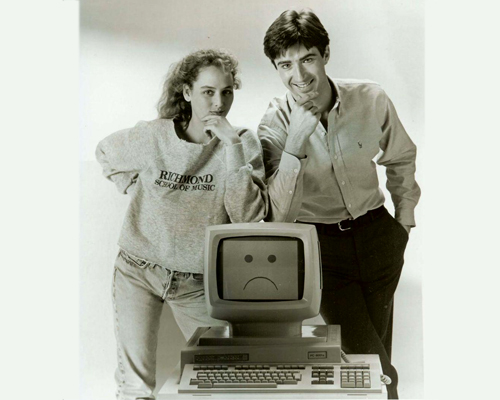
“Electric Dreams” takes a story about as old and as predictable as a romance could get and adds new twists to create a delightful movie. You know that old story of how boy meets girl, boy gets help from his buddy to impress her, and buddy becomes jealous to see how well the boy and girl are getting along? What if the buddy was a computer? Yes, there’s a love triangle in this movie in which the third wheel is a computer.

The computer falls in love. Now, that’s a wonderful idea for a movie. Not only does the computer fall in love, but it also gets jealous—jealous enough to try everything it can to get its owner out of the picture so it can have the girl to itself.

The owner is a shy nerdy guy named Miles, played by Lenny von Dohlen in a likable performance. He buys himself a home computer to get things organized for him, since everyone else has their own pocket organizers. It’s tough trying to get it to work at first, but he soon gets the gist of it…or so he thinks.

Enter the woman who moves into Miles’ apartment building—a fetching cellist, played by Virginia Madsen. Miles feels something for her, and the feeling is mutual. They go out a few times. But what neither of them realize is that the woman thinks that Miles can create great music. You see, earlier in the movie, as the computer gains its “brain” (whatever), it eavesdrops on the woman’s cello practice through a ventilation duct and plays musical notes by itself to follow along, in a duet that is easily the movie’s best scene.

But Miles realizes that the computer talks and has a mind of its own and asks it to create a love song for his new girlfriend. After wrongfully guessing what it sees on TV is appropriate for lyrics and rhythm, Miles helps it out with his own feelings. The result is a beautiful song that Miles takes the credit for, which makes the computer jealous because the computer has fallen in love.

Just thinking about the plotline makes me smile and the movie is just as winning, although maybe a little silly in most eyes, as it goes along. There’s an MTV-style as it goes with its song sequences (particularly with the duet, the love song, and the title song at the end) that gives the movie its energy, but what really makes “Electric Dreams” a nice movie are the central elements, like the actors and the computer. Lenny von Dohlen and Virginia Madsen are great together and separate. Von Dohlen does a good job as this wimpy nerd, and Madsen plays her character as attractive, but not shallow.

But credit should also be given to how well the filmmakers did with the computer. With wonderful voice acting by Bud Cort as the computer’s voice, this is a self-learning computer with a personality of its own. It not only makes for effective comedy, but also for really touching moments, particularly in the final act of the movie.

“Electric Dreams” has an innocence and charm within its characters, the direction, and that wonderful computer that gives me reason to recommend it to those who could use a nice-enough love story. I mean, how often do you come across the rivalry between a man and a machine over the woman they both love?

The Uninvited (2009)

5 Apr

normal_the-uninvited-2009

Smith’s Verdict: ***

Reviewed by Tanner Smith

(Originally reviewed mid-2009)

Another Asian horror film remade for American audiences…this time, it’s “A Tale of Two Sisters” from Korea remade as “The Uninvited.” Now, don’t dismiss this as a rip-off right away. “The Uninvited” is a chilling piece of work by the Guard Brothers by Britain. This is their directorial debut, and it’s not a bad one.

The main reason “The Uninvited” works so well is that Emily Browning is a most engaging choice for a heroine. Her face is so wonderfully expressive and she makes her character convincing in the scenes where she is supposed to be scared or confused. Emily Browning is an Australian actress, and she is 20 years old, though she looks 14. She was previously seen in “Lemony Snicket’s A Series of Unfortunate Events.” She’s terrific in this movie, and she’s so fresh and ready to take on any role.

Emily Browning plays Anna, a teenaged girl who is at a party at the beach one night. But when she is making out with her boyfriend, he says he has a condom. That causes her to leave but when she arrives at her house, she sees the boathouse nearby blow up with her terminally ill mother inside of it.

For almost a year after the incident, Anna is released from a mental institution to go back home to her loving father (David Strathairn) and her sassy older sister Alex (Arielle Kebbel). She doesn’t quite remember what happened the night of the incident. Her father’s new girlfriend is Rachel (Elizabeth Banks), who was her mother’s caregiver. Anna doesn’t trust Rachel, who is just dangerously nice.

Anna keeps questioning what really happened that night. Her boyfriend Matt claims to be a witness to the accident but he never gets a chance to talk to her. Rachel may have something to do with it. Even Alex seems to think so—the fire may not have been an accident but an act of murder by Rachel to get closer to their father. While Anna tries to figure things out, she is being haunted by visions of her dead mother who creepily tries to tell her something.

The movie looks good. I like the ominous look of the horror movies from the 70s and 80s. And the thriller aspect is effective. I recoiled in my seat during a few of the scenes. One sequence in particular is nail-biting. It’s the scene in which Anna sits up in bed and some thing is creeping towards her.

The actors are effective. David Strathairn is well-cast as the loving father who may have a secret kept. Arielle Kebbel brings charisma and energy to her role as the sassy older sister. And Elizabeth Banks, who has been the career woman for the past few months (she was George Bush’s wife in “W,” Miri in “Zack & Miri,” and the love interest in “Role Models”) as the beautiful, nice blonde, shows a darker side than we’ve seen her before. But Emily Browning makes the best impression here.

This is a thriller that works. We don’t really know why Anna is seeing all of these visions and we keep anticipating for an answer. There are a lot of scenes that seem set up and they all lead to the big twist at the end of the movie.

I have seen a lot of thrillers with big twists at the end and I love them sometimes—for example, “The Sixth Sense” and “Frailty.” But with “The Uninvited,” the ending’s twist is a bit too much. I will say this, though—I didn’t predict it. But it makes the whole movie kind of sad in a way that makes the audience question themselves, “Did who we rooted for deserve to be rooted for?” I’m not going to give the ending away, but I am going to give “The Uninvited” a marginal recommendation. Emily Browning won me over.