Archive | Three Stars *** RSS feed for this section

A Time to Kill (1996)

14 May

FailureToLaunch2

Smith’s Verdict: ***

Reviewed by Tanner Smith

Before I review “A Time to Kill,” I want to state a regular “blog-thought” (if you will). With “A Time to Kill” the next John Grisham film adaptation after “The Client,” I have to wonder—do director Joel Schumacher and screenwriter Akiva Goldsman truly get John Grisham? Or are John Grisham’s novels able to give these otherwise-mediocre-at-best artists the outer limits of material for them to use effectively? I like both “The Client” and “A Time to Kill”—they’re very good adaptations. I dislike more of Schumacher’s and Goldsman’s work separately—with Schumacher, there’s “Batman & Robin,” “St. Elmo’s Fire,” among others; with Goldsman, it’s also “Batman & Robin,” as well as “Lost in Space.” But “The Client” and “A Time to Kill,” it’s hard to deny that there is expert direction and good writing within both of them, to me anyway. So I don’t know, maybe they’re better at doing adaptations; maybe Grisham is better suited for them; I don’t know. But there is proof of talent here, in my opinion.

I could do a whole blog entry that isn’t merely a review, going into analysis on why I think “The Client” and “A Time to Kill” work. But for now, I need to review “A Time to Kill,” which is one of the best film adaptations from a John Grisham novel.

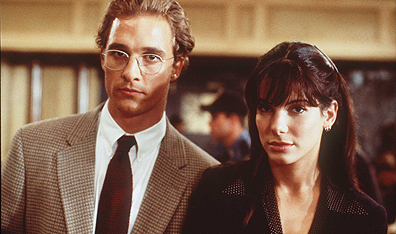
“A Time to Kill” is a compelling story with one of the most complicated scenarios that lead to the surface of morality tale. It includes racial tension, deceit, violence, and the hopes for a fair trial. It all begins as a ten-year-old black girl is brutally raped and beaten by two drunken rednecks in a small backwater Mississippi town. The two men are arrested, but the girl’s father, Carl Lee Hailey (Samuel L. Jackson), is unsure of what to do. Should he trust the justice system to give them the punishment they deserve, or should he take immediate action now, thinking they’ll get off scot-free? He shares his intentions to an old friend, a local, white, up-and-coming lawyer named Jake Brigance (Matthew McConaughey), who doesn’t quite believe that Carl Lee will murder the two men. But then the next day, Carl Lee does show up with a shotgun, killing both men and severely injuring a cop in the process. Now on trial for murder, Carl Lee chooses Jake as his attorney, his logic being he thinks like a jury would and thus would be an ideal “secret weapon.” The main question here is whether or not a black man can receive a fair trial after murdering two white men, for what they did to his daughter, especially in this time in the South. So Jake, along with his old mentor (Donald Sutherland), a divorce specialist (Oliver Platt), and an energetic (and unpaid) assistant, Ellen Roark (Sandra Bullock), Jake prepares to go up against the local DA (Kevin Spacey) and help Carl Lee.

There are numerous subplots in “A Time to Kill” that bring the film to just barely pass the two-hour-thirty-minute mark. While some of these work in serving the plot, like the scenes involving the NAACP’s legal defense representatives (led by Joe Seneca) and the plight of Jake’s wife (Ashley Judd) and daughter who are now facing threats because of the case. And there’s also developing the relationship between Jake and Roark so they’ll work together—she offers to help, he gently turns her down repeatedly, she then delivers some helpful leads, and he brings her onboard as an unpaid aide. I’m glad these two don’t develop a romance together; their relationship is purely platonic and work-related. But the one subplot that I’m still quite unsure about, and it is an important one, is the presence of the Ku Klux Klan, led by the brothers of the two men killed by Carl Lee. They threaten the lives of Jake, his family, and his friends. Making the Klan into villainous thugs in this film is prominent, but it feels like it’s going way too far to get the story’s point across. I can’t help but think that the film would be just as effective if a smaller, more moderate group in this small town would represent the “prejudice” roles. I don’t know, but to me, the Klan subplot seems like a bit much.

One subplot I missed was the plight involving Carl Lee’s family. We hardly ever see them after the half-hour mark, and I was wondering how they were reacting to this situation. What is Carl Lee’s wife going through? How is his daughter holding up? What about his other kids? Now that I think about it, with most screen time devoted to white characters (with the exception of Charles S. Dutton as the town sheriff, who is black), are the black characters just here to serve as atmosphere fuel?

John Grisham obviously specializes in characterization in relation to court cases, and “A Time to Kill” is no exception. And the way Joel Schumacher sees it is in great respect to the novel in that it doesn’t go for cheap tricks or insane plot twists to keep the audience invested. There are a few twists, but nothing bizarre. Mainly we just have this controversial trial that searches for answers to the question of whether or not Carl Lee can get a good jury and a fair trial, given what he did. In the end, there is no clear answer. I’m not even sure there can be a clear answer.

The acting in “A Time to Kill” is top-notch. Samuel L. Jackson is excellent as Carl Lee, with a great mix of grief and anger. Sandra Bullock does some of her most appealing acting as Ellen Roark. Kevin Spacey is suitably slimy as the DA, Ashley Judd is convincingly frightened as Jake’s wife, Charles S. Dutton is great as the no-nonsense sheriff, and Donald Sutherland and Oliver Platt deliver strong support as well as comic relief. But what it really comes down to is the performance of Matthew McConaughey as the hero, Jake Brigance. McConaughey is great in this role—he exhibits a powerful presence with his charisma and intensity.

It’s easy to predict the verdict at the end of the story, but “A Time to Kill” is more concerned about how it happens. It produces a good, solid story arc for Jake as he starts out as a rookie lawyer, uses professional tactics to show up the DA, and when all else fails, in a powerful speech near the end, he plays the trial with pure emotion and has the jury truly think about Carl Lee’s situation as if it were happening to them. There’s more to it, but I won’t go into it for the sake of this review. “A Time to Kill” is well-made, powerfully-acted, involving, and thought-provoking. I kind of wish Schumacher and Goldsman made more Grisham adaptations after this.

Cloverfield (2008)

13 May

images

Smith’s Verdict: ***

Reviewed by Tanner Smith

The date was July 3rd, 2007. The movie was Michael Bay’s “Transformers.” The place was Paragould Cinema 8 in Paragould, Arkansas. The coming-attractions trailers included an engrossing “sneak-peek” that showed a scene of a Manhattan party being interrupted by exploding buildings and some sort of attack, seen from the point of view of a home-video camera. What’s going on? What’s attacking the city? Hell, what’s the title of the freaking movie? The end of this ingenious trailer only showed “From Executive Producer JJ Abrams” and “Coming 1/18/08.”

That was terrific. That had me thinking what the film was going to be when it was released. What we got was “Cloverfield,” released January 18th, 2008, which is pretty much the “inside-out” version of a monster movie, much like how “The Blair Witch Project” was the case with the ghost story. Like “Blair Witch,” the film “Cloverfield” is entirely the content of one video tape, as one among a group of people documents “how it all went down” as some thing attacks Manhattan.

That means the majority of “Cloverfield’s” running time consists of shakiness of handheld camerawork, undoubtedly giving some audience members motion-sickness. (I sat in the front row of the cinema—it’s no doubt after all.) You either get into it or you’re very annoyed by it. (But for those who say people don’t really shake the camera like the camera-holder does in this movie, newsflash—people running from disaster don’t usually care about keeping the camera steady!) Besides, I can see the effect that director Matt Reeves was going for with this—not the standard monster movie; mainly a major disastrous event seen from ground-level. After all, ever since 9/11, everyone likes to record anything out of the ordinary, to say the least.

“Cloverfield” starts out as a farewell video for a sincere young man named Rob (Michael Stahl-David) at his going-away party, as he is able to leave Manhattan for a new job in Japan. Documenting the party is Rob’s best friend, goofball Hud (TJ Miller, whose line-deliveries said from behind the camera make for appealing comic relief). Also at the party are Rob’s brother Jason (Mike Vogel), Jason’s girlfriend Lily (Jessica Lucas), Hud’s crush Marlena (Lizzy Caplan), and, to Rob’s surprise, Rob’s ex-girlfriend Beth (Odette Yustman).

“Cloverfield” spends a little more than 15 minutes with these people, making it feel like a different movie than what was advertised. This actually works in the film’s favor because it really sneaks up on you the same way it sneaks up on the characters when chaos ultimately ensues. It really got me when they’re just having normal conversation and then out of nowhere, the building shakes, things start blowing up, people ask “What was that?” etc. Once the madness gets started, the film becomes exhilarating.

And by the way, I’m sure the realization that the attacker in “Cloverfield” was just a regular monster, and not Godzilla (though pretty close in shape and size), disappointed a lot of hyped moviegoers, but I’m sure any reveal would have disappointed them, so forget that. As for me, I was one of the people who didn’t care what the attacker was, as long as it was sci-fi based and big enough to be threatening. The monster itself is scary when seen in glimpses, like when the camera switches to and from it in a hurry, and also when it’s kept in the shadows so there’s that foreboding aspect to “Cloverfield.” Even scarier though are these parasitic spider-like creatures that apparently come from the big creature and attack people. The creepiest scene in the movie involves these little beasts as they attack our heroes in a dark subway tunnel. These things mean business.

What exactly is this monster? Where did it come from? What can kill it? None of that is answered. “Cloverfield” has no backstory or any kind of explanation for the monster’s origins. All we know is that it’s big, it’s mean, and it’s here. That’s it—the whole movie stays with Rob, Hud, and company as they race to survive the night and escape the city before things get worse. That’s actually kind of refreshing, in that there’s no bizarre B-movie type of explanation like it came from pollution or something like that. And the actors playing these admittedly-generic characters are pretty good and quite likable for us to follow them. They, along with some first-rate special effects, add to the realism, grittiness, and terror of this “inside-out” monster movie.

The Island (2005)

9 May

images

Smith’s Verdict: ***

Reviewed by Tanner Smith

To be completely honest, I had no idea what Michael Bay’s “The Island” was about when I first watched it. I didn’t know the premise, except that it took place in a dystopian future and, being a Michael Bay film, it would feature a heavy dose of action. That’s why as I watched “The Island,” not knowing what was going to happen, I became fascinated by each twist and turn that it would deliver.

I found myself enjoying “The Island” and its clever, intriguing story that involves a lot of science-fiction elements and gripping action sequences to keep its status as a summer-blockbuster. Michael Bay is usually known for overkill in his movies, such as “Armageddon,” “Pearl Harbor,” and the two “Bad Boys” movies. But “The Island” is more on the same dosage of entertainment as Bay’s best film, “The Rock.”

Don’t get me wrong—this isn’t a great movie. Some of the story developments are somewhat dumb, others are unresolved, and the character development is hardly solid. But most of them do work, enough to be intrigued by the creativity of such. The action is well-executed with some original touches to keep them interesting (for example, one chase scene involves a load of heavy barbells to hold off company). The production design is impressive. The actors look like they’re having fun. And the twist that comes midway through is actually pretty good, and allows for some very interesting moments of thought (quite unusual for a Bay picture).

The film begins as a sci-fi parable in a sterile, technologically-advanced, futuristic environment that features inhabitants who are survivors of a “contaminated” world outside. The residents wear entirely white clothing (while the supervisors wear entirely black) and go about a certain system that requires them to remain obedient. Big-screen TVs scattered throughout this sealed bubble announce a Lottery that declares a winner to go to the only safe place left on Earth—the “Island.”

Now, even though I didn’t know what was going to happen, I can tell you that even a grade-schooler could tell that something is not right with this futuristic society. And thankfully, our hero, Lincoln Six Echo (Ewan McGregor), conveniently starts to ask the right questions to his supervisors and his friends. This is somewhat of a surprise to Merrick (Sean Bean), one of the supervisors, since the people in the white suits aren’t supposed to think very deeply about these sorts of things.

Lincoln’s friend, Jordan Two Delta (Scarlett Johansson), has been chosen to go to the Island, but Lincoln still isn’t so sure of this system and how it works. When he discovers the truth, however, he and Jordan escape into the outside world…

It’s going to be hard to go into the second half of “The Island” without having to give away spoilers. But I will give away only one certain spoiler, and that is that the world seems fine for a future that is supposed to be “contaminated.” The world has not changed; it’s this society that has been created within it for mysterious reasons involving the Government.

Period. That’s all I’m going to describe. The less you know about the story, the more you’ll get into it. It really depends on whether or not you buy into it. I did. I thought it was very entertaining and quite intriguing. That’s not to say there aren’t problems, of course. Like I said, not everything pays off and some points are admittedly ridiculous. But there are enough aspects that I found rather fascinating.

I liked the relationship between Lincoln and Jordan. Unusually for these action movies, the romance is not so complicated. It’s nice that these two are already friends before the action takes place, and it doesn’t subject us to that clichéd forced romance in which a man and woman hate each other and then start to love each other as the action continues. I thought the relationship in “The Island” was refreshing, and I liked Ewan McGregor and Scarlett Johansson in their roles.

But being a Michael Bay film, there are all sorts of action—we have chases, shootouts, showdowns, fistfights, etc. with explosions, noise, and “permanent sunsets.” (Did you ever notice that each of Bay’s movies seem to take place at sunset most of the time?) Aside from the obligatory climax in which Lincoln and Jordan must ultimately make things right after all this peril and adventure, I was hooked by the action sequences. I already mentioned the barbells in the chase scene; that was a very original touch.

“The Island” starts out as a sci-fi parable, turns into an entertaining action flick, and as a whole, it’s quite a good movie.

Death Proof (2007)

8 May

Grind House (Death Proof)

Smith’s Verdict: ***

Reviewed by Tanner Smith

Quentin Tarantino’s “Death Proof” was the second of two films (the first directed by Robert Rodriguez) to pay homage to a type of ’60-‘70s exploitation film known as the “grindhouse,” which was commonly made for drive-in theaters. The films were made with very little money and usually bad quality in the filmmaking and acting department. They have since been accepted as guilty pleasures. Rodriguez and Tarantino are apparently among those fans, and these two films they created (released as a “Grindhouse” double-feature) are practically their love letter to the type. It’s not conventional in the slightest (compared to what we’re used to now), and it’s all about cheese, pulp, sex, and gore.

There are two main differences between Robert Rodriguez’s “Planet Terror” and Quentin Tarantino’s “Death Proof,” however. Rodriguez’s intention was to make a bad film with a tongue-in-cheek approach to the splatter-movie/zombie-flick that goes incredibly over-the-top. Tarantino plays it straight with a sincere approach in his story. “Death Proof” was the true attempt to make a “grindhouse” production.

It seems as if Tarantino was tailor-made for this type of film. It’s oddly-structured, incredibly over-the-top, and fast-and-furious in its filmmaking style, which is everything Tarantino pushes to great effect in his films.

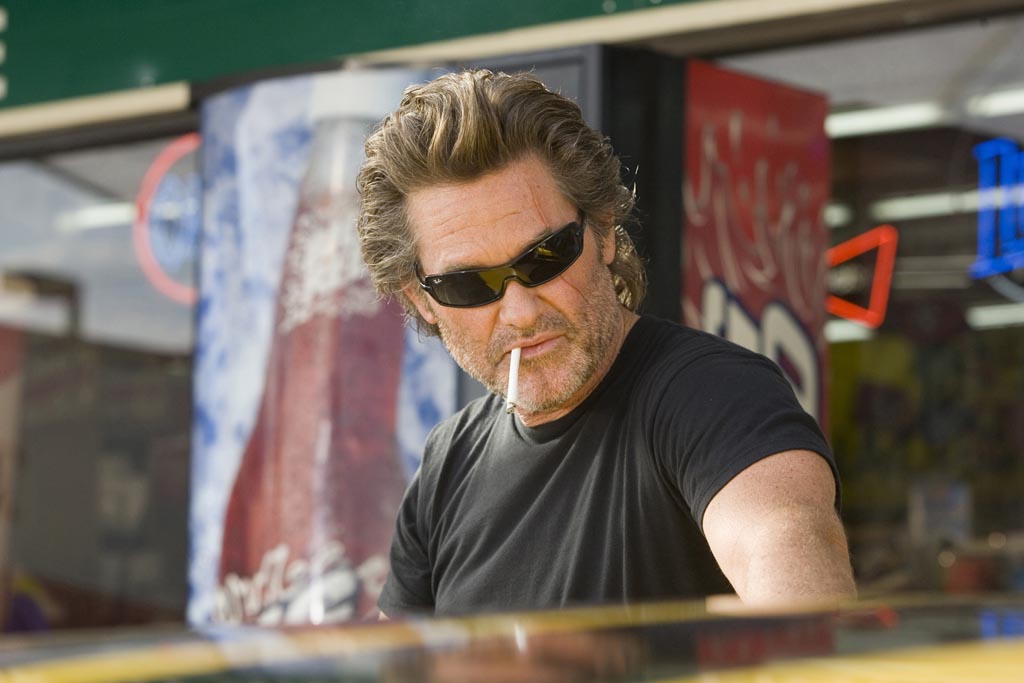
“Death Proof” stars Kurt Russell as a psychopathic stuntman, aptly named Stuntman Mike. He revels in extremities and drives a kick-ass muscle car that is guaranteed “100% death-proof.” He hangs out at a bar where several loud, obnoxious young women (with whom the film spends a lot of time with before introducing us to Stuntman Mike) are hanging out on a road trip. He picks up one of the women, takes her for a drive in his car, and gives her a ride she’ll never forget…because she’ll be dead. (Apparently, to feel the edge of a “death-proof” car is to sit in the driver’s seat.) He then performs a dangerous stunt that claims the lives of her friends, before focusing on another group of women about a year later.

For the first half-hour, we’re subjected to the girls’ chitchat amongst each other in a flat attempt to establish character development. While there are some good Tarantino-esque lines (or rather, “conversations”), I have to admit I didn’t care much for these people. And I was hoping that Stuntman Mike would show up a lot sooner so that he could dispose of these nymphs ahead of time.

Then, the film switches gears and follows a whole other group of young women. While they’re about as compelling as the first group, they at least have the honor of having New-Zealand-stuntwoman Zoe Bell among them. The idea of this striking young stuntwoman (who was Uma Thuman’s stunt-double in Tarantino’s “Kill Bill” movies) taking center-stage (and playing herself) in a movie about a psychotic stuntman brings numerous possibilities, and while it doesn’t follow through with all of them, it still brings about the most important aspect—squaring off against Stuntman Mike, giving him a worthy opponent.

Bell and her friends (played by Rosario Dawson and Tracie Thorns) come to a Tennessee town to test-drive a white 1970 Dodge Challenger R/T and perform a dangerous stunt known as “Ship’s Mast” (which requires Bell riding on the car’s hood with leather straps to hold on to). Then, Stuntman Mike comes along and messes around with them, endangering their lives. But with the extremist attitude these girls have, this may end up being his biggest mistake…

That’s the payoff to “Death Proof” and it’s a damn good one. In fact, the whole second half is the best thing about “Death Proof.” The conversations are pure-Tarantino; the intensity is taken up a notch once the women and Mike engage in their stunt-driving; and it just feels like an engaging “grindhouse” feature. If the first half represents everything people hate about the “grindhouse” element, then the second half represents what everything loves about the “grindhouse” element. Tarantino set out to deliver a love-letter to this type of film; for the most part, he succeeds.

Gremlins (1984)

7 May

images

Smith’s Verdict: ***

Reviewed by Tanner Smith

In “Gremlins,” a young man is given a special Christmas present—a little furry creature that comes with three very important rules. The rules are: keep it away from bright light (especially sunlight), don’t get it wet (don’t even give it a bath), and the most important rule of them all—don’t ever feed it after midnight. But then again, it’s always “after midnight,” isn’t it? Maybe they just mean midnight to 6am is when the little Mogwai (as it’s called) shouldn’t be fed.

Those three rules are said right at the beginning of “Gremlins,” as the kid’s father (Hoyt Axton) buys the rare creature from a shop in Chinatown. His son, Billy (Zach Galligan), is amazed and excited by his new pet, which he names Gizmo. Gizmo is unbearably cute in its appearance (with his big eyes and ears) and many talents, which include singing (or rather, humming). You wouldn’t believe that this cute little thing could cause any trouble, but as if inevitably, Gizmo is accidentally wet and produces some more of the little creatures. And those things are fed after midnight, and that’s when things get very dangerous…

The Gremlins of the title refer to the form that a Mogwai transforms into after being fed “after midnight.” They’re more vile, vicious, hateful little beasts with claws and scales. They run amok in Billy’s hometown, causing all sorts of mayhem and injuring/killing many people. So Billy and his girlfriend, Kate (Phoebe Cates), along with Gizmo, must race to stop them.

There’s a great contrast between how wholesome the town in this movie is and how it will ultimately be ravaged by the little monsters by the time this movie is over. It’s a Capra/Rockwell-esque sort of town—snowy, pleasant, and yet with a hint of darkness underneath (for example, Kate has a grim overview of Christmas, stated in full detail later). That the story takes place around Christmas makes it even more transforming.

The characters are well-suited for a town like this. Billy is a nice, innocent young man—he’s very polite and looks out for his family; not exactly the hero-type, but he’ll do what he has to do. His father is a zany inventor with inventions such as a handheld toiletry compartment (toothpick, toothbrush, toothpaste, attachable razor, shaving cream, etc.)—my favorite was the “peeler juicer” that is supposed to make quality orange juice if it doesn’t cover the kitchen in orange pulp. There’s also a cranky old man who complains about “foreign technology”; a wide-eyed little kid who is intrigued by the Mogwai and wants one of the copies; and an old ruthless hag whom Billy works for at a bank. Oh, and let’s not forget the blithering sheriff who doesn’t listen to Billy’s warnings at first until he sees something that makes him believe. They’re all basic movie characters—they’re not supposed to upstage the Mogwai or the Gremlins, who are made up of convincing mechanics and special effects.

“Gremlins” starts out light and innocent before it becomes a well-made hellraiser with a few laughs as well. Mind you, there are also some truly disgusting moments—in particular, there’s a scene in which Billy’s mother disposes of some Gremlins in her kitchen by stabbing one to death, throwing another one in a blender, and stuffing another in a microwave, causing it to explode. (That scene alone pushed the boundaries of a PG rating—nowadays, this film would be rated PG-13.) It all leads to a climax in a department store in which Billy, Kate, and Gizmo square off against the Gremlin leader. I love how Gizmo uses a little toy car to come to the rescue when Billy is attacked with a chainsaw.

The executive producer for “Gremlins” was Steven Spielberg, and so while it may seem like another “E.T.” at the beginning, it’s far from it. Another “E.T.” wouldn’t have every possible thing you could imagine going wrong on Christmas Eve. This is a witty, fun B-movie with a dark sense of humor.

Iron Man 2 (2010)

6 May


imagesSmith’s Verdict: ***

Reviewed by Tanner Smith

Have you ever noticed that in almost every superhero movie, the human side of the hero keeps its alter-ego as a burden? Clark Kent is still trying to keep his Superman identity a secret to the public, Bruce Wayne’s Batman is a curious case, and Peter Parker is still angst-ridden when he’s not Spider-Man and even more troubled when he is Spider-Man. Now with Iron Man, Tony Stark has the whole world know who he is and doesn’t seem the least bit resentful. This is why he’s one of the freshest superheroes in recent memory, based on a popular Marvel comic book and brought to life by Robert Downey, Jr. in 2008’s smash hit “Iron Man.” So you would expect a sequel and hope that Robert Downey, Jr. can give the Tony Stark the same wit and strength that he gave in the original. And he does in “Iron Man 2.”

While the original spent more time getting to know its characters and keeping the action to an absolute minimum, this sequel knows that we already know the characters and now we want to see them in action. There is more action in “Iron Man 2” and each sequence is, I must say, better crafted than the original. The best CGI sequence occurs at a racetrack when a villain and Tony square off—the villain in a suit, Tony in a car. Sometimes though, the action almost makes the characters not as interesting as they were in the original.

Robert Downey, Jr., of course, owns this film. His narcissism, wit, and innate charisma make everything he does in any movie make you want to root for him. In “Iron Man 2,” his Tony Stark has let everybody know he is Iron Man and brings world peace by traveling around the globe and eliminating problems. But privately, he’s dying. He is suffering from palladium poisoning caused by the magnetic device in his chest that was, ironically, keeping him alive. I love the scene where he treats his birthday party like his last and does a drunken standup to his guests.

His actions in that scene cause his friend Rhodey (Don Cheadle, reprising the role Terrence Howard played in the original) to steal one of Tony’s extra iron suits and try to smash some sense into him. There are many conflicts like that in this movie, two others more threatening. There, of course, has to be a villain. This one is bitter, fully-tatooed-body, Russian physicist Ivan Vanko (Mickey Rourke) who has created his own iron suit, with a few nasty adjustments. There is also a smarmy entrepreneur named Justin Hammer (Sam Rockwell) who wants Vanko to make about fifty iron drones for the Military to out-Stark Tony. My problem is that Rourke, who is marketed as the main villain in this film, is not very compelling. His performance mainly is composed of insisting growling and nasty laughter with his golden teeth and full-body tattoos. Sam Rockwell, however, outwits Rourke in every scene which features them together, trying to outwit Downey Jr., even. Rockwell delivers a brilliant comic performance, a whiner trying to get in the big leagues but tries WAY too hard.

With all these characters I’ve mentioned, I almost forgot the rest of the main characters. Another little problem with this movie is how many characters there are and how hard to could be to keep track of them. Pepper Potts, Tony’s Girl Friday and possible love interest from the original (still played by Gwyneth Paltrow), is back as CEO of Tony’s weapons company. She isn’t used enough in this movie. The chemistry between the two in the original was one of that movie’s treasures. Here, they just share a few good scenes together and then they just worry about each other, Pepper more worried about Tony. New to the story is a sexy martial arts expert named Natalie Rushman (Scarlett Johansson) who may not be who she seems. She was called Black Widow in the original comic book—wow, welcoming. Who have I left out? Only Agent Coulson (Clark Gregg) and Hogan (Jon Favreau, director of this movie), other familiar faces.

“Iron Man 2” is not as good as the original but I did like it. This sequel delivers more or less than it promises and Jon Favreau, who also directed the original film, proves more of himself as an action director, pacing the action appropriately. I did like the action, the script by Justin Theroux delivers some clever one-liners (the best ones are delivered by Downey Jr. and Cheadle), and I really loved seeing Robert Downey, Jr.’s Tony Stark in action once again. Its not-so-particularly compelling Russian villain and overuse of characters keeps this from being one of the better superhero movie sequels (such as “Spider-Man 2” and “The Dark Knight”). But I did like seeing Tony Stark sport on the iconic iron suit and kick some ass!

My Bodyguard (1980)

4 May

MyBodyguard1

Smith’s Verdict: ***

Reviewed by Tanner Smith

“My Bodyguard” is an enjoyable, appealing high-school comedy-drama with quite the engaging premise: a short teenage boy is bullied by a group of thugs at his new high school, so he hires the biggest kid in the class to be his bodyguard. That itself sounds like an appealing idea for a teen movie, but “My Bodyguard” has the heart and soul to progress it even further by adding an interesting development in the friendship that the boy and his “bodyguard” form with each other. This movie could have been just a pleasant comedy; it’s more than that.

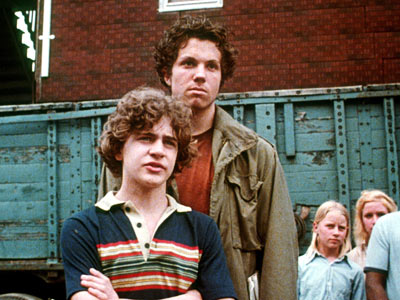
The hero of “My Bodyguard” is fifteen-year-old Clifford Peache (Chris Makepeace), a regular kid. He’s shy, small for his age, and normal…which doesn’t make him very popular at his new high school. On his first day, he is immediately the target of the campus wise-guy, Moody (Matt Dillon), and his cohorts who threaten students for a dollar each day. Moody puts it this way—one dollar each day gives them reason to protect them from the dreaded Ricky Linderman (Adam Baldwin), the school’s hulking, most whispered-about, feared kid who is said to have raped a teacher, killed a cop, poked out some guy’s eyes, etc. Clifford sees right through the bull, and refuses to pay. Thus, the bullies make school miserable for him.

Once Clifford notices that Moody is actually intimidated by Linderman himself, Clifford gets the idea to pay him some money to be his bodyguard. After more torture from the bullies, Linderman finally shows some sympathy and, in one of the film’s best scenes, humiliates Moody with the mere presence of him and Clifford standing together, in front of all their classmates.

You could call that the end of Movie 1. In Movie 2, we see more of Clifford and Linderman as they develop a nice friendship together. At first, Linderman just wants the kid to go away and leave him alone. But Clifford wants to know more about the guy and why he’s so closed off from everybody else in school. Eventually though, they do become friends as they hang out together and talk about some past experiences. They even find the missing part Linderman needed for his broken-down motorcycle, after a year of searching (and they ride through the city of New York together). There is a tragic incident dangling in the background, however, as Clifford learns that the death of Linderman’s younger brother may or may not have been his fault. Either way, he learns this is why he alienates himself from everybody, and because of his appearance, his peers like to share horror stories about him (“I heard…” etc.). And Linderman himself, as it turns out, isn’t much good in a fight. Later in the movie, Moody hires his own bodyguard who is about the size of Linderman, and Linderman actually chickens out. We get more character development and room for further story details as the movie continues.

But in the end, you know the drill—the two “bodyguards” will finally square off against each other in a fistfight, and so will Clifford and Moody. It’s pretty easy to predict the outcome, but that doesn’t mean we don’t enjoy seeing the bullies get their comeuppance.

If there’s one thing about “My Bodyguard” that really doesn’t work, and practically kills the movie for a good few minutes every time it appears, it’s every scene set in the hotel where Clifford lives and where his dad (Martin Mull) works as a manager. And it’s also where we get the most unnecessary character in the movie—Clifford’s wild, young-for-her-age grandmother (Ruth Gordon) who constantly hits on younger men, gets drunk, delivers one-liners, and pretty much annoyed me every time she showed up. Why is she in this movie? She adds nothing to the story, except teaching Linderman and Clifford “palm-reading” which has no payoff except they can show their friends how to do it.

With the exception of that constant distraction, “My Bodyguard” gets his pleasurable moments from the scenes involving the kids. The kids and their high-school adventures are appealing and fun to watch, with sharp writing and good acting. Chris Makepeace is very likeable; Adam Baldwin is solid as Linderman; Matt Dillon is suitably creepy; and there’s also Paul Quandt as Clifford’s rumor-spewing classroom buddy and Joan Cusack as braces-sporting nice-girl Shelly. They all do very good work here.

“My Bodyguard” is a lighthearted, pleasant comedy that has only one troublesome distraction. I’m serious—take out the Ruth Gordon character, and you’ve got a great movie. For the most part, it’s fun, enjoyable, and amusing.

Bad News Bears (2005)

4 May

images

Smith’s Verdict: ***

Reviewed by Tanner Smith

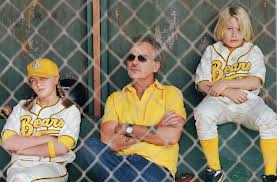
2005’s “Bad News Bears” is the remake of the beloved 1976 kids-sports comedy “THE Bad News Bears.” You know the drill—alcoholic former baseball-player Morris Buttermaker is roped into coaching a Little League team, mostly composed of losers. They start the season terribly, but through many practices and hard work, they gain a winning streak and eventually make it to the championship game where they must play against their arch-rivals.

It’s a bit odd, and kind of disappointing, that Richard Linklater is as faithful to the source material as you could practically follow it about the same as the original film (save for a few altered bits for comedic effect). I say that because Linklater is one of the most creative, insightful filmmakers around, what with films such as “Dazed and Confused,” “Before Sunrise”/”Before Sunset,” and “School of Rock” (all of which are very different films). I’m surprised he didn’t add that amount of creativity for this remake. I know some people prefer that remakes stay faithful to the original, but really, you could watch both movies and notice a great lot of similarities in element. It doesn’t feel like a Linklater film in that sense.

But to Linklater’s credit, he does get the majority of what made the original film special. In fact, he actually updates from it for the modern time. Buttermaker is more of a sex fiend than a grump this time around (and even manages to sleep with one of the kids’ mothers), and also uses his attitude and personality to get a strip joint, “Bo-Peeps,” to sponsor the team (so some of the women who work there stop by the games to cheer them on—they’re the loudest, most excited people in the crowd). The profanity that the original was known for is also updated, in that being a PG-13 movie, everything but the “F” word is said constantly. That’s pretty surprising; you’d think it would have been toned down, but nope. Another noticeable update, which you could probably tell from other concepts I mentioned—this remake is darker in tone and very un-PC.

What really makes “Bad News Bears” entertaining throughout, and what makes it worth watching rather than just watching the original, is the lead performance from Billy Bob Thornton. In a role originally portrayed by Walter Matthau as a grumpy drunk, Thornton doesn’t imitate Matthau in the slightest. Instead, he makes the role all his own. He’s crude, brash, nasty, deceitful, and creepy. But Thornton does manage to make us like him, just as he made us like his character in “Bad Santa.” And while Matthau’s advice to the kids in the original was more heartwarming than funny, Thornton’s advice to the kids in this remake is absolutely hilarious. Since the kids’ parents are never around, he has to be the surrogate-father to most of the members of the team, including an Armenian kid whose father doesn’t approve of his playing sports. What’s his advice? Lie. Say, “Guess what, Dad! We won today! He’s not gonna know the difference—he’s from Ricky-Ticky-Taffy or wherever it is, you know?”

And Thornton’s one-liners are very funny. Here’s my favorite: “You can love baseball, but it don’t always love you back. It’s kinda like dating a German chick, you know?”

Greg Kinnear plays an opposing coach, played in the original by Vic Morrow. Kinnear can play a nice guy in many movies, but in my opinion when he really shines is when he’s just playing a downright jerk. Here, he’s a winning-obsessed coach who doesn’t care what it takes to get his team to win, and also tries to intimidate Buttermaker and some of his team members when he gets the chance (but ultimately fails at it).

As for the kids, they’re good comic actors and play their stereotypical roles (mostly copied from the original) to a T. Timmy Deters, as the little tough guy Tanner Boyle, is a riot, and so is Troy Gentile as a wheelchair-bound smart aleck who always reminds Buttermaker that he’s in a wheelchair and yet still goes out to play the infield in the climactic big game. But of course, there’s the case of the role of Amanda, the girl pitcher played memorably by Tatum O’Neal in the original. Here, she’s played by Sammi Kraft, who acquits herself to the role effectively. And there’s also Kelly Leak, the rebellious bad-boy originally played by Jackie Earle Haley. Here, he’s played by Jeffrey Davies, who unfortunately is not as good.

While I give “Bad News Bears” a mild recommendation, I still find myself asking why it was made and why a director like Richard Linklater would be on board to direct it. Was it money? Were they hoping to cash in on the summer sports comedy? Well, however it worked, “Bad News Bears” is still an entertaining remake.

NOTE: Upon closer investigation of the film’s credits, I learned that the script is co-written by Bill Lancaster, who wrote the original 1976 screenplay. That would explain how faithful this remake is.

Freaky Friday (1976)

2 May

MV5BMTY0MjIyNjUxNl5BMl5BanBnXkFtZTcwNDU0OTAyNw@@._V1._SX640_SY534_

Smith’s Verdict: ***

Reviewed by Tanner Smith

1976’s “Freaky Friday” is one of those Disney live-action comedies that people just go nuts over. People love the gentle comedy that comes with the vintage Disney style of the 1970s. And when I was a kid, I watched this multiple times as well. Also, despite it already being based on a popular novel by Mary Rodgers, it’s also said to be the film that spawned the “body-swap” genre (movies, mostly comedies, in which a man turns into a boy or the other way around, or both), for better or worse.

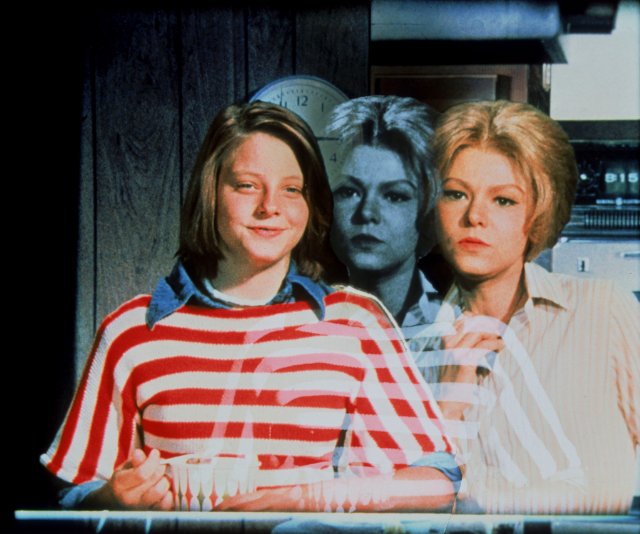
Here’s the story: A thirteen-year-old tomboy named Annabel Andrews (Jodie Foster) and her mother Ellen (Barbara Harris) aren’t getting along very well. Secretly, they each wish that they could just switch places with each other so that one will see how difficult the other’s life is, and vice versa. And on Friday the 13th, they say their wish out loud, at the same time (despite them being in two different locations). Their wish is granted—Annabel’s mind inside her mother’s body, and the mother is inside her daughter. So now they must lead each other’s lives for the day.

They each find that leading the other’s life is not as easy as they think it is. For example, how can junior high school be anything but fun? Ellen (in Annabel’s body) learns the hard way that knowing all the right answers can make her the object of practical jokes, and she doesn’t know the first thing about field hockey (Annabel’s the captain of the team). Meanwhile, Annabel (in Ellen’s body) realizes that being a stay-at-home mom isn’t all that’s cracked up to be, as she’s the one that has to do all the housework.

Watching “Freaky Friday” now, I find it’s a tad overrated. It doesn’t hold up very well and it’s a tad too goofy for its own good, especially in the final act of the movie. It’s an energetic chase scene in which Annabel drives a car in order to get to Ellen. Hijinks ensue as police give chase. The chase continues through narrow alleyways, on a public sidewalk, a walking-bridge, and eventually ends up in the lake.

Where did this come from? I mean sure, in that era, the Disney studio was crazy about exploiting their budget and letting loose a lot of energetic action sequences purely made for laughs. But while “Freaky Friday” is still silly before that point, it’s a different kind of silly. The screenplay is mainly full of dialogue and little situations for the characters to go through. Why unleash the hijinks-filled madness in the last reel?

Though, to be fair, this chase does lead to the funniest sight gag in the movie—the police car, split down the middle in half after crashing into a wall edge. Of course, the car would crash and wouldn’t rip in two pieces like a sheet of paper. But I don’t care—I laughed.

OK, what don’t I like about the movie? Aside from unleashing all the goofy, action-filled antics in the last reel, what specifically is wrong with this movie? Well…the two lead actresses. Actually no, it’s not the two lead actresses. They’re both very talented and have fun in delivering differing personalities for their age—one acts old, the other acts young. But the problem is that we don’t get enough of their real characters before the big switch. If they hadn’t said anything about this miracle, I probably wouldn’t have noticed any difference. And I sort of don’t—Jodie Foster and Barbara Harris have already played these roles many times, which I know makes them ideal casting choices, but doesn’t make them anything new. Jodie Foster was mature for her age and Barbara Harris was always young for her age. They’re well-cast, but for these roles, you need actresses who will take chances.

Also, I’m all for Disney magic, but there’s one part at the end that just got me scratching my head. When Annabel and Ellen switch back to their normal selves, they suddenly find themselves in the wrong places. How is this possible? (Well, that’s a dumb question—that’s like asking how switching bodies is possible.) Wouldn’t it make more sense if Annabel found herself back in her own body in the place where her body was, instead of being in the same place, only with her own body? It may be nitpicking, but…I don’t get it.

So what do I like about the movie, and why I think it’s worth recommending? Well honestly, it’s the script. The first half of the movie is well-written. Most of the dialogue is very funny and there are a lot of interesting ideas that come about. Even if the problems that these two leads face are predictable, they’re still pretty amusing. My favorite parts are—Annabel-as-Ellen dealing with the drapery man, the carpet cleaners, the mechanic, and a neighbor asking for her hair dryer back ALL AT THE SAME TIME; Annabel-as-Ellen dealing with her picky maid (Patsy Kelly, droll); Annabel-as-Ellen having a pleasant conversation with her crush Boris (Marc McClure), who would rather not be around the real Annabel but has fun with this middle-aged woman, not knowing who she really is; Annabel-as-Ellen bonding with her little brother Ben (Sparky Marcus), whom she hated before; and Annabel-as-Ellen forced into a meeting with her own teacher and principal, (I realized by this point that Barbara Harris has the best moments of the two leads.)

I also really liked John Astin as Bill, Annabel’s father and Ellen’s husband. Bill is the self-centered man who is trying to get these two to hold together in order to impress his bosses at a water-shoe he set up at the lake, where Annabel must water-ski and Ellen must make a feast. He’s constantly reminding them of what they’re supposed to do. He’s also the main reactor to these strange situations. Astin’s bewildered expressions are just hilarious.

So despite my issues with “Freaky Friday,” I do find it to be an enjoyable watch. The film has the usual Disney lighthearted feel and does generate some good laughs in its screenplay. I understand why people love this movie. I only like it—it’s not a great movie, but it’s a good one if you’re looking for something to watch on a rainy day.

NOTE: Now I just remembered my favorite moment from Jodie Foster—Ellen-as-Annabel’s encounter with her husband’s sexy, new secretary and scaring her into showing less cleavage. That was a nice scene.

Tucker and Dale vs. Evil (2011)

1 May

images

Smith’s Verdict: ***

Reviewed by Tanner Smith

Remember how in “Scream” teenagers had seen “Halloween” and thus took it as a crash course in how to survive a horror movie? Well, the college students in “Tucker and Dale vs. Evil” have obviously seen “The Texas Chain Saw Massacre” and maybe “Deliverance,” and take what they can to survive a similar scenario…and yet they still die in many horrific ways!

Here’s the setup—a group of obnoxious college students (all of which you’d like to see get slaughtered by a psychotic hillbilly soon) go on a camping trip in the middle of nowhere. Along the way, they receive glares from passing rednecks in a pickup truck, and also encounter them again at the obligatory Wrong Gas Station—that rundown old gas station that looks like a regular end-of-the-line shack. Of course, those two same “hillbillies” are staying in a cabin near their campsite (which is also where a certain Memorial Day Massacre took place, wouldn’t you know it), and they happen to show up when one of the girls goes skinny-dipping. Their appearance frightens her, as she gets into an accident after which the two take her away.

To be sure, the two guys—Tucker (Alan Tudyk) and Dale (Tyler Labine)—are not the psychotic hillbillies that serve as antagonists for this kind of movie. They’re just two dim-witted buddies who only hope to enjoy a fishing trip at Tucker’s cottage in the woods (though it really doesn’t help that the interior of the cabin makes the place look haunted and also has newspaper clippings of the infamous massacre reported). They’re only out there near the college kids’ camp because they were fishing, and Dale happened to see the beautiful young woman and became infatuated. When she has her accident, they rescue her and bring her unconscious back to the cabin. Meanwhile, the other kids, led by Chad (Jesse Moss), believe that she was kidnapped and because they’ve seen too many movies about psychotic mountain men, they…decide to fend for themselves and try and get her back instead of going straight for the police…

OK.

The girl, Allison (Katrina Bowden), quickly realizes that she isn’t in any danger from these two men, and even spends some time with Dale. They play board games together and talk with one another and start to hit it off pretty well. But that doesn’t make the others understand the situation as they race to “rescue” her. But the problem is (and this is a running joke), every time they attempt to make a move, they accidentally wind up killing themselves in horrifically tragic ways!

Many young people die in the most hilariously unintentional ways, but mind you, they’re the most gruesome ways as well. (I won’t even mention the woodchipper, but let’s just say that “Fargo” made it look dignified.) And thankfully, this is the first “slasher-movie” (if you will) in which you actually get your wish about the character you wish would die dies. They are not likable, and they are very obnoxious, but they are supposed to be that way. They are the butt of the running joke. And while the running joke is violent, it is still funny because of the clichés that they try to avoid and yet come back to, leading to their deaths.

Tucker and Dale are pretty likable, and are played with a great Laurel-and-Hardy rapport by Alan Tudyk and Tyler Labine. The pudgy Labine, in particular, has a puppy-dog likeability that you can’t help but sympathize with this guy. And that’s also why Katrina Bowden, as Allison, is appealing as well—she sees through the bullcrap that her friends always think they see.

Just remember this little message, you dumb college-student losers who decide to go camping in the middle of nowhere, where a “redneck’s” cabin happens to be…for whatever reason you would choose that location. “Hillbillies” are people too.