Archive | Three-and-a-Half Stars ***1/2 RSS feed for this section

Mission: Impossible–Ghost Protocol (2011)

25 Jan

mission-impossible-ghost-protocol-tom-cruise-brad-bird-burj-khalifa-dubai

Smith’s Verdict: ***1/2

Reviewed by Tanner Smith

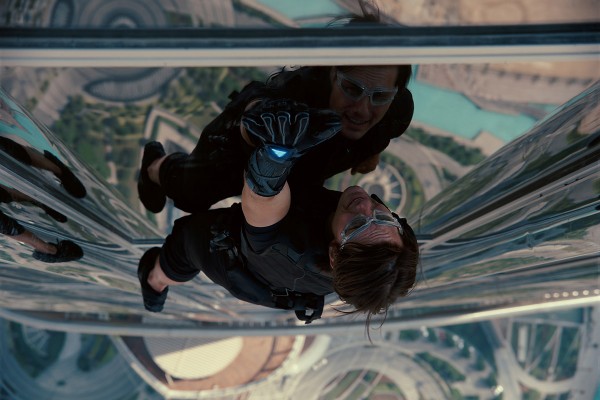
There’s no doubt about it—the best action sequence in the fourth “Mission: Impossible” movie (subtitled “Ghost Protocol”) is the one in which Tom Cruise’s Ethan Hunt has to scale a skyscraper. But not just any skyscraper—the Burj Khalifa in Dubal. The world’s tallest building. Ethan has to scale the glass windows from the outside, more than a hundred stories up. He’s equipped with special gloves that stick to a surface, which of course malfunction so that Ethan can hang on for dear life.

Why doesn’t anyone else do this? Simon Pegg’s Benji’s reponse is simple: “I’m on the computer.” Jeremy Renner’s Brandt’s response: “I’m…the helper.” And Ethan is…well, he’s the hero. He was going to scale that tower no matter what. What floor does he have to stop at? 130.

Pulling off a sequence like this is tricky enough, but then I found out this piece of information—apparently, Tom Cruise did his own stunts. Wait…what?

OK, maybe some heavy wirework was involved or there were unseen footholds around, but Tom Cruise reportedly insisted on performing his own stunts. I simply can’t believe it. There’s a shot where we actually pan out from Cruise scaling the building to where we get a full shot of the place, and I simply can’t believe that anybody would really try this. But apparently, Cruise isn’t CGI in these shots and we really are looking at him. This either means that Cruise is very brave or very stupid.

Either way, this whole sequence is impactful. I have an underlying fear of heights and seeing this on the big screen gave me vertigo. It’s that impressive.

This may be the standout, but there are other terrific action sequences in “Mission: Impossible—Ghost Protocol,” an exciting thriller that comes along like the lost James Bond picture. We have it all—stunts, chases, explosions, neat gadgetry, a megalomaniac villain with a thuggish henchman, and wall-to-wall action. It’s a lot of fun and easily the best entry in the “Mission: Impossible” franchise, proving that sometimes the fourth entry can be the charmer (see “Live Free or Die Hard” or “Star Trek IV”—just please don’t see “Superman IV” or “Batman and Robin”).

OK, maybe the story is a bit muddled and somewhat confusing in that certain things are left unsaid, but there are still some kick-ass action sequences to turn this into a thrill ride to make us care for it. It begins with a prison break, as Impossible Mission Force (IMF) need Ethan back to take care of something big. Ethan is stuck in a Russian prison, so agents Benji and Jane (Paula Patton) break him out in a nicely-done opening scene. The team is hunting down the international terrorist Hendricks (Michael Nyqvist), a genius who is looking to gain control of nuclear weapons. He must be stopped before he succeeds in unleashing nuclear war—he believes that the way to gain world peace is to start over, from the rubble.

Hendricks and his brutish sidekick Wistrom (Samuli Edelmann) blow up the Kremlin and frame IMF, forcing “ghost protocol.” But Ethan, Benji, Jane, and analyst Brandt are still carrying out the mission.

Aside from the skyscraper scene, there are some neatly-staged sequences in the movie. Of course, a lot of these aren’t plausible, but they are thrilling. There’s one in particular that comes in the final half of the movie where the team is in Mombai, and Brandt jumps into a ventilating shaft somewhere. I guess he wears a steel belt so that Benji can keep him safe in the shaft via a mobile magnet. Of course, there are close calls in that sequence as well, as you’d predict. But close calls are what make action scenes all the more exciting.

I liked the four central cast members. They do appealing work and I was interested in following them because they were entertaining. Tom Cruise is on hand for action as he always is in these movies (although you have to wonder, in those sequences where he’s running like mad, if he’s going crazy). Jeremy Renner is apparently stepping in for Cruise in a fifth “Mission: Impossible” movie; he’ll have earned his position as a new lead. (I forgot to mention that his character Brandt isn’t just an analyst—he has field agent training.) Simon Pegg has nice moments providing comic relief. I hate to actually have to type this in a review, but…Paula Patton is hot! And she gets some neat girl-on-girl action in a fight scene between her character and a sexy female assassin played by French actress Lea Seydoux.

This is the live-action film debut of the great animation director Brad Bird (“The Iron Giant,” “The Incredibles,” “Ratatouille”) and it proves to be a spectacular one. “Mission: Impossible—Ghost Protocol” is alive and entertaining with nifty action sequences and an exciting feel.

And the next best thing I can say about the skyscraper scene is this: I wish I had seen it on IMAX…or maybe I don’t. Like I said, I have a fear of heights.
October Sky (1999)

25 Jan

octobersky

Smith’s Verdict: ***1/2

Reviewed by Tanner Smith

“October Sky” has the feel a smart feel-good sports drama, mostly in the notion in that it’s not just about the sport, but about life’s ambitions and relationships. (“Hoosiers” was a great example of showing that.) But if you don’t care that much for athletics, then “October Sky” is even better for you. The “sport” in this movie is rocket-building, which doesn’t make very exciting competition. But that’s OK, because the rocket stuff isn’t competitive in the slightest. The characters in “October Sky” do what they do because they love doing it and they want to share it with people once they get it right, and hope that the people they love will approve of their goals.

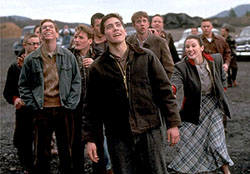
“October Sky” is based on a novel by Homer Hickam and relates to the true story of Homer and his three friends who were experimenting with rocketry when they were high school teenagers in the autumn of 1957, when the Russian satellite Sputnik was first launched. Seventeen-year-old Homer (Jake Gyllenhaal) lives in small coal mining town Coalwood, West Virginia. On the night Sputnik is seen soaring over Coalwood, Homer is amazed by the sight that man has put right up there in space, so much so that he decides he’s going to build a rocket.

His first attempt is not a successful one—it’s a flashlight with a fuse that of course explodes, and blows up part of Homer’s fence. So, Homer—who is a bright student, but science and math are his weak subjects—enlists the help of science nerd Quentin (Chris Owen) to help him and his two friends Roy Lee (William Lee Scott) and O’Dell (Chad Lindberg) build their own homemade rockets. Their first rocket together isn’t as successful as they imagined—they launch it, all right, but it makes its way through town, nearly hurting someone. So the boys make their own launching post eight miles outside of the coal mine and spend their days together making more rockets, hoping at least one of them will them will soar.

On Homer’s side is an encouraging, supportive teacher, Miss Riley (Laura Dern), and his mother (Natalie Canerday) is fine with this new hobby as long as Homer doesn’t blow himself up. But Homer’s father John (Chris Cooper), who runs the mine, doesn’t believe in Homer’s dream. He thinks of it as foolish and believes he should just get his head out of the clouds and down into the mine to work. This is a town that feels like a dirty prison and the only ones that get out of here are those who get college sports scholarships. The rest are stuck to work and mine coal. And so John believes that conducting these rocket experiments, entering and winning the national science fair, and hoping to get into college is just a waste of effort, and doesn’t want Homer to even try it.

And this is where the real tension of “October Sky” lies—not merely with the boys trying to create a successful rocket, although you do really hope that they do. It’s with Homer having different dreams than his father. And his father is not a bad person—he does what he does (confiscating the rocket equipment, forbidding Homer to use it near company property) because he’s doing what he believes is best for his son. He thinks his son just needs to face reality. And he makes sacrifices at work—he looks out for his fellow workers, fights for their jobs, and when we first see him, he even saves a life. He wants Homer to follow in his footsteps. So what we have is a legitimate realistic movie confrontation between a boy and his father—not the one-dimensional arguing that you see in most movies that have this element. It’s characterized on both sides of the confrontation and played very convincingly.

The stuff with Homer and his friends building the rockets has its own whimsy and entertainment value without getting tedious (although you can sometimes predict which rocket is going to explode, during a montage, and that gets kind of old). The boys are excited about doing this, and we’re excited for them. And when they finally get one up there (and good timing too, because everyone in town is watching) midway through the movie, it’s a glorious, joyful moment.

Of course, there must be a central conflict that nearly makes Homer change his mind about what he’s doing and it’s a pretty substantial one. It starts after Homer and friends have made their first successful launch—a forest fire is said to be caused by one of the boys’ faulty rockets and so they’re forbidden to continue with their experiments again. Actually, that’s somewhat obvious, but then John injures an eye in an emergency down in the mine and has time off for recovery. Taking his place is Homer, who learns the responsibilities his father had to go through and ponders about whether he should work down there full-time. But Miss Riley convinces Homer that he should do what he dreams of doing, and that also gets Homer thinking.

This leads to Homer and his friends rejoining to work on rockets again and enter the national science fair, but first they have to figure out, using trigonometry that they learned during all of this, whether or not it was their rocket that started that fire.

“October Sky” is a wonderful movie that has deep values within it. It has a real go-for-it, feel-good spirit in the sequences with the boys making their rockets, and a real connection between a father and son that comes rare in the movies. It’s helped by intelligent writing and more-than-capable acting by Jake Gyllenhaal who gives a winning performance as Homer, Chris Cooper who is excellent and three-dimensional as John, Laura Dern as encouraging Miss Riley, Natalie Canerday as Homer’s loving mother, and Chris Owen, William Lee Scott, and Chad Lindberg as the three friends (Scott, in particular, has some pretty funny moments, even though his fake Southern accent is somewhat forcibly thick).

I will not forget “October Sky” any time soon. It’s a delightful movie that deserves to be seen by everybody. Forget that it’s a mainstream movie that doesn’t feature tired action or forced melodrama, and enjoy it for what it is—a nicely-done, well-acted, free-spirited movie that is likely to satisfy even the most stubborn of audience members.

NOTE: Here’s a fun fact I came across—“October Sky” is actually an anagram for “Rocket Boys,” the title of the autobiography this movie is based upon.

Something Wild (1986)

25 Jan

images

Smith’s Verdict: ***1/2

Reviewed by Tanner Smith

“Something Wild” is one of the more accurate titles for a comedy. It’s about a wild woman, a not-too-wild businessman, a wild series of events, and wild encounters. It gets even wilder as it continues and only lets up in a more conventional final act, but doesn’t hurt the movie so much. It’s too interesting to be brought down.

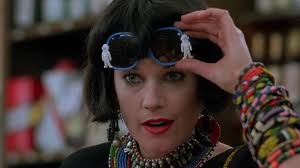
The movie gets to the plot immediately. As it opens, a conventional businessman, named Charlie Driggs (Jeff Daniels), meets an interesting, sexy woman named Lulu (Melanie Griffith). She asks him out to lunch, even if Charlie might be married. But Charlie is easily stimulated by her boldness and comes along anyway. It’s when he gets into her car that he realizes that Lulu is a wild child. She practically kidnaps Charlie and they do whatever she wants to do, and he enjoys her free-spirited, impulsive recklessness. She is that person to bring spark into Charlie’s life and he goes along with whatever she has in mind.

They rent a hotel room, have wild sex, and while he’s handcuffed to the bed, she dials his boss’ number and forces him to talk, because after all, he’s supposed to be at the office. He has to make some sort of excuse, right?

Things get even wilder from there. It involves spending a lot of money, going from hotel to hotel, continuous sex, and soon enough, leading to meeting Lulu’s mother, as Lulu introduces Charlie as her husband. That’s how fast she is; she has a creative imagination and thinks on the fly, all while leaving Charlie to experience it as it goes. (“Lulu,” by the way, is not her real name. It’s the name she chose for the week.)

Charlie and Lulu drive from New York to Tallahassee to attend Lulu’s high-school reunion, still pulling the “husband” card on Charlie to impress her former classmates. They have a fun time (and there’s a brilliant comic scene in which the two dance to a cover of David Bowie’s “Fame”), but they both run into the last people they wanted to meet. For Charlie, it’s his co-worker, an accountant from the office who knows the real deal about Charlie and could either aid him or make things worse. And for Lulu, it’s her ex-husband Ray (Ray Liotta), who was just released from prison (or did he escape?) and came to the reunion to see Lulu again. She’s not interested, but he sticks to the two and soon enough takes them captive in the same way Lulu took Charlie. Charlie is looking for more fun and excitement, but Ray is far too wild to hang around with. He has crime-related ideas to act upon, gets the two involved, and Charlie realizes he must fight for Lulu and for his own life.

The first half of “Something Wild” is mesmerizing. It takes the ordinary everyday world into a bizarre play-land for just about anything to happen at any time. We never see any of the tricks coming; they’re bestowed upon us as they go. They’re random, inventive, and unpredictable. You have to wonder if director Jonathan Demme can keep it going…and it turns out he can keep the spontaneity for so long that the movie descends into a more conventional route, as Ray continues to stalk Charlie and Lulu with vengeance on his mind. This of course must lead to an ultimate showdown—a climactic fight between Charlie and Ray. We pretty much know what’s going to happen at this point, so the tension that was brought upon the impulsiveness and eroticism of the earlier and middle sequences is somewhat reduced.

The actors carry the movie with incredible timing, appeal, and believability. Melanie Griffith has to convince us that her character is a wild child, and has no problem pulling that off. Jeff Daniels is likable and has that look in his eye that says that he wants something, but doesn’t quite know how to get it. That’s where Griffith comes in. The two share great chemistry on-screen, as well as suitable sexual tension. Ray Liotta, showing up midway through the movie, is absolutely compelling as the jealous ex-husband. He has that similar look in his eye, but resorts to higher measures to get what he wants. He is convincing in being able to get Charlie to trust him—this is a guy you’d like to go partying with before realizing that he’s a little too much into the act, more so than you are.

“Something Wild” is indeed something wild. It’s one of those inventive comedies in which the characters and the plot are consistent in that they’re just as surprised to continue as we are. Everything is thought through and seems spontaneous for us to laugh and be invested, and the actors are game for the material. Even if it goes more for a standard climax, it has a lot of fun leading up to it.

The Secret of NIMH (1982)

24 Jan

000015_16

Smith’s Verdict: ***1/2

Reviewed by Tanner Smith

Don Bluth’s animated movie “The Secret of NIMH” recalls the joy of some of the earlier Disney features. In fact, I think Walt Disney himself would’ve been impressed by the chances this animated movie takes and how unusually thought-provoking it is.

If you think the NIMH in the title is the acronym for the National Institute of Mental Health, you’re right. We learn that a group of NIMH laboratory rats and mice were injected with a secret serum that made them smarter. They could read, reason, and became so smart that they escaped from the lab and made their own secret home and society in the backyard of a farmhouse. They were able to create lights, electricity, and other mystical elements that the movie doesn’t explain, but to be fair, I’m not sure the altered rats themselves can explain them either.

That’s the secret of NIMH that the title suggests, discovered by the story’s heroine on her own adventure. This is Mrs. Brisby (voiced by Elizabeth Hartman), a field mouse/widowed mother who has a deeper connection to the rats of NIMH than she thinks.

Mrs. Brisby is an unusual leading character for a movie like this. Usually, it’s the plucky young children (like Brisby’s own children) who go out and embark on the incredible journey (in fact, in most Disney movies, parents end up either dead or separated). But not here—Mrs. Brisby also isn’t a wisecracking action hero that races to save the day. She’s a concerned mother with a real bravery to her that forces her to go out and do what she does in order to protect her family. She’s kind and likable, and serves as an appealing heroine.

Mrs. Brisby’s ill child is sick of pneumonia, as a mouse named Mr. Ages (Arthur Malet) declares, and must stay in bed for about three weeks. But “moving day” is approaching fast, meaning that a tractor will come along and plow the field. Mrs. Brisby can’t take her child away from home and risk him dying, so she must venture into the farm for answers.

After an encounter with a visionary, intimidating Great Owl (John Carradine), Mrs. Brisby finds the home of the NIMH rats, meets their wise old leader Nicodemus (Derek Jacobi), discovers their secret, and enlists their help to move her home to safe location. At the same time, the rats are trapped with the ethical dilemma of whether or not to keep stealing supplies from the humans or to move out into the wilderness to set up a new society for themselves.

For that matter, what is needed for the rats of NIMH to continue to survive together? Is it discovery? Is it science? Is it logic? Is it intelligence? Maybe it’s all of those choices. This helps make “The Secret of NIMH” into a deeper social commentary. What all do we need to survive in this world, when you really think about it?

“The Secret of NIMH” has a complicated but intriguing story that is distracted only by the unnecessary antics of an annoying talking crow named Jeremy (Dom DeLuise). Kids may enjoy this character, as he is constantly mumbling nervously and acting clumsily, but he really did nothing for me. He doesn’t really have a payoff either—he doesn’t wind up helping to save the day (he returns too late)—so the only reason he’s there is so Mrs. Brisby can ask him to look after her children while she’s gone, and the kids tie him up and torture him.

The animation from Don Bluth and his followers is nicely done. Body language is expressed for the characters, the animals range from cute to frightening, the backgrounds are interesting, and the settings are good-looking. There’s a real sense of depth here.

“The Secret of NIMH” moves at a brisk pace, is delightfully drawn, and carefully constructed. It’s a well-done family film that will entertain adults as well as kids, because they can probably see more than just cute little mice and an inviting look. They can see something deeper within the story.

The Breakfast Club (1985)

22 Jan

Image

Smith’s Verdict: ***1/2

Reviewed by Tanner Smith

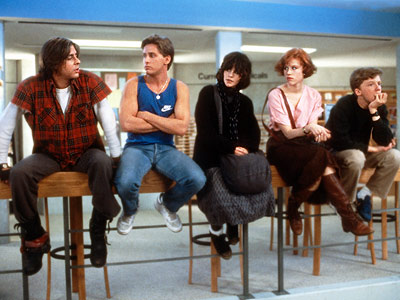
“The Breakfast Club” is a delight. It’s a wonderful, funny, feel-good comedy/drama with this simple premise—five strangers spend a day together and become closer than anyone could have imagined. Make the five strangers into teenagers from different high school cliques and have them in detention together and you have “The Breakfast Club,” a movie written, produced, and directed by John Hughes, who also made the sweet “Sixteen Candles” and actually takes teenagers seriously. Hughes creates teenage movie characters as real teenagers—young people wanting to belong in this world. Usually for the 1980s, a lot of movies will depict teenagers as simply sex-crazed or dumb or just victims in a slasher movie, like the “Friday the 13th” movies. But not with John Hughes writing the material. “The Breakfast Club” is one of those rarities that makes teenagers into three-dimensional characters while adding realistic drama and comic relief.

So we have the five teenage leads from different groups in high school—we have Brian who is a brain (ha ha), Andrew Clark who is a jock, Bender who is a rebel, Claire who is the queen bee, and Allison who is a “basket case.” They are forced to spend a Saturday in the library for a full-day detention and are checked up on every now and then by the strict vice principal Vernon (Paul Gleason).

When the day starts, they have nothing to say to each other and want nothing to do with each other. By the end of the day, they have shared their feelings and realize that they can become friends. All of this is told almost all in dialogue. Each character has his/her moment to express themselves. We feel for each of them. And the way the script is almost entirely written in dialogue, you think this could possibly be a play, especially in the scene in which the kids all sit in the floor and have a sort-of “group therapy” session. This goes on for 20 minutes, but it doesn’t get boring because we really do feel for these people.

For example, we learn that Andrew (Emilio Estevez) has a father who is a practical perfectionist who wants Andrew to win every time, and that drove Andrew to the point where he went over the edge just to please him. For Bender (Judd Nelson), the idea of pleasing his own father is difficult, since his own father is the possible abusive type who probably can never please him, whatever he does. Maybe this is why Bender is a rebel. Isn’t rebellion started by parents’ ignorance? Come to think of it, that could be why Allison (Ally Sheedy) is a recluse.

The acting is very good, especially from Judd Nelson as the down-on-his-luck criminal Bender; he’s very good here. And the other actors, more experienced than Nelson at the time, are good too—Molly Ringwald shows a different side to the character of a high school beauty, Emilio Estevez is strong as a tortured athlete, Ally Sheedy is suitably weird as the weirdo who is also a compulsive liar, and Anthony Michael Hall is a likable (and realistic) nerd (he shows you don’t have to look like a geek—he doesn’t have zits or thick glasses; you just have to act like one to be labeled a “geek”).

If there’s a weakness, it’s that the adults aren’t as drawn out. John Kapelos, as a smart-aleck janitor named Carl, is OK in his small role, but Paul Gleason’s character of the strict vice principal is one-dimensional and the scene in which he tries to connect with Carl is brief and not very interesting.

The question that Brian, the brain, asks near the end of the film is shocking to hear because even though we all were probably expecting the subject to come around, I wasn’t ready for it. Brian asks the question of what’s going to happen when all five of them go back to school. Will they still be friends? The answer he receives is the harsh truth. This is the film’s most powerful moment because it has a ring of truth and really draws the line as to where high school kids stand as individuals. What will happen? Who knows? But the ending does what it can to have the assumption that maybe they can still be friends. We don’t know what happens after this day, which is why we really have to think about who these people are and what sort of people they’re going to become.

I don’t want to make “The Breakfast Club” sound so deep that people wouldn’t be interested because there are moments when it’s fun, particularly when the kids sneak out of the room and have to get back before Vernon realizes they’re gone. But at the surface, this is a strong coming-of-age teenage film that has more than meets the eye.

End of Watch (2012)

22 Jan

end_of_watch_2012_640x360_913709

Smith’s Verdict: ***1/2

Reviewed by Tanner Smith

There is one unfortunate problem with the police drama “End of Watch” that sometimes makes it hard to handle; not just because some audience members couldn’t seem to bear it, but also because it’s an overused gimmick that does not work in the film’s favor. But first, let it be said that aside from said-problem, “End of Watch” is a gripping, insightful and effective tale about L.A. street cops who risk their lives with such importance of their mission.

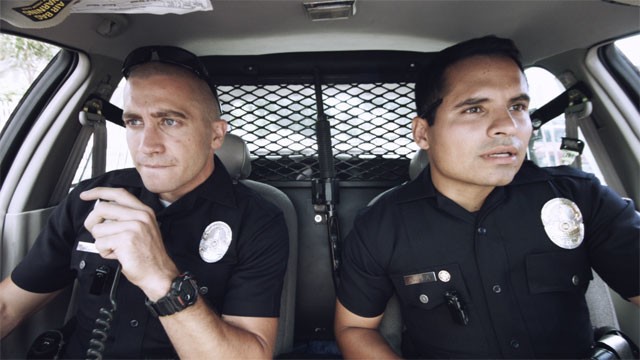
Jake Gyllenhaal and Michael Pena star as Brian Taylor and Mike Zavala, a pair of South Central cops. Paying acknowledgement to everything that “End of Watch” does right (before getting to that important thing later), Gyllenhaal and Pena deliver excellent performances. They’re two ordinary guys who have a strong bond with each other, and the chemistry is existent and natural throughout the film.

Taylor and Zavala’s night-shift job is nothing new for them—responding to disturbance-of-peace calls, rescuing children from house fires, etc. But their beat is mostly full of drugs and gangs, so there’s always that feeling of wanting to look behind you at every step. And surely enough, because they take their job seriously, Taylor and Zavala are watched upon by a Mexican druglord who wants them stopped (meaning “killed”) before they can delay his plans.

While all that’s going on, “End of Watch” progresses with the lives of Taylor and Zavala. This is the best thing about “End of Watch”—it takes the time to develop the central characters outside of their police cars. While the film has the usual ride-along, crime-spree elements (with daring heroics and “that-was-close” moments), it also goes into the lives of these two cops as they connect to each other, banter with other officers, and spend time with their women (Zavala’s wife Gabby, played by Natalie Martinez; Taylor’s girlfriend Janet, played by Anna Kendrick). These sequences are handled with credibility and effectiveness. They’re needed to make the audience care for the lives of Taylor and Zavala when things get nasty on the beat.

“End of Watch” also takes the audience on what feels like an authentic ride-along in its sequences where Taylor and Zavala constantly come across one major situation after another. The action scenes that follow are realistically gruesome and impactful, and it mostly rings so true that you would think you were watching a documentary on the subject…and this would be as good a spot to bring up the key problem with the movie. Taylor, along with other officers (and even some of the gang members), constantly film everything happening around them with handheld digital cameras. This means that the filmmaking technique of constantly-shaking-the-camera-so-the-scene-feels-even-more-intense is evident for the most part of the film. Why does this not work? Well, number one—this gimmick doesn’t work anymore; it’s awkward and overdone. Number two—because a lot of the action scenes consist of the camera shaking, it’s difficult to see some of the action, which is not supposed to be the case of an action film (action films exist to show the action). Number three—what is the point of when the film finally does move to the third-person perspective, the camera still continues to shake violently? It’s distracting, as well as dizzying, and because writer-director David Ayer is already a proven talent, it’s not needed.

Despite that, however, “End of Watch” is recommended because of its riveting elements that make similarly-themed movies look like nursery rhymes. Thanks to solid acting, convincing human drama, a good deal of plausibility, and hard-edged action violence, “End of Watch” works effectively.

NOTE (two years later): After seeing this a third time, two years since I originally wrote this review, I kind of got used to the shaky-cam. It’s like an episode of “Cops” with the double the authenticity. So there you go–I changed the Verdict rating from a 3 to a 3.5 with that in mind, because the film overall is too strong for a 3. (Also, two years later, just a random statement, but I love this line from Michael Pena: “Policing is all about comfortable footwear.”)

Jurassic Park (1993)

22 Jan

jurassicpark061411[1]

Smith’s Verdict: ***1/2

Reviewed by Tanner Smith

When it comes to monster movies, I can barely think of one with as much production value as “Jurassic Park.” The budget was huge enough to afford the best dinosaurs that could be created in Stan Winston’s Creature Workshop. As a result, we don’t merely get scary dinosaurs. We don’t go to see this movie for just-scary dinosaurs. What we get really seems like real dinosaurs.

Steven Spielberg’s “Jurassic Park” has some of the best-looking creatures I’ve seen in a movie. When you first see them the same time the protagonists see them, you’re in as much awe as they are. Here are these giant, elegant creatures traveling in herds. You look in awe and wonder because they look real, as do the other dinosaurs that the characters come across later in the movie—a ferocious Tyrannosaurus Rex, a herd of stampeding Gallomimus (spell-check?), and the fearsome Raptor. But of course, with those, you look less with awe…but more with fear.

The premise for “Jurassic Park,” based on a popular novel by Michael Crichton (unread by me), is an intriguing one. It features an eccentric billionaire named John Hammond who funds a theme park on a remote island only reachable by helicopter. What’s the theme? Dinosaurs!

This place is called Jurassic Park and it promises a tour through a forest to see live dinosaurs, cloned by the DNA found in a fossilized mosquito. (Don’t ask—it’s complicated.) The dinos are separated and kept obscure by electric fences. The park needs endorsements, so Hammond calls paleontologists Dr. Alan Grant and Dr. Ellie Sadler (Sam Neill and Laura Dern) and mathematician Ian Malcolm (Jeff Goldblum). Also along for the ride are members of the park’s target audience—Hammond’s grandchildren Lex and Tim (Ariana Richards and Joseph Mazzello).

The park’s tour turns to be a bust, but it only gets worse as one of the park’s operators—an overweight sleazeball, played by Wayne Knight (Newman from “Seinfeld”), has shut down most of the electrical system for his selfish reasons. Among those shut down are the electric fences, allowing the dinosaurs to roam free about the park while the people are trapped. The terror begins in a sensational sequence in which a T-Rex attacks the two kids in the tourist car.

So mainly the second half of “Jurassic Park” is a monster movie, as Grant and the two kids are separated from the others, who try to get the park back in control from inside the command center, and come across more obstacles and more beasts. The more dangerous of these beasts, you would suspect, would be the T-Rex, but that’s only because he’s bigger. The more frightening creatures on the loose are the raptors, which are smaller but more ruthless and more vicious. They wind up being the ones the characters have to face near the end of the movie.

OK, so the technical aspect of “Jurassic Park” has been praised. How does characterization do? Well…not so strong. Grant and Sadler aren’t fully developed as individuals and seem more like figures than actual characters. The Wayne Knight character is as developed as…well let’s face it, Newman. The kids are fine.

Hammond and Malcolm do close closer to being fully realized individuals. Hammond’s greed and love for dinosaurs gets to him and he slowly but surely realizes it when things go very wrong, and Sadler brings things to a new perspective for him in a scene midway through the movie. Malcolm is an interesting character, always discussing chaos theory and giving more input along the lines of “when-man-plays-god-man-loses.” The only reason Hammond doesn’t listen to him is because of his sharp wit, which Jeff Goldblum can deliver in a funny deadpan way.

The characters in Spielberg’s  “Jaws” and “Close Encounters of the Third Kind” are well-developed and fully realized. In “Jurassic Park,” it seems more time was spent on making the dinosaurs look real than the characters who have to face them. But you can’t deny the thrilling action scenes, the fun monster movie style, and those sensational dinosaur effects.

Near Dark (1987)

16 Jan

near-dark-1

Smith’s Verdict: ***1/2

Reviewed by Tanner Smith

“Near Dark” features a band of outlaws who are much more than anyone would think. People see these people coming and they suspect trouble, but don’t quite know exactly how much trouble. These people aren’t necessarily human, and I don’t mean that as a metaphor. As one character points out after barely surviving an encounter with them, “Those people back there—they wasn’t normal. Normal folks don’t spit out bullets when you shoot ‘em!” Indeed, conventional weapons can’t kill this family and they don’t feel pain. The only thing that can hurt and kill them is sunlight. So they sleep during the day and stalk the night. As one of them puts it, “We keep odd hours.”

And also, the only thing they can eat is human blood. This means every night, they go from place and place to find new victims, hence their outlaw status. When they keep feeding on blood, and stay out of the sunlight, they can live forever.

Are they vampires? I honestly don’t know. They share some of the same traits of such humanistic creatures, but not in the conventional way. They don’t sprout fangs or fly or morph into bats. They just feed on blood, live eternal life in the dark, and can only be killed by sunlight. And “Near Dark” isn’t an old-fashioned vampire movie—it’s a contemporary thriller, and a Western—it takes place in the South and has certain elements of a Western, such as shootouts, showdowns, and bar fights.

What do we have here that’s different? Well, having the villains be these supernatural beings is actually pretty remarkable and leads to some original story pieces. The biggest showdown is between one of these “vampires” on foot and the hero in a large truck. Should be a no-brainer, right? The hero runs down the rascal, but he’s still not dead yet (though he doesn’t look too good with his head split open). And there’s a bar fight in the middle of the movie, like a lot of Westerns. Only this one is bloodier, as the outlaws take out every person in the bar, one by one (the bartender has his throat slit by boot spurs), and drink their blood. It’s a chillingly funny moment when the wildest one in the bunch, Severen (Bill Paxton), licks a victim’s blood off his fingers and chuckles, “It’s finger-lickin’ good!”

And of course, there’s a shootout in which the law lets loose everything they have at the outlaws in a motel room, while the outlaws shoot back from inside. But the police’s bullets don’t hurt them in the slightest; however, since it’s during the day, the bullet holes that let in the light—those are what really hurt them. That’s very clever.

In fact, all of these added elements to the usual shtick are clever. And the look of the film looks quite nice, considering the subject matter—looking like a painting, especially in the scenes that take place at night. We admire the night as much as the central young couple—Mae (Jenny Wright) and Caleb (Adrian Pasdar)—who fell in with the gang. Mae tells Caleb to look and listen to the night, that it’s the most beautiful thing in the world to live with. From the look of the film, we believe her.

I should also point that “Near Dark” has one terrific opening shot. It’s a mosquito sucking blood from Caleb’s arm—just a mosquito, but it’s a classic case of foreshadowing. Caleb squashes the blood-sucking insect, calling it a “dumb suck,” and has no idea what he’s in for later, when he has to deal with practical human-sized mosquitoes.

I suppose I should share the story of “Near Dark.” The story features Caleb, a young man who goes on a date with Mae, whom he just met that night. Their date continues through the night, as Caleb quickly realizes that Mae isn’t like any other girl he’s picked up before. She commands him to stop the truck so that she can “show him the night,” as she crazily exclaims, “The night—it’s deafening! Do you hear it?” Caleb just sort of plays along, “Well, I’ll hold your ears.” Of course he can’t tell right away that she’s a vampire, even though she practically begs to be taken home before dawn. Then, Caleb and Mae share a passionate kiss…which ends with Mae biting his neck and running away. “Sure was some kiss,” Caleb says to himself.

When Caleb has to walk home as the sun comes up, he realizes what effect the sun has on him now. He nearly burns to death until he is rescued by Mae and her “family,” who show up in a blacked-out Winnebago. When they see that Caleb has been bitten, they realize that he’s “turned.” So they give him a week to call him one of them, and Mae makes it very clear that in order to survive, he has to learn to kill. Caleb doesn’t want to kill, but “the night has its price.”

As you may have guessed from many scene descriptions and lines of dialogue, “Near Dark” has a terrific script, written by Eric Red and director Kathryn Bigelow. Most of the film’s dialogue I have memorized by heart. My favorite line comes from the leader Jesse Hooker (Lance Henriksen), when Caleb asks how old he is. His response: “Let me put it this way—I fought for the South…We lost.”

Adrian Pasdar is at first playing Caleb as a dumb horny teenager, and him being from Texas don’t make him any different from most teenage sex movies. But when he understands his plight and we see him go through these changes, he does become more human, and therefore more likeable. Jenny Wright makes a charismatic complicated love interest. In fact, I was wishing for more scenes featuring these two together. We get a fair amount, but “fair” isn’t enough.

As the antagonists, the performances are first-rate. Lance Henriksen has a convincing menace to his character of Jesse, trying to keep things in check while resorting to deadly measures in the process. Bill Paxton is perfect as Severen—chilling and yet amusing at the same time. This is the guy you want to party with, given that you don’t know his true intentions and would most likely become his next victim. Also on board is Jenette Goldstein as Jesse’s wife (at least, I think she’s his wife—back stories with these characters are left vague, which I didn’t mind either) and Joshua Miller (the creepy little brother from “River’s Edge”) as Homer, the little boy with a middle-aged mind. Other supporting cast members with significant screen time are Tim Thomerson and Marcie Leeds as Caleb’s father and little sister Sarah, who look for Caleb after he’s been missing for days. The final conflict of the film is whether the vampires will turn Sarah the way they turned Caleb.

There are a few problems I have with “Near Dark.” For one thing, the transitions from day to night are very clumsy, like they transform just too easily. There’s one scene where the characters are in the motel at night, and just a few minutes later, it’s full daylight outside. Talk about dumb luck! Also, I didn’t full appreciate the ending—not just because it was one of those standard chase endings in which the hero is able to kill the villains after all this madness, but because it ended too quickly for everything to sink in. The final payoff between Caleb and Mae could have had more weight, but it’s just all too brief. But for the most part, “Near Dark” is a neat little horror movie that goes beyond all the usual vampire-movie clichés, as well as Western clichés, that we’re used to.

Attack the Block (2011)

16 Jan

images

Smith’s Verdict: ***1/2

Reviewed by Tanner Smith

How often does it happen in a movie—and a monster movie, at that—when you start out hating the main characters and then wind up rooting for them when things get crazy? One example that comes to mind is “From Dusk Till Dawn.” If you recall that movie, it was about two murderous fugitives who kidnap a family and then have to work together to fend themselves against vile vampires. Now in “Attack the Block,” a sci-fi/horror film from the UK, we have a thuggish gang of inner city London teenagers banding together with their latest victim of mugging to fight a swarm of predatory creatures from outer space.

That’s a central element in “Attack the Block,” an entertaining thriller with an adventurous feel, decent special effects, and a cast of mainly unknown but talented young actors. It begins as a young nurse named Sam (Jodie Whitaker) is walking home on the bad side of town, where she is mugged by a gang of five young hoodlums. A meteorite lands nearby, interrupting the mugging, and scampers in the form of a small, furry, fanged alien that scratches the face of the gang leader Moses (John Boyega). The kids chase after the little beast and beat it to death, like the big shots they think they are.

But guess what! There are a lot more where that came from. So Moses and the others—Pest (Alex Esmail), Dennis (Franz Drameh), Biggz (Simon Howard), and Jerome (Leeon Jones)—get excited and grab a bunch of weapons (including swords, fireworks, and a baseball bat) to take them down. But it turns out that these creatures are bigger and more vicious than the thing they killed before. When one of them bites Pest’s leg, they need Sam’s nursing training to help. The gang assures her that there are worse things out there to be scared of than them. While inside their tower block, they, along with a druggie named Brewis (well-played by Luke Treadaway, who provides comic relief), band together to survive the night.

It’s so strange how this movie develops with its characters. When the movie starts with Sam, walking down the street and talking to her mum on her cell phone, we immediately suspect that she’s the central character. But then the gang shows up and mugs her and we follow them for just about the rest of the movie. These are people we’re supposed to hate. And we don’t like them indeed, at first. They’re vile, they talk trash, and they get stoned. Then the aliens show up and the boys realize they might not stand much of a chance against them. That’s when the gang starts to become sympathetic individuals. They think things through, attempt to keep each other safe, and rely on their wits to survive. This ordeal is also a great learning experience for them. Moses realizes later that everywhere he goes, trouble seems to follow him and everyone near him. He shouldn’t have gone looking for trouble in the first place. He chased down the first creature, killed it, and now the others are here for vengeance. At one moment, he tells the others, “I don’t want no one else to die.”

“Attack the Block” is the film debut of writer-director Joe Cornish, who also would co-write Spielberg’s “The Adventures of Tintin.” Like most ambitious filmmakers, he starts out with a familiar genre to see what he could do with it before seeing what else he could do, which I am curious about. He takes what could have been just a monster movie and surrounds it with a sense of place (London after dark looks nice and mysterious), real personalities of the characters, and some truly gruesome monsters. He also brings about a mixed bag of characters. Aside from Moses, his friends, Sam, and Brewis, we also have—Hi-Hatz (Jumayn Hunter), the block’s main thug who chases the kids and the aliens; Ron (Nick Frost, “Shaun of the Dead” and “Hot Fuzz”), the local drug dealer; the gang’s girlfriends whose main purpose is to scream and laugh; and Probs and Mayhem (Sammy Williams and Michael Ajao), two nine-year-olds who want to be the big shots on the block and go after the aliens themselves (armed with a Super Soaker).

I should also give credit to Cornish for the use of the aliens. These vile, nasty creatures are coated in entirely black fur to blend into the night. They resemble werewolves, except that they have no glowing eyes (they have none), but neon green fanged teeth. That’s kind of weird though, if you think about it. Would you really believe that these predatory monsters would have the right tools for space travel? They don’t seem to be that smart, really. They merely act on instinct. But they work as gruesome monsters.

The young actors are all exceptionally terrific, especially John Boyega who has a commanding presence as Moses, and Alex Esmail as Pest, who provides comic relief and has a backpack full of fireworks that come in handy.

The British slang that these kids use—“bruv,” “fam,” “wagwan,” to name a few—grows tiresome, even if that is how inner city kids in London talk. And Hi-Hatz’s motive for going after both the kids and the aliens doesn’t hold very well. Wouldn’t it be more interesting if he were willing to stand by Moses’ side to fight the aliens themselves? It seems like Hi-Hatz is the most ruthless person on the block. But then again, Moses did need a ruthless, cold-blooded, older person to convince him (unintentionally) that this isn’t who he should become. But for the most part, “Attack the Block” is a good deal of fun. The action and characters go well together, the creatures are suitably gruesome, and it’s over in just an hour and a half. It’s awesome, bruv!