
Archive | Three-and-a-Half Stars ***1/2 RSS feed for this section

The Sandlot (1993)

30 Jan

the sandlot 1993

Smith’s Verdict: ***1/2

Reviewed by Tanner Smith

“The Sandlot” presents a kind, innocent, comic portrait of boyhood, baseball, and summertime. It’s told as a baseball announcer narrates this story in flashback, looking back on his sandlot days with his friends in the early 1960s. These are just kids being kids—having fun and misadventures.

In the early 1960s, Scotty Smalls (Tom Guiry), who will grow up to be the narrator of the story, is a shy kid who moves to a new neighborhood in a new town, with his mother (Karen Allen) and his stepfather (Denis Leary) with whom he’s trying to connect with. Smalls would love to play baseball, but is so ignorant of the game that he can’t throw a ball, he can’t catch, and he doesn’t even know who Babe Ruth is. His stepdad tries to teach him to play catch, but he winds up a black eye after being hit with the ball.

Smalls tries to fit in with a local sandlot team of eight players, figuring he could be the ninth. The leader Benny Rodriguez (Mike Vitar) takes Smalls in and teaches him to catch and throw. Now he’s in with the team and they have their own adventures. One of the highlights is when one of the kids—nicknamed “Squints” (Chauncey Leopardi)—tries so hard to gain the attention of the sexy lifeguard at the town swimming pool, even risking probable drowning. The outcome is most hilarious.

But the second half of the movie leads the kids into more fearsome territory, as Smalls swipes his stepdad’s Babe Ruth-autographed baseball—a family heirloom—to use to play in a game. When he’s up at bat, he accidentally hits into the neighbor’s yard, behind a fence past left field. It’s then he discovers who Babe Ruth is and realizes he must get the ball back. However, it’s not so simple to just hop over the fence and get the ball, because the yard is guarded by a dog so ferocious that it’s even labeled the “Beast,” who is said to have killed trespassers and even ate a kid who hopped over there once. This leads to the kids desperately attempting many strange schemes to retrieve it before it winds up in the Beast’s possession. They try everything they can think of in a series of more funny misadventures—including a kid-sized harness, a series of vacuum cleaners, and even an Erector set.

There’s a nice comic rhythm within the kids’ misadventures and a sense of innocence throughout. This doesn’t resort to the usual clichés you see in family movies, let alone baseball movies. “The Sandlot” is an effective feel-good family movie that provides entertainment and nostalgia for childhood. This movie was directed by David Mickey Evans, who also gave us the deplorable “Radio Flyer,” which tried to capture this same sort of delight, but ultimately failed. With “The Sandlot,” he hits a triple, if not a home run.

There are little problems with the movie (like how Babe Ruth is misspelled by one of the kids who know his statistics), but so what? Evans remembers what it was like to be a kid—awkwardness, nervousness, friendship, free-spiritedness, etc. This is a movie kids can relate to with its sense of fun and adventure, and adults can see it as a nostalgia trip. Even if you didn’t grow up in the 1960s, you still feel the spirit of things here.

There’s a lot of baseball that these kids play in this movie, and it still proves to be America’s pastime. The kids play mostly for practice, as Benny believes he’ll go on to play in the major leagues in the future (which he may be). And there’s one quick game in the middle of the movie that comes as a pushover, since there is no big game at the end, which is a pleasant surprise. The movie isn’t about winning or losing. It’s a coming-of-age story about growing up and facing your fears.

There’s also a welcome cameo by James Earl Jones, a blind former baseball player who remembers the game fondly. It adds to the conception that is the greatness of baseball.

The kids are appealing comic actors and hold the screen nicely—even Chauncey Leopardi as know-it-all Squints, who can get grating at times with his constant screaming in eagerness, gets points for being a convincing know-it-all. They add to the charm and humor of “The Sandlot.”

Source Code (2011)

30 Jan

© 2010 Vendome Pictures

Smith’s Verdict: ***1/2

Reviewed by Tanner Smith

If I said “Source Code” was a mix between “Groundhog Day” and “Inception,” people might think I copied Richard Roeper’s first comment in his review. Good thing I actually checked out his review before I wrote mine. Actually, I’m thankful because I realize that saying a title is a mix of something and something, where does that leave the title I’m really referring to? Think about that. But seriously, “Source Code” is a strange, bewildering, and terrific science-fiction thriller with so many ideas, all of them intriguing.

As the movie opens, a man named Colter Stevens awakes from a nap and finds everything around him strange. So right away, we’re interested because he’s wondering the following: Why is he on this Chicago commuter train? Who is this lovely woman who apparently knows him? Why is she calling him “Sean?” And more importantly, why does he see another face looking back at him in the mirror of the restroom? All he knows is that his name is Colter Stevens and he’s a helicopter pilot. All we know is that he’s played by Jake Gyllenhaal.

It’s a mystery that I’m already interested in seeing solved. Without giving too much away from the story (actually, going by what the TV spots show), the train explodes with him on it. But wait! He awakens in a secret Army lab without a scratch. How can this be? Colter knows he’s himself again (and not “Sean”) and the people holding him know him as well. A scientist named Colleen Goodwin (Vera Farmiga) talks to him and tells him that the train was destroyed by a terrorist bomb and is not the only one. Apparently, a bigger explosion is set for the middle of Chicago. Where does Colter fit into this? Well, the brain of one of the unfortunate souls on that train saved memories of the last eight minutes on the train before the explosion.

OK, so I can’t say why Colter himself is involved because it would give something in the plot away. What I’ve just written is the first fifteen minutes of the movie. But let me continue to say that the rest of the movie (I’m only setting a small description) features Colter as he relives the final eight minutes on the train before the explosion to find the bomb and identify the bomber. He has to do this until he gets it all right. And of course, with these multiple trips, Colter is experiencing it all over again, while the passengers always feel like this is the first time this happened.

So with that last statement, there’s the “Groundhog Day” distinction. With the futuristic technology that allows space travel, there’s the “Inception” distinction. There’s nothing wrong with that at all—this is fun. I’m excited and riveted. I’m racing along with the likable Colter, trying to piece together everything. Even if this technology doesn’t exist, it does seem plausible enough for this movie. This is the kind of science fiction film that is set with ideas. It’s not just special effects that are brought to the screen that impress us—it’s a sense of wonder and mystery that wins us over.

There’s a human element to “Source Code” in that Colter thinks about what it’d be like to have less than eight minutes to live. He wants to contact his father, with whom he hasn’t spoken in a long time. He also feels sympathy for the female passenger named Christina Warren (Michelle Monaghan), “Sean’s” close friend who has had a crush on him for the longest time. Soon, through these multiple trips, Colter begins to care for her and feels like he should save her and change fate. He also gets to know some of the other passengers, including a comedian preparing for a show in Chicago, and sees that he can’t just let them die.

Jake Gyllenhaal is a solid lead—it should also be mentioned that he’s solving a more complicated mystery here than in “Donnie Darko.” We believe what he’s going through, mainly because we know as much as he does to begin with, but he’s also a stable anchor for a protagonist, showing a blend of cockiness and confusion. Michelle Monaghan is also good as the beautiful train passenger who is also living the same event over and over but just not noticing it and wondering what is going on with her friend lately (each time). How can you not like Michelle Monaghan? She’s a lovely woman and shows a lot of credibility as an actress. That can also be said for Vera Farmiga, who takes over with her strong presence every time she’s on screen.

“Source Code” is a powerful, ingenious thrill ride. Why wasn’t this released in the summer is beyond my understanding. Maybe it’s the length of 93 minutes, while other summer blockbusters are close to or over two hours in length. Maybe it’s the title, I don’t know. I do know that I wasn’t bored—there wasn’t one moment when I was checking my cell phone for the time. I was intrigued by everything on screen. I’m not quite sure I figured out everything that was resolved in the final half, but I will see it again to see if I can solve everything along the way.

NOTE: I have seen “Source Code” several other times since I wrote this review. I still have a bit of trouble trying to analyze every sci-fi element. I decided, let it be. It’s thrilling sci-fi. Deal with it.

Point Break (1991)

30 Jan

pbreevesswayze

Smith’s Verdict: ***1/2

Reviewed by Tanner Smith

A young FBI hotshot is on the investigation of a series of bank robberies, in which the robbers wear rubber masks that resemble the Ex-Presidents of the United States (Reagan, Nixon, Johnson, and Carter, not in that order of course). He believes that they might be surfers because one of the robbers has a tan line. So he goes undercover as a budding surfer and falls in with a group of adrenaline junkies who may turn out to be the robbers he’s after.

When you hear the plot for “Point Break,” you’d probably think of it as a spoof of action movies, but you’d be wrong. The movie is taken as seriously as it could be taken, and it’s an effective thriller with a theme of self-discovery and some breathtaking action sequences.

Keanu Reeves is the hero Johnny Utah. He’s a former Rose Bowl star with a bum knee. Now, he’s an FBI agent assigned in Los Angeles to get on the case of the Ex-Presidents’ robberies. The robbers leave no clues behind, but Johnny’s partner Pappas (Gary Busey) notices a tan line on one of the robbers when he watches a surveillance tape of a robbery. Also, a strand of hair is found and after analyzing it, Pappas observes that the strand was polluted with the same hair gel sold on a popular surfing beach. He states, “The Ex-Presidents are surfers!”

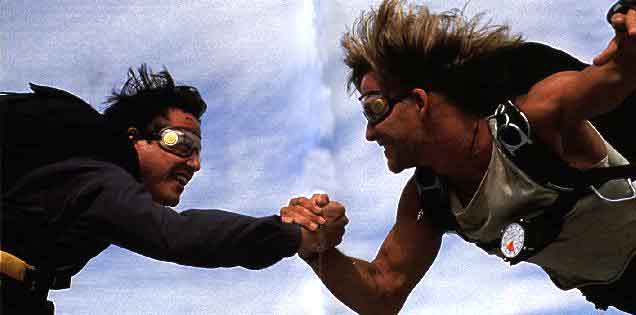
So, Johnny goes undercover and learns how to surf in order to get closer to anyone who seems interesting. That’s when he meets Bodhi (Patrick Swayze), the most extreme of his pack of surfers. Johnny also falls in love with Bodhi’s ex-girlfriend (Lori Petty). It becomes clear that they rob banks to support their surfing. Bodhi puts Johnny under his spell and explains to him why surfing and other extreme activities are so important to him. He also explains how he would like to die—by riding a wave driven by a winter storm.

Here we have a tale of a young cop who falls in with a different crowd than who he would usually hang out with. He starts to like his second life of fun and danger. It’s a great seduction story. But also in this movie is a lot of action. We get a footchase all over Santa Monica (through backyards, living rooms, and alleys) and two skydiving sequences. One sequence shows tension in which Johnny’s cover is blown and Bodhi packs his chute. The other is a great action scene in which Johnny becomes so mad he jumps out of a plane without a parachute, grabs onto a person who has one, and puts a gun to his head, threatening him to pull the chute.

Director Kathryn Bigelow is an interesting director for this material. It’s amazing how she directs these action sequences, but even more amazing how she puts the characters in them as realistically as humanly possible. We get to know these characters in the midst of the action. “Point Break” isn’t just a movie about cops and robbers. It’s simply a movie about a young cop who is seduced by a new lifestyle and questions his own values while trying to catch a possible robber.

It all leads down to the big ending in which everything that has been shown before has become meaningful and effective. I will not give it away, but I will say that “Point Break” does not end at the point where you would expect it to.

Bandslam (2009)

29 Jan

bilde

Smith’s Verdict: ***1/2

Reviewed by Tanner Smith

“Bandslam” is advertised as sort of a “High School Musical” or “Camp Rock” clone. If you’re not familiar with those two references, you probably have a kid or two in your family that can explain. But you think that the actual film “Bandslam” really is a clone of those two full-of-pep, bit overly energetic Disney Channel movies, you’d be wrong. This is a really good teen film with fully-realized teen characters, snappy dialogue, good coming-of-age drama, and entertainment.

On second thought, this does have a lot of music and teenagers involved. And it is a feel-good movie. I don’t think it’s fair to blame the advertisements for selling it as an “HSM” clone but the film doesn’t go for the pep and energy all throughout.

The film’s central character is Will Burton (Gaelon Connell), who lives in a world all his own. He goes to high school, is new in town, and doesn’t fit in, like most teenagers. But he knows a lot about music and has a shrine dedicated to David Bowie. (The film’s narration comes from his writing letters to Bowie, who never responds.) He even judges people by what kind of music they listen to.

One day, he meets popular, attractive high school senior Charlotte (Aly Michalka, from that lame Disney Channel sitcom “Phil of the Future,” and of Aly & AJ). She shows him her band, complete with a drum loop, bass-playing Flea-wannabe “Bug,” and electric guitar-playing Asian-American British-wannabe Omar. They want to enter “Bandslam,” a battle-of-the-bands competition that everyone in school anxiously awaits. But Will doesn’t think they have a chance. Charlotte knows he knows a lot about music, so she appoints him as band manager.

One of the best things about this film is that the film and its stars really do know a lot about music. The script is very fresh and funny with references to Bowie, Springsteen, Red Hot Chili Peppers, and the CBGB, a legendary New York club that was the start of punk rock. The film also delivers not the kind of teen characters we would expect in a film like this—an example is the third central character Sa5m (the “5” is silent). Vanessa Hudgens (HSM alum) portrays Sa5m not the way I would’ve imagined. She is NOT the Girl Who’s Full of Pep and Enthusiasm Who Falls for the Guy that she usually plays. Here, she’s an original—a loner, secret-keeping girl dressed usually in black who talks deadpan to keep herself from stuttering. She befriends Will as they work together on a human studies project and she has a musical talent too.

As the band—now labeled (get this) I Can’t Go On, I’ll Go On—gains new members, which include a drummer with anger issues and a girl who plays classic piano, but is really good on a pop keyboard, Will starts to have fun for the first time in this new town. He teaches the band to improve at crucial points (I love the scene in which he makes them start out with “blue-beat” and work their way up), his friendship with Charlotte grows, as well as his friendship (and possible relationship) with Sa5m.

“Bandslam” is a very satisfying film—it’s intelligent in the way that it avoids the teen film clichés and gives us original, quirky characters and is also nonoffensive. Here’s a nice touch—none of the three main female characters (including Lisa Kudrow, who has a good role as Will’s supportive single mother) fall into the romantic comedy trap. Only one scene in this film falls into that category and that is the scene that we’ve all seen before—Sa5m wants Will to go see “Evil Dead 2” with her, but Charlotte has provided tickets to a rock band and Will totally forgets about the date with Sa5m, upsetting her. But luckily, the movie redeems itself with a satisfying scene in which Will and Sa5m present their own human study project.

The actors here are very good. Newcomer Gaelon Connell is especially good as the film’s lead—a likable awkward teen that makes us feel for him in the moments of drama (yes, there is drama involved, so take that into consideration). Vanessa Hudgens is compelling here as well—lovely singing voice too, but I already knew that. What also surprised me was the performance by Aly Michalka. After seeing her as the peppy, dumb girl in “Phil of the Future,” I was surprised by how well she can act and be taken seriously as an actress. When she shows how upset she is in those moments of drama, we believe her. We wonder what she’s doing hanging around with a few outcasts for a band, but the answer is revealed later in the movie and I will not give it away. Lisa Kudrow, as the mother, avoids the clichés of the overprotective mother and gives credible reasons for why she’s concerned about her son.

I enjoyed “Bandslam” very much. It has a good script and appealing characters—it does have a competition at the end between I Don’t Go On, I Go On and Charlotte’s boyfriend’s band, but even that scene is well done too. Parents, if you’re looking for a “High School Musical/Camp Rock” clone to dump the kids to see, my advice—keep looking, because “Bandslam” has a lot more on its mind than the advertisements gave itself credit for. I liked it very much.

Home of the Giants (2007)

29 Jan

500full

Smith’s Verdict: ***1/2

Reviewed by Tanner Smith

“Home of the Giants” may seem to you like an average high school basketball movie in the same league as “Hoosiers” (indeed, this film takes place in Indiana), but you’d be wrong to assume that. Actually, describing what it really is might lose the film of its dignity, but I’ll try and make it seem as special as possible, because the truth is I really liked this movie.

“Home of the Giants” is actually a coming-of-age high school drama mixed with a crime thriller. It involves two teenage friends—a basketball jock, Matt (Ryan Merriman), who plays for his team called the Giants, and his entourage, Gar (Haley Joel Osment), who writes for the school paper. Matt is the big man on campus and can pretty much get away with anything. That’s how Gar sees Matt—he looks to Matt like a role model just as Matt looks to his ex-con older brother Keith (Kenneth Mitchell) as a role model. Keith has a job for Matt, and Matt fills Gar in on the plan to break into a possible drug dealer’s house and steal what is said to be a fortune. Gar isn’t so sure at first, but Matt talks him into it. But on the night of the heist, the guy (Brent Briscoe) comes home and it seems that Keith has cut off a finger or two while interrogating him. The days after, Matt and Gar find themselves in hot water, as the ticked-off guy stalks them and sends threatening notes, saying he plans to cut off Matt’s fingers as well. As you can plainly tell from that plot description, “Home of the Giants” is not your typical teen film.

The story development for “Home of the Giants” is smarter than you might think. The main conflict that these two kids face, other than the consequences they fear for themselves, is the difference between their friends and their heroes. If you help the person you look up to the most, why exactly are you doing that? Would he help you in a jam to return the favor? Is this really the person you’d want to be like? Etc. This is what makes “Home of the Giants” more of a coming-of-age story than anything else. The basketball scenes and the crime drama mesh surprisingly well together, and lead to a great payoff that comes with the final basket—I hardly ever felt as much suspense as I did with the final basket at the end of the final basketball game in a movie. Even the little details feel authentic, compared to most movies that feature high school sports. For example, neither of the boys’ fathers is abusive or a one-dimensional jerk that just slows things down for them. They have their reasons for worrying about their sons.

But there’s one very important element that I want to bring up. Whenever Matt wants Gar to do something that Gar doesn’t really want to do, Matt pulls the “I thought we were friends” card and Gar goes through with it. I’ve been through that situation many times with a high school friend before. Back in high school, I was an average guy and I was constantly caught between my friends, my heroes, and those who just tried to drag me down. I related to the character of Gar throughout this movie.

Speaking of whom, Haley Joel Osment, as Gar, has stepped out of his bright-little-boy roles and is acting his age. His acting isn’t as awkward as his obvious early-puberty stage in “Secondhand Lions.” As a conflicted high school student, Osment is totally convincing and sympathetic. Ryan Merriman is solid and winning as Matt, Kenneth Mitchell is suitably smarmy as Keith, and Brent Briscoe, almost reprising his similarly-slimy bad-guy role in “A Simple Plan,” has a good moment or two when he’s not merely looking intimidating. I wish that cute Danielle Panabaker, as Gar’s potential girlfriend Bridgette, had more to do, but she makes the most of her scenes.

“Home of the Giants” may sound like an odd idea for a coming-of-age high school drama, but it’s handled nicely and it’s neither dumb nor boring. The acting is solid, the direction is well-done, and the message of friends and heroes is very effective. This is a great film for teenagers who should seek this out, because it will be worth their time, and I think they’ll even see themselves portrayed here as well.

The Neverending Story (1984)

28 Jan

4713453351_92a459c777_z

Smith’s Verdict: ***1/2

Reviewed by Tanner Smith

“The Neverending Story” is a clever, original, entertaining fantasy-adventure that uses familiar elements and creates inventive new turns for them. As a result, it’s an engaging adventure all the way through.

The most notable of these inventive twists is the lack of a standard villain. Instead of a high-ruling, magic, boring, evil wizard looking to destroy the fantasy world, we have something more complex. In the fantasy land called Fantasia, set in “The Neverending Story,” there’s an abstract entity known as the Nothing. It obliterates everything it touches so that there’s absolutely nothing left. It’s growing more powerful and about to destroy all of Fantasia. Now that’s a threat.

“The Neverending Story” begins in the real modern world as a bright, imaginative young boy named Bastian (Barret Oliver) is picked on by the school bullies who chase him into a bookstore. He’s interested in the book that the librarian is reading. The librarian tells him that the books Bastian reads are safe because they’re only stories. He mystically implies that this book—the Neverending Story—has a lot more to offer, and so Bastian takes it in curiosity. He skips school and follows the world of Fantasia, as the Nothing is a worldwide menace.

Sent to seek out a way to stop the Nothing is a child warrior named Atreyu (Noah Hathaway), who ventures off into the weird lands of Fantasia. Along the way, he encounters many strange, helpful creatures, runs into some heavy obstacles, and as the story continues and Atreyu is finding answers, Bastian, still reading the book, is starting to believe that these new twists and turns in the story are because of his own imagination filling in most of the story. And it seems like the people of Fantasia actually know of Bastian. Impossible, right? That’s exactly what Bastian believes. But things get stranger and clearer until it seems as if the one that can save Fantasia is indeed Bastian.

That concept is actually probably the most intriguing part of the movie—the idea that a child’s faith can control fate and save lives (and possibly along with a whole new world). And it’s also interesting that while the cowardly Bastian is reading a book in which a boy his age is the exact opposite of him, it helps that when Atreyu does lose confidence, Bastian is the one who has to gain it back. “Be confident,” Bastian says, now very much caught up in the story. He’s really telling himself that so that later he’ll have the courage to follow his dreams. That was a clever touch.

The creatures that Atreyu encounters are all appealing and memorable. In particular, Atreyu’s Yoda-like figure on this adventure is an insightful, optimistic, humble “Luckdragon” called Falkor, who looks like a dog but can also fly, with Atreyu on his back. There are other weird creatures in this movie (you can see a lot in the gathering in one of the early scenes—it reminded me of the bar scene in “Star Wars”), and my absolute favorite is a hundred-story-high, gentle stone creature known as a Rockbiter (guess what he eats).

The sets are very impressive. Fantasia sort of resembles Wonderland and features the same kind of strange characters as such, like the scientific gnome and the man riding a racing snail. The art direction is quite imaginative. And the special effects are quite impressive here, considering most of them were probably models, puppets, and animatronics. They’re all pretty convincing and they actually manage to take what could have been a silly creature like the Rockbiter and make him into a sympathetic character.

I also really enjoyed the story and how creative it was along the way. Aside from Bastian possibly becoming the real hero and the whole concept of the Nothing itself, there are entertaining obstacles for Atreyu to overcome. I’ve already mentioned this scene briefly in an above paragraph, but it’s the most tense—it’s a scene in which Atreyu must be brave enough to make his way through a magic gate to the other side; otherwise, he’ll be zapped and destroyed. And then there’s a wolf creature that’s bent on destroying Atreyu before he succeeds on his quest—he gives a speech about lack of human imagination that is surprisingly complicatedly effective for a children’s movie. And that sets up the whole final act.

This isn’t really an actors’ movie, though the two young leads—Barret Oliver and Noah Hathaway—are adequate enough. But the voice acting of the Rockbiter, Falkor, and G’Mork (the wolf) deserve praise, and strangely enough, they were all done by one voice actor—Alan Oppenheimer. Oppenheimer has a talent for voice acting and has many distinct voices, all of which give new personality to each character.

The ultimate weapon throughout “The Neverending Story” is imagination. Stories don’t create themselves. It takes a special creative mind to keep them going. Although, you could argue that this might not be the best message for kids, since the movie opens with Bastian’s father telling him to grow up and face reality, and then he ultimately decides to use imagination to save a fantasy world. But the best way to accept this development is to look at “The Neverending Story” strictly as a fairy tale. Who really grows up in a fairy tale? And for that matter, it’s not like we all forget our imaginations in the real world, no matter how old we get. If we didn’t, there wouldn’t be any filmmakers to create something as fresh and inspired as “The Neverending Story.”

The Freshman (1990)

28 Jan

freshman

Smith’s Verdict: ***1/2

Reviewed by Tanner Smith

“The Freshman” could be considered a spin-off of “The Godfather,” since both movies feature a character who is not only entirely similar to each other, but also played by Marlon Brando. In “The Godfather,” he was Don Vito Corleone. In “The Freshman,” he’s Carmine Sabatini, the man that is said to have inspired the character in “The Godfather” (despite the fact that “The Godfather” was a novel before it was a film). In every way respectful, he is the Godfather. He looks like him, acts like him, talks like him, and has the same kind of what could be considered discreet authority as him. With Marlon Brando playing the role of Sabatini, it’s in the great tradition of the original character Corleone, and not taken as a ripoff or a cheap shot.

And what’s better is that “The Freshman” is not supposed to be as serious and epic as “The Godfather.” It’s a comedy—this is the joke; Brando pays a Mafia man extraordinary similar in every way to Don Corleone. And the screenplay and supporting actors don’t let him down.

The story isn’t necessarily about him, like how “The Godfather” wasn’t necessarily about the Godfather. But like the Godfather, Sabatini plays a crucial role in a young man’s life. The young man in “The Freshman” is a film school student Clark Kellogg (Matthew Broderick). He has left his home in Vermont to attend New York University to study film. Things don’t start out very well, as his luggage and money are stolen by thief Victor Ray (Bruno Kirby). When Clark goes to school, his film professor (Paul Benedict) doesn’t tolerate excuses.

Clark confronts the thief and demands his stuff back. Instead, Victor offers Clark a job. He brings him down to Little Italy, where Carmine Sabatini socializes and keeps his office. Clark can’t believe the striking resemblance to Marlon Brando’s Don Corleone, but Victor advises him not to bring it up. Clark has a conversation with Sabatini and it is like he’s actually talking to the Godfather. It intrigues him (and in some way, scares him), so Clark takes the job when the offer is made.

The job involves the movement of a giant lizard—a Komodo Dragon. In a very funny sequence of events, Clark and his roommate Steve (Frank Whaley) attempt to be discreet about moving this lizard from an airport and driving it (an especially difficult task) to an animal smuggler (Maximilian Schell) and his assistant (B.D. Wong).

But before he knows it, Clark finds himself a part of the Mafia family. Clark is doing what Sabatini and Victor tell him to do through a lot of convincing, and he’s also in the middle of a relationship with Sabatini’s daughter Tina (Penelope Ann Miller) that goes way too fast for him, even pressuring into marriage. Everyone is even doing favors for him, like subtly threatening Clark’s film professor for an A-grade. And things get him in more legal danger than he expected. What’s he to do?

“The Freshman” is a sharp, funny, well-written movie that really makes good use, paying homage to “The Godfather” (clips of it are even shown in film class as examples). And it features a highly respectable performance by Marlon Brando, who is truly marvelous in playing a variation of the iconic character he brought to life. It’s strange that Brando didn’t think as highly of the film as I do, as well as most people who saw it. It’s reported that he attacked the movie when it first screened, calling it trash. Well, Brando may be a highly dedicated actor, but he’s no film critic. “The Freshman” is very enjoyable.

Starman (1984)

27 Jan

images-1

Smith’s Verdict: ***1/2

Reviewed by Tanner Smith

John Carpenter’s “Starman” is an effective mix of science fiction and romance. It uses a science fiction gimmick to set up the two central characters (a man and a woman) and carefully develop a trusting relationship that turns into love. The twist in this romance, however, is that the man is an alien from outer space. The movie opens as the satellite Voyager 2, first launched in 1977, is floating through space. It contains a message of peace and inviting anyone or anything out there to come to the planet Earth. It turns out that something out there has found it and accepts the invitation. What exactly it is, I’m not quite sure. Yes, it’s an alien and we see it as a ball of light (or is a star?), but that’s all we know about it. Actually, that may be all we’d need to know.

Anyway, instead of a welcome greeting to Earth, the U.S. Government shoots down the spaceship, and the alien crashes somewhere in Wisconsin. There, it finds the home of a widow named Jenny Hayden (Karen Allen) and through a strand of her dead husband’s hair acquires the DNA of the husband and transforms into him. Jenny sees the alien in the form of her dead husband, knows that it isn’t really him, and is very frightened. However, Starman (who is never really called that in this movie) needs her to give him a ride to his ship, being kept and studied halfway across the country. If he doesn’t get there and leave the planet within the next couple of days, he will die. Jenny is afraid of Starman and thinks she’s being held against her will to drive him there. She tries a few times to get help, but then realizes that Starman means no harm. Starman doesn’t intend to frighten her, but doesn’t understand that taking the shape of her dead husband won’t calm her down—“I look like Scott so you not be…little bit jumpy,” he tries to explain after learning a few words in English.

Starman has a lot to learn, but is very smart and understands quickly. While on the trip, he takes in everything he notices. He learns to speak and eventually speaks English somewhat well enough, though not entirely. The way he moves is awkward, as he constantly is learning to control this new human body—whenever he looks around, he twitches quickly in every direction, like a bird. Along the way, Jenny learns to trust Starman and does her best to help him get back to his home planet. She explains more things about human life to him, like mortality and love. “What is love,” Starman asks. It’s at this point when “Starman” starts to become less of a science-fiction movie and more of a drama. Starman begins to feel genuine feelings toward Jenny and can’t explain it, and Jenny is able to explain what love is because the feeling does become mutual.

Jeff Bridges portrays Starman and it’s a great performance. He’s entirely convincing as an alien curious about everything he sees and uses body language and facial expressions to show what he’s thinking, as well as a partially-mumbled speech impediment. Bridges is winning in this role, and Karen Allen makes for an effective foil.

But because Bridges and Allen are so winning on screen, it makes the countless scenes of the Government hunting down the alien seem a lot less interesting. They want to experiment on it, to kill it if necessary, and the only one of the group (played by Charles Martin Smith) to realize that they’re going against the very message they sent out through Voyager. He’s the only one out of these villainous characters to appear as human, so to speak. But they don’t ruin the movie entirely.

“Starman” could have been executed as a silly sci-fi flick, but John Carpenter is smarter than that and creates an interesting feel for the characters and convincing dramatic moments for them. There are also some good laughs, such as when Starman uses his abilities to win the slot machines in Las Vegas so that he and Jenny will have money. “Starman” is more than it could’ve been.

NOTE: Don’t be put off by the title “Starman”—he’s never referred to by name.

We Need to Talk About Kevin (2011)

27 Jan

images

Smith’s Verdict: ***1/2

Reviewed by Tanner Smith

If you’re feeling happy, like you’re finally in control of your life after a hard day or week, “We Need to Talk About Kevin” is definitely not the film you want to see sometime soon. This is a film so bleak and disturbing that even the popular “slasher-film” genre would be considered watchable. If you’re happy or relieved right before watching this movie, this film will change that quickly.

However, this is undoubtedly a powerful film—skillfully-made and powerfully-acted. The horror adds to the drama that’s being presented, which makes the film more effective. There’s no reason why one shouldn’t feel unpleasant after watching this film. By that definition, I should probably hate it. But how can I ignore or pan a film that’s done well by the right people?

The story, based on the novel of the same name by Lionel Shriver, is told in a jumbled series of events, leaving us to piece everything together. But we figure out quickly what the central conflict is. As the film moves from past to present and back again, we see a woman named Eva (Tilda Swinton), who is not only depressed and practically lifeless, living like a zombie pretty much, but is also glared upon among society. In an early, disturbing scene, we see her walk down the street, minding her own business, when a woman she obviously knew in the past comes up to her and sarcastically asks, “Enjoying yourself?” Then she slaps her hard in the face and shouts, “I hope you rot in hell!”

How could this happen to a woman who keeps to herself? Well, we see flashbacks of what led to this terrible life, as Eva was married to nice-guy Franklin (John C. Reilly) and gave birth to her firstborn child Kevin. These flashbacks take up most of the movie, as we see Kevin as a baby, then a toddler, then a little kid, and then as a teenager. And right from the cradle, we know that something is definitely wrong with this kid.

To his father, Kevin is a nice, cute kid, but to his mother, Kevin is a budding sadist and knows exactly how to psychologically torture Eva, doing things so cruel that at one point, Eva can’t take anymore and throws her own son across the room, breaking his arm. But that’s just at his age of 6 or 8. When Kevin is a teenager, things get creepier, as we get more hints of his sadism—he loves to shoot his bow-and-arrows, he has an odd look on life that he isn’t afraid to express freely, and things get even worse when Eva suspects that Kevin might have been responsible for the glass eye the youngest daughter now has to wear.

It’s no secret that Kevin is a sociopath, as we see in present times the survivors of Kevin’s high school massacre. And this is Eva’s way of coping with it, and also having to deal with the people who despise her for what her son did. Some are hostile and brutal towards her, like in the scene I mentioned before; a few others, including a young survivor in a wheelchair, seem to understand that it wasn’t her fault.

From what we see in the flashbacks, it probably wasn’t her fault. It wasn’t even entirely Franklin’s fault either—he’s nice, attentive, somewhat ignorant but sweet-natured. However, you could make the argument that because he teaches Kevin to shoot a bow-and-arrow, that makes him responsible for Kevin’s mass murder. But you can tell the kid had a problem even before then, so it’s unfair to blame Franklin.

Lynne Ramsey, director and co-writer of “We Need to Talk About Kevin” makes brave choices here to make this movie far from ordinary. The past/present time-switches are one thing, but they’re also placed without pattern, which confuses but mostly keeps you wondering. There aren’t any parent/teacher meetings involving Kevin acting out in school—heck, we never even see Kevin interact with students. And despite the title, Eva never really does talk about Kevin with someone. Not with teachers, counselors, or even her own husband. Some choices Ramsey makes are somewhat grating (such as an early scene where Eva is participating in some sort of tomato festival, which looks like she’s soaking in a lake of blood), but other elements work very well.

Tilda Swinton, as Eva, is just perfect. You can easily feel the pain she’s going through as a person who is going through shock and simply can’t take anymore. Her son has committed a horrific crime, taken lives, and ruined lives (including hers), and now she’s stuck wondering if she really is to blame, or if she was the wrong woman to deliver the wrong child. Swinton’s portrayal is sometimes painful to watch, but that’s what makes it an excellent performance.

John C. Reilly is suitably wholesome, but the real supporting role to be noted is of course Ezra Miller as the little psycho himself, Kevin. If there was evil in this world, you can easily find it in this kid. Miller gives a creepy performance, keeping us uneasy as he (assumingly) secretly plans his attack. It’s a brave acting job.

“We Need to Talk About Kevin” is very bleak. Needless to say, this is definitely not for everyone. It may hardly be for anyone. This is not entertaining; not even by ordinary horror-film standards. But this horror-drama is far from ordinary. It’s here to give an effective emotional response, and it has succeeded all too well that even if it makes me feel uneasy, at least it did its job in effectiveness.

Chances Are (1989)

27 Jan

chances-are_l

Smith’s Verdict: ***1/2

Reviewed by Tanner Smith

“Chances Are” is a movie that, at first, doesn’t seem too original and sort of doesn’t know what kind of movie it wants to be, but then finds its footing soon enough and develops into a sweet, funny, lighthearted romance with a fantasy element that is crucial to settling fresh relationships put into the story. That element is reincarnation, which is used as a mind-swap situation as one of the film’s two main characters suddenly has memories of his past lifetime. See if you can follow…

The movie has its somewhat weak setup in which we meet a young married couple—Louie, played by Christopher McDonald, and Corinne, played by Cybill Shepherd. Shortly, Louie is killed in an accident and then, he finds himself in the same heaven that is seen in countless other movies. You know, the kind of Movie Heaven where there is smoke all around, everyone wears white suits, and there seems to be a wide-open space with a lot of people wandering around. These people are in line to be reincarnated. Louie is in such a hurry to get back to Earth that he runs off without getting his injection that apparently forces him forget his previous life when he enters his next life.

That’s an odd start and you’re not sure where “Chances Are” is gong to go from there.

Fade to 23 years later, when we see that Corinne is still adjusting to the death of her husband. She raises her daughter Miranda (Mary Stuart Masterson) and never remarries. She doesn’t even notice that the family’s best friend Philip (Ryan O’Neal) has always been in love with Corinne and even briefly told Louie, on their wedding day, about his feelings for her. She still has her love for Louie in her heart and is totally oblivious to see Philip’s true feelings for her.

But more importantly, we get an introduction to a 23-year-old Yale graduate named Alex Finch (Robert Downey, Jr.), who befriends Miranda and Philip and is brought home for dinner. This is when the movie starts to kick in—we learn, if we didn’t already, that Alex is Louie reincarnated. When Alex arrives at the house, he immediately begins to remember who he used to be, and he definitely remembers Corinne. This leads to an awkward but funny scene in which Alex freaks out at the dinner table.

Now, at the thirty-minute mark, the movie has really begun. Everything earlier was just buildup to introduce the characters. Maybe not much else about the plot should be said, but the movie has fun with the many implications and paradoxes. Miranda has a crush on Alex and the feeling is somewhat mutual, but if Alex is Corinne’s husband Louie reincarnated, then Alex could technically be dating his own daughter. Then, there’s the plot point in which Alex tries to convince Corinne who he really is. Then, there’s the plot point about Philip’s feelings for Corinne and how Alex reacts to them. There’s more fresh material (and fresh relationships) in the screenplay for “Chances Are,” written by Perry and Randy Howze, the writer duo who also wrote 1988’s “Mystic Pizza.” They, along with director Emile Ardonlino, take certain plot elements that are not particularly original (heaven/reincarnation/mind swap) and turn the story into something special.

The actors play this material with dedication and credibility. Cybill Shepherd is convincing as the widow who doesn’t know how to react to this strange young man, who could be her reincarnated dead husband. Ryan O’Neal and Mary Stuart Masterson are fine in their roles. But the real star is Robert Downey, Jr. His is the most crucial role—if he doesn’t bring weight and plausibility to his role, it wouldn’t be easy to follow the story, or believe it, for that matter. But Downey, Jr. pulls it off with a convincing performance.

“Chances Are” is a surprisingly effective film. It shows that artistry can redeem any subject matter. Credit the director and writers for adding lighthearted romance and humor into the mix, and also credit the actors for bringing conviction to their roles. They make the film smart and entertaining.