Archive | Three-and-a-Half Stars ***1/2 RSS feed for this section

Real Genius (1985)

6 Feb

RealGenius1985anamorphicWSDVDRip-1

Smith’s Verdict: ***1/2

Reviewed by Tanner Smith

“Real Genius”—you know, some films just have accurate titles. In a decade where a lot of society’s movies are about teenagers (that decade would be the 1980s), “Real Genius” is one of the real good ones. It’s a surprise too—this film was released in 1985 and was one of three movies about teenagers and their science projects. The other two such films were “Weird Science” and “My Science Project,” two lousy teenage comedies. “Real Genius” is a real treat, however—it’s very funny and well put together.

The film’s central teenage characters are college students who are not quite the sex-crazed goons you would find in lesser teen movies. The protagonists in this movie are actually well-developed, likable three-dimensional characters who don’t always play by the rules, but there are teenagers like that around. They are Mitch (Gabe Jarret), a 15-year-old boy genius who is the youngest person to be accepted at Pacific Tech, and Chris (Val Kilmer), another young brain who has spent four years at the school and is about to graduate. Mitch and Chris are two of the students chosen to work on a laser experiment. But little do they know that they are being used by Professor Jerry Hathaway (William Atherton), who wants to use the experiment—if it gets finished—to sell it to a military as a weapon.

But in the meantime, Chris is a class-A prankster who uses his genius to set up all sorts of things to make life on campus less boring. For example, he turns the dorm hall into an ice-skating rink, and he turns the lecture hall into a swimming pool. He tells Mitch that he used to be just like him—nervous and socially awkward—until he learned how to relax. Now he feels like it’s his duty to take Mitch out of his shell and teach him to have fun. “Real Genius” is most fun when it comes to showing Chris’ antics. There’s another scene in which Chris and Mitch get revenge on an uptight nerd named Kent, who is also Professor Hathaway’s fink and Mitch’s bully, by disassembling his car and reassembling it in his own dorm room. Brilliant and…dare I say, ingenious.

There are two other quirky characters are crucial to the movie. One is a scruffy-bearded strange man named Laszlo (Jonathan Gries) who used to be the top brain on campus until he cracked and is now living in the steam tunnels below the school (the way in is through Chris and Mitch’s closet, which makes things awkward at first). The other is a hyperactive girl named Jordan (Michelle Meyrink). She never sleeps and is the kind of girl who would run into the men’s restroom to show Mitch a sweater that she made for him. She and Mitch share a cute relationship together. Chris, Mitch, Laszlo, Jordan, and another genius nicknamed “Ick” (he helped Chris with the ice in the dorm) discover about Professor Hathaway’s plan later in the film and decide to strike back.

“Real Genius” is packed with characters and jokes. It is well-written with a real integrity and intelligence (although some jokey lines of dialogue using the word “penis” get old). The writers know that teenagers can have the freedom to be themselves—not just slobs or sex-crazed maniacs or idiots. They’re funny enough being geniuses in this film. That’s a pleasure among many pleasures that lie within “Real Genius.”

Fatal Attraction (1987)

6 Feb

52179.6a00d83451b05569e2013480acb22a970c-800wi

Smith’s Verdict: ***1/2

Reviewed by Tanner Smith

What “Fatal Attraction” is trying to get across is very simple—don’t cheat on your spouse. Even when you think there’s a way out of a one-night stand or an affair, don’t take the chance that it will turn against you and threaten the lifestyle of your family. In “Fatal Attraction,” family man Dan Gallagher (Michael Douglas) has a one-night love affair with another woman and wants to end it the morning after. But the woman won’t let it end, no matter what…

This would be the premise for a broad comedy, but “Fatal Attraction” is a thriller—and an effective one, at that. It shows the consequences that occur not only when a married man cheats on his wife, but also with the wrong woman.

The film’s opening scenes feature the life of successful, happily married lawyer Dan Gallagher, his wife Beth (Anne Archer), and adorable six-year-old daughter Ellen. While Beth and Ellen are out of town for the weekend, Dan meets Alex Forrest (Glenn Close), an editor for a publishing company. They have dinner together, Alex seems like an intelligent, passive woman, and she and Dan wind up having a passionate affair that very night. Alex assures Dan that it would’ve only been a simple thing, a fling to be forgotten about later, and Dan falls for it.

Big mistake. Dan leaves the next morning, hoping to forget all about this and go back to his normal life. But Alex doesn’t let it go—she wants to further the relationship and clings to Dan. Dan tries to let it down easy on her that they should never have a relationship together…only to have Alex attempt suicide. And it gets worse—it turns out that Alex is pregnant with Dan’s baby.

Or is she? We’re never quite sure of this. But what we do know is that Alex is obsessive and undoubtedly insane. Dan wants nothing to do with her, but Alex keeps coming and coming, threatening the lifestyle of Dan and his family. Dan tells Alex to leave him alone, to which Alex replies “I’m not going to be ignored, Dan!”

This is one crazy lady. And the odd thing is that she starts out seemingly normal. It’s this affair with Dan that sets her on edge, and the fact that she can’t have him enrages her. Her rage continues to grow every day and her obsessiveness takes her over to the point of violence. Who is at fault for all of this? Is it Dan, for falling into this affair with a woman other than his wife, and then hoping to forget about it immediately? Is it Alex, for leading him on in the first place? You can read much into this.

Dan is a likable guy, despite what he does. He’s just trying to do right by his wife, whom he still loves. He’s smart too—when things turn ugly, he follows advice that many characters in thrillers seem to neglect. He calls the police to see about a restraining order. He even tells his wife about the affair, later in the movie. Understandably, Beth doesn’t take this very well—especially not when Dan tells her that Alex is pregnant. There’s great family drama in occurrence in “Fatal Attraction,” particularly in the scenes in which Dan is trying to fix everything to keep his wife and daughter from any harm.

Michael Douglas and Glenn Close do great jobs at portraying these characters, and Anne Archer is effective as Dan’s wife Beth.

Some critics, including Roger Ebert, were bothered by the film’s ending, in which Alex officially loses it and attempts to slash Beth before Dan can try and stop her. This has been likened as a “Friday the 13th” style ending, and to be honest, the only time I made this distinction is with the brief fake-out after it seems that Alex is finally dead. Of course not; she comes back for one cheap scare. The climax itself worked for me; it’s effective in showing how far Alex was pushed in her mental obsessiveness. But that cheap scare at the end didn’t work at all. It did indeed make it seem like a slasher film. Mostly though, “Fatal Attraction” is a terrific psychological thriller. The acting is great, the dilemmas are legitimately tense, and it’s executed with convincing realism

Red Dragon (2002)

5 Feb

images-1

Smith’s Verdict: ***1/2

Reviewed by Tanner Smith

“Red Dragon” begins with an unnerving shot of an audience at a concert hall. The reason it’s unnerving is because of the one person we recognize before the camera pushes in on him. There’s a subtle lighting on that shot that isn’t too flashy so that we recognize right away who the guy is, but it just comes naturally. We can see that it’s Hannibal Lector, the infamous, cannibalistic psychiatrist/serial killer played by Anthony Hopkins in the role that won him an Oscar in 1991’s “The Silence of the Lambs.” Seeing Lector among people, wearing a suit, is unnerving even of itself, but his emotion of disgust when he studies the one flutist playing the wrong notes is even more so.

That may be because we realize who this man is and understand that “Red Dragon” is actually a prequel to “The Silence of the Lambs.” And it’s also because the director Brett Ratner has a way of showing things as they are and yet keeping an eye for important things, like the best directors of thrillers. It’s surprising that Ratner’s previous work was directing the “Rush Hour” movies.

But anyway, what follows that first scene is something even more disturbing when you’ve studied Lector in “Silence of the Lambs”—Lector is hosting a dinner party. You heard that right—a dinner party. I don’t even want to know what he serves to his dinner guests, but they seem to enjoy it. I don’t even want to think about it.

What follows isn’t as terrifying as its great opening, but it’s still pretty suspenseful. “Red Dragon” is actually a well-put-together, gripping thriller. That comes as a surprise, because while it’s an adaptation of Thomas Harris’ novel of the same name, it’s also a remake of the stylized 1986 thriller “Manhunter,” by Michael Mann. I loved the original film, and that’s why I was surprised to like this remake (or more accurately, re-adaptation) just as much. Sure, it doesn’t have the same amount of style, but not all movies can be the same.

“Red Dragon” follows an FBI Special Agent named Will Graham, who has a gift for deduction (he’s like a modern day Sherlock Holmes). He goes to Lector’s house the same night as the party and tells him, as his psychiatrist, that he’s found an extra clue in the latest killings—body parts are missing from the bodies, like livers and hearts. Soon enough, he realizes that Lector is a cannibal and he’s responsible for the killings. Graham is able to capture him, but after he nearly dies.

Several years later, Will goes into retirement is called back from his family life into the field to track down a new sick serial killer dubbed “The Tooth Fairy.” After finding some clues, Will realizes to know a serial killer is to capture one, so he goes to the prison where Lector is being held to ask Lector if he knows anything about the Tooth Fairy or if he would know what his next move would be, as a psychopath. It’s psychiatry and psychopath mixed in one, just as Lector showed in the previous film. He’ll give his answers only after he’ll share his delusions of the human mind.

These scenes are different from Lector’s talks with Jodie Foster’s Clarice Starling in “Silence of the Lambs” in two ways. The first way is, Will is too smart to fall for Lector’s delusions. In “Silence of the Lambs,” Clarice pays attention and looks on with frightened awe. But in “Red Dragon,” Will takes none of that. He’ll just get the answers he needs and get the hell out of there. And the second is that there’s a constant battle of wits between Lector and Will. While in “Silence of the Lambs,” Lector grew to care for Clarice (you have your version, I have mine), Lector hates Will in “Red Dragon.” He knows that Will isn’t interested in Lector’s off-subject rambles and is still steamed that Will found a way to get him in this prison, and that stretches to the point that he actually finds a way from inside his cell to tell the Tooth Fairy where Will’s family lives. There’s a great deal of tension between these two.

Edward Norton plays the intelligent, insightful Will Graham and sells the role. Norton has a powerful screen presence shown in countless other movies and he makes a great hero for this sort of movie.

As for the Tooth Fairy, he’s played by Ralph Fiennes in a chillingly good performance. He plays the Tooth Fairy as a tortured soul fighting his emotions the way Gollum fights his double personality. One moment, the Tooth Fairy (or Francis Dolarhyde, as he’s known at his job) is a frightened man tortured by his abusive past. The other moment, he’s a twisted killer who kills as part of his own transformation from a coward to a conqueror. Whatever part of him that’s still human is kept alive by a blind woman (played by Emily Watson) who feels compassion for him.

Anthony Hopkins is still spot-on as Hannibal “The Cannibal” Lector, the role that won him an Oscar, this fascinating character that has room for more back-story to be told. He’s a psycho, but he’s charismatic and shares his views of the human mind with exact pronunciation and a sense of irony in his wit.

There are other characters in “Red Dragon,” like Will’s wife (Mary-Louise Parker), Will’s boss (Harvey Keitel), and memorably, the reprehensible tabloid reporter (Philip Seymour Hoffmann) who finds out more than he should know and ultimately becomes the Tooth Fairy’s latest victim. What’s engaging about “Red Dragon” is that it takes its time to develop its characters while keeping the gore at a more minimum level than you might expect. There is suspense, intelligence in Will’s way of figuring all of these things out, and Norton has a mighty screen presence that balances out Lector and the Tooth Fairy.

“Red Dragon” is a smart thriller with sharp direction, great acting, and a real sense of tension, not to mention a great, memorable music score by Danny Elfman. It’s an appropriate prequel to “The Silence of the Lambs” and well-drawn-out remake to “Manhunter” and captures the right amount of menace compared to each.

Manhunter (1986)

5 Feb

images

Smith’s Verdict: ***1/2

Reviewed by Tanner Smith

I get the feeling that Thomas Harris really gets what it means to set up a gripping murder mystery. In his books “Red Dragon” and “The Silence of the Lambs,” Harris creates memorable, three-dimensional characters and brings them on some of the more original mysteries of identifying some of the more original serial killers. For movies to be adapted from these works, it’s important to capture the same sense of suspense, intrigue, and danger. It helps to have an artistic look as well. With “Manhunter,” writer-director Michael Mann brings the novel “Red Dragon” to life and delivers a gritty, tense, stylish thriller with a talented cast and a gripping mystery.

For starters, it has an intriguing main character for us to follow, played with an intense, mesmerizing performance by William Petersen. Petersen plays an FBI agent named Will Graham, a brilliant mind that can enter the mindset of a killer and read into how he acted. But after a breakdown after catching an equally brilliant serial killer, Dr. Hannibal Lecktor (Brian Cox), he went into retirement. But now, he’s called back to help his former FBI superior Jack Crawford (Dennis Farina, in a strong performance) in a new case—a serial killer known as the Tooth Fairy because of the bite-marks on his victims.

In one of the more disturbing early scenes, we see Graham as he investigates one of the murders. As he thinks everything through, you feel a great sense of unease because you feel like he is actually thinking like a sick killer himself. He isn’t merely having an epiphany—it’s almost as if he’s thinking of what he would have done if he committed the murder. This makes him an effective anti-hero—always wavering between good and evil, if you will. You know he’s not of a fully stable mind.

The killer, the Tooth Fairy, is Francis Dolarhyde (Tom Noonan), an odd person who works at a photo lab where he strikes a relationship with a blind woman, Reba (Joan Allen). We meet him later in the film, when he’s torturing a jackass journalist (Stephen Lang) who printed an article about him that he certainly didn’t agree with. In one of the creepiest scenes in the movie, the journalist is strapped to a wheelchair and has no choice but to tolerate the killer as he goes about his idea of changing into a Red Dragon (inspired by the William Blake paintings). How he does away with the journalist is especially unnerving. And then when you see how he works, and his interaction with Reba who doesn’t know who he really is and likes the way he speaks, it becomes clear that Reba will become the next victim, unless Will can find the killer and save her.

You could say that because you don’t know all that much about the killer and his relationship with Reba is somewhat rushed, then it just seems like another killing for him. While I can agree with the second part (I did want to see more of the Reba character beforehand), I think that of the first part, that you don’t know much about him, just makes him a more chilling villain. You don’t know what he’s thinking, but you know that something can put him on edge anytime and he can kill people. It’s more unnerving when you don’t know much about the killer. You know his motives, you know he’s up to no good, and Tom Noonan delivers a great sense of terror within strangeness.

There’s another killer in this movie—Dr. Hannibal Lecktor, whom was captured and locked away by Graham. Now, Graham requires Lecktor’s insight and assistance in helping him capture the killer, by using his sick mind to figure the Tooth Fairy’s move. Lecktor enjoys playing mind games with Graham, since he believes that they are “just alike,” as they are brilliant minds on the edge of destruction. On top of that, secretly, Lecktor is grudging against Graham and actually figures a way from inside his cell to get to him and his family.

“Manhunter” also allows us to see Graham with his family. The scenes in which his wife (Kim Griest) and his son (David Seaman) are effective because it gives Graham something to live for and something to protect. We care about them and hope nothing bad happens to them, and so we root for Graham to solve the case and catch the killer. In particular, the scene in which Graham talks about his son about why he was sent to the psychiatric hospital ward is very strong with the right element of tenderness.

The story unfolds quite smoothly and we’re involved all the way through, but I wish that the movie would end on something more than a climax featuring a violent showdown between Graham and the killer when they finally meet and try to kill one another. I was hoping for a more psychological element to take over since these two have been developed as mentally-unstable minds, one more than the other. But instead, it’s just a standard climax. Fortunately, it doesn’t shoot the movie in the foot, because of everything that has happened before.

The actors deliver excellent performances. William Petersen, as I’ve said, is mesmerizing as the hero Will Graham, seeking redemption by stopping the actions of a sick mind. Tom Noonan is a chilling villain, Brian Cox is a slimy catch-you-off-guard mad intellectual, Dennis Farina is an intense superior, Stephen Lang is a memorable jackass reporter, Joan Allen makes the most of her scenes, and Kim Griest and David Seaman do good jobs as Graham’s family. The characters are memorable and actors portraying them do great jobs.

The visuals in the film stand out—blank walls, long beaches, and colorful palette make the most of scenes—and while admittedly some of them get a little tiresome after a while, they still stay in your mind. Technical detail is given the appropriate attention in “Manhunter.” And while that doesn’t make it necessarily subtle, it’s still effectively chilling enough. “Manhunter” is a disturbing but active thriller that keeps you invested from beginning to end.

Election (1999)

5 Feb

top20jerks-election-590x350

Smith’s Verdict: ***1/2

Reviewed by Tanner Smith

“Election” is one of those movies that is even better the second viewing. I saw it once and wasn’t all that impressed. Then days later, I saw it again and was ultimately surprised by how much this film really is. This is a sharp, smart satire about high school with more to it as well. It’s about a high school teacher who is not perfect and gets himself in a weird situation during the student body election. And I have to ask, how often do teachers get as much good treatment as teenagers in even the best teen movies? Let alone a satire of teen movies?

We not only get one narrator, but four different narrators telling their sides of the story in this movie. One is that teacher I mentioned above. His name is Jim McAllister (Matthew Broderick). He gets involved with his students some of the time and is deeply dedicated to his work.

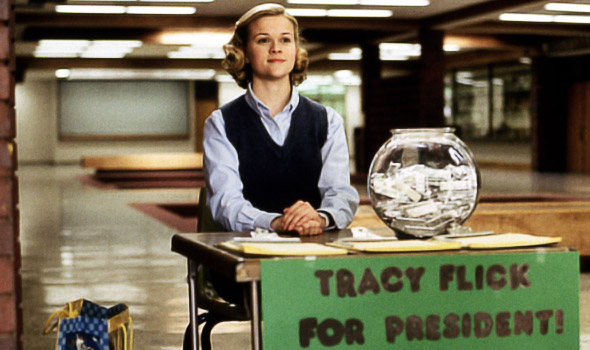
But there is another main character that really gets our attention—a student named Tracy Flick (Reese Witherspoon). To say she’s an overachiever is an understatement. She doesn’t just conquer all; she waves goodbye as she moves from regular student to obsessive, perfect student. She always has her hand up in class, leaving the teacher wishing someone else would raise a hand. She is always perky, neat, seemingly good-natured, and so-called “perfect.” But in truth, she’s a snobby wench. Her overachieving personality and unpopularity to her peers may remind the audience of a female politician. Mr. McAllister doesn’t like Tracy. She was involved as a “victim” in a sex affair that involved McAllister’s best friend, who was also a teacher. And now, she’s running unopposed for class president.

McAllister will not have this, so he decides to encourage another student to run for president against Tracy. His choice is one of the more popular and most sincere students named Paul Metzler (a third narrator played by Chris Klein). Paul was upset because of his broken leg that will not allow him to play football again and now, McAllister brightens his spirits up a little bit and convinces him to make a difference as student body president. Tracy is appalled. She will not stand for this. But what’s worse? Paul’s adopted sister Tammy (Jessica Campbell, the fourth and final narrator) is an angry lesbian whose former lover left her for Paul. So she decides to run for president as revenge.

This leads to a great scene in the gym, in which the whole school watches as the candidates give their speeches. Tracy’s speech is delivered with as much pep as possible, Paul is completely honest but his delivery is monotone, and then everyone is surprised by Tammy’s speech, simply saying that she doesn’t care about any of this and calls it a “pathetic charade.” That gets a huge round of applause from everybody except the other candidates and the teachers because…let’s face it, the students are bored by this “pathetic charade.” I know I was (and I’m sorry for saying so). That’s a great scene.

We follow all of these characters on their sides of the storyline. Mostly, we stay with McAllister. One of the darker sides of the story doesn’t even take place on school grounds. He begins to have an affair with the wife of his original best friend, who was thrown out of the house. It’s totally wrong and he’s just as bad as his friend was with Tracy. But he goes through with it and later, his life and career is all downhill. One of the strangest things about this movie is just how frank it is about sex. We get one too many bizarre sex scenes, one of which features McAllister imagining he’s having sex with Tracy (!). That frankness is a bit uneven and loses the film its fourth star from me.

But the other stuff is great. It’s all nicely directed and well-written by Alexander Payne. There are some big laughs, some touching moments, and despite everything, McAllister is someone to care about. The acting is solid here. Matthew Broderick has come back to high school after movies in the 1980s, such as “WarGames” and “Ferris Bueller’s Day Off,” where he played a high school student in each. As a teacher, he seems strangely more comfortable here than in anything else he was in recently. Chris Klein is likable as the jock that really wants to make a difference in school. He doesn’t play Paul as the stereotypical jerk who gets the hot cheerleader friend and puts everybody down. He’s just a nice guy who is completely honest about his campaign. Jessica Campbell is very good as the budding lesbian who can’t take it anymore. But it’s really Reese Witherspoon who really should have gotten an Oscar nomination for this performance as the overachieving Tracy Flick. She is absolutely fantastic here. Watch the scene in which she tries to fix her banner in the school hallway, which winds up destroyed, and watch how she reacts to one little thing becoming a mess. The way she reacts to her imperfect deeds is an absolute classic. Oh, and she thinks she knows how everything works in the world. Well, she doesn’t but she thinks she does.

We’ve all known students like Tracy, Paul, and Tammy, so we care what happens to them. Because of this, we actually care what will be the outcome of the election. They are well-developed and not just comic foils for a terrific script but real people.

There are laughs in “Election,” but this is a dark comedy, so you get the kinds of laughs you would expect about the frankness of sex I tried to explain about above. The ending is a bit overlong but it makes up for the perfect touch of irony that is developed. Director/co-writer Alexander Payne doesn’t go for the cheap laughs or cheap shots or even cardboard characters—he just wants to tell a story. “Election” is a satire that is bright, alive, sharp, funny, and endearing.

At Close Range (1986)

4 Feb

At-Close-Range-1986-Christopher-Walken-pic-7

Smith’s Verdict: ***1/2

Reviewed by Tanner Smith

“At Close Range” tells a sad, cruel, merciless story about a boy who respects his father who would just as soon kill him in order to save himself. And as a movie, it’s violent and unforgiving, but it’s also powerfully acted and very effective. Even more shocking is that it’s based on true events that occurred in 1978.

Sean Penn stars as young Bradford Whitewood, Jr., a rebellious young misfit with little to no potential and lives in a life of untidy poverty in Tennessee with his divorced mother, grandmother, and half-brother Tommy (Christopher Penn, Sean’s real-life younger brother). Two very important people come into his life (or one of them actually back into his life). One is a neat farm girl, named Terry (Mary Stuart Masterson), whom he meets and starts hanging out with. Another is Bradford Whitewood, Sr. (Christopher Walken), his criminal father who only comes in every now and then to give money. Brad Sr. seems to be doing all right for himself, as Brad Jr. notices. Brad Jr. wants to know more about him, so he decides to live at his place with his gang of professional thieves. Brad Jr. isn’t necessarily the criminal type, but he is reckless, as we saw in an opening scene where he deals unusually and effectively with a man who cheated Tommy and a buddy of his out of a bottle of liquor. He decides he wants a taste of his father’s gang’s action, since it seems a lot more exciting than what he has now. So he rallies his own gang—Tommy and his friends (Stephen Geoffreys, Crispin Glover, and Kiefer Sutherland)—and Brad Sr. assigns them to perform easy robbery tasks for them, in order to prepare for the big stuff that they want to try sometime. But while Brad Jr. is in orbit around his father’s world, his relationship with Terry, who becomes his girlfriend, strengthens and he’s hoping Brad Sr. will “come up with some money” in order to provide a place for him and her to live. However, he finds that Brad Sr. is more than a robber, but that he’s a sick, twisted killer who kills anyone who gets in his way. Brad Jr. learns the hard way when he witnesses Brad Sr. shoot a former member of his gang in the head at close range. Then, things get more dangerous when Brad Jr.’s gang messes up on a job and are busted. Brad Sr. knows that he and his own gang will be connected to all of this, and ultimately decides to take drastic measures to save himself. This also means betraying his son, to kill him if need be.

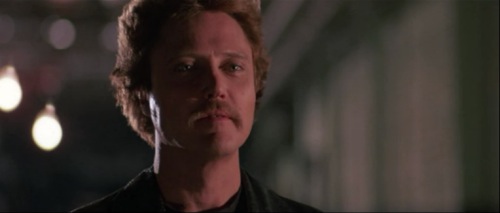
Brad Sr. is a ruthless S.O.B. and Christopher Walken shows the dark side with intensity. This is one of Walken’s best performances in a film—he has a great ability to move between easygoingness to straight-up malice, and it really comes through in this film. Sometimes he can be a wise guy, as when he enjoys the fact that Brad Jr. idolizes him and plays around it, acting like a big shot most of the time. But when he’s mad, he can turn into a truly evil creature of a man. And he won’t care whom he has to kill to save himself.

“At Close Range” is sometimes an uneasy film to watch. It’s not pleasant or particularly charming, except for the first scenes featuring Brad Jr. and Terry (their relationship is the only sweet part of the movie). It’s very violent, especially in the final act, and seems to glamorize the lifestyles of this gang of violent criminals that Brad Jr. wants to be a part of. And when things go very wrong, the movie still doesn’t let up. But it also makes “At Close Range” an effective portrait of human nature while also delivering the much-needed subtle message against violence and gun use.

Sean Penn is excellent as Brad Jr., creating a conflicted young man caught between two worlds—the nice little world he shares with his girlfriend and the mysterious world with his father that later becomes life-threateningly violent. He’s perfectly natural and very strong in the role.

Maybe “At Close Range” isn’t the movie for you, if you don’t like violence or think this story is too much. But I think it is worth seeing for the performances by Penn and Walken. These are two of the brightest, strongest actors who deliver excellent performances.

Tuck Everlasting (2002)

4 Feb

images

Smith’s Verdict: ***1/2

Reviewed by Tanner Smith

“Don’t be afraid of death. Be afraid of the unlived life.”

These are the words said by Angus Tuck to Winnie Foster. Winnie is a teenager from a wealthy family who has stumbled upon the secret of the Tucks, a family living/hiding in the woods who hold the secret to eternal life. She has lived with the Tucks and fallen in love with Angus’ young son Jesse, who finally reveals the secret to her and would like to share it (eternal life, that is) with her.

As Jesse puts it, “I’m going to be 17 until the end of the world.” The Tucks didn’t choose to live this full life. They happened upon it—you see, it’s the spring in the middle of the woods that causes those who drink from it to become immortal. The Tucks were able to realize it later. And they do have their regrets. The oldest son Miles, in particular, has a tragic past and would prefer to die—but it can never happen.

Angus—the oldest in the family—tells Winnie that if she chooses to drink from the spring, she will live forever, but there will be things to miss, especially at her young age—much like Jesse, caught in limbo at more than a hundred years of age, but still in a 17-year-old body. So the choice is to live an everlasting life with the Tucks, or live a normal life with her family.

The question of immortality is the main strength of the wonderful family film “Tuck Everlasting,” based on the popular young adult novel of the same name. Maybe the term “family film” is somewhat unnecessary. Younger viewers may not think much of immortality because they already feel like they’re never going to die. But for older ones, it’s a remarkable concept. What would you choose if you were faced between a normal life and an everlasting one? What would you feel? You could say “yes” immediately, but would you think about it first? Some would, some wouldn’t. Winnie is given moments to think about a lot of things and only after does she make her decision. That’s how “Tuck Everlasting” plays out and as a result, the movie is thought-provoking and enchanting.

As it opens, Winnie (Alexis Bledel) is a teenaged rich girl who is tired of being kept inside her huge house with her overbearing parents (Victor Garber and Amy Irving) and wishes for something more in life. She runs away from home, into the woods, where she meets Jesse (Jonathan Jackson) at the spring. Jesse warns her to go away, but Winnie is stubborn and doesn’t leave that easily. It’s then that Miles (Scott Bairstow) comes along, sees her as a threat, grabs her, and takes her back to the Tuck home. Winnie is treated like a prisoner at first, to be sure she doesn’t go back and tell people where they are. But Winnie knows nothing of their true origins at the time, and opens up to their lifestyle.

A romance develops between Winnie and Jesse, and it’s developed nicely. It’s not cloying or forced—it’s sweet and innocent. By the time Winnie must make her choice, you genuinely wonder what will happen for them. Will Winnie stay with Jesse or will she leave him, knowing he’ll outlive her? There’s weight added to the question of immortality.

The Tucks are well-developed and have their own shadows and advantages. Angus and Mae (William Hurt and Sissy Spacek), the parents, are stuck in middle-aged bodies, but remain lively. Miles, stuck in the prime of his life, is the most tragic of the family, with a past revealed later that makes him more like a zombie stuck in a lifelike state without ever dying. Jesse is more like Peter Pan—never growing old, never dying, and forever young.

As if the choice of normality and eternity wasn’t enough, there’s a rising action featuring another character crucial to the story—a mysterious Man in a Yellow Suit (Ben Kingsley) who knows the Tucks’ secret and is determined to expose it. And of course, there’s the conflict of Winnie’s parents intent on finding their daughter, also risking the Tucks’ hideaway. These elements may be necessary, but they almost make the final act of the story seem somewhat overstuffed, with all the right payoffs.

But that’s a minor quibble, mind you. Ben Kingsley is suitably menacing in the role and the determination of the parents wanting their daughter back is realistic enough. However, Winnie’s important choice is the element that should address the most concern, in my opinion.

“Tuck Everlasting” is a wonderful film—one that makes you wonder, and provokes thoughts such as, “If you live forever, what do you live for?” That’s at the center of the movie and it’s very engaging.

The Adventures of Tintin (2011)

3 Feb

images

Smith’s Verdict: ***1/2

Reviewed by Tanner Smith

“The Adventures of Tintin” is a welcome callback to exciting adventure films for families to enjoy, and also, its opening credit sequence is a callback to those wonderful animated opening-credit sequences that are the perfect ways of letting us know what we’re in for (remember the exciting animated opening-credit sequence in “Honey, I Shrunk the Kids,” for example). While the actual movie is done in motion-capture computer animation, the opening-credit sequence in “The Adventures of Tintin” is back to the traditional hand-drawn animated style (with help from computers).

By the way, since we’re on the subject of credits, have you noticed that these opening-credit sequences are very rare? Usually, movies will show what should be the opening credits at the end, as if we‘re supposed to be surprised by who directed it or wrote it. (To be fair, I know movies just show the title at the opening to get the movie going.) Some movies that do have credits at the opening just show them during the opening scene, as if the editors don’t care how the credits are shown. But with opening credits, you can really get your audience invested in what they’re about to see. While the credits appear, have some creative visuals and have some exciting music. I was glad to see that kind of sequence in a movie again, and here it is in “The Adventures of Tintin.”

“The Adventures of Tintin” is based on Herge’s classic comic books from long ago, and is also director Steven Spielberg’s first animated feature—and in 3D, no less. It’s an imaginative, exciting adventure that features some stunning action sequences and keeps the journey lively as it goes along. Spielberg must have been studying his Indiana Jones guide to remember what makes adventures exciting to execute.

Tintin (Jamie Bell) is a young, lively investigative reporter that apparently has been all over the world, as things in his apartment suggests (I must admit I’ve never read the original comic books), solving many mysteries and making them into stories for the newspaper. He has a loyal dog named Snowy, who is very gifted and possibly even smarter than Tintin. Sometimes on the same cases as him are two bumbling police detectives named Thompson and Thomason (Simon Pegg and Nick Frost, showing great comic relief)…they’re not particularly reliable because they’re so dim.

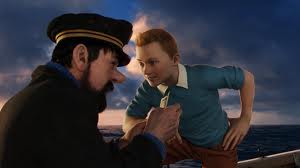
Tintin purchases a model ship called the Unicorn and believes that there’s something special about it, since the mysterious Sakharine (Daniel Craig) is trying to get his hands on it. Tintin does find a very important clue hidden inside the ship and later meets up with the rarely-sober Captain Haddock (Andy Serkis). Haddock’s seafaring ancestors have hidden a treasure long ago, which Sakharine and his crew are seeking. So the race is on to find many clues that lead to the treasure’s location.

“The Adventures of Tintin” uses entire motion-capture style animation. It’s when an entire movie is digitally animated after live actors perform their roles, in black box theater, with sensors all over their bodies. With this animation, you can do whatever you want. In “The Polar Express” and “A Christmas Carol,” in particular, this style of animation was really taken advantage of because with this technology, you can really play around with atmosphere and create some sensational energetic scenes.

Take a chase scene late in the movie, where Tintin and Haddock are after an important clue in Morocco, and the bad guys are seeking possession of it as well. There is one shot that lasts for about five minutes as the chase continues—the shot swipes from spot to spot and goes all around the place, further intensifying the action. That’s a marvelous visual shot, and it shows just how far this motion-capture computer animation can be pushed.

There are other sensational action sequences in the movie—Tintin, Snowy, and Haddock must escape from the villains on their ship after being captured; they hijack a small plane and must learn to land it, and fast; and there’s also a flashback involving the back story of the life-sized Unicorn that seems pretty heavy. These scenes are exciting and well-crafted.

The human characters in this movie certainly look better than the other characters used in other motion-capture movies. Tintin does look very human, but I must ask, why do the other characters resemble the doll-like figures in “Monster House?” They either have big heads or big noses, but then again, I don’t care—at least the eyes aren’t too big or too small to be creepy. There is one exception, aside from Tintin and that is the villain Sakharine.

By the way, I must ask, was it the animators’ intention to make Sakharine resemble director Spielberg?

The performers/voice-actors are well-chosen. Jamie Bell gives Tintin an appealing, intense curiosity and carefully avoids steering into blandness. Andy Serkis is wonderful as the constantly-drinking Haddock, who is Tintin’s sole human ally and provides some great comic moments while on this crazy adventure. I’m not really surprised—Serkis is probably considered the king of motion-capture. Remember, this is the man who played Gollum in the “Lord of the Rings” movies and Caesar in “Rise of the Planet of the Apes.”

With the right blend of humor and action, and a first-rate technical look to the film, “The Adventures of Tintin” is an ambitious, well-crafted adventure movie. I hope there’s a sequel so these new Spielberg adventures can continue; especially since I doubt people will be expecting “Indiana Jones 5” pretty soon. It has a lot of energy and enough potential to become a film series.

Cocoon (1985)

3 Feb

Cocoon1985-01

Smith’s Verdict: ***1/2

Reviewed by Tanner Smith

“Cocoon” is another modern-day science-fiction tale in which advanced aliens from outer space visit Earth with no plans to destroy us, but just to visit us. But these aliens in “Cocoon” are easy to communicate with, simply because they could easily pass off as human. Sure, their true form is pure light, but when they put their latex rubber body suits on, they just seem like rich tourists who have their own business to tend to. They could easily pass as human!

Character actor Brian Dennehy plays Walter, the leader of the group of Antareans, as they’re called, who come to Earth on a mission. He and three of his friends (one of them played by Tahnee Welch, Raquel’s daughter) rent a boat from a young broke skipper named Jack (Steve Guttenberg) to go out into the ocean, dive deep underwater, and retrieve many cocoons of their friends that were left behind on the previous mission decades (maybe even centuries) ago.

You see, it’s said that on their planet, there’s no such thing as sickness or death and so none of the Antareans have experienced the sadness of such. And if the cocoons are taken back to the planet, those inside will be free again. In the meantime, the cocoons that are already found are being kept in the swimming pool near a retirement home, where three senior citizens (Don Ameche, Wilford Brumley, and Hume Cronyn) are tired of their boring lives and take joy in trespassing over at the pool for a little fun. But now, with the strange stones at the bottom of the pool, the pool has become a fountain of youth for them. They feel young again and are suddenly joyful of their lives.

With Walter’s permission, the three men bring their wives (Maureen Stapleton, Jessica Tandy, Gwen Verdon) to the amazing discovery and they all get second chances in being young. They go for nights on the town and even tick off others at the home.

All of this is pure delight. Just about every character is either interesting or enjoyable to watch. We have the scenes with the three guys, who are all wonderful, especially Wilford Brumley who always has a twinkle in his eye that reminds us of a kind grandfather we either had or wish to have had. (Actually, I didn’t know that he wasn’t even at age 50 when this movie was filmed!) Then, we have the scenes with the aliens who just want their friends back and when things go wrong midway through the film, there’s a shocking look of revelation on Brian Dennehy’s face that brings his character full-circle. There’s also a sweet relationship between Guttenberg and Welch and one bizarre scene in which Welch shows Guttenberg her planet’s way of sharing affection with one another.

What I didn’t like about “Cocoon” was its ending. As everyone is invited to stay with the Antareans on their planet, we get a race, a chase, a child in the mix, confused orderlies and police, and a spaceship—just a typical, average Spielbergian ending that wasn’t like anything we’ve seen up until that point.

But everything else in “Cocoon” is just wonderfully entertaining, with great acting and a real feel of whimsy. It’s just a wonder as to why director Ron Howard wanted to end this wonderful film with a climax?

Raising Arizona (1987)

31 Jan

images

Smith’s Verdict: ***1/2

Reviewed by Tanner Smith

Where did a comedy like “Raising Arizona” come from? This movie is all over the map and to call the comedy offbeat would be an understatement—everyone in this movie is either foolish or insane, the screenplay’s dialogue for the characters is quirkily poetic, and it’s hard to figure whether it takes place in reality or another dimension (though I’m close to picking the latter). But I loved this movie mainly because it’s consistent—consistently funny and crazy.

In a 13-minute pre-opening credit sequence that is pure montage and narration, we meet our main characters—an ex-convict named H.I. “Hi” McDonough (Nicolas Cage) and his wife Edwina “Ed” (Holly Hunter), who takes police mug shots. Actually, in a funny twist, that’s how they met. Hi meets Ed as she takes his pictures when he’s first convicted. Then the second time he’s convicted, he notices some sadness in her life and begins to charm her. Then the third time he’s convicted, he actually proposes to her. (You see, Hi has a tendency to rob convenience stores, which always lands him in jail.) When Hi is released, again, he decides to start a clean wife and actually marries Ed. They live in a trailer out in the boonies, near a small town in Arizona. They want to have a child, but can’t because Ed can’t conceive and adoption is out of the question since Hi is a repeatedly-convicted ex-felon. But then they hear of popular furniture dealer Nathan Arizona’s newly-born quintuplets and decide that that’s too much for him and wife to handle, so…they decide to borrow one of them.

Sheesh, so much story put into the first thirteen minutes, before the credits appear. But I thought it was quite enjoyable because of how it never seemed to stop. With Hi’s “poetic” voiceover narration of the sequence and just the over-the-top delivery of the characterizations of Hi and Ed make for a zany experience that I quite enjoyed. And that sets the tone for the rest of the movie, which is equally zany.

For example, the following scene is in which Hi sneaks into the babies’ room to steal one of them. He inspects them all to see which one seems right, and they all run (or crawl) amok around the room, while Hi tries to control them while also attempting not to make any noise while Arizona is downstairs. The wide-angle shots, low-angles, and closeups add to the wackiness of a situation that…to tell the truth, could be very disturbing. Somehow Nicolas Cage makes “baby-stealing” seem less creepy. It’s strange.

Another overly-executed sequence is when Hi and Ed go to a convenience store to buy the baby (whom they call “Junior”) a pack of Huggies. The big mistake Ed makes is letting Hi go in while she stays in the car with the baby. Of course Hi robs the clerk, and this leads to a chase scene that is…well, not boring. Madness ensues during the chase, as Hi goes through streets, backyards, and a supermarket while being chased by the crazed clerk, armed police, and even a pack of snarling dogs!

“Raising Arizona” was the second movie written and directed by Joel and Ethan Coen, who obviously know how to make exciting movies. They certainly showed that in their debut film, “Blood Simple,” a completely different film than this one. They use unique camera angles and quirky characters to tell their stories, and the results are quite effective.

All of the characters in “Raising Arizona” are memorable. Nicolas Cage’s Hi is charmingly dangerous with some sincerity in him, Holly Hunter’s Ed is ultimately stubborn to the point where she seems somewhat psychotic, Trey Wilson’s Arizona is suitably flamboyant, and then there are these folks—two escaped convicts (John Goodman and William Forsythe) who are dumb as posts, Hi’s boss Glen (Sam McMurray) who gladly tells bad joke after bad joke, and Glen’s perky wife (Frances McDormand). They’re all enjoyable to watch and the Coen Brothers cast game actors who really go for it with their roles. I should also mention that their dialogue is not normal. These rural folks all talk like they’re in a Shakespearean play, with countryside jokes put in for good measure. How weird is that?

Oh, and I almost forgot to mention Randall “Tex” Cobb as Hell’s Angel type who may be just a bounty hunter, but Hi describes him as a demonic being who rides on his motorcycle with a blaze trail following. He becomes an important asset to the story when Arizona hires him to get the baby back. This subplot is very silly, to tell the truth, but it’s also a lot of fun and as wacky as the rest of the movie.

“Raising Arizona” is a weird, preposterous and yet mostly hilarious and well-put-together offbeat comedy with a lot of material, aided by flashy camera work and eccentric characters. It’s weird, goofy to say the least, and very entertaining.