Archive | Three-and-a-Half Stars ***1/2 RSS feed for this section

Harry Potter and the Goblet of Fire (2005)

19 Feb

images

Smith’s Verdict: ***1/2

Reviewed by Tanner Smith

Harry Potter may still be wide-eyed to every new magic element he observes around him, but he has gotten used to a lot of Hogwarts activity. He joins in with his friend Ron and his brothers as they chant for their favorite seeker in the famous Quidditch team (as we learn, Quidditch is a wizard-national sporting event now not just confined to Hogwarts) or when he’s learned almost every spell he can use with his wand. At age 14, he’s almost gotten used to Hogwarts School, but nothing can prepare him for what he has to encounter in the fourth “Harry Potter” film, entitled “Harry Potter and the Goblet of Fire.”

Not only is he for some unknown reason (unknown until the end of the film, anyway) chosen for the extremely dangerous Tri Wizard Tournament, but he later discovers that Lord Voldemort is on the rise. Even scarier, especially for a 14-year-old, is working up the courage to ask a girl to the Yule Ball.

It seems as though the “Harry Potter” series is getting darker and darker with each new installment. It really makes me wonder what will be in store for us in the final installment. This film ends with a setup to something even bigger. It also includes the line near the end muttered by Dumbledore, “Dark and difficult times lie ahead, Harry.” The foreshadowing is terrific.

But way before that, Harry (Daniel Radcliffe) and his best friends Ron and Hermione (Rupert Grint and Emma Watson) are in their fourth year at Hogwarts School of Witchcraft and Wizardry with only three years to go after this. Things are changing, for sure. Harry is having nightmares of Lord Voldemort (Ralph Fiennes) returning after many, many years; Ron is more nervous than usual; and Hermione is becoming a beautiful young woman (though still the intelligent bookworm). This year, there is a Tri Wizard Tournament to be held at Hogwarts, in which champion wizards from different schools (and different countries, I might add) compete for victory. Their names are drawn from the enchanted Goblet of Fire which chooses the winners to compete in the tournament. One is a tough-looking Quidditch seeker, another is a nice guy, and the other is a beauty queen—they are all 17 years old, which is a requirement for this tournament. But something weird is happening—Harry Potter’s name is drawn from the Goblet of Fire. He’s only 14 and he didn’t put his name in the goblet, but there’s nothing he can do about it.

So now he’s fighting for his life in this tournament—he fights a fire-breathing dragon, he must stay underwater for an hour to retrieve something from vicious (and ugly) merpeople, and go through a treacherous hedge maze that Jack Nicholson would have lost his mind in. He also befriends a weird new teacher who teaches defense against the dark arts (isn’t there always a new teacher in that class?)—This is Mad Eye Moody (Brendan Gleeson), a mysterious man with a robotic left eye that works as a zoom lens. But his biggest worry is finding a girl to ask to the Yule Ball. The scenes in which Harry and Ron attempt to find dates are so refreshing that it almost outshines the excellent action sequences with the dragon and the mermaids. It resembles the best of high school comedies…with young wizard crushes.

“Harry Potter and the Goblet of Fire” has finally earned a PG-13 rating in the series. The tone is darker than usual and the action is more intense. But as they were with the past three films, the action sequences are amazing—particularly the sequence in which Harry battles a dragon. The computer animation again works very well.

This is not a stand-alone film—the film reaches its final half in which Lord Voldemort makes himself seen for the first time as a whole (we only saw his face in the first film). We are not disappointed—he is pale, bald, ominous, and threatening. Ralph Fiennes makes an intriguing, terrifying villain that will make Voldemort even more so in later installments. He sets up his plotting for later installments in which Harry, Ron, and Hermione may eventually have to fight him in an epic battle. That’s one I can’t wait for. What I’m really concerned about is what will happen until that battle.

Oh, I can’t believe I almost forgot to mention another funny new character—Rita Skeeter (Miranda Richardson), the gossip columnist for the Daily Prophet who doesn’t stop until she gets her story. Richardson really makes the most of her limited role; she’s fantastic. I should also mention a nice touch at the Yule Ball—a sweet little relationship between the gentle half-giant Hagrid (Robbie Coltrane) and Madame Maxine (Frances de la Tour), who is even taller.

“Harry Potter and the Goblet of Fire” is a solid entertainment—it nicely blends fantasy with teenage comedies. The characters are growing and it will be nice to see them continue to grow until the “Harry Potter” series is over.

Forgetting Sarah Marshall (2008)

19 Feb

080416-forgetting-sarah-marshall-hmed-12p.grid-6x2

Smith’s Verdict: ***1/2

Reviewed by Tanner Smith

Well, it’s time for a new lovable loser to take over the writing in the comedies coming off the Judd Apatow assembly line. First came Judd Apatow himself, writing (and directing) the romantic comedies “40-Year-Old Virgin” and “Knocked Up.” Then came Seth Rogen and his buddy Evan Goldberg, writing the teenage comedy “Superbad.” Now for the Apatow-produced romantic comedy “Forgetting Sarah Marshall,” he calls back his former “Freaks & Geeks” cast member Jason Segel and introduces a newcomer—Nicholas Stoller—to direct.

Segel not only writes this material, but also stars in it as a guy named Peter, who has a great relationship with his TV-star girlfriend Sarah Marshall (Kristen Bell) and also provides the ominous background-music “tones” for her crime show. But when Sarah comes over to his apartment, saying “I love you” in a pitiful tone, that can only mean one thing.

So Peter and Sarah are broken up and Peter is not taking it very well. To call him a wreck would be an understatement. He’s advised to take a vacation in Hawaii to take his mind off of her. But there’s a problem—Sarah is there with her new boyfriend and staying at the same hotel!

Things are about as complicated as they could possibly get. Sarah’s new boyfriend—the British rock singer Aldous Snow (Russell Brand)—is a complete weirdo, and things get really awkward when Aldous invites Peter to eat with him and Sarah at a restaurant. But soon enough, Peter finds a friend and trace of hope in the attractive hotel receptionist, Rachel (Mila Kunis). She’s beautiful, sympathizes with Peter, and lends him a supporting hand.

All of the people on the island in this movie are just hilarious and there are a handful of characters to watch and enjoy. There’s not only the zany Aldous Snow. There’s also the constantly stoned surfing instructor (played with relish by Paul Rudd), the religious newlyweds who have trouble with sex, the waiter/stalker (Jonah Hill) who tries to get Aldous to take a listen to his demo tape, and the island’s butcher. I don’t know if this counts as “on the island,” but there’s also Peter’s stepbrother whom Peter constantly stays in touch with via Skype. He’s very funny as well.

“Forgetting Sarah Marshall” has a wonderful screenplay by Segel (who, remember, also stars as Peter). He’s not afraid of making Peter into a desperate schlub of a guy, which makes for very funny moments in the first act. And for that matter, he’s also not afraid of…how do I put this? Letting it all hang out. The scene in which Sarah breaks up with Peter features quick shots of Peter’s genitals, pushing just how far the MPAA rating system could go.

Segel also gives the side characters more than enough moments to shine and the actors are game enough to give them their all. Bill Hader, as Peter’s stepbrother, delivers some of the film’s funniest one-liners while mainly on the other end of a cell phone or a computer, and his sweet-natured wife is very likable, though her role is very brief. Russell Brand is simply hysterical as Aldous Snow, who, with his long hair, lion-like face, thick British accent, and calm-yet-nutty mannerisms, is a comic treat of a character on screen. Paul Rudd is winningly silly. Jonah Hill has some great moments as he stalks Aldous while he thinks he’s being subtle about it.

The two main women are also written well and portrayed even better by the actresses. Sarah isn’t written as a complete snob (a kinder word for “bitch”). She just believes that her relationship with Peter didn’t work out and would like to try something new. She doesn’t hate Peter and we, as an audience, don’t dislike her. Kristen Bell does a nice job of portraying Sarah Marshall as having more humanity than you would expect in this sort of role. Mila Kunis (of TV’s “That ‘70s Show” fame) is absolutely delightful as Rachel—she has a great sense of comic timing, is quite fetching, and makes Rachel the kind of girl I would like to get to know in a time of crisis.

Those previous three paragraphs have gone out of their way to give praise to the written characters of “Forgetting Sarah Marshall” and how the actors portray them, but what else does the screenplay give us? Only more and more quirks to make us laugh. I couldn’t find a single weak link when it comes to the comedy in this script. What can you say about a musical about Dracula…featuring puppets? Seriously, what can you say? I couldn’t say anything. Why? Because I was constantly laughing. Oh, and I should also mention that a majority of the jokes in this movie are not merely gross-out gags…they’re just sex jokes. To be honest, I’m actually kind of relieved.

But also, like in previous Apatow comedies like “40-Year-Old Virgin” and “Knocked Up,” the mix between raunchiness and romance is kept in check; carefully fashioned and convincing. Many of the moments that feature Peter and Rachel together reminded me of the finest moments in “When Harry Met Sally.” Segel and Kunis show a great deal of chemistry, they’re convincing throughout, and their comic timing is spot-on.

“Forgetting Sarah Marshall” is a hilarious and even heartfelt movie with a funny screenplay, likable acting, and a real heart to go with the humor. And the last thing to say is that if I wind up in a predicament like Peter’s and need a vacation to take my mind off it, I hope Mila Kunis is there to help me out.

Note: I might be wrong on this one, but if the shots of Peter’s nudity had stayed on a little longer, the R rating for this movie may have been replaced with an NC-17.

The Natural (1984)

19 Feb

11-top-sports-movies---The-Natural-jpg_1349001541229_162280_ver1.0_640_480

Smith’s Verdict: ***1/2

Reviewed by Tanner Smith

I love baseball. Who doesn’t? It’s a lot of fun to play and arguably even more fun to watch (yeah, I was never that good at the game, even when it was called “whiffleball” in P.E. class). Heck, it’s America’s pastime! You could show me a football game on TV or let me play in flag-football for fun, and I wouldn’t fully understand it. No, baseball is the sport I can easily get into. I mean, I’m not saying I collect baseball cards or even memorize statistics (or else I wouldn’t be much of a movie critic, would I?), but I really adore the sport itself. So when a movie that’s centered around a baseball player comes around, of course I hope that it gets everything right.

This is where “The Natural” comes in. This movie isn’t merely artistic and wonderfully acted. It’s also amazingly accurate about the game of baseball—not just in representation of what happens on the field, but also the spirit of the game. How can you not be excited when a character hits a home run in this movie? Or when the ball is mid-air, flying somewhat gracefully? That’s the spirit of the baseball game sequences in “The Natural.”

The movie is a fable that features a natural player named Roy Hobbs. As a young man, Roy played catch with his father and carved a wooden bat out of a fallen tree, dubbing the bat “Wonderboy.” As he gets older, he gets a chance to try out for a team in Chicago and even strikes out big-league ballplayer “The Whammer” in three pitches. It’s then that people see real talent in this person. Unfortunately, those people include a deranged woman who makes it her business to kill off “the best” in every sport.

Roy (Robert Redford) survives his encounter with the woman (Barbara Hershey), but it’s 16 years in oblivion before he finally appears as a thirty-something rookie. He signs up for the New York Knights, who can’t believe he’s on the team at his age. His manager Pop (Wilford Brumley) even states cynically that players his age retire rather than begin playing. Through half the season, Roy sits on the bench, but he eventually does make it into the starting lineup on the field and shows his skills. Everyone is impressed and amazed by him and want to find out more about him, for their own reasons.

It’s within the story of “The Natural” and the sport of baseball that these themes are represented—lighter ones like redemption, and darker ones like corruption, greed, and temptation. We have the redemptive tale of a man who steps out of nowhere after a deadly experience and uses baseball as the pathway to the right track. Within the darker themes, baseball brings about the joys (and dangers) of gambling, contracts, and fame. As the story progresses, Roy comes along corruptive characters like the Knights’ owner (known as the Judge, played by Robert Prosky) who will give Roy a long-term contract if he throws the next game, a sports writer named Max Mercy (Robert Duvall) who wants to know everything about this strange natural ballplayer, a gambler named Gus Sands (Darren McGavin) who manipulates Roy’s refusal to agree to anything dishonest, and his girl Memo Paris (Kim Basinger) who tempts Roy into all of their traps.

It’s Roy Hobbs who must make the right choices to make himself into a hero. But even if we know that Roy will aim to do the right thing, we wonder ourselves if the right thing is enough. It’s because of the writing by Roger Towne and Phil Dusenberry, based on the novel by Bernard Malamud, that the tension is there and we feel it in the scenes in which Roy must figure out what to do as he discovers he has something to prove.

Roy Hobbs is a great role model for young children—he’s not perfect, but an individual that shows character and principles as he sets out to fulfill his dreams. He’s played by Robert Redford in a believable, winning performance. He’s charming, but more importantly, he’s also convincing as a baseball player.

The movie has an outstanding supporting cast—Robert Duvall, Wilford Brumley, Kim Basinger, Robert Prosky, and Darren McGavin are all solid in their roles. There are two more important roles—Richard Farnsworth, just wonderful as the faithful bench coach Red, and Glenn Close, excellent as the angel-in-disguise: Roy’s old girlfriend Iris, a passive woman who dresses in white and wears a hat that represents a halo. Notice how she’s bathed in white light at Wrigley Field at the end of the movie. (I should also note that Barbara Hershey’s mysterious character is dressed entirely in black in her scenes, like a black widow spider about to attack her prey.)

But like I said, the very best element about “The Natural” is how well it accurately portrays baseball. This movie gets the feel just right in its ballgame sequences, and the final game is involving to say the least. The outcome is one of the most satisfying in any sports-movie big-game climax. Something it didn’t need was a heroic music score by Randy Newman, but I let it slide because it sounds great.

“The Natural” is one of the best sports films I’ve ever seen—a magical tale of the human element and a fable of a destined hero. Even if some cheesy moments and a few not-so-subtle touches (see two paragraphs above) seem a little “out there,” I enjoyed every minute of it.

Harry Potter and the Prisoner of Azkaban (2004)

18 Feb

harry-potter-and-the-prisoner-of-azkaban

Smith’s Verdict: ***1/2

Reviewed by Tanner Smith

It seems like young wizard Harry Potter is heading straight into darker territory. I think he is cursed in the way of never having a quiet year at Hogwarts. He’s 13 years old and he has already searched for the sorcerer’s stone and discovered the Chamber of Secrets. And now, he is being pursued by a Prisoner of Azkaban. OK, enough with the bad title references. You get my point though—Harry Potter will go through four more years after this and he will never have a quiet year at Hogwarts. Let’s just hope he is able to survive so he can graduate Hogwarts School. To think he is the Boy Who Lived possibly leaping towards certain doom—wonder what is in store for him in his seventh and final year at Hogwarts…assuming he lives that long.

I’m making the third entry in the “Harry Potter” series—entitled “Harry Potter and the Prisoner of Azkaban”—sound too grim. Indeed, Hogwarts has become menacing and even more dangerous than before. But this is probably nothing compared to what may happen in the later installments.

Harry Potter (Daniel Radcliffe) has grown as a person—he is not the poor young boy living a miserable life with his hateful relatives. This time, he’s developed an edge to himself. This is proven in the opening scene, in which he is fed up with an overly unpleasant relative invited to dinner and casts a spell that blows her up like a balloon and floats her away. This would’ve been one of the cruelest things a young wizard can do…but it’s just so funny.

Harry runs away to meet his old friends in time to leave for Hogwarts (this is after a wonderful scene in which he boards a fast-speed wizard bus with a Cockney guide and a shrunken head for a navigator). He is reunited with the still-cheerful Ron Weasley (Rupert Grint) and still-bookish Hermione Granger (Emma Watson). But something is wrong this year—the sinister Sirius Black (Gary Oldman) has escaped from Azkaban Prison. Sirius is said to have betrayed Harry’s parents and was the cause of their murderous deaths by Lord Voldemort, the late Dark Lord who killed Harry’s parents and failed to do so with Harry as a baby (hence the scar, in case you forgot, which you probably haven’t). On the search for Sirius are a swarm of Dementors, which are hovering, life-sucking demons that pay Harry unfriendly visits from time to time.

This year at Hogwarts, there are new faculty members. One is Professor Lupin (David Thewlis), the newest teacher of the defense against the dark arts. Harry knows that Sirius will finish what he started and come after him, so he asks Lupin to train him to protect himself. But it’s not so easy. Then there is the addition of Professor Trelawney (Emma Thompson), a psychic teacher who believes the blackness in Harry’s tealeaves means death. Also, Hagrid (Robbie Coltrane) is promoted to teaching—he has a large feathered animal named Buckbeak, which is a Hippogriff. Harry is to ride the bird-beast to set an example, but pathetic Draco Malfoy (Tom Felton) is too much of a show-off. This is why the audience cheers when Hermione finally gives him a punch right square in the face. “That felt good,” she says to her friends after Malfoy runs away whimpering. What a wimp Malfoy is.

This time, Harry doesn’t go looking for trouble, but trouble always seems to find him, Ron, and Hermione. Once again, they are propelled on another journey within school grounds and are met with many terrific action sequences. They encounter a shape-shifting dog, a werewolf, and (my most favorite) a living tree that tries to crush anyone who comes near with its branches and limbs. That tree is a beyond-terrific computer effect—I don’t believe real trees can shake off leaves in the fall and snow in the winter (I love it when the snow hits the camera).

And then there is an enchanted map that shows where people are within every minute of every day inside the school—it can be brought to life when Harry summons, “I solemnly swear that I am up to no good” and turned into a regular piece of paper when he says, “Mischief managed.” Also, there is the final half of the film—not giving anything away, but it fiddles with time in ways we’ve always admired in time-travel movies. It works here as well.

But the important thing here is that Harry, Ron, and Hermione are not children anymore. They are teenagers. Their characters have grown, but so have Radcliffe, Grint, and Watson. In later installments, they will still be likable even when they are young adults ready for something bigger in the final chapter of the final entry. Radcliffe is still a likable young hero, Grint is still cheerful but comically nervous when it comes to terror, and Watson has a way of taking charge no matter what. Coltrane as Hagrid continues to be lovable, Emma Thompson is a delightful addition to the movie, David Thewlis is great as the new teacher with a secret, and Michael Gambon, filling in for the late Richard Harris as Dumbledore, has the convincing mysticism of bearded headmaster Dumbledore.

Hogwarts may have gotten darker, but it’s still wonderful. And you do want Harry, Ron, and Hermione to be there when Hogwarts is under terror again. The series is approaching something bigger than this. It’s only a matter of which movie it will start. “Harry Potter and the Prisoner of Azkaban” is not quite up there with the first two films, but it’s still a terrific adventure.

Star Trek IV: The Voyage Home (1986)

18 Feb

vs8

Smith’s Verdict: ***1/2

Reviewed by Tanner Smith

“Star Trek” has been known as ideal science fiction—it’s an intriguing, fun presentation of ideas and creativity when it’s not filled with action and visuals like the “Star Wars” movies. The “Star Trek” TV show, created by Gene Roddenberry, may have been silly in execution, but you can’t deny that there was effort to try and make it work. There were interesting concepts and fun characters to follow, even if the effects were pretty cheesy.

Then, the movies based on the series came about. The first movie—“Star Trek: The Motion Picture”—had some creativity put into it, but was mostly a dull attempt to become the next visual treat (complete with long effects shots of the ship moving into space…slowly). The second movie—“The Wrath of Khan”—was an improvement, bringing back the imagination, the terror and excitement of the subjected “trek,” and the same chemistry among the characters seen in the series. The Vulcan Spock sacrificed his life to save his friends on the U.S.S. Enterprise at the end of that movie, leaving an open door for the third movie—“The Search for Spock”—that brought Spock back to life, but after the others deal with those menacing alien species known as Klingons.

That brings us to the fourth movie “Star Trek IV: The Voyage Home,” which in my opinion is the most imaginative and most enjoyable in the series.

“The Voyage Home” takes place where “The Search of Spock” left off. Spock is brought back to life on the Vulcan planet and the rest of the crew have to repair a stolen Klingon ship (after the Enterprise was destroyed in the previous movie) to get back. But there isn’t going to be a welcome back, as they’re approaching a court martial for blowing up their ship and disrupting the “peace treaty.” Yeah, ‘cause Klingons are known for peace after blowing up whatever they don’t understand, but I digress.

Now, see if you can follow this. A space probe threatens to destroy the Earth by draining all of its oceans, unless its call is responded to. The Enterprise crew, on their way back home, receives a distress call from Earth and discovers what the call means. Unfortunately, the call comes from the sound of humpback whales, a species extinct in the 23rd century. They have a new mission—to travel back in time to the late 20th century and pick up some humpback whales to bring back to the future with them so they can answer the probe, thus saving Earth.

It’s fitting that “Star Trek IV: The Voyage Home” would be released the same year as “Crocodile Dundee”—both movies have a plot element known as the “fish-out-of-water” tale. In “Crocodile Dundee,” an Australian jungle guide was brought to venture New York City. In “Star Trek IV: The Voyage Home,” the Enterprise crew—Admiral James T. Kirk (William Shatner), Mr. Spock (Leonard Nimoy), Dr. Bones McCoy (Deforest Kelley), Uhura (Nichelle Nichols), Sulu (George Takei), Scotty (James Doohan), and Chekov (Walter Koenig)—are in the year 1986 to explore San Francisco, California. When you know who these characters are and become accustomed to them, it’s a lot of fun to see them in strange places. What stranger place for them to explore than…ours?

All of this is good fun. I imagine the writers of “The Voyage Home” must have decided to forget the stuff with the Klingons and the family history involving Kirk (his son died in the previous movie), and decided to have some fun with this series. There are some very funny bits using the fish-out-of-water formula—Sulu, the pilot of the Enterprise, is now flying a simple helicopter; Scotty, the computer expert on the Enterprise, is working simple systems and baffling a curious computer operator in the process; and Chekov…well, let’s just say a Russian in the Cold War era asking where he can find nuclear vessels (to power the ship they came in) is not in good taste.

The funniest bits involve Mr. Spock as an alien come down to Earth. He uses a headband to cover his pointed ears, so people just think he’s some weirdo. He uses his sleeper hold on a punk who has his boombox turned up too loud on a public bus. And he can’t pass off as human—he learns from Kirk that adding profanity in every other sentence is effective; Spock can’t pull it off. He also can’t tell lies, so there’s constant banter between him and Kirk, particularly when they’re asked if they like Italian food—“Yes.” “No.” “No.” “Yes.”

The crew finds a pair of humpback whales held in captivity. A marine biologist (played with great spunk by Catherine Hicks) plans to release the whales into the ocean. It’s Kirk and Spock’s job to find out when that will happen so they can set out to find them and beam them aboard their ship (there’s a special tank for them, in case you’re wondering). This means that Kirk must ask her out to dinner.

This entire portion of the Enterprise crew in 1986 San Francisco is the best part of the movie. The setup is typical and the final climax is the least interesting part of the movie. But when they’re in San Francisco, the movie is a good deal of fun. It’s not just entertaining because of the situations the characters get into, but also because since it’s the fourth movie, there was time to develop the relationship between the crew, after a whole TV series and three feature-length adventures. There’s a sense of easy interaction among these characters; they talk with each other, gently joke with each other, and seem comfortable with each other.

“Star Trek IV: The Voyage Home” is fun and imaginative without having to resort to a real villain or a lot of action (the sequence at the end is a pushover). Instead, it tells an intriguing story that allows the characters to breathe (with an interesting romance between Kirk and the marine biologist) and enlivens comic situations that could have been silly in the wrong hands. “Star Trek IV: The Voyage Home” is a fun voyage indeed.

Cotton County Boys (Short Film) (2011)

18 Feb

timthumb.php

Smith’s Verdict: ***1/2

Reviewed by Tanner Smith

One of the films I looked forward to seeing at the 5th Annual Little Rock Film Festival in early June 2011 was “Cotton County Boys,” Collin Buchanan’s senior thesis film for the UCA (University of Central Arkansas) Filmmaking Program. What drew my attention to it was its clever, 70s-retro-style 3-minute trailer and its cast, which included Levi Agee (film columnist for the Arkansas Democrat-Gazette), Lynnsee Provence (actor in “Shotgun Stories”), and Natalie Canerday (the mother from “Sling Blade”).

So on June 5th, 2011 in Little Rock, I saw “Cotton County Boys” (which is 30 minutes long) when it was screened with five other short comedies made in Arkansas. I was hoping to like it…and fortunately I did. This is an enjoyable short comedy with a lot of laughs and many moments when I had a smile on my face. It also has a heart—the film fit right into its LRFF category title, which was “Hijinks and Heart.”

The titular Cotton County Boys are three dim-witted but well-meaning Southern brothers who still live with their mother and spend most of their time messing around and shooting each other with 4th-of-July rockets. That’s actually how the movie opens—one of the brothers smells the morning air in a brief tender moment right before the others playfully shoot fireworks at him.

The conflict of the story is that the Cotton family needs to come up with $12,000 to save the family house from foreclosure (it was originally $11,000 until one of the brothers broke the process server’s car’s back window). So the brothers—Bobby (Terrell Case), Bo (Levi Agee, who also co-produced this film and is credited here as “Reuben Agee”), and Sammy (Lynnsee Provence) Cotton—decide to go job-hunting. Bobby finds a job at a fast-food restaurant, where he develops a crush on the attractive co-worker Hattie (Kelsie Louise Craig), and Bo and Sammy find a job painting birdhouses. (This is shown in a montage, which features cameos by Arkansas Democrat-Gazette film critic Philip Martin and Candyce Hinkle, who played the landlady in “True Grit.”) Soon enough, though, they get the idea to win the money by making their own funny home videos and sending them into their mother’s favorite TV show, which can be seen as a clone of “America’s Funniest Home Videos.”

This results in multiple shots to the crotch and other injuries. Now, as tired as I am of the comedic “shots to the crotch” cliché, it works here because a) they’re still funny here and b) they help serve the story. The sequences in which the boys film their own stunts using the family video camera are amusing, fun to watch, and actually about something. This could have been a formulaic romp about cardboard characters who simply run around nearly getting themselves killed. But no—director Collin Buchanan is very careful in making us empathize with the characters. They’re not completely idiotic—in fact, Bobby, Bo, and Sammy are smart in their own way. And everything they do is for the family. This is where part of the film’s heart comes into place. There are also some brief awkwardly-funny but somewhat-sweet moments between Bobby and Hattie, although their relationship could have gotten a little further before the emotional payoff at the end. Actually, this is what cost the film half-a-star. Maybe if the film were a little longer so it could have a few more moments with Bobby and Hattie, this would have gotten four stars instead of three-and-a-half.

But the true heart of “Cotton County Boys” lies within the relationship of the Cotton family. Terrell Case, Levi Agee, and Lynnsee Provence give good performances as these likable characters and have a nice rapport with each other, as well as with Natalie Canerday, who plays their mother. They add to the humor and heart of this endearing short film. But wait! What review of a movie with ridiculous stunts could resist the joke, “Don’t try this at home?”

The Conversation (Short Film) (2011)

18 Feb

mqdefault

Smith’s Verdict: ***1/2

Reviewed by Tanner Smith

The Conversation features the chronicles of a blind hit man, although he constantly reminds the reporter that’s interviewing him that he’s not “blind,” but “visually impaired.” And yes, it turns out there is a difference. The hit man — Trench (well-played by Chad Bradford) — explains it to the reporter (Paige Reynolds, whose overly polite manner in this film makes me wonder if she can play a psychopath) in honest terms, and that most people don’t know it. They either say to him, “Oh you’re blind — let me help you” or “You can see — get it yourself.”

The Conversation tells Trench’s story in just ten minutes and it’s a nicely-done dark comedy about the ups and downs of being visually-impaired and a mercenary. Flashbacks are shown as a way of answering the reporter’s questions. Does he use his disability as an advantage? How do his relationships work out? What are his thoughts on the blind and music? Where does he have the most problems dealing with people? Does he hire a driver to drive him to his hits? Do people pick on him?

All of these questions are answered in a very funny way, with fresh writing displayed here. My favorite is how he responds to the question of where he has the most trouble—“Restaurants.” I wouldn’t dare give away how he reads the food menu. These jokes make you laugh, but they also make you think. Just about every question that’s answered in this movie—broadly or subtly—serves as credible accuracy.

The Conversation was written and directed by Leon Tidwell, who himself is visually impaired. My guess is he wanted to show that “blind” and “visually impaired” are totally different. In an interview with Arkansas Democrat-Gazette film columnist Levi Agee, he claims that the inspiration for The Conversation was his own experiences. He’s not a hit man, but he did have frustrations in finding work because of his disability—it comes across through the character of Trench in this film. The Conversation is a terrific short film (at ten minutes, it’s not too fast or too slow; it’s just right); I look forward to Leon Tidwell’s further work.

NOTE: The interview with Leon Tidwell by Levi Agee can be found here

The Man in the Moon (Short Film) (2012)

17 Feb

277791154_640

Smith’s Verdict: ***1/2

Reviewed by Tanner Smith

The Man in the Moon, made in association with the UCA Digital Filmmaking Program, had already caught my interest with its clever teaser trailer, featuring a strange, gray landscape with what looks like a golf cart making its way across, as the camera pans up to the sky … only to reveal the Earth. Yes, we are in outer space, the “golf cart” is a lunar rover, and this landscape is on the moon. It’s a great teaser, and the title suggests … well, take a guess.

This 20-minute short film is an imaginative, well-put-together science-fiction story that starts out as a futuristic prison fable and heads into different, even more interesting, territory once it unleashes that always-reliable moment in which a character digs for quite a time and then suddenly hears an unexpected THUD. (And of course, there’s another THUD to be sure of what he heard.)

The character is named Dave; he’s part of a new prison program that sends convicts into complete isolation up to the moon. As one of those convicts, he is completely alone on the moon … or so he thinks. When digging for experimental dirt or stones (there’s a machine in his prison that somehow brings it back to Earth for experimentation — I’m not quite sure how that works, but oh well), he digs a little deeper and then…you guessed it — THUD.

Dave (Lynnsee Provence) discovers a doorway leading to the underground lair of the Man in the Moon, which is actually somewhat welcoming—it looks like the inside of a suburban house…in the 1960s, which makes things kind of unnerving and unsure. But the Man in the Moon, named Manuel (Leonard Schlientz), is a kindly old man with a generous hospitality. He takes Dave in, making him feel at home, but there seems to be something more that Manuel has in mind. For example, what is inside that forbidden room right beside the back bedroom?

The more mysterious The Man in the Moon gets, the more intriguing it is. I apologize for giving away what Dave finds beneath the lunar surface, but I stopped immediately at the plot device of the “forbidden room.” There’s a lot of creativity flowing through the story and I was interested throughout, to the point where I didn’t care much for questions such as how does that machine in Dave’s prison work, and where does Manuel get all of his food if he’s been secretly living in the moon?

The film has a nice visual style. The moon setting is terrific. I hear the scenes taking place on the moon landscape were actually filmed on a quarry with color digitally added in post-production to give the illusion of moon rocks, space dust, and emptiness of outer space. The result is very effective. Also of note are the interiors—Dave’s prison and Manuel’s home. Each is different, but interesting. Dave’s home has a rustic-if-retro look, suitable for an isolated prison on the moon, and Manuel’s home looks as if it was stuck in a ‘60s time warp—the appropriate colors and props really stand out.

An interesting story idea, a continuing guessing feel, and good performances from both Provence and Schlientz makes for a pretty good film. How much did I appreciate The Man in the Moon? Of the twelve short films I saw the night it premiered at the 6th Annual Little Rock Film Festival, this is the one that I was most fond of when the night was over.

Batman: Mask of the Phantasm (1993)

17 Feb

Batman Mask of the Phantasm phantasm

Smith’s Verdict: ***1/2

Reviewed by Tanner Smith

“Batman: Mask of the Phantasm” was the only theatrical release based on the animated series of “Batman” (entitled “Batman: The Animated Series”). The series was dark and complex, which is what also could be said about this movie. It’s strange and very intriguing in the way that this movie (and the series) was able to strike the right notes for kids and adults. But “Batman: Mask of the Phantasm” is a gripping thriller that both would enjoy.

Actually, I just realized what is special about both this movie and the series—it treated the kids like adults!

“Batman: Mask of the Phantasm” digs deeper into Bruce Wayne’s past, as we discover that he almost had a normal life before becoming the Dark Knight himself. This is brought back to him by the arrival of an old flame, Andrea Beaumont, with whom he restarts a romance. At the same time, there’s a new villain in town—a mysterious vigilante who is killing off Gotham City’s crime bosses. This villain, who can appear and disappear with a puff of smoke, is called the Phantasm and is also mistaken for Batman. So while trying to deal with his life as Bruce Wayne, Batman is also on the run and out to clear his name.

The animated series was mostly known for its Gothic stories and character development, as hard choices and haunting memories come into place. Such is the case here. The flashback sequence in which we see events that lead to Bruce Wayne becoming Batman is very well-handled and quite complicated. It shows the fantasies of what might or should be, and then reality takes its toll in a harsh way that leads to tough decisions that ultimately must be made.

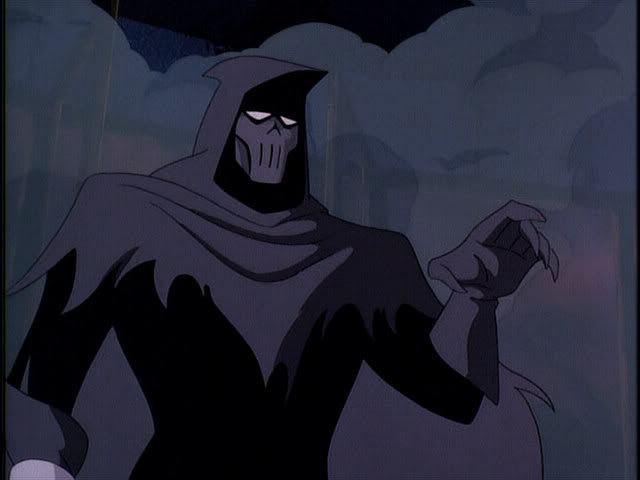
The new villain, the Phantasm, is a welcome addition. With a dark cloak, glowing eyes, a mask that also alters voice, and a lot of smoke to fool during encounters, the Phantasm is one tough customer. As the story progresses, there is more to be told about the Phantasm’s story, and during the film’s harrowing final act, that story comes full-circle in a way I wouldn’t dare give away. The Phantasm isn’t the only villain, however. We’re also fortunate enough to have the Joker, slimy as ever. And the scheme that these villains follow through with is surprisingly well-put into detail. Maybe I wasn’t too enthralled by evil schemes in some of the live-action Batman movies, but this one was quite intriguing.

The climactic final act is phenomenal. It’s not just because of the crafty animation style that makes it worth watching; it’s everything that has been set up before, and is now paying off. I love action-thrillers in which the climax really means something after all that’s happened before.

It’s a shame that this animated Batman movie was a box-office bomb. (Reportedly, this had to do with Warner Bros.’ inept marketing campaign.) It has since gained a cult following on home media release, and for good reason. It’s a pretty strong film. Even Siskel & Ebert, in 1995 (the year “Batman Forever” was released), admitted that they regretted missing this film in the theater, saying they enjoyed it more that “the current Batman adventure.” Much like the animated series this was based on, “Batman: Mask of the Phantasm” is intelligent, spectacularly-drawn, and quite dark and intricate.

Warm Bodies (2013)

14 Feb

warm-bodies-image08

Smith’s Verdict: ***1/2

Reviewed by Tanner Smith

Ever so often, we get one of those “zombie-movies” in which a strange infection devastates a population, and a small, diverse group of survivors defend themselves against a hostile race of staggering, man-eating walking-dead, and sometimes against each other. “Warm Bodies” is not that movie.

Yes, “Warm Bodies” is a zombie-movie, and the zombies are as predictable as you’d expect. They groan; they stagger; they crave human flesh; they lurch; and they get shot in the head by human survivors of…I don’t know, insert apocalyptic reasoning here. And the people include the usual gun-toting military who will shoot first and ask questions later (if at all), and of course, because they’ve never seen zombie movies, they use a special device to make sure that someone is or isn’t a zombie. Yeah, because it’s so hard to tell by appearance, isn’t it?

But wait! Didn’t I say “Warm Bodies” was not the typical zombie-movie? Yes I did. In fact, this is one of the more original zombie-movies to come around in a long time. It mixes elements of “Dawn of the Dead” with some of “Romeo and Juliet,” and it tells the story from the zombies’ point-of-view! It’s a refreshing move (among many in this movie), as if to say, “Forget the boring people who are trying to defend themselves! Let the zombies tell their story!” For the longest time, zombies have been simply known as walking allegories (who’s more human in the case of people-versus-zombies?) and have become more predictable as a result. Not here.

The main protagonist of “Warm Bodies” is “R” (Nicholas Hoult), a young zombie who narrates the story through thought. He knows he’s a zombie; he knows he has to eat human flesh; and he knows his many limitations. R slouches around the post-apocalyptic ruins of a city, and mostly hangs around an airport terminal and an airplane he has made his home. (And he doesn’t remember his first name, but he knows it starts with “R.”)

Those who have seen “The Princess Bride” will know that “there’s a difference between mostly-dead and all-dead.” Such is the case in “Warm Bodies,” in which the “all-dead,” the truly-dead zombies, have become so hungry for human flesh that they have even eaten their own, revealing skeletal bodies and becoming even more brutal monsters known as “bonies.” There’s no hope for them anymore. Is there hope for the, um, “mostly-dead?” This is where “Warm Bodies” develops its plot, as a young woman named Julie (Teresa Palmer), one of the human survivors, scouts the outskirts of the city with others for supplies, and to shoot up anything that staggers. Surely enough, some zombies find them and R eats the brains of Julie’s jackass boyfriend (Dave Franco). This somehow triggers some of the boyfriend’s memories, and also starts R’s own transformation to live again. His heart starts beating; he can form words; and he is smitten by the appearance of Julie, and he even protects her from the other zombies.

This begins a star-crossed romance, as R takes Julie to his home. Julie learns to trust R; R becomes more human as they spend more time together; they both have fun together; and they form a strong bond together.

Wait a minute—Romeo and Juliet? R and Julie? I just got it! (And yes, there is a balcony scene in this movie.)

Anyway, the idea is that love is the main thing that can bring the dead back to life. At least, that’s the case for the “mostly-dead,” and not the “truly-dead” bonies who have no purpose but to chase and kill.

There are a lot of refreshing pleasures to be found in “Warm Bodies,” thanks to some clever writing by Jonathan Levine (who also directed the film, and whose previous film was “50/50”). For example, R’s narration is full of deadpan-satiric references to other zombie-movie elements; some nice inside-jokes (though with some more obvious than others); and such.

Now I’m going to tell a little story:

I was not so anxious to see this movie. Seeing the trailer, I could see where the originality was coming from with the plot elements of this zombie-human love story (though, admittedly, I kept flashing back to “Twilight”), but I thought I could tell where the movie was going to go. I went anyway, because of a few friends who were saying how much they loved this movie. But I was constantly on guard. I was expecting to predict what was going to happen with each plot development. And because I liked the beginning of the movie so much, as R narrates his life (very clever writing involved here), I whispered a silent prayer that this would not go the way I expected. As it turned out, whatever I thought was going to happen either did happen in a more delicately-handled way, or not at all! For example, when we meet Julie’s cocky boyfriend, I immediately thought he was going to be the boring, jealous villain at whom everything in the obligatory action-climax could be pointed to. And what happens? He’s disposed of quickly!

Then, R takes Julie back home after he first meets her. I asked why Julie didn’t just run, since these zombies are somewhat slow—as it turned out, these zombies are kind of fast when they need to be.

And of course, I kept saying to myself that there would be a “liar-revealed” type of cliché in which Julie would find out that R has eaten her ex-boyfriend’s brains and then suddenly not trust him, and leave him, and there’d be a long, long stretch of time before R has to find some way to make her forgive him so they can be together in the end…Granted, that is a very grim situation and I wouldn’t expect Julie to shrug it off, but then again, the longer they hold out this secret, the more it becomes annoying when you think about it. So how does this secret become revealed to her, and how does she respond to it? All I can say is, it was treated in such a plausible way that I just let it be…

But then of course, there’s the obligatory military force who will shoot any corpse that comes their way, and ask no questions. Yeah, yeah, yeah—the leader of the force is Julie’s father (John Malkovich); he’s a hardass; he won’t listen to reason; he’ll never understand R and Julie’s love; blah blah blah, I kept waiting for this one. It’s the “prejudice” element that comes about in every one of these movies. But even this plot element is well-handled! And so is the climax in which the military doesn’t know which to shoot—the zombies or the bonies who seem to be fighting each other?

I wouldn’t want to give away too much, but you get my point. “Warm Bodies” ultimately won me over by how smart its writing was. Whichever direction I expected it to take, it either didn’t take or did take it, but with nice touches. I actually wanted to yell in the theater.

Nicholas Hoult and Teresa Palmer, as the two leads, are both winning and appealing in “Warm Bodies.” Hoult gives probably the best “earnest performance” that an undead character could be given. Palmer gives her character Julie good doses of sweetness and spunkiness—even if she does a few dumb things, you forgive her because of that. Both actors exhibit convincing chemistry on-screen, and they manage not to make a romance between a beautiful girl and a walking corpse less icky than you might imagine.

Of the supporting cast, there are two actors who deserve mention. One is Rob Corddry, who does a great job as R’s friend M who has his own transformation as well; and the other is Analeigh Tipton, who is very funny as Julie’s friend who awkwardly accepts the fact that Julie is with a zombie. John Malkovich is…well, let’s face it, he’s John Malkovich.

I can’t think of any recent zombie movie with this much heart added to it. “Warm Bodies” is sweet, original, nicely-directed, and over in just an hour-and-a-half. And even though some of it is silly (and the herky-jerky effects of the bonies don’t help much either), the movie has the nerve to be upbeat and optimistic with its subject matter, as well as tell the familiar story from a different viewpoint. It’s a terrific film; my favorite film of 2013 so far.