Archive | Three-and-a-Half Stars ***1/2 RSS feed for this section

Kids (1995)

13 Mar

Kids-Production-Still

Smith’s Verdict: ***1/2

Reviewed by Tanner Smith

The kids in the title of the film, “Kids,” refer to rebellious, aimless, pathetic, sex-crazed, drug-addicted, loudmouthed teenagers who care about nothing except sex, drugs, alcohol, skateboarding, and each other’s company. These are city kids who may seem like clean-cut kids to some people’s eyes (emphasis on the “some”), but are really some of the worst sort of young people around. And “Kids” is an ugly portrait of them.

This may seem like a documentary, but it isn’t. The social interaction and the way the camera lingers around it may have viewers mistake it to be reality. But the 19-year-old Harmony Korine, who has an ear for how inner-city children talk, wrote this film with dialogue, and the director Larry Clark directs the young actors and keeps his camera movements to frenetic quietness. But at times, it’s very disturbing, especially in the scenes involving sex.

The central character is a boy about fifteen or sixteen years old named Telly (Leo Fitzpatrick). At first, he looks like a normal kid and seems sincere and kind of nerdy. When we first see him, he’s making out with a girl in her bedroom and he talks her into having sex. At first, the girl says she’s afraid of having a baby, but Telly coaxes her by saying that with him, she wouldn’t have to worry about it and that she would love it.

It’s after that (and yes, we do see it) that we know that Telly is obsessed with deflowering young virgins. Not only that—13-year-old virgins. After he leaves his latest victim’s house, he walks the streets with his buddy Casper (Justin Pierce) and tells him about his philosophy of virgins and that he might be getting addicted to deflowering virgins. He doesn’t believe in condoms, either.

Casper is another kid who doesn’t care about much. He’s constantly stoned and drunk, and seems to envy Telly’s track record with sex. Their friends aren’t any better—together, they talk nonstop about sex, smoke weed, and drink. There are younger kids with them—they try to fit in by acting like big-time sex addicts too. But we also see just how dangerous they can be, as they beat a kid closely to death with a skateboard.

We experience a 24-hour routine day with these kids. But while all that’s going on, we get something close to a plot with a girl named Jennie (Chloe Sevigny), who is the only sympathetic character in the movie. Jennie has only had sex once, whereas her friends have experienced it multiple times and talk in as much detail about it as the boys, though they have very different opinions. Anyway, Jennie goes with a friend named Ruby (Rosario Dawson) for an HIV test. Ruby has had sex with eight guys and tests negative, but Jennie has only had sex with Telly and tests positive.

Just when you didn’t think it was possible to dislike Telly more, we find out that he is HIV positive and is spreading the virus around as he continues his one ambition in life. As for Jennie, her life collapses around her. And now, she spends the day trying to find Telly and save another girl from a fate similar to hers.

The young actors are all too real at playing these rebellious youths, particularly Leo Fitzpatrick as Telly. The hatred of Telly has to be credited to Fitzpatrick for a real tough performance. This is every parent’s nightmare.

“Kids” is not a film to enjoy, but it’s taken as a wake-up call to the world, as most critics of this movie say it is. Everything seems real, and that’s an unnerving aspect of viewing these kids. Even more unnerving is that if you watch this film and then watch a documentary about inner-city children, you won’t notice much difference. It’s hard for me to believe that “Kids” was even scripted with dialogue, but it was. And it’s hard to believe that the kids are actually young actors, but they are. “Kids” is not an enjoyable film—it’s uneasy to watch at times, but mostly, it’s a powerful, deep look at how these kids may slowly but surely be wasting their lives away.

Premium Rush (2012)

12 Mar

24PREMIUM_SPAN-articleLarge

Smith’s Verdict: ***1/2

Reviewed by Tanner Smith

I have thought about it and no, I don’t recall many action chase movies in which bicycling is the subjective way to go. And now that I think about it, it seems like a nice idea for a thriller—a cat-and-mouse chase, only with the hero chased on a bicycle. And on a busy city street, no less. David Koepp, probably one of the best-known successful screenwriters (scripts on his resume include “Jurassic Park,” “Panic Room,” and the first “Spider-Man”), has taken this idea to the screen for the exciting, well-crafted chase picture “Premium Rush,” which he directed as well as co-wrote.

“Premium Rush” centers on New York City’s daredevil bicycle messengers. The best is Wilee (Joseph Gordon-Levitt), fast on his two wheels and smart on the fly. His bike doesn’t have any brakes, because he fears they would cause him to wipe out at some point. But he’s fast—very fast. Fast enough to be cocky and reckless.

Wilee, along with his on-again off-again girlfriend Vanessa (Diana Ramirez) and the awesome Manny (Wole Parks), ride around the city, delivering letters in a hurry for thirty bucks a job. Wilee is asked specifically by Vanessa’s roommate Nima (Jamie Chung) to quickly deliver an envelope to Chinatown, to a person who will make an important call to China. Wilee accepts the job, but is cornered by a crooked cop, Bobby Monday (Michael Shannon), who politely asks for the envelope. Wilee says no, and Monday cuts the crap and gets rough, leading to Monday chasing Wilee on his bike and trying to overtake with his car. Wilee constantly has the upper hand, but not without suspense of trying to get out of what should be dead ends.

Forget the standard schlock action flicks that use chase scenes to attempt the story going, but instead manage to bore an audience to sleep, and just remember that chases can be fun. With the right amount of pacing, a good dose of tension, and very impressive stunt work, a chase scene can be very exciting to watch. Some movies recall this; others don’t. “Premium Rush” definitely does. There is a good dose of entertaining chase scenes in this movie, and they’re all very effective adrenaline rushes. Aside from the remarkable stunt work (for once, I don’t believe that a lot of CGI was used for this action movie—if they did, I have to admit I was fooled then), the camerawork is extraordinary. As Wilee is racing down the street on his bike, we’re subjected to point-of-view shots, mid-range shots, and above shots. Add that to some nifty editing and we’ve got one hell of an exciting chase picture. Also of note is a fair amount of clever moments, such as when Wilee is sorting out in his mind the exact routes to take as alternatives (if he takes a wrong turn, he’ll get hit by a vehicle—we see visions of the alternatives, some of which are quite amusing). Try doing that when you’re on a time limit.

“Premium Rush” is not all chases, however. There’s enough in this hour-and-a-half-long film to make room for a story involving why this envelope is important, why it needs to be delivered, why this dirty cop wants it so badly, etc. Most of it is told in flashback and intersects with certain parts of the movie we’ve seen before. I have to admit I almost didn’t want to see this flashback at first, since I kind of wanted to keep with the bicycle chase stuff. But as it progressed, I didn’t mind. In fact, I actually found myself caring for what was at stake.

Joseph Gordon-Levitt is one of the more reliable actors nowadays, and here he gives a top-notch performance. His character of Wilee is cocky and reckless (sort of like Chris Evans’ beach-bum character in “Cellular,” except he’s a daredevil), but he’s also likable enough for us to root for him. How much real bicycle stunt work Gordon-Levitt was able to do is beyond me, though Gordon-Levitt reportedly needed about 30 stitches after an accident with a taxi. (Stick around for a post-credits shot of the aftermath of the accident.)

And what can I say about Michael Shannon as the dirty cop Monday, other than he is just wonderful in this movie? Shannon is clearly having a lot of fun with his performance, creating a sleazy villain we love to hate. He even provides a lot of the bleakly comedic moments in “Premium Rush.”

There’s not exactly any insight in human nature or depth in much else, but “Premium Rush” isn’t exactly supposed to contain those elements. It just wants to take us on an adventure. This is a fun, exciting, energetic action film that anything but routine.

Misery (1990)

12 Mar

misery-1990-01-g

Smith’s Verdict: ***1/2

Reviewed by Tanner Smith

“Misery” is the film adaptation of the popular Stephen King novel that played to the obsessiveness of artists’ fans. Let’s imagine that you are very famous for your work—in this case, you’re an author—and you happen to be in a situation where you’re with someone who states is his “number-one fan.” Man, the phrase alone is creepy. “Number-one fan” indicates a real obsessiveness to you because of your work. You’re admittedly flattered for a while, until you realize just how much this obsessiveness goes for being a “number-one fan” and you realize that maybe you’d rather like to bid a polite farewell and continue on.

But in “Misery,” adapted to the screen by director Rob Reiner (his second Stephen King adaptation after the wonderful “Stand by Me”) and screenwriter William Goldman, the author Paul Sheldon can’t leave.

Paul (James Caan) is a successful author, whose series of novels centered around a popular character named Misery Chastain has garnered a great deal of recognition. But feeling that he’s had enough of writing these books, he has just finished a manuscript of a different novel, while up in the mountains. But just when he leaves, a blizzard hits and he is in a car accident that breaks both of his legs.

Paul wakes up in a bed in the remote home of Annie Wilkes (Kathy Bates), a seemingly kind and gentle nurse that nurtures Paul to health. She informs him that the roads are closed, that the phone lines are down, that she’s been nursing him for a couple of days while he was unconscious…and that she’s his “number-one fan.” Paul doesn’t really have a problem with this, since Annie has been nothing but kind to him and is flattered to hear her kind compliments toward his creativity.

But soon enough, just as Paul starts to get a little curious about how obsessive this woman is (she even has a pig named after Paul’s central character), Annie shows a dark side just as she realizes that Paul has killed off Misery in the final book. She turns from kind, gentle soul to shouting, crazed psychopath just like that. “You murdered my Misery!” she exclaims in anger. And just after that outburst, she lets Paul know in a matter-of-fact tone, “Don’t even think about anyone coming for you…because I never called them. Nobody knows you’re here. And you better pray nothing happens to me…because if I die, you die.”

As Paul realizes that his life is in the hands of a sure lunatic, and he can’t escape because of his broken legs, Annie forces Paul to burn his new manuscript and write a new Misery novel, bringing the character back to life and pleasing her. And he has to ease himself out of certain situations in order to keep Annie from going crazy…especially when something inevitably brutal starts to occur.

“Misery” is a tense thriller that plays well with this situation. The film has a good deal of chilling moments with this scenario, mostly having to do with Annie’s constant moving back-and-forth between personalities. She can be an angel at one point, and then a demon the next. But then she switches back again. This is what makes the performance of Kathy Bates so frightening. It’s not that Annie is a psycho-in-disguise (in fact, the shouting can go a bit over-the-top on certain occasions)—it’s the fact that anything can set her off. You never know when she’s going to do something mad, but you’re constantly on edge whenever she seems nice, because you just know that the transition is going to come again.

The film also gives us a character that could possibly be Paul’s rescuer, in a subplot involving the local sheriff named Buster (Richard Farnsworth), who believes there may something more going on here than the media can cause to believe. They think he’s dead; Buster has a different idea. Can he fit all the pieces of the puzzle together before it’s too late? Richard Farnsworth has a warm, friendly screen presence that makes him easy to like. Other supporting characters are Buster’s wife, nicely played by Frances Sternhagen), and Paul’s literary agent (Lauren Becall, in a credited “special appearance”). They all have their little moments.

But what it all comes down to in the acting department is the performances by Kathy Bates and James Caan, since the characters of Annie and Paul are the central conflicted characters. Bates’ role is undeniably tricky, as I’ve described, since her differing personalities switch to and fro—she owns it big time. But James Caan takes a role that is relatively simple—either being bed-ridden or in a wheelchair while reacting to his captor’s behavior. Caan doesn’t play it like that. He plays it even riskier—playing it brighter than you’d expect. This is a smart man who knows he has a lot to go through and relies on his limitations and wits in order to try and get himself out of this situation. Caan and Bates make a great acting duo.

“Misery” is also great as a work of craftsmanship. The cinematography by Barry Sonnenfeld makes the whole film watchable, due to the focusing of little things in contrast to the big things. Every shot in this movie has purpose. Rob Reiner, as director, and William Goldsman, as screenwriter, bring about a certain element of personal gain from this story, which is pretty much all Stephen King, and it’s surprising to see exactly how much the two are able to capture and bring forth to the screen.

All of these elements and a good story help us to pay attention to “Misery” the whole way through. It’s involving, tense, sometimes gruesome (especially the film’s most horrific scene, in which Annie “hobbles” Paul’s ankles with a sledgehammer to make sure he never escapes), and very well-acted and well-executed. “Misery” is an engaging thriller that works on almost every level.

Magic (1978)

11 Mar

Magic-Richard-Attenborough-1978_portrait_w858

Smith’s Verdict: ***1/2

Reviewed by Tanner Smith

“Magic” is an unsettling but well-made thriller with a nice take on the possessed ventriloquist’s dummy story. And it’s always fun to create stories featuring dolls or dummies with some sort of supernatural entity surrounding them, because they themselves are so wholesome-looking when they’re still that they have to have something sinisterly wrong with them.

Anthony Hopkins stars as Corky, a nervous novice magician who has failed in his attempt at professional magic. Knowing he needs a new gimmick, he comes back as a combination magician and ventriloquist with a foul-mouthed dummy named “Fats.” His act is successful, as he gains an agent (Burgess Meredith) who wants to sign him for his own TV show. Afraid of success, he takes off to the mountains, where he meets an old high school crush Peggy Ann Snow (Ann-Margret), stuck in a loveless marriage with Corky’s high school friend Duke (Ed Lauter).

Corky brings Fats with him, and he uses it to amuse Peggy. While Duke is gone, and Corky and Peggy get reacquainted, they develop the relationship that they would’ve had in high school if Corky weren’t so shy. But they also believe that they are soul mates and they wind up making love, leading to the jealousy of…Fats. As it seems, Corky cannot control Fats off-stage, and Fats even talks him into performing murderous deeds to save himself.

The genius of the film is that it’s never fully explained if the dummy “Fats” is alive, let alone evil. While it may seem that Fats may have developed a malevolent personality of its own, it’s never quite clear. Corky and Fats do have unsettling conversations; however, Fats’ lips don’t move unless Corky is controlling him, and yet he still continues to talk. That’s a very clever move and makes “Magic” more of a psychological thriller than a horror film—it presents the implication that maybe Corky is of two minds: the innocence that we see and the psychotic instability that comes from the notion that Corky doesn’t want to go back to the way he was. In that case, it’s really quite fascinating. There’s a lot you could read into this—is the doll alive or just a manifestation of Corky’s id? And how far will it go? Will it go so far that Fats won’t allow Corky to make his own decisions?

The direction by Richard Attenborough and the writing by William Goldman, based upon his own novel, is effective enough to make the story of a possible possessed malevolent doll seem somewhat plausible. There are many eerie, troubling scenes centered around Corky’s unstable mind as he talks with Fats about doing what he wants to do to stay with Peggy, and the way it continues to develop further and further into the horror element is efficiently well-done. Also, the little moments such as Corky teaching Peggy a magic card trick have their own charms.

Anthony Hopkins turns in an excellent performance as Corky, a man who appears to be innocent and balanced, but also disturbed and sad. And of course, I should also credit his work as the voice of Fats, sounding much like a British TV comic (fittingly enough, since he’s made for show business). Hopkins is great in this movie, and so is Ann-Margret, who is fun and charming as the potential love interest. She sparkles throughout the movie.

“Magic” is a terrific thriller with an eerie feel, a strong leading actor, and a suitably creepy doll. I can predict that even those who won’t find this movie scary will still see it as a brilliant character study and psychological case.

Matinee (1993)

11 Mar

matinee_1993_2

Smith’s Verdict: ***1/2

Reviewed by Tanner Smith

Where do I even start with this movie? “Matinee,” directed by Joe Dante and written by Charlie Haas, is a wonderful comedy with so many things going for it, and most of it surprisingly meshes really well with each other. What do we have? We have the Cuban Missile Crisis, young love, nostalgia, a schlocky filmmaker/showman, the premiere of his latest B-movie, several teenagers (including a jealous boyfriend), and even manages to bring in legitimate family drama as well. How are Dante and Haas able to pull all of this off in one terrific movie?

The movie is set in Key West, Florida in the fall of 1962—a time when B-movies represented innocence and imagination (and great silliness). Anything can happen in these movies, mostly thanks to gamma rays and radiation that manages to turn insects into gigantic monstrosities that terrorize cities. But suddenly, all that “nuclear stuff” doesn’t seem too innocent now that America has learned from President Kennedy that Cuba is armed with nuclear missiles, and the U.S. Navy is blockading against an oncoming Russian fleet. This of course gets the people in a panic, especially those in Key West, which is just 90 miles away from Cuba.

Enter exploitation filmmaker Lawrence Woolsey (John Goodman), who specializes in grade-B horror movies and theatrical gimmicks. With the panic going on in Key West, Woolsey sees this as the perfect time and place to premiere his latest schlocky production, a monster movie about a man who mutates into a giant ant—“Mant!”—due to, you guessed it, radiation. For teenage army-brat Gene Loomis (Simon Fenton), whose father is on one of the Navy blockade ships, the film’s premiere date is going to be a great day since he is a monster-movie fan. He sees Woolsey as a hero.

Gene is so much a fan of monster movies that he recognizes a B-movie actor when he sees one—that’s why he’s the only one to recognize one of the people who publicly denounces “Mant” a couple nights before its premiere, an out-of-work actor hired by Woolsey to further publicize the movie. (You see, it turns out that boycotters only make people further want to see the movie—I guess times haven’t changed since 1962.) Gene calls Woolsey up on the con and in exchange for keeping the secret, Woolsey shows Gene around the theater for a behind-the-scenes tour to see what tricks he has in store for his audience on Saturday afternoon.

While this is going on, there are numerous subplots in the real world—one involves Gene as he and his family (his mother and little brother Dennis) cope with the knowledge that the man of the house is now in the danger zone; another involves Gene’s new buddy Stan (Omri Katz) as he asks the “nice girl in the class,” Sherry (Kellie Martin), out on a date for Saturday, only to be threatened by a hoodlum (James Villemaire) who used to date Sherry; and another involves Gene as he befriends Sandra (Lisa Jakub), the daughter of a pair of beatniks who defend the “Mant” premiere. Sandra has her own ways of acting out—particularly, she’s the only one in school who states aloud that the classic “duck-and-cover” protection against the nuclear bomb won’t save anybody. (This even gets one of the kids in the hall to whisper, “That girl’s a Communist!”)

Everything leads to the final half-hour of “Matinee,” in which every plot development comes together. Gene, his little brother, Stan, Sherry, and Sandra end up seeing “Mant” on Saturday afternoon, there’s a large crowd because of the publicity, and Woolsey can use many of the surprises he prepared for this event—there are buzzers in the seats and a new process called “Rumble Rama” that has the theater shaking like it’s in an earthquake. He’s giving his audience a real show, and he’s loving every minute of it. Thankfully, so is a head studio executive who admires Woolsey’s childlike spirit.

And it’s easy for us to care so much for Woolsey throughout the movie. It’s obvious that this guy loves to make his movies, no matter how bad or laughable they might be, and he just wants to put on a show. John Goodman does a fantastic job at playing Lawrence Woolsey with a sense of enthusiasm and demented zaniness. How can you not love the bit in which he notices a stuffed alligator at a busted gas station, and immediately has an epiphany? (“She-Gator, Alli-Gal, GAL-a-Gator!”)

My favorite scene involves Woolsey telling Gene about his theory of “the first monster movie.” The way he puts it, a caveman is chased by a mammoth and barely makes it back to his cave alive. So he wants to tell people about the experience, and he draws a picture of the beast on his wall. But when he realizes people are coming to see it, he knows he has to make it look scarier (“make the teeth longer and the tusks bigger”). “Boom! The first monster movie,” says Woolsey. “That’s probably why I still do it. You make the teeth as big as you want, then you kill it off, everything’s okay, the lights come up…” It’s a wonderful scene that gives an even bigger sense of what this guy’s all about.

By the way, the movie-within-the-movie (“Mant”) is quite a treasure. We see a lot of clips from the movie on the screen (or screen-within-the-screen), and it’s a worthy parody of those actual B-movies of the time. There are silly creature effects, a lot of “scientific” exposition, and inane lines of dialogue, such as when the mant’s worried wife tries to tell the Army general that “Bill” is only a shoe salesman, not a monster—the general replies, “Would you let THAT fit you in a pump?” It’s a joy to watch, when we’re able to.

matinee_3

Also funny is a one-scene parody of ‘60s children’s movies, about a man that turned into a shopping cart and shakes up crooks (who wear ski masks and fall down in comedic fashion, while being covered in paint and having quirky-happy music playing in the background).

Anyway, about the movie’s final act involving the big premiere, I can only reveal that everything that could go wrong does go wrong in ways you couldn’t begin to expect. (I won’t even go into how the jealous hoodlum boyfriend gets into the mix.) There are so many things happening all at once, and it kept my attention throughout. I was laughing and smiling at the creativity of the screenplay; everything set up before has paid off ultimately.

John Goodman does a great job, as I already mentioned. And the other actors do good work as well. The young actors (Simon Fenton, Omri Katz, Kellie Martin, Lisa Jakub) are very likeable and appealing. And Cathy Moriarty, as Woolsey’s girlfriend and leading-lady in his film, is excellent as the bored, deadpan, busty blonde who always complains about how his man is too much of a dreamer to face the reality that their careers are “going nowhere.” (Of course, this doesn’t stop her from dressing up in a nurse’s uniform at the premiere and getting kids to sign “medical consent forms” in case they get too scared.) Also funny is Robert Picardo as the overly-nervous theater manager, who has a radio by his side in case the bombs come falling (he even has a fallout shelter in the theater basement designed just for him).

“Matinee” is chuck-full of surprises and pleasures, and I enjoyed it thoroughly. It’s fun, amusing, imaginative, dramatic when it needs to be (particularly when it comes to Gene’s family), and rather brilliant.

Less Than Zero (1987)

10 Mar

less than zero 1987

Smith’s Verdict: ***1/2

Reviewed by Tanner Smith

I wouldn’t be a fair critic if I reviewed “Less Than Zero” based only on the novel of the same name that the film is based on—so I guess in that sense it’s fortunate for me, because I hadn’t read the novel. But I heard that this film had very little do with it, save for its title and subject matter. I’m reviewing “Less Than Zero” as a movie. I thought it was a sad, effective portrait about how cocaine—and having more of it—can mess your life up. It features the same kind of rich, white, young yuppies seen in “St. Elmo’s Fire,” which I thought was kind of terrible in the way that the characters were portrayed. “Less Than Zero,” in my opinion, is better because it shows that these characters actually know what they’re getting into and just can’t deal with the reality of facing the future.

The three leads of the film are high school graduates who are best friends and have grown up together in Beverly Hills, California. In an opening scene, we see that they’re happy that things are working out great for them. Two of them are going to school in Harvard; the other is being set up in the recording industry. The latter one’s deal is supported by his rich father. All three of these kids come from rich families.

Cut to six months later, when suddenly, things aren’t the way we saw them in that scene. Clay (Andrew McCarthy, “St. Elmo’s Fire” and “Pretty in Pink”) has had his first semester at college without his girlfriend Blair (Jami Gertz), who, as we see in a flashback, decided to stay because she “wasn’t ready.” We also see that Clay hasn’t contacted Blair or his best friend Julian (the one getting the recording job, played by Robert Downey Jr.) since he caught them both in bed together on Thanksgiving. Blair calls Clay and asks him to see her—she knows that he’ll be home to see his family for Christmas. So Clay returns home and gets reacquainted with old friends at local parties. He meets up with a terrified Blair who tells Clay that Julian is in trouble. She tells him that Julian disappears for quite a time and wakes up not knowing where he is. And now, Julian is in debt by the local cocaine dealer, a suave young man named Rip (well-played by James Spader).

Julian is hooked on cocaine and hasn’t had things going for him since he started with it. He’s been kicked out his parents’ house, lost the recording studio, spent all of his money, and is constantly in a state of confusion. He tries to keep his cool when around the visiting Clay. But Clay knows something is wrong and that Julian may be on the path to self-destruction, if he hasn’t self-destructed already. So what can he do? How can you get someone to stop when he has a drug addiction?

This is where “Less Than Zero” gets disturbing, but it’s also tragic and effective. I didn’t think the film was dumb or dull. I thought the story played itself out just right in how these characters are developed into people who started out with everything and could possibly end up with nothing if they continue along this path. “St. Elmo’s Fire” tried to cover this issue, but not to good effect. The people in that movie didn’t seem like real people to me. “Less Than Zero” seems more realistic.

The film’s performances are terrific. Andrew McCarthy is suitably nice as the young man who finds his friend’s life going down the drain. The beautiful Jami Gertz is quite good, playing a frightened girl who has cocaine problems of her own. But the best performances come from Robert Downey Jr. and James Spader. Downey Jr. gives a frightening portrayal of a young man who took the wrong path and is currently on the brink of losing everything he had, which could also mean his own life. And the best thing—his acting is so subtle. The less-than-subtle way of showing this character’s self-destruction goes to McCarthy’s observations of it. Downey Jr. does such an excellent job as this character that it almost seems real and in that case, frightening. Spader starts out as suave and cool, but then develops into an intimidating personality. But the truth is, he’s not really a bad guy; in fact, he’s kind of reasonable. We can see that in the scene in which Clay tries to tell the guy to lay off of Julian. He gets the response; “I’m not the problem. Julian is the problem.”

The film’s ending took me by surprise. I didn’t expect it to go the way it did, but it was like a kick to the gut. I won’t give away the ending, but I can say it is tragic. “Less Than Zero” is a cautionary tale of what can happen when addicted to cocaine (or any other drug, for that matter) and it works.

Jade

9 Mar

8182604

Smith’s Verdict: ***1/2

Reviewed by Tanner Smith

NOTE: Before I begin this review, I’m obligated to state that I saw this film at a private premiere-screening at Rave Motion Pictures in North Little Rock, Arkansas, and that the film will soon begin its film-festival run. Whatever editing alterations there may be since its screening won’t be significant to this review.

There is a campaign known as “Not for Sale- Arkansas.” According to their Facebook page information, their mission is “to spread awareness in Northwest Arkansas regarding the human trafficking epidemic within the US and the world.” I don’t guess I was fully aware of the horror that is human trafficking, but I now know that statistics show over 30 million people are victims of kidnapping, slavery, and prostitution, among other things. And this campaign is here to help raise awareness of it, and also to bring back the lives of individuals who have practically nearly had theirs destroyed by it.

The made-in-Arkansas indie feature “Jade,” written and directed by Little Rock native Jess V. Carson, is a film that centers on the atrocity that is human trafficking that I don’t think I realized was happening right around us. It can happen anywhere. (Hell, maybe we’ve seen it on the streets of our hometown and just never realized what was really going on.) The film tells a fictional tale about such a young woman, named Jade, who was a victim of captivity and sets out to rebuild her life.

From Jade’s voiceover narration, we learn that her mother sold Jade to a pimp at age 12, and Jade has been serving him ever since. Through numerous intensive flashback sequences, we see the sheer unpleasantness of what she went through, along with other women (one of which is only about 12-13 years old), and the fear and distress that she can no longer deal with. This drives her to escape, as she hitches a ride to the next town (presumably North Little Rock, AR).

Free from her captor (seen in flashbacks as a truly sick individual known as “Prince,” played by Scott McEntire), Jade (Krystal Kaminar) spends most of her time at the local library, and stays at a motel (spending money she stole from Prince). Soon enough, two people come into her life. One of them is the kind librarian, Marcie (Verda Davenport-Booher), who notices that this young woman is in need of some sort of benefit. So she hires her to work in the library, and also invites her to stay in her home. (By the way, one of my favorite scenes in the film is how Marcie is able to convince Jade to accept her invitation—she practically pushes her, saying, “Ask me anything you want so you know you can trust me.” Great line.)

The other person who arrives into Jade’s life is Garrett (Joe Ochterbeck), an earnestly-goofy young man who also works in the library and clearly does not know the meaning of the word “quit.” He spots Jade and constantly tries to make small talk with her, while Jade, who doesn’t trust men anymore, is cold towards him and always cuts right through the bull. To be fair, though, Garrett is a nice guy who persists for friendship, not for sex.

The flashback sequences, which are intersected between scenes set in the present-day, don’t back down from the horror that Jade underwent. These scenes that show the living environment of Jade and her fellow victims of smuggling are disturbing and even painful (though no on-screen sex is present, and the most graphic violence mostly occurs off-screen, but clever editing still makes it effective). In particular is whenever the loathsome Prince arrives on-screen to set his “slaves” straight in his eyes—it feels like the real deal. Credit for that not only goes to the believable performances by the actors (which I’ll get to soon), but also to the screenplay by Jess V. Carson. The dialogue rings true, and the situations seem realistic—you can tell that Carson did her research on the subject, and she even claimed at the panel discussion of the aforementioned private premiere-screening, at which I saw the film, that she interviewed a former victim of human trafficking, and gained insight for the script. It shows.

The flashbacks present a great contrast to the present-day story, but that’s what’s needed in order to further represent the developments and changes that Jade will undergo with her new life in comparison to her past. This is an important element that helps make “Jade” an effective tale of redemption, as Jade continues to reconstruct her life after a horrid past. The first few times she spends with Marcie and Garrett, she’s uncertain and very standoffish. But as she spends even more time with these two nice people, she learns to trust for the first time after years of despair and feeling worthless/hopeless. She now feels like she may have something worth living for, and feels comfortable for once.

Among the film’s strengths are the performances from the actors. Lead actress Krystal Kaminar portrays Jade convincingly, and really sells the dramatic moments (particularly in most of the flashback scenes). It’s an effective representation of the kind of person that falls victim to human trafficking and needs help in order to distance herself far from it—the kind of person these anti-trafficking campaigns (whose web links are posted in the “Resources” section of the film’s website www.jadethemovie.com) are here for.

Of the other principal actors, Scott McEntire is suitably creepy as vile Prince, portraying the menacing pimp in a disturbingly plausible manner; Verda Davenport-Booher is excellent as helpful Marcie, the “guardian angel” (if you will) of the story (she has that distinctive presence as an actress, and there’s just something about her voice that makes you want to listen to whatever she says); Joe Ochterbeck is winningly sincere as Garrett, and also finds the right note of realistic goofiness for comic relief. Also terrific is Kayla Esmond as Nina, who was Jade’s lone companion and fellow victim of abduction.

What it really comes down to with “Jade” is the message, which is that there is a way for people with tragic pasts to overcome their fears and turn everything around for the better. Jade finds the courage to break free from her bonds, and from seeing the horrific memories of what she’s been through, we know she needed to. The truth of the matter is that human trafficking is a terrible reality in today’s society. We may not know about it, it may be covered up, we may not notice it if it’s right around us…but it is here.

“Jade” gets its message across and it also manages to end with a sense of courage and hope, and thankfully Carson’s script didn’t succumb to conventional plot gimmicks in order to do so. This film is very effective, and I hope it finds its audience during its festival run and beyond.

Shiloh (1997)

9 Mar

00318253

Smith’s Verdict: ***1/2

Reviewed by Tanner Smith

“Shiloh” could be seen as a “boy-and-his-dog” story, but it’s actually more than that. This is actually a nicely-done coming-of-age story, based on the novel by Phyllis Reynolds Naylor, about a young boy who would like a dog, but must learn life lessons like taking responsibility and growing up in order to prove that he deserves a dog.

It is also a terrific family film. It’s thoughtful, well-crafted, and avoids the types of lame, dumb formulas that most family films of the 1990s (or any decade, for that matter) seemed to think would work as high-quality family entertainment. And when you look at the family-film list for 1997, you notice what a lackluster year it was for the genre, with only very few gems such as “The Education of Little Tree,” “Fairytale: A True Story,” and “Shiloh” (arguably the best family film of ’97). These three family-oriented movies had one major thing in common—they were suitable for all ages, not just for kids. Adults can get as much out of it as children do. A lot of that has to do with quality character development and intelligence brought from the screenwriting.

“Shiloh” is about an eleven-year-old loner boy named Marty (played by Blake Heron), who lives in a small rural community in West Virginia with his family. It’s a lazy summer, and Marty is looking for odd jobs to do around town in order to pay for a bicycle. “Dad says if I want it, I gotta pay for it,” Marty says resentfully. While wandering around his home, he realizes he is followed by a beagle with a cut over its eye, and finds a kind of connection with the dog, even giving it the name of “Shiloh” after the name of the bridge where he found it. But it turns out that “Shiloh” is the new hunting dog of Judd Travers (Scott Wilson), an isolated hunter with an acid attitude. Marty’s dad (Michael Moriarty) has Marty do the right thing and return the dog to Judd, while Marty is reluctant about doing so because he believes Judd has mistreated poor Shiloh.

A few days later, Shiloh runs away again and finds Marty again. This time, Marty decides to keep Shiloh hidden from Judd and a secret from his parents. With help from his friend Samantha (J. Madison Wright), Marty fixes up an old shed nearby for the dog to live, and even sneaks away food for it.

Of course, this can’t be a secret forever, and Marty must figure out what to do about all dilemmas that follow. And “Shiloh” is surprisingly mature about its lessons and themes, and treats its subject matter wisely. This is especially true in the way that there are no easy answers or solutions to the problems presented here; it’s merely morals vs. ethics. Marty’s dad accuses Marty of lying and not doing the right thing, while Marty believes that if he does “do the right thing” and return the dog to Judd, he’ll beat it to near death. In that case, what is the right thing? Marty has already learned to take responsibility while caring for the dog at this point, and now he learns that if he really wants Shiloh, he has to fight for it. Somehow he must bargain with Judd, which is no small task, given how revolting he is.

This leads to what is also successful about “Shiloh”—its character development. Judd Travers, in particular, has his reasons for being nasty. A lot can be said about him in certain lines of dialogue—for example, when Judd finds that Marty has named his dog Shiloh, he chuckles and says, “I don’t name my dogs. When I want ‘em, I whistle. When I don’t want ‘em, I give ‘em a kick.” You can tell right there that Judd may have been treated the same way as a child, and it goes even further when Marty tells him that having a dog is like having a kid, and if you don’t treat it right, it’ll run away. Judd states he never ran away when he wasn’t being treated right—he mentions many welts on his back every now and then in his childhood.

The kid Marty does not have all the answers to everything and must learn as he goes along, making “Shiloh” an effective coming-of-age story about growing up and learning about property, honesty, and accountability. He protects the dog, not caring whose property it is, and lies to his parents, until his mom (Ann Dowd) discovers the secret of Shiloh, and Marty begs for her not to tell Dad because he believes he wouldn’t understand. While the mother doesn’t lie to her husband, she can’t stand to have her son’s heart broken if the dog is given back. She serves as the film’s sympathetic figure that appears the background when needed.

The father is not a one-dimensional overbearing individual. He’s a man of principle, is angry that his son lied to him, and believes that the dog should belong to its rightful owner. But at the same time, he understands Marty’s attachment to Shiloh and tries to find some ways to support him.

Among the characters, there’s also the town doctor (Rod Steiger) and his wife (Bonnie Bartlett), who manage to patch up the dog after it gets into a dogfight (thus revealing Marty’s secret, I forgot to mention) and give Marty some helpful advice about what he could do to keep it.

Everything comes together when Marty strikes a bargain with Judd only to discover, after days of doing manual labor for him, that he’s been stiffed. “All I had was your word,” Marty tells Judd. “Ain’t that worth somethin’ to ya?” Marty has learned his lesson of honesty, now knowing what his father felt like when he found out that he was lied to. And then there’s the main question of whether or not Marty will get the dog, and more importantly, whether or not he truly deserves the dog. And what will Judd ultimately do?

I have to admit; I haven’t seen “Shiloh” in quite a long while. I watched it just recently and wrote the review to see how it holds up. It turns out it really holds up. The themes are more realistically handled than I remember; the writing is very smart; and it’s a most pleasant surprise in the poorly-stated “boy-and-his-dog” film genre (oh, and did I mention this was released the same year as “Air Bud” too?). And of course, give credit to all the actors for giving credible performances. “Shiloh” is a lot better than I remember—it’s a great family film that I won’t forget anytime soon. If you (or your kids) haven’t seen it, do yourself a favor and check it out.

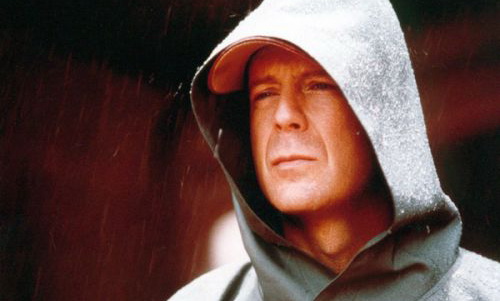
Unbreakable (2000)

7 Mar

unbreakable2nightchronicles

Smith’s Verdict: ***1/2

Reviewed by Tanner Smith

When you hear about writer-director M. Night Shyamalan’s follow-up to his masterpiece, the 1999 supernatural thriller “The Sixth Sense,” you either expect very much or very little. It’s that feeling you get when you watch the trailer of “Unbreakable” and you notice the writer-director’s name, as well as the somewhat similar tone that “Sixth Sense” had, what you can gather from the trailer. Oh yeah, and Bruce Willis is in both movies.

That said, I think “Unbreakable” is a wonderful movie. It’s eerie, original, and well put together.

It has that same uneasy feeling that was brought to life for the best in “The Sixth Sense.” Only this time, it isn’t a spin on the ghost story, but on the superhero origin story. The whole movie is scripted like the first half of a superhero movie and shot like a haunting portrait. Comic books featuring superheroes take on a major element of “Unbreakable,” but this is not a comic book movie. Far from it.

It begins as a security guard named David Dunn (Bruce Willis) is the sole survivor of a train derailment. Not only that, but he walks away from the crash completely unharmed, without breaking one bone in his body. This attracts the attention of comic book collector Elijah Price (Samuel L. Jackson), whose life has been nothing but misfortune. He was born with a disease that makes his bones extremely fragile and easily breakable. As a child, his classmates dubbed him “Mr. Glass”, because his bones “broke like glass.” His mother got him hooked on comic books as a child to keep him from sadness, and he has been studying them ever since.

Anyway, Elijah contacts David and tells him a theory that may or may not be possible. From studying comic books, he has a theory that if there is a man such as him, whose bones can break easily, then there should be a man who is in the exact opposite way of living—an unbreakable, invincible man.

At first, David dismisses Elijah’s theory as just a crazy idea. But soon, he begins to ask some questions about himself. He asks his boss if he’s ever taken a sick day from work, and he asks his wife Audrey (Robin Wright Penn) if he’s been sick in the entire time they’ve been married. (There was a nearly fatal accident he and Audrey have been in years ago, but even that has its secrets.) David’s son Joseph (Spencer Treat Clark) believes that Elijah is right and that his dad is some kind of superhero. He even goes to an extreme measure of attempting to shoot David with a pistol to prove to him that Elijah is right.

There’s a real amount of tension throughout “Unbreakable” that also comes when Audrey, a therapist, has Elijah for a patient and doesn’t know that he and David have already been in contact. There are many moments like that that just feel like there’s something eerie going on, but you’re not quite sure as to exactly what.

There are many touches that Shyamalan puts throughout the film. One is the use of glass around Elijah—you see him in a reflection off a TV or a glass case, and his own cane is made of glass. Then, there’s the constant use of lingering shots that just continue at their own pace—they’re well-directed, well-acted, and they take their time to continue. Another is the choice of clothing that these characters wear. I should explain what I mean by that, but I fear I might be spoiling something.

One could watch “Unbreakable” and appreciate what Shyamalan has done this time. It may not be up there with “Sixth Sense,” but what follow-up usually is? Then, one could watch the film more than once and piece the puzzle together after experiencing the twist ending the first time, as they did with “Sixth Sense.” Yes, there is a twist ending here, as there was in “Sixth Sense.” It features Elijah’s further characteristics, and I won’t give anything else about it away, but I will say this—When I watched it for the first time, I didn’t accept it because I couldn’t believe it. But I watched the whole film again and let everything piece together in my mind. What I realized is how tragic Elijah’s story is. It’s intriguing, the way that destiny could be either a good or bad thing, depending on how you look at it. That’s all I’ll say about the ending.

What “Unbreakable” might be missing, and I think this is what cost the film half-a-star from me, is a more confident, heartfelt relationship between David and his son. There isn’t that much of a sense of connection that we’re supposed to feel for these two. Actually, there’s some sense, but not enough. But what really makes “Unbreakable” stand out are the creative ideas put into the story, the consistent dark tone that comes with this type of storyline, and two great performances from Willis as the everyman and Jackson as the mysterious tragedy-personified.

Dogma (1999)

5 Mar

dogma_1999_1

Smith’s Verdict: ***1/2

Reviewed by Tanner Smith

When “Dogma” was released in 1999, it was met with outrage even before it came out. Because of its subject matter—which looked like satire of religion and belief—“Dogma” caused organized protests and much controversy in many countries. It also (as I’m reading from the film’s Wikipedia page), the controversy delayed release of the film and led to at least two death threats against the film’s director/writer Kevin Smith.

Well, you know what, guys? God has a sense of humor. And that’s exactly what Kevin Smith’s disclaimer that comes before the film states, along with saying that ten minutes or so into the film might offend most people, and that the film is a work of comedic fantasy, “not to be taken seriously.” If you don’t want to see a comedic fantasy revolving around Catholic belief, then for the love of God (excuse me), don’t see it. If you can’t stand the profane language that runs throughout the movie, don’t see it. Don’t take it too seriously.

OK, so there’s basic news provided in this movie, stating that Jesus was black, there was a 13th apostle left out of the Bible, God’s a woman, She’s a skee-ball fanatic, Jesus had brothers and sisters (apparently, Mary didn’t remain a virgin), and are you still with me? I figured you’d have just stopped reading after that last piece of “news.” If you stayed, congratulations—you’re not ignorant.

Me being a born-again Christian, I’ll admit I was a bit nervous about watching this movie, but I didn’t express rage before I saw it…I had enough sense, even at the age of 16, when I first watched it. Is it offensive? Yes, I should say that right off the bat, it is offensive, though that’s mainly due to the constant use of the “F” word and sex jokes. But the movie is also strangely intriguing and, I’ll have to say, very funny. Kevin Smith has always had an ear for dialogue and uses it to mix the Bible with the modern times. The result is “Dogma,” a dialogue-heavy but weirdly entertaining movie about…(sigh) a possible loophole in God’s plans.

I’ll tread easily here to save my own soul.

The movie’s story features two fallen angels named Bartleby (Ben Affleck) and Loki (Matt Damon). The two were banished to Wisconsin after thousands of years ago, Loki was the angel of death until Bartleby talked him into quitting (and giving God “the finger”). Now in the present day, they come across a loophole that could allow them back into Heaven. But that’s a huge problem, as explained by the Metatron (or the Voice of God, to be more accurate). The Metatron (Alan Rickman) explains to a cynical Catholic woman named Bethany (Linda Fiorentino) that if the two angels succeed, it would prove God to be infallible. When that happens, existence could be nothingness.

Bethany, dubbed the “last scion,” is sent on a crusade to New Jersey in order to keep that from happening. Helping her are a group of misfits—the 13th apostle named Rufus (Chris Rock), ticked off about his exclusion from the written word because he’s black; “prophets” Jay and Silent Bob (Kevin Smith’s running characters in his movies, again played Jason Mewes and Kevin Smith himself); and a muse in the form of a beautiful woman (Salma Hayek)…who has writer’s block.

The screenplay is full of ideas surrounding Catholic beliefs and it features many memorable lines, such as when Bethany asks Rufus if he knew Jesus Christ, and Rufus responds, “He owes me 12 bucks!” There are rules for angels, who can take human form and retract their own wings (oh, and they have no genitalia—Metatron states in a deadpan matter, “I’m as atomically impaired as a Ken doll”). There are many issues of religion as to how no one’s truly wrong as long as one has faith, as well as certain misreadings of the Bible that Rufus likes to point out. There’s even a scene in which Loki goes back to his original duties to try and please God—he and Bartleby go to a family-franchise studio and state the executives are idolaters but are in fact terrible human beings themselves. Instead of a fiery sword, Loki uses a gun. And there’s the constant difference to be noticed between Jay and Silent Bob. Jay’s a loudmouth who never shuts up about wanting to sleep with Bethany (or anything else, what little there is for him to talk about); Silent Bob is more sensible, but rarely utters a word.

The script is all over the map with its ideas and even provides villains for our heroes. You’d think Bartleby and Loki would be the only conflicted characters for Bethany and company to come across. No, the Devil isn’t involved in the story, but there are a group of demons—a muse-turned-demon named Azrael (Jason Lee), three rollerblading hockey punks, and a monster made entirely out of excrement—making sure that Bartleby and Loki do achieve their goal because they’d rather not exist than go back to Hell.

Strangely enough, even with everything that goes on in this story (and with the movie’s running time of 130 minutes), I was interested and wasn’t bored for a second. I listened to the movie. I realized that Smith isn’t a blasphemer—he creates a satire here, but like most great satires, they do wind up providing morals.

Smith may not be a director in respective terms, but he’s a darn good writer.

All of the actors are game for this material. Linda Fiorentino’s deadpan cynicism—her character believes God is dead in the beginning of the film—makes for an interesting heroine. Chris Rock is solid as the comic relief character—you know, aside from Jason Mewes’ obnoxious Jay character. Alan Rickman is fantastic and shows a great deal of game, particularly when he shouts lines like, “Stop a couple of angels and thus negating all existence—I hate it when people need it spelled out for them!” Ben Affleck and Matt Damon show enthusiasm, and even George Carlin, in a small role as a Catholic priest, has some nice moments.

The disclaimer followed by the story’s beginning states that within ten minutes or so, people would probably be offended. It does start out to live up to that promise—there’s a statue of the Buddy Christ (Jesus with a smile, a wink, and a thumbs-up), Loki telling a nun why he doesn’t believe in God (he claims to be an Atheist by using “The Walrus and the Carpenter” as his source), and then there’s that loophole (which, don’t worry, is resolved—I won’t say how). But the disclaimer also states not to take it seriously because it’s all for comedic fantasy, as noticed in the discussion—that also comes in the beginning—of dogmatic law and church law is defined and compared to each other. Just relax and enjoy the show.