Archive | Three-and-a-Half Stars ***1/2 RSS feed for this section

Working Girl (1988)

22 Mar

images

Smith’s Verdict: ***1/2

Reviewed by Tanner Smith

“Working Girl” is an entertaining spin on the traditional story of a plucky young woman making it big in business, but only by bending the rules. The story is updated to 1988, when the movie was made, and made into a very funny, engaging comedy.

Melanie Griffith stars as Tess McGill, a secretary working on Wall Street at a mergers and acquisitions department. She’s a bright woman—smart and aggressive with some good ideas about how to make money in this business…if only she was in a position to state them. And even if she did, it’s unlikely that anyone would listen to her, since she has the verbal wit of a precocious little girl.

Tess gets a new job and a new boss—a woman her age named Katharine Parker (Sigourney Weaver). They get along fine and Tess even shares some of her ideas with Katharine, who seems interested in what she’s saying. However, when Katharine breaks her leg (in one hilarious short scene featuring an unexpected scream) and is to be in traction for weeks, Tess is in possession of her computer files and comes across one of Tess’ own ideas, which Katharine was stealing to claim as her own.

Angered by her boss’ deception, she decides to create a little deception of her own. She is going to pose as a firm executive and meet up with another executive named Jack Trainer (Harrison Ford) to bring new ideas to life. They meet at a bar, without saying each other’s names (Tess says who she’s waiting for, and Jack decides to have some fun with this), and they get drunk and wind up in the same bed the next morning. Only at work does she realize who this guy is. However, despite Tess’ silly behavior that night, it turns out to be OK, since Jack likes Tess and he will take her ideas seriously.

So, you know the drill. Tess is continuing with the masquerade, keeping it a secret to Jack, despite their growing relationship. It’s only a matter of time before Katharine is able to come back to work and become a risk to Tess’ breakout, revealing the lie. And yes, we do get that obligatory “liar revealed” scene, in a boardroom with a lot of people, no less. It ends with shocking discoveries, a villain’s smirk, and walkouts, leading of course to scenes in which the heroine must question what to do now and…of course find a solution that will bring her back on top. The story is traditional, but updated with a quick-witted screenplay. However, a weakness with the film is that that “liar revealed” cliché is still played out just as idiotic as it almost always is in movies. But the movie saves itself with a line from Harrison Ford’s character that should have been used minutes ago, and leads to a climax that’s both suspenseful and satisfying.

While Melanie Griffith has received third billing in the credits (with Harrison Ford first and Sigourney Weaver second), this is really Tess’ story being told here. We see from her point of view and it’s really her journey that’s being shown here—her pluckiness, her mistakes, her ideas, her victories, etc. Griffith is an effective casting choice—fresh, likable, and funny. Meanwhile, Harrison Ford does fine work and shares good chemistry with Griffith, and Sigourney Weaver is great as the kind of villain (or villainess) you love to hate. Of the supporting cast, Joan Cusack, as Tess’ best friend Cyn, has some of the funniest lines in the movie, particularly in the scene when she poses as Tess’ secretary—“Anything I can get for you? Coffee, tea, me?”

If I’ve made “Working Girl” out to be a well-acted update on this standard story, I should also point out that this movie is really funny. There are hilarious one-liners delivered greatly, a lot of which centered around Tess’ naivety—for example, when she first meets Jack (without knowing who he really is), she states, “I have a head for business and a body for sin.” How can you not love that?

Sinister (2012)

20 Mar

Sinister-2012-movie-4

Smith’s Verdict: ***1/2

Reviewed by Tanner Smith

We have seen many movies with “found-footage” scenarios—“The Blair Witch Project,” “Cloverfield,” “Diary of the Dead,” “District 9,” the “Paranormal Activity” movies, “The Last Exorcism,” “Chronicle,” and “Project X.” It should be its own genre, if it isn’t already. We know what to think of them because when all is said and done, they are movies. But you have to wonder if someone did view these odd scenarios as if they really were found footage. In other words, what if these types of scenarios really were found footage, and not something staged for a production? What would be going through the head of the person who found it? What would he feel? How would he react? Would watching it have any effects on him?

“Sinister” uses that idea to tell a story about a character that grows obsessed and consumed by a mystery. Much like Alfred Hitchcock’s “Rear Window” or Michael Mann’s “Manhunter,” “Sinister” is mainly about the rules and clues within the mystery, and how it affects the person investigating it as well as how it affects those around him.

But “Sinister” is a horror movie. It has all the aspects of such—darkness, loud noises, a house with a troubled past and a mysterious attic, moaning and groaning, and murders to be investigated. Oh, and there’s also a few odd supernatural symbols and a scary demon-face that appears out of nowhere at appropriate times.

“Sinister” opens in an effectively disturbing way—a Super-8 film that shows the hanging deaths of a family of four, hanging from a tree limb. Soon, we notice that the same tree is in the backyard of the new family moving into this same house. Ellison Oswalt (Ethan Hawke) is an author of crime novels, and he knows that something grisly happened at this location, though he’s forbidden from his supportive wife Tracy (Juliet Rylance) to tell her or their two young children anything about it. Ellison is in need of a bestseller, so he decides to look more into what happened here. While searching through the attic, Ellison comes across a box of Super-8 movies. It seems quite harmless, as they’re all labeled as family home-movies, until Ellison decides to watch them.

Ellison discovers that they are snuff films that show families being murdered in various ways—throats slit in bed, multiple drowning in a swimming pool, being run over by a lawn mower, and also that hanging that was seen earlier. Ellison suspects these are all the pattern of a serial killer and decides to investigate further. But then baffling things start to happen—footsteps in the attic, the film projector starting on its own, and then there’s that ghoulish face that appears in one of the films, and also seems to move on a saved still-photograph. And it turns out there’s more than some human serial killer that Ellison is considering.

You know how the characters of horror films seem to make stupid mistakes when it builds up a climactic act? Ellison is no exception, but at least he has a reason for doing what he winds up doing as the film continues. He’s obsessed, intrigued, and even somewhat fascinated by all of this. The more clues he comes across with this, the more captivated he is by this whole situation. But of course, he also gets his family in danger as well with such knowledge. His son is having night terrors, and his daughter is possibly influenced by some sort of supernatural presence related to this.

(However, you do have to wonder where Ellison’s wife draws the line and decides to pack up the kids and leave this man before he digs deeper into this.)

“Sinister” has fun with the horror genre and also tells its story in an intriguing way so that we are learning with the character more and more as the story continues, like how most good thrillers/horror films work. And it also knows how powerful a film image, such as in these Super-8 films, can be. But what makes it more fascinating was that it was co-written, with director Scott Derrickson, by film critic C. Robert Cargill (spill.com). The fact that a film critic wrote this allows for more to be analyzed through repeated viewings. Watching the film a second time on DVD (I saw it on the big screen the first time), there are a few little things I didn’t notice before, but are starting to become clearer now. You can also tell where he got some of his influences as a writer because there is that Hitchcockian element of voyeurism, as we are watching Ellison watching these Super-8 movies that should never have been watched.

I have to come back to the first paragraph. That’s still fascinating, how it was decided “Sinister” should be, with the “found-footage” aspect. I’m very pleased that Cargill and Derrickson decided to go this route and add the elements of mystery and nosiness to it.

“Sinister” is quite an affecting horror film—it truly lives up to its name. It’s unsettling, creepy, well-executed, and like the most iconic horror films (though I’m hoping there isn’t a sequel to this), it has images that you will haunt you for quite a while, whether you like it or not.

Lethal Weapon (1987)

19 Mar

images

Smith’s Verdict: ***1/2

Reviewed by Tanner Smith

I suppose the “buddy-cop picture” is a genre. You know the story—two mismatched cops who work together to solve a case and form a bonding friendship along the way. There have been many of this type of movie, but “Lethal Weapon” is the best. “Lethal Weapon” is an action-packed thriller that does feature a pair of mismatched cops working together to solve a case, but also features character development and wry humor. But of course, it does have its dose of adrenaline within itself so that the film has a share of characters, comedy, and action.

Danny Glover stars as police sergeant Roger Murtaugh, an uptight family man with just a few weeks left until retirement. He’s “over the hill” now and constantly says he’s getting “too old for this sh—.“ Mel Gibson co-stars as Sergeant Martin Riggs, a loose cannon who lost his wife in a tragic accident. He blames himself for her death and even considers killing himself. Because he doesn’t think he has much to live for, he’s suicidal in the way that he doesn’t fear anything.

Murtaugh and Riggs are paired up and assigned to investigate the seemingly apparent suicide of the daughter of an ex-Vietnam War compatriot (Tom Atkins). But soon, it seems like that this death was an element of a drug smuggling plot. The leader of it is mercenary General Peter McAllister (Mitchell Ryan) and his right-hand man is the menacing, torturous Joshua (Gary Busey). Murtaugh and Riggs get into more than they expected.

But it’s not just about that, even though this plot detail is crucial (not to mention easy to follow). It’s also about the characters. We know and see clearly how Murtaugh feels about getting closer to retirement, and we also see the pain in Riggs’ eyes when he’s not making people believe he’s crazy. Then, we have the scenes in which Riggs interacts with Murtaugh’s family. They have dinner together and Riggs has a playful flirtation with Murtaugh’s teenage daughter (Traci Wolfe). But we also see how he envies Murtaugh’s home life.

A word about Riggs’ attitude—he loves to make people think he’s crazy by throwing himself in every dangerous situation he can get into as a police officer. When we first see him, he’s walking through the line of fire during a madman’s gunfire attack onto a school playground and standing dead center in the playground, opening fire at the madman. That’s when we know that he may be crazy until we see him at his home—a trailer near the beach—and realize that he thinks that he has nothing to live for due to blaming himself for the tragic death of his wife. So he does anything that no one else would do—this leads to a scene midway through the film in which he deals with a man threatening to jump from a building. This scene is played for comedy, and the payoff at the end of the scene is just fabulous.

The bad guys are genuinely threatening. Even if McAllister is a standard villain, Joshua is a real creep. This guy is so frightening that if he was in charge of the whole operation, there’d be a higher body count for this film. He proves himself to be a worthy antagonist for Riggs to encounter in the end, which is what they do, but that’s all I’m going to say about that, except this—the final action climax is the least interesting part of “Lethal Weapon” when compared to the character development and wry humor that came before it, even though other action scenes were also featured within the previous acts as well.

The action scenes are brought to life by director Richard Donner, director of “Superman.” His choreography and cinematography is outstanding in the scenes involving a shootout and an armed helicopter. When the lengthy climax comes into place, the action is exciting for a while but comes close to wearing out its welcome. But because we care about the characters and have an interesting bad guy, it’s not totally worthless.

Mel Gibson and Danny Glover are perfectly cast as the two heroes. They have great onscreen chemistry and become characters rather than caricatures. Mel Gibson is no stranger to action films (remember, he is Mad Max), so the real surprise is Danny Glover who previously acted in dramas like “The Color Purple.” He’s up to it.

“Lethal Weapon” has just what an audience wants in an action picture—action and comedy. First you can laugh, then something big happens, then you can relax again after that. It’s an action-thriller with a sense of humor and a sense of pace. That’s what makes the film special and different from most buddy-cop pictures.

Over the Edge (1979)

19 Mar

images

Smith’s Verdict: ***1/2

Reviewed by Tanner Smith

This had to happen sooner or later. Kids are pushed over the edge by their parents. They feel alienated and condescended by authority. At least, that’s what psychiatrists would conclude about the outrageous behavior the kids pull off in the movie “Over the Edge.” The marketing for the film tells it appropriately: “They were old enough to know better but too young to care.”

“Over the Edge” is a depressing and quite genuine film about the lives of troubled youths who live in a Denver suburb called New Granada, still in development. The kids spend their days at the local recreation center while the adults—parents, cops, and schoolteachers—try to find a way around the “youth problem,” since they feel that the kids are in the way of their paradise. One cop, in particular, practically stalks these kids each day to try and catch something on them. This is Deputy Doberman (Harry Northup), who is not really a bad guy but a deputy who knows more about the law than about human nature.

The kids have their own fun avoiding the adults during the day—going to parties, having a little hash or speed, playing with a gun they stole from someone else’s home, and talking about sex. It should be added that most of these kids aren’t bad. They just feel unwelcome by the adults, especially when they close down the rec center so the Texas investors who visit New Granada won’t think the suburb is invested with youths. That’s really low.

The main character is a good kid named Carl (Michael Kramer). He hangs with tough guy Richie (Matt Dillon) and has other friends who are into dope, hash, and speed. His parents love him and think that he’s hanging with the wrong crowd. (And Carl, like most kids in his situation, can’t fully explain under so much pressure.) He has a crush on a girl named Cory (Pamela Ludwig), who is said to have a sexual reputation which may not be true, and she has feelings for him. Soon, they become very close with one another.

But disaster strikes and Carl winds up in a nasty situation when Doberman shoots one of his best friends. This leads up to the climactic, violent ending, in which the kids are over the edge and ready to strike back at the adults. They don’t perform physical harm to the adults, but they make them suffer by showing them what they can do when pushed over the edge. The ads for this movie apparently found the climax promotable and made the whole movie sound like a youth version of “The Warriors.” I’m serious—this ending is ultimately violent. There are destroyed cars, exploding gas tanks, and more.

The ending may be a bit unconvincing but what leads up to it is exceptionally brilliant. We get to know these kids, we feel for them even when we shouldn’t, and we care about what happens to the kid who is doomed to be shot and killed (not saying who it is). “Over the Edge” gives a great portrait of teenage life. The kids are portrayed in a convincing way—they have adolescent values and real emotions. This is helped by great performances by the young actors. Michael Kramer is convincing as the trouble teenaged lead. Matt Dillon is convincingly tough as Richie and he has the best line: “I only got one law: a kid who tells on another kid is a dead kid.” Pamela Ludwig shares some terrific scenes with Kramer. Their scenes together seem so wonderfully crafted; everything they say and do make them right for each other. There’s another kid, played by blond-haired, wide-eyed Tom Fergus, who steals every scene he’s in.

Actually, if you think about it, maybe these adults have gone too far. Maybe they deserve to see what they’ve stooped their kids into doing. Maybe. But the scary thing is that there are kids in the real world who are like the kids in “Over the Edge.” They’re old enough to know better but too young to care.

Jagged Edge (1985)

18 Mar

jagged-edge-1985--02-650-75

Smith’s Verdict: ***1/2

Reviewed by Tanner Smith

Maybe it’s because I’ve seen too many movies, but whenever I hear the setup for a thriller and I hear from other people (or most critics who are almost like people) that it has a “twist ending,” I always believe I can guess exactly what the twist is. And some of the time, I am correct. Twist endings just don’t surprise me anymore because when there are so many thrillers with these alleged turns, they’re just easier for me to guess.

I bring this up because the 1985 murder thriller “Jagged Edge,” written by Joe Eszterhas and directed by Richard Marguand, is notable for its particular twist ending. And even though I didn’t know the twist, I knew there was one. And so, being the investigative reviewer that I am, I kept track of all the clues as the story continued. What surprised me, however, was just how much was being pitched into the story. In this particular “whodunit” mystery, we have clue upon clue upon clue, as they’re all introduced sneakily and smoothly. So by the time that particular twist came along, I must confess I did not guess correctly what the resolution was going to be.

“Jagged Edge” is a thriller that recalls the Hitchcock direction in that it likes to “play the audience like a piano.” In this case, with everything being thrown at us (and if we’re all caught up in the mystery), we can’t help but decide whodunit ourselves. It’s an efficiently made, well-put-together thriller that kept me on edge until the very last shot.

The mystery is this—Jack Forrester (Jeff Bridges), a San Francisco publisher, is accused of brutally murdering his wife. As the assistant Defense Attorney Krasny (Peter Coyote) points out, Jack has the motive, which is he may have murdered his wife so that he could inherit her entire fortune. Jack’s defense attorney is Teddy Barnes (Glenn Close), who used to work for Krasny and hasn’t worked in criminal law for four years since. She chooses to take the case because as she spends time with Jack, she’s convinced that he’s innocent…but also convinced that they’re in love, which only makes things a little more complicated.

Aside from the tricky storytelling, what really makes “Jagged Edge” stand out is the character of Teddy Barnes, played by Glenn Close with a great mix of vulnerability and intelligence. This is mainly her story that is centered upon in this film. We find that she hasn’t taken courtroom cases because of a certain case four years ago in which an innocent man still went to prison and later hanged himself. Seeing this new case, and believing her client truly is innocent, she sees this as a way of redemption. Even though some people believe Jack is guilty, Teddy is determined to prove otherwise and get him off the hook—she states right at the start, “If he didn’t do it, I’ll get him off.” And then she starts to fall for Jack the more time she spends with him. But then there’s the court case itself—it turns out there is a lot of evidence on both sides, and this is where Teddy (and as a result, ourselves included) asks herself a lot of questions. Is she defending Jack out of bias because she loves him? Did Jack really kill his wife? Did he not, like she thinks? Is she defending a brutal killer who may just as well murder her soon enough? The most unnerving aspect of “Jagged Edge” is that both sides of the case state plausible reasons to be true, leaving us to keep guessing what is true and what’s not. What can we truly believe?

Glenn Close does a wonderful job playing the protagonist, and you really do feel for her when she’s trying to figure things out and when her life is in peril. Jeff Bridges is great as the alleged killer whose personality constantly keeps you guessing—did he do it, or did he not? Peter Coyote is instantly (yet intentionally, mind you) unlikeable as the unethical DA who always thinks he’s right, and also holds a grudge against the defendant (for publishing some unfair stories about him) and defense attorney. Also terrific is Robert Loggia as Sam Ransom, Teddy’s investigative friend who does some digging into the case, but not without frank skepticism.

“Jagged Edge” has so many twists and turns, and it succeeded as a courtroom drama and as a genuinely scary thriller. Admittedly, I didn’t correctly guess the ending, and I was unnerved by what I going to discover. If there’s one thing about the film that kind of disappointed me, it’s that maybe I didn’t need the final shot of the film, because it already has you guessing at each part and where it was going to head; I just thought maybe they could’ve ended it ambiguously and kept us guessing as to whether Jack was innocent or guilty. But to be honest…it still shocked me.

Oh, God! (1977)

17 Mar

3iEP0EnA6nffr5WRZgtjI7PnNYk

Smith’s Verdict: ***1/2

Reviewed by Tanner Smith

Upon meeting God Himself, a mild-mannered grocery clerk named Jerry is asked not to smoke as He adds, “Tobacco was one of my big mistakes.” Jerry, of course, thinks this is some sort of prank and plays along by asking if God has made any other mistakes. God’s response—“Ostriches—silly-looking things. And avocados—I made the pit too big.” Yes, the one who claims to be God has just declared himself fallible. But the crazy part is that he really is God. There’s no other way to explain it.

That’s how the writers of “Oh, God!” want to play it. Are they being blasphemous? Not necessarily. This is a satire on religion, but not in a mean-spirited, cheap-shot, or offensive way. God Himself isn’t given dumb treatment in this movie; in fact, as played by George Burns in human form, he’s like how we would imagine him if we were to meet Him. Be honest—don’t some of you imagine him as an old man wearing golf pants? (Well OK, He actually explains that he chose this form so that Jerry would be comfortable with his appearance.) “Oh, God!” is not trying to offend anybody—it has good nature and has a feel-good spirit to it.

The story of “Oh, God!” features Jerry (John Denver) as he receives a letter in the mail, granting him an interview with God. Jerry is curious, so he goes to the location he’s supposed to meet Him at. He at first thinks it’s a prank performed by a friend, but God pulls many tricks to convince him who He really is. (For one thing, he makes it rain inside Jerry’s car.) Now that Jerry is convinced that he is seeing God, what now? God wants Jerry to spread the word that God is alive and that things on Earth can be all right, if we want them to be. Pretty simple, but as you’d expect, when Jerry states that God has told him to repeat this message, he is met with skepticism as he hits first the news, then the media, and of course, the churches.

The screenplay to “Oh, God!” is winning in the way that it delivers many surprises while still being careful around its subject matter. My favorite line in the film is not about God’s mistakes, but about his last miracle—Jerry asks if God still performs miracles, to which He responds, “The 1969 Mets.” There are other funny scenes, such as the 10:00 news story featuring Jerry, and the final courtroom scene in which Jerry (and God) must present his case after many have accused him of blasphemy.

George Burns is wonderful in the role of God, with a twinkle in his eye and a trustworthy face and voice. John Denver, however, is a bore. His constant whining grew tiresome, as did Teri Garr as his equally skeptical but somewhat loyal wife. But Paul Sorvino, as the reverend who helps bring Jerry to court for his “blasphemy,” is well-cast and pretty funny.

“Oh, God!” could have easily been a low-brow, bad-taste satire or a Sunday morning church sermon, but this is a funny, tender, and pleasurable comedy with more human values than you might expect.

Cyrus (2010)

16 Mar

images

Smith’s Verdict: ***1/2

Reviewed by Tanner Smith

“Cyrus” has the plot of a family sitcom pilot—a single mother meets a new guy and her son tries to separate them for his selfish reasons. But make the story into a gritty independent comedy-drama, make the couple relatedly likable, and make the son an over-20, creepily-wholesome man-child, and you get “Cyrus.”

Despite the casting of John C. Reilly, Jonah Hill, and Catherine Keener, Judd Apatow was at no point involved with “Cyrus.” You’ll notice that just by the camerawork and gritty tone delivered by low-key indie directors Mark and Jay Duplass. It’s dark and subtle, with a few comic moments to even things out.

It starts out pleasant enough, as John (John C. Reilly), a relatively nice guy, is suffering an emotional blow. His ex-wife (but still-friend) Jamie (Catherine Keener) is marrying her boyfriend Tim (Matt Walsh). Even though they divorced years ago, the news that his ex-wife is marrying again is a bit much. But Jamie knows this and accompanies him and Tim to a party where she hopes he and a single woman will get along great. After some reluctance, John goes and meets Molly (Marisa Tomei). They hit it off pretty well, and even perform a karaoke version of “Don’t You Want Me” together. But after their first night together, she leaves a note where she should be on his bed. And when they see each other, she always leaves too early. With the slight suspicion that maybe she’s married or seeing someone else, John follows her home and discovers her secret—her grown son Cyrus (Jonah Hill) who lives with her.

Cyrus seems like a good-hearted, somewhat-normal guy, though he does have his creepy moments as he seems just a little too wholesome. And his relationship with his mother is a little too cute to be true (or comfortable). And quite possibly, he might have a mental disorder, as he sometimes freaks out in his sleep in the middle of the night. But he also has something else in mind as long as John continues to see Molly and soon, John and Cyrus are at wits with each other.

This is treated more seriously than you would expect, but there are some light comic moments for relief. The comedy is never broad or extreme—the raunchiness is never exploited (no nudity, though there is some sex). Instead, the humor comes from the realism of the situations that play off in this script and execution. These characters aren’t caricatures of other such characters in this sort of film (or story, at least); they’re treated as real individuals with plenty of interaction to give them all dimensions. Even Cyrus has his moments of humanity, despite his reputation as a creepy man-child.

All four principal actors are great. John C. Reilly is instantly likeable and is completely relatable throughout the movie. You totally feel that he is connected to this character and script. Here, he reminds us of why he became a well-respected actor in the first place, before he joined Will Ferrell in comedies such as “Talladega Nights” and “Step Brothers.” Marisa Tomei just has to smile, and she has us invested. She’s as delightful and appealing any other role she’s played. The always-reliable character actress Catherine Keener has more dimensions to Jamie than you might expect from an ex-wife character. But what really counts the most is the casting of Jonah Hill as Cyrus. Hill is absolutely perfect in this role. Instead of pulling his usual schtick you see in comedies such as “Superbad” and “Funny People,” it’s interesting to see what he does with this character of Cyrus—normal when he can be, slightly psychotic other times.

“Cyrus” is unusual, but with an effective mix of sweetness and peculiarity. It doesn’t treat its characters as a mockery and doesn’t go for the easy way out with the drama or the comedy. Sometimes it can be inconsistent, but mostly it’s a brilliant piece of work.

Funny People (2009)

15 Mar

31funny_600

Smith’s Verdict: ***1/2

Reviewed by Tanner Smith

With a title like “Funny People,” a writer/director like Judd Apatow, and a cast that features actors/comedians like Adam Sandler, Seth Rogen, Leslie Mann, Jonah Hill, Jason Schwartzman, and Aziz Ansari, you would expect this movie to be as raunchy and as funny as Apatow’s other writing and directing works like “The 40-Year-Old Virgin” and “Knocked Up” or his productions such as “Superbad” and “Forgetting Sarah Marshall.” Well, there certainly is raunch and humor in “Funny People,” but at the surface is a story of pure drama. Many of the characters in this movie are stand-up comedians, and everyone else is in some other sort of show business (like a sitcom), but the characters are all hostile towards each other—while showing friendship as well as dealing with life issues—and the story is mainly about how life off screen or off stage is every bit as difficult as is it is on screen or on stage.

“Funny People” is probably the closest Apatow has gotten to digging deeper into what his characters are going through. Each of his movies had plenty of humor but enough realism to show their lives. This film goes the extra mile. The result—an uneven but mostly endearing movie about how these “funny people” live their lives.

Adam Sandler delivers his best work in the leading role, and that’s saying something, considering his great work in dramatic roles such as “Punch-Drunk Love” and “Spanglish,” aside from his usual shtick in his juvenile-minded comedies. He plays a stand-up comedian named George Simmons. He enlivens the stage and has a huge fan base, but his life isn’t as lively. He lives alone in a big mansion, barely has any friends, and could possibly have bipolar disorder. Women fall to his feet and men have their cell phones ready to take pictures of him whenever he sees him. The problem is he’s all alone in living this celebrity’s dream. Things get worse when he hears the news from a doctor that he has a rare blood disease that’s killing him.

Enter Ira (Seth Rogen), an aspiring comic who lives with his buddies, one of which (played by Jason Schwartzman, who’s very funny here) is a self-indulgent TV sitcom lead, who is so proud of his moderate success that he leaves his paycheck on Ira’s pillow. (Jonah Hill plays the other roommate.) Ira is forced to follow George Simmons’ stand-up comedy act one night, but it comes easy, since George is so depressed that he literally dies on stage, while no one suspects that he’s dying in real life. Ira uses George’s somewhat-failure to his advantage, and that leads George to hire Ira to write some material for him to use. Later, though, Ira is the only one who knows of George’s sickness.

What follows is actually a well-told story of how George deals with his disease and how the relationship between George and Ira develops. There’s humor, but there are also some really touching moments here—George’s meltdown when he realizes he can’t waste another minute, George’s confiding in Ira, and the people from his life whom he comes to contact with. One of those people is the “one that got away”—a woman named Laura (Leslie Mann, Apatow’s wife) who despite everything still loves George and wants to spend some time with him, now that he’s dying.

All of this is well-told. Sandler does a terrific job of showing the dark side of this stand-up comic who faces his own mortality. Sometimes, he’ll look at it with a laugh, but like everybody, he’ll ponder his life and dread the end. The movie shows a nice job of showing parts of his career—for example, we see posters and clips of George Simmons’ movies that, believe it or not, look actually worse than the actual Adam Sandler comedies. One of them features him as a man-baby, with his head on a baby’s body, and another features him as a half-man, half-fish (a merman). I should also note the way this movie opens—it opens with home-video footage of George making crank calls with his college buddies (the footage was shot by Apatow himself and the buddies were actually Ben Stiller and Janeane Garofalo). This is funny because Sandler thinks it’s so funny, he’s enjoying what he’s doing and his friends are laughing uproariously as he does it. Then the movie starts and you see George many years later, alone in bed and tired. Times have changed. He has no one to share the laughs with. This is the life he leads now that he’s become rich and famous. It lets you know right away that “Funny People” isn’t merely a comedy. It’s saying something serious about fame.

Not to say the entire movie is serious. There are plenty of funny moments in this movie to balance the dramatic moments. There’s Adam Sandler’s guitar-playing mocking of Ira’s former last name (it’s spelt Weiner, but pronounced Whiner), James Taylor briefly mocking Ira’s sense of humor at a MySpace party, Jonah Hill’s description of how a popular video can lead to something more, Jason Schwartzman’s self-indulgence, and more pleasantries.

All of the actors do fine work. Seth Rogen does a surprising turn because he isn’t playing the loud, anxious best friend role that made him famous in Apatow’s movies like “40-Year-Old Virgin.” I’ve seen him play that role in many other movies and while he is funny and entertaining to watch, it’s so refreshing to see him actually try to act in this movie. And he does a convincing job. I bought Rogen as this bashful, clueless, good-hearted comic who tries to make George feel good about himself in his remaining days. Jonah Hill and Jason Schwartzman crack several one-liners; they’re very funny here. Also notably funny is the deadpan presence of Aubrey Plaza, a mousy female comic whom Ira has a crush on. Oh, I almost forgot about Aziz Ansari—he plays another desperate stand-up comic and while Ansari’s role is brief, he makes the most of it.

“Funny People” has all the material for a movie that deserves four stars. Unfortunately, this is only the first half of the movie. And from this part, I’d like to issue a SPOILER ALERT! Even though a major plot point I haven’t discussed yet is shown in the film’s trailers, I won’t take any chances. So finish the review right here and see the movie for yourself, but I should warn you the movie is two hours and twenty-six minutes long and when you realize why that is when you watch the movie, come back and read the review.

For those of you who stayed, I’m about to go into the second half of “Funny People,” which is surely less successful than the first half. It begins with George learning that he’s actually beat his disease. Actually, that could have been the end of the movie. I felt like I’ve seen the end of a movie as Ira yells in delight that George is cured. But no, there’s a little more than an hour left to watch. All that time leads to George’s new affair with Leslie Mann’s Laura. Laura learns that George is well and still has these feelings for George, but the problem is she’s married to an Australian hunk (Eric Bana). But he’s on the road most of the time, and George finds it more appropriate—to himself, anyway—to pay her a visit at her house, dragging Ira along with him. It’s an overnight that eventually becomes longer, much to the concern of Ira and to Laura’s two young daughters (played by Apatow’s and Mann’s real-life daughters, both of whom were also in “Knocked Up”).

The movie just becomes more of a family melodrama and becomes less of what has followed before. It only gets more complicated as Bana returns home and has his suspicions of George’s visit. I wanted George and Ira to just leave the house and go back to where the more interesting characters and story developments were.

What I’m getting at is that “Funny People” is a missed opportunity for a really great movie, and I feel like I’ve seen Apatow’s special “director’s cut” than the actual movie that, when you get down to it, was really the first half of the movie, which is so rich and funny and insightful that you wonder if Apatow could have saved the stuff with Laura’s family for a “Knocked Up” spinoff.

“Funny People” ends with a conclusion that is satisfying enough that you feel like you’ve enjoyed spending time with these characters. You may be relieved to go home, but at least, you have things to think about, related to most of what you’ve seen. The movie does have pacing issues and you wonder why the editors couldn’t have cut a few minutes out of certain scenes, but as it is, “Funny People” is a smart, endearing comedy/drama and is probably the closest Apatow has ever done as a writer and director to telling a real story. Apatow has made himself known as the modern king of comedy, and I always look forward to his next movie, whether it’d be one that he wrote or directed himself or simply one he produced (because he puts in his own creativity as well as the writers of those projects, and you always recognize it). “Funny People” is a near-triumph, but good enough. Oh, and did I mention that George dismissed absolutely everything he may have learned from his near-death experience? How often does that happen in a drama that features cancer? Just thought I’d point that out at the very end of this review.

Open Water (2004)

14 Mar

images

Smith’s Verdict: ***1/2

Reviewed by Tanner Smith

“Open Water” is one of those movies that uses what limited resources it has and yet somehow causes a strong effect on you. That effect is the experience of not merely watching a movie, but letting it happen to you. And in a horror film such as this, it works even stronger—you constantly have to make sure you’re in the theater or living room or wherever you’re watching it, just to make sure it’s only a movie.

Oh yes, “Open Water” feels realistic—the characters seem credible, the atmosphere is their atmosphere (becoming our atmosphere), and the scares are genuine. Nothing happens when we expect it to, and that’s what keeps the tension rising.

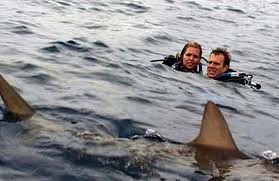
The movie, loosely based on true events, tells the story of a couple (Blanchard Ryan and Daniel Travis) who vacation in the Caribbean and go scuba-diving in the middle of the ocean. But when they surface, they’re met with the shock that the boat has left without them. There’s nobody around. They’re all alone. They’re just drifting in open water.

But it gets worse—the ocean is infested with things like jellyfish and worst of all, sharks. The man remembers only what he saw on TV documentaries featuring sharks, and warns the woman not to kick around or swim too much, because of the risk that a shark could come along and eat them. However, things get complicated and more deadly once the sense of anger and hopelessness has caught up with these people. There’s the sense of isolation brought upon by being left behind and forgotten—that sense is obvious throughout the movie.

“Open Water” was made on a shoestring budget, and you can easily tell by the film’s quality (or lack thereof). But luckily, most is made of filmmaker Chris Kentis’ limitations. He hired two good, convincing unknown actors to play these two characters we sympathize with, and it should also be noted that his use of digital cameras is effective in underwater shots. Also, his screenplay for this movie is composed of dialogue that sounds like realistic conversation given the circumstances. All of these elements make for a credible experience—a truly effective thriller.

The Boy Who Could Fly (1986)

14 Mar

MSDBOWH FE015

Smith’s Verdict: ***1/2

Reviewed by Tanner Smith

“The Boy Who Could Fly” is a movie with a great deal of sentimentality. But that’s the point. This movie didn’t need to hint out the moral to its story—it just says it out loud in the final scene. What you’ll be more impressed with is how magical it seems, given that it takes place in everyday suburban life. It’s touching, it moves, and you feel good by the time the movie is over. You either get into it, or you don’t. I did.

As the title suggests, there is a boy and he could fly. But here’s the real situation—the teenage boy, named Eric (Jay Underwood), is autistic and is constantly sitting out on his windowsill, pretending to fly. Sometimes he will even go to the roof of his own house and pretend. According to a teacher at school, Eric’s parents died in a plane crash and Eric started to pretend to fly at that exact moment, as if he could’ve saved them. Eric lives in an urban home with his constantly-drunken uncle Hugo (Fred Gwynne), who isn’t abusive but more confused because of the alcohol. He claims he has seen the boy fly, but then again, he sees a lot of things. And then there’s the story of how Eric may have flown up to a power pole to hide a neighbor’s BB gun, as well as a situation in which he is sitting at the main character’s window and when the main character turns away and back, he’s back on his own windowsill. Can he really fly? Who knows?

The main character—a 14-year-old girl named Milly Michaelson (played by Lucy Deakins)—is already told the stories about Eric’s parents and Eric’s actual flying. She also sees him pretend to fly while sitting on his windowsill. Since she moved into the house next door to Eric, she can’t help but wonder about him. She suddenly feels like it’s her responsibility to watch out for him—she’s the one who “rescues” Eric from the roof of the house (I used quotation marks because Uncle Hugo says later that he couldn’t fall). As time goes by, she and Eric become close with one another. She seems to be the only thing that can break Eric free of his world of fantasy. First he mimics her every move, then (slowly but naturally) realizes what he’s doing and tries to do his best around her. But the problem is, you never can tell what he’s thinking or even if he’s thinking. He only cares about flying…and right now, he also cares about Milly. At one point, he catches a fly ball that almost hits Milly in the head so you can tell he can set his mind to one thing, even if that one thing is caring for Milly’s wellbeing.

Then something happens. Milly is saved from almost certain death when she slips and falls off the side of the bridge while reaching for a flower. The only one that could have saved her life was Eric, who was with her at the time…and the only way he could’ve possibly saved her is if he flew.

“The Boy Who Could Fly” does a nice job of setting up its story by introducing the characters. Milly has moved into this urban neighborhood (complete with white picket fences and identical houses) with her single mother (Bonnie Bedelia) and little brother Louis (Fred Savage). The father, revealed in a scene with a cameo by Louise Fletcher as a psychiatrist, had committed suicide when he realized he had cancer, leaving the family in dismay. Milly is in high school trying to fit in with the snobby types all around her; her mother is back to doing her job in the insurance company but doesn’t know how to use a computer; and feisty Louis has his own little adventures as he tries to get around the block on his tricycle (bullies and a Rottweiler keep stopping him). We’re also introduced to Milly’s nice teacher (Colleen Dewhurst), who believes Milly can get through to Eric when no one else can.

This seems like the kind of movie Frank Capra would have liked to make—a movie that actually tells a story with compelling characters and a neat storyline. The ending, though, is somewhat preposterous but to be fair, you can already see it coming even if you don’t want to. But I was satisfied, nonetheless. In fact, before I was typing this, I was considering a three-star rating for this. I know now that I would much rather rate it three-and-a-half. That’s the kind of impression this movie left on me.

Another reason this movie works is acting, especially with the lead performance by Lucy Deakins. Deakins is wonderful as Milly. Every line of dialogue she says, you believe her. She’s so warm, empathetic, pretty, sensitive, and believable. I liked Jay Underwood, controlled and convincing as Eric; Bonnie Bedelia, convincing as a housewife mourning her dead husband; and Fred Savage who has a watchable kinetic energy to his performance.

I guess I should tell you the moral (if you want the movie to tell you itself, stop reading): if you believe and love long enough, anything is possible. It’s not subtle, but I got into it anyway because everything leading up to it. It earned its message, and “The Boy Who Could Fly” is a treasure of a movie.