Archive | Three-and-a-Half Stars ***1/2 RSS feed for this section

The Indian in the Cupboard (1995)

27 Mar

syn__0017_indianInTheCupboard

Smith’s Verdict: ***1/2

Reviewed by Tanner Smith

Children sometimes like to pretend their action figures are alive—they play their games with this imaginative concept and treat their tiny figures as if they were real people. But because these kids know their toys are not truly living, they feel free to subject them to all sorts of playful tricks in an imaginary war for them. But what if these toys actually did come to life? They wouldn’t be toys, though. They would be real, three-to-four-inch high people. Throw them around in these previously-harmless games, and they will be injured or worse. These kids would then have to learn responsibility in the case of looking out for these new companions, because they truly are new companions. That’s how “The Indian in the Cupboard” manages to teach lessons to kids without feeling the need to preach. It’s an interesting concept for a family film, and it’s put to good use.

Based on the popular novel by Lynne Reid Banks and adapted by “E.T.” screenwriter Melissa Matheson, “The Indian in the Cupboard” joins that special class of family films that truly know its target audience and treat them with enough intelligence as well as entertainment value that also manages to teach something. There’s as much focus to the story as there is to the (required) special effects. As a result, the kids are not only entertained, but they feel they learned something from the movie. And adults, or rather parents of these young children, won’t be bored by it.

“The Indian in the Cupboard” begins as a boy named Omri (Hal Scardino) is celebrating his ninth birthday. He gets a skateboard and the latest toys, but also a little plastic Indian figure and an old cupboard. Omri finds a key that fits the cupboard lock and puts the Indian inside it. He learns, to his amazement, that once he sticks a figurine in the cupboard, turns the key in the lock, and opens the door, that figurine comes to life. That’s what happens with the Indian, who is now a living, breathing, four-inch tall Iroquois native named Little Bear who sees Omri as a giant and reacts with awe and fear. Omri and Little Bear (Litefoot) soon befriend one another, as Omri realizes just how real Little Bear really is. “He talks, he eats, he trusts me,” Omri writes in his classroom story about the ongoing experience.

It’s here that the lesson of responsibility comes into place. Omri knows that this previously plastic toy is now suddenly alive because of this cupboard, and at one point feels free to try this new discovery on other toys (RoboCop and Darth Vader, in one brief scene), but once he does this, he realizes that this is not a game to play. This is a dangerous, delicate new thing that Omri must be careful with. He must also make sure that Little Bear is safe while he decides to stay in Omri’s world for a while—once Little Bear is out of Omri’s sight, he is attacked by a bird, and so Omri uses the cupboard to bring a British wartime medic, Tommy (well-played by Steve Coogan), to life for help. That also brings into the question of overusing this gift just because he can—Omri learns that if he’s going to do it again, there has to be a good reason for it. At one point, Little Bear even points out, “You should not do magic you do not understand!” “The Indian in the Cupboard” is effective at stating that everyone must be responsible for their actions, even a child.

Midway through the movie, Omri’s friend Patrick (Rishi Bhat) is let in on the secret, but Patrick is defiant and decides to use the cupboard himself, despite Omri telling him this is too much responsibility for him to handle. Patrick brings to life a cowboy figurine (and his horse) that becomes a cranky, emotional cowboy named “Boo-Hoo” Boone (David Keith) that of course sees Little Bear as a “stinkin’ savage” and so the two are at war with each other. So while Omri has to convince Patrick that having this four-inch person around is something to think further about, he also has to make sure the cowboy and the Indian get along. A clever, nice touch.

The visual effects in “The Indian in the Cupboard” are outstanding. Mixing the young actors (Hal Scardino and Rishi Bhat) with miniature people are seamless and well-done. They look like they’re right there in the frame with each other. Also, the effects aren’t flashy; they’re executed in a surprisingly plausible manner (notice how in some shots, the little people are out of focus in comparison to the “big” kids), which helps make it easy to suspend disbelief. There’s another fantastic effects shot that shows Little Bear in the palm of Omri’s hand, and it looks so convincingly real.

What it really comes down to with “The Indian in the Cupboard” is its messages of ethics and relationships. The themes of ethics are present in this movie, but they’re not thrown at your face. We see Omri’s growth and learn along with him, which also makes this more of a coming-of-age story than anything else. The relationships are present not only with Omri and Little Bear, but with Little Bear and Boone who do sort of become friends, despite their differences. They’re both tense yet interesting relationships to follow.

I don’t want to make “The Indian in the Cupboard” seem like so much of a family drama with special effects, because the movie is also a good deal of fun. There are little touches that help make the film interesting and fun to watch (as they follow along with the morals and ethics), including the character of Tommy who is fascinated by what happens to him (though he believes it’s a dream, to be sure) whenever Omri has to bring him to life for help. And of course, having a cupboard that can bring anything to life is undeniably fascinating—I love the bit in which Omri offers Little Bear a plastic tepee on his first night, and then uses the cupboard to make it into a real one. There’s also a crucial scene in which Omri and Patrick are forced to keep an eye out for a loose pet rat and make sure it doesn’t get to Little Bear and Boone, and there comes a satiation later in which Little Bear must go underneath the floorboards of Omri’s bedroom in order to retrieve the cupboard key, while the rat might also be loose down there. (Though, I’m not going to lie—I kind of wished there was an action sequence in which Little Bear fights off the rat. Instead, we’re subjected to seeing the boys as they listen for danger. But that’s a minor nitpick.) The best way to describe “The Indian in the Cupboard” is saying it’s smart, entertaining, and downright magical.

Be Kind Rewind (2008)

26 Mar

be_kind_rewind_still

Smith’s Verdict: ***1/2

Reviewed by Tanner Smith

“Be Kind Rewind” can be easily described as overtly whimsical. And that’s exactly what it’s supposed to be. I can see a lot of people—or critics who in some ways resemble people—being somewhat annoyed by everything thrown at us by visionary director Michel Gondry (“Eternal Sunshine of the Spotless Mind”), and others completely won over by the magic of it all. I fall into the latter category.

Sometimes, “Be Kind Rewind” is sticky. Other times, it’s forced. Mostly, it’s enchanting. It takes place at a street corner in Passaic, New Jersey, which seems to be stuck in a time warp. It has probably the last VHS rental store in the world (the movie’s world, anyway)—no new releases, because those are available on DVD of which there is none on display whatsoever. It’s said to be the birthplace of jazz pianist “Fats” Waller, as store owner Mr. Fletcher (Danny Glover) believes. But it’s implied that that’s not the truth. The store is set up for foreclosure and demolition to make way for modern conveniences. Fletcher leaves town to see what he can do, leaving his faithful live-in employee Mike (rapper Mos Def) in charge with instructions to keep his klutzy, annoying friend Jerry (Jack Black) out of the store.

Jerry works at the nearby power station and in a half-baked scheme to sabotage it, he becomes “magnetized” and accidentally winds up erasing every tape in the store. Desperate and panicked, Mike and Jerry grab a vintage video camera and set out to make their own versions of popular movies and rent them out instead. With help from their friends, they start with “Ghostbusters,” then “Rush Hour 2,” and then these homemade versions become so popular that it becomes a new business with a system—name which movie you want “sweded” (that’s the term they choose because they insist that the tapes come from Sweden, but who are they fooling?) and they deliver the goods. Suddenly, the store has the best business it ever had, but that doesn’t seem to please the copyright holders of the original films very well, especially since people seem to enjoy these shorter, reenacted versions better.

That story is bizarre enough, but it’s far from predictable and it’s very intriguing in its whimsy. Gondry loves to experiment with quirky, awkward humor to further the production and there’s plenty to be found here, which I’ll leave for you to discover.

The casting is inspired. I’ve always been a fan of Jack Black, but he has found a role that suits him better than a lot of his earlier roles. Mos Def is quite good as Mike—he’s calm and relaxed in contrast to Black’s zaniness. Melonie Diaz sports a cute smile and a can-do attitude as Alma, a local woman who helps Mike and Jerry with their business. (It should be noted, though, that a potential romance between Alma and Mike is immediately forgotten about after it’s set up.) Veteran actors Mia Farrow and Danny Glover are excellent in supporting roles.

The film is also a heartfelt tribute to independent filmmaking if I ever saw one and the way these “films” come about and how many people support them are great to watch, especially for an indie filmmaker such as myself. On top of that, Mike and Jerry’s new versions of these films such as “Ghostbusters” and “RoboCop” are so enjoyable, so funny, and very quirky. That they made them in just a few hours made me think back to the times when I was a kid making movies with no experience and very little equipment. I just wanted to put on a show, as these guys did.

The ending is just wonderful. It brings the tribute full-circle and becomes a sequence so heartwarming, so enchanting, so whimsical, that I couldn’t help but smile and even start to cry. I was actually wishing for the end credits, not because of usual reasons, but because I wanted to keep the tears from coming. That’s how well “Be Kind Rewind” worked for me. It’s sweet, cute, and just downright enjoyable.

Darkman (1990)

26 Mar

Darkman_2

Smith’s Verdict: ***1/2

Reviewed by Tanner Smith

Sam Raimi’s “Darkman” is a rarity in the movies—a superhero story that didn’t used to be a comic book series at first. It feels like it could be a comic book series, or a graphic novel series, and has fun with its energetic story and appealing “origin story.” Every superhero requires an origin story—how the hero gained his or her powers or skill—and “Darkman” is a doozy from the start. It gets stranger as it goes along, but that’s what makes it so entertaining. It’s engaging from beginning to end.

“Darkman” opens with criminals making deals and killing off those who disappoint. One bad guy in particular has a weird habit of breaking (severing) his victim’s fingers and keeping them as trophies in a small case, like a jewelry box. Strange enough, but then we’re introduced to our protagonist—a scientist named Peyton Westlake (Liam Neeson) who is developing a new type of artificial skin to help burn victims. The experiment isn’t going very well, as the skin disintegrates after being exposed to light for 99 minutes.

We know that these two plot elements are going to come together soon enough. That they’re both equally strange story aspects keeps you curious about how they’ll be handled once the meat of the story kicks in.

Anyway, as dumb luck would have it, just as Peyton discovers that the best way the skin can stabilize if it stays in darkness (apparently, this synthetic skin is photosensitive), this is when his laboratory is invaded by mobsters who know he has an important document that proves that a real-estate developer is bribing members of the zoning commission (and wouldn’t you know it—Peyton’s girlfriend Julie, played by Frances McDormand, is an attorney who was responsible for the document).

Are you getting all of this? Are you still with me? If so, you’re a bright reader.

So the bad guys blow up Peyton’s lab and Peyton is horribly burned alive. He survives the tragic ordeal and escapes from the hospital, but his face and hands are horribly disfigured. Oh, and a lot of his nerves are severed, so he can’t feel pain. To exact revenge on the people who did this to him, he creates a new lab in a condemned building to make new masks. He makes one of his original face so he can be with Julie again, though not telling her of his condition. Other masks are created for his enemies—he can observe them and study them, and then use the masks to become them one-by-one, in order to thwart them. The problem is he has only 99 minutes with each mask.

This leads to some fun comic scenes in which Peyton keeps his cover while impersonating these people. And give credit to the actors for imitating Liam Neeson imitating them. In particular, there’s Larry Drake, who plays a mobster who catches Peyton in disguise. Playing against himself (if you will) is a challenge and it confuses us as well as the henchman who is trying to figure which one is which. (My favorite moment in the film is when they’re both held at gunpoint and one of them shouts, “Shoot him!” while the other shouts “Shoot him!”)

“Darkman” has fun with its creative storytelling and unique visual style—the kind that Raimi has specialized in the “Evil Dead” movies (particularly the second one, which had an appealingly bizarre visual taste). “Darkman” has that hazy, dim comic-book look resembling a dark Batman tale and goes about with neat, tricky shots of people or objects popping into the frame and out and intriguing camera angles that keep action scenes not only exciting but also comic. Nicely-handled special effects help as well.

Liam Neeson, as the conflicted hero Peyton, is solid. He makes an interesting individual to follow in this superhero tale and does great work at showing the lighter and darker sides of this person who has lost his looks, restored his intelligence, but also struggles with the feeling of revenge, whether or not he can control it. At one point, he’s on a date with Julie at a fair and gets angry for a simple thing such as a worker stiffing him from a prize, and his anger which comes from previous experience with his enemies, comes through in an effective way. Neeson is well-cast here, and so is Frances McDormand as Julie, who is consistently appealing and shares some good chemistry with the hero.

One major problem I have with “Darkman” is that Peyton never really becomes Darkman. It’s said at the beginning that Peyton’s masks are only stabilized in darkness, and yet he’s constantly using them in the daylight. This means that this never becomes a crucial point of the plot and so the film doesn’t have a clear motivation. Maybe “Darkman” should have begun right at the end, when Peyton realizes who and what he is.

But then again, now that I think about it, maybe I didn’t want “Darkman” to be so simple that Peyton would actually use his replicating inventions in the dark when it’d be easier. If he did that, we wouldn’t have a constant troublesome conflict of having to be rid of a mask after 99 minutes before he gets caught. And of course, this means “Darkman” wouldn’t be as much fun.

And that’s what “Darkman” is—fun. It’s an intriguing mix of superhero origin story and unique visuals. It’s its own creation for film, not based on a comic book, and it’s quite an effective thrill ride.

Red Riding: In the Year of Our Lord 1974 (2010)

25 Mar

images

Smith’s Verdict: ***1/2

Reviewed by Tanner Smith

“Red Riding: In the Year of Our Lord 1974” is the first in a trilogy of British TV films, later released theatrically. But even most of it is setup material for the second and third entries, it can be taken as a stand-alone. Whether or not this will stand above the rest remains to be seen, as I haven’t yet seen the other films. But this is an effective first entry that works well on its own, but does have me interested in seeing the later entries.

“Red Riding: 1974” is a mystery fable, set apparently in 1974 (as the title suggests, though it could have taken place anytime, I guess). Its hero is a young reporter named Eddie Dunford (Andrew Garfield) based in the dark little town of Fitzwilliam, West Yorkshire. Eddie is given the task to report on the mysterious child killings. The police aren’t making much progress, though they say they’re working on the case. Eddie doesn’t particularly care much for the story, as he’s somewhat of a slacker. But there are two things that keep him interested—the romantic relationship he winds up sharing with Paula Garfield (Rebecca Hall), the mother of one of the dead girls; and the death of his friend Barry Gannon (Anthony Flanagan) who has stumbled upon something that could or could not related to this case. As Eddie digs deeper into the case, he runs afoul of certain characteristics with policemen and rich businessmen, particularly land developer John Dawson (Sean Bean) whom Eddie suspects of the murders.

“Red Riding: 1974” is more than a serial killer mystery. Without giving too much away, we can tell from the final act of “Red Riding: 1974” that this is a brutal tale of power and corruption, mainly involving police. And the later entries will no doubt dig further into that. Police corruption isn’t new in movies (or in life, for that matter), but the approach that’s given in this movie is so unbending and careless that it’s kind of sick, and yet effective at the same time. There’s a torture scene near the end of the film that’s especially fierce that is followed by a very tense moment involving two police officers taking joy in practically scaring the hero to death. And the hero learns the hard way that only one thing matters in this sick little world that he didn’t make—power.

This could have been great. It has a neat look—it was shot on 16 mm film and has chosen a suitably bleak town for its location. The acting is very good—particularly by Sean Bean and Rebecca Hall, while Andrew Garfield is merely OK. (He doesn’t make the strongest impression as the leading man.) The way the story develops into this heavy corruption tale is nicely-handled. The ending is uncompromising and memorable.

But if I have to criticize, I’ll say that the story isn’t precisely clear and there are some moments where I’m wondering how exactly we got to a certain spot. Maybe after another viewing of “Red Riding: 1974,” I’ll be able to understand it better and give it a more positive review. As it is the first time around, it is an effective introduction to a promising trilogy of films.

NOTE: Another little nitpick is that the thick British accents made it difficult to understand what some of the characters were saying. Is it weird that I think subtitles for an English film can be necessary sometimes?

The Good Girl (2002)

25 Mar

425.goodgirl.lc.020711

Smith’s Verdict: ***1/2

Reviewed by Tanner Smith

“The Good Girl” is a story about a woman in crisis—stuck doing the same routine with nothing new in her life. She works at the local discount store in her hometown—as you’d expect, she hates her job. Her husband is a loser—a slacker who would rather sit on the couch and watch TV with his best buddy than be with his wife. Nothing is as it should be, and she goes about her day in a constant state of quiet and imprisonment.

The woman’s name is Justine and she’s played by Jennifer Aniston, an actress you wouldn’t expect to play the part, given her mostly-TV-based career, but proves herself to be more than capable. Aniston is nearly unrecognizable as Justine—you never see her as Rachel from “Friends”; you see her as Justine.

Justine’s working-class lifestyle is, as she puts it, like being in prison on death row. Her job as a retail clerk at a Wal-Mart knockoff, called “Retail Rodeo,” doesn’t mean anything to her and she feels crippled by it. Then there’s her husband Phil (John C. Reilly), who’s not a bad person, but a lazy, pot-smoking slacker who spends most of his time watching TV with his friend Bubba (Tim Blake Nelson). He’s not abusive and does care for Justine, but he just doesn’t seem like the man Justine married years ago.

Then, Justine meets Holden (Jake Gyllenhaal), a 22-year-old loner-poet who joins Retail Rodeo and keeps to himself, reading “Catcher in the Rye” (he says he’s named after the protagonist, but he really named himself after him). Justine sees that Holden is having the same problem as herself—feeling suffocated by routine. She draws herself to him, and they spend a lot of time together. This leads to an affair that these two felt desperate to have. But the more time they spend together, the further Justine notices that maybe Holden isn’t too well—he has an unstable mentality and impulsively says things like, “I want to knock your head open and see what’s inside” (which he thinks is a romantic come-on).

The screenplay for “The Good Girl” was written by Mike White (who also co-stars as a religious security guard); he creates a grim (though realistic) outlook on life, credible main characters, and quirky side characters that seem like people you would see working at a retail store. That particular third element includes a supporting character that steals the show—a profanity-spewing, deadpan-sarcastic co-worker played by Zooey Deschanel. Her spin on the “attention shoppers” announcements is hilarious. Moments like those inside the retail store make for effective satire.

Those expecting a lighthearted comedy starring Jennifer Aniston in her typecast-“Rachel” phase should just keep looking (or go rent “Picture Perfect”). “The Good Girl” displays Jennifer Aniston’s true acting talent—credible, dynamic, and effective. Those three adjectives describe the whole movie in general.

Mystic Pizza (1988)

24 Mar

mystic01

Smith’s Verdict: ***1/2

Reviewed by Tanner Smith

“Mystic Pizza” is a coming-of-age story featuring three young women who fall in love. It’s usually in movies like this where young people meet somebody attractive and go through many lengths to get what they want, but in “Mystic Pizza,” they don’t merely fall in love; they learn about their own standards for love. It’s a nice, well-acted movie that deals realistically with these issues, but with a certain charm that keeps it from containing a gritty feel.

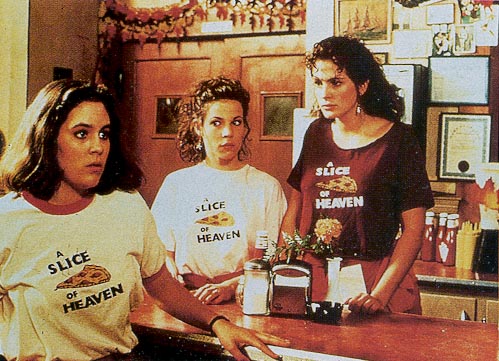
The title “Mystic Pizza” refers to the local pizzeria in a fishing town called Mystic, Connecticut. The three central characters work there as waitresses—Daisy Arujo (Julia Roberts), her sister Kat (Annabeth Gish), and their friend Jojo (Lili Taylor). Their boss is the sassy but friendly Leona (Conchata Farrell), whose pizza contains a special secret sauce that has people coming for more—she won’t even tell her employers what’s in the sauce. (We never find out, either.)

The girls have their own adventures/issues with romance. As the movie begins, Jojo is about to be married to her loving boyfriend Bill (Vincent Philip D’Onofrio) when she passes out from stress right there at the altar. She loves Bill, but just isn’t ready for a big commitment, like he is. (Huh—that’s also a change in the movies. Usually, it’s the guy that won’t commit.) As the movie continues, she tries to romance Bill many times, but Bill believes that they should wait til marriage before they get physical. Would Jojo stoop so low as to marry Bill just to have sex with him? Actually, no. But she would like more passion in their relationship.

Daisy is playing pool and drinking beer at a local hangout when she notices Pretty Boy walking in and asking her to play a set with him. He’s rich, nice, handsome, and has the name Charles Gordon Windsor (Adam Storke). (Oh, and he can also shoot three dart bullseyes in a row after having shots of tequila.) He tells Daisy that he’s currently in law school, but eventually comes clean and says he was kicked out for cheating on a final. (Huh—no wonder he can shoot darts so well; he’s had time to practice.) Daisy is the most standoffish of the three women and possibly the more slutty, but she’s not dumb and can read people well. She takes a chance on this rich boy, but then she learns something she didn’t need to know about him, in a scene near the end when Charles actually stages a dramatic dinner scene with her invited to the family dinner—he accuses his family of being snobbish and actually pulls out the tablecloth from under the dishes. It’s then that Daisy notices that maybe Charles is just looking for someone to look up to him, which isn’t exactly what she needs.

Meanwhile, Kat is babysitting the daughter of a 30-year-old Yale graduate named Tim (William R. Moses). He’s a nice, smart man whom Kat falls in love with, which can cause problems because not only is he twelve years older than her, but he’s also married. The wife isn’t around, so she won’t have to worry about it until later. But she does restrain herself from expressing her feelings towards him. He starts to like her too, for her intelligence (she’s been accepted at Yale). However, by the time she comes home, she realizes she doesn’t know how to handle the situation as it is.

“Mystic Pizza” follows these three couples through a long summer where everyone would just rather not be stuck in Mystic, but you make do with what you have. Lessons are learned, certain secrets are revealed, and hearts are broken. What Kat, Daisy, and Jojo learn is that they have each other and their job at the pizzeria.

The acting is wonderful, especially by the three lead actresses. Lili Taylor displays a comic presence in the way of her odd relationship with Bill—there’s human comedy in how she reacts to certain things, like how she nearly freaks out after Bill expresses his true feelings (she comes to work three hours early, and nervously unstacks the table chairs). Julia Roberts is a true beauty and has a fierce amount of energy—watch the scene in which she tries to imitate the hitchhiking scene from “It Happened One Night”; it’s pure delight. Annabeth Gish is my favorite of the performers, portraying Kat with intelligence but also with a little vulnerability. The supporting cast is solid, but it’s Conchata Ferrell as the pizzeria owner and Louis Turenne as an uptight food critic who really shine.

“Mystic Pizza” is an interesting, nicely-handled drama with good performances and a lighthearted screenplay. It shows that love may not be easy, but at least you know what you want. It succeeds in delivering that message.

Vision Quest (1985)

23 Mar

images

Smith’s Verdict: ***1/2

Reviewed by Tanner Smith

Even though “Vision Quest” follows a routine that most sports movies follow, it’s still a nicely done, entertaining film about a high school wrestler who has two dreams that must come true before the movie is over. The first dream is to go to the state championship and take on the toughest guy on the mat. The other dream is to win the love of a girl who has come into his life.

The kid’s name is Louden Swain (played by Matthew Modine). He has dropped from 200 pounds to 178 to join a different weight division on the school wrestling team. He baffles the coach, but is determined enough to continue working out and lose more pounds to compete against the toughest wrestler in the state, named Shute.

As you can read, the protagonist is about as standard as a sports film can ask for, but Matthew Modine is a fine actor and does what he can with his attitude as an actor to make his character quirky and engaging, and therefore a nice leading man to follow.

On his side are Louden’s respectful father (Ronny Cox); an English teacher, Tanneran (Harold Sylvester); a wrestling coach (Charles Hallahan) though sometimes he feels negatively about Louden’s determination; and his best friend Kuch (Michael Schoeffling), a teenage punk with a Mohawk hairstyle and describes himself as “Half-Indian,” though he might just be going through a phase. All of these characters are not like the usual types you would see in most sports films. For example, the father in this movie is not scornful and skeptical; the coach isn’t entirely cynical; the best friend is an actual individual instead of a one-dimensional, loudmouthed idiot. They’re all fresh and original characters.

But then there’s the girl that Louden tries to win the heart of. Her name is Carla and she’s hands-down the best character in “Vision Quest.” She’s a 21-year-old independent drifter who stays with Louden and his dad while her car, which has broken down while passing through town, is being fixed. Carla (Linda Fiorentino) is a woman who doesn’t look at anybody the wrong way; just as they are. But at the same time, she still keeps her cunning attitude and uses it to see who is real and who is a phony. Maybe this could explain why, after Louden realizes he’s infatuated by her, she doesn’t question why he sniffs her panties when he thinks no one Is looking. She doesn’t confront him about it; she waits it out to see what he’ll do next before passing judgments. What develops is a sweet relationship that doesn’t revolve around sex, but with trust. By the end of the film, you have to wonder what will happen for them in the future. That’s where the real suspense is; not just with the big match at the end.

We know that Louden will reach down to the weight limit to fight Shute, we know that they will fight in a big match with a large crowd watching, and we know there will be certain complications beforehand. But the twist is that those complications are uncertain when we follow Louden and Carla as their relationship grows. Now I have to confess something—as I mention this relationship (and continue to think about those remarkable supporting characters), I change my rating from three stars to three-and-a-half stars. I guess what can be said about “Vision Quest” is that if a seemingly-tired genre film is written well and acted beautifully, it can redeem the subject matter.

The Muppet Movie (1979)

23 Mar

the-muppet-movie-all-of-us-under-its-spell

Smith’s Verdict: ***1/2

Reviewed by Tanner Smith

When we see the Muppets, do we really need to wonder where the puppeteers are when they’re controlling the Muppets’ actions and moving mouths? I personally don’t care, since the Muppets have great personalities. But the opening scene in “The Muppet Movie” had me wonder where the puppeteer was. That scene features Kermit the Frog in a swamp surrounded by water and playing the banjo. Since Kermit is on a rock and surrounded by water, where is the puppeteer controlling him from? But as the scene progressed and Kermit continued to play, I didn’t care. I just watched Kermit in his original habitat.

If you haven’t already guessed, “The Muppet Movie” tells the story of how the Muppets got started in fame and fortune. This is as interesting as superhero origin story. We all wanted to know how our favorite superheroes became our favorite superheroes and now, since the Muppets hit close to our hearts, we can see how they became such successes. “The Muppet Movie” is the answer to the question fans of the Muppets would have loved to ask, but haven’t quite thought about it.

Kermit the Frog used to live in a swamp (of course). One day, after playing his banjo, he is met by Dom DeLuise as a Hollywood agent who informs Kermit that Hollywood is holding an audition for frogs. And so, Kermit is off to Hollywood. He needs a driver so he meets Fozzie the Bear, originally a bartender. They drive a Studebaker and make their way into Hollywood (Fozzie proclaims, “A bear in his natural habitat—a Studebaker”).

Along the way, they come across the other Muppets—such as Gonzo (originally a plumber) and Miss Piggy (who hasn’t changed much since they meet her after she wins a beauty pageant). But they are also chased by a ruthless fast food magnate, who wants Kermit to sign on as a trademark for a frog-leg fast-food franchise. He even hires gunmen and an unreliable sidekick (Austin Pendleton) to hunt him down. This subplot may frighten younger viewers, so parents should take that into consideration.

As if predictably, Kermit and Miss Piggy fall in love, but they run into many ups and downs during this road trip. Along the way, the Muppets become friends and encounter all sorts of special guest appearances, including Mel Brooks, Bob Hope, Carol Kane, Steve Martin, Richard Pryor, Telly Savalas, Orson Welles, and, in their last film appearance before their deaths, Edgar Bergen and Charlie McCarthy. The best joke in the film—Fozzie meets Big Bird hitchhiking on the highway and offers a lift; Big Bird responds, “No thanks. I’m on my way to New York City to sneak into public television.” The movie is full of clever, funny moments like that—as rich as anything in “The Muppet Show.” But “The Muppet Movie” has a great big surprise and that is…we see the Muppets’ feet. There’s a scene in which Kermit really seems to be riding a bicycle and all I’m thinking is, “How’d they do THAT?”  And of course, there has to be a musical number every 20 minutes. The problem is that the songs are not particularly interesting or memorable.

In “The Muppet Movie,” we get to know these characters better than we could in their original TV show. The Muppets are appealing, great to look at, well-managed, and with great comic personalities. I loved watching these Muppets in their own origin story.

Dodgeball: A True Underdog Story (2004)

23 Mar

dodgeball1

Smith’s Verdict: ***1/2

Reviewed by Tanner Smith

No, I don’t believe that “Dodgeball: A True Underdog Story” was based on a true underdog story. More accurately, it could be labeled as an underdog story that is much funnier that how we usually see underdogs in movies. The underdog team that we follow in “Dodgeball” is a band of underdogs who get better at playing the movie’s sport and play in the Big Game. Among the guys on the team are a guy who thinks he’s a pirate and another guy who didn’t know that there even was such a guy on the team.

What is the sport these underdogs play in the movie? Well, it is dodgeball. It’s that game we’ve all played in school in gym class where you try to hit the opposing team with rubber balls. The best way to win is to get all the bigger guys on your team, and if you have enough guts to catch a ball before it hits the ground, then the player who threw that ball is out and a person from your team comes back into the game.

OK, enough of the refresher course. Back to the first movie about dodgeball called “Dodgeball: A True Underdog Story”…

The reliably-funny and fast-talking Vince Vaughn plays Peter La Fleur, an Average Joe who manages a rundown gym called “Average Joe’s.” Among those who hang around there are the pirate character I mentioned earlier, the person who didn’t know there was a pirate guy around, a geeky teenager, and an overweight loser who reads a magazine called “Obscure Sports Quarterly.” Peter’s rival is the ridiculously pompous White Goodman (Ben Stiller), who runs “Globo Gym,” an over-the-top fitness program with the slogan, “We’re better than you and we know it!”

Ben Stiller’s performance has to be seen to be believed. Imagine Fonzie of TV’s “Happy Days” and make him more energetic and in spandex. Though the performance almost runs out of steam towards the end, it’s still very funny.

Anyway, White wants to close down the “Average Joe’s” gym to create a new building for his corporation of fit sadists. So, Peter and his group challenge White and his band of monsters to a Las Vegas Dodgeball Tournament, televised by ESPN 8 (“The Ocho”).

What follows is a great line of gags and jokes that I will not reveal, but I have give notice to Rip Torn, who portrays the coach for the team of misfits. He’s an old coot in a wheelchair, but also a veteran of dodgeball. His methods are very unusual but downright hilarious. They involve a sack of wrenches. Two other characters draw our attention: Christine Taylor (Ben Stiller’s wife) is an attractive bank employee who joins the good guys in the tournament and may (or may not) have a thing for Peter. And Gary Cole is very funny as the commentator on the tournament. It’s the funniest sports commentary since Fred Willard’s commentary in “Best in Show.”

Every character in this movie is either funny or fun to watch. And this movie really is funny. The strangest thing about Vince Vaughn’s performance is that he doesn’t do a lot to be funny. He plays a straight man that happens to deliver some one-liners when he has to. Some of the gags are great, including one in a scene where White pumps himself up before meeting a woman (not giving away the gag). There are cameos that come in and out and those bits are funny too. And another great thing about this movie is that during the Big Game (of course, it’s obvious that the “Average Joe’s” team is going to play in the Big Game), I wasn’t bored. I was with these guys, getting hit with dodgeballs with these guys, and I was glad to go along for the ride with these guys. And I laughed along the way.

“Dodgeball: A True Underdog Story” is a very funny movie; full of fun characters to watch, very funny moments here and there, and a satire on overdone sports movies. And I guess I can say nobody throws a wrench like Rip Torn.

River’s Edge (1987)

22 Mar

images

Smith’s Verdict: ***1/2

Reviewed by Tanner Smith

It’s one thing to make a teen drama. It’s quite another to make a teen drama inspired by a true story. The fact that the film “River’s Edge” is inspired by a true story makes the film even more disturbing. The film features teenagers who drink, do dope, and have no real purpose in life. Just the way these kids are depicted is unnerving enough, but the main storyline is about one of those teenagers killing another of their own without any remorse. Why? She was talking too much. And it’s a true story. A high school student, in real life, did strangle his girlfriend and showed the body to his friends. What’s worse? The friends never said anything about it to the authorities for quite a while until one of them finally confessed.

“River’s Edge” is not a forgettable film. It’s a disturbing, unnerving, creepy portrait of stoned teenagers who think they mean well but really they’re just confused. The way they act is unsettling for any parent. There is one kid who more heartfelt than the others, but he still smokes dope—his mother also thinks he’s stealing her dope. The kid scolds his younger brother, who is a 12-year-old, sadistic little creep who just dumped away his little sister’s beloved doll. “You’re stupid enough to pull a stunt like that, but then to go and brag about it…”

Not much later, the kid and his friends are taken to the side of a river to see the naked dead body of a girlfriend of one of the teenagers. The film is not really about the girl’s killer (Daniel Roebuck), who couldn’t care less about what could happen to him if anyone else finds out. The film focuses its attention on the group’s self-appointed leader Layne (Crispin Glover), who has obviously taken one shot of speed too many. Layne wants to protect his friend and orders the others not to say anything. But the sensitive kid, Matt (Keanu Reeves), doesn’t want to wait much longer. Also, there’s a girl named Clarissa (Ione Skye) who asks, “She was our friend. Shouldn’t we feel sorry for her? Are we supposed to just ignore it?”

What’s even more haunting about these kids is that the young actors portray them all convincingly. Is this what America’s youth will be reduced to? It is too late for the kids in this movie—they are so far into drugs and alcohol that they can only fear their own futures and their pasts. In particular, Crispin Glover’s performance is quite memorable—the way he uses body language and that weird voice of his to try and get his point across is electric. And then there’s Joshua Miller as the sadistic kid brother Tim. This kid is definitely not likable and a beating would be a celebration for his deeds…but he is all too real, and you know he’ll be as messed up as the older kids.

Another great performance is given by Dennis Hopper as Feck, a drug dealer who supplies the kids with dope and befriends the young killer because they both have something in common. They both killed their girlfriends. Feck shot his in the head out of passion. But his way of living and hiding out soon comes to question in his own mind when the kid comes clean about why he strangled his girlfriend to death.

“River’s Edge” was directed by Tim Hunter, who also directed “Tex,” which also featured troubled teenagers. In this movie, Hunter gives the teenaged characters not much room to grow (it’s unclear if they can grow) and surrounds them with a crisis even bigger than what they’ve already been exposed to. It’s a despairing, horrifying, yet effective portrait of adolescents who just don’t care much for what’s happening around them.