Archive | Three-and-a-Half Stars ***1/2 RSS feed for this section

Iron Man 3 (2013)

7 May

images-1

Smith’s Verdict: ***1/2

Reviewed by Tanner Smith

Funny, I kind of thought last year’s “The Avengers” was “Iron Man 3” in a way (that would also make it “Thor 2,” “Captain America 2,” and “The Incredible Hulk 2” in that same sense), but…whatever. It doesn’t matter. Robert Downey Jr.’s memorable, likeable, witty, solid Tony Stark a.k.a. Iron Man is back for more, and he’s more than welcome on the big screen. With more action and more humor, “Iron Man 3” is the best in the popular superhero-movie franchise (based on the Marvel comic book series) since the original five years ago. The second film may have been somewhat disappointing for fans of the original; this third film (yes, I might as well quit calling “The Avengers” a “third film” in this franchise—it’s not necessarily fair anway) is more than likely to satisfy those fans and more. It’s action-packed, intense, funny, and well-executed. A good time at the movies.

People who were disappointed by “Iron Man 2” may be satisfied with this film. But if people are expecting something as big and bombastic as “The Avengers,” that may be reason for them to be disappointed. But it may also be too much to hope for. This is a smaller picture by comparison, not relying entirely on a large amount of action, explosions, and CGI. But not to worry—there are still enough extended action sequences to deliver, which is what we expect in summer entertainment.

“Iron Man 3” takes place shortly after the climactic New York battle in “The Avengers,” as Tony Stark is back in Malibu making more improvements on his new “Iron Man” suits (such as making parts of the suit fly over to him and attach themselves). But he suffers from insomnia and anxiety attacks that may have to do with his experience in the “wormhole” (for those who recall, it may not have been easy to escape from). This doesn’t do well with his relationship with his lovely girlfriend, Pepper Potts (Gwyneth Paltrow), as he spends more time in his basement-laboratory than in the bed with her at night.

A new villain has entered the story—two, actually. One is a terrorist, known as The Mandarin (Ben Kingsley), and the other is his henchman, a slimy genius named Killian (Guy Pearce). They attack mostly with a special kind of suicide bombers—people who are altered to explode after their missions are complete. After one of these attacks puts Tony’s bodyguards, Happy (Jon Favreau, not directing this “Iron Man” movie, by the way), in a coma, Tony makes a public threat to the Mandarin, swearing revenge. In response, the Mandarin’s army attacks Tony’s mansion with great force, leaving Tony for dead. But Tony is still alive (though with limited materials and a low-on-paper Iron Man suit) in a small Tennessee town, and so he must find a way to stop the Mandarin before he strikes for the President (William Sadler).

Where are the other Avengers during all of this? You’d think that an assassination plot for the President would get their attention, but no. Tony and his friend Rhodes (Don Cheadle), who is now the “Iron Patriot,” are the only ones with the right abilities to stop it. Wouldn’t it be rather awesome if the Hulk suddenly came in and smacked Killian to near-death?

There is plenty of action and humor to please audiences. The best action sequences are the attack on the mansion; a low-scale barfight with one of the “suicide bombers”; and the climactic final battle on a ship, in which the ultimate deus ex machina is brought upon to help (you either accept it or you don’t; I thought it was rather awesome). The film is briskly paced and high on energy, but also has plenty of humor. There are Tony’s one-liners, which are always welcome because they’re delivered by Downey with great sharp wit every time. There are some neat visual gags involving the suits. And there’s also a nice buddy-comedy element in that Tennessee town, in which Tony gains assistance from a smart young boy and they banter like Murtaugh and Riggs.

We’re used to seeing Tony Stark as a wisecracking, cocky, likeable cutup (who also happens to be a rich genius), so it’s refreshing to see another side to him. These anxiety attacks say a lot about his vulnerability, giving him even more dimensions than we thought he had. The only little problem I had with this movie was that the attacks don’t have much of a payoff. Why not have these memories of the wormhole come back to him somehow during the climax? There would be more psychological conflict that way.

Robert Downey Jr.—what can you say? It’s RDJ. He’s Tony Stark. He’s always solid and powerful when playing this role. The rest of the actors are no slouches either—they’re very game and do credible jobs. Gwyneth Paltrow does more than play the love-interest and she gives us more reason to sympathize with her—she even sports the Iron Man suit at one point (awesome). Don Cheadle is great as the new “Iron Patriot” (formerly known as “War Machine”). Guy Pearce is suitably slimy and callous and does what the role requires him to do.

If this is the final installment in the series, it wouldn’t be very surprising, as it does have the final of a concluding entry (and a satisfactory one at that). But I am sort of hoping that at least one of the other post-“Avengers” movies feature Robert Downey Jr.’s character of Tony Stark, because he really is the most engaging of the team, and the most amusing. Either way, “Iron Man 3” is a terrific superhero-movie sequel. It’s enjoyable, engaging, and fun all the way through.

NOTE: Stay after the end-credits for a little bonus treat. (And no, it’s not Samuel L. Jackson in an eye-patch again.)
Iron Man (2008)

6 May

images

Smith’s Verdict: ***1/2

Reviewed by Tanner Smith

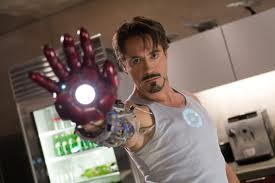
“Iron Man” is a superhero movie that is quite surprising in how it’s presented, but nonetheless exceptional as a result. Its story structure is standard for a superhero-origin-tale, but not so much, necessarily, is how it views its hero and how he reacts to his situations or relates to those around him. But it’s not saying that it isn’t entertaining, because at the same time, “Iron Man” presents some nifty action sequences as well as special effects (which are used to serve the story). This is a superhero movie that is about something. It’s gripping, well-made, funny when it needs to be, and also rather awesome when it needs to be.

Based on the Marvel comic book series, “Iron Man” tells the origin story of weapons manufacturer Tony Stark as he becomes the awesome heroic figure simply known as “Iron Man.” Tony is introduced as a wealthy, brilliant yet naïve playboy who has a creative, ingenious mind and a tendency to slack off. When in Afghanistan to present his latest weapon, from his company Stark Industries, he is attacked and captured, brought to a cave by his captors. He is healed from his serious injuries with an electromagnet attached to his torso to keep bits of irremovable shrapnel from his heart. He is kept alive to build a new lethal weapon for his guerilla captors. But instead, he spends his time building something they didn’t expect—a way out. Using his limited resources, he is able to build a bulletproof, armed, metal suit and uses it to escape and make his way back home. Upon his return, he makes a few changes—he shuts down Stark Industries’ weapons division and decides to make a few improvements on the suit’s design. For instance, he stabilizes flight and gives it more perfection in the weapon implants it has.

While “Iron Man” does have its share of action, as Iron Man must destroy a rebel base full of weapons (manufactured by Stark industries, in an ironic twist) and also battle an ultimate antagonist with a similar suit of armor, this film is more of a character story, particularly in the way Stark develops his personality throughout the movie. Here’s a guy who has a luxurious, ignorant outlook on his life, not fully knowing what his company is really doing or even how he is with the people around him—those include his loyal Girl Friday, Pepper Potts (Gwyneth Paltrow); his best friend, Jim Rhodes (Terrence Howard); and his no-nonsense business partner, Obadiah Stane (Jeff Bridges). Once he has had his eye-opening experience in the cave, and knowing that these ruthless guerillas are the main ones purchasing his company’s weapons, a sense of alarming alertness overcomes him. He now knows he has to do something about this.

Robert Downey, Jr. is this movie. He’s an inspired choice to play the role of “hero,” and Downey makes it his own, giving it a great amount of wit, flair, and energy (even more so than most superhero-movie protagonists). He dominates the screen throughout, as he should. He’s downright brilliant and so charismatic for us to follow him all through the movie. And he has a sharp wit that comes with the character, making him all the more entertaining to watch and listen to.

There’s also a solid supporting cast. Gwyneth Paltrow, as Tony’s Girl Friday and possible love-interest, is quite appealing, and she and Downey share engaging banter on par with Bond-and-Moneypenny talk; they’re great together. Jeff Bridges plays pretty much the main villain, but a good move on the film’s part is that he’s not clearly identified as such a role (but you don’t necessarily deny it, because he seems quite slick).

Thankfully, director Jon Favreau knows not to have this superhero origin-story aimed for mostly teenage boys. There is some good action, aided by well-done special effects (that don’t show up the actors, thankfully), but there’s more to it in setting up the story, developing the characters, and showing their plight and conceptions. There’s a nice, smooth pacing going with the film, and strangely enough, it doesn’t feel like the average superhero movie. Oh, there are elements existent so that superhero fans won’t be disappointed. But there’s more to it than that. It includes numerous details, some of which you wouldn’t expect, and it brings you into most of them so that you really get an understanding for this tale. “Iron Man” is a solid film, a worthy successor in the superhero-movie genre.

Tropic Thunder (2008)

1 May

TropcThndr_H2L

Smith’s Verdict: ***1/2

Reviewed by Tanner Smith

Where do I begin with the sheer comic brilliance of Ben Stiller’s fantastic comedy “Tropic Thunder?” Should I merely start with the inventive plot? The brilliant cast of characters? The way it seems to understand and love movies? Or even the real show-stealer of the film that everyone remembers with great fondness? Well…I guess I should go ahead and start with the plot.

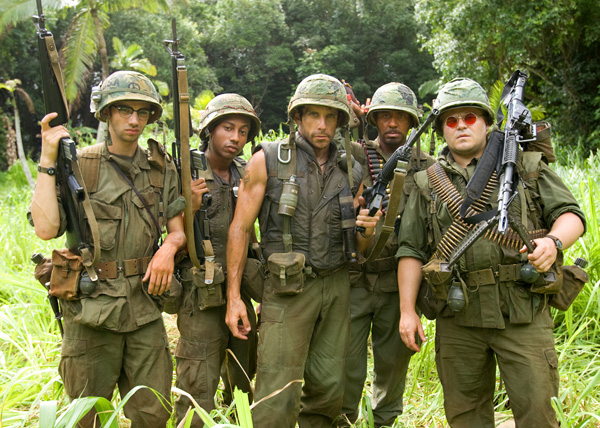
The movie tells the fictional story of the making of a war film based on the (fake) true story about a Vietnam vet. Among the main cast is a diverse group of actors/personalities. There’s Tugg Speedman (Ben Stiller, who also directed and co-wrote the film), a former big-time action hero who needs a big break after his attempt of a dramatic performance (as a retarded farmhand named “Simple Jack”); Jeff Portnoy (Jack Black), a heroin-addicted comic actor best known for his comedy franchise, “The Fatties,” which seems to be filled with flatulence jokes; Alpa Chino (Brandon T. Jackson), a hiphop artist who promotes his own merchandise (including the energy drink Booty Sweat); newcomer to the acting department, nerdy Kevin Sandusky (Jay Baruchel); and last but definitely not least, five-time Academy-Award winner Kirk Lazarus (Robert Downey, Jr.), an Australian method actor who goes to many extremes to play roles—for this particular movie, he received “pigment alteration” in order to portray the African-American sergeant that takes center-stage.

And yes, Robert Downey, Jr. spends a majority of the movie in black makeup, and actually plays it like an Australian actor playing an African-American man while constantly keeping in character even when the cameras aren’t rolling—he’s that committed to the role. Downey is not only hilarious in this movie, but he’s convincing in the role. It’s amazing how he’s able to pull this off, and it’s a great deal of fun to watch him continue to do this throughout the movie. It never gets old. He is comedic gold in this movie.

To be sure, this is the most controversial aspect of “Tropic Thunder,” putting Robert Downey, Jr. in blackface. It’s a very bold, risky move to make, and Stiller, as director and co-writer, has the nuts to go ahead and go through with it. Thankfully, he has the intelligence to back it up by casting Downey in the role, and also by having him go up against Brandon T. Jackson, whose Alpa Chino (say it out loud) really is black and constantly tears into Lazarus for “keeping in character.” It helps that the character of Lazarus isn’t aware that he’s being somewhat offensive in his portrayal.

Anyway, I’m getting sidetracked. As for the plot of “Tropic Thunder,” the director of the fake movie, Damien (Steve Coogan), can’t seem to control his actors, nor can he get the realistic reactions he needs from them (particularly from Speedman). Four-Leaf Tayback (Nick Nolte—yes, Nick Nolte), the old Vietnam vet turned screenwriter, suggests that he takes them out into the actual jungles of Vietnam and have them act out the entire war film while being filmed with hidden cameras in the trees (how exactly that works, seeing as how actors don’t know where to go, is beyond me, but who cares?), while supposed surprises are waiting for them as they continue. But something goes wrong when Damien is blown up (quite unexpectedly) by an old land mine, and Speedman, thinking it was fake (there’s a particularly disgusting bit in which he carries Damien’s “prop-head” and tastes his “corn-syrup” blood), takes charge of the movie. But it may not actually be a movie anymore, as heroin processors become involved and open fire on the actors for real.

I love this distinct group of actors that are playing in this movie-within-the-movie—they’re all different but appealing personalities. And they’re all established early on, as “Tropic Thunder” opens with (get this) fake trailers and advertisements, each featuring one of the actors. We have Alpa Chino hawking his Booty Sweat; Tugg Speedman in his sixth “Scorcher” action flick; Jeff Portnoy in “The Fatties: Fart 2” (Black portrays all members of the Fatty family, much like Eddie Murphy in “The Nutty Professor”); and the funniest of them all, Kirk Lazarus as an Irish priest in a period drama with Tobey Maguire as his lover. These fake previews are among the most hilarious parts of the movie, which is mainly a 100-minute rip of Hollywood filmmaking. There are many elements of the Hollywood system (such as the egotistical director, the obsessive agent, the overzealous producer, etc.) that are broadened for good laughs, while also providing a bit of truth to them. I won’t give away most of the details that are brought upon by Stiller’s deranged, brilliant mind, but they’re beyond funny.

Ben Stiller, as the heroic leading actor, acquits himself nicely as basically an idiot who thinks he’s better than the movie he’s in, and then takes it upon himself to run the show. He gets his laughs from sheer goofiness in the way he thinks he’s right about everything. Jack Black, despite being given second-billing between Stiller and Downey, is not particularly a scene-stealer except for one particularly funny scene in which he begs for the others to tie him to a tree while going through heroin withdrawals, and then begs to be untied. Brandon T. Jackson is brilliant as he speaks for African-Americans who might be offended by Downey’s performance. Jay Baruchel is probably the weakest of the group, but I guess that’s the point—he’s mainly the straight arrow; nothing else is required of him.

Other actors include Matthew McConaughey, who is an absolute delight as Speedman’s agent who is determined to make sure he gets his TiVo; Danny McBride as the team’s pyromaniac explosions-expert; and probably the most holy-bleep-I-can’t-believe-it performance to come around in a long, long time—Tom Cruise as a fat, balding, profane producer who cares about nothing but making money. Cruise almost challenges us to forget about Downey and focus on his character; it’s just too bad the two don’t share any scenes together.

Oh, and let’s not forget the cameos. Tobey Maguire isn’t the only recognizable face to make a cameo appearance. Keep an eye out.

“Tropic Thunder” is also high on violence and energy, particularly in the climactic sequence in which Speedman is captured and the other actors have to sneak into a heroin-processing plant to rescue him. But even that gets its share of laughs, and even moments of character development, such as when Speedman and Lazarus think about what distinguishes themselves from the characters they play. It’s an odd but effective moment to have in an action scene.

“Tropic Thunder” has so much energy that it’s hard not to pay attention to it, and has so many broadly developed moments that you can’t help but laugh at. It’s funny, it’s smart, it’s energetic, and it’s just a true blast!

Vice Versa (1988)

25 Apr

000721_27

Smith’s Verdict: ***1/2

Reviewed by Tanner Smith

For some reason, in the mid-to-late-1980s, there were a certain trend that comedies would seem to follow—body-swap. Ever since 1987’s “Like Father, Like Son” (featuring Dudley Moore and Kirk Cameron as a father and son who transfer minds) was released to box-office success, Hollywood executives thought the idea of two people switching bodies and taking over each other’s identities would be the next best thing for mainstream comedies. But truth be told, most of them aren’t very good—I hated “Like Father, Like Son,” I don’t care for “18 Again” (with George Burns), and don’t even get me started on “Dream a Little Dream” (with Jason Robards and Corey Feldman). There were two movies released in 1988 that stood out among the rest, in terms of quality, laughs, and entertainment. One was “Big,” in which Tom Hanks in an Oscar-nominated performance was a child in an adult’s body. That movie was one of the top-grossing movies of the year and is still a truly treasurable movie. The other is one that most people seem to forget about, but it truly is entertaining—it’s “Vice Versa.”

“Vice Versa” was released just a few months after “Like Father, Like Son” and it features the same gimmick. The minds of a father and son are magically transferred into each other’s bodies, so that the kid is inside his father’s body and has to go to work, and Dad is inside the kid’s body and has to go to school. But only the gimmick is the same. “Like Father, Like Son” was a terrible movie; “Vice Versa” is a good one, because it has a screenplay that truly gets the situation and has clever, funny scenes that make it entertaining. And two game actors were picked effectively to help serve it.

Judge Reinhold plays Marshall Seymour, a hard-working, divorced Chicago department store executive who is spending Christmas holiday with his 12-year-old son, Charlie (Fred Savage). But Marshall barely has enough time to spend with his son, and Charlie can’t help but admit that Dad has it better than him. Both make the mistake of wishing aloud that they could trade places with each other, while looking at an ancient Tibetan item. The item has mystical powers and winds up transforming them into one another—the kid becomes his father and vice versa.

Charlie (as Marshall) goes to work in the department store with wide eyes and an awed expression on his face, a childlike (if you will) way of talking to people (especially at a board meeting), and plays the drums in the music section. Marshall (as Charlie) endures the 7th grade as he takes simple tests but has to wait for everyone else to finish before he can do anything else, ducks school bullies, talks back to his teacher, and even takes a shot at hockey practice even though he can’t ice-skate.

There’s an advantage for each of them during all of this. In one of the best scenes, Charlie (again, as Marshall) gets to say the things he couldn’t say to his school teacher, and in another terrific scene, he even takes revenge on the school bullies. And then there’s Marshall (again, as Charlie) as he gets to say the things he didn’t have the courage to say as his previous self to his girlfriend, Sam (Corinne Bohrer).

This is all fun, entertaining, and well-done. What doesn’t work so much is a subplot involving two smugglers who try to steal the Tibetan item that caused this mess in the first place. They threaten Marshall (who is really Charlie at this point), but that doesn’t seem to work. And then they kidnap Charlie (who is really Marshall at this point), and can’t believe how calm he is about his situation. (OK, the reaction of one of the kidnappers after a firm and direct ransom phone call is pretty funny.) And this of course leads to a chase scene in which the adult in a kid’s body chases the crooks on a cop’s motorcycle so they don’t get away with it.

But what really makes “Vice Versa” work are the performances by Judge Reinhold and Fred Savage as the personality-switched main characters, who are more than able to convince us that they are someone else most of the time. In particular, Reinhold is wonderful as a child inside a grown man’s body, and he performs greatly with body language. He slumps over while he walks, he can’t be still like a kid wouldn’t be at the still age of 11, and of course when he gets excited, he celebrates with an exuberant boilermaker (he jumps up and swings his arm in the air after he gets even with the bullies in a wonderful moment).

“Vice Versa” seems to be forgotten whenever “body-swap” is mentioned to some people, but I find it to be a delightful movie with funny writing and even-more-so solid performances. I will take this over “Like Father, Like Son” any day.

Elf (2003)

25 Apr

elf3711

Smith’s Verdict: ***1/2

Reviewed by Tanner Smith

Movies with fish-out-of-water stories—sometimes they work, depending on the execution, central characters, and settings. Sometimes they don’t work. “Elf”—which features an elf who visits New York City on Christmastime—does work. It has a lovable main character, a pleasant setup, and a sense of holiday cheer.

The main reason “Elf” works so much is because of Will Ferrell’s performance as the lead character—a human named Buddy who thinks he’s an elf. Well actually, that’s the first ten minutes. For the entire movie, he realizes for the first time that he’s a human and sets out to find his real father. You see, Buddy was an orphan baby who crawled into Santa Claus’ bag and was accidentally brought back to the North Pole. There, he was adopted by Papa Elf and raised to live with the elves. This makes him several feet taller than the others, it’s difficult for him to create toys with the other elves, and he has to sleep in three small beds put together. He’s about 30 years old now and he doesn’t know that he’s indeed a human, not an elf. So he decides to go to New York City to find his birth father.

It turns out his birth father is an uptight publisher named Walter Hobbs who works in the Entire State Building, neglects his wife and pre-teen son, and is basically a Scrooge. He’s not thrilled about this strange man in an elf costume that seems to stalk him. But when Buddy mentions his college girlfriend (Buddy’s birth mother), Buddy is able to convince his father to let him live in his family’s apartment. He gets on Walter’s wife Emily’s good side, as well as the son named Michael who becomes Buddy’s best friend.

He also tours around the city to discover everything new to him and pays many visits to a department store, where he is able to spot out a fake Santa Claus in one of the funniest scenes in the movie. Also at the store is a beautiful worker named Jovie who eventually develops a relationship with Buddy.

A lot happens in “Elf,” which is just flat-out funny and very charming. And a lot rides on the performance of Will Ferrell as Buddy. Will Ferrell is absolutely amazing—he’s very likable, delightfully annoying, and so full of good cheer. This is not the Will Ferrell people were used to seeing on SNL. He’s also a great physical comedian in which he tries to blend in (or, forgive the pun, fit in) at Santa’s workshop, tries to figure out a mall escalator, or even wearing that ridiculous elf costume! He has a great personality that makes it impossible to dislike his character.

And then there’s the delightful (and much unexpected) supporting cast. We have James Caan as the Scrooge of a father, Mary Steenburgen as the sweet Emily (I really love how she gets used to the fact that Walter had a child out of wedlock and that the child is a full-grown man who thinks he’s an elf—and also, the way it seems strangely credible), and Zooey Deschanel as Jovie, the beautiful, fun love interest. Oh yeah, and Papa Elf is played by Bob Newhart, who narrates the story in deadpan delight—he’s wonderful here. We also get a nice cameo from Peter Dinklage as a business dwarf who doesn’t like being called “elf” (there’s also a nice cameo from “A Christmas Story” star Peter Billingsley as the head elf Ming Ming). What a cast there is!

If that’s not enough, the movie is well-made and fantastically-written. It was directed by actor Jon Favreau and written by David Berenbaum. We get walk-ons by the characters from the cheesy animated Christmas TV specials (including that snowman that still slides instead of walks and talks like a bluesman). And there are so many gags in which Buddy is in the city for the first time and checks out everything that it’s hard to stop laughing or even smiling. The whole movie is like that—laughs and smiles. The movie is full of in-jokes, surprises, and satire. Half of it is for kids and the other half is for parents. This is a great family entertainment.

If there is a problem with “Elf,” it’s that the ending feels somewhat rushed. It’s not the ending I would’ve gone with if I was in charge of production…then again, if I was in charge, I’m not sure I would make “Elf” as pleasant as it is by Jon Favreau and acted with a lovable, highly-charismatic persona by Will Ferrell.

NOTE: I have a confession to make—I was almost about to rate this movie three stars. But while I was writing this review, I quickly changed it to three-and-a-half stars. That’s how charming the movie was for me.

Ferris Bueller’s Day Off (1986)

23 Apr

ferris-buellers-day-paramount-pictures-1986-matthew-broderick-43884

Smith’s Verdict: ***1/2

Reviewed by Tanner Smith

Ferris Bueller is a bright high school senior who does everything he can possibly think of just to miss a day of school. He pretends to be sick, fools his parents, and then spends his day off cruising around Chicago with his girlfriend and his best friend. While in Chicago, he does whatever he wants.

No wonder Ferris Bueller, the main character in the fine teenage comedy “Ferris Bueller’s Day Off,” is the most popular guy in school. He has a lot of self-confidence and uses it to do whatever he wants. He has this philosophy: “Life moves pretty fast. If you don’t stop and look around once in a while, you could miss it.”

Ferris, played by Matthew Broderick, states this philosophy right to the camera. Just like Woody Allen’s characters, Ferris Bueller has the freedom to break the fourth wall and speak his mind. At first, it seems like skipping school is all Ferris has on his mind, but there is something more. He’s trying to gain his best friend some self-confidence of his own. His best friend, a wound-up teenager named Cameron (Alan Ruck), is sick and excused from school. He is also in a miserable living environment because his father cares more about his prized possession—a restored red Ferrari—than he does for his own son.

Ferris talks Cameron into helping him steal the Ferrari so they can pick up Ferris’ girlfriend Sloane (Mia Sara) from school (the excuse: dead grandmother). Together, the three of them spend the day in downtown Chicago—they go to the top of the Sears Tower, see the Board of Trade, have lunch at the Gold Coast, attend a game at Wrigley Field, go to the Art Museum, and see a German-American Day parade in which Ferris leaps aboard a float and has the street dancing to “Twist and Shout” (not a German song, but never mind). The marching band even backs him up on that last one. And a word about that Wrigley Field game—they arrive in the middle of the game and get box seats in the back. I know most kids would rather sit in the bleachers, but do you really think they could find seats in the bleachers when the game is midway?

Ferris, Cameron, and Sloane see the sights of Chicago (all except the Navy Pier, which is a lot of fun—I’ve been there a couple times). But Ferris isn’t just doing this for him—he’s showing his best friend Cameron a good time and how to gain self-respect and self-confidence. In that way, “Ferris Bueller’s Day Off” is not only fun, but it’s sweet. When writer/director John Hughes (“Sixteen Candles,” “The Breakfast Club,” “Pretty in Pink”) focuses on the teenagers, the film really does work. But what doesn’t work so much are the stuff with the adults. The parents aren’t given much to do, except be oblivious to Ferris’ scheme to skip school. Actually, that’s fine. But the school dean Rooney (well-played by Jeffrey Jones) is given a fair amount of screen time and while he’s very funny in the first half while he’s in his office at school, he’s reduced to many slapstick comedy situations once he leaves the school to hunt down Ferris and use him as an example to other students. Those slapstick comedy scenes don’t work, compared to the scenes involving Ferris and his friends. Another adult character is the dean’s secretary (Edie McClurg)—she’s funny and given the right amount of screen time. And she doesn’t leave the school. She’s in her element here.

There’s another character I should mention—Ferris’ twin sister Jeanie (Jennifer Grey). Jeanie is trying to bust Ferris, just as much as Rooney. In the end of the film, she develops a brief but interesting relationship with a drug addict played by Charlie Sheen.

“Ferris Bueller’s Day Off” is a pleasant comedy with a brilliant protagonist and a nice theme of living life to the fullest. We should all be like Ferris Bueller.

Tomahawk (Short Film)

21 Apr

183793_130023463737871_130020100404874_186969_2429919_n2

Smith’s Verdict: ***1/2

Reviewed by Tanner Smith

Seeing Eric White’s short film “Tomahawk” for the first time at the Ozark Foothills Filmfest in Batesville, Arkansas a couple weeks ago, I had already known that 13 minutes were cut from the film’s original running time (which was about 30 minutes in length). While I liked the version I saw fine, I did notice a few inconsistencies in its storytelling and maybe it was because I knew there was a longer version, but I did feel the story was somewhat rushed and couldn’t help but wonder what was removed from this “festival cut,” because I could tell White was onto something here. It was well-made, gripping, and had a hell of an ending.

Having met and conversed with White at the festival, and also thanks to a suggestion by filmmaker Sarah Jones (whose “John Wayne’s Bed,” already reviewed by me, was also shown at the event), I managed to gain a DVD copy of the original 30-minute version of “Tomahawk.” That was the cut that White had always preferred in the first place, and as if unsurprisingly, it’s better.

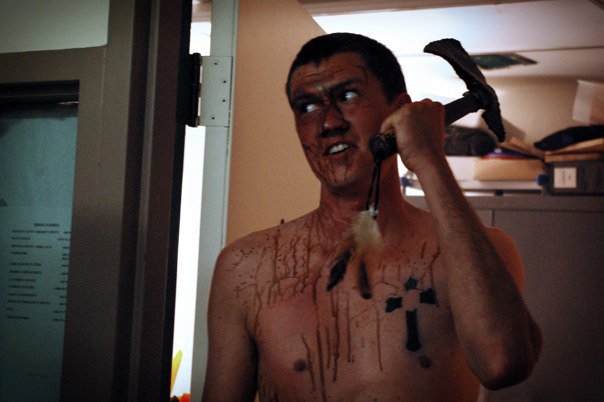
“Tomahawk” is a gritty, violent revenge tale about an ex-convict, John (Steve Helms), who returns to his hometown in Tennessee. Armed with a tomahawk (hence the title), he sets out to deliver revenge on the people who sent him to prison.

There’s a quite curious change between the 17-minute cut and the 30-minute cut. The 30-minute cut tells a story is more shrouded in mystery, as John’s actions are rough but not with much motive. That is, until midway through, when the truth becomes clear. This is pretty interesting, because this buildup makes John seem like the antagonist for the people he’s after—clean-looking Bobby (Shayne Gray), Sheriff Murray (very well-played by Bob Boaz), and a few cops—only to discover in the midsection of the film that they have done him wrong in a horrible way, and thus we sympathize with him.

The 17-minute cut, on the other hand, opens with a quick scene with the “supposed protagonists” that indicates a sense of guilt that sort of lets on that they’re not to be trusted. While John is seen as the rough, vagrant outsider visiting this small town for his own personal business, he could be considered a heroic figure strangely because of that little beginning. With the 30-minute cut, something doesn’t feel right with this guy from the start. He comes across as an Anton Chigurh type feeling the need to cause anarchy and chaos, and that’s what he does for the people he comes across—including two passersby and two obnoxious guys in a bar, before moving on to the people who would turn out to be his true targets.

And for the record, I’m not spoiling much of anything—the 17-minute cut is the version that’s being shown around in film festivals, and so people will already know that John is the hero throughout the film. The most notable changes include the cutting-down of key action sequences, and even the deletion of the whole sequence set in the aforementioned bar. I understand that the action scenes had to be toned down for a shorter running time, and it seems as if the bar scene is rather pointless in a way. But I preferred it when the action went about its own pace in the original—the buildup works, the tension is present, and it makes it seem all the more satisfying.

I mentioned that “Tomahawk” was a well-made film, and it is impressive. The action scenes (including a nicely-done chase near a railroad) are very well-done and believably violent to the point where the hits, kicks, punches, strikes, etc. seem very real. The cinematography is terrific, and there’s a consistently tense tone that flows throughout the film.

And here’s a fascinating story element—save for a couple cops, the people who have wronged John in a big way don’t seem like villainous types. In particular, Bobby seems like an ordinary family man that you wouldn’t suspect of doing something as horrible as revealed. What’s also chilling is the notion that even though Sheriff Murray knows very well that Bobby has done what started this deadly crusade, he actually agrees to assist him in a way out.

The ending…damn. What can I say? Without giving too much away, after an inevitable action climax involving an intense showdown between John and crooked police, I was surprised how strong the final outcome turned out to be. It ends with a sense of psychological terror after the final decision is made about how this is all going to turn out, followed by an unending shot of the victor walking off alone. That last shot is played silently as the end credits roll, without a music score. It allows the audience to sink in everything that has occurred. It either works or it doesn’t; it worked for me. That same impact was present in the 17-minute version too, but with everything else in the 30-minute cut, it’s even more powerful because of everything else that has occurred earlier.

I like the 17-minute “festival-cut” of “Tomahawk” fine; I believe the 30-minute cut is even better. But either way, both versions show the true craftsmanship that was put into it—Eric White proves to be a capable filmmaker; Lyle Arnett Jr.’s cinematography is great; and the hard-edged music score by Kerry Loveless and Avery Moorehead is excellent. So I’d say see either version for its own merits.

The Help (2011)

20 Apr

images

Smith’s Verdict: ***1/2

Reviewed by Tanner Smith

Before I review “The Help,” I should probably state that I did not want to see it. I saw the trailer and assumed it was another one of those heavy-handed movies that reminds us “racism and prejudice are bad.” Then I was astonished to see that it was nominated for quite a few Academy Awards, including Best Picture. This was the year I made the vow to watch all of the Best Picture nominees. So, a friend lent me the film’s Blu-Ray disc that she owned and I decided to just sit down, prepare for what’s to come, and hope for surprises.

Well, truth be told, there are very little surprises in “The Help,” save for some great performances. But when the story works, I accept the film for what it is. I liked “The Help”—a lot more than I imagined. The wonderful acting, well-developed characters, and involving story drew me in. Is it telling me what I haven’t heard before? No. But I was still quite moved.

“The Help” is a feel-good tale, based on a best-selling novel by Kathryn Stockett (unread by me, however). It presents itself as the story of African-American housemaids in the South, and how they enabled a young white woman to write a book about them.

It takes place in the early 1960s in Jackson, Mississippi, where slavery isn’t far off from house caring. The white women who live there hire black women to raise their children and tend to their houses, while also ruling over them with arrogant attitudes. One maid—named Aibileen Clark (Viola Davis)—worries that the little girl she cares for is going to turn out to be like her boss, and it seems like the other maids think the same way of the children they care of.

The worst of these overpowering women is the constantly-condescending Hilly Hollbrook (played by a scene-stealing Bryce Dallas Howard), who also seems to be the “leader” of this society. Whatever she does, the others want to do…except for one woman. That woman is named Skeeter Phelan (Emma Stone), and she’s returned home from school. She doesn’t fit in well because she’s not all for the other girls’ snooty attitudes, and sees the maids as individuals, particularly because her mother’s maid Constantine (Cicely Tyson) was more of a mother to her than her actual mother (Allison Janney).

Skeeter wants to be a writer and decides to write a book telling the life-stories of the maids. But of course, she needs them from their perspectives. So, she’s able to find two keen participants—Aibileen and her friend Minny Jackson (Octavia Spencer)—to sneak behind their employer’s backs and tell their stories, exposing certain, intriguing secrets in the process. All of the other maids are hesitant about this little project, until they see the confidence in Aibileen and Minny and decide to join in.

This story is told during the Civil Rights Movement and there are notions of violence rising in the backdrop. But mainly, “The Help” tells its story safe and doesn’t veer too far into being uncomfortable. There isn’t a shade of grey to be found here. There is melodrama, along with moments of comedy, tragedy, and triumph—enough to please audiences. It’s easy to see why this film did well with audiences. There’s a nice sense of overcoming for these characters.

I love Emma Stone, but her role is a thankless one and she’s constantly upstaged by the other performers. Aside from Sissy Spacek (who has nice moments as Hilly’s mother), Mary Steenbergen (as Skeeter’s publisher), and Allison Janney (who has more dimensions than expected, as Skeeter’s mother), there are three other actresses who really make impressions. The first is Viola Davis as the maid Aibileen. Davis is so forceful and compelling as this sensible woman who takes a chance and tells her story—it’s an excellent performance. The second is Octavia Spencer as Minny, who has a wonderfully expressive face and a comic wit that works. Minny is the kind of woman who strikes back without thinking of consequences—later in the movie, she strikes back at Hilly for firing her and treating her new employer like slime in a scene that. Uh, don’t ask how she strikes back.

The third, as Minny’s new employer, is Jessica Chastain. Chastain plays a ditzy, white-trash blonde named Celia Foote, who is married to a nice businessman but can’t seem to do much to please him. So she hires Minny to care for the house and cook, while Celia’s husband is at work, so that he’ll think that Celia did it all. Minny knows who she’s really doing this for and also develops a friendship with Celia, while giving her good pieces of advice and explaining why the other women don’t want her around. This leads to a comic scene at a charity event, in which Celia strikes back. I’m sorry for saying so much about the character here when I forgot to mention her in the main story description (her comeuppance doesn’t have much to do with the main story). I should be praising Chastain, as she plays the role. I really love her. Her performance is hilarious, infectious, and sincere. My theory—Jessica Chastain is an angel; she came down to Earth, made up a biography, and decided to act in six or seven movies in the past year to be nominated for an Academy Award.

One character that isn’t as effective is Hilly, mainly because she never comes across as a fully realized character. As played by Bryce Dallas Howard, she’s too much of a cartoonish caricature and only knows two emotions—condescension and shrieking anger.

“The Help” is engaging and at times, very affecting. And while the running time is 146 minutes, the movie gets better as it goes along. With great acting and a nicely told story, “The Help” is a feel-good movie that works.

Bad Santa (2003)

17 Apr

Bad-Santa-Thornton

Smith’s Verdict: ***1/2

Reviewed by Tanner Smith

“Bad Santa” is not your typical Christmas movie and that’s an understatement indeed. This is the vilest Christmas movie since “Silent Night, Deadly Night.” But there are differences between the two. One is, “Bad Santa” is a comedy; “Silent Night, Deadly Night” was not. Another is, “Bad Santa” is supposed to be funny; “Silent Night, Deadly Night” was unintentionally funny. Name a Christmas movie like “A Christmas Story” or “It’s a Wonderful Life” or “Elf.” Those films are made for children and families. “Bad Santa” is not for everyone; in fact, it may hardly be for anyone. This is a cruel, vulgar, vile, profane film set around Christmastime with a crude, vulgar, and profane mall-Santa Claus. This movie is not for children or for the faint of heart—and especially not for those who don’t enjoy the shot of a drunken Santa vomiting on a wall while the title “Bad Santa” fades into place.

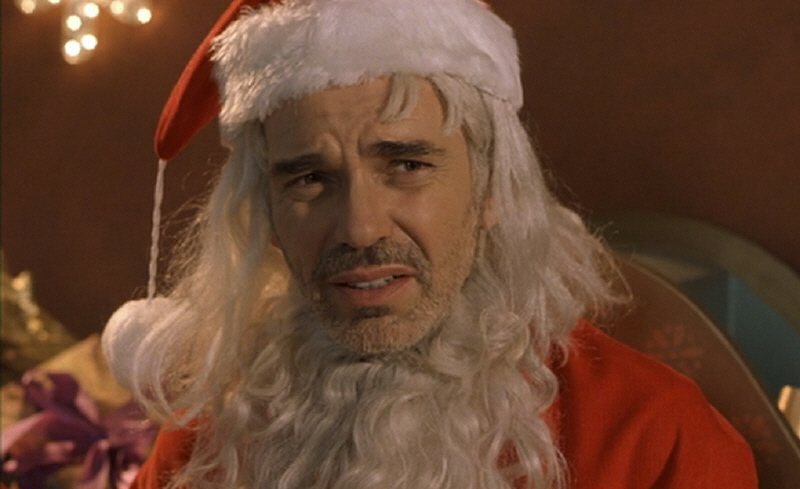
The title character is Willie and is played by Billy Bob Thornton. This is the role Thornton was born to play. He’s a smoking, drinking, vulgar sex fiend who is unfriendly to everyone and has respect for himself. He is not afraid of anything, especially not of looking like a complete idiot. Thornton does not call off any bets in making this guy extremely unlikable. This would be a mistake if the movie wasn’t so funny.

Every Christmas Eve night, Willie and his assistant “elf” Marcus (Tony Cox, brilliant) knock off a department store and then prepare for their next heist next Christmas. But in order to be able to get inside the department store, Willie has to dress up like Santa Claus for the children. He would make the Santa in “A Christmas Story” look like a buffoon. He drinks, swears in front of the kids, and even wets himself in the Santa seat. And so Marcus is the one who has to pick up the pieces that Willie leaves behind. About now, he is starting regret helping this guy out again…and again…and again. He is really ticked off at this guy.

Willie’s unusual behavior (for a Santa) catches the attention of the mall manager (John Ritter), a sleazy store detective (Bernie Mac), and an attractive bartender (Lauren Graham) with a Santa fetish and a catchphrase that should never be uttered on TV or in another Christmas movie, for that matter. He also attracts an overweight, friendless little boy named Thurman Merman (Brett Kelly)—the kid is a cross between Joe Cobb (of the Little Rascals) and Ralph Wiggum of “The Simpsons.” This kid is even weirder than Willie and stalks him everywhere to the point of saving him from a mean dwarf and inviting him to his house, where he lives alone with his senile grandmother (Cloris Leachman). Willie’s attitude doesn’t change around this kid, but the kid just doesn’t leave him alone. And he thinks he’s really Santa. This is not the cute kid you see in other Christmas movies—this kid is a creepy little tyke.

This is not a heartwarming film—it’s as crude as you could get. And yet it works because the actors are game and the script is hilarious. We also don’t get the kind of happy ending you would expect in a Christmas film—in fact, nothing you’d expect in a Christmas film is found here. Billy Bob Thornton is excellent as Willie, with a mix of hopelessness and grisliness that is very welcome and hilarious. Tony Cox, John Ritter, Bernie Mac, Lauren Graham, Brett Kelly, and Lauren Tom (as Marcus’ wife) are very funny as well.

“Bad Santa” is R-rated—like I said, it’s definitely not for children. And if you decide to check it out, I have to share this quote from Richard Roeper when he reviewed this movie—“Don’t see it with someone you don’t know very well.”

Forget About It (Short Film) (2006)

16 Apr

forget-about-it

Smith’s Verdict: ***1/2

Reviewed by Tanner Smith

We usually have a bunch of movies where street kids are robbing stores and banks just to get themselves some dough. But “Forget About It” tells us why it’s not such a good idea because thieves will get caught. No, this isn’t a drama about teenagers robbing a bank and what happens afterwards. Instead it’s a comedy about two bored teenaged guys who sit in a Jeep one night and imagine robbing a bank and talk through small (or huge) situations.

Zac Larsen plays Andrew and Levi Whitlock plays Spencer, both of whom I’m guessing were voted “most likely to be seen in a Judd Apatow comedy” in their high-school yearbook. These two idiots (wait I’m sorry—“misunderstood teenagers”) just have this idea to rob a bank and think about it first. Very smart, I guess. Through fantasy sequences, Andrew and Spencer try sequence after sequence to get into the bank and into the vault without being shot by the smirking (and utterly hilarious) security guard (Matt Lopez). No luck, and they just try again and again and again, and you know what? I was laughing out loud the whole time.

These sequences are fun to watch because you know that it’s a bad idea to rob a bank because something will happen every time. First they try it dressed in black—they get shot. Then they try it just by showing the teller the gun—they got shot when she turns on the alarm. A lot happens here and I was really interested and laughing all the way through.

Spencer has some of the funniest moments, such as when he first walks in with a sniper rifle and when he gets shot by the guard and usually goes “Oh, man! I got shot! Dude, let’s do it over again!” Levi Whitlock is very funny here and Zac Larsen is the brain who also has a couple of funny moments, such as when he freaks out when things go wrong. The guard is the funniest character in this movie. It’s a small role, but his smirks and dialogue makes him look like a cross between Clint Eastwood and Will Ferrell.

The screenplay is great and the direction is good also. James Bereece is the director and Spencer Stuard is the writer. They don’t disappoint. The idea is very good to have two guys in a car imagining robbing a bank and then get to see fantasy sequences about their many attempts to succeed. And the dialogue is just funny. These two seem to be channeling Kevin Smith comedic work and they pull it off here very well.

This film was made by a youth production company in Utah called Spy Hop Productions, who have made some of my favorite short student films, including the short documentary “Touching Sound.” This company founded by youths makes such great short films and I look forward to seeing more of whatever they have to offer.

You can see this film at https://vimeo.com/48849032