Archive | Three-and-a-Half Stars ***1/2 RSS feed for this section

Greed (Short Film)

14 Jun

stills_Greed

Smith’s Verdict: ***1/2

Reviewed by Tanner Smith

Before I start this review, it’s fair to warn you that SPOILER ALERTS are coming! SPOILER ALERTS are coming! Check out the film on the link below before reading this review.

When watching the 8-minute short film “Greed,” I wasn’t sure how I was going to review it, since it felt like a story we’ve seen/heard before, though shot and acted very nicely. I would recommend it for that skillfulness, but to be honest, it’s the ending twist that really makes the film. It’s the kind of twist that has you think about what you just saw, and unlike a lot of twist-endings I can think of, you actually care to look back because it’s a good film.

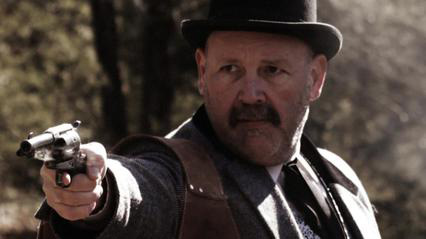
“Greed,” which was written and directed by University-of-Central-Arkansas digital-film-major Trenton Mynatt, is a Western, set in the Ozark Mountains in the 1800s. And let’s get this out right now—the look of this short is incredible. Not only is this film shot very nicely, but also you really get a sense of being there with these characters in this desolate environment. Even something as simple as handwritten words on a letter or a knife sharpened against a stone looks great.

But I digress. What’s the story? Well, it’s fairly simple and straightforward…so you would think. It begins in a cat-and-mouse chase that has already begun in a story that I wish could have been made, so the film could be longer and more effective, but you stick with what you got. Anyway, a wealthy man named Jimmy who, along with a small posse, is on a search for gold and also on the run from a malevolent Marshal for mysterious reasons. The Marshal has already killed their guide, so they must move further or else they’ll pay the same price. But a price for what, you ask? This is actually what makes “Greed” original and quite fascinating—the twist. And at this point, I’m obligated to state again—SPOILER ALERT!

Believe it or not, I’ve only described the first three-and-a-half minutes of this eight-minute short, which consists of Jimmy turning on the remaining two members of his group, killing one and leaving the other to die—all so Jimmy can claim the fortune for himself. Earlier, it seemed as if Jimmy and his posse were the heroes and the Marshal was the villain—and while the Marshal isn’t technically a protagonist, he’s not much of an antagonist either. And it all becomes clear at the end, when it’s revealed that…well, let’s just say there’s more to this man than bringing justice. What is the price that Jimmy and his group must pay? Death. For what? Greed—one of the seven deadly sins. It’s a unique, well-executed twist that brings things into perspective and makes you think about what you’ve just seen.

In a certain way, “Greed” reminded me of another UCA-produced short film: Allison (Hogue) Bristol’s “Hitchhiker” (already reviewed by me), which was made the year before. It’s the simple, seemingly-generic story with a fresh manner of execution and a resolution that turns it all around and makes you think maybe it wasn’t so “simple” or “seemingly-generic” after all. (And wouldn’t you know it—some of the people involved in the making of this film were also involved in the making of “Hitchhiker.”) Now that you’ve watched it on Vimeo before reading this part (I hope you did; if not, don’t say I didn’t warn you about spoilers), watch it again knowing what you know now and think about what you see. For example, notice the look on Jimmy’s face early on when he’s reading the letter stating a brother is dead—is it indifference due to his greed, sadness because of the loss, fear because he knows who’s after him? This is what twist-endings were made for—not to merely confuse us or take us off guard, but to make us look back and really reflect about what was set up for it. “Greed” is a short film that worked in that sense.

Check out the film here: https://vimeo.com/43716364

This is the End (2013)

12 Jun

1170481 - The End Of The World

Smith’s Verdict: ***1/2

Reviewed by Tanner Smith

When I heard about “This is the End,” a comedy about Seth Rogen, James Franco, Danny McBride, Jay Baruchel, Craig Robinson, and Jonah Hill surviving the end of the world, and then I heard that these great comic actors were playing themselves (or rather, exaggerated versions of themselves), I wasn’t sure how to respond. But I was thinking—if done right, it would be absolutely fantastic in how wild it all sounds; if done wrong, it would be the most self-indulgent, painfully-obvious, obnoxious piece of crap to come to the big screen in a long time. But just by this concept alone, I realized I had to see this movie! And thankfully, “This is the End” turned out to be as brilliant as it sounds.

It is also, don’t get me wrong, the wildest, most outrageous comedy to come around in a long, long time. I dare you to find another comedy released in the past few years with as much ambition, outrageous aspects, energy, and as a result, as much hilarity to come from such. Practically every scene, as I can recall, has something to laugh at—even moments when I was laughing in spite of myself. I’m not entirely sure what all I get away with revealing among the vulgarities in this movie, but if three or four scenes didn’t earn the film an NC-17 rating, I think the R rating will be stuck to just about anything mainstream. There are so many moments that are very much “out there,” to say the least, and on top of that, there are overly-done sexual sight gags—not the best film to see on a first date, that’s for sure.

Even co-writers/co-directors Rogen & Evan Goldberg (yes, “Superbad”/”Pineapple Express” co-writers Rogen and Goldberg direct their script this time—another reason I was looking forward to seeing this movie) were reportedly surprised to find that they got away with an R instead of an NC-17. If there was no issue with the ratings board about most of the gags seen here, then there’s pretty much anything than can get away with an R rating. No doubt about it.

But I digress. The movie opens with old friends Seth Rogen and Jay Baruchel reuniting in Los Angeles. They catch up on current events, spend time together eating fast-food and getting stoned, and then Rogen brings Baruchel to James Franco’s house-warming party at his new mansion in the Hills. Who else should be there but Craig Robinson, Jonah Hill, and Danny McBride, and also there’s Michael Cera, Emma Watson, Jason Segel, Rihanna, Aziz Ansari, Kevin Hart, David Krumholtz, Mindy Kaling, Christopher MIntz-Plasse…Am I missing somebody? I believe I am. There were so many celebrity appearances at this party, all playing themselves, that I have to wonder if maybe I missed Leslie Mann or even Judd Apatow somewhere. But anyway, they’re all playing pretend versions of themselves here and it’s a wonderful comic move in how they can poke fun at their careers, highlights, memorable qualities, etc. And there’s also room for major contrast—not with Jay Baruchel, who is just about as awkward as in a lot of films he’s acted in; but mainly with Michael Cera. Cera has about five minutes of screen time, and he’s freaking hilarious. Why? Because the nice kid from “Superbad” and “Juno” is now playing an ass-grabbing, coke-sniffing, obnoxious jerk (or seven-letter word for “jerk”) that is supposed to be the “real Michael Cera.” His exit in this movie is also hilarious and also manages the Cera-esque awkwardness, though it’s all the more hilarious in how it was set up with him (or rather, his character).

And speaking of exits, or rather the end, the Rapture is here! In the middle of the party, Rogen and Baruchel stop by a nearby gas station, only to witness the beginning of insanity of apocalyptic proportions—explosions are heard, booming is felt, people are absorbed by blue light up into Heaven, and everyone else is left to endure (gulp!) the apocalypse. And get this—no one at Franco’s house noticed anything because nobody there was apparently worthy enough for Heaven. Things get more extreme when earthquakes arrive and a large sinkhole swallows a good majority of the party until Rogen, Baruchel, Franco, Robinson, McBride, and Hill are left to hole up inside the mansion and figure out how to survive together. They spent most of their time figuring eating/drinking plans while also trying to agree with one another, getting stoned, reading (and abusing) porn magazines, and—I’m not even kidding—they even make a trailer for an unofficial “Pineapple Express 2.” (When I saw that scene, I laughed and laughed and laughed!) But when demons rise from the pits of Hell, they find that they can only survive for so long before they realize they must find a way to get to Heaven.

Remember when Bill Murray played himself in “Zombieland” or when Neil Patrick Harris played an incredibly vulgar version of himself in the “Harold & Kumar” movies? Remember how much laughs you can get from a comic actor exaggerating with his/her own personality? Such is the case with pretty much everyone in the cast here, which mainly consists of celebrities. Michael Cera, like I said, is an unbelievably funny masterstroke of writing, and Emma Watson even at one point comes to visit the six men and threatens them with an axe the moment “rape” is mentioned. (Yes—Hermione Granger with an axe!) But how about the six principles? They pitilessly lampoon themselves by going for the easy targets and the…not-so-easy targets. Their public images, their personalities—everything that the public thinks they know about them (but are probably not entirely right about) is broadly developed here, and that makes it all the more funny. We have Seth Rogen as the sometimes-reliable buddy who laughs that distinctive laugh and constantly gets stoned; we have James Franco as an oddball whose indifference in most of his performances is exaggerated (and also, he collects props from his films, like the camera in “127 Hours” which the group members use to make video-diaries); we have Jonah Hill as a former loudmouth turned fancy Oscar-nominated actor trying to keep his cool; we have Craig Robinson as the calm, relaxed “big-guy” role you see him in, only with more vulnerability and also a tendency to try new, disgusting things (like drinking his own pee); Jay Baruchel is the sweet-natured outcast here, as he usually plays the “awkward-odd-man-out” role, and wouldn’t you know it, he’s probably the only sensible one in the entire group. And then there’s Danny McBride—good Lord, is this guy horrid! If you thought he was unlikeable in many other movies, he’s incredibly obnoxious here and entirely hateful. McBride is a loser, plain and simple—there is nothing redeemable about this guy at all. And that was the purpose in exaggeration, of course—the result is freaking hilarious. All of these actors are game at this difficult task, and it’s very funny watching them trying to be nice to each other.

“This is the End” features many great moments, but I won’t dare give away even a majority of them. Even for those I did unintentionally give away, no worries—there’s a lot going on in this movie, as you feel that Rogen and Goldberg put their all into this. Even if it doesn’t work (and a couple vulgar-dialogue scenes do run on for a bit longer then they probably should), it keeps going and continuing with a new trick.

With that said, what more can I say about “This is the End?” There’s a lot I can say about this one-joke movie with comic figures poking fun at each other while surviving the apocalypse. But with a no-spoilers policy, I’ll leave you to enjoy the unbelievably-outrageous final half, along with what leads up to it. We’ve got a good couple months in the summer, but I’m going to make a prediction that no other comedy this summer-movie season is going to be as hilarious as “This is the End.”

Darby O’Gill and the Little People (1959)

8 Jun

darby-ogill-and-the-little-people-800-75_7106

Smith’s Verdict: ***1/2

Reviewed by Tanner Smith

Faithful readers may have figured out that my two favorite Walt Disney-produced live-action movies are “20000 Leagues Under the Sea” and “Old Yeller.” (And to get it out of the way, other great titles, produced by Disney himself before his death, that come into my mind are “Treasure Island,” “Swiss Family Robinson,” and “Mary Poppins,” but I’ll get to those later.) But there was one that I used to watch a lot as a kid—I mean, just as much as “Old Yeller” (yes, that much). That was 1959’s “Darby O’Gill and the Little People,” a delightful, fantastic movie that I loved as a kid and love even more now.

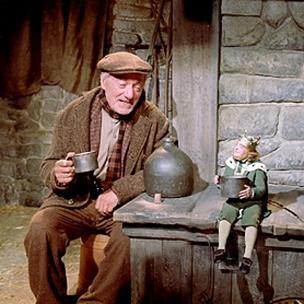
The film takes place in a small Irish village, where an old widower, named Darby O’Gill (Albert Sharpe), lives with his 20-year-old daughter Katie (Janet Munro) in a gatehouse near Lord Fitzpatrick’s (Walter Fitzgerald) estate, of which Darby is caretaker. Darby passes the time by telling stories around the town pub—telling stories about the times he constantly attempts to catch the leprechauns, particularly their king Brian Connors (Jimmy O’Dea), who live on a hilltop known as Knocknesheega. Lord Fitzpatrick has hired someone else to labor the estate, which means Darby and Katie will be forced to leave, so a young Dubliner named Michael McBride (a 29-year-old Sean Connery in one of his earliest film roles) can move in. Darby begs Michael not to tell Katie that he lost his job, and manages to convince Katie that Michael is only here to help out around the house. That night, Darby is led to Knocknesheega where he stumbles upon the home of the little people. It turns out he was led there by King Brian so he can stay forever, away from the harshness of the real world. Darby manages to escape and make his way back home, which leads to King Brian finding him and Darby being able to trick him so he can capture him. Now in Darby’s possession, King Brian owes Darby three wishes to be granted, and Darby decides to save them for something wise.

Where do I begin with this movie? There’s literally a lot to like about “Darby O’Gill and the Little People” and a great deal of inventiveness. Well, I guess I’ll begin with the rules that are established with the leprechauns. For example, if you wish a fourth wish after your third, then it negates the other three; leprechauns’ powers only work at night; leprechauns can take any shape or form (such as a rabbit); they love dancing, whiskey, and hunting, which Darby can use to trick them; and so on. All of these rules are important to the story, and important for Darby to be smart enough to remember them all. This makes Darby a wise adversary for King Brian to match wits with. And that’s another wonderful thing about this movie—Darby and King Brian can be good friends when they need to be, but when to get what they want, they know how to fool each other into making it happen for one another. For example, how does Darby escape the leprechaun underground world? He plays a hunting song on the fiddle for the leprechauns to dance to before jumping to their horses and going off to hunt, in spirit of the song, thus giving Darby a chance to escape—here, he has used the leprechauns’ love for dancing and hunting to his own advantage. King Brian is able to outwit Darby as well, such as when he tricks Darby into wasting one of his wishes, and even at one point to save Darby’s life (without giving anything away).

I like the way the rules for the leprechauns are set up. Although, I have to wonder—there’s one scene in which King Brian manages to escape from Darby’s bag through a crowd of people, but the people see him as a rabbit. How does that work? If King Brian’s powers only work at night, then how was he able to make everyone see him as a rabbit (if he didn’t transform himself as a rabbit)? I mean, OK, Darby was tricked into wasting his second wish so that Michael could see King Brian (though only as a rabbit), but what was the extent of that wish? Could everyone else just see him as a rabbit, like Michael? I don’t know; maybe I’m questioning too much.

And before anyone lists any comments below, I’m not going to list the possibility that Darby is imagining all of this about the leprechauns and the magic they represent all this time (as inventive as that may be, don’t get me wrong). This is a fantasy and I’m dealing with it. Let the leprechauns and whatever spooky element Darby comes across later be there; don’t read too much into Darby being the only one to see them.

images

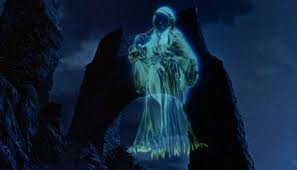
Speaking of spookiness, Darby also comes across a sinister ghostly figure at the end, known as the Banshee, which is said to represent death. In a complicated turn of events, Katie winds up at death’s door and Darby desperately attempts to keep the Banshee and the Death Coach from taking her away. Both the Banshee and the Death Coach frightened me as a kid (the Banshee’s blue-tinted, ghostly image, and not to mention her moaning howl, still continues to send chills down my spine, I’ll admit). I don’t doubt it frightened other kids as well (well, perhaps not those who were angered that the Nostalgia Critic listed the Banshee’s appearance as the Scariest Nostalgic Moment, but I digress); it’s just one of those scary aspects you find in Disney movies (the donkey-transformation in “Pinocchio,” the forest scene in “Snow White,” and so on) that scare younger kids but delight older ones.

But as for the lighthearted scenes, of which there are a lot, there are two in particular that I just love to watch every time. One is the aforementioned fiddle-scene in the leprechaun world, and it is very entertaining as well as visually astounding—by the way, the special effects in this movie, for the most part (I mean, aside from obvious trickery), are just fantastic; there are many great shots that show Darby and the little people in the same frame (done through forced perspective) and it seems completely seamless. I’m not quite sure how they were able to make them appear in the same frame in that day and age, but it’s just incredible. Anyway, the other scene I love is the scene that follows, as Darby and King Brian play a drinking game together so that Darby can trick King Brian into staying until daylight so that he’ll be powerless (and that’s how Darby catches him). This game gives us the “Wishing Song,” one of two songs in this movie (I’ll get to the other one in a bit). The “Wishing Song” has the two of them trading verses back and forth to see how long they can go. This scene is entertaining in the way they continue and keep coming up with clever, amusing rhymes.

This one’s my favorite: “I wish I was married to Old Widow Tunney; she’s ugly as sin, but has beautiful money.”

Oh, I can’t believe I almost forgot to mention the budding romance between Katie and Michael, which takes up a good chunk of movie. Darby wants Katie to be happy, while Katie only thinks about caring about her father and working around the house and doesn’t believe she has time for a man in her life. But Katie and Michael spend some good time together and actually get close to one another, while Katie doesn’t know that Michael is actually here to take Darby’s place. And Michael is wondering how long it will be before Darby tells her. But Michael isn’t keeping this secret for his sake—he genuinely likes Katie and Darby, and does want to help them. While this part of the movie isn’t as fascinating as Darby and the little people, it does help to deliver solid characterization, and on top of that, the two do share convincing chemistry together.

And need I also mention Sean Connery singing the other, most memorable song in the movie, “My Darling Irish Girl?” You know, it might just be me, but I’m not quite sure how to react to Sean Connery singing here. It’s kind of surreal, and I’m not quite sure how to describe it. It’s a good song, though.

What else is there to like about this movie? Albert Sharpe is excellent in the title role, Janet Munro and Sean Connery are appealing, the special effects are outstanding for the most part (there are some noticeable goofs, but when they’re good, they’re very good), I love the creativity among the leprechauns’ folklore, I love how Darby and King Brian are able to outwit each other, the atmosphere surrounding this small Irish town is evident throughout, and even the side characters such as the town locals who listen to Darby’s stories are amusing. “Darby O’Gill and the Little People” is just an all-around fantastic movie. It’s charming, creative, and (for lack of a better word) Disney-magic.

The Rescuers Down Under (1990)

8 Jun

images-1

Smith’s Verdict: ***1/2

Reviewed by Tanner Smith

It’s a bit odd that of the Disney animated features to spawn a theatrical sequel from, 1977’s “The Rescuers” would be followed with a follow-up, about thirteen years after the original. But nevertheless, Disney’s “The Rescuers Down Under” was released in between two of their biggest hits at the time, “The Little Mermaid” and “Beauty and the Beast.” While those two are well-known, “The Rescuers Down Under” is somewhat often forgotten by most people. Oddly enough, they remember the original “Rescuers” movie, which is ironic because that one seems a bit mediocre to me. This sequel, however, is something I see as a true upgrade in comparison. It’s a nicely-done, well-animated family-adventure that would delight children and even impress some adults as well…if only they would just check it out.

The original “Rescuers” was about two brave little mice—Bernard and Bianca—who are part of some sort of secret tiny rescue squad (I don’t know; it’s for kids, mainly) as they go and rescue a little girl from nasty villains. “The Rescuers Down Under” brings them back, as they travel to Australia to rescue a kidnapped little boy. While the original didn’t exactly have as much energy as “terminal cuteness,” this sequel is all over the place. There’s a great deal of drive and spirit put into this production from the animation to the story. Granted, the story is nothing special, but the aspects involving the main adventure, and the way they’re executed, truly are.

The story begins in Australia (where, by the way, only a couple side characters have Australian accents) as the little boy, named Cody, comes across a rare species of gigantic eagle. The eagle is caught in a trap and Cody frees it. However, he is found by a poacher named McLeach (voiced by a delightfully-game George C. Scott) whose goal is to capture endangered species and sell them off. The eagle is his latest target and he learns that the kid knows where its nest is, so he kidnaps him to gain some answers. The news gets to America, as Bernard and Bianca (voiced again by Bob Newhart and Eva Gabor) are called upon to rescue Cody. With the help of Wilbur the albatross (John Candy), they make their way Down Under and set out to rescue the boy.

I’m surprised by how much I cared about what was going on in “The Rescuers Down Under,” even now that I’m an adult watching this. I think a lot had to do with the energetic animation, but I’ll get to that later. There are little things with the characters that did a great deal of assistance in that area as well—for example, all throughout the movie, Bernard is trying to propose to Bianca, but is constantly interrupted by something each time. I felt bad for this guy (er, mouse)—all he wants to do is pop the question, and every time he does, either something tries to kill them or he’s interrupted by their guide, an adventurous kangaroo mouse named Jake (Tristan Rogers).

But now, let’s get into the action. And you can’t necessarily talk about the action without talking about the animation of this film. Animation always allows freedom to create something inventive, exhilarating, and never seen before. Nowhere is that even clearer than in the opening scene in which Cody frees the eagle. Cody falls off the cliff that the eagle was on right after he frees it, and the eagle rescues him and then lets him ride for flight. This is a truly great-looking sequence—as the boy is clinging to the back of this soaring giant bird, the animation is alive and fully realized. And it gives a great sense of flight, as well as when Bernard and Bianca are riding on the back of Wilbur (who, in comedic fashion, is not the best flier). The flight scenes are a lot of fun, and there are some other well-done action scenes such as chases and races against time that are also fun, particularly in the final climax.

All in all, “The Rescuers Down Under” is a fun little movie. When you hear the story here, you don’t hear anything special—just an adventure with little mice, much like the original “Rescuers.” But the animators put their all into this production with spectacular animation and a good sense of fun.

Batman (1989)

23 May

images-3

Smith’s Verdict: ***1/2

Reviewed by Tanner Smith

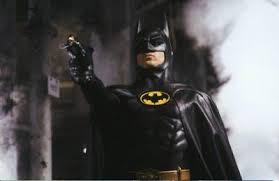
In the late-1980s, “Batman” was the most anticipated movie to come around. Warner Bros. was hoping that this would make people forget that they distributed the “Superman” sequel-bomb “Superman IV: The Quest for Peace,” released in 1987, and so they turned from DC Comics’ Man of Steel to its Caped Crusader. And people were excited to see a dark, live-action film adaptation of Batman that didn’t have the campiness of the 1960s “Batman” TV series or the in-jokes that the comic book series had, but it did have the promising director of “Beetlejuice,” Tim Burton. Sure, there were some uncertain comments from people who even wound up petitioning not to have Michael Keaton star as Batman (but I’ll get to that later), but nothing was going to keep people from seeing “Batman.” And so, in the summer of 1989, it was released in cinemas and became a box-office hit, leading to become the highest-grossing film of the year. And honestly, I can definitely see why. “Batman” is a solid entertainment. It’s dark, it’s brooding, it’s suspenseful, much like the Caped Crusader himself.

Yes, this “Batman” is dark and not necessarily for younger kids. This is more in the spirit of an old-school film noir, with Gotham City as its backdrop. There is a lot of crime, and fascist crime bosses, but there is also someone out there on a crusade to foil it. This is Batman, a dark-costumed vigilante whose presence scares criminals and angers local Mob boss Carl Grissom (Jack Palance). Gotham City locals don’t really know of any “bat man,” outside of robbers and murderers, but there are rumors about him. Reporter Alexander Knox (Robert Wuhl) describes him as a man-sized bat who is indestructible, and wants to find out more about him. In comes Vicki Vale (Kim Basinger), a reporter/photographer who is interested in his theory. To get some answers and an inside scoop, she believes that eccentric billionaire Bruce Wayne (Michael Keaton) is secretly Batman, and so she decides to romance him.

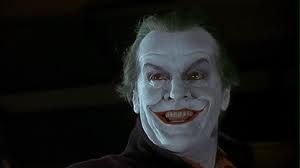
Meanwhile, Grissom’s right-hand man, Jack Napier (Jack Nicholson), is set up by Grissom on a mission that leads the cops to him. Along comes Batman, who corners Jack and tosses him into a vat of acid. Jack survives, but his facial nerves are severed, leaving a permanent smile. This also changes his personality so that he’s more gleeful and also more psychotic. He calls himself The Joker, overtakes the Mob, and begins his own reign of terror in Gotham City.

Despite being called “Batman,” the title character himself is more or less kept in the shadows for the most part. We don’t get his standard “superhero origin story” here; instead, the origin story that the movie delivers is of the Joker, the movie’s villain and Batman’s arch-nemesis. (I think the movie could have been titled “Joker,” in a way.) After all, we see how this Jack Napier becomes Joker and what will lead to his downfall in the film’s inevitable climax. And so, most attention is brought onto the Joker in this movie, as well we see a lot more of him than of Bruce Wayne/Batman. While this may seem like a flaw, it actually makes it all the more solid. Batman is known for being dark and mysterious; the less you know about him, the more interesting he is. You want to find out more about him, and there are some good details that indicate what he’s been through and what he’s going through, but had there been anymore, the fascinating mystery may have been gone. And so in the sense, I’m glad Batman wasn’t the main focus of this story.

I know having a villain as practically the “star” is a risky move to pull in a movie like this. But Jack Nicholson is so enjoyable as the Joker that it doesn’t matter how sick and psychotic he is; you just watch him go throughout his schemes, while still knowing that Batman is still the one to root for.

What we do see of Bruce Wayne is very interesting, and Michael Keaton is excellent in portraying Bruce as an odd billionaire with dark secrets and a tragic past. When Keaton plays Bruce Wayne as he socializes with people, you wouldn’t really believe that he is secretly Batman. He keeps his pain inside, not making it anyone else’s problem but his own. And when Keaton is Batman, he practically “breathes” cool. He’s intimidating, purposeful, and rock-solid, which makes his performance of Bruce Wayne all the more interesting. As the movie develops and you start to see more of this character than before, you understand what Bruce is going through—this is his problem that hardly anyone else can handle and so, he’ll deal with it by himself. Although he does have a couple people to turn to (including Vicki, who becomes his romantic-interest who discovers his secret, and his loyal butler Alfred, played by Michael Gough), he tells only what they deserve to hear and leaves everything else for him to handle. This leaves him with a few strengths for us to notice about the character, making it even more fascinating that this is our hero. When all is said and done, Michael Keaton is a great choice for Batman. I know that back then, he was known for his broad-comic persona in films such as “Night Shift” and especially “Beetlejuice”; but here, he’s absolutely brilliant. You may not see as much of him as the Joker, who practically hungers attention from the audience with the manic Nicholson performance, but there’s always that sense that this is Batman and he knows what he’s doing. I’m glad that that ridiculous petition to remove Michael Keaton from the role was ignored—seriously, what were those people thinking?

images-1

Jack Nicholson owns it as the Joker; it’s not only menacing, but also funny. You can tell he’s not just doing for a nice paycheck, much like how Marlon Brando must have felt when he played Jor-El in “Superman.” You can tell he’s just having a good time and that energy that he brings to the screen is always evident.

Kim Basinger plays Vicki Vale, whom Bruce falls for while she is attempting to gain a scoop on Batman for Knox’s story. While many critics felt that this character was pointless and a misstep, I thought she fit into the story really well. She is the one who aids the audience into discovering Bruce’s secret (and also the reason Bruce wants to admit the truth to somebody for the first time), and she is an interesting character. Sure, she screams a lot (whether she’d be menaced by the Joker or reacting to one of Batman’s surprise gadgets), but she was kind and polite while also having her limits. And when she’s captured by the Joker in the climax so Batman can save her, she still manages to fool Joker into thinking he’s winning. Basinger is game in a role that would have had her doing a lot less.

We still have the traditional Batman gadgetry, such as a self-guiding grappling hook that aids Batman up the side of a building. But more importantly, we also have the awesome-looking Batmobile and the Batplane (even though the Batplane looks more like a model in some shots, it’s still pretty awesome). Those visuals are well-handled, but the look of Gotham City itself is a true marvel. Director Tim Burton is best known for specializing in gothic production design in his films, and this is no exception. Gotham City looks kind of like Manhattan if it was redesigned to look like a carnival funhouse—it’s just incredible to look at.

The action sequences are set up and executed with such flair and energy that it makes the film all the more exciting to endure. It’s engaging and well-crafted, although I will admit that I thought the final climax went on a bit too long. That is the main reason I’m rating this film three-and-a-half stars instead of four, but just be impressed I’m even rating it that (I’m surprised to find that not many people seem to like this movie very much, because of how little of Batman is seen—oddly enough, I found that to be the most intriguing factor). But to the credit of that climactic half-hour, it does allow for some psychological turns as well as physical force. You see, in the middle of the battle, Joker and Batman attempt to turn one another off by admitting that they created each other, as Batman threw Jack into the acid that made him this way, while Jack was the one who killed Bruce’s parents long ago (this is why Bruce would become Batman). That’s pretty clever.

Another thing about “Batman” I want to praise is the music. And no, I’m not talking about the dated Prince soundtrack. I’m talking about Danny Elfman’s memorable, fantastic score. Whenever I think of Batman, this is the music I’m going to be thinking of every time. It’s terrific in the way it keeps with the dark tone of the movie and yet maintains a consistent quirky side to it, making us remember that this is a superhero movie after all. Elfman nails it here with his score.

“Batman” is told with a more adult approach, than one might have expected at the time, and that makes it interesting and all the more solid. With a dark look, a fantastic production design, and convincingly troubled characters played by great actors, this is an enjoyable, good-looking, terrific film that is respectful to the superhero-movie genre and delivers some truly great surprises.

Back to the Future Part III (1990)

22 May

images

Smith’s Verdict: ***1/2

Reviewed by Tanner Smith

While “Back to the Future Part II” was more of a zany screwball comedy and not really with the human emotions aspect that made “Back to the Future” the great film that it is, “Back to the Future Part III,” the final chapter of the “Back to the Future” trilogy, is actually closer to capturing that emotion that the original film had. While it has moments as goofy (though also as fun) as in the second film, there is still something good and moving within the human-interest story that is found here. As a result, it’s still not quite up there with the original film, but it’s still a terrifically entertaining movie that winds up having more on its mind than just slapstick and action.

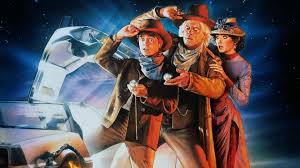
But I’m getting ahead of myself here. “Part III” begins where “Part II” left off, as teenage time-traveler Marty McFly (Michael J. Fox) has returned to 1955 to settle things so that his present-time of 1985 will be fixed after a mishap. His companion, Dr. Emmett “Doc” Brown (Christopher Lloyd), accidentally ended up going back in time to the Old West in 1885. After sending a 70-year-old letter to Marty to be delivered at that particular point in time, Marty enlists the help of the 1955 equivalent of Doc Brown to restore the time-traveling DeLorean motorcar so that he can get back to the future. But Marty soon discovers that Doc is destined to be shot by a bandit, Buford “Mad Dog” Tannen (Thomas F. Wilson), who of course is an ancestor of Marty’s bully in the other two films, Biff Tannen. So once the DeLorean is up and running, Marty decides to travel back in time to 1885 and rescue his friend before that happens.

Now in the Old West, Marty reunites with Doc, but runs into a problem—after a run-in with some Indians, the DeLorean’s fuel line is torn, and so without gasoline, Marty and Doc must come up with another way to bring the car up to 88mph in order for the “time-circuits” to operate and bring them back to the future. Their scheme includes pushing it with a freight train and hoping it bring it up to enough speed that it works. But there’s also another problem. Doc has fallen in love with a local schoolteacher, Clara Clayton (Mary Steenburgen). Upon meeting her, he is instantly attracted to her, and the feeling is mutual. The feeling is so much so that Doc sometimes forgets that he owes it to himself not to interfere with history again, even if it means going back to the future and leaving Clara behind. Marty has to be the one to talk some sense into him, for a change.

This element of “Back to the Future Part III” is the sweetest and most interesting of the film. Lloyd and Steenburgen are great together and exhibit convincing, appealing chemistry. It gives Lloyd a chance to show further dimensions in his character of intelligent Doc Brown, and Steenburgen’s Clara is not a one-dimensional floozy for Doc to fall for; she’s an odd, quirky woman who is able to capture Doc’s heart with no problem. She’s easy to like and even easier to fall for. This is the kind of performance I was hoping to receive from Steenburgen in a similar time-travel comedy/adventure, “Time After Time” with Malcolm McDowell.

Oh, and I forgot to mention Marty’s encounter with the big, bad bandit himself, “Mad Dog” Tannen. This encounter leads to Marty standing up to him when he threatens Doc and Clara, and Mad Dog challenging him to a shootout. (Although, instead of high noon, it’s high eight a.m.) Marty thinks this won’t happen, as he and Doc are expected to leave for home before that time. But of course, something has to go wrong, and Marty must ultimately face up to the jerk once and for all.

“Back to the Future Part III” is essentially a Western, and it’s an immensely entertaining one. Even if this Western world is more of a “movie-Western” than an “actual-Western,” it’s still enjoyable to see the standard stuff you usually see in Westerns. (You even see Pat Buttram as a regular in a bar.) It’s a fun Old West world that, much like “Back to the Future Part II”’s futuristic design, the production design for this Western town is impressive.

“Back to the Future Part III” concludes the “Back to the Future” trilogy, and ends on a satisfying note that pays off everything that was set up and is creative in its storytelling. It makes you want to rewatch the entire trilogy from the first film to the last to view the full experience as a whole itself.

And that’s just what I do with the entire “Back to the Future” trilogy. Yes, the first film is my favorite movie of all time, and the sequels are somewhat lesser in tone, but they are still fun to watch and I like them without comparing them to the original so much. They may not be as good, in that case, but they are still highly enjoyable, energetic romps.

Last Shot Love (Short Film)

21 May

537636_304262883000910_23165206_n

Smith’s Verdict: ***1/2

Reviewed by Tanner Smith

It’s good that the comedic short films, “Last Shot Love” by Nolan Dean and “The Discontentment of Ed Telfair” by Daniel Campbell, were screened in the same block at the Little Rock Film Festival. Playing two comedies with terrific setups and great punchlines delivers all the more laughter and enjoyment, especially after having to endure quite a few “artful” projects. “Last Shot Love” is somewhat broader in comedic style than the latter, but the laughs are still there and they come as a punch to the gut (or in this case, a shot to the…well, never mind). It has a great buildup and a surprising, unexpected, hilarious payoff that I won’t forget anytime soon.

“Last Shot Love” is about a love-struck 30-year-old named Michael (Brian Villalobos) whose platonic relationship with the beautiful, appealing Annie (Akasha Villalobos) constantly has him thinking of more than just being friends. For ten years, Michael has been working up the courage to ask her out on a date. When he finally does, he’s foolish enough to take advice from his friend Colin (Seth Kuhn)—well, “foolish enough” for us anyway, since we all know that most “best-friend” characters in romantic comedies are some of the most unreliable schmucks to come across.

Colin gives Michael the idea to stage a seemingly harmless presentation to further impress Annie on their date, and make her fall in love with him. But wouldn’t you know it—something goes terribly wrong.

I won’t give away the last five minutes of “Last Shot Love” because the less you know, the more you’ll wind up laughing at the payoff. But to that point, the buildup is funny because it’s relatable. The character of Michael is relatable (for men, anyway) as he’s just a guy caught in a girl’s “friend zone.” This is a guy who just seeks just one date with this woman for the sake of the possibility that there might be something between him and this woman. I’ve been in that situation more than once, and I bet every man has. And of course, there’s that other possibility that states that if this date doesn’t go well because these two people (who are already good friends), then things would be quite awkward and the friendship would be ruined because of that one damn date. (Man, I hate when that happens…)

So it would make sense that Michael would listen to Colin and go to certain extremes in order to make Annie fall for him the same way he has for her. And again, without giving away the utterly-hilarious surprise, those “extremes” that one should take when attempting this approach…should just take caution of what they’re getting themselves into.

I thought I could see where this was going; I wasn’t even close. And that’s all I’m going to say about that.

“Last Shot Love,” written and directed by Nolan Dean, is a funny, engaging 15-minute film. The writing is fresh, the actors are good (especially Seth Kuhn, who’s a riot as Colin), and the payoff…you know what? I’m going to stop talking. Go see the film—it’s still in its festival run, and it’s worth the trip to see whenever and wherever you can.

No Way Out (1987)

20 May

images-1

Smith’s Verdict: ***1/2

Reviewed by Tanner Smith

In a list of what I think are the most compelling thrillers to come out of the 1980s (which would also include “Witness,” “Blood Simple,” and “Jagged Edge,” among others), 1987’s “No Way Out” would definitely be in a high ranking. This film has so many twists and turns in a story that started out simple and progressed to be anything but. The result is an engaging, complicated thriller that is well-acted and engrossing.

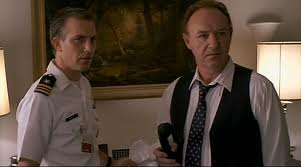
Kevin Costner stars as US Navy Lt. Tom Farrell, who is being interrogated by government agents for reasons that will be revealed to us as the main story is told in flashback. Six months earlier, we see him at a diplomatic reception party to meet the secretary of defense, David Brice (Gene Hackman), as he is introduced by his dutiful assistant, Scott Pritchard (Will Patton), who is friends with Farrell. Farrell also strikes up an encounter with a sexy young woman, Susan Atwell (Sean Young), and the two start an affair, even though she is involved with someone else. After Farrell becomes a hero on his next Naval deployment, he is then assigned to work at the Pentagon in Washington for Brice.

Here is where a few of those said-twists begin, and I’ll just reveal only a couple of them for the story’s setup. First of all, it turns out that Susan is actually Brice’s mistress. This leads to the night in which Brice pays her a surprise visit, as Farrell sneaks out the back door before he enters. Brice does notice him walking away, but doesn’t make him out in the dark. Brice demands to know who Susan is seeing, and in a violent rage, winds up killing her. So when Farrell learns of her death, he knows who the culprit is. But he can’t reveal Brice’s name to anybody because A) Brice, with the help of Pritchard, is already covering up the murder by using the rumored identity of a Soviet spy. B) Evidence is going to come back to Farrell, especially after finding a negative Polaroid picture in Susan’s place that could reveal him. And C) Farrell is put in charge of the investigation.

Whew! That’s a hell of a buildup, and it’s only the beginning of the story that has Farrell continually trying to slow down the investigation and find some way to preserve some things he learns about his fellow investigators in order to use them to his advantage, all while setting out to find a way to prove Brice’s guilt and Pritchard’s accessory. The twists don’t stop there, so I haven’t given away too much. “No Way Out” is a compelling mystery that gets more interesting as it goes along, and the more it continues with the story, the more I wound up caring about the characters involved.

The acting is great in this film. Kevin Costner is solid in the lead role and it’s quite complicated to pull off—an innocent man who has a lot of evidence leading back to him and is about to be wrongfully accused of a murder. Unless he can do something about it with his wits and intelligence, he’s a dead man. Costner and Sean Young share good chemistry together, and Young has a good amount of spunk that makes us care for her and not see her so much as a plot device. Gene Hackman is top-notch as usual. Will Patton is excellent as Pritchard, who says he’ll do anything for the secretary of defense, and yet because of yet another twist, we realize there’s probably more to it than that with him. Also terrific is George Dzundza as a wheelchair-bound computer expert whom Costner has to trust without saying too much about the mystery.

There is an even bigger twist that comes near the end that makes us question everything we’ve seen before. This is one that you either buy or you don’t. I did, and I watched the film again immediately after just so I could fully get everything that was shown to me before. That’s all I’m going to say about that.

“No Way Out” is a successful thriller that keeps you on edge all the way through until that final twist. It starts out simple and works its way up to a complicated puzzle that puts the hero’s life at risk, as well as the lives around him. The setup is incredible, the story continues to be investing, the cast is across-the-board solid, and there are enough twists to keep you interested throughout.

Fearless (1993)

16 May

images-1

Smith’s Verdict: ***1/2

Reviewed by Tanner Smith

When you feel for even a moment that you are unbreakable and nothing can kill you, there is always something to bring you back to reality. But how far is that “something” from this fearless state? Take Max Klein. After surviving a brutal plane crash, a new feeling suddenly overcomes him. He is no longer afraid of anything because he feels that no one or nothing can kill him anymore, since he survived the wreck. How far does it go? He finds himself walking along the edge on the roof of a tall building and joyfully dancing about because he believes he won’t fall. And on top of that, he no longer feels true love with his wife, Laura. So how far into this new, potentially dangerous mental state is this going to continue?

In “Fearless,” Max (played by Jeff Bridges) has not merely lost his heart in his faltering relationship with his family. But he has also lost his soul, practically. And the reason he does all of this stuff not merely to prove how far his relieved fear of dying will go, but also because he might be able to snap himself out of it. It’s as if he’s putting himself through real pain (or wants to put himself through real pain) just to snap him out of this inner pain. Because, surviving this horrific disaster now has this man questioning whether or not he deserved to survive and deserves to go on living. In some way, he’s between the living and the dead.

As for Laura (Isabella Rossellini), the main problem with this relationship between her and Max now is that she simply doesn’t understand what he’s going through. Only one person in Max’s life gets it—a young woman named Carla (Rosie Perez) who also survived the crash and has lost her infant child in the incident. She can’t connect with her own husband (Benicio del Toro) and also, along with Max, can’t be reached by the airline therapist (John Turturro). But they do understand each other because they feel more or less the same way as survivors. They spend a lot of time together, as Max convinces her to follow him on whatever he has in mind next. It’s not necessarily a romance between them, but it is emotional for both of them. And through Max, she eventually finds a way to wake up from her own morbid state. Although, with Max, it’s unclear for a long time whether or not he himself can awaken.

Max is not necessarily an appealing leading character in the traditional sense—in fact, there are times when he’s downright horrid. But you do feel for him throughout the movie because of his trauma and what it has led him to. It makes more complex in the sense that he thinks he’s fearless, but we know as well as his wife that he isn’t indestructible. And director Peter Weir shows the film in a way that we as an audience are pulled into this somewhat hypnotic state so that we can find some way of understanding what others can’t. it’s that feeling of omnipotence that most of us look for in movies.

While I really think “Fearless” is a terrific film, I can’t help but feel like it could have been a lot better if it further developed some of the subplots, such as the relationship between Max and his son in contrast to the relationship between Max and a kid who survived the crash and looks to Max as a hero; that pretty much goes nowhere. Maybe if the film focused more on that and omitted some details that would like to make us think they were going somewhere special but don’t, such as the group-therapy session midway in the movie or even the character of a conniving lawyer (Tom Hulce) who serves hardly a purpose in the story.

But its true focus on Max and his fearless state is very effectively handled and it practically is this movie. It’s handled very well with sharp direction by Weir and a strong performance by Bridges. The ending of “Fearless” is absolutely fantastic. Without giving too much away, it truly contains the essence of enduring an out-of-body experience. It’s emotionally-driven and really feels like you’re in that medium of life and death with Max as he goes through his final part of the state. That scene left a big impact on me, and this film as a whole works even better because of it. After watching it, I found myself thinking more about the story. Watching it a second time, I was even more enthralled with everything that was happening. “Fearless” is a movie that I will definitely not forget anytime soon.

Hulk (2003)

9 May

images

Smith’s Verdict: ***1/2

Reviewed by Tanner Smith

Let’s take a look at 2003’s “Hulk” from a 2013 perspective and find out what summer-movie audiences really seemed to hate about it. When Ang Lee’s film adaptation of the Marvel comic book series “The Incredible Hulk” was released in the summer of ’03, audiences walked out very disappointed and practically calling it a sad excuse for a summer-blockbuster. What was the cause of the hate? What went wrong?

Was it the numerous conversations within the characters? Isn’t it important for characters in superhero-movies to talk about their plight?

Was it the dark, depressing storyline? I think we’ve grown used to that by now, what with the releases of Christopher Nolan’s rebooted “Batman” films, for instance.

Was it the poor rendering of a CGI-Hulk running around and smashing things in his path? Well…fair enough. But haven’t we seen worse CGI? And aren’t we always aware that CGI is used in these movies? Granted, this Hulk looks more like Shrek on steroids, but he does interact with the real world very well—he smashes objects, encounters people, blends into shadows, etc. And in closeups, he doesn’t even look fake.

My guess is that “Hulk” was a superhero movie that was ahead of its time. Surely, CGI would progress in these films, but in the years since this film’s release, we’ve gotten used to action films of this type having many complex issues and dark material (see “The Dark Knight,” for example). With “Spider-Man” and “Daredevil” (both films based on Marvel comic book characters) already released before this one, people thought they were going to get just good solid entertainment with hardly anything more. I don’t think they were prepared for “Hulk.”

But wait a minute, you may exclaim. What about Tim Burton’s “Batman” films? Those came out more than ten years before “Hulk” and they were pretty dark for comic-book movies! Well since then, the superhero-movie genre was declared dead, not only with the Shaq vehicle “Steel,” the Pamela Anderson striptease “Barb Wire,” but even with Joel Schumacher’s embarrassing “Batman & Robin.” Then, “X-Men” was released in 2000, and it seemed like the superhero-movie was back, high on entertainment, low on much else, but entertaining nonetheless. So audiences figured we’d get more and more of these as they went along, and it would take a more iconic figure (like Batman) to make people ease into darkness.

I wonder what would happen if those people watched “Hulk” again nowadays because, to get straight to the point (if you didn’t figure it out already), I think “Hulk” is pretty good. It’s inventive, it’s involving, and well-executed. And more importantly, it’s successful in its character development and even how it represents the green behemoth himself, the Hulk. How Ang Lee sees the Hulk is probably different from the comic-book story (I admit never having read it), but all the more intriguing. Hulk is more of a tragic figure in this movie—a victim of unfortunate circumstances and consequences of a world he didn’t make. He can’t help but let out the rage in the physical form of a gigantic beast.

The Hulk is the rage that comes from within Dr. Bruce Banner (Eric Bana), a scientist working on a complicated radioactive experiment. He works with his ex-girlfriend, Betty Ross (Jennifer Connelly), whom he’s still friendly with. Their experiment is still is the staging process, but things get even worse as a laboratory accident exposes Bruce to radiation. It doesn’t kill him, but it does enhance something inside of him, which isn’t clear until he transforms into the Hulk—a giant, green-skinned monster with great strength and speed. He discovers he is able to transform when he’s angry and can change back when his rage dwindles down.

Bruce also learns that there’s more to him than that, as he gets in contact with an old man who turns out to be his father, David Banner (Nick Nolte). He knows of Bruce’s ability and plight, and has also passed it on to him to begin with, by experimenting with his own DNA code and passing along transformed genes to his son. He then tried to kill him before being taken away for 30 years. Betty’s father, General Ross (Sam Elliott), knows of David’s history and keeps an untrusting eye on Bruce before realizing what he has become and takes him away. But that may turn out to be a mistake…

So, while Bruce is locked up and experimented upon, he becomes the Hulk again and runs amok, leaving General Ross and his men to decide whether to kill him or help him.

Remarkably for a supposed summer-blockbuster, “Hulk” is very somber in tone. There’s some good action and some intriguing entertainment values, but for the most part, it’s pretty dark. There’s a tragic backstory involving David and what he may have attempted to do with Bruce (to end his “curse” early), as well as the philosophy of who’s human and who’s not, which is something that any science-fiction story likes to use. But more importantly, the characters talk about their situations at hand. They discuss their plight and how it’s affecting them all. That’s kind of refreshing. The film’s audience in 2003 may have found the conversations too “talky”—so what? I felt for the protagonists even more because of that. Probably the strongest moment is when Bruce and Betty discuss this transformation alone in a cabin before Bruce is taken away. Bruce reveals that it scares him most when he realizes that he likes it when he completely loses himself into being the Hulk. It’s a revealing moment and it sets the mood for the rest of the movie, in that Betty knows how her father and the authorities will treat him and hopes to be able to soothe him.

I don’t even want to call “Hulk” a superhero-movie. It’s more of an Incredible Hulk version of the classic monster movies, such as “Frankenstein,” “King Kong,” and “Dr. Jekyll and Mr. Hyde.” Elements of all three titles are evident here in a modern light. I think more of those titles than I do of “Spider-Man” or “Daredevil.” With “Frankenstein,” we have the creation gone wrong, the belief that humanity will never accept the unusual, and the creature unfairly hunted by those who don’t understand. That last one also resembles “King Kong,” in that Hulk is seen as a monster and hunted by the authorities. Also resembling “King Kong” are the action sequences, in which Hulk fights off mutated dogs that were part of David Banner’s genetics experiment, and an extended sequence in which Hulk battles Army tanks and helicopters (those scenes resemble Kong’s battle with dinosaurs and his last stand). As for the “Dr. Jekyll and Mr. Hyde” aspects, it pretty much explains itself. Bruce is Jekyll. Hulk is Hyde. Simple.

I mentioned before that I didn’t want to call “Hulk” a superhero-movie. But I can’t deny that it is a comic-book movie. Ang Lee goes all out to give it the look of a comic-book. He positions many shots to look like comic frames; he uses mobile camera movements to keep the flow of the mood; and more frequently, he uses multiple split-screens that show one area or another while keeping in the same scene. Watch this movie, and you’ll see what I mean. It’s very clever.

Oh, and should I also mention that the credits are also in that Comic Sans font that is used in descriptions of…comic books?

As for the action, it’s pretty good too. That lengthy sequence in which the Hulk battles the Military is exciting and intense. And because of everything that’s happened before, we always root for the Hulk to escape this situation.

The acting is across-the-board solid. Eric Bana is great as Bruce, giving us a complicated character to like and root for. Jennifer Connelly is appealing as Betty, who is stronger than you might think in this “girlfriend” role—she’s better than that. Sam Elliott is not entirely villainous as General Ross—he gives the character a more human side than you might expect. He’s very stubborn, yes; but he’s not evil. And then there’s Nick Nolte who is just perfect as David Banner. This is a mad scientist done right. Not manic or campy in the slightest—just a deranged, self-centered lunatic who cares more for how his experiment progressed with his son, rather than rekindling a relationship with his son.

OK, now what about the Hulk himself? Yes, I know he’s entirely CGI and people have attacked this creation as looking very fake. It’s easy to make fun of this Hulk, apparently. And I have to admit, it is the least interesting element in the movie. That might be because while in closeup, it looks very real and like I said, it interacts with the real world fine. But when you see it in faraway shots, it does look quite fake with herky-jerky movements and a cartoon-like look.

But for the most part, I really like “Hulk.” I know I’m in a minority on this, but hopefully that’ll change if people actually give this a second look. When you really think about it, comic-book movies have improved into being movies for people who don’t like comic-book movies (and thus, making them like even more comic-book movies, ironically). “Hulk” was one of the first to share that label, while other fans of the superhero-movie genre were left disappointed by the heavy dramatic situations and the dark storyline. Times have changed. It’s time to watch this movie again. Hopefully you’ll see it a different way.