Archive | Three-and-a-Half Stars ***1/2 RSS feed for this section

The Man in the Trunk

24 Oct

10169225_293732480783733_4538097213807335757_n

Smith’s Verdict: ***1/2
Reviewed by Tanner Smith

“The Man in the Trunk” premiered at the Offshoot Film Festival in Fayetteville, Arkansas this past weekend. This is an early review.

This is the third time this year that I’m doing this in a review. After reviewing Ti West’s “The Sacrament” and Alex Johnson’s “Two Step,” two unpredictable thrillers I couldn’t say much about (lest I give away surprises, taking away the suspense they had to offer), from earlier this year, here comes Marc Hampson’s “The Man in the Trunk,” another terrific thriller of which I can only talk about the setup and not much else. I hate to do this again, but you’ll probably thank me later.

The film, directed by Hampson and co-written by Aaron Fairley, reminded me of a more modern Hitchcockian way of storytelling, as it gives a setup, raises tension from there, and then delivers a plot-twist midway through, creating even more tension as the film continues. The setup goes like this: it’s Christmastime, and Andrew Tucker (Ace Marrero) is looking forward to a romantic night with his wife. But their foreplay is interrupted by an old friend, Steven Winter (very well-played by Erik Bogh), whom Andrew hasn’t seen in years. They catch up and have a couple smiles and laughs before Steven reveals he came to ask Andrew for help. Steven is a nervous, awkward type, so Andrew finds it difficult to say no to a cry for help, even though Steven won’t say right away what the situation is.

Going by the title, you can probably get some idea of Steven’s situation. I won’t give it away here, though that’s not the film’s biggest reveal. Midway through the film, something unexpected happens in the story, and from there, the film turns into a forceful thriller. It does so in such an effective way, by giving us a nice, long, quiet moment (done in one great continuous shot) before something horrific happens. Normally in thrillers and horror films, that’s a cliché, but it’s a cliché that worked so well in “The Man in the Trunk” because at that point (which is about 30 minutes in), I couldn’t begin to predict how the rest of the film would play out; thus I didn’t predict that shocking story turn and it took me by surprise. And from that point on (again, without revealing anything), all hell breaks loose, lives are at stake, and it’s a race to safety. It’s complicated, but that’s one of the reasons why “The Man in the Trunk” works. It’s a scary, unpredictable, suspenseful film that kept me guessing as well as unnerved. Other things that work for the film are the cinematography and the acting, which give the film a more realistic feel, making its settings and problems even more unsettling.

Something I probably could’ve done without is the epilogue. Without giving it away, it provides answers (albeit vague ones) to certain questions that may have been best left to the imagination. While I give Hampson and Fairley credit for not having everything spelled out for the audience by providing a detailed back-story (such as the therapist’s reasoning in “Psycho”), it was a little disappointing for a film that avoided taking the easy way out (again, without giving it away). However, I will let it slide because the film still kept its tone with this resolution.

Even so, “The Man in the Trunk” is a tense, effective independent thriller that I hope gets enough attention in its festival run for distribution, because I really think it’s that good. I’m sorry I couldn’t say much about it, but as I said before, you’ll probably thank me later. And I must admit: the night I saw this film at the Offshoot Film Festival, as I was about to leave for home, I checked the backseat to make sure no one was waiting to stab me when I got in my car. That’s how much the film worked for me.
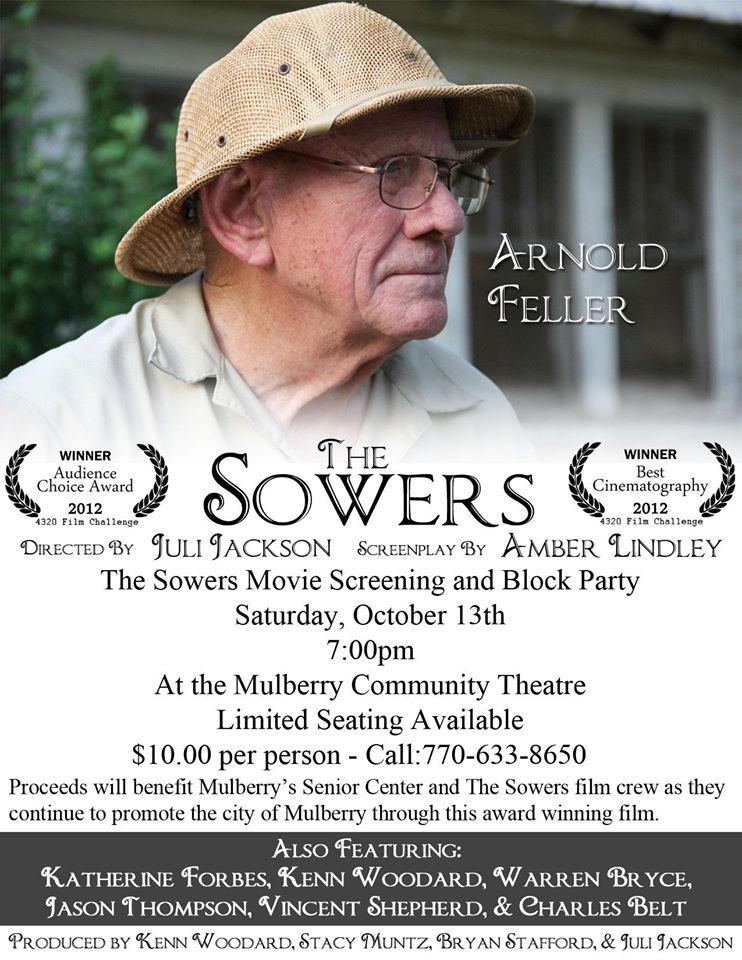
The Sowers (Short Film)

10 Oct

240646_521718641175031_1421531275_o

Smith’s Verdict: ***1/2
Reviewed by Tanner Smith

“The Sowers” is a short film that…frankly, I started out hating, but later found myself loving. I saw it twice. The first time, I disliked a good portion of the characters within the first 5 out of the film’s running time of 15 minutes. While I was admiring the film’s look and artistry for the rest of the running time, it wasn’t until the ending that I realized I was supposed to dislike said-characters. When the film was over, I was thinking more about what I just saw and what it all meant. Then I watched the film a second time and found myself looking at it another way (most likely the way it was originally intended to be).

Filmed in Mulberry, Arkansas, the film opens disturbingly with an image of an elderly man lying on the ground in pain, with a bloody, mangled hand. We’re then taken back to what led to this horrific accident as we meet the man, simply known as Papaw (Arnold D. Feller). His stubborn, bitter daughter, Sissy (Kathy Forbes), sometimes cares for him and can hardly tolerate him anymore. It’s clear that he’s not entirely senile as everyone else in his family thinks—he’s just stubborn as well and has his own way of doing things, even if it’s enough to make Sissy angry (even to the point of bringing up a tragedy to his face—“You killed Mama and you’re gonna kill me too!” she snaps at one point). He also has two grandsons (Warren Bryce and Jason Thompson); one is conceited, the other just lazy, and both just want some of Papaw’s fortune he’s been saving that he has stashed in jars hidden in a drawer.

It’s clear to us that neither Sissy nor the grandsons care for Papaw much and are most likely waiting for him to die so they can take his money. But midway through the short, it’s also clear to us that Papaw doesn’t see these people as “family” in one brief but brilliant cut that shows us exactly what they look like to him. The only ones who seem as close to being family as he’d like are a friendly stranger (well-played by Kenn Woodard) and his young son. The stranger helps him to mow the lawn.

While you don’t see enough of the family to know what they’re like outside of being greedy and selfish, the ways that these people behave and act are at least realistic. What makes this certain aspect of a dysfunctional family most remarkable is that it isn’t leading up to a rekindling. Far from it. The film ends with a payoff that is pretty much an “up-yours,” if you’ll excuse me, to Sissy and those damned grandsons. Without giving it away, it’s just what I think “The Sowers” needed and I don’t think any other ending would’ve saved the film like this one did.

“The Sowers” was directed by Juli Jackson, who also helmed the Arkansas-made festival-favorite feature “45 RPM,” and I’m convinced she’s one of the best directors based in Arkansas. She gets natural performances out of her actors, knows how to balance comedy and drama effectively, and gives her films a look & feel all her own. Credit must also go to Amber Lindley, who wrote the script; Bryan Stafford, who shot the film (he also shot “45 RPM” as well); Russ & Les Galusha, who edited the film and also provided makeup for certain pivotal shots; Amos Cochran, who composed a haunting score; and Mike Poe, who did art direction. They have crafted a film that made me cynical at the beginning, pleasantly surprised at the end, and, after another viewing, made me appreciate it as a whole.

NOTE: The film can be seen here: https://vimeo.com/63156927

An Ode to Angeline (Short Film)

14 Sep

small

Smith’s Verdict: ***1/2
Reviewed by Tanner Smith

Ever since the UCA-produced 20-minute short “John Wayne’s Bed,” I consider writer-director Sarah Jones to be one of the most talented independent Central Arkansas filmmakers around. And what’s great about her filmography of short films (made in Arkansas) is each one is different. With “John Wayne’s Bed,” it’s a riveting drama & character study. With “Turn Right onto Madness,” it’s a slasher film. And I hear she has a new documentary, “The Guard Responds,” about the Arkansas National Guard’s response to the tornado that swept through the Central Arkansas communities Mayflower and Vilonia earlier this year.

But of course, there’s also “An Ode to Angeline,” Jones’ 4-minute short that premiered at the Little Rock Film Festival a few months ago. I caught it there along with the other numerous Arkansas shorts I reviewed. I knew I liked it, but I think the reason I didn’t review it then was because…well, because I needed to see it again. Its very brief running time didn’t help much either (though I did end up reviewing Eric White’s “Perfect Machine: Homefront,” which is actually two minutes shorter than “An Ode to Angeline”). There seems to be enough material for at least a 10-to-15-minute short. As it is, it’s a 4-minute “ode,” as the title suggests, and it’s still a pretty damn good one. Seeing it again, I can say it’s a well-made, disturbingly effective short that seemed to have more on its mind and left me with more to think about.

The film is about a man who is obsessed with an unattainable beauty (named Angeline) and expresses his feelings to…well, I can’t exactly say to whom. That’s one of the problems with reviewing a film as short as this. Bottom line is, he wants so badly for her to want him that he wants her to suffer as much as he did/does. And that’s all I can say about the story.

Okay, as you can probably tell from my not-so-subtle writing style, the running time is getting to me. But why should it? I mean, the craftsmanship is evident in the directing & editing; the actor playing the narrator, Johnnie Brannon (no stranger to my Short reviews—read “PM: Homefront,” read “Twinkletown,” read “Still Life,” read “A Way Out,” and holy crap, this guy gets around), is chillingly good; it is an ode, as the title states, and it’s about as long as it should be in that sense. Maybe my problem is I don’t want Sarah Jones to make an “ode.” After seeing what she’s done with the material for “John Wayne’s Bed,” I would’ve liked to see what more she could do with this idea of obsession unleashing the inner beast, which is always fascinating. Keep the cast (which includes Kirby Gocke as Angeline), keep the crew (which includes director of photography Grant Dillion), and branch out more with this concept.

But I keep getting sidetracked here, and I have to review the film for what it is rather than what it could’ve been. I don’t dislike “An Ode to Angeline.” On the contrary, the finished product is very good. It’s very well-shot, the editing is great, the dialogue said by the Brannon character is haunting, and it works as a short thriller. Sarah Jones’ “An Ode to Angeline” is an effective short that shows yet again why Jones is a skilled filmmaker; I look forward to seeing her next film.

NOTE: After finishing this review, I messaged Jones and asked her why she chose to make a film as short as this. She said she wanted to “experiment with telling a story in under 5 minutes.” I can respect that.

South Park: Bigger, Longer & Uncut (1999)

1 Jul

watching-movie

Smith’s Verdict: ***1/2

Reviewed by Tanner Smith

I guess the best way to start this review is by saying whether or not those who aren’t fans or haven’t seen an episode of the hit animated TV series “South Park” will enjoy this movie version, “Bigger, Longer & Uncut.” Well, a typical “South Park” episode contains a lot of fearless satire (mostly on current issues or trends or sometimes both) with a lot of toilet humor, vulgarities, and usually some mean-spiritedness surrounding it. And if you can get into all that to get to what its creators Tray Parker & Matt Stone address (usually at the end of the episode to make up for everything else) and if you can laugh at it, then you get what you can expect when you see a full-length movie. It’s essentially like watching three or four episodes of “South Park.”

The main difference? It’s a theatrical release, which means the things that Parker & Stone really wanted to include in their material to make the humor full-circle, like heavy amounts of profanity and sexual references, are welcome…to a certain extent, I think. This film isn’t rated NC-17 by the MPAA and instead rated R, I believe, simply because it’s animated. Times have sort of changed since the X-rated “Fritz the Cat.” But there you go—many uses of the F-word every minute in this under-90-minute film.

Aside from that, “Bigger, Longer & Uncut” is essentially like watching a long episode of “South Park,” and if you like “South Park,” you’ll probably like this movie. Simple.

The animation is still bad but consistently so. The humor is still nonsubtle and crude and rude. The targets of such humor are savaged, and there are MANY here (the MPAA’s rating system, Canada, wars, religion, small town America, among others). Stan and Kyle learn an important lesson that they practically address to the audience. And more importantly, Kenny still dies and Cartman is still a pain in the ass. But he’s a hilarious pain in the ass if that makes sense!

What’s the story? Well, it’s quite full. It all begins as our four young heroes, Stan (Parker), Kyle (Stone), Cartman (Parker), and Kenny (Stone), sneak into an R-rated movie in which Canadian stars Terrence & Phillip tell dirty jokes, sing profane songs, and drop the f-bomb left and right. This new vocabulary and behavior fascinates them to no end, as they swear up a storm in front of their friends who then see the movie themselves. Soon, everyone in school has seen the movie and are spewing profanities all around. Kyle’s overbearing mother starts an organization that tries to prohibit profanity and decides to strike against Canada since it was made in their country. They make a citizen’s arrest against Terrence & Phillip themselves. When Canada strikes back by bombing the Baldwin brothers, American goes to war. Their next step: execute Terrence & Phillip at a public gathering. How to attend: join the US Army.

Of course, Kenny dies, as he does in most episodes. (Every occurrence is followed by this—Stan: “Oh my God! They/he/you killed Kenny!” Kyle: “You bastard(s)!”) Here, Kenny imitates a risky action done in the Terrence & Phillip movie and gets killed in the process. Does he go to Heaven? Nope. He’s sent down to Hell where he of course comes across a gigantic Satan. He’s scary at first, until Kenny notices he’s weak when next to Saddam Hussein, who happens to be Satan’s lover in a homosexual relationship. Kenny also finds out that if Terrence & Phillip are killed, Satan and Saddam will rise and rule the world. He makes a ghostly appearance to Cartman to warn him. Can Stan, Kyle, and Cartman stop everything before time runs out?

“South Park: Bigger, Longer & Uncut” is also a musical, much like a Disney animated musical but with swear words. Most of them are catchy and edgy, with hilarious lyrics all around. Where else will you find a musical in which Satan sings about dreaming of a life like everyone else on Earth? There are a lot of songs in this movie, including one that is a follow-up to a popular Cartman song done on the show, but of course with more F-words and an ironic twist.

And speaking of Cartman, he is just hilarious here. Cartman is generally everyone’s favorite character on the show because he’s so loud and obnoxious and despicable…usually, that would make him very unbearable, but somehow (I’m not quite sure how) Cartman has the right amount of cruelty, vulgarity, racism, and loudness to make us laugh at him. And a masterstroke in writing is that midway through the film, after he’s spewed so many profanities, he’s given a chip in his brain that will shock him if he utters another f-bomb or s-word. It drives him crazy when he can’t say what he really wants, and I love how angry he gets about anything, let alone not being allowed to swear.

What’s really funny about the satire is that everything that happens here happened because of profanity in a movie that kids wouldn’t see unless they snuck in to begin with. And it has a point. There’s a line Kyle’s mom says that pretty much sums up what the antagonists are doing—“Remember what the MPAA says: Horrific, deplorable violence is okay, as long as people don’t say any naughty words!” Yeah, really think about that.

That’s one of the joys of “South Park”: that Parker & Stone can look at something and how people react to it and come up with exaggerated versions of it or them. It’s kind of like they’re projecting what these people are acting like to them. And if they imagine them saying something about it, then it’s pretty much what they allow their characters to say.

There isn’t much more I can say about this film’s humor without giving stuff away, and this film practically demands you not to know too much. You may find the movie funnier that way anyway. I guess the best way to recommend “South Park: Bigger, Longer & Uncut” to those who haven’t seen the show is by saying if you’re easily offended, you shouldn’t see this movie. As for me, I laughed out loud quite a lot during this movie and found myself chuckling even more. I found the film to be funny all the way through and I’d watch it about 20 or 30 more times, like my favorite “South Park” episodes.

The Fault in Our Stars (2014)

11 Jun

A Fault In Our Stars

Smith’s Verdict: ***1/2

Reviewed by Tanner Smith

What’s this? A film based on a young-adult novel about a teen romance that doesn’t feature any supernatural elements, a dystopian future, or even a contrived love-triangle? I must say that’s a huge relief, and we can just see these characters grow together through a harsh reality. And what’s the harsh reality? Dealing with cancer…

Yeah, it’s kind of hard to believe, isn’t it? It almost welcomes the inappropriate phrase, “the young-adult cancer romance.” But I did read the book, written by John Green. It is a good read—melancholy but with realistic issues, strong characterization, and good comedic relief thrown in at just the right times.

When I heard that a film adaptation was going to be made, I thought to myself that it could work if the right actors are cast and the writers are smart enough to know what to leave and what to keep. But I was also nervous about certain scenes I knew were meant to be brought to the screen (in that they were inevitable)—I’ll acknowledge there’s a later part in particular that was sort of uncomfortable to read, and so if it was going to be adapted to film, it had to be very moving or even more uncomfortable. Without giving it away, it involves a “pre-funeral” so that one of the doomed characters will be alive to see it. And I was glad to find that it was handled very delicately and with just the right tone to fit. That statement itself could describe the whole movie.

“The Fault in Our Stars,” the film adaptation directed by Josh Boone and written by Scott Neustadter & Michael H. Weber, is an effectively moving film. It’s just as successful as the novel and features good actors that bring strong characters to life.

The main character is Hazel Grace Lancaster (Shailene Woodley), a 16-year-old girl who, because of her cancer, uses a portable oxygen tank to breathe. She attends a cancer patients’ support group (mainly to satisfy her mother, played well by Laura Dern), and finds nothing to raise her spirits until she meets a charming teenage boy named Augustus Waters (Ansel Elgort), who attends the group meetings to support his friend Isaac (Nat Wolff) who is about to be blind due to a tumor in one of his eyes (the other eye has already been extracted). Augustus, a former athlete, had his leg amputated and is now seemingly cancer-free. Hazel and Augustus start to hang out together, and they text and flirt with each other as time goes on. Though, at first, it’s hardly a romance; it’s more of a friendship that grows into a romance in due time. A refreshing thing about this story is how much time goes by in this story before their first kiss.

Hazel forces Augustus (or Gus, as he’s sometimes called) to read her favorite novel which she’s obsessed with, mainly because of its ambiguous ending. Midway through the film, Hazel and Augustus make an excursion to Amsterdam to visit the novel’s reclusive author, Peter Van Houten (Willem Dafoe). It’s here that the story grows more interesting, especially to those who haven’t read the book beforehand, because it’s hard to predict what’s going to happen, what truths are going to be revealed, and where it will go from here. When something upsetting is revealed, it happens naturally and it’s well-handled.

That brings us to the dramatic final half of the film which I’ll admit is manipulative and sometimes overly so; it definitely worked for teenage girls in the large audience I saw it with (they were bawling their eyes out and hardly stopped throughout the film’s last 30 minutes or so), but it was hard for me not to feel emotions because I grew to like Hazel and Augustus and I understood just how doomed their romance really was. And they actually talk about this. They keep most of the dialogue from the original book, and it sounds and acts as real people would talk if they were in this situation. Even with something as heavy as someone saying they will die probably long before the other, it’s handled in a gentle way that works well.

But that’s not to say the film as a whole is a downer because there are some good funny moments and light comedy in the screenplay. The lighthearted conversations between Hazel and Augustus are cute; some of their texting conversations (which are shown to us through animated bubbles) are funny; and Nat Wolff, as Isaac, is very good comic relief and thankfully makes some appearances in the dramatic final half after being away for so long until then. I would have liked to see more of this kid.

I love that the characters of Hazel and Augustus are just as fully realized here as they are in the book. They weren’t lost in translation. You see them as real young people with quirks, problems, their own times to be serious, their own times to have fun, and they’re always believable. Shailene Woodley and Ansel Elgort do terrific jobs at bringing their roles to life, and they exhibit convincing chemistry together.

Now I’ll admit I wasn’t so sure about the film in its first ten minutes. I thought the introduction was a little awkward in explaining Hazel’s illness; I felt the meet-cute between Hazel and Augustus was too awkwardly handled; and there’s a brief backstory shown and told to us about the therapy-group leader, and we never see him again. It’s as if the filmmakers were forced to show diehard fans of the novel that this character was included in the movie. And since we’re talking about problems, I think the editing could used a little more work. I feel a few scenes drag a little longer than they should, and awkwardly at that.

But when I got past all that, I got into “The Fault in Our Stars” and found it to be a well-acted, sweet film with enough humor to keep me entertained and enough melancholy effectiveness to keep me invested. And thankfully, it didn’t need anything else we usually find in young-adult novels to bring more teenagers in.

Blow Out (1981)

4 Jun

primary_EB19810719PEOPLE110329997AR

Smith’s Verdict: ***1/2

Reviewed by Tanner Smith

The premise for the Brian De Palma’s tense thriller “Blow Out” goes like this: A sound man for a b-movie factory goes out one night to capture sounds of nature, only to record a supposed car accident that he believes may not have been an accident the more he listens to his recording. Is there a gunshot before a tire blow-out? Did someone cause the car to lose control and crash? He uses his knowhow to investigate.

That’s a premise Alfred Hitchcock would have loved to try out, so it makes sense that it was given to director Brian De Palma, who has shown with his filmmaking techniques in thrillers like “Sisters” and “Carrie” that he’s kind of like Hitchcock’s protégé. However, I think his filmmaking style is a little over the top, so instead of calling it Hitchcock-like, let’s just call it De Palma-like. Anyway, the point is that De Palma clearly likes to stylize his films, as he obviously loves film and filmmaking. So even if you don’t like some of his films, it’s hard to argue it’s well-made.

I digress. De Palma’s “Blow Out” is a very well-shot, original thriller that grabs you and doesn’t let go until the end credits roll. It begins with a scene straight out of the sleazy slasher movies in which an unseen stalker lurks about the halls of a college dormitory and follows a young woman to the shower. The twist—the girl’s scream is unconvincing, straight out of a bad horror movie. And…it is a bad horror movie, as our main character, a sound operator named Jack (played by John Travolta), looks over the work-in-progress of the latest product of the b-movie studio he works for. That’s a great opening, and it gives our first glimpse into the fascinating job Jack has. It’s interesting seeing how he works with the equipment in his office, especially for those who enjoy learning about post-production for films.

Anyway, that night, Jack stands on a bridge and records the audio of random sounds of the night. Before long, he becomes witness to an accident that involves a car having a tire blown out and plunging into the river under him. He jumps in to rescue the girl inside the car, named Sandy (Nancy Allen), but is too late to rescue the car’s driver, who turns out to be a potential presidential candidate. He takes her to the hospital and they have a meet-cute that can turn into something semi-romantic for them, but strangely, he is asked by the authorities to forget about what happened. But he can’t, so he tracks Sandy down and sees her every now and then. He also listens to the recording of the accident. He becomes convinced that before the tire blow-out sound is the sound of a gunshot, and that this was no mere accident.

And that’s just the beginning of where this wild ride of conspiracy and secrets takes you, as Jack tries to make it public while he’s being followed and he and Sandy make a run-in with violent characters, including a dirty-tricks specialist (played by John Lithgow) who ties up all loose ends of the ominous plot. There’s also the question of whether or not Sandy can truly be trusted, as it seems she may have something to do with it. Either way, it seems the more they dig deeper into the mystery, the more their lives are in jeopardy.

The plot for “Blow Out” gets more inventive and intense as it connects piece upon piece of this unique, well-crafted puzzle of events. But more importantly, it gives us chances to fully understand what’s going on here and gives us one great sequence after another that shows how these characters work and how they believe that their next move could work. One sequence in particular I’m thinking of is when Jack crafts a movie of the event, using his recording and some photographs.

Of course, being a De Palma film, “Blow Out” is great to look at and gives us unique, striking visual images that are sure to be embedded in the viewer’s head for a long while.

blow-out-john-travolta

blowout

John Travolta is effective as the main character who’s determined but somewhat bitter too. You may notice how downtrodden he is in this performance most of the time; that’s because Travolta went through insomnia at the time of filming. Given the character’s past (his attempt to use his sound & wire skills to assist cops went horribly wrong), I think it works fine. Nancy Allen plays her role of Sandy as a miserable, needy woman who isn’t sure what she wants and will do anything for acceptance, hence her role as an escort. While Allen’s wispy voice takes a little getting used to, she does manage to earn our sympathies by the time it’s clear her life is in jeopardy. John Lithgow is suitably menacing as the sinister figure who pursues everyone involved, and Dennis Franz is good as a private detective who had something if not everything to do with the incident in the first place.

There’s one thing I don’t like about “Blow Out,” and it’s the ending. Without giving anything away, it settles a running joke about dubbing the perfect scream for one of the b-movies. The payoff is so cruel that I wondered if the whole film was supposed to be a joke. But aside from that, this is a solid, gripping thriller with enough to keep us involved and even more to respect our intelligence.

Manny (2014)

28 May

manny-1024x576

Smith’s Verdict: ***1/2

Reviewed by Tanner Smith

I must confess that I didn’t even know the name Manny Pacquiao before I watched this documentary about him, “Manny.” I knew nothing about him—that he was a boxer, that he was also involved in politics, where he came from, or even that he liked to sing and has even performed a duet with Will Ferrell on “Jimmy Kimmel” once. But after seeing this film, I doubt I’ll forget him.

Co-directed by Leon Gast (who also directed Oscar-winning “When We Were Kings”) and Ryan Moore (a first-time director who first imagined the project), and narrated by Liam Neeson, “Manny” delivers a clear portrait of the Filipino professional boxer who also had other ambitions in mind that he managed to succeed. His story is a familiar one (the rags-to-riches tale) but it’s still inspiring to see how Pacquiao has risen from a time of poverty in an obscure Philippine village to international stardom. We’re told interesting tales, from Pacquiao and other interviewees, about his early life in the Philippines, including how Pacquiao credits his physical strength to working with fisherman as a boy.

Most of the documentary tells about his boxing career. We meet the people who helped train him and supported him, including his uncle Sardo Mejia, his friend Buboy Fernandez, managers, promoters, boxer Freddie Roach, and others, as well as celebrities such as Mark Wahlberg. Arguably most importantly, we also get highlights from his most memorable fights, each of which represent how much his fame heightens through time, from the mid-90s to 2013 at least (as far as I know, he’s still fighting). Now it seems as if everyone who follows boxing knows who Manny Pacquiao is. In this documentary, he’s even mentioned along with Muhammad Ali at one point.

We also get into Manny’s other ambitions, as we see how he gets into entertainment. He acts in cheesy movies with titles such as “Wapak-Man” and “Anak ng Kumander,” plugs products in TV commercials, and, yes, even has a brief singing career, which includes a duet of the song “Imagine” with Will Ferrell on “Jimmy Kimmel Live” and a session recording “Sometimes When We Touch” while being coached by Dan Hill at Capitol Records. That’s the funniest sequence in the film, as Hill tries to give Manny voice lessons while treading lightly in possible fear that he will get brutally punched.

Manny is also involved in politics, as he becomes a congressman in the Filipino House of Representatives. But something that is considered later in the film, and it’s something I was waiting to be addressed, is the question of how Manny’s other activities affect his boxing career. Does he truly have his priorities in check? Does he need to quit one thing or another?

This documentary is gorgeously shot and very well-edited. The best sequences are the latest fighting sequences; it was like I could feel the knockouts being given from Pacquiao to Miguel Cotto, Pacquiao to Ricky Hatton, and Juan Manuel Marquez to Pacquiao (in one of only very few losses for him). These punches are very brutal, and the way they’re shot and edited make it seem almost as if we’re there at these boxing matches (that’s how I felt when I saw this film on the big screen at the Little Rock Film Festival).

I have a few complaints about this film, however. One is that the final 15-20 minutes seemed to me like one too many false endings. Another is kind of a personal preference, but I would have liked to see more of Manny’s mother Dionisia, who is only seen briefly as she talks about raising Manny and what he was like as a child. And I wouldn’t have minded an interview with Manny’s kids either (how is he as a father? Would he like them to fight as well? Etc.), though we have some input from Manny’s wife, Jinkee. To be fair, I think it was hard enough to edit this film with all the interview footage, documenting footage, and media coverage; what they have is good enough, I’d say.

“Manny” is a good documentary, showing that arguably the best, most interesting documentaries are the ones that serve as character-studies. It tells the story of Manny Pacquiao effectively and gives us an appealing, fascinating guy that I’m glad I could be introduced to this way. And I’ll just say I’ll never listen to “Sometimes When We Touch” the same way again.

Before I Disappear (2014)

21 May

before-i-disappear

Smith’s Verdict: ***1/2

Reviewed by Tanner Smith

“Before I Disappear” is Shawn Christensen’s premiere feature-length film based on his Academy Award winning short film, “Curfew,” and it’s a dark, riveting, successful portrait of a man who’s hit rock-bottom and may be able to find a way out again.

Christensen wrote, directed, edited, and co-stars in this film as Richie, who has found nothing to live for after the death of his girlfriend. Severely depressed, constantly threatened by moneylenders, and even discovering a grisly sight in one of the bathroom stalls at the place he works as a janitor, he contemplates suicide. One day, he cuts his wrist and lays in the bathtub for a while. Not dead, he answers a phone call from his sister, Maggie (Emmy Rossum). Maggie needs him to pick up her pre-teenage daughter, Sophia (Fatima Ptacek), whom he has never met. After bandaging his wrist, he picks her up and drops her off at her apartment until he’s called again to babysit her. The problem is she’s a spoiled brat and he has enough on his plate already. The only reason he’s here is because Maggie, whom he has spoken to in years, is relying on him, which is enough for him to carry on living for a while longer.

A mysterious circumstance (though actually, it’s one of many) causes Richie to Sophia to leave the apartment and walk across the dark side of the city through the night. Richie introduces Sophia to a few places and people he knows well, though they’re not right for a girl her age and he’s not even sure if it’s right for him anymore. As the night grows longer, Richie discovers new harsh truths about some already-harsh people in his life and also comes across unfortunate discoveries related what he saw in the bathroom stall. All while he awaits reuniting Sophia with her mother, Richie must consider the rest of his possibly-short life in order to know if he truly has something to live for.

“Before I Disappear” is a carefully-constructed character piece that is skillfully acted. Shawn Christensen has many hats to wear behind the camera, but he must also act center-stage. As what can probably be expected of someone who must direct his own acting and carry out his own written character, Christensen is nothing short of brilliant, delivering the perfect amount of staggering coldness and genuine emotion that is just right for the character. But he also knows his character and script inside and out, and because of that, he is able to deliver subtleties about the character that tell about his past and his current feelings. Watch this film again, and you might notice something about his performance that you haven’t before. He’s perfect here.

The character of Sophia is not easy to like at first. She’s cold towards her uncle (though to be fair, she’s never met him before) and kind of annoying. And I thought her transition to caring wasn’t entirely convincing to me. I thought it was going to cause a problem for the relationship that develops between her and Richie as the film went on. But surprisingly, the script doesn’t let her down either nor does it let down the character of Maggie, her mother. I won’t say exactly how or why, but you can see full dimensions in these characters as you can see what they’re going through and come to feel for them.

I’ll admit I at first thought the story was overstuffed when it introduced grim subplots including Richie’s drug-addicted, bad-tempered friend (Paul Wesley) and his intimidating mafia-type boss (Ron Perlman), both of whom have connections in one way or another. But as the film went on, there wasn’t a moment when I was bored or thought I’d rather spend running time with another story. And there are many ways to keep it interesting, including a strange but fun sequence in which people in a bowling alley randomly dance to Goodnight Radio’s “Sophia So Far.”

I haven’t seen “Curfew,” Christensen’s short film this is based on, but after seeing “Before I Disappear,” I am curious to seek it out and even more curious to see what this extremely talented filmmaker has in store next.

The Night the Blackbirds Fell (Short Film)

21 May

1393715_542818722464712_1081021356_n

Smith’s Verdict: ***1/2

Reviewed by Tanner Smith

As tough as it is to admit, something a lot of people will be curious about every New Year’s Eve is whether or not thousands of birds will suddenly drop in Beebe, Arkansas. Ever since Beebe made international news in January 2011, when more than 3,000 red-winged blackbirds fell from the sky and roughly 85,000 drum fish were washed up along the Arkansas River shore, it drew concern and investigation afterwards, even when it happened again in the beginning of 2012.

These mysterious bird & fish deaths are the topic of the 40-minute documentary, “The Night the Blackbirds Fell.”

Directed by Will Scott and written by Brian C. Campbell and Gustav Carlson, “The Night the Blackbirds Fell” presents the investigation of these mysterious animal deaths in a crafty, entertaining way. It uses a mix of sketch drawings and computer animation to present fictional characters looking up real-life media coverage, documenting first-hand testimony and explanation, and connecting theories and facts together to gain answers. It’s an interesting narrative flow, as the animated characters dig deeper into the mystery surrounding what killed the birds and the fish.

It begins as Danny (voiced by Matt Duncan), a university student developing a thesis project, walks alone from a New Year’s Eve 2010 party when he comes across a fallen blackbird, which he names Virgil, before encountering a shower of falling birds. As he watches TV and laughs at the jokes made by Jon Stewart and SNL, he quickly realizes how serious it is when he watches news coverage of the strange phenomenon. He decides to create a website as his thesis project, called “The Night the Blackbirds Fell,” as he investigates the wildlife deaths and adds new interview footage to the site.

Among the interviewees are Beebe residents, scientists, roost landowners, and anyone else who has an opinion on what happened and how it happened. It seems that everyone has their own theory as to how the blackbirds fell and how thousands of drum fish were washed ashore. Oil, toxins, military conspiracies, roost relocations, fireworks, and even, the grand consensus given by the media, the beginning of the End Times (I’m surprised Harold Camping wasn’t mentioned at all during this). You name it, someone has thought of it. It’s a puzzle that Danny must piece together as he (and the actual documentary crew) research and visit these different places and people, including a nuclear power plant and a Wal-Mart where a birds’-thicket once was (that’s a nice environmental message there). There are also two interviewees that give some input and who only agreed to be a part of the documentary if their faces and names were never revealed (one of them has his voice changed in post-production). One of them claims to know “who” killed the blackbirds.

Are the bird deaths and the fish deaths connected? Danny believes so, but Betty isn’t so sure. “The Night the Blackbirds Fell” has a clever mix of fiction and documentation with the mixture of interview footage and scripted animated sequences. The animated scenes are presented with a certain quirkiness that works well for the most part. Sometimes it’s funny when Danny and Betty’s reactions to most of these are about the same as the audience’s, and Betty’s snide commentary works for comedic effect. But other times it can seem a little forced, like an educational TV special, particularly when the film cuts back to the two and they recap on the footage they just watched. Mostly, however, it’s engaging enough to keep your attention. Some of the lines are good too—I love when Danny watches the SNL Weekly Update that shows Andy Samberg as a “lone-survivor blackbird” (with a heavy Southern accent), and reacts laughingly, “He sounds like my aunt!” And I admit it was a cute idea to have the bird, Virgil, as the “Lassie” of the situation, always pointing Danny towards important clues.

There are two shots that stay with me after seeing this documentary. One is a beginning wide shot that features the Beebe roost landowner, Lee Hayes, standing in the middle of the land and watching thousands of birds flying around. Another is an ending shot of more birds flying near a McDonald’s arch pole. These shots speak volumes as they indicate the possible extinction of blackbirds, as well as environmental threats to nature and people in Arkansas. It’s as if the film is saying that we need to rethink our connection with wildlife and by the end, it challenges us to consider the way things are now and how they may turn out to be in the future, especially if we’re going to keep checking on Beebe every year and see if more of these incidents occur, without actually contemplating them.

“The Night the Blackbirds Fell” is a well-crafted, intriguing film that entertains with the graphic-novel-style segments, involves/educates with the documentary aspects, and leaves the viewer thinking about it afterwards.

I Believe in Unicorns (2015)

20 May

unicorns

Smith’s Verdict: ***1/2

Reviewed by Tanner Smith

Leah Meyerhoff’s “I Believe in Unicorns” is one of the most compelling coming-of-age stories I’ve ever seen. I haven’t seen a feature about teenagers this direct or this honest in a long time. There are parts in this film that are so accurately portrayed that it’s hard to watch at times. It’s a frank, sometimes-brutal portrayal of a teenage girl’s first love experience that shows her come of age in an effective way.

The film stars Natalia Dyer in an excellent performance as Davina, a secluded 15-year-old girl who cares for her handicapped mother (Toni Meyerhoff) and has only one friend (Julia Garner) at school. More than often, Davina daydreams of herself as a princess in a fantasy world of unicorns and dragons. What she doesn’t have in this world is a prince. In reality, she advances towards an older skateboarder, Sterling (Peter Vack), a bad-boy who represents the rebellious spirit within Davina’s soul. Davina and Sterling spend time together. After they have sex, Davina, who was a virgin up until that point, wants to explore her sexuality even further.

I thought I had the rest of the story figured out in the first half-hour. Sterling would shut her out, Davina would grow desperate to earn respect from him again, and she’ll learn an important life lesson. Is that what happens? Actually, no. They do see each other more. When they find that their sexual encounters in Sterling’s room isn’t enough, they decide to hit the road and run away from their boring, lonely family lives just to be together.

The further they go on this journey and the longer they are together, they behave like characters in a fugitive road movie but don’t commit acts of violence toward people they come across. They instead commit acts of violence towards each other (or at least, for Sterling, it’s physical as he has a mean streak; and for Davina, it’s mental because she can say the wrong things to Sterling and set him off). The only way this road trip will end is if things go too far in their sexual sessions, and when it happens, it’s presented with the right amount of time to understand when and how it came to this and how the line will be drawn. Without giving much away, it builds up to a choice Davina must make in order to make herself happy—or if not happy, then fine enough without escaping the harsh realities of her life.

I was a little concerned when I knew there were going to be stop-motion animation sequences showing unicorns and dragons in Davina’s fantasy world, and I thought the gimmick would wear off fast. But the way it’s handled is in a sensible way that doesn’t get old and has something new to represent at crucial moments that mirror Davina and Sterling’s adventure together. It makes the film more profound in that sense. They let you know what Davina is thinking and further depict examples what she’s going through.

The characters are rich and fully realized, thanks to intelligent writing/characterization by Meyerhoff. The film is shot and written in a way that makes everything feel like the real deal, but the honesty and cruelty can mainly come through if the actors were credible. Boy, are they ever. Natalia Dyer is brilliant in the role, capturing the loneliness and curiosity of an adolescent girl going through her first sexual experience with a boy who may not be good for her. Also, give Meyerhoff credit for casting an actual teenager in the role, so the authenticity can come through. This was a risky move to pull, given how unflinching the film is on sex. But because there’s a real teenage girl in the role, we can see and understand what she goes through. She’s great here.

It was a great move not to make Sterling into just a bad guy. He’s not entirely bad; he’s misunderstood while his arrogance can get the best of him. He’s flawed, which makes him more realistic. And he’s written as a three-dimensional character—he can be enthusiastic, he can be upset, he can be angry, he can be confused, and we get to know more about him not just from his dialogue but from his actions as well. There are many emotions for the actor, Peter Vack, to pull off, and he does a great job with the role. When he changes quickly from endearing to hurtful, you believe it. There’s one particular scene later in the film in which Davina and Sterling get a motel room and start to get busy. In one long shot, the scene turns from intimate to violent after a certain action on Davina’s part that causes Sterling to react immediately. This would be a difficult task for an actor to pull off, and Vack is completely convincing.

I can’t think of another recent film that is harder or even as frank about teenage sexuality than this. Even with its fantasy sequences, some of which show a unicorn battling a dragon, it’s still very compelling because it shows how Davina will have to separate fantasy from reality.

Sometimes the film is heartfelt; sometimes that’s confusing; sometimes it’s upsetting. You know what? That’s teenage love.