Archive | Three-and-a-Half Stars ***1/2 RSS feed for this section

Star Wars Episode III: Revenge of the Sith (2005)

30 Nov

MV5BMTg3ODc1OTYxMF5BMl5BanBnXkFtZTcwMTM1NzI4NA@@._V1_SX640_SY720_

Smith’s Verdict: ***1/2

Reviewed by Tanner Smith

WARNING: SPOILER ALERT!!!

“The fear of loss is a path to the dark side.” –Yoda

It can be argued that “Revenge of the Sith” is the most complex story in the “Star Wars” franchise, delivering the tragic end of Jedi student Anakin Skywalker and the becoming of the dark lord Darth Vader. Though, I won’t go as far as to say it’s the best film in the series, as it does have its problems that keep it from the status of either the original “Star Wars’ or “The Empire Strikes Back.” But it is still an important chapter in the series that, in a way, improves the other chapters.

“Revenge of the Sith” is the entry in the saga that fans have waited for since the late-1970s. How did Anakin become Darth Vader? In 2005, with George Lucas’ third prequel, they finally got their answer. Anakin was not merely seduced by the power of the dark side of the Force but influenced into believing the dark side can help him save the one he loved, only to pay a hefty price in the end as he became the ruler of the evil Empire we know from the original trilogy. His passion and fear was exploited by Supreme Chancellor Palpatine, who turned him away from the Jedi. The Jedi themselves can’t be ignored either, for they played a part in the creation of Darth Vader by making poor decisions.

But I’m getting ahead of myself. The film begins with one of the best extended action sequences in the history of the franchise, as Obi-Wan Kenobi (Ewan McGregor) and Anakin (Hayden Christensen) are on a mission to rescue Palpatine (Ian McDiarmid) from the clutches of Count Dooku (Christopher Lee) and his droid ally, General Grievous. This takes up the first half-hour of the film. It’s thrilling, it looks great, and even has time for some humor and banter between our two heroes. (I also give it extra points for our favorite droid, R2-D2, managing to take out enemy droids with his resources—I don’t care who you are; that is awesome.) What they don’t know is that it was all staged to give Palpatine a chance to connect with Anakin in order to manipulate him. Palpatine works like the devil, doing a very good job getting to Anakin and feeding his inner demons. This is a crucial time in Anakin’s life—his secret wife, Padme (Natalie Portman), is pregnant, which is going to be an issue seeing as how Jedi are forbidden to fall in love. Anakin also has visions of Padme dying in childbirth and fears for her life. At the same time, the Jedi council have their doubts about Anakin as a Jedi, despite Yoda claiming he is “the Chosen One.” Thus, when Anakin has to make decide what to do for Padme as well as his own life, Palpatine is there to lure him over to the dark side…

Manipulation. Betrayal. Tragedy. Irony. All that and more help make “Revenge of the Sith” become, in my opinion, one of the best “Star Wars” films. Even if we know how it will all end (with Anakin turning evil, the Jedi facing defeat in the war, Obi-Wan confronting Anakin, and Anakin becoming Darth Vader), the joy comes from seeing how everything will play out. It leads to an ending that is all the more tragic in that the very thing he swore to protect has died (in childbirth, having given birth to Luke and Leia, the heroes of Episodes IV-VI) and now he has joined the Empire as a dark lord. To add on to that final nail in the coffin, Palpatine makes Anakin believe it was his fault, and by default, the Jedi’s fault too!

Palpatine is one of the most joyfully despicable villains in film history. Fans are quick to make fun of him for his cackling and screaming (and his infamously silly “NO…NO…NO!!!” scream), but when he’s not doing any of that nonsense, he’s cold and calculating, manipulating Anakin cunningly and effectively. He’s able to use Anakin’s fear, guilt, hopes, etc. to see the Jedi in a different way and lose sense of who he is and what he’s fighting for. He’s responsible for the Empire’s most horrifying ally and you can see he’s able to make anyone join him if given the right amount of time with that person.

George Lucas has always been a masterful storyteller, even if his direction and writing still don’t work as strongly as they should. Some of the dialogue is better than in the previous prequels, “The Phantom Menace” and “Attack of the Clones,” with the exception of some (thankfully-) brief romantic banter and moments when they simply bellow how they feel (I’ll get to Darth Vader’s big reaction at the end later), but his direction still shows some weaknesses occasionally. He’s much better at directing darker material than comedic moments and when it comes to directing actors, he has a lot of responsibility he sometimes isn’t able to follow through with. (I’ll get to that latter element in the next paragraph.) The bigger moments in the film are very well-handled and give fans probably more then they expected to see, especially after seeing what Lucas did wrong with the previous two films.

Hayden Christensen is often criticized for his performance as Anakin Skywalker. But I think it’s unfair, because personally, I think Lucas has had some trouble directing actors to say dialogue properly in these movies. Christensen does his best when reciting these lines, and honestly, he’s better as the tragic figure than as the whiny teenager Anakin was in “Attack of the Clones.” But there are times when he is unable to successfully pull these lines off (especially when he yells) and he comes off as dull. I can’t blame it on him, because he’s not the director—Lucas should have given more guidance to this performance, as well as the other actors’ performances, for that matter. Even Ewan McGregor, who is usually known as the best actor in the prequels, has his offbeat moments as well (remember the close-up on his eyes, during which he taunted and grunted sporadically?) that can be blamed on mediocre directing. That can also explain McDiarmid’s silliness in certain parts of the film. And so, I’d leave Christensen alone—he’s trying, he’s acted well in other films (like “Shattered Glass”), he’s better here than in “Attack of the Clones,” and when his character turns to evil, it’s very believable.

And yes…let’s get to that infamously laughable reaction from Darth Vader upon learning of Padme’s death. He stands himself up and shouts “NO!!!” Audiences were laughing and/or groaning at this response…but I didn’t mind it that much. Yes, it can seem silly out of context and it is another example of Lucas allowing his characters to shout how they feel rather than physically show it. But when you really think about the situation and what Anakin went through to try and save Padme (really think about it—the very reason he joined the dark side in the first place was to protect the woman he loved), it’s hard to blame him for having that reaction. It is a bit perplexing for one of the most badass villains in cinema history to do something Anakin Skywalker would do (hey wait a minute!), but when you think of the dread he must’ve been feeling, it’s a sensible response.

Overall, I feel that “Star Wars Episode III: Revenge of the Sith” is a good film. It’s leaps and bounds above Episodes I and II and arguably even better than Episode VI (which is a fine chapter in its own right). It’s suitably dark, full of several little moments that make up for the film’s weaknesses (Anakin’s reaction to Padme being pregnant; the scene in which Palpatine uses a story to further influence Anakin; moments that lead into Episode IV, which the film obviously brides into; and more), and adds plenty of depth to all the other chapters of the series. And you can tell this is the “Star Wars” film Lucas has wanted to make for a long time and it’s the story fans wanted to see. The result is not a perfect sci-fi film but a compelling one nonetheless.

NOTE: I forgot to mention the final confrontation between Anakin and Obi-Wan on a river of lava… It looks like a video game level. There, I said it. This review’s already pretty long, so I’ll just say I’ll forgive the film for that flaw.

Ex Machina (2015)

6 Nov

08014398-photo-ex-machina

Smith’s Verdict: ***1/2

Reviewed by Tanner Smith

From “2001” to “Blade Runner” to “Her,” artificial intelligence has been a common theme in science-fiction films. I think back to a line in a scene from “Prometheus,” in which an android asks a human he serves why he was made: “We made you because we could.” To say the least, there’s something so enthralling about the ability to play God and create life that the notion of said-life developing a soul is usually glanced over. That notion can pave the way for creative writers to explore its full potential, and with “Ex Machina” writer-director Alex Garland, best known for penning the screenplays for such films as “28 Days Later” and “Never Let Me Go,” explores this idea to create a spellbinding, thought-provoking fable about what it means to be “human.”

The film begins as Caleb (played by Domhnall Gleeson) is chosen to participate in a test conducted by reclusive computer-scientist Nathan Bateman (Oscar Isaac), who is CEO of the search-engine company Caleb works for. Caleb is brought to Nathan’s remote estate to stay for a week. Why is he there? Because Nathan has created an A.I. prototype named Ava (Alicia Vikander) and he wants Caleb to interact with Ava for seven daily sessions and see if she can pass for a human.

To get this out there right away, the special effects involving Ava are quite outstanding. She’s covered partially in metallic skin with a human-like face, and we can also see through her to see her skeletal structure. It’s really impressive.

Ava is self-aware, speaks in a pleasant, robotic tone not unlike Siri, and seems very real, in Caleb’s eyes. He is astonished by how well she can pass as human and even becomes strangely attracted to her. This gets the attention of Nathan, who sees this as a development in the test, while Caleb starts to get suspicious of Nathan’s intentions toward Ava. Who is in control of this experiment? Who is being controlled? Who is manipulating who? Who is being manipulated?

The less I say about the story of “Ex Machina,” the better. I walked into this film cold and was constantly intrigued by each direction the complicated story took. Yes, the story is a bit complicated but only in terms of the characters and their incentives. It avoids the usual scientific talk about how Nathan created Ava and instead pushes it into symbolic-dialogue territory, with Nathan telling Caleb his reasoning for creating A.I. and what he plans to do with Ava to make way for more improvements. This has Caleb worried, since he sees her to be as human as he, while Nathan sees her as just a machine that can be replaced. Nathan loves to create life, even if he doesn’t see them as “being” or “unique,” so Caleb sees his meanings as problematic.

What I like most about “Ex Machina” is that it’s a little film about grand concepts. It’s kept in this one huge compound with four characters (Caleb, Nathan, Ava, and Nathan’s housekeeper whose identity would be a spoiler to describe) and we stay there for a majority of the film. The set itself is a suitably-unsettling place to spend an hour and 40 minutes of running time, especially at night, when it feels like a prison, with surveillance, key cards, and emergency shutdowns that happen ever so often, strangely. And the film isn’t an action film with a ton of special effects (the effects, which mostly bring Ava to life, have a purpose and are understated); instead, it’s a film about construction, philosophy, value, and character, and it’s the characters and the script’s brilliant dialogue that help bring these themes across in a very effective way. It also helps that Garland builds an edgy, disquieting tone that keeps the audience unnerved and guessing throughout the film.

“Ex Machina” also benefits from strong performances as well. Alicia Vikander provides the strongest performance as Ava, keeping the audience guessing as to whether she’s mimicking human emotions or genuinely feeling them. Oscar Isaac is brilliant as Nathan. He doesn’t play him as a typical mad-scientist type by constantly shouting and spewing exposition; he just plays him as an eccentric, deadpan, alcoholic narcissist who has a brilliant mind but is also kind of insane, especially when it comes to his fascination with playing God. Domhnall Gleeson is fine as the outsider/straight-man who isn’t sure exactly what to believe.

With intriguing concepts, smart dialogue, a low-key approach, a contained feeling, and numerous surprises, “Ex Machina” is not a film I will forget anytime soon. Some of the concepts have been explored before but not quite like this. It is one of the best films of the year.

The Stanford Prison Experiment (2015)

10 Oct

the-stanford-prison-experiment-640x321

Smith’s Verdict: ***1/2

Reviewed by Tanner Smith

SPOILER WARNING (but this is based on a real study)

Imagine if you were placed in a situation where it was “you” versus “them.” What would you do? What would you say? What would you feel?

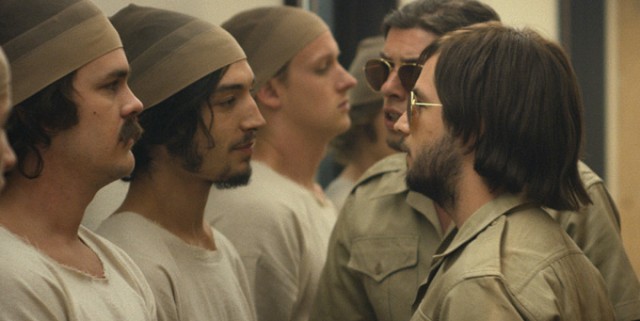
Some high-school or college psychology classes tend to teach about the Stanford Prison Experiment, which was an experiment ran by Dr. Philip Zimbardo in the early 1970s to investigate the cause of conflict between prisoners and guards by hiring 18 male Stanford students and dividing them up into one group or the other. A campus building basement was transformed into a makeshift prison and the guards took turns as three at a time kept the prisoners in order. It was supposed to last for two weeks, but due to the constant bullying to the point of psychological pain brought on by the guards, Zimbardo pulled the plug on the experiment after only six days. What did he want to prove? That the personalities of the guards and the prisoners tied with the brutality within prison settings? That people can and will change under pressure, given similar circumstances such as environment? Maybe both? Either way, it shouldn’t have happened in the first place, and he must’ve known it shouldn’t go on for another week. After only six days, it had already become violent and unpredictable; who knows what could’ve happened later?

The experiment has been the subject of many documentaries and a few narrative films (as well as term papers, for that matter), and with “The Stanford Prison Experiment,” director Kyle Patrick Alvarez and writer Tim Talbott’s fictional interpretation, based on Zimbardo’s book, “The Lucifer Effect,” may be the definitive narrative film about the subject, eyeing conflicts from both sides, the watchers (Zimbardo and his staff) and the watched (not just the prisoners but the guards as well), with a cold, objective tone. As a result, it’s chilling, shocking, and thought-provoking; one of the most disturbing films of the year.

It’s helped not only by the skillful filmmaking but also by the acting. Billy Crudup makes Zimbardo less than noble as an observer oddly compelled to keep going, despite himself becoming part of the experiment as well. Nelsan Ellis is strong in a role as an actual former prisoner who has some advice about the experiment and backs out when he becomes the very thing he hated for a long time. Olivia Thirlby shines in a brief but pivotal role as Zimbaro’s girlfriend who is appalled at what she sees. That leaves very impressive ensemble work from the many young actors playing prisoners and guards. Since they are not there to have characters of their own, only a few stand out—Michael Angarano, who is very chilling as a sadistic guard who takes influence from Strother Martin in “Cool Hand Luke”; Ezra Miller, who is heartbreaking as a prisoner who cracks as he realizes the authenticity of the experiment; Tye Sheridan, a rebellious prisoner; and Thomas Mann, a replacement prisoner who tries to cut through the “experiment.”

Alvarez and Talbott must have followed the source material closely, as we see almost exactly how the experiment gradually fell apart. There aren’t many clear answers, but the best thing about the film is how many questions it raises about human nature, as we ourselves interpret how the guards and prisoners acted certain ways because we can imagine how we would act in a similar situation. When I left the theater after I saw this film, I had a forty-minute drive home. The whole time I was driving, I kept imagining how I would behave if I was a guard or a prisoner. If I were a prisoner, would I be passive and take it or stand up for myself and fight back? If I were a guard, would I just do my duty or would I lose my head and get rough? I had to look deep within myself. That’s the effect “The Stanford Prison Experiment” had on me. It’s a film I won’t forget anytime soon. I hope to see it a second time with someone I could discuss it with to see what we both come up with in our conclusions.

Three Colors: Blue (1994)

22 Sep

blue

Smith’s Verdict: ***1/2

Reviewed by Tanner Smith

After Polish filmmaker Krzysztof Kieslowski created something ambitious with his “Decalogue” film series, which was a collection of short stories having to do with the Ten Commandments in modern life in ambiguous, satiric, and ironic ways, he decided to make something similarly impressive with the “Three Colors Trilogy.” The “three colors” in the title are blue, white, and red—the three colors of the French flag. And each film has to do with one of the three notions of the French motto: liberty (blue), equality (white), and fraternity (red). Writers Kieslowski and Krzysztof Piesiewicz create three films to show how these ideals function in everyday life, from an individual’s point of view. According to Kieslowski, “When you deal with them practically, you do not know how to live with them. Do people really want liberty, equality, and fraternity?”

The first in the trilogy, “Blue,” is centered around the subject of “liberty,” specifically personal, emotional liberty. The main focus is a Frenchwoman named Julie (played wonderfully by Juliette Binoche), who at the start of the film loses her husband and daughter in a car accident which she survives. She recovers fine but only physically. Emotionally, she’s a wreck as she tries to deal with her loss, while at the same time, she hardly seems to feel anything anymore. At one point, she even seduces and sleeps with a man who is smitten by her, possibly just so she can feel something again. After that encounter, she sets off for a new life. She sells her house, burns her late-composer-husband’s compositions, puts her mother in a home, and goes to live in an apartment building, with no name to herself, no time for love or friendship, and not even any children in the building, as she wishes. But fate runs another course for her—things in the present force Julie to have to face them, and the past is far from at rest, leading to her confronting that too.

There are many movies like this where you could easily predict what is going to happen in a character’s life because the characters are thinking in terms of plot, and therefore, it’s easy to tell where they’re going. But “Blue” is different in the way it conveys real emotion and real pain, and it puts in a lead character who is very complicated and hard to figure out because she has nothing figured out. And therefore, that makes her an interesting person to follow, because we’re not sure what she’s going to do next. For that matter, it’s hard to predict what’s going to happen in her life that she’ll have to deal with! That’s because despite what she may think of her life (and what we all may think of our own lives), there is hardly any control.

That is what makes “Blue” so powerful. It hardly takes the easy way out and thinks things for us—it has a character who’s always thinking, and so, we have to figure out exactly what’s on her mind when she does certain things. The overall mood and grim atmosphere of the film suck the audience in so that they want to know what goes on with this woman and will follow her anywhere. The slow progression of Julie’s “new life” is fascinating, as we see her cope with isolation and loneliness and contemplate what life has to offer after tragedy.

It’s also worth nothing that “Blue” is a beautiful-looking film. To go with the theme of liberty and the color blue, nearly every shot contains a blue object and is often done with a blue filter as well.

“Blue” is a wonderful film and a very strong first entry in the “Three Colors Trilogy.” Will the second film in the series appear stronger or weaker by comparison? Join me in the review of White for the answer.

American Heart (1993)

18 Sep
AMERICAN HEART, Edward Furlong, Jeff Bridges, 1993

AMERICAN HEART, Edward Furlong, Jeff Bridges, 1993

Smith’s Verdict: ***1/2

Reviewed by Tanner Smith

In the mid-1980s, director Martin Bell made the Academy Award nominated documentary Streetwise, which followed the lives of several homeless children in Seattle. One of its subjects was a 16-year-old hustler named Dewayne, whose father was incarcerated for robbery. One of the most poignant moments in the film is when Dewayne visits his father in prison and his father assures him that some day, they’ll be a family and go into business together after they’ve cleaned themselves up. And the most tragic moment of the film is when it’s revealed at the end that Dewayne committed suicide just before his 17th birthday.

“American Heart,” Bell’s 1993 fictional film based on this relationship and other aspects documented in “Streetwise,” contains the same spirit of grittiness and honesty. As a result, it’s a well-acted, well-written drama about the universal problems poor people face in the inner city.

Jeff Bridges stars as Jack, an ex-con just released from jail and trying to get his life back on track. Edward Furlong is Nick, Jack’s teenage son who has been staying at his aunt’s farm most of his life. Nick tracks Jack down and wants to stay with him, but Jack tries to send him back, with no avail. Realizing he’s stuck with the kid, Jack tries to make the best of it while also getting a job and making a living without resorting to old habits. He’s not a very good role model and the father-son relationship is edgy. As days pass, they find ways to connect, but problems arise as well, leading to trouble.

Meanwhile, there are three subplots. But each one connects to the main plot (as the best subplots do) in an effective way and they’re all well-done. One involves a relationship between Jack and Charlotte (Lucinda Jinney), a female cab driver Jack corresponded with while in prison. It’s sweet, funny, well-acted, and well-written, especially considering the undercurrents Charlotte adds to Jack and Nick’s relationship, which is already strained. Nick isn’t sure how to feel about Charlotte being there, since Jack is spending more time with her than with him. Another subplot involves Nick falling in with a crowd of streetwise kids and, among them, gets a girlfriend of his own: Molly (Tracey Kapisky), whose mother works as a stripper. The problem here is that Molly helps bring Nick down to her friends’ world of crime and debauchery. But Nick is in love with her and doesn’t care what happens to him. And it’s here where Jack must become a better father to his son. And then there’s Rainey (Don Harvey), who used to work big scores with Jack before he was imprisoned. Jack wants nothing to do with him anymore, but then Rainey goes after Nick, who can’t quite resist what he could get away with.

Jeff Bridges is perfect as Jack. This is honestly one of the best performances this great actor has ever pulled off in a long, successful career. I don’t see Jeff Bridges playing a part; I see a rugged, shaggy, burned-out man who feels hopeless and is constantly trying to get his life together while also keeping track of his son who he hasn’t seen in years. Edward Furlong is just as convincing as Nick, bringing a good sense of yearning and solemnity to the role of a kid seeking a bond with his father.

The script is very well-done. There are some effective lighthearted moments amidst the dark material of the film; the dialogue is perfect; and the back half doesn’t allow the easy way out, in which everything goes right. Not everything does turn out right. That’s life—life’s tough, get a helmet. It’s pretty powerful stuff.

Overall, “American Heart” is a terrific film. The performances are great, the script is fantastic, and the issues are as prominent now as they were in the early-1990s, when the film was made.

Stop Making Sense (1984)

18 Sep

Stop+Making+Sense+12

Smith’s Verdict: ***1/2

Reviewed by Tanner Smith

For most people, it’s hard to find a better concert film than Jonathan Demme’s 1984 Talking Heads film “Stop Making Sense.” At the time of its release, it was declared the “greatest concert film of all time” and was also notable for being the first movie made entirely using digital audio techniques. The techniques worked and the movie also had non-intrusive camera movements that also worked in its favor, capturing the fierce, dynamic energy of a fun rock concert. It’s hard to deny the film’s technical drive.

This is especially important, because what really distinguish a concert film from an album are the musical performance and the cinematography. And “Stop Making Sense,” capturing the high spirits and exhilarating impact of a riveting Talking Heads concert, has a lot going for it that cause audiences to praise it as much as they do.

For those who don’t know, the Talking Heads were a most influential and popular rock/funk group from the late-‘70s to the early-‘80s. Their music, which includes popular singles such as “Burning Down the House” and “Girlfriend is Better,” contains a large amount of types, such as rock, ska, and so forth. And oddly enough, for the time their songs were created, they hardly feel dated and are as enjoyable today as they may have been back when they were topping the pop charts.

The film was filmed over the span of four concerts in four days, with the first day being a dry run/rehearsal so director Demme and his crew can figure out where to position the cameras, and the other three days being the actual filming days, leaving the final version to be a showcase of the concert from all three performances. And strangely, for a musical documentary, the whole hour-and-a-half running time is directed at the stage and the band. No backstage footage. No interviews. Even the concert audience is rarely seen. It’s just David Byrne, his band, and the music—that’s it. And really, that’s all the film needed.

I love how the film begins. It’s low-key, beginning with a solo effort (with help from a cassette tape) from Byrne (“Psycho Killer”), a duet with Tina Weymouth (“Heaven”), and a few other numbers before the entire band is brought on stage with “Burning Down the House.” From there on in, the pieces are in place, the tempo picks up, and we’re in for a concert film that’s almost like an aerobics video, including the band jumping around on stage to the rhythm of certain songs. It’s the visual energy of the band that makes the film fun to watch. (Oh, and there’s also a number (“Girlfriend is Better”) in which Byrne sports an oversized suit that makes his head appear smaller. It’s strange and funny to look at.)

Even in 2015, “Stop Making Sense” is still an impressive concert film and still probably the best of its kind. Because the technical aspects are so well-done and the music still holds up, it’s as extraordinary today as it was in 1984 when it was released. I’ll tell you how well it worked for me—I wasn’t even that familiar with the Talking Heads upon seeing the movie for the first time, and it still delighted me.

It Follows (2015)

26 Jul

it-follows

Smith’s Verdict: ***1/2

Reviewed by Tanner Smith

How do I begin writing this review? There are three different ways I can think of in writing an introductory paragraph, so I think I’ll go with all of them. Here goes:

Intro Paragraph #1 (The Description of the “It”): It is a curse that can passed along from person to person through sexual intercourse. It is an entity visible only to those who possess the curse. It moves slowly. It will follow you. It can look like other people, even people you know. It will kill you and it will never stop until it does. If it does kill you, it moves back toward the previous holder of the curse. To be rid of it is to have sex with somebody else and pass it on.

Intro Paragraph #2 (The Daydream): Carefree college student Jay Height has just had sex in the car of her date. She can’t help but express herself by stating a daydream she used to have when she was younger and wishing she was old enough to go out on dates and have the perfect guy by her side. She feels like she’s finally an adult and still feels like her whole life is ahead of her. But her date interrupts her by chloroforming her, tying her to a wheelchair, and scaring her by telling the truth about a horrific curse that will follow her until she sleeps with someone else.

(Each of these two Intro Paragraphs would have continued with explanations of allegorical statement. For example, the “It” could obviously symbolize a sexually-transmitted disease, death, sexual anxieties, or all of the above. And Jay could be learning the hard way that with being an adult comes accepting responsibility, no matter how scary it might be.)

Intro Paragraph #3 (The Negatives): I like this film so much that I’ll get the negatives out of the way first (or in this case, third). There are times early into the film that fake us out too much—the music will build up in one shot and then cut off in the next shot, showing that everything is fine. The film risks losing the suspense by doing that. While the symbolism is mostly well-handled and fascinating, some of it can be a little too obvious. For example, one of the main character’s friends does nothing except quote “The Idiot” from her…compact Kindle case (what was that thing anyway?). I get it already—it’s about the imminence of death. And midway through the film, when the heroine and her friends find the guy responsible for the deadly curse that’s stalking her, they calmly sit down and talk. I should be glad that there are no shouting matches and he lets them know rationally what’s going on and what can be done, but wouldn’t acting accordingly be justified here? And the young characters make about three trips to the hospital—where the hell are their parents?!

OK, now that that’s all out of the way, let’s talk about “It Follows.”

Written and directed by David Robert Mitchell (whose previous film was the wonderful, underrated indie gem, “The Myth of the American Sleepover”), “It Follows” is the best horror film I’ve seen in a long time, recalling what truly makes an effective scary movie scary—slow buildup with suspense; a creepy, unknown monster; moody cinematography; likable characters you want to see live; and an eerie (dare I say, memorable) soundtrack. The film it reminds me of most, in terms of tone rather than narrative, is John Carpenter’s “Halloween.” There are echoes of Carpenter all through “It Follows,” and in this day and age with first-person/found-footage gimmicks and jump-scares and such, that’s welcome in my theater.

Mitchell slowly but surely eases us into something truly scary, as his lead character, carefree college student Jay Height (Maika Monroe), has sex with a seemingly nice guy and then is suddenly in possession of “It.” He lets her know how relentless (and invisible) it is while also explaining the rules of how to avoid it and get rid of it. Surely enough, there is a supernatural stalker following her, and though her friends, including a nice boy named Paul (Keir Gilchrist) who has a crush on her, don’t necessarily believe her at first, they can tell she’s freaked out about something and oblige her by helping fight off whatever’s coming her way.

Mitchell clearly remembers that sex in horror films doesn’t end well for anyone unless they’re fully aware of the danger outside. The film doesn’t dwell too much on that notion of sex equaling death, because it’s not that kind of movie. It’s a movie that wants to scare us and relies on scary imagery and building tension to take us on a rollercoaster ride, and thankfully, he remembers that he can allow to relax at times instead of trying to jump-scare us every couple minutes or less. Mitchell also remembers how unnerving it can be for an oncoming, relentless entity to move slowly. It can be very chilling when someone or something isn’t very fast but surely isn’t giving up. The sense of approaching terror is apparent all throughout this film.

Another smart move is not to explain the origins of “It.” The film establishes rules and takes it from there so that the most important thing for our characters is to survive it. That’s much more effective than knowing where this thing comes from or even what can kill it. And while we’re on the subject, readers who have seen this movie will wonder what I think of the climax involving a naïve plan to destroy “It.” People complain about how the characters should have known better, seeing as how they shoot it in the head at one point and it only mildly affects it. But I say this: at least they tried something, okay? Besides, the climax is fun.

Maika Monroe is wonderful as Jay. She creates a horror-movie heroine worthy of “following,” if you will. You can feel her fear and misery. Her friends are mostly unknowns, though I recognize Keir Gilchrist from “It’s Kind of a Funny Story,” and that also works in the film’s favor. They portray likable characters we hope to see get through one situation after another. Even the character of Greg, played by Daniel Zovatto, would seem like an unlikable jackass in another horror movie, but even he feels likable and real. I won’t go as far as to say they’re all complex characters, but compared to the one-dimensional detestable pawns we see in most modern horror movies, they’re delightful to watch.

“It Follows” is not what I would call a standard horror film. There are far too many symbolic elements, hidden meanings, and even scenes that are quiet (remember those?) for it to be labeled as “standard.” I saw it as a fun, visceral thrill ride the first time I saw it. The second time, I started to notice something deeper within the subtext, whether that was what Mitchell was intentionally going for or not; of that I’m not sure, but his restrained tone would leave me to believe anything.

In fact, just as I’m writing this review and I’m thinking about my question about the kids’ parents, I have to wonder if Mitchell’s intention was to show how the world of youth is dangerous and facing it makes you more of an adult. I wonder…

The main thing to take from this movie is that death is around us and won’t stop. It can be slowed down for a while, but eventually, it will grab hold of us and won’t let go. That’s what I get from the film’s ambiguous ending, which is so low-key and downbeat that it managed to get under my skin and stay there, leading me to believe “It Follows” was something more than just a horror film. It scared me, delighted me in doing so, and even got me thinking, which is more than I can say for most modern horror films.

Demolition Man (1993)

25 Jun

images

Smith’s Verdict: ***1/2

Reviewed by Tanner Smith

Yes, you read that Verdict right—three-and-a-half stars for “Demolition Man,” the 1993 Stallone/Snipes shoot-em-up/satire that asks the question…how do the three seashells work?

It’s probably the highest rating this movie will get from a critic, but read on.

“Demolition Man” was released in a time where our action films weren’t always about ideas or complex characters (if you think about it, we have plenty of those today; some damn good ones)—they were mostly about iconic figures like Schwarzenegger, Willis, Van Damme, and of course, Stallone shooting stuff up, kicking ass, and taking names. Only a few titles snuck under the radar as films that may have been ahead of their time in terms of story but made up for with the same amount of intense action everyone in the ‘80s and ‘90s was accustomed to. These are films that have some sort of symbolic theme underneath all the violence, such as “Aliens” (holding on to what’s left of being a fighter and (if you’ve seen the director’s cut) even a parent) and “RoboCop” (holding on to what’s left on one’s humanity before being totally under control). And then you have “Demolition Man,” which begins in the 1990s before taking its main story to the 2030s. This was the early ‘90s’ way of predicting what a potential future would be like if America suddenly became politically correct. It’s like if Aldous Huxley’s dystopian novel, “Brave New World,” starred Sylvester Stallone and Wesley Snipes.

And speaking of which, Stallone plays a rogue LA cop named John Spartan, who, in a brief prologue in 1996, has finally tracked down Simon Phoenix (Snipes, chewing scenery like Michael Keaton’s Beetlejuice), the criminal he’s been hunting for a long time. But in capturing him, his actions result in the destruction of a building where Phoenix’s hostages were stored, thus resulting in him serving a 70-year sentence frozen in stasis on a manslaughter charge, while Phoenix serves a life sentence.

Cut to the year 2032, where the city is now the pseudo-utopian San Angeles after a big earthquake caused the merging of LA, San Diego, and Santa Barbara. The city is under the guidance and control of Dr. Cocteau (Nigel Hawthorne). Crime is now gone, weapons are taken away, citizens have transmitters in their hands, vices are outlawed, and even the slightest use of profanity costs a fine. This is why when Phoenix is thawed and awakened in this pacifistic world for a parole hearing from which he escapes, the San Angeles Police Department don’t know how to handle his violent behavior. (By the way, I love this line from Rob Schneider as a nervous cop: “We’re police officers—we’re not trained to handle this kind of violence!”)

They say it takes a maniac to stop a maniac. Luckily, Lt. Lenina Huxley (Sandra Bullock), who collects all ‘90s memorabilia (even in her office), knows what can be done to stop Phoenix, having studied John Spartan’s unorthodox cop behavior. So, Spartan is reanimated, the race is on to stop Phoenix from carrying out whatever dastardly scheme he has in mind, and in the meantime, Spartan constantly tries to adapt to this new world where his methods are even more unusual now than they were before he was imprisoned.

As Spartan and Huxley continue the chase, they learn more about a group of rebels who live underground and don’t agree with Cocteau’s fascist ways. They have their own society in the sewer system, where they store all things prohibited from the surface, such as alcohol and meat (though since there are no cows, the meat is from…rats). And it becomes clearer that the overly evangelistic Cocteau, who arranged for Phoenix to escape in the first place (apparently frozen prisoners can be programed certain knowledge during rehabilitation), wants to obliterate the rebel leader (Denis Leary) so that the rebel group will fall and his city will be 100% peaceful. Even Phoenix agrees Cocteau is more of “an evil Mr. Rogers” than a saintly king.

The film certainly has a sharp satirical edge, establishing a society where violence is purged. People speak in overly polite manners, physical greetings (such as handshakes, high-fives, even kisses) are no more, sex is electronic and not the least bit physical (and pregnancy is apparently forbidden unless you have a “license”), and yes, instead of toilet paper, there are three seashells used to…clean one’s self. (Though, seriously, how are they used? That’s never explained.) There are a lot of funny lines thrown in the mix of numerous touches that make up this futuristic society; so many that I’m not sure I can name them all since they’re so clever and more. There’s also a nice running gag about how Huxley is so determined to be as rogue as Spartan that she constantly tries to come up with catchphrases that suit ‘90s-action-film needs but just can’t pull them off.

But even with that, the film is still a ‘90s shoot-em-up action flick—heavy on intense action, violence, wisecracks from our hero and villain, explosions, etc. It’s all pretty standard stuff and for the most part, setting its central focus in 21st-century totalitarian civilization doesn’t change much of it, no matter how funny the reactions from supporting characters may be. That was a complaint among most critics in 1993, when the movie came out. But looking at it from a mid-2010s perspective, “Demolition Man” really holds up, despite those clichés. That’s because the way things are going today with the Internet, social media, and group-focus, you could argue that our society may be headed in the same direction as the society at the center of this movie. There are people out there, especially on the Internet, who either strive for attention and call out other people, who are too sensitive and want nothing even remotely standing in the way of a goal they believe might be passive. This is what’s being addressed in the film, with Cocteau’s followers complying in the attempt for perfection and rebels who want more variety and free will but take extremes for such things. So, at the center of “Demolition Man” is a battle for compromise, because no side is right or wrong. What’s needed to live in this world, as Stallone’s character learns, is balance, and that’s also what Huxley and her fellow officers, as well as the rebels for that matter, learn along the way as well. And as for the ‘90s action clichés and how they’re definitely dated now, that also works in the film’s advantage, having taken our hero and villain from the 1990s to the future, so it kind of works. Watch this movie again and you might see that this film may actually better now than it may have been in the past. It certainly made me think while it also kept me entertained…but how do the three seashells work? Seriously, how are they even sanitized after they’re used?

How to Dance in Ohio (2015)

28 May

how_to_dance_in_ohio_header-620x347

Smith’s Verdict: ***1/2

Reviewed by Tanner Smith

“How to Dance in Ohio,” which will air on HBO later this year, is a moving, refreshingly cheerful documentary about autistic teenagers in Columbus, Ohio, as they prepare for their first spring formal. Over the course of 12 weeks, they practice their social skills and dance moves. After having seen “King Jack” and a few other gritty indie films about how depressing life can be for young people, it’s refreshing to see a film about young people that’s actually uplifting. Of course, it would be dishonest not to show how these people and their families deal with their condition, and that’s why they do show it; it’s just not as entirely downbeat as you might expect. There’s no oppression; just positive vibes all throughout. And I don’t mind that.

And for that matter, it’s also refreshing, in this day and age, not to hear any part of the “vaccine” debate.

Now, of course, there might be some people who see this as a bad thing, as the film hardly touches upon what it’s like for these autistic young people participating in society. But for others, such as me, they’ll most likely get a clear understanding nonetheless and empathize with the central subjects because of director Alexandra Shiva’s sheer engagement with them.

“How to Dance in Ohio” focuses on three young women in particular: Marideth (16) who loves looking up facts on her computer; Caroline (19), an outgoing college student who has a boyfriend who goes to the same counseling center as she; and Jessica (22), a baker who lives in a shared home. We see how they live, how they work, etc. as they prepare for the dance with much expected anxiety along the way.

“How to Dance in Ohio” is a well-made, nicely edited, balanced look at autistic teenagers that couldn’t be any better handled in the hands of a narrative filmmaker and a script (no matter how accurate that script might be). It’s also funny in certain spots; there were some nice laughs at a scene in which Marideth discusses the career of Miley Cyrus with her sister. When the big day comes when they all participate in the dance, it goes swimmingly and ends on a positive note that made me smile. I cared about the people I was watching, I thought it was well-made, and I admired how the doc focused more on rich, individual stories than making some sort of social-issue tale. I really liked “How to Dance in Ohio.”

LRFF2015 Review: “Made In Arkansas” Shorts Block 6

23 May

Reviewed by Tanner Smith

Go to the Ball with Me, Jenny

Smith’s Verdict: ***1/2

Cole Borgstadt’s (Pyro) 3-minute comedy, “Go to the Ball with Me, Jenny,” is shot like an amateur YouTube video in which an odd, quirky high-school teenager addresses a girl he likes (named Jenny, of course), asking him to go with him to their school’s Winter Ball, while telling a few things about himself such as his family, his pets, his hobbies, his…never-born twin brother he ate while in uterus (wait, wha…?). We’ve all been there—working up the courage to ask someone to a school dance can be a tricky effort and some of us felt we had to go the extra mile, like the kid in this film. What results is a funny, sweet…You know what? I can’t do it justice with a review. The film is online. Check it out here:

Sassy & the Private Eye

No Verdict rating

“Sassy & the Private Eye” is another short film of mine that was selected to screen at this festival. It’s a comedy, like The Making of ‘Sensitivity Training’, but much different, in that it’s a film-noir parody, it’s not to be taken seriously in the slightest, and it features a certain Sasquatch character from Vampire-Killing Prostitute…named Sassy.

Kristopher Pistole (audience member)—“I really liked ‘Sassy.’ The writing was very strong, really fun premise and your lead was charismatic. If I had any nitpicks, I could tell there were some technical hiccups, like dubbing. But that kind of thing gets better with time and experience.”

I thought Sarah Bailin, who reviewed The Making of Sensitivity Training, would be harsh toward this one, but she actually send me a positive message saying it’s one of my best! “It’s a nice genre mash-up and generally well done,” Bailin said. But she also criticized the slight audio issues the film may have had. “Please tell me it was a style-thing,” she said. I’m sorry, Bailin. It was a mistake.

Here’s a trailer for the film:

10511096_663444157058698_3236168490307898911_n

Simple

Smith’s Verdict: ***

Scott McEntire’s 10-minute short action film, “Simple,” is a hard-edged misunderstanding-gone-wrong, with a wry sense of humor that’s more than welcome for the violent material. It begins as mild-mannered Sam (Clayton Bowman) delivers an important package to a crime boss (Tony Gschwend) as a favor to his lazy slacker friend, Jacky (Kelly Griffin, very funny). When Sam finds out too late what was inside the package, he finds himself running and fighting for his life against the boss’ henchmen. What ensues is a series of fistfights, knifefights, narrow escapes, etc. as Sam must survive to make things right. As a straight-up action flick, it’s exciting and well-made. As a dark comedy, it works too, particularly when it cuts to Gschwend as the crime boss and Griffin as screwup Jacky. Also, Clayton Bowman is a likable lead. Though, my main criticism of the film is that it may have benefitted from tighter editing, which is an odd complaint for a 10-minute short. Aside from that, I liked “Simple”; it’s a nice 10-minute thrill ride.

11070023_829190690462239_1420823634781011477_o

The Whisperers

Smith’s Verdict: ***1/2

The full review can be found here. (NOTE: This film went on to win the LRFF award for Best Arkansas Film and is now available on demand: https://www.indiereign.com/v/da5d3 I recommend you check it out.)

Stay a While

Smith’s Verdict: ***1/2

Michael Kelley’s 4-minute short “Stay a While” is as much a music video rather than a short film. I actually had an interesting conversation with a friend about what it works best as: a narrative short or a music video. He said it works much better as a music video, so I told him, “Then it’s a music video.” Either way, it’s still a well-done piece—a good example of editing that show contrast between what was once here and what is now gone, as a young man is happy with his girlfriend but has suddenly lost her and is frantically searching for her. It’s well-done and has a nice payoff.

1511385_234521863419124_1179789493335139821_n

Perfect Machine

Smith’s Verdict: ****

And now we’ve come to the final review in the LRFF2015 Made In Arkansas Shorts Block collection: Jarrod Paul Beck’s 25-minute science-fiction drama, “Perfect Machine.” After 3 years in the making, as well as an ambitious funding & marketing campaign (see Homefront and MatchMaker), the final creation works wonderfully.

The film takes place in (supposedly) the near future, as a new government system makes everything “perfect.” All citizens of new, altered civilizations are forced against their will to daily comply with this arrangement, by taking special medication, and those who don’t are forcibly “reprogrammed” to get with the program. It’s a world in which all choice is replaced with obedience, and it’s all controlled by the ominous Administration. Stevens 8936 (Kristof Waltermire) is a citizen who has stopped taking his medication for a couple days is starting to “feel,” which doesn’t bode well, seeing as how it’s against the system. Soon after his latest Administration checkup, Stevens 8936 (everyone is given a number to their name, making it easy for matching; again, see MatchMaker) evades two guards and escapes from the city, along with an unwilling woman, Warner 5964 (Caitlin Covey), into a forbidden, untouched world of nature where they take refuge in a cabin. As Stevens 8936 to the new feeling of freedom within himself, he helps Warner 5964 get adjusted to hers. Upon seeing/feeling the beauty of this environment, they learn there’s more to life than what they were forced to believe. And in each other, they find something deeper.

The background of this society is sketchy, but read/see other futuristic fables such as this and their explanations for their universes will probably make as much sense. I’m actually glad Beck doesn’t give us an answer to the question of how this world came to be. I don’t think his characters know either. Within the first five minutes of the film, writer-director Jarrod Paul Beck establishes this new world before taking his characters, as well as us, on a journey of emotion and self-discovery, which takes up more than half of the film. This is a film that uses a sci-fi gimmick to set up the two central characters, carefully develop a trusting relationship into love, contemplate complex issues such as free will and nonconformity, and results in a heartbreaking resolution but with a final shot that brings a beacon of hope. And it’s so beautifully done. The first five minutes of the film, which show the world in a certain amount of detail, are well-executed, and the visual effects are nice. But surprisingly, it’s everything with the more familiar world, taking up mostly the rest of the film, that I take back from “Perfect Machine.” This whole sequence is moving, insightful, and beautiful. It’s also well-written; there are a few extended dialogue-free sequences, but when the characters do engage in conversation, their words are carefully chosen. It’s also great to look at, with fantastic cinematography by Eric White. Watch this on a big screen, like I did, and you’ll most likely feel like you can reach out and touch this film, especially in the nature shots; you can feel the location. Few films I’ve reviewed in these blocks provided such a pervasive sense of time and place; I wasn’t tempted to go elsewhere, not even the inventive sci-fi world established earlier.

Both Kristof Waltermire and Caitlin Covey do great jobs portraying sympathetic characters trapped in a world they didn’t make and content with one that’s been there for them all along. I cared for these two and hoped for the best. Will they remain here for the better or will the cruel, forceful hand of the Administration bring them back for the worse?

The ending makes the film yet another short film I’d like to write a “spoiler review” for, just so I can talk about the final shot and what it could mean. Without giving it away, it’s ambiguous and people will see it one of two ways: positive or negative. Maybe it’s the emotion that was brought up in the mid-section, but I’m leaning toward the positive.

There’s no other way to put it—I loved “Perfect Machine.” It’s well-made, intelligent and charming. Beck and his crew put a lot of effort into this film. It pays off beautifully.

NOTE: Beck received the LRFF2015 Best Arkansas Director award for this film. I’d say his hard work really paid off.