Archive | Three-and-a-Half Stars ***1/2 RSS feed for this section

Green Room (2016)

18 Dec

960

Smith’s Verdict: ***1/2

Reviewed by Tanner Smith

Just read the premise for writer-director Jeremy Saulnier’s “Green Room”: a punk-rock band must fight to survive a night in a bar run by ruthless neo-Nazis run by Patrick Stewart. Admit it—you want to see this film on the basis of that concept alone.

I’ll be honest and say I was expecting a more conventional (albeit fun and thrilling) film than the one I actually saw (thrilling but definitely not “fun” in the “conventional” sense). It’s a brutally realistic chiller that had my stomach knotted up and got under my skin. And it confused me; but it only confused me because nothing was happening the way I expected it to happen. Then I realize, that’s a good thing! Let me give an example—in this film, someone comes in to help and you expect him to save the day, but what happens instead? Out of the blue, he gets a shotgun blast to the face! No buildup, no tense music—it just happens. And I’m not even going to mention what someone does with an ultra-sharp razor blade.

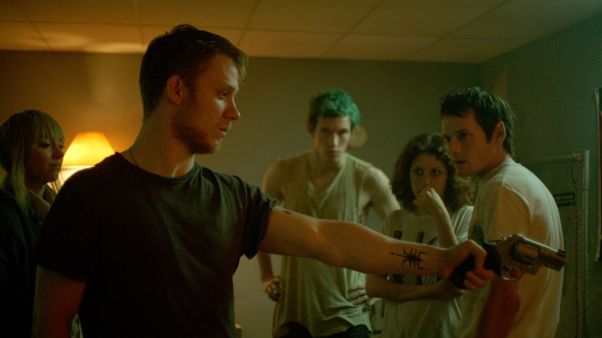
This simple, straightforward thriller that begins with the introduction of our soon-to-be-in-jeopardy protagonists—a four-member punk-rock band called the Ain’t Rights. They don’t partake in social media, they siphon gas for their van in which they all live/sleep, and they’re not as “hardcore” as they like to think they are but they try. They go from gig to gig collecting as much money as they can, but their next gig is one they’ll wish they avoided. It’s a bar in a part of the Pacific Northwest populated by rednecks and neo-Nazis. After playing their set, all they have to do is collect their payment and leave. But oops—bassist Sam (Alia Shawkat) left her phone in the green room backstage and guitarist Pat (Anton Yelchin) has to retrieve it…only to discover a dead body in the green room. A murder has occurred, and before Pat can call the police, he and the band, including two other members Reece (Joe Cole) and Tiger (Callum Turner), are kept inside the green room while the bar’s owner, Darcy Banker (Patrick Stewart), tries to think of what to do. His plan: close the bar early so the patrons can leave, call in his band of brutes and thugs (as well as man-eating attack dogs), somehow lure the band outside, and murder them, thus eliminating all witnesses. Knowing the danger they’re in, the band, as well as a bystander named Amber (Imogen Poots), realize they must fight to survive if they are even going to consider leaving the room.

The film is an exercise in realistic violence in response to the question of what people can do to other people when facing against each other. I mentioned the shotgun to the face and the razor blade, but there’s also a hand that’s nearly chopped off, a machete to the neck, and even a dog after someone’s throat. This isn’t a film for anyone who’s easily squeamish. The violence is handled in an unpredictable way so that anyone invested in the material will be on-edge wondering what will happen next. As expected from a film like this, you wonder how the characters are going to get out of one situation before they get into another one. But this is a film that disposes of a few of these characters quicker than anyone would have expected.

Who is the right audience for “Green Room”? That’s a difficult question to answer. Certainly not people looking for a b-movie thriller where you whoop and cheer for the bad guys to get their comeuppance. This isn’t a gutsy, go-for-it thrill ride; it’s more of a nightmare, as one character proclaims by the end of the story. Nothing feels overwritten or exaggerated—it’s just a matter of saying, “This is what happens when this happens, so save your popcorn for a different movie.” In that sense, maybe “Green Room” is only for people who just want to see “what happens when this happens,” based on the premise I opened the review with.

“Green Room” is a well-executed thriller with an intriguing hook and a fascinatingly original take on the situation. The actors are terrific (especially Stewart, who is more subtle than a frothing-at-the-mouth bad guy), the cinematography is top-notch, and as was Saulnier’s intent, it left an impact on me that might have actually been better than what I expected.

Midnight Special (2016)

13 Dec

MIDNIGHT SPECIAL

Smith’s Verdict: ***1/2

Reviewed by Tanner Smith

A lot goes into raising and protecting a child…and to say no one does a bang-up job doing it in “Midnight Special” is an understatement. When characters aren’t holding this kid captive, others are on the run with him from the government. You see, the child is special…meaning he has special supernatural abilities, and he needs to be protected. By the end, the people who have his best interests at heart aren’t even entirely sure they made the right decision. (No spoilers here, btw.)

“Midnight Special” is a science-fiction drama brought to us by writer-director Jeff Nichols, one of my favorite filmmakers working today. While this film isn’t quite up there with his previous films (“Shotgun Stories,” “Take Shelter,” and “Mud”—all three I hold in very high regard), I still think it has a lot to offer, particularly in terms of its themes of parenting and guidance.

The film is also in the same vein as something like Disney’s “Escape to Witch Mountain” and John Carpenter’s “Starman,” as people go on the road on the run from other people who are out to get this person who could be from another world and brought here to bring a message to humanity.

As the film opens, two men—Roy (Nichols regular Michael Shannon) and Lucas (Joel Edgerton)—are in a motel room, watching a news story about a manhunt for a kidnapped 8-year-old boy named Alton (Jaeden Lieberher). Alton is in the room with him, meaning they’re the ones who have taken him. Alton doesn’t seem nervous or scared by them at all; in fact, Roy is the boy’s father. But it’s back on the road again, as authorities are hot on their trail, and we see the people who have looked after Alton before. It’s a religious cult run a welcome Sam Shepard cameo who believes something is coming soon and that Alton is their savior. Things get more complicated when it turns out this cult has worshipped numeric sequences brought to them by Alton, and these numbers mean something to the government, who now want to find Alton to know how he knew about them. The numbers also lead to a specific location, which Roy and Lucas try to get to.

For much of the movie, we’re not sure of who (or what) exactly Alton is. Why does he wear protective goggles? Why does he know what no one else knows? Is he from another planet? Is he the Second Coming? What all can he do with his abilities?

And with whom does he truly belong? We’re rooting for Roy to keep this boy safe, and he tries his best to protect him, but he’s not quite as well-equipped as he thinks he is and sometimes makes sloppy decisions. Lucas (not a family member but an old friend of Roy’s) does too, but again, he wants to look out for him too. Soon, Roy’s estranged wife, Sarah (Kirsten Dunst), is brought into the mix, and she loves the boy too. As they eventually get some kind of answer as to what Alton’s true purpose is, both parents have to make an important decision about what’s best for him. I’m entertained by the road-trip aspect of “Midnight Special,” but it’s the parental aspect that’s the most fascinating and could cause discussion about what it means to be responsible for someone.

The truth reveals itself at the end of their journey, and while it doesn’t answer every question people might have about what has unfolded, it doesn’t choose not to say certain things. I’ll admit I was unsure about the resolution upon the first viewing, but watching it again made me reconsider something else that was on my mind about it. (Besides, it’s not like I wanted Nichols to have the conflicted NSA specialist character played by Adam Driver to come out and spell out to us what everything meant.)

“Midnight Special” is very well-made with gripping cinematography by Adam Stone and with Nichols showing his strengths in his first studio film. It’s also wonderfully acted, with great performances by everyone in the cast, especially Michael Shannon who turns in some of his most subtle work. And more importantly, it reminds us of the power of visual storytelling. It’s an enthralling film that delighted me, shocked me, and kept me engrossed even after I left the theater.

Captain America: Civil War (2016)

10 Dec

mv5bmtq3njiwmzk5mv5bml5banbnxkftztgwmjy0mjy1ode-_v1_cr060640360_al_ux477_cr00477268_al_

Smith’s Verdict: ***1/2

Reviewed by Tanner Smith

2014’s “Captain America: The Winter Soldier” was one of the best entries in the Marvel Cinematic Universe. Since its release, we’ve had another origin story with “Ant-Man” and the next “Avengers” sequel (and “Guardians of the Galaxy,” but none of those characters make an appearance until “Vol. 2”). We still have a while to wait for the ultimate two-part “Avengers” story involving something called “the Infinity Stones”—you know, the things that were only hinted upon in previous MCU films since “Thor: The Dark World” but every comic-book reader seems to know everything about? So, while we’re waiting for that, we have “Avengers 2.5: Civil War.” Er…no, I’m sorry, it’s “Captain America: Civil War,” featuring many of the Avengers in action (excluding Hulk and Thor). But we have something close enough, plus new Avengers. The result is the most exciting superhero movie I’ve seen this year.

The events of “Avengers: Age of Ultron” aren’t ignored. In fact, that film’s climax set up the issues in “Captain America: Civil War.” If you recall (and if you don’t, don’t worry—you’ll catch on), there were many casualties in the devastation of Sokovia at the hands of the Avengers. Because of this, the United Nations wants to oversee and control the Avengers. Steve Rogers aka Captain America (Chris Evans) doesn’t trust the government over his own judgment, but Tony Stark aka Iron Man (Robert Downey, Jr.) feels immense guilt over his part in the incident and agrees to oversight. On Stark’s side are Black Widow (Scarlett Johansen), War Machine (Don Cheadle), and Vision (Paul Bettany), and on Cap’s side are Falcon (Anthony Mackie), Hawkeye (Jeremy Renner), Scarlet Witch (Elizabeth Olsen), and Ant-Man (Paul Rudd). Things get even more complicated when Cap’s childhood-friend-turned-enemy-weapon Bucky Barnes (Sebastian Stan) aka The Winter Soldier returns from obscurity and is reprogrammed by the bad guys to kill. Cap breaks many rules in protecting him in order to find more answers in order to help him. His allies on the UN issue follow him, leading to battle lines being drawn between them and Stark’s followers.

There’s a lot that happens in this film, including the introduction of two new recruits: Black Panther and Spider-Man. T’Challa aka Black Panther (Chadwick Boseman) is the prince of the African nation of Wakanda whose father has fallen victim to an attack brought on by The Winter Soldier. Out for vengeance, he joins Stark’s side, as Stark is after Cap to get to Bucky. Then, there’s Spider-Man, who also joins Stark and is the hero about whom I was both excited and nervous. I’m a Spider-Man fan, and seeing what Sony continued to do with the character after good starts and bad finishes made me cross my fingers that Disney/Marvel would finally serve him well. And what did I get? The best version of Spider-Man I’ve ever seen on film. Played brilliantly by Tom Holland, Peter Parker aka Spider-Man is charismatic and energetic as well as quippy and resourceful. I watch this kid, and I’m not thinking of Tobey Maguire or Andrew Garfield—this is Spider-Man! I can’t wait to see him in this summer’s “Spider-Man: Homecoming.”

The villain isn’t very memorable, but his motivations, which are revealed later, are. That brings me to one of the movie’s biggest strengths: nothing is black and white. Sure, there are other ways of doing things than what some of the characters do here, but that adds to the moral complexities that are scattered all over the movie. The advertising makes a big thing out of “Team Captain America” and “Team Iron Man” and “whose side are you on” and so forth, but the thing about this movie is that the decision of who to side with is not an easy one. This can cause audiences to discuss many of the moral/ethical obligations sure to be brought up.

While I’m on the subject of seeing where Iron Man comes from, I have to commend this movie for making me care about Tony Stark/Iron Man again. Lately, I’ve been on the fence about this guy, after he’s made dumb decision after dumb decision—telling a terrorist where he lives, building a machine that could do good or bad even after he’s had a vision telling him he’s responsible for destruction, and so on. These things made me want to smack him in the face after he said another witty remark, because this guy wasn’t claiming responsibility for anything that was his fault. But thankfully, he does claim responsibility here. He feels a lot of responsibility over what happened in “Age of Ultron” and you can tell he wants to make up for it. This is the side of Tony Stark I’ve been waiting to see for a long time.

Blah, blah, blah. What about the action? Well, it’s there and it’s done well. But it’s nothing too special…until it gets to an extended action sequence midway through, in which the Avengers are fighting each other. This is an amazing sequence and the one people have come to see. To see the heroes we’re all familiar with suddenly facing each other is a fascinating concept by itself, but to see them use their skills on each other is even more entertaining to watch. While a part of you wants them to listen to reason and talk about why they’re fighting, another part of you can’t help but enjoy the battle. The effects are well-done, the pacing is fast as lightning, and there is room for surprises, particularly with a new development in Ant-Man’s technology.

“Captain America: Civil War” is an enormously entertaining MCU entry, though a part of me is admittedly afraid that the MCU can only go down from here. But then again, another part of me is excited to see what is to come anyway. Especially “Spider-Man: Homecoming.” We have a few months until we get to see that one—I’m crossing my fingers (and my toes as well) that it gives us what we want/need from the web-slinging superhero.

Captain America: The Winter Soldier (2014)

10 Dec

images

Smith’s Verdict: ***1/2

Reviewed by Tanner Smith

When Marvel Studios brought us its Marvel Cinematic Universe, movie audiences found themselves looking forward to a new continuing chapter in…well, whatever adapted-from-comics saga it would throw at them. It began with a promise made in the first “Iron Man” movie that an “Avengers” movie would actually happen, and it released movie upon movie upon movie to assure us it would come, from “The Incredible Hulk” to “Iron Man 2” to “Thor” to “Captain America: The First Avenger.” And when “The Avengers” finally hit, it gave them a hell of a good time and exactly what they wanted to see—superheroes working together and a load of action scenes for them to partake in. Then, after seeing the origin stories of Iron Man, Captain America, Thor and Hulk, audiences were curious to see where they were going to go next before the next Avengers movie. With Iron Man, they had “Iron Man 3.” With Thor, they had “Thor: The Dark World.” Both were decent movies, but there needed to be something more. A lone-superhero sequel that truly upped the ante in terms of action, thrills, story, and even comedy and drama; and not just filler to catch up with the heroes. (I may like “Iron Man 3” and “Thor: The Dark World” fine, but when I really think about it, it is sort of “filler” before the next Avengers movie.)

“Captain America: The Winter Soldier” is that movie.

“Captain America: The First Avenger” was a fun origin story for whom people say is the bland Boy Scout of the Avengers. Adapting the comic-book hero for a movie was a difficult task, but thankfully the movie was fun. However, you have to wonder: how do you make something complex out of a patriotic do-gooder? Well, with “Captain America: The Winter Soldier,” sibling directors Joe & Anthony Russo and writers Christopher Markus & Stephen McFeely have found a way.

Steve Rogers, aka Captain America (played again by Chris Evans), is adjusting to life in the modern world, after awakening from decades of suspended animation. Not only does he have a list of pop culture to catch up on (for a treat, pause the DVD/Blu-Ray to see what else is on the list), but many of the people he knew are gone and his old girlfriend is now an ailing elderly woman. But that’s not all. His old-school ideals must make way for subtler threats and difficult moral complexities—nothing is as simple as he was brought up to believe. Things get even more difficult when it seems SHIELD is slowly being taken over by HYDRA, an enemy organization. Before Director Nick Fury (Samuel L. Jackson) falls victim to a HYDRA attack brought on by the ominous Winter Soldier, he instructs Captain America to trust no one. So Cap, along with Black Widow (Scarlett Johansen), go rogue as they find answers as to who exactly is behind this. They partake in battle after battle as they discover some harsh truths about the people they know/meet as well as the identity of the Winter Soldier himself.

What elevates this exciting action-thriller to more compelling levels is its dramatic aspect, mostly centered around the character of Steve Rogers. The struggles he faces as a person are heartbreaking, as he tries to get used to living in this world he’s not too familiar with—a world in which his old friends are either gone or fading. The scene in which he visits his old girlfriend, Peggy Carter (Hayley Atwell), is particularly affecting. And as a hero, he has more to deal with, such as being hunted by the people he works for, facing newer threats with political agendas alien to him, and even the upsetting idea that he’s not doing as much good for the world as he wants to. All of this helps make the character of Captain America more interesting and complicated than we would’ve expected. I appreciate what went into his development in this movie. And when it becomes revealed who the Winter Soldier is, it only makes it more difficult and gripping.

But whatever. People weren’t there for its psychological issues; they were there for the action. And “Captain America: The Winter Soldier” doesn’t disappoint. They’re perfectly executed, fast-moving, and exciting. That’s really all I can say about it, except that because the film takes time out to establish the environment and develop the relationships of the characters, we care about what’s at stake here. It doesn’t feel like a typical superhero movie; there’s more than meets the eye with it.

“Captain America: The Winter Soldier” is one of the best movies the Marvel Cinematic Universe has to offer. It knows how to tell the story, it knows what to focus on, and it knows what to deliver when the time calls for it. There’s more to the film that I already explained in the review, so if you want to find out what I mean by that, I recommend you check the movie out and see what else it has to deliver.

The Hunger Games: Mockingjay–Part 2 (2015)

12 Nov

mjp2teaser

Smith’s Verdict: ***1/2

Reviewed by Tanner Smith

Previously on Smith’s Verdict…

From the “Mockingjay—Part 1” review—“[Mockingjay—Part 1”] is hard to criticize except to say it’s not a complete film. I’m rating it three stars, with it amounting to an optimistic ‘incomplete’ status. It’s just a film leading us into ‘Part 2,’ and is it is, it’s worthwhile for audiences and fans of the original source material. […] ‘Mockingjay Part 2’ has the potential to be great.”

I get why “Mockingjay,” the third book in the “Hunger Games” trilogy by Suzanne Collins, was split into two movies. For one thing, it’s a long book, and only the biggest “Hunger Games” fans would pay to see a 3+ hour long movie based on it. And for another, making two films was an opportunity for the studio to make double the amount of money it would make if it were just one film. (It’s a move that I honestly think is unnecessary—see the unfortunate mess the “Divergent” series is in.) Yes, it is a long book, but most readers will agree it moves at a snail’s pace. I give credit to the writers for adapting it as close to the source material as they could to please the fans, but I think “Mockingjay” would have been stronger as one film, if they took a few elements from “Part 1” (including the ending) and trimmed a little bit of “Part 2,” “Mockingjay” would have been as strong as “The Hunger Games” and “The Hunger Games: Catching Fire.”

With that said, “Mockingjay—Part 2” is a solid conclusion to what has always been a riveting film series. It’s well-paced, it ties up loose ends, and it ends brilliantly (I’ll get to that later). This entry is bleaker than the other two, which is necessary, since it takes us to the fight to the end between dystopian rule and rebellion. Not everything is going to be easy; if it were, there wouldn’t be as many deaths.

“Part 2” of course picks up where “Part 1” left off, with Peeta (Josh Hutcherson), after being rescued from the devious Capitol, unexpectedly choking his former lover, Katniss Everdeen (Jennifer Lawrence). Peeta has been brainwashed to believe that everything the Capitol is doing is largely because of Katniss’ actions. Distressed by this, Katniss agrees to join a group assault on the Capitol, so she can finally confront and possibly assassinate President Snow (Donald Sutherland).

One of the things that strikes me about this film is how complicated it is in its story. Peeta believes Katniss is the cause of so much destruction and is only making the Capitol worse. What’s strange is, in a way, he’s right. But Katniss does what she does in the name of survival and is trying to hold on to what she has, as well as a good moral center—but the problem is, she doesn’t always know what’s best and even though she sometimes goes against what she’s told to do by her allies, she knows her allies’ advice isn’t the best decision either. That is a strong asset to this movie—it shows the complications of doing the right thing in this corrupt, violent society, and it’s never clear exactly what the right thing is. What matters in this world are survival and holding onto your moral center as much as possible.

This is as much a credit to Jennifer Lawrence’s brilliant work as an actress, but I like how you can see Katniss’ inner struggle to do what she can and must in this insane world she didn’t make. On top of that, she’s made up to be a symbol to the media—someone who did something rebellious and paved the way for the Resistance. So now, the President of the Resistance, Alma Coin (Julianne Moore), wants to use her as a decoy for others to move in ahead of her, but as the raid continues, she’s less interested in becoming a martyr and a decoy than becoming a savior and a heroine. And then, when something horrible happens to one of her loved ones, you’re not sure how she’s going to react/retaliate (that is, unless you read the book).

Other critics complain that “Mockingjay—Part 2” starts off at a slow pace. On the one hand, I can see what they mean. But on the other hand, I don’t mind because I see the turmoil these people are going through before the big raid on the Capitol, and it’s fascinating to see how their minds work. This film needed that time to build things up, so I could feel what they were feeling. And no, there isn’t a lot of action (and a few action scenes are scattered far apart), but I think people misunderstand—this isn’t the epic-battle conclusion in the same way “The Return of the King” was for “The Lord of the Rings” or “The Deathly Hallows” was for “Harry Potter”; it’s still a conclusion, but it’s one that uses wits instead of weapons. The final half-hour of the film isn’t a big, bombastic action climax—it’s a battle of brains. It leads to an unexpected resolution that I honestly commend this film for delivering us instead of taking the easy way out.

If you read my reviews of the previous “Hunger Games” movies, you know I’m not a fan of Gale (Liam Hemsworth). So, something I was interested in while seeing this final chapter was how this love triangle between him, Katniss, and Peeta was going to work out. I won’t give away what becomes of Gale, but I will say it only reinforces my statement that Gale was an unnecessary character. (But on the plus side, nothing too big was made of the “love triangle”; it’s played in a mellow way.)

The action scenes are very well-done, with solid direction by Francis Lawrence. There are scenes of combat that are brutally tense, but the highlight of the film is an “Aliens”-like sequence in which the rebels fight for their lives in a sewer tunnel against Capitol-trained man-monster things. That was a very chilling scene that had me on the edge of my seat.

I appreciated “The Hunger Games: Mockingjay—Part 2” for making a tough point about the moral uncertainty of war in the midst of providing a conclusion most of us have been waiting for. It’s not an action-packed thrill ride, but it’s not supposed to be. If you’re willing to dig beneath the surface of the story, you’ll find that it’s saying deeper than expected.

Evil Dead II (1987)

13 Oct

evil-dead-2-movie-image-2.jpg

Smith’s Verdict: ***1/2

Reviewed by Tanner Smith

I’m sure some people are looking at the “Smith’s Verdict” rating and thinking, “What?! This so-called ‘critic’ didn’t give ‘Evil Dead II,’ one of the best movies ever made in the history of mankind, a four-star rating? Or even a FIVE-star rating?! I’m so mad, I’m going to unsubscribe from his blog right now! That’ll show him for giving ‘The Goonies’ a higher rating than this movie!” There is an explanation for that—a selfish reason, but still a reason all the same. “Evil Dead II,” Sam Raimi’s sort-of sequel to his 1981 gory, goofy horror classic “The Evil Dead,” is a hell of a good time—a slapstick comedy in the guise of a horrific supernatural shocker. It is a relentless, outrageous (and yes, also groovy) romp with lots of blood, gore, slapstick, gags, practical effects, crazy camerawork, fast editing, energetic spirit, an awesome hero, and an overall uncompromisingly zany style to it. Since then, it has become a cult classic like no one’s business, with many, many people praising it to high heaven (ironic, considering this movie features many, many demons in it), watching it every Halloween, showing it to their friends, and calling it one of their favorite movies. It was definitely the movie that put Sam Raimi in the spotlight, causing him to make another sequel (“Army of Darkness”) and eventually make more mainstream movies (such as the “Spider-Man” trilogy later on), and I think it’s safe to say it made actor Bruce Campbell the star we know him as today.

The film is technically a sequel to the original film, but it’s more of a remake. It was supposed to take place where the original left off, but the sequel’s new studio couldn’t get the rights to footage from the original for a recap, and so, they shot new footage for a prologue, explaining why Ash (Campbell) is at that creepy cabin in the woods and how the Necronomicon Ex-Mortis (or “Book of the Dead”) has brought forth an evil entity that threatens to consume his soul. He barely survives but can’t escape the evil, and he’s left to face off against whatever this force can throw at him in a night of battle against non-stop over-the-top macabre components. Ash isn’t one to give up so easily—even when he is forced to cut off his right hand, which was possessed by a demon, he eventually has it replaced…with a chainsaw. Is that “groovy” or what?

The film is similar in style to the original “Evil Dead” but not necessarily in tone. The original intent of “Evil Dead” was to be legitimately scary, while the main intent for “Evil Dead II” is to be ludicrously comical. Raimi and his crew pull out every trick in the bag to make something so absurd into something so fitting, and it really works. This movie is a lot of fun to watch as a result, and that’s why people love it so much. Absolute slapstick (such as when Ash’s hand punches him in the face or grabs his head to smash against dishes and windows) and one-liners (such as when Ash shotguns a demon who wants to “swallow [his] soul”—“Swallow this”) add to the humor aspects of the movie. “Evil Dead II” can unsettle you if you don’t like nasty, creepy-looking, possessed people or mangled deer heads coming to life and laughing maniacally (yes, that’s in this, if you haven’t seen the movie already) or lots and lots of blood (sometimes in different colors even), but it’s not here to scare you or even to necessarily gross you out—it’s here to make you laugh.

So, what do I think would make “Evil Dead II” a better movie (and by that, I mean a four-star movie rather than a three-and-a-half-star movie)? Well…if it had no one else except Bruce Campbell in it. I mean it—if it was just the ever-awesome Bruce Campbell taking center-stage throughout, fighting off many supernatural beasties (or “Dead-ites”) with no outside help whatsoever, I would’ve given the movie a four-star rating. But instead, Raimi decided to bring in some annoying visitors for the demons to kill. They are Annie (Sarah Berry), whose father owns the cabin; her boyfriend (Richard Domeier); and a redneck couple (Dan Hicks and Kassie Wesley). I get that they’re here to be picked off one-by-one, and they’re supposed to be funny, I suppose. But I wasn’t amused by them and I found them annoying and too dumb for me to care. The stuff with Ash fighting off the forces of darkness is great on its own; if the movie was just about this macho-dude-turned-badass-hero against an army of demons, then I would’ve given it four stars. That’s a compliment to Bruce Campbell, who is so much fun to watch in a movie that is so much fun to watch, despite my nitpick about the other characters.

The Martian (2015)

12 Oct

The-Martian

Smith’s Verdict: ***1/2

Reviewed by Tanner Smith

“The Martian” has an intriguing premise: an astronaut is left behind on Mars after a fierce storm caused his crew to believe he was dead. Now he’s alone and stranded on a desolate planet and must rely on his skill, inner strength, and wit to survive and find a way to contact Earth. From there, it’s a question of whether or not he can leave Mars and get home.

One of the biggest pleasures of this science-fiction drama, based on the novel by Andy Weir, is the humor that allows itself within it. It’s relatively realistic and believable in its science (at least, for me—I’m not a scientist) and its dramatic moments are warranted and very effective. But at the end of the movie, it’s easy to realize it was still a lot of fun. The film has a sense of humor, with a clever, sharp script, which requires the characters to say many witty lines of dialogue.

Some examples:

  • “Mars will come to fear my botany powers,” states astronaut Mark Watney (Matt Damon) when he realizes he has to “grow food on a planet where nothing grows.” Luckily, he’s a botanist.
  • “They say once you grow crops somewhere, you have officially colonized it. So, technically, I colonized Mars. In your face, Neil Armstrong!”
  • “I’m going to have to science the shit out of this.”
  • At the time NASA officials finally realize one of their astronauts is stranded on Mars, one of them (played by Chiwetel Ejiofor) wonders “what this does to a man psychologically.” The immediate cut back to Mars results in probably the funniest moment in the movie (which I will not reveal here).

I wasn’t surprised by this welcome comic angle to what would otherwise be just a tense, dark sci-fi thriller when I realized who wrote the screenplay—Drew Goddard, who wrote and directed the delightfully entertaining “The Cabin in the Woods.” However, I was surprised to find it was directed by Ridley Scott, who has made films such as “Alien,” “Blade Runner,” and “Prometheus,” neither of which are as cheerful or even as adventurous or hopeful as “The Martian.” I still like those movies, but I kind of appreciated this change of pace more.

And that’s really what it comes down to, more than the movie being humorous—it’s hopeful. The main character is an optimist. Even though he’s trapped on a desolate planet with very few resources on hand, he simply states, “I’m not going to die here.” So he does everything possible to make sure everything’s going to be fine (and also that he believes it himself). Even when things are at their darkest and he starts to doubt himself, he knows that it’s better to die fighting than not try to survive. I admire stories that show how a lone survivor in a dire situation copes with seclusion (like “Cast Away,” “Gravity,” “127 Hours,” “Touching the Void,” among others), and “The Martian” has a real good share of challenges, both internally and externally, and they’re all captivating.

The film cuts back and forth from Mark’s experiences on Mars to the many attempts of NASA on Earth seeking to find a way to save him. A month after mission controller Vincent Kapoor (Ejiofor) and NASA director Teddy Sanders (Jeff Daniels) made the news of Mark’s death public, they do become aware of his survival, and they find ways to communicate as they race to find a solution to the problem. This is, of course, after stick-in-the-mud PR director Annie Montrose (Kristen Wiig) mentions how bad it would make NASA look if they announced they were wrong about Mark’s death—nice sense of priorities there. (Commentary!) The film also cuts to Mark’s crew in space (played by Jessica Chastain, Michael Pena, Kate Mara, Sebastian Stan, and Aksel Hennie), as they realize what’s happened as well and have to make a choice to either defy authority to turn around and go back for Mark or continue straight on to Earth and hope for the best.

Another statement about the humor—it’s low-key. The film doesn’t lose sight of the urgency of the situation at hand, but it also knows to lighten up at times, which I greatly appreciated. But the main reason it works perfectly in a story that would otherwise be a dark, deep, depressing exploration of a man’s awareness in a remote area is because these characters feel like real people. Many of the things they say feel like what most of us would say, even the one-liners; in fact, especially the one-liners—most of us like to joke in order to relieve ourselves of some stress at times. (I know I do.) The scenes in which Mark expresses himself in his video logs leave opportunity for this humor to shine in particular. Even in the scenes set on Earth, even though they’re not widely comedic, they are played with a relaxed susceptibility.

I could relate to Mark easily; he feels like a real, likable, easy-going person and not merely a plot device. A lot of credit for that goes to Matt Damon, who turns in one of his truly best turns in a long career of strong performances (right up there with “The Departed” and “Good Will Hunting”). He shines brightly in a movie in which he’s allowed to, having only himself to work with. He has to portray every emotion imaginable in this ordeal—fear, optimism, enjoyment, hopelessness, anxiety, agony, whatever…and he does it all brilliantly. There isn’t a false note in this performance at all.

Of course, I can’t talk about a movie set on Mars without talking about the look—Mars looks suitably unwelcoming as is expected, the special effects are top-notch, and the visuals are nicely done. What else can I say? But then again, what all do I want to say? The effects aren’t the focus of the movie, which is always a refreshing change of pace for a sci-fi film.

I mentioned “The Martian” in my “2015 Review” post. I said, “With this and the new Star Wars film, maybe now we’re moving toward an era where our sci-fi blockbusters can have characters most of us optimistic wiseasses can actually relate to.” What I meant was, if these movies can continue to have their characters say things most general audiences would say if they were in the same situations, that makes the characters more relatable and therefore more sympathetic, and therefore they make us more willing to care for them. Keep this up, filmmakers of mainstream blockbusters, and we’ll be out of a cinema slump that people on the Internet claim we’re living in. (By the way, guys, that’s not true—just keep looking for movies like this one.)

Don’t Breathe (2016)

27 Aug

82c6KE9hGwj84cggRS6Swi-970-80.jpg

Smith’s Verdict: ***1/2

Reviewed by Tanner Smith

I wrote in my “Lights Out” review that 2016 was becoming a great year for smart mainstream horror. I also notice it’s been a banner year for confined thrillers—“10 Cloverfield Lane” has a maniac in a basement; “Hush” takes place at one house in which a deaf woman is vulnerable against a psycho (or is she?); the action in “Green Room” mostly takes place in a tight room in the back of a bar; and now, we have “Don’t Breathe,” in which unlucky burglars are trapped in a locked-down house with a blind war vet trained to kill.

“Don’t Breathe” brings a neat twist to the Home-Invasion Thriller. Of course, the particular example I think of is the 1967 thriller, “Wait Until Dark,” in which Audrey Hepburn is a blind woman terrorized by three thieves searching her home for something specific; they underestimate her and she manages to fight back. In this film, however, the thieves are our protagonists. And it’s not sweet Audrey Hepburn’s house they’re burgling—it’s rough-as-sandpaper Stephen Lang. He apparently has a stash of cash hidden somewhere in his house in the middle of a lonely neighborhood. The thieves—three arrogant teenagers (Jane Levy, Dylan Minette, and Daniel Zovatto)—hear about this and figure this will be their last score if they can pull it off. Because Lang is blind, they see this whole idea as an easy task, aside from the pet Rottweiler they have to sedate temporarily.

But in the middle of the gang’s search, the Blind Man (who’s never given a name) awakens after their chloroform bomb fails and knows there are people in his house. That’s when the teens realize they burgled the wrong house and messed with the wrong guy. And from that point, things go really, really wrong…

From that point, the film turns into a tense, chilling thrill ride that grabs you by the throat and doesn’t let go. From the cinematography to the sound design to the “how-the-hell-are-they-gonna-get-outta-this-one” situations (one after the other), “Don’t Breathe” is a nail-biting experience that hardly lets up once it gets started. When Stephen Lang is walking blindly in his house while looking for these kids, I feel like I should be holding my own breath, making sure I’m not heard either. The suspense is palpable throughout many of these sequences, and you wonder, from one scene to the next, how these kids are going to get out of each tight spot they’re stuck in. You really feel these kids’ mutual fear as they realize too late they made a huge mistake in thinking they could rob a blind person who may in fact be a psychopath, and you do root for them to either find a way out of that house without being caught somehow or even to steal the loot. (How often does a film come along in which you forget stealing money from a blind guy is a bad thing? To be fair, we do get early character-establishment scenes that show why these kids, particularly Levy’s character, need the money; so we at least have some understanding why she takes a chance at times.)

When it comes to messages, we see it mostly done in melodramas which most of us would rather not watch because a lot of them are portrayed in a very manipulative way. I feel with horror films, you can get the message out stronger. It can be summed up like this: “If you do this, you’re screwed.” The best way to sum up “Don’t Breathe” is, “Don’t underestimate the blind, because if you do, you’re screwed!”

OK, OK, so the film tries to stretch it out even longer by giving the Blind Man more psychotic tendencies (to say the least—but I won’t spoil anything here), but the point still remains: don’t underestimate the blind.

“Don’t Breathe” is a well-made, well-acted, exciting hell-ride that helps me further my statement that 2016 is a very good year for horror. We have four months left, so let’s wait and see what else we can get.

Tallulah (2016)

23 Aug

6840c860-4efc-11e6-86d5-59965f7b75f9_20160721_Tallulah_Dead.jpg

Smith’s Verdict: ***1/2

Reviewed by Tanner Smith

I must confess, when I started watching Sian Heder’s Netflix Original film “Tallulah,” I had no idea what it was about. I knew it starred Ellen Page and Allison Janney…and that was it. As it was establishing the main character, I was invested. She’s a drifter named Tallulah aka Lu (played by Page) who lives in a van and roams from place to place. Where’s her family? I don’t know. Where was she from? I don’t know. How does she get by? I don’t really know that either. She has a boyfriend in tow, Nico (Evan Jonigkeit), who tires of her lifestyle and ends up abandoning her, causing her to feel more alone (and it’s to Page’s credit as an actress that she can really show that in a scene in which she has very little dialogue). As the film continued for another 15 minutes or so, I was still curious where this person (along with the film) was going. Then it got to the point (which isn’t a spoiler, because it’s more or less the film’s “hook”) in which she snatches a baby from its mother and tries to care for it. That’s when I thought to myself, “Oh no, you’re not really going here, are you?” I worried maybe this was going the clichéd melodramatic path I expect from a premise like this.

Yet, I didn’t turn the film off. I was curious to see where it might be going, just in case it surprised me. And surely enough, it did. “Tallulah” turned to be one of the most moving films I’ve seen in quite a while. Much of that has to do with how this material was handled. It could have easily been bland, overwrought melodrama, but thanks to a carefully fashioned script, its grounded sense of direction, and brilliant performances by Page and Janney, it instead became something special.

The conflict begins as Lu goes to New York City, in search of Nico. All she has to go on is his mother, a divorcee author named Margo (Janney) who has enough problems in her life without a strange young woman asking for help. Lu steals room-service food from a nearby hotel and is mistaken for housekeeping by a young mother named Carolyn (Tammy Blanchard). While tipsy and preparing to go out on a date, she asks Lu to look after her one-year-old daughter Madison. Carolyn comes off to Lu like an irresponsible mess, so Lu, even though she has no experience in caring for children let alone babies, decides to take the gig of babysitting. But when Carolyn returns drunk and passes out, Lu is concerned for Madison’s wellbeing and takes her away with her. Not knowing what to do, Lu takes Madison to Margo’s apartment, claiming the child is Nico’s and is her granddaughter. Margo reluctantly lets them stay for a little while.

From that point starts a bond that gradually forges the more time these people spend together. Lu continues to look after the child while Margo finds Lu is a bit of a handful as well. But Lu and Margo find ways to relate to one another that neither of them would have expected. This is where the film really shines: the development of the relationship between Lu and Margo. Both Page and Janney do extraordinary work and play off each other wonderfully. And this growth is important to the story, because it plays on the theme of motherhood and what it means to truly care for someone. Neither of these two have definite answers to questions of sacrifice and stress, but through each other, maybe they can find them together.

Of course, you know the truth about the child has to be revealed to Margo near the end of the film. While I was dreading that moment, I had hope in how it would play out, given how good everything was turning out so far. But thankfully, even though the moment does come, it’s surprisingly underplayed, allowing the characters to progressively think things through before they can really talk about the issue at hand. Sian Heder, who also penned the script, knows what we’re tired of seeing and has done something with tired material that feels fresh.

And that surprisingly also includes the subplot involving the child’s worrying mother! I was shocked to find how heartbreaking and compelling Carolyn’s story was turning out, given how we started seeing her as a caricature of an irresponsible mother. But you see how she feels throughout this turmoil of missing her baby and how she could’ve prevented something like this from happening eats her up inside. I truly felt for her.

The film isn’t entirely successful, however. A subplot involving the doorman (Felix Solis) of Margo’s apartment building goes nowhere. (Even if his exit from the film was the punchline to a joke…I didn’t get it.) Take that part out of the film, and I don’t think anything would have been missed.

By the end of “Tallulah” comes much warranted and appreciated character development from the title character. She learns what it means to be responsible for someone else after spending so much time looking after herself, and it turns out she may even be a little better looking out for someone else than she has for herself. When the film was over, I felt glad to be in the company of good people who I felt grew through difficult circumstances. “Tallulah” isn’t a film I’ll forget anytime soon.

A Girl Like Her (2015)

15 Aug

cast_of_a_girl_like_her.jpg

Smith’s Verdict: ***1/2

Reviewed by Tanner Smith

Afterschool Specials. Lifetime movies. ABC Family (er, sorry—Freeform) Original Movies. Some of the films in either of these categories are well-done. But they have a reputation among many for throwing out several manipulative, bland, not-especially-well-made films that tell stories that deal with important issues that aren’t as effective they should be, as a result of being insipid. How do you make a film that tackles an important issue while making it well?

Simplest answer: make it well. Focus on the writing, the characters, the direction. Take the issue from a clear-eyed point-of-view. Write people who could be you or people you know. Don’t just base it on what you see/hear; base it on what others see/hear too, maybe. Hell, take risks. Think outside the box (the box within which most of the offenders continue to think).

Take school-hallway bullying. This is still a big problem in society, and for as long as it’s been around, I’m sorry to say it shows no sign of disappearing anytime soon. Making a film about bullying and the tragedies that result from it is not an easy task, as most films that try to tackle the issue end up being either wishy-washy or flat-out ordinary. Not that any film is going to make something go away, no matter what it is, but there needs to be some good attempts.

Amy S. Weber’s “A Girl Like Her” is a very good attempt. This is the kind of film teachers should show their students that just could maybe—maybe—raise a few eyebrows.

“A Girl Like Her” is a “mockumentary” (a fictional story told in documentary-style fashion), but it might as well be real; its emotional honesty about an important subject made me forget that everything was scripted and actors were playing roles (even though I’d seen one of them—Jimmy Bennett—in many other movies before, like “Orphan” and “Trucker”). The high school portrayed in the film could be any high school. The students feel real. And so on. Even if it doesn’t entirely work (I mean, it is possible some people would forget cameras are rolling on them and say certain things, but it is unlikely), I praise it for attempting to understand the mindset of both of the school bully and the bully’s victim.

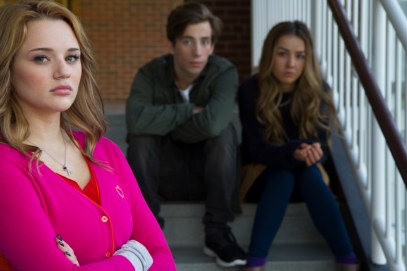
A documentary is being filmed at a high school that is being proclaimed as one of the top 10 in America. The documentary’s director (played by the director herself, Weber) finds an interesting angle after student Jessica Burns (Lexi Ainsworth) attempts suicide and rumors indicate that the harassment she received from popular girl Avery Keller (Hunter King) might be responsible.

The film constantly switches points of view by showing additional footage from time to time—footage recorded by Jessica, her best friend & video geek Brian (Bennett), and even Avery herself, as she’s asked by the director to show what her life is like. We learn that Avery has in fact harassed Jessica countless times in the halls and even through text messaging and email. Brian gave Jessica a secret camera hidden in a necklace (and he filmed some things with his own camera as well), because he felt this behavior had to be exposed somehow. We also learn that Jessica didn’t want it brought to light, because she thought things would only get worse rather than better. And more importantly, we see what Avery’s home life is like: she comes from a dysfunctional family with an overbearing mother who demands too much, and she tries to hide it as best as she can. And of course, when more and more rumors pile on about her part that led to Jessica’s attempted suicide, she’s in denial, claiming she couldn’t have done that much damage.

Anyone remember the 2012 documentary “Bully?” (You know, the one that caused that ridiculous MPAA rating controversy?) Anyone else think that should have been called “Bullied” instead? After all, it didn’t focus on any of the bullies; just the victims of bullying. What did the bullies go through in their lives? What caused them to inflict harm onto others? “A Girl Like Her” mercilessly shows a lot of the physical and verbal abuse perpetrated by Avery onto Jessica (and it’s pretty hard to watch—the movie doesn’t shy away from it, which is another honorable element to its success), but then in the last third, it pulls off an incredibly surprising trick: making us empathize with the bully too, as the gravity of the true hurt Avery caused comes crashing down on her, internally and externally. It leads to an ending that may be a little too immaculate, but it is very effective nonetheless and adds to the cautionary-tale aspect. And Hunter King portrays the part extraordinarily well in a final monologue that led to chills running down my spine.

“A Girl Like Her” is a powerful film with three winning performances (King, Ainsworth, and Bennett) and a careful examination about a problem still being faced today. Will it change the way things are? Probably not. But as I said before, it’s a real good attempt.