Archive | Three-and-a-Half Stars ***1/2 RSS feed for this section

Cop Car (2015)

3 Feb

copcar.jpg

Smith’s Verdict: ***1/2

Reviewed by Tanner Smith

Growing up, I didn’t always watch the greatest films. Most of them were straight-to-video family films you could rent at the local video store for a dollar. Most of them involved mischievous kids getting involved in something bigger than them and ultimately saving the day from ruthless (but mostly clumsy) baddies. As a child, I loved watching them because they showed me a world in which children can get away with anything and embark on risky adventures but still come out all right.

I also started to watch the R-rated “Stand By Me” when I was 9 years old (before I would watch it again and again and again), but not even that would’ve prepared me if I saw director Jon Watts’ “Cop Car” at a very young age.

“Cop Car” has a setup that sounds like one of the movies I used to watch way back in the day. Set in the deep South, two pre-teenage boys (played with natural ability by Hays Wellford and James Freedson-Jackson) are running away from home (for reasons never explained, so who cares?) and are walking along empty fields out in the middle of nowhere when they come across…a cop car. It’s a patrol unit abandoned out in the open, and they decide to hit it with a rock…then they decide to play inside it…then they realize that the keys are in it… And this leads to a fun joyride, as the boys drive along fields before taking it to the mostly-empty highway to drive faster. But meanwhile, the Sheriff (Kevin Bacon) wants his car back…

Sounds a bit trite, doesn’t it? Well, what if I told you that the Sheriff is a definite bad guy who disposes of a dead body from the trunk of the cop car? What if I told you there’s something sinister awaiting the boys once they find what’s left in the trunk? What if I told you this plot went from fun adventure to Cormac McCarthy territory, in which the situation becomes more bleak, lives are in jeopardy, and it’s unclear whether these little boys will get out of this alive?

And what if I told you that I loved the directions “Cop Car” kept taking?

This kid’s joyride story takes a dark, disturbing turn as the boys start playing with the artillery left in the backseat (with one of them looking down the barrel of a rifle when he thinks it isn’t working—yikes!), they discover something in the trunk that brings everything to a horrific situation (and with one of the most horrifying monologues I’ve ever heard in a movie—hide your pet guinea pig, kids), and the corrupt Sheriff does what he feels he must do in order to save his reputation and himself in this deadly game of cat-and-mouse. It’s a pulsepounding, suspenseful thrill ride that had me riveted right to the ambiguous conclusion.

We don’t know all the details involving the characters, such as why the boys are running away, who the Sheriff murdered, is the frightened but deadly Shea Whigham character (who shows up late in the proceedings) to be trusted in any other situation, and so on. We’re just put into this journey as the boys are walking and exchanging curse words before coming across the cop car, and off we go. By the time the film got really good, I didn’t care about details that were left out; I was simply involved, and all I knew was how unlikely it seemed that anyone was going to get out of this alive.

The kids feel like real kids. They’re rowdy little boys who think they’re much smarter than they actually are; they do very stupid things (like play with guns; at one point, one tries to shoot the other wearing a bulletproof vest). Because they feel real, the danger for them feels even more real, and that’s when we start to fear for them when they don’t even realize how much trouble they’re in.

Cop-Car.jpg

Kevin Bacon is a ton of fun in this role of the corrupt Sheriff. He’s menacing but also funny, particularly in the scenes in which he realizes his car is missing, he has to steal the only car around for miles, and he has to come up with numerous ways to keep dispatchers from noticing anything out of the ordinary (and it also doesn’t help for him that he’s not very smart either). He handles it with his usual Kevin Bacon charisma. But the charisma turns to terror, especially when he bluntly tells the boys, “YOU DON’T STEAL A COP CAR!”

The cinematography, by Matthew J. Lloyd and Larkin Sieple, is gorgeous, delivering a vibe that’s very much Terrence Malick-esque. As the boys are walking along these empty fields and surrounded by nothing but seemingly-endless country, I can’t help but feel the location.

“Cop Car” is darkly terrific and a great thrill ride. And it taught me to never steal a cop car, especially if it’s Kevin Bacon’s.

Man on the Moon (1999)

3 Feb

btzyafuzpmcvytzwgvgs.gif

Smith’s Verdict: ***1/2

Reviewed by Tanner Smith

It’s often said that humor is subjective—what one finds funny, another finds offensive and/or unforgivably stupid. The late entertainer Andy Kaufman knew this and kept alienating his audience in order to keep around the only people that understood his humor, as few as they may seem. He never liked to do things conventionally; he just liked to put on a show his own way. While some people would declare him a comic genius, others would refer to him as a crazed fool. “Man on the Moon,” the Andy Kaufman biopic created by director Milos Forman (“Amadeus”) and screenwriters Scott Alexander & Larry Kareszewski (“Ed Wood,” the Forman-directed “The People vs. Larry Flint”), is a wonderful film that illustrates the work of both the genius and the fool.

What aids the film throughout is not only the expert direction by Forman or the detailed script by Alexander & Kareszewski, but it’s the leading performance from Jim Carrey as Andy Kaufman that keeps it alive. From beginning to end, Carrey disappears into the role of the late Kaufman and gives a great sense of what the man must have gone through in life. We may not always know what he was thinking, as we are kept out of the loop during much of Kaufman’s extreme antics. But that works in the film’s favor, as we’re supposed to be left wondering what Kaufman is thinking. What’s important is Carrey has some idea as to what he’s thinking for the duration of the film.

For those who don’t know, Andy Kaufman became popular for a comedic character he portrayed in the TV series “Taxi”: a foreign oddball named Latka Gravas. He was also known for doing unpredictable things, such as reading the entirety of “The Great Gatsby” at a college presentation, wrestling women in front of live audiences (which led to a feud with wrestler Jerry Lawler for making a mockery out of wrestling), and other antics that ticked many people off. His practical jokes got to the point where, when it seemed he was dying of lung cancer, hardly anyone believed it when he was sick or even after he had died. (You could say the film even argues at the end that Kaufman is still alive.) His untimely death in 1984 caused people to think back to his career and the insane performances he created. Back in his heyday, his popularity was minimal; nowadays, he’s hailed as a comedic master.

“Man on the Moon” is a slightly fictional biopic that chronicles the highlights of Andy Kaufman’s career. It begins with one of the most innovative prologues I’ve ever seen in any biopic, in which Carrey as Kaufman, using his Latka imitation, berates the movie before it even begins and even starts rolling the end credits after having cut out the entire film, which he describes as “full of baloney.” (But it turns out to be a prank to get rid of audience members who wouldn’t understand Kaufman.) Many biopics don’t have the courage to acknowledge that they made up a lot of material for dramatic purposes; this one just flat-out opens by declaring it isn’t to be taken too seriously.

As the movie continues, we see Kaufman performing on-stage at local bars, meeting agent George Shapiro (Danny DeVito…strangely not reprising his role as Danny DeVito who co-starred with the actual Andy Kaufman in “Taxi” in real life), landing guest appearances on “Saturday Night Live,” getting a contract for “Taxi,” crafting a TV special that ABC executives turn down for being too different, and more. Oh, and there’s also Kaufman’s arch-nemesis: a loud, crass lounge singer named Tony Clifton. The less I say about him, the better…

The more we see of Kaufman’s performance on-stage with the public and off-stage with Shaprio, his writing partner (Paul Giamatti), and his lover (Courtney Love), the less we know about who Kaufman truly is. The best we can gather is that he’s a man who just wants to entertain people in his own ways, and it’s in the quieter moments of the film that we can figure that out, making the more outrageous moments even more telling. (I’ve seen this film about five times now, and I learn more from this character each time.)

Jim Carrey is this movie. He has the look and feel of Andy Kaufman, eerily so that I hardly see the actor in the performance. Carrey does tremendous work here, probably the best performance he’s ever given in a film. (Side-note: watch the Netflix documentary “Jim & Andy: The Great Beyond,” which features never-before-seen behind-the-scenes footage about the making of “Man on the Moon.” It shows how deeply Carrey wanted to inhabit the character he was playing. It’s almost psychopathic, the way he attempted method acting here.)

“Man on the Moon” has some pacing issues, particularly toward the final act which feels somewhat rushed, which is unfortunate as we should be feeling more for Kaufman’s plight after being diagnosed with terminal cancer and people wondering if it’s yet another performance art. But it makes up for that with a clever ending and a reveal that I won’t dare give away here. Overall, “Man on the Moon” is a fun (but also deep) film about an entertainer that wanted to entertain, no matter who was part of his audience.

Heavyweights (Revised Review)

26 Dec

BPF69H.jpg

Smith’s Verdict: ***1/2

Reviewed by Tanner Smith

Yep, it’s “Revised Review” time again! And I would say it’s “Guilty Pleasure” time again, except I hold no guilt in liking “Heavyweights” whatsoever. It’s one of my childhood favorites, and when I wrote my mixed review (saying I liked it until the end), I thought I was telling myself I had outgrown the silly humor, the clichéd plot, the overdone stereotypical characters, and the conventional sports-movie ending. But I should’ve told myself, “Come on! You enjoy many parts of this movie, you love watching it every once in awhile, and even the ending isn’t that bad. At least give it three stars for being something you like!”

It is true; I do enjoy watching “Heavyweights” every once in awhile. I loved it as a kid and watched it over and over and over again, so much so that I had most of it memorized by the time I realized the clichés and the stereotypes and whatnot. Because of that, I thought I wasn’t supposed to cut it too much slack as a film critic. How silly I was, because while “Heavyweights” does have those familiar elements to it, there’s an edge that makes them more enjoyable than in something like “The Mighty Ducks” (which featured some of the same actors and crew members three years earlier). (Maybe since-accomplished Judd Apatow, providing one of his first screenwriter credits in his career by co-writing this movie, had something to do with that edge.)

So, because of that, I’m giving it three-and-a-half stars instead of three, because I just like “Heavyweights” that much!

The main character of “Heavyweights” is an 11-year-old overweight boy named Gerry (Aaron Schwartz). His parents send him, against his wishes, to a fat camp called Camp Hope, which is advertised to make overweight boys lose weight and have fun in the process. Gerry is bummed about it until he makes friends with his cabinmates, including Josh (Shaun Weiss) and Roy (Kenan Thompson in one of his early roles, just before Nickelodeon’s “All That”), who are not serious about losing weight. (They even hide food in secret compartments in their cabin.)

But before the first day at camp is even over is when the trouble starts. The friendly owners of the camp (played by Anne Meara and Jerry Stiller—I dunno, are they wasted cameos?) announce that their positions are taken over by self-assured fitness guru Tony Perkis (Ben Stiller), who is determined to make the kids lose weight quickly. Why? So he can make a quick buck with an infomercial about weight loss. He makes life at camp a living hell for the kids, and so the kids fight back and take control of the camp and their lives.

From this point forward, I would like to issue a SPOILER ALERT! If you haven’t seen the movie before, check it out and then come back to read the rest of this review.

Everything builds up to an ultimate confrontation between Perkis and the kids (in which, in a neat little twist, Perkis’ parental issues come into play as he lashes out at the parents: “PARENTS! YOU’RE ALL THE CAUSE OF MY…THEIR PROBLEMS!”). But the movie continues with the kids earning their self-respect, going up against the athletic bullies from the camp across the lake (“Camp MVP”). This is what I complained about before, in my original review. But I really don’t have that much to complain about anymore. It’s dealt with quickly, isn’t boring, and it has its share of funny jokes here or there (such as when one of the jocks mistakes the Mona Lisa for Cher). Yeah, the big race is predictable. Yeah, the ultimate happy-ending is a bit much. But did I complain about the slow-clap at the end of one of my favorite movies, “Lucas”? No way. So why should I complain about this final act when, really, my problems with it are mere nitpicks?

This is what happens when a kid tries to become a serious film critic—he lets nitpicks of a silly, fun film get the better of him in a “serious review.”

“Heavyweights” is full of memorable, colorful characters, which is part of the reason I keep coming back to revisit the film. The kids are entertaining to watch and played by good comic actors, and the adults just have as much fun. Tom McGowen plays a good-natured counselor character named Pat, who is downgraded to janitor upon Perkis’ arrival because Perkis sees his weight as less of a motivator for the kids. Leah Lail is the attractive new nurse who becomes the apple of Pat’s eye; she doesn’t have as much to do as the rest of the cast in terms of humor, but she is likable enough. Paul Feig (yes, Paul Feig of “Freaks and Geeks” and “Bridesmaids” fame) scores a few laughs as a skinny counselor named Tim. And then there’s Ben Stiller as Tony Perkis and Tom Hodges as a buff, foreign counselor named Lars. Man, are these two lots of fun to watch—very funny and memorable at the same time. Stiller plays the part of Perkis with a few parts Fonzie and other parts Wayne from “Wayne’s World” and much original talent—a mixture that would fit him well for a similar role in “Dodgeball” nine years later. Even in the smallest comedic moments, such as when he jogs in the woods near his cabin, he’s wonderful. (“Come on, you devil log!” he exclaims as he stops to lift a log in his path.)

I mentioned that Judd Apatow, in the early stages of his career (which would lead to bigger and better things), is one of the writers of the film, and it actually makes sense. For what could have otherwise been a deplorable, standard summer-camp romp for Disney, Apatow gives the material a much-needed edge with a lot of witty one-liners, an awareness of itself, and colorful characters that don’t get dumbed down (for the most part). He and Paul Feig went on to create “Freaks and Geeks,” and honestly, I think I like “Heavyweights” almost as much as my favorite episodes of that series.

Yes, there are some things that are overdone. For example, there are some slapstick pratfalls that get more groans than laughs from me. And I guess it should bother me that the idea of satirizing the infomercial-weight-loss concept isn’t stretched out to its full potential (and accidentally treating the overweight kids as the problem, if you really think about it—none of the kids end up with serious pain as a result of the “system”). But I can’t sit here and let my original review of “Heavyweights” remain on smithsverdict.com without some redemption from me, a person that genuinely enjoys the movie and will probably watch it again now that I’ve talked about it some more. It even made it go out and buy the Blu-Ray, which has tons of bonus material about the making of the film, a commentary with cast & crew, an hour-and-a-half of deleted/extended scenes, and even more.

Any film that gets me excited about extensive bonus features on the Blu-Ray doesn’t deserve a mixed review.

Spider-Man: Homecoming (2017)

20 Nov

bg_spiderman.png

Smith’s Verdict: ***1/2

Reviewed by Tanner Smith

Before I review the latest movie about Spider-Man, I want to talk about a certain side element to it that really surprised and impressed me: Iron Man.

As you know, “Spider-Man: Homecoming” is part of the Marvel Cinematic Universe and a sequel to “Captain America: Civil War.” (Though, that was a sequel to “Captain America: The Winter Soldier”…which was a sequel to—you know what, forget it, most of you know the MCU’s continuity by now; I only meant “Civil War” was the introduction to Spider-Man.) If you recall, in that movie, Tony Stark aka Iron Man (Robert Downey Jr.) recruited a high-school boy, Peter Parker (Tom Holland), to assist in an emergency Avengers situation because the kid is secretly Spider-Man, a masked vigilante that is super-strong and has spider-like reflexes. In “Spider-Man: Homecoming,” Peter is excited for possible new opportunities to prove himself as an up-and-coming Avenger. But being a kid with huge ambitions, which only grow the longer he waits for a call back into action with the Avengers, can lead to him going in over his head on an ego trip. So who has to be his mentor and set him straight?

That’s right—Tony Stark. Why am I impressed by this? Because between “Iron Man” and “Civil War,” Stark has proved himself to be irresponsible, egotistical, unlikable, and even straight-up dumb in his decisions (telling a terrorist where he lives with no back-up plan, creating a device that could doom humanity while thinking it could save it, etc.). In “Civil War,” he felt the weight of what his deeds led to and wanted to assume responsibility for them. And he still makes mistakes and doesn’t always think straight, but you can tell he’s trying to be better—after all, the reason he became Iron Man in the first place was to do good! And now that this kid is reminding him of himself, he has an opportunity to teach him to be better. He even warns Peter at one crucial point, “Don’t do anything I would do.” This is a great development for Iron Man; one I’ve been waiting a long time for.

Oh right, I have a Spider-Man movie to review, don’t I? Don’t misunderstand; the Iron Man element is not the biggest thing to take away from it. It’s just a welcome addition to the MCU, a neat continuation of a sideplot in “Civil War,” and all-around awesome for a would-be Avenger getting advice from Iron Man! (Among Iron Man’s advice to Spider-Man, yet again bringing down Peter’s expectations to be an Avenger: “Couldn’t you just be a friendly, neighborhood Spider-Man?” Ouch.)

Now let’s talk about “Spider-Man: Homecoming.” As I said, in “Civil War,” 16-year-old Peter Parker was discovered by Tony Stark and brought on board as Spider-Man to assist in a fight between squabbling Avengers. (And this is recapped in a wonderful video-diary montage, with footage recorded by Peter, chronicling what we didn’t see leading up to the fight, his point of view of the fight, and what happened after the fight. I’m not gonna lie—if I was in that situation, I would document it too.) Since then, he can’t help but wonder when will be the next time he’ll get a call to fly around with Iron Man and hang out with Captain America and so on. Time goes on, and he’s stuck just performing good deeds around his neighborhood. But how much can he do and how long can he wait before he’s called to leave the city and save the universe? Well, he can try to balance out his ambitions and his classwork for a start, which is even harder than it sounds.

We get as much of Peter Parker’s high-school comedy/drama that we do of Spider-Man’s neighborhood crusades. So while Spidey is thwarting criminal deeds downtown and uncovering a sinister plot to use alien technology (left over from fragments of the infamous battle in “The Avengers”), Peter is preparing for the Academic Decathlon, letting his best friend Ned (Jacob Batalon) in on his secret, and working up the guts to ask his crush Liz (Laura Harrier) out to the Homecoming Dance. It sounds like a lot to juggle for a mainstream superhero film, but director Jon Watts (who also made the terrific “Cop Car”) and his team of screenwriters manage to intertwine the storylines well enough that we can believe Peter’s struggles in trying to maintain both identities as high-schooler Peter Parker and “your friendly neighborhood Spider-Man.”

And it’s also funny too. Peter and Ned have great chemistry and are a goofy duo to laugh at and with. Spider-Man has winning quips due to Peter’s chippy personality. And there’s also humor in how Spider-Man is in over his head—at one point, he catches a guy trying to break into his own car (oops).

“Spider-Man: Homecoming” also deserves credit for giving us a compelling, complicated, NOT-forgettable antagonist (thank God, I thought Loki was the best the MCU could offer). This is The Vulture (Michael Keaton), a criminal mastermind with a bone to pick with the government after his working-class duties were taken over, leading to him wanting to exact revenge. And thanks to leftover bits of alien tech (and some little gizmos from Avengers Headquarters as well), he’s able to create some deadly weapons and even a suit that allows him to fly, hence the name The Vulture. Spider-Man catches wind of some of these strange devices and meets The Vulture face-to-face, leading to him going on a desperate raid that’s more of a job for The Avengers to handle. It’s actually more complicated than what I just described, but to say any more would be spoiling certain details. But Michael Keaton is great in the role, charming and sinister when the occasion calls for either.

Overall, “Spider-Man: Homecoming” is more of a coming-of-age story, as it starts with Spider-Boy wanting to become Spider-Man. He may call himself Spider-Man already, but he’s still a kid with much growing up to do; something Iron Man tries to teach him. He has his abilities, but he also has impatience, doubt, awkwardness, and overwhelming desire, all of which he has to overcome in order to be the man he’s meant to be. This is something that I think is handled better in this version of “Spider-Man” than the other cinematic versions of the superhero. And Tom Holland does an excellent job at portraying the character going through all these changes—I enjoyed his likable performance in “Civil War,” and here, he’s even better.

Sony is back to teaming up with Marvel to gain co-possession of the Spider-Man character, and that makes me very nervous because of how quickly they’ve given up after major blunders such as “Spider-Man 3” and “The Amazing Spider-Man 2.” (I hope they have enough sense not to quit and reboot the film franchise yet again.) But “Spider-Man: Homecoming” is a very enjoyable movie. It works as a continuation of the MCU, it works as a Spider-Man movie, and overall, it works as a coming-of-age film, with just the right man to mentor the boy.

The Meyerowitz Stories (New and Selected) (2017)

20 Nov

meyerowitz-stories-2.jpg

Smith’s Verdict: ***1/2

Reviewed by Tanner Smith

In my review of Noah Baumbach’s “Margot at the Wedding,” I praised the film but I concluded by saying “I’m just glad I’m not Margot’s son.” I can say something similar about the Meyerowitzes in this review of Baumbach’s latest film “The Meyerowitz Stories,” subtitled “New and Selected”—something like, “I’m just glad these guys aren’t my problem.”

But my review of “The Meyerowitz Stories” is still positive. I don’t know how Baumbach is able to find the craft out of creating stories with such shallow, neurotic, sometimes despicable people, such as with “The Squid and the Whale,” “Greenberg,” and of course “Margot at the Wedding,” but I was getting used to his more simple, (mostly) gentler approaches with “Frances Ha,” “While We’re Young,” and “Mistress America.” But here he is back to form with the Netflix comedy-drama “The Meyerowitz Stories,” a film that takes the “fun” out of “dysfunctional family.”

Showing in a chronological series of vignettes featuring the same set of characters (hence, the titular “stories”), we have the Meyerowitzes, a family now in instability (actually, I think they’ve always been in instability). Retired-sculptor-turned-art-professor Harold Meyerowitz (Dustin Hoffman) and his fourth wife Maureen (Emma Thompson) want to sell the old New York apartment and move upstate. This is news to Harold’s oldest son Danny (Adam Sandler), who had hoped to crash at the apartment for a while after his 18-year-old daughter Eliza (Grace Van Patten) goes off to college. He’s recently divorced and his stay-at-home-dad status is changing, and to add more salt in the wound that can only be described as “underachieving dissatisfaction,” he’s a failed musician too. Danny and his clinically-depressed sister Jean (Elizabeth Marvel), who is even more pathetic than Danny in ways that are at the same time explained and unexplained as the film continues, were often in the shadow of their half-brother Matthew (Ben Stiller), Harold’s son from his second marriage. Matthew is the one with all the accomplishments, having gone into finance in LA rather than art in NY. That was probably a good move, because Harold and Danny often complain about their failures in art. Harold particularly, when he’s not boasting about Matthew’s successes, is not afraid to let everyone know about his own self-pity, going on about how he felt his sculptures deserved a wider audience.

Needless to say, these people need some serious help. Harold is an obsessive boor who lets out his arrogance on his family, Danny is pathetically seeking his affection, Matthew seems fine but has his own demons as well, and Jean, well…no comment. We gradually find out more about these people with each passing vignette (all of which are labeled by the character we switch focus to), and it’s mostly done with dialogue. And this is where Baumbach’s skill really shines: as an expert wordsmith who creates biting dialogue out of every uncomfortable situation he can find for his unstable characters. Sometimes it’s sharp and funny, sometimes it’s dark and deep, and mostly, it’s both, showing us there’s more beneath the surface. And he’s also effective in showing the dynamics of this family, particularly in the envy one member feels for another (from another generation) and how the oldest son is slowly but surely becoming like his father, whether he likes it or shouldn’t like it.

By the end of the film, we don’t know where these people are going, but we hope they’re going somewhere far better (and healthier) than they’ve been before.

But “The Meyerowitz Stories” isn’t so serious that you can’t get a laugh, because sometimes, the film is very funny. Dialogue aside, Baumbach finds ways to bitingly satirize both the modern-art and film-school scenes, with Harold’s lackluster art and Eliza’s amateur film projects that are so outrageous that I won’t even explain them in this review; they’re really funny.

Nearly every review is surprised by Adam Sandler’s excellent dramatic turn as Danny in this film, and while they’re not wrong, I never doubted Sandler’s skilled work as an actor…especially since he’s been able to show that in more than a few movies in between his Happy Madison productions. But whatever—Sandler’s great here, doing what he does best as an actor. Dustin Hoffman isn’t afraid to show just how insufferable Harold can be, as well as how feared and respected he can be. Ben Stiller, in his third Baumbach film, is solid as usual. Elizabeth Marvel is impressively messy. And young actress Grace Van Patten brings a new spark and much-needed energy to the proceedings.

I can enjoy “Margot at the Wedding” while thanking God that I don’t have to deal with miserable, excruciating Margot in real life, because the misery and humor made for tender insights and snappy comedy. And I can say the same thing about “The Meyerowitz Stories” and the Meyerowitzes. Baumbach’s material can be a little alienating in some of his films (which is probably why I’ve preferred his Greta Gerwig collaborations a little more), but I can’t deny the power he can deliver when treading through uncomfortable waters. “The Meyerowitz Stories” is effective without having us hate the characters too much.

Wonder (2017)

20 Nov

wonder-cur.png

Smith’s Verdict: ***1/2

Reviewed by Tanner Smith

When I saw “Wonder,” a film featuring a boy with a facial deformity, it was in a theater packed with parents and children. Seated in the row behind me were a mother and her children, who were probably around 7 or 8 years of age. The film had barely started when I overheard the children whisper loudly and repeatedly to their mother, “I don’t want to see what he looks like!” They were referring to the boy with the facial deformity whose face hadn’t been revealed yet. (I’m guessing they didn’t see any promos for the film…?)

Those kids are the exact group of children that need to see “Wonder.”

Stephen Chbosky’s “Wonder,” based on the novel of the same name by R.J. Palacio, does feature a troubled but brave 10-year-old boy with a genetic facial deformity as he attempts to tough it out in public school after being homeschooled for so many years. And some readers have probably stopped right there, because they think they know what kind of film this is—a manipulative, cloying melodrama that uses a physical handicap for exploitation and forced sentiment. But they’d be wrong, because not only is “Wonder” full of familiar elements now done fresh and original, but it also does something else very important that elevates it from the afterschool special that it could’ve been: it shows all that the boy affects around him. That makes the overall lesson we’re supposed to take from the film (that nobody is “ordinary”) all the more stronger. Everyone has their own issues, no matter what their physical differences.

August “Auggie” Pullman (Jacob Tremblay) has undergone 17 operations in his 10 years of life, and his face still alarms everyone around him. His mother (Julia Roberts) decides it’s finally time for him to attend public school, while his father (Owen Wilson) isn’t so sure. They both love their son and want what’s best for him—he’s afraid the other kids will mock or be feared by him; she feels he has to adjust to the outside world more regularly; they’re both understandable in their reasoning. Nonetheless, Auggie begins the fifth grade and is given the looks and the mocking by his fellow classmates, until he slowly but surely starts to adjust and make friends.

Typical, yes. But “Wonder” switches focus from time to time, giving us insight into other characters. We see what goes through the mind of Auggie’s older sister Via (Izabela Vidovic), as she wishes just once that her parents would ask about her day. She loves her brother but silently resents the spotlight that’s always been given to him. And their parents are loving and trying their hardest to be there for both of them; they just don’t always notice when their daughter needs them.

And then we wonder (forgive the pun) about Via’s former best friend Miranda (Danielle Rose Russell), who neglects her after a summer away. We see why there’s this change in her, and suddenly we’re feeling for her.

And then there’s Auggie’s friend at school, Jack Will (Noah Jupe). When something unexpected comes up, we see his point of view and feel for him too.

All of these detours help make “Wonder” even stronger when we realize the full story surrounding Auggie, who at one point has to be reminded that not everything is about him and everyone else is going through hard stuff as well. It’s more than welcome to see the perspectives of those surrounding Auggie as well as Auggie. It’s a very effective way of presenting to the audience that no one person is just “ordinary.”

Appealing characters is only aided by solid acting, and the cast as a whole is terrific. Little Jacob Tremblay continues his string of winning performances, showing that his breakthrough role in 2015’s “Room” was no fluke. And once you see past the odd disfigurement (done with convincing makeup work), you see the genuine sweetness within this character. Julia Roberts delivers her best work in years, playing a genuinely sweet (and thankfully knowing, unlike most naïve parental characters in movies of this sort) mother who tries to be there for both her children. Owen Wilson plays an endearing dad. Other adult actors such as Daveed Diggs as a teacher and Mandy Patinkin as the principal are solid. And all the other young actors, particularly Izabela Vidovic, are very impressive.

My only problems with the film come near the final half. The big final moment is handled well, with of course a big speech and a standing ovation (it earns it), but a couple moments leading up to it feel forced. One involves a meeting between the principal and a bully’s parents (painful), and the other involves a fight followed by a silent moment on a beach (overly whimsical). Also, there are a few lines of dialogue that spell out all the lessons we’re supposed to take from the film, way before the final speech already does it well enough and we get the point by then. “Don’t blend in when you’re made to stand out.” “Between what’s right and what’s kind, do what’s kind.” And a couple more I noticed.

But overall, “Wonder” works “wonders.” (Forgive that pun also—or use it as an article headline.) By the time it ends, you feel that Auggie is going through a positive change in his life and will continue with it through junior high, high school, college, and ultimately adulthood. And you also feel that his friends and his family are going through the same change. Maybe the film will be powerful enough to teach it to the aforementioned children in the audience who saw it along with me.

Alpha Dog (2007)

19 Sep

Alpha-Dog-Gallery-8

Smith’s Verdict: ***1/2

Reviewed by Tanner Smith

SPOILER WARNING! (Though it’s based on a true story.)

Most criminals don’t know what they’re doing half the time. Most of them are just kids trying to act tougher than they are. And even if they think they’re unstoppable, they’re too arrogant to recognize that this lifestyle has to end. We’ve learned this lesson in movies before, but there’s still something about Nick Cassavetes’ gritty crime drama “Alpha Dog” that speaks volumes in how unsettling and unforgiving it is in its portrayal of this kind of lifestyle.

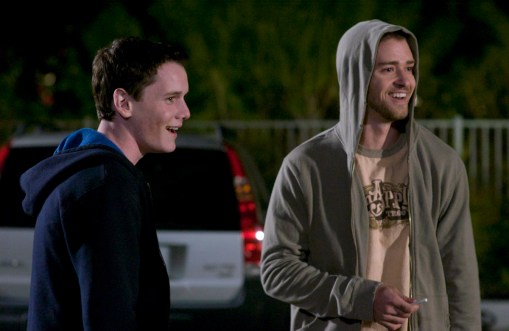
Based on the kidnapping/murder of 15-year-old Nicholas Markowitz (though with each name altered for the film), “Alpha Dog” takes place in the late 1990s and focusing on young drug dealer Johnny Truelove (Emile Hirsch, playing a fictional version of real-life Jesse James Hollywood) and his crew, which includes Frankie (Justin Timberlake), Elvis (Shawn Hatosy), and many other young people in it for the money and the drugs (and the guns). One of Johnny’s customers, an addict named Jake Mazursky (Ben Foster), owes him money, which leads to conflict. That conflict leads to the kidnapping of Jake’s 15-year-old brother Zack (Anton Yelchin, playing a fictional version of Nick Markowitz).

Zack, who is tired of the constant suffocating by his loving but overbearing mother (Sharon Stone), doesn’t realize the trouble he’s in; in fact, he actually adapts to his surroundings and doesn’t even try to escape his captors. “I’m just gonna ride it out,” he tells Frankie who becomes his friend, “and see what happens.” Soon enough, more friends are involved in this abduction, including two girls who are turned on by Zack’s situation and his innocent reaction to it all. (“Stolen boy,” one of the girls, played by Amanda Seyfried, declares him.) Zack has a good time—he hangs out with Johnny’s crew, he drinks and does drugs, he has a sexual awakening with the girls, and he basically has the time of his life. But as Johnny realizes the gravity of what he put himself and his crew into by taking this boy, he also realizes the kid may have to be silenced for good in order to avoid jail time.

When you’re young, you feel like you’re indestructible. It’s not until you learn a very harsh life lesson when you understand what you put yourself into and how easily you can be corrupted. Frankie, Elvis and co. think they can get away with anything if they follow the right leader. Unfortunately, that leader happens to be Johnny, who himself has no idea where he’s headed and mostly reacts in anger and fear. They think they’re big-time gangsters and, in a group, they perform violent actions, but the tragic thing about it, when all is said and done, they’re all a bunch of scared kids who make dumb decision after bad decision until they all end up in a world of hurt. Cassavetes successfully (and in an unflinching way) captures that side of this arrogance where real-world consequences seem to elude them until it’s too late.

And then you have Zack, who sort of idolizes these (slightly-) older people, particularly his older brother who is constantly stoned and/or coked out (but also filled with rage). But this is a good kid who is impressionable and corrupted by this lifestyle, blinded from the truth and trapped in a situation he didn’t expect. It leads to the inevitable climactic moment in which Frankie has to assure Zack that everything’s going to be OK for him…when it really isn’t. It’s a powerfully frightening scene that keeps the tension alive even though we know what’s going to happen. And it’s even sadder that this kid learns the hard way what this lifestyle is all about: self-perseverance.

The acting is across-the-board solid. Anton Yelchin is perfect in the role of the innocent caught in a world of both bliss and corruption. Emile Hirsch captures both the ego and the cowardice of this “mastermind” who, it turns out, has nothing under control. Justin Timberlake had many other times to shine in the acting spotlight, such as “The Social Network” just a few years after this film’s release, but this was the film and the performance, as jokester/confidant Frankie, that first showed us there was something more to this guy than popular music. Another performance I want to single out is Sharon Stone as Zack’s mother—her final scene, a mock interview, is definitely among Stone’s finest moments as an actress.

Some parts of “Alpha Dog” can be a little too simple, particularly in the conventional lines of dialogue between the captors talking it out and the victim’s searchers concerns. And I didn’t quite see the point in singling out every “witness” (with subtitles) as they arrive throughout the film. But overall, I can’t deny the power of Cassavetes’ portrayal of such an ugly side of youth in America. And that portrayal concludes with a punch to the gut.

Juno (2007)

11 Sep

juno-ss2

Smith’s Verdict: ***1/2

Reviewed by Tanner Smith

Hard to believe it was almost ten years ago when Jason Reitman & Diablo Cody’s “Juno” took the world by storm, becoming that little indie high-school-drama film that beat the odds, received just as much acclaim from audiences as critics, and even receiving three pivotal Oscar nominations (Best Picture, Best Director, Best Actress) and a win (Best Original Screenplay)… Actually, on top of that, it’s hard to believe it was this film that received the attention I think should have been received by other, more superior films of the sort. Films like “The Spectacular Now,” “The Perks of Being a Wallflower,” or even “Sing Street.”

But it was “Juno” that received the attention, probably more than it deserved. And with that came the inevitable backlash, with people being overhyped/oversold on how “groundbreaking” this film was when it was released (or since then). But a good portion of said-backlash…came from people who were among the cult that made it popular to begin with. Repeated viewings can either increase or decrease viewers’ perceptions of a film, and with “Juno,” it seemed to decrease for people who couldn’t help but notice things about it that annoyed them—things that were there from the beginning.

Now, it’s 10 years later, and we look back on “Juno” with either fond memories or annoyed groans. As for me, even though I feel the film is somewhat overrated (and there are some things to groan about), I’d be lying if I said I didn’t enjoy watching it every now and then as a legitimately good (not great) film.

For those who missed the Juno-craze, “Juno” follows 16-year-old high-school junior Juno MacGuff (a star-making turn by Ellen Page, nominated for Best Actress) when she unexpectedly becomes pregnant, decides to have the baby and give it up for adoption, and endures the ups and downs that follow. We follow her through the important moments of the pregnancy—telling people including her boyfriend and her parents, meeting the would-be adoptive parents, establishing a connection with them, bulging out, getting dirty looks and remarks, and of course, as a teenager in an adult situation, learning some things about herself and about life.

The scene that sold the movie for audiences is the scene midway through, in which Juno and her best friend Leah (played with ditzy appeal by Olivia Thirlby) sit down with Juno’s father Mac (J.K. Simmons, always great) and stepmother Bren (Allison Janney, delightful in everything she’s in) to reveal Juno is pregnant. In any other film, the parental characters’ reaction would be along the lines of heartbroken cries or screams (melodramatic but undeniably real). But in this film, it’s a different kind of heartbreak—shock and disappointment—and it’s followed by a calm, rational discussion about what to do next. This was such a relief to people who were tired of the typical parental reply to a situation like teenage pregnancy. Others were confused about it, wondering if these parents were underreacting to something that should be treated as a big deal. I think Mac and Bren do see it as a big deal and you can see the surprise on their faces (Mac even says he was hoping for Juno to face expulsion from school rather than pregnancy); but I also think they know Juno is going through enough with the situation already that she doesn’t need them to make it worse by yelling at her.

The film is full of unusually calm, quiet moments like that. One of my favorites is when Juno tells the boy with whom she had sex once, Paulie Bleeker (Michael Cera), that he is the father. This is a nice, timid boy (the type of character you don’t see in many high-school movies…except for “Superbad,” which Cera starred in a few months prior to this film’s release), and you can tell that the moment he first appears on-screen. The look on his face when Juno announces she’s pregnant is priceless—and thankfully, he doesn’t ask if she’s sure he’s the father. Instead, he simply asks, “What should we do?”

After Juno considers abortion and backs out just as soon as she enters the clinic’s waiting room, she decides to have the baby and give it up for adoption. She comes across a wealthy yuppie couple, Vanessa (Jennifer Garner) and Mark (Jason Bateman), and feels the couple is right for the baby…well, right for her, actually—Vanessa desperately wants to be a mother and Mark seems like a really cool person (he plays guitar and has decent taste in music), so why not? As time goes on, she visits them and gives them updates, while making somewhat of a connection with Mark (almost too uncomfortable, but it’s PG-13, so don’t expect something extreme).

During all of this, Juno learns from her loved ones (Mac, Bren, Paulie) just how difficult the adult life can be, in making tough decisions and especially in relationships. Being a teenager who is growing up so fast due to this experience and not realizing how big of a deal this is, she learns things she didn’t want to learn before, especially about herself, and as a result, she comes of age. This is what truly makes the film special. You do see a change in her when the third act reveals some heavy truths about which Juno has to ponder. And this is a teenager who acts like a hipster in terms of her tastes in music and movies, tries to act cool, thinks she’s better than most people and things, and has an acid tongue. She can even be unlikeable at times, particularly when she stops paying attention to Paulie, who wants to be there for her—at one point, when Juno chews him out after she finds out Paulie is dating someone else, that’s when Paulie finally reveals how hurt he is by being ignored. But it comes from a place of understanding why she would feel the way she feels—being a teen who is growing up too fast, she’s confused and scared, even if she won’t admit it. Juno learns truths she didn’t expect, didn’t see coming, didn’t want to accept…and by the end, she becomes a better person who will enjoy the rest of her pleasant teenage years before making tougher decisions as an adult.

Let’s talk about the dialogue. This is another major issue some people have with the film—Diablo Cody’s screenplay is laced with snappy, witty dialogue that is so quick, so uncommon, so…not like anyone’s ever heard in a movie before. Let me list a few here:

  • “Honest to blog?”
  • “I am forshizz up the spout.”
  • “Phuket, Thailand!” (used as an exclamation)
  • “Thanks a heap, coyote ugly. This cactus stings even worse than your abandonment.”
  • “So what’s the prognosis, Fertile Myrtle? Minus or plus?”
  • “Paulie Bleeker is totally boss.”

And my personal favorite, from a one-scene cameo by Rainn Wilson as a general-store clerk who sells Juno three pregnancy tests:

  • “This is one doodle that can’t be un-did, home-skillet.”

There are even more sassy lines like that, much of which are said in Juno’s constant voiceover monologues. It’s overdone and somewhat dated that it “captured the voice of a generation” (I remember some peers saying stuff like that—I was 15 when the film came out), but it is the key to the film’s humor and much of it did make me at least snicker (more so than the hipster-vocal soundtrack which also scatters throughout the film). Do I think it deserves the Oscar for Best Original Screenplay? Well, it is distinct in its dialogue and characters’ behaviors, so the win is seen as an appreciation for creativity in a situation we’ve all seen in other movies. (Though, personally, I would’ve voted for “Ratatouille”—the closing monologues given in that lovely animated film were more beautiful than anything else written for any other film released in 2007.)

While it is unfortunate that people still see Ellen Page as Juno nowadays (meaning she needs to make an even more memorable turn in future projects), even though she’s been in many other movies since her breakthrough, I can’t deny the good work she puts in the performance. She’s always watchable and fun to listen to as she spouts out a lot of Diablo-isms from the script. But more importantly, when she does get hurt, you can feel the pain—that’s the key to this performance, that she’s able to mask her true emotions with abrasiveness, and it’s completely credible.

But the supporting cast can’t escape praise. Michael Cera has been typecast like crazy since “Juno” and “Superbad” (which makes his crazy cameo as himself in “This is the End” all the more hilarious), but I can’t deny that the roles he became famous for were made so because he’s just so damn likable. J.K. Simmons and Allison Janney are among the best pair of parents I’ve seen in movies about teenagers—I’ve seen movies with parents that try to be “hip” and “with it” (“Mean Girls” even made fun of that trope to perfection), while these parents feel more “real” and respectful than any of those. Jennifer Garner shows more than what her introduction as an OCD yuppie would like us to believe and she has a truly shining moment in which she feels the baby’s kick beneath Juno’s belly. And this is truly among the best of Jason Bateman’s work (right up there with his performance in 2015’s “The Gift”), as he plays a character that eventually can’t deny to Juno or Vanessa that he’s not ready for the adult world, even though he himself is an adult.

So I guess I’m not one of those people who found reasons to dislike “Juno,” but I’m not one of those people who praise it to high heaven either (I’m not sure I can find many who still can to this day either). Parts of it do annoy me, but the strengths of the narrative and characters outweigh the weaknesses. And even the parts that annoy me could also be seen as funny due to how dated they are. Richard Roeper announced on his show “Ebert & Roeper” in December 2007, “Small flaws be damned, I have to say it—I LOVED, LOVED this movie!” I think I would just state in this blog in September 2017, “I see the film’s appeal and recognize the flaws, but I do particularly care for the film and will even watch it once or twice a year.” How’s that for praise?
Annie Hall (1977)

23 Jun

annie-hall-watching-recommendation-videoSixteenByNineJumbo1600-v4

Smith’s Verdict: ***1/2

Reviewed by Tanner Smith

Let’s address the elephant in the room first: Woody Allen’s “Annie Hall” won the Best Picture Oscar instead of “Star Wars.” There’s not much I can add to that, so let’s move on.

Well…maybe there is. I’m not going to act like I can’t understand why “Annie Hall” took home the award instead of the ever-popular “Star Wars” (which is one of my favorite films, so calm down). “Annie Hall” was more than just a typical romantic comedy. Hell, it was the 1970s, when typical romantic comedies were the rarity until the 1990s, when “When Harry Met Sally” set a new standard in 1989…thus resulting in the “typical romantic comedies” I can think of, now that I think about it…

Where was I going with this? Oh yes, “Annie Hall.” It was more than just pure comedy. Sure, there are funny lines of dialogue and many unusual comedic sketches (such as a cartoon sequence, fantasy journeys through time and daydreams, and constant breaking of the fourth wall), but considering all of it as the mindset of the narrator, Alvy Singer, played by writer-director Woody Allen, the film is more than a comedy and more like a bitter exploration into his psyche. In that respect, while “Star Wars” was the most fantastic, inventive and fun movie of 1977, “Annie Hall” might have been the smartest and most insightful.

“Annie Hall” represents the pure use of comedy I admire—if done well, comedy can allow audiences to get a real feel for the characters. Comedy can set you up and draw you in, and before you know it, you’re learning more about the characters and also learning from them as well.

If it wasn’t clear from Woody Allen’s films prior to this (“Take the Money and Run,” “Bananas”), Allen is a sad, sad man. The questions he has about life lead to a non-stop pursuit of answers, he has a very low opinion on many aspects of life and existence, and it’s probably fair to say that his therapy in getting through life is by creating characters to live through and writing jokes; first for standup, then for cinema. (Allen has since made quite a few dramatic films later in life, and while jokes may not be a primary focus in them, the way he lives through his characters certainly is.) With “Annie Hall,” written and directed by Allen, the public got a pretty clear picture of Allen’s personality and how close his character of Alvy Singer is to the actual Allen.

Alvy, a comedian, has a very low opinion of himself. As the film opens, he addresses the camera with a couple jokes—one about how short and pointless life can seem and another which is attributed to Groucho Marx: “I would never want to belong to any group that would have someone like me for a member.” All uphill from here, eh?

The film is essentially Alvy’s recollection of previous relationships with women, particularly the one he had the most fondness for: Annie Hall (played by a fabulous Diane Keaton, who won an Oscar for the role). He tries to understand why he and Annie broke up a year ago, and we take this journey inside his head, figuratively speaking, experiencing memories and fantasies (all in non-linear fashion, by the way). We even see the source of his melancholy at a very young age, when he read as a child that “the universe is expanding” and often questioned his mother about the point of existence.

Alvy recalls many pleasant times with Annie, more so than with his first wife (Carol Kane), who disagreed with him about his thoughts on the JFK assassination (maybe Allen felt better when he saw Oliver Stone’s “JFK”), or his second wife (Janet Margolin), a writer who was unable to get an orgasm. Annie talked a little differently (“la-de-da, la-de-da, la-la, yeah”) and dressed a little differently (with a wardrobe that started a trend for a little while after this film’s release), but they shared many fun times with her: frantically trying to cook lobsters, making fun of men from her past, among other things. She feels a loving connection between the two of them, but when the two of them move in together, that’s when things start to get a little tense, leading to their breakup.

But it doesn’t stop there. From that point on, Alvy has bad dating experiences (and bad sex), he’s unsure of what to do with his career, and when Annie calls for him in the middle of the night, it’s to get him to kill a spider (“a spider the size of a Buick”).

Sometimes, the journey through Allen’s (er, sorry—Alvy’s) psyche takes detours. I’m not sure why they’re there, but I find them simply hilarious. For example, Alvy and Annie are standing in line at a movie theater and Alvy is very annoyed by the guy standing behind him and telling his friend about the works of Fellini and McLuhan and his opinion on them. What does Alvy do? He brings in McLuhan himself to talk down to the man, saying “You know nothing of my work!” Why is this there? I don’t know—maybe just to appease Allen’s annoyance of people who try to act smarter than they are, but it’s got nothing to with Annie, other than…she was there.

But then again, maybe this was never really about Annie after all. Maybe this was all just a way of making Alvy feel better about himself. That would also explain the scene in which he revisits his first-grade classroom (with 6-year-old Alvy there as well) and all his old classmates state what kind of adults they became. (“I’m into leather,” a girl states.) Is this a way of Alvy thinking to himself that he could’ve had a worse journey in life than ending up as a comedian? A way of making himself feel better? Could be.

“Annie Hall” is also somewhat of a love letter to living in New York City (something Allen recaptured in the arguably-better “Manhattan” two years later) as opposed to Los Angeles, where Alvy and Annie visit in the final half-hour of this hour-and-a-half film. L.A. doesn’t look very good here, and I think what Allen was trying to say was people in New York City think too much and people in L.A. think very little. Ouch. No wonder Woody Allen never attends the Oscars in Hollywood, despite his numerous wins and nominations for his screenwriting.

Basically, “Annie Hall” is all about Woody Allen. It’s his vision, his dialogue, his persona, his representation of how he feels about love and life in general. And amidst all the talk about how embittered he is about a lot of things and how unsure he is about himself (to the point where he can’t let good things be as good as they should be), there is a lesson to be learned by the end of “Annie Hall”: relationships can be painful, but they’re also worth the pain. He’s not telling us how to feel; he’s telling us how he feels. And maybe we can learn something from him in the process.

Dawn of the Planet of the Apes (2014)

23 Jun

pota2.jpg

Smith’s Verdict: ***1/2

Reviewed by Tanner Smith

Summer 2011: “Rise of the Planet of the Apes” is released to theaters. I decide not to see it. “Really? What’s the point? We all know how it’s going to end.”

Spring 2012: I catch “Rise of the Planet of the Apes” on one of the satellite movie channels. To my surprise, it’s pretty good. I write my three-star review, stating one major problem I had with it: the ending. I write that the story grinds to a halt, obviously setting up for a sequel. “I guess the origin story isn’t enough to set up the events in the previous movies,” I wrote. (Though, in hindsight, isn’t it deliciously ironic to see a film where man’s defeat is the happy ending?)

Summer 2014: No, the origin story is not enough to set up the events in the other “Planet of the Apes” movies, for now we have “Dawn of the Planet of the Apes.” Let’s see how this one turns out… Well, that was one of the best sequels I’ve ever seen. I did not expect that…

“Dawn of the Planet of the Apes” is the seventh entry in the “Planet of the Apes” film series. (Actually, it’s the eighth, but who wants to acknowledge the 2001 Tim Burton re-imagining?) Frankly, I think it’s the best in the series by far. It’s a solid sci-fi action film, but it also works effectively in its dramatic and allegorical elements.

The film is set a decade or so after “Rise of the Planet of the Apes” left off, when a virus plagued humankind, leaving much to ruin. A band of humans lives as one in San Francisco and an ape colony lives in the nearby woods. The apes, now more advanced than before, are led by Caesar (again played with stellar motion-capture performance work by Andy Serkis), who recalls the good in humanity more than most of his followers who were caged and horribly treated by their human captors. None of the apes have seen a single trace of humans until one day, when a small group of the San Francisco survivors enter the woods unexpectedly. They attempted to pass through to restore the power grid. Caesar has learned to speak, and so the group’s leader, Malcolm (Jason Clarke), reasons with him for help. But the mutual cooperation unfortunately doesn’t last long, as members of both man and ape clash, leading to the beginning of inevitable war.

The allegories of hatred and prejudice are done quite well in “Dawn of the Planet of the Apes” without getting preachy or too heavy-handed. There are blunt points that are made, but for the most part, it’s handled efficiently with visuals, interaction, and just the right amount of dialogue that helps get the point across. It makes for an intruging tragedy amongst the blockbuster-expected explosions and gunfire. And what helps even further is the characterizations of both the humans and the apes—the personalities that get the most focus are fleshed out. There are some humans and apes that see a mutual connection—they include Malcolm, Caesar, a nurse named Ellie (Keri Russell), Malcolm’s son Alexander (Kodi-Smit McPhee), and a wise orangutan named Maurice. (I’m not gonna lie—Maurice stole my heart.) But there are many of the other human survivors and many of the other apes who share a mutual hatred for each other and would like nothing more to see them exterminated if only for their own selfish desires of annihilation. The humans that represent it are Dreyfus (Gary Oldman) and Carver (Kirk Acevedo), and the ape that stands for warfare is Kobo, who often butts heads with Caesar, who tries to keep peace by keeping humans and apes separate in the beginning. But tragically, despite the sincere efforts of Malcolm, hatred breaks free and everything starts going to hell. The parallels of human and ape are effectively done and help make this allegorical tale even more powerful.

Andy Serkis is once-again outstanding as Caesar, hands-down the best, most compelling character in the whole “Planet of the Apes” series. He’ll always be known as the king of the CGI/human blend of acting, and someone at the Academy should give the man a special Oscar for his work. With his work in “Lord of the Rings,” “King Kong,” and now the “Planet of the Apes” reboots, I’d say he’s due for Academy recognition. Exaggeration, you may say? I don’t think so.

Director Matt Reeves (who is also making the upcoming sequel, “War for the Planet of the Apes”) does a great job with the action and gives the audience what they crave in a summer movie, such as a lengthy battle sequence on the streets of San Francisco. But he’s also very efficient in the quieter moments, particularly in the first 15+ minutes, which show the home life of Caesar and the rest of the apes.

“Dawn of the Planet of the Apes” did something I didn’t expect it to do: it made me anticipate the next “Planet of the Apes” movie. Will “War for the Planet of the Apes” be just as good if not better? I don’t know, but I’m willing to find out. If there’s anything I’ve learned from “Rise of the Planet of the Apes,” it’s not to be cynical about a continuing reboot that comes my way.